Citations audited 2026-08-01 — 🟢 clean
Zero Wikipedia cites, zero dead links, zero soft sources. Brennan Center, NBER, National Research Council, ProPublica — and the opposition is stated at full strength before rebuttal. This note is the model. Reachability verified; individual claims not yet matched line-by-line against sources. → Citation Audit
Thesis / Core Claim
Info
One clear sentence that captures your main idea.
CORE CLAIM
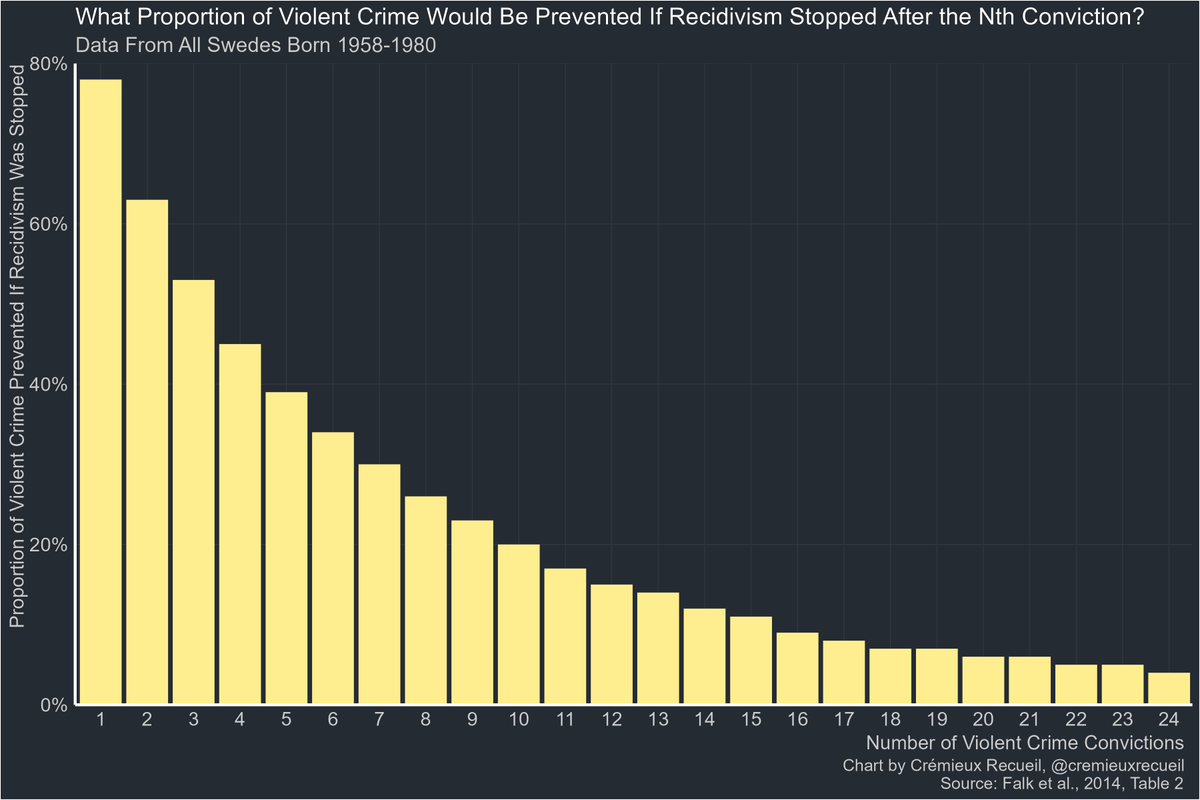
Crime would significantly decrease if individuals with three or more felony convictions were no longer allowed repeated reentry into society without demonstrating verifiable reform. Current lenient policies—driven by progressive district attorneys, bail reform, and parole mismanagement—allow habitual offenders to reoffend, endangering communities and undermining public trust in justice. A stricter, evidence-based system of permanent containment or highly supervised rehabilitation for chronic offenders is necessary to protect public safety.
Supporting Points (Rule of 3)
1. Bail and Early-Release Policies Enable Violent Recidivism
Expanded Argument:
Modern bail reform, designed to address economic inequality, has in practice removed critical safeguards that kept repeat violent offenders detained. The shift toward “risk-based” and “zero-dollar bail” systems—implemented in states like New York (2020), New Jersey (2017), and Illinois (2023)—has allowed dangerous individuals to repeatedly cycle in and out of custody. While reform advocates cite fairness, the real-world outcomes reveal alarming recidivism among offenders with extensive criminal histories.
Evidence:
- A Yolo County, California study found that suspects released under zero-dollar bail were twice as likely to be rearrested for felony crimes and three times as likely to be rearrested for violent crimes compared to those who posted bail. District Attorney Jeff Reisig warned that automatic release “allowed dangerous individuals to commit murders and domestic-violence offenses.”
- Darrell Brooks, released on just $1,000 bail after running over his girlfriend, went on to kill six people at the Waukesha Christmas parade in 2021. He had a 20-year record of violent crime, weapons charges, and domestic assault—yet was repeatedly released by courts prioritizing leniency over risk assessment.
- Ronald Wayne James, a Texas offender with 29 felony convictions and 60 arrests, was granted a personal recognizance bond despite local rules barring such release for violent assault. He was later arrested for stabbing a man to death at a Houston Popeyes.
- Austin Collette, another Houston case, was out on bond after pleading guilty to murder. He violated his release terms repeatedly but remained free; weeks later, he murdered his girlfriend before killing himself.
Analogy / Story:
Imagine a revolving door at a courthouse—each time it spins, another repeat felon walks free. Instead of serving as a filter for risk, bail reform has become a turnstile, spinning without accountability while citizens pay the price in blood.
2. Progressive Prosecutors and Soft Sentencing Undermine Deterrence
Expanded Argument:
Elected “progressive prosecutors” in major U.S. cities have dramatically changed charging and sentencing practices under the guise of reform. By raising felony thresholds, declining to prosecute “nonviolent” crimes, and avoiding sentence enhancements, they’ve reduced deterrence and created an environment where repeat offenders perceive minimal consequences for criminal behavior.
Evidence:
- Kim Foxx (Cook County, Chicago) raised the felony theft threshold from $300 to $1,000, effectively decriminalizing many forms of organized retail theft. Her office also reduced jail populations by 30% and average sentence lengths by 46%, citing social equity concerns. But Chicago police officers report that the same individuals are now being arrested dozens of times with little to no jail time.
- Larry Krasner (Philadelphia) eliminated cash bail for many offenses and declined to prosecute numerous low-level crimes. The result was a significant drop in convictions and, according to police unions, a rise in violent crime committed by offenders who previously would have been detained.
- Alexander Dickey of South Carolina, with 39 arrests and 25 felonies, received only 411 days in prison after pleading guilty to burglary, and his probation was later shortened for “good behavior.” In 2025, he murdered 22-year-old Logan Federico—a preventable tragedy that even the state’s lieutenant governor said “should never have happened.”
- Radee Prince, with 42 arrests and 15 felony convictions, repeatedly avoided long sentences because of plea deals and dismissals. In 2017, he shot five co-workers at a Maryland office park, killing three. Police later confirmed his record should have disqualified him from freedom years earlier.
Analogy / Story:
If justice is a fortress meant to protect the innocent, progressive DAs are removing bricks in the name of compassion. They call it reform—but the walls are collapsing, and criminals know they can walk through the rubble unchallenged.
3. Parole and Probation Systems Are Overwhelmed, Allowing Dangerous Offenders to Slip Through
Expanded Argument:
America’s parole and probation infrastructure is critically overstretched and under-supervised. Lax oversight, bureaucratic overload, and lenient time-credit systems have transformed parole from a privilege earned through reform into a conveyor belt for repeat offenders. States have widened parole eligibility to cut costs and manage overcrowded prisons, but the lack of oversight has proven deadly.
Evidence:
- In Alabama, each parole officer is responsible for supervising an average of 198 offenders. Jimmy Spencer, a career criminal with decades of burglaries, was released despite being unrehabilitated. He went on to murder three people, including a 7-year-old boy.
- In Ohio, Brian Golsby, a convicted sex offender paroled early despite multiple violations, kidnapped and murdered college student Reagan Tokes. His GPS tracker wasn’t even monitored in real time.
- Bryan Keith Hall (California) had at least 10 felony convictions for home invasion, drugs, and assault. After being released early, he murdered a parole officer in 2025, prompting national outrage and a renewed call for stricter supervision standards.
- The U.K.’s probation system provides an international warning: between 2010 and 2022, offenders on probation committed 3,540 serious crimes, including 762 murders and 220 attempted murders. The pattern of unchecked release and insufficient oversight mirrors U.S. failures.
Analogy / Story:
Parole boards now function like overworked doctors signing off discharges without reviewing patient charts. Dangerous men with long histories are sent back into communities under the illusion of “supervision,” only for headlines to later reveal the predictable: someone is dead, and the system “missed the signs.”
4. Reform Parole and Probation Oversight
Core Idea:
Rebuild parole and probation systems as public-safety networks, not bureaucratic relief valves. Supervision should be selective, data-driven, and properly resourced.
Policy Details:
- Cap parole officer caseloads at no more than 50 offenders per officer, ensuring meaningful supervision.
- Introduce mandatory GPS monitoring for high-risk parolees with violent felony histories.
- Expand real-time monitoring technology integrated with law enforcement databases, flagging curfew violations or restricted-zone entries instantly.
- Establish “earned parole” metrics—release contingent on verified milestones (education, therapy, employment)—not merely time served.
- Tie funding incentives to recidivism reductions, rewarding departments that cut violent parole reoffenses by measurable percentages annually.
Rationale:
Cases like those of Brian Golsby (Ohio) and Jimmy Spencer (Alabama) show that parole failures stem not from compassion but from under-supervision. Proper resourcing and technology can make parole both humane and safe.
5. District Attorney Accountability and Voter Transparency
Core Idea:
Voters deserve to know how prosecutors handle habitual offenders. Public oversight can check ideological drift that prioritizes reform optics over safety outcomes.
Policy Details:
- Require annual prosecutorial outcome reports detailing the number of felonies declined, downgraded, or dismissed—broken down by offense type.
- Create state-level oversight boards that can temporarily suspend prosecutorial discretion when office policies demonstrably endanger public safety (e.g., repeated releases of high-risk felons).
- Launch victim impact registries, allowing families affected by repeat offenders to petition for state reviews of prosecutorial decisions.
- Establish performance-based reelection metrics—linking prosecutorial budgets and campaign disclosures to measurable crime outcomes.
Rationale:
The public cannot hold prosecutors accountable if data is hidden. Soft-on-crime policies thrive in opacity. Transparency creates informed electorates and deters ideological extremism masquerading as reform.
6. Rebuild the Culture of Deterrence and Moral Clarity
Core Idea:
Beyond legal mechanisms, the system needs a moral recalibration. Crime prevention requires not only rules but a shared conviction that justice defends the innocent and restrains the guilty.
Policy Details:
- Promote victim-centered sentencing narratives that restore balance between offender rehabilitation and social protection.
- Reintroduce community deterrence education—public awareness campaigns that explain how repeat-offender leniency endangers safety.
- Partner with faith-based and civic organizations for reentry programs emphasizing accountability, restitution, and moral rehabilitation rather than entitlement.
- Encourage federal funding for criminological studies that measure the correlation between deterrence, certainty of punishment, and social stability.
Rationale:
A justice system’s legitimacy rests not on its leniency but on its reliability. The public must believe that crime leads to predictable, fair, and swift consequences—or deterrence collapses entirely.
Summary Synthesis
A safer, fairer system isn’t about returning to the “tough on crime” excesses of the 1980s—but about reintroducing consequence, proportionality, and data-driven vigilance.
The path forward is dual reform: firm boundaries for chronic offenders, coupled with structured opportunities for genuine rehabilitation. The justice system must stop mistaking permissiveness for progress.
Opposition & Rebuttal
Info
- Opposing View: Summarize it fairly in 1–2 sentences.
- Rebuttal: Clear counter backed by reasoning or example.
1) “Bail reform hasn’t increased crime; the evidence is weak or nonexistent.”
Opposing View (fair statement): Major syntheses report no statistically significant relationship between statewide bail reform and overall crime; New Jersey and Illinois show stable crime and court-appearance rates after reforms. See: Brennan Center—No Evidence Connecting Bail Reform with Crime Rates (2024), Brennan Center—Does Bail Reform Impact Crime? (2024), NJ Judiciary Annual Reports, and early Illinois coverage indicating limited impact: Capitol News Illinois (2024), AP Fact Focus (2025). (Brennan Center for Justice)
Rebuttal: Statewide averages can mask high-harm edge cases driven by repeat violent defendants. Where jurisdictions briefly used zero-dollar bail, defendants were 2× more likely to be rearrested for felonies and 3× more likely for violent crimes versus those who posted bail (Yolo County). This suggests the right fix is targeted risk-based detention for chronic/violent offenders, not blanket cash-only systems—or blanket release. Source: CBS Sacramento summary of the Yolo County study. (AP News)
2) “Pretrial detention itself increases future crime (criminogenic effects).”
Opposing View (fair statement): Detaining people before trial—even briefly—can raise the likelihood of re-arrest and worsen long-term outcomes (job loss, housing disruption). See syntheses and funder write-ups: Arnold Ventures—Harmful Ripples of Pretrial Detention, Advancing Pretrial—Harmful Ripples, and research summarizing findings (e.g., Lowenkamp et al. 2013; Leslie & Pope 2017): Hidden Costs Revisited (FFJC brief). (Arnold Ventures)
Rebuttal: The remedy is triage, not default release. Evidence that detention can be harmful largely concerns first-time or low-risk defendants. Your policy stance targets chronic, 3+ felony offenders with demonstrated violence/recidivism, for whom incapacitation yields clear public-safety gains. Adopt narrow detention triggers (prior violent felonies, weapons use, repeated violation of court orders) + alternatives (GPS, curfews, check-ins) for lower-risk cohorts. This preserves the benefits of reform without exposing the public to high-risk outliers. (Balance the statewide “no-harm” averages with the local high-harm reality flagged in Yolo County). (AP News)
3) “Declining to prosecute many low-level cases can reduce future crime.”
Opposing View (fair statement): A quasi-experimental study in Suffolk County (MA) finds that nonprosecution of non-violent misdemeanors reduces future criminal justice involvement (≈ 53% reduction for marginal defendants); media coverage echoed these results. See: Agan, Doleac & Harvey, NBER WP 28600 / PNAS (2021); SSRN version; TIME write-up. (NBER)
Rebuttal: Those results apply to nonviolent misdemeanors and first-time/marginal defendants—not to habitual violent felons. Policy take-away: keep declination/diversion tools for truly low-level cases, but carve out mandatory charging and detention reviews for defendants with 3+ prior felonies or violent histories. Otherwise, broad nonprosecution norms can bleed into violent-recidivist cases via plea-down pipelines and case-backlog pressures. (Your template already proposes guardrails: felony-history thresholds, transparency on plea reductions, and victim-consent for charge downgrades.) (NBER)
4) “Three-strikes and habitual-offender regimes were costly, racially disparate, and didn’t deliver big crime reductions.”
Opposing View (fair statement): The National Research Council’s landmark synthesis finds the crime-reduction returns to incarceration are diminishing; California’s early “Three Strikes” showed limited deterrence and heavy costs; later reforms (e.g., Prop 36) narrowed life-terms to serious/violent third strikes. See: NRC—The Growth of Incarceration in the U.S. (2014), PDF chapters and summaries: Chapter PDF, Columbia Law extract; California evidence and critiques: Zimring, Hawkins & Kamin (2001), OJ P abstract, PPIC—decades of shifts. (National Academies Press)
Rebuttal: Agreed on the excesses—hence the modernized approach you’ve specified: limit triggers to violent/serious felonies, add annual multidisciplinary reviews, preserve appeals, and use risk thresholds rather than automatic life terms. This precision incapacitation targets the small, high-harm cohort while avoiding the overbreadth and disparities of 1990s statutes. (Note: California itself narrowed its law with Prop 36 to focus strikes on serious/violent crimes—consistent with your proposal.) (Public Policy Institute of California)
5) “Risk-assessment tools used to justify detention are racially biased.”
Opposing View (fair statement): Investigations and follow-up scholarship (e.g., ProPublica’s COMPAS series) raise fairness concerns about algorithmic risk scores and show trade-offs between predictive parity and equality of error rates. See: ProPublica—Machine Bias (2016) and follow-ups on fairness trade-offs: ProPublica—Bias Is Mathematically Inevitable…; overviews in legal scholarship: “Lessons from the COMPAS–ProPublica Debate” (2021). (ProPublica)
Rebuttal: Use transparent, auditable models (open documentation, periodic bias audits) plus human-in-the-loop review and victim-safety overrides for high-risk violent histories. Detention decisions for 3+ violent felons should not hinge solely on a black-box score; they should combine structured risk factors (prior violent convictions, escalation patterns, supervision failures) with judicial findings on clear and convincing evidence. This answers equity concerns without abandoning accountability for the highest-risk group. (Colorado Technology Law Journal)
6) “Ending cash bail can enhance equity without harming safety (e.g., Illinois).”
Opposing View (fair statement): Illinois’ 2023 Pretrial Fairness Act ended cash bail statewide; early analyses and fact-checks report no clear increase in crime post-reform and note judges still detain high-risk defendants. See: AP explainer on Illinois cash bail repeal (2023) and AP Fact Focus (2025); peer-reviewed early work on PFA outside Chicago: Sims 2025, Journal of Criminal Justice. (AP News)
Rebuttal: Your position is compatible with equity-oriented reform if the law draws bright-line carve-outs for repeat violent felons and mandates detention hearings that weigh prior felony convictions, weapon use, and supervision failures. In short: keep the equity wins for low-risk defendants; restore robust detention tools for the small repeat-violent cohort that drives disproportionate harm. (ScienceDirect)
7) “Public frustration is political; harsh rollbacks (new ‘three-strikes’) risk repeating failed 1990s policies.”
Opposing View (fair statement): Critics argue rollbacks reflect politics more than evidence; they warn of costs, prison crowding, and reduced treatment funding (California debates over Prop 36 revisions, Prop 47 context). See: AP overview of California debates (2024); broader discussions of costs/returns to incarceration: NRC report (2014). (AP News)
Rebuttal: The evidence-based middle path avoids the 1990s’ overbreadth: (i) narrow strike eligibility to violent/serious felonies; (ii) require annual multidisciplinary reviews; (iii) publish DA charging/plea transparency; (iv) fund parole supervision so incapacitation isn’t the only tool. This couples precision incapacitation for the most dangerous with equitable alternatives for everyone else—answering both safety and fairness critiques. (Public Policy Institute of California)
One-sentence synthesis you can use aloud
“Statewide averages show bail reform can work for low-risk people—but the repeat violent tail drives a huge share of harm; our plan keeps equity for the many while detaining the few who repeatedly prove dangerous.” (Brennan Center for Justice)
Implications / Why It Matters
Info
- Why this point is important beyond itself.
- Connection to larger themes, values, or practical consequences.
Allowing habitual offenders endless chances destroys the moral contract between law-abiding citizens and the state. Public safety—government’s most basic duty—erodes when justice becomes a social experiment. This debate is not about cruelty versus compassion; it’s about responsibility versus negligence. A justice system that values offenders’ convenience over victims’ lives forfeits legitimacy. Reform must balance mercy with measurable accountability, not ideological leniency.
Rhetorical Notes
Info
- Hook: (Question, quote, surprising fact, or story opening)
- Key Phrases: (Memorable phrasing you want to reuse)
- Pause / Emphasis cues: (e.g., “/pause/”, “(stress this word)”)
- Hook: “If a man with 25 felonies can walk free and kill again, who is justice really protecting?”
- Key Phrases: “Mercy without boundaries becomes neglect.” / “Justice that forgets victims ceases to be just.” / “One more chance shouldn’t mean one more death.”
- Pause / Emphasis cues: /pause/ before “kill again”; (stress) “public safety is not a partisan issue.”
Micro-Practice
Info
- 30-second version: Summarize in 2–3 sentences.
- 1-minute version: Expand with one example.
- 2-minute version: Full thesis + 3 supports + implication.
- 30-second version:
Crime would drop if repeat felons were no longer cycled back into society. Zero-bail policies, lenient DAs, and overloaded parole systems repeatedly free dangerous criminals. We need firm thresholds and better risk assessment, not ideological leniency. - 1-minute version:
When a man with 25 felonies walks free to kill again, that’s not compassion—it’s failure. Policies like zero-dollar bail and soft prosecution embolden repeat offenders. Darrell Brooks, free on $1,000 bail, killed six people at a Christmas parade. Public safety demands that chronic offenders face lasting consequences. - 2-minute version:
America’s justice pendulum has swung too far from “tough on crime” to “soft on consequence.” Bail reform, progressive DAs, and parole leniency have released individuals with 10, 20, even 40 felonies—many who went on to murder again. The pattern is clear: repeat offenders exploit leniency while victims pay the price. Real justice requires permanent or highly supervised containment after three felonies, coupled with rehabilitative review for those truly reformed. Compassion is not the same as negligence—and no policy rooted in wishful thinking should cost innocent lives.
References