[line-3, body-2, active-color-interactive-accent]
date: 2000 – 1001 BC
title: Canaanites
content: 
[Canaan — Wikipedia](https://en.wikipedia.org/wiki/Canaan)
date: 1100 BC
title: Israel culture appears
content: 
[Kingdom of Israel (united monarchy) — Wikipedia](https://en.wikipedia.org/wiki/Kingdom_of_Israel_(united_monarchy))
date: 960 BCE
title: Solomon’s Temple in Jerusalem completed
content: [The First Temple — Solomon's Temple](https://www.jewishvirtuallibrary.org/the-first-temple-solomon-s-temple)
date: 850 BC
title: Kingdom of Israel and Judah
content: 
[Kingdom of Judah — Wikipedia](https://en.wikipedia.org/wiki/Kingdom_of_Judah)
date: 732 BCE
title: Assyrian conquer Land of Israel
content: [Sennacherib's campaign in the Levant](https://en.wikipedia.org/wiki/Sennacherib's_campaign_in_the_Levant)
date: 597 BCE
title: Babylonians conquer Jerusalem
content: [Siege of Jerusalem (587 BC)](https://en.wikipedia.org/wiki/Siege_of_Jerusalem_(587_BC))
date: 63 BCE
title: Roman conquer Jerusalem
content: [Siege of Jerusalem (63 BC)](https://en.wikipedia.org/wiki/Siege_of_Jerusalem_(63_BC))
[[3000BCE-1800#Jewish-Roman Wars|→ Jewish–Roman Wars]]
date: 132 AD
title: Bar Kokhba revolt
content: <span class="fg-file-unavailable">Bar_Kokhba_Revolt.pdf <small>(file not included in this release)</small></span>
date: 635 AD
title: Caliph Umar conquer Jerusalem
content: 
[Siege of Jerusalem (636–637) — Wikipedia](https://en.wikipedia.org/wiki/Siege_of_Jerusalem_(636–637))
[Umar — Wikipedia](https://en.wikipedia.org/wiki/Umar)
date: 1260
title: Mamluks conquer Jerusalem
content: [History of Jerusalem during the Kingdom of Jerusalem](https://en.wikipedia.org/wiki/History_of_Jerusalem_during_the_Kingdom_of_Jerusalem)
date: 1516
title: Ottoman Turks invade and occupy Palestine
content: [Ottoman–Mamluk War (1516–1517)](https://en.wikipedia.org/wiki/Ottoman%E2%80%93Mamluk_War_(1516%E2%80%931517))
[Old Yishuv — Wikipedia](https://en.wikipedia.org/wiki/Old_Yishuv)
date: 1517
title: Hebron Pogrom
content: Amid the upheaval of the Ottoman conquest, the ancient Jewish community of [Hebron](https://en.wikipedia.org/wiki/Hebron) was subjected to a pogrom — killings, rapes, and the looting of Jewish homes. Centuries before Zionism, it is early evidence that anti-Jewish violence in the land long predates any modern national conflict.
[1517 Hebron attacks — Wikipedia](https://en.wikipedia.org/wiki/1517_Hebron_attacks)
Consolidated for debate → [[Violence Against Jews Before 1948]]
date: 1660
title: Destruction of Tiberias by Druze
content: [1660 destruction of Tiberias](https://en.wikipedia.org/wiki/1660_destruction_of_Tiberias)1517: Hebron Pogrom
Obsidian does not index block IDs inside code blocks, so this anchor lives
outside the timeline above to keep existing ^1517heb links resolving.
Amid the upheaval of the Ottoman conquest, the ancient Jewish community of Hebron was subjected to a pogrom — killings, rapes, and the looting of Jewish homes. Centuries before Zionism, it is early evidence that anti-Jewish violence in the land long predates any modern national conflict.
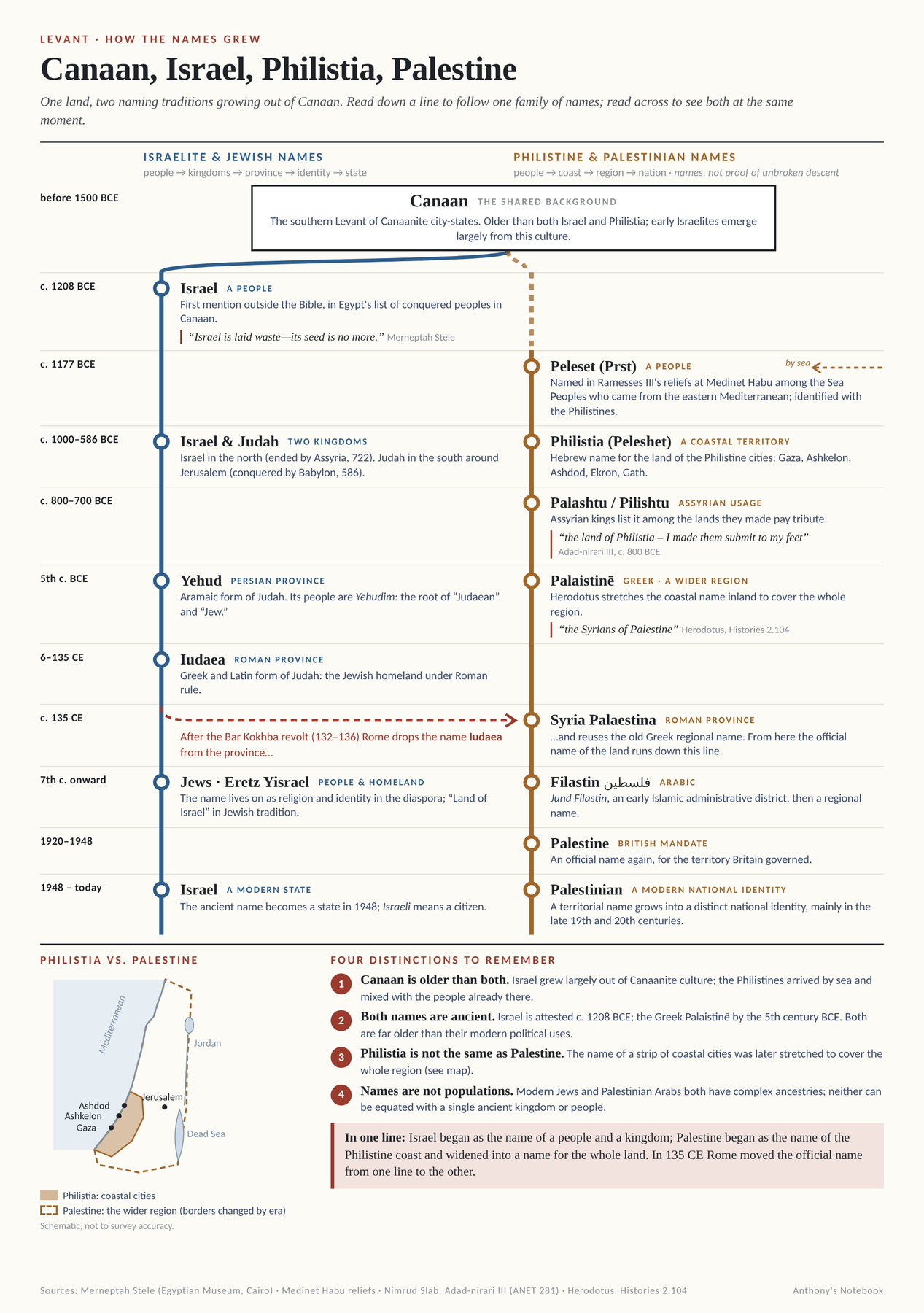
How the names grew: Canaan, Israel, Philistia, Palestine
Two naming traditions growing out of Canaan, read side by side from the Merneptah Stele (c. 1208 BCE) to today. The crossover is c. 135 CE, when Rome renamed the province of Iudaea as Syria Palaestina. Related: Palestine On the History and Geography of a Name Bernard Lewis.
Indigenous
Are Jews Indigenous to the Land of Israel? Yes. - Tablet Magazine
History of Jews in Iraq
- History_of_the_Jews_in_Iraq.pdf (file not included in this release)
- The first legal expression of Islam toward the Jews, Christians, and Zoroastrians after the conquests of the 630s were the poll-tax (“jizyah”), the tax upon real estate (“kharaj”) was instituted.
- The Umayyad caliph, Umar II (717–720), persecuted the Jews.
- Like the Arabs, the Jews were zealous promoters of knowledge, and by translating Greek and Latin authors, mainly at the House of Wisdom in Baghdad, contributed essentially to their preservation.f
- When the Abbasid Caliphate and the city of Baghdad declined in the 10th century, many Babylonian Jews migrated to the Mediterranean region, contributing to the spread of Babylonian Jewish customs throughout the Jewish world.
Jewish-Roman Wars
The Jewish–Roman wars, a series of unsuccessful revolts against Roman rule during the first and second centuries CE, had significant and disastrous consequences for the Jewish population of Judaea. The First Jewish-Roman War (66–73 CE) culminated in the destruction of Jerusalem and the Second Temple. The severely reduced Jewish population of Judaea was denied any kind of political self-government. A few generations later, the Bar Kokhba revolt (132–136 CE) erupted, and its brutal suppression by the Romans led to the depopulation of Judea. Following the revolt, Jews were forbidden from residing in the vicinity of Jerusalem, and the Jewish demographic center in shifted to Galilee Similar upheavals affected the Jewish communities of the empire’s south-eastern provinces, when a significant uprising known as the Kitos War (115–117 CE) resulted in the complete disappearance of the influential Jewish community of Egypt and Alexandria
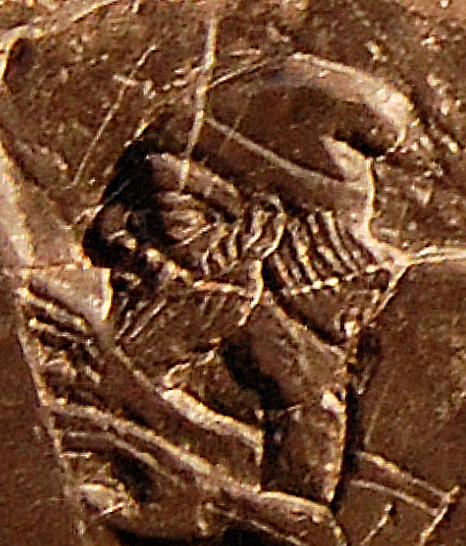
Depiction of King Jehu, tenth king of the northern Kingdom of Israel, on the Black Obelisk of Shalmaneser III, 841–840 BCE. This is “the only portrayal we have in ancient Near Eastern art of an Israelite or Judaean monarch”.
https://upload.wikimedia.org/wikipedia/commons/3/39/Jehu_on_the_Black_Obelisk_of_Shalmaneser_III.jpg
According to James Carroll, “Jews accounted for 10% of the total population of the Roman Empire. By that ratio, if other factors had not intervened, there would be 200 million Jews in the world today, instead of something like 13 million.”
Islam and Judaism
Islam and Judaism have a complex relationship. Traditionally Jews and Christians living in Muslim lands, known as dhimmis, were allowed to practice their religions and administer their internal affairs, but they were subject to certain conditions. They had to pay the jizya (a per capita tax imposed on free adult non-Muslim males) to the Islamic state. Dhimmis had an inferior status under Islamic rule. They had several social and legal disabilities such as prohibitions against bearing arms or giving testimony in courts in cases involving Muslims. Many of the disabilities were highly symbolic. The one described by Bernard Lewis as “most degrading” was the requirement of distinctive clothing, not found in the Quran or hadith but invented in early medieval Baghdad; its enforcement was highly erratic. On the other hand, Jews rarely faced martyrdom or exile, or forced compulsion to change their religion, and they were mostly free in their choice of residence and profession.
Notable exceptions include the massacre of Jews and forcible conversion of some Jews by the rulers of the Almohad dynasty in Al-Andalus in the 12th century, as well as in Islamic Persia, and the forced confinement of Moroccan Jews to walled quarters known as mellahs beginning from the 15th century and especially in the early 19th century.
Khazar theory debunked
Inventingan_Invention-_Haaretz.pdf (file not included in this release)
Bar_Kokhba_Revolt.pdf (file not included in this release)
ThomasSowell-_Are_Jews_Generic.pdf (file not included in this release)
Dhimmi (file not included in this release)
Philistines - World History Encyclopedia
Philistines - Wikipedia
Merneptah Stele - Wikipedia
Misc
Dhimmi (file not included in this release)
Philistines - World History Encyclopedia
Philistines - Wikipedia
Merneptah Stele - Wikipedia