⬅️ People, Groups & Places (MOC) · Primary text: The Jewish State (Herzl, 1896) · Related: Zionism · colonization terminology · Auto-Emancipation (Pinsker, 1882)
Primary-Source Profile
LonerBox’s dossier on Der Judenstaat sharpens four points that matter for interpreting Herzl:
- Diagnosis: Herzl regarded modern antisemitism and failed assimilation as durable political conditions, making collective security the starting problem.
- Political objective: the pamphlet seeks recognized sovereignty and institutions capable of negotiating territory, finance, and organized migration.
- Territorial openness: Herzl discussed both Palestine and Argentina, showing that refuge and sovereignty initially competed with exclusive territorial commitment.
- Anticipated resistance: he understood that unapproved migration could provoke the resident population and restriction by the existing government, which is why he pursued diplomatic authorization rather than relying only on gradual infiltration.
The full claim-and-evidence map is in The Jewish State (Herzl, 1896). Compare Pinsker’s earlier, less institutionally developed argument in Auto-Emancipation (Pinsker, 1882).
- Herzl’s Observations: Theodor Herzl, a key figure in political Zionism, observed that anti-Semitism in Europe was not just a relic of religious prejudice but had evolved into economic and political hostility. He noted that Jews faced exclusion and violence in various forms across Europe, from social ostracism in France to violent pogroms in Russia and Romania.
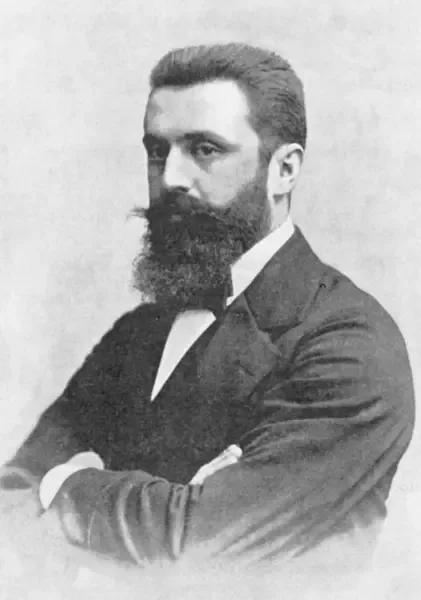
Theodor Herzl, often regarded as the father of modern political Zionism, addressed anti-Semitism extensively in his writings, particularly in his seminal work, Der Judenstaat (The Jewish State). Herzl’s approach to anti-Semitism was multifaceted, reflecting his personal experiences, observations, and evolving political ideology.
Personal Experiences and Observations
Herzl’s engagement with anti-Semitism began during his student days in Vienna, where he encountered anti-Semitic taunts and realized the limitations imposed on Jews in professional and social spheres[2][9]. The Dreyfus Affair in France, where a Jewish officer was wrongfully accused of treason, profoundly shocked Herzl and reinforced his belief that anti-Semitism was pervasive even in “enlightened” societies[4][6][11].
Analysis of Anti-Semitism
Herzl viewed anti-Semitism as a complex phenomenon with socio-economic and political roots rather than merely a religious bias. He argued that the emancipation of Jews had paradoxically intensified anti-Semitism because Jews, having emerged from the ghettos, entered into direct competition with the middle classes, which led to increased hostility[6][9]. Herzl believed that anti-Semitism was an intractable problem that could not be eradicated through assimilation or conversion, as these measures did not address the underlying socio-economic tensions and prejudices[2][4][6].
Zionism as a Solution
Herzl proposed Zionism as the only viable solution to the Jewish Question. He argued that the establishment of a Jewish state would provide a safe haven for Jews and allow them to live with dignity and security, free from the pervasive anti-Semitism in Europe[1][5][6]. In Der Judenstaat, Herzl wrote that the creation of a Jewish state would not only protect Jews but also normalize their status, transforming them into a nation like any other, thus eliminating the root causes of anti-Semitism[5][8].
Strategic Use of Anti-Semitism
Interestingly, Herzl also saw a strategic use for anti-Semitism in galvanizing Jewish support for Zionism. He believed that the pressures and dangers posed by anti-Semitism could unite Jews and drive them towards the Zionist cause. Herzl even suggested that anti-Semitic countries might support the establishment of a Jewish state as a means to rid themselves of their Jewish populations[1][8].
Contradictions and Criticisms
Herzl’s writings contain some contradictions. While he acknowledged the deep-seated prejudices against Jews and the impossibility of their full assimilation, he also attempted to build Jewish pride and confidence by emphasizing the historical resilience and nobility of the Jewish people[4]. Critics like Daniel Boyarin have argued that Herzl internalized some anti-Semitic views and that his vision of Zionism was influenced by a desire to mimic gentile masculinity and gain acceptance among non-Jews without succumbing to servility[1].
Conclusion
In summary, Herzl addressed anti-Semitism by analyzing its socio-economic and political roots, rejecting assimilation and conversion as solutions, and advocating for the establishment of a Jewish state as the ultimate remedy. His strategic use of anti-Semitism to promote Zionism and the inherent contradictions in his views reflect the complexity of his thought and the challenges he faced in addressing the Jewish Question[1][2][4][5][6][8].
Citations:
[1] https://en.wikipedia.org/wiki/Herzl%27s_Mauschel_and_Zionist_antisemitism
[2] https://www.opendemocracy.net/en/north-africa-west-asia/theodor-herzl-and-trajectory-of-zionism/
[3] https://muse.jhu.edu/article/18206
[4] https://link.springer.com/article/10.1007/BF00131830
[5] https://en.wikipedia.org/wiki/Theodor_Herzl
[6] https://learninglink.oup.com/access/content/von-sivers-3e-dashboard-resources/document-excerpts-from-theodor-herzl-the-jewish-state-1895
[7] https://www.haaretz.com/opinion/2024-01-10/ty-article-opinion/.premium/fight-antisemitism-the-way-herzl-did/0000018c-efc3-d0b4-a7ce-ffe3c1d30000
[8] https://www.aljazeera.com/opinions/2012/12/24/zionism-anti-semitism-and-colonialism
[9] https://www.gutenberg.org/files/25282/25282-h/25282-h.htm
[10] https://academic.oup.com/book/628/chapter-abstract/135334068?redirectedFrom=fulltext
[11] https://www.britannica.com/topic/The-Jewish-State
[12] https://herzlinstitute.org/en/theodor-herzl/
[13] https://www.jstor.org/stable/1878229