DESCRIPTION
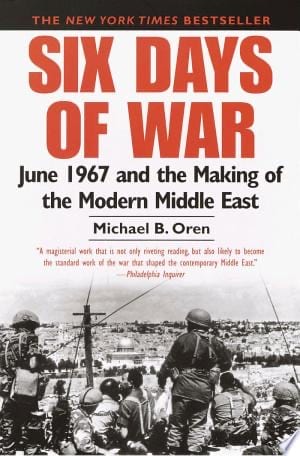
NEW YORK TIMES BESTSELLER • The first comprehensive account of the epoch-making Six-Day War, from the author of Ally—now featuring a fiftieth-anniversary retrospective Though it lasted for only six tense days in June, the 1967 Arab-Israeli war never really ended. Every crisis that has ripped through this region in the ensuing decades, from the Yom Kippur War of 1973 to the ongoing intifada, is a direct consequence of those six days of fighting. Writing with a novelist’s command of narrative and a historian’s grasp of fact and motive, Michael B. Oren reconstructs both the lightning-fast action on the battlefields and the political shocks that electrified the world. Extraordinary personalities—Moshe Dayan and Gamal Abdul Nasser, Lyndon Johnson and Alexei Kosygin—rose and toppled from power as a result of this war; borders were redrawn; daring strategies brilliantly succeeded or disastrously failed in a matter of hours. And the balance of power changed—in the Middle East and in the world. A towering work of history and an enthralling human narrative, Six Days of War is the most important book on the Middle East conflict to appear in a generation. Praise for Six Days of War “Powerful … A highly readable, even gripping account of the 1967 conflict … [Oren] has woven a seamless narrative out of a staggering variety of diplomatic and military strands.”—The New York Times “With a remarkably assured style, Oren elucidates nearly every aspect of the conflict… . Oren’s [book] will remain the authoritative chronicle of the war. His achievement as a writer and a historian is awesome.”—The Atlantic Monthly “This is not only the best book so far written on the six-day war, it is likely to remain the best.”—The Washington Post Book World “Phenomenal … breathtaking history … a profoundly talented writer… . This book is not only one of the best books on this critical episode in Middle East history; it’s one of the best-written books I’ve read this year, in any genre.”—The Jerusalem Post “[In] Michael Oren’s richly detailed and lucid account, the familiar story is thrilling once again… . What makes this book important is the breadth and depth of the research.”—The New York Times Book Review “A first-rate new account of the conflict.”—The Washington Post “The definitive history of the Six-Day War … [Oren’s] narrative is precise but written with great literary flair. In no one else’s study is there more understanding or more surprise.”—Martin Peretz, Publisher, The New Republic “Compelling, perhaps even vital, reading.”—San Jose Mercury News
Highlights
- Background and Tensions:
- The book begins by setting the stage for the Six-Day War, highlighting the longstanding tensions and conflicts in the Middle East.
- It discusses the Arab-Israeli conflict, including the 1948 Arab-Israeli War and the 1956 Suez Crisis, which contributed to the volatile situation in the region.
- Causes and Motivations:
- Oren delves into the motivations and objectives of the key players involved, including Israel, Egypt, Syria, Jordan, and the United States.
- He explains how factors like territorial disputes, water rights, military buildups, and political rivalries escalated tensions.
- The Countdown to War:
- The book provides a day-by-day account of the events leading up to the war, highlighting the military preparations and political maneuvering on all sides.
- Oren discusses the role of intelligence, miscalculations, and miscommunications in the lead-up to the conflict.
- The Six-Day War:
- Oren narrates the war itself, detailing the lightning-fast Israeli military campaign that resulted in the capture of the Sinai Peninsula, Gaza Strip, West Bank, East Jerusalem, and the Golan Heights.
- He examines the military strategies and tactics employed by Israel and the Arab nations during the war.
- Consequences and Implications:
- The book explores the immediate aftermath of the Six-Day War, including the challenges of occupation and governance faced by Israel.
- It discusses the international response, with the United Nations passing Resolution 242, which called for Israel to withdraw from occupied territories in exchange for peace.
- Shaping the Modern Middle East:
- Oren analyzes how the Six-Day War had far-reaching consequences for the Middle East and its geopolitics.
- He discusses the impact on Arab nationalism, the Palestinian question, and the rise of non-state actors like the Palestine Liberation Organization (PLO).
- The Quest for Peace:
- The book also delves into subsequent attempts at peace negotiations, including the Camp David Accords and the Oslo Accords.
- Oren examines the challenges of achieving a lasting peace in the region.
- Personal Stories:
- Throughout the book, Oren weaves in personal stories and anecdotes from individuals who experienced the war firsthand, providing a human perspective on the conflict.
- Controversies and Debates:
- “Six Days of War” acknowledges the ongoing controversies and debates surrounding the war, including issues related to land, borders, and refugees.
- Legacy:
- The book concludes by reflecting on the enduring legacy of the Six-Day War and its impact on the modern Middle East, including ongoing conflicts and peace efforts.
Ben-Gurion refused to despair. Short but imposing, a visionary with a pragmatist’s appreciation of power, he exploited UN-mediated truces to refresh and rearm his forces. That advantage, together with the Arabs’ egregious lack of command, dramatically turned the tide. (Location 254)
commitments—“Sure I promised, but did I promise to keep my promise?” (Location 1343)