Deductive & Inductive
Here’s a detailed breakdown of the structure of logic for arguments, including different types of deductive and inductive logic, along with examples of illogical reasoning:
| Type of Logic | Description | Example |
|---|---|---|
| Deductive Logic | A form of reasoning where the conclusion necessarily follows from the premises. If the premises are true, the conclusion must be true. | ”All humans are mortal. Socrates is a human. Therefore, Socrates is mortal.” |
| Inductive Logic | A form of reasoning where the conclusion is likely based on the premises. It moves from specific observations to broader generalizations. | ”Every swan we have seen is white. Therefore, all swans are white.” |
| Type of Illogic | Description | Example |
|---|---|---|
| Deductive Fallacies | Errors in reasoning that make a deductive argument invalid or unsound. | |
| - Affirming the Consequent | Assuming that if the conclusion is true, then the premise must be true. | ”If it rains, the ground is wet. The ground is wet, so it must have rained.” |
| - Denying the Antecedent | Assuming that if the premise is false, then the conclusion must be false. | ”If it rains, the ground is wet. It did not rain, so the ground is not wet.” |
| - Circular Reasoning | Using the conclusion as a premise to support the argument. | ”The Bible is true because it is the word of God, and we know it is the word of God because the Bible says so.” |
Additional Types of Reasoning
| Type of Reasoning | Description | Example |
|---|---|---|
| Abductive Reasoning | Infers the best explanation for a set of observations. | ”The lawn is wet. It probably rained last night.” |
| Analogical Reasoning | Draws a conclusion based on the similarity between two situations. | ”Just as a car needs fuel to run, a human needs food to live.” |
| Toulmin Argument | Breaks down arguments into six parts: claim, grounds, warrant, qualifier, rebuttal, and backing. Useful for constructing arguments with strong evidence. | Claim: “Junk food should be banned in the office canteen.” Grounds: “Junk food is unhealthy for employees.” |
| Rogerian Argument | Focuses on finding common ground and negotiating a mutually satisfactory solution. Useful in situations requiring compromise. | In a team meeting, discussing the best approach for a project by acknowledging different viewpoints. |
| Elliptical/Enthymematic Argument | Involves arguments with missing premises that are assumed to be understood. These arguments can be strengthened by explicitly stating the missing premises. | ”All metals expand when heated; therefore, iron will expand when heated.” (Missing premise: “Iron is a metal.”) |
Summary of Logical Structures
| Structure | Description | Example |
|---|---|---|
| Proposition | A statement that expresses a judgment or opinion. | ”All humans are mortal.” |
| Premise | A proposition used as evidence in an argument. | ”Socrates is a human.” |
| Conclusion | A proposition that follows logically from the premises. | ”Therefore, Socrates is mortal.” |
| Inference | The reasoning process of drawing a conclusion from premises. | ”If all humans are mortal and Socrates is a human, then Socrates is mortal.” |
Understanding these logical structures and recognizing fallacies is crucial for constructing sound arguments and critically evaluating the arguments of others. Deductive reasoning is valid if the premises logically lead to the conclusion, while inductive reasoning is strong if the premises make the conclusion likely. Recognizing fallacies helps in identifying weaknesses in arguments.
Citations:
[1] https://open.library.okstate.edu/criticalthinking/chapter/__unknown__/
[2] https://www.indeed.com/career-advice/career-development/types-of-reasoning
[3] https://en.wikipedia.org/wiki/Logical_reasoning
[4] https://en.wikipedia.org/wiki/Argument
[5] https://www.yourdictionary.com/articles/examples-logic
RULES FOR IDENTIFYING PREMISES AND CONCLUSIONS
- Rule one : We do not identify premises and conclusions by content.
- Rule two : We do not identify premises and conclusions by position or location within a paragraph. For stylistic or other reasons, the premises and the conclusions can appear anywhere.
- Rule three : The appearance of the following word or words at the beginning of a sentence or clause signifies that the sentence or clause is a conclusion : therefore , thus , so , hence , consequently , accordingly , it follows that , as a result , I conclude, and other synonymous terms.
- ..(C)…for…(P)..
- …(Conclusion)…because…(premise)
- Rule four : The appearance of the following word or words at the beginning of a sentence clause signifies that the sentence or clause is a premise : since, for , because , whereas , as , inasmuch as , seeing that, and synonymous terms.
- Rule five : Supply implicit or missing premises and conclusions. Many times an argument is so clear from its context that the author provides only part of it. In these cases, it is up to the reader to supply the missing or assumed premises or even the conclusion. This kind of argument is referred to as an enthymeme.
Syllogisms
- A categorical statement has four distinguishable parts: a quantifier, a subject, a copula, and a predicate.
Categorical Syllogisms
-
Both premises and conclusion are categorical, subject-predicate form
-
Four Parts
- Subject
- Copula
- Predicate
- Quantifier
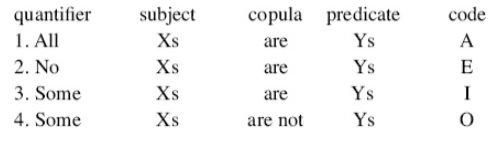
Example:
-
Major premise: “All fish are found in water.”
-
Minor premise: “All carp are fish.”
-
Conclusion: “All carp are found in water.”
In this example:
- Major term: “found in water”
- Minor term: “carp”
- Middle term: “fish”
Quality
- About statements being affirmative or negative
- Universal
- Refers to entire class of objects that it names (1 & 2)
- Particular
- Subject term does not refer to entire class of objects it names , rather only some part of that class (3 & 4)
- Singular
- Single individual
Categorical statements are categorized using the letters A, E, I, and O:
- A: Universal affirmative (e.g., “All Xs are Ys”)
- E: Universal negative (e.g., “No Xs are Ys”)
- I: Particular affirmative (e.g., “Some Xs are Ys”)
- O: Particular negative (e.g., “Some Xs are not Ys”)
Quantity refers to the relationship between the subject term and quantifiers, while distribution refers to whether a term (subject or predicate) refers to the entire class it names. In an A statement, the subject is distributed, but the predicate is not. In an E statement, both the subject and predicate are distributed. In an I statement, neither the subject nor the predicate is distributed. In an O statement, the subject is undistributed, but the predicate is distributed.Distribution Summary:
- A: Subject (distributed), Predicate (undistributed)
- E: Subject (distributed), Predicate (distributed)
- I: Subject (undistributed), Predicate (undistributed)
- O: Subject (undistributed), Predicate (distributed)
Contradictions and Contraries:
- Contradictions: Two statements that cannot both be true or false simultaneously (e.g., A and O).
- Contraries: Two statements that cannot both be true but can both be false (e.g., A and E).
| Type | Example 1 | Example 2 |
|---|---|---|
| Contradiction | ”John is alive and dead at the same time" | "The sky is blue” vs. “The sky is green” |
| Contrary | ”All dogs are friendly” vs. “No dogs are friendly" | "All politicians are honest” vs. “No politicians are honest” |
Affirmative
- Affirm the predicate of the subject(1 & 3)
Negative
- Deny the subject (namely predicate) (2 & 4)
Understanding Syllogisms
A syllogism is a form of deductive reasoning that involves drawing a conclusion from two premises: a major premise and a minor premise. This logical structure was first formalized by Aristotle and remains a cornerstone of classical logic.
Components of a Syllogism
- Major Premise: A general statement that sets the context.
- Minor Premise: A specific statement that relates to the major premise.
- Conclusion: A statement that logically follows from the two premises.
For example:
- Major Premise: All mammals are animals.
- Minor Premise: Camels are mammals.
- Conclusion: Therefore, camels are animals[2][3].
Categorical Statements
Categorical statements are the building blocks of syllogisms and assert a relationship between two categories or classes. Each categorical statement consists of four parts:
- Quantifier: Indicates the quantity (e.g., “all,” “some”).
- Subject Term: The first category or class being discussed.
- Copula: The linking verb (usually “are” or “are not”).
- Predicate Term: The second category or class being related to the subject.
For example, in the statement “All dogs are mammals”:
- Quantifier: All
- Subject Term: Dogs
- Copula: Are
- Predicate Term: Mammals[1][5][7].
Types of Categorical Statements
Categorical statements can be classified based on their quantity and quality:
Quantity
- Universal: Refers to all members of the subject class (e.g., “All dogs are mammals”).
- Particular: Refers to some members of the subject class (e.g., “Some dogs are friendly”).
- Singular: Refers to a single member of the subject class (e.g., “Socrates is a man”).
Quality
- Affirmative: Asserts inclusion (e.g., “All dogs are mammals”).
- Negative: Asserts exclusion (e.g., “No dogs are reptiles”).
The Four Standard Forms (AEIO)
- A (Universal Affirmative): All S are P (e.g., “All cats are animals”).
- E (Universal Negative): No S are P (e.g., “No cats are dogs”).
- I (Particular Affirmative): Some S are P (e.g., “Some cats are black”).
- O (Particular Negative): Some S are not P (e.g., “Some cats are not black”)[1][5][9].
Examples of Syllogisms
Universal Syllogism
- Major Premise: All humans are mortal.
- Minor Premise: Socrates is a human.
- Conclusion: Therefore, Socrates is mortal.
Particular Syllogism
- Major Premise: Some animals are mammals.
- Minor Premise: All dogs are animals.
- Conclusion: Therefore, some dogs are mammals.
Venn Diagrams
Venn diagrams are often used to visually represent the relationships in categorical statements. They show the overlap (or lack thereof) between different sets, helping to clarify the logical structure of the syllogism[1][8].
Conclusion
Syllogisms are a powerful tool in logical reasoning, providing a clear framework for deducing conclusions from given premises. By understanding the components and types of categorical statements, one can construct valid and sound arguments that are essential in various fields of study and everyday reasoning.
In a categorical statement, the quantifier and the subject term are essential components that help define the logical structure of the statement.
Quantifier
The quantifier specifies the extent to which the subject term is related to the predicate term. It indicates the quantity of the subject that the statement is about. Common quantifiers include:
- All: Indicates a universal quantification.
- Some: Indicates a particular quantification.
- No: Indicates a universal negation.
- Some…not: Indicates a particular negation.
For example, in the statement “All dogs are mammals”:
- The quantifier is “All”, indicating that the statement applies to every member of the subject class.
Subject Term
The subject term is the first category or class being discussed in the categorical statement. It is the noun or noun phrase that the quantifier is measuring.
For example, in the statement “All dogs are mammals”:
- The subject term is “dogs”, which is the category being quantified by the quantifier “All”.
Example Breakdown
Consider the categorical statement: “All dogs are mammals.”
- Quantifier: “All”
- Subject Term: “dogs”
- Copula: “are”
- Predicate Term: “mammals”
In this example, the quantifier “All” specifies that the statement applies universally to the subject term “dogs”. The copula “are” links the subject term to the predicate term “mammals”.
Types of Categorical Statements
Categorical statements can be classified based on their quantity and quality:
- Quantity:
- Universal: Applies to all members of the subject class (e.g., “All dogs are mammals”).
- Particular: Applies to some members of the subject class (e.g., “Some dogs are friendly”).
- Quality:
- Affirmative: Asserts inclusion (e.g., “All dogs are mammals”).
- Negative: Asserts exclusion (e.g., “No dogs are reptiles”).
Summary
- Quantifier: Defines the extent (e.g., “All”, “Some”).
- Subject Term: The category being quantified (e.g., “dogs”).
Understanding these components is crucial for analyzing and constructing logical arguments using categorical statements.
Rules for Valid Syllogisms
- Both premises are true, then conclusion must be true
- Rules
- The middle term must be distributed at least once. This rule is the only one that is seriously and frequently violated in everyday reasoning.
- Example:
All Socialists are in favor of reform.
All liberals are in favor of reform.
All liberals are Socialists.
- Example:
- A term that is distributed in the conclusion must be distributed in one of the premises.
- Example:
All radicals are in favor of reform.
No conservatives are radicals.
No conservatives are in favor of reform.
- Example:
- The number of negative premises must be the same as the number of negative conclusions. This rule sounds odd, but just think of the possibilities. Since there is one conclusion (a) if the conclusion is negative then there must be one, and only one, negative premise. As soon as there are two negative premises, the argument is automatically invalid. (b) If the conclusion is affirmative, there can be no negative premises. If there is a negative premise, there must be a negative conclusion. For example: Suppose your opponent argues that “Country X is not a capitalist country; therefore, Country X respects workers.” There is no possible way of making this a valid argument.
- Example:
All (or: No) countries that respect workers are capitalist countries.
Country X is not a capitalist country.
Country X is a country that respects workers. - Either way, the above argument is invalid. The only way to get to the affirmative conclusion desired is to present the affirmative argument: All noncapitalist countries are countries that respect workers. Country X is a noncapitalist country. Country X is a country that respects workers.
- Example:
All noncapitalist countries are countries that respect workers.
Country X is a noncapitalist country.
Country X is a country that respects workers.
- Example:
- The middle term must be distributed at least once. This rule is the only one that is seriously and frequently violated in everyday reasoning.
Here is an expanded breakdown of logic and argument structures, including syllogisms and false or incorrect logic, organized in a table format:
| Type of Argument | Description | Example |
|---|---|---|
| Deductive Argument | Aims to provide conclusive support for its conclusion. If the premises are true, the conclusion must be true. | ”All humans are mortal. Socrates is a human. Therefore, Socrates is mortal.” |
| Inductive Argument | Provides probable support for its conclusion. The premises make the conclusion likely but not certain. | ”Most Greeks eat olives. Socrates is a Greek. Therefore, Socrates eats olives.” |
| Syllogism | A form of deductive reasoning consisting of a major premise, a minor premise, and a conclusion. | ”All men are mortal (major premise). Socrates is a man (minor premise). Therefore, Socrates is mortal.” |
| Toulmin Argument | Breaks down arguments into six parts: claim, grounds, warrant, qualifier, rebuttal, and backing. Useful for constructing arguments with strong evidence. | Claim: “Junk food should be banned in the office canteen.” Grounds: “Junk food is unhealthy for employees.” |
| Rogerian Argument | Focuses on finding common ground and negotiating a mutually satisfactory solution. Useful in situations requiring compromise. | In a team meeting, discussing the best approach for a project by acknowledging different viewpoints. |
| Elliptical/Enthymematic Argument | Involves arguments with missing premises that are assumed to be understood. These arguments can be strengthened by explicitly stating the missing premises. | ”All metals expand when heated; therefore, iron will expand when heated.” (Missing premise: “Iron is a metal.”) |
| Fallacious Argument | Contains errors in reasoning or invalid forms. Often involves misleading or unsound logic. | ”I was thirsty and therefore I drank” (not a logical argument despite using “therefore”). |
| False/Incorrect Logic | Arguments that appear logical but contain fallacies or errors in reasoning. These can be intentional (to deceive) or unintentional. | ”Ad hominem”: Attacking the person instead of the argument. “Straw man”: Misrepresenting someone’s argument to make it easier to attack. |