Open: Verbal Judo - George J. Thompson, PhD.pdf (file not included in this release)
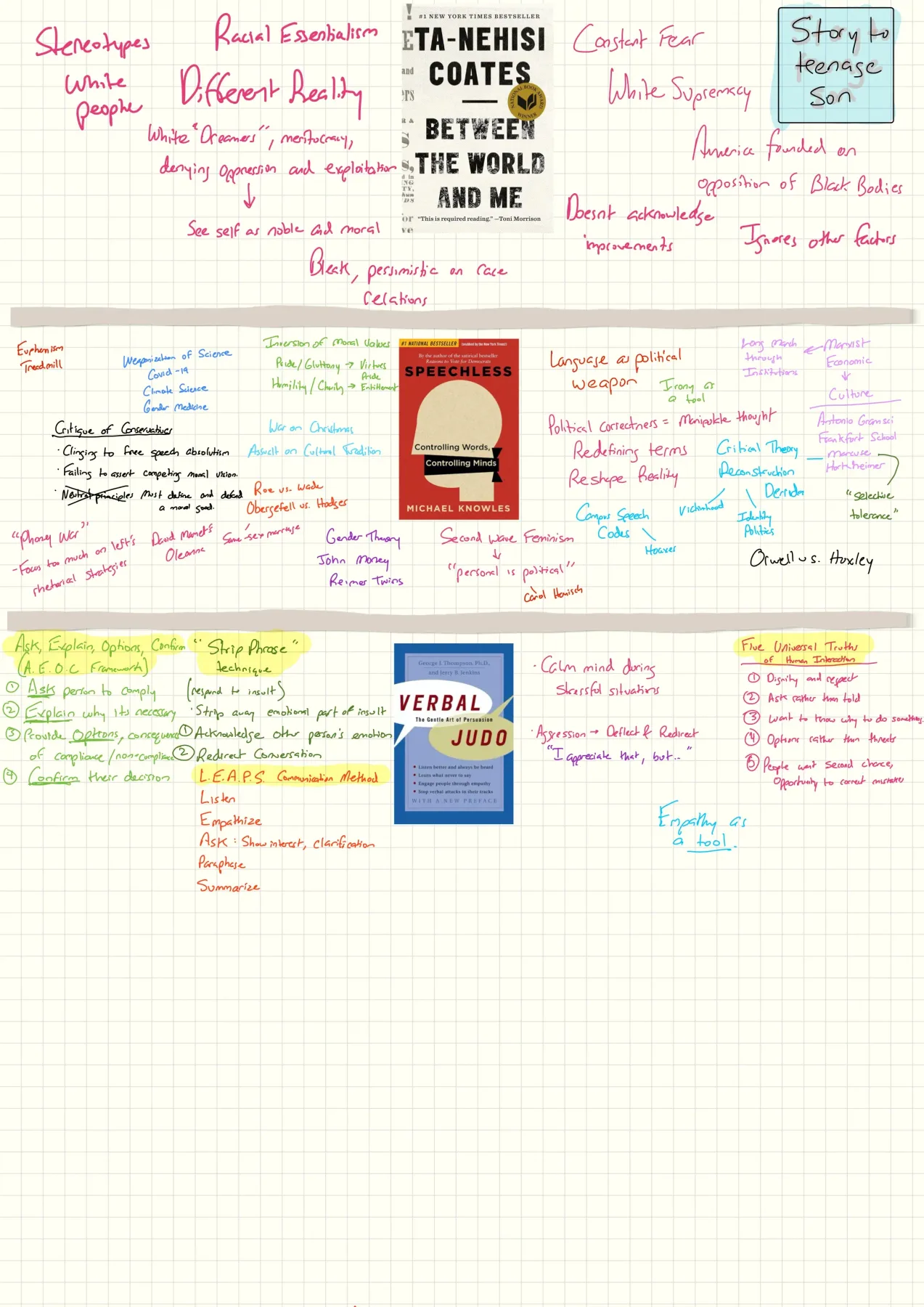
Summary
- Remain calm.
- Don’t resist. Redirect.
- Difficult people, who always ask why, gives you the opportunity to explain why its in their best interest
- Wimps: Confront them honestly.
- Don’t confront or be confronted. Stay calm and metaphorically go hand in hand with them to conquer the problem.
- Tongue lashings do more damage than physical. Words cut deep. Use them wisely, you can’t take them back.
- Empathy absorbs tension.
- Strip Phrases deflect insults:
- I hear ya, but
- I got ya, but
- I believe that, but
- Paraphrasing
- put another person’s meaning into your words and deliver it back to him
- “Let me be sure I heard what you just said.”
- “Okay, you are feeling X because of Y, true?” The X equals an emotion, like anger or frustration, and the Y equals a reason.
- “Do you understand what I’ve just said?”
- Persuasion Five-Step Model
- (1) Ask (Ethical Appeal),
- (2) Set Context (Reasonable Appeal),
- (3) Present Options (Personal Appeal),
- (4) Confirm (Practical Appeal), and
- (5) Act (Determination of Appropriate Action)
- Domestic Dispute
- Paraphrase
- Paraphrase Again
- Refocus the other’s attention
- Say what you want to say
- LEAPS: Listen Empathize Ask Paraphrase Summarize
LEAPS Model
The LEAPS model from George J. Thompson’s Verbal Judo is a tactical listening framework used to calm conflict, build rapport, and gain voluntary compliance.
LEAPS = Listen, Empathize, Ask, Paraphrase, Summarize
L — Listen
Give the other person enough space to speak without interrupting, correcting, or preparing your rebuttal too quickly.
The purpose is not passive agreement. It is intelligence gathering. You are listening for:
- What they want
- What they fear
- What they misunderstand
- What emotion is driving the conflict
- What outcome they think would be fair
Example:
“Tell me what happened from your point of view.”
E — Empathize
Show that you understand the person’s emotional state, even if you disagree with their facts, tone, or conclusion.
Empathy does not mean approval. It means you recognize the feeling underneath the words.
Example:
“I can see why that would be frustrating.”
Or:
“I’d be annoyed too if I thought I was being ignored.”
This lowers defensiveness because the person no longer feels forced to prove that their frustration is valid.
A — Ask
Ask questions to gather facts, redirect emotion, and create cooperation.
Good questions are usually calm, specific, and purposeful.
Examples:
“What were you expecting to happen?”
“What would help fix this from your perspective?”
“When did this start?”
“Who else was involved?”
“What do you need from me right now?”Questions move the conversation from emotional discharge toward problem-solving.
P — Paraphrase
Restate the person’s meaning in your own words. This proves you heard them and gives them a chance to correct misunderstandings.
Example:
“So what I’m hearing is that you’re not mainly upset about the delay. You’re upset because no one told you what was going on.”
Paraphrasing is powerful because it makes the other person feel understood without forcing you to concede.
S — Summarize
Condense the conversation into the key facts, concerns, and next steps.
Example:
“Let me make sure I have this right: the order was supposed to arrive Monday, no one updated you, and now you need a clear answer by the end of today. I’m going to check the status and call you back by 3 p.m.”
Summarizing creates closure and turns a tense exchange into an action plan.
Simple LEAPS Script
Use this in a difficult conversation:
“Tell me what happened.”
“I can see why that would bother you.”
“What were you expecting instead?”
“So the main issue is not just what happened, but that you felt blindsided.”
“Here’s what I understand, and here’s what I’m going to do next.”Why LEAPS Works
LEAPS works because it follows the emotional order of conflict. Most people cannot think clearly until they feel heard. The model first reduces emotional resistance, then gathers information, then moves toward resolution.
For interpersonal and leadership communication, the key lesson is:
Do not start by explaining, defending, or correcting. Start by listening, naming the concern, asking useful questions, and summarizing a path forward.
Verbal Judo

Readwise Information
Author:: George J. Thompson, PhD
Title:: Verbal Judo
Type:: readwise/category/books
Last-Highlighted-Date:: 2024-07-16
Link:: https://readwise.io/bookreview/42391690
Readwise-Source:: readwise/source/pdf
Related-To::
Tags::
Review-for-Repurpose::
Linked Notes from Around My Vault
Backlinks (Bases)
Backlinks.base (file not included in this release)
Highlights
1 Birth of a Communication Samurai (Page 16)
- I have three overarching goals. First and most important is to ensure your personal safety. Developing mind-mouth harmony is the greatest skill in the world, because if you make a mistake with either you can find yourself in serious personal danger. You can lose a marriage, stall a career, instigate violence, lose your credibility, alienate people, and lose friends. I know, I’ve done them all. (Page 19)
- Goal number two is to enhance your professionalism. Regardless whether you’re in retail, wholesale, on a police force, part of corporate America, or working at home, you’re a professional. Everything I offer improve your performance by reducing here can measurably complaints from those you work with and reducing your personal stress. (Page 19)
- If you can learn to use your words without causing strife and conflict, you will have fewer complaints in the work world and fewer arguments with your friends and family. This will go a long way in reducing stress, which is something you usually bring on yourself by the way you deal with people. Reduce your capacity for conflict, and you will reduce stress. (Page 19)
- My third goal is to increase your efficiency by improving your performance level. This will have the added benefit of improving your self-esteem, the way you view yourself. Increasing your efficiency also means improving your ability to “say it right” the first time, rather than as so many of us do, having to apologize, restate, and try to (Page 19)
- explain why you fired off words that caused you problems in the first place. (Page 20)
2 Motivating the Disagreeable (Page 21)
- Then, using the language of your audience, you can make the strange become familiar. Albert Einstein was brilliant at that. He would sit in Princeton Square and use balloons and oranges to explain the most complicated ideas. Carl Sagan does much the same. Great, profound thinkers must communicate simply. They understand the complexities, but they must make them simple so everyone can understand. (Page 22)
- motivated a disagreeable person to a point of Voluntary Compliance—the ultimate goal of Verbal Judo. (Page 22)
3 Baptism of Fire (Page 23)
- Almost without knowing it, I raised the expectations of those students. They saw themselves as losers, unmotivated, uncaring. When they were challenged to do something, to show off their expertise, they gained confidence and were even motivated to expand, to learn something more. Their expectations of themselves had been raised. (Page 27)
4 Taking Crap with Dignity … and Style (Page 29)
- Because I teach you to be careful of the words that rise automatically to your lips, the Verbal Judo that you substitute will initially feel foreign to you. But as you gradually learn new thinking feel language, habits and corresponding comfortable and become automatic. As you learn to choose and deliver your words for maximum effectiveness, you’ll enjoy benefits beyond merely improved communication. they will eventually (Page 30)
- You’ll find that you can remain calm, which is a particularly valuable art. If your antagonist can upset you, he owns you at some level. Even if you score an immediate “victory” by telling him off, he may own you later when the encounter is evaluated by your boss, in court, by your family, or wherever. (Page 30)
- As the Confucian philosopher Sun-tzu put it, “To win one hundred victories in one hundred battles is not the highest skill. To subdue the enemy without fighting is the highest skill.” (Page 32)
- The first step in learning to deal with verbal attacks is to acknowledge that crap is being flung. The second step is to admit it is being flung at you. Then congratulate yourself. It’s okay to be questioned, heckled, or even attacked. If you are willing to take it, you should be commended. The only way to avoid criticism is either to live in a capsule or spend your whole life trying to please everyone. That means playing it safe, surrounding yourself with sycophants, taking few responsibilities, and doing what other people tell you to do. (Page 32)
- The moment you have an idea and try to persuade others to move in concert with you, you have invited disagreement. The more (Page 32)
- intensely you live, the more you choose to make a difference in the world, the more you create vital, as opposed to insipid, relationships, then the more open you are to whacks and bumps and bruises. That’s the only path to honest, bottom-line communication. (Page 33)
- The secret is simple: It’s okay if someone insults, resists, or attacks you. Laugh it off. Show that it has no meaning, no sting. If you fight back and resist the affront, you give it life and credibility. If you defend yourself, you invite counterattack. (Page 34)
- When I train cops around the country I find that black officers are usually more adept at letting insults roll off them. Why? Probably because they have had to survive in a world that constantly attacks them. Many of them grew up playing a game called Dozens. Dozens teaches kids to handle verbal abuse. They learn looseness and agility in conversational play. The worst taunts imaginable, usually insults of each other’s mothers, are hurled back and forth. “Yo’ mama so stupid, she heard it was chilly outside, so she brought out a bowl!” “Oh yeah? Well, yo’ mama so old she was born before slavery!” Sometimes a shorthand version of Dozens is the simple insulting phrase, “Yo’ mama!” (Page 34)
- What happens is that one player finally takes it personally and reacts in anger. He loses face and loses credibility. He also loses the game and is laughed at. By playing Dozens again and again, a black kid eventually catches on that an attack carries only the weight he allows it to. He learns that if he makes no big deal of even an insult to his mother there’s no incentive for anyone to keep insulting him. He has learned to effortlessly, eloquently, and effectively disarm the cocked tongue. (Page 35)
5 The Nice, the Difficult, and the Wimp (Page 36)
- Gradually I learned that why is the bottom line in America. That little word can be one of the most powerfully destructive or constructive words in any language. (Page 39)
- When I want voluntary compliance from a Difficult Person, I explain early on what’s in it for him. As clearly and specifically as I can, I show him what he has to gain. Only when that doesn’t work will I tell him what he stands to lose. (Page 39)
- The first principle of physical judo is to not resist your opponent. Instead, move with him and redirect his energy. Ignoring or dismissing a question is the same as resisting it. In Verbal Judo you do not try to shut out pesky questioning of your authority, reasons, or methods. It’s important to always answer, rather than dismiss the question when someone asks why. (Page 40)
- Instead, leap into those questions, turn them into outrageous opportunities. See questions as invitations to explain yourself, to tell what you do, to fill someone in on your views. Here’s the chance to educate a person, to win his respect, and provide him with deeper understanding so he won’t go away angry. (Page 40)
- I stopped being irritated at Difficult People asking “Why?” all the time when I realized that I am one of them. They’re my kind of people! When someone says, “No, that’s wrong. You can’t do that to me. What gives you the right to tell me what to do?” I get interested. That’s a challenge. I actually enjoy it now when Difficult People look me in the eye and say, “Why do I have to do that?” It gives me the opportunity to explain why it’s in their best interest to comply. (Page 40)
- There’s a big payoff in all this: When you shift from resisting to appreciating and even welcoming Difficult People, things become interesting and less tense. (Page 41)
- The toughest bird of all is the Wimp. Wimps are the ones who sound like Nice People but are closet Difficult People. To your face they say, “Oh yes,” “I agree,” “You’re right.” They may even compliment you on your words, ideas, or even clothes. They’ve got the courtesy rap down cold. But later they get you back, in the back, baby. (Page 41)
- Many think it’s best to ignore Wimps, but that’s just another form of resisting them. Ignored or resisted, they grow stronger. The basic principle here is to confront them honestly. They immediately weaken. (Page 42)
- Resist the urge to gossip about these people or snipe back at them. Those are Wimp techniques, and they are often better at them than you are, unless you too are a Wimp. (Page 42)
- Outside of my training sessions, in private, I’m even more direct with Wimps. Notice that when I’m flushing them out of their cover in the class setting I’m not embarrassing them. I’m letting them embarrass themselves. If they have a good point or something constructive to say or ask, they can. I haven’t put them down or challenged them. I’ve merely courteously asked them to repeat their comment or question because I missed it. Privately, however, I might be more straightforward. “I understand what you’re doing,” I’ll say. “If you continue, we’re going to have a problem. I won’t put up with this.” (Page 42)
6 Eleven Things Never to Say to Anyone (And How to Respond If Some Idiot Says Them to You) (Page 43)
-
- “COME HERE!” (Page 43)
- more effective to casually approach a person and say, “Excuse me, but I need to chat with you a second,” or even “Could I chat with you a second?” I gave the other party the feeling that he had some choice, but my implication was clear. (Page 43)
-
- “YOU WOULDN’T UNDERSTAND.” (Page 44)
- Better to say, “This might be difficult to understand, but …” or “Let me try to explain this …” (Page 44)
- If you’re being pressed to reveal something you don’t want to reveal, avoid the convenient lie that the person wouldn’t understand. Just say, “I’d rather not answer that,” or the more emphatic, “I’m not willing to answer that.” (Page 44)
- If someone brushes you off with “You wouldn’t understand,” insist, “Yes I would. Try me. I want to help.” (Page 44)
-
- “BECAUSE THOSE ARE THE RULES.” (Page 44)
- Tell them that you need their help in doing your job as a parent. “It’s my responsibility to bring up healthy, happy kids. You do your part, and I’ll do mine.” (Page 44)
- If all you can do is to repeat that “rules are rules and those are the rules,” your listener knows you’re weak and can’t support your order with logic. (Page 45)
- “Could you please tell me why this rule was created? It doesn’t make sense to me, and if you could help me understand why it was made, it would be much easier for me to follow.” (Page 45)
-
- “IT’S NONE OF YOUR BUSINESS.” (Page 45)
- Rather than saying, “It’s none of your business,” explain why the information cannot be revealed. You can usually do this without revealing more than you want to. If it’s a confidential matter, say why. (Page 45)
- If you’re simply uncomfortable revealing something, just admit that, rather than making the other person feel like a jerk. Telling him it’s none of his business leads only to conflict. (Page 45)
- “It is my business, and here’s why.” (Page 46)
-
- “WHAT DO YOU WANT ME TO DO ABOUT IT?” (Page 46)
- Rather, offer to help sort out the problem and work toward a solution. (Page 46)
- Say, “I’m sorry. I really don’t know what to tell you or what else to recommend, and I wish I did. I’d like to help, but I can’t.” A concerned tone will enhance your credibility and convey that you’re not secretly just trying to pass the buck. (Page 46)
-
- “CALM DOWN!” (Page 46)
- Rather, put on a calm face and demeanor, look the person in the eye, touch him gently if appropriate, and say, “It’s going to be all right. Talk to me. What’s the trouble?” (Page 47)
-
- “WHAT’S YOUR PROBLEM?” (Page 47)
- Rather, say, “What’s the matter? How can I help?” Then you can start a real discussion of the issue. (Page 47)
- If someone is unenlightened enough to ask you “What’s your problem?” say, “It’s not a problem, it’s just something I need to discuss. Can we talk?” (Page 47)
-
- “YOU NEVER …” OR “YOU ALWAYS …” (Page 47)
- Better to turn the burden upon yourself and seek his help. “When you are late without calling, it makes me feel as if you don’t care about me or my schedule.” (Page 48)
- If someone uses such absolute phrasing to you, see if you can see his point. Say, “I know it seems I never help out, because often I don’t. But let’s talk about it. Is that the real issue or are you upset about something else?” (Page 48)
-
- “I’M NOT GOING TO SAY THIS AGAIN.” (Page 48)
- If you need to emphasize the seriousness of your words, say, “It’s important that you understand this, so let me say it again. And please listen carefully.” (Page 48)
-
- “I’M DOING THIS FOR YOUR OWN GOOD.” (Page 49)
- If what you are doing really is for the other person’s benefit, show him that. Offer reasons. Give concrete examples of how his life will improve because of what you’re doing. (Page 49)
- ask for specifics (Page 49)
- Remind the person, “No one knows me better than I do. I’m the best judge of what is for my own good, just as you’re the best judge of what is for your own good.” (Page 49)
-
- “WHY DON’T YOU BE REASONABLE?” (Page 49)
- Use the language of reassurance, saying things like “Let me see if I understand your position,” and then paraphrasing their own words. (Page 49)
- Take a deep breath and in a slow, thoughtful, nonthreatening voice, say, “I’m being as reasonable as I know how, and with any luck, I’ll get better. But apparently I see the issue differently than you do.” (Page 50)
7 The Crucible of the Street (Page 51)
- Verbal Judo teaches you to become consciously competent in both the use of words and in your nonverbal presence. If it’s true that lack of communication is a major factor behind everything from ruined marriages to lost fortunes and world wars, verbal skills are crucial to the survival of society. If you’ve ever alienated anyone, burned any bridges (or even left them smoking), lost a promotion, or angered your mother-in-law, you have had communication problems. I believe the greatest abuse today is verbal abuse, which is the basis for all child abuse, spouse abuse, drug abuse, and just about any other type of abuse you can think of. In fact I would argue that verbal abuse is far more prevalent than substance abuse in our country. (Page 55)
- Tongue lashings are a major reason why people turn to drugs or alcohol. (Page 55)
- Words cut deeper and their wounds fester longer than traumas of the sword. That’s why we need to be trained to speak effectively. (Page 56)
8 The Most Powerful Word in the English Language (Page 59)
- So to empathize means to understand, to see through the eyes of another. It is the most crucial skill in both physical and Verbal Judo. (Page 59)
- Empathy is the quality of standing in another’s shoes and understanding where he’s coming from. (Page 59)
- Here is the bottom line of all communication: Empathy absorbs tension. It works every time. I have seen it even save a life. (Page 60)
9 The Greatest Speech You’ll Ever Live to Regret (Page 66)
- A closed mind misreads people and makes terrible errors. The flexible mind has the surviving strength of the willow tree, which survives even in heavy winds because it bends, it is malleable. This is precisely what we have to do and be when under the influence of verbal abuse. (Page 67)
- Being malleable is always superior to that which is unmovable, thus the judo principle of controlling things by going along with them —mastery through adaptation. This allows you the strength to deal with people different from yourself. (Page 67)
- Crazy as it sounds, that works. I have heard some of the greatest communicators in the country use similar phrases, like “I hear ya, sir, but …” and “I got t’at, ma’am, but …” or “I b’lieve that, sir, but …” or “Tha’sa fact, but …” These strip phrases deflect the insults coming at you and allow you to focus on what you’re doing. (Page 69)
- After the word but, use only words that serve your professional purpose. (Page 70)
10 The Only Way to Interrupt People and Still Have Them Love You (Page 73)
- ONE OF THE most powerful verbal tools I know is Paraphrasing. (Page 73)
- To paraphrase, put most simply, is to put another person’s meaning into your words and deliver it back to him. (Page 73)
- So you start with the Sword of Insertion, a wedge into the harangue like “Whoa!” or “Listen!” (spoken earnestly, not in anger) or “Wait a second.” (Page 74)
- Here then is the powerful sentence that will allow you to interrupt anyone without fear of bodily harm: “Let me be sure I heard what you just said.” (Page 74)
- No matter how upset, just about anyone will shut up and listen because she too wants to be sure you heard what she said. In fact, the surer she is that you were not listening, the more likely she is to now hear you out, if only to prove you wrong! (Page 74)
- Once you have thrust the Sword of Insertion and pronounced the ultimate empathetic sentence, you have gained attention. Then, to effect this seventh benefit of paraphrasing you want to immediately follow up with something like this: “Okay, you are feeling X because of Y, true?” The X equals an emotion, like anger or frustration, and the Y equals a reason. You don’t even have to be right. You’re guessing at this point. For instance, it might go like this: “Whoa! Listen, let me be sure I understand what you’re saying. You’re feeling angry because you believe I purposely undermined you in front of your colleagues yesterday at the meeting.” (Page 75)
- “Do you understand what I’ve just said?” very few people will admit they missed your point. The key is not to ask for a negative answer. Ask the person to tell you what you said, and you’ll get an accurate reading how you’ve communicated. Remember, the responsibility for the understanding belongs to the speaker, not the listener. Your job is to get through. (Page 78)
11 Verbal Judo Versus Verbal Karate (Page 80)
- The goal of persuasion is to generate voluntary compliance. You can’t expect it just because you play a certain authority role. You must make it happen. The great communicators have that art. They somehow get people to do what they want them to do by getting them to want to do it. (Page 84)
12 The Five-Step Hard Style (Page 88)
- Persuasion—generating voluntary compliance—is the essence of Verbal Judo, and at the heart of persuasion is a five-step model I discovered the hard way in police work. It suggests that you (1) Ask (Ethical Appeal), (2) Set Context (Reasonable Appeal), (3) Present Options (Personal Appeal), (4) Confirm (Practical Appeal), and (5) Act (Determination of Appropriate Action). (For a full discussion of the four types of appeals, see Chapter 21.) (Page 88)
- For example, suppose I were to tell my son, “Taylor, before you go to the party, take the trash out.” I might hear something like “Hey, Dad, I haven’t got time to do it tonight. I’m in a rush. Why don’t you do it?” Why don’t I do it? Most of us would snap at that response. We don’t set context or lay out options. We just move right to Step 3 and turn options into threats: “Hey, you don’t take the trash out, you don’t go out!” (Page 92)
- Of course, all that gets you from the teenager is “That’s unfair, I have to do everything, you never do anything, blah, blah, blah.” Suddenly you’ve got yourself a serious argument. Why not pleasantly go to Step 2—setting context? “Taylor, remember when we agreed six months ago that your allowance would be partially based on getting that trash to the curb every Friday night, before going out? Why don’t you just keep your word and do it?” For some kids, appealing to their honor works immediately, as it usually does with my son. But what if you have a difficult teenager? You’re apt to hear, “Yeah, well, I meant to talk to you about that allowance business, anyway. I’m fed up with that. Get someone else to take the trash out because I’m in a hurry.” Now it’s time to go setting and creating options instead of threats. Something like this might work: “Taylor, listen, we agreed, ‘When cans by curb, Taylor out for parties.’ You don’t have to physically take them out; your job is to see that they get out. If you want to bribe your sister or get Mama to take them out or you want to use voodoo, I don’t care. No cans out, no party.” At this point, most kids would probably do it. There’s been no assault on Taylor’s personal face, and he can maintain his dignity by simply taking the trash out. But suppose he doesn’t. Suppose he says, “I’m not gonna do it! I’m in a hurry!” Then you have no choice. You move right to Step 4. “Taylor, listen! Is there anything I can say or do at this time to earn your cooperation and get you to keep your word and take the trash out? I’d sure like to think there is.” I don’t know about your kids, but most kids know by that sentence that discussion is about over. The teenager can still take out the trash at that point and lose no credibility, no personal face. If he doesn’t, you can ground him, send him to his room, take away his allowance, or whatever punishment is appropriate in your house. But notice that he cannot blame you. In the end it was his choice. The punishment is an appropriate action based on a fourth step that he resisted. He had a right to resist. That’s how he earns his identity over time, flexing his muscles. We have to give our kids room to flex. If we’re always coming down on them, they can’t grow. But they must pay the consequences if they do not obey. Once the line is drawn, they must (Page 93)
- not cross it without punishment. Up to that point, we owe them the courtesy of looking for the keys to voluntary compliance. (Page 94)
- The Five-Step Hard Style is a communication tactic that arms you to deal with difficult people under almost any condition. It provides you with decisiveness and certainty. You will always know where you are. You are in the asking stage (Step 1), the setting the context (telling why) stage (Step 2), the presenting of options (in the other person’s best interest) stage (Step 3), or the confirming (that some kind of cooperation is either forthcoming or not) stage (Step 4). If not, you have to act (Step 5). (Page 94)
13 The First Great Communication Art: Representation (Page 95)
- You should take pride in your ability to get better under the pressure people put on you in the workplace. To be a contact professional who can handle any kind of stress, you must exude credibility and an aura of power. (Page 95)
- To be a top-flight contact professional, you have to become an artist at representation, the first of three great communication arts. Besides being in contact with (or knowing) yourself, you must be in contact with your organization and its constituency. As you do your professional representation work, you stand between the proverbial rock and a hard place. (Page 98)
- Every time you open your mouth, you represent the boss, whether that is the chief of police, the mayor, the company president or CEO, or whoever. (Page 99)
14 The Second Great Communication Art: Translation (Page 101)
- Translation is the ability to put what you say in the most proper, fitting, assertive, and powerful words possible. The goal is to put the precise meaning in your mind into your listener’s mind. That means doing whatever the is necessary that comes with normal distractions and misunderstanding influences. to avoid (Page 101)
-
- Content. You have to know what you’re talking about. As a professional or a parent, you must decide precisely what it is you want and need to communicate. 2. Coding. Coding is merely putting your message into words. This involves thinking of those words as a code that reflects your meaning. Think, for example, how many ways there are to tell a man you cannot help him. Or to tell a man to step out of his car. How many ways there are to tell your spouse you are sorry—most not as effective as they could be. Words should be seen as a way of reflecting meaning, but not ego—you must separate your words (meaning) from your self (ego). 3. Sending. Once you know your meaning and have chosen the words for it, it’s time to transmit it, whether by phone or in (Page 101)
- person, using your voice and other nonverbals (facial expressions, body language, etc.). 4. Decoding. Decoding is the responsibility of the hearer, but how well he decodes is in direct proportion to the effectiveness of the content, coding, and sending—yours. His decoding is also affected by your demeanor and carriage (voice and body language), external noise (cars, planes, phones, people, etc.), and his own internal noise (what I call “brain damage,” or any other influence he may be under). (Page 102)
- I said, “So do I!” and I laughed. Humor, carefully used, can be a deflector, an identifying factor, a way to forge a bond and work with a dangerous personality. (Page 107)
15 The Third Great Communication Art: Mediation (Page 109)
- Simply put, the art of mediation is the ability to skillfully present options, which takes us right back to Step 3 of the Five-Step Hard Style (see Chapter 12). (Page 112)
16 What Makes This All So Difficult (Page 115)
- There are four elements to voice. The first, tone, is the most deadly four-letter word I know. Tone of voice has caused more violence, more divorce, more lost court cases, more lost business, and more brawls than anything else I can think of. (Page 117)
- Besides tone, your voice has three other elements: pace, pitch, and modulation. Pace, of course, is your speed. Pitch is how high or low (Page 119)
- and how loud and soft you speak. And modulation is your rhythm and inflection. If you want to calm somebody, modulate your voice as you assure him, “Listen, it’s going to be all right.” That’s a whole lot different than “Listen! I’m doing everything I can, so calm down!” (Page 120)
17 Readin’, ’Ritin’, and Rhetoric (Page 122)
- I have developed an acronym—PAVPO—which I agree is kind of an ugly-sounding one, but which is also very serviceable. If you can lock it into your mind, it will help you memorize the five components of what I call the rhetorical perspective of Verbal Judo, some of which I have already discussed: Perspective Audience Voice Purpose Organization (Page 123)
18 How to Diagnose a Verbal Encounter (Page 133)
- Another one that can help you diagnose a verbal encounter and thus skillfully deal with people under pressure is PACE: Problem (situation you’re in), Audience (to whom effective are communication), and Ethical presence (your professional face). speaking), Constraints (obstacles you to (Page 133)
19 The Language of Reassurance (Page 138)
20 How to Fight Fair (Page 145)
- FOUR STEPS TO A GOOD DOMESTIC DISPUTE (Page 145)
- The prototype I recommend to help you generate closure and keep the higher goal in mind (long-term harmony) does not lend itself like this: (1) Paraphrase. (2) to an acronym. It simply goes Paraphrase again. (3) Refocus the other’s attention. (4) Say what you want to say. (Page 146)
-
- Paraphrase (Page 147)
- First employing a trusty Sword of Insertion like “Whoa!” follow with “Wait a minute, darling [totally without sarcasm—you’re reaffirming your affection, even in the heat of battle, subliminally establishing that your goal is to make things right and maintain the relationship]. Let me be sure I hear what you’re saying. [Here comes the paraphrase.] You’re angry at me because you think I come home every night and do everything I can to purposely undermine you in front of the children. Is that the way you feel? (Page 147)
- Notice how disinterested is the tone; there’s no condemnation or put-down at the end of that, implied or otherwise. (Page 147)
-
- Paraphrase Again (Page 147)
- “Okay, darling, you’re angry at me because for the last three nights I have come home and purposely tried to undermine you in front of your children.” (Page 147)
-
- Refocus the other’s attention (Page 148)
- Still in a conciliatory tone, the husband should now say something like “Let me ask you something. What specifically did I do the last three nights that led you to believe I was trying to undermine you?” (Page 148)
-
- Say What You Want to Say (Page 148)
- Now is the most crucial time in the argument. The husband needs to state his case, all the while convincing his wife that he has the relationship at heart. (Page 148)
- This is another of those times to bury the ego, take a lump or two, and concentrate on persuading your opponent that you’re as interested in preserving the relationship as she is. (Page 148)
- So, he says, “Let me ask you something, hon. Could we talk about the difference between what I do and what I intend to do? I didn’t marry you two months ago to destroy the relationship, but I’m doing something wrong. Can we talk about it?” (Page 148)
- His voice should sound as though he cares. He should be using everything he knows about pace and pitch and modulation and tone. (Page 148)
- To me one of the great signs of true love is the ability to take over and cover for the other when he or she is having a bad day. The hope is that he or she will do the same for you when you need it. (Page 149)
21 Take the Giant LEAPS (Page 150)
- I HAVE IDENTIFIED five basic tools to generate voluntary compliance, and—you guessed it—they fit into an acronym: LEAPS. Listen Empathize Ask Paraphrase Summarize (Page 150)
22 Applying LEAPS to Your World (Page 158)
- But this four-step approach can ensure greater communication effectiveness. 1. Ask. Ask your people what they feel, what they want, or how they think things are going. 2. Listen actively. (Repeat Steps 1 and 2 as many times as necessary until you feel you have heard everything.) 3. Reevaluate your position. Be sure of where you stand, based on your people’s input. Don’t change your mind unless that is the right and appropriate course. But don’t be afraid to do that. Your people won’t see you as weak and manipulable; they’ll admire your strength. 4. Deliver the information. Get before your people and tell them how it is going to be. You’re in charge. You’re the boss, but you don’t have to say that. The day you need to remind people who’s the boss is the day you should realize you have lost your people. (Page 158)
23 Persuasion for Fun and Profit (Page 162)
- Train yourself to be free of bias, prejudice, and expectation. That’s easier said than done, of course, and I’m the first to admit that it isn’t something that comes naturally. There is a Chinese word that means both “crisis” and “opportunity.” By remembering that, I am now able to like Difficult People, or at least to appreciate where they’re coming from and view them as challenges and opportunities rather than obstacles. (Page 163)
24 The Misunderstood Motivator (Page 167)
- I contend that praise remains the most effective motivator and disciplinarian there is. Effective and genuine praise does far more than make people feel good. They tend to do voluntarily what they are praised for. But if they are criticized they will do just what they need to to get by. (Page 167)
- Offering praise communicates and reinforces your values. And when praise is specific—as I will discuss more fully—it appears more authentic and increases your credibility, regardless of your role. (Page 167)
- My first praise principle is that if you plan to praise people, never follow it with criticism. If you do, from then on, whenever people hear a compliment from you (no matter how sincere), they will also hear in their minds, “… but …” (Page 168)
- I’m not saying you cannot or should not criticize people when necessary. If you must, criticize first, then leave them with praise. (Page 168)
- One of the ways has to do with where you insert praise into the conversation: last, not first. (Page 168)
- The second way to effect the sincerity of praise is to make it as specific as possible. There is something disconcerting about “Nice going! Good job! Appreciated that.” It’s much better when someone says—to use the singing example again—“I enjoyed your solo, especially the song you selected and the way you interpreted that chorus. I felt as if I were young and in love again.” (Page 169)
- THE BENEFITS OF SPECIFIC PRAISE 1. Specific praise feels good. It made me feel good. The specificity of his praise reached me as no general praise could have. Specific praise is powerful praise; general praise is just good manners. 2. Specific praise is believable. Because he had been specific, I believed him. He was credible and that made him look good too. 3. Specific praise always either reinforces or teaches. It made me learn something about myself as a speaker. In all honesty, I had not previously had a clue to my success. I knew I was in demand and that people seemed to appreciate and enjoy my speaking. But if I’d had to guess, I would have said it was because they liked my style. I’m expressive, hard-driving, and I don’t do a lot of gyrating. I get to the point—it’s just in-yourface principles and give ’em the bottom line. I have always been a storyteller, but until that guy pointed out that the specific detail of my illustrations made my points come alive for him, I didn’t know. I might have drifted from that technique, but once I knew it was effective, I went back and emphasized stories and illustrations for all my presentations. His specific praise taught me to be a better speaker. (Page 170)
-
- Specific praise gets passed along. Two years later I ran into a guy in Jacksonville, Florida, who said, “Are you that crazy guy from Albuquerque who teaches Verbal Judo? I’ve got a friend in Chicago who raved about your course. He couldn’t remember your name but he never forgot what you did.” I said, “What was that?” He said, “You taught with specific little stories the way Einstein taught physics. My friend had to give a presentation before his bosses and he completely redid it based on that one principle alone. And he gave the best speech.” (Page 171)
- WHEN YOU ARE CRITICIZED (Page 173)
- I have just a few simple guidelines for taking criticism, which we all must at times. None of these will be new to you, but it is worthwhile to list them here as reminders. 1. Maintain eye contact. Don’t roll your eyes as if you are amazed at the stupidity of the person doing the criticizing. And don’t cast your eyes down either. That is a sign of resignation or defeat. The person criticizing you probably doesn’t want you to wallow in self-pity. Take it like an adult. Look the person in the eye and indicate that you’re listening. 2. If you disagree, hold your tongue for the time being. If you constantly interrupt to correct an inaccuracy or plead your case, you’re going to look worse. Maybe you’re right and the criticizer is wrong. Still, arguing and appearing defensive will only make the person believe more strongly that he is right. The time may come when it is appropriate to defend yourself, but gather your thoughts first and be prepared to discuss them calmly, just to try to balance the record. 3. Nod and show an open body language that says you’re not only listening, but also that you’re hearing and understanding. You’re not necessarily agreeing, but you’re getting the message. 4. Use phrases that confirm your openness to be corrected such as “Uh-huh,” “Yes,” “Okay,” “I hear you,” “I understand what (Page 173)
- you’re saying,” “I’m willing,” “I’ll make every effort,” “I’ll work on that,” “Thanks for pointing that out.” 5. When you have the floor, use the opportunity not only to defend yourself but also to reiterate that you welcome such input and want to learn. Insist on a follow-up meeting with a request such as “Could I check back with you to make sure I’m making progress and doing what you want?” Being criticized and responding appropriately can be better than never having been noticed at all. Your demeanor and ability to choose your words carefully make all the difference. (Page 174)
- 25 You Can Punish Without Drawing Blood (Page 175)
- If you’re so angry at someone that you simply must express it, do so. But be careful not to effect punishment at the same time. (Page 175)
- The moment you use words that indicate you have lost respect for someone or don’t like him, he shuts down and quits listening. Your personal self has intruded and spoiled your professionalism. (Page 176)
- I’ve established that the worst abuse in this world is verbal. So, if you want to be an effective punisher, you must learn to use language disinterestedly, unemotionally, and without bias. The goal of punishment should be positive. It is not to inflict pain or exact revenge. Rather it is to reconstruct, to make better, to educate. (Page 178)
- Train yourself to do the opposite of what you feel. If you feel like shouting, whisper. If you feel like striking, caress. If you feel like storming from the room, stay put. Take control. Feel the power it gives you. Above all, separate emotion from punishment. (Page 178)
- 26 Dancing When You Might Have Stumbled (Page 179)
- Every time you interact with somebody in your family, on the street, or in your workplace, make it your goal to improve the situation or the relationship. If you try to control people, you’ll be breathing down their necks. You can’t force people to do what you want in today’s society. You have to use your words strategically. Generate voluntary compliance and cooperation by directing rather than controlling. (Page 180)
- 27 Verbal Judo as an Automatic Response (Page 189)
- If you have gained nothing else from this book, remember that the principle of Verbal Judo is the same as that of physical judo. Instead of pushing back and confronting, you want to redirect, using the energy of the other. According to Sun-tzu and Lee, two famous fighters, two thousand years of encounters have taught us that the most powerful warriors are people who do not engage in physical conflict. (Page 190)
- THE PRINCIPLES OF IMPARTIALITY (Page 190)
- The twins of great communication are the same great twins of police work: 1. Always maintain your professional face; never strive to save your personal face. Your personal face is ego on your sleeve, (Page 190)
- your expression of irritation, anger, and bias. I would have paid somebody to teach me that principle when I was twenty-one. 2. Always treat the other person as you would want to be treated under identical circumstances. This is really the Golden Rule, isn’t it? It’s in the Bible and we’ve heard it all our lives, but how many of us live it out? The next time your children misbehave, treat them as you wish you had been treated when you were that age. Too often people grow up and become just like the parents they resented. That’s why child abuse is perpetuated through twin principles of communication are easy to recite but hard to implement. Most of the mistakes I’ve made can be traced directly to my failure to follow them. I’ve either allowed my personal face to come through or I have failed to even think of the Golden Rule. the generations. These (Page 191)
-
- Be careful to distinguish between reasonable and severe resistance. Reasonable resistance is any kind of verbal resistance you encounter that does not interfere with your ability to complete your job. When you think about it, it is fairly common. Let it go. Ignore it. Don’t let it annoy or distract you. It ties in with my reminder to let a person say what he wants as long as he does what you say. People have different tolerance levels. How much can you take and not get upset? I urge you, if you want to be successful, to increase the quotient. Work on increasing your resistance level so you can keep from reacting and emphasize responding (see principle 9). Admittedly, there are times when you will face what I call that markedly severe resistance, a interferes with your ability to get your job done. That is the time to draw the line, to deal with it and get your adversary back in line. level of resistance (Page 191)
-
- Every verbal encounter is unique. You may work with the public all day and communication may seem to you like a stream of endless repetition. If you’re ineffective, it may be because you have bought into that myth. As a cop, I learned that my life depended on my ability to see each car stop as unique. With twenty or thirty stops every eight hours, I had to remember that each of itself was different, no matter how routine it might have looked. In the workplace, remember that your customers don’t realize they are asking you the same question you have been asked a dozen times already. To each the question is important. The forty-first person who calls does not want to be treated as if he had called forty times earlier. Make that forty-first caller feel as if he were your first or only call of the day. Empathize! 5. As a contact professional, you alone have the responsibility to create and maintain continuous rapport with people. Verbal Judo is a hands-on art. Don’t expect others to become pleasant, malleable, or compliant. 6. Always check your own assumptions. Your assumptions may be wrong. Be aware of your influence. For example, I answered a call about a loud party once, took a lot of verbal abuse, and had to be forthright to get them to turn down the volume. Forty minutes later I was called back again, this time naturally assuming that I would be treated the same way. I approached the scene with more vigor and negativity, only to be surprised that they were much more compliant this time, and we were able to settle the matter for good. I was fortunate I didn’t make the situation worse by allowing my logical, but false, assumption to make me act inappropriately. 7. Control encounters; don’t become a victim of them. Think of yourself as a contact professional who, from the beginning, will control the situation. Don’t let people foot-sweep you by getting you upset. If you can’t control yourself, you can’t control the situation. It starts with you. You have to be in control to create control. (Page 192)
-
- Use adrenaline; never be ruled by it. A professional fighter with blood pouring from his mouth and nose can nevertheless manage a fine left uppercut and knock his opponent to the canvas. He has used his adrenaline to his advantage, and now it is raging. But he doesn’t jump on his opponent and risk losing the fight by hitting a man while he’s down. He goes to a neutral corner, because that’s the law of the ring. As people hassle you and put pressure on you, take pride in your role and think like Michael Jordan: The more others pour it on, the better you should play. 9. Respond to people; never react. The word respond comes from the Latin respondere, meaning “to reanswer.” The word react suggests that you’re being controlled from the outside. When you are responding, you are in control. You are reanswering, responding to the event with power. When, on the other hand, you react, the event is controlling you. Hamlet said, “The readiness is all.” Be ready to respond, no matter what. Even if someone is suddenly in your face, accusing you of something you had not even imagined possible, don’t react, don’t fly off the handle and say things you’ll wish you hadn’t. 10. Flexibility equals strength; rigidity equals weakness. This is a principle of the ancient samurai, who spent years teaching young warriors flexibility. The rigid mind breaks under pressure. You want to be like the willow tree that bends in the heaviest windstorm but does not break. If you are a head-up, face-forward, marching kind of a person, you’re going to fail at home, in business, and in life. Take pride in your ability to bend and flex, looking for voluntary compliance, working toward better communication. 11. Avoid the depersonalization of abstraction. Keep your language specific. Abstraction has a killing quality. Airlines, for example, too often refer to passengers as fares. The U.S. government managed to depersonalize the Vietnam war for many years by referring to the dead as casualties, VC, or GIs. We didn’t lose any George Thompsons or John Smiths. We (Page 193)
- lost a Vietcong or a Government Issue, which, like a rifle or a blanket, is inventory, no longer a person. I recommend addressing older people by their last names. “Excuse me, sir, your last name again? Mr. Johnson? Mr. Johnson, I have a question …” If you’re talking to a younger man, I recommend using his first name. “Excuse me, sir. May I call you Jim? Jim, I’m curious about …” That specificity suggests that you care. Abstract depersonalization is destroying our society. Don’t let your children label a person racially, instead of as an individual, or they will never be able to skillfully or successfully interact with those different from themselves. Teach them the power and dignity of specificity and personalization. 12. Use positive feedback when you least feel like it. It’s easy to be positive with someone you feel good about. There’s real skill in being positive when what you feel is negative. One busy Saturday night I responded to a call about an underaged kid in a bar. He gave me a lot of trouble and it took me ten minutes to talk him out of there. It was a dangerous place, so I played it smart, not getting rough and causing a disturbance. When he finally walked out the front door he said sarcastically, “All right, Officer. I’m out of the bar now.” It was all I could do to not say what I felt. I wanted to threaten him and throw him in the squad car, but I was testing this very principle. I forced myself to realize that I had gained some voluntary compliance, sarcastic as he was. Did he come out? Yes. Was his attitude bad? Yes. Is that unusual? No. I decided to emphasize the positive and see what happened. I said, “Let me tell you something …” and I could see him getting ready for some negative feedback. But I said instead, “I really appreciate your coming out. It’s a busy Saturday night and I’ve got better things to do than to get into a tussle with you. And you must have something better to do than get into a tussle with the police and go to jail. Look, we’re talking about a minor report. What do you say we skate on over to that patrol (Page 194)
- car a half a block away, get this juvenile summons done, and you’re on your way. No big deal. What do you say?” You should have seen the look on that guy’s face. He said okay, and I was gone in five minutes, paperwork done, back to serve the public. If I had emphasized the negative and gone with my instincts, it could have resulted in chaos, a fight, backups called, lots of paperwork, and time out of service. As it was, I got maximum effectiveness with minimum effort. Try that with the people in your orbit. Do the unexpected. If they expect you to be negative, be positive. 13. Use self-talk to maintain control when under assault. Remember your acronyms: PAVPO: Perspective, Audience, Voice, Purpose, Organization—the overview of rhetorical perspective. PACE: Problem, Audience, Constraints, Ethical presence— the way to read a scene. LEAPS: Listen, Empathize, Ask, Paraphrase, Summarize— the five great tools of communication. 14. Never violate the equity principle. Treat people equally, regardless of their age, race, appearance, or apparent value to you. 15. Cultivate your constituency; don’t try to run people’s lives. If a customer or an employee is difficult, for example, try going the extra mile for him. He’s not expecting that, and he will never forget it. Every time you touch somebody with words you have an opportunity to make him feel better about his relationship with you. That gives you ultimate power. (Page 195)
- FOR THE TOUGHEST CASES (Page 195)
- Many of the rest of these principles are from the ancient samurai, some from my street experience, and all have been tested in the Verbal Judo laboratory of real life. They relate more to situations that (Page 195)
- have escalated to an emotional pitch and have the potential to turn ugly. 16. It’s not enough to be good; you’ve got to look good and sound good or it’s no good. To make that easier to remember, you might cast it in shorthand the way the ancient samurai may have said it: “Not enough to be good; got to look good or no good.” In today’s society it’s no longer enough to simply do the right thing. There are too many video cameras, too many tape recorders, and too many people who will sue you or make your life miserable if you’re wrong in one point of procedure. Right or wrong, you can still be in trouble if you don’t carry yourself and represent yourself (or your employer) in the right way. 17. Say what you want as long as you do what I say. Needless to say, this is a major street principle for the police. I teach that they should allow a citizen to say what he wants as long as he cooperates. Who cares what he says? He’s usually just trying to save face. Remember this when dealing with your children. Unless they’re so disrespectful that that in itself is cause for discipline, let them grumble about what you’ve told them—as long as they comply. Being able to gripe a little gives them the feeling that they still have some say about what happens in their life, even though in reality you are holding the reins. The only time this is not advisable is when your target audience is on the verge of being out of control and his own words can trigger an adrenaline rush in him or in bystanders that will prove dangerous. The same is true at home. Let your children say what they want as long as they aren’t getting a sibling or your spouse agitated at the same time. When that happens you need to address not just their actions but also their words, draw a very clean line, and move to discipline. In other words, before things get out of hand, you might have to say, “You, be quiet. You, go to your room now and I’ll be in to see you in a minute. You, put that down and wait here for me.” 18. You can have the last word, because I have the last act is a principle associated with the previous one. Obviously it is a (Page 196)
- police principle and does not apply when you’re simply trying to negotiate with a service person or an equal. But if you’re a parent or a boss it applies. You don’t want to flaunt it or say it, but knowing it will give you great confidence. Your employee can cuss you out and flip over your desk, and if it fits your purpose you can sit there smiling benignly. He knows as well as you do that the final verdict—likely his dismissal—lies with you. 19. Never use those words that rise most readily to your lips, for the moment you do you will give the greatest speech you’ll ever live to regret. This is one I’ve personally proven more times than I care to remember. I’m an expert at Verbal Karate, lashing out at people, angering them, burning bridges. Never once has it resulted in anything positive. I say my peace and feel great temporarily (see number 21), and then I spend months or years dealing with fallout of a broken relationship. the The words that rise most readily to your lips are always reactive rather than responsive. You must choose your words with an eye on the goal: What is the one thing I want to accomplish? 20. If it doesn’t work with Mama, don’t use it on the street. This is merely a simple way to remember that you have to treat everyone as you treat your family. If it doesn’t work to tell your spouse or your kids, “Calm down!” then don’t try it with the public. 21. If it makes you feel good, no good. If you say the thing that makes you feel the best, nine times out of ten you’re making a mistake. Sadly, it makes you feel good to stroke your own ego, to put somebody down, to tear into someone. The only exceptions to this principle are when what makes you feel good is something you know will also make the other person feel good, or when you’re using strip phrases as deflectors (“’preciate that, understan’ that, oyesss”). 22. Never step on someone’s personal face. Allow most everyone to save face. Remember, you have the last act, so there’s no (Page 197)
- need to put people down. I wish somebody had told me that when I was a teenager, because for many years I made a habit out of doing just that, and it resulted in nothing but broken relationships. You can get into a person’s space, but never in his face. If as a police officer I told somebody, “Hey, you! Come here!” he’d immediately back up. To a person in trouble, “come here” means “go away.” What I had to do was to go to him in a nonthreatening manner. When I got in close proximity I’d say, “Excuse me, sir, may I chat with you?” By then I might have been only about a foot and a half from him, but because I was nonthreatening, I was not in his face. 23. The less ego you show; the more power you have over others. It takes a healthy ego to be a leader, a mover and shaker. I admit I have a good deal of confidence in myself and my ability to communicate, speak, and teach. But if I got up in front of an audience and bragged about that, I would lose them. Put your ego into your job, into the people you supervise, into your goals. But don’t show your ego by revealing your personal face in verbal encounters. The most common complaint about supervisors is that they have their heads in the air, their noses turned up, “they think they’re better than us.” That’s exactly how not to create a cohesive team. Great teams are built by leaders who channel their egos into their people. The best supervisor will come to work every day to make his people better than he ever was. That was a goal of the ancient masters, to see their students go beyond them. Success comes from others. Put your power into others, let them carry the day, and you will be seen as a successful leader. 24. Men are like steel; when they lose their temper, they are useless. Fine-tempered steel has strength. Steel that lacks temper breaks under stress. This is another principle that goes back to the samurai. (Page 198)
-
- When your mouth opens, your ears slam shut. Too many people think leadership has to do with talking. But great leadership has more to do with listening. When you’re talking, you cannot listen. Listening is a highly active, artificial skill. 26. Common sense is most uncommon under pressure. Everybody from customers to clients to people on the street know that if they can get under your skin, they’re going to own you. Keep your cool and you’ll maintain your common sense. (Page 199)
28 Final Chapter: The Five Truths That Fit All (Page 200)
- What is true of all cultures? I came up with these truths: 1. All cultures want to be respected and treated with dignity, regardless of the situation. When treated with disrespect, all people want to fight and get revenge. 2. All people would rather be asked than told what to do. To ask is a sign of respect; to tell is often a sign of disrespect. 3. All people want to know why they are being asked or told to do something. Telling people why is another sign of respect and based on my own research on the streets of America, I’ve found that it calms about 70 percent of Difficult People. Not telling people why is a sign of disrespect and lowers morale in all organizations, including one’s own family. 4. All people would rather have options than threats. Again, offering people a choice of action shows respect and allows people face. Threats are not only disrespectful, they force people, if they have any backbone, to resist and fight. to save personal 5. Finally, all people want a second chance to make matters right. People are human; we err and act in ways we wish we hadn’t. Whenever appropriate, people value being given a second chance to get it right. (Page 201)