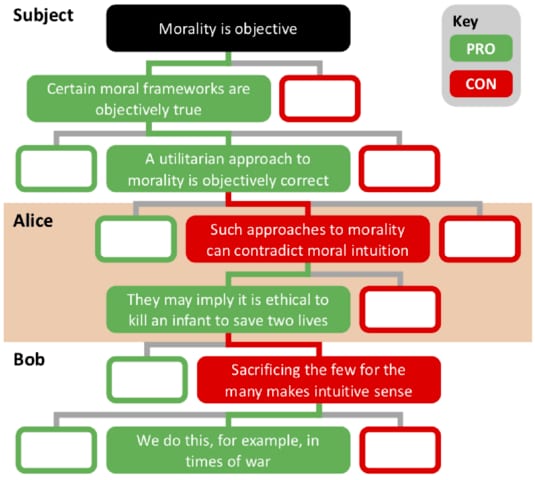
The fastest, least-headache way to do this is:
- Build everything as a simple text outline first.
- Use a tiny, consistent code for node types (Claim, Reason, Objection, Reply).
- Then, if you want visuals, mirror that outline into an Obsidian Canvas / mind map.
Here’s a concrete workflow you can reuse for any debate topic, and I’ll show it using the “logic from God” + Euthyphro stuff as the example.
1. Use a tiny argument “grammar”
Pick a small set of labels and never deviate from them:
- C = Claim (thesis or sub-thesis)
- R = Reason (support for that claim)
- O = Objection
- RR = Reply to Objection (“rebuttal of rebuttal”)
And add simple numbering: - C1, C2 …
- R1.1 = Reason 1 for Claim 1
- O1.1 = Objection to R1.1
- RR1.1.1 = Reply to Objection O1.1
Once you get used to this, your brain sees the tree just from the codes.
2. Start with a plain Markdown outline (no visuals yet)
For your specific topic, you might start like this:
C1. Logic is grounded in God (the “logic from God” thesis).
  R1.1 (Theist): Laws of logic are necessary, immaterial, and rational.
  R1.2 (Theist): Only a necessary, immaterial, rational mind (God) can ground them.
  O1.1 (You – Euthyphro-style):
       Are logical laws true because God thinks/wills them,
       or does God think them because they’re true?
    R R1.1.1 (Horn A – because God thinks them):
             Then logic depends on God’s psychology and could have been otherwise → not truly necessary.
    R R1.1.2 (Horn B – because they’re true):
             Then their truth doesn’t depend on God; God just knows already-necessary truths → God isn’t the ground.
  O1.2 (Theist): “False dilemma – logic is grounded in God’s necessary nature.”
    R R1.2.1:
             Could God’s nature have been different?
             - If yes → logic is contingent on whichever nature he had.
             - If no → some necessary structure constrains God’s nature → logic doesn’t come *from* God; God conforms to it.
  O1.3 (Theist): “You can’t even talk about truth/logic without presupposing God.”
    R R1.3.1:
             Using logic ≠ accepting your story about its metaphysics.
             I presuppose logic; you add ‘logic = God’s thoughts’.
             The Euthyphro question is an internal challenge to that extra step.
This is already a debate tree in text form. Once you have this pattern down, you can:
- Add C2: “Logic does not require God”
- Under it, add R2.1 Platonism, R2.2 Structuralism, etc., then objections and replies.
You’re training your brain to see:Claim → Reason → Objection → Reply → Objection → Reply…
like branches.
3. Turn the outline into a visual map (Obsidian Canvas style)
Now mirror that structure visually (you don’t have to do this for everything, just once or twice so your brain “gets” the shape).
Step-by-step:
- Create nodes for major claims:
- Box:
C1: Logic is grounded in God - Box:
~C1: Logic is not grounded in God
- Box:
- Branch reasons under each claim:
- From C1, create child nodes:
R1.1: Logic is necessary, immaterial, rationalR1.2: Only a necessary mind can ground such truths
- From C1, create child nodes:
- Under each reason, hang objections:
- Connected to R1.2:
O1.1: Euthyphro – because God thinks them OR God thinks them because they’re true
- Then from O1.1, hang:
RR1.1.1: If because God thinks them → logic contingentRR1.1.2: If because they’re true → logic independent of God
- Connected to R1.2:
- Color-code or shape-code:
- Claims (C) = one color
- Reasons (R) = another
- Objections (O) = another
- Replies (RR) = another
Your brain will start associating “oh, green boxes are my counters; red are the theist’s claims,” etc.
You don’t have to make it pretty. The goal is pattern recognition, not aesthetics.
4. Compress into a mental “trunk + branches” image
For memory, don’t try to store the whole tree node by node. Store:
- The trunk:
C1: “Logic comes from God” vs C2: “Logic doesn’t need God.” - Three main branches you care about:
- Euthyphro branch
- Horn A: contingent logic → bad for necessity.
- Horn B: independent truths → God not ground.
- “Grounded in God’s nature” branch
- Could nature differ? If yes, contingent.
- If no, some necessary structure constrains nature → logic independent.
- “You’re presupposing God by using logic” branch
- Distinguish using logic vs accepting logic = God’s thoughts.
- You’re making an internal critique of their own claim.
Each branch has 2–3 key bullets. That’s all you actually need in your head; the full tree is in your notes.
- Euthyphro branch
5. Add “triggers” instead of memorizing everything
You don’t need to memorize every O/RR label. You need triggers that remind you which branch to open.
Examples:
- If they say “false dilemma” → your brain goes:
“Ah, ‘grounded in God’s nature’ branch. Ask: Could God’s nature have been different?” - If they say “you presuppose God by using logic” →
“Ah, presupposition branch. Say: I presuppose logic, not your theological story about it.” - If they say “logic is identical to God’s intellect” →
“Identity branch. Say: Identity doesn’t explain necessity; it relabels it.”
You can literally write in your notes (or Canvas): - Node: “False dilemma / God’s nature” → arrow to questions:
- “Could God’s nature have been different?”
- Node: “You presuppose God” → arrow to:
- “Using logic ≠ accepting logic = God’s thoughts.”
Those little prompts are easier to remember than full paragraphs.
- “Using logic ≠ accepting logic = God’s thoughts.”
6. Practice recall in layers
Efficient retention = layered recall:
- Layer 1: Trunk only
- “Logic from God vs Logic without God.”
- Layer 2: Main branches
- Euthyphro branch
- God’s nature branch
- Presupposition branch
- Plus: a favorite positive account (e.g. Platonism or Structuralism).
- Layer 3: Each branch’s two key moves
- Euthyphro: contingent vs redundant.
- God’s nature: could have been different? If not, what constrains it?
- Presupposition: using logic vs theology of logic.
If you can recite those without notes, you’re 80% of the way there. The detailed tree in Obsidian is there when you want to review.
7. Simple template you can reuse for any topic
In your vault, create a template note:
# Debate Tree: [Topic]
C1. [Main claim you’re targeting]
  R1.1 (Opponent):
  R1.2 (Opponent):
  O1.1 (You):
    RR1.1.1 (Them):
    RR1.1.2 (You):
  O1.2 (Them):
    RR1.2.1 (You):
C2. [Your counter-claim]
  R2.1 (You):
    O2.1 (Them):
      RR2.1.1 (You):
  R2.2 (You):
    O2.2 (Them):
      RR2.2.1 (You):
Then mirror just the top three levels of that in Canvas or a mind map.
If you want, you can paste your current logic/God notes, and I can turn them into a fully structured C/R/O/RR tree in this format, so you have one master “Logic vs God” map to drop into Obsidian and canvas-ify.
Debate Tree: Logic and God as Ground of Logic
C1. Logic is grounded in God (“logic from God” thesis)
C1. The laws of logic depend on and are grounded in God (his mind/nature).
R1.1 (Opponent): Logic’s profile fits God
Laws of logic are necessary, universal, immaterial, and rational.
- Therefore they must have a ground with those properties.
- God, as a necessary, immaterial, rational mind, fits this profile.
R1.2 (Opponent): Only God can ground such truths
P1. Necessary, immaterial, rational truths require a necessary, immaterial mind.
P2. God is the only such mind.
C. Therefore, logic is grounded in God’s mind.
O1.2.1 (You – core challenge)
P1 is not obvious. There are alternative accounts (abstracta, structures, conditions of rationality) that don’t involve a mind at all, much less a divine one.
→ This opens the door for C2 and its reasons (see below).
R1.3 (Opponent): Presuppositional claim
Whenever you use logic, you presuppose God, because only God can be the ultimate standard of truth and rationality.
O1.3.1 (You)
Using logic does not equal accepting your metaphysics of logic.
- I presuppose:
- Valid inference matters.
- Contradictions are bad.
- P ∨ ¬P, etc.
- You add:
- “Those logical laws just are God’s thoughts / God’s nature.”
- That extra identification is exactly what’s in dispute.
RR1.3.1.1 (Opponent)
But without God there’s no basis for trusting reason or for objective logical norms.
RR1.3.1.2 (You)
- Distinguish:
- (a) What logical truths are (their metaphysical basis).
- (b) How reliable our faculties are in tracking them.
- The Euthyphro-style dilemma and non-theistic accounts mainly target (a).
- For (b), you can give a transcendental answer:
- Global doubt of logic is self-undermining, because any doubt uses logic.
- Trust in logic is built into the possibility of reasoning at all, not into theism specifically.
R1.4 (Opponent): “Logic is grounded in God’s nature” (third option)
You pose a false dilemma. Logical laws are neither arbitrary products of God’s will nor independent of God. They’re grounded in God’s necessary nature.
O1.4.1 (You – Euthyphro pushed down a level)
Ask:
Could God’s nature have been different?
- If yes:
- Then a different divine nature could yield different logical structure.
- That makes logic contingent on whichever nature God happens to have.
- → Logic no longer absolutely necessary.
- If no:
- There is some necessary structure that constrains what a “divine nature” can be like.
- That constraint is effectively the same sort of necessary logical/structural reality you already accept.
- → Logic (or something like it) is doing the grounding work; God conforms to it.
RR1.4.1.1 (Opponent)
God’s nature is just necessarily what it is; that’s a primitive fact.
RR1.4.1.2 (You)
- Then you’ve arrived at a brute necessity:
- “It is necessarily the case that God’s nature = logical.”
- A non-theist can equally stop at:
- “It is necessarily the case that logical structure is as it is.”
- Once you allow brute necessities, God becomes optional, not required.
R1.5 (Opponent): “Logic is identical to God’s intellect”
It’s not that God causes logical laws. Logical truths are just identical with God’s eternal, necessary intellect.
O1.5.1 (You)
Identity is not explanation.
- Saying “logical truths = God’s intellect” doesn’t show why those truths are necessary.
- The necessity resides in the structure of those truths; you’re just naming that necessary structure “God.”
- A non-theist can say:
- “There exists a necessary structure of logical truths.”
- You say: “That structure is a mind called God.”
- The explanatory work is done by the structure, not by the label.
R1.6 (Opponent): “Only a necessary mind can ground immaterial necessary truths”
Abstract objects or structures are “cold” and causally inert; only a mind can unify and ground necessary truths like the laws of logic.
O1.6.1 (You)
- Grounding here isn’t about causal power:
- God does not causally produce “P ∧ ¬P is impossible.”
- Neither do abstracta or structures.
- The question is: what makes it necessarily true? Not “who causes it”.
- You’re assuming the very premise in dispute:
- “Necessary truths require a mind.”
- That is not self-evident; it’s what you must argue for.
- Even if you insist on a mind, the Euthyphro pressure returns:
- Are logical truths what they are because of the mind’s nature?
→ Then they’re contingent on that nature. - Or is the mind’s nature constrained by logical necessity?
→ Then logic is independent; the mind just tracks it.
- Are logical truths what they are because of the mind’s nature?
R1.7 (Opponent): “Your dilemma fails because you use logic, which presupposes God”
To pose the Euthyphro-style dilemma at all, you rely on the law of non-contradiction, etc. If those are from God, you’re using God to argue against God.
O1.7.1 (You)
- Again: using logic ≠ accepting “logic = God’s thoughts.”
- The dilemma is an internal critique:
- “Given your claim that logic is from God, exactly how does that dependence work?”
- If every way they spell it out either:
- makes logic contingent, or
- makes God explanatorily redundant,
…then the “logic from God” claim fails on its own terms.
R1.8 (You – Euthyphro-style dilemma as central objection to C1)
O1.1 (Core): Are the laws of logic true because God thinks/wills them, or does God think them because they are true?
RR1.1.1 (Horn A – because God thinks/wills them)
- Then the content of logic depends on God’s psychology or will.
- If God’s mental life or will had been different, logical laws could have been different.
- That makes logic contingent, not absolutely necessary.
→ Undermines what presuppositionalists want: genuinely necessary logic.
RR1.1.2 (Horn B – because they are true)
- Then logical truths are explanatorily prior:
- They are what they are independently of God.
- God, being omniscient, knows them perfectly.
- In that case:
- God is a perfect knower of logic, not its ground.
- You can fully account for logical necessity without God; he’s an optional add-on.
→ Undercuts “without God you can’t have logic.”
C2. Logic does not require God (your counter-thesis)
C2. Logic can be necessary, objective, and non-empirical without being grounded in God.
R2.1 (You): Platonist / Fregean grounding
Logical truths are necessary facts about abstract structures (propositions, truth-values, consequence relations).
- They are mind-independent, including independent of God.
- Minds (human or divine) discover logical truths; they do not create them.
O2.1.1 (Opponent): “Abstract objects are mysterious / just atheist faith”
RR2.1.1.1 (You)
- The theistic view is no less metaphysical:
- You posit a necessary mind with necessary thoughts.
- Platonism posits necessary abstract structures.
- Both are “heavyweight” metaphysics.
- The question isn’t “which involves fewer mysteries,” but:
- Which has fewer internal problems (Euthyphro) and
- Which is actually needed as an explanation.
R2.2 (You): Transcendental / Kantian grounding
Logical laws express the forms of thought any rational agent must use to have coherent beliefs and experience.
- Logic is necessary because rationality itself demands it.
- It’s a condition on thought, not a description of God’s mind.
O2.2.1 (Opponent): “You’re smuggling in absolutes, which only make sense if they’re divine”
RR2.2.1.1 (You)
- The “absoluteness” comes from:
- “If you want any rational thought at all, these norms are non-optional.”
- That’s a transcendental “must,” not a theological one.
- Even if God exists, he would also be a rational agent operating in accordance with these norms; that doesn’t make them his creation.
R2.3 (You): Conventionalism / framework view
Logical truths are necessary relative to a chosen framework (rules for connectives, inference, etc.).
- Once you fix the rules of the system, some statements are true by definition.
O2.3.1 (Opponent): “That makes logic arbitrary or relative”
RR2.3.1.1 (You)
- Not arbitrary:
- We choose frameworks partly by pragmatic virtues: coherence, fruitfulness, non-triviality, power in modeling reality.
- Saying “valid in this framework” doesn’t mean “anything goes”; it means:
- Necessity comes from the structure of the framework, not from a divine mind.
R2.4 (You): Formalism / Structuralism
Logic is about formal structures and symbol manipulation, and about truths that hold in all models of a given kind.
- Once you fix the formal system, some formulas are true in every admissible structure.
- Their necessity is structural, not psychological.
O2.4.1 (Opponent): “Where do the structures come from?”
RR2.4.1.1 (You)
- That’s a further metaphysical question, but it doesn’t force a divine mind:
- You can be a Platonist about structures.
- Or a naturalist treating them as part of our best theories.
- In any case, positing “these structures are God’s intellect” doesn’t add explanatory power; it just re-labels the same necessary structure.
R2.5 (You): Naturalism / anti-exceptionalism
Logic is justified as part of our overall scientific worldview by the same criteria as other theories (simplicity, fit, explanatory power).
- It’s central and extremely stable, but not metaphysically special in the sense of “must be divine thoughts.”
O2.5.1 (Opponent): “Science itself presupposes God and logic”
RR2.5.1.1 (You)
- Science presupposes logic and some norms of rational inquiry, not your claim that logic is divine.
- The Euthyphro problem shows your “logic from God” story doesn’t actually secure logic; at best, it re-describes it.
- A naturalist can take logic as a highly confirmed part of the web of belief without invoking God.
R2.6 (You): Logic as norms of reasoning
Logic codifies the most general norms of correct inference in our practice of giving and asking for reasons.
- Its authority comes from the nature of rational discourse itself.
O2.6.1 (Opponent): “Who decides which norms are correct without God?”
RR2.6.1.1 (You)
- Norms are constrained by:
- avoiding triviality,
- preserving coherence,
- enabling communication and error-correction.
- Those constraints are conceptual and practical, not theological.
R2.7 (You): Logical pluralism
There may be more than one legitimate logic (classical, intuitionistic, relevant, paraconsistent, etc.), suited to different domains and aims.
- Logic is more like a toolbox than a single divine operating system.
O2.7.1 (Opponent): “That’s incoherent relativism”
RR2.7.1.1 (You)
- Pluralism isn’t “anything goes”; it’s:
- Different consequence relations are appropriate under different constraints.
- Like using different geometries (Euclidean vs non-Euclidean) in different contexts.
- Presuppositional arguments often presuppose:
- One monolithic logic,
- which must be grounded in one monolithic divine mind.
- Pluralism calls that assumption into question:
- Before arguing “logic ⇒ God,” you’d have to show:
- There is exactly one true logic.
- It is classical.
- Its correctness requires a divine mind.
- None of that follows just from “we use logic.”
- Before arguing “logic ⇒ God,” you’d have to show:
If you mirror this into a Canvas, you can:
- Put C1 and C2 as the two big roots.
- Hang R- and O-nodes underneath.
- Use colors/shapes for:
- Claims (C)
- Reasons (R)
- Objections (O)
- Replies (RR)
Then practice recalling:
- The trunk: C1 vs C2.
- Three main branches you’ll use most:
- Euthyphro (O1.1 + RR1.1.*),
- “God’s nature” (O1.4),
- “You presuppose God” (O1.3).
- One or two positive accounts you prefer (e.g. R2.1 Platonism, R2.4 Structuralism).
Visual