If Islam were a Violent Religion Then All Muslims Would Be Violent
The Game:
Most Muslims live peacefully, without harming anyone, so how can Islam be a violent religion?
If Islam were the religion of terrorists then why aren’t most Muslims terrorists?
The Truth:
This argument presumes that it is valid to make assumptions about an ideology based on the behavior of adherents. However, if this were the case, then we would have to conclude that Islam is different and dangerous. True, most Muslims are not terrorists, but most terrorists are Muslim. If Islam is a religion of peace, why is it the only one that consistently produces religiously-motivated terrorist attacks each and every day of the year?
Rather than answer a question with a question, let’s just say that the reason most Muslims don’t kill is that, regardless of what Islam may or may not teach, it’s wrong to kill over religion. Most people know deep down that if God wanted people dead for not believing in Him, then He’s perfectly capable of doing the job Himself.
Here’s a similar question with identical logic to the “If the Quran taught violence then all Muslims would be violent” argument:
“If the Quran taught that a thief’s hand should be cut off, then all Muslims would cut off hands.”
We can all agree that very few Muslims cut off hands and that a majority (perhaps) believe it is wrong to do so. If the logic were sound, then this would be proof that the Quran does not say to cut off hands.
But the Quran does say this… quite explicitly, in fact:
Cut off the hand of the thief, male or female, as a recompense for that which they committed, a punishment by way of example from Allah. Quran 5:38
This is also the example set by Muhammad according to the Hadith (Bukhari 81:792). Yet, the vast majority of Muslims do not do this.
What this means is that proof of what Islam teaches or what the Quran says is not necessarily found in what the majority of Muslims choose to do or not do.
As individuals, Muslims make their own choices about which parts of their religion they practice and which parts they would rather dismiss via the guise of “context”.
Adherents may think or say whatever they want to about Islam, it doesn’t change what Islam says about itself. As a documented ideology, Islam exists independently of anyone’s opinion. As such, it may be studied objectively, apart from how anyone practices or chooses to interpret it.
The Quran plainly teaches that it is not only proper to kill in the name of Allah in certain circumstances, but that it is required. Muslims who don’t believe in killing over religion either do not know of Muhammad’s example or tacitly prefer a moral law that is independent of it. Those who put Islam first or know Islam best will think and act differently, even if they are in the minority.
Few Muslims have ever read the Quran to any extent, much less pursued an honest investigation of the actual words and deeds of Muhammad (which were more in line with hedonism, deception, power and violence than moral restraint). The harsh rules that Muslim countries impose on free speech to protect Islam from examination also prevent it from being fully understood.
As Taslima Nasreen succinctly puts it, “Islam is a violent ideology. Most Muslims are not violent - because they believe Islam is not violent.”
In the West, many Muslims, devout or otherwise, simply prefer to believe that Islam is aligned with the Judeo-Christian principles of peace and tolerance, even if it requires filtering evidence to the contrary. They read into the Quran what they want to see.
But, while most Muslims are peaceful in spite of Islam, others are dangerous because of it. It is what some of us comfortably refer to as “radicalization” - an ‘affliction’ that is conspicuously endemic to Islam.
Purists who take Islam to heart are more likely to become terrorists than humanitarians. Those most prone to abandoning themselves to Muhammad’s message without a moral filter are always the more dangerous and supremacist-minded. They may be called ‘extremists’ or ‘fundamentalists,’ but, at the end of the day, they are dedicated to the Quran and the path of Jihad as mandated by Muhammad.
This explains why Islam is a constant challenge that becomes harder to deal with as the number of Muslims increases.
[Note: Christian apologist, David Wood, makes a compelling point about the distinction between a religious command and obedience. No Christian is perfect, he says, but this doesn’t change the fact that they are told to be (Matthew 5:48).]
Further Reading
Ending the Myth of the Poor Terrorist (Tablet Magazine)
Other Religions Kill Too
The Game:
Bringing other religions down to the level of Islam is a favorite tactic of apologists confronted with the spectacle of Islamic violence. Remember Timothy McVeigh, the Oklahoma City bomber? How about Anders Breivik, the Norwegian killer? Why pick on Islam if other religions have the same problems?
The Truth:
Because they don’t have the same problem.
Timothy McVeigh is a good example of how the game works. Since his birth certificate says he was Catholic, Muslim apologists will say that he was a “Christian terrorist.” Whatever objections are raised to this (ie. against the teachings) are then said to exonerate Islam as well, since it is also a religion. This is a logical error called a “faulty generalization.” It is a conclusion based on insufficient premises.
In reality, details are important. Regardless of what his birth certificate may or may not say, McVeigh was not a religious man (in fact, he stated explicitly that he was agnostic and that “science” was his religion). At no time did he credit his deeds to religion, quote Bible verses, or claim that he killed for Jesus. His motives are very well documented through interviews and research. God is never mentioned.
The so-called “members of other faiths” alluded to by Muslims are nearly always just nominal members with no active involvement. They are neither inspired by, nor do they credit religion as Muslim terrorists do - and this is what makes it a very different matter.
Islam is associated with Islamic terrorism because that is the association that the terrorists themselves make.
Muslims who compare crime committed by people who happen to be nominal members of other religions to terror committed explicitly in the name of Islam are comparing apples to oranges.
Yes, people do sometimes die in the name of other religions - such as abortion clinic attacks in the US - but consider the scope of the problem. For example, there have been seven deadly clinic attacks over a 44 year period in the U.S. Eleven people died. This is an average of one death every 4 years.
By contrast, Islamic terrorists staged nearly ten thousand deadly attacks in just the six years following September 11th, 2001. If one goes back to 1971, when Muslim armies in Bangladesh began the mass slaughter of Hindus, through the years of Jihad in the Sudan, Kashmir and Algeria, and the present-day Sunni-Shia violence in Iraq, the number of innocents killed in the name of Islam probably exceeds five million over this same period.
Anders Breivik, who murdered 77 innocents in a lone rampage on July 22nd, 2011, was originally misidentified as a “Christian fundamentalist” by the police. In fact, the killings were later determined to be politically motivated. He also left behind a detailed 1500 page manifesto in which he stated that he is not religious, does not know if God exists, and prefers a secular state to a theocracy. Needless to say, he does not quote any Bible verses that support his killing spree, nor did he shout “praise the Lord” as he picked people off.
In the last ten years, there have been perhaps a few dozen attacks in which death occurred at the hands of outliers motivated by a religion other than Islam (see GTD). Such a small handful of loners acting in isolation can legitimately be chalked up to mental illness or (at best) genuine misunderstanding.
By contrast, Islamic terror is organized and methodical. Islamist groups span the globe with tens of thousands of dedicated members, despite intensely targeted counter-measures. Supporters number in the tens of millions. They are open about their religious goals and they kill in the name of Allah each and every day of the year. Verses in their holy texts arguably support them. There are no video debates where they are challenged on theology by “moderates.”
No other religion is doing this. So, while some Muslims may pretend that other religions are just as prone to “misinterpretation” as is their “perfect” one, reality says otherwise.
Where Does the Quran Say to Kill Innocent People?
The Game:
The Quran never says to kill innocent people
The Truth:
Yes, the Quran never says to kill innocent people. Unfortunately, it does say that people who don’t follow Allah’s Law are not innocent - even if they are outwardly Muslim… and it does say to kill them.
This is explained in this article: Myth - It is Against Islam to Kill Innocent People
So, if a Muslim apologist asks where the Quran says to kill “innocent people,” ask where the Quran states that non-believers are innocent - since it also says that they are being sent to Hell.
The Quran Says that There Can be No Compulsion in Religion
The Game:
Verse 2:256 from the Quran is often quoted to prove what a tolerant religion Islam is. The verse (supposedly) reads in part, “Let there be no compulsion in religion; truth stands out clearly from error…”
The Truth:
The word “let” is not in the Arabic, so the verse is not an imperative. What it actually says is “there is no compulsion in religion…” It is a statement that true belief can’t be forced. However, this is not to say that others can’t be forced into an outward manifestation of faith, such as the pillars of Islam:
Allah’s Apostle (Muhammad) said, “I have been ordered to fight the people till they say: ‘None has the right to be worshipped but Allah’. And if they say so, pray like our prayers, face our Qibla and slaughter as we slaughter, then their blood and property will be sacred to us and we will not interfere with them except legally.” Bukhari 8:387
Even within the same sura (chapter) of the Quran that verse 256 appears, Muslims are instructed to “fight with them (non-Muslims) until there is no more persecution and religion is only for Allah. (v. 2:193)” Apologists claim that this applied to the people of Mecca. This is interesting because these same Meccans were later converted to Islam by force (compulsion).
Sura 2 is from the early Medinan period. It was narrated at a time when the Muslims had just arrived in Medina after being chased out of Mecca. They needed to stay in the good graces of the stronger tribes around them, many of which were Jewish. It was around this time, for example, that Muhammad decided to have his followers change the direction of their prayer from Mecca to Jerusalem.
But Muslims today pray toward Mecca. This is because Muhammad Allah issued a later command that abrogated (or nullified) the first. In fact, abrogation is a very important principle to keep in mind when interpreting the Quran – and verse 2:256 in particular – because later verses (in chronological terms) are said to abrogate any earlier ones that may be in contradiction (Quran 2:106, 16:101).
Muhammad’s message was far closer to peace and tolerance during his early years, when he didn’t have an army and was trying to pattern his new religion after Christianity. This changed dramatically after he attained the power to conquer, which he eventually used with impunity to bring other tribes into the Muslim fold. Contrast verse 2:256 with Suras 9 and 5, which were the last “revealed,” and it is easy to see why Islam has been anything but a religion of peace from the time of Muhammad to the present day.
Though most Muslims today reject the practice of outright forcing others into changing their religion, forced conversion has been a part of Islamic history since Muhammad first picked up a sword. As he is recorded in many places as saying, “I have been commanded to fight against people till they testify that there is no god but Allah, that Muhammad is the messenger of Allah…” (See Bukhari 1.2.24)
Muhammad put his words into practice. When he marched into Mecca with an army, one of his very first tasks was to destroy idols at the Kaaba, which had been devoutly worshipped by the Arabs for centuries. By eliminating these objects of worship, he destroyed the religion of the people and supplanted it with his own. Those who would not convert were killed or evicted. Later, he ordered that Jews and Christians be expelled from Arabia. Does forcing others to choose between their homes or their faith sound like “no compulsion in religion?”
According to Muslim historians, Muhammad eventually ordered people to attend prayers at the mosque to the point of burning alive those who failed to comply. He also ordered that children who reached a certain age be beaten if they refused to pray.
Interestingly, even the same contemporary Muslims who quote 2:256 usually believe in Islamic teachings that sound very much like religious compulsion. These would be the laws punishing apostasy by death (or imprisonment, for females), and the institutionalized discrimination against religious minorities under Islamic rule that is sometimes referred to as “dhimmiitude.”
Islamic law explicitly prohibits non-Muslims from sharing their faith and even includes the extortion of money from them in the form of a tax called the jizya. Those who refuse to pay this arbitrary amount are put to death. If this isn’t compulsion, then what is?
Further Reading
Muhammad and Forced Conversions (Raymond Ibrahim)
The Crusades
The Game:
Muslims love talking about the Crusades… and Christians love apologizing for them. To hear both parties tell the story, one would think that Muslims were just peacefully minding their own business in lands that were legitimately Muslim when Christian armies decided to wage holy war and “kill millions.”
The Truth:
Every part of this myth is a lie. By the rules that Muslims often claim for themselves, the Crusades were justified. The excesses (though well beneath Christian standards) pale in comparison with the historical treatment of conquered populations at the hands of Muslims.
Here are some quick facts…
The first Crusade began in 1095… 460 years after the first Christian city was overrun by Muslim armies, 457 years after Jerusalem was conquered by Muslim armies, 453 years afterEgypt was taken by Muslim armies, 443 after Muslims first plundered Italy, 427 years afterMuslim armies first laid siege to the Christian capital of Constantinople, 380 years afterSpain was conquered by Muslim armies, 363 years after France was first attacked by Muslim armies, 249 years after the capital of the Christian world, Rome itself, was attacked by a Muslim army, and only after centuries of church burnings, killings, enslavement and forced conversions of Christians.
By the time the Crusades finally began, Muslim armies had conquered two-thirds of the Christian world.
Europe had been harassed by Muslim aggression since the first few years following Muhammad’s death. As early as 652, Muhammad’s followers launched raids on the island of Sicily, waging a full-scale occupation 200 years later that lasted almost a century and was punctuated by massacres, such as that at the town of Castrogiovanni, in which 8,000 Christians were put to death. In 1084, ten years before the first crusade, Muslims staged another devastating Sicilian raid, burning churches in Reggio, enslaving monks and raping an abbey of nuns before carrying them into captivity.
In 1095, Byzantine Emperor, Alexius I Comneus began begging the pope in Rome for help in turning back the Muslim armies which were overrunning what is now Turkey, grabbing property as they went and turning churches into mosques. Several hundred thousand Christians had been killed in Anatolia alone in the decades following 1050 by Seljuk invaders interested in ‘converting’ the survivors to Islam.
Not only were Christians losing their lives in their own lands to the Muslim advance, but pilgrims to the Holy Land from other parts of Europe were being harassed, kidnapped, molested, forcibly converted to Islam and occasionally murdered. (Compare this to the Quran’s justification for slaughter on the simple basis that Muslims were denied access to the Meccan pilgrimage).
Renowned scholar Bernard Lewis points out that the Crusades, though “often compared with the Muslim jihad, was a delayed and limited response to the jihad and in part also an imitation… Forgiveness for sins to those who fought in defense of the holy Church of God and the Christian religion and polity, and eternal life for those fighting the infidel: these ideas… clearly reflect the Muslim notion of jihad.”
Lewis goes on to state that, “unlike the jihad, it [the Crusade] was concerned primarily with the defense or reconquest of threatened or lost Christian territory… The Muslim jihad, in contrast, was perceived as unlimited, as a religious obligation that would continue until all the world had either adopted the Muslim faith or submitted to Muslim rule… The object of jihad is to bring the whole world under Islamic law.”
If someone takes your wallet and you take it back, who is the real thief?
The Crusaders only invaded lands that had been Christian. They did not attack Saudi Arabia (other than a half-hearted expedition by a minor figure) or sack Mecca, as the Muslims had done (and continued doing) to Rome and Constantinople. Their primary goal was the recapture of Jerusalem and the security of safe passage for pilgrims. The toppling of the Muslim empire was not on the agenda.
The period of Crusader “occupation” (of its own former land) was stretched tenuously over about 170 years, which is less than the Muslim occupation of Sicily and southern Italy alone - to say nothing of Spain, Bulgaria and other lands that had never been Islamic before falling victim to Jihad. In fact, the Arab occupation of North Africa and Middle Eastern lands outside of Arabia is almost 1400 years old.
Despite popular depiction, the Crusades were not a titanic battle between Christianity and Islam. Although originally dispatched by papal decree, the “occupiers” quickly became part of the political and economic fabric of the Middle East without much regard for religious differences. Their arrival was largely accepted by the local population as simply another change in authority. Islamic radicals even lamented the fact that many of their co-religionists preferred to live under Frankish (Christian) rule than migrate to Muslim lands.
The Muslim world was also split into warring factions, many of which allied themselves with the Frankish princes against each other at one time or another. This even included Saladin, the Kurdish warrior who is credited with eventually ousting the “Crusaders.” Contrary to recent propaganda, however, Saladin had little interest in holy war until a rogue Frankish prince began disrupting his trade routes. Both before and after the taking of Jerusalem, his armies spent far more time and resources battling fellow Muslims.
For its part, the Byzantine (Eastern Christian) Empire preferred to have little to do with the Crusader kingdoms and went so far as to sign treaties with their Muslim rivals on occasion.
Another misconception is that the Crusader era was a time of constant war. In fact, very little of this overall period included significant hostilities. In response to Muslim expansion or aggression, there were only about 20 years of actual military campaigning, much of which was spent on organization and travel. (They were from 1098-1099, 1146-1148, 1188-1192, 1201-1204, 1218-1221, 1228-1229, and 1248-1250). By comparison, the Muslim Jihad against the island of Sicily alone lasted 75 grinding years.
Ironically, the Crusades can be justified from the Quran itself, which encourages Holy War in order to “drive them out of the places from whence they drove you out” (2:191). However, in this case the objective wasn’t to expel Muslims from the Middle East, but to bring an end to the molestation of pilgrims. Holy war is not justified by New Testament teachings, which is why the Crusades are an anomaly, the brief interruption of centuries of relentless Jihad against Christianity that began long before and continued well after that event.
The greatest crime of the Crusaders was the sacking of Jerusalem, in which at least 3,000 people were said to have been massacred. This number is dwarfed by the number of Jihad victims, from India to Constantinople, Africa and Narbonne, but followers of Islam have never apologized for their crimes and never will.
What is called ‘sin and excess’ by other religions, is what Islam refers to as duty willed by Allah.
Further Reading
Yes, Italy Should Remember Its Past with Islam
Just War vs. Plain-Old Jihad (Raymond Ibrahim)
The Andalusian Paradise (Tolerance in Muslim Spain
Andalusia-Myth.pdf (file not included in this release)
Muhammad Never Killed Anyone
The Game:
Muslims sometimes claim that Muhammad never killed anyone. By this, they usually mean that he never slew anyone with his own hand (except in battle… which they may or may not remember to mention).
The Truth:
By this logic, Hitler never killed anyone either.
Obviously, if you order the execution of prisoners or the murder of critics by those who are under your command, then you are at least as guilty as those who carry out your orders. In Muhammad’s case, the number of people that he had murdered were literally too many for historians to fully know.
There were the men taken prisoner at Badr (including one who cried out for his children at the point of execution), a mother of five (stabbed to death for questioning Muhammad’s claim to be a prophet), dozens of Jewish citizens, including poets and merchants who were accused of mocking Islam, numerous adulterers, at least one slave girl, 800 Qurayza men and boys taken captive and beheaded on Muhammad’s order, a Qurayza woman made delirious by the execution of her family, and an unfortunate individual who was tortured to death so that the prophet of Islam could discover his hidden treasure and then “marry” his freshly-widowed wife.
Indirectly, Muhammad is also responsible for the millions upon millions of people who have been slaughtered down through the centuries by those carrying on his legacy of Jihad. Not only did he kill, he is truly one of the bloodiest figures in history.
The Quran Teaches that All Life is Sacred
The Game:
Verse 5:32 promotes a universal principal that all life is sacred to Allah. It says “If any one slew a person… it would be as if he slew a whole people; and if any one saved a life, it would be as if he saved the life of a whole people…”
The Truth:
This fragment of verse 5:32 appears above as it was quoted by the Fiqh Council of North America. It is what apologists want non-Muslims to believe is in the Quran, as opposed to the dozens of other open-ended passages that command warfare, beheadings and torture. But even this quote from verse 5:32 isn’t quite how it appears. It leaves out a few words.
Here’s the full text of the verse:
“On that account: We ordained for the Children of Israel that if any one slew a person - unless it be for murder or for spreading mischief in the land - it would be as if he slew the whole people: and if any one saved a life, it would be as if he saved the life of the whole people. Then although there came to them Our messengers with clear signs, yet, even after that, many of them continued to commit excesses in the land.”
First, notice the gaping loophole. Killing is allowed in cases of murder or “for spreading mischief in the land.” Murder is pretty straightforward, but “spreading mischief” is a bit ambiguous. There are varying interpretations of what this means. However, violating Sharia (Islamic law) or sharing a different religious faith appears to qualify. Verse 7:103 of the Quran even indicates that merely rejecting Muhammad and the Quran counts as “mischief”.
Secondly, note the broader context of this verse. It turns out that this isn’t a divine command to Muslims after all. It’s a recounting of a rule that was given to the Jewish people (lifted from the Talmud, in fact). It isn’t an admonition against killing. It’s an imagined indictment against the Jews for violating the law given to them. “Any one” doesn’t mean “anyone,” but rather any one of the Jews.
Any application to Muslims would have to apply only to Muslims - as in Muslim-on-Muslim murder within the brotherhood of believers. In fact, the context of the verse is the murder of Abel by Cain. Historically, this verse has never been interpreted by Islamic scholars to mean that Allah places equal value on the lives of non-Muslims. The Quran says that restitution for murder is bound by the law of equality (2:178) and that non-believers are not equal to Muslims (39:9). Muhammad affirmed that while a Muslim may be punished with death for killing a fellow Muslim, they should never be slain for killing a non-believer.
Rather than encouraging tolerance, Sura 5 as a whole is actually an incitement of hatred with a hint of violence. Later in the chapter, Jews and Christians are explicitly cursed as ‘wicked’ people with ‘diseased hearts’ and as hateful ‘blasphemers’ respectively. Muhammad goes on to coyly remind his people that Allah loves those who “fight” in his service - and it’s fairly obvious who the enemy is.
Muslim apologists will also rarely mention that 5:32 is immediately followed by a gruesome verse which actually mandates killing in the case of the aforementioned “mischief” - and this isn’t pulled from the Talmud. It even suggests crucifixion and “the cutting off of hands and feet from opposite sides.” (This injunction is dutifully followed by ISIS)
Although verse 5:32 recounts the law given to Jews, the verse that follows is clearly intended for Muslims. (It is as if the New Testament had Jesus saying, “You have heard it said that all life is sacred, but I tell you that those who wage war against God should be crucified…”)
Verse 5:33 provides the basis for blasphemy laws, in which people are executed for insulting or questioning Islam. Ironically then, the very part of the Quran that apologists use to portray Islam as a non-violent religion has long been used as justification for making verbal offense into a capital crime.
So, the Quran’s best example of moral instruction is a passage which actually mandates the torture and execution of those deemed a threat to Islamic hegemony…
With this being the best that Islam has to offer, it’s not hard to guess why the religion contributes over a thousand deadly terrorist attacks to the world each and every year.
Further Reading
The Most Violent and Awkward Verse of the Quran (Apostate Prophet video)
Muslims are Only to Kill in Self-Defense
The Game:
Muslims are only allowed to kill in self-defense (ie. when their lives are at immediate risk).
The Truth:
This game involves finding a verse from the Quran that authorizes fighting in self-defense, and then ignoring others. It is sometimes bolstered by disingenuously slipping in the word “only” to make it appear as if fighting for Allah is limited by this condition.
The Quran certainly gives Muslims permission to fight in self-defense, but it is not the only circumstance under which they may take the lives of others. Fighting is urged in other places “until all religion is for Allah”. The faithful are told to fight unbelievers who offer resistance to Islamic rule until they are subjugated.
The myth of killing only in self-defense is easily disproven from the accounts of Muhammad’s own life. His career of violence began with raids on merchant caravanstraveling between Syria and Mecca. His men would sneak up on unsuspecting drivers and kill those who defended their goods. There was no self-defense involved (on the part of the Muslims, at least). This was old-fashioned armed robbery and murder – sanctioned by Allah (according to Muhammad, who also demanded a fifth of the loot for himself).
The first true battle that Muhammad fought was at Badr, when a Meccan army of 300 was sent out to protect the caravans from Muslim raids. The Meccans did not threaten Muhammad, and (turning this Muslim myth on its ear) only fought in self-defense after _they_were attacked by the Muslims. Following the battle, Muhammad established the practice of executing surrendered captives – something that would be repeated on many other occasions.
The significance of this episode can hardly be overstated, because it set in motion a long chain of Muslim violence that eventually passed through the heart of America on 9/11. The early Muslims were not being threatened by those whom they attacked, and certainly not by those whom they had captured. They staged aggressive raids to eventually provoke war, just as al-Qaeda attempts to do in our time.
Muslims try to justify Muhammad’s violence by claiming that he and his followers “suffered persecution” at the hands of the Meccans in earlier episodes. It is true that Muhammad was evicted from the city of Mecca and had to seek refuge at Medina. But even the worst of this persecution did not rise to the level of killing. Nor were Muhammad and his Muslims in any danger in their new home at Medina. They were free to get on with their lives.
Even Muhammad’s own men evidently questioned whether they should be pursuing and killing people who did not pose a threat to them, since it seemed to contradict earlier, more passive teachings. To convince them, Muhammad passed along a timely revelation from Allah stating that “the persecution of Muslims is worse than slaughter [of non-Muslims]” (Sura 2:191). This verse established the tacit principle that the authority of Muslims is of higher value than the very lives of unbelievers. There is no larger context of morality against which acts are judged. All that matters is how an event impacts or benefits Muslims who follow Islam.
Under Muhammad, slaves and poets were executed, captives were beheaded and adulterers were put into the ground and stoned. None of this was during the heat of battle or necessitated by self-defense.
In addition to the Quran’s instruction of violence against unbelievers and non-practicing Muslims (Sura 9), Islamic law mandates death for certain crimes such as blasphemy and apostasy. How does killing a blasphemer, an adulterer or someone who leaves Islam qualify as self defense?
Following his death, Muhammad’s companions stormed the Christian world - taking the Middle East, North Africa and parts of Europe. They attacked and conquered to the east as well, including Persia, Central Asia, and the Indian sub-continent. Few, if any, of these campaigns involved even the pretense of self-defense. They were about Jihad.
Verse of Violence are Taken Out of Context
The Game:
_All verses of violence were issued during times of war. Critics engage in “cherry-picking” (pulling verses out of context to support a position, and ignoring others) to discredit Islam.
This leaves the impression that the Quran is full of verses of peace, tolerance and universal brotherhood, with only a small handful that say otherwise. The “exceptions” are embedded in context with obvious constraints that bind them to a particular place and time (as is usually the case with violent passages from the Old Testament)._
The Truth:
It isn’t the verses of violence that are rare; it’s the ones of peace and tolerance. The latter were also narrated at an earlier time in Muhammad’s life and superseded by what came later. Neither is the “historical context” of these verses of violence all that obvious from the surrounding text in many cases.
The last chapters of the Quran to be narrated by Muhammad are the more violent. Also, the historical context is that Muslims had total power at the time and were not being persecuted or attacked. In fact, these verses order believers to “be harsh” to the unbelievers and Muslims who are peaceful or non-practicing (verse 9:73), and even to fight Christians and Jews into a state of submission (verse 9:29). Nothing in the text to indicates that this is based on anything other than their status as non-Muslim.
These are not the teachings of a religion of peace. Thus, the apologists are forced to play games, such as “inventing” historical context, pulling “textual context” from an entirely different part of the Quran, or pretending that the true meaning can’t be translated to non-Arabic speakers (or to non-Muslims, when native Arabic speakers agree with the translation, as they usually do).
A perfect book from a perfect god should be easy to understand. In the Quran, constructs and topics are jumbled into a random mess, with little consistency or coherent stream of thought. This is underscored by the fact that Qurans are almost always printed with extensive commentary, which often exceeds the size of the original “revelation.” In other words, it takes more space to explain what Allah is really trying to say.
Although Muslim apologists often mitigate verses of violence with non-intuitive references to passages in other parts of the Quran, not all believers are as determined to force the word of Allah into a separate moral framework. It is unclear why a perfect book from a perfect god would so often leave sensitive topics like killing and child rape open to interpretation.
Back to historical context. It’s true that references to the external Hadith and early biographies of Muhammad’s life determine when a Quranic verse was narrated and what it may have meant to Muslims at the time. This lets apologists opportunistically dismiss passages they don’t like by insisting that they are really just a part of history and not intended to be present-day imperatives.
But “historical context” cuts both ways. If any verse is a product of history, then they all are. Indeed, there is not a verse in the Quran which was not given at a particular time to address a particular situation in Muhammad’s life, whether he wanted to conquer the tribe next door and needed a “revelation” from Allah spurring his people to war, or if he needed the same type of “revelation” to satisfy a lust for more women (free of complaint from his existing stable of wives).
Here is the irony of the “cherry-picking” argument: Those who use “historical context” against their detractors nearly always engage in cherry-picking of their own by choosing which verses they apply “historical context” to and which they prefer to hold above such tactics of mitigation.
‘Context’ may be the most popular and disingenuous game that Muslims like to play. Simply put, the apologists appeal to context only when they want it to be there. They ignore context when it proves inconvenient. An example of the latter would be the many times in which verse 2:256 is isolated and offered as proof of religious tolerance (in contradiction to Muhammad’s later imposition of jizya and the sword).
Islamic purists do not engage in such games. Not only do they know that verses of Jihad are more numerous and authoritative (abrogating earlier verses), they hold the entire Quran to be the eternal and literal word of Allah… and this is what often makes them so dangerous.
Islam Must be True Because it is the Fastest Growing Religion
The Game:
How can Islam be a bad religion if it is growing so fast? Doesn’t this mean that it is actually a truthful religion, since so many are accepting it?
The Truth:
In the first place, the truth of an idea or doctrine is never established by mere belief or majority opinion. Up until the last hundred years or so, the vast majority of people on our planet did not even believe that they were on a planet. Nor did they believe that the earth was spinning at a thousand miles an hour or hurtling around the sun at 67,000 miles an hour. Does this mean that the earth wasn’t doing these things up until people believed that it was?
Secondly, Islam is not “growing faster” than other religions because of conversion, but because the birthrate (Pew: 2017 & 2021) among Muslims is significantly higher than it is among nominal Christians and others(2.9 vs 2.6 per woman), particularly in the West, where it is nearly twice as high. Kids can be raised to believe just about anything, so growth from a higher birthrate hardly constitutes a genuine accomplishment.
In fact, there is a negative correlation between birthrate and progress. Birthrates drop as a society develops economically and socially. Wealthier, more advanced countries provide equal educational and career opportunities for women, for example, which enable them to delay starting families. Even within Islam, the more developed populations have lower birthrates. So, it is ironic that what is often touted as Islam’s biggest “success” is more of an indicator of how it lags.
This is also true with regard to the growth of Islam in the West, which is due almost entirely to migration. Migration always flows from Muslim countries into non-Muslim rather than vice versa. Again, this is nothing to be proud of, because it means that Islamic countries are less attractive and less tolerant. Rising social dysfunction and the gradual decline in quality of life in areas where Islam takes hold argue against the claim that it is the “true religion.”
A 2011 Pew Research study of global Muslim growth rates concluded that there is “no net growth through conversion”, meaning that for every person who “embraces” Islam (usually a woman who changes her affiliation after marrying a Muslim man) there is at least one other who is willing to leave the faith despite harsh consequences. A 2019 study found Islam declining in the Arab world.
Of the so-called “converts” from other religions, only a miniscule number were active believers. Nearly all are just people who had no real faith to convert from – regardless of their nominal designation. In the West and other parts of the non-Muslim world in which all religions are allowed to compete equally, such people experiencing a spiritual awakening are far more likely to turn to Christianity than Islam.
This leads to a very important point, which is that decent Muslims should feel a sense of embarrassment rather than pride over the rules they have to impose to maintain Islam’s status as the “fastest growing religion.” In truth, it speaks more to the insecurity that Muslims have about their religion - and the banal immaturity of Islam compared with other faiths.
Let’s say that you are playing chess with a 6-year-old girl. Instead of following the same set of rules, however, the child is allowed to make up rules that are preferential to herself. One of the rules, she decides, is that you aren’t allowed to make any moves on her half of the board, but she is allowed to make moves on yours. Another might be that it is impossible for any of her pieces to be taken.
Now, if the child is winning the game – which is assured by the conditions she has imposed - is it really something in which she can truly take pride?
The rules that Muslims impose on the “conversion game” are almost exactly like this chess analogy. Other religions are not allowed to operate in Islam’s own territory (ie. preaching their faith and evangelizing) as Muslims are in others. Neither is conversion away from Islam allowed – on penalty of death.
In the Muslim world, Christians who evangelize are imprisoned, assaulted, beaten, set on fire, shot, bludgeoned, and tortured by Islamists. Missionaries are raped and killed. Former Muslims who embrace Christianity as their religion of choice are thrown in jail along with their children, sexually assaulted, crippled, hanged, stoned, stabbed, dismembered, carved up, scalded, beheaded, poisoned, brutalized, doused with acid, burned alive and publicly executed…
…and Muslims brag that their religion is growing faster!
Muslims who gloat over their “fast growing” religion are no different than the child from our example who deludes herself into thinking that she is smarter and better for “beating” a much wiser adult in a game played under manufactured conditions that render the artificial “victory” entirely meaningless.
So the more pertinent question isn’t which religion is growing faster, but which is growing faster where people are free to choose. In this environment, Christianity (and ‘non-belief in any religion’) win easily. Converts are even won in Muslim countries under draconian conditions that Muslim evangelists never have to face anywhere on the planet. When was the last time a person was killed or tortured merely for embracing Islam?
Islam has been playing by these rules since its inception. It is unlikely that Muslims will soon develop the maturity and confidence in Islam to lift the shameful restrictions to which it owes its artificial success, nor risk competition with other faiths on a level playing field.
As was first mentioned, the truth of a belief or creed is never established by how many followers it has (by that standard, Christianity would be true). But when a religion has to be supported by double standards, death threats and violence there is all the more reason to doubt its veracity.
Further Reading
Although the video is no longer available, Dr. Wood points out that the higher Muslim birthrate can be attributed to discrimination against women in Islamic countries. He also clarifies the true argument of those who insist that Islam’s rate of growth makes it the “true religion” at about the 8 minute mark:
See Islam is not the Fastest Growing Religion in the World or “Fastest Shrinking Religion” for other viewpoints as to whether Islam really is growing faster.
List of Converts to Christianity from Islam (Wikipedia)
Muslims are Converting to Christianity in Record Numbers
Islam: The Fastest Breeding Religion (Apostate Prophet)
Nuances Behind Islam’s “Growth” (World)
The Quran Can Only be Understood in Arabic
The Game:
The Quran can only be fully understood in Arabic. One cannot criticize Islam without knowing Arabic
The Truth:
Critics of Islam are often told to “read the Quran” by those who are usually unprepared for what happens when their advice is heeded. An honest translation of Islam’s most sacred book generally reinforces negative opinion. The fallback is to then claim that the Quran can only be understood in Arabic.
This transparent effort to cloak Islam from intellectual critique isn’t well thought out. In the first place, the Quran was translated from Arabic by Arabic speakers: devout Muslims whose linguistic expertise far exceeds that of the armchair apologist. If these translators err, it is by subjectively toning down the literalism. The idea that they would deliberately mangle an interpretation to cast Islam in an unflattering light is highly unlikely.
Another problem is the fundamental impossibilty for anyone to learn a language that cannot be translated into one they do know, which means the apologists who insist that one “must learn Arabic” in order to understand the Quran are refuting their own premise. If Arabic can be learned, then it can be translated. If it can be translated, then there is no need to learn it.
While every language has its nuances, how is it that Arabic is the only one which supposedly has words and phrases that are literally untranslatable? More importantly, why in the world would Allah choose to communicate his one true “universal” religion for all people in the only language that cannot be translated for all people? Even the vast majority of Muslims and their imams do not speak Arabic.
How suspicious that this linguistic “discovery” was made only recently – and that it coincides with contemporary rejection of Islamic practices which were considered acceptable up until Islam’s recent collision with Western liberalism. In fact, the argument that there are hidden and alternate meanings to unflattering Quranic passages (eg. justifying slavery, the inferior status of women, sexual gluttony, holy warfare, wife-beating, and religious discrimination) corresponds with the level of embarrassment that modern scholars have about such verses being in the Quran!
No other world religion claims that it can only be understood in one language. Neither is the same level of effort required to explain away primary messages. While the Bible is generally distributed “as is” by various Christian groups, for example, it is rare to find a Quran that does not include voluminous and highly subjective commentary intended to mitigate politically-incorrect passages.
An additional problem is that apologists want to have it both ways. On the one hand, they declare that (for some strange reason) the “perfect book” can’t be translated and that Allah’s perfect religion thus cannot be understood by most of humanity without a battery of intercessors and interpreters. Then they turn around and blame the reality of Islamic terrorism on this same “necessary” chain of intermediaries by claiming that the Osama bin Ladens of the world have simply gotten bad clerical advice, causing them to “misunderstand” the true meaning of Islam (in the most catastrophic and tragic way imaginable).
Of course, the irony is that, as a Saudi, the Quran-toting Osama bin Laden was a native Arabic speaker – as are most of the leaders and foot soldiers in his al-Qaeda brotherhood of devout Muslims. In fact, many critics of Islam are Arabic speakers as well - a fact that is often ignored by the apologists, who only find Arabic linguistic skills relevant when they are lacked by critics (not that the pundits have ever been known to care about whether a critic of the Bible speaks Hebrew or Greek).
At this point the beleaguered apologist might offer up a weak claim that the Quran can only be understood in Classical Arabic, an obscure Quraish dialect which has not been commonly used in over a thousand years and is known only by a few hundred people today (generally Wahabbi scholars, who - ironically enough - are accused of taking the Quran ‘too literally’).
It is hardly plausible that the differences between classical and modern Arabic are of such significance that peace and tolerance can be confused with terrorism, but even if this were true, it begs the same question. Why would such a “perfect book” be virtually impossible for the rest of us to learn - and susceptible to such horrible “misinterpretation” on a daily basis?
Really, it isn’t hard to see through this childish game, particularly since the rules are applied only to detractors and not to advocates. Apologists never claim that Arabic is a barrier to understanding Islam when it is lauded as a “religion of peace,” no matter how less knowledgeable the fans are than the critics. Neither do they qualify the claim that “Islam is the fastest growing religion” with the caveat that new converts (or the vast majority of existing Muslims) must not understand Islam, since they can’t read the Quran in Arabic.
Obviously, this game exists because the Information Age is now making the full history and texts of the Islamic religion available to a broader audience - and the contents are highly embarrassing. Pretending that different meanings exist in Arabic is a weak attempt at self-assurance and saving face.
Further Reading
Muslims are Afraid of the Quran (Apostate Prophet video)
Terrorists Can’t be Muslim Because They Kill Muslims
The Game:
The Quran says that a true Muslim should never kill another Muslim. Since Muslims comprise the bulk of terror attack victims, the terrorists must not be Muslim.
The Truth:
When it comes to Islamic terror, apologists prefer semantics to real action. The terrorists can’t be Muslims themselves, we are told, because Muslims often die in their attacks.
The fault in the argument is the premise that a true Muslim would never kill another Muslim. This is easily refuted by the fact that Islamic Law mandates the death penalty for crimes such as adultery and blasphemy. Since apologists assure us that Sharia applies only to Muslims, this proves that there are circumstances in which a Muslim not only can, but should, be killed. This opens a whole range of possibilities.
Today’s Islamic militancy has its roots in the early history of Islam, among those who knew their prophet best. No one would dare argue that Abu Bakr, the first caliph, was not a true Muslim, for example… nor Ali, the first convert and fourth caliph… nor Aisha - Muhammad’s favorite wife. These are revered figures in Islam who personally authenticated verses of the Quran and many stories from Muhammad’s life. Yet, they all killed Muslims. Ali and Aisha even sent armies against each other a few years after Muhammad died, resulting in the deaths of 10,000 Muslims, including 600 personally ordered put to death at the grand mosque in Basra by the “Mother of the Believers.”
While it may be safe to say that a true Muslim would not intentionally kill another true Muslim (4:92-93), the Quran places no such value on the life of a Muslim who is not true. Consider verse 9:73:
Strive hard against the disbelievers and the hypocrites, and be harsh against them, their abode is Hell.
The Arabic for “strive hard” uses the same root as Jihad - and the context in this sura is holy war (see v. 86 and 91). Thus, there are two distinct classes of people that a true Muslim is to target with “harshness”: disbelievers and hypocrites.
A “disbeliever” obviously refers to a non-Muslim, so a “hypocrite” must be a Muslim of some sort. In fact, hypocrites are those who say they believe, but do not act as they should. In other words, they are “Muslims”, but not true Muslims. They will go to hell just as unbelievers do, and so, according to the verse, their lives matter for naught.
The same sura says that a hypocrite can be recognized not just by lack of piety (reluctance to follow Sharia), but by fear of death (9:56), reluctance to fight (9:44-45) and even friendliness toward non-believers (5:80-81). A true Muslim would thus be a pious person who relishes martyrdom, is eager to fight, and shuns non-believers.
Even the Quranic passage that warns against killing “believers” (4:88-94) is more complicated than it first appears. It never says that a true Muslim is incapable of killing another Muslim, just that it should not be done. In fact, it makes exceptions for the unintentional killing of “believers” in war and mandates the killing of “hypocrites.”
Verse 17:33 says, “Do not kill anyone which Allah has forbidden, except for a just cause”. The greatest cause of all is that Islam be superior (9:33), which is exactly what Islamic terrorists say is their goal. Thus, believing Muslims are allowed to be collateral damage in the war on unbelievers.
Muslim antagonists faced each other quite frequently in the early days of Islam (and since), with each declaring the other to be takfir or apostate. Several bloody wars were fought by Muhammad’s Companions against Muslim tribes who wanted out and even between the Companions themselves. This is how the Sunni-Shia schism began. It exists to this day and accounts for the majority of violence in the Islamic world, either directly or indirectly.
If Muhammad’s own friends and family killed fellow Muslims – not to mention each other – then what basis is there for stating that a true Muslim could never do the same? None, of course. It is just a word game that apologists play to fool others into thinking that Islam has nothing to do with Islamic terror. In fact, Muhammad told believers that they would receive a heavenly reward for killing Muslims who say they believe but do not put their religion into practice (Sahih Bukhari 66:82).
Verse 5:44 of the Quran says that “Whoever does not judge by what Allah has revealed - then it is those who are the disbelievers.” This means that anything less than a theocracy is not a government run by true Muslims - nor one that a true Muslim would support. (See also 58:22, a true believer would never even befriend those who stand in the way of theocracy).
Thus, the mindset of the terrorist is perfectly compatible with the Quran. Such persons sincerely believe that they are fighting for the advancement and rule of Islam - an Islamic state governed by Sharia. Their active opponents - Muslim or otherwise - are therefore “disbelievers” and obstacles to that which Allah has ordained. They are thus categorized as hypocrites along with any others who will not join or assist the cause. The Quran says to deal harshly with these people - and so the Islamists do.
_[Additional Note: Apologists often play a double game that exposes the insincerity of their argument. On the one hand, they pretend that Islamic terrorists aren’t Muslim because they kill Muslims. If this were the case, then these apologists would be leading proponents of the war on terror - as one could hardly think of a cause more worthy to Muslims than trying to kill those who intentionally kill innocent Muslims.
Instead, Muslims are the harshest critics, conflating military efforts to eradicate terrorists as a “war on Islam” or a “war on Muslims”, and applying the highest standards of moral scrutiny to the West, while overlooking barbaric atrocities committed in the name of their religion. Clearly, all is not what it appears.]
[Additional Note #2: This article explained that Muslims are not targeted because they are Muslim, but because they are thought not _to be according to the Quran. The question of why Muslims are killed disproportionately (i.e. why most _of the people killed by terrorists are Muslim) has everything to do with proximity. Most terrorists operate in Muslim countries with few minorities. Terror attacks in non-Muslim countries rarely target Muslims. (India is an exception - but most attacks there occur in the Muslim-majority Kashmir region, which the terrorists insist is not part of India)
A better way to discern the motive of terrorists is to analyze how they treat religious minorities relative to Muslims. For example, even though 90% of those killed by ISIS during its peak were Muslim, only a small percentage of Muslims were killed. The same was not true of the Yazidis and Christians, who were all but wiped out.]_
Further Reading
“ISSI Kills Muslims Too!”
“Implementing the laws of the land before the laws of Allah” - The last statement of a Paris terrorist to moderate Muslims.
Leading Islamic University Refuses to Declare ISIS ‘Apostate’
Suicide Bombings are Against Islam
The Game:
Apologists claim that since suicide is against Islamic teaching, suicide bombings must be unIslamic.
The Truth:
It is true that suicide is against Islam, however, the religion does not consider ‘martyrdom attacks’ to be the same as suicide. The Quran extols martyring oneself for the cause of Allah, and there are many historical accounts in which Muhammad encouraged young men to throw themselves into battle knowing they would die.
This subject is explored in greater detail in the TROP article on suicide attacks.
It’s a Phobia Because More People are Killed in Bathtubs Than by Islamic Terror…
The Game: Fear of Islam is a phobia since far more people are killed by something other than Islamic terrorism.
The Truth:
Comparing the number of people killed by terrorists to the number killed in accidents involving items that are otherwise benign - say, bathtubs or furniture - is a strategy to mitigate concern about Islam. The argument is that since we don’t fear these “more deadly” objects, then it is irrational to fear “less deadly” Islamic terror.
The critical assumption is that danger and risk are measured by number of people killed. Let’s test the soundness of this logic by applying it to bathtubs and alligators.
In the United States, about 300 people are killed accidently each year in a bathtub, usually by hitting their head or drowning. In the same period, on average, only one person dies from an alligator attack. According to the “it’s a phobia” argument, alligators must be significantly less dangerous than bathtubs.
Of course, no one seriously believes that bathing in an alligator pond is safer than using a bathtub. When they actually do think about it, no one seriously believes that a bathtub is more dangerous than a terrorist either, even though terrorists kill fewer people (in the West, at least). This is because the number of casualties does not necessarily correspond to the severity of a threat - nor what our response should be.
Untold billions of dollars and the lives of thousands of security personnel are spent each year to protect the world from Islamic terrorists. This means the number of terror victims is not an apples-to-apples comparison to bathtubs and lightning strikes. Most people know that much of the planet would be killed off if these religious extremists were left free to pursue their stated ambitions.
Even the people who peddle the numbers game do not seriously think that a terrorist in the home would be safer than a bathtub or refrigerator, which proves that their simplistic point is meaningless.
Moreover, how much stock do these ‘intellectuals’ put in the numbers game when they claim that “Islamophobia” is a great problem than Islamic terror? To our knowledge, only one Muslim in America lost their life to anti-Muslim bigotry in the fifteen years following 9/11, while there were close to 100 Islamic terror plots and 150 kills. In Western Europe, there were more than 200 Islamist attacks and over 1100 killed against perhaps a dozen deadly hate crimes targeted toward Muslims.*
Only a Muslim Can Teach Islam
The Game:
Only Islamic scholars are qualified to teach Islam. How can you learn Islam from a non-Muslim?
The Truth:
The Quran, Hadith and Sira paint a picture of Islam and the life of Muhammad that is unsavory in the modern age. Because of this, Islam’s apologists prefer that non-Muslims “learn” about the religion from people who agree with it and can make it sound appealing by dismissing the bad parts while exaggerating (or inventing) the good. Of course, they can’t come out and say this. What they say instead is that Islam can only by taught by Muslims.
Much like the debunked ploy that the Quran can only be understood in Arabic, this is really just a cheap defensive strategy based on bad logic. There are no secrets in Islam. If it can be taught, then it can be learned. If it can be learned, then it can be taught by anyone who has learned it.
Any serious student of a subject doesn’t rely on mystics and high priests for ‘interpretation’. They want sources that are both knowledgeable and objective. While an Islamic scholar is knowledgeable, they are not necessarily objective. The average Muslim is neither.
Belief and knowledge are not the same thing. Becoming a Muslim is as simple as repeating the shahada. How does that confer knowledge?
Consider some of the e-mail exchanges our editor has had with Muslims who object to this website (TROP):
Muslim #1: If you were a Muslim, then you would know that it is against Islam to kill anyone.
TROP: Really? Because it says in verse 5:33 of the Quran that “the punishment of those who wage war against Allah and His messenger and strive to make mischief in the land is only this, that they should be murdered or crucified or their hands and their feet should be cut off on opposite sides.” Does that not sound like killing to you?
(No reply)
Muslim #2: If you were a Muslim, then you would know that the Quran says not to kill women and children.TROP: Where does it say that?
(No reply)
Muslim #3: If you were a Muslim, then you would know Muhammad never killed a woman.TROP: All of the Sahih hadith compilers and early biographers say that Muhammad had women stoned to death for adultery. Doesn’t that count?
(No reply)
Muslim #4: If you were a Muslim, then you would know that terrorists can’t be Muslim because a Muslim would never kill another Muslim.TROP: What religion were the women that Muhammad had stoned to death?
(No reply)
Imagine how conversations like this would go if, instead of a knowledgeable critic, the Muslim “teacher” was “explaining Islam” to someone who believes that simply _being_Muslim makes one knowledgeable about it. Even if the Muslim “teacher” were sincere (and our feeling is that most are) the gullible “student” would come away horribly misinformed on very critical matters.
Most people in any religion know only what they are told, and rarely care to question, examine or expand on it. The Muslim who says that “Islam means peace,” for example, probably doesn’t know that it really means “submission” and that there is a separate Arabic word for peace (salaam). More to the point, they probably don’t care if they are wrong and may even get argumentative and stubborn when told the truth.
This affirms a larger problem with learning Islam from Muslims: objectivity. A company’s salesperson may know the product well, but they are probably not the best source for balanced and truthful information, particularly as it relates to critical flaws and shortcomings.
Even a knowledgeable Muslim wants others to believe the best about Islam, as they do, and has an interest in presenting the religion in the most flattering light. Along with basic beliefs (ie. the Five Pillars) they may offer up simple clichés about violence and peace that sound pleasant but don’t stand up well to truth (accounting for the brevity of some of our editor’s e-mail conversations).
As an example, a popular website called “Muhammad Fact Check” prominently states that one should “Discover what True Islam is directly from Muslims.” Right next to this, however, they claim that “during his lifetime, Muhammad is not known to have murdered anyone.” By this, they apparently assume that apostates, consenting adults, gays, Jews and critics don’t count, since these were among the hundreds of people Muhammad ordered put to death, according to Islam’s own historians.
Let’s use a saying of Muhammad as another example of how it isn’t always wise to trust contemporary Muslim sources for truthful information about Islam:
Throughout the Internet, one finds this quote attributed to Muhammad: “A Muslim is one from whose tongue and hand others are safe.” (Sometimes the contributor will say “from whom people are safe”).
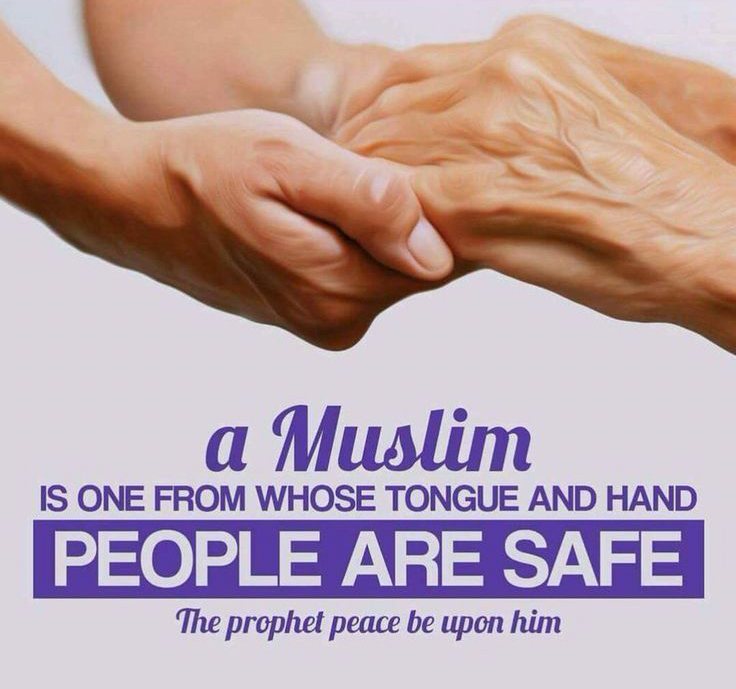 The quote sounds good, but, unfortunately, it does not appear this way in the Sahih (authentic) Hadith, where it is recounted several times in slightly different formats. Each verse actually states that the targets of decent treatment aren’t “people” in general but fellow Muslims in particular: “A Muslim is one from whose tongue and hand other Muslims are safe.”
This is more than a subtle difference, because it implies that non-Muslims are entitled to a different sort of treatment; otherwise, why not expand the target group to include everyone?
Muslims who promote the edited (or weak) version may or may not know the truth. Somewhere along the way, however, someone did, yet decided to make it appear as if Muhamad was speaking of universal brotherhood instead of his own identity group. They wanted to make Islam sound appealing to non-Muslims and more in line with the Judeo-Christian ethic by shading the truth.
In fact, disingenuous tactics like these characterize most of the warm and fuzzy ‘sayings of Muhammad’ found in basic Islamic propaganda, such as billboards and ads on public transportation. These are usually weak hadith verses that have been rejected by past scholarship as non-authentic, or fragments from the Quran that are incomplete or ‘slightly reworded’ to project a different meaning than what is found in the full reading and context.
Of course, this doesn’t mean that critics of Islam are immune from disingenuous tactics of their own. However, religious people are often vested in a way that others are not, making them more apt to believe without evidence or even dismiss evidence a priori that is contrary to preferred conclusions. After all, faith is considered a virtue in Islam, and those who don’t “believe” are threatened with eternal torture.
A truly objective Muslim would see the difference between what they want Islam to be and what it really is. Instead of holding their hand over the parts they don’t like, or trying to manufacture what isn’t there out of bits and pieces, they would abandon Islam for a worldview that doesn’t require such games - or they would abandon themselves to it (a phenomenon known as “radicalization”).
In most Muslim countries, skepticism and doubt are dealt with crudely (as Muhammad dictated). If you criticize Islam or leave the faith, Islamic law calls for your death. While Muslims do not yet have the numbers to impose Sharia in the West, deception works well as a stand-in. If Islam is important enough to kill for, then it can certainly be lied for - particularly to those who would otherwise be killed for not believing.
Muslim apologetics is a game of deception. It is a constant effort to creatively obscure, with half-truth and deception, what is straightforward about Islam and the life of Muhammad. Sometimes this involves playing the credential card against critics, implying that truth is determined by having a PhD or “knowing Arabic,” rather than by what the Quran, Hadith and Sira say (or don’t say).
But relevancy and depth of knowledge are not necessarily the same thing. A physicist can explain why you can’t walk on water, for example, but you really don’t need his or her expertise to know that you can’t. The Islam critic who points out that 11 of the first 32 caliphs were murdered by fellow Muslims is providing truthful information that is far more salient to the issue of violence than is the believing scholar who can better tell you their names but doesn’t mention their fate.
A skeptic seeks knowledge, not faith. They don’t outsource critical thinking to apologists and high priests. They know that ideology and fact aren’t determined by an opinion poll or what someone else says. They go straight to the source. In Islam, the source is the Quran, Hadith and Sira.
Further Reading
Jihad Watch: Islam 101
Sharia and the “Interest-Free” Loan
The Game:
“You’ll know when you’re living under Sharia Law if suddenly all your loans & credit cards become interest free. Sound nice, doesn’t it?”
Linda Sarsour, Twitter (May 12, 2015)
The Truth:
Sharia proponents in the West paint their critics as religious bigots and assure their audience that they have nothing to fear from Islamic law. Although this should be a hard sell, given that Sharia is openly discriminatory, bigoted and sexist, it is often opponents who are slurred as ‘fascists.’ Some gays even disparage other gays for speaking out against a theocratic code that plainly calls for their execution, even as their peers are being thrown from buildings and stoned by Sharia courts.
This bizarre situation owes much to the fact that Sharia advocates in the West have learned to cloak themselves in the mantle of progressivism to peddle what they know is a lie (to people who seem completely uninterested in fact-checking).
One of the more well-known advocates of Sharia in America is Linda Sarsour, a self-described “progressive” (and faux feminist), who assures eager ears that liberal views of dignity and human rights are upheld and even exceeded by Islamic law. Given Sarsour’s rock-star status, it is unlikely that she doesn’t know what Sharia really is: meaning that she is actively misleading her audience.
In 2015, Sarsour began advertising the Sharia rule of “not paying interest” on Twitter. One of her tweets reads as follows: “If you’re still paying interest then Sharia hasn’t taken over America” (May 12, 2015). A separate tweet on the same day explained that credit cards and loans would be “interest free” under Sharia:
“You’ll know when you’re living under Sharia Law if suddenly all your loans & credit cards become interest free. Sound nice, doesn’t it?”
According to Sarsour, if Islamic law was adopted, money would effectively be lent free of charge. As she puts it, “Sounds nice, doesn’t it?”
Actually, it sounds like BS. If money were lent free of charge, then it would obviously not be lent at all, since there is no incentive for the lender to take the risk. Pure Sharia does not work in the real world of capital and trade. Islamic finance thus involves creating incentives for lending, but calling it something other than “interest” or “usury.”
This pretend game is known as murabaha. In simplistic terms, murabaha means inflating the purchase price to assure that the lender gets a return on their investment. While it may not be called “interest,” the effect is generally the same for the borrower.
For example, let’s say that you take out a normal $100,000 mortgage on a house. At 5% interest, your payment is $537/mo for 360 months. Your total cost is about $193,000.
Under Sharia finance, your contract with the lender technically charges 0% interest… butthe purchase amount is $193,000! In other words, you still pay the same by the end of the term. The only difference is that it isn’t called “interest” (and your ability to pay down early or realize equity is more complicated, meaning that the lender probably enjoys the arrangement more than you do).
Linda Sarsour is not a moron. She knows that there is no real financial benefit to Sharia. Her gullible audience does not. They believe what she says. Thus, she is blatantly misleading them into thinking that they will not pay to borrow money under Sharia when it simply isn’t true.
This is an example of taqiyya, the Islamic principle of deception for the advancement of Islam. While, in the case of finance, the consequences are relatively benign once the truth is discovered, the same cannot be said of the fate of religious minorities, atheists, women and homosexuals, who would (and do) suffer greatly under Islamic law.