⬅️ Hub: Christianity
DESCRIPTION
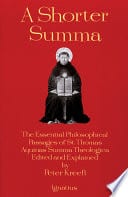
A shortened version of Kreeft’s much larger Summa of the Summa, which in turn was a shortened version of the Summa Theologica. The reason for the double shortening is pretty obvious: the original runs some 4000 pages! (The Summa of the Summa was just over 500.) The Summa is certainly the greatest, most ambitious, most rational book of theology ever written. In it, there is also much philosophy, which is selected, excerpted, arranged, introduced, and explained in footnotes here by Kreeft, a popular Thomist teacher and writer. St. Thomas Aquinas is universally recognized as one of the greatest philosophers who ever lived. His writings combine the two fundamental ideals of philosophical writing: clarity and profundity. He is a master of metaphysics and technical terminology, yet so full of both theoretical and practical wisdom. He is the master of common sense. The Summa Theologica is timeless, but particularly important today because of his synthesis of faith and reason, revelation and philosophy, and the Biblical and the classical Greco-Roman heritages. This little book is designed for beginners, either for classroom use or individually. It contains the most famous and influential passages of St. Thomas’ philosophy with copious aids to understanding them.
Preface / Introduction
Kreeft’s aim is to make Aquinas accessible to beginners by selecting the most philosophically important and teachable parts of the Summa. He presents Aquinas as the supreme medieval synthesizer of faith and reason, clarity and depth, theory and practice. He also explains that the Summa is best understood as an ordered, dialectical inquiry: each article frames a question, gives objections, states Aquinas’ answer, and then replies to the objections. The “big picture” of the Summa is an exit from God through creation and a return to God through human life and choice.
I. Methodology: Theology as a Science
Prologue
Aquinas says sacred doctrine is written for beginners and should be taught with brevity, clarity, and proper order. The purpose is not to overwhelm students with endless arguments, but to present what is necessary in a way that forms the mind.
The Nature and Extent of Sacred Doctrine
Whether, besides Philosophy, Any Further Doctrine Is Required?
Aquinas argues that philosophy alone is not enough. Human reason can discover some truths, but not all the truths needed for salvation, and even the truths reason can reach are difficult, slow to attain, and prone to error. Therefore revelation is necessary. Sacred doctrine does not replace philosophy; it supplements it by giving knowledge that reason either cannot reach or cannot reach reliably for most people.
Whether in Holy Scripture a Word May Have Several Senses?
Aquinas explains that Scripture has a literal sense and also spiritual senses built upon it. Because God is the author of Scripture, He can signify not only through words but through the realities those words describe. This allows allegorical, moral, and anagogical readings. Still, the literal sense remains foundational, and doctrine must ultimately rest on it.
Main idea of Part I
The first part establishes Aquinas’ method: theology is a genuine science, but one whose source includes revelation as well as reason. It is disciplined, ordered, argumentative, and aimed at truth.
II. Proofs for the Existence of God
The Existence of God
Whether the Existence of God Is Self-Evident?
Aquinas says God’s existence is self-evident in itself, because in God essence and existence are one, but it is not self-evident to us because we do not directly know God’s essence. So the proposition “God exists” must be demonstrated from effects that are more familiar to us.
Whether It Can Be Demonstrated That God Exists?
He argues that God’s existence can be demonstrated a posteriori, that is, from effects to cause. We cannot know God’s essence directly and reason downward from it, but we can reason upward from the world to its source. Thus God’s existence is rationally demonstrable even if not obvious at first glance.
Whether God Exists?
This is the famous section containing the Five Ways. Aquinas argues from motion to an unmoved mover, from efficient causation to a first cause, from contingent beings to a necessary being, from gradations of perfection to a maximal source of perfection, and from natural teleology to an intelligent governor. He also addresses the problem of evil by arguing that God can permit evil in order to bring forth greater good.
Main idea of Part II
Aquinas’ argument for God does not begin with mystical feeling or blind faith, but with ordinary features of the world: change, causality, contingency, degrees of perfection, and purposive order. The conclusion is that reason can know that God exists, even if it cannot fully comprehend what God is.
III. The Nature of God
Of the Simplicity of God
Whether God Is Altogether Simple?
Once God’s existence is established, Aquinas asks what God is not. God is not composite: not made of parts, matter and form, subject and accident, or essence and existence. Divine simplicity means God is utterly non-composite and therefore metaphysically ultimate.
The Existence of God in Things
Whether God Is in All Things?
God is present to all things, not as one object among others, but as the cause of their being. His presence is intimate and universal because He gives existence to everything that exists. This does not mean God is identical with the world, but that all things depend on Him at every moment.
The Immutability of God
Whether God Is Altogether Immutable?
Because God is pure actuality and not a being moving from potential to actual, He does not change. Change implies imperfection or incompletion, but God lacks neither fullness nor actuality. Divine immutability protects God’s perfection.
The Names of God
Whether What Is Said of God and of Creatures Is Univocally Predicated of Them?
Aquinas rejects both total sameness and total difference in God-language. Terms like “good,” “wise,” and “being” are not used of God and creatures in exactly the same sense, nor in totally unrelated senses, but analogically. We can speak truly of God, but always with awareness that divine reality surpasses creaturely modes. Kreeft’s notes summarize God-language as including names of essence, negation, analogy, relation, and metaphor.
Of God’s Knowledge
Whether God Knows Things Other Than Himself?
Aquinas defends the claim that God knows creatures without compromising divine perfection. Since creatures come from God as effects from cause, God knows them by knowing Himself as their source.
Whether the Knowledge of God Is the Cause of Things?
God’s knowledge is not passive like ours. He does not first observe a world that already exists; rather, His knowing is causally connected to creation. In God, knowledge is creative. Kreeft explicitly notes that what is wrong for human knowing is, in a qualified sense, true of divine knowing: God’s intellect is not formed by the world; the world is formed by God’s intellect.
Of Truth
Whether Truth Is Immutable?
Truth is ultimately rooted in the eternal divine intellect. Human knowledge may change, and propositions about changing things may vary, but truth itself has an unchanging ground in God.
The Will of God
Whether Any Cause Can Be Assigned to the Divine Will?
Aquinas argues that nothing outside God causes or determines God’s will. Divine willing is not arbitrary, but neither is it controlled by something external to God. This preserves both God’s rationality and His sovereignty.
God’s Love
Whether God Loves All Things?
God loves all existing things because to love is to will good, and all goodness in creatures comes from God’s will. Unlike human love, which is usually attracted by prior goodness, God’s love creates and bestows goodness.
Whether God Loves All Things Equally?
Aquinas distinguishes two senses of equality in love. God’s act of love is one and simple, but He does not will the same degree of good to all things. So God loves all things, yet loves some more in the sense of bestowing greater goods upon them.
The Providence of God
Whether Providence Imposes Any Necessity on Things Foreseen?
Divine providence is infallible, but it does not eliminate contingency. God wills some things to occur necessarily and others contingently, according to the kind of causes He gives them. Providence therefore includes, rather than destroys, creaturely freedom and contingency.
Main idea of Part III
This whole section develops a classical theistic picture of God: simple, immutable, present to all things, knowable only analogically, knowing all things as their cause, loving all things by giving them goodness, and governing the world without abolishing created contingency.
IV. Cosmology: Creation and Providence
Of the Beginning of the Duration of Creatures
Whether the Universe of Creatures Always Existed?
Aquinas distinguishes between what reason can prove and what faith reveals. Reason can show that the world is created and dependent on God, but it cannot strictly prove that the world had a temporal beginning.
Whether It Is an Article of Faith That the World Began?
The claim that the world began in time is held by faith, not demonstrated by philosophy alone. Aquinas therefore separates creation from temporal beginning: creation means radical dependence on God, not merely having a first moment in time.
Main idea of Part IV
Creation is not just a past event but an ongoing dependence of all creatures on God. Aquinas is careful to distinguish metaphysical creation from the historical question of whether the universe had a beginning in time.
V. Anthropology: Body and Soul
Of Man as Composed of Spiritual and Corporeal Substance
Whether the Human Soul Is Incorruptible?
Aquinas argues that the human soul is not destroyed when the body dies. Because the intellect has operations that transcend matter, the soul has an immaterial aspect and is incorruptible.
Whether the Soul Is of the Same Species as an Angel?
No. Human souls are spiritual, but they are naturally the forms of bodies, whereas angels are pure spirits. Human beings are essentially embodied rational animals, not angels trapped in matter.
Of the Union of Body and Soul
Whether the Intellectual Soul Is Properly United to Such a Body?
Aquinas insists that body and soul form one substance. The soul is not merely housed in the body; it is the form of the body, the principle that makes a living human being to be the kind of being he is. This makes human nature a genuine unity rather than a loose partnership of two substances.
Main idea of Part V
Human beings are neither reducible to matter nor understandable as pure spirits. Aquinas presents a unified view of man as an embodied rational soul whose spiritual powers point beyond material reductionism.
VI. Epistemology and Psychology
Of the Will
Whether the Will Is a Higher Power Than the Intellect?
Aquinas treats intellect and will as deeply interrelated. The intellect knows the good; the will desires it. In some respects intellect is prior because it presents the good to the will, though in certain practical and existential respects the will has its own primacy. The section is aimed at clarifying their order rather than setting them in simple opposition.
Of Free-Will
Whether Man Has Free-Will?
Yes. Human beings possess free choice because they act through reason and can deliberate among alternatives. Freedom arises not from irrational spontaneity but from rational appetite guided by intellect.
How the Soul Understands Corporeal Things
Whether the Soul Knows Bodies through the Intellect?
Whether Intellectual Knowledge Is Derived from Sensible Things?
Aquinas rejects both crude empiricism and rationalism. Human knowledge begins with the senses, but intellect rises above sensation to grasp universal meanings. We do not directly know material things by bare sensation alone; intellect works upon sensory data to understand them.
Of the Mode and Order of Understanding
Whether Our Intellect Understands Corporeal and Material Things by Abstraction from Phantasms?
Whether the Intelligible Species Abstracted from the Phantasm Is Related to Our Intellect As That Which Is Understood?
Aquinas’ central epistemological claim is that the mind knows by abstraction. The intellect draws intelligible form from phantasms, that is, from sense-images. The abstracted species is not itself the final object known, but the means by which the intellect knows the thing. In other words, the mind does not get stuck inside representations; it uses them to know reality.
Main idea of Part VI
Human knowing is embodied, rational, and realist. Knowledge begins in sensation, proceeds through abstraction, and culminates in intellectual grasp of the real. Human freedom similarly depends on rational deliberation, not mere impulse.
VII. Ethics
Of Those Things in Which Man’s Happiness Consists
Whether Man’s Happiness Consists in Wealth, Honor, Fame, Power, Bodily Good, Pleasure, Some Good of the Soul, or Any Created Good?
Aquinas surveys the usual candidates for happiness and rejects them one by one as ultimate ends. Wealth, honor, fame, power, bodily goods, and pleasure may be partial goods, but none can fully satisfy the human person. Not even created spiritual goods suffice as man’s ultimate beatitude. Perfect happiness can only be found in God.
Of Goodness in General
Whether Goodness Is Rightly Divided into the Virtuous, the Useful, and the Pleasant?
Aquinas classifies goods into the morally good, the instrumentally useful, and the pleasurable. This shows that not all goods are of the same kind, and ethical confusion often comes from collapsing these distinctions.
The Distinction of Things in Particular
Whether Pain Has the Nature of Evil More Than Fault Has?
Aquinas holds that moral fault is a deeper evil than pain. Suffering is bad in one sense, but moral corruption is worse because it damages the soul’s order to the good. This gives ethics priority over mere comfort.
Of the Cardinal Virtues
Whether There Are Four Cardinal Virtues?
Aquinas affirms the classical four: prudence, justice, fortitude, and temperance. These are called “cardinal” because other moral virtues hinge on them. They structure right action and the ordered soul.
Of the Theological Virtues
Whether Faith, Hope, and Charity Are Fittingly Reckoned as Theological Virtues?
Yes. These virtues have God directly as their object and are infused rather than merely acquired. Faith perfects intellect, hope perfects desire toward God as attainable good, and charity perfects love by uniting the soul to God.
Of the Various Kinds of Law
Whether There Is an Eternal Law?
Whether There Is in Us a Natural Law?
Whether There Is a Human Law?
Whether There Was Any Need for a Divine Law?
Aquinas lays out a hierarchy of law. Eternal law is God’s rational governance of the universe. Natural law is the rational creature’s participation in eternal law. Human law applies natural law to particular social conditions. Divine law is needed because human beings are ordered to a supernatural end, because human judgment can err, and because inner acts as well as external acts require guidance.
Of the Natural Law
Whether the Natural Law Can Be Changed?
Whether the Law of Nature Can Be Abolished from the Heart of Man?
Aquinas argues that the first principles of natural law are stable and cannot be erased, though their application can be obscured by passion, bad custom, or corruption. Natural law is therefore enduring, but human recognition of it can be distorted.
Main idea of Part VII
Aquinas’ ethics is teleological: morality is about the right ordering of human life to its true end. Happiness cannot be found in created goods alone, virtue orders the soul toward genuine flourishing, and law is an expression of rational order rooted ultimately in God.
Overall summary
Taken as a whole, A Shorter Summa presents Aquinas’ philosophical vision as a unified system of ordered reality. Sacred doctrine perfects reason; reason can know that God exists; God is simple, immutable, knowing, loving, and providential; creation depends on Him; man is an embodied rational soul; knowledge begins in the senses and rises through abstraction; freedom belongs to rational agents; and ethics culminates in the claim that human happiness is found only in God and in a life ordered by virtue and law.
Criticism
There are many criticisms of Aquinas’s Summa Theologiae, and they come from very different directions. Some critics think it is one of the greatest achievements in philosophy and theology, but still argue that major parts of it are flawed.
Main kinds of criticism
1. Overreliance on Aristotle
A common criticism is that Aquinas built too much of his theology on Aristotelian metaphysics:
- act and potency
- form and matter
- substance and accidents
- final causation
- hierarchical causation
Critics say this makes his theology dependent on an old philosophical system that many people no longer accept. If the Aristotelian framework is wrong or outdated, then much of the Summa’s structure can seem less convincing.
This criticism often comes from: - modern philosophers
- empiricists
- secular thinkers
- some Protestant theologians
- some modern Catholics influenced by newer philosophy
2. The arguments for God are not compelling
Aquinas’s Five Ways are famous, but heavily criticized.
Common objections include:
- they do not prove the personal God of Christianity, only perhaps some first cause or necessary being
- they rely on disputed metaphysical assumptions
- they may commit fallacies, such as assuming every series needs a first member in the way Aquinas claims
- modern readers often think the arguments confuse physical causation with metaphysical dependence
For example: - Hume criticized arguments from causation and necessity
- Kant argued that existence is not the kind of predicate some traditional arguments assume, and he also challenged rational theology more broadly
- later analytic philosophers often argue the Five Ways do not get you all the way to the God of revelation
3. The problem of evil
Aquinas addresses evil, but many think his answers are insufficient.
Critics argue:
- the amount and intensity of suffering in the world seem hard to reconcile with an all-good, all-powerful God
- saying God brings good out of evil may not adequately explain apparently pointless suffering
- Aquinas’s framework can seem too abstract in the face of concrete horrors
This is one of the strongest continuing criticisms of the whole Thomistic system.
4. His natural law ethics is too rigid or too teleological
Aquinas’s moral thought depends on the idea that human beings have a nature and ends built into them, and that morality is grounded in fulfilling those proper ends.
Critics object that:
- human nature is more complex and historically variable than Aquinas allows
- teleology is not obvious in the modern scientific worldview
- deriving moral rules from “natural ends” can seem forced
- this approach can become rigid, especially in sexual ethics
A lot of contemporary criticism of Thomism focuses here, especially around: - sex
- marriage
- gender
- reproduction
- social roles
5. Faith and reason may not harmonize as neatly as he claims
Aquinas is famous for trying to show harmony between reason and revelation. Critics say this harmony may be overstated.
Some argue:
- reason cannot reach nearly as far as Aquinas thinks
- revelation cannot be made philosophically tidy
- his synthesis smooths over real tensions between biblical religion and Greek metaphysics
This criticism comes especially from: - fideists
- existentialist theologians
- some Protestants
- postmodern theologians
They think Aquinas domesticates the strangeness of revelation by fitting it into a rational system.
6. Too systematic and abstract
Some people criticize the Summa not for specific arguments, but for its whole style.
They say it can feel:
- overly conceptual
- detached from lived religion
- too focused on classification and logical structure
- less attentive to history, narrative, emotion, and existential experience
Thinkers influenced by Augustine, Pascal, Kierkegaard, or modern existentialism often say Aquinas gives a brilliant system, but not a full picture of religious life.
7. Weaknesses in his account of human psychology
Aquinas has a very rich moral psychology, but critics say:
- it can understate irrationality, trauma, fragmentation, and unconscious motivation
- it assumes a more orderly soul than actual human beings seem to have
- it may be too optimistic about reason’s ability to govern passions
Modern psychology, psychoanalysis, and existential thought often challenge this part of the Summa.
8. Social and political criticisms
Some criticisms focus on the social assumptions in Aquinas’s thought.
Critics point to:
- hierarchical views of society
- acceptance of inequality as part of social order
- views about women that reflect medieval assumptions
- limited attention to individual autonomy in the modern sense
Some modern readers say the Summa reflects a premodern world with assumptions that no longer seem defensible.
9. The analogy of being is unclear or unstable
Aquinas argues we do not speak of God in exactly the same way as creatures, nor in a completely unrelated way, but analogically.
Critics argue that this is difficult to make fully clear:
- if language about God is too different from creaturely language, it becomes empty
- if it is too similar, God becomes just a bigger being among beings
- analogy can seem like an unstable middle position
This is a major technical criticism in philosophy of religion and metaphysics.
10. Too confident in metaphysical realism
Aquinas assumes the intellect can really know the structure of reality: substances, essences, causes, ends, and so on.
Critics shaped by nominalism, skepticism, empiricism, or Kantian philosophy argue that:
- we do not have access to essences in the strong way Aquinas assumes
- the mind may not grasp reality as directly as he thinks
- metaphysical claims of this kind go beyond what can be justified
This is one of the deepest criticisms because it attacks the whole epistemic basis of the Summa.
Major critics or traditions that challenge Aquinas
Scotists
They often criticize Aquinas on technical metaphysical issues, such as:
- analogy of being
- essence and existence
- individuation
- divine freedom
Nominalists
Thinkers in the Ockhamist line challenge Aquinas’s realism about universals, essences, and natural law.
Protestants
Some Protestant critics argue Aquinas gives too much authority to reason and philosophy, and not enough to grace, scripture, and divine sovereignty.
Hume
He challenges causation, natural theology, and rational arguments for God.
Kant
He argues traditional metaphysics overreaches and that reason cannot prove what scholastic thinkers thought it could.
Kierkegaard
He thinks Christianity cannot be reduced to a rational system and emphasizes faith, paradox, and subjectivity.
Nietzsche
He would see Aquinas as part of the broader metaphysical and moral tradition he wanted to overturn.
Modern analytic philosophers
Some admire Aquinas, but others argue that many arguments in the Summa depend on unclear premises or outdated metaphysical categories.
But there is also an important counterpoint
Many criticisms of Aquinas are aimed at simplified versions of him. Thomists often respond that critics misunderstand things like:
- what Aquinas means by “cause”
- the difference between a temporal series and a hierarchical causal series
- what he means by essence and existence
- how natural law works
- how analogy works
So some criticisms are strong, but some are attacks on a cartoon version of Aquinas.
The most important criticisms in plain terms
If I had to condense the biggest ones, they would be:
- his system depends too much on Aristotelian metaphysics
- his proofs for God do not convince many modern philosophers
- the problem of evil remains powerful
- his natural law ethics can seem rigid
- his whole system may be too abstract and confident in reason
Bottom line
The Summa is criticized for being:
- too Aristotelian
- too metaphysical
- too confident in reason
- too systematic
- and insufficiently persuasive on God, evil, and natural law
But even many critics still regard it as one of the most ambitious and intellectually sophisticated works in Western thought.
I can also give you:
- the strongest criticisms of the Five Ways specifically, or
- the best Thomist replies to those criticisms.o