The Objective Moral Argument is a theistic argument that grounds morality in God’s existence. It claims that the reality of binding, universal moral truths is best explained by a divine source.
Main Idea
- Existence of Objective Moral Values and Duties
- Many people intuitively recognize that some moral truths—like “murder is wrong” or “kindness is good”—are objectively true, regardless of personal opinions or cultural norms.
- Dependence on a Moral Foundation
- If objective morals exist, they require a foundation beyond human subjectivity.
- Purely naturalistic explanations (evolution, social contracts) describe why we have moral feelings but don’t account for why moral values are truly binding and universal.
- God as the Best Explanation
- A morally perfect, transcendent being (God) provides the necessary foundation for objective moral values (rooted in His nature) and moral duties (His commands or will).
- Without God, morality reduces to subjective preference or cultural convention.
- Conclusion
- Since objective moral values and duties exist, it is reasonable to conclude that God exists as their ultimate ground.
Here’s the Objective Moral Argument laid out as a formal syllogism, along with major objections and responses, combined into a single structured outline.
1. The Objective Moral Argument (Formal Syllogism)
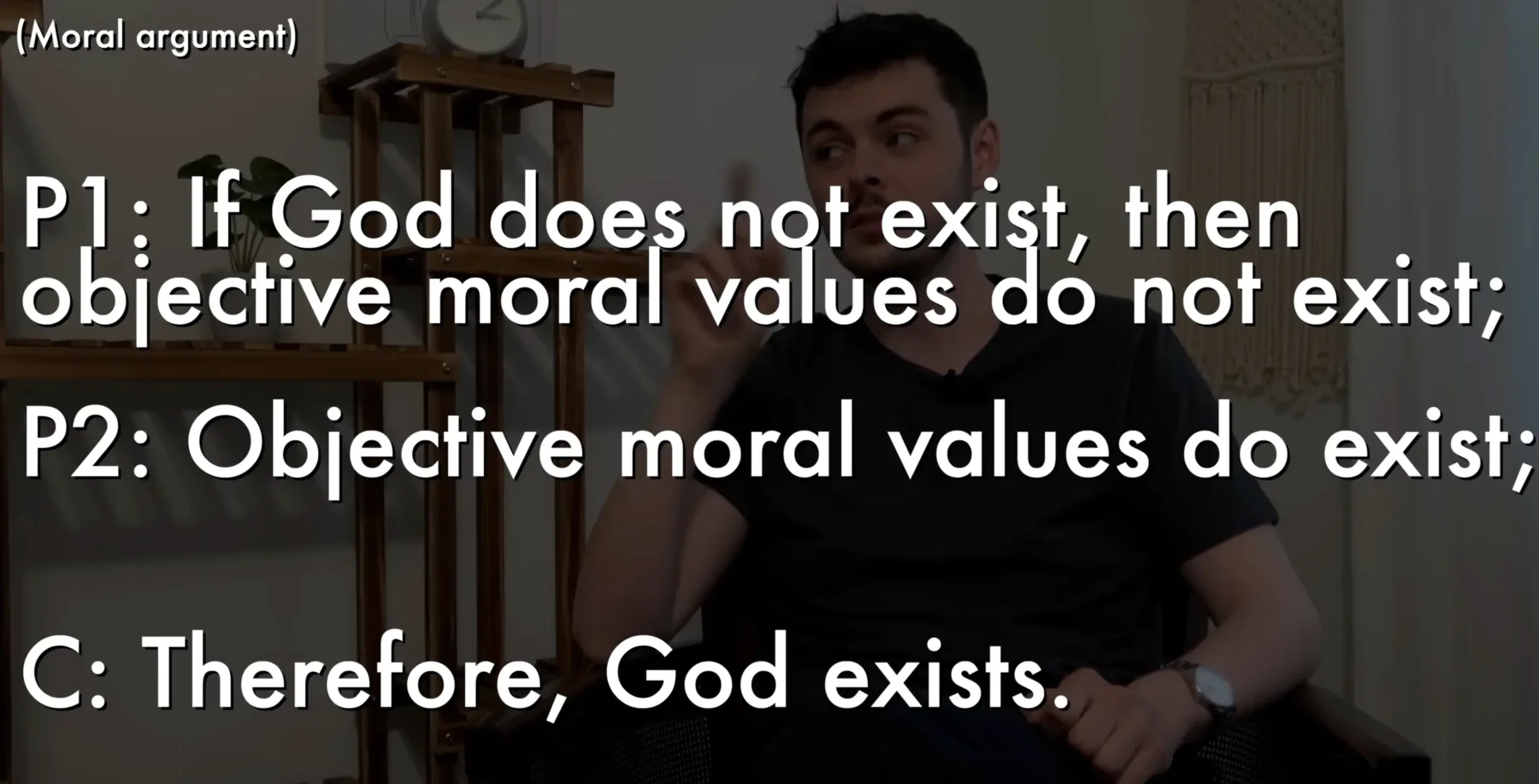
- Premise 1 – If God does not exist, objective moral values and duties do not exist.
- Without God, morality is reduced to human opinion, cultural convention, or evolutionary survival instincts. There is no ultimate standard beyond subjective viewpoints.
- Premise 2 – Objective moral values and duties do exist.
- Most people recognize certain moral truths as universally valid and binding (e.g., “torturing children for fun is wrong”), independent of culture or opinion.
- Conclusion – Therefore, God exists as the foundation of objective moral values and duties.
- God’s nature grounds moral values (what is good), and His commands or will ground moral duties (what we ought to do).
2. Major Objections and Responses
1. “Morality Can Be Explained by Evolution or Social Contracts”
- Objection:
- Humans evolved moral instincts because they aided survival, or societies created moral rules to promote order. No need for God.
- Response:
- Evolution and social contracts may explain why we believe certain moral norms, but they cannot make them objectively true.
- Survival-driven instincts don’t determine whether actions like genocide are truly wrong; they only describe behaviors that helped a species persist.
2. The Euthyphro Dilemma (“Is something good because God commands it, or does God command it because it’s good?”)
- Objection:
- If morality is based solely on God’s commands, it seems arbitrary (He could command cruelty).
- If God commands actions because they’re good, then goodness exists apart from God, making Him unnecessary.
- Response:
- Christian philosophers (e.g., William Lane Craig) resolve this by grounding goodness in God’s nature, not arbitrary commands.
- God’s commands reflect His inherently good nature, which serves as the ultimate standard of morality.
3. “Atheists Can Be Moral Without Believing in God”
- Objection:
- Many non-believers live moral lives and affirm moral truths without religious belief. Doesn’t this undermine the argument?
- Response:
- The argument isn’t about whether one must believe in God to act morally.
- It’s about whether morality has an objective basis without God. Atheists can recognize and follow moral truths, but on naturalism, those truths lack ultimate grounding.
4. “Morality is Just Relative (No Objective Truths)”
- Objection:
- Morality is entirely subjective or culturally constructed; there are no universal moral truths.
- Response:
- Denying objective morality leads to counterintuitive results: one cannot truly condemn atrocities (like genocide) as wrong in any universal sense.
- Most people, even moral skeptics, live as though some moral truths are binding and universal, suggesting that moral relativism is unlivable in practice.
3. Structured Summary (Condensed)
- Core Idea:
- Objective moral truths (good and evil, right and wrong) exist and are best explained by a transcendent, morally perfect source—God.
- Naturalistic accounts explain moral beliefs, but not moral truths.
- Key Objections & Replies:
- Evolution/Social Contracts → Describe origins of moral instincts, but don’t establish objective moral truth.
- Euthyphro Dilemma → Resolved by rooting morality in God’s unchanging nature, not arbitrary commands.
- Atheist Morality → The issue is grounding, not whether atheists can act morally.
- Relativism → Leads to unlivable conclusions, since we still treat certain moral judgments as universally valid.
Arguments For God’s Existence Tier List - YouTube
Core Structure of the Moral Argument
- Premise 1: If God does not exist, objective moral values and duties do not exist.
- Premise 2: Objective moral values and duties do exist.
- Conclusion: Therefore, God exists.
Main Discussion Points
- Challenging Premise 2 (Denying Objective Morality):
- One response is to reject the existence of objective moral values altogether, adopting:
- Subjectivism: Morality depends on human stances, preferences, or desires.
- Error Theory: Moral claims (“you ought to…”, “this is bad”) are uniformly false because objective moral truths don’t exist.
- Philosophers take these routes, though most surveyed philosophers identify as moral realists (believing in objective morality).
- Rejecting Premise 2 requires accepting that acts like torturing someone for amusement aren’t “truly wrong” beyond human opinion, which many find counterintuitive.
- One response is to reject the existence of objective moral values altogether, adopting:
- Non-Theistic Moral Realism (Challenging the Conclusion):
- Even if objective morality exists, it doesn’t necessarily point to God.
- Many metaethical theories attempt to ground objective morality without a deity, such as moral truths based on human flourishing, rationality, or intrinsic properties.
- Theists are asked: what does God actually add?
- Euthyphro-Type Dilemma (Targeting Premise 1):
- If God commands moral truths, He either:
- Has reasons for His commands (then those reasons, not God, ground morality).
- Has no reasons (making morality arbitrary, undermining its objectivity).
- Either way, God isn’t the ultimate moral foundation.
- Intuitions about God’s authority rely on the same intuition (moral truths being objective) that the argument appeals to.
- If God commands moral truths, He either:
- Functional Goodness vs. Moral Goodness:
- Some argue goodness can be like functionality (“a good chair fulfills its designer’s purpose”), so a “good person” fulfills God’s design.
- Critics note this equivocates functional and moral goodness:
- A “bad table” isn’t “evil,” but calling someone a “bad person” implies moral failure (virtue vs. evil, not just function).
- This view risks making morality arbitrary, based solely on God’s preferences.
- Cultural and Psychological Intuition:
- Many intuitively link morality and God because they’ve been raised to see God as the source of goodness and order.
- Removing God can feel like removing the “center” of meaning and morality.
- Critics argue this is a psychological association, not evidence that morality needs God.
- Moral goodness and beauty, they claim, can be located intrinsically in the world (in human and animal well-being, suffering, flourishing) without reference to a deity.