Haidt’s Chapter 11 adds two more distinctions: truth and institutional form
Haidt’s argument is narrower than “people need religion.” He models religion as reciprocal believing, doing, and belonging and argues that repeated ritual, dense relationships, costly commitment, reputation, and sacred obligation can suppress free riding. His evidence includes nineteenth-century communes, Balinese water temples, trust games, and Putnam and Campbell’s U.S. finding that religious friendship networks predicted neighborliness more strongly than doctrine or denomination.
That creates four separate questions: Does religion improve an individual’s well-being? Does a religious community produce social goods? Are its supernatural claims true? Should the state privilege it? Evidence for one does not answer the others. The chapter is also source-era and functionally focused: group survival is not flourishing, attendance is entangled with selection, and internally cooperative communities can be coercive or predatory. The defensible policy inference is to protect voluntary religious and secular associations while preserving equal citizenship, criticism, meaningful exit, and safeguards for outsiders—not to infer establishment. → full concept and evidence audit · Chapter 11 source audit · source PDF, Chapter 11, pp. 277–307 (file not included in this release)
Henrich’s Chapter 4 sharpens the social claim without proving social necessity
Henrich supplies a plausible mechanism for religion’s public effects: morally concerned supernatural monitoring, daily cues, costly displays of sincere commitment, doctrinal ritual, and reputational sanctions can make cooperation among non-kin easier. Yet his own comparison prevents the inference that supernatural belief is uniquely necessary. In the Dictator Game, secular reminders of police, courts, and juries raised generosity among believers and atheists, whereas God-primes worked mainly among believers. Institutions can therefore recruit some of the same monitoring psychology without theology.
Nor is “more cooperation” a sufficient verdict. Big-God belief was associated with fairer treatment of distant coreligionists, but local gods could intensify clan favoritism and cohesive religious groups could become more dangerous to outsiders. The careful conclusion is that religion can be one powerful architecture for scaling trust and commitment; whether a society needs it depends on what secular institutions and associations can reproduce, and whether either system preserves truth-seeking, exit, equal standing, and external accountability. God and secular monitoring primes, PDF pp. 134–135 (file not included in this release) · punishing gods and distant cooperation, PDF pp. 145–147 (file not included in this release) · Chapter 4 qualifications, PDF pp. 532–540 (file not included in this release) · Chapter 4 source audit
Left-wing institutions have become woke, and the wokes have a story to tell. They can’t plausibly argue that we’ve become more racist and sexist over the last few decades, so they justify increasing negativity by arguing that we’re finally dealing honestly with problems we’ve always had.
Conservatives increasingly seem to agree with the left-wing premise that there is something terribly wrong with modern society, even if they point to different causes. As with the left, there’s the sense that the masses need something deeper and more important than what they have. Sometimes, wokeness itself is seen as the sign things have gone haywire, a tendency that, while it gets at something real and important, exaggerates the nature of the problem.
Charles Murray, for example, recently declared that religion is indispensable for a moral society. I see no indication of him actually being a religious believer. Rather, in the long tradition of secular conservatism, Murray thinks that religion is a social good, regardless of whether any particular faith is rooted in truth.
About a year or two ago, I think I would’ve agreed with this. Those of us opposed to wokeness see that society is getting more secular and becoming more PC. We see much of the resistance to the things we dislike coming from people of religious faith. It’s easy to therefore come to the conclusion that, whether or not one believes in the tenets of Christianity, society needs some kind of belief in the supernatural, or at least religious practice, to resist modern ugliness.
Is this true though? To determine whether society needs religion, one must differentiate between two theories:
- Individuals need religion to live happy and fulfilling lives (individualist view)
- Society needs religion to function well (social view)
Of course, the two arguments are related, since a society where most people live happy and fulfilling lives is likely to be one that functions well. Nonetheless, it’s possible to imagine religion making people happy as individuals but being correlated with negative outcomes in the aggregate, or that religion makes people miserable as individuals while being good for society. For that reason, it’s possible to separate the two theories and judge them independently.
Neither of these propositions has much empirical support as far as I can tell. A recent meta-analysis by David Bryce Yaden and three co-authors looked at 256 different studies of the relationship between five measures of religiosity and life satisfaction. The results are as follows. They find a weak but consistent positive relationship.
[


The average correlation of the 5 measures is 0.18, with a range spanning for religious attendance to for spirituality. These aren’t strong relationships. The results are consistent with previous meta-analyses.
And all of this is before publication bias. Check out the funnel graph from Yaden et al. below.
[


One can see that the smaller the sample size (higher standard error on the Y-axis), the stronger the correlation between measures of religiosity and life satisfaction. In plain English, this means that the already weak correlations are probably exaggerating the relationship. Finally, Yaden et al. find that the effects are even lower in developed countries, which implies that faith may be a crutch that people only need under difficult circumstances. Between the small effect sizes, the even smaller effects in rich countries, and likely publication bias, it seems that the best evidence suggests that there is practically no relationship between religious faith or practice and life satisfaction outside of the developing world.
One may also check whether secularization over the decades has made people less happy. There appears to be little evidence of that. Here is happiness across various European countries. All of them, I think, have experienced increasing secularization, and probably drop-offs in other things people consider central to meaning like pride in one’s country.
[

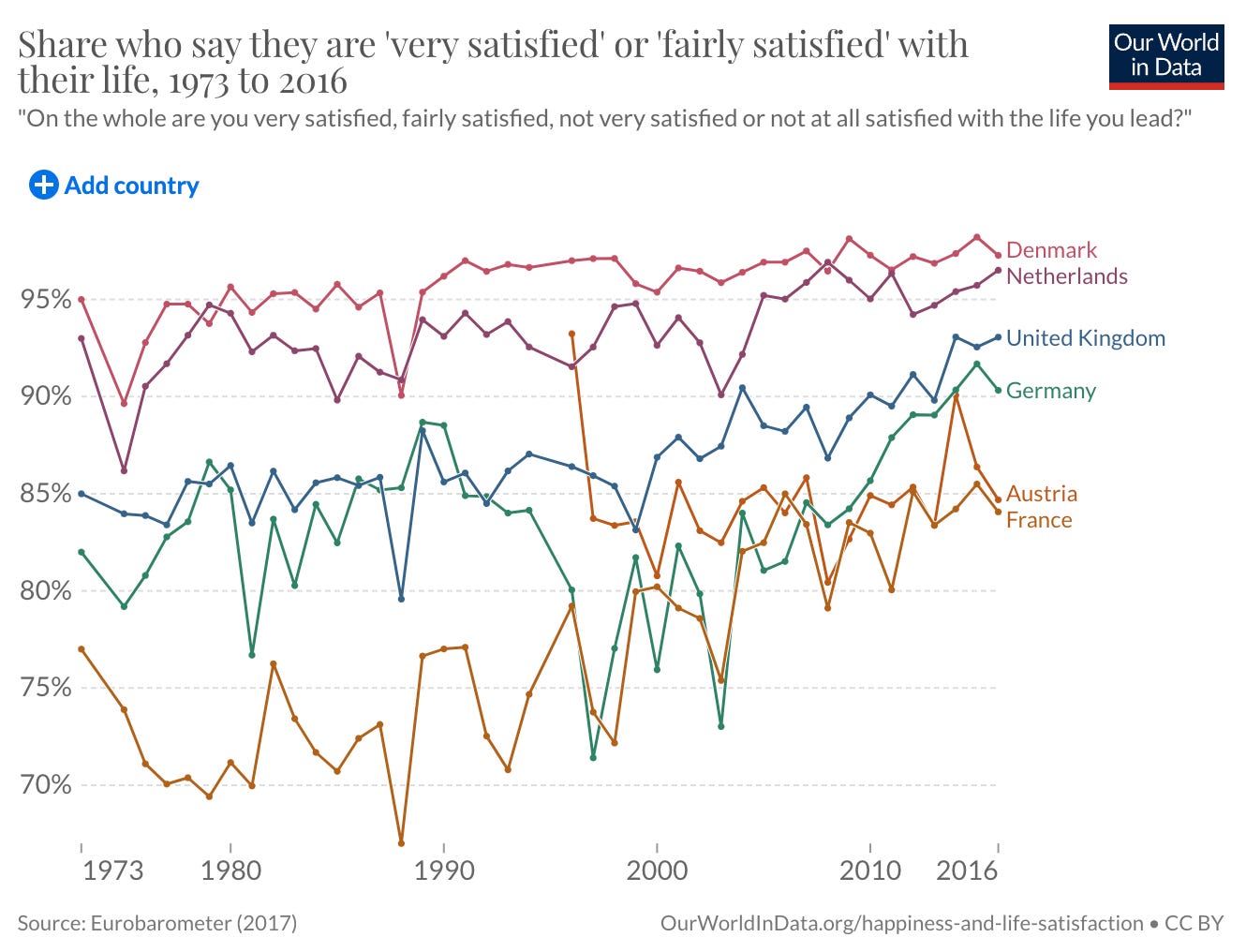
Another datapoint: atheist blogger Jerry Coyne put a helpful graph together showing the negative correlation between religiosity and happiness across different countries.
How about the collectivist view? Does religion make society function better, even, if one can’t find much in the way of positive effects at the individual level?
To the “Drag Queen Story Hour Conservative,” yes, because more religious societies prevent sexual perversion. But can a broader case be made that could convince those who don’t think transsexualism is the most important issue in the world?
One might start by pointing out that the most secular countries in the world are generally the most successful.
[


Of course, causation at least in part certainly goes in the other direction, as being richer makes you more secular. But it’s telling that there’s little indication that modern secular nations are falling apart. I understand that this might seem like a shocking claim to some people, and if you’re one of them, you’re probably spending too much time on Twitter getting angry at random nonsense that doesn’t matter. By historical standards, across the West, we see that growth is solid, crime is manageable practically everywhere outside the American inner city, people are happy, and there is no foreign actor that poses any serious threat to our safety or well-being.
The one place that the pro-meaning crowd may have a point is when it comes to birth rates. This is such an important topic that it probably deserves its own post at some point. For now, I’ll say that in Europe there doesn’t appear to be much of a correlation between fertility and belief in god or religious attendance. I agree with Anatoly Karlin, who has argued that developed countries that have higher fertility today were the ones that had their second demographic transition earlier, meaning that there’s been selection for a desire for larger families. If this is right, there may not be much government or top-down propaganda can do to change fertility patterns, as this is a matter of evolution running its course.