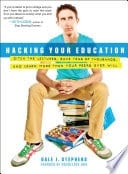
DESCRIPTION
It’s no secret that college doesn’t prepare students for the real world. Student loan debt recently eclipsed credit card debt for the first time in history and now tops one trillion dollars. And the throngs of unemployed graduates chasing the same jobs makes us wonder whether there’s a better way to “make it” in today’s marketplace. There is—and Dale Stephens is proof of that. In Hacking Your Education, Stephens speaks to a new culture of “hackademics” who think college diplomas are antiquated. Stephens shows how he and dozens of others have hacked their education, and how you can, too. You don’t need to be a genius or especially motivated to succeed outside school. The real requirements are much simpler: curiosity, confidence, and grit. Hacking Your Education offers valuable advice to current students as well as those who decided to skip college. Stephens teaches you to create opportunities for yourself and design your curriculum—inside or outside the classroom. Whether your dream is to travel the world, build a startup, or climb the corporate ladder, Stephens proves you can do it now, rather than waiting for life to start after “graduation” day.
My Summary
Main Ideas, Takeaways & Similarities
Questions
I. What is the problem?
A. How is this problem formulated?
B. Why is this problem important?
C. What is the history of this problem?
D. Which prominent personalities have been interested in this problem?
II. What solutions to the problem are there?
A. What are the conclusions reached?
B. By what argument(s) is the conclusion reached?
C. What facts or assumptions serve as premises?
D. When a prominent personality offers a solution, does he also argue for or against other prominent personalities? Does he raise objections to alternative solutions? Does he consider objections to his own solutions?
III. Evaluation
A. What are the advantages and disadvantages of the alternative formulations to the problem?
B. Has the importance or history of the problem ever been misrepresented?
C. Are the solutions logically related to the premises?
D. Are the facts true? Are the assumptions acceptable? Are the objections answerable?
AI Summary
Highlights
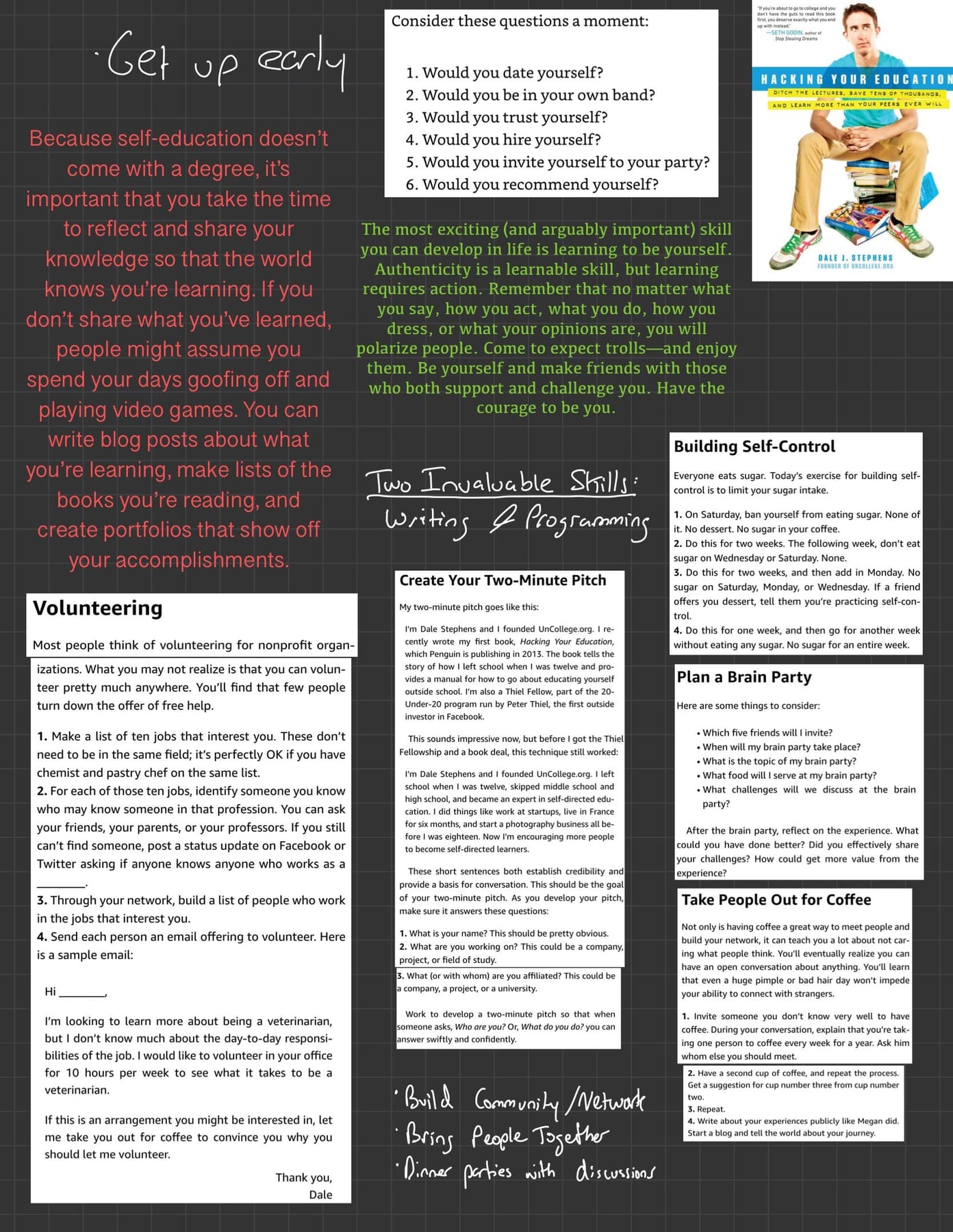
Get Up at 6:00 a.m. (Location 461)
As soon as you get out of bed, make yourself stand up and do ten squats. The blood will rush to your head, and you’ll be awake. Set an alarm for a consistent time every morning. Don’t hit snooze. Before you know it you’ll be getting up before the alarm to turn it off. Drink a glass of water as soon as you get up—you’re usually dehydrated after sleeping. Go to bed around the same time so that you get enough sleep. Try to sleep a consistent amount of time each night. Develop a morning routine. Many of the people I interviewed spend five minutes after getting up silently meditating. (Location 465)
The biggest roadblock holding most of us back from the life we want is entirely self-created: It’s that we care what other people think. If you feel that your actions (or lack thereof) are governed in a large part by societal expectations, the first step to not caring what other people think is to acknowledge that this is a serious problem and probably the most serious problem in your life. (Location 496)
The most exciting (and arguably important) skill you can develop in life is learning to be yourself. Authenticity is a learnable skill, but learning requires action. Remember that no matter what you say, how you act, what you do, how you dress, or what your opinions are, you will polarize people. Come to expect trolls—and enjoy them. Be yourself and make friends with those who both support and challenge (Location 518)
you. Have the courage to be you. (Location 521)
Because self-education doesn’t come with a degree, it’s important that you take the time to reflect and share your knowledge so that the world knows you’re learning. If you don’t share what you’ve learned, people might assume you spend your days goofing off and playing video games. You can write blog posts about what you’re learning, make lists of the books you’re reading, and create portfolios that show off your accomplishments. (Location 777)
Take People Out for Coffee (Location 1341)
http://charliehoehn.com/2009/07/14/announcing-my-first-e-book. (Location 1452)
Create Your Two-Minute Pitch (Location 1643)