DESCRIPTION
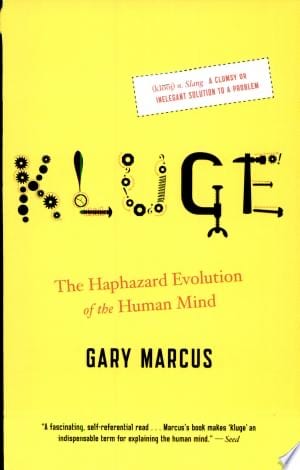
A New York University psychologist argues that the mind is a “kluge”-a clumsy, cobbled-together contraption-as he ponders the accidents of evolution that caused this structure and what we can do about it.
My Summary
Main Ideas, Takeaways & Similarities
Questions
I. What is the problem?
A. How is this problem formulated?
B. Why is this problem important?
C. What is the history of this problem?
D. Which prominent personalities have been interested in this problem?
II. What solutions to the problem are there?
A. What are the conclusions reached?
B. By what argument(s) is the conclusion reached?
C. What facts or assumptions serve as premises?
D. When a prominent personality offers a solution, does he also argue for or against other prominent personalities? Does he raise objections to alternative solutions? Does he consider objections to his own solutions?
III. Evaluation
A. What are the advantages and disadvantages of the alternative formulations to the problem?
B. Has the importance or history of the problem ever been misrepresented?
C. Are the solutions logically related to the premises?
D. Are the facts true? Are the assumptions acceptable? Are the objections answerable?
AI Summary
“Kluge: The Haphazard Construction of the Human Mind” is a book written by Gary Marcus, published in 2008. The book explores the quirks and imperfections of the human mind, offering insights into the evolutionary history and cognitive biases that shape our thinking. Here is a comprehensive summary of the book in bullet points:
- The book delves into the idea that the human mind is a “kluge,” a term borrowed from engineering that refers to a solution that is clumsy, inelegant, or cobbled together from available materials.
- Gary Marcus argues that the human mind is not a perfectly designed system but rather a product of evolutionary processes that have led to a collection of cognitive quirks and biases.
- He discusses how evolution has shaped the human brain, resulting in a cognitive system that is sometimes inconsistent, error-prone, and prone to biases.
- Marcus explores various aspects of human cognition, including memory, decision-making, language, and reasoning, highlighting the limitations and imperfections of each.
- The book provides insights into cognitive biases such as confirmation bias, availability heuristic, and anchoring, which can lead to flawed judgments and decision-making.
- Marcus discusses the challenges of understanding the true nature of human intelligence and the limitations of traditional approaches to artificial intelligence.
- He reflects on the role of culture and society in shaping human cognition, including the impact of language and education.
- The book addresses the concept of “rationality” and the ways in which human thinking often deviates from the ideal of logical and rational decision-making.
- Marcus explores the tension between the intuitive and deliberate modes of thinking and how they interact in various situations.
- He discusses the role of emotions in decision-making and the challenges of achieving emotional intelligence.
- The book emphasizes the importance of recognizing our cognitive limitations and biases and offers strategies for making more rational decisions.
- Marcus provides examples from psychology, neuroscience, and everyday life to illustrate the concepts and challenges discussed in the book.
- He reflects on the implications of understanding the haphazard construction of the human mind for fields such as psychology, education, and artificial intelligence.
- The book concludes by encouraging readers to embrace the imperfections of their own minds and work toward improving their decision-making and problem-solving skills.
“Kluge: The Haphazard Construction of the Human Mind” offers a thought-provoking exploration of the quirks and imperfections of human cognition. Gary Marcus’s book provides insights into the evolutionary history and cognitive biases that shape our thinking, highlighting the challenges and limitations of human intelligence. It encourages readers to recognize and address their cognitive biases and work toward more rational decision-making.