📓 In your handwritten notebooks
- March 21 – June 9 2026, pp. 112 — *The Daily Laws — Robert Greene* → open PDF p121 (file not included in this release)
Index: Personal Journal
⬅️ Hub: 60.12 Self-Improvement · Stories: The Daily Laws - Story Index · Library: 40 Stories
Vault PDF
Open the vault-local PDF (file not included in this release)
The Daily Laws - Robert Greene.pdf (file not included in this release)
Story audit and source navigation
The page-by-page story audit reviewed all 366 dated laws and retained 85 reusable records from 90 entries. It added 84 new canonical stories to the theme-first 40 Stories library and merged 1 overlapping scene into an existing story rather than duplicating it. Every record includes a concise paraphrase, a transferable claim, an evidence-type label, and collapsed PDF++ links to the exact viewer page(s).
Source boundary
The audit identifies reusable narratives in Greene’s book; it does not independently authenticate every historical claim and does not endorse every technique. Fiction, scripture, traditional anecdotes, political and military interpretation, reported biography, and Greene’s framing remain explicit.
Ethical reading rule
Preserve the descriptive insight about incentives, appearances, timing, and power, but test any proposed application against honesty, consent, reciprocity, proportionality, and long-run trust. A tactic’s effectiveness is not evidence of its moral legitimacy.
DESCRIPTION
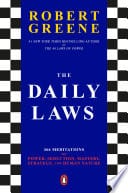
A NEW YORK TIMES BESTSELLER From the world’s foremost expert on power and strategy comes a daily devotional designed to help you seize your destiny. This is the only authorized paperback edition in the US. Robert Greene, the #1 New York Times bestselling author, has been the consigliere to millions for more than two decades. Now, with entries that are drawn from his five books, plus never-before-published works, The Daily Laws offers a page of refined and concise wisdom for each day of the year, in an easy-to-digest lesson that will only take a few minutes to absorb. Each day features a Daily Law as well—a prescription that readers cannot afford to ignore in the battle of life. Each month centers around a major theme: power, seduction, persuasion, strategy, human nature, toxic people, self-control, mastery, psychology, leadership, adversity, or creativity. Who doesn’t want to be more powerful? More in control? The best at what they do? The secret: Read this book every day. “Daily study,” Leo Tolstoy wrote in 1884, is “necessary for all people.” More than just an introduction for new fans, this book is a Rosetta stone for internalizing the many lessons that fill Greene’s books and will reward a lifetime of reading and rereading.
Handwritten Notebook Pages
Source
Open The Daily Laws · The Daily Dad notebook pages — start at notebook p. 12 (file not included in this release).
June 2026 recall synthesis
The notebook extracts a cluster of Greene’s strategic maxims rather than a continuous chapter argument:
| Theme | Recalled maxim | Practical translation |
|---|---|---|
| Indirect power | influence often belongs to the person behind the visible operation | map dependencies and decision channels, not only titles |
| Status | let others retain dignity and sometimes feel smarter | avoid turning every collaboration into a contest |
| Curiosity | preserve wonder rather than reflexive cynicism | ask what is actually happening before displaying sophistication |
| Reputation | credibility compounds and is expensive to repair | treat small public actions as deposits or withdrawals |
| Motivation | appeal to another person’s interest | explain the benefit in their terms, not only the justice of your request |
| Network position | circulation and connection can create leverage | avoid isolation; become useful across groups |
| Belief | people have a deep desire to believe in something | study the need an ideology, leader, or story is meeting |
| Independence | excessive possession by a faction reduces leverage | keep judgment and relationships from collapsing into one patron |
| Flattery | tailored, discreet recognition is stronger than generic praise | notice the capability or insecurity actually at stake |
| Boldness | timidity can magnify uncertainty and invite resistance | when action is justified, execute clearly and correct quickly |
| Effort display | visible strain can weaken the impression of mastery | prepare heavily without making performance about the preparation |
| Imperfection | conspicuous perfection provokes envy or disbelief | remain human; do not manufacture false modesty |
| Masks | public fronts do not settle underlying incentives | compare words, behavior, constraints, and repeated choices |
Notebook warning signs
The entry also records Greene’s advice to be suspicious of extreme niceness and hidden ambition. These are prompts for attention, not licenses for paranoia. Kindness can be sincere, and quiet people need not be covert rivals. A useful rule is to update on patterns, incentives, and costly behavior, not a single mannerism.
Ethical boundary
Greene often describes techniques that can be used for persuasion or manipulation. Preserve the descriptive insight—status, incentives, reputation, dependency—while testing every application against honesty, reciprocity, consent, and long-run trust. “It works” is not the same as “it is right.”
Retrieval questions from this entry
- Where does the real decision power sit behind the formal chart?
- What self-interest would make cooperation genuinely attractive to the other person?
- Am I reading repeated behavior or projecting motive onto a social style?
- Would this tactic survive disclosure to the person affected?
- Does the short-term advantage build or spend long-run trust?
Review
Before Reading
What do I expect this section/book to argue?
- Prediction:
- Question I want answered:
After Reading
1. Recall Dump
Close the book. From memory, what were the main points?
2. The Core Argument
- The book/section in one sentence:
- Main claim:
- Why the author thinks this is true:
- Best evidence/example:
3. Feynman Check
Explain the idea simply, as if teaching it to someone unfamiliar with the topic.
Simple explanation:
4. What Actually Matters?
- Most important idea:
- Best quote or passage:
- Term/concept worth remembering:
- Connection to another book/idea:
5. Pushback
- Strongest objection or weakness:
- How the author might respond:
6. Personal Takeaway
- What changed, clarified, or challenged my thinking?
- One way I could apply this:
Retention Check
24 Hours Later
- I can explain the main argument without notes.
- I remember the best example or evidence.
- I can state one objection.
1 Week Later
- I can summarize this in 5 sentences.
- I can connect it to another book, thinker, or historical period.
1 Month Later
- I still remember the core argument.
- I know whether this book changed my larger framework.
Flashcards / Recall Questions
- Q:
- A:
- Q:
- A:
- Q:
- A:
Scratchpad
Unfiltered thoughts, questions, comparisons, argument trees, or future writing ideas.