Zibaldone 2024–2025 journal
Journal connection: Book excerpts and diagrams from The Happiness Hypothesis.
Source boundary: These are captured journal materials; the integration does not independently verify every clipped claim, quotation, or figure.
PDF++ pages: p. 305 (file not included in this release) · p. 306 (file not included in this release)
Embedded previews:
Zibaldone 2024-2025.pdf (file not included in this release)
Zibaldone 2024-2025.pdf (file not included in this release)
Open the complete Zibaldone page index

DESCRIPTION
“The most brilliant and lucid analysis of virtue and well-being in the entire literature of positive psychology. For the reader who seeks to understand happiness, my advice is: Begin with Haidt.” —Martin E.P. Seligman, University of Pennsylvania and author of Authentic Happiness The Happiness Hypothesis is a book about ten Great Ideas. Each chapter is an attempt to savor one idea that has been discovered by several of the world’s civilizations—to question it in light of what we now know from scientific research, and to extract from it the lessons that still apply to our modern lives and illuminate the causes of human flourishing. Award-winning psychologist Jonathan Haidt shows how a deeper understanding of the world’s philosophical wisdom and its enduring maxims—like “do unto others as you would have others do unto you,” or “what doesn’t kill you makes you stronger”—can enrich and transform our lives.
My Summary
Main Ideas, Takeaways & Similarities
Questions
I. What is the problem?
A. How is this problem formulated?
B. Why is this problem important?
C. What is the history of this problem?
D. Which prominent personalities have been interested in this problem?
II. What solutions to the problem are there?
A. What are the conclusions reached?
B. By what argument(s) is the conclusion reached?
C. What facts or assumptions serve as premises?
D. When a prominent personality offers a solution, does he also argue for or against other prominent personalities? Does he raise objections to alternative solutions? Does he consider objections to his own solutions?
III. Evaluation
A. What are the advantages and disadvantages of the alternative formulations to the problem?
B. Has the importance or history of the problem ever been misrepresented?
C. Are the solutions logically related to the premises?
D. Are the facts true? Are the assumptions acceptable? Are the objections answerable?
AI Summary
Highlights
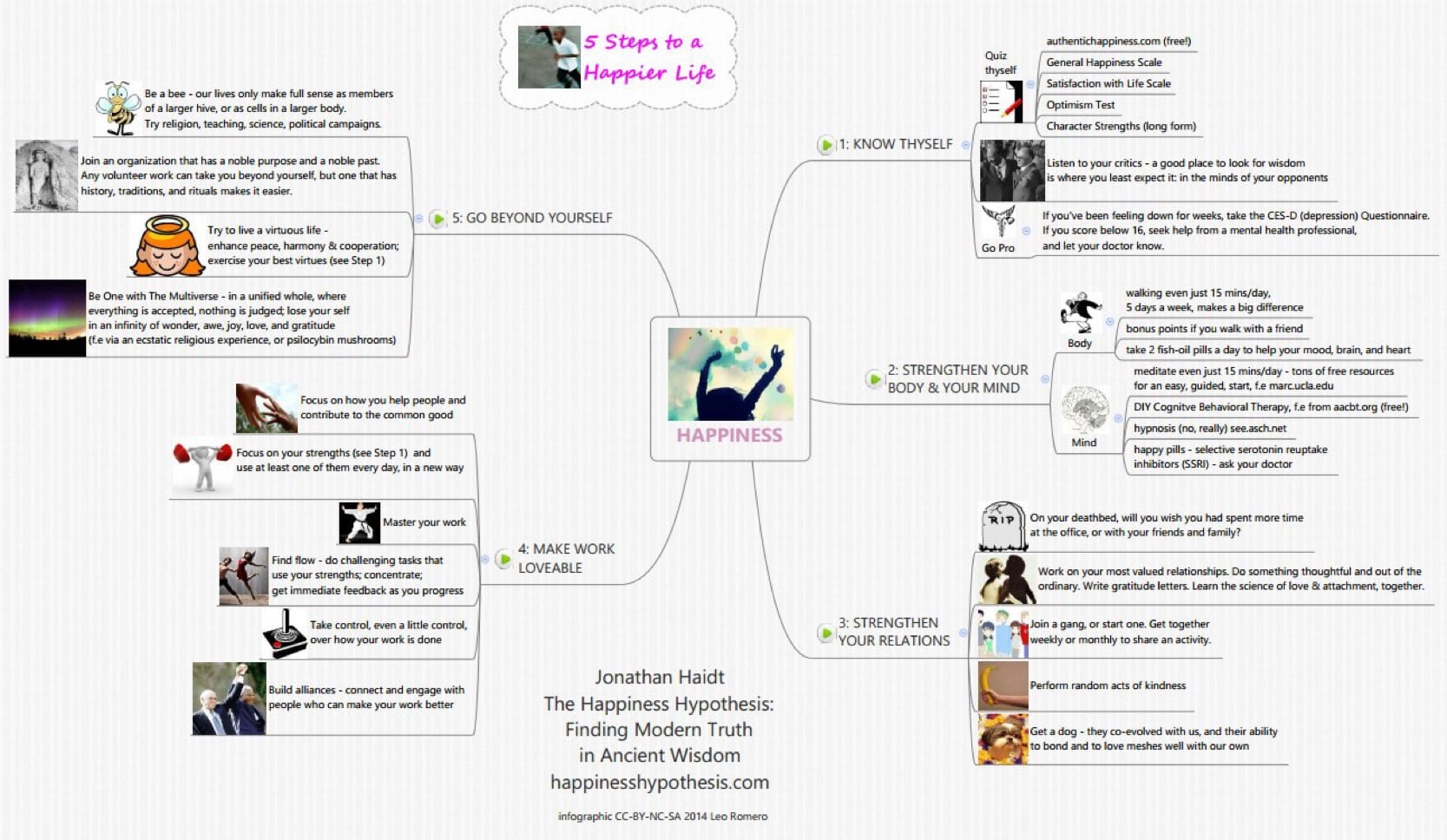
The Happiness Hypothesis – Summaries
Introduction – Too Much Wisdom
- Explores the abundance of wisdom across cultures and history, from religious texts to philosophy.
- Identifies ten “Great Ideas” about happiness and meaning, drawn from both ancient traditions and modern psychology.
- Frames the book as a bridge between timeless insights and scientific research.
Chapter 1: The Divided Self
- Central metaphor: the rider and elephant — the conscious, rational mind (rider) versus the powerful, emotional, intuitive unconscious (elephant).
- Draws from Plato, Buddha, Freud, and neuroscience (e.g., split-brain studies) to show how our mind is divided and why reasoning is often post-hoc.
- Explains self-sabotage, weakness of will, and moral intuition as products of this division.
Chapter 2: Changing Your Mind
- Ancient wisdom (Marcus Aurelius, Buddha, Boethius) teaches that suffering stems from interpretation, not events themselves.
- Pop psychology often promotes reframing, but epiphanies fade unless the elephant is retrained through long-term habits, mindfulness, and behavioral practices.
- Introduces cognitive-behavioral therapy, meditation, and gratitude as tools for rewiring pessimistic tendencies.
Chapter 3: Reciprocity with a Vengeance
- Reciprocity is humanity’s core social glue—the “Golden Rule” is nearly universal.
- Explores reciprocal altruism, revenge instincts, and vulnerability to exploitation.
- Emphasizes monitoring our own hypocrisy and biases when judging fairness.
Chapter 4: The Faults of Others
- Humans are natural hypocrites, blind to their own faults while keenly aware of others’.
- Self-righteousness drives conflict; humility and perspective-taking reduce it.
- Encourages practices that increase self-awareness and reduce moral arrogance.
Chapter 5: The Pursuit of Happiness
- Tests competing ideas: happiness from external rewards (fleeting) versus happiness from within (Stoic/Buddhist acceptance).
- Argues that lasting happiness comes from a balance: inner attitudes (gratitude, perspective) and external factors (relationships, engagement).
- Highlights “flow” (deep, immersive activity) as a central source of fulfillment.
Chapter 6: Love and Attachments
- Passionate love inevitably fades, but companionate love—rooted in deep attachment—produces lasting happiness.
- Attachment theory explains how secure bonds create emotional stability.
- Focus on nurturing enduring intimacy over chasing perpetual passion.
Chapter 7: The Uses of Adversity
- Debunks the oversimplified “what doesn’t kill you makes you stronger.”
- Post-traumatic growth arises from moderate adversity, approached with meaning and support.
- Severe trauma can cause long-term harm unless resilience strategies are in place.
Chapter 8: The Felicity of Virtue
- Ancient moral traditions emphasized a broad set of virtues: wisdom, courage, humanity, justice, temperance, and transcendence.
- Modern moral culture is narrower; reviving a richer vision of virtue enhances personal and societal flourishing.
- Links positive psychology tools to ancient virtue cultivation.
Chapter 9: Divinity With or Without God
- Humans instinctively perceive a “vertical dimension” of life—experiences of awe, elevation, holiness, or nobility, religious or secular.
- Such experiences can deepen morality and meaning but also fuel fundamentalism.
- Haidt’s research on awe and elevation explains this phenomenon.
Chapter 10: Happiness Comes from Between
- True happiness emerges not just from within or from external achievements but from the _interaction between_internal states, relationships, work, and purpose.
- Flourishing means aligning personal strengths with connection and contribution.
- Advocates balancing striving (external goals) with acceptance (inner peace).
Conclusion: On Balance
- The final “happiness hypothesis”: Happiness and meaning arise from integrating ancient wisdom with modern science.
- Balance gratitude and perspective with deep relationships, purposeful work, engagement, and transcendence.
- Haidt urges readers to actively apply these lessons rather than merely consume them.
One-Page Quick Reference Summary
- Core Idea: Happiness arises from balancing inner attitudes (gratitude, perspective) with external relationships, work, and purpose.
- Rider & Elephant: The conscious mind (rider) can advise but rarely control the emotional, intuitive unconscious (elephant). Most judgments and actions are automatic.
- Lasting Change: Insights fade; habits, mindfulness, and behavior retraining are needed to truly reshape the elephant.
- Relationships: Reciprocity and secure attachments are critical; watch for hypocrisy and revenge instincts.
- Happiness Formula: Combine gratitude, flow, and purpose with strong relationships for durable well-being.
- Love: Passion cools, but companionate love and emotional security sustain fulfillment.
- Adversity: Moderate challenges can build resilience; growth depends on meaning-making and support, not suffering alone.
- Virtue: Broader, ancient virtues (wisdom, courage, humanity, justice, temperance, transcendence) foster deeper flourishing.
- Divinity & Awe: Experiences of awe and elevation inspire morality and meaning, regardless of religious belief.
- Final Lesson: Happiness “comes from between”—through integration of inner peace, deep connection, and meaningful striving.
Misc Notes
The mind is divided into parts that sometimes conflict.
Reciprocity is the most important tool for getting along with people.
We are so good as seeing the slightest speck in a neighbors eye but so bad at seeing the log in our own.
Happiness comes from within AND it comes from the outside.
“In days gone by this mind of mine used to stray wherever selfish desire or lust or pleasure would lead it. Today this mind does not stray and is under the harmony of control, even as a wild elephant is control by the trainer.” -Buddha
“I am dragged along by a strange new force. Desire and reason are pulling in different directions. I see the right way and approve it, but follow the wrong.” -Ovid
Four divisions of the mind:
Mind vs. Body
Left vs. Right
New vs. Old
Controlled vs. Automatic
“Reason is, and ought only to be the slave of the passions, and can never pretend to any other office than to serve and obey them.” -David Hume
A skilled rider who knows how to distract and coax the elephant without having to engage in a direct contest of wills.
We sometimes fall into the view that we are fighting with our conscious, our id, or our animal self. But really we are the whole thing. We are the rider, and we are the elephant. Both have their strengths and special skills.
Negativity bias
“When a man knows the solitude of silence, and feels the joy of quietness, he is then free from fear and sin.” -Buddha
Buddha had it right: You need a method of taming the elephant, for changing the mind gradually: Meditation, cognitive therapy or Prozac.
Gossip extends our moral-emotional toolkit. Its a policeman and a teacher. Paired with reciprocity allows karma to work.
The very process of give and take creates a feeling of partnership, even in the person being taken.
“Human beings are a species splendid in their array of moral equipment, tragic in their propensity to misuse it, and pathetic in their constitutional ignorance of the misuse.” -Robert Wright
“illusion of objectivity” studies on how people find some evidence to support and argument then stop looking.
“naive realism”
“progress principle”
Pleasure comes more from making progress toward goals than from achieving them.
“Things won are done; joy’s soul lies in the doing.”
H(Happiness Level) = S (Biological set point) + C (Conditions of life) + V (Voluntary Activities)
“We do not live but a quarter part of our life—why do we not let on the flood—raise the gates—& set our wheels in motion—He that hath ears to hear let him hear. Emply your senses.” Henry David Thoreau
“No one can live happily who has regard to himself alone and transform everything into a question of his own utility; you must live for your neighbor, if you would live for yourself.” -Seneca
People need obligations and constraints to provide structure and meaning to their lives.
If you want to predict how happy someone is, or how long she will live, you should find out about her social relationships.
Giving support shows that caring for others is often more beneficial than is receiving help.
“When heaven is about to confer a great responsibility on any man, it will exercise his mind with suffering, subject his sinews and bones to hard work, expose his body to hunger, put him to poverty, place obstacles in the paths of his deeds, so as to stimulate his mind, harden his nature, and improve wherever he is incompetent.” -Meng Tzu
People need adversity, setbacks, and perhaps even trauma to reach the highest levels of strength, fulfillment and personal development.
“Sweet are the uses of adversity,
Which like a toad, ugly and venomous,
Wears yet a precious jewel in his head.”
Shakespeare
“All things come into being by conflict of opposites.” -Heraclitus