
DESCRIPTION
An acclaimed philosopher shows us how—in an age of unprecedented anxiety—we can find fulfillment by embracing the present and living more fully in the now. He is “the perfect guide for a course correction in life” (from the Introduction by Deepak Chopra). The brain can only assume its proper behavior when consciousness is doing what it is designed for: not writhing and whirling to get out of present experience, but being effortlessly aware of it. Alan Watts draws on the wisdom of Eastern philosophy and religion in this timeless and classic guide to living a more fulfilling life. His central insight is more relevant now than ever: when we spend all of our time worrying about the future and lamenting the past, we are unable to enjoy the present moment—the only one we are actually able to inhabit. Watts offers the liberating message that true certitude and security come only from understanding that impermanence and insecurity are the essence of our existence. He highlights the futility of endlessly chasing moving goalposts, whether they consist of financial success, stability, or escape from pain, and shows that it is only by acknowledging what we do not know that we can learn anything truly worth knowing. In The Wisdom of Insecurity, Watts explains complex concepts in beautifully simple terms, making this the kind of book you can return to again and again for comfort and insight in challenging times. “Perhaps the foremost interpreter of Eastern disciplines for the contemporary West, Watts had the rare gift of ‘writing beautifully the unwritable.’” —Los Angeles Times
My Summary
Main Ideas, Takeaways & Similarities
Questions
I. What is the problem?
A. How is this problem formulated?
B. Why is this problem important?
C. What is the history of this problem?
D. Which prominent personalities have been interested in this problem?
II. What solutions to the problem are there?
A. What are the conclusions reached?
B. By what argument(s) is the conclusion reached?
C. What facts or assumptions serve as premises?
D. When a prominent personality offers a solution, does he also argue for or against other prominent personalities? Does he raise objections to alternative solutions? Does he consider objections to his own solutions?
III. Evaluation
A. What are the advantages and disadvantages of the alternative formulations to the problem?
B. Has the importance or history of the problem ever been misrepresented?
C. Are the solutions logically related to the premises?
D. Are the facts true? Are the assumptions acceptable? Are the objections answerable?
AI Summary
Highlights
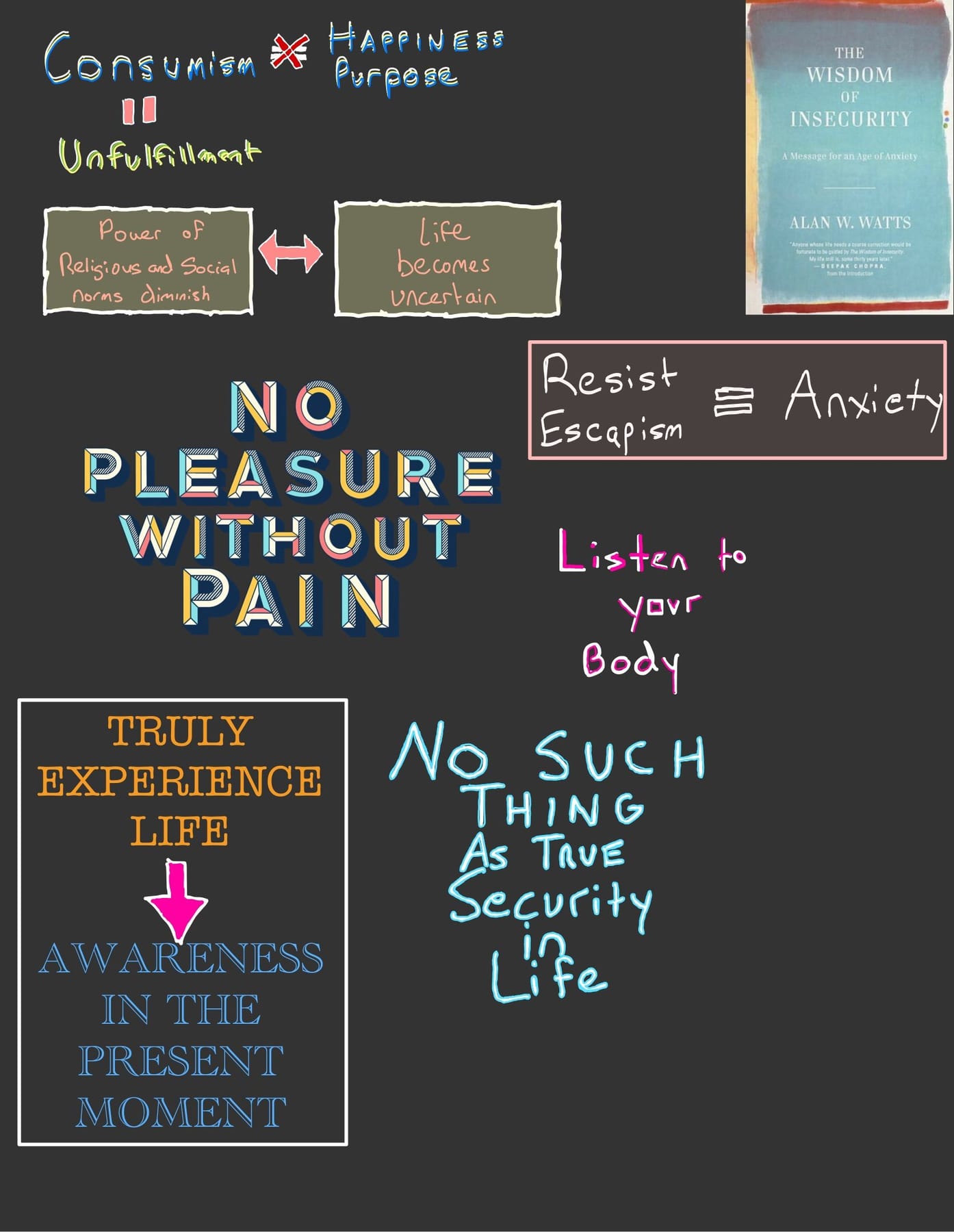
- The Nature of Insecurity:
- Watts begins by acknowledging the pervasive sense of insecurity and anxiety that plagues modern society.
- He contends that humans have an innate desire for certainty and control, which often leads to feelings of fear and restlessness.
- The Illusion of Control:
- Watts argues that the quest for control and certainty is an illusion because life is inherently uncertain and ever-changing.
- He suggests that attempting to control every aspect of life only leads to frustration and disappointment.
- The Eternal Now:
- Watts introduces the concept of living in the present moment, also known as the “eternal now.”
- He asserts that true happiness and wisdom can only be found by fully embracing and experiencing the present moment.
- The Ego and the Self:
- Watts distinguishes between the ego, which seeks to protect itself and create a sense of identity, and the true self, which exists beyond the ego’s constructs.
- He encourages individuals to let go of their ego-driven desires and embrace their authentic selves.
- The Paradox of Desire:
- Watts explores the paradox of desire, suggesting that the pursuit of happiness through external possessions and achievements often leads to suffering.
- He advocates for understanding the nature of desire and recognizing that true fulfillment arises from within.
- The Fear of Death:
- Watts addresses the fear of death and argues that it is rooted in the ego’s attachment to its own existence.
- He suggests that accepting the impermanence of life and the inevitability of death can lead to a more meaningful and fearless existence.
- The Unity of Opposites:
- Watts discusses the interconnectedness of opposites, such as good and evil, pleasure and pain, and certainty and uncertainty.
- He proposes that embracing both sides of these dualities allows for a deeper understanding of reality.
- The Importance of Letting Go:
- Watts emphasizes the need to let go of attachments, preconceptions, and rigid beliefs to fully experience the present moment.
- He encourages individuals to surrender to the flow of life rather than resisting it.
- The Playful Attitude:
- Watts suggests adopting a playful and lighthearted attitude toward life.
- He believes that a sense of humor and spontaneity can help individuals navigate the complexities of existence with greater ease.
- Zen Buddhism and Eastern Philosophy:
- Throughout the book, Watts draws on Zen Buddhism and Eastern philosophical traditions to illustrate his points.
- He emphasizes the importance of meditation and mindfulness in cultivating the wisdom of insecurity.
- Transcending the Search for Certainty:
- Watts argues that true wisdom lies in transcending the never-ending search for certainty and security.
- He encourages readers to find peace in embracing the inherent uncertainty of life.