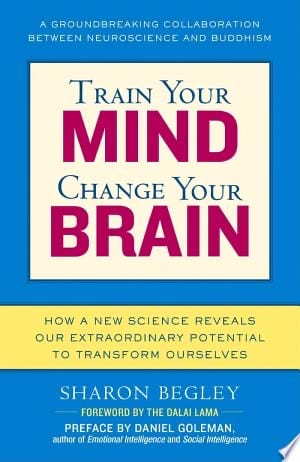
DESCRIPTION
Cutting-edge science and the ancient wisdom of Buddhism have come together to reveal that, contrary to popular belief, we have the power to literally change our brains by changing our minds. Recent pioneering experiments in neuroplasticity—the ability of the brain to change in response to experience—reveal that the brain is capable of altering its structure and function, and even of generating new neurons, a power we retain well into old age. The brain can adapt, heal, renew itself after trauma, compensate for disabilities, rewire itself to overcome dyslexia, and break cycles of depression and OCD. And as scientists are learning from studies performed on Buddhist monks, it is not only the outside world that can change the brain, so can the mind and, in particular, focused attention through the classic Buddhist practice of mindfulness. With her gift for making science accessible, meaningful, and compelling, science writer Sharon Begley illuminates a profound shift in our understanding of how the brain and the mind interact and takes us to the leading edge of a revolution in what it means to be human. Praise for Train Your Mind, Change Your Brain “There are two great things about this book. One is that it shows us how nothing about our brains is set in stone. The other is that it is written by Sharon Begley, one of the best science writers around. Begley is superb at framing the latest facts within the larger context of the field. This is a terrific book.”—Robert M. Sapolsky, author of Why Zebras Don’t Get Ulcers “Excellent … elegant and lucid prose … an open mind here will be rewarded.”—Discover “A strong dose of hope along with a strong does of science and Buddhist thought.”—The San Diego Union-Tribune
My Summary
Main Ideas, Takeaways & Similarities
Questions
I. What is the problem?
A. How is this problem formulated?
B. Why is this problem important?
C. What is the history of this problem?
D. Which prominent personalities have been interested in this problem?
II. What solutions to the problem are there?
A. What are the conclusions reached?
B. By what argument(s) is the conclusion reached?
C. What facts or assumptions serve as premises?
D. When a prominent personality offers a solution, does he also argue for or against other prominent personalities? Does he raise objections to alternative solutions? Does he consider objections to his own solutions?
III. Evaluation
A. What are the advantages and disadvantages of the alternative formulations to the problem?
B. Has the importance or history of the problem ever been misrepresented?
C. Are the solutions logically related to the premises?
D. Are the facts true? Are the assumptions acceptable? Are the objections answerable?
AI Summary
Highlights
“Train Your Mind, Change Your Brain: How a New Science Reveals Our Extraordinary Potential to Transform Ourselves” is a book written by Sharon Begley, published in 2007. The book explores the emerging field of neuroplasticity and how the brain’s structure and function can change through mental training and mindfulness. Here is a comprehensive summary of the book in bullet points:
- The book introduces the concept of neuroplasticity, which is the brain’s capacity to rewire and adapt throughout an individual’s life.
- Sharon Begley discusses groundbreaking research in the field of neuroplasticity and how it challenges the long-held belief that the brain’s structure is fixed and unchangeable.
- She explores the work of scientists and researchers who have demonstrated that the brain can physically change in response to mental training, experiences, and mindfulness practices.
- The book delves into the role of meditation and mindfulness in promoting neuroplasticity and enhancing cognitive function.
- Begley presents case studies and scientific findings that illustrate how mindfulness practices can lead to changes in brain structure and function, including increased gray matter density.
- She discusses the potential therapeutic applications of neuroplasticity in addressing mental health conditions such as depression, anxiety, and post-traumatic stress disorder.
- The book explores the relationship between the mind and the brain, highlighting the influence of mental states, emotions, and thoughts on neuroplasticity.
- Begley addresses the ethical and philosophical implications of neuroplasticity, including questions about the nature of the self and personal transformation.
- She emphasizes the importance of focused attention, mental discipline, and intention in harnessing the potential of neuroplasticity.
- The book discusses the role of neurofeedback and cognitive-behavioral therapy in promoting neuroplasticity and improving mental well-being.
- Begley reflects on the broader implications of neuroplasticity for education, personal development, and human potential.
- She encourages readers to adopt practices that promote mindfulness and mental training to harness the brain’s capacity for change.
- The book concludes by highlighting the transformative power of neuroplasticity and the potential for individuals to shape their own brain function and well-being.
“Train Your Mind, Change Your Brain” offers a thought-provoking exploration of the concept of neuroplasticity and its implications for personal transformation and mental well-being. Sharon Begley’s book provides insights into the groundbreaking research that has challenged traditional views of the brain’s fixed nature. It highlights the potential for individuals to harness the power of mindfulness and mental training to promote cognitive and emotional well-being. The book encourages readers to adopt practices that promote neuroplasticity and personal growth.