

DESCRIPTION
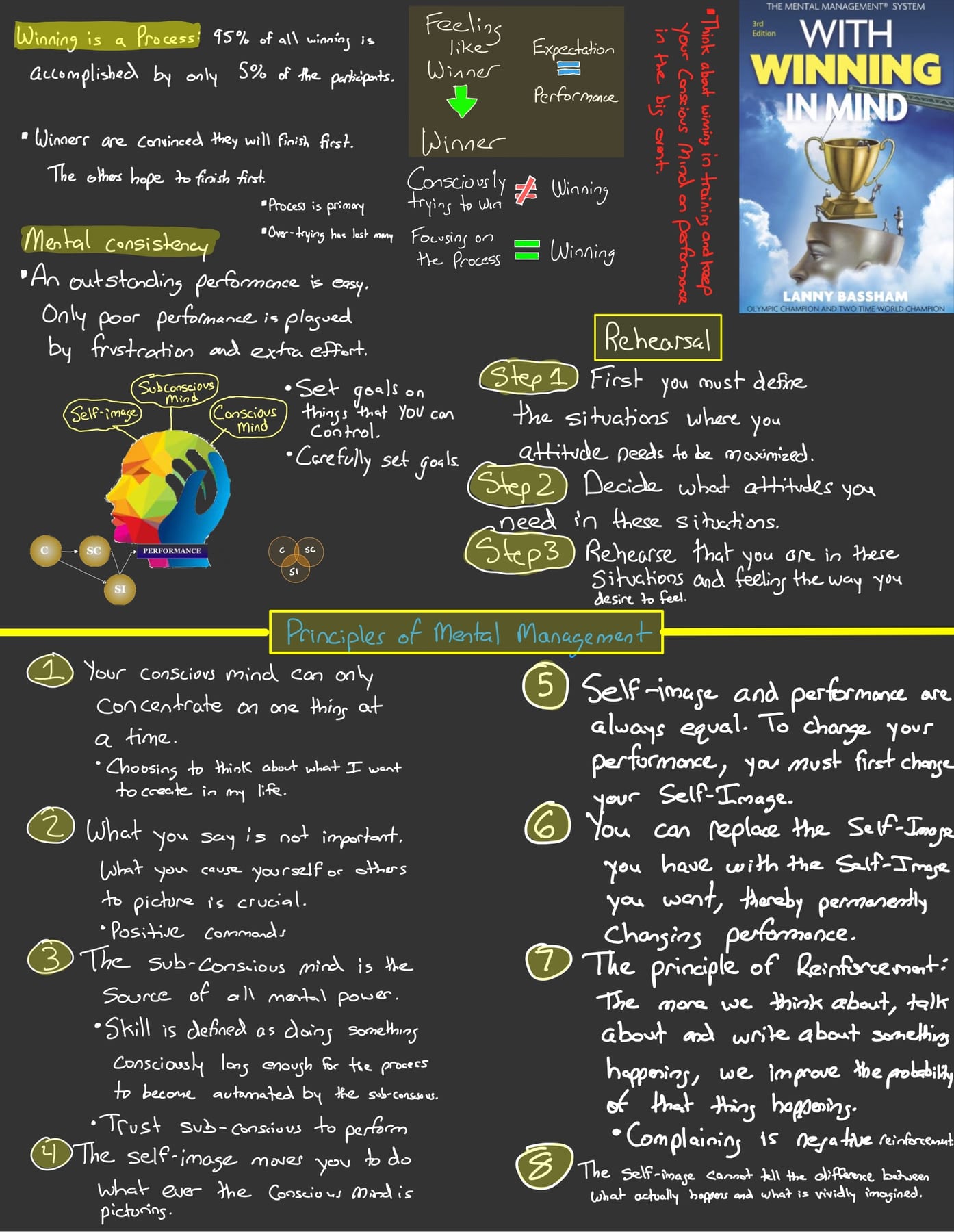
Winning is a Process (Location 156)
ninety-five percent of all winning is accomplished by only five percent of the participants. (Location 158)
Winners are convinced they will finish first. The others hope to finish first. (Location 164)
I am not saying that everyone who expects to win will always win. What I am saying is if it is not like you to win, you have no chance of winning at all. (Location 172)
When athletes have the mind-set that they expect to perform well, victory is automatically an option. For others, hope is their mind-set. Who would you pick to win that competition? I certainly wouldn’t rely on hope. (Location 173)
The expectation of winning comes from an internal feeling the champion has concerning his performance. He is in harmony with the idea that his expectation and his performance are equal. (Location 185)
I find it interesting that champions who were consciously trying to win while competing rarely do. (Location 188)
Scoring is a function of great execution, and winning is the result, but thinking about winning can pull your focus off of proper execution in a competition. Thinking about process is the answer. (Location 196)
Process is Primary.” (Location 204)
Interestingly, most say that they were thinking about nothing or very little while winning their event. This makes sense when you consider that when the Conscious Mind is quiet the Subconscious can do its best work. We need to perform subconsciously in big competitions. When we think about winning while performing, we become outcome-oriented instead of performance-oriented and normally over-trying is the result. Over-trying has caused more good competitors to lose competitions than any other form of mental error. (Location 205)
So, should we be concerned at all about winning? Certainly. And the best focus, in my view, is on a winning performance, not on finishing on top. I suggest that you goal set to have a winning performance on the day of competition instead of goal setting to win the competition. What is the difference you ask? If you goal set to have a winning performance you will always be process-oriented and not outcome-oriented. You will be much less likely to over-try in the competition because you are always focused on the next step and not counting your score. (Location 226)
think about winning in training and keep your Conscious Mind on performance in the big event. (Location 241)
If you can define a thing you can duplicate it. If you can duplicate it you can achieve mental consistency. If you have mental consistency you can win. (Location 252)
an outstanding performance is easy. Only poor performance is plagued by frustration and extra effort. (Location 263)
three mental components: the Conscious Mind, the Subconscious Mind and the Self-Image. (Location 266)
Principle of Mental Management® Number 1 Your Conscious Mind can only concentrate on one thing at a time. (Location 362)
Principle of Mental Management® Number 2 What you say is not important. What you cause yourself or others to picture is crucial. (Location 378)
Principle of Mental Management® Number 3 The Subconscious Mind is the source of all mental power. (Location 387)
Conscious override is a major problem for athletes on Olympic day. Instead of trusting the Subconscious Mind to perform, athletes try extra hard to do well. Conscious override is the result. You tighten up. You slow down. Off your rhythm, your performance drops. You must allow the Subconscious to do the work. Trust in your ability. Let it flow. (Location 406)
Action Statement for Principle Number 3 “I am so well-trained that all of my performance is subconsciously done. I trust my Subconscious to guide my performance in competition.” (Location 409)
Principle of Mental Management® Number 4 The Self-Image moves you to do what ever the Conscious Mind is picturing. (Location 412)
Principle of Mental Management® Number 5 Self-Image and performance are always equal. To change your performance, you must first change your Self-Image. (Location 427)
We all have a comfort zone, the upper and lower limits being defined by our Self-Image. It is “like us” to operate within this zone. As long as we are in the zone, our Self-Image will provide us with extra power to improve until we are back within the zone. Likewise, if we start scoring better than our comfort zone, the Self-Image tends to slow us down until we are, once again, back in the zone. Change the zone, and we will change the performance. (Location 445)
Action Statement for Principle Number 5 “I am aware that my performance and Self-Image are equal. I am eager to change my habits and attitudes to increase my performance.” (Location 448)
Principle of Mental Management® Number 6 You can replace the Self-Image you have with the Self-Image you want, thereby permanently changing performance. (Location 453)
Action Statement for Principle Number 6 “I am responsible for changing my Self-Image. I choose the habits and attitudes I want and cause my Self-Image to change accordingly.” (Location 469)
Principle of Mental Management® Number 7 The Principle of Reinforcement: The more we think about, talk about and write about something happening, we improve the probability of that thing happening. (Location 475)
Complaining is negative reinforcement. (Location 496)
Positive Prediction: Reinforcement in Advance (Location 498)
When Positive Prediction is implemented correctly everyone wins. You feel great using the technique. The person you are talking to gets a lift and the results make everyone feel wonderful. (Location 517)
Action Statement for Principle Number 7 “I choose to think about, talk about, and write about what I wish to have happen in my life.” (Location 528)
My advice is to only set goals on things that YOU can control. Keep your focus on you, not your competitors. Rehearse in your mind the process of executing a combination of mental feelings and technical moves that get results. Your success is determined by how well you can control what is in front of you not by worrying about outcome. (Location 555)
A habit that separates the top five percent of competitors who win from the other 95 percent who just play is the practice of carefully setting goals. (Location 580)
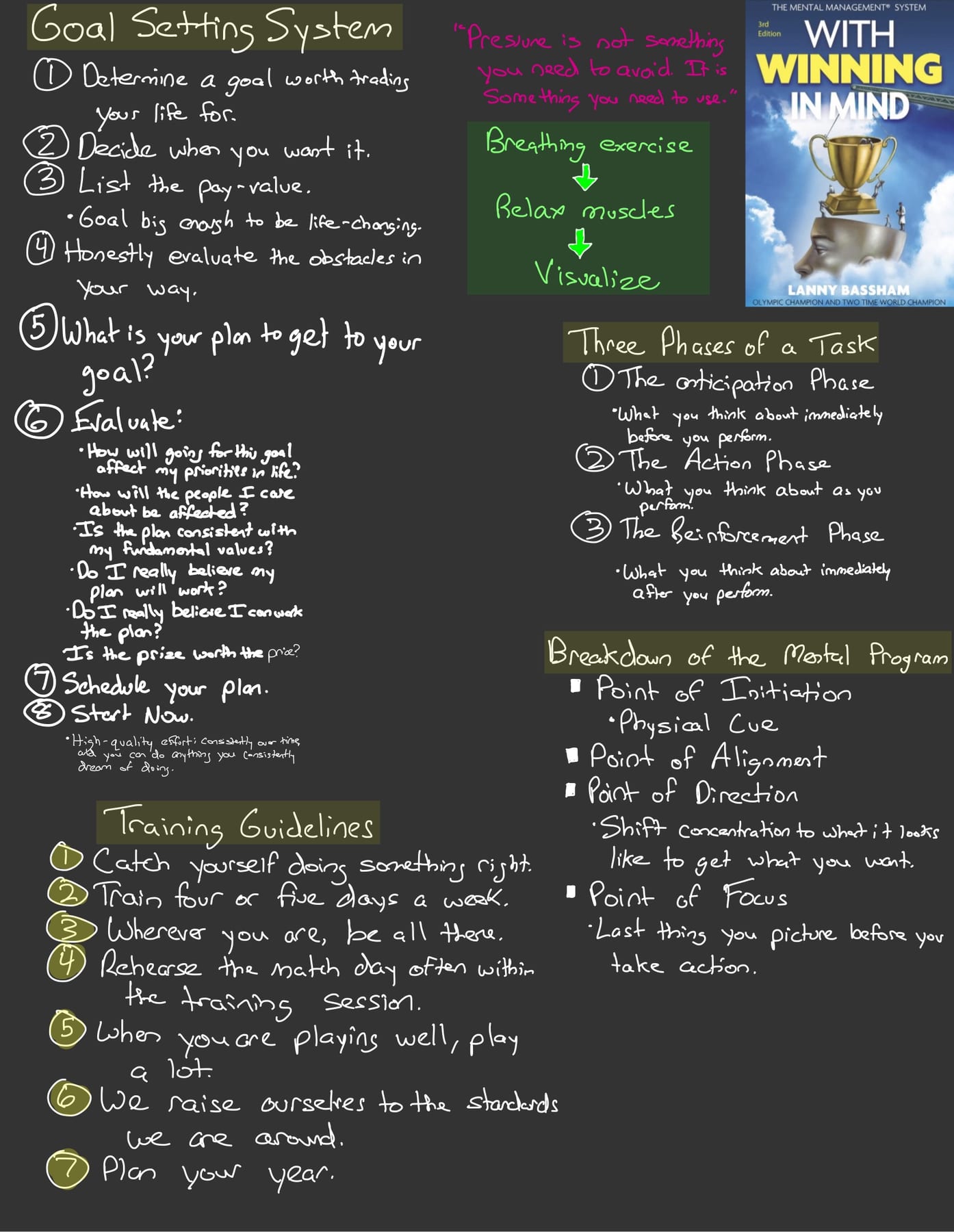
Step Number 1 Determine a goal worth trading your life for. (Location 596)
Step Number 2 Decide when you want it. (Location 611)
Step Number 3 List the pay-value. (Location 615)
Make certain the goal you set is big enough to be life-changing for you. People are motivated by three things: promise of gain, fear of loss and recognition. Set a goal big enough to move you to change your habits or attitudes. If it is too small it will just not be worth it for you to make changes in your life. (Location 618)
Step Number 4 Honestly evaluate the obstacles in your way. (Location 640)
Step Number 5 What is your plan to get your goal? (Location 645)
Step Number 6 Evaluate your plan before you proceed. Ask some questions. (Location 652)
How will going for this goal affect my priorities in life? How will the people I care about be affected by this plan? Is the plan consistent with my fundamental values? Do I really believe my plan will work? Do I really believe I can work the plan? Is the prize worth the price? (Location 654)
Step Number 7 Schedule your plan. (Location 660)
Step Number 8 Start Now. (Location 666)
Put out high-quality effort, consistently over time, and you can do anything you consistently dream of doing. (Location 670)
Step Number 9 Prior to reaching your goal always set a new one to take it’s place. (Location 671)
Step Number 10 Hold on to the end or trade up. (Location 678)
I told her to relax in bed and rehearse that she was shooting well in the match. When Eva began to rehearse shooting well, her level of arousal dropped, allowing her to sleep. The next day, Eva Funes, rested from a good night’s sleep, won the competition. (Location 773)
Step one: First you must define the situations where your attitude needs to be maximized. Step Two: Decide what attitudes you need in these situations. Step Three: Rehearse that you are in these situations and feeling the way you desire to feel. (Location 791)
To prepare yourself for competition, you need to ask yourself, how well prepared are you for your task? Are you performing below your potential because you are not properly prepared? Truthfully answering these questions will help your anticipation phase preparation. Then, ask yourself how well do you perform when the circumstances are different from those you have anticipated? This gives you insight into your action phase preparation. Finally, ask yourself what do you reinforce? Do you praise others when they perform well? Do you praise yourself? If you have a bad shot do you focus on correcting it instead of getting angry at yourself? If you can answer yes to these questions, pat yourself on the back and continue reinforcing your successes. If not, it’s time to start. (Location 856)
Breakdown of the Mental Program (Location 902)
The Point of Initiation The Point of Alignment The Point of Direction The Point of Focus (Location 905)
Mental Program for Rifle Shooting (Location 960)
The Point of Initiation (Location 961)
The Point of Attitude The Point of Direction The Point of Control The Point of Focus (Location 962)
“Pressure, is not something you need to avoid. It is something you need to use.” (Location 991)
Recognize that pressure is positive and something that you can control. (Location 1018)
Focus on what you want to see happen, not on what is stressing you. (Location 1023)
Use a planned, practiced recovery strategy. (Location 1029)
pattern for say three breaths. Then relax a specific muscle group such as your neck and shoulders. Finally, visualize being in complete control of a good performance. You can only think of one thing at a time so while you are thinking about these things you cannot be still thinking negatively. Also, you can 100 percent control your method of breathing, the relaxation of your muscles and the visualization so the second step is accomplished as well. Now, when you refocus on your next series you should be recovered and should perform well. (Location 1034)
FAKE a YAWN. The same chemicals that cause your muscles to relax when you yawn naturally also seem to work just the same when you fake a yawn. (Location 1039)
Many competitors work hard enough in training but still work extra hard in the competition. WORKING HARD IN COMPETITION = OVER-TRYING. Champions work hard in training and work easy in the competition. The key is to work hard enough in practice to just trust your Subconscious in the competition. (Location 1068)
Training Guideline Number 1 Catch yourself doing something right. (Location 1138)
Training Guideline Number 2 Train four or five days a week. (Location 1148)
Training Guideline Number 3 Wherever you are, be all there. (Location 1159)
Training Guideline Number 4 Rehearse the match day often within the training session. (Location 1168)
Training Guideline Number 5 When you are playing well, play a lot. (Location 1175)
Training Guideline Number 6 We raise ourselves to the standard we are around. (Location 1188)
Training Guideline Number 7 Plan your year. (Location 1206)
Here is why you MUST record your progress in a Performance Journal. I’ll give you three reasons. First, you cannot manage what you do not measure. Simply put, you cannot afford to be in the dark concerning your progress. You need to have a plan to reach your goals. So, you set a goal, make a plan and go to a competition. Let’s say you do not reach your goal at that competition. If you have a well-documented Performance Journal you can easily determine if your plan failed or you just failed to work your plan. Winning is not an accident. You must plan your work, work your plan and be accountable. (Location 1247)
A Performance Journal, by my definition, has no references to bad shots, bad experiences or poor performances. It is a Performance Journal not a lack of Performance Journal. (Location 1270)
I recommend that you record critical information in a journal every day at the end of training or competition. (Location 1275)
www.mentalmanagementstore.com (Location 1298)
Your Competition Log Your Equipment Log Your General Data Section Your Solution Analysis Your Success Analysis Your Daily Goal Statement (Location 1301)
You cannot expect people to think well of you if you are not willing to think well of yourself. I am not saying that we should boast. But I have had just about enough of people apologizing for being competent. (Location 1742)