
DESCRIPTION
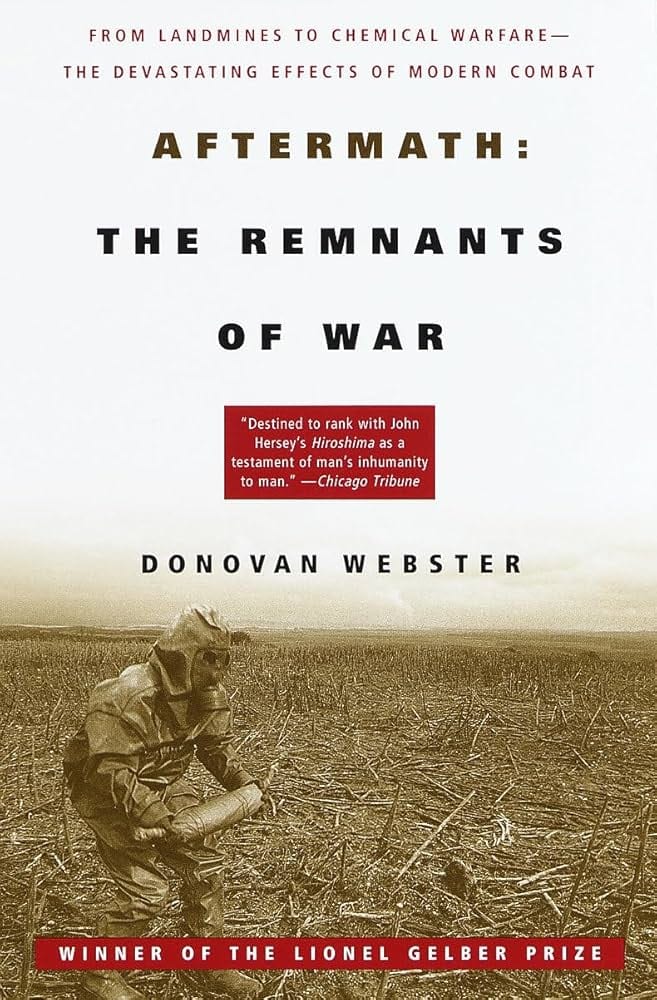
In riveting and revelatory detail, Aftermath documents the ways in which wars have transformed the terrain of the battlefield into landscapes of memory and enduring terror: in France, where millions of acres of farmland are cordoned off to all but a corps of demolition experts responsible for the undetonated bombs and mines of World War I that are now rising up in fields, gardens, and backyards; in a sixty-square-mile area outside Stalingrad that was a cauldron of destruction in 1941 and is today an endless field of bones; in the Nevada deserts, where America waged a hidden nuclear war against itself in the 1950’s, the results of which are only now becoming apparent; in Vietnam, where a nation’s effort to remove the physical detritus of war has created psychological and genetic devastation; in Kuwait, where terrifyingly sophisticated warfare was followed by the Sisyphean task of making an uninhabitable desert capable of sustaining life. Aftermath excavates our century’s darkest history, revealing that the destruction of the past remains deeply, inextricably embedded in the present.
My Summary
Main Ideas, Takeaways & Similarities
Questions
I. What is the problem?
A. How is this problem formulated?
B. Why is this problem important?
C. What is the history of this problem?
D. Which prominent personalities have been interested in this problem?
II. What solutions to the problem are there?
A. What are the conclusions reached?
B. By what argument(s) is the conclusion reached?
C. What facts or assumptions serve as premises?
D. When a prominent personality offers a solution, does he also argue for or against other prominent personalities? Does he raise objections to alternative solutions? Does he consider objections to his own solutions?
III. Evaluation
A. What are the advantages and disadvantages of the alternative formulations to the problem?
B. Has the importance or history of the problem ever been misrepresented?
C. Are the solutions logically related to the premises?
D. Are the facts true? Are the assumptions acceptable? Are the objections answerable?
AI Summary
Highlights
Aftermath
Readwise Information
Author:: Donovan Webster
Title:: Aftermath
Type:: readwise/category/books
Last-Highlighted-Date:: 2022-10-10
Link:: https://readwise.io/bookreview/20353887
Readwise-Source:: readwise/source/kindle
Related-To::
Tags::
Review-for-Repurpose::
Summary
Donovan Webster’s Aftermath: The Remnants of War offers a sobering exploration of the enduring physical, environmental, and human toll of 20th-century conflicts. Through firsthand accounts and meticulous research, Webster reveals how the detritus of war—unexploded ordnance, environmental contamination, and human remains—continues to affect landscapes and communities long after the battles have ended.
Key Statistics and Insights
France: The Lingering Shadows of World War I
-
Over 12 million unexploded shells from World War I remain buried near Verdun, with millions more along the Marne and Somme rivers.
-
Approximately 80% of the shells recovered annually are from World War I, primarily due to the static nature of trench warfare.
-
In 1991 alone, 36 French farmers died when their machinery hit unexploded shells dating back to wars as early as the Franco-Prussian War of 1870.
Russia: The Haunting Fields of Stalingrad
-
The area around Volgograd (formerly Stalingrad) remains an “endless field of bones,” with the remains of German and Soviet soldiers surfacing each spring.
-
The Battle of Stalingrad resulted in over 150,000 German, Austrian, Italian, and Romanian deaths within the encircled area known as the Kessel.
-
Each spring, as the land mines and artillery shells come to the surface again, a few children are hurt, and that is tragic.
United States: The Silent Legacy of Nuclear Testing
-
Between 1951 and 1992, 126 atmospheric nuclear tests were conducted at the Nevada Test Site, contaminating 1,350 square miles of desert, rendering it uninhabitable for the next 5,000 years.
-
Radiation-associated cancers from these tests are projected to cause at least 400,000 deaths by the year 2000, surpassing the fatalities from Hiroshima and Nagasaki combined.
-
The nearby town of Mercury, once home to 4,500 Department of Energy workers and their families, now stands virtually empty.
Vietnam: The Enduring Toll of Agent Orange
-
The use of Agent Orange during the Vietnam War has led to widespread environmental contamination and severe health issues among the population.
-
Thousands of children are born with severe birth defects due to their mothers’ exposure to the chemical.
-
The nation’s efforts to remove the physical detritus of war have inadvertently created psychological and genetic devastation.
Global Menace of Land Mines
-
An estimated 85 to 200 million land mines are scattered across 62 nations worldwide.
-
In Angola, 20 million land mines cause approximately 120 deaths each month.
-
In Cambodia, 18 million mines have led to thousands of casualties annually, with 1 in every 236 Cambodians having lost a limb or eye to land mine explosions.
-
The widespread use and low cost of land mines—some as cheap as $3—have made them a persistent hazard, with removal costs ranging from $200 to $1,000 per mine.
Conclusion: The Unending Echoes of War
Webster’s Aftermath serves as a poignant reminder that the consequences of war extend far beyond the battlefield. From the unexploded shells in French fields to the radioactive deserts of Nevada, the remnants of conflict continue to shape the environment and lives of countless individuals. As Webster illustrates, the true cost of war is not only measured in immediate casualties but also in the enduring scars left on the land and its people.
Highlights
- The reclusive Nobel—who had become enormously wealthy as the inventor of dynamite, blasting caps, smokeless gunpowder, and blasting gelatin—was (Location 70)
- ALFRED B. NOBEL died on December 10, 1896, spiritually broken and completely alone. A life-long bachelor, he had no wives, lovers, or children. No one was at his side—neither siblings nor servants—when a heart attack killed him as he waited for breakfast in his villa outside San Remo, Italy. (Location 119)
- The chain of technology Nobel initiated has led to more than 100 million deaths by war since he died, making this—by hundreds of times—the bloodiest century in the history of the world. (Location 136)
- The remnants of these wars exist as unexploded artillery shells and swaths of buried land mines. They drift as sea mines in oceans and molder as dead soldiers left unburied beneath forest leaves. They even lace the soil with invisible death: dirt made poison by radioactivity from nuclear tests, blasts that render land uninhabitable for millennia. The weapons we have warred with, and their effects on the world’s landscape and cultures, have become our century’s most prevalent history. Only now, at century’s end, can we begin to sift through the past and discern a trajectory that begins with Alfred Nobel, arcs through the nuclear age, and ends in the stockpiles we have labored to create for wars still unfought. (Location 138)
- THE FRENCH INTERIOR Ministry estimates that, more than seventy-five years after the close of World War I, 12 million un-exploded shells from that conflict still sleep in the soil near Verdun. Millions more await discovery in the World War I battle zones along the rivers Marne and Somme, (Location 246)
- southwest and northwest of Verdun. Millions of undiscovered shells from World War II remain embedded in the beaches of Normandy and Brittany. As do long-forgotten sea mines in waters surrounding France. As do unexploded remnants of World War II’s Allied campaign from the Normandy beaches and into Germany. Everywhere in France—in potato fields and orchards, under town squares and back porches—the fallout from two world wars has turned the soil into an enormous booby trap. (Location 248)
- About 80 percent of the bombs and shells, however, come from northeastern France, in a crescent that extends from the English Channel to Nancy, just south of Metz. (Location 291)
- Bélot explains the philosophy of toxic artillery. Intended as a strategic, area-denial tool, the Germans used it first: near Ypres, Belgium, in 1915. They would “toxic-barrage” a strategic area—such as a crossroad or rail junction—not in hopes of killing vast numbers of troops, but to keep the enemy out. Then, after the poison dissolved and became inert, which took about a month, the Germans would move in and control the zone. (Location 339)
- Before the war was over, Bélot says, 100,000 tons of toxic materiel were deployed, killing 91,000 soldiers and permanently wounding more than a million others. (Location 345)
- Then he tells me of the Paris Guns, train-mounted German cannons that fired 2,200-pound shells. The Train Guns, as they were also called, required 100 soldiers to operate. Once fired, their shells returned to earth at twice the speed of sound, and the Département du Déminage estimates that unexploded shells from the Paris Guns are still sixty feet underground—scattered across the Zone Rouge and beyond. “They’re slowly working to the surface,” (Location 352)
- He says that 80 percent of the shells they find each year are from World War I, mainly because that war’s battlefront was static. “It was opposing armies, with their infantries at the battle lines,” he says. “The heavy artillery was set far behind the fighting, and those guns kept shelling and shelling and shelling for four years. That left many unexploded shells in the soil.” (Location 477)
- Things were different in World War II. In that war, the Germans captured France in a month, then occupied it almost peacefully for nearly four years. In the second war, it wasn’t until the Allied armies swept through and liberated France in 1944 that any more fighting took place, and then the conflict was short-lived: the Allies drove the Germans out in about four months. “The second war was very fast and mobile,” Deleuze says. “In the second war, the fighting wasn’t conducted along entrenched battle lines, but was moving combat.” (Location 481)
- “In the first war,” he says, “about 15 percent of the shells didn’t go off. (Location 486)
- In the second, where far fewer total shells were fired, detonator failure dropped to only 6 percent. (Location 487)
- In an area at the back of the Ossuary there is a small shop, and inside it are history books and photo slides for sale. (Location 977)
- From the street, I can see a poster inside one of the local cafés. It is a photo of some bullets and trench mortars that are partially covered in dirt. The poster reads: Touche Pas. Ça Tue! (Don’t Touch. These Kill!) (Location 997)
- Outside the town of Montfaucon, I come upon the American cemetery: 14,000 squared off crosses of white marble stretch away in orderly rows. (Location 1021)
- “The Battle of Stalingrad was over. The Germans were defeated—and here in Peschanka what we found was beyond belief.” (Location 1118)
- Alexandrovitch raises his arm parallel to the flat ground. With a long, sweeping motion, he aims his hand across the landscape. “Our town was gone. Nothing left. The Germans burned our houses for firewood, pulling them down with their tanks. They probed the earth and found our family treasures, which we had buried to prevent looting. They burned our heirlooms for warmth. There was not an animal left. Not a crow or a rat. They had eaten them all.” What the Germans left behind were their dead. (Location 1119)
- “Each spring when the snow melts, the bones of the German dead remind us what happened in the winter of 1942. They will never go away.” (Location 1131)
- the armored tank was originally called a “land ship.” It earned its modern name because, as it was boated across the English Channel to France to shatter World War I’s trench-warfare stalemate, it was packed beneath canvas sheets marked “Water Tank” (Location 1163)
- Believing the service in Parisian restaurants to be slow, for instance, the czar’s soldiers were known to pound their fists on tables while shouting the Russian word for “quickly”: bystro! The result, with its focus on simple food served promptly, is France’s now-famous bistro style of cooking. (Location 1209)
- By early October, however, German fortunes had started to fade. Red Army forces continued to defend Leningrad’s city center, and all across Russia a week of raw and drenching rains left the steppe saturated, (Location 1275)
- Soviet commanders sent Paulus an offer to surrender on January 8, granting him a decision deadline of two days. When Paulus did not respond, on the morning of January 10, a bombardment shattered the entrapped Germans with the largest concentration of field artillery in history: more than 7,000 guns, often strung at a density of 170 pieces per kilometer. (Location 1327)
- Since early January, more than 150,000 Germans, Austrians, Italians, and Romanians inside the Kessel had died. Upon (Location 1337)
- “Each spring, as the land mines and artillery shells come to the surface again, a few children are hurt, and that is tragic,” (Location 1442)
- “But more often, it is farm animals who die in blasts. Last year, near Rossoshka, five hogs were blown up at one time. Dozens of cattle die each year, too.” (Location 1443)
- Stalingrad, especially on the German-controlled land beyond Mamayev Hill and inside the Kessely (Location 1486)
- Intourist guide and interpreter named Margarita Efremenkova is showing me downtown Volgograd. (Location 1587)
- Mamayev Hill, (Location 1610)
- Germans had destroyed everything, just as they had done in Peschanka, fifteen miles away. (Location 1703)
- Kriegsgräberfürsorge: (Location 1723)
- 126 atomic weapons would be atmospherically detonated above the Nevada Test Site, a 1,350-square-mile emptiness nestled inside the Air Force’s top-secret Nellis Air Force Base. (Location 1750)
- According to National Academy of Sciences and United Nations cancer research, radiation-associated cancers from atmospheric nuclear testing will produce at least 400,000 deaths by the year 2000, killing twice as many people as died at Hiroshima and Nagasaki. (Location 1759)
- making 1,350 square miles of American desert uninhabitable for the next 5,000 years. (Location 1764)
- Frenchman Flat, (Location 1786)
- Mercury, Nevada, where 4,500 Department of Energy workers and their families once lived. Now, after all nuclear testing was halted in 1992, it stands virtually empty. (Location 1792)
- 2,000 square miles now proposed as American “national sacrifice zones,” lands like the Nevada Test Site and the Han-ford Nuclear Reservation in Washington State, which because of their high radioactivity are off limits for thousands of years. (Location 1847)
- Yucca Flat, (Location 1936)
- Sedan Crater. (Location 1963)
- Yucca Mountain. (Location 2060)
- first, regulated atomic waste dump in the United States. (Location 2061)
- St. George, Utah, (Location 2097)
- Americans would detonate the equivalent of 250 pounds of dynamite for every person living on the Southeast Asian subcontinent, dropping more bombs than were used by all sides in World War II. (Location 2222)
- Along Highway 1 heading north out of Hue, (Location 2488)
- Khe Sanh (Location 2610)
- Quang Tri, (Location 2727)
- ACROSS THE SANDS of Kuwait, an estimated 7 million land mines were sown—and subsequently abandoned—by both Iraqi and coalition forces during the five months leading up to the Gulf War conflict. (Location 2940)
- In Kuwait alone, the mines have killed more than 1,700 civilians—and thousands of sheep, goats, and camels—since the end of the Gulf War. (Location 2965)
- They have also found 3,068 Iraqi vehicles, which they have towed away to an impoundment. (Location 3054)
- In Angola alone, where two decades of no-holds-barred civil war has left 20 million land mines in the earth, 120 people are killed by them each month. In Cambodia, 18 million antipersonnel mines have been (Location 3109)
- implanted, and health workers there calculate that, thanks to Khmer Rouge mine-laying teams, 4,000 people are killed or maimed each year, and 1 of every 236 Cambodians has lost a limb or eye to land mine explosions. In Afghanistan, 12 million mines were laid during the 1980s war with the former Soviet Union. (Location 3111)
- In the former Yugoslavia, an estimated 6 million mines have gone into the soil. In northern Somalia and the Mozambique highlands, millions of mines ring villages and water holes like silent sentries. (Location 3114)
- “Land mines are so plentiful and cheap, as little as $3 a throw, that their numbers have become staggering overnight,” says Patrick Blagden, demining expert for the United Nations. “They’re now so pervasive that—and this is terrible to admit—we can’t even calculate how large the problem is.” (Location 3117)
- Worldwide estimates on the number of uncleared land mines vary, but the figures tossed around are relentlessly impressive. In 1994, the U.S. State Department said upward of 85 million mines were spread across fifty-six nations. (Location 3120)
- The United Nations, for example, claims that somewhere between 105 million and 200 million mines may be emplaced in sixty-two nations worldwide. The International Committee for the Red Cross says as many as 300 million mines may now be indiscriminately scattered across sixty-six countries. (Location 3122)
- one mine in the ground for every sixteen people on earth. (Location 3124)
- United Nation’s Blagden estimates will cost $200 billion to $300 billion to clean up. (Location 3125)
- “That’s one of the most plentiful buggers out there. A Chinese-made Type 72 antipersonnel mine. It’s all plastic, except for the slightest bit of metal in its firing mechanism. Virtually undetectable once in the ground.” (Location 3137)
- In the world today, some 340 types of mines are manufactured in forty-eight nations. (Location 3143)
- Asia—Blagden says 10 million to 30 million mines are produced each year. (Location 3146)
- Britain’s Mines Advisory Group, (Location 3310)
- Boneyard is south of Kuwait City. (Location 3316)
- Mozambique: (Location 3364)
- El Salvador and Somalia and Cambodia. (Location 3367)
- former Yugoslavia … they’ll (Location 3367)
- Tooele Depot, (Location 3413)