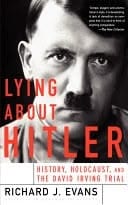

Description
Richard J. Evans, the defense’s principal expert witness in David Irving’s 2000 libel suit against Deborah Lipstadt and Penguin Books, explains how a court came to decide whether a famous writer of Nazi history had deliberately falsified the historical record. Lipstadt had called Irving a Holocaust denier who distorted evidence; Irving sued. Evans and his researchers followed Irving’s footnotes back to the documents and found a consistent pattern: mistranslation, omission, misdating, invented links, and reliance on discredited witnesses, every one of which tilted the record in Hitler’s favor. The book walks through the prewar persecution of the Jews, the “Final Solution,” Irving’s turn to outright denial after 1988, and the inflated Dresden death toll, then follows the trial in the witness box to Justice Gray’s judgment that Irving had deliberately distorted evidence, was a Holocaust denier, and was antisemitic and racist. Evans closes by defending the verdict as proof that historical scholarship can tell truth from falsification.
Vault PDF and source boundary
Open the complete book (file not included in this release) · Annotated copy (file not included in this release)
Navigation note: page links use the PDF viewer’s page count, not the printed pagination. The PDF is a scan with OCR, so a few quotations were normalized where the OCR garbled single letters.
Evidence boundary: these notes reconstruct Evans’s account. Evans was a participant, not a neutral observer; the notes keep his findings, Irving’s claims, and the court’s judgment distinct.
Chapter-by-Chapter Overview
Linked reading map
Use the entries below to jump to the full argument, analytical divisions, essential evidence, concepts, conclusion, and reflection questions for each part of the book.
- Preface: Evans frames the book as a study of how truth is distinguished from lies in history, using the Irving v. Lipstadt trial to examine Irving’s alleged falsification of evidence, while stating its limits and sources. PDF p. 12 (file not included in this release)
- 1. History on Trial: Evans sets up the Irving v. Lipstadt case: Lipstadt’s charge that Irving falsified evidence, specialists’ prior criticism of him, the libel law and defense strategy, and Evans’s method for distinguishing deliberate falsification from error. PDF p. 16 (file not included in this release)
- 2. Hitler and the Jews, 1924–1939: Evans tests Irving’s claim that Hitler was no antisemitic persecutor by checking his prewar sources, from a 1924 witness to the November 1938 pogrom, against the originals, finding consistent suppression and distortion in Hitler’s favor. PDF p. 55 (file not included in this release)
- 3. Hitler and the "Final Solution": Evans examines Irving’s chain of documents claiming Hitler did not know of or opposed the extermination of the Jews, finding in each case mistranslation, omission or misreading, and that Irving’s own readings imply Hitler’s knowledge. PDF p. 86 (file not included in this release)
- 4. Irving and Holocaust Denial: Evans, as expert witness, defines Holocaust denial by four core beliefs and shows from Irving’s post-1988 speeches and writings that he held them all, adopted denier arguments such as the Leuchter Report, and was closely tied to the Institute for Historical Review. PDF p. 119 (file not included in this release)
- 5. The Bombing of Dresden: Evans tests Irving’s Dresden book and finds an inflated death toll built on hearsay and a forged Order of the Day, kept in print after authentic records showed about 25,000 dead, to create moral equivalence with the Holocaust. PDF p. 164 (file not included in this release)
- 6. In the Witness Box: Evans argues that the High Court, despite predictions to the contrary, suited the dispute: its procedures made Irving defend his handling of documents under oath, and his explanations, retreats and concessions supported the charge of deliberate falsification. PDF p. 200 (file not included in this release)
- 7. Judgment Day: The judge found Irving deliberately distorted evidence, denied the Holocaust and was antisemitic; Evans rebuts critics, defenders and free-speech fears, arguing that the verdict was a victory for historical scholarship that shows the past can be known. PDF p. 240 (file not included in this release)
Notes
Book Argument and Reading Map
Evans’s governing claim is that the line between legitimate historical interpretation and deliberate falsification can be drawn, and drawn reliably, by checking an author’s claims against the sources he cites. The book is not mainly about whether the Holocaust happened, which no serious historian disputed, but about whether David Irving’s account of Hitler and the Jews was an honest interpretation or a systematic manipulation of evidence. Because English libel law put the burden of proof on the defendants, Lipstadt and Penguin had to show that her description of Irving was substantially true, which turned a courtroom into an unusually detailed test of historical method.
The argument moves in three stages. First, Evans sets out the case and his method (Chapter 1): read Irving’s books against their footnotes, and ask whether errors are random, as honest mistakes would be, or consistently bent in one direction. Second, he applies the method to four bodies of work. On the prewar years he finds Irving suppressing and misrepresenting evidence of Hitler’s antisemitism and his responsibility for the 1938 pogrom (Chapter 2). On the “Final Solution” he takes Irving’s chain of documents meant to show Hitler did not know of or opposed the killings, and finds mistranslation, omission, and misreading in each link (Chapter 3). He defines Holocaust denial by four core beliefs and shows that from 1988 Irving held all of them and worked closely with the denial movement (Chapter 4). On Dresden he shows Irving inflating the death toll with a forged document to suggest a moral equivalence with the Holocaust (Chapter 5).
Third, Evans follows the trial. Under cross-examination Irving had to defend his handling of documents under oath, and his retreats and concessions confirmed the defense’s case (Chapter 6). Justice Gray found that Irving had deliberately distorted the evidence, was a Holocaust denier, and was antisemitic and racist. Evans then answers critics who said a court should not judge history, who feared for free speech, or who defended Irving as a gifted military historian (Chapter 7). His conclusion is that the verdict vindicated the ability of historians to know the past beyond reasonable doubt, even while explanation remains open to debate.
Evans’s central sequence
Lipstadt calls Irving a falsifier → Irving sues and the burden falls on the defense → Evans traces Irving’s footnotes to the documents → errors prove systematic and always pro-Hitler → denial and Dresden show the same pattern → cross-examination confirms it → the judge finds deliberate distortion.
Interpretive guardrails
- Evans was the defense’s expert witness (Penguin paid the experts’ fees) and writes partly to defend the verdict; his account is detailed and documented, but it is not neutral.
- The court decided whether Lipstadt’s description of Irving was substantially true. It did not adjudicate the Holocaust itself, which was not in dispute among historians.
- Irving’s statements in these notes are reported as his claims, as Evans quotes or paraphrases them; they are not endorsed.
Preface
Open in PDF — p. 12 (file not included in this release)
Chapter Objective and Through Line
Evans states the subject at once: “how we can tell the difference between truth and lies in history” (p. 12 (file not included in this release)). His example is the libel case Irving brought in the High Court in London in 2000 against Deborah Lipstadt and Penguin Books, and his focus is the falsification of the historical record that Lipstadt accused Irving of committing. Evans was asked to investigate that charge as an expert witness for the defense, and the book presents what he found.
He sets deliberate limits. It is not a comprehensive account of the trial. The Auschwitz gassing debate and Irving’s far-right connections, which dominated press coverage, were handled by other experts and are only alluded to. Evans argues that falsification took up more courtroom time than anything else yet was “barely mentioned” in reports, so that the media, absorbed by Irving’s racism and antisemitism, gave a distorted picture. Correcting that is one of his aims (p. 13 (file not included in this release)). The case also gives concrete illustrations of the questions about historical objectivity he raised in In Defense of History.
Chapter Structure at a Glance
- Subject: the book tests how truth and falsehood are told apart in history, through Irving v. Lipstadt.
- Layout: Chapter 1 gives background and how Evans became involved; Chapters 2 to 5 present his findings; Chapter 6 covers the trial and Irving’s response; the last chapter treats the aftermath and wider issues.
- Limits: the 740-page expert report is condensed to selected examples.
- Sources: the trial record and Discovery materials, collated by Lipstadt’s solicitors.
Section-by-Section Argument
Scope and sources (analytical division)
The Preface frames the book as an exercise in historical method, not a trial narrative. Evans says Chapters 2 to 5 offer “a series of significant examples” and that much was omitted for clarity and length (p. 13 (file not included in this release)). The original report was written for a court, but the most important issues in it, those “upheld in the corresponding parts of the judgment,” are included.
- The evidence base is Irving’s books and articles, documents disclosed through Discovery, the expert reports, the pleadings and the daily transcripts (p. 14 (file not included in this release)).
- Evans credits Anthony Julius with inviting him, and names his research assistants and the other defense witnesses.
Key Concepts and Distinctions
- Falsification of the historical record: the specific charge Lipstadt made and Evans was asked to test.
- Significance: it is the organizing issue of the book, as distinct from the Holocaust’s reality or Irving’s politics.
- Report versus book: a legal document of 740 pages reduced to a readable selection.
- Significance: later chapters present representative findings, not every one.
Chapter Conclusion and Significance
The Preface commits Evans to a narrow claim: the trial’s most consequential and least reported question was whether Irving manipulated evidence. The book is a case study in historical objectivity and a correction to press coverage. The qualification is that it rests on the defense’s report and trial materials, so its selectivity is Evans’s own, though he points to the judgment as upholding the main issues.
Questions for Reflection
- Why might Evans treat falsification, rather than Irving’s antisemitism, as the better test of a historian’s reliability?
- How should a reader weigh a book drawn from an expert report prepared for one side of a dispute?
- In what sense can one libel trial illustrate general problems of historical objectivity, and where might the illustration fall short?
Chapter 1: History on Trial
Open in PDF — p. 16 (file not included in this release)
Chapter Objective and Through Line
Evans uses the opening chapter to set up the case and his role in it. The problem it addresses is how anyone can show that a historian has falsified the record, as opposed to merely interpreting it differently or making mistakes. That question matters because deniers of the Nazi extermination of the Jews exploit the idea that historical truth is only opinion (p. 16 (file not included in this release)). Lipstadt’s 1993 book Denying the Holocaust accused David Irving of bending evidence “until it conforms with his ideological leanings and political agenda” (p. 21 (file not included in this release)). Irving answered with a libel writ, and Evans was recruited as an expert witness to test whether the accusation was justified.
The chapter develops in three movements. First it introduces the parties and Evans’s own entry into the case, setting out how Irving’s reputation had already been judged by specialists before the trial. Second it examines how the case was understood in public, arguing that many commentators wrongly cast Irving as the victim of censorship and the trial as a verdict on the Holocaust itself. Third it explains the legal and practical setting: English libel law, the defense’s three-pronged strategy, the Discovery process, and the method Evans and his assistants adopted.
Within the book, this chapter supplies the context and the criteria. Chapters 2 to 5 present the detailed findings; here Evans establishes what is being tested, by what standard, and why it matters beyond Irving himself. He is explicit that he did not know in advance what he would find (p. 45 (file not included in this release)).
Chapter Structure at a Glance
- The problem is posed: doubts about historical objectivity, and a denial literature that exploits them, set up Lipstadt’s charge against Irving.
- Irving’s standing is tested against expert opinion: reviewers praised his archival energy but repeatedly condemned his handling of documents, so Lipstadt’s accusation was not new.
- Irving’s self-image is contrasted with professional practice: his claim to “Real History” rested on a misdescription of how historians work, and the Hitler diaries episode shows his documentary judgment was not as reliable as he implied.
- The public framing is corrected: the free speech argument inverts who sued whom, and the writ could not simply have been ignored.
- The legal structure shapes the defense: English law puts the burden of proving truth on the defendants, which dictated the three-pronged strategy and Evans’s brief.
- The method and stakes are fixed: Evans must distinguish error from deliberate falsification, while the trial’s meaning extends beyond the issue he was asked to examine.
Section-by-Section Argument
The chapter has numbered divisions in the original, but the headings are not legible in the extracted text. The subsections below are analytical divisions.
The question, the parties, and the charge (analytical division)
Evans opens with a run of questions about historical objectivity and notes that debate about them keeps gravitating to the Nazi extermination of the Jews (p. 16 (file not included in this release)). He describes the denial literature, which denies the gas chambers, shrinks the death toll and treats the evidence as postwar invention, and presents Lipstadt’s book as the major scholarly account of it. He reports her background and political commitments candidly, observing that she was a specialist in post-1945 American history who never worked in German archives; for her purposes secondary literature was sufficient.
The role of Irving is then set out. He was the author of some thirty books, read German, and had worked for years in the archives, yet had no degree and described himself in 1986 as “an untrained historian.” Evans concedes that this alone does not disqualify him (p. 21 (file not included in this release)).
- Lipstadt’s charges, as quoted by Evans, were that Irving “bends” evidence to his political agenda, misquotes and distorts, and is “one of the most dangerous spokespersons for Holocaust denial.” Irving demanded withdrawal of the book in 1995 and issued his writ in September 1996.
- Evans notes the contrast with normal practice: historians “do not usually answer such criticisms by firing off writs.”
This section establishes who is accusing whom and why the accusation is serious. The next step is whether it was plausible.
Evans’s recruitment and the verdict of Irving’s reviewers (analytical division)
Anthony Julius explained that an expert witness owes a duty to the court, not to the side that engaged him, and gives opinion under oath. He chose Evans for two reasons: Evans’s command of German and of the documentary basis of modern German history, and his recently published In Defense of History, which dealt with the very questions of bias and objectivity at issue (p. 23 (file not included in this release)). Evans had met neither protagonist.
Evans then surveys reviews of Irving’s books, and this is the chapter’s key evidentiary step. Generalist reviewers were often generous. Specialists were not. Paul Addison called him “often a schoolboy in judgment”; Hugh Trevor-Roper conceded his “indefatigable scholarly industry” but said that when Irving is most original “we are likely to be least sure”; Martin Broszat alleged, with detailed examples, manipulation of original documents; Charles Sydnor wrote a thirty-page rebuttal after substantial original research; John Lukacs found “Mr Irving’s factual errors are beyond belief” (p. 27 (file not included in this release)). Peter Hoffmann accused him of using archival detail as “a screen” and of “manipulating historical sources” in the Goring biography.
- Evans’s reading is that Lipstadt “was far from being the first critic” to say Irving bent the record (p. 28 (file not included in this release)).
- Irving’s legal history supports the picture: the 1970 libel damages over The Destruction of Convoy PQ 17, a conviction in Germany in 1991 and entry bans in 1992 to 1993. Evans infers that no reputable historian of standing had faced so many adverse judgments.
- Irving himself conceded his reputation among historians was “down to its uppers” (p. 29 (file not included in this release)).
The point is that the falsification allegation had a pre-existing evidential basis, but those were opinions and reviews. The defense still had to show it in the documents.
Irving’s self-image and “Real History” (analytical division)
Irving presented himself as the one historian who consulted original sources, while “idle” predecessors copied each other. Evans rebuts this as a misdescription of the profession. The major archives had been open for decades, the Ph.D. trains historians in archival method, and discovering new documents is a normal part of the work (p. 32 (file not included in this release)). Historians must also rely on one another’s work, and footnotes exist precisely so the reader can check it. Irving’s refusal to engage other historians was therefore “disturbing.”
Evans uses the Hitler diaries to test Irving’s claimed documentary expertise. Irving denounced the forgeries at the Stern press conference in 1983, and later boasted of it. But, following Robert Harris, Evans reports that Irving then changed his mind within days, partly because the diaries presented a favorable picture of Hitler and nothing suggesting Hitler’s awareness of the Holocaust, and publicly declared them genuine before forensic tests showed they were fakes (p. 35 (file not included in this release)). A Times reporter’s remark that he was “the last person to declare them authentic” is quoted.
- Irving’s “Real History” campaign was presented as modest (“it may be right, it may be wrong”) yet he claimed repeatedly to hold the objective truth, so Evans judges the concession unserious.
- He insisted that “Jewish historians” present facts with an agenda, while denying any of his own, and cast opponents as a conspiracy of “traditional enemies.”
This section shows Irving’s claims about himself and Evans’s assessment of them. It sets up the question of how Irving managed the public framing.
Free speech, and who sued whom (analytical division)
Evans argues that press coverage repeatedly misplaced the case. Irving said the central issue was his freedom of speech, and a number of commentators agreed, some writing as if the defense threatened expression, some even believing that Irving was the one on trial or that Lipstadt sought to imprison him (p. 38 (file not included in this release)). Evans points out the basic facts: Irving brought the action, sought the withdrawal and pulping of a book, and wanted undertakings that the criticism not be repeated.
Evans also rejects the claim that Penguin was “out for blood,” observing that no responsible publisher could abandon an author facing such a threat, and that withdrawal would still have left Lipstadt exposed. A second line of criticism held that American Jewish groups pushed the case, or that Irving should simply have been ignored. Evans answers that “a writ is a writ”: defense was a necessity, not a choice, and Irving was running other suits at the same time, including against Gitta Sereny and threats against Lukacs’s publishers (p. 42 (file not included in this release)).
- Fox, Freedland, Kronig and Schoeps are the commentators cited for the “should have been ignored” view; Evans notes that German writers lived under a different law, where denial is criminal.
- The case for letting Irving’s claims go unanswered also overlooks that the genie, as Evans puts it, was “out already.”
English libel law, the defense strategy, and Evans’s task (analytical division)
English defamation law, as Julius explained, is loaded toward the plaintiff: the claimant need only show a damaging statement, and the defendant must prove it true (p. 43 (file not included in this release)). Disputing the meaning or denying that the statements were defamatory were not realistic options, leaving justification as the only defense.
The defense then had three prongs (p. 44 (file not included in this release)):
- Historians would present the evidence for Auschwitz’s gassing facilities (Van Pelt), the wider extermination (Browning), and Hitler’s antisemitism and the systematic character of the killings (Longerich). Their purpose, Evans says, was not to prove what happened but to put before the court the evidence any fair-minded commentator would have to take into account.
- Experts on the far right would document Irving’s politics; in the end only Hajo Funke’s report was presented.
- Evans would examine whether the falsification charge was justified.
Evans’s brief was to go through Irving’s work, or a representative sample, and he told the lawyers there was “no guarantee” of the answer they expected. Discovery proved decisive: court orders forced Irving to disclose his private diaries, letters, speeches and notes, a mass too large for one person, so Evans enlisted two of his doctoral students, Nikolaus Wachsmann and Thomas Skelton-Robinson (p. 47 (file not included in this release)).
His method follows from a problem he states directly: historians rarely trace a colleague’s claims back to the sources, because they assume fellow historians do not deliberately mistranslate, suppress or apply double standards to evidence. Lipstadt had named no examples, so the team started from scratch. The difficulty was telling “interpretation” from “fantasy” and error from deliberate distortion. Evans notes this was eased by Irving’s own insistence that he was not advancing an argument but telling the truth. In a 1986 press conference Irving allowed subjectivity in condensing material, but none in proving his points (p. 49 (file not included in this release)).
What was at stake (analytical division)
The chapter ends by asking whether the Holocaust was on trial. Evans sets out the positions. Many commentators, including Efraim Zuroff, saw a test of the Holocaust itself; many German observers found it absurd to debate at all; Walter Reich feared alarmism. Others, including David Cesarani and the judge, insisted the factuality of the Holocaust was never at issue. Judge Gray is quoted as saying the issue was “Irving’s methodology and historiography” (p. 52 (file not included in this release)).
Evans’s own view is that the distinction, though real, was almost impossible to sustain: if the evidence for the gas chambers and the six million is overwhelming, then it amounts to showing, so far as historians can, that these events happened. A win for Irving would also have licensed him and his sympathizers to sue anyone who said their work rested on falsification, as Ian Burrell warned (p. 53 (file not included in this release)).
For the report itself, Evans narrowed the field to three things: whether Irving was a Holocaust denier, his claims that Hitler helped the Jews, and, as a control, his account of the bombing of Dresden. The report was completed at the end of July 1999 (p. 54 (file not included in this release)).
Key Concepts and Distinctions
- Falsification versus error or interpretation: deliberate distortion of evidence, as against honest mistakes, defensible readings, or accidental omission.
- Significance: the whole report depends on being able to show intent through patterns, which Evans says required checking claims against their sources.
- Defendant’s burden of proof (“justification”): under English law the plaintiff need only show a damaging statement, and the defense must prove it true.
- Significance: this explains why the defense mounted a large evidential case and why a trial about a historian’s honesty drew in the history of the Holocaust.
- Expert witness’s duty: the first duty is to the court, with evidence as truthful and objective as possible, whichever side commissioned it.
- Significance: it defines the standard Evans claims to meet and the basis on which his findings should be assessed.
- The Irving methodology versus the Holocaust’s reality (Gray’s distinction): whether the trial concerned Irving’s treatment of evidence or whether the events occurred.
- Significance: Evans calls the distinction real but says it is hard to hold apart in practice.
Essential Evidence and Examples
- The expert reviews of Irving’s books: the convergence of Trevor-Roper, Broszat, Sydnor, Hoffmann, Lukacs and Cannadine shows that the falsification charge preceded Lipstadt.
- The Hitler diaries affair: Irving’s shifting reaction illustrates, according to Evans (relying on Harris), how his documentary expertise was applied in line with his preferences.
- The Lukacs letters of 1997: Irving’s threat to sue a publisher over a book making similar criticisms shows, in Evans’s reading, libel law being used to deter criticism.
Chapter Conclusion and Significance
Evans concludes that the case was never an attack on free speech or a trial of the Holocaust’s facticity, though it had consequences for both. It was a test of whether a historian could be shown, with “chapter and verse,” to have distorted evidence in the service of political belief. He treats political commitment as normal in historians; “the real test” is whether they subordinate it to the demands of research (p. 50 (file not included in this release)).
The chapter prepares the reader for the findings by fixing the standard, the legal pressure on the defense, and the method. Two qualifications remain. Evans admits that he did not know what he would find, and the chapter itself does not report the court’s judgment, which is dealt with later in the book. It also relies on critics’ reviews and on Harris for the diaries, so its portrait of Irving is Evans’s assessment and not yet the evidential demonstration of Chapters 2 to 5.
Questions for Reflection
- Evans accepts that political commitment does not disqualify a historian, yet argues Irving’s use of evidence did. What features of a pattern of errors would justify calling it deliberate falsification rather than bias?
- Is Judge Gray’s distinction between Irving’s methodology and the historical reality of the Holocaust coherent, given Evans’s claim that it was nearly impossible to hold apart?
- The chapter relies heavily on other people’s reviews to establish Irving’s reputation. How far can such secondary judgments support a claim of falsification, and why does Evans still need the document-level analysis to follow?
Chapter 2: Hitler and the Jews, 1924–1939
Open in PDF — p. 55 (file not included in this release)
Chapter Objective and Through Line
Evans, writing as the defense’s expert witness, opens by asking whether Deborah Lipstadt’s description of Irving as a Hitler admirer and apologist plausible, and did his writing on Hitler and the Jews amount to a distortion of the historical record or merely an unpleasant point of view? Irving presented himself as a “stone-cleaner” scrubbing away the myths and caricatures that postwar historians had layered over Hitler, using primary sources and a scrupulously critical attitude to documents. Evans’s claim is that the self-portrait does not survive inspection, first on the level of attitude (Irving identifies with Hitler and admires him) and then, more importantly, on the level of method (Irving handles documents dishonestly to keep Hitler clear of anti-Jewish violence).
The argument moves from a general question about bias to a series of case studies, each of which Evans traces back to the original document and compares with what Irving wrote. The cases cover the period before the war: a 1924 trial witness, Nazi crime statistics from 1935, and above all the pogrom of 9-10 November 1938. Irving’s thesis, which Evans quotes at length, is that Hitler was never really hostile to the Jews, that he lost interest in antisemitism once in power, and that there is a “chain of documents” showing him intervening to protect them. Evans tests the early links in that chain one by one.
The chapter does not yet reach the wartime killings, which are the subject of Chapter 3; it establishes the pattern of conduct that Chapter 3 then applies to the “Final Solution.” Throughout, what the chapter reports is Evans’s own findings and judgments as an expert witness, set against Irving’s published claims and his statements in court filings. The court’s own verdict is not part of this chapter.
Chapter Structure at a Glance
- Irving’s self-image is tested against reviewers and his own words: he claims objectivity, yet his stated aim is to see events through Hitler’s eyes, and several historians and journalists had already noticed the resulting bias.
- Irving’s position on Hitler and the Jews is set out as a claim resting on documents: Hitler was a “friend” of the Jews, and a chain of documents proves it, so the question becomes whether those documents say what Irving says they say.
- Two early links fail: a Nazi police witness at the 1924 trial and a set of Weimar-era “Jewish crime” statistics are both shown to be tainted sources, misreported.
- The November 1938 pogrom becomes the main case: Goebbels’s diary, the police and Party telexes, and the postwar testimony of Hitler’s entourage are compared with Irving’s account, which blames Goebbels alone.
- Irving’s handling of the pogrom is traced further: he shifts his position on the diary, leans on a Holocaust-denying source, and shrinks the scale of destruction.
- Evans draws the methodological conclusion: the same techniques recur, and they amount to deliberate distortion rather than error.
Section-by-Section Argument
The chapter has no headings that survive in the text beyond section numerals, so the subsections below are analytical divisions.
Irving’s identification with Hitler (analytical division)
Evans begins with attitude because Lipstadt’s charge was that Irving admired Hitler. Irving wrote in the preface to Hitler’s War that “this book views the situation as far as possible through Hitler’s eyes, from behind his desk” (p. 55 (file not included in this release)). Evans finds the book’s claims about Hitler’s patriotism, economic recovery and benign intentions toward Britain unsubstantiated by the specialist literature he knew, which shows rearmament distorting the economy and the “living-space” campaign in the East being a genocidal war.
- Hugh Trevor-Roper found a “consistent bias” in favor of Hitler; Robert Harris, Charles Sydnor, John Lukacs and Martin Broszat reached similar verdicts. Evans uses them to show that informed reviewers had seen the pattern in 1977, so his own conclusion was not novel.
- Irving’s own statements point the same way. He described the biographer as the subject’s “ambassador,” told historians in 1978 that Hitler had chosen him as biographer via the physician Giesing’s diary, and in 1991 listed Hitler’s “mistakes” as things “you have to avoid replicating.” Evans reads the “you” as Irving himself.
- Asked in Brisbane in 1986 whether he admired Hitler, Irving answered “certain aspects.” Evans notes that Irving’s one criticism, that Hitler “went off the rails” from 1938, ignored the intimidation behind the 99.8 percent plebiscite and conflicted with Irving’s own account of the war years.
This establishes motive. It does not yet show distortion, which is why Evans immediately turns to the question of whether bias had corrupted the evidence.
The claim and the “chain of documents” (analytical division)
Irving held that Hitler “used his antisemitism as a political platform” to seize power and then lost interest, and that by the war the Jewish question was “a nuisance to him.” He summed up his view in 1983: “probably the biggest friend the Jews had in the ‘Third Reich,’ certainly when the war broke out, was Adolf Hitler” (p. 61 (file not included in this release)). Crucially, he said this was not opinion but what the documents showed, since “Every document actually linking Hitler with the treatment of the Jews invariably takes the form of an embargo.” Evans treats the distinction as decisive: a repulsive point of view is one thing, a misreading of evidence another. So he follows Irving’s chain link by link.
Two early links: the Hofmann testimony and the crime statistics (analytical division)
The first link is a 1924 story that Hitler expelled a Nazi squad leader who had looted a Jewish delicatessen. Evans locates Irving’s source in the trial record and finds that Irving embellished it (invented Goring’s and the policeman’s reactions, placed the incident on the night of the putsch although the testimony does not) and, more importantly, left out who the witness was. Hofmann was a Nazi Party member, a former policeman, a participant in the putsch, and an official whom the court itself declined to put on oath because it regarded him as biased (p. 63 (file not included in this release)). Evans also argues that the likelier reason for Hitler’s anger was that the men had removed their party badges and so exposed the party to charges of common crime; nothing in the testimony says he was protecting Jews.
The second link is a set of figures that Irving gave in 1996 purporting to show Jewish over-representation in Weimar crime, attributed in a footnote to “Interpol figures.” Evans finds that:
- the two books cited contain nothing supporting the claim;
- the “Interpol” figures are a 1935 press conference by the SS police general Kurt Daluege, reported by the Nazi-controlled news agency, and so propaganda rather than data;
- Irving also misreported Daluege, converting 31,000 fraud cases in Berlin in 1933 into 31,000 cases of mostly insurance fraud “committed by Jews” in 1932, when official statistics recorded only 74 convictions for insurance fraud in the whole of Germany that year.
These two cases matter less for their stakes than for what they show about method: sources whose bias is invisible in the footnote are used as neutral evidence, and numbers are altered. Evans explicitly asks whether this is a rare slip or a pattern, and the pogrom is where he tests that.
The pogrom of 9-10 November 1938: Goebbels, the telexes and the entourage (analytical division)
Irving blamed the pogrom entirely on Goebbels and said Hitler did not approve it, learned of it late and tried to stop it. Evans tests each part against the documents.
- The diary. In Irving’s rendering of Goebbels’s entry, Hitler tells the police to “hold back” against “anti-Jewish demonstrators” in Munich. Evans’s translation shows that the context was the burning of synagogues and destruction of shops in Kassel and Dessau, and that the order was “let the demonstrations go on. Withdraw the police” (p. 69 (file not included in this release)). The Supreme Party Court’s report confirms how the party understood Goebbels’s speech to the assembled officials; Irving left that part out.
- The telexes. Muller’s late-night telex said actions against Jews “are not to be interrupted,” and the Himmler/Heydrich telex at 1:20 a.m. told police not to hinder the demonstrations, with four limits protecting German life and property, non-Jewish shops and foreign nationals. Irving buried Muller’s telex in a footnote and described the second as an order to “protect Jews and Jewish property,” which Evans calls the opposite of what it says. Evans adds evidence that Himmler had been in contact with Hitler beforehand, which Irving ignored.
- The entourage. Irving relied on the postwar accounts of Schaub, Below and Wiedemann for Hitler’s supposed fury. Evans argues these men were loyal and self-serving, that Goebbels’s contemporary diary has Schaub eagerly joining in, and that Below and Wiedemann did not actually say what Irving attributes to them. The Party court records Goebbels dismissing news of the first death with the remark that “thousands of Jews” had better believe it in the coming days.
- The Hess telex and Hassell’s diary. Evans’s translation of Hess’s telex shows it banned only arson against Jewish “shops,” not all outrages, so Irving’s rendering as “property” and his gloss that “Adolf Hitler himself” had ordered it all to stop were unsupported. Irving’s use of Hassell, who reported Hess saying Goebbels started it, omitted the sentence that Hess’s plea to Hitler had been “completely in vain” and a report of Goring saying “do you want to punish the Fuhrer?”
Evans’s judgment is that Hitler backed the action from the start and that Irving “surely decided to suppress information of which he was aware.” The section’s logic is cumulative: no single mistranslation carries the argument, but every error moves in the same direction.
Goebbels’s diary again, Weckert and the casualty figures (analytical division)
Evans next shows how Irving’s stance changed without new evidence. Immediately after reading the Moscow diary entries for 9-10 November in 1992, Irving said they showed Hitler “closely implicated” in the outrages and that he had to revise his opinion. By 1996 he treated the entry as a lie by Goebbels; the stated reason was that it “stands alone” against the entourage, which Evans has already shown does not hold. Goebbels’s 11 November entry records Hitler approving his order to end the actions and wanting very sharp measures taken against the Jews, which suggested to Evans, as it “surely would have done to any historian approaching it with an open mind,” that Hitler approved the pogrom.
Evans also exposes Irving’s supporting sources. He cites the writer Ingrid Weckert six times in seven pages without bibliographic details. Evans found her only on revisionist websites and in Irving’s own papers (pencil marks in the margins of her articles suggest he read them). Her work minimized Nazi crimes and blamed German “traitors” and “World Jewry” for the pogrom, and had been blacklisted in Germany. Irving followed her on the claim that the radio order ending the violence went out at 10:00 a.m., and took from her hints of a Jewish conspiracy behind vom Rath’s assassination that Evans traces to no evidence.
The destruction is also minimized. Irving gave thirty-five or thirty-six dead where the Party court gave ninety-one, 191 synagogues where Heydrich’s own report listed more and the exile Social Democrats estimated 520, and described shops as having “windows smashed” where Heydrich wrote that they were destroyed. A chapter title, “Sunshine Girl and Crystal Night,” linked the pogrom to Goring’s daughter. The investigations ordered by Hess, Evans shows, were designed to spare nearly all participants from criminal courts: of sixteen cases before the Party court, only two went to ordinary courts.
Evans’s conclusion on method (analytical division)
Having examined the November 1938 material, Evans summarizes Irving’s practice: false attribution of conclusions to reliable sources, reliance on material that contradicts him when checked, distorted quotation, skewed data, the use of “insignificant and sometimes implausible pieces of evidence to dismiss more substantial evidence,” and the suppression of inconvenient material. The aim was to “minimize and trivialize the violence” and “dissociate Hitler completely from these events.” He concludes that Irving’s conclusions were “completely untenable,” and ends by posing the wartime question that Chapter 3 will answer.
Key Concepts and Distinctions
- Bias versus falsification: Evans accepts that a historian may hold a repellent view, and the issue is whether the evidence has been misrepresented.
- Significance: The distinction organizes the whole chapter, since he first treats Irving’s admiration as an attitude and then argues for distortion by checking documents.
- The “chain of documents”: Irving’s term for the sequence of items he says show Hitler restraining anti-Jewish measures.
- Significance: It supplies a testable claim, so Evans can examine each link instead of arguing about Hitler’s psychology.
- Source criticism: Asking who produced a document, when, for whom and with what interest.
- Significance: Evans’s complaint against Hofmann, Daluege, Schaub and Weckert is that Irving presents partisan sources as neutral and hides their identity.
- Suppression, relocation and mistranslation: the recurring techniques of omitting, moving to a footnote or translating loosely.
- Significance: The pattern across cases is what turns individual errors into evidence of intent.
- Convergent contemporary evidence versus postwar testimony: Evans prefers diary entries, telexes and Party court findings to later recollections by Hitler’s circle.
- Significance: This is why the Goebbels diary and telexes outweigh the entourage in his reconstruction.
Essential Evidence and Examples
- The Goebbels diary entry of 9 November: Evans’s comparison of the German with Irving’s version shows the context swapped from burning synagogues in Kassel and Dessau to unspecified demonstrations, which supports the claim that Hitler approved the violence.
- The Hofmann testimony: It shows the pattern of invention plus concealment of a witness’s bias in miniature, with a defect that, Evans argues, Irving could not have missed since he had read the transcript.
- The Daluege “Interpol” statistics: They show an apparently authoritative citation resolving into SS propaganda, and a numerical claim contradicted by the Criminal Statistics.
- The Hess telex and the Party court’s results: The telex shows how one word, “shops” turned to “property,” widened an order’s apparent scope, and the sixteen cases show the leadership shielding perpetrators, against Irving’s picture of Nazi anger at the violence.
- Ingrid Weckert: Her case shows that a source Irving drew on without acknowledgment was a propagandist, which bears on whether the errors were innocent.
Chapter Conclusion and Significance
Evans concludes that Lipstadt’s description of Irving as a Hitler partisan who manipulated the record was supported by what he found in the pre-1939 material. The case rests less on any one example than on the repeated direction of error: the mistakes always favor Hitler and diminish Jewish suffering, and they involve concealment (burying telexes, hiding witnesses’ affiliations, withholding references) that a careless researcher would not manage. Evans reads this as deliberate, an inference he draws from the pattern and from Irving’s evident access to the documents.
For the book, the chapter does two jobs. It shows the method of verification that Evans used for the defense, going back to the originals and comparing them, and it prepares the ground for the more serious question about Hitler’s knowledge of the extermination. A qualification is that these cases come from before the war, and that several of Evans’s reconstructions of Hitler’s role (his approval before leaving the Old Town Hall, his contact with Himmler) are inferences from diaries and circumstantial evidence rather than a surviving direct order. The Party court itself noted that orders in such cases were often only hinted at.
Questions for Reflection
- Evans asks whether Irving’s pro-Hitler bias was “just a point of view like any other, even if it was a repulsive one.” Where exactly does he locate the line between legitimate partisanship and falsification, and is the line as clear as his cases make it appear?
- Several of Evans’s most important inferences (that Hitler approved the pogrom before leaving the Old Town Hall, that Himmler spoke to him beforehand) rest on diaries and circumstantial evidence rather than a direct order. How should a historian weigh a contemporary partisan diary against postwar testimony from the same circle?
- Evans argues that the cumulative direction of Irving’s errors shows intent. What would it take for a pattern of error to count as bias or poor method rather than deliberate distortion, and does the evidence in this chapter meet that test?
Chapter 3: Hitler and the “Final Solution”
Open in PDF — p. 86 (file not included in this release)
Chapter Objective and Through Line
Chapter 3 moves from the prewar period to the central issue in Irving’s work: his claim that Hitler did not know about, or actively opposed, the extermination of the Jews. Evans sketches the wartime background (ghettos, the shootings by the Einsatzgruppen from June 1941, the deportations of German Jews from autumn 1941, then specialized gassing) and then examines the documents that Irving cited, often in the form of a “chain of documents” running from 1938 to 1943, to show Hitler as ignorant or restraining. Evans, again speaking as the defense’s expert, compares each one with the original text.
His thesis is that every link breaks when examined. Irving mistranslates, shifts crucial passages to endnotes, cuts the sentences that implicate Hitler, mixes up separate conversations, and reads ambiguous notes as if they were clear orders. Evans also advances a second, logical argument: Irving’s readings, even if accepted, would imply that Hitler knew of a general killing policy, since one cannot intervene to spare a single trainload or a single city’s Jews without knowing that the rest are being killed. The “chain of documents” is therefore, in Evans’s words, “a chain of contradictions.”
The chapter belongs to the book’s larger demonstration that Irving’s treatment of the sources is a pattern and not a run of mistakes, and it adds the claim that the same techniques run through his work from the 1970s onward. As before, the findings are Evans’s, tested against Irving’s published text and his submission to the court. The chapter does not report the judge’s decision.
Chapter Structure at a Glance
- Setting the context: the wartime ghettos, the Einsatzgruppen killings and the deportations from Germany form the background against which Irving’s claim of Hitler’s ignorance has to be judged.
- The autumn 1941 evidence is checked against the German originals: Hitler’s table talk and Goebbels’s diary are shown to say something different from Irving’s versions.
- The best-known “exculpatory” documents are dismantled: the Himmler phone log of 30 November 1941 and the “Schlegelberger memorandum” are read in context.
- The “kept in the dark” thesis is tested for 1942: the Goebbels diary and a Himmler agenda note are compared with Irving’s claim that Himmler deceived Hitler.
- The late-war pressure on Hungary and Italy is examined: in both cases Irving presents Hitler as moderate, and Evans finds omissions and misplaced conversations.
- Evans draws the general conclusion: the manipulations are a systematic distortion, were identified by critics as early as 1977, and have always been part of Irving’s method.
Section-by-Section Argument
As in Chapter 2, the author’s section numerals are all the structure there is, so the subsections below are analytical divisions.
The background and the autumn of 1941 (analytical division)
Evans opens with a compressed account of the escalation. By spring 1941 the death rate in the Warsaw ghetto was nearly 4,000 a month; after the invasion of the USSR, Einsatzgruppen shot well over a million Jews; from September 1941 German Jews were made to wear the star and then deported east. Himmler wrote on 18 September that the “Fuhrer wishes” the Old Reich and the Protectorate to be emptied of Jews. Goebbels, as Gauleiter, wrote on 20 August that “Berlin must become a city free of Jews.” Against this Irving asserted that “Hitler was neither consulted nor informed” about the deportations from Berlin.
- The monologue of 25 October 1941. Irving quotes Hitler as saying “park them in the marshier parts of Russia,” that it is “not a bad thing” that rumor credits the Nazis with a plan to exterminate the Jews, and that he intended to start nothing at present. Evans translated the German original, published in 1980, and finds that it says “send them” (not “park”), has no reference to Russia, and reads “It’s good if the terror that we are exterminating Jewry goes before us” (p. 87 (file not included in this release)). “Public rumour,” “plan” and the idea of future action were Irving’s additions, and “I had to remain inactive for a long time against the Jews too” signalled that inactivity was over. Evans connects the “marshes” remark to Himmler’s order of 30 July 1941 to drive Jewish women into the Pripet marshes, a method that the SS cavalry report said failed because the marshes were not deep enough.
- How Irving defended it. He said he had followed the “official” 1953 Weidenfeld translation. Evans accepts that this was reasonable in 1977, since the German text was not available to historians until 1980, but points out that by 1996 Irving had known the original for almost twenty years, had dropped one invented phrase from the old translation, and kept other flawed parts of it that helped Hitler. Evans calls this a “conscious and deliberate manipulation.”
- The Goebbels diary of the Udet funeral. Irving said that Goebbels’s anti-Jewish article of 16 November 1941 was “far more uncompromising” than Hitler and that Hitler told Goebbels to pursue a policy that “does not cause us endless difficulties.” Evans quotes the full entry: Hitler “completely agrees,” wants “an energetic policy against the Jews,” and for mixed marriages recommends a “somewhat more reserved procedure.” Irving omitted the first sentence and half of the second, relegated the first to an endnote with the gloss that Hitler was “clearly” not in agreement, and turned “unnecessary” into “endless” difficulties.
Evans adds Hitler’s own statements around this time: the 10 July 1941 comparison of himself to Robert Koch having “discovered the Jew as the bacillus,” and the 19 August diary entry recording his belief that the Reichstag prophecy of annihilation was being confirmed. The upshot is that Hitler’s views in 1941 were as radical as Goebbels’s, which is the reverse of Irving’s claim.
The Himmler phone log of 30 November 1941 (analytical division)
This is the link Irving treated as central. A phone-log note of a call between Himmler and Heydrich includes “Judentransport aus Berlin. keine Liquidierung.” Irving called this “incontrovertible evidence” that Hitler ordered on 30 November 1941 that there was to be “no liquidation” of the Jews, and in the 1977 Hitler’s War said that Himmler had been summoned to Hitler’s bunker and had telephoned the order from there.
Evans shows that the entry concerns one transport of Jews from Berlin, which had left on 27 November and reached Riga on the night of 29-30 November, just before Jeckeln’s men machine-gunned the local Jews into pits. They shot the Berliners with them. Nothing in the log records a meeting with Hitler, who made the call or any general order. The note is therefore no general order to stop the killing, and “The ‘order’ from Hitler was a figment of Irving’s imagination” (p. 95 (file not included in this release)).
- Broszat, Trevor-Roper and Jäckel had pointed out in 1977 that if Hitler had intervened to stop the shooting of one trainload, that suggested a general policy of killing and an exception.
- After the opening of the Moscow archive, Irving received on 17 May 1998 Himmler’s appointments for that day. They show that Hitler and Himmler met at 2:30 p.m., after the phone call, and that Himmler had arrived at the headquarters only half an hour before it. Irving conceded on his website that his “original theory” was “wrong,” although he had never presented it as a theory. Yet on 31 August 1998 he posted a document again asserting that Hitler had “demonstrably” ordered that the Berlin Jews not be killed.
The case matters because it shows retreat under pressure combined with persistence in public: Irving gave up the claim when forced and then repeated it.
The “Schlegelberger memorandum” (analytical division)
Irving described this note as “the most cardinal piece of proof” of what Hitler knew: it records Lammers saying that Hitler “repeatedly explained to him that he wanted the solution of the Jewish Question put back until after the war.” Evans found the original in a German Federal Archives file (R 22/52) and notes that it has no letterhead, date, signature, classification or reference number, and that the file seems to have been compiled by the Allies. Attribution to Schlegelberger is a “supposition, although not necessarily a wrong one.”
Evans reads it in context. The surrounding documents deal with the leftover business of the Wannsee Conference, namely the fate of “half-Jews” and Jews in “mixed marriages,” on which agencies disagreed; this was discussed under the general heading “Final Solution of the Jewish Question,” and the Lammers-Schlegelberger meeting probably took place on 10 April 1942. On his reading, the postponement concerned those borderline categories, not the “full Jews” whose murder had already been agreed in principle. Hitler’s caution is explained by fear of public reaction, which the Rosenstrasse protest of 1943 would confirm.
Evans then makes the logical point that undermines Irving’s reading from within. If “final solution” meant extermination, the memo shows that Hitler knew about the policy, if only to postpone it. If it meant deportation, then Hitler could not have wanted it postponed while having ordered it the previous autumn and knowing it was in full swing; and it would also conflict with Irving’s reading of the phone log. A further contextual argument: on 16 April 1942, six days after the presumed meeting, the Ministry of Justice supported the “evacuation” of Jewish prisoners to the East, exempting remand prisoners only if they were expected to be sentenced to death, which Evans takes to show that officials understood evacuation as a synonym for execution; in September 1942 handed the remainder to the police “for annihilation through labour.” The ministry’s own conduct is incompatible with a standing order against deportation or killing. Jäckel had already dismantled Irving’s reading ten years earlier and predicted that Irving would keep repeating it.
”Kept in the dark”: Goebbels in March 1942 and Himmler’s note of 22 September 1942 (analytical division)
In the first edition of Hitler’s War Irving wrote that the “ghastly secrets of Auschwitz and Treblinka were well kept,” that Goebbels wrote a frank summary on 27 March 1942 but “held his tongue” when he met Hitler two days later, quoting only the remark that “The Jews must get out of Europe.” Evans reads the full entry: Goebbels describes a “barbaric procedure” in the Lublin region, estimates that 60 percent of the Jews “must be liquidated,” and says that “the Fuhrer is the persistent pioneer and spokesman of a radical solution” (p. 103 (file not included in this release)). Irving omitted the passage about Hitler in both editions. His chronology is also wrong: no meeting took place on 29 March, and Hitler’s remark came on 19 March, recorded on 20 March together with Goebbels’s note that Hitler remained “unrelenting.”
Evans then cites further evidence of Hitler’s knowledge or approval, “to put it no more strongly”: Himmler wrote to Berger on 28 July 1942 that “The Fuhrer has laid the implementation of this very difficult order on my shoulders,” when the worst mass murder was under way in the General Government. On 22 September 1942 Himmler’s handwritten agenda for a long meeting with Hitler listed “Emigration of Jews” and “Globus,” Globocnik’s nickname. Evans’s reasoning here is hedged: the note “may have been” about the extermination, and it raised “the suspicion” that it was a topic. Irving told the court that spinning theories around such jottings was “imprudent in the extreme.” Yet in the 1991 edition he had used the same note to claim that “Himmler meanwhile continued to pull the wool over Hitler’s eyes.” Evans says Irving gave no basis for “calmly,” and that the omission of explicit reference to murder was typical of Nazi camouflage language.
Hungary and Rome (analytical division)
Hungary. At their meeting of 16-17 April 1943 Hitler and Ribbentrop pressed Horthy over Hungary’s roughly three-quarters of a million Jews. Ribbentrop said on the second day that the Jews “must either be annihilated or taken to concentration camps. There was no other way,” and Hitler followed with the remark that if Jews could not work “they had to perish” and should be treated like “tuberculosis bacilli.” Irving, Evans says, moved Ribbentrop’s statement to a footnote and rewrote Hitler’s speech, inserting the Warsaw ghetto uprising (which had not yet begun), exaggerating its scale, softening verkommen to “wasted away,” and attaching to the second day Horthy’s protest and Hitler’s reassurance that “there is no need” to murder them, which came from the first day, when the Nazi leaders were less open. Evans also notes that most Slovak Jews, the model Hitler cited, were in fact deported to the extermination camps. The aftermath confirmed Hitler’s priority: German troops occupied Hungary in March 1944, Eichmann’s unit arrived, and over 430,000 Jews were deported to Auschwitz by July 1944.
Rome. Irving’s version has Ribbentrop bringing Hitler a telegram that the SS planned to liquidate Rome’s eight thousand Jews, whereupon Hitler took a “moderate” line and ordered them held as “hostages” in Mauthausen. Evans untangles the sequence. SS orders to round up the Roman Jews, “for liquidation,” went out in September 1943; the consul Moellhausen, the city commandant Stahel and Field Marshal Kesselring resisted and proposed labor on fortifications. Irving omitted Moellhausen’s second telegram (no. 201) and, more importantly, the Foreign Ministry’s follow-up that the Reich Foreign Minister “insists that you keep out of all questions concerning Jews” because these were the SS’s exclusive competence. Evans reads the Mauthausen order as cutting through local resistance: Hitler’s order meant the Jews were still to be deported, not kept on fortification work. Mauthausen was the harshest category of camp, and the Jews seized on 16 October 1943 went to Auschwitz, where most were gassed.
The shared logic is the point. If Hitler intervened to prevent the killing of the Roman Jews, then he knew of Himmler’s liquidation orders and of the wider pattern; Evans concludes that Irving “suppressed material that he knew ran against his case.”
The Ribbentrop note and Evans’s general verdict (analytical division)
Evans closes with an older example of Irving’s technique, previously exposed by the journalists Gitta Sereny and Lewis Chester in 1977. Irving’s footnote in Hitler’s War quoted Ribbentrop’s Nuremberg note that he refused to believe Hitler ordered the destruction of the Jews. He left out the next sentence, in which Ribbentrop wrote that, judging from Hitler’s last will, “one must suppose that he at least knew about it, if, in his fanaticism against the Jews, he didn’t also order it” (p. 117 (file not included in this release)). Irving called the sentence “irrelevant” and said he did not “want to confuse the reader.” It was still missing from the 1991 edition.
Evans then sums up. The falsifications, “looked at individually,” may seem minor, but taken together “they amounted to a systematic distortion of the historical record.” The footnotes and archival display gave the “unwary reader” an appearance of solidity, but traced back to the originals the work was “a house of cards.” Evans stresses that Broszat, Trevor-Roper, Sydnor and Sereny had said this in 1977 and that later commentators who thought Irving had only recently “gone off the rails” were mistaken: the deceptions were present early and persisted.
Key Concepts and Distinctions
- The “chain of documents”: Irving’s claim that a sequence of authentic documents from 1938 to 1943 shows Hitler ignorant of, or opposed to, the killing of the Jews.
- Significance: It turns an assertion about Hitler’s mind into a checkable claim, and Evans’s method is to examine each link against the original.
- Camouflage language: Nazi documents routinely used terms such as “evacuation,” “resettlement,” “liquidation” or “Final Solution,” and the meaning depends on context.
- Significance: Evans uses this to explain why the absence of explicit extermination language in a note does not show ignorance, and why terms like “hostages” or “upper Italy” can be read as euphemisms.
- The logical trap of exculpation: Any document in which Hitler is shown stopping a particular killing presupposes that he knew of the general killing.
- Significance: It lets Evans argue that Irving’s readings are self-defeating, even apart from any mistranslation.
- Selective use of sources: Irving takes what helps from an unreliable translation or a partial diary entry and drops the rest.
- Significance: This explains why Evans calls the errors “deliberate” and not simply sloppy, since the errors favor Hitler consistently.
- Contextual reading versus isolated citation: Evans reads documents with their neighbors in the file, their date and their author.
- Significance: Context is what changes the Schlegelberger memo and the phone log from exculpation into evidence of limited, specific events.
Essential Evidence and Examples
- The 25 October 1941 table talk: Comparing the German with Irving’s English shows “terror that we are exterminating Jewry” turned into a rumor of a “plan,” which supports Evans’s case that Hitler spoke of extermination as a fact by autumn 1941.
- The Himmler phone log: It is the clearest example of a sweeping claim (a general order from Hitler) resting on a note about one transport, and of Irving’s later retreat.
- The Goebbels diary of 27 March 1942: The passage Irving left out describes Hitler as the pioneer of the “radical solution,” directly refuting the “kept in the dark” thesis.
- The Horthy minutes: The displaced conversation and the footnoted Ribbentrop statement show manipulation of text order to make Hitler seem to oppose killing.
- The Ribbentrop prison note: A single omitted sentence demonstrates the technique at its simplest and that critics identified it in 1977.
Chapter Conclusion and Significance
Evans concludes that Irving’s thesis, that Hitler did not know of or approve the extermination of the Jews, rested on a series of falsifications. Their direction is constant, favoring Hitler. Their style varies (mistranslation, omission, relocation, invention of context, confident assertion later quietly abandoned), and in several cases Irving’s own interpretation conflicts with itself, so that the chain was in Evans’s phrase a chain of contradictions.
For the book, the chapter carries the weight of the defense’s historiographical case: it takes the central question, Hitler’s role in the Holocaust, and shows by direct comparison with the sources that Irving’s claims about it cannot be sustained. A qualification is that Evans is careful in places to say that documents are open to interpretation (the Schlegelberger memo’s attribution, the Himmler agenda, the exact meaning of “Mauthausen”); his case is that Irving’s reading is the least plausible one, and that the accumulation of cases makes innocent explanations strained.
Questions for Reflection
- Evans argues that any document showing Hitler stopping a specific killing implies he knew of the general policy. Does this logical argument carry independent weight, or does it depend on the earlier evidence about camouflage language and Hitler’s own statements?
- Evans treats the postponement memo, the Himmler agenda and the Mauthausen order as open to interpretation and prefers the reading that best fits their context. What standard of proof is he applying, and how does it differ from the standard Irving demands when he calls such readings “fanciful theories”?
- Irving’s retreat on the phone log in 1998, followed by his renewed assertion of the claim, is used as evidence of bad faith. How far can changing or inconsistent claims be taken as evidence of intent, as opposed to evidence of a historian updating his views?
Chapter 4: Irving and Holocaust Denial
Open in PDF — p. 119 (file not included in this release)
Chapter Objective and Through Line
Lipstadt’s book accused Irving of two things: falsifying history and being a Holocaust denier. Evans takes up the second charge here, and his question is a narrow one. Does what Irving said and wrote conform to the recognised content of Holocaust denial, and did he have real ties to the people and organisations that propagate it? To answer it Evans first has to say what denial is. He builds a minimum definition from the scholarly literature on the deniers (Rassinier, App, Butz, Faurisson, Staeglich and their students), reduces it to four core beliefs, and then tests Irving against each belief using his speeches, videotapes, interviews, and books. This is Evans’s analysis as an expert witness. The chapter reports his reasoning and his conclusions. It does not report the court’s verdict.
The core of the argument is chronological and comparative. Evans finds that Irving was not a denier in the 1970s, because his 1977 Hitler’s War accepted large-scale extermination. By the 1991 edition the extermination vocabulary had been removed, and the turning point was Irving’s 1988 appearance as a witness at the Zundel trial and his adoption of the Leuchter Report. From then on, Evans argues, Irving minimised the number of dead, denied the gas chambers, denied a centrally directed programme, and described the evidence as an Allied and Jewish fabrication. He did all this using the same arguments, and often the same sources, as the established deniers. He also expressed antisemitic views in the process.
The chapter has two roles in the book. It supplies the substantive proof for Lipstadt’s second charge, and it sets up the later chapters on Irving’s historical method. Evans’s repeated finding that Irving manipulated evidence and applied “double standards” in the denial context is the same pattern the next chapter finds in the Dresden book. The chapter also shows that Irving’s self-defence (“I am a Holocaust analyst”) relied on definitional shifts that Evans treats as evasions.
Chapter Structure at a Glance
- Define the target: denial is isolated from the wider “paranoid” fringe of history writing and reduced to four minimum beliefs, so that Irving can be tested against a fixed standard.
- Fix the time frame: comparing the 1977 and 1991 editions of Hitler’s War and Irving’s own testimony shows a change of mind in 1988, so only post-1988 statements bear on Lipstadt’s 1994 charge.
- Test the factual claims: Irving’s numbers for the dead and his denial of the gas chambers are traced to their sources and shown (by Evans) to rest on misreadings and on the discredited Leuchter Report.
- Test the interpretive and conspiratorial claims: Irving denies a systematic policy, calls the evidence a British and Jewish fabrication, dismisses survivors, and speaks in the language of classic antisemitism.
- Test the connections: Irving’s ties to the Institute for Historical Review, to Faurisson, and to the denial milieu are shown to be close and sustained, despite his disclaimers.
- Answer the dissenters: Evans addresses the view that Irving “wavers” and concludes that he held all four beliefs from 1988 onward.
Section-by-Section Argument
The chapter has Roman-numeral parts (the printed numeral “IV” appears at the section on the Institute), but the scan lost the other numerals. The divisions below are analytical, not the author’s.
Defining denial and its milieu (analytical division)
Evans begins by setting aside a side issue. The word “Holocaust” had been criticised, but historians agreed on the substance: a Nazi attempt, between 1941 and 1945, to kill all European Jews, which murdered between 5 and 6 million, including by gassing in purpose-built camps (p. 120 (file not included in this release)). That knowledge rests on survivor testimony, Nazi documents, the Nuremberg and later trials, and the physical remains of the camps. Against this stands a small group of deniers. Evans sketches them as figures who mixed prejudice with personal grievance: Rassinier, App, Butz (whose 1976 book first dressed denial in academic form), Faurisson, and Staeglich.
- Evans separates denial from the “paranoid style” of fringe history (survival of Bormann, Hitler and Wittgenstein), which he judges mostly harmless. Denial differs because it insults victims, attacks a vast body of professional research, is tied to racial hatred, and is organised through journals, conferences, and institutes.
- From the scholarly literature he extracts four minimum beliefs (p. 125 (file not included in this release)): (a) far fewer than 6 million Jews were killed, perhaps a few hundred thousand; (b) gas chambers were not used to kill large numbers; (c) there was no Nazi programme of extermination, only deportation; (d) “the Holocaust” was an Allied and Jewish invention, with the evidence fabricated afterwards.
- This definition is the yardstick for everything that follows. Evans also poses a second test: did Irving have contacts with deniers and denial organisations?
Irving’s own defence, and the 1988 turning point (analytical division)
Irving’s written submission called the label a libel “worthy of” Goebbels, and said he had never denied the mass murder of Jews if “the Holocaust” meant that. Evans’s reply is that Irving’s cited concessions did not match the Holocaust as historians define it. Concentration camps inside the Reich were not at issue. The disputed camps were the extermination camps in the East, and shooting hundreds of thousands is not the same as the “extermination by shooting, gassing, starvation, and deliberate neglect of millions” (p. 127 (file not included in this release)).
- Two editions of Hitler’s War. In 1977 Irving wrote of “the extermination program,” of Jews being exterminated at Auschwitz and Treblinka, and of Auschwitz’s idle apparatus of death starting up again when the Hungarian trains arrived in 1944. By 1991 the extermination language had gone, and the Hungarian Jews were arriving as “slave labor” for a chemical plant. Evans takes this comparison to prove that Irving’s views changed (p. 128 (file not included in this release)).
- The Zundel trial. The turning point was the 1988 trial of Ernst Zundel, at which Irving testified for the defence and admitted a change of mind: “My mind has now changed”. Evans therefore sets pre-1988 work aside as irrelevant to whether Lipstadt was right in 1994 and concentrates on what Irving said afterwards (p. 129 (file not included in this release)). This is a fair qualification: Evans does not claim Irving was always a denier.
Numbers and gas chambers: the first two beliefs (analytical division)
On the numbers, Irving moved from calling 6 million “probably marginally exaggerated” (1986) to saying at Zundel that the toll was perhaps “100,000 or more”, and later offered a minimum of one million and a maximum of about four million only in one interview (Casey, 1995) while attributing deaths mainly to disease. Evans’s account of how Irving sustained the low figures is the heart of the numerical argument.
- Dismissing documents ad hoc. Irving discounted Einsatzgruppen reports by speculating that officers inflated figures, and called Himmler’s 1942 memorandum on 300,000 exterminated an “isolated” document. Evans says the speculation had no documentary support and that the document was “isolated” only because Irving ignored others.
- The Hinsley / Auschwitz decrypts. Irving claimed that the official British intelligence history showed nearly all Auschwitz deaths were from disease. Evans checked and found that Hinsley only said the decrypts did not mention gassings (unsurprising, as the Nazis avoided naming them), that the decrypts covered only a short period in 1942 before mass gassing began, that they concerned only registered inmates, and that Hinsley himself said he had seen only a summary (p. 132 (file not included in this release)).
- The missing Jews. Irving said the 6 million figure had no documentary basis and demanded to know where the bodies had gone, yet offered speculation of his own, including secret transport to Palestine and deaths at Dresden. Evans says Irving “suddenly and conveniently forgot” his own demand for documented fact.
- Epidemics. Irving blamed camp deaths on typhus and on Allied bombing of transport and medicines. Evans answers that the Nazis deliberately created the conditions for epidemics.
- Redefinition. Irving also reduced the Holocaust to one sentence, “Adolf Hitler ordered the killing of six million Jews in gas chambers at Auschwitz”, and invited doubt of it. Evans says no one claimed that; Auschwitz’s toll was about 1.1 million and killing took place elsewhere and by other means (p. 134 (file not included in this release)). Irving’s “analyst” label is, in Evans’s view, a euphemism for denial.
On the gas chambers, Evans first notes the self-contradiction in Irving’s court submission and then his double standard on evidence: demanding authentic wartime documents for gassing while relying heavily on postwar testimony from Hitler’s entourage when it suited him (p. 137 (file not included in this release)). His pattern was to concede tiny, experimental gassings as a kind of alibi and to deny the large-scale reality.
- The Leuchter Report had been decisive in bringing Irving to full denial in 1988. Evans reports that Leuchter, an unqualified designer of execution equipment, took chunks out of the walls rather than surface scrapings, thereby diluting the cyanide residues, and ignored that killing humans needs far lower concentrations than killing lice, so his findings if anything confirmed gassing. Irving ignored these objections (p. 139 (file not included in this release)).
- Irving’s unambiguous public statements, such as “There were no gas chambers in Auschwitz, there were only dummies” and “I’m a gas chamber denier”, show that his court assertion that he had not denied the gas chambers was, in Evans’s word, “a falsehood” (p. 140 (file not included in this release)).
No systematic policy, fabrication, survivors, and antisemitism (analytical division)
The third and fourth beliefs link Irving’s methods to his worldview. Irving had long denied that Hitler ordered the killing, but after 1988 he denied any overall policy. In 1986 he blamed “run-of-the-mill criminal elements” in Central Europe, and at Zundel he said he did not think “there was any overall Reich policy to kill the Jews”, arguing that survivors in the camps showed the Nazis were either “sloppy” or had no such programme. Evans replies that Auschwitz combined labour and extermination, while Treblinka and the other purely extermination camps left hardly any survivors. The Wannsee minutes used euphemism, and Eichmann testified in 1961 that the talk had been of killing. Irving’s response was to claim that Eichmann was confused, though he relied on that testimony elsewhere.
- The British “gas chamber lie.” Irving said British intelligence “deliberately masterminded” the story. Evans went to the Public Record Office and found that the Foreign Office had received Riegner’s report in August 1942 and was sceptical about public use of the gassing claims. One official still wrote that the Germans were “out to destroy the Jews of any age unless they are fit for manual labour”. Evans’s finding is that there was no evidence of invention. The officials were unsure, and their doubts concerned mainly claims about Poles (p. 146 (file not included in this release)).
- Survivors. Irving said survivor testimony was hysteria, greed, or lies, and mocked tattooed survivors. Evans notes that he never used victim testimony in his writings. Evans quotes one televised exchange in which Irving asserted that crematoria do not smoke, without considering that Auschwitz’s crematoria were designed differently from a Sydney one.
- Antisemitism. Evans reads Irving’s 1990s speeches against Gill Seidel’s account of denial as continuing anti-Jewish prejudice. The evidence he cites includes the phrase “our traditional enemies”, calling the Board of Deputies of British Jews “cockroaches”, warnings about Jewish predominance in the professions, a prediction of a “tidal wave of antisemitism” that Evans describes as a veiled threat, and the claim that Jews were responsible for their own persecution. Evans also notes that Irving claimed reparations were a swindle, whereas the true figure was $735 million, paid for resettlement, and that a state seeking to maximise payments would not minimise the dead.
- Evans judges the language classically antisemitic and draws the explicit conclusion that after 1988 Irving’s position moved “rapidly into line” with the view that the history had been written by Jews and fabricated for their benefit.
Connections to the denial movement (author’s part IV)
Here Evans addresses Lipstadt’s second charge, that Irving was linked to deniers. The Institute for Historical Review (IHR) was the main denial organisation. Its 1979 resolution called the gas-chamber allegation “demonstrably false” and Evans shows that its journal had the format of scholarship while its leading figures (Butz, Faurisson, Staeglich) were not historians. It was owned through Willis Carto’s Liberty Lobby network, and Evans describes the political, not academic, background and the financial feud of the early 1990s.
- Irving was not formally a member of the IHR, as he claimed, but his informal ties were “extremely close”. He spoke at four successive conferences, wrote and was written about in the journal, advertised its books, endorsed it in 1994 as “sincere, balanced, objective”, and praised Faurisson as “very brave” (p. 158 (file not included in this release)).
- Irving defended his appearances by saying that James Bacque also spoke at IHR conferences. Evans checked the speaker lists and Bacque’s letter and judged the claim “pure invention”. Irving also pointed to quarrels with Faurisson. Evans concedes that they disagreed in 1983, but argues that their positions had converged by the early 1990s, when Irving began to speak of “we revisionists”.
Dissenting views and the verdict (analytical division)
Evans concedes that not everyone accepted that Irving had become a consistent denier. Ron Rosenbaum found that Irving’s stance seemed to waver, and Norman Stone concluded that Irving put “blue water” between himself and the deniers. Some distinguished Nazi specialists also told Evans that they did not think Irving was a denier. Evans answers that Rosenbaum was careless and had no working definition of denial. Irving’s admission that perhaps a hundred thousand Jews died in unco-ordinated acts on the Eastern Front is not an acceptance of the Holocaust in “any meaningful or generally accepted sense”.
- Evans’s conclusion, stated as his own: “he had become a Holocaust denier in 1988”. He held all four beliefs, any wavering after Lipstadt’s book was “more a matter of presentation than of content”, and he was not isolated.
- Evans notes that Irving was convicted in Germany under German law. His own 1991 words come close to accepting the label: “Until 1988” he believed there had been “something like a Holocaust”, and what he rejected was the negative connotation.
Key Concepts and Distinctions
- Four-part definition of denial: minimisation of the dead, denial of mass gassing, denial of a systematic programme, and the claim that the evidence is a fabrication serving Jewish interests.
- Significance: it converts a charged label into a testable standard, so Evans can argue from Irving’s own words instead of from the label.
- Soft-core versus hard-core denial: the shift Evans traces from Irving’s 1970s acceptance of extermination to his post-1988 denial, with the Zundel trial as the break.
- Significance: it lets Evans be fair to Irving’s earlier work and limits his conclusion to the period relevant to Lipstadt’s 1994 statement.
- Analysis as euphemism: Irving’s self-description as a “Holocaust analyst” who merely “challenges” the figures.
- Significance: Evans argues that the difference between analysis and denial “was nonexistent”. He adds that nothing in the word “denial” implies telling a lie, just as nothing in “analysis” implies telling the truth, so Irving’s objection to the word is beside the point.
- Double standards of evidence: demanding contemporary documents for gassings but accepting postwar testimony, or unsupported speculation, when it suits.
- Significance: this is the chapter’s main method charge, and it links to the book’s larger thesis about Irving’s treatment of sources.
- Concession as alibi: admitting small-scale or unauthorised killings to deny the large-scale programme and to claim he is not a denier.
- Significance: it explains why Irving’s “I accept this” statements, and the IHR’s own invocation of him, do not rebut the charge.
Essential Evidence and Examples
- Hitler’s War, 1977 versus 1991: the removal of “extermination” and the rewriting of the Hungarian Jews passage show a change of position on the page itself, and justify the 1988 dividing line (Evans’s finding).
- The Hinsley decrypts: Irving’s claim that British intelligence history showed Auschwitz deaths were due to disease is checked by Evans against the source; the passage says only that decrypts did not mention gassings, and covered a limited period and population. It supports the charge of misusing evidence to minimise numbers.
- The Leuchter Report: its flawed sampling and chemistry, which Irving adopted and kept promoting, support the claim that Irving’s gas-chamber denial rested on a discredited document.
- The Foreign Office files: Evans’s reading of the 1942 minutes shows that British officials doubted reports but did not invent them. This rebuts Irving’s claim that British intelligence fabricated the gas-chamber story.
- The Bacque claim: the claim that James Bacque spoke at IHR conferences is shown by Evans to be false, and it illustrates how Irving minimised his own association with deniers.
Chapter Conclusion and Significance
Evans concludes that Irving was a Holocaust denier from 1988: he minimised the dead, denied the gas chambers, denied a central programme, and called the evidence a fabrication, and he did so in step with Faurisson, Butz, and the IHR. The support is cumulative, drawn from Irving’s own words over several years, and tested wherever possible against the documents he cited. Evans also insists on the qualifications that make the case credible: the early Irving was not a denier, and the label is applied only from 1988.
The chapter’s contribution is to show that denial and bad method are linked. The same misreadings, speculation, and double standards that Evans finds in Irving’s treatment of the Holocaust recur in later chapters. A tension remains: the case depends on a definition Evans himself assembled, and he acknowledges that respected experts and commentators disagreed with the label. This chapter reports no ruling by the court, and the reader should not treat Evans’s analysis as that judgment.
Questions for Reflection
- Evans builds his definition of denial from the existing scholarly literature and then applies it to Irving. How persuasive is it to define the standard first and test an individual against it, and what would a rival definition do to the verdict?
- Evans treats Irving’s concessions (some shootings, a million dead, small experimental gassings) as part of a technique rather than as evidence of non-denial. What would count as a genuine concession, and how can a reader tell the difference?
- Why does Evans date Irving’s denial to 1988 instead of treating it as continuous with his earlier work, and how does that choice make his case stronger or more vulnerable?
Chapter 5: The Bombing of Dresden
Open in PDF — p. 164 (file not included in this release)
Chapter Objective and Through Line
Some historians had argued that Irving’s distortions were confined to Hitler and the Jews, and that the rest of his work was sound. Evans tests that view on the book that made Irving’s name, The Destruction of Dresden. His finding is that the same methods are present there from the start: a death toll driven upward by hearsay, an unauthenticated document that Irving knew was questionable, suppression of contrary testimony, and a refusal to revise when the evidence turned against him. This is Evans’s assessment, based on Irving’s published editions and on his private correspondence, which Irving had to disclose to the defence under the rules of Discovery. It is not a statement of the court’s judgment.
The argument follows one document. Irving accepted a typescript, “Order of the Day no. 47” (TB 47), which put the Dresden dead at 202,040 and expected 250,000. He had earlier called it spurious, then reversed himself on sight of the “whole” text and promoted it in several languages. Evans reconstructs how he obtained it, shows how little checking he did, and then sets it beside the genuine records: a police Final Report of 15 March 1945 giving 18,375 dead, later corroborating situation reports, burial figures, and a surviving copy of the real TB 47 in which each number was a tenth of Irving’s. Evans concludes that the figures had been doctored by adding a zero.
The chapter then follows Irving’s fallback arguments (refugees, the missing, uncounted bodies) and, in its last part, his purpose. Evans argues that inflating the Dresden toll served from the beginning to create a moral equivalence with the Holocaust, and that Irving later paired a high Dresden figure with a low Auschwitz figure. The chapter shows that Irving’s method was consistent across subjects, which is what supports Lipstadt’s charge of falsification.
Chapter Structure at a Glance
- Test the “isolated flaw” defence: if Irving’s manipulation is confined to the Holocaust, the Dresden book should hold up under scrutiny; Evans compares the editions and the underlying evidence.
- Show the estimates rest on weak, shifting sources: Voigt’s 135,000 is hearsay, and the register evidence points to a much lower figure.
- Trace the acquisition and promotion of TB 47: Irving obtained a typed copy at several removes, ignored the denial of its supposed source, and pressed it on publishers and the press.
- Show it should have been recognised as propaganda and a forgery: its provenance, its implausible proportions, and its internal contradictions were all warning signs, and Irving’s attempts at authentication fail.
- Set the authentic documents against it: the Final Report, the situation reports, and the real TB 47 settle the matter, yet Irving’s recantation was partial and slow.
- Follow the fallback arguments and the motive: refugees, the missing, and unburied bodies fail on the evidence, and Irving’s persistence reveals a purpose in setting Dresden beside Auschwitz.
Section-by-Section Argument
Chapter 5 has no visible internal headings in the scanned text apart from an opening numeral. The divisions below are analytical.
The Dresden raids and the first estimates (analytical division)
Evans opens with the context for his audit: Dresden was hit by two British raids on 13-14 February 1945 and two American raids the next day, in a city with few defences and swollen with refugees. He gives his own view of the strategic debate. The industrial targets were not directly hit, the British attacked the timbered old centre, and the effect was overkill. The ethical dispute is real, and Evans stresses that it is separate from the question of whether Irving’s numbers were honest.
Irving’s first estimate came from Hans Voigt, a local official who had led the “dead persons department” of the missing-persons bureau. Voigt’s four filing systems allowed about 40,000 of the dead to be identified, so Irving took 40,000 as an “absolute minimum”, a figure that matched Georg Feydt’s 39,773 in 1953. Voigt also told Irving he estimated the final number at 135,000 and that the Germans “struck off the first digit” to please the Russians.
- Evans finds no support for the missing-digit claim. Voigt blamed Dresden officials, and the Russians, at the height of the Cold War, would have had every reason to inflate, not lower, the number. The mayor, Weidauer, said the death register still existed with a highest card number of 31,102 and that the street books matched (p. 167 (file not included in this release)). Evans’s verdict is that Irving could sustain 135,000 only by relying on a postwar speculation that he must have known was shaky, which undercuts his claim to rest on contemporary documents.
Obtaining and promoting TB 47 (analytical division)
Between the 1963 and 1966 English editions, Irving acquired TB 47, dated 22 March 1945 and attributed to a Colonel Grosse. It gave 202,040 dead and a forecast of 250,000, and he printed it as an appendix. Irving had cited Max Seydewitz in 1963 dismissing it as spurious, and he reversed himself on seeing the full text. He was coy about the source, naming only a “Dresden private citizen”, but Discovery let Evans trace it.
- Provenance. Irving did not get TB 47 from the doctor Max Funfack. He got it from the Dresden photographer Walter Hahn, who had transcribed Funfack’s copy without his knowledge. Irving saw it on Hahn’s desk, had it typed, and tucked a copy in his wallet while the archive director Lange called it a patent forgery (p. 168 (file not included in this release)). Evans describes what Irving held as “a carbon copy of a typed-up transcript of another typed-up transcript of a handwritten transcript of an extract from an unknown document”, without signature or stamp.
- Promotion. Within weeks Irving called the figure “sensational” in letters to his publishers, urged that it be reproduced prominently, and his German publisher announced it to the press as authentic and “precisely counted.”
- The denial. On 19 January 1965 Funfack wrote that he had only heard figures “thirdhand”, and that he had never been Dresden’s chief or deputy chief medical officer. Irving nevertheless went on writing that Funfack had been deputy chief medical officer, even in a letter to the RAF historian Noble Frankland in May 1965, and defended TB 47 in the West German press (p. 171 (file not included in this release)). In one letter Irving claimed that “Two thirds of an historian’s efforts lie not in getting hold of exact facts, but in verifying the authenticity and reliability of his sources”, a standard Evans says he failed to apply himself.
Why TB 47 was suspect, and how Irving tried to authenticate it (analytical division)
Evans argues that several features should have alerted Irving to a fabrication. A report from Das Reich in early March 1945 included a “fictitious top-secret estimate” of 250,000 dead, and Goebbels’ Propaganda Ministry leaked the figures to neutral-country journalists. Swedish newspapers reported them, with the figure rising from “several tens of thousands” to “closer to 200,000”. The aim was to shock the world and also to goad Germans to resistance. TB 47 itself was dated 22 March and claimed to counter “wild rumours”, yet its own closing remark that rumours “far exceed the reality” implied a rumoured toll above a quarter of a million, for which Evans found no evidence.
- Proportions. Hamburg lost 3.3 per cent of its population with 48 per cent of dwellings made uninhabitable, and Kobe about one per cent. A figure of 250,000 would mean 20 to 30 per cent of Dresden’s population, a statistic out of proportion that Irving, as an expert on bombing, should have recognised. Recovering that many bodies in under a month would have needed an army of workers and transport.
- Internal contradiction. TB 47 gave 68,650 bodies burned on the Altmarkt, a square about 100 by 125 metres partly occupied by a water tank. In the same book Irving put the number burned there at only 9,000. He also never reconciled TB 47’s 250,000 with Voigt’s 135,000. Evans notes that Irving doubted that Auschwitz could dispose of large numbers of bodies, but accepted without question that Dresden could (p. 173 (file not included in this release)).
- Weak corroboration. Irving claimed to have talked to “wartime police associates” of Grosse but never named them. Evans found that three people suggested by the Federal Archive did not endorse the document: Nolke thought the building figures could be right but not the dead, and preferred the 35,000 figure; Buhlmann could not comment; and Thierig vouched for it, though a document he later signed gave 18,375 dead on 10 March, which led Evans to conclude that Thierig “was lying” (p. 175 (file not included in this release)).
- The Grosse interview. Irving interviewed Grosse’s widow for about an hour and claimed “clear similarities” between TB 47 and her husband’s letters, with no evidence. Irving’s own notes recorded her recalling that her husband had predicted a final figure of a quarter of a million. In his 1966 text and again in 1995 the word “prediction” dropped out: the future tense became the past, and a prediction became a report (p. 177 (file not included in this release)).
- The Red Cross. Funfack mentioned a Red Cross delegation. The Red Cross replied that its delegate Kleiner’s reports did not even allude to the air raids. Irving still wrote that a figure of 140,000 had been given in Kleiner’s presence, and in 1995 that his report “may well have contained other information”. Evans finds this “his own invention” (p. 178 (file not included in this release)).
- Theo Miller. Miller had kept the book for the Dresden Clearing Staff and wrote twice to Irving in 1965 that the total was about 30,000 recovered, no more than about 36,000 overall, and that anything above 50,000 was implausible on logistical grounds (burning rates on the Altmarkt, horse-drawn carts, and fuel shortages). Evans calls this a “lucid, sober, and detailed account”, and notes that Miller’s testimony was never mentioned in Irving’s published work (p. 181 (file not included in this release)).
The Final Report, the real TB 47, and Irving’s recantation (analytical division)
In 1965 the Dresden police Final Report of 15 March 1945 surfaced. It was signed by Thierig, stamped secret, and recorded the dead as of 10 March: “18,375 fallen” and about 35,000 missing. TB 47 purported to be an extract from this very report. In 1966 the archivist Lange sent it to Irving, and the West German archivist Boberach added Situation Report no. 1404 (22 March 1945) with the same data, predicting 25,000 dead. A later Situation Report (no. 1414, 3 April) gave 22,096 killed recovered up to 31 March. Evans says the conclusion was clear: the Final Report was authentic, and someone had tampered with the death toll in TB 47 (p. 183 (file not included in this release)).
- Irving’s response. He wrote to The Times on 7 July 1966, but privately kept reservations, saying the man who wrote the Final Report was “responsible for civil defence” and so might understate. Evans asks why Irving never doubted the police’s ability to count 202,040 dead by 20 March while doubting their ability to count 18,375 by 10 March.
- Later editions. The German edition of October 1967 and the 1971 Corgi edition still printed TB 47 as an appendix, and Irving only reduced his text estimate to 100,000.
- The forgery proven. In 1977 Gotz Bergander found Werner Ehrlich, a reservist in the police, who still had his own copy of the original: the dead were 20,204, the expected total 25,000, and the cremated 6,865. Evans concludes that someone, probably in the Propaganda Ministry, added a zero to each figure (p. 185 (file not included in this release)).
- Late admission. Irving only called TB 47 a Nazi fake in 1977 in Germany and in 1995 in English, claiming to have reached this “independently” of earlier research. Evans calls this “pure bluster”. Evans also shows Irving’s double standard: he praised police air-raid reports for other cities and cited the Final Report eighteen times in 1995, while treating the Dresden toll in it as unreliable.
Fallback arguments: refugees, the missing, and the burials (analytical division)
With TB 47 gone, Irving argued that the true toll was hidden by an unrecorded mass of refugees and by missing persons. Evans takes each in turn.
- Refugees. Irving’s estimate of the refugees rose, between the 1966 and 1995 editions, from “hundreds of thousands” to “one or two million”, with no source. His ration-card figure of 1,250,000 came from a “Mr. Howard Gee”, and Irving later admitted that many such cards had been dropped by the RAF. Feydt described the city on 13 February as calm. Bergander estimated about 200,000 refugees as a maximum, by deliberate doubling of a guess, and Reichert estimated 567,000 residents plus about 100,000 refugees. Evans’s point is that these figures were not very different from the usual official population (p. 189 (file not included in this release)).
- The missing. The Final Report’s 35,000 missing included many who had fled, and 10,000 were later found alive. Even if many of the rest died, Evans reasons that they would add only a few thousand, not the tens of thousands Irving needed.
- Burials. New material from the Dresden burial offices, found in 1993, recorded 21,271 registered burials (17,295 at the Heidefriedhof including the ashes of the 6,865 burned on the Altmarkt, 3,462 at the Johannisfriedhof, and 514 at the Neue Annenfriedhof). That is close to the 18,000 in the Final Report once smaller graveyards (under 2,000) are allowed for. The head gardener’s 28,746 overstated by more than 7,000 and lacked written authentication (p. 190 (file not included in this release)).
- Uncounted bodies. Weidauer recorded 1,858 bodies dug from the ruins between May 1945 and 1966, and Reichert quoted a slightly lower figure. Irving himself had written in 1963 that most inner-city bomb sites had been cleared, and yet in 1995 he wrote of thousands recovered each week. Reichert’s tally of the raids of 13-14 February and 17 April comes to 25,000 dead.
- Evans’s summary: every attempt to justify a high figure rested on “fantasy, invention, speculation, the suppression of reliable evidence, the use of unreliable sources”, or the repeated use of a document Irving knew to be a forgery.
Motive: Dresden set beside Auschwitz (analytical division)
Evans closes by asking why Irving did this. Irving’s publisher William Kimber had, by his own letter of 3 April 1963, found the first proofs “riddled with falsifications” and likely to be read as the work of a Nazi propagandist hostile to Churchill; Irving said Kimber had changed the text and that he noticed only years later, but the documents show he knew at once. Irving wrote in 1963 that the crime of the war was “innocentocide”, not genocide, and he let reviewers draw the parallel to the Nazi atrocities while thanking them for doing so.
- By 1992 Irving made the comparison explicit. He told a Toronto audience that 25,000 Auschwitz victims were killed over four years while 25,000 were burned alive in Pforzheim in 25 minutes, and added that putting things in perspective “diminishes their Holocaust”. Evans notes that a 1954 Pforzheim report gave 17,600, not 25,000.
- In a 1991 interview Irving said, “Exact numbers are important.” Asked whether shooting Jews in pits was as bad as bombing Dresden, he answered: “I see very little difference.” Evans reads this as Irving meaning Dresden was as bad as the Holocaust. He sees the symmetry in the persistent 100,000 for Dresden and the Auschwitz toll lowered to about the same number.
- Death marches. After the Leuchter Report, Irving suggested that missing Auschwitz Jews had been marched to Dresden and killed in the raids. Evans finds no documentary support: about 60,000 Auschwitz prisoners were evacuated in January 1945, but nothing shows that any went through Dresden (p. 198 (file not included in this release)).
Key Concepts and Distinctions
- Tagesbefehl 47 (TB 47): the Dresden “Order of the Day” giving 202,040 dead, whose circulation Evans traces to Goebbels’ Propaganda Ministry. The genuine order of 22 March gave 20,204 dead; the version Irving printed carries each figure multiplied by ten.
- Significance: it is the chapter’s pivotal case of an unauthenticated source being accepted because it supported Irving’s thesis, and later retained after it was exposed.
- The Final Report and corroborating records: the 15 March police report (18,375 dead, 35,000 missing), the situation reports, and the burial figures.
- Significance: they are the authentic documentary base against which Irving’s numbers are measured. Evans argues that a convergence of independent sources around 25,000 is the honest estimate.
- Provenance and verification: the historian’s duty to trace a document back to its origin, as Irving himself said.
- Significance: Evans uses Irving’s own words about verification as the standard he failed.
- Selective (double) standards: trusting police figures when high, doubting them when low, and the contrast with his scepticism about disposing of bodies at Auschwitz.
- Significance: it ties the Dresden case directly to the denial-chapter finding on the same pattern.
- Innocentocide: Irving’s term for civilian killing as the central crime of the war, replacing genocide.
- Significance: it is the conceptual route by which he sets Dresden alongside Auschwitz and removes the specific character of the murder of the Jews. Evans rejects its claim that genocide implies sympathy for a “chosen race”.
Essential Evidence and Examples
- Funfack’s letter of 19 January 1965: the alleged source disclaimed any official role and said he knew the numbers only at third hand, yet Irving kept describing him as deputy chief medical officer. This supports the claim that Irving misrepresented provenance.
- The 6,865 and the 68,650: the real TB 47 gives 20,204, 25,000, and 6,865, and the Irving version gave 202,040, 250,000, and 68,650. This shows the forgery by the addition of a zero.
- Miller’s letters: a first-hand record-keeper’s estimate of about 30,000 recovered, with logistical arguments against anything above 50,000, was withheld from Irving’s published work. This supports the charge of suppressing contrary testimony.
- The 1966 to 1971 editions: continued printing of TB 47 after Irving wrote to The Times shows that his recantation had little effect on the books themselves.
- Pforzheim and the 1991 interview: the inflated 25,000 (against 17,600) and the exchange “I see very little difference” show the use of numbers to equate Allied bombing with the Holocaust.
Chapter Conclusion and Significance
Evans concludes that the Dresden book contains the same patterns as Irving’s work on the Holocaust: falsified statistics, misreported testimony, wrong attributions to reliable sources, and use of material he knew or should have known to be unreliable. His view of Irving’s purpose is that he wished to drive the number of dead many times above the true figure until it became comparable to the Nazi murders at Auschwitz. The audit relies heavily on Discovery material and on the record of Irving’s own changes across editions.
Evans also keeps two things apart. The bombing itself, he says, was extremely hard to justify, did not weaken Germany’s war effort, and destroyed irreplaceable buildings, so his criticism of Irving is that falsification obscures a real moral question. A limit on the argument is that Evans attributes motive from the pattern of behaviour, and the most direct evidence is Irving’s own later statements. The point matters most for the book’s wider case, because it answers the claim that Irving’s manipulation was confined to the Holocaust, and Evans closes with the remark that the best treatment of the book was the description “a novel”, which Irving’s German publishers appended to the title page.
Questions for Reflection
- Evans says Irving applied his own rule about verifying sources only when it favoured his case. Is a historian’s selective scepticism of this kind best understood as dishonesty or as bias, and how could one tell from the evidence?
- The Dresden toll turns out to rest on a forgery that, on Evans’s account, probably came from Goebbels’ ministry, not from Irving. Where does responsibility lie when a historian repeats a forgery he did not make, and what changes after the forgery is exposed?
- Evans argues that Irving’s purpose was to build a moral equivalence between Dresden and Auschwitz, while also saying the bombing was hard to justify. How can a historian criticise a falsified account without appearing to defend the thing it exaggerates?
Chapter 6: In the Witness Box
Open in PDF — p. 200 (file not included in this release)
Chapter Objective and Through Line
Evans turns from his own archival investigation of Irving’s use of documents, which took him all of 1998 and much of 1999, to the trial in which that evidence was tested. He is writing as a participant: an expert witness for the defense who was cross-examined by Irving for six days. The chapter’s thesis is that the High Court, despite widespread predictions that it was the wrong place to settle a historical dispute, turned out to be an unusually good one. Its procedures forced the question the case turned on, whether Irving had made honest mistakes or had deliberately manipulated the sources, into the open and kept it there.
The problem the chapter addresses is therefore double. One is whether a libel court can adjudicate history at all. The other is what actually happened when Irving, who chose to represent himself, had to defend his handling of the evidence under oath. Evans argues that English defamation law placed the burden of proof on the defense and so made Irving’s reputation the object of the trial. He argues that the expert reports, not the lawyers, supplied the substance of the case, and that the court’s insistence on documents, context, and straight answers exposed Irving’s methods and extracted concessions from him.
The chapter moves from the doubts surrounding the trial, through its setting, rules, and personalities, to Evans’s own cross-examination and then a catalogue of Irving’s collapses on specific documents. It belongs to the book’s second half: the earlier chapters showed what Irving did to the evidence, and this one shows how he fared when required to defend it. The verdict itself is left to Chapter 7. Note that the chapter is mostly Evans’s own account of events in which he took part, supplemented by press commentary he selects and assesses, so his judgments of Irving’s performance are his own and not the court’s.
Chapter Structure at a Glance
- Preparation and skepticism: after the reports were finished, commentators doubted that a courtroom could handle history, setting up the question the chapter answers.
- The court as a good place for history: absence of time and space limits, a focus on documents, and a standard of proof close to the historian’s own made the setting more suitable than critics assumed.
- Unusual features and atmosphere: no jury, a decisive role for expert witnesses, and a self-represented plaintiff, in an emotionally charged public setting, shaped how the case unfolded.
- The libel law turns the tables: because the defense had to justify the charges, the trial became an examination of Irving, and the key issue was deliberate falsification rather than mere error.
- Irving as cross-examiner: his page-by-page hunt for small errors, his unsupported assertions, and his interruptions failed to engage the criticisms in Evans’s report.
- Irving under cross-examination: on one document after another, his explanations broke down or were abandoned, forcing concessions that tied together the charges of falsification, denial, and antisemitism.
Section-by-Section Argument
Preparation, and doubts that a court could judge history (analytical division)
The solicitors assembled the evidence behind the expert reports into several hundred lever-arch files (“bundles”), while researchers combed Irving’s diaries, letters, videotapes, and audiocassettes. The reports ran to over two thousand pages in total and were handed in during July and August 1999; the hearing opened in Court 37 on 11 January 2000 and was scheduled for three months (p. 201 (file not included in this release)). Evans uses this opening to set up the objection he will then answer.
- Commentators across Britain and abroad thought the setting unsuitable. Cesarani said context and circumstance matter greatly in history but are the least important evidence in a court, and Ascherson feared history reduced to “toxic sludge.”
- Goldhagen argued that a court’s ruling “has no bearing on historical fact”; even the expert Peter Longerich found the court’s demand for exactness stricter than humanities standards. Evans’s point in collecting these views is that the skepticism was nearly universal, which makes his contrary conclusion a real argument and not a truism.
Why the court worked better than expected (analytical division)
Evans’s reply is practical. A broadcast debate allows ten or fifteen minutes and an academic seminar an hour, and journals and books face space limits; in court the experts could pursue every point for hours and wrote reports of over six hundred pages (Van Pelt) and over seven hundred (Evans). The proceedings turned almost entirely on Irving’s reading of original, mostly German, wartime documents. Journalists found the debates over a full stop, a translation, or a handwritten letter tedious, but Evans insists this was the point: the trial was about “the very creation of historical knowledge from the remains the past has left behind” (p. 204 (file not included in this release)).
- Rigor of the oath. In an ordinary controversy a historian can evade a question; in court a witness under oath faces relentless questioning, and verbatim transcripts circulated each evening meant nobody could dispute what was said.
- Standards of proof. A civil case turns on the balance of probabilities, as history does. Irving asked that the standard be set high because the allegations were serious, and the judge agreed, but Evans says this made little difference, since context and circumstance decided what a document meant (for example, Vernichtung in 1939 could mean something vaguer than in 1943, which all the experts and Irving accepted as a general principle).
- Evans frames the court’s standards as “not much higher” than those historians use in their own work, which is the claim that makes the courtroom a legitimate venue for the historical questions.
Three unusual features and the atmosphere in court (analytical division)
Three features distinguished the trial. First, there was no jury, since the documentation was too vast and the issues too intricate; Evans guesses a jury might have been swayed by Irving’s rhetoric or numbed into thinking the two sides equivalent, but also that the defense would still have prevailed in a different style. Second, the expert witnesses played a large role and worked independently of the solicitors, who lacked the necessary expertise; Evans says that almost every assessment of Irving’s work in the final judgment derived from the expert reports and from the way Irving dealt with them in court. Third, Irving represented himself and called no experts on the substantive issues, only two historians on his reputation and the evolutionary psychologist Kevin Macdonald on antisemitism. Evans suggests Irving may have wanted to control the publicity and seemed often to address the press rather than the judge.
- The public gallery mixed survivors, activists, academics, and far-right sympathizers, and observers felt the surreal contrast between courtly ceremony and arithmetic about gassing lorries.
- Evans describes the emotional curtain the defense team needed, lunching in Rampton’s chambers after mornings spent on mass murder. He records advice from Anthony Julius and Robert Jan Van Pelt (including “Don’t look Irving in the eye”), which he learned the hard way, and says the trial had to be played as an intellectual and forensic exercise because the decisive issues for the court were intellectual and legal.
Defamation law turns the tables, and the central question (analytical division)
Evans explains why Irving could not set the agenda. The burden of proof lay on the defense, which had admitted that the words complained of meant what they said and were defamatory, so justifying them in detail was its only option. “Thus it was Irving, not Lipstadt, whose reputation was on the line” (p. 209 (file not included in this release)). Ascherson observed after three weeks that it was as if Irving were the defendant. Press interest fell once the trial reached detailed allegations, and observers who could not read German or see the documents under discussion sometimes thought Irving was doing well.
- Freedland and Dalrymple described how Irving “plants tiny seeds of doubt” by finding inconsistencies in eyewitness accounts; Evans adds that Irving was not doubting that truth could be found but bending the rules of evidence to impose his own, and that recognizing this took expertise.
- The defense’s central step was to show deliberate distortion. Irving himself said in his opening that the defense must show he “knew what happened” and portrayed it differently. Evans’s answer to him in the box: random errors point in no particular direction, but mistakes that all run in the same direction in support of a thesis are “a deliberate manipulation and deception” (p. 220 (file not included in this release)). Rampton’s opening put the choice bluntly: Irving was “not an historian at all but a falsifier of history.”
Evans in the witness box and Irving as cross-examiner (analytical division)
Evans was cross-examined for six days. Some observers, such as John Keegan, found Irving impressive, but Evans and several Central European commentators did not. His technique was to go through the report page by page, picking up any errors he could, in what he called “death by a thousand cuts.” Evans concedes he found a few minor errors, some of his own alleged mistakes were not errors at all, and most points were irrelevant to the central issue of falsification.
- Justice Gray grew impatient, calling one question “an absolutely futile point” and saying Irving was not grasping the nettle of the criticisms. Rampton’s warning that unchallenged criticisms would be treated as accepted was not endorsed as a rule by the judge, who said he would take non-challenge into account; Evans notes that the judgment repeatedly recorded where Irving had not challenged a criticism (p. 216 (file not included in this release)).
- Irving built false premises into his questions (for instance a wrong date for when gas chambers began operating), cross-examined by assertion without supplying documents, and distorted Evans’s words moments after he said them. Evans’s response, “I do not trust your account of what is in documents,” was treated by Irving as a joke but proved prudent, since Irving often failed to supply the document at all. His repetitions and interruptions led to the judge and Rampton repeatedly intervening.
Irving under cross-examination: the collapse of his explanations (analytical division)
This is the longest part of the chapter and its evidentiary core. Evans argues that Irving’s several defenses were not even consistent with each other. He claimed to have read all eight thousand pages of Hitler’s 1924 trial transcript, then claimed not to have read the five pages that identified his supposedly neutral witness as the Nazi Party’s intelligence chief. He professed a “gut instinct against eyewitnesses” yet urged the court to prefer the adjutants’ postwar accounts of Hitler’s ignorance of the Kristallnacht pogrom over the Goebbels diary and contemporary telexes. Under pressure he had to concede that Hitler stood behind two police telexes of the night of 9-10 November 1938.
- The Himmler documents. Irving was forced to drop his claim that Hitler had summoned Himmler on 30 November 1941 to stop the killing of Jews (the trainload was from Berlin, and the words aus Berlin were in the document), and his story of misreading Judentransport as plural was destroyed by a photocopy and a 1974 letter in which he transcribed it correctly. Of the 1 December 1941 phone log, Evans shows that Himmler’s note read “Administrative leaders of the SS are to stay,” not that Jews were to stay; Irving had read haben as Juden, and kept the error in the 1991 edition of Hitler’s War after learning of it in 1988 (p. 224 (file not included in this release)).
- The Riga killings. Irving’s figure of about 4,000 Riga Jews rested on an early report, while a later report gave 10,600, a Hamburg court in 1973 gave 13,000 to 15,000, and the Einsatzgruppe total across the two actions was 27,800. His argument about how many bodies the pits could hold, built on assumed dimensions, was in Evans’s words a series of “if, if, if” assumptions treated as facts and part of a pattern of minimizing numbers (p. 228 (file not included in this release)).
- Manipulating sources. He reversed Hans Frank’s remark, “Liquidate them yourselves,” to suggest Frank was telling Berlin what to do; he presented the Schlegelberger memorandum as showing Hitler wanted the Jewish question postponed; he sought to cast doubt on a document recording 97,000 gassed at Chelmno but then conceded it was authentic and admitted his earlier claim that gassing was only experimental was “just plain wrong.” His admission that he was only trying to “plant a seed of suspicion” drew the judge’s rebuke that this was not working.
- Literary license and eyewitnesses. When cornered he said he was writing literature, not academic “sludge,” or that American editors had cut passages, though he admitted he himself had removed the references to gassing. He rewrote Judge Biddle’s note on a witness’s evidence, “(This I doubt.),” as “All, this I doubt.)” so that it covered her whole testimony, and he had followed other deniers in calling Anne Frank’s diary a “novel” despite the Dutch institute’s findings.
- Denial and antisemitism. He admitted “I denied the gas chambers,” but conceded under cross-examination that Berlin directed the Einsatzgruppen killings, that Hitler knew and approved, that hundreds of thousands were probably killed in the Reinhard camps, and that the Leuchter Report was fundamentally flawed. Evans notes this left him trapped: persist and Lipstadt’s charge of denial is proved; retreat and he has conceded that he denied what he knew to be true. A written retraction of some concessions counted for little since they were made on oath. He also minimized his ties to the Institute for Historical Review (Evans says he spoke at five of its conferences, with a sixth, the 1998 keynote, unknown to Evans), and tried to justify calling the Board of Deputies “cockroaches” with a document that did not support him.
Irving’s Closing Statement then claimed he had been “outlawed” and harassed by historians, a claim Evans says came without a shred of evidence. The chapter ends with Irving’s slip addressing the judge as “Mein Führer,” met by laughter, and the adjournment on 15 March 2000 with judgment reserved.
Key Concepts and Distinctions
- Negligence versus deliberate manipulation: Random mistakes are the mark of a sloppy historian; mistakes that all favor one thesis indicate intent.
- Significance: This is Evans’s test for the legal question of whether Irving distorted the record knowingly, which the defense had to prove.
- Legal and historical standards of proof: A civil case rests on the balance of probabilities, which Evans says resembles historical reasoning, with context deciding what a document means.
- Significance: It answers the claim that a court is the wrong forum for history by arguing the two disciplines’ rules of evidence are close.
- Burden of proof in English defamation law: Because the defense must prove its charges true, it must in effect put the plaintiff’s character and work on trial.
- Significance: It explains why Irving, as plaintiff, found himself the defendant in all but name and could not set the agenda.
- Cross-examination by assertion: Irving’s practice of putting claims about documents without supplying them, often with false premises built in.
- Significance: It shows why Evans insisted on seeing every document, and why the court demanded “chapter and verse.”
- Evidence versus innuendo: Irving’s habit of casting doubt on a document’s authenticity without taking a position on whether it was genuine.
- Significance: It distinguishes reasoned source criticism from tactical doubt, which the court would not accept.
Essential Evidence and Examples
- The 1 December 1941 Himmler phone log: Irving turned “Administrative leaders of the SS are to stay” into Jews being told to stay, via a misreading of haben as Juden. This is the chapter’s clearest case of a falsification that could be checked against a facsimile and that Irving repeated after he knew of the error.
- The Riga pit calculation: Hypothetical dimensions and a courtroom exchange about digging pits were used to undermine a documented figure of 27,800 victims, showing minimization of numbers as a pattern.
- The Chelmno concession: Irving’s admission that 97,000 gassed was “systematic” and that his earlier statements were “just plain wrong” supports the claim that his denial of mass gassing could not survive documents.
- Judge Biddle’s marginal note: Changing a parenthetical doubt about SS brothels into a doubt about “All” of a witness’s testimony shows how a small textual alteration serves the disposal of eyewitness evidence.
Chapter Conclusion and Significance
Evans concludes that the trial’s procedures, though strange to journalists, put the central issue of historical method on public view: Irving could not evade questions, change the subject, or rely on his rhetoric, and where he could not defend a reading he retreated, abandoned it, or conceded the point. The chapter argues that the pattern of retreats, consistently tending to exculpate Hitler and minimize the killing, supports the finding that his distortions were deliberate. It also explains why newspapers and the public missed this at the time: documents were in German, the detail was extensive, and the fog of apparent controversy suited Irving.
The chapter adds to the book its dramatization of the argument made in the earlier chapters, converting documentary findings into testimony that the court could weigh. The principal qualification is that the account is Evans’s: he is an interested participant, he quotes press opinion selectively to support his view that the court was well suited to the task, and the verdict that confirms or limits his claims comes only in the next chapter.
Questions for Reflection
- Evans argues the legal balance of probabilities is close to the historian’s own standard. Where might the two differ, and does his argument depend on the court having examined only documentary questions?
- His test for deliberate falsification is that the errors run in one direction. How strong is this inference, and what other evidence in the chapter supports intent?
- Critics feared that a libel court would reduce history to “toxic sludge” or sound bites. Which features of the trial answered that fear, and which did not (consider the role of the press and public)?
Chapter 7: Judgment Day
Open in PDF — p. 240 (file not included in this release)
Chapter Objective and Through Line
Evans’s final chapter covers the verdict and the argument over its meaning. It has two jobs. The first is to report what Mr. Justice Gray actually found and how Irving, the press, and the far right reacted. The second, which takes up most of the chapter, is to defend the view that the judgment was a vindication of historical scholarship, and to answer the many commentators who read it as censorship, as an attack on historical debate, or as a victory for “Holocaust memory.” Throughout, the chapter keeps three voices in play: the court’s findings, Irving’s public claims about them, and Evans’s own assessments, which he offers as an expert witness who believes the case was rightly decided.
The central claim is that the trial was about whether Irving had deliberately falsified evidence, not about whether the Holocaust happened or about the limits of permissible opinion. Evans argues that the verdict turned on Irving’s treatment of sources, that his defenders (including senior historians) misunderstood this, and that the widespread fears for free inquiry rested on the same misunderstanding. Evans’s response is a positive account of what it means to be an “objective” historian, built around the difference between legitimate disagreement and the doctoring of evidence.
The chapter then widens: it considers the libel law, the politics of Holocaust commemoration, and the role of survivors, before returning to the claim that the trial vindicated the capacity of scholarship to establish what happened. As the book’s last chapter it draws its final conclusion, so the notes below separate carefully what the judge said, what Irving and others claimed, and what Evans argues.
Chapter Structure at a Glance
- The verdict and its findings: the judge accepted that Irving distorted the record, qualified as a Holocaust denier, was antisemitic, and did so deliberately, so the defense won.
- Irving’s response: he disputed the judgment, alleged a Jewish-funded conspiracy, and misreported the judgment in interviews, while the media were largely unprepared to challenge him.
- Irving’s standing after the verdict: the press turned against him, hard-line deniers criticized his concessions, and a few journalists and historians still defended him.
- What an objective historian does: Evans answers Keegan, Watt, and others by distinguishing bias from falsification and arguing that Irving is not a historian.
- Fears for free speech and historical debate: Evans argues these fears were misplaced, since Irving sued, the defense opposed bans, and legitimate inquiry was strengthened.
- Libel law, memory, and the lessons of the trial: debates over the law, the “Holocaust industry,” and survivors lead to the conclusion that the verdict vindicated historical scholarship.
Section-by-Section Argument
The judgment (analytical division)
Irving’s website reports bore little relation to what happened in court, and by the end he admitted that the press had turned against him. The verdict came in a 350-page reasoned judgment, of which the judge read the key sixty or so pages. Because there was no jury, Evans notes, the court produced a full judicial account instead of a bare finding that Penguin had or had not libelled Irving (p. 241 (file not included in this release)).
- What Gray granted Irving. He credited an “unparalleled knowledge” of the Second World War and found Evans’s view that Irving was not a historian at all “too sweeping.” But the case concerned Irving’s treatment of Hitler and the Jews, where the defense’s criticisms were “almost invariably well-founded.” In nineteen instances the defense proved misrepresentation of the evidence.
- The standard applied. An objective historian may speculate but must say when he does; he must be even-handed, must consider the circumstances of a document, and must not distort through selective quotation. The judge held it “incontrovertible” that Irving qualifies as a Holocaust denier, as his denial of the gas chambers and of centrally directed mass shooting was contrary to the evidence.
- Why the errors were deliberate. Historians make mistakes, but all of Irving’s pointed toward a favorable view of Hitler, and none the other way; his explanations were “unconvincing,” he challenged some documents only because they did not fit his thesis, and his withdrawal of concessions showed a determination to hold to his preferred version of history. The judge found Irving antisemitic, racist, and associated with neo-Nazi extremists, and inferred from his political agenda that manipulation was deliberate. Irving’s appeal was refused, first by the judge and later by the Court of Appeal.
Evans adds that the judge went further than Lipstadt had. Her short comments on Irving were replaced by over three hundred pages of detailed condemnation, backed by examples that neither she nor Evans had known of beforehand (p. 272 (file not included in this release)). He also explains why Lipstadt was not called: the decision was the lawyers’ not hers, her motives were irrelevant, and the case was about what was on the printed page of her book.
Irving’s counter-narrative: money, experts, and the media (analytical division)
Irving called the judgment “perverse,” blamed an establishment judge, and claimed the defense was financed by Jews worldwide. Evans responds with the record: Penguin and its insurers paid the experts, counsel, and solicitors, and Lipstadt’s solicitors worked without fee for the first two years. Irving’s own claims of a large fighting fund contrasted with a mortgaged flat, and an interim order to pay part of the costs went unmet. He also invoked a “pound of flesh,” a Shylock allusion Evans treats as unrepentant antisemitism.
- Irving claimed to have stood alone against thirty witnesses; only five experts appeared, none abandoned a criticism, and it was Irving who recanted point after point. Of his own experts, one gave evidence on matters of fact only, two came under compulsion, and Macdonald’s testimony was disregarded in the judgment.
- On the charge that paid historians would not criticize their client’s position, Evans notes the experts were paid by the hour not by results, signed declarations of independence, and that his own report said Lipstadt was wrong on one point without anyone asking him to change it.
- Media failure. Evans separates two issues: interviewing Irving was legitimate, but unprepared interviewers let him misstate the judgment. Irving claimed the judge called him Britain’s preeminent military historian (the judge had said only that there was much to commend), that the judge was horrified there was no document proving the gas chambers (Evans: the judgment says the “cumulative effect” of the documentary evidence was “considerable”), and that defense costs were 10 million pounds, a figure Evans puts at 2 million. Jeremy Paxman alone unsettled him, and Irving refused to stop denying the Holocaust on the strength of the judgment.
Aftermath: Irving’s reputation and his defenders (analytical division)
Andrew Roberts called the result a Pyrrhic victory because of the free publicity; Irving claimed to have won. Evans answers with evidence: reports after the verdict outnumbered those during the trial three to one, and of 55 articles from 12 to 17 April 2000, fewer than 15 called him a gifted researcher while 40 stressed that he was a Holocaust denier, 37 that he was a racist, and 35 that he falsified history. Irving’s standing also fell among deniers: Nick Griffin, Ernst Zundel, Germar Rudolf, and Robert Faurisson criticized his concessions or his lack of preparation, so he lost credibility with both mainstream and extremist audiences.
Some still spoke for him. Tom Bower and Conor Cruise O’Brien treated the 1977 Hitler’s War as sound, which Evans rejects as an example of how easily lay readers are “hoodwinked by the appearance of solid research.” Tony Judt reported that some professional historians argued that Irving was a knowledgeable collector of facts who misused them politically, and disagreed with them. Three older historians stood out:
- John Erickson described Irving as “whittling down” the Holocaust rather than denying it. Evans replies that this ignores what the judgment found: no gas chambers, no systematic extermination, no Hitler involvement.
- John Keegan (subpoenaed to testify) praised Irving’s military history and afterward attacked Lipstadt as “dull” and “politically correct.” Evans’s reply is that the judgment concerned the creation of “a body of knowledge that was not really knowledge at all but invention, manipulation, and falsification of the sources,” not a mere difference of interpretation; that falsification ran through Irving’s work, including books on Sikorski, PQ17, and Churchill; and that critics such as Gordon Craig, Trevor-Roper, Sydnor, and Lukacs had found his military history tendentious (p. 257 (file not included in this release)).
- Donald Cameron Watt (also compelled to attend) claimed most historians considered Irving of repute, and that Irving’s challenge had stimulated Holocaust research. Evans denies both: the research reflected wider developments in West German scholarship and the Eichmann and Auschwitz trials, and Broszat’s functionalism was not stimulated by Irving.
What an objective historian does (analytical division)
Watt’s remark that every historian would fear similar scrutiny, and critics who thought the judge’s appeal to an “objective historian” naive in an age of relativism, lead Evans to his main statement of principle. Gibbon and A. J. P. Taylor allowed their views to influence selection and interpretation, but Irving’s views dictated them, and neither knowingly doctored the sources. The American historian David Abraham is the nearest comparison, since his book contained errors favoring his thesis; Evans distinguishes his case because the research was a hasty doctoral effort, he admitted mistakes, some errors counted against his own argument, and the number of falsifications was far fewer than Irving’s.
Evans then turns to principle. Historians bring ideas and preconceptions to the evidence, but “once they get to work on the documents, they have a duty to read the evidence as fully and fairly as they can,” and must discard assumptions the evidence contradicts. He quotes Thomas Haskell on the need to “abandon wishful thinking, assimilate bad news,” and Hexter on looking for the vulnerabilities in one’s own thesis (p. 264 (file not included in this release)).
- The mountain metaphor. Painters seated around a mountain will paint it differently, but “If one of them paints a fried egg, or a railway engine, we are entitled to say that she or he is wrong.” An objective historian is one who works within these limits, which still leave wide latitude for interpretation.
- Evans lists what reputable historians do not do: suppress inconvenient parts of quotations, present known forgeries as genuine, invent reasons for distrusting genuine documents, attribute conclusions to sources that say the opposite, seek only the highest figures, knowingly mistranslate, or invent quotations. Irving has done all of these. Evans concludes that Irving is “not a historian” in the sense of someone concerned to discover the truth about the past, and is “essentially an ideologue who uses history for his own political purposes.” This is Evans’s own conclusion, which the judge declined to adopt in so sweeping a form.
- Irving’s treatment of Eichmann’s memoir, whose account of Heydrich reporting Hitler’s order he suggested Eichmann “may well have adapted,” illustrates the method: if a source does not fit, argue it out of existence.
Free speech, censorship, and the libel law (analytical division)
Many commentators feared the verdict would chill inquiry, among them Howard Jacobson, Magnus Linklater, David Welch, and writers in the Boston Globe, the Daily Telegraph, and The Guardian. Evans rejects the fears on several grounds: Irving was not interpreting the Holocaust but twisting evidence, there is no scholarly debate over the basic factuality of the gas chambers, and the judgment itself, like Lipstadt’s books, said research on debatable points (victim numbers, the origins of the extermination program) is not denial. He cites Cesarani and Lipstadt, who argued that unmasking the deniers made space for legitimate research, and the point that Irving, not the defense, sued. The British government had dropped a promised law against denial, which the defense and Lipstadt welcomed because bans make martyrs; a Times leader said a British court had produced a more effective cross-examination of denial than a ban could.
Assessments of the libel law itself divided. Julius and Libson called the result “a sparkling vindication of British libel laws,” while Evans notes the more important point that in the United States Irving would have had to prove malice and probably would not have sued. Others, including the Independent, Wheatcroft, and The Guardian, thought the law favors plaintiffs and that Lipstadt should never have had to endure the case; Penguin’s solicitor Mark Bateman also called for reform. Evans reports both sides without choosing between them, but treats the verdict as a victory for free speech.
Memory, the “Holocaust industry,” survivors, and what the trial vindicated (analytical division)
Evans rejects two attempts to use the verdict politically: an Israeli official’s claim that it showed the Holocaust should be approached morally, and the argument that it put an end to debate about the public presentation of the Holocaust raised by Novick and Finkelstein. Those critics, he says, had nothing to do with denial. He adds his own reservations about the field: the Wilkomirski fraud, which was accepted too readily by a field dominated by people from literature, religion, and education rather than history; the Washington museum’s marginalization of non-Jewish victims; and Goldhagen’s sweeping thesis. He agrees with Novick that the political exploitation of the Holocaust involves distortion, but thinks the claim that denial and the “Holocaust business” feed off each other goes too far.
- Survivors. None were called as witnesses. Evans argues this was not necessary, since the trial concerned Irving’s falsification and not whether the Holocaust happened, and not in the defense’s interest, because Irving would have exploited any slip of memory, as the 1961 Eichmann trial showed how traumatic testimony could be. Lipstadt feared a “clear and future danger” as survivors die.
- The final judgment of the book. Evans rejects Freedland’s view that the verdict was “a victory for memory.” As Robert Treichler said, it was “not perpetrators and victims who spoke as witnesses, but historians,” and the judgment was “above all, as Freedland knew, a victory for history, for historical truth and historical scholarship.” Without the case, Lipstadt’s few paragraphs would have been obscure, and the trial publicized Auschwitz and Irving’s real nature (p. 281 (file not included in this release)).
Key Concepts and Distinctions
- Court’s findings versus Evans’s conclusions: The judge held that Irving falsified deliberately and qualified as a Holocaust denier, but called Evans’s view that Irving is not a historian “too sweeping.” Evans keeps that stronger view as his own.
- Significance: It tells the reader which claims carry judicial authority and which are Evans’s argument.
- Bias versus falsification: Historians’ politics may shape their questions and interpretations; falsification means altering, inventing, or suppressing evidence to fit a conclusion.
- Significance: This answers every comparison to Taylor, Gibbon, or Abraham and every fear that the verdict punished unpopular views.
- Objective historian: One who works within limits set by the evidence, tests his thesis against it, and amends or drops it when needed; the mountain metaphor illustrates the limits.
- Significance: It rebuts relativist objections without requiring any claim that historians are free of values.
- Denial versus legitimate debate: Questioning victim numbers or decision-making is not denial; denying the gas chambers and the systematic, centrally directed killing is.
- Significance: It underpins Evans’s argument that the verdict does not restrict genuine research.
- Victory for history versus victory for memory: The trial vindicated the evidence-based method by which the past can be known, not the testimony of survivors.
- Significance: It is the chapter’s closing claim about what the trial achieved.
Essential Evidence and Examples
- The judge’s reasoning on deliberate distortion: Every error ran in the direction of favoring Hitler, and the same documents were treated differently by Irving depending on whether they suited his thesis. This is the basis for the legal finding of intent.
- Irving’s misreporting of the judgment: His claims on television about “preeminent” status, a missing gas chamber document, and defense costs, set against what the judgment says, show the cost of unprepared interviewers and the persistence of his method after the verdict.
- The 55-article press analysis: The count of coverage after the verdict supports Evans’s claim that Irving lost the media war despite his boasts.
- The Abraham comparison: A historian accused of errors and some invented quotations, but with admissions, fewer falsifications, and consequences for his career, shows how rare proven falsification is among historians.
- Survivors not called: The decision shows that the case was about Irving’s treatment of evidence, and that exposing witnesses to cross-examination served no purpose.
Chapter Conclusion and Significance
Evans concludes that the trial and judgment demonstrated “the ability of historical scholarship to reach reasoned conclusions about the Nazi extermination of the Jews on the basis of a careful examination of the written evidence.” It showed, in his closing words, “that we can know, beyond reasonable doubt, even if explaining and understanding will always be a matter for debate.” The judgment did this by showing, point by point, that Irving’s departures from the evidence were systematic and tied to his ideology, not the ordinary errors and tendencies found among historians. The criticisms of the verdict (from relativists, from free-speech advocates, from defenders of Irving’s military history) are met by distinguishing disagreement within the limits of evidence from fabrication outside them.
The chapter completes the book’s argument by moving from the evidence of falsification to its public meaning. Two qualifications remain. Evans is a participant defending a verdict he helped produce, and some of his rebuttals (for example, his conclusion that Watt probably did not read the expert reports, which he says he doubts rather than knows) rest on inference. And Lipstadt herself did not think memory had won, since the danger of denial may grow as survivors die; Evans leaves the longer-term threat, and his own unease about the term “Holocaust,” unresolved.
Questions for Reflection
- Evans accepts the judge’s finding of deliberate falsification but not the judge’s view that “not a historian” was too sweeping a claim to make of Irving. What does this disagreement show about the difference between a legal finding and a scholarly judgment?
- The mountain metaphor allows wide latitude for interpretation but rules out a “fried egg.” Where would you locate the boundary in hard cases, and does the metaphor depend on a prior agreement about what the evidence is?
- Evans says the trial was a victory for history, not memory. Is the distinction persuasive given that the case rested partly on contemporary documents and the credibility of testimony that Irving dismissed?
Highlights
- There is a thin but seemingly continuous line of writing since the Second World War that has sought to deny the existence of the gas chambers at Auschwitz and other extermination camps, to minimize the number of Jews killed by the Nazis until it becomes equivalent to that of the Germans killed by the Allies, to explain away the killings as incidental by-products of a vicious war rather than the result of central (Page 16)
- 2 planning in Berlin, and to claim that the evidence for the extermination, the gas chambers, and all the rest of it had mostly been concocted after the war. (Page 17)
- With the publication of his massive study of Hider’s War in 1977, Irv ing stirred up fresh debate. In this book, he argued that far from ordering it himself, Hitler had not known about the extermination of the Jews (Page 19)
- HISTORY ON TRIAL 5 until late in 1943, and both before and after that had done his best to mitigate the worst antisemitic excesses of his subordinates. Irving heightened the controversy by publicly offering a financial reward to anyone who could come up with a document proving him wrong. (Page 20)
- Despite all this, Irving had never held a post in a university history department or any other academic institution. He did not even have a degree. He had started a science degree at London University but never finished it. “I am an untrained historian,” he had confessed in 1986. “Hiswas at school.”” Several tory was the only subject I flunked when I decades on from his self-confessedly disastrous schoolboy encounter with the subject, however, Irving clearly laid great stress on the fact that the catalogue of his work demonstrated that he had now become a ‘reputable historian’ (Page 20)
- like Irving “misstate, Lipstadt charged that Holocaust deniers misquote, falsify statistics, and falsely attribute conclusions to reliable sources. They rely on books that directly contradict their arguments, quoting in a manner that completely distorts the authors’ obje (Page 21)
- Paul Addison, for example, an expert on British history in the Second World War, had concluded that while Irving was “usually a Colossus of research, he is often a schoolboy in judgment.” (Page 23)
- Reviewing Hitler’s War, Trevor-Roper paid the by now customary tribute to Irving’s ingenuitv and persistence as a researcher. “No praise,” he wrote, “can be too high for his indefatigable scholarly industry.” But this was immediately followed by devastating criticism of Irving’s method. Trevor-Roper continued: When a historian relies nlainly on primary sources, which we cannot easily check, he challenges our confidence and forces us to ask critical questions. How reliable is his historical method? How sound is his judgment? We ask these questions particularly of any man who, like Mr. Irving, makes a virtue-almost a profession-of using arcane sources to affront established opinions. (Page 25)
- Broszat went much further, however, and included the allegation, backed up by detailed examples, that Irving had manipulated and misinterpreted original documents in order to prove his arguments (Page 26)
- Sydnor’s thirty-page demolition of Irving’s book was one of the few reviews of any of Irving’s books for which the reviewer had manifestly undertaken a substantial amount of original resear~h.’~ Sydnor considered Ilving‘s boast to have outdone all other Hitler scholars in the depth and thoroughness of his research to be “pretentious twaddle.” He accused Irving of innumerable inaccuracies, distortions, manipulations, and mistranslations in his treatment of the documents” (Page 26)
- Peter Hoffnlann, the world’s leading authority on the conservative resistance to Hitler and the individuals and groups behind the bomb plot of 20 July 1944, and a profound student of the German archival record of the wartime years, was equally critical of Irving’s biography of Hermann Goring, published in 1988: Mr. Irving’s constant references to archives, diaries and letters, and the overwhelming amount of detail in his work, suggest objectivity. In fact they put up a screen behind which a very different agenda is transacted… . Mr. Irving is a great obfuscator… . Distortions affect evely important aspect of this book to the point of obfuscation… . It is unfortunate that Mr. Irving wastes his extraordinary talents as a researcher and writer on trivializing the greatest crimes in German history, on manipulating historical sources and on highlighting the theatrics of the Nazi era. (Page 26)
- John Lukics, an American historian who had written extensively on the Second World War, declared in a review of one of Irving’s books in 1981 that “Mr Irving’s factual errors are beyond belief.” He renewed his criticisms of Irving years later in a general survey of historical writings on Hitler.”22 “Few reliewers and critics of Irving’s books,” Lukics complained, not without some justification, “have bothered to examine them carefully enough.” Hider’s War contained “many errors in names and dates; more important, unverifiable and unconvincing assertions abound.” There were references to archives “without dates, places, or file or page numbers.” “Many of the archival references in Irving’s footnotes … were inaccurate and did not prove or even refer to the pertinent statements in Irving’s text.” Lukics found many instances of Irving’s “manipulations, attributing at least or, in other instances, printing references to irrelevant ones.” Often “a single document, or fragment of a document, was enough for Irving to build a very questionable thesis on its contents or on the lack of such.” ‘While some of Irving’s ‘finds’ cannot be disregarded,” Lukhcs went on, “their interpretation … is, more often than not, compromised and even badly flawed.” He convicted Irving of “frequent ‘twisting’ of documentary sources” and urged “considerable caution” in their use by other historian^.^^ false meanings to some documents (Page 27)
- “Perversely tendentious,” ‘“twisting’ of documentary sources,” “man ipulating historical sources,” “pretentious twaddle”: these were unusually harsh criticisms emerging from the wider chorus of praise for Irving’s energy and persistence as a researcher. (Page 28)
- He had been sued for libel by a retired naval officer who considered Irving’s charge of cowardice against him in The Destruction. of Convoy PQ 17 (Page 28)
- His allegation in the introduction to the German edition of Hider’s War that the Dia y of Anne Frank was a forgery had led to his publisher being forced to pay damages. (Page 28)
- r libel by Jillian Page (Page 28)
- obliged to pay costs in an unsuccessful libel action against Colin Smythe, publisher of a book (The Assassination of Winston Chzwchill) attacking Irving’s views on the death of General Sikorski (Page 28)
- deportation from Austria in 1983, his difficulties in this respect had increased noticeably during the 199Os, with his conviction for insulting the memory of the dead in Germanv in 1991 and his banning from entry into that country. into Canada, and into Australia, all in 1992-93. (Page 29)
- Irving’s reputation as a historian, never entirely secure, seemed to have plummeted during the 1990s (Page 29)
- A picture emerged, therefore, of a man who had left no stone unturned in his search for new documentation about Hitler and his role in the Third Reich, but whose use of that documentation raised many objections in the minds of those who knew the field well. (Page 30)
- He listed a whole variety of diaries and other sources on which he claimed previous historians had relied, and which he himself had exposed as falsifications. All these falsifications, he argued, were to the disadvantage of Hitler. Yet his “idle predecessors” in writing about Hitler had failed to detect them “Each successive biographer” of Hitler, he declared in 1977, “has repeated or engrossed the legends created by his predecessors, or at best consulted only the most readily available works They had never bothered to visit the survivof reference t h e m ~ e l v e s . ” ~ ~ ing relatives of leading Nazis to search for, additional material. And they never troubled to consult the most basic documentation. In a debate held in 1978 in the German town of Aschaffenburg, Irving attacked establishment historians for allegedly simply copying out of each other’s books, while he was the only Hitler specialist who actually consulted the original sources (Page 31)
- inter-historian incest. (Page 31)
- Irving was evidently very proud of his personal collection of thousands of documents and index cards on the history of the Third Reich. (Page 31)
- This was not an area of history like, say, the fifth century, when historians had to make do with sparse and obscure source material to reconstruct what happened. Historians of the Third Reich and the Second World War were more in danger of drowning in a sea of sources. (Page 32)
- The techniques of documentary investigation in which Irving presented himself as the master were in fact a normal part of the stock-in-trade of every trainee professional historian. (Page 33)
- So vast was the material with which historians dealt, so numerous were the subjects they covered, so consuming of time, energy, and process of historical research, that it would be completely impossible for new historical discoveries and insights to be generated if every historian had to go back to the original sources for everything he or she wanted to say financial resources was the whole (Page 33)
- Irving had come into contact with the diaries through August Priesack, an old Nazi who had been one of the first to be approached by the forger in his quest for authenticatio (Page 34)
- Yet, one reason why the forgery got as far as being printed as authentic in the national press was the fact that eminent academics had not been allowed near them. There were those who had, like the American historian Gerhard Weinberg and the Stuttgart expert on Hitler, Eberhard Jackel, expressed grave suspicions almost from the very start. Even Hugh Trevor-Roper had changed his mind about them immediately after he had sent off his article authenticating them to the Sunday Times, and had used the Stern press conference, much to the discomfiture of the organizers, to give voice to his newfound ~ k e p t i c i s (Page 35)
- Moreover, what Irving subsequently conveniently forgot to mention was that a couple of days after the press conference, he had changed his mind. According to Robert Harris, he did this because he was uncomfortable at being aligned with majority, respectable historical opinion, because he was impressed by the sheer size of the diaries-sixty volumes-which seemed almost beyond the capacity of any one individual to forge, and because, having finally seen the diaries for himself, they looked more convincing than he had expected. “Finally,” added Harris, “there was the fact that the diaries did not contain any evidence to suggest that Hitler was aware of the Holocaust.” Indeed, all the way through, they seemed to give a favorable impression of Hitler. Whereas most historians held Hitler responsible for the antisemitic pogrom of the Reiclaskristullnucht in November 1938, for example, the diaries showed him ordering a stop to it as soon as he found out about it. Whereas most historians thought the flight of Rudolf Hess to Scotland in 1941 the act of a madman, the diaries revealed him to have been acting on Hitler’s orders i n pursuit of a genuine peace mission. On point after point, the diaries seemed to endorse Irving’s rose-colored view of the Fuhrer (Page 35)
- authenticity, When forensic tests shortly afterwards revealed them definitively as fakes, Irving issued a statement accepting the finding but drawing attention to the fact that he had been the first person to unmask them as forged. “Yes,” said a reporter from The Times when this was read to him, “and the last person to declare them authenA (Page 35)
- History.” “My version of Real History,” he conceded in 1992, “may be wrung History!”-and he continued: I am not so arrogant as to say “thou shalt have no other version of history but mine.” … Nobody has the right to stand up and say, only my version of history is right: all other versions are wrong: and nobody has the right to propagate alternative versions… . And that’s what I say about my book Hitler’s War; it may be right, it may be wrong! But is certainly a magisterial work … a book which makes my rivals livid with envy and rage (Page 36)
- But who was trying to stifle free-ranging debate here? Wasn’t it Irving who was trying to silence his critics by bringing a libel suit against one of their number? (Page 38)
- ist Peter Millar, who had accompanied Irving on his trip to Moscow in 1992 to get a copy of the Goebbels diaries, “if we allowed political correctness to condemn Irving for thinking (or even saying) the unsayable.” would be sad,” added the journal (Page 38)
- history.”66 Jonathan Freedland, author of some of the most thoughtful reflections on the trial, claimed in The Guardian that Irving could have been ignored. The decision to take him on instead, at enormous cost, is typical of a strong current in contemporary Holocaust thinking: the desire to defeat “revisionism” once and for all. The sentiment is keenest in America. Indeed, it’s telling that it was US Jewry which wanted to do battle with Irving in a London court: British Jews were wary of handing him a free platform. But the Americans prevailed, as they nearly always do when it comes to the s h ~ a h . ~ ~ (Page 40)
- After plowing through a lot of this journalism, I had to pinch myself to recall that it was Irving who had launched the court case; Irving who was attempting to silence his critics; Irving who wanted a book withdrawn from circulation and pulped, its author and publisher ordered to pay him damages and costs, and undertakings given that the criticisms they made of his work should never be repeated. Defending yourself in these circumstances is a necessity, not a matter of choice. (Page 42)
- Irving had other libel actions in progress, or threatened, at the same time. Most particularly, he was suing the journalist Gitta Sereny and The Observer newspaper for an article alleging in terms not dissimilar to those employed by Lipstadt that he falsified the historical record. Irving’s use of the British libel laws to deter criticism of his work was made clear by his reaction to criticisms of his work, already mentioned, in John Luktics’s book The Hitler of Histon), first published in the United States. On 25 October 1997 Irving wrote to LukQcs’s American publishers telling them that he considered the book “libellous” and adding: “A major British Sunday newspaper was obliged to pay me very substantial damages for similar libels eighteen months ago.” (Page 42)
- How was it going to be possible to distinguish between interpretation and fantasy, argument and tendentiousness, imaginative readings of the sources and outright manipulations of them, minor errors of fact and deliberate distortions of the documents, or the accidental omission of relevant material and the deliberate suppression of inconvenient evidence (Page 49)
- Absurd. Here in London an obsessive charlatan is forcing a parade of top researchers to take part in a duel that he will win one way or another, either as a martyr or as a successful in the Stuttgurter plaintiff.’” “Really,” wrote Werner Birkenmaier Zeitung, “this trial is a farce. All the world knows that six million Jews were murdered, and yet we still have to debate this fact in front of a C O U ~ (Page 51)
- CHAPTER T W O Hitler and the Jews, 1924-1939 (Page 55)
- I did not think that these claims were in any way substantiated by Irving. The work I knew by specialists on these subjects indicated, rather, that Hitler did not restore the German economy in any normal sense, but rapidly distorted it through his extreme prioritization of rearmament; his intentions toward Britain and its empire were far from benign; and his “adventure of winning living-space in the East” was a war of genocidal extermination against the Poles and other peoples who had lived there, justified by an ideology of racial supremacy: there is no evidence that Germany and the Germans actually needed ‘living-space’ in the Eas (Page 56)
- This Week, in 1991, Irving said: “I think Adolf Hitler made a lot of mistakes. He surrounded himself with people of very very poor quality. He was a rotten judge of character. These are the mistakes that you have to avoid replicating.”1 (Page 59)
- ’~ Irving summed up his views on Hitler and the Jews when he said in 1983 that “probably the biggest friend the Jews had in the ‘Third Reich,’ certainly when the war broke out, was Adolf Hitler. He was the one who was doing everything he could to prevent things nasty happening to them (Page 61)
- So Irving must have deliberately concealed these salient facts about Hofmann and his evidence, and he made it more difficult for others to discover his deception by failing to provide a proper footnote reference to the document in which it was revealed. (Page 64)
- On checking out these references, which were, typically for Irving, without specific page numbers, I eventually managed to establish that while there were indeed sections in Kiaulehn’s and Weigh’s books that dealt with the Berlin criminal underworld, not a single reference could be found in either of the books to back up Irving’s claim that Jews dominated the crime scene in the 1 9 2 (Page 65)
- This antisemitic propaganda by a fanatical Nazi was utterly useless as a statistical source for the participation of German Jews in the Weimar Republic in criminal activities. The official figures from the Weimar period were readily available. I checked them. They did not indicate that Jewish criminality was particularly widespread. For instance, in 1925, only one in a hundred among all inmates in Prussian penitentiaries (Zuchthiiuser) was Jewish. (Page 66)
- The official German Criminal Statistics for the year 1932 recorded a total of 74 persons, Jewish and non-Jewish, convicted of insurance fraud (paragraph 265 of the German Criminal Code) in tlze whole ofGemanya far cry from Irving’s claim that the 31,000 fraud cases mostly involving insurance swindles had been committed by Jews. (Page 67)
- Reichskristallnacht (Page 67)
- David Irving blamed it entirely on Goebbels. He claimed that Hitler did not approve of the pogrom, did not know about it until it was well under way, and tried to stop it when he found out about it, much later that nigh (Page 68)
- Irving gave the entirely false impression that the context had been provided by some “anti-Jewish demonstrators” in Munich. In truth, the context for Hitler’s decision, as the diary made clear, was the serious destruction of Jewish property in Kassel and Dessau. (Page 69)
- Munich. But what Goebbels really recorded Hitler as saying was that police forces should be withdrawn in the case of “demonstrations” against Jews, so that the Jews would feel the “people’s fury,” as expressed in the destruction of Jewish property which had already occurred in Kassel and Dessau. (Page 69)
- HITLER AND THE JEWS, 1924-1939 The first telex was sent at 1155 P.M. on 9 November 1938 by Heydrich’s subordinate Heinrich Muller, head of Section I1 of the Security Police. Muller warned German police officials: Actions against Jews, in particular against their synagogues, will vely shortly take place across the whole of Germany. They are not to be interrupted. However, measures are to be taken in co-operation with the Ordnungspolizei for looting and other special excesses to be prevented… . The arrest of about 20-30,000 Jews in the Reich is to be prepared. Propertied Jews above all are to be chosen. More detailed instructions will be issued in the course of the present night (Page 70)
- The Nazi Party’s own Supreme Party Court later found that all party officials present apparently understood Goebbels to mean that “the Party should not appear to the outside world as the originator of the demonstrations, but should in reality organize them and carry them o (Page 70)
- Goebbels’ diary on 10 November as having been ordered by Hitler himself (“The Fuhrer has ordered that 20-30,000 Jews are to be immediately arrested). (Page 71)
- Even a cursory glance at the telex showed that it ordered the opposite of what Ilving claimed it did. What Heydrich was telling the police was n.ot to prevent the destruction of Jewish property or get in the way of violent acts against German Jews. (Page 72)
- Thus Goebbels was explicitly intervening to stop attempts to protect Jews and threatening further violence “in the coming days” with his menacing language. (Page 74)
- So the available evidence pointed to Hider’s having backed it from he actually approved of it the outset. I found strong indications that before he left the Old Town Hall in Munich. In any case, the evidence made it clear that Hitler did not order that “all this outrage has to stop.” Irving knew this evidence. Yet he deliberately chose to suppress or distort it in his efforts to exculpate Hitler from responsibility. This was not a mere case of carelessness or sloppy research on Irving’s part. He surely decided to suppress information of which he was aware, deliberately misthe material in order to serve construe other information, and manipulate his own purpose of absolving Hitler from blame for the anti-Jewish excesses of the night in question. (Page 76)
- On 13 February 1939, Goring was informed of the outcome of the investigations in sixteen cases which the Supreme Party Court had undertaken. In only two of the sixteen cases, both involving the rape of Jewish women, had the Party Court transferred criminal courts (and in these two cases the party judges were not motivated by concern for the victims, but simply by the fact that Nazi Party members had committed ‘racial defilement’ or in other words compromised what the party regarded as their own racial purity). the perpetrators to ordinary (Page 80)
- . ~ ~ Irving’s source Ingrid Weckert thus turned out to be an antisemitic propagandist who had been sentenced for her antisemitic and pro-Nazi outpourings. No wonder that Irving concealed the true identity of his source from his readers and withheld full references to her work from his footnotes. (Page 82)
- CHAPTER THREE Hitler and the “Final Solution” (Page 86)
- After the Nazi invasion of Poland in 1939, Jews in the occupied areas were forced into ghettos, where they were deliberately kept in overcrowded and insanitary conditions and isolated from the outside. The Nazi authorities restricted supplies of food and other vital resources. By the spring of 1941 the death rate in the Warsaw ghetto was running at nearly 4,000 a month. Conditions worsened still further after the German invasion of the Soviet Union in June 1941. The advancing German army was followed by four heavily armed task forces (Einsatzgmppen) organized by the Security Service of the SS. These task forces started shooting Jews found in the occupied territory. By 15 October 1941, Task Force A alone, working in the Baltic area, was reporting that it had executed 118,430 Jews. These actions continued through 1942 and well into 1943 and accounted for well over a million deaths. (Page 86)
- clothes On 18 September, Heinrich Himmler informed Arthur ,Greiser, Gadeiter of the occupied Polish area of the Warthegau, that the “Fuhrer wishes that the Old Reich and the Protectorate (of Bohemia and Moravia) be emptied and freed of Jews from west to east as quickly as p ~ s s i b l (Page 86)
- The arrival of thousands of German, Austrian, and Bohemian Jews in the ghettos did, however, cause the Nazi leadership to accelerate the killing of native Jews in the occupied East in order to make room for them, and it was at this point that the SS began to set up special camps designed for rapid mass extermination by poison gas, initially in mobile gassing vans (Page 87)
- Sending the Jews into the marshes in this manner was something very different from merely “parking them in the marshier parts of Russia.” (Page 88)
- But while Irving cut out this phrase, which made Hitler appear in a bad light, he deliberately continued to use the other parts of the flawed (and in no sense ‘official’) Weidenfeld translation, if the original German text implicated Hitler in a way that the Weidenfeld translation did not. (Page 90)
- Irving used both the German original, and the flawed translation, selecting from each of them whatever served his purpose of-showing Hitler in a favorable light and dropping, if he could, anything that did not. (Page 90)
- a conscious and deliberate manipulation of the source-material. (Page 90)
- I found plenty of evidence that Hitler was voicing views concerning the Jews similar to those expressed by Goebbels at this tim (Page 92)
- On 5 November 1941, Hitler was recorded as voicing similar sentiments in his ‘table talk: I have always said that Jews are the stupidest devils there are. They haven’t a single real musician, thinker, no art, nothing, nothing at all. They are liars, forgers, deceivers. Any one of them only ever achieved anything as a result of the stupidity of his surroundings. If he wasn’t washed by the Aryan, the Jew wouldn’t be able to see out of his eyes for dirt. We can live without the Jews, they can’t live without us (Page 93)
- So Irving had now retreated from his claim that Hitler,,had ordered … . that Hitler had ordered Himmler a stop to all liquidations of Jews on 30 November 1941. He had been forced to admit that the Heydrich-Himmler phone call only referred to one trainloacl of Jews from Berlin. He had also been obliged to give up to make the phone call. his claim Absolutely nothing remained of his original assertions, which he had set out with such certainty in Hider’s W a r (1977) and repeated in modified form on a number of subsequent occasions, that the order referred toall it came from Hitler. So conclusive was the new Jews everywhere, and that to admit that a key link in his documentary evidence that even Irving had ‘chain of documents’ supposedly proving Hitler’s opposition to the extermination of the Jews, was completely without substanc (Page 96)
- That these ‘Aryan’ Germans would not necessarily allow deportations to go ahead without resistance 1943, when a large crowd of was powerfully confirmed in February ‘Aryan’ German women against the Gestapo in the Rosenstrasse in Berlin to force the release of their arrested Jewish husbands and even the return of a handful who had already been sent to A u s ~ h w i t z . ~ ~ For most of the war, Hitler was worried about repercussions such as these. successfully staged a public demonstration (Page 99)
- Hitler had expressed in the past that the solution of the ‘Jewish question’ should be postponed until after the war was over, referred only to the fate of ‘half-Jews’ and Jews in ‘mixed marriages.’ The fate of ‘full Jews,’ by contrast, had already been decided upon in principle. Yet, until the position of the borderline categories was finally clarified, the ‘Jewish Question’ as many Nazis understood it could not be regarded as completely solve (Page 100)
- Irving’s version, however, raised serious problems for his own views on a wider scale. It occurred to me that if the termfind solution was really understood to mean here the total physical extermination of the Jews in Europe, as Irving implied in his writings, then the document would mean that Hitler did know about the policy of exterminating Europe’s Jews, even if he did want it postponed until after the war. (Page 100)
- By the time the discussions were being held in March and April 1942 about the future of ‘half-Jews,’ those people classified by the Nazis as full Jews were already being exterminated in large numbers, not just by Inass shootings, but also by gassing, first in mobile vans, then in specially constructed facilities at camps, such as Belzec, behind the Eastern Fron (Page 102)
- Irving did not tell his readers that Goebbels described Hitler as having pushed for this “radical solution.” H e simply omitted the entire passage relating to Hitler, as he did in the 1991 edition of Hitler’s War, because this statement by Goebbels discredited his claim that Hitler knew nothing about the extermination camps in the East If Hitler was ignorant, how could he be “the persistent pioneer and spokesman of a radical solution”? Thus, Irving manipulated the diary entry to argue the exact opposite of what it actually showed. (Page 103)
- Historians later estimated that around 1.75 million women, men, and children were murdered in Belzec, Treblinka, and Sobibor by the time the camps were dismantled the following year (Page 104)
- Irving’s claim lacked all factual foundation. First, there was no indication that Himmler took down the agenda for the meeting “calmly” or kept Hitler in the dark about the mass annihilation of the Jews. Second, the fact that the mass murder of the Jews was not mentioned openly in Himmler’s notes, which Irving seemed to have taken as proof for Himmler’s having misled Hitler, was no surprise. The Nazis generally used camouflage terms when noting details of the extermination of the Jews at this time. There was no question of trying to pull the wool over Hitler’s eyes with regard to the mass killings. If anyone had spun fanciful theories around this document and pulled the wool over people’s eyes, it was Irving himself. (Page 106)
- How did Irving deal with this incriminating document? I had by this time become familiar with his tactics when confronted with material such as this, and in this instance too, he did not disappoint. In the 1977 edition of Hitler’s War, Irving started off by hiding away in a footnote Ribbentrop’s statement that all Jews had to be either “annihilated or taken to concentration camps.” H e resorted to the same tactic in his 1991 edition of Hitler’s Having disposed of this awkward remark to a place where many readers would not trouble to consult it, Irving then placed Hitler’s following references to Poland, bacilli, and so on in an entirely different context. (Page 108)
- I could not avoid the conclusion that Irving, to use some of the phraseology employed by Lipstadt in her general criticism of his and the Holocaust deniers’ work, bent this reliable source to suit his argument, misprepresented the historical data, and skewed the documents on which he relied, by placing quotations in a false context, removing part of the record to a footnote, and mixing up two different conversations in the text so that it looked as if Hitler was telling Horthy that the Jews should not be killed, only interned in camps. (Page 110)
- Hitler’s order cut decisively through the mess the Jews of Rome were still to and made clear in no uncertain terms that be deported and not to be kept in Italy on fortification work. (Page 114)
- It was clear to me that Irving manipulated this document by omitting all mention of this part of it both in the 1991 edition of Hider’s War and in his submission to the court. I had no doubt that he the was suppressing this important information impression that Hitler was intervening purely and simply to stop the Jews being killed. in order to underline (Page 115)
- If Hitler was intervening to stop the Roman Jews from being killed, then he knew that the Roman Jews were to be liquidated, he knew it was on Himmler’s orders, and he must have known it was part of a much wider pattern of mass murder of Jews by the SS, or in other words, he must have known it was part of an exterminatory ‘Final Solution of the Jewish Question in Europe.’ (Page 115)
- The verbal camouflage surrounding the ‘Final Solution’ was always hard to penetrate. (Page 115)
- Thus Hitler’s intervention was not one that ‘mitigated’ the lot of the Jews of Rome. On the contrary, it counteracted a concerted local attempt to save them and condemned them to extermination. Hitler’s order was not a revision of Himmler’s, but a forceful reaffirmation of it. Hitler surely knew that for the Jews to be deported from Italy ‘as hostages’ was their death warrant, whether it was to Mauthausen or whether this was simply a euphemistic deception on his part. I could not avoid the conclusion that in this instance, too, Irving had manipulated and falsified the documentation. He suppressed material that he knew ran against his case, in order to support an untenable conclusion which was in fact the exact opposite of what the documents indicated. (Page 116)
- CHAPTER FOUR Irving and Holocaust Denial (Page 119)
- The use of the term Holocaust was ultimately a secondary issue. However it was labeled, there was wide agreement among historians that there was a systematic attempt undertaken by the Nazi regime in Germany between 1941 and 1945 to la11 all the Jews of Europe, and that it succeeded to the extent of murdering between 5 and 6 million of them in a variety of ways, including mass gassings in camps specially constructed for the purpose. These events were known about from a variety of sources. There was testimony from Jewish survivors of the camps (principally, Auschwitz) and the ghettos. The Nazi authorities also left contemporary documentation providing details of the policy of extermination and its implementation. After the war, the International Military Tribunal at Nuremberg presented a mass of testimony and documentation in a series of trials both of leading Nazis and of lesser but still important figures. Other trials followed over the years, yielding more evidence. The physical remains of at least some of the camps, notably Auschwitz, were also available for inspection. Hundreds of scholars from many different countries had published detailed research based on all this material (Page 120)
- I had reviewed a few of these books over the years and often wondered why their authors had written them. They did not seem to have any particular political axe to grind. What they were offering was more a perverse kind of entertainment to the reader. They belonged to a paranoid style of historical writing: nothing was quite what it seemed, and terrible secrets had been suppressed by mainstream historical scholarship for decadesor even centuries. tJnlike genuine historians, however, these writers were never willing to accept criticism, and stuck to their theses, however convincing the documentaly evidence that was thrown at them. (Page 123)
- Moreover, much of the writings of the Holocaust deniers seemed nei ther morally nor politically harmless. On the contrary, a good deal of them racial hatred and antisemitic animosity in the most seemed to be linked to direct possible way. And, unlike the purveyors of historical fantasies about the survival of Bormann or the relationship between Hitler and Wittgenstein, the Holocaust deniers were not maverick indilidualists but fed off each other’s work and organized journals, conferences, and institutes to exchange views and disseminate publications. (Page 124)
- reducing them all to a lowest common denominator, it seemed clear that Holocaust denial involved the minimum following beliefs: (a) The number of Jews killed by the Nazis was far less than 6 million; it amounted to only a few hundred thousand, and was thus similar to, or less than, the number of German civilians killed in Allied bombing raids. (b) Gas chambers were not used to kill large numbers of Jews at any time. (c) Neither Hitler nor the Nazi leadership in general had a program of exterminating Europe’s Jews; all they wished to do was to deport them to Eastern Europe. (d) “The Holocaust” was a myth invented by Allied propaganda during the war and sustained since then by Jews who wished to use it to gain political and financial support for the state of Israel or for themselves. The supposed evidence for the Nazis’ wartime mass murder of millions of Jews by gassing and other means was fabricated after the war (Page 125)
- In his written submission to the court, Irving wrote: “It is a particularly mischievous and damaging libel to call the Plaintiff ‘a Holocaust denier,’ a lie worthy of the Nazi propaganda minister Dr Goebbels himself.”17 Irving asserted “that the whole of World War Two can be defined as a Holocaust.” (Page 125)
- When I looked at the 1991 edition of Hitler’s War, it became clear that the picture painted by Irving here was very different from what it had looked like in the first edition. The references made in 1977 to “the extermination of the Jews,” “the methodical liquidation of Russian Jews,’. and “the extermination machinely” had all been deleted from the introduction by 1991. Indeed, the word extermination no longer appeared at all. Instead, Irving referred vaguely to “the Jewish tragedy,” “the Nazi maltreatment of the Jews,” (Page 127)
- Irving also appeared as an expert witness in this trial. Irving repeatedly admitted under questioning in the court that he had changed his mind since 1977 on the issues of the numbers of Jews killed and the use of the gas chambers. “My mind has now changed,” he said, “because I understand that the whole of the Holocaust mythology is, after all, open to doubt.”24 In examining the question of whether or not Irving was a Holocaust denier, I had therefore to concentrate on his publications and statements in 1988, not before. For Irving himself said at and after the Zundel trial quite openly in 1991 that he had removed all references to extermination I could camps and death factories from thus disregard work published by Irving before 1988 since it was plainly irrelevant to the issue of whether Lipstadt was correct in 1994 to call him a Holocaust denier. the second edition of the (Page 129)
- ving it But of course, it was because it is such an unusual, isolated d o ~ u m e n t . ’ ’ ~ ~ only “isolated” because Ilving had dismissed or ignored other documentary evidence that pointed in the same direction: there was no genuine documentary warrant at all for this remark. said he was “unhappy about (Page 130)
- In Nurentberg: The Last Battle, he claimed that the Auschwitz death books gave 46,000 names of people who had perished in the camp, mainly from diseaseo Citing British decrypts of German code messages from Auschwitz to Berlin, Irving suggested on a number of occasions that some 25,000 Jews possibly died in Auschwitz by killing, the rest from disease, the cause given in most of the reports.”’ On occasion, he went so far as to suggest that all the Jews who died in Auschwitz died from disease: “Probably 100,000 Jews died in Auschwitz,” he said in 1993, “but not from gas chambers, they died from epide~nic (Page 131)
- Nazis’ policy of not mentioning the gas chambers explicitly in any of their communications with one another. (Page 131)
- It was only subsequently that numbers increased (to 135,000 in March 1943) and mass gassing began on a really large scale with the completion of Crematorium I1 in March 1943 (Page 132)
- over.’’38 This did not mean, of course, that the same names referred to the same people; nor did the fact that the number of names compiled totaled less than G million mean that G million were not killed. The figure of G million, Irving said, originated in a guesstimate based on a comparison of European Jewish population figures in 1929 and 1946. It had no basis, he declared, in documented historical factg Yet the discrepancy in population was a documented historical fact. (Page 132)
- The standard works on the Holocaust made it clear both that a substantial proportion of those killed were shot or starved to death or deliberately weakened and made susceptible to fatal disease as a matter of policy, that gassings took place at other centers besides Auschwitz, including notably Belzec, Chelmno, Sobibor, and Treblinka, and that the number killed in Auschwitz was around 1.1 million.”2 (Page 134)
- And who, in Irving’s view, was responsible for these epidemics? We have to admit probably that we, the British and the Americans, were partially responsible, at least partially responsible for their misfortune. (Page 135)
- Irving had a repeated tendency to blame virtually all the deaths of the Second World War on the Allies in general, the British in particular, and above all on Winston Churchill (Page 136)
- he said on another occasion, probably in the same year: “We’d killed 20 million people.”5G Winston Churchill, in Irving’s view, “bears at least a partial share of the blame for the tragedy that befell the Jews in Europe, because Churchill fought the war five years longer than was necessary and provided the smokescreen behind which the tragedy could occur.”s7 (Page 136)
- This minor concession was characteristic of his technique in admitting small-scale, limited instances of what he devoted much of his attention to denying on the large scale, as a kind of alibi that enabled him to deny that he was really doing the latter at all. (Page 137)
- 7 As for the unfortunate Jews who were crammed into gas vans, eyewitness reports described them as being slowly asphyxiated by carbon monoxide, which is one reason why it was eventually replaced by the somewhat faster-acting Zyklon-B, to spare the distress caused, not to the victims, but to the perpetrators who waited outside for them to die and had to listen to their screams and bangings on the sides of the van. (Page 139)
-
- Leuchter had removed samples from the inner walls of Crematorium I1 at Auschwitz-Birkenau and had them analyzed, with the result that the concentration of cyanide residues was found to be slight, compared with the concentrations found in the delousing facilities, thus showing, he had triumphantly declared, that the crematorium was not used for gassing people. But he had taken great chunks out of the wall instead of scrapings off the surface, thus greatly diluting whatever residues were to be found there. Even more crass, he had ignored the fact that the concentration of cyanide gas needed to kill humans was far lower than that needed to kill lice in clothing, and so failed to understand that, far from disproving the existence of the gas chamber, his findings actually tended to confirm it. Yet Irving, in his continued championing of the report. had completely ignored-or fatal objections to its credibility suppressed-these (Page 139)
- This was a classic instance of the Holocaust denial technique desclibed by Vidal-Naquet, of taking the euphemistic language of Nazism at face value, but casting doubt on any source that avoided euphemisms and spoke directly and in unvarnished terms about murder and extermination. (Page 142)
- “The eyewitnesses in Auschwitz … who claim to have seen the gas chambers,” he said in another lecture in 1991, “are liars.” They were “an interesting case for the psychiatrist. People over a period of years begin kidding themselves that they have seen something.” This was because they had been through a traumatic experience (Irving did not say what this was), and “being in the centre of a traumatic experience is liable to induce strange thoughts in eyewitnesses.”10 (Page 147)
- Describing various versions of Holocaust denial in 1986, Gill Seidel remarked in her pioneering survey of the subject: They all purport to show that Jews are liars and tricksters holding the is a world to ransom and continuing to extract war reparations. This continuation and an extension of the anti-Jewish prejudices and practices. The implication is that after all this time Jews are still liars, parasites, extraordinar[il]y powerful, and fundamentally dishonestand that maybe Hitler was right.lo5 (Page 149)
- “The ‘big lie,’” he declared in 1991, referring to the Holocaust, “allows Jewish fraudsters to escape unpunished and Israel to torture Arabs and ignore UN resolutions.” And who were these Jewish fraudsters? “The big lie is designed to justify both in arrears and in advance the bigger crimes in the financial world elsewhere that are being committed by the survivors of t h e H o l o ~ a u s t . ” ’ ~ ~ The idea that survivors were engaged in large-scale financial fraud was new to me. I could not find any evidence in Irving’s writings and speeches to support this sweeping claim. (Page 150)
- The allegation that the Jews had used the Holocaust story to win reparations from the Germans could also be found in the texts of Paul Rassinier.log Austin J. App similarly argued that the Jews had “used the six million swindle to blackmail West Germany into ‘atoning’ with the twenty billion dollars of indemnities to Israel.”“o In fact, the true figure was $735 million; and the money was paid for resettlement of survivors, not as compensation for the dead; had the state of Israel actually wanted to maximize the amount of reparations, then, as Deborah Lipstadt pointed out, the state of Israel would have tried to argue that-as Irving himself tried to argue-millions of Jews were not killed by the Nazis, but fled to Israel instead.”‘ (Page 150)
- This was the classic language of antisemitism that I had encountered in reading texts from German antisemites from the late nineteenth century on: “ghettos,” “greasy and slimy,” “lucrative professions,” “cockroaches,” “international Jewish conspiracy.” The use of the term ghettos, for example, suggested in standard racist manner that there were districts in Great Britain where Jews were in a majority and, by implication, not integrated into the wider society in which they lived. In fact, such ghettos existed nowhere in the United Kingdom. Irving’s language expressed the classic ideology of antisemitism too, with its attempt to whip up jealousies and hatreds of Jews by portraying them-without as exerting predominance over key professions and institutions (although why this should have been a cause for pogroms, or indeed objections from anybody, Irving did not say). This alleged ‘predominance,’ in the view of Holocaust deniers, was behind the continuing widespread public acceptance of what they called the ‘Holocaust a shred of evidence (Page 152)
- Fundamentally, however, as Irving conceded, he was in basic agreeto them.” For, ment with Goebbels in his belief that “they had it coming Irving told an audience in Tampa, Florida, on 6 October 1995, referring to the Jews: What these people don’t understand … is that they are generating antisemitism by their behaviour, and they can’t understand it. They wonder where the antisemitism comes from and it comes from themselves, from their behaviour… . I said to this man from Colindale, this leader of the Jewish community in Freeport, Louisiana, I said … “You are disliked, you people. You have been disliked for three thousand years. You have been disliked so much that you have been hounded from country to country, from pogrom to purge, from purge back to pogrom, and yet you never asked yourselves why you’re disliked. That’s the difference between you and me. It never occurs to you to look into the mirror and say, why am I disliked? What is it that the rest of hu~nanity doesn’t like about the Jewish people, to such an extent that they repeatedly put us through the grinder?” And he went beserk. He said: “Are you trying to say that we are responsible for Auschwitz? Ourselves?” And I said, ‘Well the short answer is yes. The short answer I have to say is yes… . If you had behaved differently over the intervening three thousand years, the Germans would have gone about their business and not have found it necessary to go around doing whatever they did to you (Page 153)
- James Bacque gained brief notoriety in the late 19SOs and early 1990s not for Holocaust denial, in which he had never been involved, but for his book, Other Losses: An Investigation into the Mass Deaths of German Prisoners of War at the Hands of the French and Anzericans Afe.r Wodd War ZZ, published in 1979. This publication alleged that the Americans under General Eisenhower deliba million German prisoners at the end of the erately starved to death over thesis which might have made its author an obviSecond World War-a ous person to invite to a conference of Holocaust deniers, given their need to establish that Allied war crimes were as bad as, or worse than, German war crimes. In fact, the books claims, which gained some credence on its publication through the appearance of careful archival (Page 159)
- IRVING AND HOLOCAUST DENIAL 145 research, were quickly discredited. (Page 160)
- Irving was far from being a lone figure or an original, isolated researcher in this field. He had close contacts with virtually all the major Holocaust deniers, including Faurisson and Butz and the Institute for Historical Review. He was prosecuted for Holocaust denial in Germany and found guilty under German law. There was no doubt that he was a Holocaust denier (Page 162)
- CHAPTER F I V E The Bombing of Dresden (Page 164)
- After Berlin and Leipzig it was the largest city behind the Eastern Front, a military installation with gamsons and troops. Its industries were fully integrated into the structure of armaments manufacture (Page 164)
- . In proportion to the Allies’ declared aim of crippling Dresden as a transportation point, the attack was an act of overkill. Industrial production, although damaged, was not crippled. Even the main railway line remained severed for only four days. (Page 165)
- The resulting firestorm blazed in the center of a city clogged with refugees fleeing the approaching Russian army. Fifteen square kilometers of Dresden were destroyed. The death-toll, whatever its final figure, was substantial. This, and the destruction of the historic heart of one of Germany’s finest cultural treasures, became the focal point of impassioned postwar debate about the respective crimes of the Allies and the h i s . It proved hard to disentangle the strategic merits or limitations of Allied bombing from the ethical implications. Opinions were divided between those who saw the British bombing campaign as in some way effective and therefore justifiable and those who condemned it not merely as ineffective but as calculated ‘ t e r r ~ r (Page 165)
- Irving was not in fact the first person to have seen or written about TB 47. Max Seydewitz had photographically reproduced a copy of it and had dismissed it as a forgery as early as 1955. Irving had accepted this.’” H e had in fact cited Seydewitz in 1963 himself, branding the document an ingenious piece of propaganda and as thoroughly spurious He was the document, familiar with therefore, and found them convincing. But now he changed his mind, reporting that he had previously not seen the report himself. Seydewitz had only quoted a few sentences, but on seeing the ‘whole’ Irving could no longer agree that it was a forgery the reasons for Seydewitz’s dismissal of (Page 168)
- edition Yet what Irving had obtained in Dresden was not an authentic original at all. It was merely a carbon copy of a typed-up transcript of another typed-up transcript of a handwritten transcript of an extract from an unknown document, unauthenticated by any distinguishing marks such as a signature or an official stamp of any description. Had it not contained information congenial to his purposes, Irving would doubtless have had little hesitation in dismissing it as inauthentic. But the figures it contained led him to suspend his much-vaunted critical approach to archival sources altogether. (Page 169)
- The propaganda effect was therefore twofold: to shock the world and to shock the German people. The Allies were portrayed as monsters in a the German population was believable way while at the same time goaded on to futile efforts at final resistance. This also explained how an inflated number so resolutely remained in the minds of the Dresden population and of former Nazi officials for long after the war. (Page 172)
- Even if the attack on Dresden could be considered the worst of the war, the number of deaths would still have remained in some proportion to the extent of the physical destruction. In raids that had cost Hamburg 3.3 percent of its population, 48 percent of dwellings became uninhabitable; in Kobe the destruction of over SO percent of its dwellings went with the death of one percent of its population. Even allowing for the unique circumstances of Dresden, a figure of 250,000 dead would have meant that 20 to 30 percent of the population was killed, a figure so grossly out of proportion to other comparable attacks as to have raised the eyebrows of anyone familiar with the statistics of bombing raids, as Irving was, even if the population had been inflated by an influx of refugees fleeing the advance of the Red Army. (Page 173)
- s I could find no evidence, not even of an indirect nature, that a figure of 140,000 was supplied to the Red Cross. However, this small elision gave the story a ring of authenticity to the unsuspecting reader by associating the figure with the Red Cross, when in fact no such association existed. (Page 178)
- Here was a lucid, sober, and detailed account by a witness who had obviously taken some time and care to recollect his activities following the bombings. The0 Miller’s unequivocal conclusion, imparted to Irving early in 1965, was that all estimates exceeding fify thousand were inherently implausible. (Page 181)
- The Dresden historian Friedrich Reichert went one step further. He quoted witnesses who attested that no refugees were billeted in Dresden houses and that no billeting took place in the parks or squares. He then was not at its prewar level pointed out that the Dresden population because of the numbers of men away on active service. Not 630,000, but 567,000 were resident in the city at the time. To that he added 100,000 refugees.llg This was already a very considerable number in view of the city’s overall population; but nowhere near the one or 2 million suggested by Irving in 1995. And it meant that the number of people in Dresden on the night of the raids was not much greater than the number given in the official figure of the city’s population anyway. (Page 189)
- An honest historian would have taken due consideration of the convergence of the major authentic in the area of 25,000 dead. sources around estimates (Page 192)
- two decades before he started to deny Irving’s book on Dresden was published right at the beginning of his career. Reflecting on the distortions that it contained, I found it striking that Ining had massaged up the death toll from the Allied bombing raids in Dresden long before he begal to argue that Hitler had been a friend of the Jews, and more than the existence of the gas chambers. Even as a young writer Irving seemed to have used his manipulations of the evidence on the bombing of Dresden to peddle what was then relatively ‘soft’ form of revisionism (Page 192)
- It was clear to me that Irving’s overriding purpose was to drive up the figure of those killed in the raids by any means until it became many times achieve implicit and in the greater than the actual number, and began to end explicit comparability with the mass murders carried out by the Nazis at Auschwitz and elsewhere. In the light of his consistent and deliberate falsification of the historical evidence to this end, and the amount of time and energy he spent on these manipulations, I thought it somewhat hypocritical of him to put the rhetorical question to the Siiddezctsche Zeitzmg, (Page 198)
- 184 HITLER LYING ABOUT a reputable Munich newspaper, in 1985: “Is the question of the number of deaths really of is odious to debate whether night.”153 In 1991, after all, Irving was once again to insist that “exact numbers are important.” say to The Times that “It 200,000 or ‘only’ 35,000 that we killed and to (Page 199)
- Few historians defended the Allied bombing raids on Dresden on always 13-14 February 1945 without equivocation; certainly it had justify, to put it no more seemed to me that they were extremely hard to strongly than that. The war was virtually n7on anyway, and it was extremely doubtful whether the raids saved more lives in terms of Allied and other troop losses than they cost in terms of civilian deaths. I could see no evidence that they weakened the German war effort in the final months of the conflict, or damaged the German will to fight to the end. Nor could I underestimate the terrible cost they wrought in terms of human life and suffering, or to ignore the wanton destruction of some of Europe’s most beautiful and significant buildings, whose reconstruction was still not complete when I visited them in the late 1980s and saw some of the damage for myself. (Page 199)
- CHAPTER SIX In the Witness Box (Page 200)
- The court proceedings turned almost entirely on Irving’s interpretation of original historical documents. (Page 203)
- We spent hours going over detailed matters of research such as the interpretation of particular sentences in the original sources, the translation of individual words, the reading of a series of letters in a handwritten manuscript. Journalists frequently found this extremely irritati (Page 204)
- Even Neal Ascherson, one of Britain’s most intelligent and perceptive journalists, with a keen eye for history and a good knowledge of the recent European past, expressed some impatience with the proceedings complaining, We spend hours on the timing of a scribbled Himmler phone-note about how a transport of Berlin Jews should be treated in Riga, on a bugged conversation between captured SS men in London about whether somebody said he had an order from Hitler to kill Latvian Jews, on the meanings of words such as Verniclatung (destruction) or Judenturn ( J e w ~ y ) . ~ The Irish reporter Rachel Donnelly did a reasonable job of reporting the issues, but even she showed some irritation with “circular arguments about the position of a full stop” in one particular document°As Simon Rocker observed in The Jewish Chronicle, “The finer points of German grammar, the position of a full-stop in a document … it is easy to see why the two sides considered the case too much for a jury (Page 204)
- The third unusual aspect of the trial was the fact that the plaintiff was representing himself. This lent the whole proceeding a directly personal quality often missing when most of the talking is done by lawyers. It was unclear whether Irving decided to represent himself because he could not afford the legal fees or whether he was so convinced that he knew more about the subjects under discussion than anyone else could ever do, that he simply did not trust a lawyer to put his case. He did not call any expert witnesses to testify on the substantive issues, only two historians to comment, favorably as he hoped, on his reputation among professional historians, and one Kevin Macdonald, a Californian “evolutionary psychologist,” to defend him against the charge of antisemitism by supporting his view that Jews had always stuck together throughout history in (Page 207)
- 193 pursuit of their own interests. Interviewed on BBC Radio 4, Irving admitted being “self-confident to the point of arrogance.” His interviewer, the psychologist Oliver James, suggested that this derived from the fact that he was “actually very short of self-esteem,” and suffered “from feelings of inferiority” which made him “far more anxious about who you are and far more in need of kicking everyone and trying to make a big fuss and being the centre of attention than you r e a l i ~ e . ” ’ ~ These feelings were to emerge in curious ways during the trial (Page 208)
- By the end of the third week of the trial, as Neal Ascherson observed, the defense had succeeded in turning the tables, “as if David Irving were the defendant and Deborah Lipstadt the plaintiff,”18 an observation shared by other commentators t 0 0 . l ~ “In the relentless focus on Irving’s beliefs,” wrote Jenny Booth in The Scotsnuzn, “it was easy to forget that it was actually Lipstadt’s book which was on trial. Increasingly it seemed that was Irving (Page 209)
- As James Dalrymple observed of Irving’s performance in court: Like a magician producing rabbits from a hat, he produces questions that are disturbing, puzzling, confusing, even bewildering. Remorselessly, he plants tiny seeds of doubt in the minds of even intelligent and reasonable people… . On and on it goes. Find some tiny inconsistencies, discover some flaws in eye-witness accounts, present logistical anomalies as Zionist soon the minds of those who were not even born during the Holocaust are filled with the possibilities that it could all be a lie lies-and (Page 210)
- The other piece of advice was from Robert Jan Van Pelt, who went into the box before me. “Don’t look Irving in the eye,” he said, “it’ll just make you angry.” On my first day of cross-examination I was foolish enough to forget this sage counsel, and it turned out to be just as Robert Jan had foretold: I became irritated by many of the things Irving was saying or implying, especially when he tried to tackle me on reports written by other expert witnesses whom the defense had chosen not to callreports for which I was not responsible and did not have the expertise to discuss. This did not make a good impression on the court. Over the weekend, I had a rethink, and for the remaining five days of cross-examination I did not make eye-contact with Irving once. This was much better; as the disembodied questions, statements, innuendos, and insults volleyed in from my left, I was able to take them in an impersonal manner and answer them in relative calm, addressing my remarks either to the court in general, or to the judge. Later I noticed that Richard Rampton never looked Irving in the eye either. Confronting Irving in a personal manner would have made it more difficult to deal with the issues at hand in a dispassionate way. For all of us he became someone with whom the least contact was defiling. (Page 214)
- A major problem in dealing with Irving as a cross-examiner lay in the fact that he would frequently build into his often lengthy and elaborate questions assumptions that themselves rested on his falsification of the evidence, and so had to be disputed before the question itself could be dealt with. This tactic, whether conscious or not, did not escape the attention of the judge. “No, Mr. Ilving, that will not do, will it?” he exclaimed on one such occasion: “You cannot put a question which has as its premise a misstatement about the date when gas chambers began operating… . If you are going to ask that question, and it is a relevant question, you must premise it ~ o r r e c t l (Page 217)
- The defense’s case was, after all, as Richard Rampton said in his brief Opening Statement, that “Mr. Irving calls himself an historian. The truth is, however, that he is not an historian at all but a falsifier of history. To put it bluntly, he is a liar.”50 Irving’s line was of course that it was he who was telling the truth, he who was the bonafide historian. The purveyors of what he had called the ‘Holocaust myth’ were the ideologically motivated liars. “Although Irving relishes his status as a contrarian and historic mischief-maker,” wrote Gerald Posner perceptively in The Observer, “he desperately wants to be accepted as a serious historiar~. (Page 220)
- Similar contradictions were to be found in Irving’s attempt to show that Hitler did not know about the pogrom of the Reichskristullnncht and put an immediate stop to it when he found out. Despite his statement elsewhere in the trial that he had a “gut instinct against eyewitnesses” and “always preferred to use concrete documents rather than statements of people,”54 Irving tried to persuade the court to prefer the postwar testimony of a number of Hitler’s adjutants who were with him at the time to the contemporary evidence of Goebbels’ diary and his speech at the Old Town Hall and other documents which made it clear that the ‘demonstrations’ had been authorized by H i t l e ~ ~ ~ Hitler knew nothing about the events until the middle of the night and raged at Goebbels when he found out. This was far from convincing for a number of reasons: The adjutants had insisted that (Page 221)
- PROF. EVANS: Well, Mr. Irving, it is not beyond the bounds of possibility. You have already suggested in the course of this trial that many thousands of Holocaust survivors are all collectively lying, so it is not beyond the bounds of possibility that three people are lying, is itFG (Page 222)
- Irving was unable to sustain his claim that such evidence had to be preferred to contemporary documents such as the Goebbels diary. Indeed, under cross-examination by Richard Rampton, Irving had been forced to concede that Hitler himself had been behind the two telexes sent out to German police units at 11:55 P.M. and 1:20 A . M . on the night of 9-10 November 1938 and that both these telexes were ordering the police not to interfere with the action against the Jews (Page 223)
- Irving returned to a number of these issues in his lengthy Closing Statement to the court. “A judgment in my favour,” he said, “is no more than a judgment that disputed points which I have made about some aspects of the narrative are not so absurd, given the evidence, as to disqualify me from the ranks of historians.”’0’ As a result of his work, and indeed of the trial, he claimed, the Holocaust had been “researched more, not less.”lo2 He had made mistakes in his work, to be sure, but so did all historians, and if any other historian had been subjected to the kind of critical investigation to which he had, the results would have been more or less the same. He admitted occasional lapses of taste in his speeches, but in his written works he had not distorted, falsified, or manipulated history at all. Professional historians, “including some whom you have heard in court,” had “cheered from the sidelines as I have been outlawed, arrested, harassed, and all but venzicfztet as a professional historian; and they have put pressure on British publishers to destroy my works.” (Page 238)
- CHAPTER SEVEN Judgment Day (Page 240)
- When the verdict finally came, it was in the form of a 350-page reasoned judgment handed down by Judge Charles Gray. “Libel trials,” wrote Clare Dyer in The Gzuzrdiun after the judge had delivered his verdict, “rarely end with the feeling that the full story has been told. ‘Irving v Penguin Books is a rare exception.” If the trial had been held before a jury, all that would have happened at the end would have been a finding that Penguin had or had not libelled Irving. The judge would not have had the opportunity to write his lengthy judgment at all4 Now here it of the judgment was. Plaintiff and defendant had received written copies shortly before the final day’s proceedings, but Irving still seemed stunned as he sat in front of Judge Charles Gray and listened to him read out, in a rapid monotone, the key sixty or so pages of his 350-page document. On his way into the High Court, Irving had been pelted with eggs by hostile demonstrators and had discarded his egg-stained jacket as a result, giving him an unwontedly informal appearance. His face reddened as he heard the judge read out his lengthy statement of findings on the case. (Page 241)
- The judgment had a good deal to say about what an objective histo rian should do. ‘Whilst I accept that an historian wrote Judge Gray, “he must spell out clearly to the reader when he is speculating rather than reciting established facts.” Irving had not done this. “An objective historian,” continued the judge, “is obliged to be evenis entitled to speculate,” (Page 241)
- JUDGMENT DAY 227 handed in his approach to historical evidence: he cannot pick and choose without adequate reason.” Irving was not even-handed. Objective historians had to take account of the circumstances surrounding the production of a document, and Irving had not. “I accept,” wrote the judge, “that historians are bound by the constraints of space to edit quotations. But there is an obligation on them not to give the reader a distorted impression by selective quotation.” Irving had not fulfilled this obligation. In sum, ‘‘Irving treated the historical evidence in a manner which fell far short of the standard to be expected of a conscientious historian.” He “misrepresented and distorted the evidence which was available to him.” It was also “incontrovertible” that “Irving qualifies as a Holocaust denier.” His denial of the gas chambers and of the systematic and centrally directed nature of the mass shootings of Jews was “contrary to the evidence.” (Page 242)
- However, the judge went on, this was still not sufficient to justify the defense’s case. The defense had to “establish that the misrepresentation by Irving of the historical record was deliberate in the sense that Irving was motivated by a desire borne of his own ideological beliefs to present Hitler in a favourable light.” “Historians are human,” the judge noted. “They make mistakes, misread and misconstrue documents and overlook material evidence.” But in all the instances in which Ilving had done these things, the effect was to cast Hitler in a favorable light. There were no instances in which his errors worked in the opposite direction. His mistakes were thus “unlikely to have been innocent.” His explanations for such errors in his work as he did concede were “unconvincing.” Moreover, the judge declared: “In the course of these proceedings Irving challenged the authenticity of certain documents, not because there was any substantial reason for doubting their genuineness but because they did not fit i n with his thesis.” “His attitude to these documents was in stark contrast to his treatment of other documents which were more obviously open to question.” There was “a comparable lack of even-handedness when it comes to Irving’s treatment of eye-witnesses. (Page 242)
- Irving’s attempts to brand the defense experts as corrupt tools of a monied Jewish conspiracy went largely unchallenged in his post-trial rad0 and television interviews, which were so numerous that the Board of Deputies of British Tews lodged an official complaint with the BBC. Why was the Corporation offering a platform to a man branded by the High Court as a racist and antisemite? Jewish observers complained that Irving “was allowed, in many instances, to spout his views, unchecked, As John Waters noted in the Irish and without the co~nter-argument.”~~ Tinzes, there were serious problems with “the conceited belief in the media that all discussion leads to enlighten~nent.”~~ The BBC rejected (Page 247)
- JUDGMENT DAY 233 the complaints. “Far from giving him a platform,” it said, “we challenged him on his opinions and asked the lands of questions many viewers and listeners wanted to see put to him.”31 Awkward questions were indeed asked. The problem lay in the way that interviewers dealt with Irving’s answers. Discussion in this case had to be based on a detailed knowledge of the documents, the reports, and the court case that the journalists a interviewers simply did not possess. Few of the journalists who interviewed Irving after the trial proved capable of challenging the fresh distortions of the truth that he peddled. (Page 248)
- ~onsiderable.”~” Irving claimed that the judge said he was right to criticize Jews for what they had done to him. What the judge actually wrote was that while he had some sympathy for Irving’s argument that Jews were not immune from his criticism, “Irving has repeatedly crossed the divide between legitimate criticism and prejudiced vilification of the Jewish race and people (Page 248)
- The only interviewer who did manage to unsettle Irving was the persistent Jeremy Paxman, on BBC2 television’s Newsnight. Paxman was alert enough to spot that Irving was quoting selectively from the judgment (“typical of your methods,” said P a m a n with his inimitable sneer). He proved sufficiently effective in demolishing Irving’s claim not to be an antisemite and racist for Irving, letting the mask slip for a moment, to say to him suddenly: “You’re not Jewish, are you?” In another unguarded molnent, when Paxman asked him, “Will you stop denying the Holocaust on the basis of this judgment?,” Irving baldly replied, “Good Lord, no.” No other interviewer was so effective. (Page 249)
- The historian Andrew Roberts agreed with Ilving’s assessment of the defense’s triumph as a Pyrrhic victory because the trial had brought his views to the attention of a worldwide audience. “The free publicity that this trial has generated for him and his views has been worth far more than could ever have been bought for the amount of the costs,” he wrote after the trial. It was Irving, not Lipstadt, who was being interviewed on virtually every television channel. The law had let him propagate “his repulsive political message.” It had been a public relations triumph, and all at the expense of Penguin Nevertheless, Ilving’s boast that even if he had lost the courtroom battle, he had won the media war, was vain. Reports about him in the press were overwhelmingly critical. Stories on trial by a factor of the verdict outnumbered those printed during the three to one. At sea for much of the courtroom battle, journalists now had some solid ground on which to base their assessments (Page 250)
- If it was depressing that a historian of Erickson’s standing could leap into print without actually having considered the details of the trial and the judgment, then it was, if anything, even more depressing that two other distinguished historians of the older generation, Sir John Keegan and Professor Donald Cameron Watt, actually testified on Irving’s behalf in court. Admittedly, when asked by Irving to appear for him, both had refused, and he had issued a subpoena to force them to attend. Nevertheless, his choice by no means proved to be misguided. Keegan, a former teacher at Sandhurst military academy and now defense editor of the Daily Telegraph, had recently been knighted for his services to military (Page 255)
- JUDGMENT DAY 241 histoly. He told the court that if he were to recommend to a starter a book “which would explain the Second World War from Hitler’s side,” it would be Hider’s know what was going on with the Jews until October 1943 as “pelverse … it defies common sense … it would defy reason.”56 But he also described Irving’s view that Hitler did not (Page 256)
- And the doctoring of the historical record was not a small part of Irving’s work, but ran right through it. It concerned not nwrely Hitler’s knowledge of the ‘Final Solution’ but also the actual conduct of events such as the Reichskri.stoll,lncJlt, Nazi antisemitism in 1933, the gas chambers at Auschwitz and elsewhere, the evidence of camp survivors, the bombing of Dresden, and much more besides. Among Ining’s books, not only Hitlel-:s \Val- but also his works on General Sikorski, on Convoy PQ17, on Churchill, and other subjects, had also been criticized for their manipulation of the historical ebridence. As for his writing of military hisreservations about accepting his account of tory, others had serious Hitler‘s direction of the war. Gordon A. Craig, for example, had pointed out that Irving “accepted the Fiihrer’s attribution of all military setbacks to the incompetence or disloyalty of the General Staff and the com (Page 257)
- JUDGMENT DAY 243 manding generals, without making any appraisal of Hider’s own deficiencies as a commander.” Hugh Trevor-Roper, indeed, had commented that when I17iing wrote about Hitler’s view of his generals, “it is not clear who is pronouncing judgment on these ‘undesirables,’ these ‘querulous generals,’ this ‘polyglot mixture of nobility and plebs.’”59 Irving’s view seemed indistinguishable from Hider’s. Both Charles Sydnor and John Lukics had identified numerous inaccuracies accounts of military in Irving’s (Page 258)
- It is useless for example, merely to select quotations from the Goebbels diaries to back up your argument; some other historian is bound to read them and refute your argument by selecting other quotations that tell against it. What a professional historian does is to take the whole of the source in question into account, and check it against other relevant sources, to reach a reasoned conclusion that will withstand critical scrutiny by other historians who look at the same material. It is precisely for this reason that there is so much agreement among historians on so many aspects of the Third Reich, at least as much agreement as there is disagreement. Argument between historians is limited by what the evidence allows them to say. Perhaps the point may be best put in the form of a metaphor. (Page 265)
- Irving has done all of these things from the beginning of his career. Not one of his books, speeches, or articles, not one paragraph, not one sentence in any of them, can be taken on trust as an accurate representation of its historical subject. Some of them may be. But we cannot know until we have checked. It may seem the appellation of historian to somean absurd semantic dispute to deny one who has written two dozen books or more about historical subjects. (Page 266)
- to fear? They remind us, too, that This was not the only point on which Robson proved to be more perceptive than some of the journalists writing for the ‘quality’ newspapers. Martin Mears declared in the legal columns of The Times: “The fact is that people such as Irving do us a service. They force us to examine the foundations of our orthodoxies and if the foundations are sound, what have we yesterday’s orthodoxies become today’s villainies and vice versa.”“ This was once more confusing fact and opinion. Irving was doing nobody a service by peddling his lies. Historians are constantly reexamining, extending, and refining the evidential basis for the history of Hider’s Third Reich. To suggest that the foundations of our knowledge somehow lay unexamined until Irving came along was to show a lamentable ignorance of historical research into the subject. But David Robson had the right thing to say about this argument too. “There are those who say that histoly needs its David Irvings,” he noted, “especially Holocaust history where there is a tendency to resist (Page 270)
- 256 LYING ABOUT HITLER e v e q account that questions the accepted version of events. This would be true if one believed his questions were genuine. They are not. They are dishonest questions based on dishonest reading of the evidence.”g2 In a similar vein, David Cesarani also rejected the view that that the trial was “about interpretations of histoly.” “By unmasking the methods of the deniers,” he wrote, “the trial has actually made space for legitimate research and debate about the history of the Nazi era.”93 Deborah Lipstadt agreed, as she reaffirmed after the trial, that “we are not dealing here with sacred canon and I defend the right of historians to re-examine and ask questions. But,” she went on, “it must be based on the evidence, not 011 what they want it to say.”g4 As Jost Nolte correctly observed in the Berliner Morgenpost: “With his Judgment, Judge Charles Gray proved himself a proponent of a free, decidedly critical debate within the historical p r o f e s s i ~ n . ” ~ (Page 271)
- Who was trying to silence Irving or suppress debate? Certainly 110 one on the defense side. During the trial the British government announced that it was not going to implement a law against Holocaust denial, as had been promised, because of the threat it posed to freedom of speech. The defense agreed. Deborah Lipstadt opposed the outlawing of Holocaust denial as had happened, for example, in German law, because it made martyrs out of deniers (Page 271)
- Novick and Finkelstein had attacked, with widely differing degrees of detail and accuracy, the exploitation of the Holocaust in public discourse, from memorial museums that edited out the sufferings of non-Jewish (Page 274)
- 260 LYING ABOUT HITLER victims of Nazism, to the propagation of Holocaust education, which took the topic out of history, where it belonged, and transported it into realms of mysticism and identity-definition. They were backed up by Jonathan Freedland, who called for the defense’s victory in the trial to be taken as frankly, a rest: for it’s time we gave the a moment for “a pause and even, victims and survivors of the Holocaust some peace.” The “current Holocaust boom,” he thought. made them a “dead people,” building their identity on the past, and it was time to end the “kitschy, quasi-mystical’’ commemoration of it because it was ‘‘unhealthy.” (Page 275)
- in all its As James Dalrymple remarked, “The Holocaust libel action, absurdity” had “cast a great spotlight” on Auschwitz, reminded people of what happened there, and educated those who did not know about it The trial taught the difference between real history and politically motitruth, The Guardian vated propaganda. For rightly said, cannot be assumed, but “has to be worked at… . Even a casual reader of the case reports could quickly see how painstaking genuine historical scholarship is; it builds detail upon detail, avoiding casual inference and thin deduction.” It was truth established in this way over many years that had been vindicated The trial demonstrated triumphantly the ability of historical scholarship to reach reasoned conclusions about the Nazi extermination of the Jews on the basis of a careful examination of the written evidence. It vindicated our tell the tale. It showed that we can know, survivors are no longer around to beyond reasonable doubt, even if explaining and understanding will always be a matter for debate. That is why, as the Daily Telegraph rightly concluded: “The Irving case has done for the new century what the Nuremberg tribunals or the Eichmann trial did for earlier generations.”1 capacity to know what happened after the (Page 281)