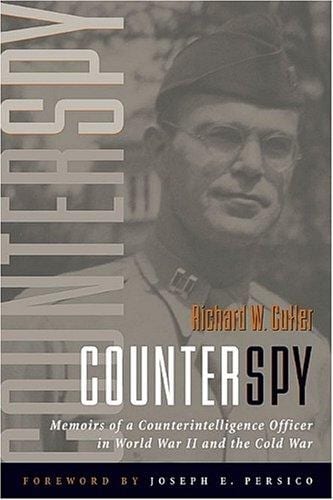
DESCRIPTION
During World War II and the beginning of the Cold War, Richard W. Cutler was an officer with the elite X-2 counterintelligence branch of the Office of Strategic Services (OSS) and with its successor, the Strategic Services Unit (SSU). Counterspy offers a rare firsthand account of the secret war against Hitler and the postwar competition with the Soviets for German intelligence assets.While with X-2, Cutler analyzed the super-secret Ultra intercepts and vetted agents about to be sent into Nazi Germany. Cutler provides an insightful overview of OSS operations during the war and their contribution to the Alliesa victory. This is also one of the few books to describe the role of the OSS and the SSU in the postwar occupation of Germany. Cutleras first job after the German surrender was to vet all of Allen Dullesas wartime sources inside Germany, who were aptly nicknamed the Crown Jewels. Just as the OSS was reorganized into the SSU, Cutler moved to Berlin, where his first task was to collect intelligence from former Nazis. Soon he became chief of counterespionage in Berlin. Soviet intelligence had already begun recruiting former German intelligence officers to spy on Americans, so Cutleras top priority was to uncover Soviet objectives and either neutralize or double their agents. Cutler reveals previously unpublished case histories of double agents against Soviet intelligence and details agentsa recruitment, missions, methods of operation, successes and failures, and fates. All of these events are recounted against the fascinating background of postwar Germany. He provides a vivid picture of the mood of the German people, how they rationalized war guilt, and how they coped with the devastation throughout the country. With photographs and a foreword by bestselling author Joseph E. Persico (Rooseveltas Secret War: FDR and World War II Espionage), Counterspy is a unique account of espionage during the momentous years of World War II and the beginning of the Cold War.”
My Summary
Main Ideas, Takeaways & Similarities
Questions
I. What is the problem?
A. How is this problem formulated?
B. Why is this problem important?
C. What is the history of this problem?
D. Which prominent personalities have been interested in this problem?
II. What solutions to the problem are there?
A. What are the conclusions reached?
B. By what argument(s) is the conclusion reached?
C. What facts or assumptions serve as premises?
D. When a prominent personality offers a solution, does he also argue for or against other prominent personalities? Does he raise objections to alternative solutions? Does he consider objections to his own solutions?
III. Evaluation
A. What are the advantages and disadvantages of the alternative formulations to the problem?
B. Has the importance or history of the problem ever been misrepresented?
C. Are the solutions logically related to the premises?
D. Are the facts true? Are the assumptions acceptable? Are the objections answerable?
AI Summary
“Counterspy: Memoirs of a Counterintelligence Officer in World War II and the Cold War” by Richard W. Cutler provides a detailed account of espionage activities during World War II and the early Cold War period. Here is a summary in bullet points:
- Richard W. Cutler served as an officer in the elite X-2 counterintelligence branch of the Office of Strategic Services (OSS) and its successor, the Strategic Services Unit (SSU).
- The book offers a firsthand account of the secret war against Hitler and the Cold War competition with the Soviets over German intelligence assets.
- Cutler’s role involved analyzing Ultra intercepts and vetting agents for missions in Nazi Germany.
- He gives an overview of OSS operations during WWII and their impact on the Allies’ victory.
- Post-WWII, Cutler was involved in vetting Allen Dulles’s wartime sources inside Germany, known as the Crown Jewels.
- Upon the OSS’s transition to the SSU, Cutler moved to Berlin, focusing on gathering intelligence from former Nazis and becoming chief of counterespionage.
- He played a crucial role in identifying and countering Soviet intelligence efforts, including recruiting and managing double agents against the Soviets.
- The book includes previously unpublished case histories of these double agents, detailing their recruitment, missions, methods, successes, failures, and outcomes.
- Cutler provides insights into the mood and attitudes of the German people postwar, addressing war guilt and coping with the devastation.
- The book is enriched with photographs and a foreword by Joseph E. Persico, known for “Roosevelt’s Secret War: FDR and World War II Espionage”【11†source】.