
DESCRIPTION
The Peloponnesian War (Oxford World’s Classics) — Rhodes, Peter John; Hammond, Martin; Thucydides — Oxford World’s Classics, tra, 2009 (Annotated).pdf (file not included in this release)
Military Facts of Sparta & Athens
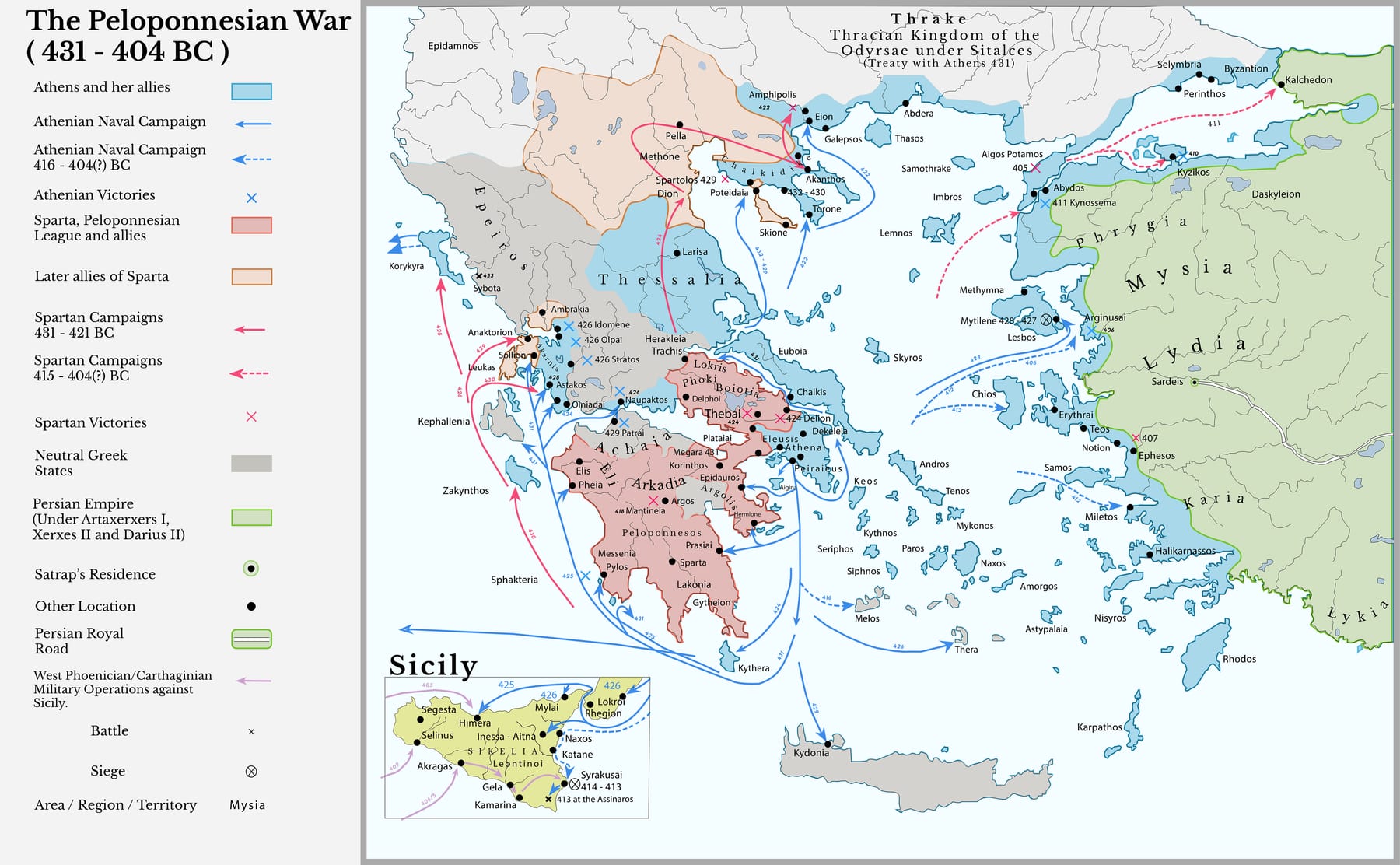
At the start of the Peloponnesian War in 431 BC, the military forces of Athens and Sparta differed significantly in structure and specialized strength. Athens was a dominant sea power with a large citizen-soldier population, while Sparta was a superior land power that relied heavily on a smaller elite core and a massive network of allies.
🏛️ Athens (The Sea Power)
The Athenian military was categorized by its citizen “regulars” and those held in reserve for home defense.
- Citizen Field Army: Athens had 13,000 hoplites (armored heavy infantry) available for active field duty.
- Reserve/Home Guard: An additional 16,000 men were assigned to garrisons and home duty. This force consisted of the oldest and youngest levies, as well as resident aliens who possessed heavy armor.
- Specialized Units: The land forces also included 1,000 cavalry and roughly 1,200 archers.
- The Navy: Athens maintained a fleet of 300 triremes at the outset of the war. At its peak, the Athenian navy theoretically required roughly 80,000 personnel to fully crew its maximum fleet.
🛡️ Sparta (The Land Power)
Sparta’s primary strength lay in its heavy infantry, which maintained a roughly 3:1 superiority over Athens on land.
- Elite Citizen Core: In the early classical period, there were approximately 8,000 full Spartan citizen-soldiers(Spartiates). However, this number declined steadily throughout the 5th century BC.
- Lacedaemonian Forces: When marching to war, full Spartiates were supplemented by perioikoi (free non-citizens). For instance, at the earlier Battle of Plataea, Sparta fielded 5,000 Spartiates and 5,000 perioikoi hoplites.
- Peloponnesian League Allies: Unlike Athens, which used tribute to pay for its own troops, Sparta’s total power came from mobilizing its allies. The total Peloponnesian army that initially took the field against Athens in 431 BC is estimated at as many as 60,000 hoplites.
- Light Infantry (Helots): Sparta also possessed a massive pool of potential light-armed soldiers in the helots(enslaved population). While their numbers in every campaign are debated, records from the Persian Wars claim as many as 35,000 helots served as light infantry alongside the hoplites.
Casualty Figures
Precise casualty figures for the Peloponnesian War are difficult to determine due to sparse historical records, but modern estimates suggest a total death toll ranging from tens of thousands to several hundred thousand people.
🦠 The Impact of the Athenian Plague (430–426 BC)
The single greatest cause of death during the war was not combat, but the “Plague of Athens.”
- Total Mortality: The epidemic is estimated to have killed 25% to 33% of the Athenian population.
- Numerical Estimates: This equates to roughly 75,000 to 100,000 deaths in Athens alone.
- Combatant Losses from Disease: Thucydides records that the plague specifically killed 4,400 hoplites and 300 cavalrymen from the Athenian citizen-soldier ranks.
⚔️ Combatant Casualties
While battle records are incomplete, several major engagements resulted in catastrophic losses for the military forces.
- The Sicilian Expedition (415–413 BC): This was the most devastating military defeat for Athens. Out of a total force of 40,000 men, only about 7,000 survived the final battles and subsequent imprisonment in quarries.
- Citizen Population Decline: At the start of the war, Athens had approximately 40,000 adult male citizens; by the war’s end, this number had plummeted to roughly 16,000.
- Specific Battle Losses: At the Battle of Delium (424 BC), the Athenians lost approximately 1,000 men (roughly 14% of their force) during a pursuit by Boeotian cavalry.
- Spartan Losses: Spartan figures are less clearly documented, but the Spartiate (full citizen) population saw a long-term decline, dropping from several thousand at the start of the war to only about 1,500 by 371 BC.
🏙️ Civilian Deaths and Massacres
The war frequently targeted civilian populations through sieges, starvation, and direct massacres.
- Blurred Lines: Historians note that the conflict often blurred the lines between combatants and civilians, particularly during city sieges.
- Athenian Civilian Deaths: Well over 100,000 Athenians of all classes (including civilians, foreigners, and slaves) are estimated to have died as a direct result of the war.
- Population Displacement: The strategy of withdrawing the rural population of Attica within Athens’ Long Walls led to extreme overcrowding, which exacerbated deaths from both disease and the lack of sanitation.
- Massacres: Several cities saw their entire male populations executed and women and children enslaved, such as at Melos (416 BC) and Plataea (427 BC).
Introduction
- The conflict arose between the two dominant Greek powers: Athens, a democratic naval empire, and Sparta, a conservative oligarchic land power.
- The “Thucydides Trap”: The war’s fundamental cause was the growth of Athenian power and the fear it inspired in Sparta.
- The War’s Conclusion: After a disastrous expedition to Sicily and the eventual intervention of Persia on Sparta’s side, Athens was defeated in 404 BC, losing its navy, long walls, and empire.
- Thucydides’ Revolutionary Methodology
- Human-Centered Causality
- Accuracy over Entertainment
- Chronological Precision
- The Role of Speeches
- Imperial Dilemma: As a patriotic Athenian, he admired Pericles’ empire but struggled with the “cynical” reality that imperial power often requires the rejection of moral standards in favor of raw force.
In the second half of the fifth century bc the two leading powers in Greece were Athens, which was democratic and innovative, and whose navy had built up an empire in the Aegean Sea, and Sparta, which was oligarchic and conservative, and whose army of heavy infantry enabled it to dominate the southern part of the Greek mainland. Athens’ continuing expansion threatened Sparta’s position in Greece, and, prompted by the complaints from some of its allies, from 431 to 404 Sparta challenged Athens in the Peloponnesian War. A peacetreaty in 421 seemed to acknowledge that Sparta had failed to break the power of Athens; but the peace was inherently unstable, and after Athens had weakened itself in an over-ambitious campaign in Sicily, and had provoked the Persians, the dominant power in the Near East, Sparta managed to obtain Persian support and to continue the war until Athens was defeated.
He himself thought that ‘the lack of a romantic element in [his] history will make it less of a pleasure to the ear’; but he hoped that it would be ‘judged useful by those who will want to have a clear understanding of what happened — and, such is the human condition, will happen again at some time in the same or a similar pattern.
Thucydides states at the outset of his history that he started work on the history of the Peloponnesian War at the beginning of the war, ‘reckoning that this would be a major war and more momentous than any previous conflict… . This was in fact the greatest disturbance to affect the Greek and a good part of the non-Greek world, one might even say the majority of mankind’
The Mytilenean Debate (Thucydides 3.37–50)
What’s happening
After Mytilene revolts from the Athenian empire and then surrenders, Athens initially votes (in anger) to execute all adult male Mytileneans and enslave the women and children. The next day, the Assembly feels doubt and reopens the question. Two speakers dominate: Cleon (argues to keep the death sentence) and Diodotus (argues to reverse it). The debate is less about Mytilene specifically than about how an empire governs: fear vs prudence, rage vs calculation, “justice” vs utility.
Cleon’s argument: carry out mass execution
- Democracy is too easily manipulated: Cleon says the Assembly is prone to being swayed by clever speakers and novelty. He frames reconsideration as weakness and instability.
- Empire is rule over unwilling subjects: Athens doesn’t have allies; it has subjects. Therefore leniency invites more revolt, because subjects calculate risk.
- Deterrence requires severity: If rebellion’s worst-case outcome isn’t catastrophic, other cities will gamble. For Cleon, making an example matters more than case-by-case fairness.
- Mytilene wasn’t a desperate uprising: He stresses that Mytilene had unusual privileges and power, so the revolt was not forced by hardship; it was “ingratitude” and deliberate treachery—making them less deserving of mercy.
- Do not let rhetoric override anger: He implies that pity and eloquence are tools that corrupt political judgment; the city should stand by its first decision to prove resolve.
Diodotus’ argument: reverse the mass execution (not from mercy, but from advantage)
- Don’t confuse justice with what helps Athens: Diodotus insists the Assembly should decide based on Athenian interest, not moral outrage. He’s explicit: he isn’t defending Mytilene’s innocence.
- Extreme punishment does not reliably deter: People rebel for hope, necessity, miscalculation, and leadership pressure. If the penalty is always death, rebels will fight to the end, making revolts more expensive to suppress.
- Preserve incentives to surrender early: If cities know surrender means total annihilation anyway, they have no reason to stop. A policy that leaves room for negotiation shortens conflicts and saves Athenian lives and money.
- Empires need workable governance, not theatrics: Mass killing might feel satisfying, but it can damage Athens strategically: it hardens resistance, reduces revenue, and pushes wavering cities toward desperate rebellion.
- Punish the guilty leaders, not the whole population: Diodotus leans toward targeted punishment, arguing that collective slaughter turns entire communities into enemies and removes the possibility of future cooperation.
Outcome
Diodotus wins by a narrow margin. Athens sends a second ship racing to overtake the first order. The revised decision:
- Execute the leading rebels (those judged most responsible),
- Spare the broader population.
Why this debate matters (the big ideas Thucydides is highlighting)
- Imperial logic: Both speakers accept empire; the dispute is over technique—terror vs manageability.
- Rhetoric and democracy: Thucydides uses Cleon and Diodotus to show how democratic deliberation can swing between passion and calculation, and how speakers frame “reason” to serve power.
- Deterrence vs incentives: The debate becomes a classic statement of a practical problem: if punishment is maximally severe, you remove the incentive to surrender, potentially worsening outcomes.
- Moral language masking policy: “Justice” and “desert” are invoked, but Thucydides keeps pulling attention back to interest, fear, costs, and control—how empires rationalize decisions.
The Melian Dialogue (Thucydides 5.84–116) — expanded breakdown
1) Context and why the scene is unusual
- Time/place: 416/415 BCE (late in the Archidamian phase, during the uneasy “Peace of Nicias” period). Athens is still powerful, but the war’s logic has hardened.
- Who Melos is: A small island polis with Spartan (Dorian) kinship ties. Melos has tried to remain neutral.
- What Athens wants: Not an alliance, but submission—tribute and formal incorporation into the empire. Neutrality is treated as a threat.
- Why Thucydides stages it as a “dialogue”:
- It’s not a set-piece speech to a crowd; it’s a cold negotiation.
- The form lets Thucydides strip away patriotic rhetoric and show an imperial logic with minimal decoration.
- It reads like a philosophical disputation, but the endpoint is military coercion.
2) The Athenians’ opening move: redefine the terms of discussion
The Athenians essentially say:
- Don’t talk to us about moral right. “Justice” only meaningfully applies between equals in power.
- In unequal relations, the real rule is: the strong do what they can; the weak suffer what they must.
- They claim this isn’t cruelty; it’s a law of human nature and international life.
This is the key move: they force the Melians into a frame where moral claims are inadmissible evidence unless backed by power.
3) What Athens offers, and why it’s framed as “reasonable”
Athens presents submission as the rational choice:
- Melos keeps its city and people (under Athenian control), rather than being destroyed.
- Athens gets tribute + an unmistakable message to other subjects.
- Athens presents the offer as almost benevolent: “We’re giving you a way to survive.”
But the “reasonableness” is a tactic: the underlying choice is compliance or annihilation.
4) The Athenian argument, step-by-step
You can read the Athenians as making a tight chain of claims:
A. Empire must run on fear, not goodwill
- Athens can’t afford to let a small neutral state exist on the edge of its power, because subjects will interpret that as:
- Athens can be resisted, or
- Athens lacks the nerve to enforce obedience.
B. Neutrality is more dangerous than open enmity
- A declared enemy is expected.
- A neutral that refuses incorporation becomes a symbol that Athenian power has limits.
- So neutrality is punished not because Melos is attacking Athens, but because Melos is refusing the imperial status order.
C. “Hope” is a seductive trap
Athens repeatedly attacks what they portray as Melian psychology: - The weak rely on hope (chance, miracles, allies).
- Rational policy should rely on calculable power.
- Hope becomes, in Athens’ language, a kind of intoxication that makes people risk total ruin.
D. Gods don’t save the weak; they reinforce the strong
This is one of the most chilling parts: - Athens claims that both humans and gods follow the same rule: power prevails.
- So appeals to divine justice are dismissed as wishful thinking, not strategy.
E. Sparta won’t save you
Athens gives a hard-nosed model of Spartan behavior: - Sparta is cautious, slow, and acts from self-interest.
- Even if Sparta sympathizes, it may not intervene in time (or at all) to save Melos.
Put together: Athens argues that Melos is gambling everything on unlikely variables (Sparta, gods, fortune) against a near-certain siege.
5) The Melian argument, step-by-step
The Melians try to reopen the moral frame Athens has closed.
A. Justice and fairness should matter
- They insist that naked coercion isn’t legitimate.
- They argue Athens is destroying a neutral party and thus undermining norms that could protect Athens someday.
B. The gods favor the just - They suggest moral order exists beyond power.
- Their stance implies: Athens’ injustice could invite divine or historical punishment.
C. Sparta (kinship + honor) will help - Shared ethnicity/kinship and Spartan reputation for defending their own.
- The Melians count on Sparta’s honor and strategic interest.
D. Better to risk everything than live as subjects - There’s a civic-honor logic: survival at the price of submission is a form of death.
- This is a key difference in values:
- Athens: survival through prudence.
- Melos: dignity and independence even at catastrophic risk.
6) The Athenian rebuttal: dismantling each Melian pillar
Athens replies in a way that’s psychologically and strategically pointed:
- On justice: “Nice idea, but irrelevant without power.”
- On gods: “If gods enforce a rule, it’s the same rule we follow: the powerful dominate.”
- On Sparta: “They will calculate and delay; you’re not worth a major risk.”
- On honor: “Honor is a luxury for those who can afford it. For you, it’s a path to ruin.”
Notice what Athens is doing: it’s not merely arguing policy; it’s re-engineering Melos’s self-conception—trying to replace honor and moral hope with a cost-benefit view of survival.
7) The ending and why it hits so hard
- Negotiation fails.
- Athens besieges Melos.
- When Melos is eventually taken, Athens kills the adult men and enslaves the women and children, then settles the island.
Thucydides doesn’t add moral commentary in a sermon-like way; the horror is delivered through spare consequence. The dialogue’s “logic” cashes out in real bodies.
8) What Thucydides is teaching (without preaching)
The Melian Dialogue is often treated as a “realist” manifesto, but it’s more layered than “might makes right.”
A. Realism as description vs realism as justification
- The Athenians talk like they are describing an iron law.
- But they’re also using that “law” to justify choices that are still choices.
B. Imperial rationality can be internally coherent and still catastrophic - Athens’ reasoning is coldly consistent: deterrence, reputation, control.
- Thucydides invites you to ask whether that consistency is a form of blindness (especially as Athens moves toward the Sicilian disaster in Books 6–7).
C. The critique of “hope” cuts both ways - Athens mocks Melian hope as irrational.
- But Athens itself will soon act on a massive hope-fantasy in Sicily: the idea that it can take everything.
That symmetry is part of the tragedy: the empire condemns in the weak what it later indulges in itself.
9) A quick argument map (for retention)
- Athens: Justice only applies among equals → power decides → neutrality is dangerous → submit for safety → hope is a delusion → gods/sparta won’t save you.
- Melos: Justice should matter → gods favor the just → Sparta will help → freedom is worth risk.
- Athens: Those supports are fantasies → you’re choosing annihilation.