The Iroquois sought to expand their territory to monopolize the fur trade with European markets.
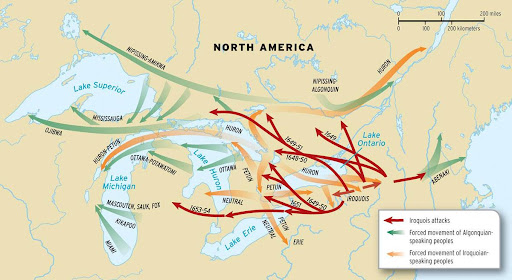
As a result of this conflict, the Iroquois destroyed several confederacies and tribes through warfare: the Hurons or Wendat, Erie, Neutral, Wenro, Petun, Susquehannock, Mohican and northern Algonquins whom they defeated and dispersed, some fleeing to neighbouring peoples and others assimilated, routed, or killed.
The Iroquois effectively destroyed several large tribal confederacies, including the Mohicans, Huron (Wyandot), Neutral, Erie, Susquehannock (Conestoga), and northern Algonquins, with the extreme brutality and exterminatory nature of the mode of warfare practised by the Iroquois causing some historians to label these wars as acts of Genocide committed by the Iroquois Confederacy.2(https://en.wikipedia.org/wiki/Beaver_Wars#cite_note-2) They became dominant in the region and enlarged their territory, realigning the American tribal geography. The Iroquois gained control of the New England frontier and Ohio River valley lands as hunting ground from about 1670 onward.


Haudenosaunee Confederacy (also known as the Iroquois or Five Nations, then including the Mohawk, Oneida, Onondaga, Cayuga and Seneca), numerous other First Nations, and French colonial forces.
By the middle of the 17th century, the Haudenosaunee had depleted the numbers of beaver in their homeland. They therefore began a campaign to increase their territory and gain access to new hunting and trapping grounds. After Dutch traders on the Hudson River (in present day New York State) provided them with firearms, the Haudenosaunee began to exert their military strength. In 1628, they pushed the Mohicans east and, in the 1630s, the Mohawk began to raid the Algonquin in the Ottawa Valley. By the early 1640s the Mohawk and Oneida were attacking settlements of New France and raiding the colony’s Algonquian allies throughout the St. Lawrence Valley.
Many of the Iroquois people allied with the British during the American Revolutionary War, particularly warriors from the Mohawk, Cayuga, Onondaga and Seneca nations. These nations had longstanding trade relations with the British and hoped they might stop American encroachment on their lands. After the Americans emerged triumphant, the British parliament agreed to cede control over much of its territory in North America to the newly formed United States and worked to resettle American loyalists in Canada and provide some compensation for lands the Loyalists and Native Americans had lost to the United States. Mohawk Chief Joseph Brant led a large group of Iroquois out of New York to what became the reserve of the Six Nations of the Grand River in Ontario. The new lands granted to Six Nations reserves were all near Canadian military outposts and placed along the border to prevent any American incursions.42(https://en.wikipedia.org/wiki/Beaver_Wars#cite_note-42)
The coalition of Native American tribes, known as the Western Confederacy, was forced to cede extensive territory, including much of present-day Ohio, in the Treaty of Greenville in 1795.
References
Iroquois Wars | The Canadian Encyclopedia
[Beaver Wars - Wikipedia](https://en.wikipedia.org/wiki/Beaver_Wars#:~:text=The%20Beaver%20Wars%20(Mohawk%3A%20Tsian%C3%AC,the%20Great%20Lakes%20region%20which)