Based on the provided search results, here is a summary of the Moorish invasion of Spain and France in 711 AD:
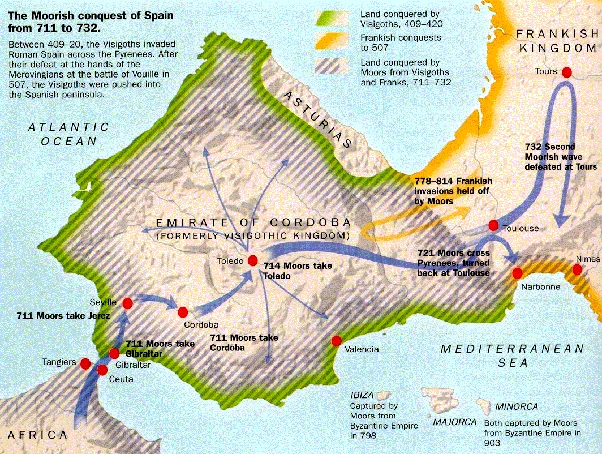
In 711, the Moors, who were Muslims from North Africa, invaded the Iberian Peninsula (modern-day Spain and Portugal) from Morocco. Their army was led by Tariq ibn Ziyad and consisted mostly of Berbers (indigenous North Africans).[2][5][11] The invasion was likely motivated by a desire to expand Muslim territory rather than a response to a plea for help from a Visigothic ruler.[10]
The Moors quickly defeated the Visigothic Christian kingdom that controlled Iberia at the time. In the decisive Battle of Guadalete, King Roderick of the Visigoths was killed.[2][10] By 719, the Moors had conquered most of the Iberian Peninsula.[7]
The invaders established their capital at Córdoba and called the territory Al-Andalus.[3][10] The Moors then advanced into southern France (Septimania), capturing cities like Narbonne.[2][12] In 732, a Moorish army led by Abdul Rahman Al Ghafiqi was defeated by Frankish forces under Charles Martel at the Battle of Tours in central France, halting further northward expansion.[1][12]
The Moors went on to rule much of the Iberian peninsula for nearly 800 years, until the last Moorish stronghold, Granada, fell to the Catholic Monarchs Ferdinand and Isabella in 1492.[3][6] Over those centuries, the Moors introduced many innovations to Spain including new crops, irrigation techniques, architecture, arts, and sciences.[3][13]
In summary, the Moorish invasion and conquest of most of Iberia in 711 AD represented a major expansion of Muslim rule into Western Europe. Although the Moors’ northward advance into France was stopped, they firmly controlled Al-Andalus for hundreds of years, leaving a significant and lasting impact on Spanish culture.
Citations:
[1] https://www.youtube.com/watch?v=rYEMexhrBdI
[2] https://en.wikipedia.org/wiki/Muslim_conquest_of_the_Iberian_Peninsula
[3] https://www.andalucia.com/history/spainsmoorishhistory.htm
[4] https://history.stackexchange.com/questions/1740/why-did-the-moors-invade-the-iberian-peninsula
[5] https://www.historytree.net/world-history/the_moors_711_ce
[6] https://www.amazon.com/Moorish-Spain-Richard-Fletcher/dp/0520248406
[7] https://en.wikipedia.org/wiki/Moors
[8] https://www.southcoasttoday.com/story/news/nation-world/2002/01/06/muslim-moors-left-their-stamp/50295902007/
[9] https://www.nytimes.com/2022/08/30/travel/spain-travel-moorish-arab.html
[10] https://www.bbc.co.uk/religion/religions/islam/history/spain_1.shtml
[11] https://www.themaparchive.com/product/moorish-conquest-of-spain-711-to-732/
[12] https://en.wikipedia.org/wiki/Battle_of_Tours
[13] https://blackhistorystudies.com/resources/resources/15-facts-on-the-moors-in-spain/
[14] https://historum.com/t/why-didn%E2%80%99t-the-moors-conquer-all-of-europe.190905/
[15] https://www.reddit.com/r/badhistory/comments/hc6dv8/article_claims_that_in_711_ad_the_moors_crossed/?rdt=33495
[16] https://cycling-centuries.com/blogs/news/a-brief-history-of-the-moors-in-andalucia-when-who-and-why-a-spanish-tale
[17] https://www.warwicks.com/book/9781647644819
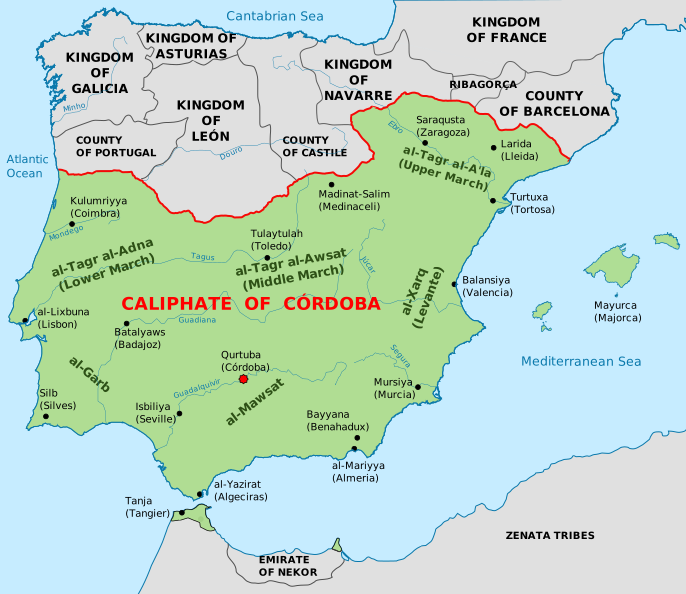
Open: Califato_de_Córdoba_-_1000-en.svg
Open: Al-Andalus732.svg
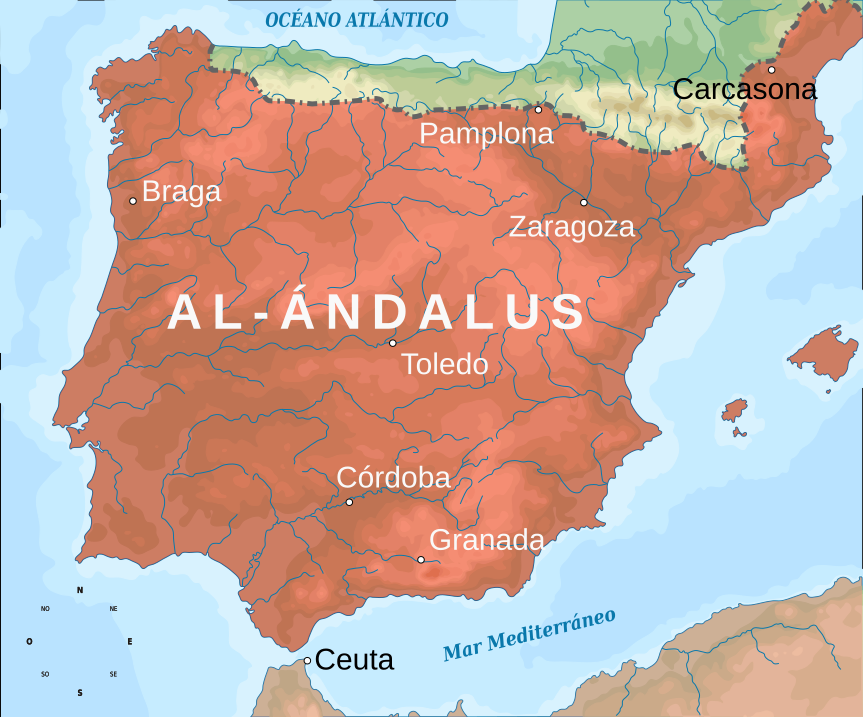
- Al-Andalus - Wikipedia
- Muslim conquest (711–732)
- For much of its history, al-Andalus existed in conflict with Christian kingdoms to the north. After the fall of the Umayyad caliphate, al-Andalus was fragmented into minor taifa states and principalities. Attacks from the Christians intensified, led by the Castilians under Alfonso VI, culminating with the capture of Toledo in 1085. The Almoravid empire intervened and repelled the Christian attacks on the region, then brought al-Andalus under direct Almoravid rule. For the next century and a half, al-Andalus became a province of the Muslim empires of the Almoravids and their successors, the Almohads, both based in Marrakesh.
- Ultimately, the northern Christian kingdoms overpowered the Muslim states to the south. With the fall of Córdoba in 1236, most of the south quickly fell under Christian rule, and the Emirate of Granada became a tributary state of the Kingdom of Castile two years later. In 1249, the Portuguese Reconquista culminated with the conquest of the Algarve by Afonso III. In Spain, the Reconquista would continue until the late-15th century, leaving Granada as the last Muslim state on the Iberian Peninsula. On January 2, 1492,10(https://en.wikipedia.org/wiki/Al-Andalus#cite_note-11) Emir Muhammad XII surrendered the Emirate of Granada to Queen Isabella I of Castile, completing the Christian Reconquista of Spain.
- The Jewish population worked mainly as tax collectors, in trade, or as doctors or ambassadors. At the end of the 15th century there were about 50,000 Jews in Granada and roughly 100,000 in the whole of Islamic Iberia.118(https://en.wikipedia.org/wiki/Al-Andalus#cite_note-119)
- Non-Muslims were given the status of ahl al-dhimma (people under protection), with adult men paying a “Jizya” tax equal to one dinar per year with exemptions for the elderly and the disabled. Those who were neither Christians nor Jews, such as pagans, were given the status of Majus.119(https://en.wikipedia.org/wiki/Al-Andalus#cite_note-120) The treatment of non-Muslims in the Caliphate has been a subject of considerable debate among scholars and commentators, especially those interested in drawing parallels to the co-existence of Muslims and non-Muslims in the modern world.120(https://en.wikipedia.org/wiki/Al-Andalus#cite_note-121)
- Jews constituted more than five per cent of the population.121(https://en.wikipedia.org/wiki/Al-Andalus#cite_note-122) Al-Andalus was a key centre of Jewish life during the early Middle Ages, produced important scholars and was one of the most stable and wealthy Jewish communities.
- Slavery existed in Muslim al-Andalus as well as in the Christian kingdoms, and both sides of the religious border followed the custom of not enslaving people of their own religion. Consequently, Muslims were enslaved in Christian lands, while Christians and other non-Muslims were enslaved in al-Andalus.188(https://en.wikipedia.org/wiki/Al-Andalus#cite_note-Phillips2014-189)
- The harem could contain thousands of slave concubines; the harem of Abd al-Rahman Iconsisted of 6,300 women.191(https://en.wikipedia.org/wiki/Al-Andalus#cite_note-Man1999-192) They were appreciated for their light skin.192(https://en.wikipedia.org/wiki/Al-Andalus#cite_note-Ruiz2007-193) The concubines (jawaris) were educated in accomplishments to please their master, and many became known and respected for their knowledge in a variety of subjects from music to medicine.192(https://en.wikipedia.org/wiki/Al-Andalus#cite_note-Ruiz2007-193) Jawaris concubines who gave birth to a child attained the status of an umm walad, which meant that they could no longer be sold and were to be set free after the death of her master.