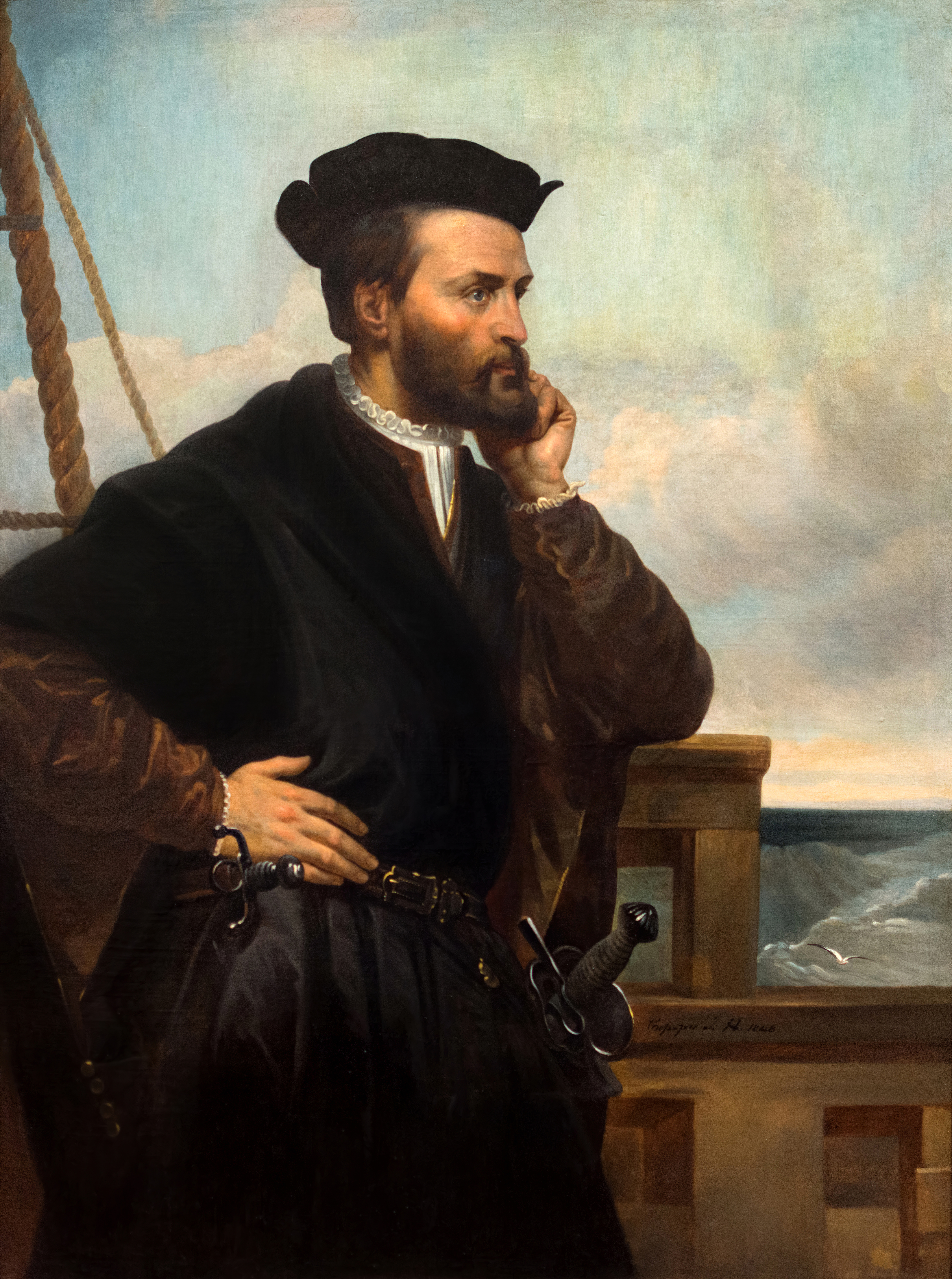
Here is a biography of French explorer Jacques Cartier:
Jacques Cartier was born on December 31, 1491 in Saint-Malo, a port town in Brittany, France. Not much is known about his early life, but as a young man he likely gained experience in navigation and seafaring in the fishing town where he grew up.[1][2]
In 1534, Cartier was commissioned by King Francis I of France to lead an expedition to explore the northern lands of the New World in search of gold, spices and a passage to Asia. Cartier made three major voyages to Canada between 1534 and 1542:
-
On his first voyage in 1534, Cartier explored the Gulf of St. Lawrence, the west coast of Newfoundland, Prince Edward Island and the Gaspé Peninsula where he met Iroquois Indians and claimed the land for France by erecting a cross.[3][4]
-
On his second voyage in 1535-1536, guided by two captured Iroquois, Cartier sailed up the St. Lawrence River as far as modern-day Montreal. He wintered near an Iroquois village, where his crew suffered from scurvy. He explored the surrounding lands and waterways before returning to France in the spring.[5][9]
-
On his third and final voyage in 1541-1542, Cartier attempted to establish a permanent French settlement along the St. Lawrence River, but it failed after a harsh winter and deteriorating relations with the Iroquois. He abandoned the colony in 1542 and returned to France, his career as an explorer over.[6][14]
Cartier’s expeditions were the first extensive explorations of the Gulf of St. Lawrence and the St. Lawrence River valley. Though he failed to find a passage to Asia or great riches, his voyages laid the basis for later French claims and colonization of Canada, to which he gave its name (derived from the Iroquois word “kanata” meaning village or settlement).[9][14]
However, Cartier’s legacy is tarnished by his poor treatment of the Iroquois. He captured Iroquois chiefs and took them back to France against their will. This, along with the general mistrust between the French and Iroquois, led to hostilities and restricted trade relations.[12][18]
After his expeditions, Cartier retired to his estate near Saint-Malo and died on September 1, 1557 at the age of 65. Though controversial, he is remembered as the first European to provide a detailed mapping of the Gulf of St. Lawrence and the St. Lawrence River, paving the way for future French exploration and settlement of Canada.[9][14]
Citations:
[1] https://www.proxi.co/blog/jacques-cartier
[2] https://study.com/academy/lesson/jacques-cartier-explorer-voyages-facts-route.html
[3] https://www.loc.gov/item/today-in-history/june-09/
[4] https://parks.canada.ca/lhn-nhs/qc/cartierbrebeuf/culture/histoire-history/evenement-event/cartier/a
[5] https://www.pbs.org/empireofthebay/profiles/cartier.html
[6] https://www.encyclopedia.com/people/history/canadian-history-biographies/jacques-cartier
[7] https://www.thoughtco.com/jacques-cartier-biography-510215
[8] https://canadaehx.com/2022/05/21/cartier-and-the-indigenous/
[9] https://en.wikipedia.org/wiki/Jacques_Cartier
[10] https://americanjourneys.org/aj-026/summary/
[11] https://parks.canada.ca/lhn-nhs/qc/cartierbrebeuf/culture/histoire-history/evenement-event/cartier/exploration
[12] https://www.dailykos.com/stories/2023/10/19/2199964/-Indians-301-Canadian-First-Nations-and-Jacques-Cartier-1534-to-1542
[13] https://christophergeib.weebly.com/impact.html
[14] https://www.britannica.com/biography/Jacques-Cartier
[15] https://www.britannica.com/video/213446/Top-questions-answers-Jacques-Cartier
[16] https://www.biography.com/history-culture/jacques-cartier
[17] https://homework.study.com/explanation/how-did-jacques-cartier-treat-the-native-americans-he-encountered.html
[18] https://thisiscanadiana.com/blogposts/2017/6/16/the-dark-disturbing-tale-of-jacques-cartier-in-canada
[19] https://exploration.marinersmuseum.org/subject/jacques-cartier/