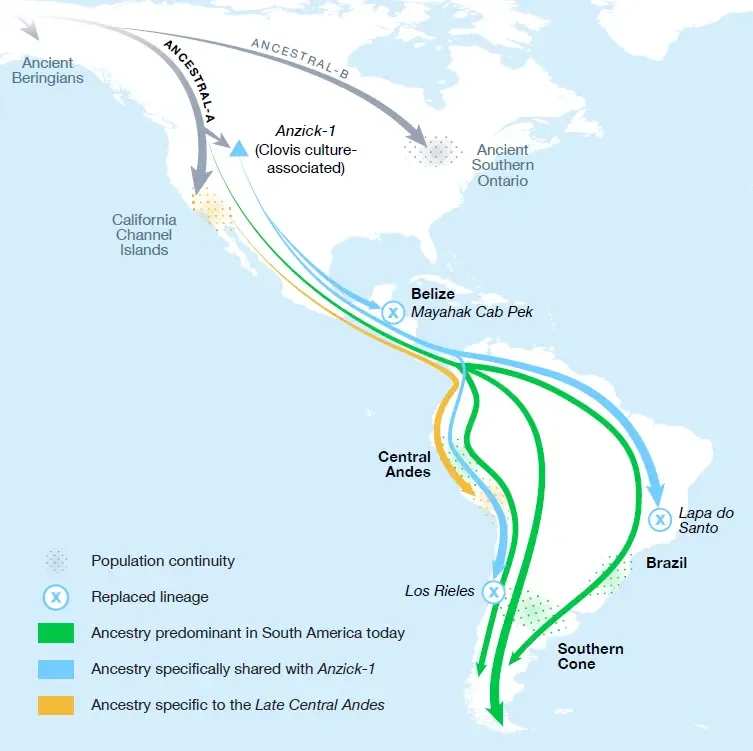
Based on the provided sources, the indigenous peoples of South America arrived there through a complex set of migration routes over thousands of years:
-
The first human populations likely arrived in South America either from Asia into North America via the Bering Land Bridge and then migrated southwards, or alternatively from Polynesia across the Pacific.
-
There is evidence of a north-to-south migration during the initial peopling of the Americas by ancient indigenous peoples. Around 15,000 years ago, people departed Beringia (the Bering Land Bridge) and spread into North and South America.[1][7]
-
However, the sources also point to migration in the opposite direction - a south-to-north route along the Atlantic coast linking ancient populations in Uruguay and Panama around 1,000 years ago. This suggests the settlement of the Atlantic coast occurred after the peopling of the Pacific coast and Andes.[1][2]
-
Genetic analysis has revealed surprising ancestral links between some indigenous South Americans and populations in Australasia (Australia and Papua New Guinea). This Australasian genetic signal is more widespread in South America than previously thought, though how it got there remains unclear.[2][7]
-
The genetic data also shows greater Denisovan ancestry than Neanderthal ancestry in some ancient South American individuals, suggesting an admixture event with Denisovans perhaps 40,000 years ago in Asia before the migration to the Americas.[2]
-
So in summary, the indigenous peoples of South America likely arrived through multiple migration waves over many thousands of years, originating from Siberia/Beringia, and possibly Australasia, with complex movements along the Pacific coast, Atlantic coast, and Andean regions. The precise routes and timing are still being unraveled through archaeological and genetic research.[1][2][4]
The sources emphasize that this migration history is complex and multi-layered, with new discoveries still adding to and refining our understanding of how the indigenous peoples came to inhabit South America. Let me know if you need any clarification or have additional questions!
Citations:
[1] https://www.discovermagazine.com/planet-earth/the-migration-of-ancient-indigenous-people-in-south-america-is-a-complex
[2] https://www.fau.edu/newsdesk/articles/ancient-dna-south-america
[3] https://www.redalyc.org/journal/3238/323827368007/html/
[4] https://www.ucl.ac.uk/news/2012/jul/native-american-populations-descend-three-key-migrations
[5] https://uwm.edu/clacs/indigenous-migration-from-latin-america/
[6] https://www.lawg.org/the-unique-struggles-of-indigenous-migrants/
[7] https://www.science.org/content/article/earliest-south-american-migrants-had-australian-melanesian-ancestry
[8] https://rosanjose.iom.int/en/blogs/5-key-aspects-migration-indigenous-peoples