DESCRIPTION
The Sunday Times Bestseller A new assessment of the West’s colonial record In the wake of the dissolution of the Soviet empire in 1989, many believed that we had arrived at the ‘End of History’ - that the global dominance of liberal democracy had been secured forever. Now however, with Russia rattling its sabre on the borders of Europe and China rising to challenge the post-1945 world order, the liberal West faces major threats. These threats are not only external. Especially in the Anglosphere, the ‘decolonisation’ movement corrodes the West’s self-confidence by retelling the history of European and American colonial dominance as a litany of racism, exploitation, and massively murderous violence. Nigel Biggar tests this indictment, addressing the crucial questions in eight chapters: Was the British Empire driven primarily by greed and the lust to dominate? Should we speak of ‘colonialism and slavery’ in the same breath, as if they were identical? Was the Empire essentially racist? How far was it based on the theft of land? Did it involve genocide? Was it driven fundamentally by the motive of economic exploitation? Was undemocratic colonial government necessarily illegitimate? and, Was the Empire essentially violent, and its violence pervasively racist and terroristic? Biggar makes clear that, like any other long-standing state, the British Empire involved elements of injustice, sometimes appalling. On occasions it was culpably incompetent and presided over moments of dreadful tragedy. Nevertheless, from the early 1800s the Empire was committed to abolishing the slave trade in the name of a Christian conviction of the basic equality of all human beings. It ended endemic inter-tribal warfare, opened local economies to the opportunities of global trade, moderated the impact of inescapable modernisation, established the rule of law and liberal institutions such as a free press, and spent itself in defeating the murderously racist Nazi and Japanese empires in the Second World War. As encyclopaedic in historical breadth as it is penetrating in analytical depth, Colonialism offers a moral inquest into the colonial past, forensically contesting damaging falsehoods and thereby helping to rejuvenate faith in the West’s future.
Colonialism_ A Moral Reckoning copy.pdf (file not included in this release)
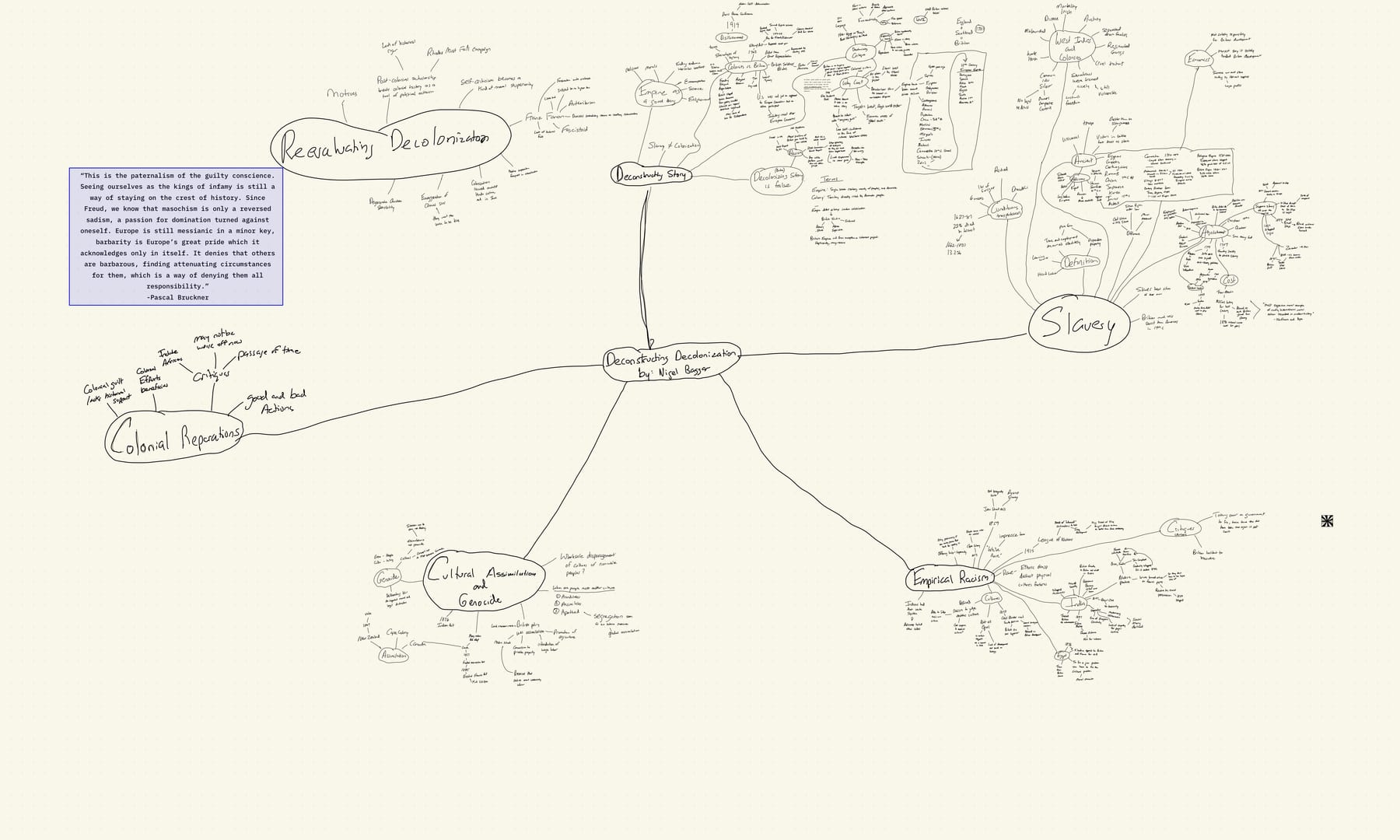
Introduction: Context and Controversy
I. The Heathrow Incident
- In December 2017, the author’s “Ethics and Empire” project at the University of Oxford faced public denunciation from students and academics.
- The controversy stemmed from the author’s qualified defense of Cecil Rhodes during the first “Rhodes Must Fall” campaign in Oxford and his approval of Bruce Gilley’s article “The Case for Colonialism.”
- The “Ethics and Empire” project aimed to analyze historical evaluations of empires to understand their ethical implications, rather than defending the British Empire.
II. The Imperial History Wars
- The author, a non-historian ethicist, stumbled into the “Imperial History Wars” unaware of the strong reactions.
- Critics of the project were not interested in the nuanced and morally ambiguous truth about the past.
- The author argues that the controversy over empire is more about present-day politics than historical accuracy.
III. The Universal Nature of Empires
- Empires have existed across all continents and throughout history, not just in Europe.
- The contemporary focus on European empires, particularly the British one, targets the Anglo-American liberal world order established post-1945.
- The British Empire, while significant, is not unique in its historical context.
IV. Academic and Political Anti-colonialism
- Anti-colonialists include academic “post-colonialists” who often inhabit literature departments and adhere to Edward Said’s “Orientalism.”
- Academic post-colonialism influences students to repudiate Western dominance, aligning inadvertently with authoritarian regimes like those in Russia and China.
- The author critiques the political motives behind anti-colonialist narratives, which aim to undermine faith in the West.
V. The Complexity of Colonial History
- Anti-colonialist narratives often exaggerate the negative aspects of colonial history while ignoring the positive.
- British colonial history includes significant efforts to abolish slavery and promote humanitarian principles.
- The author aims to present a more balanced view of the British Empire’s legacy, acknowledging both its evils and virtues.
VI. A Moral Assessment of Empire
- The book is not a chronological history but a moral evaluation of the British Empire.
- Each chapter addresses specific moral questions related to the empire’s motives, actions, and consequences.
- The author’s ethical perspective is shaped by Christian principles, emphasizing the importance of universal moral values and a realistic understanding of human limitations.
VII. Terminology and Historical Context
- The terms “imperialism” and “colonialism” are often used interchangeably but should be distinguished.
- The author prefers “empire” to reflect the variety within the British imperial experience.
- A brief history of the British Empire is provided to offer context for the moral evaluation.
VIII. Structure and Purpose
- The book addresses key moral questions about the British Empire: its motives, relationship with slavery, racism, land conquest, genocidal actions, economic exploitation, legitimacy, and use of violence.
- The conclusion summarizes the moral evaluation, and the epilogue discusses the nature and motives of anti-colonialism and its implications for the British future.
This summary captures the key points of the introduction from “Colonialism: A Moral Reckoning,” formatted for import into Obsidian.
Chapter 1: Motives, Good and Bad
I. Introduction
- Anti-colonialists often describe the British Empire as a unified project driven by motives like domination, despotism, oppression, racism, white supremacism, exploitation, theft, and violence.
- Historically, the British Empire was not a coherent project with a single motive. It was shaped by diverse and often changing motives across different times, places, and people.
II. Diverse Motives Behind the Empire
- The British Empire had various motives, including economic interests, search for better living conditions, adventure, cultural curiosity, military and political strategy, and humanitarian ideals.
- Different actors such as traders, migrants, soldiers, missionaries, entrepreneurs, financiers, government officials, and statesmen had different reasons for their involvement in the empire.
- Motives also varied between locations like London, Cairo, Cape Town, and Calcutta, and changed over time.
III. Innocent and Admirable Motives
- Many motives behind the British Empire were morally neutral or even admirable, such as the aversion to poverty, the desire for a better life, duty to shareholders, adventure, cultural curiosity, the need to maintain peace and martial prestige, and the aim to lift oppression and establish stable self-government.
- Good motives could be corrupted by vices, but moral corruption is a universal feature of human affairs and not necessarily central or systemic.
IV. International Rivalry and Security
- Imperial expansion was often driven by the need for national security and advantage in international competition.
- Rivalries with Spain, France, Russia, and Germany influenced British territorial acquisitions across the globe.
- Self-defense and competitive advantage were significant motives for imperial expansion.
V. Individual Stories and Broader Trends
- Personal stories like that of John Malcolm, who rose from poverty to become governor of Bombay, illustrate the diverse and sometimes noble motives behind involvement in the British Empire.
- Malcolm’s motives included earning a living, adventure, martial prowess, cultural fascination, and ambition to rule, which were channeled into confirming and expanding the British Empire.
VI. Moral Judgements and Historical Context
- The chapter emphasizes the importance of understanding the diverse and often morally complex motives behind the British Empire.
- Recognizing the variety of motives helps in making a more nuanced moral assessment of the British colonial project, rather than reducing it to a simplistic narrative of greed and oppression.
This summary captures the key points of Chapter 1 from “Colonialism: A Moral Reckoning,” providing a balanced view of the diverse motives behind the British Empire, formatted for import into Obsidian.
Chapter 2: From Slavery to Anti-Slavery
I. Colonialism and Slavery
- The chapter begins by addressing the common assumption that colonialism and slavery are inherently connected.
- Contemporary movements like “Rhodes Must Fall” and “Black Lives Matter” argue that anti-black racism in modern British society stems from the justifications used for slavery in the 17th and 18th centuries.
II. Defining Slavery
- Slavery is identified as an institution where a person’s time and employment are owned absolutely, and the person is treated as disposable property.
- Historical variations of slavery existed, some with legal or customary constraints on the owner’s power over the slave.
III. Historical Context of Slavery
- Slavery has been a universal institution across various civilizations, from ancient Mesopotamia to the Americas and the Islamic world.
- The Portuguese initiated the Atlantic slave trade in the 1440s, followed by the British who transported over 3 million slaves between 1525 and 1866.
IV. The Horrors of the Slave Trade
- The conditions under which slaves were transported across the Atlantic were horrendous, with high mortality rates during transit.
- Slaves who survived were sold at auctions and subjected to harsh labor on plantations, often under severe and cruel discipline.
V. Economic Aspects of Slavery
- The profitability of the slave trade is debated, with figures like Eric Williams arguing it significantly contributed to Britain’s industrial development.
- Recent studies suggest the profits from the slave trade were less significant compared to other economic activities in Britain.
VI. Abolitionist Movement
- Intellectual streams from Enlightenment philosophers and Christian evangelicals fueled opposition to slavery in the late 18th century.
- Anti-slavery sentiment led to the founding of the Society for the Abolition of the Slave Trade in 1787 and significant public agitation.
VII. Legislative Milestones
- The British Parliament passed legislation to abolish the slave trade in 1807 and eventually slavery itself in 1834.
- The abolition process included controversial measures like compensating slave-owners and implementing a transitional apprenticeship system for former slaves.
VIII. Post-Abolition Efforts
- Britain’s commitment to ending slavery extended globally, with diplomatic and military efforts to suppress the trade and the institution of slavery.
- The Royal Navy played a significant role in patrolling and intercepting slave ships, and treaties were signed to end the trade in various regions.
IX. Economic and Moral Costs
- The efforts to suppress slavery were costly, both economically and in terms of naval resources.
- The British commitment to abolition was driven by a moral imperative to end the inhumanity of slavery, despite economic disadvantages.
X. Conclusion
- Britain’s involvement in slavery was not unique, but its later efforts to abolish slavery and the slave trade were significant.
- The transition from a slave-trading nation to an abolitionist one reflects a major moral shift within British society and its imperial policies.
This summary captures the key points of Chapter 2 from “Colonialism: A Moral Reckoning,” formatted for import into Obsidian.
Chapter 3: “Human Equality, Cultural Superiority and ‘Racism’”
Introduction
Chapter 3 of Colonialism: A Moral Reckoning explores the complex relationships between human equality, cultural superiority, and the concept of racism within the context of the British Empire. The chapter delves into the moral and philosophical justifications used by proponents of imperialism and examines whether these justifications were inherently racist.
Key Points
-
Abolition of Slavery and Racism:
- The British Empire, particularly in the latter half of its existence, was actively involved in abolishing slavery. Despite this, the legacy of slavery and its associated racist attitudes continued to influence British society.
- The chapter argues that the Empire’s anti-slavery stance does not absolve it of racism. Racism persisted due to other factors beyond the slave trade.
-
Defining Racism:
- Racism is defined as a prejudiced attitude where members of one race hold a pejorative view of members of another race. This involves judging individuals based on group stereotypes.
- The chapter highlights the moral objections to racism: it reduces individuals to their group identity and attributes negative characteristics to the entire group.
-
Cultural Superiority vs. Biological Racism:
- The British often justified their imperial rule through claims of cultural superiority rather than biological racism. They believed that some cultures were less developed and required guidance.
- This belief in cultural superiority was sometimes seen as non-racist because it suggested the possibility of improvement and development of the ‘inferior’ cultures.
-
Views of Notable Figures:
- The chapter references John Stuart Mill and Cecil Rhodes, who both believed in the potential for ‘barbarians’ to improve under guidance. Rhodes, for example, viewed Africans as children emerging from barbarism but capable of development.
- Such views, while paternalistic and patronizing by today’s standards, were not necessarily rooted in biological racism but in a belief in cultural development.
-
Cultural Interaction and Adaptation:
- The chapter discusses the interaction between Western and indigenous cultures, noting that cultural exchange was inevitable. While some African elites adopted Western ideas, these ideas often resonated with existing elements of traditional culture.
- The missionaries and colonial administrators who worked in Africa believed they were bringing progress and improvement, which sometimes led to genuine changes appreciated by some locals.
-
Critique of Modern Anti-Colonialism:
- The chapter critiques modern anti-colonialists who equate cultural changes brought by colonialism to coercion and violence. It argues that not all changes were forcibly imposed; many Africans willingly adopted new ideas.
- The notion of ‘cultural invasion’ is examined, with the argument that individuals should have the freedom to choose new cultural practices if they see them as beneficial.
-
Complex Legacy:
- The chapter concludes that the legacy of British colonialism is complex, with both positive and negative aspects. The impact of colonialism on indigenous cultures involved both the destruction of traditional practices and the introduction of new ideas that some locals found valuable.
Conclusion
Chapter 3 of Colonialism: A Moral Reckoning presents a nuanced discussion on the themes of human equality, cultural superiority, and racism within the British Empire. It challenges the simplistic view that the British Empire was uniformly racist, suggesting instead that many imperialists believed in the potential for cultural improvement and development among the colonized peoples.
Here’s a summary of Chapter 4 from “Colonialism: A Moral Reckoning” formatted in markdown for import into Obsidian:
Chapter 4: Land, Settlers, and ‘Conquest’
I. Introduction
- Discusses the moral implications of migrating in pursuit of a better life, particularly when it involves infringing on the rights of others.
- Highlights the common assumption that the British Empire expanded primarily through conquest, seizing territories by superior force.
II. Concept of Rights
- Defines a right as a social institution protecting elements of human flourishing, including property rights.
- Emphasizes the role of social rules and laws in creating and securing property rights.
III. Encountering New Societies
- Explores the uncertainties and conflicts when British migrants first encountered indigenous peoples in America, Africa, and Australia.
- Criticizes the notion that indigenous peoples had inherent, inviolable rights to land from time immemorial.
IV. The British Empire’s Approach
- Details British colonial policies and treaties, focusing on their attempts to respect indigenous land rights while also expanding their territories.
- Describes how the British sometimes exploited ambiguities in treaties or failed to explain terms clearly to indigenous leaders.
V. Case Studies
Canada
- Indigenous peoples had been in Canada for only a few thousand years, contradicting claims of eternal possession.
- British treaties often based on recent patterns of habitation, not ancient claims.
South Africa
- British actions in South Africa, including the Treaty of Vereeniging, which ended the Second Anglo-Boer War.
- The complexities of British motives, beyond mere economic exploitation.
Australia and New Zealand
- British initial assumption of Australia as terra nullius (land belonging to no one) led to violent conflicts with Aboriginal peoples.
- British humanitarian concerns partly motivated the assertion of sovereignty over New Zealand.
Zimbabwe (Rhodesia)
- The ambiguous and contentious agreements between British South Africa Company and Ndebele King Lobengula.
- Subsequent conflicts and the moral complexities of land seizures.
VI. Moral and Ethical Reflections
- Discusses the natural morality principles that should guide the interactions between societies in the absence of common laws.
- Considers exceptions to property rights, such as the moral duty of those with surplus to aid those in need.
VII. Conclusion
- Acknowledges the severe disruptions and suffering of indigenous peoples due to British colonial expansion.
- Highlights the unintended consequences of British policies and the limitations of their power to control settler actions.
Chapter 5: Cultural Assimilation and Genocide
Overview
Chapter 5 delves into the complex and often controversial topic of cultural assimilation and its relationship with genocide, specifically within the context of British colonialism. The author explores various policies, practices, and historical events to provide a nuanced understanding of how assimilation efforts were implemented and their impacts on indigenous populations.
Key Themes
-
Assimilation Policies:
- British colonial policies aimed at assimilating indigenous peoples, often starting with land reserves, native schools, and the promotion of agriculture.
- The creation of reserves was seen as an interim measure to gradually integrate indigenous people into colonial society.
-
Impact of Assimilation:
- Many native people adapted to the new ways of life, supported by policies providing agricultural tools, education, and religious instruction.
- However, these policies also involved significant cultural suppression, leading to mixed outcomes for indigenous communities.
-
Residential Schools:
- Residential schools in Canada were a central element of assimilation policies, aiming to educate indigenous children in European ways.
- These schools have been criticized for their harsh conditions, cultural erasure, and long-term psychological impacts on indigenous communities.
-
Genocide and Cultural Genocide:
- The term “genocide” is examined critically, with the author questioning whether the outcomes of British colonialism, such as the near-extinction of the Tasmanian aboriginals, fit this label.
- The chapter discusses the use of “cultural genocide” to describe policies aimed at eradicating indigenous cultures through assimilation.
-
Historical Controversies:
- The chapter highlights debates among historians regarding the extent and nature of violence and cultural destruction caused by colonial policies.
- It examines both the arguments for and against the classification of certain historical events as genocide.
Conclusion
Chapter 5 of “Colonialism: A Moral Reckoning” provides a detailed examination of the interplay between cultural assimilation and genocide in the context of British colonialism. By exploring various policies, their implementations, and their impacts, the author presents a comprehensive overview of this contentious topic, encouraging readers to consider the complex legacy of colonial assimilation efforts.
Chapter 6: Free Trade, Investment, and ‘Exploitation’
I. Introduction
- The chapter addresses economic crimes attributed to the British Empire, including land theft, resource exploitation, use of slave labor, destruction of native industry, and profit draining from colonies to the imperial center.
- Discusses the controversy of these claims due to competing economic theories, lack of reliable data before 1950, and speculative counterfactual questions.
II. Economic Oppression in India
- Highlights the East India Company’s (EIC) economic domination in Bengal post-1757 Battle of Plassey, resulting in financial ruin for Bengal due to land taxes and market monopolies.
- Mentions the Maratha mercenaries’ destruction prior to EIC’s rule, contextualizing the exploitation within broader predatory practices of the time.
- Describes Lord Cornwallis’s reforms, including the Permanent Settlement aimed at stabilizing land taxation but resulting in unintended economic hardship for tenant farmers.
III. Free Trade and Industrial Disruption
- The British Empire’s commitment to free trade from 1846, which disrupted traditional industries like Indian textile production but also opened new opportunities for native entrepreneurs.
- The transition to imperial protectionism from the 1930s, benefitting some colonies but causing mixed results overall.
- Wartime commodity purchase policies intended to stabilize markets but later misused by local politicians for personal gain.
IV. Labour and Exploitation
- Discusses the recruitment of both local and indentured labor, emphasizing that while coercive incentives like hut taxes were used, they were not forced labor in the strict sense.
- Describes Cecil Rhodes’s rationale for the Glen Grey Bill, which aimed to stimulate labor among Africans by imposing taxes.
- Explains the compound system in mines, which, despite criticisms, provided better living conditions compared to other labor contexts of the time.
V. Technological and Social Disruption
- Acknowledges the disruptive impact of new technologies and capitalist development on traditional ways of life.
- Highlights the adaptive success of some African entrepreneurs who exploited new markets created by colonial economies.
- Discusses improvements in native prosperity and health during the colonial period, despite significant social costs.
VI. Investment and Economic Development
- Critiques the notion that the British Empire deliberately neglected economic development in colonies, noting the significant capital investment, especially in white-settler colonies.
- Discusses obstacles to investment in tropical agriculture and manufacturing, including environmental challenges and market limitations.
- Notes that where investment did occur, it often lacked the transfer of skills to native populations.
VII. India’s Unique Case
- Addresses the nationalist critique of British economic exploitation in India, arguing that much of the economic stagnation was due to factors like environmental challenges rather than solely colonial policies.
- Highlights debates on the impact of British rule on Indian economic growth, with some historians suggesting that Indian society’s own structures also played a significant role in its economic condition.
VIII. Conclusion
- The chapter concludes with a nuanced view of British colonial economic policies, acknowledging both the benefits and harms of British rule.
- It emphasizes the complexity of assessing colonialism’s economic legacy, considering the diverse experiences across different colonies and regions.
Chapter 7: Government, Legitimacy, and Nationalism
I. The Colonial Project and Imperial Government
Anti-colonialist rhetoric often frames the “colonial project” as a concerted and unitary endeavor, implying a central agent—typically the imperial government in London—that orchestrated colonial activities. This assumption leads to the conclusion that imperial rule was inherently oppressive and exploitative, benefiting the British at the expense of native peoples.
II. Decentralized Imperial Governance
The British Empire’s government was not highly centralized due to limitations in communication until the third decade of the nineteenth century. Messages between London and the colonies took weeks or months to deliver by sailing ship. The advent of steam power and the telegraph significantly improved communication speeds, enabling faster responses to colonial issues. By the 1880s, transatlantic messages could be sent in ten days, and communication with India could be achieved within a month by the 1870s. The development of undersea cables further reduced communication times, allowing London to communicate with Calcutta within 24 hours by 1870.
III. Governance and Local Autonomy
Imperial governance often allowed for significant local autonomy. Colonial administrations had to adapt to local conditions, resulting in varied governance practices across the empire. This decentralized approach sometimes led to conflicts between colonial and imperial authorities, especially when local actions did not align with broader imperial policies.
IV. Nationalism and Resistance
Nationalist movements against colonial rule were morally complex and often justified by their proponents as a fight for self-determination and freedom from oppression. However, these movements were not inherently virtuous and sometimes involved violence and terror against perceived enemies, including their own people. The case of Zimbabwean War of Liberation highlights the brutality of such conflicts, where liberation efforts were marked by atrocities and internal strife.
V. The Moral Accountability of Nationalism
Nationalism is not an unquestionable moral good. It must be held accountable for its actions and consequences. In some instances, nationalist movements were justified reactions to oppressive colonial rule, but they also had to be judged by the means they employed and the ends they achieved.
VI. The Dinshawai Incident
The Dinshawai incident in Egypt serves as an example of how colonial mismanagement and cultural insensitivity could exacerbate anti-colonial sentiments. In 1906, British officers’ actions in Dinshawai led to violence, resulting in harsh punishments for villagers. The incident attracted significant criticism in Britain and contributed to the erosion of Egyptian faith in British rule, becoming a turning point in Anglo-Egyptian relations.
VII. Famine and Government Response
The British government’s response to famines in India illustrates the complexities of colonial administration. Efforts to provide famine relief were inconsistent, with successes and failures. The response to the Orissa famine in 1865 was obstructed by free-market doctrines, leading to high mortality. Later, the government overcompensated during the Bihar and Bengal famine in 1874, importing excessive rice but successfully preventing starvation. Subsequent famines saw a mix of inadequate and effective responses, highlighting the challenges of colonial governance in crisis situations.
VIII. The Role of Treaties
Treaties between colonial authorities and native peoples were intended to secure peaceful expansion and mutual benefits. However, these agreements were sometimes made in bad faith or under coercion. The Rudd Concession with the Ndebele in 1888 is an example of a treaty that may have been secured through deceit, leading to significant conflicts later.
IX. Conclusion
The governance of the British Empire was a complex and often decentralized endeavor, influenced by local conditions and limited by communication challenges. Nationalist movements and anti-colonial sentiments were shaped by the moral and practical failings of imperial rule. The legitimacy of both colonial and nationalist actions must be critically examined to understand their historical and moral implications.
Chapter 8: Justified Force and ‘Pervasive Violence’
I. Introduction
- The chapter examines the charge that the British Empire was pervasively violent, with violence characterized as essentially racist and terroristic.
II. State Use of Force
- All states use force, sometimes lethally, to suppress disorder, fend off external threats, and defend innocents.
- The use of force is more frequent in weak states with fewer resources and control.
- The British colonial states often used force due to their relative weakness and lack of control.
III. Just War Ethic
- The “just war” ethic, rooted in Christian tradition, provides criteria for justified war: just cause, proportional response, right intention, and last resort.
- Lethal means must be discriminate (targeting combatants) and proportionate (no more than necessary).
IV. Infamous Cases of British Imperial Violence
- The First Opium War (1839-42): Triggered by the destruction of British opium by Chinese authorities, leading to British military response.
- Indian Mutiny (1857): Began with grievances among sepoys and expanded into rebellion; British response included severe reprisals.
- Amritsar Massacre (1919): General Dyer ordered troops to fire on a large crowd, resulting in hundreds of deaths and widespread condemnation.
- Benin Expedition (1897): British forces attacked Benin City, leading to significant casualties and the removal of cultural artifacts.
V. Moral Reflections on British Actions
- The British often acted with a sense of justified force but sometimes exceeded moral and ethical boundaries.
- Responses to violence were mixed, with some actions condemned and others supported within the British administration.
VI. Conclusion
- The British Empire’s use of force was complex and multifaceted, driven by a combination of perceived necessity, strategic interests, and sometimes moral justifications.
- Evaluating the morality of British colonial violence requires considering the historical context, intentions, and consequences of their actions.
This summary provides a concise overview of Chapter 8 from “Colonialism: A Moral Reckoning,” formatted for easy import into Obsidian.
Conclusion: On the Colonial Past
I. Introduction
- Margery Perham in 1961 compared judging an empire to measuring an elephant, criticizing indiscriminate condemnation of imperialism and advocating for a nuanced evaluation.
- The challenge of making an overall moral judgement on British colonialism is immense due to its vast and complex nature.
II. Evils of British Colonialism
- Recognizes numerous evils, including slavery, disease spread, economic disruption, displacement, government failures, racial alienation, cultural suppression, miscarriages of justice, military aggression, and slow admittance of native talent into government.
- These evils are lamentable and, where culpable, merit moral condemnation but do not amount to genocide in the strict sense.
III. Reparation and Historical Injustice
- Contemporary claims for reparation, especially for slavery, face complications due to the passage of time, making causal pathways and direct harms hard to trace.
- The debate extends to broader historical wrongs and questions the practicality and fairness of compensation across different historical contexts and parties involved.
IV. Beckles’ Case and Its Problems
- Hilary McD. Beckles argues for reparations, viewing British colonialism as a “criminal enrichment project” and emphasizing its exploitation and violence.
- Beckles’ position, influenced by Eric Williams’ thesis in “Capitalism and Slavery,” faces criticism for its oversimplification and ideological bias.
- There are counterarguments and complexities, including the role of African complicity in the slave trade and the century and a half of British efforts to suppress slavery.
V. Moving Forward with Justice
- Addressing present injustices should take precedence over attempting to rectify historic wrongs.
- Compensation should focus on current harm rather than ancient wrongs, considering the extensive changes and complexities over time.
VI. Contributions and Legacies of the British Empire
- The British Empire’s positive legacies include the abolition of slavery, promotion of free trade, regional peace, involvement in government, relief for the poor, incorrupt civil service, infrastructure development, modern agricultural and medical advancements, and standing against fascism and communism.
- The Empire’s influence on liberal democracy, the rule of law, and the establishment of prosperous states like Canada, Australia, New Zealand, the United States, and Israel is acknowledged.
VII. The Moral Balance of the Empire
- The Empire did both good and evil, and determining a net moral balance is challenging due to the incommensurability of diverse impacts.
- Comparing varied goods and evils is inherently problematic, and utilitarian calculations cannot provide a clear answer.
VIII. Systemic Justice and Imperial Rule
- The British Empire, despite its flaws, was not systemically unjust like the Nazi regime.
- The Empire’s values and principles evolved towards promoting trade, strategic advantage, humanitarianism, public service, and a liberal political vision.
- Liberal traditions of free speech and political criticism played a significant role in addressing imperial abuses and promoting self-government.
IX. Conclusion
- The British Empire’s complex legacy includes both substantial achievements and significant wrongs.
- Evaluating this legacy requires a balanced and nuanced approach, recognizing the interplay of diverse factors and the evolution of values and principles over time.
This summary captures the key points of the conclusion from “Colonialism: A Moral Reckoning” and is formatted for import into Obsidian.
Epilogue: On Anti-colonialism and the British Future
I. Introduction
- Not all anti-colonialists are driven by humanitarian motives; some, like the Chinese Communist Party, use anti-colonial rhetoric to further nationalist and aggressive foreign policies.
- Western anti-colonialists, such as academics and activists, often express righteous anger at perceived racism stemming from colonial history. However, data on racism in contemporary Britain shows it as less prevalent than in other EU countries.
II. Critique of Anti-colonialist Narratives
- Anti-colonialists rightly condemn racism, economic exploitation, and violence, but their narratives often exceed the evidence.
- Examples include exaggerated claims about British colonialism made by various historians and commentators.
- Some anti-colonial narratives are driven by material political interests or professional motives, with academics aligning with fashionable views to advance their careers.
III. The Dangers of Crusading
- Crusading for a cause can lead to self-righteousness and arrogance, mirroring the faults of those being criticized.
- Frantz Fanon’s work is highlighted as an example of revolutionary self-righteousness that dismisses contradictory evidence and promotes a dogmatic authoritarianism.
IV. Misuse of Historical Evidence
- Fanon’s assertions about European colonialism and its consequences often lack historical accuracy, relying more on ideological axioms than disciplined observation.
- The influence of Fanon’s ideas explains why many anti-colonialists use historical data as political ammunition rather than intellectual constraints.
V. The Psychological and Spiritual Dimensions
- Anti-colonialists’ eagerness to condemn their own nations can reflect a perverse form of moral self-righteousness, rooted in a degenerate Christian sensibility that emphasizes guilt and self-criticism.
- This attitude can lead to self-obsession, where the rhetoric of supporting the oppressed becomes a way to showcase one’s own moral superiority.
VI. The Future Role of Britain
- Anti-colonialism’s exaggeration of colonial sins can mislead contemporary Britain into abandoning its role in promoting liberal values globally.
- Britain’s imperial history, while containing evils and injustices, also shows a capacity for self-correction and humanitarianism.
- The British Empire’s legacy includes efforts to prepare colonized peoples for self-government and liberal democracy, which should be recognized and carried forward.
- This is not about nostalgia but about identifying and continuing the positive aspects of Britain’s colonial past.
This summary captures the key points of the epilogue from “Colonialism: A Moral Reckoning,” formatted for import into Obsidian.
Highlights
Introduction
Page 11
This unscrupulous indifference to historical truth indicates that the controversy over empire is not really a controversy about history at all. It is about the present, not the past. An empire is a single state that contains a variety of peoples, one of which is dominant. As a form of political organisation, it has been around for millennia and has appeared on every continent. The Assyrians were doing empire in the Middle East over four thousand years ago. They were followed by the Egyptians, the Babylonians and the Persians. In the sixth century BC the Carthaginians established a series of colonies around the Mediterranean. Then came the Athenians, followed by the Romans and after them the Byzantine rump. Empire first appeared in China in the third century BC and, despite periodic collapses, still survives today. From the seventh century AD Muslim Arabs invaded east as far as Afghanistan and west as far as central France. In the fifteenth century empire proved very popular: the Ottomans were doing it in Asia Minor, the Mughals in the Indian subcontinent, the Incas in South America and the Aztecs in Mesoamerica. Further north, a couple of centuries later, the Comanche extended their imperial sway over much of what is now Texas, while the Asante were expanding their control in West Africa. And in the 1820s King Shaka led the highly militarised Zulus in scattering other South African peoples to several of the four winds, conducting at least one exterminationist war.
Page 13
Set in this global historical context, the emergence of European empires from the fifteenth century onwards is hardly remarkable. The Portuguese were first off the mark, followed by the Spanish, and then, in the sixteenth century, by the Dutch, the French and the English. The Scots attempted (in vain) to join their ranks in the 1690s and the Russians did so in the 1700s. What is remarkable, however, is that the contemporary controversy about empire shows no interest at all in any of the non-European empires, past or present. European empires are its sole concern, and of these, above all others, the English – or, as it became after the Anglo-Scottish Union of 1707, the British – one.
Page 14
One important way of corroding faith in the West is to denigrate its record, a major part of which is the history of European empires. And of all those empires, the primary target is the British one, which was by far the largest and gave birth to the United States, Canada, Australia and New Zealand. This is why the anti-colonialists have focused on slavery, presenting it as the West’s dirty secret, which epitomises its essential, oppressive, racist white supremacism. This, they claim, is who we really are. This is what we must repent of.
Page 15
If you want to make others obey your will, it is surely useful to subvert their self-confidence and exploit their guilt. If Henry Kissinger is to be believed, ever since Sun Tzu’s Art of War in the fifth century BC, China’s Realpolitik has placed a premium on gaining psychological advantage. Certainly, its agents are looking to gain that now. In 2011 a British diplomat in China was told, ‘What you have to remember is that you come from a weak and declining nation.’ And when, in July 2020, Britain criticised the Chinese regime for running roughshod over the Sino-British Joint Declaration of 1984, in which China had agreed to respect Hong Kong’s relative autonomy and liberal rights, Beijing’s ambassador was quick to dismiss the criticism as colonial interference. Similarly, when the hard left wants to undercut Britain’s role as a major supporter of the post-1945 liberal international order, or when Scottish separatists want to deepen alienation from the United Kingdom, it is politically useful to recount the history of the British Empire as a litany of ugly racial prejudice, rapacious economic exploitation and violent atrocity.
Chapter 1: Motives, Good and Bad
Page 25
Such a description does not fare well in the light of history. No one woke up one sunny morning in London and said, ‘Let’s go and conquer the world.’ In that sense, the British Empire was not from its inception a coherent project, methodically developed out of some original plan. It was not started by a single agent or like-minded group of agents. Therefore, it was not the fruit of a single motive or cluster of motives, such as the desire to dominate and exploit, or even to improve and civilise. There was no essential motivation behind the British Empire.
Page 26
The Tudor foundation of colonies in North America was also driven by the desire to secure England against the dominant power of imperial Spain. (Not for the first or last time would the beginnings of an empire be ‘anti-imperialist’. So was the Revolutionary origin of the later, nineteenth-century western empire of the United States.) Resistance to dominant power is not its own justification, however. Some dominant powers deserve to be accepted. So England’s resistance to Spanish imperialism in the sixteenth century needs to give an account of itself.
That justifying account comes in terms, first of all, of religion, but then also of liberty. England was Protestant and Spain was Catholic, and under Philip II Spain was committed to eliminating Protestantism and recovering Protestant Europe for the Roman Church – if need be, by force of arms. Accordingly, Spanish armies waged war against the Dutch, off and on, for eighty years. But the ‘religious’ war between Catholics and Protestants was not simply an arcane, if bloody squabble over different views of the Eucharist; it was bound up with opposing views of authority and autonomy, both in the church and in wider society. Protestantism typically elevated the conscience of the individual, promoted the notion of the priesthood of all believers and accordingly downgraded the authority of the ecclesiastical hierarchy. Insofar as the Christian Church was held to be a model for a Christian society as a whole, this Protestant anti-authoritarianism had political implications.
Page 27
So among the reasons for the earliest English colonisation of North America were the desires to defend national autonomy, the freedom to be Protestant and a broad Church designed to prevent bloodshed on the streets. Subordinate to these were other motives, too. ‘Privateers’ such as Sir Francis Drake and Sir Walter Raleigh were licensed by the Crown to raid Spanish shipping and ports for silver and gold, and to establish colonies in order to mine for them. For the privateers, this held the prospect of amassing fabulous private wealth; and for the Crown, the prospect of augmenting revenue by taking a 20 per cent cut of the proceeds.
The extension of English – and after 1707, British – control over territories in distant parts of the globe was often a consequence of international rivalry and war, and the associated need to gain a competitive advantage. In the late sixteenth and early seventeenth centuries, the main rival was Spain. From the late seventeenth to the early nineteenth centuries it was France. Initially, France represented the authoritarian Catholicism and monarchical absolutism that England had repudiated. After 1793, it represented terroristic revolution imposed by military force, and then, under Napoleon, the scarcely less frightening prospect of invasion and foreign domination. In the second half of the nineteenth century, Russia became a strategic threat to British interests in the Near East and in India; and in 1914–18 Germany’s illegal invasion and ruthless occupation of Belgium and France posed a direct threat to the security of Britain itself. In the course of each of these international struggles, Britain acquired more territory in the Americas, Africa, the Middle East and the Indian subcontinent.
Prosperous trade depended upon political peace, and from the middle of the seventeenth century central and northern India became increasingly disturbed. The Muslim Mughals had come to rule in northern India after invading from Afghanistan in the 1520s, and especially from the 1550s onward their empire expanded until it covered almost all of India. From the early 1680s, however, this empire was weakened internally by a series of insurrections against oppressive taxation. Then in 1739–40 a Persian invasion defeated the emperor and occupied his capital, Delhi. Thereafter, the Mughal Empire disintegrated into a plurality of states that were virtually independent, while paying lip service to imperial authority, and whose rivalry often escalated into armed conflict. Some territories became virtually stateless. Imperial weakness allowed northern India to be invaded four times by the Afghans between 1748 and 1761. One consequence of these foreign raids was to enlarge the market for professional, mercenary cavalrymen, who sold their ‘protection’ to the highest bidder and lived off the peasantry between contracts.
Chapter 2: From Slavery to Anti-slavery
Page 46
Nevertheless, it is important to remember that, historically, not everything that went by the name of ‘slavery’ lived down to this simply evil form. In different times and places the condition of the slave differed. Sometimes there were legal or customary constraints on what owners were permitted to do with their human property: the right to ownership was not always absolute. For example, an owner was sometimes forbidden to strike or kill his slave, or obliged to grant him his freedom, under certain conditions. And where a failure of proprietorial duty was liable to incur legal penalties, and where those penalties were applied, there the slave had an enforceable right. Yet even where there were no legal constraints and no corresponding rights, slave-owners whose consciences retained a measure of sensitivity may have felt morally obliged to use their legal freedom humanely – say, by not selling a slave apart from his wife and children, if they could possibly avoid it. (Page 47)
Slavery was not only various, but ancient. From the earliest times, victors in battle chose to enslave the vanquished rather than slaughter them. Counterintuitive though it may be, therefore, slavery represented a moral advance. As the late-nineteenth-century moral philosopher David Ritchie put it, slavery was:
“a necessary step in the progress of humanity … [since] [i]t mitigated the horrors of primitive warfare, and thus gave some scope for the growth, however feeble, of kindlier sentiments towards the alien and the weak … Thus slavery made possible the growth of the very ideas which in course of time came to make slavery appear wrong. Slavery seems to us horrible … It used not to seem horrible.” (Page 47-48)
All the ancient Mesopotamian civilizations practiced 60 Knowledge/60.3 Politics/60.3.9 - Social Issues/Race/Slavery in one form or another, starting with Egypt in the third millennium BC. To the west, around the shores of the Mediterranean Sea, the ancient Greeks, Carthaginians, and Romans followed. To the east, slavery could be found among the Chinese from at least the seventh century AD, and subsequently among the Japanese and Koreans. In the Americas, the peoples on the northern Pacific coast practiced it from before the sixth century AD, the Incas and the Aztecs extracted forced labor from subject peoples from the fifteenth century, and the Comanches ran a slave economy from the eighteenth century. From the time of Muhammad in the 600s onward, slavery was practiced throughout the Islamic world. In the eighth and ninth centuries, the Vikings supplied slave markets in Arab Spain and Egypt with slaves – white slaves – from eastern Europe and the British Isles. In the 1600s, corsairs or pirates from the Barbary Coast of North Africa raided English merchant ships, and even villages in Cornwall and west Cork, for slaves. One estimate has it that raiders from Tunis, Algiers, and Tripoli alone enslaved between 1 million and 1.25 million Europeans from the beginning of the sixteenth century to the middle of the eighteenth century. Another estimate reckons that the Muslim slave trade as a whole, which lasted until 1920, transported about 17 million slaves, mostly African, exceeding by a considerable margin the approximately 11 million shipped by Europeans across the Atlantic. (Page 48)
Meanwhile, Africans had been enslaving other Africans for centuries, mostly by capturing them in war or raids, sometimes taking them in lieu of debt. Often slaves were destined for profitable export, first to Roman markets and then to Arab ones. But they also had their local uses, which included supplying victims for human sacrifices. The practice of human sacrifice in West Africa was attested as early as the tenth century by Ibn Hawqal, and by Europeans four hundred years later. Human sacrifices – as distinct from the judicial execution of criminals – served a variety of purposes: sometimes to appease the gods, but more often to supply a deceased master with servants in the afterlife, to make a conspicuous display of extravagant wealth and to intimidate onlookers. Although wives, favorites, women, and foreigners were also liable to serve as victims, slaves – usually war captives – were the main source. Commonly, their fate, especially at funerals, was to be buried alive. One report in 1797 has it that between 1,400 and 1,500 people were sacrificed at royal funerals in Asante. (Page 48-49)
Slavery and the slave trade, then, were alive and well in Africa long before Europeans arrived to develop the export market. The Portuguese were the first to seek slaves from West Africa in the 1440s, to make up for a labor shortage in Portugal and to man sugar plantations on their Atlantic island possessions, not least Madeira. Between 1525 and 1866 the Portuguese Empire is reckoned to have shipped 5,841,468 slaves out of Africa, amounting to 46.7 percent of the total of African slave exports of 12,508,381. After the Portuguese came the English – or, from 1707, the British – with 3,259,443 slaves exported, or 26.1 percent of the total, mostly between 1660 and 1807. The exporting was primarily done by merchants operating under the charter of the Royal African Company, which had been granted not only a monopoly, but the right (and obligation) to establish forts and ‘factories’ (trading posts), maintain troops and exercise martial law on the West African coast. In fact, the company was never able to secure its monopoly against interlopers, and in 1698 that monopoly was formally withdrawn. (Page 49)
General mortality statistics lay bare the scale of the suffering. According to one estimate, of the African slaves shipped by British traders in 1672–87, a full 23 percent were ‘lost in transit’. It seems that conditions became less dreadful later, since, according to another estimate, over the much longer period 1662–1807, 13.2 percent died before they reached the shores of the Americas. However, even if this does represent a comparative improvement, it still amounts to the terrible loss of about 450,000 souls. (Page 49-50)
Further, the conditions of work were very harsh, especially on the sugar plantations. Slaves commonly toiled for their owners for up to twelve hours a day, six days a week, without pay. They were malnourished, laboring in a very debilitating climate and prey to a wide array of diseases. Not unsurprisingly, they suffered a high rate of mortality. As a result, before the ending of the slave trade, none of the sugar colonies in the West Indies managed to achieve a natural increase in the slave population. That is why they had to keep on bringing in fresh supplies of slaves. Even so, Jamaica, which had imported 575,000 Africans in the course of the eighteenth century, still only had 348,825 in 1807. (Page 50-51)
Anstey’s general view has been confirmed more recently by David Richardson, who estimated that profits from the slave trade probably contributed under 1 percent of total domestic investment around 1790. In 2010, David Brion Davis, the distinguished historian of slavery and its abolition in the Western world, confidently pronounced the last rites on Williams’ thesis, declaring that it ‘has now been wholly discredited by other scholars’. (Page 51)
Another economic historian, Joel Mokyr, agrees: ‘In the absence of West Indian slavery, Britain would have had to drink bitter tea, but it still would have had an Industrial Revolution, if perhaps at a marginally slower pace.’ (Page 52)
As the effects of colonial slavery upon Britain are controversial, so are its effects on Africa. And they are likely to remain so, since data on trends in output and population in pre-colonial Africa are scarce. Some argue that the Atlantic slave trade made little difference to most of Africa, though it might have had a greater impact on the population and wealth of societies along its Atlantic coast. Others hold that it had devastating consequences, causing widespread depopulation and economic dislocation, undermining the socio-political fabric of African societies, and propagating forms of slavery and servitude hitherto unknown. Although it is impossible to calculate the costs to Africa of the slave trade with any precision, it makes sense to suppose that British (and European) demand for slaves stimulated African endeavor to supply – and thereby an increase in war and slave-raiding in West and Central Africa. While the British investors and merchants bear responsibility for that, so do their African suppliers. Commercial and political elites in West and Central Africa ‘appear to have made large profits from helping to meet the American demand for slave labor’. (Page 52)
The British were actively involved in the slave trade for about one hundred and fifty years until 1807, and in employing slave labor for almost three decades beyond that, until 1834. Before about 1770, few condemned the institution of slavery as such. Even the maroons – runaway slaves who hid out in the forested interiors of Jamaica and elsewhere – were prepared to secure their own autonomy in 1739 by agreeing to stop freeing slaves and to assist white settlers in suppressing slave revolts. They also kept slaves of their own. Nevertheless, in the second half of the eighteenth century, both the trade and the institution came under mounting public criticism in Britain. Two main intellectual streams fueled the opposition. One was a body of Enlightenment philosophers, which included the Baron de Montesquieu and Adam Smith. In his highly influential De l’esprit des lois (1748, translated into English two years later), the former objected to slavery because of its demoralizing effects on both parties: by robbing the slave of his freedom, it makes it impossible for him to act ‘through a motive of virtue’, and because, ‘by having an unlimited authority over his slaves [the master] insensibly accustoms himself to the want of all moral virtues, and from thence becomes fierce, hasty, severe, choleric, voluptuous, and cruel’. Smith went further, romanticizing Africans in his Theory of Moral Sentiments (1759) and attributing to the slave a superior moral dignity:
“There is not a Negro from the coast of Africa who does not … possess a degree of magnanimity which the soul of his sordid master is too often scarce capable of receiving. Fortune never exerted more cruelly her empire over mankind than when she subjected those [African] nations of heroes to the refuse of the gaols of Europe, to wretches who possess the virtues neither of the countries which they come from, nor of those which they go to, and whose levity, brutality, and baseness, so justly expose them to
the contempt of the vanquished.”
The second, more popular, intellectual catalyst for the emergence of the movement to abolish the slave trade and slavery in the late eighteenth century was Christian. Anti-slavery sentiment flourished widely among English Dissenters or Nonconformists – especially the Quakers – and the Methodist or evangelical wing of the Church of England. John Wesley, Anglican priest and founder of Methodism, prefaced his Thoughts upon Slavery (1774) with a quotation of the tenth verse of the fourth chapter of the Book of Genesis: ‘And the Lord said – What hast thou done? The voice of thy brother’s blood crieth unto me from the ground’ (Genesis 4:10). (Page 53)
Anti-slavery sentiment acquired practical, political focus in 1787 with the founding of the Society for the Abolition of the Slave Trade in London. (Page 54)
The efforts of the campaigners finally bore fruit in 1807, when Parliament legislated to abolish the slave trade. It took a further twenty-six years to achieve the empire-wide abolition of the institution of slavery itself, initially because the leading abolitionists were politically conservative and assumed that cutting off fresh supplies of slaves would doom the slave-based economies to wither naturally, gradually, and with minimal disruption. Even most black abolitionists were gradualists until the 1820s. (Page 54)
One controversial feature of the process of abolition was the agreement to compensate slave-owners for their loss of property to the tune of £20 million, which was paid by the government and funded by metropolitan taxpayers. That concession is controversial today and it was controversial then. The government was already committed to abolition, but it preferred to win the consent of the West Indian planters rather than have to coerce them. The shadow of the French Revolution and its Terror was long and made unthinkable the idea of the state riding roughshod over the right to property. The payment of compensation to the slave-owners was considered a distasteful but necessary political compromise. (Page 55)
The humanitarian motive to suppress the slave trade and slavery remained a common reason for imperial endeavor in Africa from the late nineteenth century into the twentieth. It caused the British government to lean upon the khedive of Egypt to sign the Anglo-Egyptian Slave Trade Convention in 1877. It propelled General Charles Gordon into the Sudan in the same year. It found expression in the principles of the Imperial British East Africa Company, when it was founded in 1888. It featured among the reasons for establishing a British protectorate in Nyasaland in 1891. And it was one reason for the invasion of the Sokoto Caliphate (now northern Nigeria) by Frederick Lugard in 1903. (Page 58)
The task of estimating the cost of all the empire’s various efforts to abolish the slave trade and slavery at sea and on land, worldwide, over the course of a century and a half, would present – at the very least – a major challenge both in scale and in complexity. No one, to my knowledge, has tried it. Some, however, have developed an estimate of the expense of transatlantic suppression alone. David Eltis reckoned that this cost British taxpayers a minimum of £250,000 per annum – which equates to £1.367–1.74 billion, or 9.1–11.5 percent of the UK’s expenditure on development aid, in 2019 – for half a century. Moreover ‘in absolute terms the British spent almost as much attempting to suppress the trade in the forty-seven years, 1816–62, as they received in profits over the same length of time leading up to 1807. And by any more reasonable assessment of profits and direct costs, the nineteenth-century costs of suppression were certainly bigger than the eighteenth-century benefits.’ (Page 59)
Chaim Kaufmann and Robert Pape took a broader view. In addition to the costs of naval suppression, they considered the loss of business caused by abolition to British manufacturers, shippers, merchants, and bankers who dealt with the West Indies. They also factored in the higher prices paid by British consumers for sugar, since duties were imposed to protect free-grown British sugar from competition by foreign producers who continued to benefit from unpaid slave labor. Overall, they ‘estimate the economic cost to British metropolitan society of the anti-slave trade effort at roughly 1.8 percent of national income over sixty years from 1808 to 1867’. Although the comparisons are not exact, they do illuminate: in 2021 the UK spent 0.5 percent of GDP on international aid and just over 2 percent on national defense. (Page 59)
Kaufmann and Pape conclude that Britain’s effort to suppress the Atlantic slave trade (alone) in 1807–67 was ‘the most expensive example [of costly international moral action] recorded in modern history’. (Page 60)
The basic problem with the anti-colonialists’ equation of British colonialism with slavery, and their consequent demand for cultural ‘decolonization’, is that it requires amnesia about everything that has happened since 1787. It requires us to overlook how widely popular in Britain was the cause of abolition from the closing decades of the eighteenth century onward. (Page 62)
Between the slave trade and slavery of the eighteenth century and the present lie a hundred and fifty years of imperial penance in the form of costly abolitionist endeavor to liberate slaves around the globe. For the second half of its life, anti-slavery, not slavery, was at the heart of imperial policy. The vicious racism of slavers and planters was not essential to the British Empire, and whatever racism exists in Britain today is not its fruit. (Page 63)
Chapter 4: Land, Settlers and ‘Conquest’ (Page 88)
Suppose, then, a situation where members of two different societies encounter one another for the first time. Since these societies have made no treaties with each other, there is no international law to govern their interaction and no international authority to enforce the law. With respect to each other, therefore, the freedom to use things such as land is highly insecure, neither party having a legal right to property. So, were members of one society to trespass on the territory of the other, taking it and settling on it for their own purposes, no right would have been violated. (Page 89)
Nevertheless, an injustice may have been done. If that is so, it is only because, beyond the rules or laws that societies invent for themselves and between themselves – beyond legal rights – there is also natural morality. That is to say, there are moral principles built into the rational nature or minds of all human beings, wherever they are located, which carry moral authority even where there is no law. One such principle is that one usually ought not to take from other people things in which they have invested their time and energy, or on which their social life has come to depend, or which they need to survive. ‘Usually’, of course, implies that there are exceptions. According to a major tradition of Western thought, which I generally endorse, one exception is when other people have more than they need to survive, and you are destitute. In such a situation it may be morally permissible for you to take what you need from their surplus without their permission. The reason for this is that those who have more than they need are morally obliged to supply those who have less than they need; and if they fail to do their moral duty, those in need may do it for them. (Page 89)
When British migrants first entered America, Africa, and Australia, it was uncertain whose freedom to use land obliged respect. Adding to this uncertainty was often the migration of native peoples themselves. Some contemporary representatives of indigenous peoples hold that the land that they occupied when European migrants first appeared had been in their possession since time immemorial. Thus Tracey Lindberg, a member of the Cree ‘First Nation’ in Canada and professor of law at the University of Ottawa, has written: ‘“The earth is our mother”. No one can own your mother … [T]here is no possibility that someone whose bones, histories, and laws were not birthed or placed in that land over thousands of years could come and “take it”.’ The native peoples, therefore, had – and still have – ‘an inherent right’ to the land, which is ‘inviolable’. This, however, is fanciful. According to Tom Flanagan, there was no human habitation of Canada before 12,000 BP (‘Before Present’, the present being 1950), since it was almost totally covered in glacial ice. ‘[T]he direct ancestors of the Indians living in Canada (other than coastal British Columbia) at the time of contact with European explorers,’ he writes, ‘could not have arrived at those locations earlier than a few thousand years before; otherwise their languages would have become more divergent.’ ‘European settlers are, in effect, a new immigrant wave, taking control of land just as earlier aboriginal settlers did.’ (Page 90)
From the sixteenth century onward, there is strong evidence that aboriginal peoples ‘contested with each other for control of territory and that conquest, absorption, displacement, and even extermination were routine phenomena’. In the south-west of North America, the Comanches launched ‘an explosive expansion’, which in three generations obliterated Apache civilization from the Great Plains and carved out ‘a vast territory that was larger than the entire European-controlled area north of the Río Grande at the time’. From 1750 to 1850, their empire dominated the region, building ‘the largest slave economy in the colonial Southwest’. Meanwhile to the north, in the second half of the sixteenth century, the Iroquois were displaced from the St Lawrence valley by the Algonquian-speaking Montagnais, but then returned
in the seventeenth century, reconquered it and expanded west as far as present-day Illinois; in the eighteenth century, the Ojibwa also pushed west into what are now Minnesota and Dakota; and in the seventeenth and early eighteenth centuries, the Cree moved onto the prairies and encountered the Blackfoot, who were being pushed north and east by other tribes. ‘These population movements were not caused by aboriginal people losing their own lands to white settlers, but by taking advantage of new technology [European guns] secured through trade.’ Therefore, judges Flanagan, Erasmus’ account hardly does justice to the war of extermination waged by the Iroquois against the Huron, or to the ferocious struggles between the Cree and the Blackfoot over access to the buffalo herds. The historical record clearly shows that, while aboriginal peoples exercised a kind of collective control over territories, the boundaries were neither long-lasting nor well defined and communities must have been repeatedly formed, dissolved, and reconstituted with different identities. (Page 90-91)
It is true that settlers, eager to better their lives and knowing what could be achieved with land associated with native peoples, were often frustrated by the latter’s failure to make it more productive and by the apparent squandering of resources. Thus, an editorial in the Sarnia Observer addressed the natives of Canada in 1868, saying, ‘You must either fall into the ranks of progress, or sell your lands at the high value which our labour and enterprise has given them; and stand aside so that others can perform the work for the public good.’ Frustration tends to be the mother of impatience, impatience that of greed and greed that of injustice – and too often they were, notwithstanding colonial governments’ attempts at regulating the transfer of land. (Page 92)
The political philosophers John Locke (in the seventeenth century), Emer de Vattel (in the eighteenth century) and David Gauthier (in the twentieth century) have all argued that they are not justified. And at his treason trial in Regina in 1885, Louis Riel, ‘the great Canadian symbol of aboriginal resistance’, recognized the cogency of their argument, saying:
”… civilization has the means of improving life that Indians or half-breeds have not. So when they come in our savage country, in our uncultivated land, they come and help us with their civilization, but we helped them with our lands, so the question comes: Your land, you Cree or you half-breed, your land is worth today one-seventh of what it will be when the civilization will have opened it? Your country unopened is worth to you only one-seventh of what it will be when opened. I think it is a fair share to acknowledge the genius of civilization to such an extent as to give, when I have seven pairs of socks, six, to keep one.” (Page 93)
In North America, the legislative assemblies of all thirteen American colonies enacted laws affirming their right of pre-emption, requiring individual colonists to obtain licenses to buy, lease or occupy Indian lands, in order to prevent an anarchic and incendiary free-for-all and to make expansion orderly and peaceful. For the same reason, they asserted sovereignty over commercial relationships between colonists and native peoples, hoping ‘to control the trade of weapons and alcohol to Indians and to prevent fraudulent trade practices because these activities often caused friction and conflicts’. (Page 94)
There is no doubt that the native peoples with whom British colonists came into contact were invariably disturbed by the encounter, and sometimes they suffered grievously from it. In North America, Australia and to a lesser extent New Zealand, this was because the number of immigrating settlers was overwhelming. There and in Africa, it was also because the disparity in cultural – and especially technological – development was great, much greater than that between Europeans and Indians. And while imperial pacification was beneficial in ending constant intertribal warfare, it also had the demoralizing and socially destabilizing effect of making native warrior classes redundant. But, above all, the colonial encounter was destructive because of the susceptibility of the natives to imported diseases, which ravaged them. Yet while the British and other Europeans were often the carriers, they were not the only ones. The deadliest killer of Australian aboriginals is reckoned to have been smallpox, some of which was probably transmitted by fishermen from what is now Indonesia. (Page 107)
Chapter 5: Cultural Assimilation and ‘Genocide’ (Page 109)
When the people of one culture meets another and dominates it in number and power, only three outcomes are possible: either the dominant people annihilates the dominated one, or the latter adapts and assimilates, or the two peoples separate. As we have seen with the Beothuk of Newfoundland, British colonial settlement did sometimes cause the annihilation of a native people. Whether such a phenomenon really was the result of human choice and ought to be called ‘genocide’ – as many are now wont to do – is a question we shall consider later in this chapter. The third option, separation – of which Afrikaner apartheid or ‘separateness’ was a version – was not British imperial policy. Whether in Canada, Australia, New Zealand, or South Africa, imperial policy was assimilation, even when provisional separation or segregation was countenanced. The view that native peoples were essentially equal to Britons, possessed of the potential to become equally civilized, predominated in the imperial metropolis, even when some settlers on the colonial periphery doubted it. (Page 109)
At best, ‘cultural genocide’ is a metaphor: whatever its harm, it does not kill. There are claims, however, that the British Empire did preside over real, lethal genocide, most infamously in Tasmania (or Van Diemen’s Land) in the early 1800s. As Robert Hughes put it, the eradication of the first Tasmanians was the ‘only true genocide in English colonial history’. This is highly contested territory, containing controversies over the number of aborigines who died, the reasons for their dying, and whether or not their near extinction amounted to ‘genocide’. (Page 118)