
DESCRIPTION
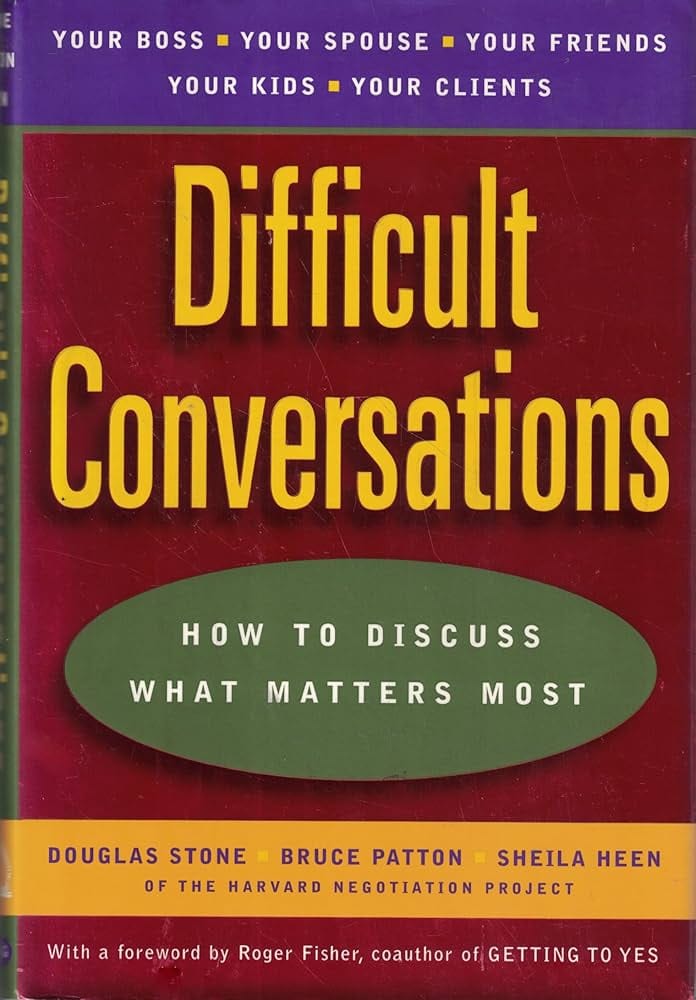
The 10th-anniversary edition of the New York Times business bestseller-now updated with “Answers to Ten Questions People Ask” We attempt or avoid difficult conversations every day-whether dealing with an underperforming employee, disagreeing with a spouse, or negotiating with a client. From the Harvard Negotiation Project, the organization that brought you Getting to Yes, Difficult Conversations provides a step-by-step approach to having those tough conversations with less stress and more success. you’ll learn how to: · Decipher the underlying structure of every difficult conversation · Start a conversation without defensiveness · Listen for the meaning of what is not said · Stay balanced in the face of attacks and accusations · Move from emotion to productive problem solving
My Summary
Main Ideas, Takeaways & Similarities
Questions
I. What is the problem?
A. How is this problem formulated?
B. Why is this problem important?
C. What is the history of this problem?
D. Which prominent personalities have been interested in this problem?
II. What solutions to the problem are there?
A. What are the conclusions reached?
B. By what argument(s) is the conclusion reached?
C. What facts or assumptions serve as premises?
D. When a prominent personality offers a solution, does he also argue for or against other prominent personalities? Does he raise objections to alternative solutions? Does he consider objections to his own solutions?
III. Evaluation
A. What are the advantages and disadvantages of the alternative formulations to the problem?
B. Has the importance or history of the problem ever been misrepresented?
C. Are the solutions logically related to the premises?
D. Are the facts true? Are the assumptions acceptable? Are the objections answerable?
AI Summary
“Difficult Conversations: How to Discuss What Matters Most” is a book by Douglas Stone, Bruce Patton, and Sheila Heen. It provides practical guidance on handling challenging conversations effectively. Here’s a summary in bullet points:
- Authors: Douglas Stone, Bruce Patton, and Sheila Heen
- Overview:
- The book focuses on helping individuals engage in and navigate difficult conversations in various aspects of life, including personal relationships, work, and more.
- It provides a framework for understanding and managing emotions and communication during tough discussions.
- Key Concepts:
- The Three Conversations Framework: The authors introduce the concept of three conversations happening simultaneously during any difficult conversation:
- What Happened Conversation: This is about the facts and what each person perceives as the truth.
- Feelings Conversation: This addresses the emotional impact of the situation on both parties.
- Identity Conversation: This concerns the implications of the conversation on one’s self-worth and identity.
- Communication Styles: The book explores different communication styles, including silence, violence, and negotiation, and how they can hinder or facilitate effective communication.
- Listening Skills: It emphasizes the importance of active listening, understanding the other person’s perspective, and avoiding assumptions.
- Emotions: The book delves into how emotions can affect conversations and provides strategies for managing and expressing emotions constructively.
- Difficult Conversations Profile: The authors offer a self-assessment tool to help individuals understand their communication tendencies and areas for improvement.
- Shift from Blame to Contribution: The book encourages a shift from a blame-oriented approach to a focus on each person’s contribution to the situation and the resolution.
- The Three Conversations Framework: The authors introduce the concept of three conversations happening simultaneously during any difficult conversation:
- Practical Advice:
- The book offers practical techniques and guidelines for preparing for difficult conversations, including setting the right environment, choosing the appropriate time, and framing the conversation effectively.
- Examples and Stories: It includes real-life examples and stories to illustrate the concepts and principles discussed.
- Application: “Difficult Conversations” provides readers with actionable strategies and skills that can be applied to improve their ability to handle challenging discussions successfully.
- Audience:
- The book is suitable for anyone seeking to enhance their communication skills and manage tough conversations in personal and professional settings.
- Impact:
- “Difficult Conversations” has been widely used in various fields, including leadership, conflict resolution, and interpersonal relationships, to improve communication and resolve challenging issues.
- Legacy:
- The book remains a valuable resource for individuals seeking guidance on navigating complex and emotionally charged conversations, making it an enduring reference in the field of communication and conflict resolution.