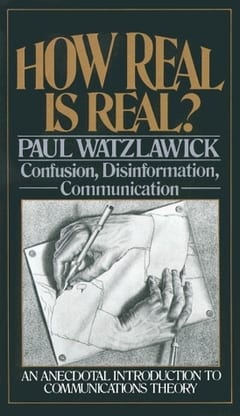

DESCRIPTION
The connection between communication and reality is a relatively new idea. It is only in recent decades that the confusions, disorientations and very different world views that arise as a result of communication have become an independent field of research. One of the experts who has been working in this field is Dr. Paul Watzlawick, and he here presents, in a series of arresting and sometimes very funny examples, some of the findings.
My Summary
Main Ideas, Takeaways & Similarities
Questions
I. What is the problem?
A. How is this problem formulated?
B. Why is this problem important?
C. What is the history of this problem?
D. Which prominent personalities have been interested in this problem?
II. What solutions to the problem are there?
A. What are the conclusions reached?
B. By what argument(s) is the conclusion reached?
C. What facts or assumptions serve as premises?
D. When a prominent personality offers a solution, does he also argue for or against other prominent personalities? Does he raise objections to alternative solutions? Does he consider objections to his own solutions?
III. Evaluation
A. What are the advantages and disadvantages of the alternative formulations to the problem?
B. Has the importance or history of the problem ever been misrepresented?
C. Are the solutions logically related to the premises?
D. Are the facts true? Are the assumptions acceptable? Are the objections answerable?
AI Summary
Highlights
“How Real Is Real?” is a book written by Paul Watzlawick, published in 1976. The book explores the nature of reality and communication, emphasizing the role of perception and language in shaping our understanding of the world. Here is a comprehensive summary of the book in bullet points:
- The book delves into the fundamental question of how humans perceive and construct reality through their interactions with the world.
- Paul Watzlawick argues that reality is not an absolute and objective entity but is, instead, a product of human perception and communication.
- He introduces the concept of “first-order” and “second-order” realities, where the former refers to direct sensory experiences and the latter involves the interpretation and meaning attributed to those experiences.
- Watzlawick discusses the idea that language and communication are essential tools for conveying meaning and constructing reality.
- He explores the limitations of language and the potential for miscommunication, including how words and symbols may fail to capture the complexity of human experience.
- The book examines the role of context and cultural factors in influencing our perception of reality, highlighting the relativity of truth and meaning.
- Watzlawick discusses the concept of “symmetry” and “complementarity” in interpersonal communication, emphasizing the dynamics of power and control in relationships.
- He explores the role of paradox and contradiction in communication, illustrating how paradoxical statements can disrupt rigid thought patterns and encourage new perspectives.
- The book addresses the therapeutic implications of understanding the constructed nature of reality, particularly in the context of psychotherapy and counseling.
- Watzlawick emphasizes the importance of awareness and mindfulness in challenging entrenched beliefs and fostering personal growth.
- He discusses the application of these ideas to various fields, including psychology, philosophy, and communication theory.
- The book provides practical examples and case studies to illustrate the concepts discussed and their relevance in everyday life.
- Watzlawick encourages readers to question their assumptions about reality and communication, highlighting the potential for greater self-awareness and improved interpersonal relationships.
- “How Real Is Real?” challenges conventional notions of reality and communication, offering a thought-provoking exploration of the ways in which language and perception shape our understanding of the world.
In summary, “How Real Is Real?” by Paul Watzlawick explores the intricacies of human perception, communication, and the construction of reality. The book encourages readers to critically examine their assumptions about truth and meaning, highlighting the dynamic and subjective nature of our understanding of the world.