DESCRIPTION
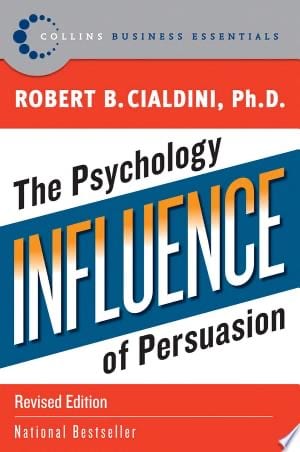
The foundational and wildly popular go-to resource for influence and persuasion—a renowned international bestseller, with over 5 million copies sold—now revised adding: new research, new insights, new examples, and online applications. In the new edition of this highly acclaimed bestseller, Robert Cialdini—New York Times bestselling author of Pre-Suasion and the seminal expert in the fields of influence and persuasion—explains the psychology of why people say yes and how to apply these insights ethically in business and everyday settings. Using memorable stories and relatable examples, Cialdini makes this crucially important subject surprisingly easy. With Cialdini as a guide, you don’t have to be a scientist to learn how to use this science. You’ll learn Cialdini’s Universal Principles of Influence, including new research and new uses so you can become an even more skilled persuader—and just as importantly, you’ll learn how to defend yourself against unethical influence attempts. You may think you know these principles, but without understanding their intricacies, you may be ceding their power to someone else. Cialdini’s Principles of Persuasion: Reciprocation Commitment and Consistency Social Proof Liking Authority Scarcity Unity, the newest principle for this edition Understanding and applying the principles ethically is cost-free and deceptively easy. Backed by Dr. Cialdini’s 35 years of evidence-based, peer-reviewed scientific research—including a three-year field study on what leads people to change—Influence is a comprehensive guide to using these principles to move others in your direction.
My Summary
Main Ideas, Takeaways & Similarities
Questions
I. What is the problem?
A. How is this problem formulated?
B. Why is this problem important?
C. What is the history of this problem?
D. Which prominent personalities have been interested in this problem?
II. What solutions to the problem are there?
A. What are the conclusions reached?
B. By what argument(s) is the conclusion reached?
C. What facts or assumptions serve as premises?
D. When a prominent personality offers a solution, does he also argue for or against other prominent personalities? Does he raise objections to alternative solutions? Does he consider objections to his own solutions?
III. Evaluation
A. What are the advantages and disadvantages of the alternative formulations to the problem?
B. Has the importance or history of the problem ever been misrepresented?
C. Are the solutions logically related to the premises?
D. Are the facts true? Are the assumptions acceptable? Are the objections answerable?
AI Summary
Highlights
“Influence: The Psychology of Persuasion” by Robert B. Cialdini explores the psychology behind why people say “yes” and how to apply these understandings. Key points include:
- Reciprocity: The obligation to give when you receive. People tend to return a favor.
- Commitment and Consistency: Once people commit to what they think, believe, or say, they are more likely to honor that commitment.
- Social Proof: People will do things they see other people doing, especially in situations of uncertainty.
- Authority: People follow the lead of credible, knowledgeable experts.
- Liking: People are easily persuaded by others they like.
- Scarcity: Perceived scarcity generates demand; people are more attracted to limited availability.
Here is a comprehensive summary of each chapter from Influence: The Psychology of Persuasion by Robert B. Cialdini. The summary condenses the key points and main ideas while maintaining clarity and relevance:
Chapter 1: Weapons of Influence
This chapter introduces the concept of automatic and fixed-action patterns—mental shortcuts that guide behavior. Cialdini highlights how compliance professionals exploit these psychological tendencies. Using examples from animal behavior (e.g., turkey mothering instincts) and human behavior (e.g., “expensive = good” heuristic), the chapter lays the groundwork for how people can be manipulated without deep thinking. The key idea is that certain triggers (like a “click, whirr” mechanism) can prompt predictable responses, often bypassing rational scrutiny.
Chapter 2: Reciprocation
People feel obligated to return favors or concessions—a deeply ingrained rule across cultures. Cialdini explains how this is used in marketing (free samples), negotiations (the rejection-then-retreat technique), and social situations. One powerful tactic described is giving a small gift or favor to induce compliance with a larger request. The chapter shows that reciprocity can trigger guilt or indebtedness, leading people to say yes even when they don’t want to.
Chapter 3: Commitment and Consistency
Once people commit to something—especially publicly or in writing—they feel compelled to act consistently with that commitment. This principle is rooted in a desire to appear rational and reliable. Techniques such as the “foot-in-the-door” method (asking for a small commitment before a bigger one) rely on this tendency. Cialdini also explores how personal identity can be shaped by commitments, leading to long-term behavioral shifts. Inconsistency is seen as a character flaw, so people strive to maintain alignment with past actions.
Chapter 4: Social Proof
Humans look to others to decide what is correct behavior, especially in uncertain situations. This chapter explores how people assume that if others are doing something, it must be right—creating powerful peer pressure. It’s why canned laughter works and why testimonials increase sales. Cialdini also describes the “pluralistic ignorance” phenomenon, where people assume others’ inaction means nothing is wrong (e.g., in emergencies). The principle is strongest under conditions of uncertainty and similarity.
Chapter 5: Liking
People are more likely to comply with requests from people they like. Factors that enhance liking include physical attractiveness, similarity, compliments, familiarity, and association with positive things. Cialdini shows how marketers and salespeople manufacture liking—through shared interests, flattery, or even simple exposure. The principle also explains why celebrity endorsements are effective, even when irrelevant to the product.
Chapter 6: Authority
This chapter examines how people are inclined to obey authority figures—even when asked to perform questionable actions. Cialdini references the famous Milgram experiments, where participants administered what they believed were harmful electric shocks simply because an authoritative figure told them to. Indicators of authority, such as titles, uniforms, and even the trappings of wealth (e.g., expensive cars), can trigger compliance. The key idea is that people are conditioned to believe that obeying authority is both safe and correct, often at the expense of their own judgment.
Chapter 7: Scarcity
Scarcity increases perceived value. When something is less available, it appears more desirable—a principle marketers often exploit with “limited-time offers” or “only a few left in stock” notices. Cialdini explains that scarcity works on two levels: it evokes a fear of loss (which is more powerful than the desire for gain) and it arouses competition. He also distinguishes between two forms: item scarcity (a product is rare) and information scarcity (restricted access to information, which makes it seem more valuable or credible).
Epilogue: Instant Influence
The epilogue synthesizes the book’s themes, emphasizing the idea that these six principles (Reciprocation, Commitment/Consistency, Social Proof, Liking, Authority, Scarcity) operate automatically—often without conscious awareness. Cialdini warns of the ethical concerns when these tools are misused. He encourages readers to be both educated consumers and ethical influencers, suggesting that resistance begins with awareness. Knowing how influence works enables individuals to recognize manipulation and assert their own autonomy in decision-making.