Powerful Phrases for Dealing with Difficul - Renee Evenson (Annotated).pdf (file not included in this release)
DESCRIPTION
How to Manage Work Relationships in a Constructive Way that Leads to Success. Learning how to maintain strong, harmonious work relationships is essential. Unfortunately, at some point in your career, you’ll have to work with people whose personalities or habits make every interaction with them a trial. Communications expert Renee Evenson has written the definitive phrasebook on how to confront the situations that can arise when dealing with difficult personalities and bring about a positive outcome. Powerful Phrases for Dealing with Difficult People is packed with practical and easy-to-use tactics such as: 325 powerful phrases to communicate effectively, as well as powerful actions to take in support of those phrases. 30 common personality traits, behaviors, and workplace scenarios along with the phrases that work best with each. Nonverbal communication actions to back up your words. Sample dialogues that demonstrate how phrasing improves interactions. A five-step process for moving from conflict to resolution. “Why This Works” sections that provide detailed explanations. Often, an employee who can interact well with others and feels comfortable handling conflict will be promoted over an employee who possesses greater job or technical knowledge. From egotistical bosses to meeting monopolizers, you’ll learn how to develop the skills to handle any type of conflict with anyone.
My Summary
PART1 Powerful Phrases + Actions = Successful Work Relationships (Page 12)
1 Communicating Powerful Phrases (Page 13)
The bottom line is that no matter how well you get along with people, you aren’t going to get along with everyone all the time. Whenever people spend a lot of time together, conflicts are going to arise. But, in work situations, the conflicts can be particularly tough to handle. It’s hard to maintain your composure and self-control when a coworker’s done something that’s irritated you, but that’s just what you need to do. (Page 13)
Employees who are able to stay calm and approach conflict in a selfcontrolled, thoughtful manner are viewed more positively by coworkers and bosses. When you take the time to think before speaking, plan the best approach to handle the problem, and communicate in a constructive manner, your coworkers and bosses are more likely to listen and respond considerately to you. (Page 13)
When confronting someone, refrain from using the words always or never. When you say to someone: “You always…” or “You never…,” the other person is going to focus more on that one word than on the point you’re trying to make and is likely to become instantly defensive, as Emma did. Rarely is anything always or never. (Page 15)
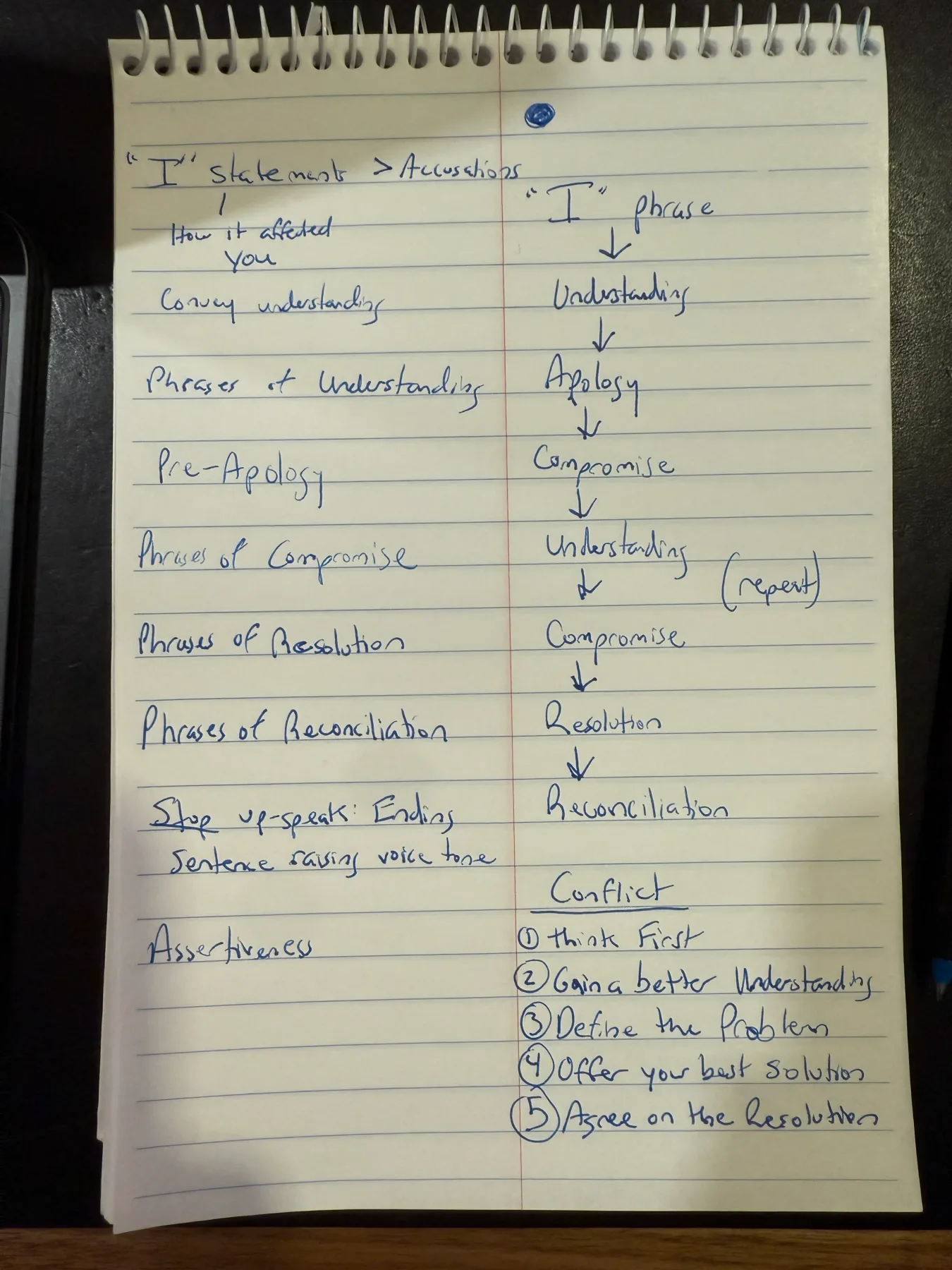
Begin with “I” Phrases (Page 16)
The you word is going to immediately put the other person on the defensive. (Page 16)
Think about how the person’s behavior made you feel. Open the conversation with an “I” statement describing how the event affected you, and you’ll come across in a more constructive manner. After all: “I’m” the one with the problem. “You” may not even know that what you’re doing that bugs me. (Page 16)
Sample “I” Phrases (Page 16)
You don’t want your opening statement to sound like an attack the other person’s character, so always begin with an “I” phrase: “I was hurt when you said I make too many mistakes.” “I became upset when you took credit for my work.” “I felt betrayed when I heard that you talked behind my back.” “I became confused and lost focus when you interrupted me during my sales presentation.” “I was surprised when you jumped in before I had time to finish.” “I get frustrated every time you talk so loudly that I can’t hear my customers.” (Page 16)
If you don’t know how to launch into your conversation, try prefacing your “I” phrase by saying something like: “I have something I need to talk to you about” or “I have something I need to get off my chest” or “Something happened that’s been bothering me.” (Page 17)
Phrases of Understanding (Page 18)
Opening your conversation with “I” phrases keeps the focus on how the other person’s actions made you feel. After listening to that person’s response, it’s important to let the person know you understand that he or she may view the situation differently. By doing this, you demonstrate that you’re willing to listen to the other perspective before drawing your conclusion or assigning blame. (Page 18)
Conveying understanding is also a great way to build a rapport. (Page 18)
offering a phrase of understanding allows you to step into the other person’s shoes for a moment. (Page 18)
Sample Phrases of Understanding (Page 18)
“I realize that you didn’t do it on purpose.” “I understand that you didn’t mean it to sound that way.” (Page 18)
“I’m sure you were just excited when you started talking.” “I’m certain you didn’t mean to take credit for my idea.” “I know you well enough to know that you wouldn’t knowingly do that to me.” (Page 19)
You can also use a phrase of understanding when you have an aha moment. Incorporating a phrase of understanding at that point will productively move the conversation along. “Now I see where you’re coming from.” “I understand the situation from your viewpoint now.” “I can see why you didn’t think that would bother me.” “I’m glad you gave me the additional information. I realize why you did that.” (Page 19)
Phrases of Apology (Page 19)
Sample Phrases of Apology Offer a phrase of apology whenever you feel it will encourage empathy between the other person and you. “I’m sorry if I seem overly sensitive.” “I’m sorry if I misunderstood your intent.” “I’m sorry that we need to have this conversation.” “I apologize if I misunderstood what happened.” “I regret that I have to bring this up.” “Please forgive me for feeling this way.” (Page 20)
Phrases of Compromise (Page 20)
Sample Phrases of Compromise When you open your conversation with an “I” phrase and offer a phrase of understanding and your colleague doesn’t take responsibility, you’ll want to add a phrase of compromise to continue the dialogue. “Let’s talk about this. I need to know why it happened and how we can keep it from happening again.” “Can we talk about what happened?” “I feel that we need to talk this out so it doesn’t happen again.” “Let’s go somewhere in private and try to resolve this.” “Let’s talk this over and find a suitable compromise.” “I’d like to hear how you saw the situation so that I better understand.” (Page 21)
incorporate additional phrases of compromise. “Here’s how you see the issue: ____. And here’s how I see it: ____. Let’s see where we can come together on this.” “Since we don’t agree why this happened, let’s lay out the facts and come up with a solution we both can live with.” “Why don’t we each state our viewpoints? Then we’ll see if we can find common ground.” “We need to resolve this somehow. The only way to do that is for each of us to be flexible and try to come together.” (Page 21)
Something to Think About Timing is important when you’re trying to resolve conflict of any kind, so before beginning your discussion, make sure it’s a good time. When Kate asked Emma if she had a few minutes to talk, she (Page 22)
made sure that Emma was open to having the conversation at that time. If now isn’t a good time for the other person, ask when it will be and then schedule a time that’s agreeable to both of you. (Page 23)
Phrases of Resolution (Page 23)
When each of the involved parties is able to voice their opinion, listen to each other’s perspective, compromise, and agree on a solution, everyone feels good about the outcome. (Page 23)
Sample Phrases of Resolution After finding a solution that’s agreeable to all parties, add a phrase of resolution to show your appreciation that you were able to reach an (Page 23)
agreement. “I’m happy…we could resolve this.” “I’m glad…we talked this out. We have a better understanding of what happened.” “I’m pleased…we were able to clear up the misunderstanding.” “I’m thrilled…we were able to come to an agreement.” If you’re not sure the solution is agreeable to everyone, voice your phrase of resolution as a question. “Are you satisfied with the solution?” “Is there anything else we need to talk about?” “Do you feel we have a better understanding of what caused the problem?” “How do you feel about the solution?” “I’m happy with our compromise. How do you feel about it?” (Page 24)
Something to Think About It’s a good idea to restate the resolution just in case you misinterpreted what you and your coworker agreed to. (Page 24)
Phrases of Reconciliation (Page 25)
Before ending the discussion, take one more step and say something about the value of your working relationship. Letting the other person know that he or she is important to you ends your conversation on a positive note and will strengthen your working relationship. (Page 25)
Sample Phrases of Reconciliation Always end your conflict resolution discussions with a positive comment about your relationship. “I value our working relationship…. Going forward I feel we’ll be able to work through any problem.” “I’m glad we talked this out…. Now I’m confident we can work through any problem.” “I respect you…and know that we’ll work even more closely now.” “I’m glad we talked this out…. In the future, we’re not going to let any disagreement get in the way of our friendship.” “I have a better understanding of you…, and I hope you do of me as well.” “We’ve always worked closely and going forward…. I know that we won’t let a little problem stand between us.” (Page 25)
2 Actions That Enhance Powerful Phrases (Page 29)
Sample Body Language If you want to be viewed as confident, competent, capable, composed, and comfortable in your surroundings, form the following habits: Stand or sit up straight. Hold your head high. Maintain good posture. Relax your shoulders. Keep a relaxed stance by standing with equal weight on both feet. Allow your hands to fall naturally at your sides or fold them in front of you in a relaxed position. Keep your hands out of your pockets. Try not to fidget. Use controlled gestures to enhance your message, allowing them to flow naturally. Stand about two to four feet from the other person. (Page 33)
Reading Other People’s Body Language Watch for these actions in other people: Stooped shoulders, which may signal a lack of confidence. Fidgeting with hands, which may signal nervousness or agitation. Hands on hips, which may be a sign of impatience or aggression. (Page 33)
Arms crossed in front of the body, which could mean the person is defensive or frustrated. Wild gesturing, which may be a sign of anger, excitement, or agitation. Backing up, which probably means that you’re invading their personal space. (Page 34)
Something to Think About Touch is another component of body language. Putting your arm around someone, touching someone’s arm, or patting someone on the back may enhance the message you’re sending, but it can also detract from it. Make sure you know the other person well enough to know that touch is welcomed; otherwise, keep your hands to yourself. (Page 34)
Sample Facial Expressions To enhance the body language actions you learned, complete the image you want to project by becoming comfortable doing the following: Calm down and maintain a concerned and sincere expression rather than an angry scowl if you’re feeling angry or upset. (Page 35)
Hold your head up straight rather than lowering it to the floor or tilting it to one side. Smile when appropriate. Turn the ends of your mouth upward slightly to convey friendliness when you want to keep a neutral expression. Maintain eye contact, but not to the degree that you appear to be staring. Shift your gaze away occasionally. Use your eyebrows once in a while to enhance your message. Raise them to show interest or excitement. Furrow them to convey concern or confusion. Nod from time to time to show that you’re actively listening. (Page 36)
Something to Think About Some people have formed the habit of using up-speak—ending every sentence by raising voice pitch—in their voice tone, as if they’re asking a question. If you do this, break the habit. It really serves no purpose. (Page 37)
Sample Tone of Voice To communicate effectively, it’s important to match your voice tone to your emotions, but it’s also important to control your voice tone when resolving conflict. For example: (Page 37)
When beginning your conversation, speak in a tone that sounds professional and nonthreatening. Throughout your conversation, use your tone to enhance your message by showing concern and empathy. If you notice that your tone is reflecting that you’re feeling upset or confused about a situation, try to also show that you’re interested in working together toward a positive solution. (Page 38)
Reading Other People’s Tone of Voice Listen to how the other person is speaking to you to pick up clues to their emotions. If the person sounds angry, speak softly and calmly. If the person sounds confused, provide more details to explain your position. If the person sounds guilty or embarrassed, smile sympathetically and say something to ease his or her discomfort. If the person sounds dismissive, speak in a concerned tone and state why you feel the way you do. If the person is speaking quickly or loudly, control your voice by speaking slowly and softly, as that may help the other person calm down. (Page 38)
Assertiveness (Page 39)
Sample Assertiveness Assertiveness is reflected outward through the following actions: Speaking with confidence. Expressing your views clearly. (Page 39)
Speaking objectively. Staying calm. Controlling your emotions when stating your position. Apologizing no more than necessary. Refusing to back down or allow someone to verbally bully you. Showing respect and consideration toward the other person. (Page 40)
PART2 Conflict Effective Strengthened Work Relationships Resolution (Page 44)
3 Five Steps Resolution toEffectiveConflict (Page 45)
However, conflict is not all bad. Without it, people can become bored, complacent, or stagnant. When every conflict is viewed as an opportunity, you’ll look for resolutions that allow for growth and development. Effective conflict resolution gets people back on track, opens the door to creative (Page 45)
thought processes, and paves the way to open, honest, and effective communication. (Page 46)
When you’re vigilant and on the lookout for problems, you can work to resolve issues when they’re still manageable. Become an active observer and communicator. Stay involved and look for things that seem askew. Be aware of coworkers who suddenly become negative, quiet, agitated, or upset, as these are often signs of conflict. Watch for signs that you and your boss aren’t communicating effectively. Even if you’re unaware of a problem, but notice that a coworker or your boss is acting in a way that indicates a conflict, ask what’s going on, because something likely is. (Page 46)
Step 1: Think First (Page 48)
Key Points Practice the following to help you think first: (Page 48)
Never act or speak before you think. Take time to calm down and control your emotions. Look at the situation from all perspectives. Stay objective when thinking about the conflict. Focus on the problem, not the person. Think through your conversation, along with likely responses. Refrain from taking sides in other people’s problems. Try to help the other person objectify the situation, rather than make judgments. (Page 49)
Step 2: Gain a Better Understanding (Page 50)
Key Points Practice the following when gaining a better understanding: Never draw conclusions before first speaking to the other person. Question the other person in an objective and respectful manner. Carefully listen to the response so that you gain an understanding of how the other person views the issue. If more than two people are involved, get everyone together and allow each person to tell his or her version of the situation. Encourage everyone to use “I phrases” when explaining. If someone becomes emotional, pay attention to the nonverbal clues behind the message. Listen carefully, and avoid interrupting. When it’s your turn to respond, control your emotions. If someone becomes upset or starts losing control of his or her emotions, acknowledge and offer an assurance. Defer your discussion until the person has had time to calm down. (Page 51)
Step 3: Define the Problem (Page 52)
Key Points (Page 52)
Practice the following when defining the problem: When you feel you have enough information, restate the problem from your viewpoint. Then ask others how they view the problem. Say something like: “I see it this way…. How do you see it?” Before you move on to find a workable solution, everyone must agree on how the problem is defined. (Page 53)
Step 4: Offer Your Best Solution (Page 53)
When you offer your solution, encourage discussion and keep the focus on the purpose of your meeting: to find the best solution that everyone can buy into. This isn’t the place to decide who’s right and who’s wrong. It may help to state this: “Let’s be respectful of everyone’s viewpoints. It’s important that we remain flexible, cooperate, and be able to compromise.” If you feel the discussion starts heading toward a blame game, politely interrupt and assertively say that it isn’t the purpose to assign blame, but rather to find a solution everyone can agree to. After everyone’s contributed, objectively analyze the consequences of each proposal. That will keep everyone focused on the issue at hand and keep the discussion solution oriented. (Page 54)
Key Points Practice the following when offering your best solution: After offering your best solution, ask if the other party or parties agree. If everyone agrees, then you’re ready to move to the final step. If they don’t agree, ask for other ideas. Allow everyone to propose a solution. Analyze the consequences of each proposal. Be respectful of everyone’s opinion. Keep the focus on finding the best solution. Emphasize that this is not a blame game. Try to find common ground by looking for the things on which you can agree. Be prepared for give and take. Be the one to offer a compromise. If your role is to facilitate conflict resolution that doesn’t directly involve you, maintain your objectivity. If the discussion stalls, postpone the meeting to give everyone a chance to calm down and look at the situation more objectively. In the event that you’re not able to reach a compromise, involve someone with greater authority to mediate the meeting. (Page 55)
Step 5: Agree on the Resolution (Page 56)
Key Points Practice the following when agreeing on the resolution: Reach agreement through consensus, by taking a vote, or by one person making the call. Attempt to reach agreement through consensus, whereby everyone agrees on the final outcome. If you resort to deciding by majority rule, explain why the majority feels this is the best decision. If you have to make the final call, explain that you listened carefully to everyone’s suggestions and made the best decision based on the information you had. Explain why you chose that decision. Once you’ve arrived at an agreement, restate the resolution and give everyone the chance for additional input to ensure that they buy into the final decision. (Page 58)
4 Powerful Phrases Coworker Situations forChallenging (Page 62)
Basic Rules When Confronting a Coworker (Page 62)
Always remain calm, no matter how the other person speaks to you. Always treat others with respect. Don’t overreact. Take a wait-and-see approach whenever possible. Get a neutral person’s perspective on the situation if you feel it’ll help. Always speak in specifics and be prepared to share examples. Don’t try to change people; focus only on changing the behavior. Avoid complaining about people to others. Not every situation needs to be addressed, even if you feel confident that you know how to effectively resolve conflict. Ignoring a situation may sometimes be your best option, particularly if it’s the result of an annoying habit you can learn to ignore. Always give the person the chance to make things right; never go over someone’s head without speaking to the involved person directly. If the situation can’t be resolved after your resolution conversation, then and only then refer the matter to your boss. If the conversation heats up or you feel threatened, end the discussion and get someone else to mediate. (Page 63)
5 Powerful Phrases Situations with Your Boss forChallenging (Page 137)
Basic Rules When Confronting Your Boss (Page 138)
confidence throughout assertiveness Only approach your boss when you feel certain that you’ll be able to maintain your the and conversation. When speaking to your boss, use positive and constructive language. Always remain calm, no matter how your boss speaks to you. Always treat your boss with respect. No matter what happens during the conversation, never insult your boss or other members of upper management. Clearly state the facts when telling your boss what’s bothering you and how it made you feel. Be prepared to share examples. Offer your compromise and focus on how you can work together to solve the problem. If you feel it’s impossible to have a productive conversation with your boss, speak to someone else who can provide guidance about how to deal with the problem. Don’t ever burn your bridges; you never know when you’ll have to cross one again. (Page 138)
6 Powerful Phrases for Situations You Cause (Page 181)