⚠ Switch to EXCALIDRAW VIEW in the MORE OPTIONS menu of this document. ⚠
Excalidraw Data
Text Elements
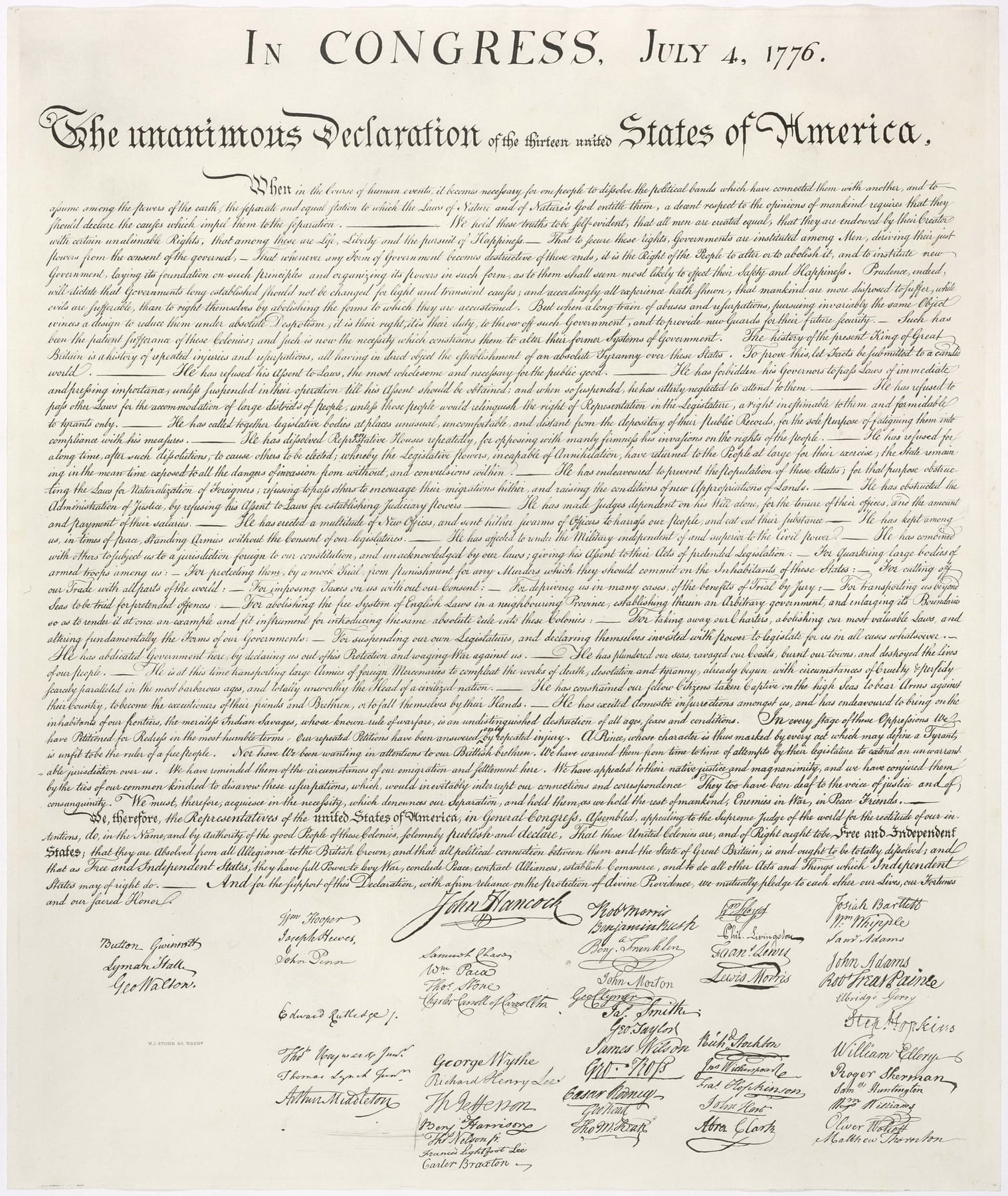
Thomas Jefferson attempted to enshrine the brilliance
of his philosophical forebears in our founding document; in 1825,
he explained, “it was intended to be an expression of the American mind…
All its authority rests then on the harmonizing sentiments of the day,
whether expressed in conversation, in letters, printed essays, or in the
elementary books of public right, as Aristotle, Cicero, Locke, Sidney, etc.”
Thomas Jefferson, “To Henry Lee,” May 8, 1825, in The Works of
Thomas Jefferson, ed. Paul Leicester Ford, vol. 10, Federal Edition
(New York: G. P. Putnam’s Sons,
1904–1905), 342–43.
The Declaration begins with a ringing statement of authority: that of
“the Laws of Nature and of Nature’s God.” This isn’t the passivity of
Hobbes or Augustine or Luther with regard to the value of the current regime.
This is the unification of ancient natural law with the force of Biblical drive.
It is an active statement that men can take power into their own hands so long
as that power is utilized in pursuit of the natural law, and in accordance
with the human right to liberty.
Jefferson quickly makes that clear. “We hold these truths to be self-evident,”
he writes. But clearly such truths are not self-evident—they have not been
self-evident for most of human history. Jefferson here references the “right reason”
of the ancients: those who think properly, who look to the meanings behind nature,
can discover fundamental truths that should undergird human life and human action.
What, precisely, are those truths?
First, that “all men are created equal.” Obviously, Jefferson did not mean that
all human beings are created with equal capacity. He would have disagreed radically
with that notion, since he wasn’t a fool. Jefferson originally worked from a draft
of George Mason’s Virginia Declaration of Rights, which was far more specific:
“all men are born equally free and independent.” 30 Jefferson merely compressed
these ideas into the pithier “all men are created equal.”
The notion of all men having equal freedom and independence sprang originally
from the Biblical notion of man being made in God’s image, admixed with the
Greek tradition of individual reason, and passed down generation after generation,
transmuted over time into the understanding that not only are human beings made
in God’s image with will and reason, but with the liberty to exercise that will and
reason in accordance with the pursuit of virtue.
Jefferson continues by stating that men are “endowed by their Creator with certain
unalienable Rights, that among these are Life, Liberty and the pursuit of Happiness.”
In Locke, that phrase had been “life, liberty, and property.” Why didn’t Jefferson simply
use the word property rather than pursuit of happiness? He certainly didn’t ignore the
right to property because he rejected it—Jefferson routinely talked of the right to the
fruits of your labors.
Jefferson used the right to happiness because in Jefferson’s view, property and its ownership
was not a full enough description of our rights. Jefferson, like Locke, believed that the pursuit
of happiness encompassed ownership of our own labor, our own minds. Locke himself wrote at length
about the pursuit of happiness—and he did not mean the modern misreading of his phrase, which
suggests that we all define happiness in our own way. In his “Essay Concerning Human Understanding,”
Locke wrote, “the care of ourselves, that we mistake not imaginary for real happiness, is the
necessary foundation of our liberty.” This is Locke touting virtue, suggesting that we forgo our
own subjectivism in pursuit of a higher happiness, discernible through right reason. 32 As Harry Jaffa
of the Claremont Institute wrote, “It is difficult to imagine a more forthright Aristotelianism in Hooker
or Aquinas.”
And the founders, despite common misperception of their religious practice, were well aware of the
necessity for a community of virtue-seeking religious believers in their new republic. 34 The vitality
of religion was a precondition for a healthy society. No wonder the founders placed such heavy
emphasis on freedom of worship.
Rights and duties, according to the founders, were simply two sides of the same coin. While
some critics of the founders have claimed that they ignored duties on behalf of rights, thereby
setting the course for societal disintegration, that’s a misreading of the founding philosophy:
as George Washington stated in his first inaugural address:
The foundation of our national policy will be laid in the pure and immutable principles of private
morality … there exists in the economy and course of nature an indissoluble union between virtue
and happiness.
Embedded Files
b2667ae80e7e39760bdd3ebbb078d095544539b0: United_States_Declaration_of_Independence.jpg