
DESCRIPTION
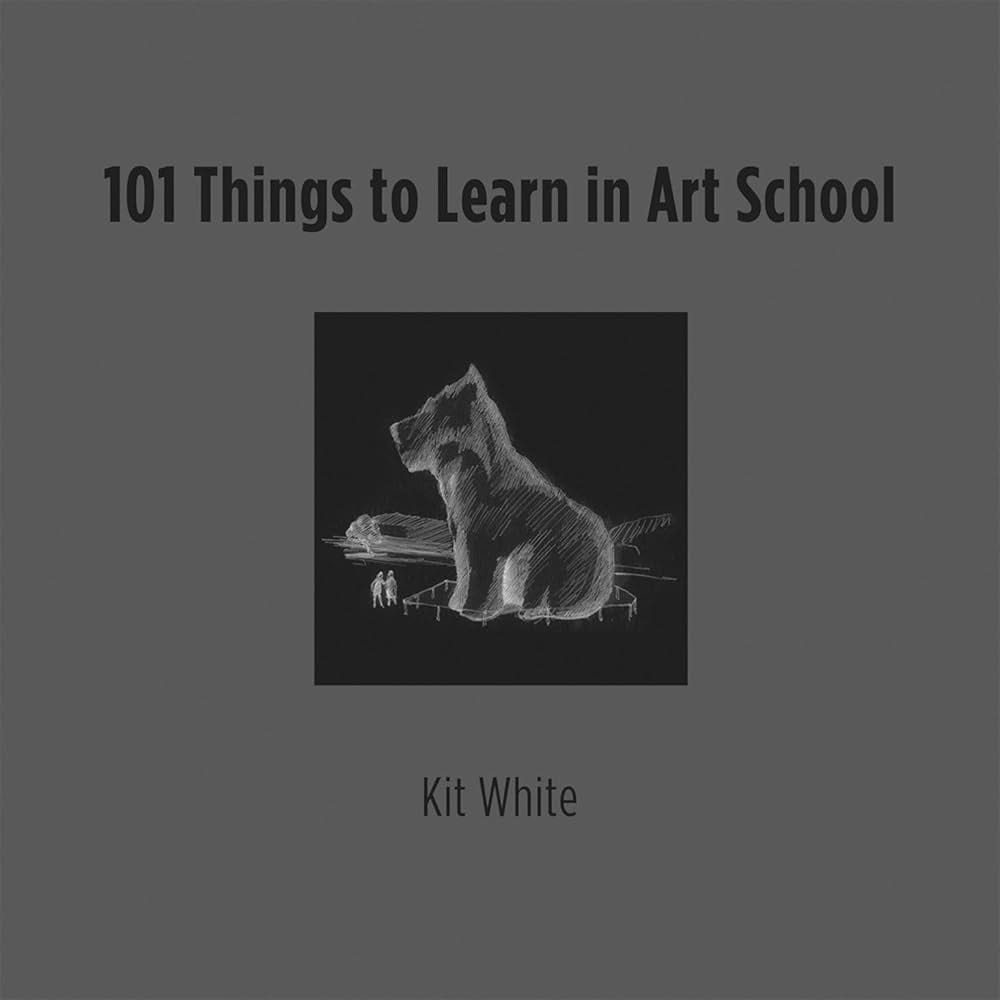
Lessons, demonstrations, definitions, and tips on what to expect in art school, what it means to make art, and how to think like an artist. What is the first thing to learn in art school? “Art can be anything.” The second thing? “Learn to draw.” With 101 Things to Learn in Art School, artist and teacher Kit White delivers and develops such lessons, striking an instructive balance between technical advice and sage concepts. These 101 maxims, meditations, and demonstrations offer both a toolkit of ideas for the art student and a set of guiding principles for the artist. Complementing each of the 101 succinct texts is an equally expressive drawing by the artist, often based on a historical or contemporary work of art, offering a visual correlative to the written thought. “Art can be anything” is illustrated by a drawing of Duchamp’s famous urinal; a description of chiaroscuro art is illuminated by an image “after Caravaggio”; a lesson on time and media is accompanied by a view of a Jenny Holzer projection; advice about surviving a critique gains resonance from Piero della Francesca’s arrow-pierced Saint Sebastian. 101 Things to Learn in Art School offers advice about the issues artists confront across all artistic media, but this is no simple handbook to making art. It is a guide to understanding art as a description of the world we live in, and it is a guide to using art as a medium for thought. And so this book belongs on the reading list of art students, art teachers, and artists, but it also belongs in the library of everyone who cares about art as a way of understanding life.
My Summary
Main Ideas, Takeaways & Similarities
Questions
I. What is the problem?
A. How is this problem formulated?
B. Why is this problem important?
C. What is the history of this problem?
D. Which prominent personalities have been interested in this problem?
II. What solutions to the problem are there?
A. What are the conclusions reached?
B. By what argument(s) is the conclusion reached?
C. What facts or assumptions serve as premises?
D. When a prominent personality offers a solution, does he also argue for or against other prominent personalities? Does he raise objections to alternative solutions? Does he consider objections to his own solutions?
III. Evaluation
A. What are the advantages and disadvantages of the alternative formulations to the problem?
B. Has the importance or history of the problem ever been misrepresented?
C. Are the solutions logically related to the premises?
D. Are the facts true? Are the assumptions acceptable? Are the objections answerable?
AI Summary
Highlights
Knowledge-62 1.jpg (image unavailable)
One can only gauge the need to throw technique away if one has first achieved the mastery of it. (Location 244)
What happens in the studio should be a conversation, not a monologue. (Location 262)
Don’t try to defend a work’s shortcomings with protestations of good or sincere intentions. It isn’t part of the of the larger world’s criteria of judgment. (Location 292)
Complexity derives from the presence of contradiction. (Location 309)
Making art is an act of discovery. (Location 321)
To make an image different enough to bypass the brain’s pattern recognition and force it to reassess the meaning of an image is a challenge for every artist. To make the familiar unfamiliar is a large part of making new visual language. (Location 352)
“The importance of an artist is to be determined by the number of new signs he introduces into the language of art.” —Henri Matisse, (Location 369)
“The whole of life of those societies in which modern conditions of production prevail presents itself as an immense accumulation of spectacles. All that once was directly lived has become mere representation.” —Guy Debord, (Location 471)
A painting should be satisfying at a distance of both twelve inches and twelve feet. (Location 496)
Viewers, and posterity, have the last word on a work’s meaning. (Location 626)
Eliminate the nonessential. (Location 629)
Scale is a critical component of any work. (Location 642)
Cultivate your idiosyncrasies. (Location 653)
Irony has controlled the stage in contemporary art since the end of Modernism. (Location 660)
The lens is a distancing agent. (Location 666)
If you are making collages from borrowed images or appropriating images for your own purposes, be aware that in order to make it yours, you must subvert its original agenda. Otherwise, that initial agenda will remain and override yours. (Location 681)
Admire your forebears, but don’t try to build a career by repeating their discoveries. (Location 690)
Art is the means by which a culture describes itself to itself. (Location 698)