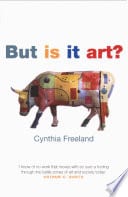
DESCRIPTION
In today’s art world many strange, even shocking, things qualify as art. In this book, Cynthia Freeland explains why innovation and controversy are valued in the arts, weaving together philosophy and art theory with many fascinating examples. She discusses blood, beauty, culture, money, museums, sex, and politics, clarifying contemporary and historical accounts of the nature, function, and interpretation of the arts. Freeland also propels us into the future by surveying state-of-the-art web sites, along with cutting-edge research on the brain’s role in perceiving art. This clear, provocative book engages with the big debates surrounding our responses to art and should prove an invaluable introduction to anyone interested in thinking about art.
Highlights---
Category: articles
URL:
date: 2024-07-09
- Some people advocate a theory of art as ritual: ordinary objects or acts acquire symbolic significance through incorporation into a shared belief’ system. (Location 103)
- Industry has been mechanized and an artist. cannot work mechanically for mass production… Artists find it incumbent … to betake themselves to their work as an isolated means of ‘self-expression.’ In order not to cater to the trend of economic forces, they often feel obliged to exaggerate their separateness to the point of eccentricity. (Location 123)
- writings of Hume and his successor Immanuel Kant (t724-1804) form the basis of modern aesthetic theory, (Location 141)
- Hume emphasized education and experience: men of taste acquire certain abilities that lead to agreement about which authors and artworks are the best. (Location 147)
- And yet there is some sort of basis for claiming that the roses are beautiful. After all, there is quite a lot of human agreement that roses arebeautiful and that cockroaches are ugly. Hume (Location 157)
- Kant’s way of recognizing this was to say that something beautiful has `purposiveness without a purpose’. (Location 165)
- rightness is what Kant means by saying that beautiful objects are purposive. We label an object beautiful because it promotes an internal harmony or ‘free play’ of our mental faculties; we call something ‘beautiful’ when it elicits this pleasure. (Location 169)
- three-pronged analysis: she examines (t) his work’s formal and material properties; (2) its content (the thought or meaning it expresses); and (3) its context, or place in the Western art tradition. (Location 204)
- Ancient discussions of tragedy introduced one of the most persistent of all theories of art, the imitation theory: art is an imitation of nature or of human life and action. (Location 284)
- So Danto concludes that a work of art is an object that embodies a meaning: `Nothing is an artwork without an interpretation that constitutes it as such’. (Location 447)
- Anderson proposes to define art as `culturally significant meaning, skilfully encoded in an affecting, sensuous medium’. (Location 565)
- Renoir allegedly and notoriously said, `I paint with my prick’. (Location 980)
- ‘Until a man has expressed his emotion, he does not yet know what emotion it is. The act of expressing it is therefore an exploration of his own emotions. He is trying to find out what these emotions are.’ (Location 1096)