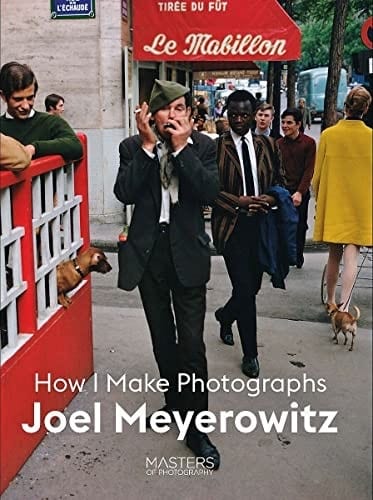
DESCRIPTION
The “Masters of Photography” series is a new approach to photography how-to. Each volume is dedicated to the work of one key photographer who, through a series of bite-sized lessons and ideas, tells you everything you always wanted to know about their approach to taking photographs. From their influences, ideas and experiences, to tech tips and best shots. The series begins with Joel Meyerowitz, who will teach you, among other essentials: How to use a camera to reclaim the streets as your own, why you need to watch the world always with a sense of possibility, how to set your subjects at ease, and the importance of being playful and of finding a lens that suits your personality.
My Summary
Main Ideas, Takeaways & Similarities
Questions
I. What is the problem?
A. How is this problem formulated?
B. Why is this problem important?
C. What is the history of this problem?
D. Which prominent personalities have been interested in this problem?
II. What solutions to the problem are there?
A. What are the conclusions reached?
B. By what argument(s) is the conclusion reached?
C. What facts or assumptions serve as premises?
D. When a prominent personality offers a solution, does he also argue for or against other prominent personalities? Does he raise objections to alternative solutions? Does he consider objections to his own solutions?
III. Evaluation
A. What are the advantages and disadvantages of the alternative formulations to the problem?
B. Has the importance or history of the problem ever been misrepresented?
C. Are the solutions logically related to the premises?
D. Are the facts true? Are the assumptions acceptable? Are the objections answerable?
AI Summary
Highlights
-
Discover your identity as an artist
- Express your vision of the world
- Looking at the world and seeing just the pieces that make you feel connected to it
- instinct strikes — your moments of clarity, observation and recognition.
- It’s about awareness and impulse, and as soon as it arises, react, do it, go for the picture! Don’t think too much. Let the intuitive and physical parts of your being — your brain and body — join in that moment, and you’ll make a photograph of something that is disappearing right in front of you.
- In photography, hesitation is loss, and every picture you lose is like a wound.
-
Be inspired
- Important to have access to the literature of photography — not to copy from these artists but to find inspiration in their work, which will in turn spark creative impulses in you.
- Case of recognizing and tapping into your particular instincts and responses to the incredible generosity of experience that the world offers.
- There will be days where you feel as though you’ve nothing to say, its all boring, there’s no point in going out. You’ll find a lot of excuses — everybody does. When you feel that way, pick up a book and it will charge you with desire again.
- Stand here a while. Pay attention here.
-
Own the street
- You have a right to be in public spaces, so shoot with confidence.
- A simple smile and being good-humored goes a long way.
- Being quick and being happy and excited about what you’re doing sends out an aura of, ‘This person’s OK. I don’t have anything to worry about.’
-
Embrace the everyday
- Photography is all about responding to the things that call your attention, and staying connected to them.
-
Anticipate a moment
- Be present and ready to react.
-
Make connections
- Create relationships with the people and places you encounter
- Creating a meaningful street photograph is about awareness
- One approach is to go over to a stranger and say something like: “There’s something about you that moves me; may I make a portrait of you?”
-
Find the story
- Let your images tell tales
-
Be open to humor
- When you carry a camera with you all the time, it is like an invitation for surprises to happen.
-
Look for the detail and get in close
- Sometimes the smallest gestures or happenings have the greatest impact
- intersections
- beautiful patch of light
- Being attentive to one thing often enables you to see other things, and then include them in your photograph.
- If you look at the whole, you will see details that pull everything together. So when you see a small detail that catches your attention, think about how you might be able to use a series of these small things to build a larger picture.
- Building on the little events and putting things together that don’t belong is how you make interesting photographs and tune up your intelligence and timing on the street.
-
Engage your head as well as your heart
- Don’t just look, reflect on what you’re seeing and keep exploring
-
Body language and communication
- Where to put yourself, and what to do if someone approaches you.
-
Visual play
- Play with what you’re seeing
- The more you open yourself up, the more you see.
-
Be at one with your camera
- Gear isn’t everything, but use a camera and lens that feel right
- Find a lens that suits your personality.
-
The middle isn’t always best
- Shift the focus of your picture away from the center
-
Notes on composition
- If you look at what’s around an object and not just at the object itself, you can find interesting combinations.
- Photographs should invite us in. You want the viewer to look at your photograph and enter into the moment to which you respond so fully, because those are poetic moments — moments when your consciousness is so excited by where you are that you enter the space and record it in its entirety.
-
Push yourself
- Have courage and reach beyond your limits.
-
Photography is about ideas
- What do you want to say? Find your subject
- If you are searching for something new, take a journey into your own interests first. Look at the work you already have and see what it is you’ve hit on again and again and again. Your subject has identified itself already; it’s just that you may not have recognized it yet, and that’s your responsibility.
-
Color or black or white?
- Exposure IMG_2731 1.jpg (image unavailable)
-
Light as subject
- Any time you feel you don’t know what to photograph or have no imagination, I urge you to look around and let light be your subject.
-
Edit your photographs
- Print out the images at playing-card size and compare them.
- A photograph might look really great on your computer, but it must hold up as print.
- Lightroom Process
- Read the overall story first, how it all played out, familiarize yourself
- Wait a day
- Look at images again and anytime you feel the impulse give it a 1 star rating
- View all that are starred, whittle them down; Repeat
- Print them out