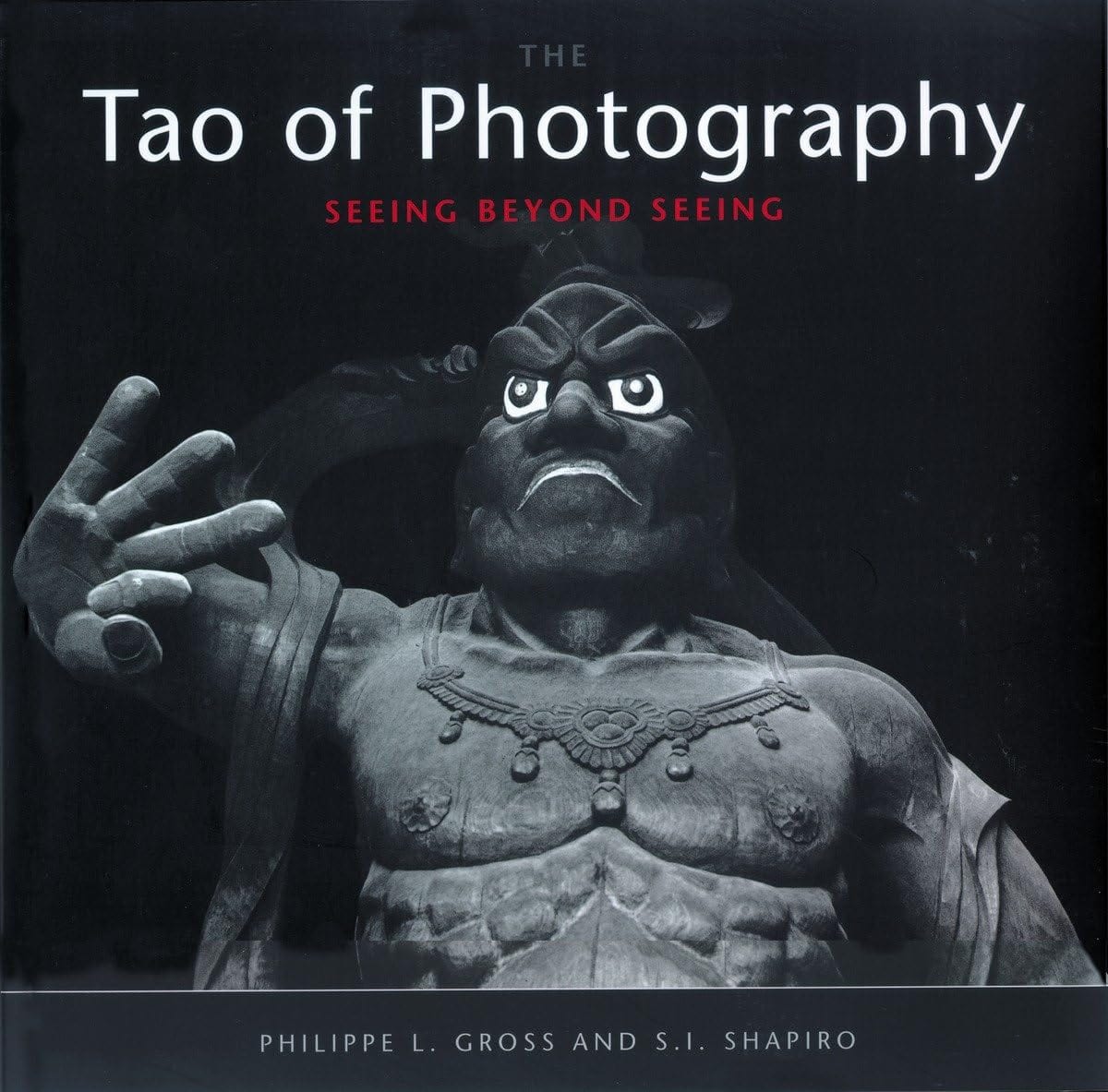

DESCRIPTION
This provocative, visually stunning volume draws upon Taoist teachings to explore the creative and spiritual dimensions of the art of photography. Excerpts from the Taoist classic the Chuang-tzu and the writings of Western aesthetes are complemented by over 60 photographs from the work of such canonical photographers as Henri Cartier-Bresson, Alfred Stieglitz, and Dorothea Lange. Lucid instructional text and enlightening exercises assure that photographers of all levels will be able to incorporate the lessons of the Tao into their own work.
My Summary
Main Ideas, Takeaways & Similarities
Questions
I. What is the problem?
A. How is this problem formulated?
B. Why is this problem important?
C. What is the history of this problem?
D. Which prominent personalities have been interested in this problem?
II. What solutions to the problem are there?
A. What are the conclusions reached?
B. By what argument(s) is the conclusion reached?
C. What facts or assumptions serve as premises?
D. When a prominent personality offers a solution, does he also argue for or against other prominent personalities? Does he raise objections to alternative solutions? Does he consider objections to his own solutions?
III. Evaluation
A. What are the advantages and disadvantages of the alternative formulations to the problem?
B. Has the importance or history of the problem ever been misrepresented?
C. Are the solutions logically related to the premises?
D. Are the facts true? Are the assumptions acceptable? Are the objections answerable?
AI Summary
Highlights
“Great understanding is broad and unhurried; little understanding is cramped and busy.” -Chuang-tzu
Restricting oneself to the photograph that has been pre imagined in ones mind and not allowing oneself to be open to all the other possibilities and the surroundings.
A judgemental mind creates a constricted awareness and therefore unable to see the whole
The ability to use the “little understanding” such as technique, composition, exposure to “big understanding” which is the holistic artistic nature, for these to come together spontaneously and effortlessly.
“Seeing, in the finest and broadest sense, means using your senses, your intellect, and your emotions. It means encountering your subject matter with your whole being. It means looking beyond the labels of things and discovering the remarkable world around you.” -Freeman Patterson
List of traits: Freedom from the sense of self, receptivity, non-forceful action, spontaneity, non attachment, acceptance, resourcefulness, virtue/power, free and easy wandering.
“Forget things, forget Heaven, and be called a forgetter of self. The man who has forgotten self may be said to have entered Heaven.” -Chuang-tzu
The merging of self and environment in the practice of photography may lead to the recognition that it is no longer the individuated self who takes the picture but that the picture is being taken by itself.
“There comes a moment when it is no longer you who takes a photograph, but receives the way to do it quite naturally and fully.” Sebastiao Salgado
“I find that you have to blend in like a fish in water, you have to forget yourself.” -Henri Cartier-Bresson
“I’m not responsible for my photographs. Photography is not documentary, but intuition, a poetic experience. It’s drowning yourself, dissolving yourself and then sniff, sniff, sniff—being sensitive to coincidence. You can’t go looking for it; you can’t want it, or you won’t get it. First you must lose your self. Then it happens.” -Henri Cartier-Bresson
“Superiors must adopt inaction and make the world work for them; inferiors must adopt action and work for the world.” -Chuang-tzu
“Throughout my life I’ve never pursued anything. I just let things puruse me…they just show up…. This is the way I’ve led my life, not just in photography, but in life.” -Manuel Alvarez Bravo
A constricted mind, entangled in endless discriminations cannot perform as well as a receptive, unconstricted mind.
The Way is already contained within the flow of life. Being attuned to it, the sage simply acts in concert with the flowing nature of it.
“While all other things move spontaneously on the course proper to them, man has stunted and maimed his spontaneous aptitude by the habit of distinguishing alternatives, the right and the wrong, benefit and harm, self and others, and reasoning in order to judge between them. To recover and educate his knack he must learn to reflect his situation with the unclouded clarity of a mirror, and respond to it with the immediacy of an echo to a sound or shadow to a shape.” -Angus Graham
“People who really know what they are doing, such as a cook carving an ox, or a carpenter or an angler, do not precede each move by weighing the arguments for different alternatives. They spread attention over the whole situation, let its focus roam freely, forget themselves in their total absorption in the object, and then the trained hand reacts spontaneously with the confidence and precision impossible to anyone who is applying rules and thinking out moves.” -Angus Graham
“The best way to go into an unknown territory is to go in ignorant…” -Dorothea Lange
“Don’t try to subdue a subject to your way of thinking—you can’t push a piano through a porthole. Go with the flow. Be flexible. Adapt. The scene will not adapt to you, as you’ll discover when viewing your pictures…Don’t let your expectations project mirages that leave you thirsting. Release expectations. Defy assumptions. Unite with the scene to see not what you want to see, but what’s there. Then strengthen the strong points to build the photograph you want. Sometimes a situation will prove to be unphotogenic. Recognize when that happens and be on your merry way looking for something else.” -Derek Doeffinger
Attachment to habitual ways of seeing can thus impede clear seeing by interposing filters of expectations
“Instead of seeing the horsiness of a horse, you might see it as a landscape—the prairie of its back rising into a mountainous neck. Or you may see it as a temple supported with four slender columns.” -Derek Doeffinger
Adopt a new eye level. How does the cockroach see the world?
“Mysteriously, wonderfully, I bid farewell to what goes, I greet what comes; for what comes cannot be denied, and what goes cannot be detained.” -Chuang-tzu
By being caught in the preconceived belief that only clear atmospheric conditions can yield good pictures, inflexible photographers may fail to exploit the unexpected opportunity afforded by “adversity.”
“Mediocre pictures may follow a formula, good ones seldom do: When the visual tools are used just right, the design, lighting, mood, and emotion come together to just the right point, and that point hits you and you know what the photographer meant—that’s a good picture.” -Ed Feingersh
“Taking photographs…is a way of shouting, of freeing oneself, not of proving or asserting one’s own originality. It is a way of life.” - Henri Cartier-Bresson
“Watching as things arrange themselves in changing light, the photographer with unobstructed vision sees them as they are. Appropriate images appear without struggle, moving with the flow of light like leaves in a stream, to be immediately reflected in a mind unclouded by preconceived ideas.” -Benjamin Hoff
“A photograph” it has been said, “shows the art of nature rather than the art of the artist.” This is mere nonsense, as the same remark might be applied equally well to all fine arts. Nature does not jump into the camera, focus itself, expose itself, develop itself, print itself. On the contrary, the artist, using photography as a medium, chooses his subject, selects his details, generalizes the whole in the way we have shown, and thus gives his view of nature. This is not copying or imitating nature, but interpreting her, and this is all any artist can do” - Henry Emerson
We once heard a story about Pablo Picasso creating a portrait of a woman in the presence of her husband. The famous painter noticed that the husband was becoming increasingly agitated and inquired about the reason for his uneasiness. The husband responded that the painting did not look like his wife. Picasso replied, “So tell me, what does your life look like?” The man took a picture out of his wallet and said: “That’s how she looks!” Picasso, carefully looking at the picture, then commented, “Oh, really! Small, isn’t she?”
“A road is made by people walking on it; things are so because they are called so. What makes them so? Making them so makes them so. What makes them not so? Making them not so makes them not so.” -Chuang-tzu
“Once a photographer is convinced that the camera can lie and that, strictly speaking, the vast majority of photographs are “camera lies,” inasmuch as they tell only part of a story or tell it in distorted form, half the battle is won. Once he has conceded that photography is not a “naturalistic” medium of rendition and that striving for “naturalism” in a photograph is futile, he can turn his attention to using a camera to make more effective pictures.” -Andreas Feininger
Becoming aware of the constructive nature of images and emancipated from the conviction of an ideal way to photograph a subject, new visual avenues emerge. No longer bound by rigidities of the past, person is freed to live creatively.
Replace your lens with one you would less likely use in that situation and take a picture.
Taking pictures where you are not allowed enough information to reconstruct the scene and are only shown a portion, which creates its own poetic nature. Ex: Showing only a hand throwing a ball, without the ball in the photograph. “details, framed, and dismembered from the world at large.”
-“Cartier-Bresson applied the principle with radical concision, often denying the viewer the bare minimum of clues necessary for plausible reconstruction of the broad scene from which the cryptic detail had been snatched.” -Galassi
-Invites the view to impart new meanings
Artistry in photography requires the ability to achieve a state of unconstricted awareness, free of conventional ways of seeing and thinking.
The need to control is the greatest barrier to seeing. Comes from the need for psychological safety and security.
Deficiency-Motivations
-
Need to conform, win approval, be a member of a group—inability to disagree, be unpopular, stand alone.
-
Overrespect for authority, for the great man…Becoming only a disciple, a loyal follower, unable to be independent, unable to affirm oneself.
-
Ability to be only active, dominant, masterful, controlling, in charge, “masculine”, and the inability to be also non controlling, non interfering, receptive.
-
Underrespect for authority. Need to fight authority, inability to learn from one’s elders.
-
Knowledge and truth may be feared, and therefore avoided or distorted, for many reasons.
-
Rubricizing, i.e., pathological categorizing as a flight from concrete experiencing and cognizing.
-“By these labels we recognize everything but no longer see anything. We know the labels on all the bottles, but never taste the wine.” -Frederic Franck
-“to see we must forget the name of the thing we are looking at.” -Monet
- Intolerance of ambiguity: The inability to be conformable with the vague, the mysterious, the not yet fully known.
Photography can become an attempt to reduce experience to a souvenir.
“When taking a picture, the sound of the shutter can “click off” the scene. One immediately turns to look for the next thing to shoot. To avoid killing what you behold, linger on it. Not merely saving the view for posterity, but savoring it in the now is the only antidote to this subtle occupational hazard.” -Berner
“Experience has shown that the more fascinating the subject, the less observant the photographer.” -Feininger
“The eyes, under the direction of the brain, are selective, consciously noticing only those aspects of reality in which the person is interested, and paying no attention to the rest. In ocntrost, the camera, being a machine, seeing objectively, noticing and recording on film everything within the angle of view of the lens, the important as well as the superfluous and the aesthetically disastrous. Therefore, the photographer must consciously observe every aspect of the scene he fixes it irrevocably on film.” -Feininger
“Even the simplest thing is as important as the things we consider important. I consider a fallen leaf as important as the Grand Canyon. It’s all important; it’s all connected. One couldn’t be without the other.” -Ruth Bernhard
“There is no way, no method, no technique which you or I can use to come into accord with the Tao, the Way of Nature, because every how, every method implies a goal. And we cannot make the Tao a goal any more than we can aim an arrow at itself.” -Alan Watts
“If one really wishes to be master of an art, technical knowledge of it is not enough. One has to transcend technique so that the art becomes an ‘artless art’ growing out of the unconscious.” -D. T. Suzuki
The Taoistic photographer is receptive to and accepting of every aspect of life: seeing wonder everywhere and in everything.
“Mindfulness entails breaking through stereotyped perception. Our natural tendency is to become habituated to the world around us, no longer to notice the familiar… In mindfulness, the meditator methodically faces the bare facts of his experience, seeing each event as though occurring for the first time. He does this by continuous attention to the first phase of perception, when his mind is receptive rather than reactive.” -Daniel Goleman
“When you take photographs, just before you click the shutter, your mind is empty and open, just seeing without words.” -Jeremy Hayward
Camera can only capture an image in the here and now: the photographer is compelled, moment by moment, to remain in tune with the present.
Conscious camerawork also involves sensing, feeling, and thinking. A photographer must be aware not only of external subjects but also of internal phenomena like thoughts, emotions, and sensations, and how they affect photographic vision.
“observe themselves as observers and in that way come to understand why they see the way they do.” -Ralph Hattersley
“The secret of the Tao is found in the smallest detail of the ordinary day.” -Lao-tzu
“Seeing the smallest dewdrop, you can stand in awe of perfection.” -John Shaw