DESCRIPTION
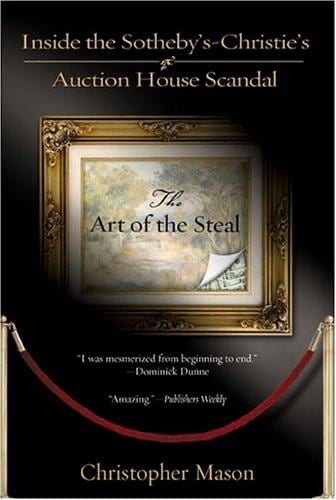
The Art of the Steal tells the story of several larger-than-life figures - the billionaire tycoon Alfred Taubman; the most powerful woman in the art world, Dede Brooks; and the wily British executive Christopher Davidge - who conspired to cheat their clients out of millions of dollars. It offers an unprecedented look inside this secretive, glamorous, gold-plated industry, describing just how Sotheby’s and Christie’s grew from clubby, aristocratic businesses into slick international corporations. And it shows how the groundwork for the most recent illegal activities was laid decades before the perpetrators were caught by federal prosecutors.
Highlights
Henry Ford, Sr., the founder of the Ford Motor Company, whose privately owned newspaper, the Dearborn Independent, ran a ninety-one-part series of incendiary articles in the early 1920s that he published collectively in a book entitled The International Jew: The World’s Foremost Problem. “If there is one quality that attracts Jews, it is power,” the book stated, echoing Ford’s complaint that “moneylenders” had tried to wrest control of his company during an economic downturn. “Wherever the seat of power may be, thither they swarm obsequiously.” 313 Henry Ford’s fame ensured a wide distribution for the book during Alfred’s formative years. For a while, a complimentary paperbound copy could be found in the glove compartment of every new Ford car. (Location 238)
The aspiring architect sensed that the problem lay in the placement of the front door, which was set back ten feet from the sidewalk behind a U-shaped window display. He advised the owner, Irving Diem, to move the door to the sidewalk. With some trepidation Diem followed his teenage clerk’s suggestion and was impressed when the new configuration began attracting more customers into the store. (Location 253)
ebullient (Location 271)
amorous (Location 275)
druthers. (Location 390)
languid (Location 645)
perennially (Location 648)
The dealers’ discontent centered mostly on Christie’s and Sotheby’s use of secret reserves, which they felt allowed the wicked auction houses to deceive the public by permitting the auctioneer to rapidly call out a series of opening bids known as “chandelier bids,” even though nobody in the salesroom was bidding. (Location 909)
Years later, many art-world veterans would feel nostalgic for the good old days before reform was deemed necessary. “The auction houses were nice, rather cozy, gentlemanly, undynamic businesses in the seventies,” Henry Wyndham recalled. “Then the competition hotted up. Alfred Taubman bought Sotheby’s and the whole game changed. This became a theatrical, dynamic, big-money sexy business. And Davidge realized that if Christie’s was going to survive they had to sharpen up their act. 16 (Location 977)
entwine (Location 986)
exactitude, (Location 1103)
THE OSTENSIBLY fierce rivalry between Sotheby’s and Christie’s was a relatively recent phenomenon. Founded in London in 1744 and 1766, respectively, the two leading auction houses had a history of cordial relations until the 1950s, when Peter Wilson had seized the reins of power and begun operating in full-battle mode, paving the way for the ferocious competitiveness of Alfred Taubman. (Location 1214)
bombazine (Location 1221)
Sotheby’s was founded by Samuel Baker, a London book dealer whose portrait as a plump-cheeked gentleman in a powdered bob wig and greengage frock coat now hangs behind the front desk of the company’s London headquarters on New Bond Street. His first recorded auction, on March 11, 1744, was of the library of one Sir John Stanley, comprising “Several Hundred Scarce and Valuable Books in all Branches of Polite Literature,” which fetched £826 when sold in the Great Room of the Exeter Exchange in the Strand. 21 Christie’s, which considered itself the more socially superior firm, was founded by James Christie, a thirty-six-year-old midshipman who resigned his naval commission to become an auctioneer. His first sale, on December 5, 1766, included several bales of hay and “a large quantity of Madeira and high Flavour’d Claret, late the Property of Noble Personage (Deceas’d).”22 Christie constructed a salesroom in the garden of his town house in Pall Mall, which rapidly became a fashionable gathering place for Georgian society. (Location 1222)
ignominious (Location 1415)
blithely.1 (Location 1571)
throng (Location 1572)
pied-à-terre, (Location 1578)
incredulous (Location 1652)
besotted. (Location 1720)
EXULTANT (Location 1985)
quixotic,” (Location 2154)
paroxysms (Location 2159)
malapropisms.”48 (Location 2161)
mordant (Location 2905)
mirth (Location 3337)
merriment (Location 3535)
succinctly.12 (Location 3542)
colossus. (Location 3607)
restive (Location 3612)
colloquy (Location 3656)
intimated (Location 3720)
incredulous. (Location 3804)
moribund (Location 3909)
idyll (Location 3955)
nonplussed. (Location 3986)
acquiescence. (Location 4071)
avuncular (Location 4185)
comeuppance. (Location 4380)
sanguine (Location 4386)
lithe (Location 4458)
wearily. (Location 4655)
irascible (Location 4789)
blithe (Location 4870)
bonhomie. (Location 4933)
insouciance (Location 4957)
mirth (Location 4961)
Blenheim,” (Location 5637)
countenance (Location 5707)