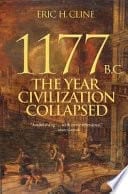
DESCRIPTION
A bold reassessment of what caused the Late Bronze Age collapse In 1177 B.C., marauding groups known only as the “Sea Peoples” invaded Egypt. The pharaoh’s army and navy managed to defeat them, but the victory so weakened Egypt that it soon slid into decline, as did most of the surrounding civilizations. After centuries of brilliance, the civilized world of the Bronze Age came to an abrupt and cataclysmic end. Kingdoms fell like dominoes over the course of just a few decades. No more Minoans or Mycenaeans. No more Trojans, Hittites, or Babylonians. The thriving economy and cultures of the late second millennium B.C., which had stretched from Greece to Egypt and Mesopotamia, suddenly ceased to exist, along with writing systems, technology, and monumental architecture. But the Sea Peoples alone could not have caused such widespread breakdown. How did it happen? In this major new account of the causes of this “First Dark Ages,” Eric Cline tells the gripping story of how the end was brought about by multiple interconnected failures, ranging from invasion and revolt to earthquakes, drought, and the cutting of international trade routes. Bringing to life the vibrant multicultural world of these great civilizations, he draws a sweeping panorama of the empires and globalized peoples of the Late Bronze Age and shows that it was their very interdependence that hastened their dramatic collapse and ushered in a dark age that lasted centuries. A compelling combination of narrative and the latest scholarship, 1177 B.C. sheds new light on the complex ties that gave rise to, and ultimately destroyed, the flourishing civilizations of the Late Bronze Age—and that set the stage for the emergence of classical Greece.
1177 BC- The Year Civilization Collapsed- Revised and — Eric H Cline.pdf (file not included in this release)
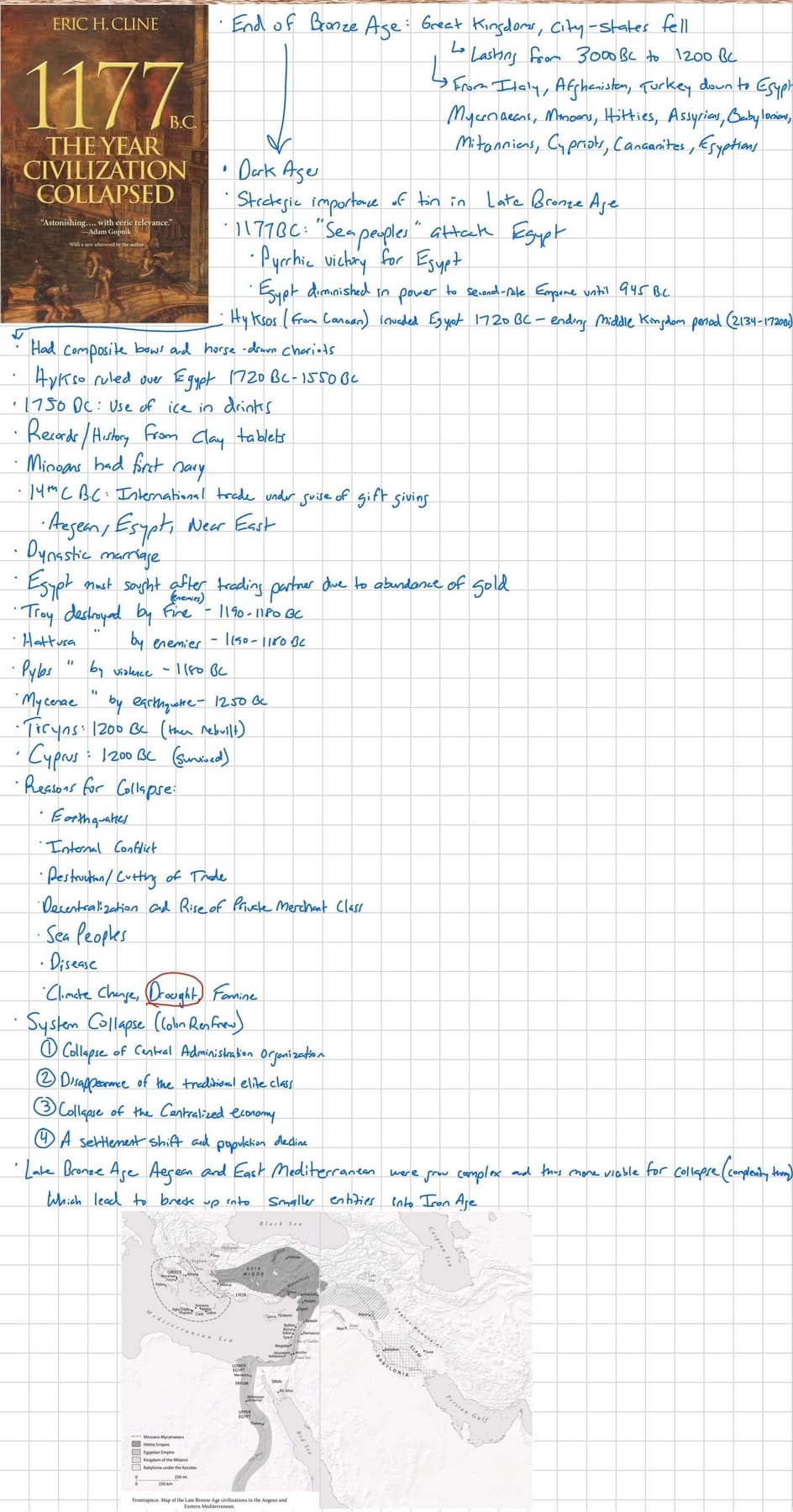
AI Summary
Prologue
- 1177 BC is used as a “pivotal” moment in a longer, messy collapse. The prologue opens with the attack on Egypt in Year 8 of Ramses III (1177 BC) by a coalition modern scholars call the “Sea Peoples”—but the author stresses that this was only one dramatic episode within a drawn-out breakdown that unfolded over decades (and in some places up to a century).
- “Sea Peoples” is a modern label; the sources describe multiple groups. Egyptian records treat them as distinct peoples operating together (e.g., Peleset, Tjekker, Shekelesh, Shardana, Danuna, Weshesh). They appear culturally diverse in Egyptian iconography (different helmets, dress, beards), and they traveled by both sea and land, sometimes with families—suggesting migration as well as warfare.
- We don’t know their origins or motives with confidence. The prologue lays out competing origin hypotheses (Western Mediterranean vs. Aegean/western Anatolia/Cyprus/Eastern Mediterranean) and underscores that no definitive “point of origin” site has been identified. Motives might include raiding for spoils/slaves, but also push factors like drought, famine, and population pressure.
- Egypt “won,” but the broader system still unraveled. Ramses III’s inscriptions claim a decisive victory (defeat, captives, resettlement in Egyptian strongholds), yet the author calls it effectively Pyrrhic: Egypt never fully recovered its prior imperial stature and later rulers presided over a reduced power.
- The prologue argues against a single-cause story. Earlier scholarship often blamed the Sea Peoples for nearly all destructions and even (wrongly) credited them with iron weapons. The author emphasizes that the best current picture is multi-causal: destruction layers are not simultaneous, and archaeology often can’t identify _who_destroyed a site—only that it was destroyed.
- Key claim: the Sea Peoples may be as much “symptom” as “cause.” One leading interpretation presented is that they may have been displaced by crises and moved into a region already weakening—making them opportunistic beneficiaries (and sometimes victims) of wider decline rather than the prime mover.
- The author previews the “perfect storm” framework. The prologue ends by previewing a combined set of stresses—climate change → drought/famine, earthquake storms, internal rebellions, and “systems collapse”—as the more plausible explanation for the end of the Late Bronze Age world.
Historical timeline in the prologue
- Late Bronze Age “golden years” (roughly the 15th–13th centuries BC): The prologue gestures to a centuries-long international system of major powers across the Aegean and Near East, setting up why its breakdown is so consequential.
- 1207 BC (Year 5 of Pharaoh Merneptah):
- An earlier coalition (including Shekelesh, Shardana, Eqwesh, Lukka, Teresh) is described in Egyptian texts in connection with fighting in/near Libya.
- This same year contains the famous Egyptian inscription with the earliest known extra-biblical mention of “Israel” as a people in Canaan (though Merneptah’s attention is portrayed as focused mainly on Libyans and Sea Peoples).
- 1177 BC (Year 8 of Ramses III):
- A major assault on Egypt by a later coalition (not identical membership), depicted at Medinet Habu in land/sea battle scenes and described in inscriptions. Ramses claims victory and describes captives and resettlement.
- End-of-system evidence during the collapse (late 13th–early 12th century BC):
- The letter from the king of Ugarit to the king of Cyprus/Alashiya pleads for help as enemy ships burn cities—illustrating how rapidly the security environment deteriorated and how militaries were stretched elsewhere.
- After 1177 BC (remainder of the 2nd millennium BC):
- Egypt persists but is diminished; elsewhere, many powers “withered and disappeared,” followed by a transitional/dark-age-like period lasting at least a century (longer in some regions).
- ca. 945 BC: Egypt later regains a measure of prominence under Shoshenq I (linked to the biblical Shishak).
Causes of collapse as framed in the prologue
1) External shocks and violence (one part of the story)
- Sea Peoples incursions: real, destructive in some cases, and clearly documented in Egyptian royal texts and reliefs—yet their role is not treated as sufficient to explain regional collapse by itself.
2) Misattribution problems in older scholarship
- Scapegoating and overreach: The prologue explains that earlier scholars tended to attribute any destruction layer to the Sea Peoples and even popularized false claims (e.g., that they had iron weapons).
- The “Sea Peoples narrative” as a constructed story: It highlights how a classic, catastrophic interpretation was shaped early (notably by Gaston Maspero in the late 19th/early 20th century), before many destroyed sites were excavated.
3) Structural fragility and cascading failure (“systems collapse”)
- Core idea: interconnected kingdoms and trade/military systems can fail catastrophically when multiple stresses hit at once; the prologue frames this as a leading way to understand the Late Bronze Age breakdown.
4) The “perfect storm” (the author’s preview list of contributing factors)
- Climate stress: drought and famine connected to broader climate change.
- Seismic disasters: “earthquake storms.”
- Internal conflict: rebellions and instability within kingdoms.
- Compounding interactions: these forces combine, weakening states so that raids/migrations become far more effective and destabilizing than they would be in a healthy system.
Helpful reference frames introduced (tables)
- Table 1 (p. 11): A chronological list of Late Bronze Age rulers mentioned across multiple polities (Egyptian, Hittite, Assyrian, Babylonian, Mitanni, Ugarit, and others), spanning roughly the 18th–12th centuries BC—signaling that the book will treat collapse as an international, multi-kingdom phenomenon, not a single-country event.
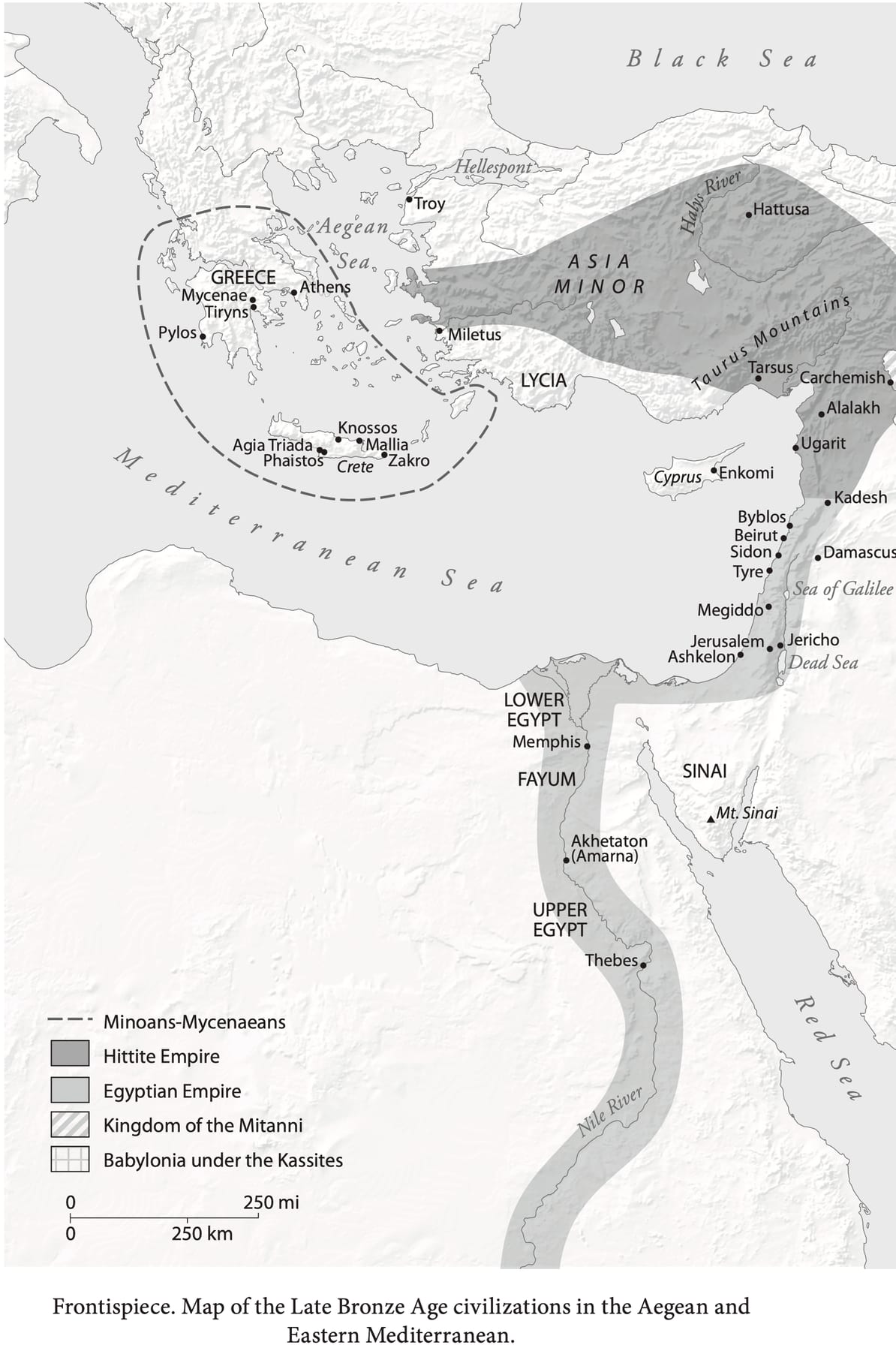
- Table 2 (p. 12): A quick map between modern regions and Late Bronze Age names (e.g., Cyprus = Alashiya; Crete = Keftiu/Caphtor; Canaan = Retenu/Pa-ka-na-na; Mainland Greece = Tanaja/Ahhiyawa/Hiyawa), preparing you to track shifting names across sources.
Chapter 1 (Act I) — Main ideas (what this chapter is doing)
- The Late Bronze Age “international system” starts taking recognizable shape in the 15th century BC. The chapter opens with a vivid symbol of that connectivity: Minoan-style frescoes (bull-leaping scenes, true fresco technique) appearing not only on Crete but in elite palaces across the eastern Mediterranean, including Peru-nefer / Tell el-Dab‘a in Egypt’s delta—evidence that ideas, artisans, and prestige styles moved across long distances.
- Egypt’s “foreign rule” trauma (the Hyksos) becomes part of the story of later expansion and global reach.The chapter backtracks to the Hyksos: Semitic “chieftains of foreign lands” who ruled from Avaris ca. 1720–1550 BC, bringing composite bows and chariots, and provoking the Egyptian reconquest under rulers like Kamose (whose inscriptions describe destroying Avaris and expelling the Hyksos). This sets up how Egypt’s New Kingdom becomes more outward-looking and militarily capable.
- Trade and diplomacy are already “cosmopolitan” long before 1200 BC—and they run on elite exchange.The chapter’s long Mari–Crete example shows that luxury objects and specialist goods traveled astonishing distances by the 18th century BC (e.g., “Caphtorian”/Cretan items reaching Mesopotamia), and that gift exchange between rulers is a standard diplomatic language of value and rank.
- Minoan and then Mycenaean participation in eastern Mediterranean networks is central. The chapter sketches Minoan chronology (earthquake rebuilding; Thera/Santorini eruption; later Mycenaean takeover) to show how Aegean powers are not peripheral but increasingly embedded in wider circuits of goods, prestige, and politics.
- Egypt under Hatshepsut and Thutmose III becomes both a diplomatic hub and an imperial war machine.
- Hatshepsut is framed as prestige-through-diplomacy: long-distance expeditions (especially to Punt, with detailed record at Deir el-Bahari) and state-sponsored acquisition of strategic resources.
- Thutmose III pivots to systematic campaigning while also maintaining trade/tribute-like exchanges—including contacts that reach into the Aegean and possibly Anatolia/Cyprus (“Isy”), and a world where “tribute” can really mean elite gift/trade packaged as deference.
- The chapter highlights the mechanics of power: chokepoints, surprise, siege, and logistics. The Battle of Megiddo (1479 BC) is used to show operational choices (routes, ambush risk, surprise) and how even a tactical victory can become a long siege if discipline breaks for looting—an early illustration of how outcomes depend on logistics and decision-making, not just “battlefield strength.”
- Great-power rivalry and alliance-making (Mitanni, Hittites) are already “international” in the modern sense. Egypt’s interactions with Mitanni show that war, horse/chariot expertise, and shifting alliances are transregional; the chapter uses details like the famous Mitannian horse-training tradition (via later Hittite texts) to underline how specialized military knowledge circulated.
- Anatolia’s coalitions (Assuwa) and the “Ahhiyawa = Mycenaeans?” question preview the political geography behind later crises. The Assuwa rebellion (~1430 BC) and a Hittite-inscribed sword (a Mycenaean-type blade) are used to show that Aegean and Anatolian politics could intersect far earlier than the conventional Trojan War horizon—and that later legend may preserve distorted memories of earlier real conflicts.
Historical timeline (the chapter’s key dates, in order)
- ca. 1720 BC — Hyksos begin ruling much of Egypt; Avaris is their capital.
- ca. 1550 BC — End of Hyksos rule; Egyptian reconquest (Kamose/Ahmose era); Avaris later becomes Peru-nefer.
- 15th century BC (ca. 1450 BC) — Minoan-style frescoes at Tell el-Dab‘a/Peru-nefer; “internationalized world” coalescing.
- Hatshepsut’s reign (15th c.) — Major prestige expeditions, especially Punt (ninth regnal year); also resource missions (Lebanon timber; Sinai copper/turquoise).
- ca. 1480 BC — Hatshepsut dies; Thutmose III assumes sole rule and moves quickly into campaigning.
- 1479 BC — Battle of Megiddo: Thutmose III’s first-year campaign; surprise route choice; prolonged siege after looting delays.
- After 1450 BC — Thutmose III sends Punt expedition (Year 33) and again (Year 38), and receives “inw” from distant regions such as “Isy” (possibly Assuwa or Cyprus/Alashiya).
- ca. 1430 BC — Assuwa rebellion crushed by Hittite king Tudhaliya I/II; prisoners/booty recorded; names on the coalition list include Wilusiya and Taruisa (often linked to Troy/Troad); Mycenaean-type sword appears in the episode.
“Causes of collapse” in this chapter (what it adds to the later 1200 BC story)
This chapter isn’t yet describing the 1200 BC collapse directly; it’s building the preconditions—the structural features that make a later “systems collapse” plausible:
- Interdependence as strength—and later as vulnerability. The chapter repeatedly illustrates long-range movement of artisans, prestige goods, raw materials (metals, timber, luxury items), and diplomatic missions. The implied point for later chapters is that when a region’s elites and states become tightly networked, shocks can cascade rather than stay local.
- Militarized, horse-and-chariot power politics. Hyksos chariot/composite-bow advantages, Thutmose III’s campaigning, Mitanni’s chariot-warrior tradition, and Hittite conflict management all show a world where maintaining power means maintaining expensive, specialized military systems—systems that are sensitive to disruption in supplies, training pipelines, and political stability.
- A pattern of coalition warfare, rebellion, and regime fragility. The Assuwa coalition and its violent suppression show recurring dynamics—vassals rebel, empires retaliate, populations are displaced—creating long-term instability and resentments that can prime later breakdowns when other stresses (drought, famine, etc.) arrive.
If you want, for the next chapter I can keep the same three-part structure (main ideas + timeline + collapse-relevance) and also add a short “Who’s who” roster so the cast stays easy to track as the great-power network expands.
Chapter Two “Act II: An (Aegean) Affair to Remember: The Fourteenth Century BC”)
1) The “Aegean List” at Amenhotep III’s mortuary temple: what it is and why it matters
- The excerpt opens at Amenhotep III’s mortuary temple site at Kom el-Hetan (west bank of the Nile, opposite modern Luxor), famous for the Colossi of Memnon (actually statues of Amenhotep III later misidentified by Greco-Roman visitors).
- The key evidence for the chapter’s argument is not the Colossi, but a set of statue bases inside the temple. These bases were carved with “topographical names” inside an Egyptian “fortified oval” motif (a stylized fortified city), typically placed over the body of a bound prisoner—an artistic/political convention signaling symbolic domination, even when Egypt didn’t truly control the place.
- Collectively, these lists aimed to catalogue the known world for Egyptians in Amenhotep III’s time. What makes the “fifth base” exceptional is that it contains place-names from far to Egypt’s west—the Aegean—many of which were unprecedented in Egyptian inscriptions.
2) Destruction and reconstruction: why the evidence is fragile
- The Aegean List base was excavated in the 1960s but later accidentally destroyed (stories differ: deliberate cracking for illicit sale vs. wildfires). It shattered into hundreds of pieces, leaving scholars for years reliant on photographs.
- Excavations reopened in 1998 under Hourig Sourouzian (with Rainer Stadelmann), and conservators have been painstakingly reassembling fragments; the Aegean List alone took years to piece together.
3) What the names likely represent: a plausible travel itinerary
- Two names were already known in Egyptian usage: Keftiu (Crete) and Tanaja (mainland Greece), here appearing like “headnames” or titles introducing the list.
- Early publication and identification: Kenneth Kitchen cautiously noted that some names resembled Amnisos and Knossos—and later scholarship confirmed such identifications.
- The list’s internal order is central to the author’s interpretation: it begins with major Minoan Cretan sites (e.g., Knossos and its port Amnisos; Phaistos; Kydonia), moves through Kythera (a stepping-stone between Crete and mainland Greece), then to important Mycenaean mainland centers (e.g., Mycenae and its port Nauplion; Messenia; possibly Thebes), and finally returns to Cretan names in the reverse direction—suggesting a round-trip route.
- The excerpt notes debate: some scholars see the list as propaganda or aspirational boasting; others argue it reflects real knowledge and contact. The text leans toward real contact, given earlier documented Aegean–Egypt interactions (15th century BC tomb depictions of envoys/merchants bringing gifts) and the “itinerary-like” ordering.
4) Corroborating clue: Egyptian royal-name objects found in the Aegean
- A major supporting argument is the discovery of objects bearing the cartouches of Amenhotep III or Queen Tiyiat multiple Aegean sites, with a notable overlap between findspots and places on the Aegean List.
- The most striking evidence is a set of faience “foundation deposit” plaques from Mycenae—unique because such plaques with Amenhotep III’s name have not been found anywhere else outside Egypt, and appear exclusive to Mycenae in the broader Mediterranean record as presented here.
- The plaques carry Amenhotep III’s titles and function (in Egypt) like time capsules placed under temples/statues, meant to preserve the donor/builder’s identity and date. At Mycenae, their original use-context is unknown, but their uniqueness suggests an unusually direct relationship with Egypt.
5) Trade patterns shifting: Crete to the mainland, and Mycenaean ascent
- The excerpt describes a broader pattern: Crete seems to remain a principal destination early in the 14th century, but Egyptian goods are not necessarily dominant relative to Canaan and Cyprus; trade routes appear more complex and multi-actor.
- By the end of the 14th century BC, imports reportedly drop on Crete while increasing on the Greek mainland; the text suggests (explicitly as conjectural) that this may relate to Knossos’s destruction by ~1350 BC and a Mycenaean takeover of routes to Egypt and the Near East.
- On this reading, an Egyptian embassy in Amenhotep III’s reign could have had a dual diplomatic/trade purpose: reaffirm ties with established Minoan partners while engaging the rising Mycenaeans.
6) The Amarna Letters: a documentary archive of international relations
- The chapter then pivots to the Amarna archive (first found in 1887 at Tell el-Amarna / Akhetaten), preserving correspondence of Amenhotep III and Akhenaten with other rulers and governors.
- It explains Akhenaten’s “Amarna Revolution” (closing major temples, elevating Aten, centralizing power) while emphasizing that he maintained international diplomatic/trade relationships and kept formal records.
- The letters are written in Akkadian (a diplomatic lingua franca) and involve Great Powers (Egypt, Assyria, Babylon, Mitanni, Hittites) plus regional rulers (e.g., Abdi-Hepa of Jerusalem; Biridiya of Megiddo), showing sustained Bronze Age interstate diplomacy.
7) “Greeting-gifts,” invented kinship, and the mechanics of high-level exchange
- A recurring diplomatic practice is gift exchange between kings, illustrated with a letter from Tushratta of Mitanni to Amenhotep III that includes formal well-wishing and a list of chariots, horses, attendants, and luxury items for the pharaoh and queen.
- Kings use kinship language (“brother,” “father/son”) to structure relations and trade partnerships; the text frames this as a known anthropological pattern in preindustrial settings to facilitate exchange without formal markets/kin ties.
- The excerpt gives a contrasting Hittite reaction—skeptical of easy “brotherhood” claims—and explains that “brother” often signals equality, while “father/son” can signal deference.
8) Dynastic marriage as diplomacy—and how bluntly it could be negotiated
- Some “kinship” was literal via marriage alliances: Tushratta’s connections to Amenhotep III through women given in marriage (Kelu-Hepa; later Tadu-Hepa) are used to justify calling the pharaoh “brother” and “son-in-law” and to intensify expectations of favorable treatment and gifts.
- Amenhotep III is portrayed as unusually active in using dynastic marriages to cement treaties (Babylon, Mitanni, Arzawa, etc.).
- The excerpt also shows the transactional edge: a Babylonian king (Kadashman-Enlil) links the promise of his daughter directly to receiving gold quickly; Amenhotep III rebukes the cynicism, though the marriage apparently occurs later.
9) Gold as the engine of prestige—and the problem of “fool’s gold”
- Egypt’s Nubian gold makes it especially attractive; letters repeat the claim “gold is like dust” in Egypt.
- Babylonian kings complain that Egyptian “gold” shipments sometimes prove impure or fraudulent when melted: dramatic losses in weight after firing lead to accusations that it looked like silver or turned to ash.
- The text raises two possibilities: deliberate deceit by the Egyptian court vs. substitution by intermediaries en route. Burna-Buriash suggests the pharaoh should personally verify and seal shipments rather than delegating—implying mistrust of deputies/transport chain.
- It also notes robbery of caravans and named perpetrators, hinting at how insecure and politically entangled long-distance movement of valuables could be.
10) The “tip of the iceberg”: real commerce beneath ceremonial exchange
- To explain how elite gift exchange can mask broader economic activity, the excerpt uses Malinowski’s study of the Kula Ring: while chiefs perform ceremonial exchanges, crews trade pragmatically on shore for essentials—suggesting a parallel where royal diplomacy overlays merchant-level commerce and social exchange.
- The text argues that merchants/sailors likely transmitted not only goods but also ideas, stories, and skills across ports and routes, possibly contributing (as a hypothesis) to later cross-cultural literary parallels (e.g., Gilgamesh with Homer; Kumarbi with Hesiod).
- Skilled labor also moved as part of exchanges (physicians, sculptors, masons), and Aegean-style wall paintings and floors in Egypt/Levant/Anatolia are cited as evidence of artisans traveling across regions for centuries.
11) New major actors: Cyprus (Alashiya) and Assyria
- The excerpt highlights Cyprus/Alashiya’s correspondence and especially the scale of copper shipments (hundreds of talents), likely in oxhide ingots; the “apology” for sending “only” 500 talents underscores the massive industrial scale of Late Bronze Age metal supply.
- Assyria enters as a rising power under Assur-uballit I (ca. 1365–1330 BC), sending greeting-gifts and seeking recognition among the Great Powers; the letters include the standard request for Egyptian gold and a claim of equality with Mitanni.
- The excerpt then sketches Assyria’s rise at Mitanni’s expense: military defeat of Shuttarna II, reversal of earlier Mitannian dominance, and later intervention in Babylon’s succession politics.
- The author frames this as the Late Bronze Age stage filling out: Egyptians, Hittites, Mitanni, Babylonians/Kassites, Assyrians, Cypriots, Canaanites, Minoans, and Mycenaeans interacting in a complex international system.
12) Akhenaten’s family, Nefertiti, and Tutankhamen: background leading toward a diplomatic crisis
- The excerpt briefly recounts Nefertiti’s famous bust discovery (Borchardt, 1912; Berlin display in 1924) and the contested circumstances of its export.
- It introduces Tutankhamen (Tutankhaten) as a child king, and summarizes debates about his death; recent scientific work is described as pointing to a broken leg with infection, plus malaria and congenital issues.
- The discovery of Tut’s tomb (Howard Carter; Lord Carnarvon) is narrated as a modern event that shaped Egyptomania and preserved unusually rich burial goods, despite evidence of ancient robbery.
- The excerpt ends by setting up the next major diplomatic episode: Tut’s widow Ankhsenamen (also his sister) and the impending “Zannanza Affair” involving the Hittite king Suppiluliuma I—but the provided text cuts off right as Suppiluliuma’s story begins.
Chapter Three / Act III: “Fighting for Gods and Country: The Thirteenth Century BC” (pp. 69–97)
Main ideas (what this chapter is doing)
- The Late Bronze Age was highly interconnected—more like a “first global age” than a set of isolated kingdoms. Cline uses the Uluburun shipwreck (c. 1300 BC) as a concrete snapshot of that interconnected system: a single vessel carrying a multinational cargo (copper, tin, glass, resin, luxury goods, seals/scarabs, weapons, etc.), with evidence of mixed peoples aboard and routes linking the Levant, Cyprus, Anatolia, and the Aegean.
- Trade, diplomacy, and war are entangled. The same sea-lanes that move copper/tin and prestige goods also move raiders, refugees, emissaries, and armies—so prosperity and vulnerability rise together.
- Major-power rivalry peaks in the 13th century, especially Egypt vs. Hatti (Hittites). The chapter highlights the Battle of Qadesh (1274 BC) as a massive clash featuring deception/intelligence and nearly catastrophic battlefield swings, ending in a stalemate rather than decisive victory.
- Stalemate leads to formalized diplomacy and alliance-building. Cline emphasizes the “Silver Treaty” (Nov/Dec 1259 BC)—mutual recognition and stabilization between Egypt and the Hittites—then notes its reinforcement through dynastic marriage and lavish transfers.
- The Hittite–Mycenaean (Ahhiyawan) frontier in western Anatolia is unstable. Through treaties/letters, Cline shows a world of rebellions, raids, asylum, contested buffer zones, and shifting status between “Great Kings.” Key examples include:
- A Hittite treaty with Alaksandu of Wilusa (often linked by many scholars to Troy/the Troad), implying Wilusa’s strategic importance and outside pressures.
- The Tawagalawa Letter, where the Hittite king addresses the Ahhiyawan ruler as “Great King”/“brother,” while complaining about the raider Piyamaradu, Ahhiyawan asylum, and a dispute over Wilusa that had to be settled.
- Later evidence that the Ahhiyawan king’s prestige drops in Hittite eyes (Ahhiyawa literally crossed out in a draft treaty list of “equal kings”), alongside signs the Mycenaean footprint at Milawata (Miletus) is no longer secure.
- Cline threads in Canaan/“Israel” traditions cautiously, distinguishing text tradition from archaeology. He notes that widespread biblical-style destruction layers in key cities are often not archaeologically visible for the 13th century, while Hazor remains the strongest candidate for a major destruction event—though the date and perpetrators are disputed.
Historical timeline (events and what they signal)
- c. 1300 BC — Uluburun ship sinks off southwestern Anatolia. A “microcosm” cargo reveals dense long-distance exchange (metals, glass, resin, luxury items) and the scale of wealth at stake.
- 1274 BC — Battle of Qadesh (Ramses II vs. Muwattalli II). Huge armies, deception, near-disaster, then stalemate; the border effectively holds.
- Nov/Dec 1259 BC — “Silver Treaty” between Ramses II and Hattusili III. Formal peace after prolonged rivalry; preserved in Egyptian/Hittite versions and used as a key example of high diplomacy.
- c. 1246 BC (about 13 years after 1259) — Dynastic marriage ties Egypt and Hatti. Reinforces the treaty; emphasizes that peace is maintained through elite alliance and resource transfer.
- c. 1280 BC (noted in the chapter’s Anatolian dossier) — Treaty with Alaksandu of Wilusa. Wilusa/Troy-region framed as a strategic flashpoint needing Hittite protection commitments.
- Mid–late 13th century — Tawagalawa Letter and related Ahhiyawa texts. Raiding/asylum disputes (Piyamaradu), recruitment against Hittites, and negotiated settlement over Wilusa show persistent frontier instability.
- Late 13th century — Diplomatic “demotion” signals shifting power. A Hittite draft treaty lists “equal kings,” but crosses out the King of Ahhiyawa, suggesting the Mycenaean world is losing recognized great-power status; the Milawata situation hints at shrinking influence in Anatolia.
- c. 1230 BC (debated) — Hazor destruction (Upper Tel/palace-temple complex). Clear burn/destruction evidence, but date and perpetrators remain uncertain; Cline treats it as real destruction with contested attribution rather than a simple confirmation of any single narrative.
Causes of collapse (what this chapter adds to the “why did it fall apart?” question)
This chapter is mainly building the 13th-century backdrop—a world that looks powerful and prosperous, yet is quietly accumulating systemic risks. The collapse arguments here are less “one smoking gun” and more “stressors that can cascade”:
- System fragility from interdependence: Uluburun illustrates how the era’s military capacity and elite economies depended on long supply chains (especially metals and specialized goods). When routes break, the whole system can seize up.
- Chronic conflict as a drain and destabilizer: Qadesh shows that even “successful” campaigns can end in stalemate after enormous mobilization—meaning prolonged pressure rather than decisive resolution.
- Frontier instability, raiding, and contested buffer zones: The Hittite–Ahhiyawa material (Piyamaradu raids, asylum, Wilusa disputes) depicts a security environment where authority is constantly challenged at the edges—exactly the kind of instability that can accelerate breakdown when other shocks hit.
- Diplomatic/economic coercion and tightening controls: The chapter points to what looks like an early embargo logic (“no ship of Ahhiyawa…”), implying that trade access could be weaponized—another vulnerability in an economy built on movement.
- Signs of weakening or disruption in the Mycenaean sphere: The “crossed-out Ahhiyawa” moment is presented as an indicator that something significant has changed—enough that a previously peer “Great King” is no longer treated as one. That kind of geopolitical downgrading often accompanies internal disruption.
- Localized destructions with contested perpetrators: Hazor’s devastation shows that major city-level collapse events are already occurring in the 13th century (even if sporadically and ambiguously), foreshadowing broader regional breakdown.
Chapter Four: Act IV: THE END OF AN ERA: THE TWELFTH CENTURY BC
- The “globalized” Late Bronze Age system breaks down. The chapter frames the 12th century BCE as the dramatic unraveling of a long period of interconnected trade and diplomacy, now “marked more by tales of woe and destruction” than exchange.
- Ugarit is the clearest case study for “everything looks normal…until it isn’t.” Texts suggest trade and routine business continued right up to the end, and then the city was violently destroyed (with widespread fire, collapse, and weaponry like arrowheads indicating fighting), after which it was abandoned for centuries.
- Chronology is messy, and some “Sea Peoples” explanations don’t line up cleanly. Radiocarbon dates (e.g., for a major ash layer) can be earlier than Ramses III’s famous 1177 BCE battle—raising the question of how long movements/raids would have taken and whether multiple waves or different actors were involved.
- Across regions, “destruction layers” rarely identify the destroyer. Again and again, the evidence shows burning, collapse, abandonment, and rebuilding—but not a clear signature for who did it (or whether nature played a role). Lachish is a representative example: plausible human enemies are proposed, but there’s also serious discussion of earthquake indicators vs. looting/fire.
- Southern Canaan sees both destruction and cultural transformation. In the Philistine pentapolis region, some sites show violent ends followed by major material-culture change (pottery, hearths, bathtubs, architecture), while other transitions (e.g., Ashkelon) may have been comparatively peaceful—suggesting multiple local trajectories rather than one uniform conquest story.
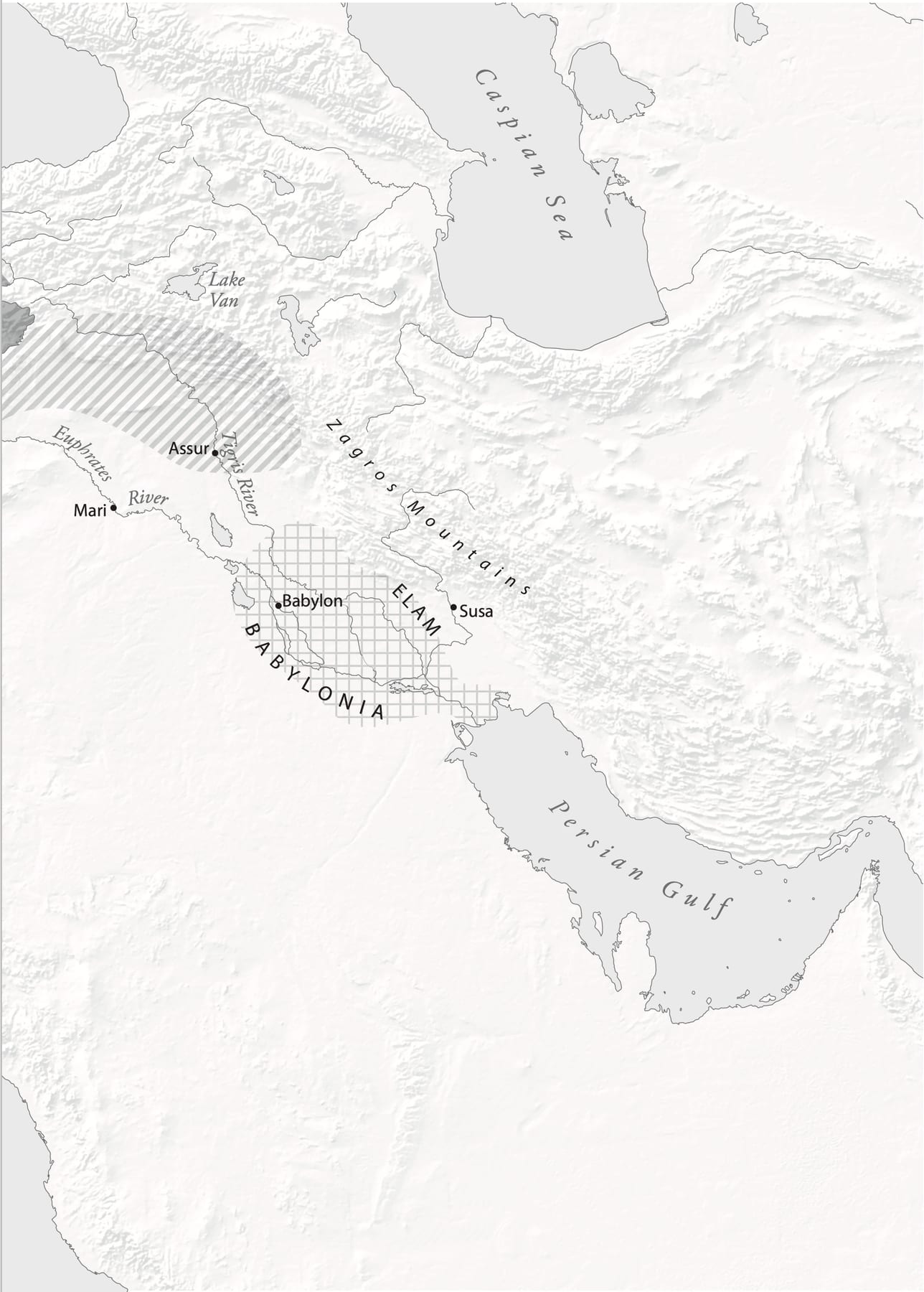
- Events farther east aren’t “Sea Peoples” at all. Mesopotamian destruction episodes discussed here are explicitly tied to Elamite campaigns (e.g., Shutruk-Nahhunte’s invasion and plundering of Babylon), underscoring that the wider crisis had multiple independent military drivers.
- In Anatolia, even famous collapses like Hattusa are hard to attribute. The city was destroyed, but the chapter stresses that blaming the Sea Peoples is more assumption than proof; internal Hittite political conflict is also on the table.
- The Greek mainland shows widespread upheaval, but scholars debate whether this was sudden catastrophe or long “unrest.” The chapter surveys destruction/abandonment patterns across many sites and presents the interpretive split between (a) sudden palace destructions and (b) a longer-running dissolution culminating in palace collapse.
- Natural disasters remain plausible contributors in multiple places. For Greece, Tiryns is used to illustrate the earthquake hypothesis (with later debate about whether fortification walls could have survived), and for Cyprus there’s explicit discussion of children killed by falling mud-bricks, pointing to seismic activity as at least a candidate in some cases.
- Cyprus is a key cautionary tale against simple “colonization” stories. Earlier models (Aegean refugees raiding/settling in clear waves) have been revised toward a more complex picture: (a) destruction dates compressed later, (b) some sites abandoned rather than destroyed, and (c) material culture reflects hybridization/syncretism rather than straightforward Mycenaean imposition.
- End-state interpretation: Sea Peoples are not the single master-cause. The chapter’s summation emphasizes uncertainty about responsibility, warns against equating “Aegean-looking” artifacts with “Aegean people,” and argues the end likely required more than the predations recorded by Egyptians—Sea Peoples may even have been victims as well as aggressors.
- A material-culture marker illustrates how disruption reshapes production. “Mycenaean IIIC1b” pottery appears widely after ~1200 BCE, but the chapter notes it likely reflects local Eastern Mediterranean/Cypriot production after true Aegean imports ceased—another example of why “style ≠ people.”
Historical timeline highlighted in this chapter (approximate)
- ca. 1225 BCE — Trouble begins showing in multiple zones; Cyprus is sometimes placed into an early “unrest” horizon in older reconstructions (later revised), with fortified sites and destruction claims in the traditional narrative.
- ca. 1207 BCE — Merneptah’s reign is a reference-point for Sea Peoples chronology (used here as an anchor when evaluating whether destruction horizons are “too early”).
- ca. 1192–1190 BCE — Radiocarbon dates for a major ash/destruction layer (used to argue some catastrophic events predate 1177), and a key comparison point for assessing migration/raid timing.
- 1190–1185 BCE (most likely) — Ugarit destroyed during King Ammurapi’s reign; evidence suggests violent destruction and rapid abandonment.
- 1184 BCE onward — Ramses III’s accession becomes a dating anchor for some Levantine destruction contexts (e.g., artifact associations used to argue destruction happened during/after his reign).
- ca. 1180 BCE — Pylos palace destroyed in a massive fire; “watchers of the sea” texts exist but don’t conclusively identify Sea Peoples or any specific attacker.
- ca. 1177 BCE — Ramses III’s famous battle with Sea Peoples is treated as a culminating episode, but the chapter repeatedly notes that several destruction horizons appear earlier than this.
- 1190–1130 BCE (Greece, broad horizon) — Widespread destruction/abandonment across many Mycenaean sites; scholars debate sudden catastrophe vs. a longer deterioration beginning as early as the mid-13th century.
- ca. 1200 BCE and just after (Tiryns/Argolid) — Destruction at Tiryns; earthquake interpretation proposed (and debated), plus evidence the site continued with rebuilding rather than total annihilation.
- ca. 1190–1174 BCE (Cyprus, revised range) — Current reconstructions compress the Cypriot destruction/abandonment horizon into the late 12th century rather than starting at 1225; some sites appear abandoned with goods left behind, and material culture looks hybrid rather than purely “colonized.”
- ca. 1158 BCE — Elamite invasion of Babylonia under Shutruk-Nahhunte; important as “collapse ripple effects” not attributable to Sea Peoples.
- ca. 1150 BCE (debated; sometimes later) — Lachish Stratum VI destruction dated using Ramses III-linked material; attribution remains uncertain (enemy vs. earthquake vs. other), and the chapter stresses the limits of confident identification.
- First half of the 12th century BCE — Philistine-region transformations: some violent destructions followed by major cultural change; elsewhere (e.g., Ashkelon) a shift that may not look overtly violent in the excavated areas.
- End-point takeaway (no single date) — After ~1200 BCE, “Mycenaean-looking” styles (like IIIC1b) spread, but the chapter treats them as local/regional production and interaction under stress, not straightforward proof of mass Aegean migration; overall, the collapse likely required multiple reinforcing causes.
Chapter Five: “A ‘Perfect Storm’ of Calamities?”
- The core problem: Cline argues we’re finally in a position to “pull together” the evidence to explain why the long-stable, interconnected Late Bronze Age system collapsed—but we have to weigh probabilities rather than hunt for a single silver bullet.
- No single agreed cause: There is still no scholarly consensus; candidates include foreign attacks, internal uprisings, natural disasters, systems collapse, and changes in warfare—and in many destructions we can’t even tell whether invaders, revolt, or something else was responsible.
- Earthquakes were real—and widespread—but not enough alone: He reviews how archaeologists distinguish quake damage from warfare damage (leaning walls, crushed bodies under debris, toppled columns vs. weapons in destruction layers), and highlights research suggesting an “earthquake storm” affecting much of the region c. 1225–1175 BC.
- “Sea Peoples” and migration are part of the story, but not the whole story: He emphasizes that the newcomers in the Levant shouldn’t automatically be imagined as a single-minded, uniformly violent horde. New scientific approaches (including ancient DNA work) support a picture in which at least some groups looked like migrants/refugees who settled and intermarried, not only destroyers.
- Disease as an additional stressor: He raises the possibility of epidemic disease in this era, using the case of Ramses V (c. 1140 BC)—often thought to show smallpox on the mummy—and notes suspicious burial delays that resemble quarantine behavior.
- Climate change, drought, and famine as a major driver (and a trigger for migration): He treats drought as the “elephant in the room,” noting that climate explanations predate today’s climate concerns and can help explain population movements (“push-pull” migration). He uses examples like the Terramare culture’s collapse around 1200 BC (large migrations potentially linked to multiple pressures including drought) to show how environmental stress can combine with conflict and resource competition.
- Hard evidence for prolonged drought: He summarizes newer proxy evidence (especially pollen studies and other climate indicators) suggesting a major drought episode, possibly in two phases: 1250–1150 BC and 1100–950/850 BC, with only a brief interlude of recovery.
- Textual evidence for famine is stark: Letters from Ugarit’s archives (including the House of Urtenu) describe grain crises and desperate appeals; one letter about Emar (destroyed 1185 BC) warns: “we will all die of hunger,” and Egyptian correspondence explicitly acknowledges severe hunger in Ugarit.
- The chapter’s conclusion: collapse as a systems failure (“perfect storm”): Cline argues that no single factor—drought, famine, earthquakes, or invaders—would have been sufficient on its own. What made this episode different was the combination of stressors hitting an interconnected international system, producing (1) a “multiplier effect” (drought/famine worsening everything else) and (2) a “domino effect” (failures cascading through trade, diplomacy, and resource dependencies).
Historical timeline highlighted in the chapter (approximate)
- c. 1300 BC — In northern Italy (Terramare region), pollen evidence suggests growing environmental strain/overexploitation well before the final collapse era.
- c. 1250 BC (and shortly after) — A major earthquake damages Ugarit (now usually treated as damage followed by repairs, not the city’s final destruction).
- c. 1250–1150 BC — First major drought phase proposed in recent studies (part of a longer “megadrought” narrative).
- c. 1225–1175 BC — A region-wide sequence of earthquakes (“earthquake storm”) affecting mainland Greece and much of the eastern Mediterranean.
- c. 1200 BC — Terramare culture collapses; large migrations (tens of thousands) occur amid pressures that may include warfare, resource competition, and drought.
- c. 1185 BC — Emar is destroyed; a letter from an Ugaritic commercial network describes famine so severe that “we will all die of hunger.”
- c. 1180 BC — The Palace of Nestor at Pylos is destroyed; Cline uses it to illustrate how even famous destruction events have disputed causes (invaders vs internal revolt).
- c. 1177 BC — The famous confrontation of Ramses III with the Sea Peoples sits within (not necessarily at the start of) the wider collapse process and destruction horizon.
- c. 1100–950/850 BC — Second major drought phase proposed, after a brief recovery; the broader drought regime is used to explain long-term fragility and population disruption.
- c. 1140 BC — Ramses V (Egypt) dies young; possible smallpox and unusual burial delays are raised as suggestive evidence for epidemic disruption.
- c. 1000 BC — Pollen work in Egypt’s Nile delta area indicates an “aridity event,” linked (in scholarly interpretation) to reduced Nile flow from decreased rainfall over the Ethiopian plateau.
Big picture: by the end, Cline frames the collapse as a cascading breakdown across a tightly connected “global” Late Bronze Age economy—where prolonged drought/famine removes recovery capacity and interdependence spreads failure system-wide.
Chapter 6: SEA PEOPLES, SYSTEMS COLLAPSE, AND COMPLEXITY THEORY
- The Late Bronze Age “collapse” is best understood as a systems collapse, not a single-cause event. Cline leans on Colin Renfrew’s framing: when an interconnected system is stressed, failure in one part can cascade (domino effect) and amplify (multiplier effect), eventually bringing down the whole structure.
- What “collapse” looks like on the ground. Renfrew’s “classic features” include: collapse of central administration, disappearance of traditional elites, collapse of centralized economy, settlement shifts and population decline—followed by a lower level of integration and later “Dark Age” mythmaking (e.g., Trojan War traditions later gathered by Homer).
- 1177 BCE is a useful benchmark—but a placeholder, not a magic switch. Cline explicitly compares it to using AD 476 for “the fall of Rome”: convenient shorthand for a long, complex process (with earlier sacks in AD 410and AD 455). Likewise, the world of 1200 BCE differed from 1100 BCE, and again from 1000 BCE; 1177 BCE is simply a representative date tied to the Sea Peoples’ clash with Ramesses III.
- Multiple stressors, plus ripple effects. Beyond drought/famine, earthquakes, invasions/revolts, and trade disruption, Cline stresses indirect “ripple effects”: severed trade in copper/tin/gold/silver, bronze shortages, broken diplomatic ties and mutual-defense expectations, and cascading economic/political breakdown.
- Why palatial concentration made failure catastrophic. Following Mario Liverani, Cline highlights how Late Bronze Age palaces centralized organization, exchange, and control—so when palaces failed, the whole kingdom’s functioning failed with them.
- Economic fragility: dependence on prestige goods and long-distance trade. Christopher Monroe argues the system’s growing dependence on bronze and prestige-goods exchange (his “capitalist enterprise,” including long-distance trade) made it unstable—so when invasions + natural catastrophes hit together, the system couldn’t absorb the shock.
- Complexity theory as the explanatory “lens.” Cline’s point isn’t that complexity theory predicts the exact moment of collapse; rather, it helps model nonlinear interactions among many stressors, and why tightly coupled interdependence becomes unstable (“hypercoherence”: growing dependence means changes in one part destabilize the whole).
- Modern analogies to make the mechanism intuitive. He compares Late Bronze Age interdependence to:
- a power grid that can generate electricity but can’t distribute it after disruption,
- and COVID-19 supply-chain and market disruption (including the spike in US unemployment claims in March–April 2020), illustrating how fast a globalized network can destabilize.
- Climate as “major driver,” but not sole trigger. Cline argues against a simplistic “drought → famine → Sea Peoples → collapse” linear chain: megadrought likely mattered a lot, but collapse required multiple interacting stressors.
- Collapse also equals “transition,” with uneven resilience. Some societies effectively vanished (e.g., Mycenaeans/Minoans; Hittites as an empire), while others adapted or reemerged (Assyrians later reemerge; Egyptians and Cypriots show resilience; Canaanites partly persist as Phoenicians).
- Open questions + “lessons learned.” Cline stresses we don’t know whether contemporaries recognized systemwide collapse or could have coordinated meaningful prevention. He cites work arguing resilience depends on complexity, flexibility, and systemic redundancy, and suggests tools like agent-based modeling to explore “what might have worked.”
Historical timeline (events referenced in this chapter)
Late Bronze Age background and collapse window
- 15th–13th centuries BCE: Multiple flourishing, interacting civilizations across the Aegean/Eastern Mediterranean (trade-linked network).
- End of the 13th century BCE (during Tudhaliya IV’s reign): Assyrian king Tukulti-Ninurta I defeats Hittite forces; Cline presents this as an example of how one shock might embolden subsequent attacks (e.g., Kashka pressure on Hattusa).
- 1225–1175 BCE: A roughly fifty-year span of earthquakes affecting Greece and the Eastern Mediterranean (one of several stressors).
- 1207 BCE: First major Sea Peoples incursion (Merneptah’s year 5; referenced here as part of the wider process).
- ca. 1200 BCE: The system begins visibly unraveling; soon after, Bronze Age civilizations across the region exhibit classic collapse features (administrative breakdown, elite disappearance, population shifts).
- 1177 BCE: Ramesses III’s year 8—major land/sea battles in the Nile Delta; used as a benchmark for the broader collapse/transition.
- 1200 BCE vs 1100 BCE vs 1000 BCE: Cline emphasizes the transition as an extended process; these snapshots represent increasingly transformed worlds.
- 9th century BCE: Neo-Assyrian Empire reemerges after decades of hardship—example of post-collapse resilience and recovery into a new order.
- 8th century BCE: Homer gathers traditions like the Trojan War—example of later “Dark Age” memory-making after collapse.
Comparative and modern reference points used as analogies
- AD 410: Rome sacked by the Visigoths.
- AD 455: Rome sacked by the Vandals.
- AD 476: Overthrow of Romulus Augustulus—“placeholder” end-date for the Western Roman Empire, analogous to 1177 BCE as shorthand.
- March–April 2020: COVID disruption example; >30 million US unemployment claims in a six-week window; used to illustrate fragility in highly connected systems.
Scholarship timeline referenced
- 1978–1979: Colin Renfrew proposes framing this kind of event as systems collapse.
- 1987: Mario Liverani argues palatial concentration magnified catastrophe when palaces failed.
- 1993: Robert Drews treats the problem systematically but rejects systems-collapse framing, favoring warfare-change explanations (not universally accepted).
- Late April 2020: Taleb interview in The New Yorker cited in discussion of connectivity/fragility (as part of the complexity-network analogy).
Epilogue: “The Aftermath”
- A 300+ year “globalized” system, then sudden unraveling. From roughly Hatshepsut’s era (~1500 BC) until after 1200 BC, the eastern Mediterranean hosted a highly interconnected international world (multiple major civilizations tied together). Cline argues that this very interdependence helped make the collapse cascade across regions once failures began.
- No definitive single cause—yet. He emphasizes we still cannot identify with certainty the precise causes of the transition from Late Bronze Age to Iron Age, nor definitively pin down the Sea Peoples’ origins/motivations; the best we can do is present probable narratives that remain revisable with new discoveries.
- Texts are the clearest evidence for “globalization,” and their absence limits certainty. Archives like Amarna(Amenhotep III/Akhenaten), Ugarit, and Hattusa document overlapping diplomatic, commercial, transportation, and communication networks—exactly the kinds of systems whose disruption would be disastrous. Cline imagines how new finds (letters like those from Ugarit, or the war-warning letter from Qatna) could someday supply the “smoking gun” or confirm multi-causality.
- Trade/contacts may have continued right up to the end. He argues there’s reasonably good evidence that international contacts (and perhaps trade) persisted until the sudden end (and maybe even beyond), based on late correspondence and gifts close to Ugarit’s destruction.
- Collapse was “fluid” over decades (maybe a century), and rebuilding was slow. The end wasn’t a single instant everywhere; it unfolded across decades. Recovery took additional decades—and in some areas, centuries. The Pylos example is used to stress how deep the rupture could be: the kingdom’s area remained severely depopulated for nearly a millennium.
- Institutional and literacy breakdown. After the catastrophes, Greece loses palaces, administrative structures, and even the idea of the wanax (supreme ruler). In the Levant, cuneiform writing ends and is replaced by other writing systems.
- A new geopolitical landscape emerges (and new “civilizational products”). With the Hittites gone and Egypt weakened, new powers and cultures grow: Neo-Hittites, Phoenicians, Philistines, Israelites, and Greeks through Geometric → Archaic → Classical phases. He highlights post-collapse innovations and shifts: the alphabet, “other inventions,” and expanded iron use (hence “Iron Age”).
- “Dark Age” as catalyst rather than void. Cline cites scholarship arguing the post-collapse “Dark Age” wasn’t simply darkness, but a period that catalyzed new cultural formations (especially via Phoenicians and Israelites). He also notes a view that in Greece the collapse may have offered a “window” to escape an unsustainable palatial order already strained by major building projects.
- Modern relevance: fragile complex systems and cascading “tipping points.” He draws explicit parallels to modern crises (financial collapse fears in 2008; climate-driven insecurity and migration; the added shock of COVID), stressing how quickly interlinked systems can destabilize.
- Lessons: no society is invulnerable; awareness should drive action. The ancient world lacked real-time knowledge and technological tools to respond to drought/pandemics; we have more understanding and hindsight, but Cline ends on an open question: do we have the capacity to act effectively on that understanding?
Historical timeline emphasized in this chapter (approximate)
- ~1500 BC — Start of the long Late Bronze Age international system (anchored here to Hatshepsut’s reign).
- Mid–14th century BC — Amarna archive era (Amenhotep III and Akhenaten), crucial written evidence for diplomacy and inter-kingdom relationships.
- ~1340 BC — Letter from Hanutti (Hittite commander under Suppiluliuma) to King Idanda of Qatna warning to prepare for war (example of what more texts could reveal).
- ~1250 BC — Mycenaean building projects strain the Greek palatial economy (used to frame one argument that collapse created an “escape” from an unsustainable structure).
- After ~1200 BC — Multiple civilizations collapse; the end of the Late Bronze Age begins unfolding across the region.
- ~1180 BC — Destruction of the Palace of Nestor (Pylos); aftermath includes severe depopulation for nearly a millennium.
- Mid–12th century BC — The region’s former interconnectedness/globalization has largely been lost; elites lose international frameworks and foreign goods/ideas stop arriving.
- Iron Age emergence (post-collapse) — New powers/cultures expand: Neo-Hittites, Phoenicians, Philistines, Israelites, and Greek development through later phases; increasing iron use; alphabet highlighted as a major downstream development.
- 2008 (modern analogy) — Global financial crisis; quoted warning about reaching a “tipping point” where crisis cascades into meltdown.
- February 2020 + COVID era (modern analogy) — Survey warning about interconnected climate/resource pressures driving instability and migration; added note that COVID’s direct and ripple effects further demonstrate systemic fragility.