Book and method
Book note · Primary learning process · Source PDF (file not included in this release)
Next action — about 5–10 minutes
Close the book and the source note. Say aloud, in 60–90 seconds, what you think Anderson is trying to explain and how his explanation works. Write a few bullets under First attempt, then answer Question 1. Open its reading route only after trying. Check one consequential gap, explain it again, and stop there if that is enough for today.
Current state: workbook prepared; no answers, independent recall, or essay have been assessed. This is one continuing workspace. Work on one question per session if useful; the essay is optional deeper practice.
My goal: explain the book’s central argument, support it with concrete episodes, test a serious objection, and develop my own essay if the question interests me.
Commands I can use
- Create or resume: “Give me a refresher on Crucible of War.” Explicit skill form:
$book-refresher Crucible of War. - Chat practice: “Quiz me on Crucible of War, one question at a time. Wait for my answer before giving hints or feedback.”
- Check my work: “Read my Crucible of War refresher note and check my answers against the source pages.”
- Essay feedback: “Review the essay in my Crucible of War refresher note for argument, evidence, source accuracy, and a Substack reader.”
- Save feedback: “Save the feedback in this note, preserving my original answers.”
- Resume: “Continue my Crucible refresher from the last recorded gap.”
The same requests can name another book. The assistant should resolve it from the live vault, reuse any existing workbook, and build from actual attempts. Chat-only quizzing and requests to check work do not themselves save changes. These commands require access to the live vault; this note is not a timed reminder or background process.
First attempt
Before opening the source: What question holds this book together? What is Anderson’s answer, why does he think it is right, and what episode could I use to explain it to someone who has not read the book?
My attempt, in my words:
What happened during the Seven Years war and how did that contribute to and birth the revolution? Anderson answers first when Washington’s fumble, it creating a world war, how the Indians created a barrier to the West and how the French wanted to create a passage from Louisiana to Canada and keep that area and constrain the colonies and then once Britain won, they realized they needed a tighter grip on the colonies and higher taxation as they were in debt.
Conditions: one cue
The gap I noticed:
My corrected explanation, after checking:
Questions on the main ideas
Try first with the source closed. A complete answer can be short: answer → because → example → qualification. If I cannot explain it with the source open, ask for a simpler explanation; if I can explain it while looking but go blank afterward, use one cue and then retry. The reading routes and checkpoints are help, so mark an attempt helped when using them.
1. What changes when the story starts earlier?
Why does Anderson begin in 1754 rather than treating 1763 as the natural starting point? Explain how that changes the question a historian asks and which actors become visible. What would be misleading about treating the later outcome as inevitable?
My answer: to include the story of Iroquois chief attempting to keep the French of seizing control of the Ohio valley and how important the Ohio Valley was to both the French and the British and their jostling for power between each other which concentrated itself in the Ohio Valley.
Help used, if any: Re-read the introduction of the book
One correction and retry:
If I need a refresher — Question 1
Read the Introduction, PDF pp. 31–34: start p. 31 (file not included in this release) → end p. 34 (file not included in this release). Focus on his explanation of the starting date and retrospective history. Then close it and answer again.
Note route: Introduction in the book note.
2. How did Britain get more effective cooperation?
Compare Loudoun’s approach with Pitt’s change in policy. Give a concrete example of what changed and explain the mechanism. Why would “Pitt was simply a more inspiring leader” be an incomplete answer?
My answer: Pitt understood that you had to gain, instead of instructing or demanding, the support of the colonialists. Pitt gave money as many of the soldiers were poor people and not the rich folks fighting.
Help used, if any:
One correction and retry:
If I need a refresher — Question 2
Read Chapter 22, PDF pp. 291–294: start p. 291 (file not included in this release) → end p. 294 (file not included in this release). Compare the requests, terms, response, and explanation of the response; distinguish a vote to raise troops from soldiers actually serving.
Note route: Chapter 22.
3. How does Indigenous agency change the explanation?
Using Pontiac’s War, explain why Indigenous peoples should appear as actors pursuing their own goals. How did British policy, local grievances, and religious renewal interact? What would be lost by making Pontiac the single controller of everything, or treating resistance only as French manipulation?
My answer:
Help used, if any:
One correction and retry:
If I need a refresher — Question 3
Read Chapter 56, PDF pp. 635–639: start p. 635 (file not included in this release) → end p. 639 (file not included in this release). Identify multiple causes and the spread of the uprising. Avoid treating different nations and communities as one mind.
Note route: Chapter 56.
4. Why did a revenue problem become a dispute about authority?
First explain why a British minister could regard postwar revenue reform as reasonable. Then explain why the Stamp Act could provoke resistance beyond the immediate amount of money involved. Can I give each side’s argument fairly before judging it?
My answer: The Seven Years war was enormously costly and the British citizens on the main land were themselves heavy taxed and many thought that the colonialists should pay their fair share of the war costs. Stamp Act provoked resistance due to colonials believing they had soveignty to impose their own taxes and that debate should be done in the colonies not in Britain.
Help used, if any:
One correction and retry:
If I need a refresher — Question 4
For the minister’s fiscal problem, read Chapter 59, PDF pp. 664–665: p. 664 (file not included in this release) → p. 665 (file not included in this release). For the tax’s design and reach, read Chapter 66, PDF pp. 755–757: start p. 755 (file not included in this release) → end p. 757 (file not included in this release). For sovereignty and the colonists’ understanding of their rights, read PDF pp. 827–829: start p. 827 (file not included in this release) → end p. 829 (file not included in this release). Read only the part needed to repair the gap.
Note routes: Chapter 59 · Chapter 66 · Chapter 72.
5. What had victory and repeal actually settled?
Explain why winning territory and repealing a tax did not necessarily settle how the empire should work. Identify one unresolved disagreement and one limit on British power. How can that help explain a later rupture without claiming that independence was already inevitable?
My answer:
Help used, if any:
One correction and retry:
If I need a refresher — Question 5
Read Chapter 72, PDF pp. 825–829: start p. 825 (file not included in this release) → end p. 829 (file not included in this release). Return to the Introduction’s warning about hindsight at PDF p. 34 (file not included in this release).
Note route: Chapter 72.
Try the argument under a changed cue
Opposing move to answer: “Britain had incurred huge costs defending the colonies. Asking beneficiaries to contribute was reasonable. A story about failures of consent risks understating the real problem of paying for defense.”
This is an exercise constructed from the fiscal problem Anderson describes, not a quotation from a named historian. Use Question 4’s sources. I may agree with part of the objection; understanding Anderson does not commit me to his view.
The strongest version of the objection, in my words:
My own reply, spoken in about 30 seconds:
What my reply concedes and what it still contests:
Changed cue: Explain the difference between the capacity to conquer and the capacity to govern to an interested friend. Use two episodes from the book. Then identify a condition under which accommodation might still fail. This last condition is my analysis to test, not automatically Anderson’s conclusion.
My attempt:
One gap and a revised attempt:
Optional essay for a Substack reader
The question to investigate
Working title: The Empire Britain Won—and Struggled to Govern
Essay question: How did the methods and consequences of British victory create problems that military superiority could not resolve? How much explanatory weight should go to political accommodation, and how much to the practical costs of maintaining a much larger empire?
The payoff for a general reader is a concrete historical puzzle: why success could expose weaknesses in the relationship that made success possible. Test that proposition against the evidence. I can reject or qualify it. Avoid assuming “all empires fail this way” or adding a modern analogy before establishing the historical case.
Suggested scope: roughly 900–1,400 words if useful, or begin with a 300-word argument. This is a writing assignment and research route; the essay below is mine to write.
Research route
- Possible opening scene — a changed request, a changed response. In Chapter 22, PDF pp. 291–294, trace Massachusetts’s deadlock and the arrival of Pitt’s letters. Investigate the terms and the vote that followed. Why might this scene make the larger question visible? Check every quoted word and number before using it.1
- Complicate the picture — whose consent, and on what terms? In Chapter 56, PDF pp. 635–639, trace settler incursions, policy changes, religious renewal, and the spread of resistance. This prevents an essay about “the colonists” from excluding Indigenous actors, and tests how far one explanation can cover distinct relationships.2
- Give the minister a serious case. In Chapter 59, PDF pp. 664–665, reconstruct the debt, defense costs, and domestic political constraints. In Chapter 66, PDF pp. 755–757, examine why Grenville thought the stamp tax an equitable and workable solution. Explain the problem before criticizing the response.34
- Test the conclusion — what survives repeal? In Chapter 72, PDF pp. 825–829, identify the unresolved assumptions and material problems. Compare the ending I propose with Anderson’s warning against hindsight in the Introduction, PDF pp. 31–34.56
These passages support an essay interpreting Anderson’s book. Claims about rival historians, present-day politics, or the precise wording of legislation require further checked sources. If I want to challenge Anderson historically, identify a specific claim and seek primary records or a serious contrasting account. Do not present the proposed objection as a documented disagreement between named authors without research.
Before drafting
My provisional thesis, including its main “because”:
The opening scene and what it shows:
Three pieces of evidence, each with the claim it supports and source page:
The strongest objection and what I concede:
What this evidence cannot establish:
My view, distinguished from Anderson’s:
My essay draft
Revision and feedback
My revision priorities:
Close the source again
After the source check or essay, put the book and note away. Explain the book in five connected sentences: its question, central claim, main reason, concrete evidence, and a qualification. On another day, compress it to one sentence in my own words.
My five-sentence attempt:
Independent or helped, and how:
My later one-sentence version:
Enough for today: one useful correction and a reasonable retry. A complete fluent explanation and accurate understanding are separate things to assess. I can continue reading with a remaining question.
If sequence is the main obstacle, use the existing one-page timeline after an unaided attempt, then close it and reconstruct a short chain on paper or in Goodnotes. No new sheet is needed just to repeat the existing artifact.
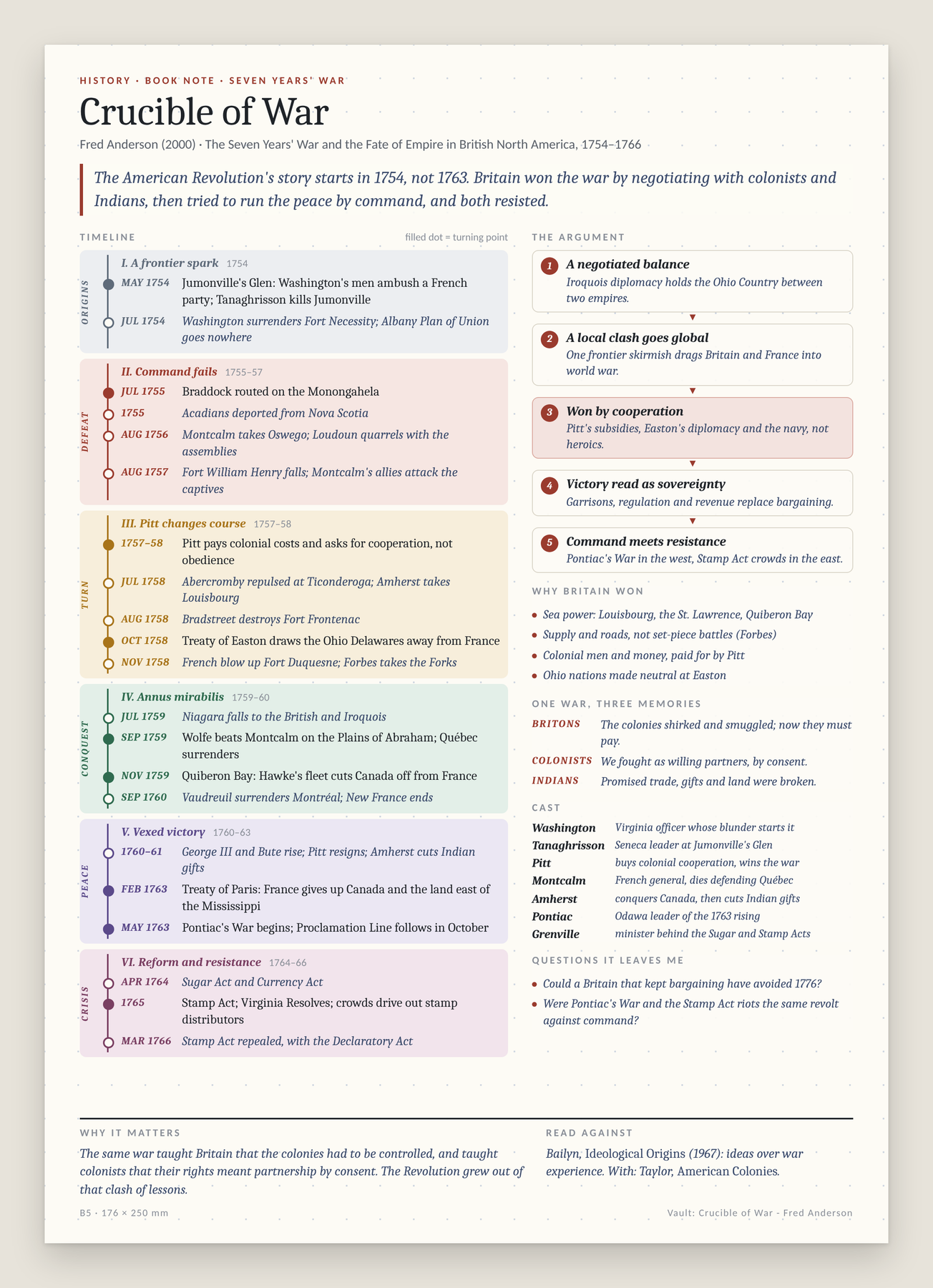
Actual practice and next return
No session recorded yet. After an actual session, add a dated entry with the question or idea, independent/helped conditions, main gap, correction, and next action. Do not mark the workbook complete just because it exists.
At the next session, try one previous idea before opening the note. Around a week later, change the cue; around a month later, reconstruct a short synthesis if the book still matters to me. These are flexible return suggestions. Use the existing Book Revisit panel in Command Center or Book Revisits (file not included in this release) when I choose to arrange a return. No reminder or review date has been set by creating this workbook.
Source checkpoints — after trying
These are assistant-written checkpoints based on the book and existing dossier, not my answers and not an independent verification of all Anderson’s historical claims. Different wording and defensible disagreement are welcome. Check whether I reconstruct the reasoning and evidence, rather than whether I repeat these sentences.
Question 1 — starting point and contingency
Anderson argues that starting in 1763 makes postwar disputes appear as steps toward an outcome contemporaries did not seek. Starting in 1754 places colonial allegiance, imperial rivalry, and Indigenous actors inside the explanation. A good answer explains how the choice of chronology affects interpretation; it does not simply say the war “caused the Revolution.”6
Question 2 — policy and mobilization
Identify the shift away from imposed quotas toward assembly cooperation, provincial rank recognition, support in arms and provisions, and prospective reimbursement. Massachusetts’s vote supplies a specific example of a changed response. Anderson connects that response to political and material conditions; personal popularity alone is insufficient. The passage reports commitments to raise men, not a direct count of men who ultimately served.1
Question 3 — several actors and causes
Connect settler incursions and Amherst’s policies with local grievances and Neolin’s religious message. Pontiac’s organizing at Detroit matters, but the spread of attacks involves multiple communities; this is not evidence of one uniform Indigenous objective or a single commander directing everything. French contacts belong in the context without replacing Indigenous motives.2
Question 4 — a reasonable problem and a disputed remedy
The British fiscal and defense pressures were real within Anderson’s account. Grenville saw a relatively moderate, broadly distributed, administratively practical tax. The dispute also concerned the authority to impose obligations and what that implied for colonial rights and assemblies. A fair answer can recognize the first point while explaining why it did not settle the second.345
Question 5 — victory, agreement, and limits
Anderson distinguishes military predominance from effective rule. Repeal did not reconcile competing views of sovereignty or remove fiscal, commercial, and frontier problems. Colonists could resist in the name of English liberty while still identifying as British subjects. Explain the unresolved conditions without turning them into proof that one later outcome was unavoidable.56
When checking my work, the assistant should identify what is accurate, one consequential correction, the exact supporting passage, and one retry. Mark unsupported or uncheckable details honestly. Give feedback in chat unless I ask to save it.
Sources and page convention
All numbered book pages above are PDF viewer pages in the vault’s edition, not printed page numbers. The assigned passages were checked directly during workbook preparation on 5 November 2026. Links navigate to pages; no PDF annotations or highlights were created. The larger chapter routes lead to the existing book note’s synthesis.
The learning sequence adapts My Learning Process, Memory Retrieval Techniques, and Goodnotes and Obsidian - Reading and Review Workflow. Learning Checklist supplies optional writing ideas, especially a concrete scene connected to a larger question. The exercise timings and essay length are practical choices. This workbook does not claim that any named learning protocol has been scientifically tested as a whole.
Footnotes
-
Anderson, Crucible of War, Chapter 22, “Deadlock, and a New Beginning,” PDF viewer pp. 291–294. Open p. 291 (file not included in this release) → p. 294 (file not included in this release). ↩ ↩2
-
Anderson, Crucible of War, Chapter 56, “Amherst’s Reforms and Pontiac’s War,” PDF viewer pp. 635–639. Open p. 635 (file not included in this release) → p. 639 (file not included in this release). ↩ ↩2
-
Anderson, Crucible of War, Chapter 59, “An Urgent Search for Order,” PDF viewer pp. 664–665. Open p. 664 (file not included in this release) → p. 665 (file not included in this release). ↩ ↩2
-
Anderson, Crucible of War, Chapter 66, “Stamp Act and Quartering Act,” PDF viewer pp. 755–757. Open p. 755 (file not included in this release) → p. 757 (file not included in this release). ↩ ↩2
-
Anderson, Crucible of War, Chapter 72, “The Hollowness of Empire,” PDF viewer pp. 825–829. Open p. 825 (file not included in this release) → p. 829 (file not included in this release). ↩ ↩2 ↩3
-
Fred Anderson, Crucible of War: The Seven Years’ War and the Fate of Empire in British North America, 1754–1766, vault Vintage edition, Introduction, PDF viewer pp. 31–34. Open p. 31 (file not included in this release) → p. 34 (file not included in this release). ↩ ↩2 ↩3