📓 In your handwritten notebooks
- March 21 – June 9 2026, pp. 168–171 — *Genghis Khan — Weatherford* → open PDF p181 (file not included in this release)
Index: Personal Journal
DESCRIPTION
NEW YORK TIMES BESTSELLER • The startling true history of how one extraordinary man from a remote corner of the world created an empire that led the world into the modern age—by the author featured in Echoes of the Empire: Beyond Genghis Khan. The Mongol army led by Genghis Khan subjugated more lands and people in twenty-five years than the Romans did in four hundred. In nearly every country the Mongols conquered, they brought an unprecedented rise in cultural communication, expanded trade, and a blossoming of civilization. Vastly more progressive than his European or Asian counterparts, Genghis Khan abolished torture, granted universal religious freedom, and smashed feudal systems of aristocratic privilege. From the story of his rise through the tribal culture to the explosion of civilization that the Mongol Empire unleashed, this brilliant work of revisionist history is nothing less than the epic story of how the modern world was made.
Handwritten journal source
Consolidated source: PDF pp. 183–186 (file not included in this release)
Source boundary: These are handwritten source pages. Use the scan for exact wording; verify quotations and factual claims before reuse.
Embedded preview:
March 21-June 9 2026.pdf (file not included in this release)
Open the journal routing table
Chapter 7: “Warring Queens”
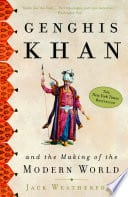
Book: Genghis Khan and the Making of the Modern World by Jack Weatherford
Core theme: After Genghis Khan’s death, the empire was held together, redirected, and eventually destabilized through a decade of rule by powerful women, followed by Mongke Khan’s attempt to restore centralized Mongol power and resume world conquest.
Chapter Objective
This chapter explains how the Mongol Empire transitioned from the age of Genghis Khan and Ogodei into the age of Mongke, Khubilai, Hulegu, and Arik Boke. Weatherford’s main argument is that women were not marginal figures in this transition; they were central political actors. While Mongol men were away conquering, women governed the empire, managed succession struggles, supported religion and learning, controlled courts, and determined which branch of Genghis Khan’s family would inherit imperial authority.
The chapter then shifts from the “warring queens” to Mongke Khan, whose rule marked both the height of Mongol imperial power and the beginning of its fragmentation.
Main Ideas
1. Mongol women ruled during the empire’s most important succession crisis
Weatherford opens by emphasizing that while Mongol men were occupied with war, Mongol women administered the empire. This was not completely new: among steppe herding peoples, women traditionally managed domestic and economic affairs while men hunted, herded, or fought. But after Genghis Khan’s conquests, the “household” had become an empire.
Several women controlled major imperial regions:
- Sorkhokhtani, widow of Tolui, ruled northern China and eastern Mongolia.
- Ebuskun, widow of Chaghatai, ruled Central Asia/Turkestan.
- Toregene, wife of Ogodei, gradually took over administration as Ogodei declined into alcoholism.
- After Ogodei’s death in 1241, Toregene became official regent.
For roughly a decade, from 1241 to 1251, a small group of women controlled the largest empire in the world. Weatherford stresses that these women were often not born Mongol; many came from conquered steppe tribes, and many were Christian. Neither gender nor religion prevented them from rising to power.
The chapter’s title, “Warring Queens,” refers to the fierce succession struggle among these women, each seeking to place her own son in control of the empire.
2. Toregene Khatun becomes regent and engineers Guyuk’s election
Ogodei had nominated one of his grandsons as successor, but Toregene wanted her own son, Guyuk, to become Great Khan. At first, she could not secure enough support from the Golden Family to elect him. So she spent five years building political backing.
Her strategy included:
- dismissing Ogodei’s ministers;
- replacing them with her own loyalists;
- relying heavily on Fatima, a Persian or Tajik captive who became her closest adviser;
- using her regency to consolidate court power.
Fatima became a major figure in Mongol politics. The Persian chronicler Juvaini, who disliked politically powerful women, portrayed her as having extraordinary influence over Toregene. Weatherford uses this to show both Fatima’s real importance and the misogynistic suspicion directed toward women in power.
By 1246, Toregene had enough control to orchestrate Guyuk’s election. She staged his installation as a grand imperial event, drawing foreign dignitaries from across the empire and beyond.
3. The first direct contact between Europe and the Mongols goes badly
During Guyuk’s installation, the first official western European envoy arrived at the Mongol court: Friar Giovanni of Plano Carpini, sent by Pope Innocent IV.
The pope’s letter did not offer submission or tribute. Instead, it chastised the Mongols for invading Christian lands and demanded that they stop attacking Christians. The pope also asserted his own authority as God’s representative on earth.
Guyuk responded from an opposite worldview. He asked how the pope could know God’s will and claimed that God had given the Mongols power over the world. Rather than accepting the pope’s authority, Guyuk ordered the pope and European princes to come to Karakorum and submit to the Mongol khan.
Weatherford presents this as a failed diplomatic opening. Instead of recognizing possible shared religious ground, both sides spoke past each other. The first direct diplomatic contact between Europe and the Far East became an exchange of theological and political insults.
4. Guyuk’s reign becomes a campaign of revenge
After his enthronement, Guyuk moved to consolidate power. His first major target was Fatima, his mother’s adviser. He accused her of witchcraft, demanded her surrender, and eventually seized her. Around the same time, Toregene died under unclear circumstances.
Fatima was publicly tortured and executed in a gruesome way. Weatherford stresses that this violated the spirit of Genghis Khan’s practice. Genghis Khan could be harsh and ruthless, but he avoided torture and unnecessary cruelty. Fatima’s treatment marked a darker, more vindictive phase in Mongol court politics.
Guyuk then pursued revenge against political rivals:
- he killed people associated with Fatima;
- he prosecuted Temuge Otchigen, Genghis Khan’s youngest brother and a possible rival claimant;
- he removed or investigated women ruling other branches of the empire;
- he began moving west under the pretense of a great hunt, likely intending to attack Batu Khan in Russia.
Sorkhokhtani secretly warned Batu. Guyuk died mysteriously after only eighteen months in office. Weatherford implies that assassination is plausible, though the sources do not clearly prove who killed him.
5. Sorkhokhtani outmaneuvers her rivals and places Mongke on the throne
After Guyuk’s death, his widow Oghul Ghaimish tried to become regent, just as Toregene had done. But she lacked Toregene’s political skill, and her own sons undermined her by setting up rival courts.
This gave Sorkhokhtani her opportunity. She allied with Batu Khan, the powerful ruler of the western Mongol domains. Batu called a khuriltai in 1250 near Lake Issykul, outside Mongolia. This gathering elected Sorkhokhtani’s eldest son, Mongke, as Great Khan, but the Ogodei faction objected because the election was not held in Mongolia proper.
Sorkhokhtani solved the problem brilliantly. She controlled the sacred Mongol homeland where Genghis Khan had been born, elected, and buried. No Mongol prince could easily reject a khuriltai held there. With military protection from Batu’s brother Berke, she organized a second election. On July 1, 1251, Mongke was proclaimed Great Khan.
This was Sorkhokhtani’s greatest political achievement. Weatherford presents her as one of the most successful political mothers in world history. She produced four sons who would dominate the next phase of Mongol history:
- Mongke, Great Khan;
- Khubilai, later Great Khan and founder of the Yuan dynasty in China;
- Hulegu, conqueror of Persia and founder of the Ilkhanate;
- Arik Boke, later rival claimant to the title of Great Khan.
6. Mongke’s accession brings a purge of rival branches
Mongke’s rise did not lead to peaceful reconciliation. Members of the Ogodei family arrived late to the celebration and were accused of plotting an attack. Mongke arrested them and began trials.
Because descendants of Genghis Khan could not be tortured or have their blood shed, Mongke punished them through methods that avoided bloodshed. Their advisers, however, were tortured into confessing. In total, Mongke executed many people connected to Ogodei’s line.
At the same time, Sorkhokhtani dealt with the rival women. Oghul Ghaimish was arrested, publicly humiliated, wrapped in felt, and drowned. Other women of the family were also killed.
The purge spread across the empire. Mongke sent investigators throughout Mongol territories to identify anyone disloyal to Tolui’s branch. The Ogodei and Chaghatai lines were weakened, and Tolui’s line became dominant.
Weatherford’s key point: Sorkhokhtani had secured the empire for her sons, but the victory came through ruthless dynastic violence. She died in early 1252, shortly after seeing her family triumph.
7. The decade of female rule left lasting institutional effects
Although the women fought one another, Weatherford argues that their decade of rule had important constructive consequences. They brought outside talent into Mongol administration, supported monasteries and schools, encouraged printing, and promoted the exchange of ideas.
This is one of the chapter’s most important interpretive claims: the women’s legacy was not merely political intrigue. They helped create institutions that would have long-term effects across Eurasia.
Their rule ended with Sorkhokhtani’s death, but the institutions and networks they supported continued to shape the empire after the men resumed large-scale conquest.
8. Mongke Khan tries to restore discipline, legitimacy, and imperial order
Mongke is presented as very different from Ogodei and Guyuk. He was sober, serious, disciplined, and committed to ancestral Mongol law. His statement, “I follow the laws of my ancestors; I do not imitate other countries’ ways,” summarizes his self-image.
To strengthen his legitimacy, Mongke retroactively awarded his father Tolui the title of Great Khan. This mattered because Tolui had been Genghis Khan’s youngest son, the Otchigen, or Prince of the Hearth. By claiming that Tolui should have inherited Genghis Khan’s title, Mongke gave his own rule a stronger dynastic foundation.
Mongke also transformed Karakorum from the seat of Ogodei’s family into a true imperial capital. He employed captured European craftsmen, especially the Parisian goldsmith Guillaume Boucher, to build the famous Silver Tree of Karakorum.
The tree symbolized the empire’s universal ambitions. Its four serpents represented the four directions of Mongol expansion, and the four drinks flowing from it symbolized the products of different civilizations: wine, airak, rice wine, and mead. It was both an artistic marvel and a political statement: the Mongol Empire stood at the center of the world.
9. Mongke’s court becomes a center of religious debate and tolerance
Christianity temporarily gained influence at Mongke’s court, partly because many women of the Golden Family were Christian and because Christian vassal states such as Georgia and Armenia had been loyal to the Mongols.
The Franciscan monk William of Rubruck, envoy of King Louis IX of France, visited Mongke’s court in 1253–1254. His account gives Weatherford a way to contrast Mongol religious pluralism with the intolerance of Christian and Muslim states of the same period.
Rubruck observed Christian rituals at court but disliked the Assyrian, Armenian, and Orthodox Christians there because he considered them heretics. The Mongols, however, did not define themselves primarily by religion. Even a Mongol Christian general reportedly said he was not a Christian; he was a Mongol.
Mongke organized a formal debate among Christians, Muslims, and Buddhists. It was treated almost like a wrestling match, with judges and rules. The participants debated topics such as:
- God’s nature;
- creation;
- good and evil;
- the soul;
- reincarnation;
- whether God created evil.
No side convinced the others. Eventually, the Christians sang, Muslims recited the Qur’an, Buddhists meditated, and everyone drank until the debate dissolved.
Weatherford contrasts this with Europe, where Louis IX was burning Jewish books and the Catholic Church was moving toward sanctioned torture of heretics. Mongke’s famous statement captures the chapter’s theme of Mongol religious tolerance: just as God gave different fingers to the hand, He gave different ways to men.
10. Mongke reforms imperial administration and finances
Mongke’s interest in Rubruck was more diplomatic and commercial than religious. His real goal was to reorganize the empire for renewed conquest.
He ordered empire-wide censuses to measure:
- people;
- animals;
- orchards;
- farms;
- taxable resources;
- military and labor potential.
This gave him centralized knowledge of the empire and greater control over local officials.
He also addressed the empire’s financial disorder. Guyuk had issued many paper drafts and debts, and some officials wanted to ignore them after his death. Mongke chose to honor those debts to preserve trust with merchants. Weatherford treats this as a major act of financial intelligence: Mongke understood that commerce depended on confidence.
He created a Department of Monetary Affairs in 1253 to regulate paper money and prevent inflation. He also standardized currency around a silver ingot measure called the sukhe, allowing different local currencies to be measured against a common standard. This made taxation, accounting, and long-distance trade easier across the empire.
This section presents Mongke as a ruler concerned not only with conquest but with administration, fiscal stability, and commercial integration.
11. Mongke launches the Second Mongol World War
Once the empire was stabilized, Mongke resumed the unfinished goals of Genghis Khan:
- conquest of the Sung dynasty in southern China;
- conquest of the Arab and Persian Muslim world.
He divided the work among his brothers:
- Hulegu received the Army of the Right and was sent west against Persia, Baghdad, Damascus, and Cairo.
- Khubilai received the Army of the Left and was sent against the Sung dynasty.
- Arik Boke remained in Mongolia to help manage the imperial center.
- Mongke stayed at the center as Great Khan.
This marked a renewed phase of global Mongol expansion.
12. Hulegu destroys the Assassins and conquers Baghdad
Hulegu moved west with a massive, highly organized army. Unlike Genghis Khan’s faster and more mobile forces, Hulegu’s army included engineers, medical corps, clerks, carts of supplies, and siege specialists.
His first major target was the Nizari Ismailis, known in the West as the Assassins. They controlled mountain fortresses and wielded influence through assassination. Hulegu used a combination of siege warfare and political strategy. Rather than capture every castle separately, he focused on forcing the Imam/Grand Master to surrender, then used him to order other fortresses to submit.
After the Assassins were crushed, Hulegu turned toward Baghdad, the symbolic, cultural, and political center of the Muslim world. The Abbasid Caliph refused to submit, believing the Muslim world would rise to defend him.
The Mongols surrounded Baghdad in January 1258. Weatherford emphasizes their military innovation: they used siege engineering, flooding, explosives, proto-grenades, mortars, incendiary rockets, and gunpowder-based weapons. On February 5, 1258, they broke through the walls. The Caliph surrendered after several days.
Baghdad was looted and devastated. Christians in the city were spared and, in Weatherford’s account, participated in looting and revenge against Muslims. Hulegu executed the Caliph without shedding blood, in the Mongol fashion, likely by wrapping or enclosing him and having him trampled or beaten.
Weatherford presents the fall of Baghdad as one of the greatest turning points in Islamic history. The Mongols achieved in two years what Crusaders and Seljuk Turks had failed to accomplish in two centuries: they conquered the heart of the Arab world.
13. Mongol expansion west reaches its limit at Ayn al-Jalut
After Baghdad, Damascus surrendered, and Mongol armies reached the Mediterranean. It appeared that the Mongols might conquer the rest of the Muslim world.
But their western expansion stopped in 1260 at Ayn al-Jalut, near the Sea of Galilee. There, the Mamluks of Egypt defeated a Mongol detachment. Weatherford presents this as the western boundary of Mongol expansion.
The empire had reached its maximum extent in the west.
14. Khubilai struggles in China, forcing Mongke to intervene personally
While Hulegu was victorious in the Middle East, Khubilai’s campaign against the Sung was slow and disappointing.
Khubilai was culturally drawn to China and lived more like a sedentary prince than a traditional Mongol warrior. Weatherford presents two possible interpretations of him:
- sympathetic view: Khubilai was careful, mature, and strategically patient;
- critical view: he lacked Mongol military aptitude and relied on talented generals.
Mongke grew frustrated. He sent investigators into Khubilai’s administration. They found corruption and executed several officials. Khubilai was summoned to Karakorum and humiliated himself before Mongke, who publicly forgave him. But the deeper issue remained: the Sung conquest had stalled.
Mongke decided he would lead the campaign himself.
15. Mongke’s death freezes the empire and ends unified Mongol expansion
Mongke personally led an invasion toward the Sung. He followed Genghis Khan’s strategy of attacking weaker surrounding areas first, including Sichuan and Yunnan, before closing in on the main target.
But the southern climate devastated the Mongol army. Many soldiers suffered from disease, likely dysentery. Mongke became ill, seemed to recover, and then died suddenly on August 11, 1259. Sources disagree on the cause: cholera, dysentery, or an arrow wound.
His death changed everything.
Instead of returning to Mongolia for a unified succession process, the major Mongol factions stayed where they were and protected their territories:
- Hulegu stayed in the Middle East.
- The Golden Horde stayed in Russia and the western steppe.
- Khubilai and Arik Boke began competing for the title of Great Khan.
Weatherford’s conclusion is that Mongke was the last Great Khan recognized by the whole empire. After him, different branches continued to rule different territories, and many claimed supreme legitimacy, but no one again held universal recognition.
The Second Mongol World War did not end in victory or defeat. It simply “flickered out.”
Key Concepts
Warring Queens
The chapter’s central concept is that women were not passive figures in Mongol politics. Toregene, Sorkhokhtani, Oghul Ghaimish, Fatima, and others shaped succession, administration, diplomacy, and policy. Their struggle determined which branch of Genghis Khan’s family would dominate the empire.
The Golden Family
The ruling descendants of Genghis Khan. Much of the chapter is about conflict among different branches of this family: the lines of Ogodei, Chaghatai, Jochi, and Tolui.
Regency
Because succession was not automatic, widows and mothers could rule temporarily while arranging the election of a new khan. Toregene and Oghul Ghaimish both tried this, but Sorkhokhtani was the most successful in using succession politics to place her son on the throne.
Khuriltai
A Mongol political assembly where leaders were elected or confirmed. Control over where and when a khuriltai was held could shape the outcome. Sorkhokhtani’s genius was holding the decisive khuriltai in the sacred Mongol homeland.
Otchigen / Prince of the Hearth
The youngest son, who traditionally inherited the family hearth and homeland. Mongke used this concept to strengthen Tolui’s posthumous claim to greatness and, by extension, his own legitimacy.
Religious Tolerance
Mongke’s court hosted Christians, Muslims, Buddhists, and shamans. Weatherford contrasts Mongol pluralism with the religious persecution occurring in Europe and the Islamic world. Mongol tolerance was not modern liberal tolerance, but it created space for debate and coexistence under imperial rule.
Monetary Standardization
Mongke strengthened the empire by regulating paper money, paying debts, standardizing currency exchange, and monetizing taxes. This made the empire more administratively coherent and commercially reliable.
Second Mongol World War
Weatherford describes Mongke’s renewed expansion against the Sung dynasty and the Islamic world as a second world war. It pushed the empire to its greatest extent but ended after Mongke’s death.
Major Figures
Toregene Khatun
Ogodei’s wife and regent after his death. She used her power to secure the election of her son Guyuk. She was politically skilled, but her success led to backlash after Guyuk’s accession.
Fatima
Toregene’s adviser, a Persian or Tajik captive who became one of the most powerful women in the empire. Guyuk accused her of witchcraft, tortured her, and executed her.
Guyuk Khan
Son of Ogodei and Toregene. His short reign was marked by revenge, cruelty, and attempts to consolidate power. He planned to attack Batu but died mysteriously.
Sorkhokhtani
Widow of Tolui and mother of Mongke, Khubilai, Hulegu, and Arik Boke. She is the chapter’s most successful political strategist. She outmaneuvered rival queens, allied with Batu, secured Mongke’s election, and transferred imperial power to Tolui’s line.
Oghul Ghaimish
Guyuk’s widow. She attempted to rule as regent after Guyuk’s death but lacked the political skill and support needed to succeed. She was eventually executed after Mongke’s rise.
Mongke Khan
Sorkhokhtani’s eldest son and Great Khan from 1251 to 1259. He restored discipline, purged rivals, reorganized finances, supported religious debate, resumed conquest, and brought the empire to its greatest extent. He was the last Great Khan accepted by the entire Mongol Empire.
Hulegu
Mongke’s brother, sent west to conquer Persia and the Arab world. He destroyed the Assassins, captured Baghdad, and founded Mongol rule in Persia.
Khubilai
Mongke’s brother, sent against the Sung dynasty. He struggled militarily and politically but would later become one of the most famous Mongol rulers.
Arik Boke
Youngest brother of Mongke, Khubilai, and Hulegu. Left in charge of Mongolia during Mongke’s campaign. After Mongke’s death, he became Khubilai’s rival for the title of Great Khan.
Timeline of the Chapter
1241
Ogodei dies. Toregene becomes regent.
1241–1251
A decade of female rule begins. Toregene, Sorkhokhtani, Ebuskun, Oghul Ghaimish, and other women shape imperial politics.
1246
Toregene secures Guyuk’s election as Great Khan. Friar Giovanni of Plano Carpini arrives as envoy from Pope Innocent IV.
1246–1248
Guyuk consolidates power, tortures and executes Fatima, purges rivals, and prepares to attack Batu.
1248
Guyuk dies mysteriously.
1250
Batu and Sorkhokhtani organize a khuriltai that elects Mongke, but the Ogodei faction contests it.
July 1, 1251
A second khuriltai in the sacred Mongol homeland proclaims Mongke Great Khan.
1251–1252
Mongke and Sorkhokhtani purge the Ogodei faction. Oghul Ghaimish is executed.
February 1252
Sorkhokhtani dies. The decade of ruling women ends.
1253
Mongke reforms imperial finances, creates the Department of Monetary Affairs, and launches renewed campaigns. Hulegu heads west; Khubilai heads toward China.
1254
William of Rubruck attends Mongke’s court and observes religious debates.
1256
Hulegu defeats the Assassins.
February 1258
Baghdad falls to Hulegu.
1258–1259
Mongke personally leads the campaign against the Sung.
August 11, 1259
Mongke dies during the Chinese campaign.
1260
The Mamluks defeat a Mongol detachment at Ayn al-Jalut, stopping Mongol expansion westward.
Overall Interpretation
Chapter 7 shows the Mongol Empire at both its height and its turning point. The empire reached unprecedented power because of the political skill of women like Sorkhokhtani and the administrative discipline of Mongke. But the same dynastic struggles that elevated Tolui’s line also weakened the unity of the empire.
Weatherford’s deeper point is that Mongol history was not simply a story of male warriors conquering cities. It was also a story of women governing, arranging succession, patronizing learning, shaping religious policy, and deciding the fate of empires.
By the end of the chapter, Mongke’s death marks the end of the unified Mongol Empire. The empire still existed, and its separate branches remained powerful, but universal rule under one Great Khan was over. The Mongol world had reached its greatest physical extent, but its political unity had begun to fracture.
Chapter 8: “Khubilai Khan and the New Mongol Empire”
Book: Genghis Khan and the Making of the Modern World by Jack Weatherford
Core theme: Khubilai Khan transformed the Mongol Empire from a nomadic conquest machine into a hybrid imperial state centered on China. He succeeded where Genghis Khan had failed by conquering and unifying China through administration, propaganda, cultural adaptation, legal reform, commerce, and public spectacle. But his later naval failures and luxurious court life also showed that the empire had begun to lose the disciplined spirit of Genghis Khan.
Chapter Objective
This chapter explains how Khubilai Khan created a new kind of Mongol Empire. Unlike Genghis Khan, who relied primarily on mobility, terror, military strategy, and steppe discipline, Khubilai understood that China could not be conquered by force alone. To rule the most populous civilization on earth, he had to appear legitimate to Chinese subjects.
His solution was to become, outwardly, a Chinese emperor. He built a Chinese capital, adopted Chinese dynastic language, created Chinese-style ancestral rituals, supported Chinese institutions, and presented himself as the ruler favored by Heaven. At the same time, behind the walls of his court, he and his family continued to live as Mongols.
The chapter therefore presents Khubilai as both a brilliant political adapter and a symbol of Mongol decline: he created a powerful new empire, but one increasingly separated from the original hard discipline of Genghis Khan.
Main Ideas
1. Khubilai understood that China required political conquest, not just military conquest
Weatherford begins by arguing that Khubilai’s genius came from recognizing that China could not be conquered by brute force alone. He lacked the pure military ability of Genghis Khan, but he surpassed many of his relatives in political intelligence. He understood that victory over China required public legitimacy.
China had often been a cultural civilization more than a unified political state. Educated Chinese elites shared written language, classical texts, artistic traditions, and a dream of unity, but China was usually divided among competing dynasties, regions, and peoples.
Khubilai used this dream of unity to his advantage. He presented himself as the ruler who could finally achieve what the Sung dynasty could not: the unification of China under one government. In Weatherford’s interpretation, Khubilai won China by making himself appear more capable of fulfilling the Chinese ideal than the Chinese rulers themselves.
2. Khubilai built a Chinese identity around Mongol rule
Khubilai’s state-building project required a new public image. He did not abandon his Mongol identity, but he wrapped Mongol power in Chinese symbols.
He adopted the reign name Zhiyuan, meaning “complete beginning,” and in 1271 declared the dynastic name Da Yuan, meaning “great origins” or “great beginnings.” This gave Mongol rule a formal place in Chinese dynastic history.
He also built ancestral temples and commissioned Chinese rituals for his family. He gave his ancestors Chinese-style titles and had portraits made of them so that Mongol warriors looked more like Chinese sages. This was propaganda, but it was also statecraft. Khubilai was trying to make his foreign dynasty appear like the legitimate continuation of Chinese imperial order.
His strategy had three parts:
- military pressure;
- public propaganda;
- effective administration.
The third part mattered most for winning over the population.
3. Khubilai built Dadu/Khanbalik, the future Beijing, as a world capital
Khubilai needed a real imperial capital, not just a tent court or a nomadic base. He kept Shangdu/Xanadu as a summer residence, but he built a new capital farther south near the old Jurchen capital of Zhongdu.
The Mongols called the city Khanbalik, meaning “City of the Khan.” The Chinese called it Dadu, the “Great Capital.” It became modern Beijing.
The city was designed partly in Chinese style and partly for Mongol needs. Its broad, straight streets allowed military movement and control. Guards at one gate could see across the city to the opposite gate. The boulevards were wide enough for Mongol cavalry to move rapidly if the local population rebelled.
Khubilai also made the city cosmopolitan. It included districts for Mongols, Middle Easterners, Chinese from different regions, merchants, priests, doctors, scholars, and foreigners from as far away as Italy, India, and North Africa. Roman Catholic, Nestorian Christian, Buddhist, Taoist, Confucian, Muslim, Indian, and Jewish figures all appeared in the broader world of Mongol China.
Dadu was not merely a Chinese capital. It was a world capital.
4. The Mongols ruled publicly as Chinese emperors but privately lived as steppe Mongols
At the heart of Dadu, Khubilai created a protected Mongol world: the early form of the Forbidden City. Behind high walls, guarded by Mongol warriors, the royal family continued to live according to Mongol customs.
The court kept open areas for animals, used gers, ate Mongol foods, drank heavily, and preserved steppe customs. Pregnant royal women made sure their children were born in gers. Children received lessons in gers. Mongol dress, language, rituals, food, and entertainment continued behind the walls.
This created a split identity:
- outwardly, Khubilai was a Chinese emperor;
- inwardly, he remained a Mongol khan.
Weatherford emphasizes the awkwardness of this cultural mixture. Mongol women mingled freely with men at court ceremonies, Mongols drank heavily, slurped soup, cut meat at the table, and swarmed in ways that disturbed Chinese expectations of order and rank.
Khubilai’s empire was therefore not simply Mongol becoming Chinese. It was a hybrid civilization.
5. Khubilai used law to create legitimacy and win support
Like Genghis Khan, Khubilai understood that law could unify diverse peoples. He did not simply replace Chinese law with Mongol law. Instead, he reformed Chinese law to make it more compatible with Mongol principles and more appealing to Chinese subjects.
His administration:
- guaranteed property rights;
- reduced taxes;
- improved roads and communication;
- reduced the number of capital offenses;
- limited executions;
- substituted fines for physical punishments when possible;
- restricted torture;
- encouraged amnesty for repentant criminals.
Weatherford stresses that Mongol rule in China was often milder than the Sung legal system it replaced. The Sung had 233 capital offenses; the Mongols reduced this to 135. Khubilai also rarely used execution compared with many other societies.
The Mongols especially disliked unnecessary bloodshed and certain forms of bodily mutilation. For example, Chinese authorities often tattooed crimes on criminals’ foreheads, but Mongols considered the forehead sacred because it housed the soul. They moved tattooing to the arms or neck and prevented its spread to groups that did not already practice it.
Khubilai’s legal reforms reveal a broader Mongol ideal: law was not only for punishment but also for preserving peace, managing conflict, and creating social order.
6. Mongol law encouraged practical justice, evidence, and local dispute resolution
The Mongols promoted a more practical and accessible legal culture. They encouraged local settlement of disputes whenever possible. Family disputes could be handled by families, religious disputes by religious communities, and professional disputes by professional councils.
They also printed books on criminology and created standards for crime-scene investigation. Officials were expected to collect evidence, examine corpses, document wounds, and submit reports in triplicate. Weatherford presents this as part of the Mongol preference for practical, useful knowledge over purely classical education.
The law was meant to be understandable and usable by ordinary people, not only by elite scholars. This fit the broader Mongol policy of expanding access to knowledge, professions, administration, and legal process.
7. Khubilai rejected the old mandarin examination system
Although the Mongols were few and ruled over a huge Chinese population, Khubilai refused to simply depend on the traditional Confucian mandarin class.
He abolished the old civil service exams and staffed the government with a diverse mix of peoples:
- northern Chinese;
- southern Chinese;
- Muslims;
- Tibetans;
- Armenians;
- Khitan;
- Arabs;
- Tajiks;
- Uighurs;
- Tangut;
- Turks;
- Persians;
- Europeans when available.
This prevented any one ethnic group from dominating administration. It also made officials dependent on the Mongol state rather than on local social networks.
Khubilai also promoted men from low-status jobs, such as cooks, scribes, translators, gatekeepers, and servants. Like Genghis Khan, he valued ability and loyalty over birth.
8. Khubilai experimented with councils and salaried administration
Instead of relying entirely on top-down bureaucracy, Khubilai introduced councils modeled on the Mongol khuriltai tradition. Local councils had to meet regularly, deliberate, and reach consensus. Major decisions required approval from more than one official.
By Chinese standards, this was inefficient. But to the Mongols, group deliberation made government more legitimate and less dependent on a single official.
The Mongols also replaced many unpaid officials, who often survived through extortion, with salaried employees. This was meant to reduce corruption and make administration more regular.
Weatherford notes that this system did not survive the Mongols. When the Ming dynasty came to power, China returned to more traditional bureaucratic forms. Still, he presents the Mongol experiment as an important but temporary attempt at participatory administration.
9. Khubilai expanded paper money, credit, and commercial integration
Khubilai greatly expanded the use of paper money. Marco Polo was amazed by this system. The money was made from mulberry bark, cut into rectangles, marked with value, and stamped with an official seal.
The advantages were clear:
- easier to transport than metal coins;
- useful across the empire;
- helpful for trade and taxation;
- connected markets under Mongol authority.
Mongol authorities tried to introduce paper money in Persia, but merchants resisted, and the attempt failed.
The Mongols also developed bankruptcy rules. A person could declare bankruptcy twice, but a third time could lead to execution. This was meant to stabilize credit markets and prevent people from abusing debt protection.
Khubilai’s monetary policy shows how much the Mongols valued commerce. They did not merely conquer territory; they built systems that moved goods, money, people, and information across Eurasia.
10. Khubilai promoted schools, literacy, archives, and a universal script
Although the Mongols rejected parts of Chinese culture, especially Confucian hierarchy and foot binding, they adopted and expanded useful Chinese institutions.
Khubilai revived the Hanlin Academy, supported scholars, built schools, and founded institutions for Mongolian language and higher learning. He maintained scribes in many languages, including Mongol, Arabic, Persian, Uighur, Tangut, Jurchen, Tibetan, and Chinese.
Because the empire contained so many languages, Khubilai attempted one of the most ambitious administrative experiments in world history: a universal script. He assigned the Tibetan lama Phagspa to create a script that could write all languages of the empire.
Phagspa presented a forty-one-letter alphabet in 1269. Khubilai made it the official script of the empire, but he did not force people to abandon their own writing systems. The project ultimately failed because Chinese scholars and other peoples remained attached to their traditional scripts. But Weatherford presents the attempt as bold and innovative.
Khubilai also promoted public education. Peasant families were organized into local units called she, which managed farming, water, famine reserves, and local affairs. They were also responsible for education. The Mongols created public schools for children, including peasant children, and used colloquial language rather than classical Chinese.
The chapter claims that Khubilai’s reign saw the creation of more than 20,000 public schools. Even if exaggerated, Weatherford argues that this was an extraordinary achievement for the time.
11. Mongol patronage helped create a golden age of Chinese drama
The Mongols did not favor the same refined literary traditions as the Confucian elite. They preferred popular entertainment: drama, music, acrobatics, spectacle, colorful costumes, and emotional performance.
This helped elevate drama in Chinese culture. Khubilai frequently sponsored plays in the royal compound. Mongol patronage raised the status of actors and performers, who had traditionally been looked down upon.
Weatherford compares the Yuan drama tradition to Shakespearean drama in Europe: entertaining but also concerned with moral and political questions, such as the relationship between virtue and power.
The Yuan dynasty became a golden age of Chinese drama. About 500 plays were reportedly created, with around 160 surviving. This cultural development helped lay the groundwork for what later became Peking Opera.
12. Khubilai slowly undermined and defeated the Sung dynasty
Khubilai’s conquest of the Sung was not a sudden military collapse. It was a long process of erosion. His policies and propaganda convinced increasing numbers of people that the Mongols had the Mandate of Heaven and that the Sung were weak, decadent, and abandoned by fate.
Over time:
- soldiers deserted the Sung;
- officials defected;
- peasants accepted Mongol rule;
- merchants shifted trade to Mongol territory;
- priests and scholars found greater freedom under the Mongols;
- Chinese generals and entire units joined Khubilai.
Khubilai directed the political and propaganda campaign, while his general Bayan led the military campaign. In 1276, Mongol forces captured the Sung capital, Hangzhou. Remaining resistance was gradually defeated.
Khubilai treated the defeated royal family carefully. He provided for the dowager empress and allowed much of the royal family to live comfortably. To prevent the young emperor from becoming a symbol of resistance, he sent him to Tibet, where he later became a monk.
Weatherford argues that Khubilai did something Genghis Khan could not: he unified China. The Mongol Empire created the basic shape of the later Chinese state by joining Chinese-speaking regions with Tibetans, Manchurians, Uighurs, and many smaller peoples into a single imperial structure.
13. Khubilai’s land empire succeeded, but his sea empire failed
Once Khubilai controlled most lands reachable by Mongol armies, he turned toward the sea. He wanted Japan, Java, Ceylon, and the spice islands to submit to Mongol rule.
This exposed a major Mongol weakness: their strategies of mounted warfare did not translate well to naval campaigns.
First invasion of Japan, 1274
Khubilai sent envoys demanding Japanese submission, but Japan refused. In 1274, he launched an invasion with about 900 ships carrying Korean and Chinese infantry and Mongol horsemen.
The Mongols won the initial land battle. Japanese samurai expected individual combat, but the Mongols fought in formation, used arrows, and deployed exploding missiles. The Japanese retreated inland.
But that night, a storm struck. Later Japanese tradition called it the Kamikaze, or “Divine Wind.” Many Mongol ships were destroyed, and around 13,000 invaders died, mostly by drowning.
Both sides interpreted the event differently:
- Khubilai claimed victory because the Mongols had won the land battle.
- The Japanese claimed victory because the invasion failed.
The Japanese then executed Mongol envoys, a major insult in Mongol diplomatic culture.
Second invasion of Japan, 1281
Khubilai prepared a much larger invasion. One fleet came from Korea, and a larger one from China. The Japanese had prepared by building stone coastal walls and using small boats for night attacks.
The Mongol fleets were delayed, disorganized, and disease-ridden. Then another massive storm destroyed much of the armada. Perhaps more than 100,000 men died.
The invasion failed completely.
14. The Mongols influenced Southeast Asia but failed in Java
The Mongols had more success on land in Southeast Asia, including Burma, Annam in northern Vietnam, Laos, and other regions. Some kingdoms submitted voluntarily and sent tribute, including exotic gifts such as elephants, rhinoceroses, and a supposed tooth of the Buddha.
Weatherford argues that Mongol pressure helped shape the development of Korea, Vietnam, Thailand, and other regional states. It helped create new hybrid cultures, especially in Indo-China.
But Khubilai failed again when he tried to conquer Java. After a Javanese king branded the face of a Mongol envoy, Khubilai sent a fleet in 1292. The Mongols initially succeeded and killed the offending king, but then they were lured into an ambush by the new ruler. Many Mongol leaders were killed, and the army retreated in humiliation.
The failures in Japan and Java marked the eastern maritime limits of Mongol expansion.
15. The Mongol Empire reached its maximum boundaries
Weatherford identifies four frontier points that marked the limits of Mongol expansion:
- Poland/Hungary in the northwest;
- Egypt/Ayn al-Jalut in the southwest;
- Japan in the east;
- Java in the southeast.
Between roughly 1242 and 1293, Mongol expansion reached its maximum. Inside those limits, the empire created a century of relative peace, commerce, technological exchange, and intellectual movement.
Outside those limits, the Mongols could not expand further.
16. Khubilai’s later life shows decadence and loss of Mongol discipline
The chapter ends with a vivid description of Khubilai’s hunting processions. Earlier Mongols had hunted for survival and military training. Genghis Khan adapted hunting strategies into warfare. Khubilai, by contrast, transformed the hunt into a luxurious spectacle.
Too fat and ill with gout to ride comfortably, Khubilai hunted from a silk couch inside a gilded pavilion carried by elephants. His hunting caravan included:
- falconers;
- elephants;
- tigers;
- leopards;
- lynxes;
- archers;
- shamans;
- monks;
- astrologers;
- musicians;
- acrobats;
- servants;
- doctors;
- cooks;
- lavish food and drink.
He changed Genghis Khan’s hunting law so that he could hunt in spring instead of winter. His court consumed luxury foods, fermented mare’s milk from special white mares, and elaborate hangover remedies.
Weatherford’s point is symbolic. Khubilai still preserved some Mongol traditions: hunting, falcons, mare’s milk, gers, left and right military organization, and the Spirit Banner. But the substance had changed. What had once been discipline, survival, and military preparation had become spectacle, indulgence, and display.
The chapter ends by suggesting that the Spirit Banner of Genghis Khan no longer truly led his descendants. The empire would continue for another century, but it had already lost its way.
Key Concepts
Sinicization
Khubilai deliberately made Mongol rule appear Chinese. He adopted Chinese dynastic names, rituals, temples, capitals, and administrative forms. This helped him gain legitimacy among Chinese subjects.
Hybrid Empire
The Yuan dynasty was neither purely Mongol nor purely Chinese. It combined Mongol military-political traditions with Chinese institutions, Central Asian administrators, Muslim architects, Tibetan religious influence, and global commerce.
Mandate of Heaven
Khubilai used Chinese political theology to present himself as Heaven’s chosen ruler. Each Mongol victory and each Sung failure reinforced the idea that Heaven had abandoned the Sung and favored the Yuan.
Dadu / Khanbalik
Khubilai’s new capital, later Beijing. It symbolized his transformation from steppe khan into world emperor.
Forbidden City as Miniature Steppe
Inside the Chinese-style capital, the Mongol royal family preserved steppe life. The Forbidden City was a protected Mongol enclave within the imperial capital.
Legal Reform
Khubilai used law to create order, reduce punishments, protect property, limit torture, and win popular support.
Paper Money
Khubilai expanded paper currency and used it to integrate commerce across the empire. This was one of the major administrative innovations of Mongol rule.
Universal Script
The Phagspa script was Khubilai’s attempt to create a single writing system for all languages of the empire. It failed, but it shows the scale of Mongol administrative ambition.
Public Education
Khubilai promoted schools for common people, including peasants. Weatherford presents this as one of the most remarkable features of Mongol rule.
Naval Failure
The Mongols mastered land conquest but failed to adapt to maritime empire. Japan and Java marked the limits of Mongol expansion.
Decadence
The final hunting scenes show how far Khubilai’s court had drifted from the austere discipline of Genghis Khan.
Major Figures
Khubilai Khan
Grandson of Genghis Khan, brother of Mongke, Hulegu, and Arik Boke. He founded the Yuan dynasty, unified China, built Dadu, expanded paper money, promoted education, supported drama, and attempted failed naval conquests of Japan and Java.
Genghis Khan
Khubilai’s grandfather. His example looms over the chapter. Khubilai succeeded in China where Genghis had failed, but he also drifted away from Genghis’s discipline and simplicity.
Arik Boke
Khubilai’s brother and rival in the struggle for the title of Great Khan. Khubilai’s adoption of Chinese imperial identity occurred partly during and after this struggle.
Bayan
Khubilai’s highly skilled general who led the military campaign against the Sung dynasty.
Marco Polo
Venetian traveler whose descriptions of Khubilai’s court, paper money, capital, and ceremonies provide vivid details used in the chapter.
Phagspa
Tibetan Buddhist lama commissioned by Khubilai to create a universal script for the empire.
Odoric of Pordenone
Franciscan friar who visited Mongol China in the 1320s and described the Forbidden City and imperial palace.
Timeline
1260
Khubilai struggles with Arik Boke for supremacy and begins adopting Chinese-style titles.
1263
Khubilai orders an ancestral temple built for his family.
1264
He modifies his reign name to Zhiyuan, meaning “complete beginning.”
1268
Khubilai sends envoys to Japan demanding submission.
1269
Phagspa presents his new script, which Khubilai makes the official script of the empire.
1271
Khubilai declares the new dynasty Da Yuan.
1272
He orders the building of Dadu/Khanbalik, the future Beijing.
1274
First Mongol invasion of Japan. The Mongols win the land battle but lose much of the fleet to a storm.
1276
Mongol forces capture the Sung capital of Hangzhou.
1279
The Japanese execute another Mongol delegation. The Sung collapse is effectively complete.
1281
Second Mongol invasion of Japan. A massive storm destroys the armada.
1289
Khubilai sends an envoy to Java; the envoy is branded and returned.
1292–1293
Mongol invasion of Java initially succeeds but ends in ambush and retreat.
Overall Interpretation
Chapter 8 presents Khubilai Khan as one of the most successful and transformative Mongol rulers, but also as a sign of the empire’s changing character.
His achievement was extraordinary. He unified China, created the Yuan dynasty, built a new capital, expanded commerce, strengthened law, promoted education, supported the arts, experimented with writing systems, and helped create the political shape of later China. Weatherford even suggests that one of the Mongols’ greatest legacies to China was the Chinese nation itself.
But the chapter also contains a warning. Khubilai’s success depended on adaptation, compromise, and spectacle. He became powerful by becoming something other than a traditional Mongol conqueror. His court grew luxurious, theatrical, and indulgent. His naval expeditions showed that Mongol methods had limits. His hunting processions, once rooted in survival and military discipline, became empty pageantry.
So the chapter’s final message is double-sided: Khubilai created a new world empire, but in doing so he also revealed that the original spirit of Genghis Khan’s empire was fading.
Chapter 9: “Their Golden Light”
From Genghis Khan and the Making of the Modern World by Jack Weatherford
Chapter 9 argues that after the age of Mongol conquest, the Mongols created something even more historically transformative: a vast intercontinental system of trade, diplomacy, communication, technological transfer, religious exchange, and cultural diffusion. Weatherford presents the Mongol Empire not merely as a military empire, but as a world-connecting engine that helped lay foundations for the modern global system.
Chapter Objective
The chapter’s central purpose is to show how the Mongols transformed Eurasia after conquest. Instead of focusing on warfare, Weatherford emphasizes the Pax Mongolica, or “Mongol Peace,” during which the Mongols connected Europe, the Middle East, Central Asia, India, China, and Southeast Asia through protected trade routes, diplomatic missions, postal systems, scientific exchange, and cultural transmission.
The chapter also argues that Europe benefited enormously from this Mongol-created world system. Europe was never fully conquered by the Mongols, but it received the fruits of Mongol trade and technological exchange: paper, printing, gunpowder, improved navigation, new crops, new textiles, new artistic styles, and new political ideas.
Main Ideas
1. Rabban Bar Sawma symbolizes the new Mongol world system
The chapter opens with the extraordinary journey of Rabban Bar Sawma, a Christian priest and Mongol envoy sent westward from Khubilai Khan’s world. Around 1287–1288, he traveled from the Mongol capital through the Middle East and into Europe, visiting major rulers and religious authorities.
He met:
- The Mongol Ilkhan in Persia
- Emperor Andronicus II Palaeologus of Byzantium
- The College of Cardinals in Rome
- King Philip IV of France
- King Edward I of England
- Pope Nicholas IV
Weatherford uses this journey to show how dramatically the world had changed. A Mongol envoy could now travel thousands of miles across Eurasia and be received by kings and popes. Earlier, Europeans had feared the Mongols as terrifying invaders. Now Mongol representatives arrived as diplomats, priests, and cultural intermediaries.
Rabban Bar Sawma’s mission failed diplomatically because he did not secure treaties with European rulers. However, symbolically, it was hugely important. His presence showed that Europe and Asia were no longer isolated worlds. They had become connected by a single system of communication, commerce, diplomacy, and religious contact.
2. The Mongol Empire shifted from conquest to commerce
Weatherford argues that by the late thirteenth century, the Mongols had moved from being primarily a conquering force to being the managers of a giant commercial system. He describes this as the transformation from the Mongol Empire into the Mongol Corporation.
Instead of simply conquering new lands, the Mongols increasingly sought to connect regions through trade. They maintained roads, relay stations, postal routes, caravan networks, and protected commercial corridors. These systems allowed goods, people, messages, and ideas to travel across enormous distances.
The Mongols had originally created many of these roads for military purposes. But once conquest slowed, those same routes became commercial arteries.
3. The Mongol postal and relay system made long-distance exchange possible
A major part of the Mongol system was the ortoo, or yam, the relay network that placed stations every twenty to thirty miles along major routes. These stations provided:
- Fresh horses or camels
- Guides
- Food and lodging
- Protection
- Transportation support
Travelers with official Mongol authorization could move across the empire with remarkable speed and security.
Weatherford also describes the paiza, a tablet made of gold, silver, or wood that functioned like a passport, credit card, and diplomatic badge. The paiza identified the traveler’s rank and entitled him to protection, lodging, transportation, and exemption from certain local taxes.
This system made the Mongol Empire unusually open to movement compared with many earlier empires.
4. The Mongol system of shares encouraged trade across the empire
Weatherford explains that Mongol trade was not driven purely by abstract love of commerce. It was rooted in the Mongol tradition of khubi, or shares.
Under Genghis Khan’s system, members of the ruling family were entitled to shares of wealth from different regions of the empire. This meant that Mongol elites had claims on goods, workers, herds, workshops, and products spread across Eurasia.
For example:
- Hulegu in Persia had claims on silk workers in China.
- Khubilai had farms and herds in Persia and Iraq.
- Mongol rulers exchanged spices, jewels, textiles, medicines, porcelain, steel, falcons, furs, animals, and craftsmen across regions.
Even when different branches of the Mongol family fought politically, they often continued exchanging goods because their economic interests were interdependent. Weatherford’s point is that Mongol imperial finance created a powerful incentive to keep trade routes open.
5. The Mongols improved geography, cartography, and long-distance knowledge
The Mongols actively gathered maps, atlases, astronomical charts, and geographic information from conquered peoples. Khubilai Khan sponsored expeditions, including one in 1281 to map the source of the Yellow River.
Mongol scholars synthesized knowledge from Chinese, Arab, Persian, Greek, and Central Asian sources. Under Arab influence, particularly through figures such as Jamal al-Din, they produced advanced maps and even terrestrial globes that depicted Europe, Africa, Asia, and Pacific islands.
This cartographic work mattered because the Mongols needed accurate knowledge to govern, trade, tax, move armies, and coordinate long-distance administration.
6. The Mongols expanded water transport and maritime trade
Weatherford emphasizes that although Mongol armies had moved quickly over land, bulk goods moved more efficiently by water. Under Khubilai Khan, the Mongols expanded canals, improved ports, promoted shipbuilding, and increased maritime transport.
They extended the Grand Canal and used ships to move grain and other goods across China. Over time, the volume of goods transported by ship grew massively.
The Mongols also learned from their failed naval invasions of Japan and Java. Even though those military ventures failed, the shipbuilding knowledge gained from them was turned toward commerce. Mongol-era ships connected China with Southeast Asia, India, Ceylon, Arabia, and the Persian Gulf.
The route from Zaytun in southern China to Hormuz in the Persian Gulf became one of the great commercial sea routes of the age.
7. The Mongols encouraged Chinese migration and overseas trading communities
To expand commerce beyond direct Mongol political control, the Mongols encouraged Chinese merchants and settlers to establish trading communities abroad.
Chinese traders settled in:
- Vietnam
- Cambodia
- The Malay Peninsula
- Borneo
- Java
- Sumatra
These communities worked in shipping, river trade, port commerce, and eventually other professions. Weatherford presents this as part of the Mongol-driven expansion of Asian maritime commerce.
8. The Mongols opened safer trade routes to Europe
The Mongols also encouraged European merchants to establish trading posts along the Black Sea. Genoese traders were allowed to maintain stations at Kaffa in Crimea and later at Tana.
Weatherford notes that Mongol protection made routes across Eurasia unusually safe. The Florentine merchant Francesco Balducci Pegolotti wrote in his commercial handbook that the route to Mongol Cathay was safe “by day or by night.”
This safety encouraged European merchants to travel east and participate in long-distance commerce.
9. Mongol attitudes toward merchants differed from older aristocratic traditions
Weatherford contrasts Mongol commercial attitudes with those of other civilizations.
In feudal Europe, aristocrats often viewed commerce as undignified or morally suspect. The ideal manor was supposed to be self-sufficient, producing its own food, tools, timber, and cloth.
In traditional China, merchants were often ranked low in the social hierarchy. Confucian culture valued scholars and administrators above traders.
The Mongols reversed many of these values. They elevated merchants and placed them socially above many other professions. In China, they reduced the status of Confucian scholars and promoted practical commercial activity.
Weatherford presents this as one of the ways Mongol rule weakened older elite monopolies and encouraged a more open, market-oriented world.
10. Mongol trade created new global markets for everyday goods
The Mongols were skilled at realizing that goods common in one region might be rare and valuable elsewhere. They searched constantly for products that could be sold in new markets.
Examples include:
- Dyes
- Paper
- Drugs
- Pistachios
- Firecrackers
- Poison
- Porcelain
- Silk
- Ivory carvings
- Religious images for export to Europe
Weatherford argues that Mongol trade helped create a more universal market. Workshops in China began making goods specifically for foreign buyers, including Christian images of the Madonna and Christ Child.
11. Mongol commerce spread textiles and changed language
The chapter explains that many textile names reflect Mongol-era trade routes.
Examples:
- Satin likely came from Zaytun, the Mongol-era port.
- Damask came from Damascus, through which Persian trade passed.
- Muslin came from Mosul, a textile center mentioned by Marco Polo.
These examples show how commerce shaped not only material culture but also language.
12. Mongols did not impose one civilization on conquered peoples
Weatherford contrasts the Mongols with empires such as Rome, Britain, Spain, and the Netherlands. Many empires imposed their own architecture, language, religion, crops, and urban designs on conquered peoples.
The Mongols did not do this in the same way.
They did not impose:
- A distinctive architectural style
- A universal Mongol language
- A single religion
- A forced agricultural system
- A single cultural model
Instead, they collected useful ideas, people, technologies, and goods from many places and moved them across the empire.
This is one of the chapter’s most important claims: the Mongols did not create unity by making everyone Mongol. They created unity by connecting different peoples and circulating their knowledge.
13. The Mongols made culture portable
Weatherford says the Mongols “made culture portable.” This means they did not merely trade objects. They moved the knowledge systems needed to use those objects.
For example, drugs were not useful unless doctors knew how to apply them. New crops required new methods of planting, irrigation, harvesting, cooking, and storage. New tools required new manufacturing techniques.
The Mongols moved:
- Doctors
- Translators
- Astronomers
- Mathematicians
- Scribes
- Engineers
- Artists
- Musicians
- Cooks
- Goldsmiths
- Acrobats
- Farmers
- Weavers
This movement of people spread knowledge more deeply than ordinary trade.
14. Mongol rule encouraged agricultural experimentation
Khubilai Khan created the Office for the Stimulation of Agriculture in 1261. Its purpose was to improve farming, protect peasants, and increase yields.
The Mongols encouraged farmers to plant crops suited to local soil, climate, and drainage rather than simply following regional tradition. They also spread crops across regions.
They helped move:
- Tea
- Rice
- Millet
- Citrus fruits
- Peas
- Beans
- Grapes
- Lentils
- Nuts
- Carrots
- Turnips
- Melons
- Leaf vegetables
- Cotton
In Persia, they imported seeds, shoots, branches, and even whole trees from China. In China, they planted Middle Eastern lemon trees. This exchange helped create new agricultural diversity.
The Mongols also created a Cotton Promotion Bureau in 1289 to spread cotton cultivation and improve textile production.
15. Mongols promoted medical exchange between East and West
The Mongols encouraged the exchange of medical knowledge across Eurasia. They brought Persian and Arab doctors to China and sent Chinese doctors to the Middle East.
Weatherford notes that different medical traditions had different strengths:
- Chinese medicine had advanced pharmacology, acupuncture, moxibustion, pulse diagnosis, and internal anatomical knowledge.
- Muslim doctors had more advanced surgical knowledge.
The Mongols created hospitals and training centers where these traditions could interact. Khubilai Khan founded a department for Western medicine under a Christian scholar, while near Tabriz the Mongols established a House of Healing that functioned as a hospital, research center, and training facility.
In 1313, Rashid al-Din published the first known book on Chinese medicine outside China. Interestingly, acupuncture was less popular in the Middle East because it required too much bodily contact, but Chinese pulse diagnosis became popular because it allowed doctors to treat women with minimal physical contact.
16. Mongols transformed astronomy, calendars, and timekeeping
The Mongol Empire faced a major administrative problem: different regions used different calendars.
East Asians used a twelve-year animal cycle. Muslims used a lunar calendar. Persians marked the year by the solar equinox. Europeans used a solar calendar with religious holidays calculated partly by lunar cycles. Even Christian groups disagreed with each other.
Because the Mongol Empire governed and traded across so many regions, it needed better coordination. The Mongols built observatories and collected astronomers, instruments, and charts from conquered regions.
This was not merely intellectual curiosity. Accurate calendars mattered for:
- Moving armies
- Coordinating trade
- Predicting eclipses
- Legitimizing rulers
- Managing religious festivals
- Administering a vast empire
17. Mongols spread mathematical knowledge
The empire required enormous amounts of numerical information. The Mongols needed to count people, animals, buildings, soldiers, goods, taxes, and tribute. Their administrators needed efficient calculation systems.
Weatherford argues that Mongol officials found Chinese and European mathematics less practical for some administrative needs, so they adopted useful ideas from Arabic and Indian mathematics.
They helped introduce to China:
- Place-value notation
- Zero
- Negative numbers
- Algebra
- Methods associated with Arabic and Indian mathematics
The word algorithm is connected to al-Khwarizmi, reflecting the importance of Central Asian mathematical traditions that the Mongols helped spread.
18. Mongols used history as a tool of rule
The Mongols understood that written history helped legitimize rulers and shape political memory. Khubilai Khan established a National History Office in the 1260s and commissioned histories of earlier dynasties and kingdoms, including the Jurched, Khitan, and Sung.
In Persia, the Ilkhan Gazan commissioned Rashid al-Din to write a world history. This project included histories of the Chinese, Turks, Franks, and other peoples.
Weatherford presents these historical projects as part of Mongol universalism. The Mongols wanted to understand and rule many peoples, so they gathered and organized knowledge about the world.
19. Mongols expanded printing and mass communication
The amount of information moving through the empire exceeded what scribes could copy by hand. The Mongols therefore embraced printing.
Weatherford says the Mongols adopted printing early and used it at scale. Under Ogodei, regional printing facilities were established in northern China. Under Khubilai, a printing office was created in 1269 to spread government decisions widely.
The Mongols used alphabetic movable type more efficiently than Chinese character-based printing because the same letters could be reused in different combinations.
Printing expanded the availability of:
- Government decisions
- Agricultural manuals
- Medical texts
- Calendars
- Almanacs
- Scriptures
- Laws
- Histories
- Mathematical works
- Songs
- Poetry
Book production increased, prices fell, and literacy rose during the Mongol period.
20. Mongol universalism was practical rather than ideological
A major theme of the chapter is that Mongol universalism was pragmatic. The Mongols did not have a fixed civilizational system they insisted everyone adopt. Instead, they borrowed whatever worked.
They were willing to combine:
- Chinese administration
- Muslim medicine
- Indian mathematics
- Persian astronomy
- European trade relations
- Buddhist, Christian, Muslim, and other religious communities
- Local agricultural methods
- International commercial law
Weatherford argues that this broke the intellectual monopolies of local elites. The Mongols did not ask whether an idea fit Confucian tradition, Christian theology, or Islamic law. They asked whether it worked.
21. Europe gained greatly from the Mongol system
Weatherford claims Europe may have benefited more than anyone because it received many of the advantages of the Mongol world system without suffering full Mongol occupation.
Europe gained access to:
- Trade goods
- Luxury textiles
- New crops
- Mechanical technologies
- Paper
- Printing
- Gunpowder
- The compass
- Improved shipbuilding knowledge
- Scientific and geographic information
- New ideas about law, religion, diplomacy, and the state
This new flow of goods and knowledge helped raise Europe’s standard of living and stimulated intellectual change.
22. The Mongol Global Awakening contributed to the Renaissance
Weatherford makes one of his boldest claims near the end of the chapter: what Europeans later called the Renaissance was not simply a rebirth of Greece and Rome. It was also the result of Europe absorbing and adapting Mongol-era global knowledge.
He points to three major technologies identified by Francis Bacon as transformative:
- Printing
- Gunpowder
- The compass
Bacon argued that these changed literature, warfare, and navigation. Weatherford emphasizes that all three reached Europe through the Mongol-era exchange system.
For Weatherford, the Renaissance was not simply Europe rediscovering its own classical past. It was Europe entering a broader global system created in large part by the Mongols.
23. Mongol influence reached European art
The chapter ends by discussing Mongol influence on Italian Renaissance art.
After Rabban Bar Sawma’s visit, Pope Nicholas IV ordered the construction of a new Franciscan mother church at Assisi. The Franciscans had close connections to the Mongol court because earlier envoys to the Mongols, such as Plano di Carpini and William of Rubruck, had been Franciscans.
Weatherford argues that artists such as Giotto di Bondone and his disciples absorbed Chinese and Persian artistic influences brought through Mongol contact.
Mongol influence appeared in:
- Silk textiles in frescoes
- Mongol clothing
- Mongol-style headgear
- Bows
- Horses drawn in Chinese-influenced style
- Rocky landscapes
- Trees
- Depth and light
- Mongol script, including Phagspa letters
Weatherford says this created a hybrid artistic style that was neither purely European nor purely Asian. It helped form what later became known as Renaissance art.
24. Mongol ideas influenced European philosophy and political imagination
Weatherford also argues that Mongol ideas entered European writing and philosophy. He discusses Nicolaus of Cusa, whose works imagined dialogue among many nations and religions and reflected awareness of Mongol religious pluralism.
The Mongol view of religion puzzled Europeans. Mongol rulers tolerated many religions but subordinated them all to the needs of the state. This differed sharply from Europe, where religious authorities had enormous political power and only one religion was usually tolerated.
Weatherford connects this to broader ideas that later became important in Europe:
- Religious toleration
- Diplomatic immunity
- International law
- State authority over religious institutions
- Global peace through political order
- Intercultural dialogue
25. Genghis Khan became romanticized in European literature
By the late Middle Ages, Europeans no longer saw the Mongols only as terrifying invaders. Mongol goods, stories, and political images became associated with luxury, exoticism, and power.
Weatherford ends with Geoffrey Chaucer, who praised Genghis Khan in The Canterbury Tales as noble, wise, just, rich, strong, honorable, and royal.
This is a dramatic reversal. Earlier chroniclers saw the Mongols as monstrous destroyers. Later European writers could imagine Genghis Khan as a model of kingship and worldly greatness.
Key Concepts
Pax Mongolica
The period of relative peace, security, and commercial expansion created by Mongol rule across Eurasia. It allowed merchants, diplomats, missionaries, scholars, and goods to move across vast distances more safely than before.
Mongol Corporation
Weatherford’s phrase for the commercial transformation of the Mongol Empire. The Mongols became managers, shareholders, and protectors of a vast trading system rather than simply conquerors.
Paiza
A Mongol passport-like tablet that authorized travel and guaranteed services such as lodging, transport, protection, and tax exemption.
Yam / Ortoo
The Mongol relay and postal system. It connected the empire through stations that supplied fresh animals, guides, food, and lodging.
Khubi
The Mongol system of shares. Members of the ruling family were entitled to shares of goods, workers, animals, and production from different parts of the empire.
Universalism
The Mongol tendency to create systems that crossed local boundaries: universal trade routes, shared calendars, diplomatic norms, communication systems, and scientific exchange.
Pragmatic Borrowing
The Mongols adopted useful knowledge from many cultures without worrying whether it came from China, Persia, India, Europe, Islam, Christianity, Buddhism, or elsewhere.
Cultural Portability
The movement not only of goods but of the knowledge, techniques, people, and institutions needed to use those goods effectively.
Global Awakening
Weatherford’s phrase for the burst of exchange and innovation caused by Mongol-connected trade, communication, technology, and knowledge networks.
Overall Argument of the Chapter
Weatherford’s core argument is that the Mongols helped create the first truly intercontinental system of exchange. Their empire connected separate civilizations into one larger network. They moved goods, ideas, crops, technologies, doctors, astronomers, artists, merchants, and diplomats across Eurasia.
Their impact was not limited to destruction or conquest. After the military phase, the Mongols created conditions for:
- Safer long-distance trade
- Technological diffusion
- Religious exchange
- Scientific collaboration
- Agricultural experimentation
- Expansion of printing
- Maritime commerce
- Diplomatic contact
- Artistic transformation
- Early forms of international law and diplomatic immunity
Europe, in particular, absorbed many of these benefits and adapted them into what later became the Renaissance and the modern world.
Questions for Reflection
- Does Weatherford overstate the Mongol contribution to the Renaissance, or is his argument persuasive?
- How does the Mongol model of religious tolerance differ from modern liberal religious freedom?
- Why did the Mongols promote trade and communication so effectively despite beginning as a nomadic military power?
- In what ways did Mongol pragmatism weaken older religious, scholarly, and aristocratic elites?
- Should the Mongol Empire be remembered more for destruction or for integration?
Chapter 10: “The Empire of Illusion”
From Genghis Khan and the Making of the Modern World by Jack Weatherford
Chapter 10 explains how the Mongol world system collapsed after the Black Death, but also how the image, memory, and political usefulness of the Mongol Empire survived long after Mongol power itself disappeared. Weatherford’s main argument is that the Mongol Empire died materially, but lived on as an illusion: later rulers, empires, explorers, colonizers, scientists, nationalists, and revolutionaries continued to use the idea of Genghis Khan and the Mongols for their own purposes.
Chapter Objective
The chapter’s purpose is to trace the decline of the Mongol Empire and the afterlife of its image.
Weatherford moves through several stages:
- The plague shattered the Mongol commercial system.
- The Mongol ruling houses fragmented and assimilated into local cultures.
- Later rulers tried to borrow Mongol legitimacy.
- Europeans mistakenly continued to imagine the Great Khan’s empire as still existing.
- Enlightenment and colonial Europe turned Genghis Khan into a symbol of Asian barbarism.
- Asian anti-colonial thinkers later reclaimed Genghis Khan as a symbol of Asian strength.
- Modern powers such as Japan, Germany, the Soviet Union, and China tried to use or suppress the memory of the Mongols.
Main Ideas
1. The chapter begins with dynastic crisis and plague
The chapter opens in 1332 at Xanadu, the Mongol summer capital. The ruling family was in chaos. From 1328 to 1332, at least four members of the Golden Family occupied the throne, and one, the child ruler Rinchinbal Khan, held power for only two months.
At the same time, an even greater threat appeared: plague.
Weatherford describes the terrifying symptoms of bubonic plague:
- Sudden fever
- Chills
- Vomiting
- Diarrhea
- Swollen lymph nodes, or buboes
- Blood and pus
- Blackening of the skin
- Rapid death
Some victims developed pneumonic plague, which attacked the lungs and spread through coughing and sneezing.
The plague created panic because it seemed invisible, mysterious, and almost unstoppable.
2. The Black Death spread through the same networks the Mongols had built
Weatherford argues that the plague was an “epidemic of commerce.” The Mongols had created the roads, relay stations, caravan routes, ports, and maritime links that tied Eurasia together. Those same networks now carried disease.
The chapter suggests that the plague probably originated in southern China, then spread north through rats and fleas traveling in food shipments, tribute, grain sacks, clothing, and caravans.
China suffered terribly. Weatherford says chroniclers recorded that 90 percent of Hopei Province died in 1331, and that by 1351 China may have lost between one-half and two-thirds of its population. China’s population may have dropped from about 123 million at the beginning of the thirteenth century to around 65 million by the end of the fourteenth century.
Because China was the manufacturing center of the Mongol world system, goods poured outward from China, and the plague followed.
3. The plague moved west through Central Asia, the Black Sea, and Europe
Archaeological evidence shows that by 1338 the plague had crossed the Tian Shan Mountains and devastated a Christian trading community near Lake Issyk Kul in Kyrgyzstan.
By 1345, it reached Sarai, the capital of the Golden Horde on the lower Volga. From there, it spread toward the Crimean port of Kaffa, a Genoese trading post.
Weatherford discusses the famous story that Mongol forces catapulted plague-infected corpses into Kaffa during a siege. He treats this story cautiously. It comes from a single indirect European source, Gabriele de Mussis, who heard it from sailors. Weatherford doubts that this was likely the main cause of the outbreak, since the disease usually spread through living fleas and respiratory transmission rather than dead bodies. But whether or not the story is true, the disease was already spreading.
When refugees fled Kaffa by ship, they carried the plague to:
- Constantinople
- Cairo
- Messina
- Italian cities
- England
- The Faeroe Islands
- Iceland
- Greenland
Ships were especially effective incubators because humans, rats, and fleas were enclosed together.
4. The Black Death caused catastrophic population collapse
Weatherford emphasizes the scale of the disaster.
Between 1340 and 1400, he reports estimates that:
- Africa declined from about 80 million to 68 million people.
- Asia declined from about 238 million to 201 million people.
- Europe declined from about 75 million to 52 million people.
- The world population dropped from about 450 million to between 350 and 375 million.
Europe alone may have lost about 25 million people, roughly one-third to one-half of its population.
Weatherford compares this to later catastrophes to show how extreme it was. European losses from the plague were proportionally much higher than losses in World War II for countries such as Britain, France, Germany, Poland, and Ukraine.
5. The plague destroyed social order in Europe
The plague did not merely kill individuals. It shattered institutions and habits of trust.
Weatherford uses Florence and Giovanni Boccaccio’s Decameron as evidence of social collapse. Boccaccio described a world in which:
- Husbands abandoned wives.
- Mothers abandoned children.
- Priests could not keep up with burials.
- Bodies were thrown into mass graves.
- Dogs and pigs fed on corpses.
- Law and authority collapsed.
- People acted according to their own impulses.
The plague hit cities especially hard because of crowding, poor sanitation, and close human-animal contact. It also devastated monasteries and convents, weakening the Roman Catholic Church and European monasticism.
6. Fear of outsiders and commerce intensified
Because people recognized that the disease was associated with movement, trade, and strangers, many communities tried to protect themselves by shutting down contact with outsiders.
Cities created plague laws. Pistoia in Tuscany, for example, barred people from infected areas, restricted used textiles, banned some commerce, and limited baggage brought by returning citizens.
These reactions damaged the very networks that had supported Mongol power:
- Trade stopped.
- Diplomatic missions ceased.
- Letters stopped flowing.
- Cities closed themselves off.
- Foreigners became objects of suspicion.
This was disastrous for the Mongol system, which depended on movement, exchange, and communication.
7. The plague fueled persecution of Jews and Muslims
Weatherford describes how Christians in Europe blamed Jews for the plague because Jews were associated with commerce and the East. Despite Pope Clement VI issuing a papal bull in July 1348 protecting Jews and ordering Christians to stop persecuting them, violence increased.
The most horrifying example in the chapter is Strasbourg. On Valentine’s Day in 1349, authorities herded around two thousand Jews to the cemetery and burned them. Some were allowed to save themselves by converting, and some children were forcibly converted.
Similar persecutions spread across Europe. In Christian Spain, Muslims also faced persecution and fled toward Granada and Morocco.
This section shows how epidemic fear became ethnic and religious scapegoating.
8. The plague broke the Mongol Empire’s interlocking economic structure
The plague cut the Mongols in Persia, Russia, China, and Mongolia off from each other. The Golden Family could no longer exchange goods, collect shares, or maintain the economic arrangements that had held the empire together.
This is one of Weatherford’s key arguments: even after political unity weakened, the Mongols had preserved a kind of commercial and cultural unity through shared material interests. The plague destroyed that system.
The Mongol Empire depended on:
- Constant movement of goods
- Rapid communication
- Tribute flows
- Trade profits
- Shared ownership across regions
- Reinforcement between Mongol branches
Without these, “there was no empire.”
9. Mongol branches assimilated into local cultures
Once the Mongol branches were cut off from each other, each had to survive locally. They could no longer count on military support or commercial wealth from the broader empire.
So Mongol rulers in Russia, Central Asia, Persia, and the Middle East adapted to their subjects. They intermarried, adopted local languages, and converted to local religions, especially Islam.
This marked a major departure from Genghis Khan’s universalist system. Instead of religious pluralism and imperial integration, Mongol rulers became tied to particular religious and ethnic factions.
Examples:
- The Golden Horde in Russia became Muslim.
- The Ilkhanate in Persia converted to Islam.
- Mongol rulers shifted between Sunni and Shiite alignments depending on political need.
- Under Oljeitu, persecution of Buddhists, Jews, and other minorities increased.
Weatherford says the universal principles of Genghis Khan’s empire disappeared.
10. Mongol rule in China became increasingly paranoid and repressive
In China, Khubilai Khan had succeeded partly because he learned how to appear Chinese enough to rule China. His successors failed to understand this strategy.
Instead of integrating with Chinese society, later Mongol rulers isolated themselves and emphasized their foreignness. They increased repression and tried to prevent Chinese resistance.
They reportedly:
- Confiscated weapons from Chinese people
- Confiscated iron agricultural tools
- Restricted knives
- Forbade Chinese people to use horses
- Stopped Chinese opera and storytelling
- Restricted public and private gatherings
Rumors spread that the Mongols planned to kill Chinese children or exterminate people with certain family names. This intensified distrust and rebellion.
11. Tibetan Buddhism became politically privileged and deeply resented
As the Mongol court in China became more isolated, it gave increasing power to Tibetan Buddhism. This alienated Chinese subjects, especially because Tibetan monks received special privileges and were seen as abusive.
The Bureau of Buddhist and Tibetan Affairs tried to impose severe punishments for insulting or harming monks, including cutting off hands or tongues. Mongol officials eventually rejected these laws because body mutilation violated Mongol legal tradition.
But the damage to public trust was already serious. Tibetan monks became symbols of foreign oppression and court corruption.
12. The Mongol court retreated into ritual, sexuality, and illusion
Weatherford portrays the late Mongol court in China as detached from reality. Instead of confronting plague, financial collapse, and rebellion, rulers turned toward Tibetan religious rituals.
Monks encouraged the royal family to gain spiritual merit by freeing prisoners. This became a theatrical and commercialized practice.
Weatherford also describes Tantric sexual rituals at court, which increased Chinese suspicion. Rumors spread that Tibetan lamas practiced human sacrifice to preserve the khan’s life and regime.
The chapter’s title, “The Empire of Illusion,” fits this section especially well: the Mongol rulers acted as if ritual and symbolism could preserve an empire that was collapsing materially.
13. Paper money collapsed in China
The Mongols had earlier created a sophisticated paper currency system. But as confidence in Mongol rule declined, the currency lost value.
People turned back to copper and silver. Inflation spiraled. By 1356, Mongol paper money in China had become effectively worthless.
This was both a symptom and cause of political collapse. When people no longer trusted the state, they no longer trusted the currency.
14. Mongol rule collapsed in Persia and China
The Ilkhanate in Persia collapsed in 1335. The Mongols there were either killed or absorbed into the local population.
In China, the Yuan dynasty fell in 1368. The Great Khan Togoon Tumur fled with about sixty thousand Mongols, while roughly four hundred thousand Mongols were left behind and either killed or absorbed into Chinese society.
Those who returned to Mongolia resumed nomadic pastoral life, as though the long period of rule in China had been only a temporary southern episode.
The Golden Horde in Russia did not vanish immediately but broke into smaller hordes and declined slowly over centuries.
15. The Ming dynasty rejected Mongol policies
After overthrowing the Mongols, the Ming rulers tried to purge Mongol influence from China.
They forbade Chinese people from:
- Wearing Mongol clothing
- Giving children Mongol names
- Following foreign habits
The Ming also reversed many Mongol policies: - Expelled Muslim, Christian, and Jewish traders
- Abolished paper money
- Returned to metal currency
- Rejected Tibetan Buddhism
- Revived Taoist and Confucian traditions
- Burned ocean vessels
- Banned Chinese foreign travel
- Built massive walls to keep foreigners out
Weatherford presents the Ming reaction as a retreat from Mongol openness into isolation.
16. The Mongol legacy survived through political legitimacy
Even after the Mongols fell, many rulers continued to use Mongol symbols, titles, language, marriage ties, and myths to legitimize themselves.
The Ming tried to find and preserve the Mongol imperial seal. They continued using the Mongol language in diplomacy for some time. The Manchu later intermarried with descendants of Genghis Khan to claim legitimacy.
This shows that even after Mongol rule ended, the idea of Mongol authority still carried political power.
17. Timur tried to revive the Mongol Empire but distorted its legacy
In Central Asia, Timur, also known as Tamerlane, claimed descent from Genghis Khan, though the evidence was weak. He tried to associate himself with Mongol legitimacy by sponsoring books that linked him to Genghis Khan and marrying into Genghis’s family line.
Weatherford strongly distinguishes Timur from Genghis Khan.
According to Weatherford, Timur did not follow Genghis Khan’s methods. Timur practiced cruelty, torture, humiliation, and slaughter for their own sake. Because Timur claimed Mongol identity, later people wrongly projected Timur’s atrocities backward onto Genghis Khan and the original Mongols.
This is one of the chapter’s major historiographical claims: some of Genghis Khan’s reputation for irrational cruelty comes from confusion with later rulers like Timur.
18. The Moghuls of India preserved part of the Mongol inheritance
The descendants of Timur became the Moghuls of India. Babur founded the dynasty in 1519 and claimed descent from Genghis Khan through Chaghatai.
Weatherford praises Akbar, Babur’s grandson, as a ruler who recovered some genuine Mongol strengths:
- Administrative genius
- Support for trade
- Merit-based civil service
- Cavalry organization based on Mongol units
- Religious universalism
- Abolition of the jizya tax on non-Muslims
- Higher status for women
- Attempt to create a universal Divine Faith, Din-i-Illah
The Moghuls turned India into one of the world’s greatest manufacturing and trading societies.
19. Columbus sailed west looking for the Mongols
One of the most striking claims in the chapter is that Christopher Columbus sailed in 1492 looking for the land of the Great Khan.
Because Europe had lost contact with East Asia after the collapse of Mongol communication routes, many Europeans did not fully understand that the Mongol Empire had fallen. Columbus believed he could sail west and reach Cathay, the land described by Marco Polo.
He carried a printed copy of Marco Polo’s travels and used it as a guide. When he reached Cuba and other islands, he thought he was near the realm of the Great Khan. Since he did not find the Mongols, he concluded the people he encountered were neighbors of Asia, and called them Indians.
Weatherford uses Columbus to show the power of the Mongol “illusion”: even after the empire was gone, European exploration was still shaped by the desire to reconnect with it.
20. Enlightenment Europe turned against the Mongols
During the Renaissance, many European writers admired or romanticized Genghis Khan. But in the Enlightenment, Weatherford says European opinion shifted sharply.
Writers and philosophers began using the Mongols as symbols of Asian barbarism, despotism, and inferiority.
Montesquieu described Asians as servile and despotic and blamed Mongols for destroying civilization. He contrasted supposedly liberty-loving European tribal peoples with supposedly enslaved Asian ones.
Voltaire adapted a Chinese play into The Orphan of China, turning Genghis Khan into a cruel, ignorant conqueror. Weatherford argues that Voltaire’s real target was the French monarchy, but because he used Genghis Khan as a symbol of evil, he helped create the modern negative image of the Mongols.
21. European science racialized the image of the Mongols
Weatherford then shows how Enlightenment and nineteenth-century “science” made the image of the Mongols even more damaging.
Naturalists and racial theorists such as Buffon and Blumenbach classified Asians under the label “Mongol” or “Mongoloid.” These classifications were tied to claims of European superiority and Asian inferiority.
The category “Mongoloid” expanded to include many Asian peoples, Indigenous peoples of the Americas, Eskimos, and others.
Later, European doctors wrongly applied “Mongoloid” to people with intellectual disabilities, especially what is now known as Down syndrome. Weatherford traces how figures such as Robert Chambers, John Langdon Haydon Down, and Francis Crookshank linked disability, race, degeneration, and Mongol ancestry in deeply racist and pseudoscientific ways.
This section argues that the Mongols became central to a racist system of classification that justified exclusion, institutionalization, colonialism, and the ideology of the “Yellow Peril.”
22. The “Yellow Peril” made Genghis Khan a symbol of Asian threat
By the nineteenth and early twentieth centuries, Europeans increasingly feared Asia, especially China and Japan. The Mongols were used as historical proof that Asia was dangerous, barbaric, and threatening.
Russian poet Vladimir Soloviev’s 1894 poem “Pan Mongolism” portrayed Asia as a swarm of tribes preparing to attack Europe again.
Weatherford argues that European colonial powers used the Mongol image to justify domination. If Asia was supposedly trapped under the legacy of Genghis Khan’s barbarism, then Europeans could claim they were bringing civilization.
23. Asian anti-colonial thinkers reclaimed Genghis Khan
In response to European contempt, Asian intellectuals began reclaiming Genghis Khan as a symbol of Asian strength and resistance.
Weatherford highlights Jawaharlal Nehru, who wrote letters to his daughter Indira from prison beginning in 1931. Nehru wanted to correct the Eurocentric history taught in colonial schools. He insisted that it was foolish to deny Europe’s greatness, but equally foolish to forget Asia’s greatness.
Nehru described Genghis Khan as:
- Strong
- Disciplined
- Carefully prepared
- A remarkable leader
- A military genius
- Greater than Alexander and Caesar in military terms
- A man who tried to combine civilization with nomadic life
Nehru admitted that Genghis Khan fascinated him.
24. Pan-Mongolism became a modern Asian political idea
Some Asian activists and thinkers imagined “Pan-Mongolism” as a way to unite Asia against Western domination. If Asian peoples could unite as the Mongols once had, they might resist European imperialism more effectively.
In Inner Mongolia, some even created a calendar beginning in 1206, the year Genghis Khan created the Mongol nation. Under that system, 1937 became Genghis Khan Year 731.
Japan also became interested in Genghis Khan’s legacy. Some Japanese writers even claimed that Genghis Khan had been a Japanese samurai who fled to the steppe and then conquered the world. This myth allowed Japan to claim symbolic leadership over Asia.
25. Modern militaries studied Mongol tactics
In the years before and during World War II, the Mongols became a subject of military study.
The Germans, Soviets, and Japanese all tried to understand Mongol military tactics, especially after the rise of tanks made it possible again to combine mobility and firepower in ways reminiscent of mounted archers.
Weatherford compares German blitzkrieg to Mongol tactics: rapid movement, surprise, disorientation, and deep penetration into enemy territory.
German scholars translated The Secret History of the Mongols, but the printed copies were destroyed in an Allied bombing raid before they could be widely distributed.
The Soviets also studied Genghis Khan and Timur. Stalin even had Timur’s body exhumed and sent expeditions to look for Genghis Khan’s burial place. Weatherford says Soviet strategy against Germany resembled Subodei’s tactics at the Kalka River: lure the enemy deep into hostile territory, stretch them out, then counterattack.
26. The last ruling descendant of Genghis Khan died in exile
Weatherford identifies Sayid Alim Khan, former emir of Bukhara, as the last reigning descendant of Genghis Khan. He died in Kabul in 1944 after years of exile.
He had ruled Bukhara as a Russian-controlled puppet before being deposed by Communist forces in 1920. His fall symbolized the final political end of Genghis Khan’s ruling line.
Weatherford links this moment to the earlier Mongol conquest of Bukhara. The same fortress once conquered under Genghis Khan now fell under the red flag of revolution.
27. The Soviet and Chinese regimes fought over the memory of Genghis Khan
In the twentieth century, Russia and China divided the Mongol homeland between Inner Mongolia under China and Outer Mongolia under Soviet influence.
The Soviets turned Mongolia into a buffer zone and suppressed Mongol identity. They purged descendants of Genghis Khan and persecuted scholars who studied Mongol history.
In 1964, Pravda warned against placing the “bloodthirsty barbarian Genghis Khan” on a pedestal. China responded by mocking Russia, saying the Mongol conquest had allowed Russians to encounter a higher culture.
The political fight over Genghis Khan’s memory continued even under communism.
28. The disappearance of Genghis Khan’s Spirit Banner symbolizes the suppression of Mongol identity
The chapter ends with the disappearance of Genghis Khan’s sulde, or Spirit Banner. The banner had symbolized his soul, authority, and continuing inspiration for the Mongol people.
Sometime in the 1960s, during Communist repression, the sulde disappeared. Some believe it was destroyed deliberately. Others hope it remains hidden somewhere and may one day be recovered.
This ending is symbolic. The Mongol Empire had collapsed centuries earlier, but the battle over its memory continued.
Key Concepts
Empire of Illusion
The chapter’s title refers to the survival of the Mongol Empire as an idea after it had ceased to exist materially. Later rulers, explorers, colonizers, and nationalists continued to act as if the empire, its legitimacy, or its symbolic power still mattered.
Black Death
The plague pandemic that devastated Eurasia in the fourteenth century. Weatherford presents it as the major force that shattered the Mongol world system.
Epidemic of Commerce
Weatherford’s phrase-like idea that the plague spread through the very commercial routes, caravans, ships, and relay stations that had made the Mongol world system so successful.
Golden Family
The ruling lineage of Genghis Khan. Its branches depended on shared trade, tribute, and goods from different parts of the empire.
Assimilation
After the plague destroyed interregional support, Mongol rulers increasingly survived by becoming more like their local subjects in religion, language, marriage, and culture.
Ming Reaction
The Ming dynasty’s rejection of Mongol openness, foreign trade, paper currency, Tibetan Buddhism, and overseas travel after overthrowing the Yuan.
Mongol Legitimacy
Even after Mongol rule ended, later dynasties and conquerors sought legitimacy by claiming descent from Genghis Khan, using Mongol symbols, or preserving Mongol diplomatic practices.
Pan-Mongolism
A modern political idea that used the memory of Genghis Khan and the Mongol Empire to imagine Asian unity against European domination.
Yellow Peril
A racist European fear of Asian power, often linked to distorted memories of Mongol conquest and fears of China or Japan.
Sulde
The Spirit Banner of Genghis Khan, symbolizing his soul, authority, and sacred national memory. Its disappearance under Communist rule represents the suppression of Mongol identity.
Overall Argument of the Chapter
Weatherford’s core argument is that the Mongol Empire collapsed because the plague destroyed the networks that made it function. The empire was not held together only by armies. It depended on trade routes, postal stations, tribute flows, shared ownership, communication, and movement. When plague made movement dangerous and disrupted exchange, the empire’s foundation broke.
But the Mongols did not disappear from history. Their image became even more powerful after their political collapse. Later societies used Genghis Khan in contradictory ways:
- Renaissance Europeans admired him.
- Columbus sought the land of the Great Khan.
- Enlightenment writers demonized him.
- European racial theorists turned “Mongol” into a racist category.
- Colonial powers used his image to justify ruling Asia.
- Asian anti-colonial thinkers reclaimed him as a hero.
- Japan used him for Pan-Asian propaganda.
- Germany and the Soviet Union studied Mongol tactics.
- Communist regimes tried to suppress his memory.
- Mongolians continued to see him as a source of identity.
The chapter therefore presents Genghis Khan not only as a historical ruler, but as a symbolic figure whose meaning changed depending on who needed him.
Questions for Reflection
- Was the Mongol Empire destroyed more by military weakness, political fragmentation, or the plague?
- How did the same networks that created Mongol prosperity also spread the Black Death?
- Why did later rulers continue to seek legitimacy from Genghis Khan even after the Mongol Empire collapsed?
- How did European views of the Mongols shift from admiration to racialized contempt?
- Why did Asian anti-colonial thinkers find inspiration in Genghis Khan after Europeans had turned him into a symbol of barbarism?