
DESCRIPTION
Finalist for the Pulitzer Prize A compelling, fresh account of the first great transit of people from Britain, Europe, and Africa to British North America, their involvements with each other, and their struggles with the indigenous peoples of the eastern seaboard. The immigrants were a mixed multitude. They came from England, the Netherlands, the German and Italian states, France, Africa, Sweden, and Finland, and they moved to the western hemisphere for different reasons, from different social backgrounds and cultures. They represented a spectrum of religious attachments. In the early years, their stories are not mainly of triumph but of confusion, failure, violence, and the loss of civility as they sought to normalize situations and recapture lost worlds. It was a thoroughly brutal encounter—not only between the Europeans and native peoples and between Europeans and Africans, but among Europeans themselves, as they sought to control and prosper in the new configurations of life that were emerging around them.
Vault PDF
Open the complete book (file not included in this release)
Chapter-by-Chapter Overview
Linked navigation
Each entry jumps to the detailed argument, evidence, concepts, significance, and reflection questions under
# Notes.
- Introduction: Bailyn frames the peopling of seventeenth-century British North America as a contingent, pan-Atlantic collision among heterogeneous Native, European, and African peoples—not a smooth national founding—and makes the loss and attempted recovery of civility his central problem.
- 1. The Americans: Eastern Native societies were spiritually integrated, technologically skillful, politically diverse, and already changing; Powhatan expansion, intertribal trade, warfare, and early epidemics shaped the world the English entered.
- 2. Death on a Coastal Fringe: Jamestown’s first settlers brought assumptions, institutions, and ambitions poorly matched to the Chesapeake, producing factional rule, ecological vulnerability, dependence on Native food, racial violence, and near extinction.
- 3. The “Hammerours’ ” Regime: The Virginia Company rescued its colony through militarization, martial law, forced labor, and terror against the Powhatans, while tobacco and the Pocahontas-Rolfe marriage opened a fragile, misunderstood route toward survival.
- 4. Recruitment, Expansion, and Transformation: Edwin Sandys replaced military government with mass recruitment, private property, representative institutions, and dispersed plantations, but rapid expansion overloaded supplies, consumed labor, raised mortality, and exposed settlers and Native communities to catastrophe.
- 5. “A Flood, a Flood of Bloud”: Opechancanough’s 1622 assault sought to confine rather than exterminate the English; the settlers answered with unlimited retaliatory warfare, and the resulting demographic disaster destroyed the Virginia Company without ending colonial expansion.
- 6. Terra-Maria: Maryland’s Catholic proprietors tried to reproduce a hierarchical, tolerant manorial society, but tobacco, Protestant immigration, Jesuit ambitions, Native dispossession, labor instability, and Atlantic political conflict dissolved the design.
- 7. The Chesapeake’s New World: A profitable tobacco society emerged from mass servitude, high mobility, unequal access to land, improvised racial slavery, and the rise of a managerial planter gentry unlike the rentier aristocracy it hoped to imitate.
- 8. The Dutch Farrago: New Netherland became a polyglot commercial colony despite the West India Company’s reluctance to fund settlement; patroonship, autocratic directors, Kieft’s war, and pressure from the commonalty produced a volatile but increasingly civic society.
- 9. Carnage and Civility in a Developing Hub of Commerce: Families, merchants, artisans, soldiers, enslaved people, and refugees turned New Netherland into a stable Atlantic hub, but political rights remained oligarchic and repeated Native wars exposed the limits of Dutch accommodation.
- 10. Swedes, Finns, and the Passion of Pieter Plockhoy: New Sweden’s weak imperial sponsorship produced a scattered Scandinavian borderland whose Finnish settlers adapted unusually well to woodland life; Dutch and English conquest erased its governments but not its population or vernacular culture.
- 11. God’s Conventicle, Bradford’s Lamentation: Plymouth’s separatists survived the Mayflower ordeal only to see commerce, private property, immigration, demographic growth, and geographic dispersal dissolve the compact religious community William Bradford hoped to preserve.
- 12. The New-English Sionists: Fault Lines, Diversity, and Persecution: The Great Migration was organized by formidable Puritan networks but drew people from divergent English regions, classes, and religious tendencies; those differences made Massachusetts creative, expansionary, and intrinsically contentious.
- 13. Abrasions, Utopians, and Holy War: Disputes over land, religious perfection, authority, and grace shattered hopes for a unified Puritan commonwealth, while the Antinomian Controversy and Pequot War fused internal dissent with apocalyptic racial fear.
- 14. Defiance and Disarray: Massachusetts stabilized a moderate Congregational order by excluding dissenters, yet Quaker resistance, generational change, the English Civil War, commercial necessity, and Atlantic opportunity steadily transformed the Bible Commonwealth.
- 15. The British Americans: By the 1670s distinct Chesapeake, New England, and former Dutch societies had emerged, but none was fully settled: racial war, insecure authority, coerced labor, Atlantic dependence, and frustrated ambitions remained constitutive features of British America.
In-Depth Timeline
How to read this chronology
The dates follow Bailyn’s narrative rather than a later national origin story. Approximate or extended developments are marked with c. or a date range. Chapter links jump to the analytical summaries below; selected PDF links open the book at the relevant discussion. Parallel entries are deliberate: they show how Native, Chesapeake, New England, Dutch, Swedish, Finnish, African, and metropolitan histories acted on one another.
Before 1607 — Native histories and Atlantic preconditions
- Before sustained European settlement — An inhabited, connected eastern world: Eastern woodland peoples live in permanent and seasonal settlements linked by rivers, trails, hospitality, diplomacy, intermarriage, trade, captivity, and war. Their political systems range from persuasive village leadership to tributary chiefdoms, while reciprocal spiritual obligations organize subsistence and social life. Ch. 1 · PDF p. 15 (file not included in this release)
- Late sixteenth century — Powhatan consolidates a new chiefdom: Through conquest, tribute, population transfer, and sacral authority, Powhatan assembles a powerful but still contested Tidewater polity. The chiefdom is a recent historical formation—not an immemorial backdrop to Jamestown—and resistant communities remain on its edges. Ch. 1 · PDF p. 43 (file not included in this release)
- Late sixteenth to early seventeenth century — Trade begins reorganizing Native power: European metal, cloth, beads, weapons, and demand for furs move inland through Native-controlled networks. Hunting intensifies, animal populations and food balances shift, fortified settlements grow, and access to the St. Lawrence, Hudson, Delaware, and Chesapeake corridors becomes strategically important. Ch. 1
- Before 1607 — Epidemic vulnerability becomes an unseen force: Sporadic contact introduces diseases against which Native communities lack acquired immunity. Familiar healing practices lose authority when they cannot explain or stop unfamiliar mortality, but the scale and geography of disruption remain uneven. Ch. 1 · PDF p. 43 (file not included in this release)
- 1606 — The Virginia Company receives its colonial mandate: Investors imagine a small, disciplined commercial station that will find valuable commodities, a passage to Asia, and a strategic foothold against Spain. The plan combines trade and diplomacy with assertions of English sovereignty it lacks the people and local knowledge to enforce. Ch. 2 · PDF p. 58 (file not included in this release)
1607–1618 — Survival, militarization, and the tobacco transition
- May 1607 — Jamestown is planted: The first party establishes a fort on a defensible but unhealthy island. Gentlemen, artisans, laborers, soldiers, and company agents arrive without a stable chain of command, sufficient food production, or a realistic understanding of the Chesapeake environment. Ch. 2 · PDF p. 50 (file not included in this release)
- 1607–1609 — Dependence and faction shape the colony: Disease, brackish water, poor sanitation, hunger, and leadership struggles kill more settlers than battle. John Smith imposes work and trades for or coerces Native food, preserving a remnant while deepening a relationship of mutual suspicion and racial violence. Ch. 2 · PDF p. 70 (file not included in this release)
- 1609 — Two colonial pathways open at once: A new Virginia charter expands the company’s claim and authorizes stronger resident government, while the Third Supply carries hundreds of migrants but loses coherence in a hurricane. In the north, Henry Hudson’s voyage gives Dutch merchants a route into the Hudson fur network and a basis for territorial claims. Ch. 3 · Ch. 8
- Winter 1609–1610 — The Starving Time nearly ends Virginia: Powhatan forces isolate the English, rats consume stored corn, and colonists eat animals, roots, leather, corpses, and—in one documented case—a murdered wife. Roughly four hundred inhabitants fall to about sixty survivors. Ch. 2 · PDF p. 80 (file not included in this release)
- June 1610 — Jamestown is abandoned and accidentally reprieved: Thomas Gates loads the survivors aboard ships and leaves on June 10; the arriving fleet of Lord De La Warr intercepts them downstream and orders a return. Permanent settlement survives through contingent reinforcement, not because the original colony had become viable. Ch. 2
- 1610–1611 — Company rule becomes military government: Gates, De La Warr, and Thomas Dale rebuild under the Laws Divine, Moral and Martial. Compulsory labor, surveillance, whipping, execution, fortified expansion, and terror against Native communities create the coercive order the company believes survival requires. Ch. 3 · PDF p. 88 (file not included in this release)
- 1613 — Pocahontas is captured: Her seizure gives the English diplomatic leverage and becomes part of a campaign that mixes coercion, conversion, and claims of benevolent civilization. Ch. 3
- 1614 — The Pocahontas–Rolfe marriage helps establish a truce: English leaders read the peace as submission and a prelude to conversion and expansion; Powhatan’s people read exchange and English withdrawal through a language of continued autonomy and reciprocity. The opposed interpretations remain unresolved. Ch. 3 · PDF p. 92 (file not included in this release)
- 1616 onward — Tobacco supplies Virginia’s economic engine: John Rolfe’s Caribbean variety finds an English market. Exports rise from about 1,250 pounds in 1616 to nearly 400,000 pounds by 1625, tying profit to land acquisition, dispersed riverside plantations, and a continually replenished bound labor force. Ch. 3 · PDF p. 99 (file not included in this release)
- 1616–1619 — Epidemics devastate southern New England: Contact-related disease destroys much of the coastal Algonquian population before Plymouth’s arrival, changing the balance among Native communities and affecting later diplomacy, settlement, and English interpretations of apparently vacant land. Ch. 1 · Ch. 15
- 1618 — Edwin Sandys launches reform and mass recruitment: Private farms, regularized landholding, headrights, English legal protections, representative government, and aggressive migration replace the old joint-stock labor regime. Reform ends martial rule but makes expansion more land- and labor-hungry. Ch. 3 · Ch. 4
1619–1630 — Mass migration and competing colonial projects
- 1619 — Virginia receives people faster than it can absorb them: About 1,261 migrants arrive in the spring amid company efforts to import artisans, servants, children, prospective wives, religious communities, and specialized workers. Representative government appears, and the arrival of Africans introduces statuses that are coercive but not yet uniformly defined as hereditary racial slavery. Ch. 4 · PDF p. 108 (file not included in this release)
- November 1620 — The Mayflower reaches Cape Cod: Only about seventy-eight passengers come from the Leiden congregation; the rest include servants, hired workers, and nonseparatist families. Outside their intended patent, forty-one men sign the Mayflower Compact to create a civil body capable of making “just and equal” laws. Ch. 11 · PDF p. 396 (file not included in this release)
- Winter 1620–1621 — Plymouth survives catastrophic mortality: About half the passengers die, leaving a community with depleted families and blurred household boundaries. Wampanoag assistance and regional Native calculations are indispensable to survival, though English memory later places the separatist covenant at the center. Ch. 11
- 1621 — The Fortune imports a less cohesive population: Unattached workers selected by investors arrive alongside future leaders. Reinforcement strengthens Plymouth numerically while making it less identical with the original religious congregation. Ch. 11 · PDF p. 401 (file not included in this release)
- March 22, 1622 — Opechancanough launches a coordinated assault: Warriors enter familiar Virginia plantations and attack at a common signal, killing about 347 colonists. Bailyn interprets the aim as containment—forcing the English back into a limited trading enclave—rather than extermination; the English read the assault as treachery requiring holy and unlimited war. Ch. 5 · PDF p. 127 (file not included in this release)
- 1622–1624 — Virginia answers with a war against subsistence: Settlers repeatedly burn villages, destroy corn, stage deceptive peace talks, and attempt to produce famine. Disease and hunger still kill more colonists than the assault, but retaliatory war converts expansion into a policy of dispossession. Ch. 5 · PDF p. 134 (file not included in this release)
- 1622–1623 — Wessagusset destabilizes the Plymouth borderland: Thomas Weston’s undisciplined settlement fails to provision itself and burdens nearby Native communities. Miles Standish preemptively kills Native leaders in 1623, intensifying fear and driving trade and settlement away from Plymouth. Ch. 11
- 1623 — The Anne and Little James reunite some Pilgrim families but widen division: Wives, children, and committed Leiden members arrive with independent “particulars” seeking private advantage. Plymouth becomes more viable while the congregation becomes a smaller part of the whole. Ch. 11
- 1624 — Corporate Virginia ends, plantation Virginia survives: The Crown annuls the Virginia Company charter after investigation of faction, failure, and mortality. More than eight thousand migrants had been sent under company auspices, yet the 1625 census records only 1,218 survivors; tobacco, headrights, private property, indenture, and the assembly pass into royal Virginia. Ch. 5 · PDF p. 138 (file not included in this release)
- 1624–1625 — Walloon refugees establish the Dutch territorial foothold: Cornelis May disperses families among the Delaware, Fort Orange, and Governor’s Island to make possession visible. Later arrivals include company workers, soldiers, artisans, and transients, and officials soon concentrate the population around Manhattan. Ch. 8 · PDF p. 238 (file not included in this release)
- 1625–1626 — Enslaved Africans become part of New Netherland: People taken from Iberian shipping or transferred through the West India Company’s Atlantic empire labor on farms, docks, roads, fortifications, and households. Individual legal positions vary, but coercion and imperial slavery are present from the colony’s formative years. Ch. 8 · PDF p. 250 (file not included in this release)
- 1626 — Plymouth’s “Undertakers” assume its commercial burden: Eight colonial leaders and three London allies take over the debt in return for a fur monopoly. The arrangement eventually finances poorer Leiden migrants but also strengthens private property, trade, and outward dispersal. Ch. 11
- 1628 — Plymouth arrests Thomas Morton at Merrymount: Morton’s maypole, Anglican rites, arms trade, alcohol, and open sociability embody the Atlantic world the separatists hoped to keep outside. His removal asserts authority but cannot prevent the region’s growing pluralism. Ch. 11 · PDF p. 408 (file not included in this release)
- 1629 — Two corporate blueprints promise ordered settlement: Massachusetts receives a charter and transfers the company government to New England, while the Dutch Charter of Freedoms and Exemptions offers patroon estates to sponsors who transport fifty settlers. Both seek hierarchy and disciplined peopling; both will be reshaped by land, markets, migration, and local conflict. Ch. 8 · Ch. 12
- 1630 — The Winthrop fleet begins Massachusetts’s Great Migration: Roughly seven hundred arrive in the fleet and about one thousand during the year, bringing families, capital, clergy, and a chartered government. Disease disperses the first encampment into Boston, Watertown, Roxbury, Newtown, and other towns; rapid settlement immediately complicates the ideal of one covenanted commonwealth. Ch. 12 · Ch. 13 · PDF p. 431 (file not included in this release)
1631–1642 — Expansion, dissent, and fragile coexistence
- 1631 — Roger Williams reaches Massachusetts: His insistence that magistrates cannot compel worship, settlers cannot acquire Native land merely by royal patent, and churches must separate from corrupt institutions pushes Puritan premises beyond what the colony’s leaders can tolerate. Ch. 13 · PDF p. 503 (file not included in this release)
- 1632 — Cecil Calvert receives Maryland’s charter: The palatine grant joins profit, imperial loyalty, a discreet refuge for Catholics, Native conversion, and a manorial hierarchy under proprietary control. The design requires Maryland to be safe for Catholics without publicly appearing to be a Catholic polity. Ch. 6 · PDF p. 148 (file not included in this release)
- 1633 — John Cotton and Thomas Hooker migrate together: The two eminent ministers carry different understandings of conversion and assurance into New England. Their contrast demonstrates that organized Puritan migration exports unresolved English theological differences rather than a finished orthodoxy. Ch. 12 · PDF p. 445 (file not included in this release)
- 1633–1634 — The Ark and Dove found Maryland: A small group of mostly Catholic gentlemen arrives with a much larger, mainly Protestant laboring population, artisans, Jesuits, and racially diverse passengers. Piscataway and Yoacomaco diplomacy gives the newcomers access to an existing village and cleared fields, but alliance, land transfer, and conversion mean different things to each side. Ch. 6 · PDF p. 160 (file not included in this release)
- 1634 — Virginia’s palisade marks a new territorial order: The barrier opens Middle Plantation and symbolically separates conquered English land from Powhatan country. William Claiborne’s Kent Island network simultaneously carries Virginia’s trade and land claims into territory claimed by Maryland. Ch. 5
- 1634–1636 — Pequot trade rivalry becomes regional war: Competition over wampum, access to Dutch and English exchange, killings, and competing Native alliances draw Massachusetts and Connecticut toward conflict with the Pequots. English religious fear turns a contest over commerce and security into an apocalyptic confrontation. Ch. 13
- 1635 — Massachusetts banishes Roger Williams: He escapes in winter and, with Narragansett assistance, establishes Providence in 1636. His developing argument for liberty of conscience and common human civility creates a durable alternative to the coercive Bible commonwealth. Ch. 13
- 1636 — Settlement spreads into the Connecticut Valley: Thomas Hooker and others build new towns beyond Massachusetts’s center. Land abundance allows dissenting groups to separate rather than reconcile, turning religious and political abrasion into geographic expansion. Ch. 13 · PDF p. 490 (file not included in this release)
- 1636–1637 — Anne Hutchinson’s meetings become a constitutional crisis: Disputes over grace, sanctification, clerical authority, gendered speech, and Governor Henry Vane’s faction divide Boston. John Wheelwright’s January 1637 fast-day sermon makes opponents hear social and religious war in language he calls spiritual. Ch. 13 · PDF p. 514 (file not included in this release)
- May 1637 — English and Native allies destroy the Pequot fort at Mystic: John Mason and John Underhill’s force burns the settlement and kills hundreds of men, women, and children. Pursuit, enslavement, and forced absorption dismantle Pequot political identity, but victory leaves a legacy of fear, bounty killing, and further violence. Ch. 13 · PDF p. 520 (file not included in this release)
- After 1637 — Tobacco disperses Maryland’s compact settlement: St. Mary’s stretches into riverside farms, headright claims, and nominal manors. Catholic officeholders accumulate land, but labor mobility and mortality prevent stable rentier hierarchy; servants can sue and rise, yet are also sold, mortgaged, gambled, and abused. Ch. 6 · PDF p. 164 (file not included in this release)
- 1637–1638 — Massachusetts defeats and expels the Antinomian faction: A synod catalogs eighty-two errors, Wheelwright and Hutchinson are tried, and Hutchinson is banished after civil and church proceedings. The regime stabilizes a moderate Congregational order by defining orthodoxy through exclusion. Ch. 14 · PDF p. 528 (file not included in this release)
- 1638 — New Sweden plants Fort Christina: Former New Netherland director Peter Minuit leads a small expedition into the Delaware and establishes a settlement with soldiers, sailors, and an enslaved Angolan. Weak Swedish sponsorship leaves survival dependent on Lenape tolerance, local adaptation, and intermittent reinforcement. Ch. 10 · PDF p. 335 (file not included in this release)
- 1638–1639 — Dutch liberalization accelerates migration and trade: The West India Company opens commerce and shipping, offers free land, and narrows patroon privileges. Fort Orange becomes a lucrative exchange center, but commercial opportunity attracts a transient, multilingual population that corporate officials cannot easily govern. Ch. 8 · Ch. 9
- 1640 — Atlantic politics reverse two migration systems: Parliament’s assault on Laudian government removes the persecution that drove the Great Migration, so immigration to New England abruptly declines and remigration begins. In New Netherland, Kieft’s effort to tax Native communities for colonial defense initiates a chain of raids and reprisals. Ch. 14 · Ch. 8
- 1641–1642 — Kieft ignores warnings against frontier war: After revenge killings, he consults householders but rejects David de Vries’s warning that scattered farms cannot be defended. Violence exposes the contradiction between a thin commercial settlement and a director claiming coercive sovereignty. Ch. 8 · PDF p. 261 (file not included in this release)
- 1642 — Maryland’s founding design is already coming apart: Only three to four hundred Europeans occupy a dispersed tobacco colony. Proprietary authority, Jesuit claims, Protestant majority politics, Claiborne’s rivalry, Piscataway alliance, and Susquehannock pressure collide just as civil war begins in England. Ch. 6 · PDF p. 177 (file not included in this release)
1643–1655 — Colonial wars and metropolitan revolutions
- February 1643 — Kieft’s troops massacre Native refugees: Attacks at Pavonia and Corlears Hook turn retaliation into full-scale war. Dutch farms are destroyed, New Amsterdam fills with refugees, and soldiers answer resistance with torture, mutilation, crop burning, and bounties for heads. Ch. 8
- 1643–1645 — Kieft’s War links the Hudson, Delaware, and New England borderlands: Fighting reaches from upper Delaware settlements to Manhattan and the Hudson; John Underhill repeats tactics from the Pequot War. Anne Hutchinson and members of her household are killed amid the expanding conflict. Ch. 8 · Ch. 15
- 1644 — Opechancanough makes a final major assault in Virginia: Four to five hundred settlers are killed, and the English answer with two years of village destruction, induced famine, and killing. By the war’s end Powhatan power is broken, though violence and dispossession continue. Ch. 15 · PDF p. 582 (file not included in this release)
- 1644 — Susquehannock war shakes Maryland’s Native alliances: Raids destroy Jesuit mission communities, fifteen Maryland militiamen are captured and tortured, and uncertainty about Piscataway support makes colonists fear annihilation. Early cautious coexistence gives way to broad enemy declarations and martial defense. Ch. 6 · PDF p. 188 (file not included in this release)
- 1644 onward — Dutch Africans gain partial concessions without freedom from racial rule: Some long-serving company slaves receive “half-freedom,” allowing family farms and limited autonomy while requiring payments and continued labor; their children remain enslaved. The arrangement exposes both legal flexibility and the company’s lasting claim over Black life. Ch. 9
- 1645–1646 — Maryland’s “Plundering Time” collapses proprietary order: Richard Ingle and allies invoke Parliament and anti-Catholicism while looting tobacco, manors, and Jesuit property and mobilizing local grievances. Leonard Calvert recovers the colony, but the Calverts’ authority and manorial project never regain their original coherence. Ch. 6
- 1646 — Robert Child challenges Massachusetts from within the English constitution: His Remonstrance demands political standing for non–church members, access for Anglicans and Presbyterians, and the legal rights of English subjects. By appealing toward Parliament, it threatens the chartered basis of the Puritan regime more directly than a domestic theological dispute. Ch. 14 · PDF p. 560 (file not included in this release)
- 1647 — Pieter Stuyvesant replaces Kieft: He repairs defenses, streets, waterfront, finances, and public order through relentless regulation. His competence makes New Netherland more governable, but authoritarian intervention in religion, trade, municipal life, and the courts generates a more organized opposition. Ch. 8 · PDF p. 268 (file not included in this release)
- 1649 — Maryland adopts limited religious toleration: Baltimore’s Act Concerning Religion protects Trinitarian Christians and penalizes sectarian abuse. It is a practical compact meant to preserve a Catholic proprietor in a Protestant-majority colony, not a declaration of universal conscience. Ch. 6 · PDF p. 193 (file not included in this release)
- 1649 — Van der Donck carries New Netherland’s constitutional conflict to The Hague: His delegation blames “bad government,” not the land, for colonial weakness and seeks municipal government, immigration, secure borders, and transfer from company to States General rule. The campaign briefly gains ground and gives the commonalty a coherent political language. Ch. 8 · PDF p. 268 (file not included in this release)
- 1649 — Royal grants plant a future Chesapeake land crisis: The exiled Charles II grants the already partly settled Northern Neck to supporters. Competing patents, resident farms, absentee proprietors, and kin-linked officials make the million-acre domain a long-running symbol of imperial favoritism and speculative enclosure. Ch. 15
- c. 1650 — Bradford recognizes Plymouth’s sacred community has dispersed: Private property, debt, death, new migration, and movement into outlying towns have “untwisted” the original congregation. His history converts institutional disappointment into a providential memory for posterity. Ch. 11 · PDF p. 422 (file not included in this release)
- 1650 — The Treaty of Hartford concedes Dutch weakness before English numbers: New Netherland surrenders claims to most of Long Island and Connecticut while retaining its core. The agreement protects commerce temporarily but reveals how rapidly New England’s family migration has altered the balance of power. Ch. 9
- 1651 — Imperial and millenarian projects collide: England’s navigation legislation begins restricting Dutch participation in colonial trade. In Massachusetts, John Eliot’s Christian Commonwealth proposes a scriptural polity modeled on Indian Praying Towns; the approaching Restoration will turn the work from utopian experiment into political danger. Ch. 14 · Ch. 15
- 1652 — Beverwyck becomes an ordered market town: Stuyvesant removes Fort Orange’s settlement from patroon control, creates courts and burgher rights, and regulates lots and trade. The beaver market produces wealth and seasonal chaos together, repeatedly overwhelming ordinances meant to civilize it. Ch. 9 · PDF p. 297 (file not included in this release)
- 1653 — Colonial subjects organize against personal rule: Eight Long Island towns denounce taxation and legislation without consent, while New Amsterdam receives municipal institutions whose offices are quickly captured by great merchants. In New Sweden, twenty-two settlers accuse Governor Printz of brutality and private profiteering; he executes the alleged leader, then abandons the colony. Ch. 8 · Ch. 10
- 1654 — Two displaced Atlantic populations reshape the middle colonies: Johan Risingh arrives with a disease-ravaged Swedish reinforcement, seizes Dutch Fort Casimir, and briefly revives New Sweden. After the fall of Dutch Brazil, twenty-three impoverished Sephardic Jews reach New Amsterdam; Stuyvesant tries to exclude them, but Amsterdam’s directors place settlement and commercial interest above his religious uniformity. Ch. 9 · Ch. 10
- August–September 1655 — The Dutch conquer New Sweden: Stuyvesant brings seven vessels and 317 soldiers against perhaps seventy-five defenders. Fort Trinity falls and Fort Christina surrenders after a siege; Swedish government ends, but Scandinavian farms, language, and local identity remain. Ch. 10 · PDF p. 351 (file not included in this release)
- September 1655 — The Peach War exposes New Amsterdam’s vulnerability: While Stuyvesant is on the Delaware, hundreds of Native warriors enter the poorly guarded town after the killing of a Native woman accused of taking fruit. Fighting spreads through nearby settlements, revealing that conquest of one European rival has not secured the region. Ch. 9 · PDF p. 319 (file not included in this release)
- 1655 — Protestant rule overturns Maryland’s compact: Commonwealth-backed opponents depose Governor William Stone, repeal the toleration settlement, disfranchise Catholics, and suppress their worship. Stone’s armed recovery fails; executions and confiscations follow. Ch. 6 · PDF p. 196 (file not included in this release)
1656–1664 — Social consolidation, coercion, and imperial conquest
- 1656 — Quakers confront Massachusetts with the Inner Light: Itinerants reject clerical monopoly, fixed worship, deference, and coercion. Imprisonment, expulsion, whipping, mutilation, and eventually execution turn attempted suppression into public witness and expose the limits of enforced Congregational unity. Ch. 14 · PDF p. 540 (file not included in this release)
- 1656 — Finnish migration strengthens the Delaware woodland borderland: The Mercurius brings 110 settlers, at least ninety-two of them Finns. Slash-and-burn farming, log construction, hunting, and dispersed households allow migrants from Finland’s forest frontier to adapt more successfully than metropolitan planners expected. Ch. 10 · PDF p. 354 (file not included in this release)
- 1657 — The Flushing Remonstrance defies Stuyvesant’s religious coercion: English villagers appeal to conscience and their chartered rights rather than accept suppression of Quakers. The document joins the colony’s broader insistence that lawful allegiance does not require submission to arbitrary government. Ch. 9 · Ch. 15
- 1657 — Baltimore recovers Maryland, but not its founding society: Proprietary title returns after years of revolt, yet manor lords have died, fled, or become working planters and large estates are breaking into small tobacco freeholds. Maryland persists as a colony only after its original Catholic-manorial synthesis has failed. Ch. 6
- 1657 — Bradford dies after Plymouth becomes a dispersed colony: About two thousand people occupy eleven towns. The original conventicle has dissolved geographically and institutionally, even as Bradford’s narrative secures its founding claims in historical memory. Ch. 11
- 1657–1664 — Family migration stabilizes New Netherland: Roughly four thousand overseas immigrants and about two thousand migrants from New England arrive. Cross-ethnic marriages, Dutch as a common language, and rooted households help turn the colony from a garrison-trading post into a society, while a narrow merchant circle monopolizes credit, shipping, land, and municipal office. Ch. 9 · PDF p. 311 (file not included in this release)
- 1659–1660 — The first Esopus War reopens the northern frontier: Alcohol, unpaid restitution, livestock, settler vigilantism, and the abuse or enslavement of captives produce siege and reprisal. Stuyvesant debates whether the conflict is a just war but ultimately yields to settler fear and military escalation. Ch. 9 · Ch. 15
- 1659–1661 — Quaker executions reveal the defeat inside Massachusetts’s victory: Four Quakers are executed, but royal pressure, continuing testimony, and the publicity created by punishment force the colony away from the gallows. Whipping and branding continue, yet coercion has enlarged the movement it was meant to erase. Ch. 14
- 1660 — The Restoration changes every colony’s political horizon: Monarchy and the established Church of England return with limited space for nonconformity. Massachusetts loses its central place in an imagined Protestant transformation, Eliot’s millenarian politics become dangerous, New England merchants see new imperial opportunities, and chartered governments face renewed scrutiny. Ch. 14 · Ch. 15
- By 1660 — Regional societies become visible: Plymouth has about two thousand inhabitants; New Amsterdam has expanded from 120 houses in 1656 to 354; and the Chesapeake has become a profitable tobacco region sustained by mass servitude and growing African slavery. None resembles its founders’ blueprint. Ch. 7 · Ch. 9 · Ch. 11
- 1662 — Virginia legislates against servant abuse: After recurring beatings, deaths, flight, and uprising, the Assembly condemns the “barbarous usage” that deters migration. The statute recognizes a crisis in private authority but cannot remove the coercive structure of tobacco labor. Ch. 15 · PDF p. 594 (file not included in this release)
- 1663 — Rebellion and utopia appear at opposite ends of the labor order: A servant rising adds to Chesapeake fears of a restive bound workforce. On the Delaware, Pieter Plockhoy establishes a small cooperative settlement at Whorekill devoted to toleration and shared economic life, attempting yet another metropolitan ideal in a thinly governed borderland. Ch. 10 · Ch. 15
- 1663 — The second Esopus War repeats the cycle of failed accommodation: Native forces enter under cover of trade, kill or capture settlers, and besiege the town; Dutch, English, African, and Native troops retaliate by destroying food, villages, and lives. Military victory again leaves unresolved land pressure and reciprocal grievance. Ch. 9
- 1664 — England conquers New Netherland: Stuyvesant surrenders to English forces, and New Amsterdam becomes New York. Sovereignty changes more abruptly than society: surrender terms preserve much property and local practice, while Dutch merchants, churches, families, and Atlantic ties remain powerful. Ch. 9 · PDF p. 327 (file not included in this release)
- 1664 — English conquest also destroys Plockhoy’s settlement: Sir Robert Carr’s force demolishes it “to a very nail.” Swedish and Finnish farmers remain in the Delaware, but Dutch corporate, city, and Scandinavian jurisdictions are folded into an English imperial province. Ch. 10 · PDF p. 364 (file not included in this release)
- 1664 — A royal commission tests New England’s autonomy: Massachusetts refuses to recognize the commissioners, denies access to records and officials, and obstructs their work. The commission fails, but its arrival shows that the colony’s corporate jurisdiction is vulnerable under Charles II. Ch. 15 · PDF p. 589 (file not included in this release)
- By 1664 — New Netherland’s mixed population has become rooted but not unified: About six thousand people include Dutch, Germans, Walloons, French, Scandinavians, English, Jews, and roughly six hundred Africans. Commercial civility, family settlement, slavery, oligarchy, and ethnic friction develop together. Ch. 9 · Ch. 15
1665–1676 — Provincial cultures and converging crises
- Late 1660s — Ethnic identities crystallize in English New York: Dutch inhabitants consciously defend language, church, custom, and surrender rights; Huguenot, Jewish, African, and English groups also seek institutional space. The English remain a culturally divided minority even while monopolizing sovereign authority and office. Ch. 15 · PDF p. 598 (file not included in this release)
- 1669 — A Virginia census measures Native dispossession: Bailyn reports roughly two thousand Algonquian survivors confined to reservations and made tributary to about twenty-five thousand Europeans. The figure registers not merely population decline but the political transformation of the coastal Native world. Ch. 15
- By 1670 — Chesapeake population and hierarchy have rapidly expanded: The European population has risen from about 8,000 in 1640 to 38,500. Freed servants confront expensive or preempted land, small planters defend local standing, and kin-linked gentry use office, credit, and speculation to assemble large estates. Ch. 7 · Ch. 15
- 1650–1675 — Land speculation closes the promise of easy independence: Virginians patent about 2.35 million acres, much of it uncultivated, while Northern Neck claims and other grants reward imperial favorites. Former servants increasingly become tenants or move to exposed frontier land, converting abundance into relative deprivation. Ch. 15
- By 1670–1675 — Racial slavery becomes central to elite power: Enslaved labor is concentrated among officeholders and affluent planters, who can afford its high initial cost and profit from lifelong control. The shift strengthens a newly forming racist, patriarchal gentry while most small tobacco producers own few or no enslaved people. Ch. 7 · Ch. 15
- 1672 — Tobacco exports reach about 17.6 million pounds: English, Dutch, colonial, and smuggling networks bind scattered Chesapeake plantations to volatile European markets. Visiting traders and crews also circulate information and relationships, producing a pervasive maritime culture rather than colonial isolation. Ch. 15 · PDF p. 615 (file not included in this release)
- 1673–1674 — New York changes empires twice more: The Dutch reconquer the province during the Third Anglo-Dutch War; fifteen months later a peace settlement restores it to England. Merchants and officials repeatedly reposition themselves, making political adaptability as important as ethnic allegiance. Ch. 15
- 1674 — Imperial grants deepen Virginia’s political grievance: Charles II grants all remaining public land in Virginia for thirty-one years to two favorites, including Thomas Lord Culpeper. The award intensifies conflict among resident claimants, royal officials, and a gentry already tied to speculative land power. Ch. 15
- By 1674 — Quakers maintain a Boston meeting: A movement once met with banishment, mutilation, and death has secured a continuing presence. The outcome demonstrates how public punishment could erode rather than consolidate the Puritan establishment’s authority. Ch. 14
- 1675–1676 — King Philip’s War becomes New England’s devastating reckoning: Decades of land pressure, demographic catastrophe, fear, and unresolved sovereignty erupt across the region. The war threatens towns and Connecticut’s existence while carrying the long Euro–Native conflict into its most destructive New England phase. Ch. 15
- 1675–1676 — Chesapeake stress erupts in Bacon’s Rebellion: Land-hungry frontier settlers, Native war, former-servant grievance, planter interests, Governor Berkeley’s faction, and distrust of remote authority combine in open revolt. Bailyn presents the uprising as an explosion along stress lines produced by the preceding half-century, not as an isolated constitutional rehearsal. Ch. 15
- 1676 — New York’s Van Rensselaer–Leisler dispute exposes postconquest fault lines: A slander case about theology and ministerial legitimacy reveals Dutch fear of Anglicanizing governors, Catholic royal patrons, English courts, and the erosion of surrender rights. Governor Andros’s coercive handling deepens the scars of English rule. Ch. 15
- 1676 — John Winthrop Jr. dies between metropolitan science and provincial crisis: Once connected to projects of universal reform and later a member of the Royal Society, he dies amid King Philip’s War and renewed royal investigation. His sons inherit a narrower world of colonial land, trade, and office—evidence of New England’s passage from utopian experiment to provincial culture. Ch. 15
- By the mid-1670s — “British Americans” have emerged: Chesapeake managerial gentry, post-utopian New England towns, and polyethnic commercial New York are distinct societies, not copies of Europe. Yet ships, credit, coerced migration, slavery, news, war, religion, and illicit trade bind them to Europe, Africa, the Caribbean, one another, and the Native interior. They are provincials—locally transformed but still dependent on distant powers and standards of civility. Ch. 15 · PDF p. 615 (file not included in this release)
Review
Handwrite First
Use this section with the book and notes closed. The goal is retrieval, not polish.
1. Before Reading
Prime your mind before reading.
- Prediction:
- Question I want answered:
- What I already think about this topic:
- What I expect to disagree with:
2. Closed-Book Recall Dump
Close the book and notes. Reconstruct what you read from memory.
-
Main points I remember:
-
Key examples, evidence, stories, or cases I remember:
-
Terms, people, dates, or concepts I remember:
-
-
What feels fuzzy or incomplete:
3. Core Argument From Memory
- The book/section in one sentence:
- Main claim:
- Problem the author is responding to:
- Why the author thinks this is true:
- Best evidence/example I remember:
- Conclusion the author wants the reader to accept:
4. Argument Map From Memory
5. Feynman Check
Explain the idea simply, as if teaching it to someone unfamiliar with the topic.
- Simple explanation:
- Analogy or concrete example:
- Where someone might misunderstand this:
6. Pushback From Memory
- Strongest objection or weakness:
- What evidence would weaken the author’s argument?
- What a rival thinker/book might say:
- My current judgment:
7. Personal Takeaway
- What changed, clarified, or challenged my thinking?
- What am I less certain about now?
- One way I could apply this:
- One question I need to keep investigating:
Type Into Obsidian
Use this section after handwriting. The goal is long-term storage, search, linking, and spaced review.
1. Correction After Checking Notes
Reopen the book/notes. Compare them against your handwritten recall.
- I forgot:
- I misunderstood:
- I overemphasized:
- I underemphasized:
- This needs review:
2. Clean Core Argument
- The book/section in one sentence:
- Main claim:
- Problem the author is responding to:
- Why the author thinks this is true:
- Best evidence/example:
- Conclusion the author wants the reader to accept:
3. What Actually Matters?
- Most important idea:
- Best quote or passage:
- Term/concept worth remembering:
- Most useful example:
- Most surprising point:
- One sentence I want to remember:
4. Connections
- Connects to:
- [[]]
- [[]]
- [[]]
- Supports:
- [[]]
- Challenges:
- [[]]
- Reminds me of:
- [[]]
- Possible future note:
- [[]]
5. Clean Pushback
- Strongest objection or weakness:
- What evidence would weaken the author’s argument?
- What the author might say in response:
- What a rival thinker/book would say:
- My current judgment:
Retrieval Questions
Answer these without looking during future reviews.
Basic Recall
- What is the author’s main thesis?
- What problem is the author responding to?
- What are the 3–5 main claims?
- What are the key terms or concepts?
- What is the best example or piece of evidence?
Argument Reconstruction
- How does the author move from evidence to conclusion?
- What assumptions does the argument depend on?
- What would the argument look like in premise-conclusion form?
- What does the author want the reader to reject?
Comparison
- How does this book/section compare with [[]]?
- How does this support or challenge [[]]?
- Which thinker would agree with this?
- Which thinker would disagree with this?
Criticism
- What is the strongest objection?
- What evidence would weaken the argument?
- What does the author ignore, minimize, or assume?
- Is the author’s conclusion stronger than the evidence allows?
Synthesis
- How does this change my larger framework?
- Where does this fit in the broader historical/philosophical debate?
- What question should I ask next?
- What would I write about using this idea?
Flashcards / Atomic Recall
Use only for facts, definitions, distinctions, names, dates, and compact claims.
- Q:
- A:
- Q:
- A:
- Q:
- A:
Retention Check
24 Hours Later
- I can explain the main argument without notes.
- I remember the best example or evidence.
- I can define the key concept.
- I can state one objection.
24-hour recall notes:
- What I remembered:
- What I forgot:
- What needs another review:
1 Week Later
- I can summarize this in 5 sentences.
- I can reconstruct the argument.
- I can connect it to another book, thinker, or historical period.
- I can state whether I agree, disagree, or remain undecided.
1-week recall notes:
- What I remembered:
- What I forgot:
- New connection:
- Revised judgment:
1 Month Later
- I still remember the core argument.
- I can explain why this matters.
- I know whether this changed my larger framework.
- I know whether this is worth rereading, citing, or building into a permanent note.
1-month recall notes:
- What endured:
- What disappeared:
- What this changed:
- Next action:
Scratchpad
Unfiltered thoughts, questions, comparisons, argument trees, future writing ideas, or possible links.
Simplified rule
Handwrite
Use handwriting for:
- Before-reading predictions
- Closed-book recall dump
- Core argument from memory
- Argument map from memory
- Feynman explanation
- Initial pushback
- Personal takeaway
- Confusion list
These are the sections where the benefit comes from struggling to reconstruct the idea.
Type in Obsidian
Use Obsidian for:
- Corrections after checking notes
- Clean one-sentence thesis
- Clean argument summary
- Important quotes
- Key concepts
- Links to other notes
- Retrieval questions
- Flashcards
- Retention checks
- Review logs
- Scratchpad for future essays or synthesis
These are the sections where the benefit comes from searchability, linking, spaced review, and long-term organization.
Best workflow
Use this order:
1. Handwrite from memory.
2. Check the book/notes.
3. Type only the corrected, useful version into Obsidian.
4. Create retrieval questions.
5. Review those questions later without looking.
Do not type all your handwritten notes into Obsidian. That turns the system into transcription work. Only transfer what is worth preserving, linking, or reviewing.
Notes
Introduction
Chapter Objective and Through Line
Bailyn defines the book as a history of the first great seventeenth-century transit of people from Britain, continental Europe, and Africa into eastern North America, preceded by a reconstruction of the Native world they entered and followed by a comparison of the societies that had emerged after roughly seventy-five years. The subject is therefore peopling, not simply institutional founding: who moved, under what pressures and auspices, with what inherited expectations, and what happened when migrants encountered unfamiliar environments and peoples. Because no comprehensive passenger register survives for this period, Bailyn combines fragmentary demographic evidence with individual lives, seeking motives, fears, beliefs, and remembered social forms in scattered records. PDF p. 9 (file not included in this release)
The emigrants formed a mixed multitude. Even the English majority came from sharply different regional economies, social ranks, and Christian traditions; they mingled with Dutch, Walloons, Germans, Swedes, Finns, Africans, and others. All entered Native worlds that they exploited but did not understand and an Atlantic system linking Europe, Africa, the Caribbean, and the American interior. Bailyn’s unifying problem is the effort of people to restore or reproduce what each considered civilized life under abnormal conditions. Those efforts did not yield a triumphal national origin. They produced confusion, improvisation, violence, failed utopias, and new vernacular cultures. Native Americans, Europeans, and Africans all confronted people they regarded as alien or barbarous; the invaders’ pursuit of their own normality tore apart Indigenous normalities. The narrative therefore has beginnings and developments but no inevitable outcome.
Chapter Structure at a Glance
- Situate this volume within Bailyn’s larger study of migration and settlement.
- Replace a homogeneous English migration with heterogeneous Atlantic population movements.
- Recover individuals and motives despite incomplete demographic data.
- Treat colonization as a collision among rival definitions of civility.
- Reject retrospective gentility and teleology in favor of contingent, often brutal formation.
Section-by-Section Argument
The project and its evidence
This volume moves backward chronologically from Bailyn’s earlier work on pre-Revolutionary migration to examine the founding generations. Quantitative estimates matter, but the absence of a complete statistical base makes narrative reconstruction indispensable.
- Personal records disclose the aspirations and disorientation concealed by aggregate population figures.
- Regional narratives allow comparison without assuming that Virginia, New England, and New Netherland followed one colonial model.
A mixed Atlantic population
Migrants carried distinct regional cultures rather than a single European civilization. England itself contained modernizing commercial zones, older rural worlds, and a spectrum running from Catholicism and Anglicanism to Calvinism, Anabaptism, millenarianism, and Quakerism.
- Colonies became sites where these subcultures collided, recombined, or failed.
- Connections extended beyond England to Europe, Africa, the Caribbean, and Native continental networks.
Civilization under abnormal conditions
Bailyn’s central interpretive move is to study colonists trying to normalize a world they experienced as barbarous. Their familiar institutions were stretched or distorted, while conquest destroyed the stability of the peoples already there.
- The conquerors’ experiences were dominated by failure, fear, and violence rather than steady mastery.
- Later national memory “gentrified” this passage by reading eventual success backward into uncertain beginnings.
Key Concepts and Distinctions
- Peopling: The movement, composition, encounter, and social recombination of populations, broader than political settlement alone.
- Mixed multitude: Migrants differed by nation, region, class, religion, legal status, and motive; diversity was causal, not decorative.
- Civility and barbarism: Relational judgments through which every group interpreted unfamiliar conduct and defended its own normality.
- Vernacular cultures: New local forms assembled from inherited practices under environmental and social pressure.
- Contingency: The colonies’ later shape was not programmed into their founding projects.
Essential Evidence and Examples
- England’s migrants came from London and commercialized southeastern counties as well as remote northern and western districts; “English” therefore did not name one transferable culture.
- The settlers represented incompatible religious commitments, ensuring that migration exported metropolitan conflict rather than escaping it.
- Bailyn explicitly includes Native and African experiences and treats British and Dutch conquest as capable of brutality and, at moments, genocide comparable to Iberian colonization.
Chapter Conclusion and Significance
The Introduction supplies the book’s method and moral vocabulary. British North America emerged through attempts to recover lost worlds, but those attempts produced new societies because neither environments nor populations could be made to conform to prior designs. The rest of the book tests that proposition region by region, keeping the uncertainty experienced by participants in view.
Questions for Reflection
- How does treating the subject as “peopling” change what counts as a cause in colonial history?
- Does the language of shared descent toward “barbarism” illuminate mutual incomprehension, or risk obscuring unequal power and invasion?
- What kinds of historical explanation become possible—and what remains uncertain—when demographic records are fragmentary?
Part I — Foundations
Chapter 1: The Americans
Chapter Objective and Through Line
Bailyn reconstructs the eastern Native world before sustained English settlement in order to deny two retrospective myths: that Europeans entered an empty wilderness and that the peoples they met were timeless remnants outside history. Native societies inhabited a spiritually dense universe in which humans, animals, natural objects, weather, and places possessed active powers. Ritual, reciprocity, dreams, and shamanic interpretation maintained fragile balances within this world. These beliefs were not marginal “superstitions”; they organized hunting, diplomacy, healing, war, gender expectations, child-rearing, and personal identity. PDF p. 14 (file not included in this release)
The chapter then moves outward from cosmology to geography, population, language, politics, technology, and health. Eastern peoples were dispersed across immense spaces but linked by trails, waterways, trade, hospitality, diplomacy, captive adoption, and war. They varied greatly in language, subsistence, gendered labor, political centralization, and religious leadership, yet shared village-based lifeways and sophisticated adaptations to local ecologies. Finally, Bailyn emphasizes change already underway before 1607. Powhatan was consolidating an expansionist chiefdom in Tidewater Virginia, while European trade goods and fur competition were intensifying rivalries farther north. Early epidemic disease destabilized communities and undermined healers. Europeans thus arrived in societies that remained confident and adaptive but were already being altered by distant contact. PDF p. 42 (file not included in this release)
Chapter Structure at a Glance
- Explain an animist cosmos governed by spiritual potency and reciprocity.
- Map a spacious but connected eastern woodland world.
- Establish linguistic, political, and economic diversity beneath broad cultural similarities.
- Demonstrate technological skill, ecological knowledge, and generally strong health.
- Show Native societies changing through Powhatan expansion, commerce, warfare, and disease.
Section-by-Section Argument
§1 — A spiritually crowded universe
Eastern Native peoples inhabited an animist universe crowded with purposeful spiritual powers. Animals, trees, waters, weather, seasons, and apparently inert objects possessed forms of agency; nothing was simply profane matter. Survival therefore depended on disciplined respect. Hunting rituals apologized to animal nations, limited waste, and prescribed how bodies and bones were handled, while taboos governed agriculture, sexuality, pregnancy, menstruation, childhood, and warfare. The Algonquian idea of manitou named the spiritual potency running through this diverse but integrated world. PDF p. 15 (file not included in this release)
Reciprocity was the principal means of restoring equilibrium after death, insult, depletion, or injury. It shaped diplomacy, marriage exchange, ecological restraint, mourning war, captive adoption, and revenge. When ordinary remedies failed, shamans interpreted hidden offenses and prescribed cures through ritual, trance, medicines, or sacrifice. Dreams were likewise treated as communications from the soul that could demand symbolic enactment. These practices joined personal identity to communal order but also imposed severe pressures—especially on warriors expected to display courage under pain, captivity, and death.
§2 — Space, settlement, and connection
The eastern woodlands were spacious and unevenly populated, but not empty. Permanent or semipermanent villages clustered around productive rivers, estuaries, fields, and fishing grounds, while seasonal camps extended a community’s reach into hunting, gathering, and coastal zones. Controlled burning opened forests, improved travel, encouraged useful plants, and attracted game. Because settlements moved as soils, fuel, and local resources changed, Europeans often mistook managed landscapes and temporarily vacant sites for untouched wilderness. Population estimates remain highly uncertain, and Bailyn resists turning fragmentary archaeological and eyewitness evidence into a falsely precise continental total. PDF p. 24 (file not included in this release)
Distance did not mean isolation. Rivers, portages, forest paths, hospitality practices, diplomacy, intermarriage, warfare, and captive adoption connected communities across large territories. Copper from the Great Lakes, marine shells, stone, foodstuffs, wampum, and information moved through relay networks far beyond their points of origin. The result was a landscape of locally rooted peoples whose economic and political lives nevertheless depended on regional circulation.
§3 — Diversity without a common “Indian” identity
“Indian” was a European category, not a shared continental identity. Algonquian- and Iroquoian-speaking peoples were divided into numerous communities, dialects, alliances, and rivalries; linguistic kinship did not erase political independence. Collective labels could conceal small villages whose members primarily identified through kin, locality, and immediate leadership. Trade, migration, adoption, and war continually rearranged those affiliations, making the social map fluid rather than tribal in a rigid modern sense. PDF p. 31 (file not included in this release)
Political authority varied especially sharply. Many New England sachems governed through persuasion, gift exchange, kinship, and demonstrated competence, whereas Powhatan built a more coercive and sacralized tributary chiefdom. Subsistence and gender relations also differed: women’s responsibility for agriculture was extensive in some regions and more limited in others, while matrilineal Iroquoian arrangements contrasted with other kinship systems. Bailyn’s point is not that Native societies lacked common features, but that no single model of leadership, household organization, or economy can stand for them all.
§4 — Skill and vulnerability
Native technology was highly adapted to woodland conditions rather than simply “primitive.” Skilled archers used powerful bows, specialized arrows, armor, concealment, and coordinated tactics; early firearms were slow, inaccurate, moisture-sensitive, and not an automatic European trump. Dugout and birchbark canoes combined speed, carrying capacity, portability, and maneuverability. Bark houses, traps, fish weirs, nets, storage pits, wells, agricultural practices, leatherwork, herbal medicine, and the demanding manufacture of wampum show sustained technical refinement. Seasonal mobility and ecological restraint allowed communities to exploit diverse resources without routinely exhausting them. PDF p. 37 (file not included in this release)
Their diets were often more varied and nutritious than those of contemporary Europeans, and early observers remarked on stature, endurance, and freedom from deformity. Archaeology complicates that favorable impression with high infant mortality and localized disease, but still suggests generally successful adaptation. The same epidemiological isolation that spared them Europe’s recurrent killers, however, left them without acquired immunity to smallpox, measles, influenza, and other infections that expanding contact would unleash.
§5 — History before settlement
Native America was already historical and changing before Jamestown. Powhatan’s chiefdom had emerged only in the later sixteenth century through conquest, tribute, population transfers, and continuing repression. It remained insecure at its borders and among resistant communities such as the Chickahominies. Farther north and west, the Five Nations Iroquois, Susquehannocks, coastal middlemen, and their rivals were repositioning themselves around European commerce and access to the St. Lawrence, Hudson, Delaware, and Chesapeake corridors. PDF p. 43 (file not included in this release)
The fur trade intensified hunting, altered gendered labor, depleted food resources, encouraged territorial monopolies, concentrated populations in fortified villages, and fed escalating mourning wars. European metals, cloth, beads, and weapons acquired meanings within Native cultures before becoming materially indispensable. At the same time, early epidemics overwhelmed familiar cures and weakened the authority of healers. Yet these disruptions remained uneven. Native leaders still approached Europeans as useful strangers who might be absorbed into existing diplomacy and exchange—not as an obviously unstoppable invasion. Bailyn therefore presents the later catastrophe as contingent and historically produced, not inevitable.
Chapter 1 Map Gallery
These maps complement Bailyn’s map of trails leading from the Chesapeake (file not included in this release): they show New England’s Native connections, Powhatan’s political geography, and an early English representation of the Chesapeake.
How to read the maps
The Wampanoag and Powhatan maps are modern reconstructions of particular periods, not permanent or precisely surveyed borders. Smith’s map is a contemporary English source that preserves Native place names and geographic knowledge but was also made to advance colonial interests. None of these maps captures the spiritual relationships or flexible land use Bailyn describes earlier in the chapter.
Wampanoag and neighboring nations — southern New England, 1600s
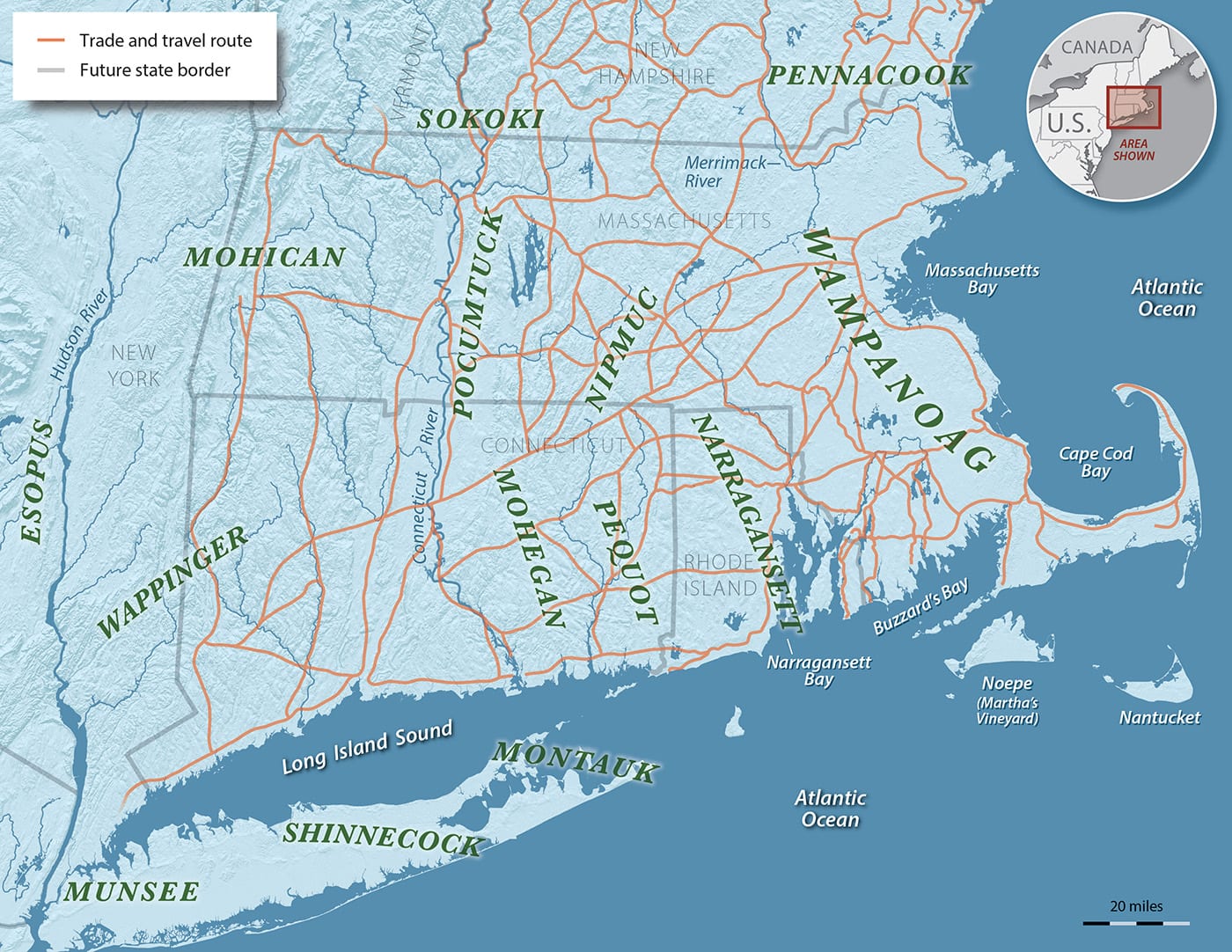
Chapter connection: The routes crossing Wampanoag, Narragansett, Mohegan, and neighboring homelands make §2’s network of travel, trade, and diplomacy visible without reducing the chapter to Virginia. Map by Doug Stevens/Flyboy Graphics for the Smithsonian’s National Museum of the American Indian, made with the Wampanoag community and Native scholarship. Map, explanation, and historical-boundary disclaimer.
Powhatan paramount chiefdom — Tidewater Virginia, 1607
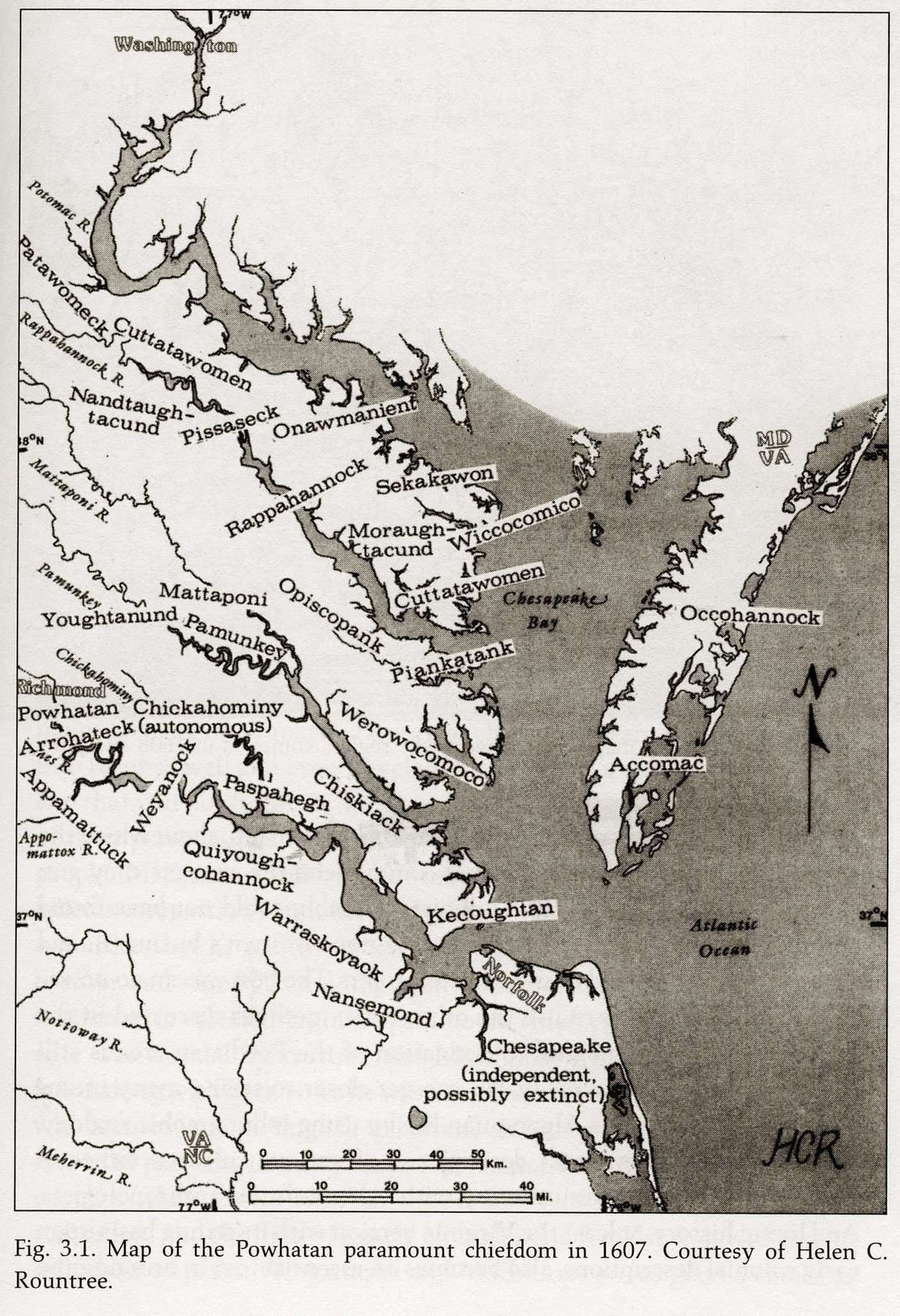
Chapter connection: The rivers and constituent groups clarify §3’s contrast between village leadership and Powhatan’s more centralized rule, as well as §5’s account of his recent expansion. The map does not make every labeled group a straightforward subject of Powhatan; the Chickahominy, for example, retained independence. Map by Helen C. Rountree (2002). Map and contextual description, Encyclopedia Virginia; political qualifications.
John Smith’s Virginia — an early English view of the Chesapeake
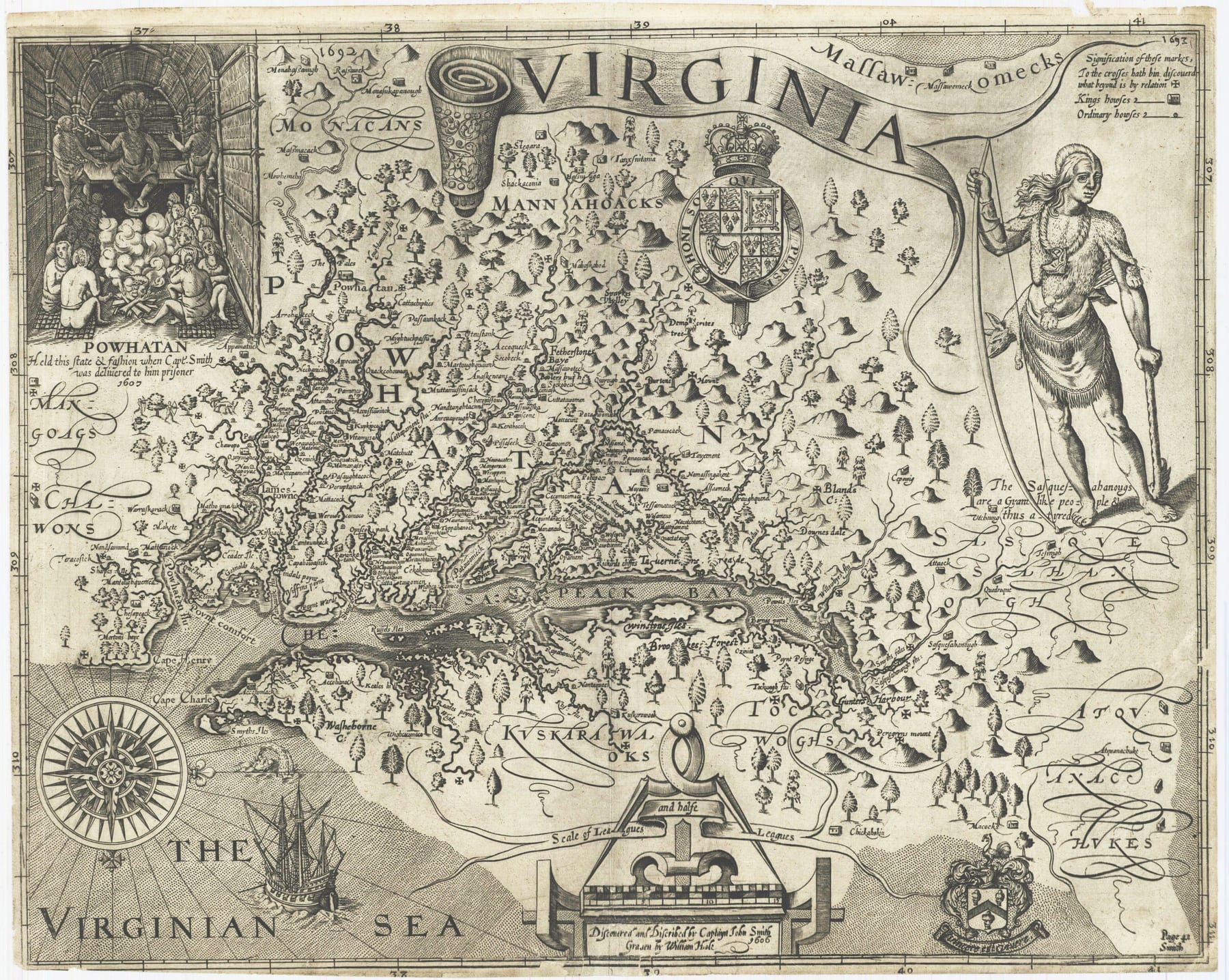
Chapter connection: Compare Smith’s named Native towns and waterways with the reconstructed map above. Smith drew on Indigenous information, including for places he did not visit, but his map also served English exploration and the Virginia Company’s colonial project; west is at the top. First published in 1612, the version shown here is a 1624 ninth state. Image and edition details, Maryland State Archives; source analysis, Library of Virginia.
Key Concepts and Distinctions
- Manitou: Spiritual potency animating the diversity of the world and making ordinary life morally charged.
- Reciprocity: The restoration of balance among persons, communities, animals, and spiritual powers.
- Mourning war: Warfare and captive-taking used to replace losses and repair communal identity.
- Chiefdom versus village authority: A distinction between coercive, tributary consolidation and leadership based more on persuasion.
- Historical Native society: A changing social world, not a static baseline outside time.
Essential Evidence and Examples
- Ritual rules governing beaver, bear, and first kills show that subsistence was embedded in reciprocal spiritual obligations.
- Trade networks carried Lake Superior copper, Atlantic shells, and distant stone across the region, demonstrating continental connection.
- Powhatan’s late-sixteenth-century conquests and northern fur competition show large changes preceding Jamestown.
Chapter Conclusion and Significance
The English entered a world that was diverse, connected, politically active, and capable of adaptation. Its vulnerability came not from cultural stasis but from the convergence of epidemic disease, expanding commerce, ecological pressure, and new forms of warfare. This foundation makes the ensuing story a collision between historical societies, not civilization arriving to replace an absence.
Questions for Reflection
- How does Bailyn connect cosmology to political and economic behavior without reducing either to belief alone?
- Which Native vulnerabilities were already developing before permanent English settlement, and which were produced by it?
- Does emphasizing common eastern-woodland patterns risk flattening the diversity Bailyn is trying to recover?
Part II — Conquest: The Europeans
Chapter 2: Death on a Coastal Fringe
Chapter Objective and Through Line
Bailyn presents early Jamestown as a radical mismatch between English expectations and Chesapeake realities. The newcomers came from a hierarchical, monotheistic, patriarchal, literate, land-owning society that considered cultivated property and dominion markers of civilization. Yet England itself contained violence, poverty, mobility, religious persecution, public terror, and deep regional difference. Colonization exported these contradictions. The Virginia Company imagined a disciplined commercial station that would locate commodities and a route to Asia; the 1607 party was instead a faction-ridden collection of gentlemen, laborers, artisans, soldiers, and adventurers with no stable authority or adequate knowledge of the environment. PDF p. 49 (file not included in this release)
The colony’s survival depended on Native food and political calculations it scarcely understood. Company instructions combined impractical geography, commercial fantasy, and contradictory advice to trade peacefully while asserting sovereignty and preparing coercion. Leadership struggles repeatedly displaced governors. John Smith imposed labor and extracted food effectively enough to preserve a remnant, but his violence and self-dramatizing account also entrenched racial hostility. Disease, brackish water, poor sanitation, hunger, and the settlers’ inability or refusal to sustain agriculture did more damage than combat. After Smith left, the “Starving Time” reduced the colony to desperate cannibalism and collapse. When Sir Thomas Gates arrived in 1610, he abandoned Jamestown; only the coincidental arrival of Lord De La Warr’s fleet reversed the retreat. PDF p. 79 (file not included in this release)
Chapter Structure at a Glance
- Contrast English assumptions about land, hierarchy, religion, and violence with Native order.
- Explain the company’s commercial design and the socially unstable first expedition.
- Show how unrealistic instructions shaped a vulnerable settlement site and confused priorities.
- Trace factional government, dependence on Native supplies, and Smith’s coercive survival strategy.
- End with demographic collapse and the abandoned settlement of June 1610.
Section-by-Section Argument
§1 — The world the English carried
The English entered the Chesapeake with assumptions almost inverse to those of the Native peoples. Their monotheistic hierarchy separated spirit from nature, placed civilized Christians above “natural” peoples, and joined cultivation to dominion. Land was alienable property and the foundation of wealth, status, and government. A patriarchal, literate, monarchical society gave them confidence in law and rank, yet population growth, falling real wages, vagrancy, urban migration, religious persecution, and commercial expansion were unsettling that order. London concentrated both capital and uprooted people, while chartered companies and imperial “projectors” converted Atlantic ambition into organized colonization. PDF p. 50 (file not included in this release)
English images of Native Americans were contradictory: wealthy but satanic peoples described by Spaniards, simple pagans who might advance through conversion, and “wild” barbarians assimilated to England’s brutal Irish experience. Public execution, torture, Protestant martyrdom, and service in Ireland or the Netherlands made spectacular violence familiar. The settlers therefore carried neither a peaceful nor a culturally uniform England overseas; they brought regional, class, religious, and military divisions along with an unquestioned sense of superiority.
§2 — A company’s agents, not a settled society
The Virginia Company’s investors imagined a commercial and strategic outpost, not yet a self-reproducing settler society. They sought precious metals, exportable commodities, trade with inland peoples, a route to the Pacific, and a base against Spanish power. The first expedition’s 104 passengers were correspondingly ill-balanced: many gentlemen, soldiers, and specialized artisans, but too few experienced farmers and family households. They remained company employees dependent on resupply and expected quick returns rather than years of subsistence labor. PDF p. 58 (file not included in this release)
Conflict began before landfall. Concealed instructions, uncertain command, status rivalry, and the imprisonment of John Smith divided the voyage. Smith was abrasive, ambitious, and contemptuous of gentlemanly privilege, yet he possessed the military experience and practical authority the company’s appointed leaders often lacked. Bailyn treats this social composition as a structural weakness: Jamestown did not become disorderly only because America was difficult; the expedition arrived as a faction-ridden commercial detachment without the demographic or institutional basis of a durable community.
§3 — Instructions detached from reality
The company’s instructions combined sensible precautions with fantasies born of geographical ignorance. The colonists were to seek a navigable river toward the “other sea,” locate valuable minerals and commodities, trade peacefully, conceal English deaths, avoid giving offense, and nevertheless prepare to displace or command Native peoples. They selected Jamestown Island because deep water allowed ships close to shore and the site seemed defensible from Europeans, but it was marshy, isolated, and supplied by brackish water. Strategic caution against Spain produced an ecological trap. PDF p. 67 (file not included in this release)
The settlers continued searching for gold, trade routes, and a passage through the mountains while food production, sanitation, and shelter remained insecure. Native communities did not simply await English decisions: they observed, tested, attacked, traded with, and redirected the newcomers according to their own rivalries and interests. From the start, company plans collided with both the Chesapeake environment and an autonomous political landscape that London scarcely understood.
§4 — Faction, coercion, and racial conflict
Jamestown’s governing council never acquired stable legitimacy. Edward Maria Wingfield and John Ratcliffe were successively deposed as gentlemen resisted labor, supplies disappeared, and factions accused one another of hoarding, incompetence, and treason. Drought, putrid water, hunger, disease, unsuitable clothing, and inadequate shelter killed most of the original settlers; repeated “supplies” enlarged the dependent population faster than they repaired the colony. Smith’s explorations mapped the Chesapeake and revealed both its resources and the Powhatan chiefdom’s strength, but survival still depended on Native corn. PDF p. 70 (file not included in this release)
Each side tried to incorporate the other into its own political order. Powhatan’s ritual treatment of Smith probably marked subordinate adoption, while Newport’s crowning of Powhatan symbolically made him King James’s vassal. Neither accepted the other’s meaning. As president, Smith enforced work, dispersed settlers, seized food, took hostages, and used theatrical violence against Opechancanough. These measures preserved a remnant but converted uncertain accommodation into escalating coercion. English accounts labeled Native resistance “treachery” while overlooking the impossible demands and sovereign claims provoking it.
§5 — The Starving Time
The third supply brought hundreds of additional settlers in 1609, but storms delayed its leaders and Smith soon returned to England. Native attacks destroyed outlying settlements and cut off foraging, rats consumed the corn reserve, illness continued, and many colonists still resisted sustained agricultural labor. During the winter siege, the inhabitants ate horses, dogs, cats, rats, mice, roots, starch, and leather. Contemporary testimony also records the exhumation of corpses and the murder and consumption of one man’s pregnant wife. The “Starving Time” reduced roughly four hundred people to about sixty skeletal survivors. PDF p. 80 (file not included in this release)
When Sir Thomas Gates finally arrived in May 1610, he found open gates, ruined buildings, exhausted supplies, and people crying that they were starved. Judging the position indefensible and unable to expect Native aid, he loaded everyone aboard ship and abandoned Jamestown on June 10. Only the chance encounter downstream with Lord De La Warr’s arriving relief fleet reversed the evacuation. English permanence was therefore not secured by the 1607 “founding”; it survived a demonstrated institutional collapse through contingent reinforcement.
Key Concepts and Distinctions
- Company colony: A commercial and strategic enterprise whose agents were not yet a reproducing settler society.
- Dominion: The English fusion of property, cultivation, sovereignty, and religious hierarchy.
- Leadership without legitimacy: Appointed authority repeatedly defeated by faction and distance.
- Ecological mismatch: Disease and subsistence failure arising from location, season, sanitation, and inexperience.
- Contingent survival: Jamestown’s persistence depended on a last-minute reversal, not steady institutional success.
Essential Evidence and Examples
- The original 104 passengers included many gentlemen and adventurers but lacked a balanced agricultural population.
- Jamestown’s swampy defensive site offered deep-water access while exposing settlers to unhealthy water and isolation.
- By June 1610, Gates judged the settlement unsustainable and placed its survivors aboard ships to leave.
Chapter Conclusion and Significance
Jamestown’s first phase was not a successful founding temporarily interrupted by hardship. It was a failed coastal encampment whose commercial purpose, social composition, political disorder, and ecological vulnerability nearly destroyed it. Survival required a new regime, and that regime would import the most coercive practices of England’s military frontiers.
Questions for Reflection
- Which mattered more to Jamestown’s collapse: poor institutional design, settler composition, ecology, or Native resistance?
- How should Smith’s genuine survival skills be weighed against the violence his methods institutionalized?
- What does the aborted evacuation reveal about later narratives of inevitable English permanence?
Chapter 3: The “Hammerours’ ” Regime
Chapter Objective and Through Line
The Virginia Company’s second attempt to preserve Jamestown replaced loose commercial experimentation with a militarized program of population, labor discipline, and territorial conquest. Sir Thomas Smith and the reorganized company sent larger fleets, veteran soldiers, and governors empowered to use martial law. De La Warr, Gates, and especially Sir Thomas Dale rebuilt settlements and imposed work, but their solution treated colonists and Powhatans alike as populations to be coerced. The regime’s severity was not accidental frontier excess: it drew on English campaigning in Ireland and the Netherlands and on corporate authorization to suspend ordinary legal protections under necessity. PDF p. 82 (file not included in this release)
Military force created guarded settlements and extracted labor, yet it did not solve the economic problem. The colony survived commercially only when John Rolfe’s tobacco cultivation produced a marketable staple. Tobacco redirected expansion toward privately worked land and intensified pressure on Native territory. At the same time, the capture, conversion, and marriage of Pocahontas produced an apparent truce. Bailyn stresses that the parties assigned different meanings to it: the English saw submission, conversion, and permission for expansion; Powhatan’s people saw reciprocal accommodation that preserved their independence. PDF p. 98 (file not included in this release) The company’s financial crisis and Edwin Sandys’s displacement of Thomas Smith then opened a new phase—less overtly military in government but far more expansive in migration and landholding.
Chapter Structure at a Glance
- Refinance the company and send mass reinforcements under stronger executive authority.
- Recruit veterans—the “hammerours”—whose frontier experience normalized coercion.
- Rebuild settlements through martial discipline and war against Native food and villages.
- Discover tobacco as the staple capable of reorganizing the colony’s economy.
- Mistake a reciprocal truce for Native acceptance of unlimited English growth.
- Transfer leadership from Thomas Smith to Edwin Sandys and prepare mass colonization.
Section-by-Section Argument
§1 — Corporate reconstruction
The rescue fleets of 1609–11 reflected a basic redesign of the Virginia enterprise. Sir Thomas Smith and the company’s major investors abandoned the idea of a small fort and trading station in favor of a permanent, populous, self-supporting colony. The 1609 charter enlarged Virginia’s territorial claim, strengthened the joint-stock corporation, promised land to investors and settlers, and authorized an “absolute” resident governor. Promotional literature described an earthly paradise rich in commodities and presented emigration as a cure for England’s surplus poor. Initial enthusiasm produced more than a thousand subscribers and financed fleets carrying hundreds of people. PDF p. 83 (file not included in this release)
Recruitment, however, reproduced the colony’s instability. The company wanted skilled artisans and rooted families but continued to receive gentlemen, vagrants, “unruly youths,” and casual laborers. It deliberately added perhaps 150 veterans of the Dutch and Irish wars—the “hammerours” expected to break Native resistance before missionaries arrived. The reorganization therefore joined demographic expansion to coercive discipline before the colony had found a profitable staple or a sustainable civic order.
§2 — Rebuilding by force
Lord De La Warr tried to restore Jamestown through an inseparable program of construction, compulsory labor, and war. He repaired the church, palisades, houses, gardens, and cornfields, built forts near the James River’s mouth, and sent out provisioning parties. Yet disease and despair continued to kill settlers whom leaders dismissed as debauched or idle. When Powhatan refused demands to return captives and submit as King James’s subject, De La Warr answered with punitive expeditions rather than negotiation. PDF p. 88 (file not included in this release)
The violence was deliberate and exemplary. Gates lured Kecoughtans into the open with music, killed men, women, and children, and seized their fields. George Percy’s troops burned Paspahegh houses and crops, murdered captives, threw children into the river and shot them, and executed their mother. Other raids destroyed temples, amputated a suspected spy’s hands, and attacked communities indiscriminately. English leaders represented terror as necessary retaliation and Christian “correction,” importing methods and moral defenses developed in Ireland. Kecoughtan land was then absorbed as Elizabeth City: reconstruction of English settlement proceeded through Native removal.
§3 — Martial law and an ambiguous peace
Gates and Sir Thomas Dale transformed Virginia into a military labor camp under the Laws Divine, Moral and Martial. Drumbeats regulated work, meals, worship, and rest; desertion, theft, disobedience, blasphemy, and resistance could bring whipping, starvation, hanging, burning, breaking on the wheel, or execution by gunfire. Civilian settlers became soldiers and soldiers became workers. The regime drew on martial law used in Ireland and Britain’s borderlands, treating dependent laborers as people outside ordinary English protections. Dale proposed supplementing them with reprieved convicts and imagined clearing Powhatan’s country for thousands of households. PDF p. 92 (file not included in this release)
Against Native communities, Dale pursued terror, crop destruction, land seizure, and attacks that ignored the line between combatants and civilians. English leaders justified barbarous means as paternal civilization. The 1613 capture of Pocahontas and her conversion and marriage to John Rolfe helped produce a 1614 truce, but its meanings diverged. The English treated it as Powhatan submission and a prelude to mass conversion and expansion; Powhatan’s people understood reciprocal exchange and Dale’s withdrawal as confirmation that they remained autonomous. Peace rested on incompatible expectations.
§4 — Tobacco and transition
The company’s finances deteriorated even as military government preserved the colony. Timber, furs, silk grass, glass, iron, and other experiments yielded too little; subscribers withheld payments and lotteries disappointed. In response, company leaders created separately financed ventures such as the Bermuda subsidiary, the supply “Magazine,” and private partnerships. At the same time, labor contracts expired and surviving settlers received individual farms. The dissolution of the 1609 joint stock converted investors’ claims into land, and the promise of fifty acres for each transported person created the headright system. Public colonization was giving way to decentralized private plantations. PDF p. 99 (file not included in this release)
Tobacco supplied the missing engine. John Rolfe’s imported Caribbean variety gradually found an English market, and exports rose from 1,250 pounds in 1616 to almost 400,000 by 1625. The crop could be grown on partly cleared land and rewarded the acquisition of acreage and indentured labor. Large “hundreds” pooled investors’ claims and operated like subordinate colonizing companies. Edwin Sandys’s 1618 victory over Smith promised reform and mass settlement, but tobacco’s success made territorial expansion and labor recruitment more urgent—deepening the forces that the fragile Powhatan peace could not contain.
Key Concepts and Distinctions
- “Hammerours”: Veteran soldiers expected to break resistance and prepare Native peoples for missionaries.
- Martial law: Emergency command that displaced ordinary English legal protections and made terror administrative.
- Staple economy: A colonial order organized around one export commodity—in this case tobacco.
- Reciprocity versus submission: Competing interpretations of diplomacy that made apparent peace unstable.
- Private plantation: A separately financed land-and-labor venture within the company’s territorial claim.
Essential Evidence and Examples
- Dale’s governors received authority to proceed by martial law in cases of rebellion, mutiny, or necessity.
- Settlement at Kecoughtan followed the removal of its Native residents, linking security to dispossession.
- Tobacco succeeded where silk, glass, timber, and other projected commodities had not, redirecting the entire colony.
Chapter Conclusion and Significance
Militarization preserved the English presence but could not itself make Virginia viable. Tobacco did that, and thereby converted a fortified survival project into an expanding settler economy. The Pocahontas peace concealed rather than resolved incompatible expectations. Sandys inherited a colony whose economic path now demanded more migrants, more land, and more labor—the very combination that would produce the crisis of 1622.
Questions for Reflection
- Did martial government solve Virginia’s problems, or merely keep the colony alive until tobacco changed its incentives?
- How did English and Powhatan concepts of diplomacy generate different meanings from the same marriage and truce?
- Why did a successful staple make peace less rather than more secure?
Chapter 4: Recruitment, Expansion, and Transformation
Chapter Objective and Through Line
Edwin Sandys tried to rescue the bankrupt company by converting Virginia from a garrison into a populated English society. His program joined publicity, private landholding, an assembly, the end of martial law, commodity diversification, and mass migration. Yet the reform was coercive as well as liberal: company agents recruited artisans and families but also swept up vagrants, convicts, poor children, and vulnerable women. Headrights and private plantations dispersed settlers along the rivers faster than officials could house, feed, or defend them. PDF p. 103 (file not included in this release)
Sandys’s achievement was therefore double-edged. Thousands arrived and representative government appeared, but mortality remained extreme, tobacco defeated diversification, and giant speculative claims intruded into Native country. Expansion made the colony look successful from London while producing exposed settlements and a labor force debilitated before or during passage. George Thorpe’s confidence that charity and conversion had secured peace epitomized the settlers’ blindness: the proliferation of plantations was precisely what Opechancanough was preparing to resist.
Chapter Structure at a Glance
- Advertise Virginia as healthy, rich, Christian, and lawfully governed.
- Mobilize voluntary and coerced migrants to solve the labor shortage.
- Replace corporate concentration with headrights and private plantations.
- Overload the colony’s provisioning and settlement capacity.
- Mistake rapid numerical and territorial growth for durable security.
Section-by-Section Argument
§1 — Reform and recruitment
Edwin Sandys’s rescue program sought to make Virginia appear lawful, healthy, profitable, and permanent. He ended martial government, regularized land tenure, promised English legal protections and representative institutions, and advertised diversified production, schools, churches, and accommodation for newcomers. Behind that optimistic publicity stood a desperate need for labor. Company planners recruited ironworkers, vintners, shipwrights, carpenters, glassmakers, farmers, and religious dissenters from across Britain and continental Europe, but no project mattered unless the colony’s population could be enlarged rapidly. PDF p. 104 (file not included in this release)
Recruitment therefore moved from inducement to coercion. London authorities gathered hundreds of poor and vagrant children from Bridewell and the streets, threatened families with loss of parish relief, punished children who refused transportation, and sent them as apprentices under changing, increasingly restrictive terms. Sandys even sought a national levy of the poor, while fraudulent agents attempted to impress young women. The reform regime was thus liberal for investors and established settlers but coercive toward dependents whose poverty and custody made them usable as colonial labor.
§2 — Human influx beyond capacity
Migration surged beyond Virginia’s capacity to absorb it. Sandys’s first year brought roughly four hundred newcomers; 1,261 more arrived in spring 1619, and by 1622 about 3,500 had been transported under the expansion program. They included vagrant children, artisans, farmers, servants, convicts, religious separatists, families, and Africans whose legal statuses were not yet uniform. The company also recruited young women as prospective wives, supplied and nominally protected them, but sold their passage for large tobacco payments that effectively reserved marriage access for prosperous planters. PDF p. 108 (file not included in this release)
The ships were small, crowded, undersupplied, and unsanitary; voyages lasted months, and disease, spoiled food, bad water, and exhaustion killed passengers before arrival. There was no effective medical screening, so people with ulcers, ruptures, disabilities, and grave illnesses were sent as workers. Ships commonly arrived without warning at the start of the hot season, before harvests, when almost no guest housing existed. Officials begged London for time to build and provision, but privately sponsored arrivals continued. “Seasoning” turned nominal population growth into repeated demographic collapse as weakened newcomers dispersed to exposed riverside farms.
§3 — Dispersal and danger
Private plantations multiplied from sixteen settlements in 1618 to more than forty by 1622, scattered along roughly one hundred miles of river and deliberately spaced apart. Headrights and pooled investment produced immense patents such as Berkeley, Southampton, and Martin’s Hundreds. Their sponsors spent thousands of pounds on servants, cattle, tools, weapons, and supplies, while planter-merchants organized subordinate farms around palisaded compounds. Archaeology reveals pockets of imported gentility, but most buildings were cramped, dirt-floored wattle-and-daub structures surrounded by stump-filled tobacco land. PDF p. 117 (file not included in this release)
This growth remained fragile. A third or more of some workforces were bonded servants, nuclear families were scarce, mortality was so high that communities could not reproduce themselves, and tobacco displaced food production and diversification. The geography that maximized river transport and land claims also made settlements hard to supply and defend. George Thorpe’s belief that health, prosperity, humane treatment, and Christian mission had reconciled Native people to expansion captured the settlers’ fatal misreading. His murder and mutilation in 1622 revealed that what London celebrated as improvement and peopling could appear to Opechancanough as accelerating dispossession.
Key Concepts and Distinctions
- Headright: Land granted for financing migration, turning population recruitment into territorial acquisition.
- Representative reform: Assemblies and English law that expanded settler participation without limiting conquest.
- Forced peopling: Use of poverty, custody, penal authority, and deception to supply colonial labor.
- Dispersed vulnerability: Profitable riverside plantations that were hard to provision or defend.
Essential Evidence and Examples
- In spring 1619 alone, 1,261 migrants were sent with supplies and cattle.
- Some recruited children arrived with ulcers, ruptures, injured hands, and diseases that made labor impossible.
- Berkeley, Martin’s, and Southampton Hundreds claimed enormous territories before they could cultivate them.
Chapter Conclusion and Significance
Sandys created the demographic and institutional foundations of plantation Virginia, but did so by intensifying every destabilizing pressure: land hunger, labor exploitation, food dependence, disease, and encroachment. Reform did not replace conquest; it made conquest expansive.
Questions for Reflection
- In what sense was Sandys’s program both liberal and coercive?
- Why did numerical growth initially reduce rather than increase colonial security?
- How did the headright system connect migration policy to Native dispossession?
Chapter 5: “A Flood, a Flood of Bloud”
Chapter Objective and Through Line
Opechancanough interpreted plantation expansion as an existential threat and organized the coordinated assault of March 1622. Bailyn stresses that his object was not extermination: he hoped one devastating blow would confine the English to a useful coastal trading enclave and restore Native autonomy. English leaders interpreted the attack through categories of treachery, pagan cruelty, and holy war. Their response removed restraints on conquest and aimed to destroy food, villages, political identity, and adult resistance. PDF p. 122 (file not included in this release)
The war coincided with disease, starvation, administrative collapse, and the failure of Sandys’s economic experiments. More settlers died from sickness than in the attack, and only 1,218 of more than 8,000 company-sponsored migrants remained in the 1625 census. The Crown annulled the company charter, but tobacco and private landholding survived. Colonial collapse thus produced royal Virginia rather than withdrawal; William Claiborne’s Kent Island venture then carried expansion into the upper Chesapeake and collision with Maryland.
Chapter Structure at a Glance
- Contrast Opechancanough’s containment strategy with the company’s conversion-and-expansion program.
- Trace the coordinated 1622 attack and its immediate devastation.
- Show English rhetoric transforming retaliation into perpetual racial war.
- Link military vengeance to hunger, disease, and servant misery.
- End company rule while preserving the tobacco-settlement system.
Section-by-Section Argument
§§1–2 — Two incompatible futures
- §1 — Peace conceals opposed projects: After Powhatan withdrew and died, Opechancanough concluded that expanding tobacco settlements threatened the autonomy and survival of the Tidewater peoples. His object was not to exterminate the English, whose trade remained useful, but to deliver one overwhelming blow that would confine them to a small eastern enclave. At the same time, Sandys revived the company’s missionary program, raised funds for an Indian college, and instructed officials to pursue conversion and “civility.” However benevolent its language, this program assumed English cultural sovereignty and accompanied uncontrolled plantation growth. Ordinary trade and hospitality continued, allowing each side to interpret apparent peace as permission to prepare a mutually exclusive future. PDF p. 123 (file not included in this release)
- §2 — The assault of March 1622: Opechancanough organized warriors from multiple chiefdoms to enter familiar plantations peacefully and then seize available tools and weapons at a coordinated signal. The death of Nemattanew, the charismatic “Jack of the Feathers” whose supposed invulnerability embodied spiritual protection, intensified the crisis of confidence and revenge. On March 22, Native attackers killed about 347 colonists across the James River settlements, destroyed crops and buildings, and devastated exposed projects such as Martin’s Hundred and the proposed college lands. Jamestown survived because of a last-minute warning; the eastern settlements were largely spared, consistent with Opechancanough’s containment strategy. English accounts instead emphasized betrayal, mutilation, and satanic cruelty, transforming advocates such as Thorpe into martyrs and erasing the political limits of the Native objective. PDF p. 127 (file not included in this release)
§3 — Retaliation and suffering
The survivors abandoned exposed plantations, strengthened others, shifted population eastward, and gave local commanders sweeping military power. Retaliation became a war of attrition through “feed fights”: colonists burned villages and crops, destroyed canoes, attacked winter food supplies, and tried to split Native alliances. Deception became policy. Captain Daniel Tucker negotiated peace and a prisoner release, toasted the agreement with poisoned wine, and then returned to kill more people. Religious language cast destruction as divinely assisted vengeance and removed practical limits on violence. PDF p. 134 (file not included in this release)
The English community meanwhile remained a slaughterhouse of its own members. Nearly nine hundred newcomers arrived after the attack when food and shelter were already insufficient; the disease-ridden Abigail spread another epidemic. More colonists died from sickness and starvation than from Native weapons. Nathaniel Butler described infectious sites, exorbitant food, unburied bodies, miserable housing, failed industries, and government dominated by tobacco. Richard Frethorne’s letters expose the servant’s experience beneath company rhetoric: exhausting labor, rags, hunger, fear, abandonment, and desperate pleas to be redeemed from bondage. He died within a year.
§4 — Corporate death, colonial persistence
By 1624 every major diversification scheme had failed, company laborers had drifted to private plantations, and tobacco alone sustained the economy. The Crown annulled the bankrupt Virginia Company’s charter after an investigation exposed faction, mismanagement, and catastrophic mortality. More than eight thousand European and African migrants had arrived under company auspices, but the 1625 census counted only 1,218 survivors; in 1622 alone disease and hunger killed more than twice the number lost in the assault. Corporate colonization died, yet its decisive institutions—private landholding, headrights, indentured labor, representative government, and tobacco—survived under royal rule. PDF p. 138 (file not included in this release)
Leadership passed from metropolitan grandees and veteran “hammerours” to hard-driving planter-traders such as Mathews, Menefie, Utie, Wood, and Spencer, backed by hundreds of smaller English merchants. Their rank was unstable, but their ability to acquire land, control trade, and survive the frontier gave them power. By 1634 a palisade symbolically sealed off conquered Powhatan land and opened the Middle Plantation. William Claiborne pushed the same expansion north, building a fur-trading and provisioning network on Kent Island. His enterprise carried Virginia’s land hunger and commercial rivalry directly into territory newly chartered as Maryland.
Key Concepts and Distinctions
- Containment versus extermination: Opechancanough sought a bounded English presence; English retaliation moved toward eliminating Native power.
- Holy war: Religious language made unlimited violence appear morally obligatory.
- “Feed fights”: Destruction of crops, homes, and transport to produce famine and displacement.
- Corporate failure versus settler success: The company died, but its land-and-tobacco order endured.
Essential Evidence and Examples
- The 1622 attack killed 347 settlers but disease killed even more that year.
- Tucker’s poisoned-wine “peace” shows deception becoming accepted colonial policy.
- More than 8,000 company migrants yielded only 1,218 recorded survivors in 1625.
Chapter Conclusion and Significance
The catastrophe did not end colonization; it radicalized its violence and detached it from the failed corporation. Bailyn makes 1622 a turning point from unstable coexistence toward recurrent wars of dispossession, while preserving the distinct aims and fears of both sides.
Questions for Reflection
- Why is Opechancanough’s limited objective essential to interpreting the attack?
- How did religious rhetoric widen the permissible scope of English retaliation?
- Why did the failure of the Virginia Company not amount to the failure of Virginia?
Chapter 6: Terra-Maria
Chapter Objective and Through Line
Maryland began as George and Cecil Calvert’s effort to combine profit, proprietary authority, Catholic refuge, and a hierarchical manorial society. It emerged from England’s wider religious and economic dislocations, alongside much larger migration to Ireland. The Ark and Dove carried Catholic gentlemen, mostly Protestant servants, artisans, and Jesuits—a social mixture already at odds with a unified Catholic design. Settlers acquired cleared Native land amid pressure from the Susquehannocks, then dispersed into tobacco farming and headright claims. PDF p. 144 (file not included in this release)
The colony’s attempted order dissolved under environmental, demographic, religious, and Atlantic pressures. Servitude became pervasive; manor lords could not reproduce English tenancy; tobacco scattered farms. Jesuit plans for mission communities threatened Baltimore’s secular authority and policy of discreet toleration. Claiborne disputed Maryland’s territory, while Ingle’s rebellion and English civil conflict exposed the proprietorship’s weakness. By midcentury Catholic governance survived legally, but the envisioned social structure had largely disappeared.
Chapter Structure at a Glance
- Place Maryland within England’s religious persecution, mobility, and imperial expansion.
- Explain the Calverts’ Catholic-proprietary-manorial synthesis.
- Reconstruct a socially divided founding migration and Native-assisted settlement.
- Show tobacco and servitude defeating compact manorial order.
- Trace Jesuit, Protestant, Virginian, and metropolitan challenges to proprietary rule.
Section-by-Section Argument
§§1–2 — The Calvert design
- §1 — Maryland within a widening diaspora: Economic change, textile depression, low wages, high prices, plague, failed harvests, urban growth, and sharpening religious conflict made early Stuart England mobile and unstable. At the same time, reports from Newfoundland, Virginia, Bermuda, the Caribbean, and New England made the western Atlantic imaginable as a field of opportunity and refuge. Bailyn places Maryland within this general migration rather than treating it as an isolated founding. The much larger precedent was Ireland, where seized land and plantation schemes drew an estimated 120,000 English and Scottish migrants from 1630 to 1642—twice the West Indian movement and six times New England’s. Maryland was one small, distinctive experiment within a British expansion already transforming Native lands on both sides of the Atlantic. PDF p. 145 (file not included in this release)
- §2 — A Catholic refuge under proprietary control: English Catholics were a small, legally burdened, socially dispersed minority centered in gentry households and accustomed to private worship and pragmatic accommodation. George Calvert, a former royal secretary who openly returned to Catholicism, first tested colonization in Newfoundland’s Province of Avalon. Its climate, warfare, expense, and Protestant-Catholic friction drove him toward the Chesapeake; after his death, Cecil Calvert received Maryland’s palatine charter. The design joined private profit, imperial loyalty, discreet Catholic refuge, Native conversion, and a nostalgic manorial hierarchy. Manor lords would exercise local courts, collect rents, govern dependent tenants, and finance expansion through servants and trade. Yet Baltimore ordered Catholic worship kept private and Protestants treated mildly, because the colony had to be safe for Catholics without appearing politically Catholic. Robert Wintour’s vision of estates, servants, sport, abundance, and easy gentility expressed the dream—and his indebted death after two years exposed its unreality. PDF p. 148 (file not included in this release)
§§3–4 — Settlement and labor
- §3 — A divided migration enters Native geopolitics: The Ark and Dove carried perhaps 148–175 people in 1633–34: seventeen mostly Catholic gentlemen, a much larger body of mostly Protestant servants and laborers, artisans, one Black passenger, one Portuguese mulatto, two Jesuit priests, and a lay brother. The expedition reached a healthier-looking Potomac landscape and, guided by veteran trader Henry Fleete, pursued diplomacy more cautiously than Virginia had. Piscataways and Patuxents, threatened by Susquehannocks and other rivals, saw potential allies in the newcomers. The Yoacomacos, already preparing to move, exchanged their village and cleared fields for tools and cloth. Father Andrew White interpreted this pressure-driven transfer as providence and imagined conversion as benevolent elevation. Initial peace therefore rested on converging short-term interests but radically different understandings of land, alliance, and Christianization. PDF p. 160 (file not included in this release)
- §4 — Tobacco dissolves the planned society: The settlers first lived within a compact palisaded village, then dispersed after 1637 into manors, headright claims, and riverside farms. A handful of Catholic gentry—Calvert, Cornwallis, Lewger, Gerard, and the Brents—accumulated land and offices, but mortality, labor scarcity, and mobility prevented a stable rentier order. St. Mary’s became a five-mile sprawl rather than a planned capital, and most “manors” were crude, lightly furnished tobacco farms whose lords worked as merchants, planters, and land developers. Tobacco became crop, currency, and organizing principle despite Baltimore’s objections; debt and uncertain boundaries filled the courts. The population mixed people from many English regions and several nations in male-heavy work households and temporary “mateships.” Servants could sue, bargain, gain freedom, and occasionally rise spectacularly, but they were also bought, sold, mortgaged, gambled, and harshly exploited. Their eventual freedom continually recreated labor demand and encouraged interest in permanent coercion. PDF p. 164 (file not included in this release)
§5 — Authority disintegrates
By 1642 Maryland remained a scattered outpost of only three to four hundred Europeans. The Calverts’ planned synthesis—a Catholic refuge, proprietary sovereignty, manorial hierarchy, and cautious relations with Native peoples—was being pulled apart by linked struggles over church, land, diplomacy, and political legitimacy. PDF p. 177 (file not included in this release)
- Mission versus proprietorship: The Jesuits’ hopes briefly seemed vindicated when Father Andrew White converted the Piscataway tayac Kittamaquund, but deaths, famine, few reinforcements, and language barriers reduced the mission to itinerant visits. The deeper clash was jurisdictional: the order claimed Native-granted land, extensive headright acreage, tax immunity, and church-court authority while proselytizing Protestants. Baltimore’s charter and refuge depended on Catholic discretion and control of land, so he subordinated the Jesuits to civil power, with Rome’s reluctant support. Maryland could not be both a semi-autonomous mission and a politically defensible English proprietorship. PDF p. 184 (file not included in this release)
- Native diplomacy becomes frontier war: Early coexistence with the Piscataways rested on a temporary balance rather than deep accommodation. Roaming livestock, fencing demands, revenge killings, uncontrolled trade in furs, guns, and liquor, and Claiborne’s defiant Kent Island network destabilized the region. Susquehannocks struck Piscataway villages and destroyed Jesuit mission sites; Calvert answered with broad enemy declarations and martial-law defenses. After fifteen militiamen were captured and tortured in 1644, wavering Piscataway alliances raised the possibility of a combined assault that could destroy the colony. PDF p. 188 (file not included in this release)
- English civil war becomes colonial plunder: Just when Native affairs demanded unity, England’s conflict between Crown and Parliament entered Maryland. Richard Ingle used a parliamentary letter of marque, anti-Catholic fear, and likely cooperation with Claiborne to pose as the defender of Maryland’s Protestants. His “Plundering Time” also pursued private gain: rebels looted tobacco, manor houses, and Jesuit property; imprisoned Catholic leaders; and mobilized the resentments of planters, servants, debtors, and tenants against the proprietary elite. Baltimore kept his charter and Leonard Calvert recovered the colony, but its authority was badly discredited.
- Pragmatic toleration fails to settle the conflict: Recovery required a general pardon, a stronger elected Assembly, Protestants on the Council, and the Protestant William Stone as governor. Baltimore’s 1649 Act Concerning Religion protected worship and restrained sectarian abuse only among Trinitarian Christians. It was a practical compact for a Protestant-majority colony, not universal liberty or church–state separation. PDF p. 193 (file not included in this release)
- Puritan victory ends the founding design: Stone invited several hundred Virginia Puritans to form Providence, but its leaders Richard Bennett and Claiborne later used Commonwealth authority to depose him, repeal the toleration act, disfranchise Catholics, and suppress Catholic worship. Stone’s armed counterattack failed in 1655; executions, sequestration, and renewed plunder followed. Baltimore recovered legal control in 1657, but manor lords had died, fled, or become ordinary farmers, and the best estates were breaking into small tobacco freeholds. Maryland survived; its manorial Catholic order did not. PDF p. 196 (file not included in this release)
Part 5’s through line is therefore broader than religious conflict alone. Rival jurisdictions, Native geopolitics, Atlantic civil war, class resentment, Protestant majority politics, and dispersed tobacco settlement converged to preserve Baltimore’s title only after destroying the social order that title was intended to create.
Key Concepts and Distinctions
- Proprietary colony: A quasi-private jurisdiction whose legal title exceeded its practical control.
- Pragmatic toleration: Religious peace designed to protect a vulnerable Catholic minority, not modern equality of conscience.
- Manorial ideal: Hierarchical settlement based on landlords and permanent tenants.
- Tobacco dispersal: Market incentives that dissolved compact social planning.
Essential Evidence and Examples
- The first migration joined seventeen gentlemen of fashion with a much larger servant majority.
- Jesuit missionaries understood Native retreat as providential transfer, revealing benevolence entwined with appropriation.
- By 1652 even successful manorial land was being sold into small freeholds.
Chapter Conclusion and Significance
Maryland demonstrates how quickly colonial blueprints yielded to labor scarcity, commodity production, confessional conflict, and imperial distance. Toleration survived intermittently, but not the coherent Catholic manorial society the Calverts imagined.
Questions for Reflection
- Was Maryland’s toleration a principle, a strategy of minority survival, or both?
- Why did tobacco undermine the manorial order even while enriching landowners?
- How did Atlantic politics turn local jurisdictional disputes into existential crises?
Chapter 7: The Chesapeake’s New World
Chapter Objective and Through Line
By 1660 the Chesapeake had become profitable and populous, but its mature form bore little resemblance to its founders’ designs. Tobacco and rising land values drew free families, artisans, merchants, indentured servants, war prisoners, convicts, and growing numbers of Africans. The servant stream initially sustained expansion, but lower mortality and land concentration reduced freed servants’ prospects. As English labor supply tightened, planters turned toward African slavery. Bailyn emphasizes development without a master plan: law converted varied African statuses into hereditary racial chattel slavery over several generations. PDF p. 196 (file not included in this release)
Alongside this labor transformation, a planter gentry emerged from successful local climbers and better-connected later immigrants. They copied English gentility but could not become rentiers: scarce labor, tobacco volatility, and dispersed estates required personal management. The result was a new ruling class—aspirational, land-hungry, politically dominant, and deeply implicated in racial bondage.
Chapter Structure at a Glance
- Trace rapid migration and the heterogeneous labor force.
- Explain declining prospects for former servants as land and tobacco conditions changed.
- Follow the legal construction of hereditary racial slavery.
- Reconstruct the mixed origins of the planter gentry.
- Distinguish Chesapeake managerial elites from English landed aristocrats.
Section-by-Section Argument
§§1–2 — Migration and narrowing opportunity
- §1 — The servant-powered tobacco migration: Rising tobacco profits and land values drew free families, modest merchants, artisans, and would-be gentlemen, but indentured servants outnumbered free migrants by three or four to one. Roughly one hundred thousand Britons migrated to the Chesapeake during the century, perhaps 70–85 percent under indenture. They came from scattered English regions and included skilled workers, displaced rural laborers, urban poor, orphans, convicts, kidnapped “spirits,” Irish migrants, and thousands of Scottish prisoners from the civil wars. On arrival, uncommitted contracts were sold like commodities at shipboard auctions or carried inland to small farmers. The labor was voluntary and time-limited for many, coerced or fraudulent for others, but all entered a tobacco regime that demanded year-round discipline and treated acreage and workers as mutually reinforcing investments. PDF p. 197 (file not included in this release)
- §2 — Mortality, fractured families, and closing mobility: The migrants were initially overwhelmingly male and usually sixteen to twenty-five; as English conditions improved, employers increasingly drew on younger, female, Irish, criminalized, and otherwise marginal recruits. “Seasoning” still killed 15–30 percent of male immigrants in some midcentury Maryland cohorts. Early death shattered marriages, orphaned children, and created households of stepparents, half-siblings, wards, and quasi-kin. Most people lived in dark one- or two-room wooden cottages scarcely better than England’s poorest dwellings, and intimate master-servant relations could turn paternalism into overwork, assault, and sexual exploitation. Servants nevertheless expected eventual independence because their bondage had a contractual end. As fertile river land filled, tobacco prices weakened, and survival improved, that promise narrowed: freed workers moved to dangerous frontiers, hired themselves for wages, or became tenants and sharecroppers. Declining English recruitment pushed planters toward African labor. PDF p. 205 (file not included in this release)
§3 — Slavery made in law
Africans arrived in small numbers and through varied routes long before large-scale slave importation. Some were free, some held term contracts, some purchased freedom and property, and many arrived without contracts and were presumed bound for life. Their early legal status was therefore uneven, but Europeans never regarded most Black people as equal to white servants. Deep cultural associations of blackness with baseness and alien “barbarism,” combined with planters’ demand for permanent labor, made unlimited exploitation morally and politically possible. PDF p. 211 (file not included in this release)
No legislator designed the complete system at once. Courts and assemblies built it incrementally while resolving disputes: lifetime service became racially restricted; baptism ceased to justify freedom; children’s condition shifted from the common-law status of the father to that of the mother; interracial marriage was penalized; movement, arms, manumission, and legal recourse were restricted; and masters gained protection when violent “correction” killed an enslaved person. After uncertainty over whether humans were realty, freehold, or movable goods, law classified them as chattel personal. Over three generations, racism, labor scarcity, profit seeking, and local legal improvisation created total, hereditary racial slavery without a single prior blueprint.
§§4–5 — An improvised gentry
- §4 — Several streams form a ruling class: Chesapeake elites emerged from overlapping groups rather than a transplanted aristocracy. Successful early planter-traders joined a small influx of displaced royalists around Governor William Berkeley and, more importantly, ambitious younger sons and relatives of merchant and gentry families with old colonial investments. Berkeley himself used court connections to secure the governorship and promoted Virginia as refuge and opportunity, but the famous “Cavalier” migration was small and culturally mixed. Families such as the Blands, Burwells, Byrds, Diggeses, Masons, Lees, Carters, Beverleys, Ludwells, Washingtons, and Fitzhughs converted inherited claims, capital, office, and marriage into estates. Maryland’s Neales, Sewalls, Darnalls, Lloyds, and Tilghmans built comparable Catholic-Protestant kin networks after the Plundering Time. Their cohesion came from property, patronage, and strategic family connection more than shared regional folkways. PDF p. 217 (file not included in this release)
- §5 — The managerial gentleman: These elites were “gentlemen manqué”—close enough to English gentility to feel exclusion sharply and ambitious enough to reconstruct status abroad. Yet they could not live as English rentiers. Most claimed land remained undeveloped, tenancy produced limited income, and tobacco exposed fortunes to price swings, crop failure, labor shortages, and border violence. Large planters had to manage recruitment, coercion, planting, credit, bookkeeping, marketing, land sales, and expansion directly, even after acquiring overseers. PDF p. 228 (file not included in this release)
Their material culture showed the limit of imitation. Even gubernatorial and leading-family houses were enlarged wooden farmhouses, “meane and little” beside the residences of English squires or merchants. The Chesapeake achieved a degree of stability and an identifiable ruling class, but its gentry remained a colonial production elite: politically dominant, land hungry, commercially active, and inseparable from bound labor and frontier management.
Key Concepts and Distinctions
- Indentured labor market: Time-limited bondage supplying most early workers.
- Racial chattel slavery: Lifelong, hereditary, legally commodified bondage identified with African descent.
- Gentleman manqué: A partially displaced aspirant whose proximity to status intensifies ambition.
- Managerial gentry: Landed rulers directly engaged in crops, labor, credit, and sales.
Essential Evidence and Examples
- Chesapeake European population grew from roughly 8,000 in 1640 to 38,500 in 1670.
- African numbers rose slowly at first, then law made slavery total and maternally hereditary.
- The leading houses remained “meane and little” by English elite standards, despite political dominance.
Chapter Conclusion and Significance
The Chesapeake normalized itself through a volatile combination of opportunity and coercion. Its apparent social stability rested on narrowing access to land, a newly racialized labor system, and a gentry whose English aspirations could never escape colonial managerial realities.
Questions for Reflection
- What does Bailyn gain by emphasizing that racial slavery developed without a single prior design?
- How did improving survival alter both labor relations and access to land?
- Why did Chesapeake elites imitate English gentility yet remain structurally different from English landlords?
Chapter 8: The Dutch Farrago
Chapter Objective and Through Line
New Netherland grew from the Dutch Republic’s commercial expansion, not from a coherent program of national settlement. The West India Company valued the Hudson chiefly as a claim securing access to the fur trade. Its first permanent settlers were Walloon and French refugee families; later arrivals included Dutch, Germans, Scandinavians, English people, Africans, soldiers, artisans, and transient laborers. This “farrago” made the colony more heterogeneous than the Chesapeake and ensured that corporate officials could never simply reproduce Dutch order. PDF p. 230 (file not included in this release)
Repeated schemes tried to solve chronic underpopulation. Kiliaen van Rensselaer’s patroonship privatized recruitment and authority but attracted mostly mobile young workers who resisted permanent dependency. Company directors—Verhulst, Minuit, Van Twiller, Kieft, and Stuyvesant—faced competing merchants, settlers, patroons, Native nations, and foreign claimants. Kieft’s attempt to resolve insecurity through massacre produced a devastating regional war and strengthened demands by the “commonalty” for accountable civic government. The colony slowly acquired towns, courts, merchant leadership, and a sense of public rights despite corporate autocracy.
Chapter Structure at a Glance
- Explain commercial rather than settler origins.
- Reconstruct the refugee and polyglot founding population.
- Test private patroonship as a solution to population and capital shortages.
- Follow unstable directors and the opening of trade and migration.
- Trace Kieft’s war and the political emergence of the commonalty.
- Show local leaders imagining a prosperous territorial society.
Section-by-Section Argument
§§1–3 — Commerce, refugees, and patroonship
- §1 — A trading company reluctantly becomes a colonizer: New Netherland emerged from the Dutch Republic’s polyglot commercial world and the West India Company’s global war against Iberian power. After Henry Hudson’s 1609 voyage, the company regarded the Hudson chiefly as a territorial claim and a route to furs, not as the nucleus of a Dutch nation overseas. It authorized settlement only when occupation became necessary to protect title and trade. The first thirty Walloon and French-speaking families received passage, land, credit, and private worship, but the company retained the land, crops, fur monopoly, and conduct of Native relations. Colonization began, therefore, as an expensive instrument of commerce whose permanent inhabitants had interests the corporation had not planned to serve. PDF p. 231 (file not included in this release)
- §2 — Refugee families and an improvised territorial claim: The 1624 migrants were Walloon Calvinist refugees associated with Leiden and Jesse de Forest’s long search for a place of refuge. Cornelis May dispersed them among the Delaware, Connecticut, Fort Orange, and Governor’s Island so their mere presence could substantiate Dutch possession. Reinforcements in 1625 were a rougher, multilingual mixture of company employees, soldiers, artisans, livestock handlers, and transients. Officials soon concentrated most inhabitants at Manhattan while preserving Fort Orange as the chief fur post. The colony’s succession of directors inherited a nearly impossible brief: make a scattered outpost feed and defend itself, police private trade, treat Native peoples fairly without governing them, restrain quarrelsome subordinates, and answer to distant directors preoccupied with larger Atlantic ventures. PDF p. 238 (file not included in this release)
- §3 — Patroonship and the failure of transplanted hierarchy: The 1629 Charter of Freedoms and Exemptions offered hereditary estates and broad jurisdiction to patroons who transported fifty settlers, while preserving the company’s shipping duties and priority in the fur trade. The scheme transferred the cost of colonization to private capital but built conflict into every level of authority. Swanendael, Samuel Godijn’s Delaware whaling and farming settlement, was annihilated after a chain of misunderstood exchanges and retaliations; David Pietersz. de Vries’s later projects also failed amid warfare. Kiliaen van Rensselaer’s Rensselaerswyck alone endured. Even there, the patroon’s paternal dream of a stable, deferential community collided with the labor market: he had to recruit poor, young migrants from across northern Europe at high wages, barely half were Dutch, and many abandoned their contracts. The “loose mass” he feared was the human material on which his ordered estate depended. PDF p. 243 (file not included in this release)
§§4–5 — Autocracy and war
- §4 — Disorderly directors, early slavery, and liberalized trade: Company efforts to populate Manhattan drew unemployed sailors, impoverished farmers, ethnic and religious minorities, soldiers, artisans, and Africans taken from captured Iberian vessels or transferred from other Dutch possessions. The Africans who appeared by 1625–26 had uncertain individual statuses, but their coerced labor already connected the settlement to the company’s African and Caribbean slave system. Verhulst’s punitive rule ended in arrest; Minuit purchased Manhattan and advanced construction but was consumed by official and clerical feuds; Van Twiller’s administration became notorious for nepotism, private land accumulation, and his public battle with the minister Everardus Bogardus. Willem Kieft arrived in 1638 determined to restore discipline and corporate profit. That year the company opened the fur trade and shipping, offered free land, and curtailed patroon privileges. Migration and commerce surged—about 2,200 newcomers in fifteen years—but so did smuggling, speculative settlement, livestock damage, illegal arms sales, and competition for Native hunting grounds. Corporate liberalization populated the province while making autocratic control and peaceful coexistence still harder. PDF p. 250 (file not included in this release)
- §5 — Kieft’s War and reciprocal barbarization: Kieft treated Native communities as obstacles and tried in 1640 to extract tribute for colonial defenses. A failed seizure of corn and a retaliatory Raritan raid escalated into punitive expeditions, torture, burned villages, and bounties for severed heads. After another revenge killing in 1641, Kieft solicited householders’ advice but ignored David de Vries’s warning that scattered Dutch farms could not survive war. Dutch troops massacred refugee families at Pavonia and attacked villages across the region; John Underhill’s force surrounded and burned the community at Pound Ridge. Native counterattacks destroyed farms, killed or captured settlers, and drove survivors behind New Amsterdam’s crumbling defenses. Dutch soldiers answered with mutilation and exemplary cruelty. By 1643–44 the countryside was ash, crops and hay were rotting, livestock was gone, and Kieft faced both an assassination attempt and collective denunciation. Exhaustion produced a truce, not reconciliation. The company itself judged the war unnecessary and disgraceful, while the catastrophe taught settlers that arbitrary government threatened their property and lives. PDF p. 261 (file not included in this release)
§6 — The commonalty and a territorial future
The wreckage of Kieft’s War gave political definition to the “commonalty,” the permanent merchants, farmers, and householders whose interests diverged from those of a profit-seeking corporation. Cornelis Melyn and Jochem Kuyter’s Council of Eight indicted Kieft for provoking war and claiming power greater than a lawful king’s; they demanded locally chosen officers and consultation. His 1647 replacement, Pieter Stuyvesant, rebuilt the fort, streets, waterfront, morals, and finances with a stream of regulations, but his law-and-order campaign and biblical theory of obedience widened the constitutional dispute. His indirectly selected Board of Nine gave Adriaen van der Donck, Augustine Herrman, and other opponents an institutional platform. PDF p. 268 (file not included in this release)
Van der Donck’s 1649 petition, supporting observations, and massive Remonstrance argued that “bad government,” not the land, explained the colony’s decay. The delegation sought municipal government, immigration aid, secure borders, and transfer from company to States General control. A favorable provisional ruling in 1650 collapsed when Anglo-Dutch war restored the company’s influence; Van der Donck returned under political restrictions and died in 1655. Yet his Description of New Netherland transformed close observation of Native life and ecology into an imaginative case for the territory’s future. Herrman took a different path from dissident to Stuyvesant’s trusted diplomat, Chesapeake lord, smuggler, and cartographer. His monumental map joined the Chesapeake and Delaware into a single field of settlement and exchange. Together, the former commonalty leaders left verbal and visual proofs that New Netherland had become more than a fur station, even though they failed to dislodge its corporate rulers.
Key Concepts and Distinctions
- Commercial colony versus territorial society: The company wanted trade; settlers increasingly wanted durable communities and land.
- Patroonship: Privately financed colonization carrying extensive jurisdictional privileges.
- Commonalty: Local inhabitants claiming a public interest distinct from company officials.
- Polyglot settlement: Ethnic and linguistic plurality as a constitutive feature of the colony.
Essential Evidence and Examples
- Only about half of Rensselaerswyck’s migrants were Dutch, and many failed to complete contracts.
- The 1638 liberalization helped bring roughly 2,200 migrants in fifteen years.
- Kieft’s exterminatory policy produced war, assassination attempts, and demands for representative restraint.
Chapter Conclusion and Significance
New Netherland became a society almost against the intentions of its corporate sponsor. Commerce created mobility and diversity; failed autocracy and war produced demands for civic institutions. Yet Native relations remained unresolved, making civility and carnage simultaneous rather than successive phases.
Questions for Reflection
- Why did a successful trading empire struggle to create a stable settler colony?
- How did ethnic diversity strengthen New Netherland while weakening corporate control?
- Did Kieft’s war generate political reform, or merely expose authority already lacking legitimacy?
Chapter 9: Carnage and Civility in a Developing Hub of Commerce
Chapter Objective and Through Line
Under Stuyvesant, New Netherland acquired population, families, farms, municipal order, and a merchant elite, but it never reconciled corporate sovereignty with settlers’ claims to natural and inherited rights. English communities within Dutch borders and delegates from the towns challenged legislation without consent. Beverwyck became a profitable fur entrepôt whose unruly traffic exceeded official control. Meanwhile New Amsterdam and surrounding settlements drew young families, religious minorities, artisans, soldiers, and enslaved Africans into an increasingly stable, intermarried European population. PDF p. 289 (file not included in this release)
This social maturation was not egalitarian. Great burghers with Amsterdam capital monopolized high office and Atlantic commerce; small burghers and workers occupied subordinate positions; slavery expanded. The English conquest of 1664 removed Dutch sovereignty but preserved much local property, law, and merchant power. Beyond the towns, repeated Native wars revealed the inability of Dutch settlers to create genuine accommodation. Familiarity and exchange grew, yet intermarriage and conversion remained rare, and land pressure sustained fear.
Chapter Structure at a Glance
- Continue constitutional conflict under Stuyvesant.
- Show Beverwyck’s fur economy creating wealth and disorder.
- Trace population growth through families, refugees, and laborers.
- Explain the stabilization of a hybrid European society and merchant oligarchy.
- Contrast civic maturation with recurrent Native war and incomprehension.
Section-by-Section Argument
§§1–2 — Rights and commercial disorder
- §1 — English migration turns demography into a constitutional problem: New Netherland’s postwar growth came less from organized Dutch settlement than from Huguenots, Germans, Walloons, Scandinavians, Brazilian and Caribbean refugees, and especially land-hungry New Englanders. From Southampton and Southold to Gravesend, Hempstead, Flushing, and Newtown, English migrants repeatedly moved in search of acreage, stricter or looser churches, and local self-rule. Dutch charters sometimes promised courts, land, and liberty of conscience in exchange for allegiance, but Stuyvesant’s interventions made those rights insecure. The 1650 Treaty of Hartford conceded most of Long Island and Connecticut to the numerically superior English while protecting the Dutch core. John Underhill’s armed “Vindication” and the eight-town convention of 1653 then cast taxation, legislation without consent, imprisonment, and religious coercion as violations of the natural rights of “every freeborn man.” The delegates stopped short of rejecting Dutch sovereignty, but they asserted that lawful authority was answerable to the governed rather than merely a gift from rulers. PDF p. 290 (file not included in this release)
- §2 — Beverwyck’s market creates order and defeats it: Once the fur trade opened in 1639, Fort Orange became a magnet for Native suppliers, Dutch and English traders, discharged soldiers, artisans, former tenants, and speculators. Stuyvesant separated it from Rensselaerswyck in 1652, renamed it Beverwyck, and established courts, burgher rights, lots, and market rules. Yet during the trading season hundreds of Native people and transient Europeans overwhelmed the small town. Merchants mortgaged houses and estates to finance purchases, sent factors into the woods to intercept suppliers, and routinely swindled, assaulted, or robbed both Native traders and competitors. Magistrates were cursed and their ordinances openly mocked. The beaver traffic—worth 327,520 guilders in 1657—sustained much of the colony and could make a trader twelve times a farm laborer’s annual wage, but it did not produce a broad agricultural migration. Commercial success generated a recognizable civil society and a seasonal antiauthoritarian bazaar at the same time. PDF p. 297 (file not included in this release)
§§3–4 — Families and oligarchy
- §3 — Refuge, constrained toleration, and an urban slave society: By 1655 farms and villages extended from Haarlem and Staten Island through Long Island and up the Hudson, while the fall of Dutch Brazil added refugees and intensified debate over population. Stuyvesant tried to bar twenty-three impoverished Sephardic Jews in 1654 and then restricted their landholding, trade, office, and worship; Amsterdam’s directors, mindful of Jewish capital and the need for settlers, forced him to permit their limited Dutch liberties. He similarly tortured and imprisoned Quakers until the Flushing Remonstrance defended welcome for all who came “in love” and the company ordered toleration consistent with public order. Population strategy also expanded slavery. Company laborers had long worked farms, docks, construction sites, and households; after 1655 shiploads arrived from Africa and Curaçao, and New Amsterdam’s Black population reached about 375 by 1664. Dutch bondage remained unequal and coercive but legally less total than Chesapeake slavery: enslaved people could testify, marry, own movables, earn wages, obtain full or “half-freedom,” and had no comprehensive slave code. PDF p. 300 (file not included in this release)
- §4 — Families stabilize a hybrid society, merchants capture it: Roughly four thousand overseas immigrants arrived between 1657 and 1664, supplemented by about two thousand New England migrants. Unlike the earlier stream of unattached men, most sampled newcomers traveled in young or mature families; many Manhattan men had already spent a decade or more in the colony. A quarter of Dutch Reformed marriages crossed European ethnic lines, Dutch became a common language, and New Amsterdam grew from 120 houses in 1656 to 354 in 1660, with improved streets, wharves, warehouses, chimneys, roofs, and canal works. This civility rested on an Atlantic merchant oligarchy rather than broad equality. Locally risen traders and capitalized newcomers used kinship and agency ties to Amsterdam firms to dominate shipping, land, credit, and public office. Only six men served as burgomaster between 1653 and 1665; great burghers monopolized burgomaster and schepen posts while small burghers held lesser offices. The English takeover could therefore absorb a rooted, commercially skilled elite whose wealth and authority no longer depended chiefly on the company. PDF p. 311 (file not included in this release)
§5 — Civility ringed by violence
By 1664 New Netherland’s merchants were polished Atlantic provincials, but their towns remained ringed by peoples they feared and scarcely understood. Kieft’s treaties had not repaired losses, land disputes, wandering livestock, alcohol sales, or cycles of revenge. In September 1655, while Stuyvesant campaigned against New Sweden, hundreds of Native warriors entered poorly guarded New Amsterdam. The killing of a Native woman accused of stealing peaches and a violent Dutch response triggered attacks that killed at least fifty colonists, captured one hundred, and destroyed the property of roughly two hundred more. Stuyvesant recovered captives through negotiation, consolidated exposed farms, and resisted calls for indiscriminate war, even as he sought professional troops. PDF p. 319 (file not included in this release)
At Esopus, liquor, settler vigilantism, unpaid restitution, and the enslavement of captives produced wars in 1659–60 and 1663. Native forces besieged the settlement, then entered it under cover of trade and killed or captured scores; Dutch, English, Native, and African troops retaliated by burning forts, crops, and dwellings, killing warriors, and deporting prisoners. Military victory ended the campaigns but not frontier violence. Daily proximity nonetheless produced cooperation, shared drink, mutual trickery, and unintentional cultural borrowing. It did not create a common society: sexual unions were condemned, intermarriage was rare, Native worship was mocked, and the Dutch mission produced virtually no converts. The colony England seized combined urban civility and European ethnic integration with slavery, racial separation, dispossession, and recurrent carnage—conditions the transfer of sovereignty did not resolve.
Key Concepts and Distinctions
- Natural rights claim: A language for limiting officials while remaining loyal to the colonial regime.
- Great and small burghers: Legal and economic ranks that concentrated political power.
- Hybrid European population: Cross-ethnic stability that did not include meaningful racial integration.
- Carnage and civility: The simultaneous development of urban order and frontier violence.
Essential Evidence and Examples
- Beverwyck’s 1657 fur shipments were valued at 327,520 guilders.
- A quarter of Dutch-church marriages through 1665 crossed European ethnic lines.
- The English conquest encountered a merchant oligarchy whose property and influence could be incorporated into New York.
Chapter Conclusion and Significance
New Netherland was no longer a fragile trading post by 1664. It was a socially rooted, commercially sophisticated provincial society. But its civility rested beside slavery, oligarchy, and unresolved Native dispossession, patterns that English conquest inherited rather than abolished.
Questions for Reflection
- How broad were the rights claimed by the commonalty, and whom did they exclude?
- Why did European ethnic integration coexist with racial separation?
- Was 1664 a social rupture or primarily a transfer of sovereignty?
Chapter 10: Swedes, Finns, and the Passion of Pieter Plockhoy
Chapter Objective and Through Line
New Sweden was a marginal product of Sweden’s imperial age: a weakly supplied Delaware settlement populated by Swedes, Finns, other northern Europeans, soldiers, servants, convicts, and a few officials. Johan Printz and Johan Risingh tried to impose order, expand the fur trade, and defend territorial claims against Dutch and English rivals. Distance and sparse resources made these plans brittle. The Dutch conquered the colony in 1655, but its farmers remained, and later Finnish migration strengthened a distinctive woodland population. PDF p. 327 (file not included in this release)
The Finns are Bailyn’s central social case. Their slash-and-burn farming, log buildings, saunas, forest knowledge, and dispersed household life adapted readily to Native borderlands and helped create a durable frontier style. Political regimes changed above them while vernacular practices persisted. The chapter ends with Pieter Cornelis Plockhoy’s cooperative, tolerant settlement at Whorekill. The English conquest of 1664 destroyed it, but its failure became a model of the recurring fate of transplanted utopias: intense metropolitan vision, fragile colonial embodiment, and survival through ideas rather than institutions.
Chapter Structure at a Glance
- Explain Sweden’s weakly supported imperial experiment and heterogeneous recruits.
- Trace Printz’s authoritarian stabilization and rivalry with the Dutch.
- Follow Risingh’s revival effort and the Dutch conquest.
- Show Scandinavian persistence, especially Finnish woodland adaptation.
- Examine Plockhoy’s cooperative utopia and its destruction.
Section-by-Section Argument
§§1–4 — A precarious colony
- §1 — An imperial afterthought peopled from Europe’s margins: New Sweden was a small commercial appendage to Sweden’s age of military greatness. Dutch projectors Willem Usselinx and Samuel Blommaert, Swedish statesmen, and former New Netherland director Peter Minuit converted repeated failed companies into the New Sweden Company. Minuit’s 1638 expedition bought a Delaware tract and left twenty soldiers and sailors, plus an enslaved Angolan, at Fort Christina; eleven expeditions followed, but support became sporadic and the population never exceeded roughly four hundred under Swedish rule. Recruitment therefore targeted whoever could be moved: Dutch families, soldiers, roaming poor, artisans, deserters, convicts, poachers, adulterers, debtors, tax defaulters, and “forest-destroying” Finns. The known migrants came from across Scandinavia, Finland, the Netherlands, Germany, and the Baltic. Finns were at least 22 percent of known arrivals through 1644 and about 40 percent of the population by 1655. The colony survived through Lenape tolerance, Scandinavian adaptation, and coercive leadership more than sustained metropolitan design. PDF p. 328 (file not included in this release)
- §2 — Printz imposes a military marchland: Peter Ridder repaired Fort Christina and maintained trade but could not discipline his feuding, underskilled settlers. His successor Johan Printz governed from 1643 to 1653 as a soldier: forceful, profane, suspicious, and accustomed to European war. Finding only 105 adult men, widespread sickness, spoiled supplies, and a population eager to leave, he sought hundreds of troops and imagined security through Native extermination and forced conversion. Sweden’s wars and depression instead left him almost unsupported. Printz nevertheless compelled the English at Varkens Kill to accept Swedish allegiance, built Fort Elfsborg, Fort Gothenburg, Printzhof, and a chain of Schuylkill posts, and competed with Dutch traders while relying on Lenape food and Susquehannock fur networks. Stuyvesant’s construction of Fort Casimir inside Swedish claims exposed the limit of this achievement. Printz could erect a defensive geography, but not supply or populate it strongly enough to keep the Dutch out. PDF p. 335 (file not included in this release)
- §3 — Isolation turns command into rebellion, then revival: With no Swedish ships for the final six years of his rule, Printz financed the colony personally, monopolized scarce profits, punished desertion, and faced growing hatred. In 1653 twenty-two Swedish and Finnish settlers accused him of brutality, private trading, denial of common resources, and disregard for juries. He executed the alleged leader by firing squad but recognized that he had lost the colony; he departed with his family and twenty-five others, leaving further defections behind. Johan Risingh’s arrival in 1654 briefly reversed the decline. His overcrowded Eagle lost about one hundred voyagers to disease, yet its survivors nearly doubled the settlement. Risingh granted heritable land, promised consultation, repaired mills and forts, planned Christinehamn, provisioned newcomers, negotiated with English and Native claimants, and bought a large Susquehannock tract connecting the Delaware with the upper Chesapeake trade. In sixteen months he gave a neglected military post the beginnings of a civilian territorial program. PDF p. 344 (file not included in this release)
- §4 — Fort Trinity provokes the Dutch conquest: Risingh’s revival contained its own destruction. On arrival he seized the weak Dutch Fort Casimir and renamed it Trinity, while punishing suspected plots and deserters with the same coercive logic he hoped to supersede. Stuyvesant confiscated Risingh’s misdirected reinforcement ship and in August 1655 entered the Delaware with seven vessels and 317 soldiers against perhaps seventy-five Swedish defenders. Trinity surrendered; after a three-week siege, sickness, dwindling supplies, and threatened mutiny compelled Risingh to capitulate at Fort Christina on favorable terms. Dutch soldiers nonetheless stripped farms, houses, churches, livestock, and inhabitants. The conquest ended Swedish sovereignty but not the Swedish-Finnish population or its local culture. PDF p. 351 (file not included in this release)
§5 — The Finnish borderland
The Dutch conquest enlarged rather than erased the Finnish presence. The Mercurius brought 110 settlers in 1656, at least ninety-two of them Finns, and 140 more sailed in 1664 after selling their property and crossing Sweden by sleigh to evade interference. Their “America fever” grew from an expulsive history. Savo-Karelian forest families had migrated through Finland into central Sweden, where authorities first welcomed their slash-and-burn cultivation and then criminalized it as iron and copper industries made timber valuable. In America, abundant woods, weak government, familiar fur trading, and Native lifeways resembling those of the Saami made the Delaware unusually congenial. PDF p. 354 (file not included in this release)
Their burn-beating could yield spectacular rye crops but exhausted huge tracts and required mobile, widely separated households. Log cabins, saunas, hunting shelters, animal-skin clothing, birch-bark or deerskin footwear, corn mush, and herbal remedies made Finnish survival less dependent on Atlantic supply. Swedes adopted these techniques; Lenapes regarded the Finns as comparatively kindred and exchanged crops, clothing, technology, children, and some intimate relations with them. This convergence was neither idyllic nor lawless by nature, but the records show a borderland of smuggling, desertion, tax resistance, alcohol, assault, and periodic insurrection, personified in exaggerated form by Iver the Finn. Regimes changed from Swedish to Dutch to English while dispersed families resisted concentration and preserved vernacular practices. Bailyn’s point is not simply that Finns “invented” the log-cabin frontier, but that an old northern forest culture supplied a durable way of living where imperial institutions were weakest.
§6 — Plockhoy’s passion
After 1655 the Delaware acquired another layer of rule. Stuyvesant failed to concentrate the Swedes and Finns and had to concede limited self-government. The indebted West India Company then transferred the southern district to Amsterdam as New Amstel. Its lavish subsidies brought German-border farmers, soldiers, artisans, women, children, and orphans, but Director Jacob Alrichs confronted epidemic disease, failed crops, exploding muskets, food shortages, broken subsidies, desertion, and Maryland’s rival claim. After his death, Alexander D’Hinoyossa’s violent autocracy deepened the jurisdictional chaos. Yet by 1664 the former New Sweden held more than a thousand people, 110 farms, thousands of livestock, and rising exports. The same city-sponsored recruitment that produced this precarious growth carried Pieter Cornelisz Plockhoy and forty followers to Whorekill in 1663. PDF p. 364 (file not included in this release)
Plockhoy’s plan condensed decades of Mennonite, Collegiant, English revolutionary, and Hartlibian reform. His “little commonwealth” joined universal Christian worship without clergy, liberty of conscience, elected and accountable magistrates, two-thirds-majority legislation, cooperative labor, private property after a five-year common phase, care for the sick and dependent, and protection of weaker members from domination. Equality meant ending coerced subservience, not erasing differences in talent or wealth; even his tolerance had limits for people he thought would destroy toleration. The Amsterdam charter supplied land and loans, but the experiment left almost no record of life in practice. Sir Robert Carr’s English force destroyed it in 1664 “to a very nail,” and the members dispersed into the polyethnic Delaware countryside. Plockhoy died, while his blind son eventually received charity in Germantown. The settlement was fleeting, but Bailyn treats it as an archetype: European utopian thought briefly embodied at an exposed imperial frontier, destroyed as an institution yet surviving as an intellectual precedent for later cooperative movements.
Key Concepts and Distinctions
- Vernacular persistence: Social practices surviving the collapse of the state that sponsored migration.
- Forest Finn culture: Mobile woodland agriculture and settlement unusually transferable to the Delaware.
- Imperial marginality: A colony peripheral to the resources and priorities of its metropolis.
- Utopian transplantation: Deliberate removal meant to realize reform outside corrupt Europe.
Essential Evidence and Examples
- Finns formed at least 22 percent of identified voyagers by 1644 and roughly 40 percent of the population by 1655.
- Scandinavian farmers refused Dutch resettlement orders and threatened to move to Maryland.
- Plockhoy’s village was physically destroyed, while his cooperative ideas influenced later reformers.
Chapter Conclusion and Significance
Formal conquest did not determine cultural survival. New Sweden disappeared politically, but Scandinavian and especially Finnish practices endured. Plockhoy’s opposite fate—ideas surviving while the community vanished—underscores the uneven relationship between imperial power, settlement, and culture.
Questions for Reflection
- Why did Finnish lifeways prove more durable than New Sweden’s government?
- How does Plockhoy’s colony illuminate the vulnerability of planned communities?
- What does the Delaware case suggest about distinguishing political conquest from social assimilation?
Chapter 11: God’s Conventicle, Bradford’s Lamentation
Chapter Objective and Through Line
Plymouth began as a separatist effort to preserve primitive Christianity by complete removal from a corrupt world. The Scrooby congregation’s refuge in Leiden provided freedom but threatened cultural absorption and economic exhaustion, prompting a second migration. The Mayflower carried both saints and “strangers,” tying the religious conventicle to commercial sponsors and nonmember labor from the beginning. Storm, disease, and the first winter killed roughly half the company; survival depended on a tiny group’s care and on Native circumstances the settlers interpreted providentially. PDF p. 381 (file not included in this release)
The community survived materially but lost its intended form. Merchant pressure, unwanted migrants, internal challengers such as Lyford and Oldham, private property, trade, and geographic dispersal weakened congregational solidarity. Natural increase and migration from Massachusetts enlarged the colony after direct Leiden immigration ceased. Bradford’s history became an elegy for a mission dissolved by prosperity and centrifugal opportunity.
Chapter Structure at a Glance
- Trace separatism from England to Leiden and then America.
- Show the Mayflower party as a religious-commercial mixture.
- Reconstruct the voyage, first winter, and demographic catastrophe.
- Follow disputes with sponsors, outsiders, and internal opponents.
- Explain how land, trade, and dispersal eroded the conventicle.
- Interpret Bradford’s narrative as lament rather than uncomplicated founding epic.
Section-by-Section Argument
§§1–3 — Separation and survival
- §1 — A conventicle twice displaced: The Pilgrims sought to narrow the gap between God’s invisible church and a visible congregation of professing, disciplined believers. William Brewster, John Robinson, and the young William Bradford gathered farmers and artisans from the “Pilgrim Quadrilateral” around Scrooby, where separatism made them enemies of both church and state. After a failed escape in 1607 and a traumatic divided departure in 1608, about 125 people found refuge in Amsterdam and then Leiden. Dutch tolerance protected worship, but low-paid textile work exhausted families, children absorbed Dutch language and habits, sectarian disputes multiplied, and the congregation feared losing both English identity and apostolic purpose. America promised isolation and renewal. The dangers of Guyana, Spain, Virginia, disease, famine, and Native violence were debated explicitly; faith did not blind the congregation to risk, but made honorable danger preferable to slow dissolution in exile. PDF p. 382 (file not included in this release)
- §2 — The holy removal becomes a mixed commercial venture: A private Virginia patent and Thomas Weston’s joint-stock financing made emigration possible at the price of dependence on some seventy investors. Only about seventy-eight Leideners could leave in 1620; Pastor Robinson and most of the church remained, while families divided in hope of later reunion. Problems with the Speedwell forced passengers into the Mayflower, where the saints became a minority among English “strangers,” hired workers, servants, orphaned children, sailors, and families such as the defiant Billingtons. The expedition’s capable core—Brewster, Bradford, Carver, Winslow, Allerton, Standish, and Alden—combined piety, diplomacy, military force, craft, and enterprise, but not all were church members. From its first sailing, Plymouth’s sacred project depended on commercial capital, nonseparatist skill, household hierarchy, and people whose behavior the saints could not spiritually control. PDF p. 390 (file not included in this release)
- §3 — Compact, winter, and catastrophic mortality: Nine storm-tossed weeks weakened the Mayflower’s 102 passengers before they anchored outside their patented jurisdiction at Cape Cod on November 11, 1620. Servants threatened independence, so forty-one men covenanted to obey future “just and equal” laws. The Mayflower Compact was an emergency act creating a civil body politic, not a complete constitution or the erasure of rank. Exploration through freezing water, wet shelter, scant fresh food, scurvy, and exposure deepened the damage. Patuxet’s cleared fields and water made a deserted Native village the least dangerous available site, but disease had already taken hold. From December through March spouses, children, servants, and leaders died; scarcely fifty settlers remained, and at the worst point only six or seven healthy people performed every intimate task of care. The contrast between their selfless nursing and the crew’s refusal to help became, for Bradford, evidence of the covenant’s reality amid physical ruin. PDF p. 396 (file not included in this release)
§§4–5 — Intrusion and recovery
- §4 — Reinforcement imports the world they fled: The Fortune arrived in 1621 with future pillars such as Thomas Prence, Jonathan Brewster, and Thomas Cushman, but most passengers were unattached workers selected by investors rather than the church. Weston’s sixty-seven undisciplined men established Wessagusset in 1622, failed to plant or fish, burdened nearby Native communities, and provoked fears of attack. Miles Standish preemptively lured Native leaders into a blockhouse, killed them, hanged a youth, and displayed a severed head; Robinson condemned the action from Leiden as excessive, unlawful, and spiritually ruinous. The Anne and Little James brought separated wives, children, and faithful “old friends” in 1623, but also independent “particulars” seeking sudden wealth. Their leader John Oldham and the Anglican minister John Lyford organized private opposition, tried to introduce Anglican worship, and sent accusatory letters to England. Bradford intercepted the correspondence; public trial, expulsion, and Oldham’s humiliating gauntlet showed that this community preserved spiritual separation through civil coercion. PDF p. 401 (file not included in this release)
- §5 — Commercial autonomy rescues and corrodes the church: Removing Oldham and Lyford did not isolate Plymouth. Coastal fishing posts, sponsor-selected migrants, expired servants, and Thomas Morton’s Merrymount brought revelry, illicit fur competition, liquor, firearms, and sexual contact with Native people to the colony’s doorstep. Standish arrested Morton in 1628, but suppression could not reverse the demographic trend. When the original adventurers dissolved their partnership in 1626, eight Plymouth leaders and three loyal London backers assumed £2,400 in debt and a six-year fur monopoly. Their commercial “undertaking” finally financed the arrival of poorer Leiden members in 1629–30, including valued saints and artisans, at immense cost. Even so, fewer than one-third of the roughly 362 people who reached Plymouth during the 1620s belonged to the church. The independent trade needed to reunite the congregation simultaneously exposed it to market ambition, external debt, and a permanent nonmember majority. PDF p. 408 (file not included in this release)
§§6–7 — Dispersal and lament
- §6 — Provincialization and centrifugal prosperity: Plymouth never replaced Robinson with a minister of equal authority. One candidate proved mentally ill; Ralph Smith was overmatched; Roger Williams’s church-state separation, religious toleration, and challenge to English land title threatened consensus; stronger ministers soon left for Massachusetts. Meanwhile crimes, religious indifference, and the execution of John Billington confronted Bradford with a colony now peopled mostly by those who had not come “for religion’s sake.” Private property accelerated the change. After the joint stock ended, cattle and twenty-acre male allotments supported households, but the Boston market rewarded ever larger farms. Standish, Alden, Prence, and Brewster led movement to Duxbury; Marshfield, Scituate, Sandwich, Barnstable, Yarmouth, Taunton, and Eastham followed. New congregations split from the mother church despite pledges to return for worship. Yet dispersal was material and demographic success: a population of about 300 in 1630 reached perhaps 1,000 in 1640 and 2,000 in 1660, sustained by long lives, low child mortality, large surviving families, and migration from Massachusetts. PDF p. 415 (file not included in this release)
- §7 — Bradford converts failure into providential memory: To Bradford, the colony’s growth was not the harvest that mattered. Around 1650 he reread the congregation’s 1617 covenant and lamented how necessity, property, death, and dispersal had “untwist[ed]” its sacred bonds. England’s civil and religious revolution deepened the crisis: Cromwell’s Puritans had overthrown the persecuting episcopal order and achieved toleration in the very world the Pilgrims abandoned, obscuring Plymouth’s once-unique mission. Bradford answered through warning poems, study of Hebrew, and three dialogues between New England youth and the “ancient men” from Holland and England. He moderated old claims, distinguished the Pilgrims from indiscriminate separatists, and placed Congregational independence at the end of a providential history running from corrupt Catholicism through Episcopacy and Presbyterianism. Their community might disappear, he argued, but its suffering had helped illuminate reform. When Bradford died in 1657, two thousand people occupied eleven Plymouth towns: the conventicle had dissolved as a physical unity but survived as an authored memory and a claim on posterity. PDF p. 422 (file not included in this release)
Key Concepts and Distinctions
- Conventicle: A gathered religious community seeking disciplined separation from corruption.
- Saints and strangers: The division between church members and other necessary migrants.
- Providential history: Events interpreted as signs within a sacred collective mission.
- Centrifugal prosperity: Material recovery and land opportunity dissolving communal concentration.
Essential Evidence and Examples
- Families divided at departure because not all Leiden members could travel.
- Half the company died during the first winter despite comparatively low mortality at sea.
- Fewer than one-third of roughly 362 arrivals in the 1620s belonged to the church.
Chapter Conclusion and Significance
Plymouth endured institutionally while its utopian core faded. Bailyn uses Bradford’s grief to expose the paradox of successful settlement: survival required people, property, and exchange that made the original ideal impossible to sustain.
Questions for Reflection
- Did the Pilgrims fail, or did their definition of success make durable settlement impossible?
- How did the presence of “strangers” alter the meaning of the Mayflower Compact?
- Why could prosperity be more destructive to the conventicle than scarcity?
Chapter 12: The New-English Sionists: Fault Lines, Diversity, and Persecution
Chapter Objective and Through Line
The Massachusetts Great Migration differed from Plymouth in scale, leadership, and ambition. Puritan magistrates and celebrated clergy did not merely flee England; they hoped their reformed society would speak back to it. Although fewer than 20,000 people went to New England, the migration’s concentration in the 1630s, family composition, capital, and organization created unusually durable towns. Yet “Puritan migration” concealed substantial diversity. Settlers came from East Anglia, London, Kent, the West Country, northern counties, and overseas enclaves, carrying different economies, farming practices, class relations, speech, and expectations. PDF p. 430 (file not included in this release)
Economic depression and Laudian religious coercion supplied the “seismic shocks” that broke rooted English networks. Clerical kinships such as the Rogers-Ward circle and charismatic leaders such as John Cotton and Thomas Hooker organized migration, but Puritanism contained unresolved differences over grace, church discipline, and authority. Lay leaders were equally formidable and abrasive: John Winthrop joined law, management, theology, and political ambition; John Winthrop Jr. brought scientific and commercial experimentation; other regional leaders carried distinct projects. The migration was coordinated enough to survive but too heterogeneous to realize one harmonious Sion.
Chapter Structure at a Glance
- Contrast Massachusetts’s transformative ambition with Plymouth’s separatist refuge.
- Reconstruct settlers’ varied regional and ecological origins.
- Link economic depression and Laudian persecution to migration.
- Map the clerical networks that organized and divided the movement.
- Contrast Cotton, Hooker, Williams, and other theological tendencies.
- Show lay leadership combining piety, property, law, science, and ambition.
- Conclude that organized migration carried its future conflicts within it.
Section-by-Section Argument
§§1–3 — A diverse migration under pressure
- §1 — A small migration with a large and internally unstable design: Fewer than twenty thousand people went to New England, far below contemporary British migration to Ireland or the later Atlantic total, but their concentrated movement in the 1630s carried capital, families, clergy, and government with unusual coherence. Unlike Plymouth’s separatists, Massachusetts leaders did not simply seek retreat; they hoped a reformed Sion would transform the Protestant world. Their social ideals remained conservative: godly, able gentlemen and merchants would govern without hereditary office, levelling democracy, or formal theocracy. Negotiations with Lords Saye and Sele and Brooke exposed the balance—hereditary dignity would be respected, but political participation depended on church membership and divine gifts for office. The 1630 Winthrop fleet brought roughly seven hundred migrants, about one thousand that year, and later annual arrivals raised the regional population above eleven thousand before 1640. Rapid growth created towns and institutions while releasing conflicts formerly contained by English custom. PDF p. 431 (file not included in this release)
- §2 — English-looking towns made from incompatible local worlds: East Anglia supplied the largest share of settlers, but migrants also came from London and Kent, the West Country, Yorkshire, Lancashire, Lincolnshire, and many other counties; Winthrop’s first fleet alone represented at least twenty. These origins mattered because England was an ecological and social mosaic. Open-field grain villages, enclosed pasture, dairying, cloth districts, commercial market farms, wooded hamlets, fens, mining areas, and hierarchical manors organized labor, land, family authority, and expectations differently. East Anglia itself combined grain, dairying, cloth, timber, and wood-pasture; the southwestern counties varied from manorial sheep-and-grain districts to dispersed dairying and mining communities; northern settlers came from both stratified open-field villages and impoverished forests and fens. New England’s villages were therefore hybrids assembled from people who did not share a single “English” custom of property or community. Their disagreements were inherited social knowledge transplanted into a setting where old restraints no longer worked. PDF p. 439 (file not included in this release)
- §3 — Economic recession and Laudian discipline become a seismic shock: Migration required more than ordinary mobility to sever dense networks of kinship, work, neighborhood, and authority. The cloth collapse, poor harvests, falling wages, unemployment, food inflation, rent pressure, and vagrancy of the 1620s supplied material strain, especially in greater East Anglia and the West Country, but communities had survived economic cycles before. The decisive shock was the convergence of distress with Charles I’s political autocracy and William Laud’s campaign for ritual and clerical conformity. Puritanism itself was not a single doctrine: presbyterian organization, affective preaching, baptismal reform, gathered churches, separatism, and radical spiritism pointed toward different ends. Laud’s courts, visitations, altar rules, vestments, suppression of lecturers, and targeting of influential ministers converted loose reformers into coordinated, defiant nonconformists. Repression temporarily unified people whose disagreements over grace, ministry, membership, and authority would become fissures once colonial freedom removed the common enemy. PDF p. 445 (file not included in this release)
§§4–5 — Clerical networks and theological fault lines
- §4 — Persecution mobilizes a clerical intelligentsia: The Rogers-Ward dynasty linked Richard Rogers’s legacy to the celebrated preaching of John and Nathaniel Rogers, Samuel and Nathaniel Ward, and their close ally Thomas Hooker. Hooker’s own circle—Thomas Shepard, Hugh Peter, Thomas Weld, Nathaniel Ward, and John Eliot—turned pastoral influence into a migration network. After 1629 Laud’s agents suspended, prosecuted, or silenced these “breeders” of dissent; Hooker fled to Holland, John Davenport hid in disguise, Ezekiel Rogers was excommunicated, and Shepard’s personal interrogation by Laud hardened uncertainty into opposition. Roughly one hundred highly educated clergy emigrated during the 1630s. The selective process mattered: accommodating and hesitant ministers remained, while those who crossed the ocean had already endured surveillance, loss of office, exile, and fears of martyrdom. They arrived intellectually armed, certain that compromise threatened conscience, and practiced in mobilizing followers. The same resilience that made institutional survival possible made tranquil agreement unlikely. PDF p. 452 (file not included in this release)
- §5 — Cotton and Hooker embody Puritanism’s unresolved center: John Cotton and Thomas Hooker sailed together in 1633, equally eminent but shaped by opposite conversion experiences. Cotton emphasized God’s sudden, unmediated infusion of saving grace; human striving, outward conduct, and church machinery could neither cause nor prove it. His mild diplomacy had sustained an inner church of visible saints inside the broad parish of St. Botolph’s, Boston, until Laud forced his flight. Hooker’s own agonizing conversion and years counseling Joanna Drake produced a doctrine of “preparation”: human acts could not merit grace, but disciplined stages, pastoral guidance, and church institutions could remove obstacles and ready the soul. Their allied circles reproduced the divergence—Davenport and Wheelwright near Cotton; Shepard, Weld, Ward, Peter, Eliot, and Wilson near Hooker. Other migrants ranged from Presbyterians and separatists to Anabaptists, Samuel Gorton, and Roger Williams. No settled Puritan orthodoxy crossed the Atlantic; persecution had held a field of competing impulses together, and Massachusetts would have to decide by conflict which could coexist. PDF p. 459 (file not included in this release)
§§6–7 — Lay projects and an incongruous population
- §6 — Secular leadership joins covenant, management, and ambition: John Winthrop’s path from Suffolk manor management, law, and local office to colonial governor expressed the Puritan gentry’s combined spiritual, familial, and economic anxiety. In his General Observations he answered objections about Native title, danger, cost, and abandoning England; in the Model of Christian Charity he imagined ordered ranks softened by mutual obligation, with public care overriding private appetite. He then converted that vision into the immense practical work of transferring the company charter, recruiting settlers, outfitting a fleet, and governing. His circle was no uniform cadre. John Winthrop Jr. joined alchemy, medicine, metallurgy, town founding, religious toleration, and Atlantic science; Thomas Dudley supplied hard managerial rivalry; Richard Bellingham, William Pynchon, William Vassall, and others pursued legal, commercial, and political projects. West Country leaders John Endecott, Roger Conant, Roger Ludlow, and Henry Wolcott carried different temperaments and rural traditions into Salem, Dorchester, and Connecticut. Their competence built New England, while their pride, ambition, and incompatible projects multiplied centers of contention. PDF p. 467 (file not included in this release)
- §7 — Organized companies contain a divided social order: Migration traveled through overlapping clerical followings, extended kin groups, neighborhood parties, and nuclear households—not intact English villages. Cotton, Davenport, Wheelwright, Hooker, Shepard, the Rogerses, and the Hingham ministers drew hundreds in loosely bonded “companies”; Winthrop, Hutchinson, Tuttle, and at least fifty-five identified East Anglian networks carried kinship across sequential voyages and scattered settlements. Complete families distinguished New England from every other English colonial migration: on seven documented ships, 87.8 percent traveled in family groups. Yet servants, young single men, and unaffiliated artisans were also unusually numerous; London departures were only 60 percent familial and one-third of known-status migrants were servants. This produced both extraordinary fertility and household stability and a laboring population eager for independence. It also placed a highly literate society—perhaps one university man per thirty-two families—under learned, demanding, argumentative leaders. The gulf between metropolitan theological and scientific ideals and immediate frontier needs made “Puritan New England” an incongruous population whose integrated regional culture would emerge only after generations of abrasion. PDF p. 482 (file not included in this release)
Key Concepts and Distinctions
- Great Migration: A concentrated, organized, largely familial movement with consequences disproportionate to its size.
- Sionist ambition: The hope of building a model reformed society relevant to the Protestant world.
- Seismic shock: Pressure strong enough to break rooted local relationships and make Atlantic removal thinkable.
- Latent Puritan pluralism: Differences suppressed by persecution but released in colonial freedom.
- Regional folkways: Inherited practices of land, work, hierarchy, and community that migration did not erase.
Essential Evidence and Examples
- New England received fewer than 20,000 permanent or temporary migrants, while far more Britons moved to Ireland.
- Winthrop’s first fleet included people from at least twenty English counties.
- The same clerical networks that enabled coordinated departure contained Cotton-Hooker differences that later divided Massachusetts.
Chapter Conclusion and Significance
The Great Migration’s strength—dense networks of committed, capable people—was also a source of conflict. Massachusetts began neither homogeneous nor culturally complete. Its eventual provincial culture emerged only after several generations of argument, exclusion, expansion, and adaptation.
Questions for Reflection
- Why did a relatively small migration have such durable demographic and institutional effects?
- How did persecution both unite Puritans and postpone their internal conflicts?
- Which mattered more in shaping New England: shared theology or divergent regional folkways?
Chapter 13: Abrasions, Utopians, and Holy War
Chapter Objective and Through Line
Once settlers landed, the tensions embedded in the Great Migration became open struggles over land, church, grace, gender, and authority. English communal land practices initially shaped towns, but abundant acreage and the desire for independently controlled family farms drove a multigenerational movement toward enclosed property. Religious conflict was more explosive. Because no uncontested Puritan orthodoxy existed, Massachusetts had to construct one against radical possibilities represented by Roger Williams, Samuel Gorton, Anne Hutchinson, John Wheelwright, and others. PDF p. 489 (file not included in this release)
The Antinomian Controversy grew from real theological differences—especially those around Cotton and Hooker—but acquired social and political force through Hutchinson’s meetings, Wheelwright’s rhetoric, and Winthrop’s fear that spiritual enthusiasm would dissolve civil order. At the same moment, attacks associated with the Pequots generated apocalyptic fear. Internal dissenters and external Native enemies became parts of one imagined struggle against Antichrist. The Mystic massacre and enslavement of survivors made holy war the racial counterpart to domestic purification.
Chapter Structure at a Glance
- Show abundant land destabilizing inherited communal forms.
- Trace the proliferation of radical Puritanisms and Rhode Island refuges.
- Explain the Cotton-Hooker divide and Hutchinson-Wheelwright crisis.
- Connect fear of religious anarchy to fear of Native conspiracy.
- Follow the Pequot War from punitive expedition to annihilation.
Section-by-Section Argument
§1 — Land and generational adaptation
Winthrop’s single Christian commonwealth began dispersing almost immediately. Disease drove the 1630 encampment at Charlestown into Boston, Watertown, Roxbury, Newtown, and other settlements; by 1650 Massachusetts had forty-four towns. A typical grant required a sponsored group to obtain General Court permission, negotiate with Native owners, survey land, plan roads, and allocate home lots, arable, and meadow according to wealth, rank, skill, household capacity, and land quality. The system was ordered but not egalitarian. It also joined migrants accustomed to incompatible English practices. Only 115 of 693 documented household heads remained in their first New England location, and repeated moves mixed regions, generations, servants, and dissidents into ever-new combinations. PDF p. 490 (file not included in this release)
Local histories show adaptation rather than the simple transplantation of a single folkway. West Country and East Anglian Salem eventually divided into Salem and Beverly; Andover and Hingham moved gradually from cooperative fields toward scattered family farms. Yorkshire Rowley preserved small strips, common fields, stratified stability, and Ezekiel Rogers’s dominance, while neighboring East Anglian Ipswich favored large enclosed farms, land markets, wealth inequality, and rule by a narrow selectman elite. Watertown’s founders preemptively divided most land among themselves; excluded newcomers founded cooperative Sudbury, whose younger generation then demanded equal new allotments and broke away to form enclosed-farm Marlborough. Abundant acreage, commercial opportunity, and children’s claims made independent family property increasingly attractive, but the change took generations and proceeded through quarrels, town genealogies, and lingering hybrid forms—not an instant triumph of “American” individualism.
§2 — Puritanism without a settled center
Massachusetts possessed no original orthodoxy from which dissent simply deviated. Its leaders had to construct a moderate Congregationalism—autonomous churches of visible saints, still nominally within the Church of England, governed by clergy and disciplined conduct—while Puritan logic pressed toward separatism, adult baptism, private revelation, and the possible collapse of law. Memories of Anabaptist Münster made religious enthusiasm look capable of becoming social and military catastrophe. Officials therefore tried to exclude dangerous opinion before it entered, but most later “heretics” initially differed from respectable reformers only in temperament, intensity, or willingness to follow a premise to its end. PDF p. 503 (file not included in this release)
Roger Williams exposed the compromise. He demanded explicit separation from the corrupt English church, denied civil enforcement of religious commandments, challenged the charter’s title to Native land, rejected compulsory oaths for the unregenerate, and eventually advanced adult baptism, church-state separation, and full liberty of conscience. Banished in 1635, he founded Providence, moved beyond every settled church, learned from Narragansett society, and argued for common human civility. Samuel Gorton represented a more socially alarming spiritism: Christ’s indwelling presence made learned clergy, fixed ranks, sin, and magistracy instruments of Antichrist. Whipped and expelled from Plymouth and Portsmouth, arrested at Shawomet, sentenced to chained labor, then banished, he returned from revolutionary England under elite protection and continued preaching at Warwick. Williams, Gorton, Baptists, and other Rhode Island exiles showed that Massachusetts could establish a “center” only by expelling possibilities born within Puritanism itself.
§§3–4 — Antinomian crisis and Pequot war
- §3 — The free-grace controversy becomes a struggle for the state: Cotton’s emphasis on unmediated grace raised a difficult question: if redemption came wholly from God, what evidentiary role remained for sanctified behavior, preparatory discipline, clergy, and law? Shepard and Hooker pressed him privately; Cotton replied with distinctions subtle enough to reassure himself but not his critics. John Wheelwright’s arrival and Anne Hutchinson’s popular sermon discussions widened the dispute. Hutchinson condemned almost every minister but Cotton as a preacher of works; Governor Henry Vane supported the free-grace party. Repeated clerical examinations produced tens of thousands of words without settlement. Wheelwright’s January 1637 fast-day sermon urged the faithful to combat Antichrist in inflammatory biblical language. Though he later insisted the weapons were spiritual, opponents heard Münster and civil war. The General Court convicted him of sedition, and Winthrop’s party defeated Vane in a bitter May election. Questions of salvation had reorganized Boston into parties fighting over who could belong, govern, and define public danger. PDF p. 514 (file not included in this release)
- §4 — Pequot destruction turns political fear into holy war: The Antinomian crisis unfolded alongside killings of John Stone, John Oldham, Joseph Tilly, and settlers at Saybrook and Wethersfield. English colonists interpreted Pequot resistance and internal dissent together as manifestations of Antichrist; Shepard later remembered their simultaneous rise and fall as providential. In May 1637 about ninety English troops under John Mason and John Underhill, supported by Native allies, surrounded the Pequot fort at Mystic, set its dwellings ablaze, and killed those who fled. Mason estimated six or seven hundred deaths in about an hour and described the slaughter in ecstatic biblical terms. Survivors were hunted through swamps: adult men were killed, women and children divided among allied nations and English towns or sold into Caribbean slavery, and rewards offered for Pequot heads. Williams urged mercy for noncombatants but shared much of the providential frame. Between eight and nine hundred Pequots may have been killed, and the survivors were barred from their homeland. The war shows how a community frightened by its own theological instability converted racial enemies into agents of Satan and exterminatory violence into divine judgment. PDF p. 520 (file not included in this release)
Key Concepts and Distinctions
- Constructed orthodoxy: A moderate center created through conflict rather than inherited intact.
- Antinomianism: The feared claim that inward grace liberated believers from moral law and clerical discipline.
- Holy war: Violence framed as destruction of satanic opposition rather than limited political conflict.
- Internal-external threat fusion: Dissent and Native resistance interpreted through one apocalyptic vocabulary.
Essential Evidence and Examples
- Three generations were required before independent enclosed farms became the dominant land pattern.
- Wheelwright’s militant sermon was prosecuted as a danger to civil peace, not merely erroneous doctrine.
- Between eight and nine hundred Pequots were estimated killed, with survivors displaced, enslaved, or denied return.
Chapter Conclusion and Significance
Massachusetts pursued cohesion by defining and expelling enemies. The result was neither harmony nor simple theocracy, but an orthodoxy stained by the simultaneous suppression of dissent and destruction of a Native polity. Bailyn makes the conjunction causal: frontier fear magnified theological disagreement into an existential struggle.
Questions for Reflection
- How did material disputes over land interact with theological disputes over authority?
- Was the Antinomian Controversy primarily doctrinal, political, gendered, or inseparably all three?
- How did apocalyptic language alter the restraints that might otherwise have governed the Pequot War?
Chapter 14: Defiance and Disarray
Chapter Objective and Through Line
After the Pequot War, Massachusetts resumed purging internal danger. The synod cataloged alleged errors; civil and church proceedings isolated Hutchinson; banishment and excommunication dispersed many dissenters to Rhode Island. A workable nonseparating Congregationalism emerged and was codified in the Cambridge Platform, but stability came through coercion and remained incomplete. Women inspired by Hutchinson’s example and later itinerant Quakers tested the boundaries repeatedly. Punishments—whipping, mutilation, banishment, and execution—damaged New England’s reputation and eventually proved less effective than toleration. PDF p. 527 (file not included in this release)
More transformative pressures came from within ordinary life and across the Atlantic. Wealth, dress, commerce, and personal aspiration strained pious austerity. The English Civil War removed the persecution that had driven migration, stopped the inflow, and drew talented leaders home. New England’s economy collapsed when immigrant capital and credit vanished. Failed self-sufficiency schemes gave way to trade with the West Indies and broader Atlantic markets. John Winthrop Jr.’s experimental, commercially connected, more tolerant outlook represented the emerging order; after the Restoration, royal favor and entrepreneurial success further weakened the founding generation’s religious controls.
Chapter Structure at a Glance
- Complete the suppression of Hutchinson and the Antinomian faction.
- Establish a moderate Congregational center while exporting dissent.
- Meet Quaker defiance with escalating and self-defeating persecution.
- Trace wealth and worldly aspiration inside the Bible Commonwealth.
- Show the English Revolution reversing migration and destabilizing the economy.
- Follow failed self-sufficiency toward Atlantic commerce.
- Contrast the Winthrop generations and the decline of founding authority.
Section-by-Section Argument
§§1–3 — Orthodoxy through exclusion
- §1 — Cotton’s retreat isolates the Antinomian faction: Victory over the Pequots did not end the leadership’s apocalyptic fear. A 1637 synod cataloged eighty-two alleged errors, then forced the central question of how saving grace related to faith, sanctification, and disciplined behavior. Cotton concluded that Hutchinson and Wheelwright had used his language to shelter doctrines he did not endorse. By granting faith a necessary, if not meritorious, role and naming the “ringleaders,” he joined the emerging mainstream and stripped the dissenters of their most powerful protection. The General Court banished Wheelwright and other leaders, disfranchised supporters, and put Anne Hutchinson through a two-day civil trial. She repeatedly demanded witnesses and proof, challenged the judges’ premises, and nearly escaped conviction until she claimed immediate revelation and miraculous deliverance. Officials associated that claim with Münster, banished her, disarmed seventy-five male sympathizers, and criminalized contempt for courts. A later church trial ended only when Cotton joined her accusers; John Wilson cast her out as a spiritual “leper.” PDF p. 528 (file not included in this release)
- §2 — Social location and gender explain the controversy’s force: Hutchinsonianism was not a fringe of ignorant wanderers. At least 187 men—about 12 percent of Massachusetts’s adult male population—showed sympathy; its core was disproportionately drawn from Boston, Lincolnshire, London, merchants, craftsmen, church members, freemen, and magistrates. Many responded less to a technical doctrine than to a more personal and self-expressive religious life. For women, Hutchinson’s authority made direct revelation appear to equalize souls across sex while opening public roles reserved for male clergy and magistrates. The repression was correspondingly gendered: accusers condemned her for being husband rather than wife, preacher rather than hearer, and magistrate rather than subject. Jane Hawkins was forbidden medicine and religious discussion, Mary Oliver was whipped and gagged, and other women were jailed, excommunicated, or banished for “errors,” prophesying, and defiance. Orthodoxy emerged not only through doctrinal definition but through the restoration of social rank, household order, and male control of public speech. PDF p. 536 (file not included in this release)
- §3 — Quaker witness defeats escalating persecution: The 1656 arrival of itinerant Quakers confronted a later Massachusetts establishment with an even more radical Inner Light: creedless worship, anticlerical testimony, refusal of deference, and universal access to divine guidance. Salem, Plymouth, and Rhode Island contained receptive remnants of earlier dissent. Officials answered missionaries with confiscation, isolation, whipping, imprisonment, cropped ears, bored tongues, banishment, and finally execution. Four people, including Mary Dyer after she rejected reprieve and returned, were hanged. Quakers made punishment part of their testimony, repeatedly reentering the colony and turning coercion into evidence against the Bible Commonwealth. Massachusetts defended death sentences as self-preservation against a Münster-like threat, but Charles II ordered executions stopped; whippings and branding continued before royal pressure and futility weakened the campaign. By 1674 Quakers maintained a Boston meeting. Even Cotton Mather later judged that civil punishment had prolonged a movement better met without the gallows. PDF p. 540 (file not included in this release)
§§4–5 — Internal erosion and Atlantic reversal
- §4 — Pious enterprise breaks against the moral economy: Merchant Robert Keayne united meticulous spiritual discipline, public charity, civic service, and commercial calculation until accusations of excessive profit brought a large fine and church censure. His enormous later will defended worldly success as both God’s blessing and the fruit of ascetic labor, yet the same Puritan ethic that rewarded diligence also imposed the “just price” and subordinated gain to communal welfare. Keayne’s later legal quarrels and conviction for repeated drunkenness dramatized a tension that no individual bookkeeping could resolve. Price controls, wage ceilings, and dress laws likewise tried and failed to distinguish legitimate calling from avarice and proper rank from frontier social mobility. Massachusetts’s 1651 sumptuary law lamented artisans and other people of “mean condition” dressing like gentlemen while exempting those of superior education or decayed estates. The founders could legislate visible hierarchy, but commerce, aspiration, and changing fortunes had already destabilized it. PDF p. 546 (file not included in this release)
- §5 — England’s Puritan victory reverses the exodus: Parliament’s recall in 1640, the destruction of Laudian institutions, civil war, and Cromwellian ascendancy removed the persecution that had justified flight. Immigration stopped and perhaps 1,500 settlers returned across the Atlantic, including more than one-third of the clergy alive in 1640 and nearly half the identified university-educated men; ambitious younger intellectuals were especially likely to leave. Some sought a providential “call” releasing them from covenants, while Winthrop denounced desertion of people bound together in a wilderness. Returnees served Parliament, armies, navies, Ireland, Scotland, and the Western Design: Saltonstall, Stephen Winthrop, Leverett, Stoughton, Cooke, Fenwick, Hopkins, Bourne, Sedgwick, Winslow, Hugh Peter, Henry Vane, and George Downing carried colonial experience into the British revolution. Their letters attacked Massachusetts’s intolerance and warned that persecution discouraged population and disgraced the saints. Remigration connected New England to metropolitan power while draining precisely the broad-minded and innovative people who might have loosened its provincial orthodoxy. PDF p. 551 (file not included in this release)
§§6–7 — “Learn commerce or perish”
- §6 — Self-sufficiency fails, and economic reform challenges the regime: The end of immigrant cash and credit after 1640 collapsed cattle prices, glutted farm markets, immobilized debt, and threatened imports. Debtor protections softened distress, but furs were depleted and regulated household spinning never supplied sufficient cloth. The most ambitious substitute was John Winthrop Jr. and Robert Child’s Saugus ironworks—an applied Christian-scientific project with English capital, skilled immigrant labor, furnaces, mills, tax privileges, and a market monopoly. High wages, price limits, transport costs, and conflict over its religiously “profane” workers undermined it. Child concluded that industry required strangers and liberty of conscience. His 1646 Remonstrance demanded English legal rights, political standing for nonmembers, and church access for Anglicans and Presbyterians, threatening appeal to Parliament. Massachusetts convicted and fined the petitioners, intercepted their papers, and successfully defended charter autonomy in London. The state won, but the ironworks failed and Child left. Winthrop Jr., increasingly convinced that peaceful religious difference lay beyond the magistrate’s authority, quietly diverged from his father and carried experimental enterprise and broader toleration into Connecticut. PDF p. 560 (file not included in this release)
- §7 — Atlantic exchange creates a post-utopian economy: Recovery came not from an enclosed godly economy but from traders who learned to exchange fish, timber, livestock, meat, flour, and barrel staves for Caribbean sugar, tobacco, cotton, wine, salt, credit—and enslaved people. Kin-based partnerships connected Boston, Rhode Island, London, the Azores, Iberian ports, West Africa, and especially Barbados; New England provisioning and shipping became materially entangled with sugar slavery. A 1645 voyage carried Africans from Cape Verde to Barbados, and members of the Winthrop family and other Puritan networks participated in slave commerce. By the late century Boston was a three-thousand-person Atlantic hub whose wharves, courts, warehouses, artisans, sailors, and strangers contradicted isolation. Merchants pressed against immigration controls and generally sided with political dissidents. After 1660 figures such as Richard Wharton treated Puritan restrictions as obstacles to wealth and imperial expansion, while Crown patronage offered new status. The irony became familial: in 1663 John Higginson warned that New England was a plantation of religion, not trade; nine years later his daughter married Wharton. PDF p. 574 (file not included in this release)
Key Concepts and Distinctions
- Nonseparating Congregationalism: Local church autonomy combined with a claim to remain within the reformed English church.
- Persecution paradox: Coercion intended to protect orthodoxy strengthened dissenters’ witness and discredited the colony.
- Post-utopian transition: Survival after the founding sacred mission lost metropolitan urgency.
- Atlantic commercial adaptation: Dependence on exchange replacing hopes of an enclosed godly economy.
Essential Evidence and Examples
- Hutchinson was expelled as a spiritual and civic contaminant after Cotton withdrew support.
- Quakers repeatedly returned despite corporal punishment and execution, forcing authorities into escalating failure.
- The end of immigration after 1640 removed capital and demand, compelling New England to seek external markets.
Chapter Conclusion and Significance
Massachusetts preserved institutions but could not preserve the founding moment. Orthodoxy survived in moderated form, while commerce, toleration, generational succession, and imperial reintegration made the society more provincial and worldly. The colony normalized itself by becoming something its first leaders had not intended.
Questions for Reflection
- Why did excluding dissenters stabilize Massachusetts in the short run but weaken its wider legitimacy?
- How did the English Civil War alter New England even without military invasion?
- Does Winthrop Jr. represent decline from the founding vision or a more viable adaptation of it?
Part III — Emergence
Chapter 15: The British Americans
Chapter Objective and Through Line
Bailyn’s final chapter asks what had emerged by the 1660s and 1670s from decades of migration and conquest. The first common feature was continuing racial violence. English and Dutch colonists drew on exceptional European precedents—Irish conquest, suppression of rebels, and religious war—to place Native enemies outside normal restraints. Violence brutalized all participants and persisted after apparent victories; severed heads and hands became ordinary diplomatic and punitive objects. The Pequot War did not secure peace but produced fear, suspicion, and further killing. PDF p. 582 (file not included in this release)
Authority was also chronically insecure. Virginia cycled through company factions, martial rulers, royal governors, and planter resistance; Maryland’s proprietors faced confessional and territorial revolt; New Netherland’s directors confronted commonalty and foreign conquest; Massachusetts resisted royal scrutiny even after disciplining internal dissent. Private authority over servants, slaves, dependents, women, and children was similarly contested. Yet durable regional patterns were visible. New England became a fecund, land-rich, post-utopian nonconformist society; the Chesapeake became a tobacco economy dominated by an emergent gentry, insecure servants, frontier settlers, and a rapidly racializing slave system; New York preserved polyglot commerce and Dutch merchant connections under English rule.
These were not isolated provincial worlds. Shipping, credit, migration, religion, war, news, and illicit trade linked them to Europe, Africa, the Caribbean, and one another. By 1675 “British Americans” were provincials who still listened anxiously for metropolitan decisions while creating cultures no longer reproducible in Europe. Their normality remained strained, unequal, and unstable.
Chapter Structure at a Glance
- Identify continuous racial war as the shared background of settlement.
- Compare the instability of public authority across colonies.
- Show conflict within households and labor systems.
- Define the distinctive regional societies visible by the 1660s.
- Trace Chesapeake land pressure and the explosive tensions behind Bacon’s Rebellion.
- Reconnect every region to the Atlantic system.
- Conclude with provincial cultures still struggling to become civil.
Section-by-Section Argument
§1 — The barbarization of warfare
For the entire half-century of settlement, Bailyn argues, racial conflict was active somewhere along the coast. These were not merely isolated murders or conventional wars but recurring campaigns of devastation that placed Native opponents outside the restraints Europeans associated with civilized or just war. The relevant precedents were Europe’s own exceptional atrocities: the treatment of besieged towns that refused surrender, rebels who denied legitimate authority, heretics thought to threaten society, Elizabethan conquest in Ireland, and the Duke of Alba’s repression in the Netherlands. Veterans of those conflicts—including De La Warr, Smith, Standish, Underhill, Mason, and Printz—carried both military experience and these categories of exclusion to America. Bailyn therefore asks readers to see the Virginia campaigns after 1607, the “feed fights” after the 1622 assault, the Pequot War, Kieft’s War, Susquehannock conflict, the Virginia war of 1644, and the Esopus wars as overlapping phases of a nearly continuous Euro–Native war that reached new climaxes in the 1670s. PDF p. 582 (file not included in this release)
The Dutch supplied the rare sustained colonial debate over the morality of this warfare. The West India Company condemned Kieft’s war as unnatural, barbarous, unnecessary, unjust, and disgraceful, while Stuyvesant twice asked his council whether war against the Esopus could meet the requirements of a just war. Fear and settler pressure nevertheless overwhelmed restraint; by 1660 Stuyvesant rationalized unlimited violence by treating Native people as a lawless “species apart.” This failure of reflection matters because the asymmetry of destruction was immense. By the 1630s Virginia’s Algonquian population was nearing collapse, by 1669 roughly two thousand survivors had been confined to reservations and made tributary to about twenty-five thousand Europeans, and epidemics and war had eliminated about 90 percent of the estimated precontact Algonquian-speaking population of southern New England. Displacement, forced migration, intertribal conflict, religious division, and loss of customary reciprocity spread the damage far beyond direct casualties.
Settlers were also changed, though not equally harmed. Fear of sudden attack militarized ordinary life, as New Haven’s armed Sabbath watches and compulsory drills show. European terror tactics and Native practices of reciprocal trophy-taking entered a vicious exchange, but colonial power increasingly converted mutilation into a language of domination: bounties for heads, hands, and scalps made dismembered bodies routine objects of punishment and diplomacy. The apparent peace after victory thus concealed pervasive dread, coarsened sensibilities, and what colonists feared as “creolian degeneracy.”
§2 — Public authority without security
Conflict with authority was almost as continuous as racial war. Virginia passed from quarrelsome adventurers to soldiers, martial government, reformers, and finally the Crown without finding durable legitimacy: royal governor John Harvey was expelled by expansionist planters, while William Berkeley was removed under the Commonwealth and later returned only to face Bacon’s Rebellion. Maryland’s proprietors contended with a Protestant majority, rival land claims, Ingle’s destructive raids, civil war, and shifting regimes in England. New Sweden moved from Printz’s brutal personal rule and unauthorized departure to the faction-ridden administration of Risingh, then Dutch conquest. New Netherland’s directors used representative councils only when convenient; even the more capable Stuyvesant faced Van der Donck’s attack on West India Company jurisdiction, the 1653 remonstrances, the 1657 Flushing Remonstrance, English conquest, Dutch reconquest, and a second transfer to England. Formal warrants from Europe did not by themselves create consent on the ground. PDF p. 589 (file not included in this release)
Massachusetts appeared more stable, but its autonomy was equally contingent. The Antinomian Controversy was an internal struggle over theology and church order; Robert Child’s 1646 Remonstrance was more threatening because it appealed over the magistrates’ heads to England, charging that a sectarian minority used its charter to deny loyal subjects their native rights. John Eliot’s Christian Commonwealth created a different danger. His Praying Towns were meant as biblical models for the approaching rule of Christ, but his call for England to replace inherited constitutional reasoning with a scriptural polity became an acute liability as monarchy returned. Massachusetts forced Eliot to recant, condemned the book, and seized copies. In 1664 the colony then obstructed a royal commission charged with investigating its charter and enforcing navigation laws. The commission failed, but it demonstrated that even New England’s orderly government rested on a corporate jurisdiction the restored Crown could challenge or revoke.
§3 — Private authority and demographic pressure
Private hierarchy was no more settled than public government. The Chesapeake’s European population rose from roughly 8,000 in 1640 to 38,500 in 1670, driven mainly by indentured migration and improving survival. The laboring population mixed English servants from different subcultures with growing numbers of enslaved Africans, convicted felons, Irish vagrants, and Scottish prisoners of war. Masters tried to command a workforce afflicted by disease, exhausting labor, poor provisions, and isolation; servants ran away, stole, fought, rebelled, or died under punishment. Courts recorded a “dreary litany” of abuse, and two uprisings in the early 1660s helped provoke Virginia’s 1662 statute against the “barbarous usage” of servants. Law could specify rights and penalties, but it could not repair relations organized around coercion, dependency, and scarce labor. PDF p. 594 (file not included in this release)
Other colonies exposed different forms of the same instability. New Netherland in 1664 held about six thousand people; roughly half of a large immigrant sample had not originated in the Netherlands, and its Dutch, German, Walloon, French, Scandinavian, English, Jewish, and African inhabitants had not converged into a coherent society. Enslaved Africans numbered about six hundred, roughly 12 percent of the population. Ethnic and religious variety enriched the colony while multiplying competing interests. New England’s institutional sophistication and relative ethnic homogeneity likewise did not produce village harmony. Towns split over land, farming, and church organization; Essex County’s tiny population generated at least two hundred court cases a year, while remote Connecticut Valley settlements were marked by assaults, family feuds, slander, fraud, witchcraft accusations, and arguments over where authority properly lay. Courts and covenanted communities contained some disputes, but neither household hierarchy nor intense moral surveillance eliminated contention.
§4 — Regional societies emerge
By the 1660s two or three colonial generations had produced persistent regional patterns, though not settled or inevitable ones. The Restoration reduced New England from a world-historical Puritan experiment to a distant cluster of nonconformists. John Winthrop Jr.’s career embodies the change: once connected to Hartlib’s projects for universal reform, he secured Connecticut’s charter and joined the Royal Society but gradually became a supplier of colonial specimens and local expertise rather than a partner in metropolitan transformation. At home, natural increase doubled New England’s population about every twenty-seven years. Successive generations pushed settlement inland as inherited farms fragmented; scattered family holdings gradually became communities, and the immigrants’ many English microcultures collapsed into a vernacular New England organized around austere piety, nuclear households, land hunger, and practical ambition. PDF p. 598 (file not included in this release)
Postconquest New York formed along a different line. Dutch people remained an estimated 76 percent of a significant Manhattan sample and a majority in the Hudson settlements, but English officials held sovereign power. Conquest encouraged “ethnic crystallization”: Dutch, Huguenot, Jewish, African, and eventually English groups became more self-conscious as they defended institutional and cultural space. The politically dominant English minority was itself divided by nation, confession, and allegiance. Trade flourished, yet oaths, taxes, garrison violence, the 1676 Van Rensselaer–Leisler dispute, and Governor Andros’s prosecution of Dutch merchants kept politics abrasive. Over time, commercial partnership, intermarriage, English law, and the ambitions of Dutch and English merchant-landlords—including Philipse, Van Cortlandt, and Livingston—began to anchor authority in a new social elite.
The Chesapeake was becoming the most sharply hierarchical region. Freed servants found good land increasingly expensive or already patented; many became indebted tenants or moved toward dangerous frontiers. Above them, small and middling planters competed with a kin-linked gentry and the Green Spring faction surrounding Berkeley. Land speculation reserved enormous tracts—including the disputed Northern Neck—and Virginians patented about 2.35 million acres between 1650 and 1675, much of it uncultivated. Wealthy officeholders also led the transition toward permanent racial slavery: by 1670 enslaved people appeared in more than half of the recorded estates Bailyn discusses in Virginia and Maryland, while political officeholders controlled between two-thirds and three-quarters of the enslaved population. By 1675 land-poor former servants, exposed frontier settlers, established small planters, ambitious gentry, absentee imperial favorites, and Native communities defending territory formed an explosive configuration. A single shock could rupture both social and political authority.
§5 — Atlantic provincials
The emerging societies were variants, not reproductions, of European life. Chesapeake grandees imitated English county elites but lacked a stable tenant base and therefore remained personally tied to tobacco management, coerced labor, and volatile income. New England villages resembled English communities while combining post-utopian Puritan austerity, abundant land, and extraordinary natural increase. Manhattan’s mixture of languages, ethnicities, confessions, and a Dutch-majority society under English government had no straightforward European equivalent. Recollection and imitation mattered, but unfamiliar environments and the forced proximity of diverse free and unfree peoples produced genuinely new regional cultures. PDF p. 615 (file not included in this release)
None of these coastal worlds was isolated. Chesapeake tobacco exports rose from about 365,000 pounds annually in the colony’s early years to 17.6 million pounds in 1672. Dutch merchants first built direct commercial and personal ties to planters; after navigation laws narrowed that trade, the same connections survived through coastal exchange and smuggling before English merchants expanded their role. More than 1,300 identifiable traders participated in Virginia commerce, most on only a few voyages, and crews spent weeks moving through river systems, selling imports, collecting tobacco, sharing news, and forming relationships. That recurring contact produced what Bailyn, following April Hatfield, calls a pervasive maritime culture rather than a sealed English economic sphere.
Northern networks were even denser. New Englanders exchanged fish, livestock, and provisions in Spain and the Caribbean and returned with sugar, molasses, rum, and European goods. New York’s middle-ranking wholesalers worked the entire North American coast, while major merchants used English and Dutch credit to trade across Europe, West Africa, the Caribbean, and Spanish America. Ideas and political news moved with commodities, usually late and in fragments but with immediate colonial consequences. Bailyn’s final designation is therefore precise: these settlers were provincials—dependent on distant decisions and standards of recognition, yet struggling to normalize regional cultures that could no longer be recreated in Europe. Their world was viable, connected, and increasingly distinctive, but still violent, unequal, anxious, and incompletely civil.
Key Concepts and Distinctions
- Exceptional warfare: Violence against peoples categorized outside the protections of ordinary war.
- Insecure authority: The gap between formal jurisdiction and the ability to command consent.
- Regional vernacular culture: A durable colonial way of life assembled from inherited forms and local pressures.
- Provinciality: Dependence on metropolitan information and recognition combined with increasing social distinctiveness.
- Emergence without inevitability: Stable patterns becoming visible without a predetermined national endpoint.
Essential Evidence and Examples
- Post-Pequot bounties and the circulation of severed body parts show violence persisting after military victory.
- Chesapeake European population more than quadrupled from 1640 to 1670 while servant and slave absorption strained private authority.
- Dutch merchants retained Atlantic networks after English conquest, demonstrating continuity beneath imperial transfer.
Chapter Conclusion and Significance
The “barbarous years” produced viable colonies, but viability was not civility achieved. Migrants remade familiar institutions under the pressure of land abundance, labor scarcity, religious zeal, commercial opportunity, racial fear, and imperial distance. Their new societies were recognizably related to Europe yet no longer European reproductions. The unresolved tensions—frontier violence, racial slavery, insecure authority, class ambition, and metropolitan dependence—were not debris from founding; they were foundations of the British American world.
Questions for Reflection
- Which features genuinely unified British America by 1675, and which remained sharply regional?
- Does Bailyn’s shared language of barbarization adequately preserve the asymmetry between invaders and invaded peoples?
- How does the book’s nonteleological method change the meaning of “emergence” in its final part?