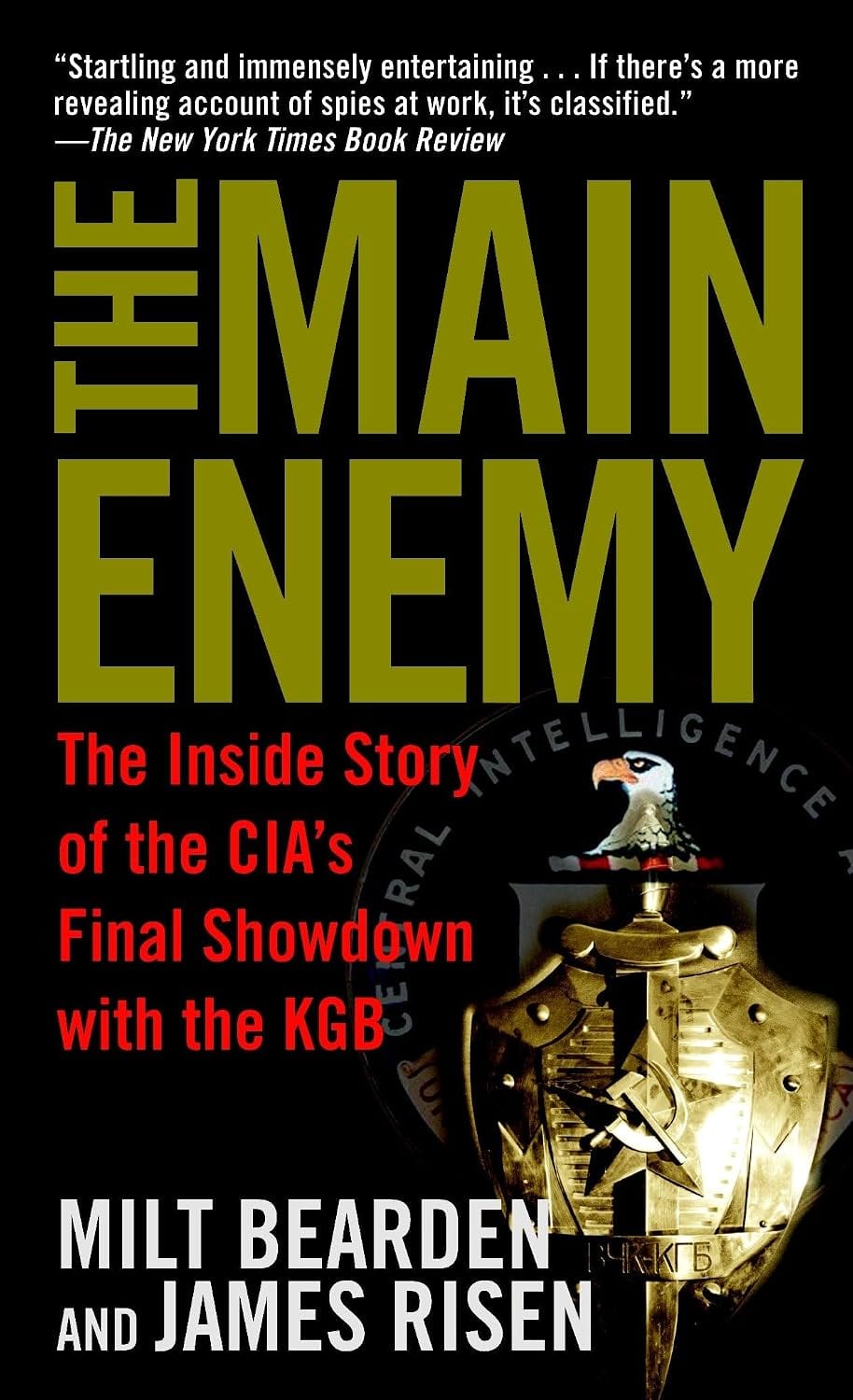
The Main Enemy - The Inside Story of the CIA’s Final - Milton Bearden.pdf (file not included in this release)
The Main Enemy — Hierarchical Summary
Source: Milton Bearden and James Risen, The Main Enemy: The Inside Story of the CIA’s Final Showdown with the KGB
Executive Summary
The Main Enemy argues that the final phase of the Cold War was not only decided by summits, ideology, economics, or military pressure, but also by a hidden intelligence war between the CIA and the KGB. Bearden and Risen present the late Cold War as a sequence of clandestine battles: the catastrophic CIA losses of 1985, the Afghan covert war that helped bleed Soviet power, and the intelligence adjustments required as the Soviet empire began to collapse.
The book’s central claim is that espionage both reflected and accelerated the Cold War’s end. The CIA and KGB were not merely observing history; they were acting inside it. The CIA’s successes in Afghanistan, its penetration of Soviet institutions, and its ability to exploit late-Soviet disorder mattered. But the book is equally concerned with CIA failure: betrayal by Aldrich Ames, Edward Lee Howard, and Robert Hanssen exposed American agents, destroyed human networks, and forced painful reassessment of CIA tradecraft and counterintelligence.
[!quote] Core Framing
“The Main Enemy.” — Title / KGB phrase for the United States and CIA
The book’s significance lies in its insider narrative. It combines Milt Bearden’s CIA perspective with James Risen’s journalistic reconstruction, giving the story both operational detail and broader historical interpretation. Its major limitation is that it is primarily written from the CIA side, with Soviet/KGB perspectives included but still filtered through the authors’ narrative structure.
Key Concepts
The “Main Enemy”
The KGB term Glavniy Vrag, or Main Enemy, referred to the United States and its intelligence services. The phrase captures the institutional worldview of the KGB: the Cold War was not an abstract geopolitical rivalry but a permanent, existential clandestine contest.
The Year of the Spy
The book treats 1985 as a watershed year. It was a year of spectacular intelligence drama: CIA assets were arrested, Soviet defectors appeared and disappeared, Edward Lee Howard escaped, Vitaly Yurchenko defected and then redefected, and Aldrich Ames began delivering CIA secrets to Moscow.
Tradecraft
Tradecraft means the practical methods used in espionage: surveillance detection routes, dead drops, brush passes, secure communications, disguise, signals, exfiltration, and case-officer discipline. In the book, tradecraft is almost a character of its own. Success or failure often turns on whether an officer can “get black,” detect surveillance, or make a brief clandestine exchange under hostile observation.
Counterintelligence Paranoia
The book contrasts necessary counterintelligence suspicion with destructive paranoia. James Jesus Angleton’s earlier mole hunts had paralyzed CIA Soviet operations, while the later Ames disaster proved that internal betrayal was real. The dilemma is central: too little suspicion invites penetration; too much suspicion destroys operations.
Volunteers
A recurring theme is the importance of volunteers: Soviet or Eastern Bloc officials who approached the CIA on their own initiative. Burton Gerber’s earlier reassessment of Soviet volunteer cases helped reverse the CIA’s post-Angleton paralysis and reopened the agency to some of its most valuable Cold War sources.
Covert Action
Part Two shifts from classic espionage to covert action, especially the CIA’s role in supporting the Afghan mujahideen. The book presents Afghanistan as a military, logistical, political, and intelligence campaign designed to raise the cost of Soviet occupation.
Endgame Intelligence
In Part Three, intelligence work changes as the Soviet bloc unravels. The CIA must adapt from operating against a stable totalitarian adversary to interpreting revolution, state collapse, institutional fragmentation, and new opportunities for recruitment.
Key Terms
- KGB — Soviet state security service, responsible for foreign intelligence, domestic counterintelligence, internal security, and political policing.
- CIA Soviet/East European Division / SE Division — CIA component responsible for operations against the Soviet Union and Eastern Europe.
- Rezidentura — A Soviet intelligence station abroad, usually operating under embassy or consular cover.
- Rezident — Chief of a KGB station abroad.
- Line PR — KGB political intelligence line inside a rezidentura.
- GRU — Soviet military intelligence.
- Case officer — Intelligence officer who recruits and handles agents.
- Agent / Asset — A person who secretly provides intelligence to a foreign service.
- Double agent — Someone apparently working for one intelligence service while secretly controlled by another.
- Dangle — A person offered to an intelligence service as bait, often controlled by the opposing service.
- Walk-in / Volunteer — Someone who approaches an intelligence service offering cooperation.
- Dead drop — A hidden place where messages, money, documents, or equipment can be left for later pickup.
- Brush pass — A brief, covert physical exchange between two people in public.
- Surveillance Detection Route / SDR — A planned route used to determine whether one is being followed.
- Get black — Become free of hostile surveillance.
- Bren — CIA term used in the book for a brief operational meeting.
- Exfiltration — Secret removal of a person from hostile territory.
- Special preparations — Euphemism in the book for suicide devices or pills used by agents to avoid capture.
- Stinger missile — U.S. shoulder-fired antiaircraft missile supplied to Afghan fighters; a major turning point in the Afghan war.
- Mujahideen — Afghan Islamist resistance fighters opposing the Soviet occupation.
- ISI — Pakistan’s Inter-Services Intelligence, the CIA’s crucial partner in the Afghan covert war.
PART ONE — The Year of the Spy
Chapter 1 — Washington, D.C., June 13, 1985
Main Ideas
- The book opens with Burton Gerber, chief of the CIA’s Soviet/East European Division, overseeing a Moscow operation from Langley.
- Gerber represents the CIA’s mature operational culture: obsessive attention to detail, reverence for tradecraft, and moral responsibility toward agents inside the Soviet Union.
- The operation is designed for Paul Stombaugh to meet Adolf Tolkachev, the CIA’s most valuable Soviet agent.
- Gerber’s confidence collapses when word arrives that Stombaugh has been arrested in Moscow.
- The chapter establishes the central tragedy of Part One: CIA operations that appear technically sound are being compromised by unseen betrayal.
Key Concept
Operational perfection cannot overcome strategic penetration. Gerber’s meticulous planning is meaningless once the KGB already knows the meeting plan.
Chapter 2 — Moscow, June 13, 1985
Main Ideas
- The narrative shifts to KGB counterintelligence officer Rem Krassilnikov, who is waiting to spring a trap on Stombaugh.
- Adolf Tolkachev has already been arrested and is being used to lure the CIA into a staged operation.
- The KGB reconstructs CIA communications procedures and uses them against the Americans.
- The chapter also introduces Alexander Ogorodnik, whose earlier suicide after arrest changed KGB arrest procedures.
- Aldrich Ames appears in Washington the same day, handing Soviet officials a list of CIA and FBI sources. The authors emphasize that Ames’s betrayal compounds losses already underway.
- Stombaugh is seized in a classic KGB ambush, complete with cameras, staged evidence, and theatrical humiliation.
Key Concept
Counterintelligence theater: the KGB does not merely arrest spies; it stages arrests for internal prestige, propaganda, and operational deception.
[!quote] Operational Worldview
“Moscow Rules.” — Page 5
Chapter 3 — Washington, D.C., June 14, 1985
Main Ideas
- Gerber’s career and CIA Soviet operations are placed in historical context.
- The chapter reviews the destructive legacy of James Jesus Angleton, Yuri Nosenko, Anatoliy Golitsyn, and CIA mole-hunting paranoia.
- Gerber’s analysis of Soviet volunteers helped revive CIA operations after years of paralysis.
- David Blee’s reforms reopened the CIA to Soviet volunteers and encouraged professionalized tradecraft.
- Adolf Tolkachev’s recruitment becomes the symbol of this revived CIA confidence.
- The chapter frames the 1985 disaster as especially devastating because it destroys the results of a decade-long operational recovery.
Key Concept
The Angleton problem: The CIA had to learn that fear of deception can be as damaging as deception itself.
Chapter 4 — Moscow, June 13, 1985
Main Ideas
- Krassilnikov interrogates Tolkachev at Lefortovo Prison before the Stombaugh ambush.
- Tolkachev’s motivations emerge as a mixture of ideological hostility to the Soviet system, personal resentment, intellectual pride, and the thrill of espionage.
- The chapter explores the psychology of betrayal from the Soviet side.
- Krassilnikov recognizes that spies are not always simple mercenaries; they often experience espionage as moral rebellion or personal liberation.
- Tolkachev’s fate is already sealed, and his remaining value to the KGB lies in operational exploitation.
Key Concept
Agent motivation: The book resists reducing espionage to money. Ego, ideology, revenge, alienation, and excitement all matter.
Chapter 5 — Moscow, June 18, 1985
Main Ideas
- Oleg Gordievsky, a senior KGB officer secretly working for British intelligence, attempts to signal for emergency exfiltration.
- The chapter recounts his suspicion, recall to Moscow, drugged interrogation, and eventual escape plan.
- British intelligence executes a risky exfiltration through the Soviet-Finnish border.
- Gordievsky’s escape is contrasted with the CIA’s disastrous losses: British tradecraft succeeds where CIA operations are failing.
- His case exposes the vulnerability of the KGB from within and shows that Soviet intelligence was also penetrated.
Key Concept
Exfiltration as last resort: When an agent is compromised but not yet arrested, speed, nerve, and preplanned escape routes become decisive.
Chapter 6 — Langley, July 10, 1985
Main Ideas
- Milt Bearden enters the narrative as deputy chief of SE Division.
- He arrives in the aftermath of the Tolkachev disaster and must help manage a division facing cascading agent losses.
- The chapter introduces internal CIA hierarchy, bureaucratic culture, and the emotional pressure of running Soviet cases.
- Bearden begins to understand that the problem may not be isolated tradecraft failure.
- The chapter also sets up his later transition from Soviet operations to Afghanistan.
Key Concept
Institutional shock: Intelligence organizations often first explain failure through known categories — poor tradecraft, surveillance, agent error — before accepting the possibility of penetration.
Chapter 7 — Viborg, USSR, July 20, 1985
Main Ideas
- Gordievsky’s escape continues through the Soviet-Finnish border.
- British officers move him out of the USSR in a tense operation that depends on discipline, deception, and timing.
- The chapter highlights the human strain of espionage: fear, exhaustion, waiting, and physical exposure.
- Gordievsky’s survival becomes one of Western intelligence’s major successes in an otherwise dark period.
- His intelligence will later help the West understand Soviet leadership and the internal KGB world.
Key Concept
Operational patience: Successful clandestine operations often involve long periods of stillness interrupted by seconds of decisive action.
Chapter 8 — Andrews Air Force Base, August 2, 1985
Main Ideas
- Vitaly Yurchenko, a senior KGB officer, defects to the United States.
- His arrival electrifies the CIA because he appears to possess major counterintelligence secrets.
- Chuck Medanich, the CIA psychologist, becomes central to managing Yurchenko’s emotional condition.
- Aldrich Ames is assigned to assist in the debriefing, creating a bitter irony: a CIA traitor is helping process a KGB defector.
- Yurchenko identifies Edward Lee Howard as a likely KGB source.
Key Concept
Defector handling: Intelligence value depends not only on what a defector knows but also on psychological management, credibility assessment, and bureaucratic coordination.
Chapter 9 — Lefortovo District, Moscow, August 10, 1985
Main Ideas
- The chapter returns to Soviet imprisonment, interrogation, and the machinery of Lefortovo.
- It explores the fate of Soviet citizens accused of espionage.
- The prison symbolizes Soviet state power: isolation, confession, psychological pressure, and inevitable punishment.
- The authors use Lefortovo to contrast Western intelligence’s operational secrecy with Soviet coercive authority.
- The chapter deepens the moral stakes of the CIA’s agent-running: capture usually means death or permanent ruin.
Key Concept
Lefortovo as institution: It is not merely a prison but an instrument of state terror and counterintelligence control.
Chapter 10 — Coventry, Virginia, August 15, 1985
Main Ideas
- Yurchenko is moved to a safer, more controlled CIA debriefing site.
- His information produces leads on Edward Lee Howard and other possible penetrations.
- Yurchenko’s reliability seems strong, but the CIA’s handling of him becomes increasingly complicated.
- The chapter shows how defector debriefings are slow, repetitive, and psychologically delicate.
- The CIA seeks “counterintelligence production”: usable leads, names, patterns, and operational explanations.
Key Concept
Counterintelligence production: The systematic conversion of a defector’s memory into actionable investigative leads.
Chapter 11 — Santa Fe, New Mexico, August 25, 1985
Main Ideas
- Edward Lee Howard realizes he is under FBI surveillance.
- Howard’s CIA training helps him detect and evade surveillance.
- The chapter also follows GRU officer Gennady Smetanin, another Soviet source under pressure.
- Howard’s case shows the danger of training someone in CIA tradecraft and then losing institutional control over him.
- The CIA and FBI struggle to coordinate a response before Howard escapes.
Key Concept
Blowback from training: Skills taught for intelligence operations can become dangerous when a former trainee turns against the service.
Chapter 12 — Washington, D.C., September 18, 1985
Main Ideas
- The FBI decides to close in on Edward Howard.
- Jack Platt, Howard’s former CIA instructor, fears that Howard’s training makes him capable of escape.
- Surveillance errors allow Howard to slip away.
- Howard’s escape is a major embarrassment because he had direct knowledge of Moscow operations.
- The chapter intensifies the sense that CIA losses are no longer isolated.
Key Concept
Interagency friction: CIA and FBI missions overlap in counterintelligence, but differences in culture and procedure can create operational gaps.
Chapter 13 — Montreal, September 24, 1985
Main Ideas
- The CIA tries to address Yurchenko’s personal life, especially his longing for a woman in Canada.
- The chapter emphasizes Yurchenko’s emotional volatility and the personal costs of defection.
- CIA officers misread or underestimate the depth of his dissatisfaction.
- His treatment becomes a case study in how psychological needs can override intelligence value.
- The chapter foreshadows Yurchenko’s eventual redefection.
Key Concept
Human fragility of defection: Defectors are not merely intelligence containers; they are displaced persons under extreme emotional stress.
Chapter 14 — Alexandria, Virginia, October 4, 1985
Main Ideas
- Aldrich Ames secretly approaches the KGB again, using covert communications through Soviet officers in Washington.
- The chapter reconstructs the mechanics of Ames’s betrayal.
- Ames is motivated by money, resentment, ego, and personal financial pressure.
- His access allows him to compromise a broad range of CIA operations.
- The KGB begins exploiting Ames as one of its most damaging sources inside American intelligence.
Key Concept
Penetration agent: Ames represents the nightmare case — a trusted insider with access to identities, operations, and counterintelligence files.
Chapter 15 — Langley, October 1985
Main Ideas
- The CIA and FBI try to trace Howard after his escape.
- Evidence suggests he has reached Soviet protection.
- The chapter examines the damage Howard could do because of his knowledge of Moscow operations and planned agent meetings.
- SE Division begins to connect Howard’s betrayal to specific Soviet arrests.
- The authors show a bureaucracy trying to map invisible damage after the fact.
Key Concept
Damage assessment: After a betrayal, intelligence services must determine what the enemy now knows, which assets are compromised, and which operations must be shut down.
Chapter 16 — Coventry, November 2, 1985
Main Ideas
- Yurchenko escapes CIA custody during an outing and returns to the Soviet embassy.
- He publicly claims he was kidnapped and drugged by the CIA.
- The CIA is humiliated and internally divided over whether Yurchenko had been a genuine defector or a KGB plant.
- Bearden and others believe the reality is more ambiguous: Yurchenko may have defected genuinely and then lost his nerve.
- The episode becomes one of the strangest intelligence reversals of the Cold War.
Key Concept
Redefection: A defector’s return to his original side can be genuine, coerced, staged, or psychologically driven; Yurchenko’s case remains ambiguous.
Chapter 17 — Langley, November 20, 1985
Main Ideas
- The disappearance of Gennady Varennik deepens SE Division’s dread.
- Multiple CIA Soviet assets are now missing, arrested, or silent.
- The CIA begins to suspect a systemic compromise.
- Yet the organization still struggles to identify Ames because the culture resists imagining betrayal from within.
- The chapter captures the atmosphere of institutional fear inside Langley.
Key Concept
Pattern recognition under uncertainty: Intelligence officers must infer betrayal from silence, no-shows, arrests, and fragmentary reporting.
Chapter 18 — Moscow, Early January 1986
Main Ideas
- Krassilnikov pursues more CIA operations and Soviet agents, including Sergey Vorontsov.
- The KGB is receiving highly accurate information from above, likely from penetrations of U.S. intelligence.
- The chapter describes KGB confidence at its peak.
- Soviet counterintelligence appears to be winning the street war in Moscow.
- The CIA’s technical operations also become vulnerable.
Key Concept
Source-protected information: The KGB must exploit intelligence from moles without revealing the mole’s existence, shaping how arrests and investigations unfold.
Chapter 19 — Moscow, February 21, 1986
Main Ideas
- The KGB discovers a CIA technical collection operation hidden in a shipping container crossing the Soviet Union.
- The operation demonstrates CIA ambition: using advanced technical systems to collect signals across Soviet territory.
- Its discovery is a major operational loss.
- The KGB views the find as evidence of American ingenuity and aggression.
- The chapter expands the book beyond human espionage into technical intelligence.
Key Concept
Technical collection: Espionage includes machines, sensors, transmitters, concealment devices, and logistical deception, not only human agents.
Chapter 20 — Langley, Late March 1986
Main Ideas
- A mysterious source in East Berlin offers information about how Varennik was compromised.
- The CIA debates whether the source is genuine or a KGB dangle.
- This source becomes connected to the later PROLOGUE case.
- The chapter reveals how difficult it is to act when every new volunteer may be either salvation or trap.
- Bearden and SE Division must decide how much risk to accept.
Key Concept
Dangle dilemma: Rejecting a source may lose priceless intelligence; accepting one may invite deception or compromise.
Chapter 21 — Moscow, October 22, 1986
Main Ideas
- The Soviet Union announces Tolkachev’s conviction and execution.
- Tolkachev’s death marks the definitive end of one of the CIA’s greatest Soviet cases.
- The chapter closes Part One with the human cost of 1985’s betrayals.
- The CIA’s Moscow operations have been severely damaged, and the agency still does not fully understand why.
- The book frames Tolkachev as both a triumph of CIA recruitment and a victim of American counterintelligence failure.
[!quote] Soviet Judgment
“High treason.” — Page 196
Key Concept
Strategic loss through individual death: Each arrested agent is both a human tragedy and an intelligence catastrophe.
PART TWO — The Cold War Turns Hot in Afghanistan
Chapter 1 — Islamabad, June 1, 1986
Main Ideas
- Bearden is assigned to Islamabad to run the CIA’s Afghan covert action program.
- The war is going badly for the Afghan resistance as Soviet tactics improve.
- Bearden inherits a program that has been cautious and supply-driven.
- He concludes that the CIA must escalate the war’s effectiveness rather than merely sustain resistance.
- The chapter marks a shift from counterintelligence disaster to covert-action initiative.
Key Concept
Cost-imposition strategy: The Afghan program aims to make Soviet occupation militarily, politically, and economically unbearable.
Chapter 2 — Islamabad, August 1986
Main Ideas
- Bearden surveys Pakistan’s geography, politics, and intelligence environment.
- Pakistan’s ISI is indispensable but difficult, because its goals do not perfectly match Washington’s.
- The Afghan war is fought through proxies, supply routes, tribes, commanders, and Pakistani intermediaries.
- The chapter emphasizes that covert action depends on local partners who have their own agendas.
- Islamabad becomes the operational hub for a regional war.
Key Concept
Proxy warfare: The CIA cannot directly command the Afghan resistance; it must influence events through Pakistan, money, weapons, and relationships.
Chapter 3 — Kabul, August 26, 1986
Main Ideas
- Mujahideen rocket attacks destroy an Afghan army ammunition dump near Kabul.
- The operation becomes a symbolic success in a war that had been tilting toward the Soviets.
- The chapter illustrates sabotage, delayed-action devices, and guerrilla planning.
- The psychological impact matters as much as the physical destruction.
- It shows that the resistance can hit major regime targets.
Key Concept
Asymmetric warfare: Lightly equipped insurgents can impose disproportionate costs through timing, surprise, and vulnerability exploitation.
Chapter 4 — Ojhri Camp, Rawalpindi, September 1986
Main Ideas
- Afghan fighters are trained to use the U.S. Stinger missile.
- The Stinger is presented as a major tactical and psychological turning point.
- The primitive training environment contrasts with the sophistication of the weapon.
- The weapon gives the mujahideen a credible answer to Soviet airpower.
- Bearden recognizes that the Stinger’s success depends on training, discipline, and controlled distribution.
Key Concept
Technology as force multiplier: A single weapon system can alter battlefield incentives if it neutralizes the enemy’s key advantage.
Chapter 5 — Islamabad, October 1986
Main Ideas
- Robert Gates visits Pakistan as William Casey’s deputy.
- Bearden navigates Washington’s bureaucracy, Islamabad’s politics, and operational secrecy.
- The CIA must balance congressional scrutiny with battlefield demands.
- Gates’s visit signals that Afghanistan has become central to Cold War strategy.
- The chapter shows covert action moving closer to policy center stage.
Key Concept
Field-policy interface: Station chiefs translate Washington’s strategic objectives into local operations while managing political risk.
Chapter 6 — Washington, December 1986
Main Ideas
- Iran-Contra erupts, weakening CIA leadership and congressional trust.
- William Casey’s health deteriorates, and his influence wanes.
- The Afghan program is endangered by broader political scandal even though it is separate from Iran-Contra.
- Bearden must defend the program amid institutional turbulence.
- The chapter shows how covert action is vulnerable to domestic politics.
Key Concept
Political contamination: Scandal in one covert program can threaten unrelated operations by damaging institutional legitimacy.
Chapter 7 — Islamabad, March 1987
Main Ideas
- Signs emerge that the Soviets may be looking for a way out of Afghanistan.
- The Stinger and increased resistance effectiveness are changing Soviet calculations.
- Bearden remains skeptical of quick victory but senses momentum.
- The Afghan war becomes a test of whether covert action can shape superpower behavior.
- Casey’s death closes one era of CIA activism.
Key Concept
Battlefield pressure and diplomacy: Military costs can alter negotiating behavior, especially when a war loses political justification.
Chapter 8 — Islamabad, Late April 1987
Main Ideas
- Clair George asks Bearden whether he was involved in an attack inside Soviet Uzbekistan.
- The question raises escalation risks: covert action in Afghanistan could spill into Soviet territory.
- Bearden must maintain plausible boundaries.
- The chapter underscores the danger of a proxy war expanding beyond accepted limits.
- Washington fears giving Moscow a pretext for escalation.
Key Concept
Escalation control: Covert action must hurt the adversary without crossing thresholds that produce open confrontation.
Chapter 9 — Aboard the Red Arrow Express, May 1987
Main Ideas
- Jack Downing meets a mysterious KGB officer who becomes connected to the PROLOGUE case.
- The chapter returns to classic espionage inside the Soviet bloc.
- The source’s access and motives are uncertain.
- The CIA must decide whether to trust a Soviet counterintelligence officer volunteering information.
- The chapter connects the Afghan narrative back to SE Division’s mole-haunted world.
Key Concept
Volunteer validation: Before acting on a source’s information, the CIA must establish identity, access, motivation, and possible hostile control.
Chapter 10 — Islamabad, June 1987
Main Ideas
- Bearden’s relationship with U.S. Ambassador Arnold Raphel becomes central.
- Raphel is portrayed as politically skilled, regionally knowledgeable, and crucial to managing Pakistan.
- The Afghan program requires coordination among CIA, State Department, Pakistan’s military, and resistance factions.
- Bearden and Raphel must think beyond Soviet withdrawal to Afghanistan’s future political order.
- The chapter highlights the gap between winning a proxy war and shaping the peace afterward.
Key Concept
End-state problem: Covert action can help defeat an adversary without producing a stable political settlement.
Chapter 11 — Nottoway Park, Virginia, November 23, 1987
Main Ideas
- Robert Hanssen, an FBI agent spying for the Soviets, uses a dead drop in Virginia.
- Hanssen’s betrayal parallels Ames’s and widens the theme of American counterintelligence failure.
- His motives include ego, money, alienation, and a sense of superiority.
- The chapter shows that Soviet penetration of U.S. intelligence was not confined to CIA.
- Hanssen’s existence complicates later damage assessments.
Key Concept
Insider threat across institutions: The KGB benefited from penetrations inside both CIA and FBI, making attribution of losses more difficult.
Chapter 12 — Islamabad, February 2, 1988
Main Ideas
- Geneva negotiations over Soviet withdrawal from Afghanistan reach a critical stage.
- Bearden and Raphel discuss interim government possibilities.
- The CIA worries that Soviet withdrawal may leave behind a durable communist regime.
- The chapter shows the difference between forcing withdrawal and determining postwar power.
- Bearden recognizes that Afghan factional politics may become the next crisis.
Key Concept
Withdrawal is not victory: An occupying army can leave while the political struggle continues.
Chapter 13 — Rawalpindi, August 13, 1988
Main Ideas
- Bearden maintains contact with General Akhtar, former head of ISI.
- Pakistan’s internal politics, military rivalries, and Afghan ambitions remain decisive.
- The chapter leads toward the plane crash that kills President Zia, Ambassador Raphel, Akhtar, and others.
- The deaths radically alter the political landscape around the Afghan war.
- Bearden loses a crucial American partner in Raphel.
Key Concept
Personal networks in covert war: Covert action often depends on relationships among a small number of powerful actors; sudden deaths can shift strategy.
Chapter 14 — Islamabad, February 15, 1989
Main Ideas
- Soviet General Boris Gromov exits Afghanistan, ending the Soviet occupation.
- Bearden marks the withdrawal as a Cold War milestone.
- The CIA-supported resistance has helped force a Soviet retreat.
- Yet Afghanistan’s future remains unresolved, with Najibullah’s regime still in place.
- The chapter closes Part Two with victory shadowed by instability.
[!quote] End of Occupation
“Today it was over.” — Page 355
Key Concept
Pyrrhic victory risk: A successful anti-Soviet campaign leaves behind armed factions, Pakistani influence, and no coherent Afghan settlement.
PART THREE — Endgame
Chapter 1 — Vienna, April 27, 1989
Main Ideas
- CIA counterintelligence tracks a KGB illegal, Reino Gikman, and identifies connections to U.S.-based espionage.
- The chapter reopens the hunt for Soviet penetrations.
- The intelligence war continues even as Soviet power begins to weaken.
- The CIA is still trying to understand past losses and active betrayals.
- The chapter links technical surveillance, patient observation, and counterintelligence reconstruction.
Key Concept
Illegals network: Deep-cover Soviet officers could operate outside normal diplomatic channels, complicating surveillance and attribution.
Chapter 2 — East Berlin, July 20, 1989
Main Ideas
- David Rolph runs CIA operations in East Berlin.
- East Germany is portrayed as a rigid but weakening police state.
- Rolph begins exploiting cracks in the Soviet bloc by encouraging more aggressive recruitment.
- The CIA’s operational environment is changing rapidly as communist authority erodes.
- East Berlin becomes a front line of both espionage and historical transformation.
Key Concept
Late-imperial vulnerability: As Soviet control weakens, fear declines, and recruitment opportunities multiply.
Chapter 3 — Prague, November 17, 1989
Main Ideas
- The Velvet Revolution begins in Czechoslovakia.
- Václav Havel and dissident networks move from marginal opposition to national leadership.
- The CIA watches as events outpace traditional intelligence assumptions.
- The chapter emphasizes civil society, moral dissent, and the fragility of communist legitimacy.
- Intelligence officers must interpret mass politics, not just secret reporting.
Key Concept
Open revolution versus secret intelligence: Some historical events become visible faster than clandestine services can process them.
Chapter 4 — Langley, December 27, 1989
Main Ideas
- Eastern Europe’s revolutions culminate in Romania’s violent collapse.
- Bearden briefs CIA leadership on the rapidly changing Soviet bloc.
- The agency must reassess assumptions built around a durable communist system.
- The chapter shows bureaucratic difficulty in adapting to sudden historical acceleration.
- Intelligence analysis and operations both lag behind revolutionary reality.
Key Concept
Analytical inertia: Intelligence institutions built to study stability may struggle when systems rapidly disintegrate.
Chapter 5 — Langley, April 5, 1990
Main Ideas
- The CIA plans the exfiltration of PROLOGUE, identified as Aleksandr “Sasha” Zhomov.
- The case remains uncertain because Zhomov may be genuine or part of a KGB deception.
- Sergei Papushin helps confirm Zhomov’s identity.
- The CIA debates whether extracting him is worth the risk.
- The chapter dramatizes the moral problem of agent protection after years of betrayal.
Key Concept
Duty to the agent: Intelligence services owe protection to sources, but extraction can also compromise operations and reveal capabilities.
Chapter 6 — East Berlin, June 1990
Main Ideas
- Soviet walk-ins increase as the Eastern Bloc collapses.
- Rolph screens defectors and volunteers, most of whom have little intelligence value.
- Amid the flood, valuable sources may appear.
- The chapter shows how collapse changes recruitment: fear decreases, but noise increases.
- The CIA must distinguish opportunity from chaos.
Key Concept
Signal-to-noise problem: Political collapse produces many sources, rumors, and defectors; intelligence value becomes harder to filter.
Chapter 7 — Langley, September 25, 1990
Main Ideas
- German reunification forces the CIA to rethink operations in Germany.
- Bearden pushes a more aggressive approach suited to post-Cold War realities.
- Older SE Division habits remain attached to Cold War assumptions.
- The chapter is about bureaucratic reform under geopolitical change.
- The CIA must decide whether to keep treating Soviet targets as if the old order still exists.
Key Concept
Organizational adaptation: Agencies must change doctrine when the adversary’s political environment changes.
Chapter 8 — Tyson’s Corner, Virginia, April 12, 1991
Main Ideas
- Aldrich Ames is back at CIA headquarters and continues to escape detection.
- His career mediocrity protects him: he is not seen as important enough to be suspected.
- Ames’s wealth, behavior, and access should raise alarms, but institutional blindness persists.
- The chapter underscores the CIA’s failure to connect financial anomalies with operational losses.
- Ames remains the unresolved center of the 1985 catastrophe.
Key Concept
Normalcy bias in counterintelligence: Institutions often overlook traitors who appear bureaucratically ordinary.
Chapter 9 — Moscow, August 1, 1991
Main Ideas
- David Rolph becomes Moscow chief, symbolizing Bearden’s effort to inject new operational energy into SE Division.
- Moscow is changing: Soviet authority is weaker, surveillance is less absolute, and political uncertainty is everywhere.
- The CIA sees new opportunities to recruit and operate.
- Rolph must run operations in a system that is no longer classically totalitarian but not yet free.
- The chapter captures the unstable atmosphere before the August coup.
Key Concept
Transitional operating environment: The rules of espionage change when an authoritarian state begins to lose control but its security organs remain active.
Chapter 10 — Langley, August 20, 1991
Main Ideas
- The hard-line coup against Gorbachev appears to vindicate CIA officers who believed Soviet reform was reversible.
- Bearden’s reformist assumptions are tested.
- SE Division watches events unfold with both anxiety and professional fascination.
- The chapter shows how intelligence officers experience history as both analysis and personal career risk.
- The coup’s failure will ultimately confirm that the Soviet system is more fragile than its security organs appear.
Key Concept
Coup as stress test: The August coup reveals whether Soviet institutions still possess coercive legitimacy.
Chapter 11 — Moscow, August 22, 1991
Main Ideas
- Rolph’s officers observe the collapse of the coup from the streets of Moscow.
- Crowds gather around the Lubyanka and the statue of Felix Dzerzhinsky.
- The symbolic center of Soviet repression becomes vulnerable to public anger.
- Intelligence officers witness the delegitimation of the KGB in real time.
- The chapter presents the end of the Soviet security state as visual and theatrical.
Key Concept
Symbolic collapse: When citizens attack or mock symbols of repression, political authority has already been deeply damaged.
Chapter 12 — The Lubyanka, Mid-September 1991
Main Ideas
- U.S. Ambassador Robert Strauss visits the Lubyanka in the aftermath of the failed coup.
- Bearden reflects on the surreal reversal: Americans now entering the symbolic heart of Soviet security power.
- The KGB is weakened, disoriented, and politically exposed.
- The chapter closes the intelligence-war narrative with the adversary’s institutional humiliation.
- Yet the book does not imply that espionage ends; rather, the old Cold War structure dissolves into a new uncertain order.
Key Concept
End of the old adversary: The KGB’s loss of political sanctity marks the end of the Cold War intelligence world the CIA had been built to fight.
Epilogue
Main Ideas
- The epilogue reflects on the aftermath of the Soviet collapse and the later exposure of Ames.
- The CIA eventually identifies Ames as a devastating mole, but only after enormous damage.
- The book closes with a mixed verdict: the CIA helped win major Cold War victories but failed catastrophically to protect its own agents.
- Afghanistan is treated as both a success and a warning. The Soviet withdrawal was a triumph of covert action, but the long-term consequences of the Afghan war were unresolved.
- The final message is not triumphalist. Victory over the Soviet Union did not eliminate intelligence failure, geopolitical disorder, or moral ambiguity.
Critical Analysis
Methodology
The book’s method is narrative reconstruction based on interviews, insider memory, operational records, and journalistic investigation. Its strongest feature is access. Bearden’s firsthand CIA experience gives the reader unusually detailed insight into operational culture, while Risen’s reporting broadens the account beyond memoir.
The authors also openly explain their division of labor and CIA prepublication review. Bearden’s portions were reviewed by the CIA, while Risen’s were not. That matters: the book is candid, but it is not an unfiltered archive. Some details are reconstructed, and some dialogue depends on memory.
Strengths
- Operational detail: The book excels at explaining how espionage actually works: routes, signals, dead drops, surveillance, psychological pressure, and bureaucratic decision-making.
- Humanization of spies: Agents, defectors, and case officers are not treated as abstractions. Tolkachev, Gordievsky, Yurchenko, Howard, Ames, Hanssen, Bearden, Gerber, Rolph, and Krassilnikov all receive psychological treatment.
- Balanced sense of victory and failure: The book does not present the CIA as simply triumphant. It gives full weight to American betrayal, incompetence, interagency friction, and institutional blindness.
- Integration of espionage and geopolitics: The Afghan war, Eastern European revolutions, German reunification, and the Soviet coup are presented as intelligence problems as well as historical events.
Weaknesses and Biases
- CIA-centered perspective: The book’s moral and operational center is the CIA. KGB perspectives are included, but they are not equally authoritative.
- Limited Afghan aftermath: The Afghan covert war is presented mainly through the lens of defeating the Soviets. The later consequences — civil war, Taliban rise, jihadist networks, Pakistani strategic depth — receive less sustained attention than a modern reader may expect.
- Heroic field-officer framing: Bearden’s narrative naturally privileges field judgment, boldness, and operational initiative. Bureaucratic caution often appears as obstruction, even when caution may have had legitimate strategic grounds.
- Reconstructed dialogue problem: The prose is vivid, but reconstructed scenes can blur the line between documented fact and narrative dramatization.
- Counterintelligence hindsight: Ames and Hanssen appear obvious in retrospect. The book rightly criticizes missed signs, but the actual difficulty of detecting a careful insider inside a compartmented bureaucracy may be greater than the narrative sometimes allows.
Overall Evaluation
The Main Enemy is one of the strongest narrative accounts of late-Cold War espionage because it connects street-level clandestine operations to the collapse of Soviet power. Its central achievement is showing that intelligence history is neither purely institutional nor purely geopolitical. It is made by individuals under pressure, acting with incomplete knowledge, often inside systems that do not understand their own vulnerabilities.
Its strongest conclusion is also its most sobering: the CIA could help impose strategic costs on the Soviet Union and still fail the agents who trusted it. The hidden war ended with American victory, but not with institutional innocence.
Questions for Reflection
- How does The Main Enemy complicate the claim that the Cold War was won primarily through economics, diplomacy, or military pressure?
- Was the Afghan covert-action program a strategic success, a moral hazard, or both?
- How should intelligence agencies balance openness to volunteers with fear of dangles and deception?
- Did CIA counterintelligence fail because it was insufficiently suspicious after Angleton, or because it was suspicious in the wrong ways?
- What does the Tolkachev case reveal about the moral obligations intelligence services have toward agents they recruit or handle?
- How does the collapse of the Soviet bloc change the meaning of espionage? What happens when the enemy’s institutions weaken faster than intelligence doctrine changes?
- What parallels exist between the CIA’s late-Cold War adaptation problem and modern intelligence challenges involving China, Russia, cyber operations, terrorism, or insider threats?
Connections
People
- Milton Bearden — CIA officer; central narrator; later chief of Soviet/East European Division.
- James Risen — Journalist and co-author.
- Burton Gerber — CIA Soviet operations chief; symbol of disciplined tradecraft.
- Adolf Tolkachev — Major CIA Soviet agent; aviation electronics specialist; executed by the USSR.
- Aldrich Ames — CIA officer who spied for the KGB; central betrayal figure.
- Edward Lee Howard — Former CIA officer who defected to the Soviet Union.
- Robert Hanssen — FBI agent who spied for the Soviets/Russians.
- Oleg Gordievsky — KGB officer and British agent; successfully exfiltrated.
- Vitaly Yurchenko — KGB defector who later returned to the Soviet side.
- Rem Krassilnikov — KGB counterintelligence officer.
- James Jesus Angleton — CIA counterintelligence chief associated with destructive mole hunts.
- Yuri Nosenko — KGB defector whose treatment became a major CIA scandal.
- Anatoliy Golitsyn — KGB defector whose claims fed Angleton’s paranoia.
- Oleg Penkovsky — GRU officer and major Western source during the Cuban missile crisis period.
- William Casey — CIA director under Reagan; strong supporter of Afghan covert action.
- Robert Gates — Deputy CIA director; later CIA director and U.S. secretary of defense.
- Arnold Raphel — U.S. ambassador to Pakistan; key Bearden partner in Afghan policy.
- General Zia-ul-Haq — Pakistani president during much of the Afghan war.
- General Akhtar Abdul Rahman — Former ISI chief; major Pakistani figure in Afghan covert war.
- Boris Gromov — Soviet general who symbolically exited Afghanistan in 1989.
- Václav Havel — Czech dissident and later president; central figure in the Velvet Revolution.
- Robert Strauss — U.S. ambassador to the Soviet Union during the final phase.
Institutions
- CIA
- KGB
- GRU
- FBI
- MI6 / British Secret Intelligence Service
- ISI
- Soviet Second Chief Directorate
- Soviet First Chief Directorate
- Lefortovo Prison
- Lubyanka
- U.S. Embassy Moscow
- Moscow Station
- East Berlin Station
Historical Movements and Events
- Cold War
- Year of the Spy, 1985
- Soviet-Afghan War
- Afghan jihad / Mujahideen resistance
- Iran-Contra scandal
- Eastern European revolutions of 1989
- Velvet Revolution
- Fall of the Berlin Wall
- German reunification
- Romanian Revolution
- August 1991 Soviet coup
- Collapse of the Soviet Union
Related Works for Further Study
- Christopher Andrew and Vasili Mitrokhin, The Sword and the Shield
- Benjamin Weiser, A Secret Life: The Polish Officer, His Covert Mission, and the Price He Paid to Save His Country
- David E. Hoffman, The Billion Dollar Spy
- Tim Weiner, Legacy of Ashes
- Steve Coll, Ghost Wars
- George Crile, Charlie Wilson’s War
- Oleg Gordievsky and Christopher Andrew, KGB: The Inside Story
- John Prados, Safe for Democracy
- Robert Gates, From the Shadows
- Lawrence Wright, The Looming Tower