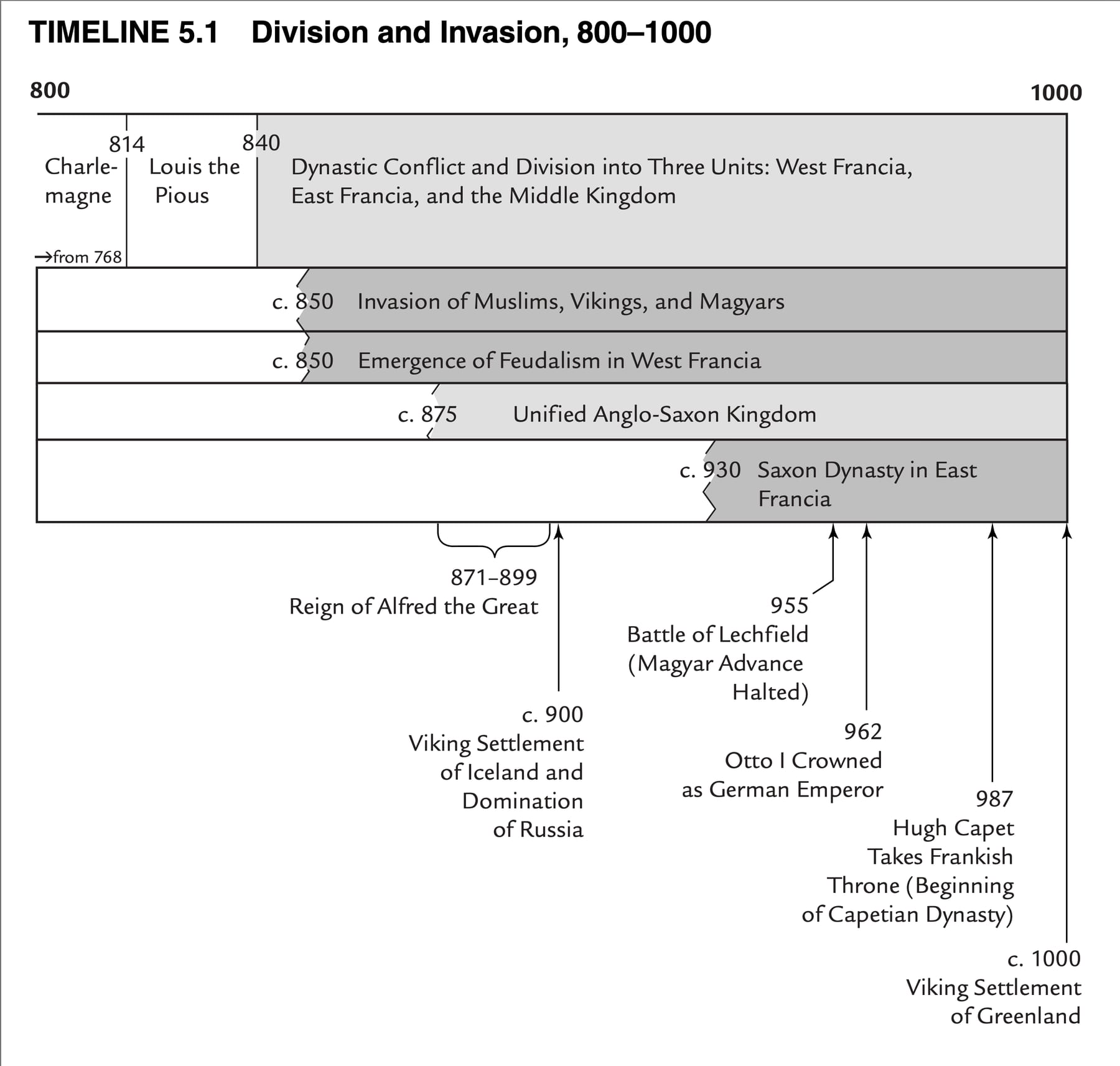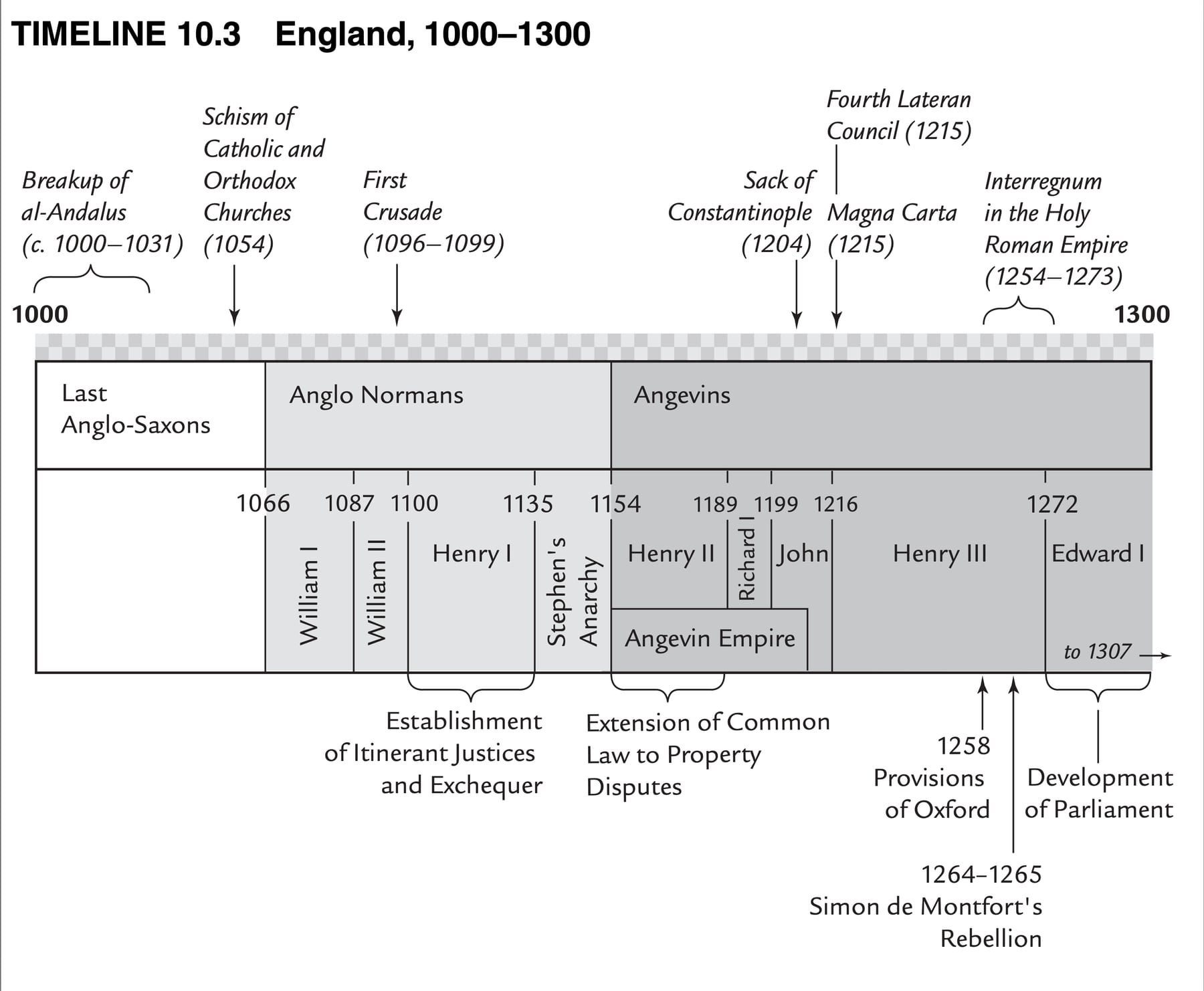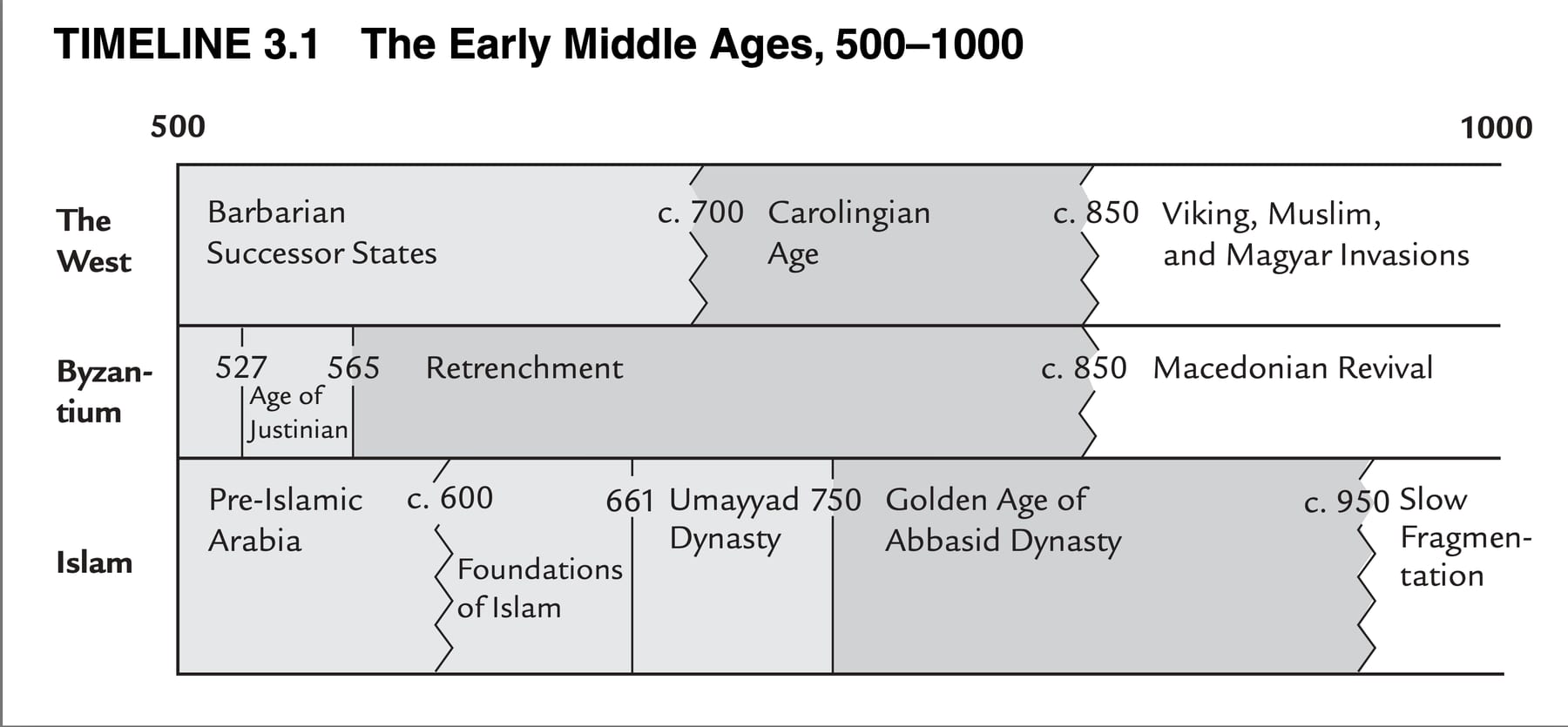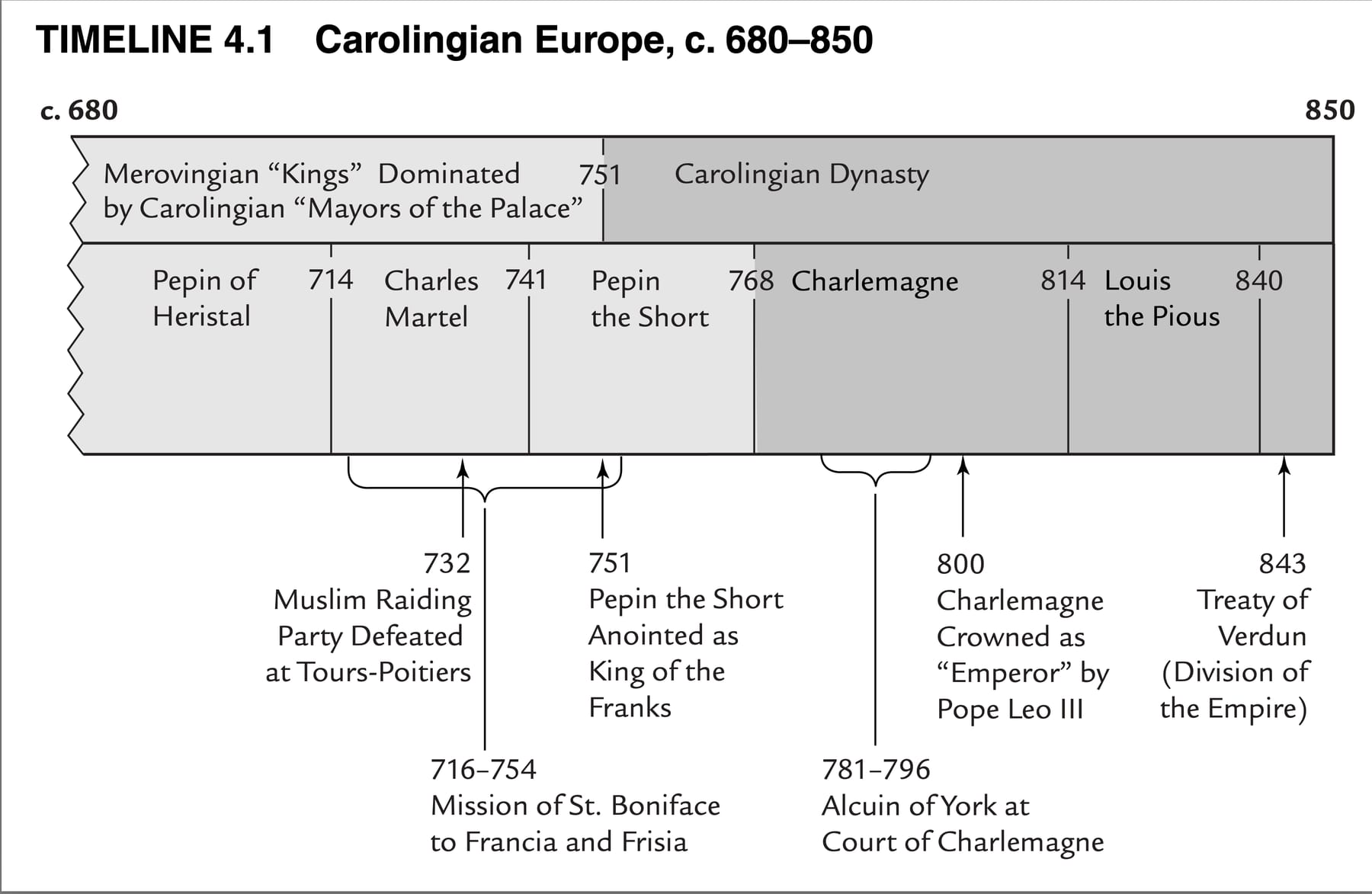
📓 In your handwritten notebooks
- March 21 – June 9 2026, pp. 105–110 — *The Making of Europe — Bartlett* → open PDF p114 (file not included in this release)
Index: Personal Journal
DESCRIPTION
This provocative book shows that Europe in the Middle Ages was as much a product of a process of conquest and colonization as it was later a colonizer. “Will be of great interest to… . (those) interested in cultural transformation, colonialism, racism, the Crusades, or holy wars in general… ”.—William C. Jordan, Princeton University. 12 halftones, 12 maps, 6 diagrams.
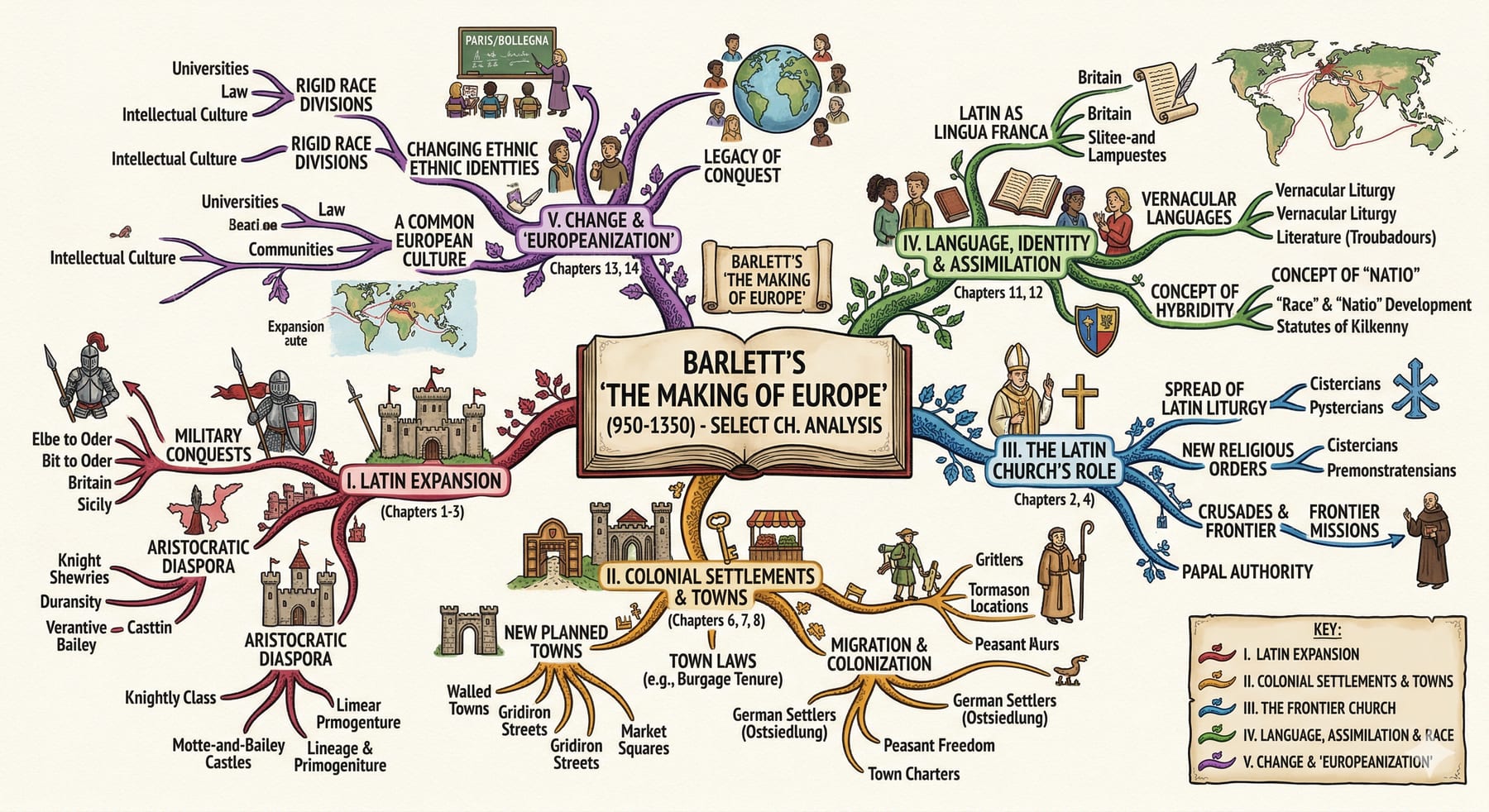
Introduction
Chapter Objective
- This Introduction sets up the book’s central claim: Europe in the High Middle Ages was not just a place, but an expanding civilization, and its growth was driven by conquest, colonization, migration, and cultural consolidation.
- Bartlett frames Europe as both a geographical region and a historical idea, arguing that by the later Middle Ages there was enough shared structure in Latin Europe to treat it as a coherent civilizational whole.
- The introduction also explains how the book fits into the broader argument: it will study how Europe was “made” between 950–1350 through both internal development and frontier expansion, especially in places where Europeans settled, conquered, and reshaped peripheral regions.
Europe as Both Diversity and Unity
- Bartlett begins by stressing that Europe has always been diverse, so “Europe” is not a simple or obvious category.
- Even so, by the later Middle Ages, western and central Europe shared enough common features to be viewed as a meaningful unit.
- He places special emphasis on Latin Europe:
- the Roman Catholic part of Europe
- distinct from Greek Orthodox and non-Christian regions
- bound together by strong shared institutions and cultural patterns
- This matters because the book is not treating Europe as timelessly unified; rather, it is showing how that unity was historically formed.
Basic Structure of Medieval Latin Europe
- Bartlett sketches the core social order of medieval Europe before discussing its expansion.
- Main features:
- a world of peasant communities based on pastoral and arable agriculture
- a small aristocratic elite living from peasant labor
- a division between:
- lay aristocrats, centered on warfare, lineage, and lordship
- clerics and monks, centered on literacy, celibacy, and the Church
- Political life was shaped by:
- networks of lordship, loyalty, domination, and alliance
- Church institutions linked, however loosely, to Rome
- Its cultural inheritance was mixed:
- Roman: Latin language, roads, cities
- Christian: sacramental religion, scripture, ecclesiastical structure
- Germanic: names, rites, military ethos of the aristocracy
- This section is important because Bartlett shows that Europe’s expansion grew out of an already distinctive social and institutional core.
From Early Medieval Fragmentation to High Medieval Dynamism
- Bartlett contrasts the early Middle Ages with the period after 1000 AD.
- Early medieval Latin Europe was:
- more internally fragmented
- territorially smaller
- less mobile and less connected across regions
- The shift after 1000 was not an overnight revolution, but from the eleventh century onward Europe entered a period of unusual energy and growth.
- A major background condition was the end of earlier invasions:
- Vikings
- Magyars
- Saracens
- This opened the way for the High Middle Ages, which Bartlett presents as an era of:
- economic growth
- territorial expansion
- cultural and social transformation
The Creative and Institutional Growth of High Medieval Europe
- Bartlett argues that the period from the late tenth to early fourteenth centuries was marked by a broad civilizational takeoff.
- He identifies several interconnected developments:
- population growth
- expansion of cultivated land
- increasing urbanization
- greater commercialization
- wider use of money
- development of banking and business techniques
- growth in manufacturing
- He also emphasizes that many key European institutions took recognizable form in this era:
- the incorporated town
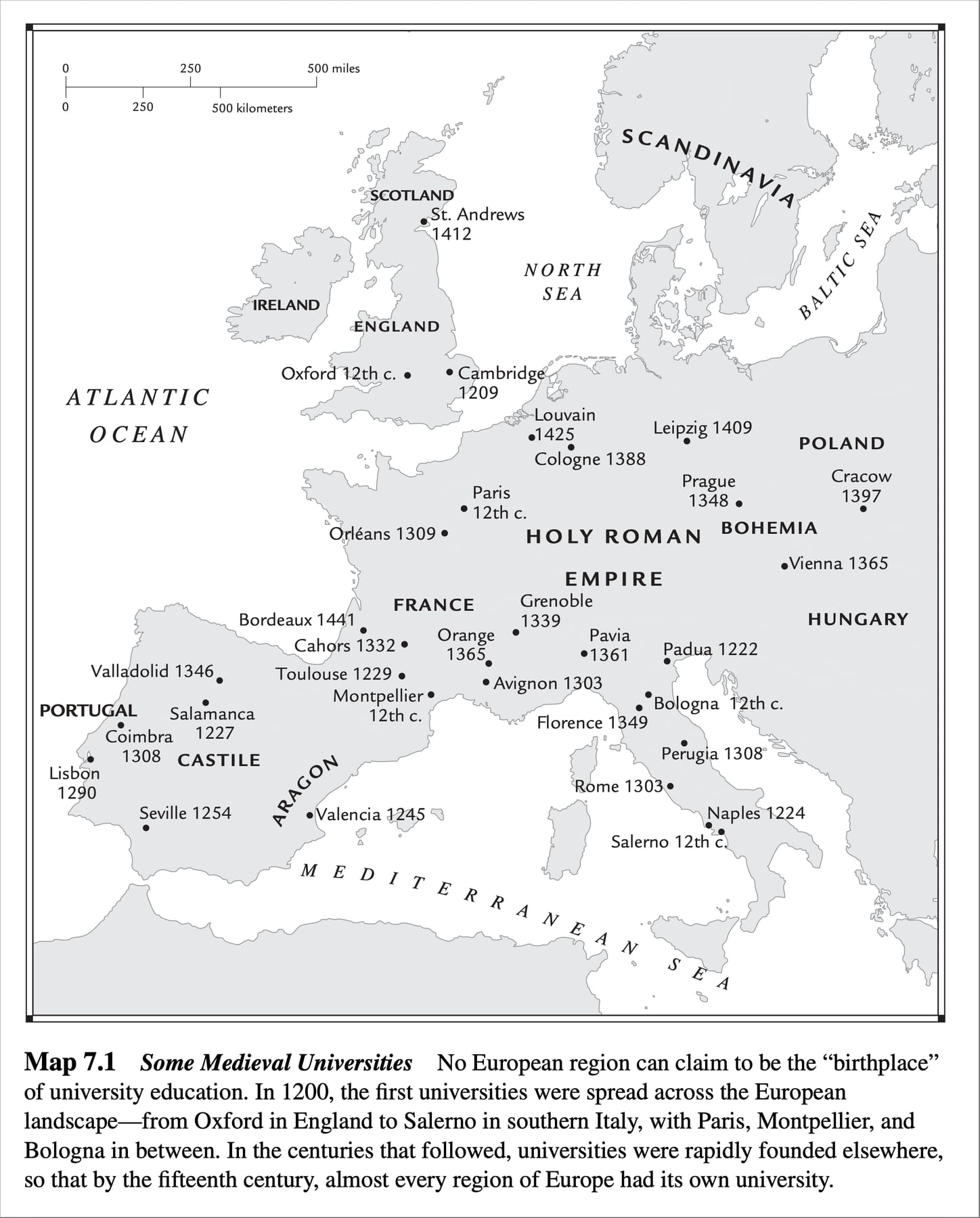
- the university
- central representative bodies
- international religious orders
- Historical examples used to illustrate this vitality:
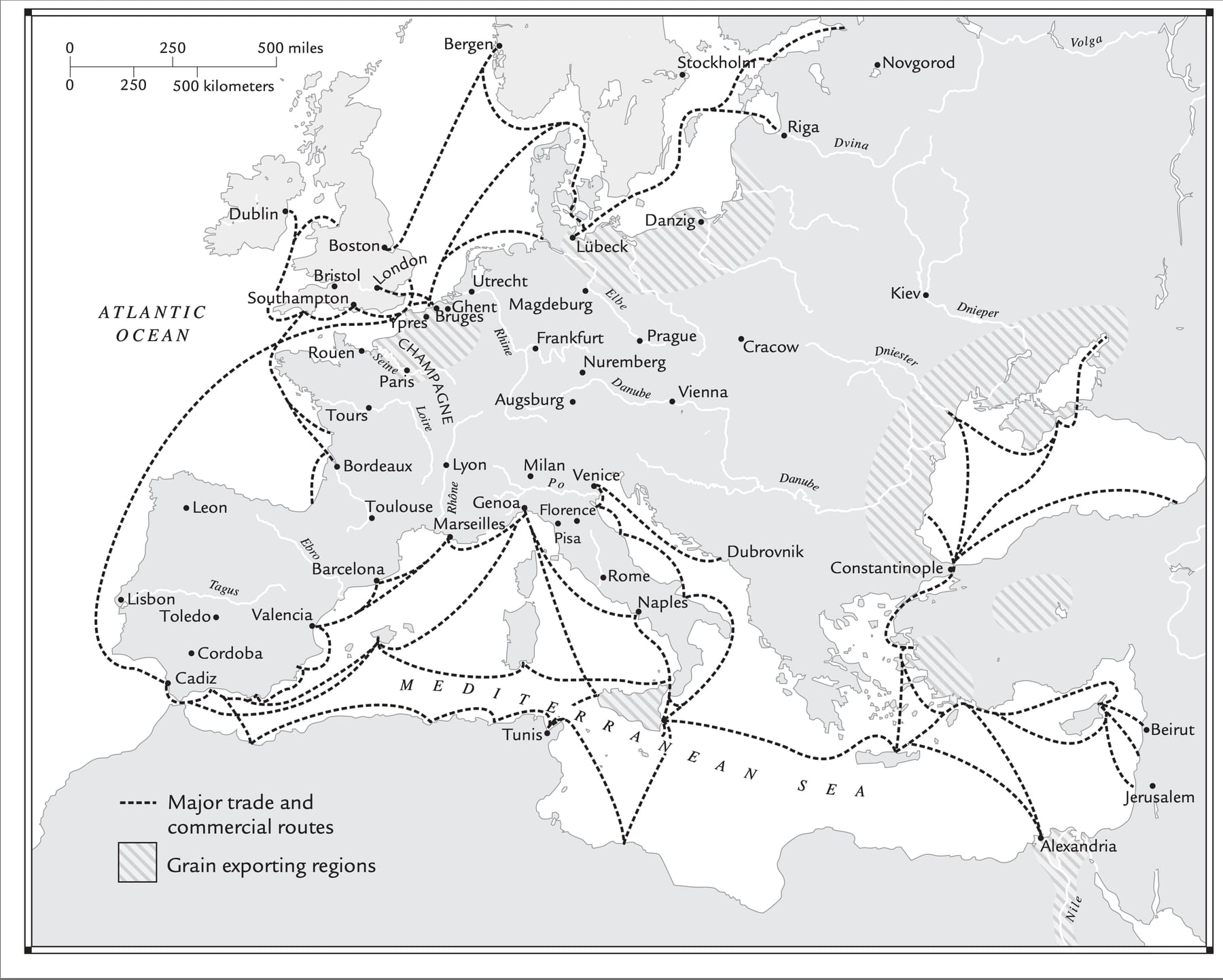
- Flanders with large-scale textile production
- northern Italy with advanced banking, credit, insurance, and investment
- northern France with powerful political organization and sophisticated intellectual life
- These examples show that Europe’s expansion was not only military. It was also rooted in economic productivity, institutional development, and cultural innovation.
Expansion at the Edges and Within the Core
- One of the most important ideas in the introduction is that Europe’s growth was both:
- external: moving outward into frontier zones
- internal: intensifying settlement and restructuring life within Europe itself
- Bartlett gives concrete frontier imagery:
- forests being cleared
- marshes drained
- emigrants recruited from crowded areas
- settlers moving across the continent
- ships carrying colonists
- knights carving out new lordships
- These examples show that expansion was not abstract. It involved land clearance, migration, settlement, warfare, and institution-building.
- But Bartlett complicates the picture by saying that the line between “inside” and “outside” is not always clear:
- internal expansion mattered just as much as conquest abroad
- therefore, understanding frontier growth requires understanding European society itself
- This is a key methodological point: the frontier is not separate from the center; the frontier reveals the forces generated by the center.
The Book’s Focus: Conquest, Colonization, and Cultural Change, 950–1350
- Bartlett states directly that the book will examine Europe and the Mediterranean from 950–1350 through the lens of:
- conquest
- colonization
- cultural change
- He identifies several main case areas:
- English colonialism in the Celtic world
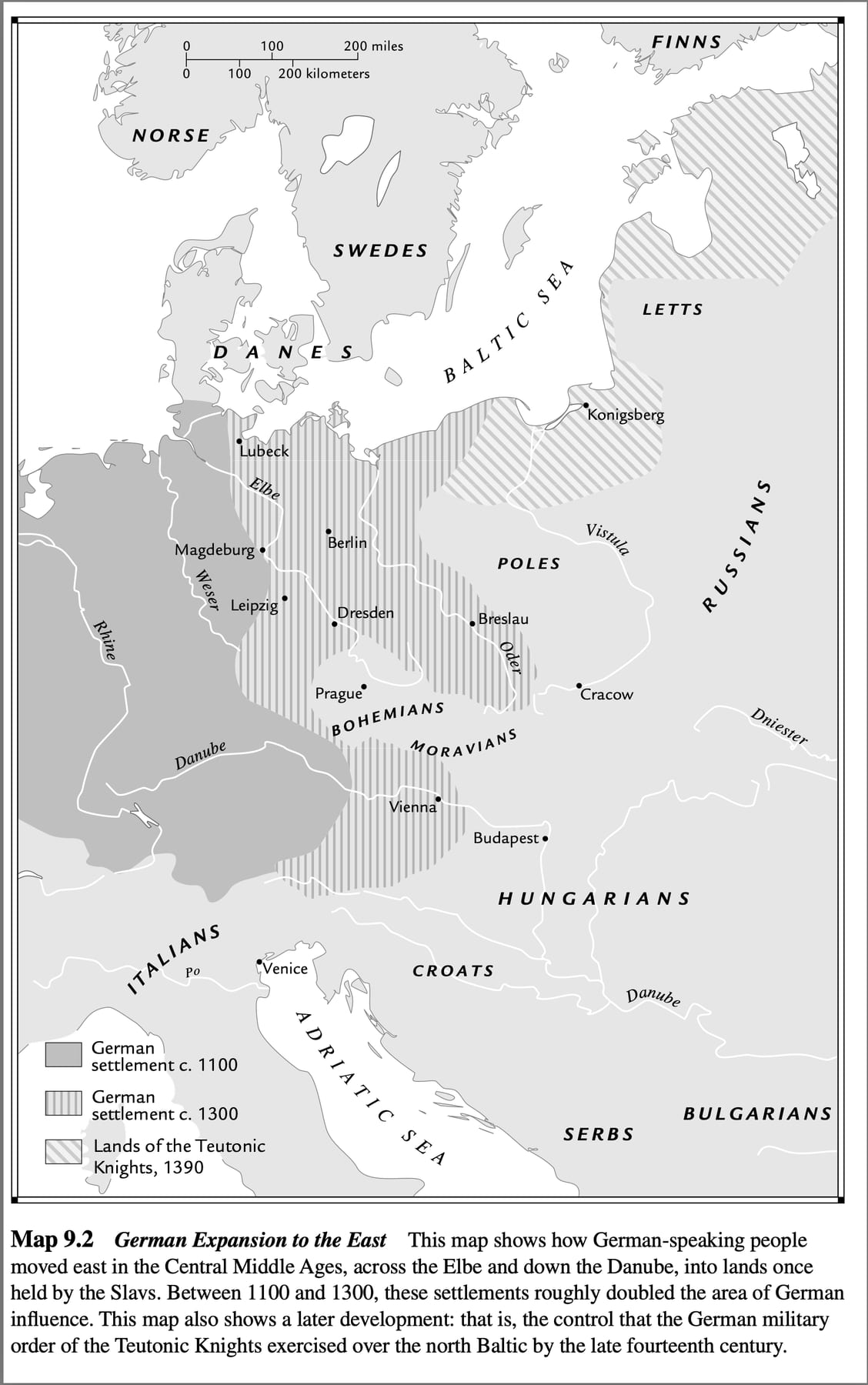
- German settlement in eastern Europe
- the Spanish Reconquest
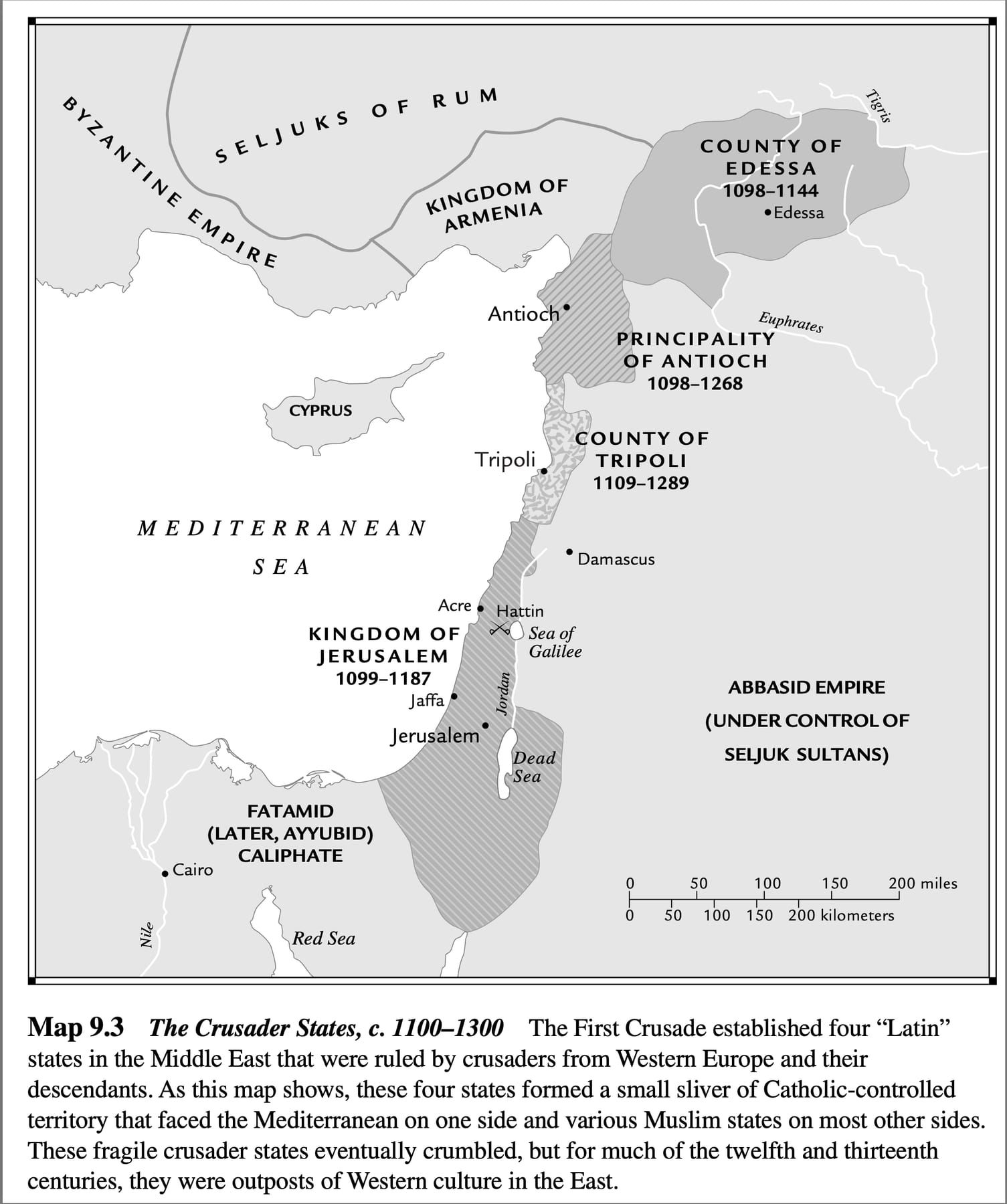
- crusader and colonial activity in the eastern Mediterranean
- He is interested not only in military takeover or migration, but in what accompanied them:
- changes in language
- changes in law
- changes in belief
- changes in habit
- The book will move back and forth between:
- frontier-specific phenomena born from war and settlement
- deeper forces emerging from Europe’s heartlands
- Final takeaway of the introduction:
- Europe was “made” not merely by expansion at its margins,
- but by the rise of an expansive, increasingly homogeneous society whose power came from its core and became most visible at its frontiers.
Key Concepts for Introduction
- Europe as an idea and a region
Europe is not just a map location; it is a historically constructed civilizational category. - Latin Europe
The Roman Catholic zone of medieval Europe, marked by stronger internal commonalities than other parts of the continent. - High Middle Ages
The period of major growth and transformation, roughly from the eleventh century to the crises of the fourteenth and fifteenth centuries. - Internal expansion
The intensification of settlement, cultivation, and institutional reorganization within Europe itself. - External expansion
Territorial movement outward through conquest, colonization, migration, and frontier settlement. - Conquest and colonization
The paired processes by which Europeans established rule over new territories and populated them with settlers. - Cultural homogenization
The spread of shared law, language, institutions, and practices that made Europe more unified across regions.
Questions for Reflection for Introduction
- How does Bartlett’s idea of Europe as both a region and an idea challenge modern assumptions about what Europe is?
- Why does Bartlett insist that internal expansion is just as important as frontier conquest for explaining medieval Europe?
- In what ways did institutions like the town, university, and Church orders help make Europe more coherent?
- Why might Europe’s centers be more important than its frontiers for explaining its expansion?
- How does focusing on language, law, belief, and habit deepen the study of conquest beyond just battles and political control?
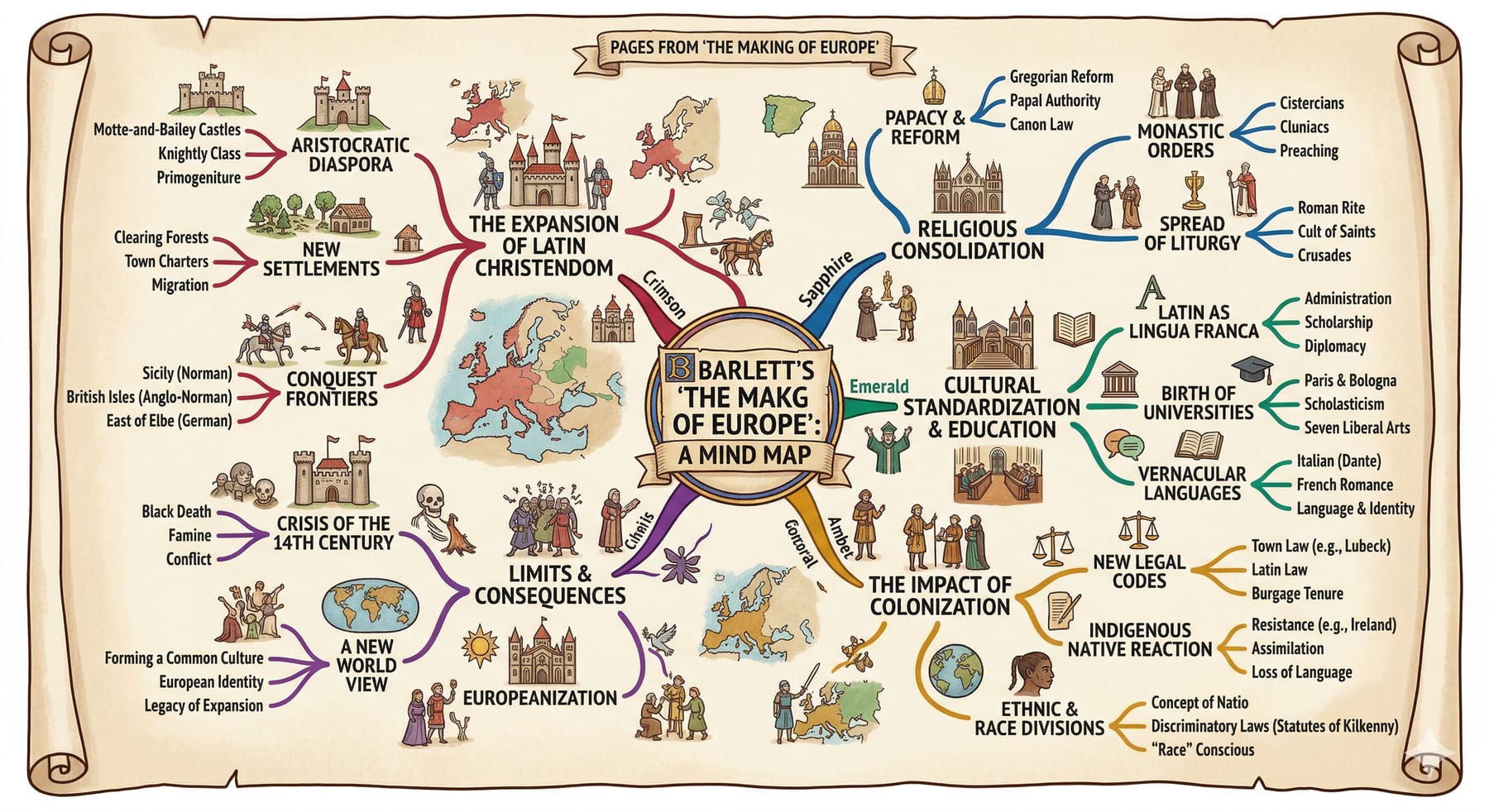
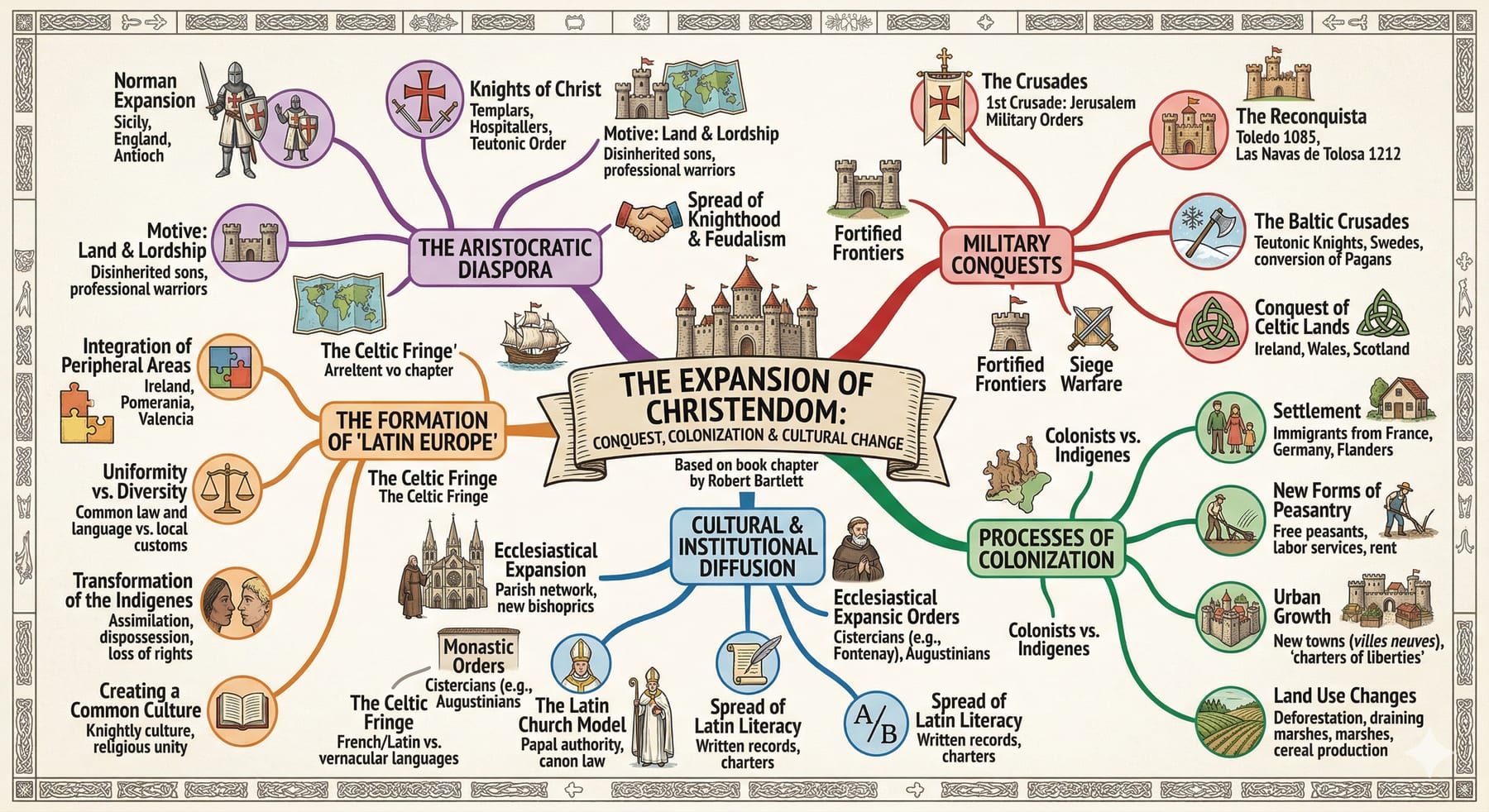
Chapter 1. The Expansion of Latin Christendom
Chapter Objective
- This chapter explains how Latin Christendom expanded between roughly 950 and 1300, and uses that expansion as a first way to understand the broader making of medieval Europe.
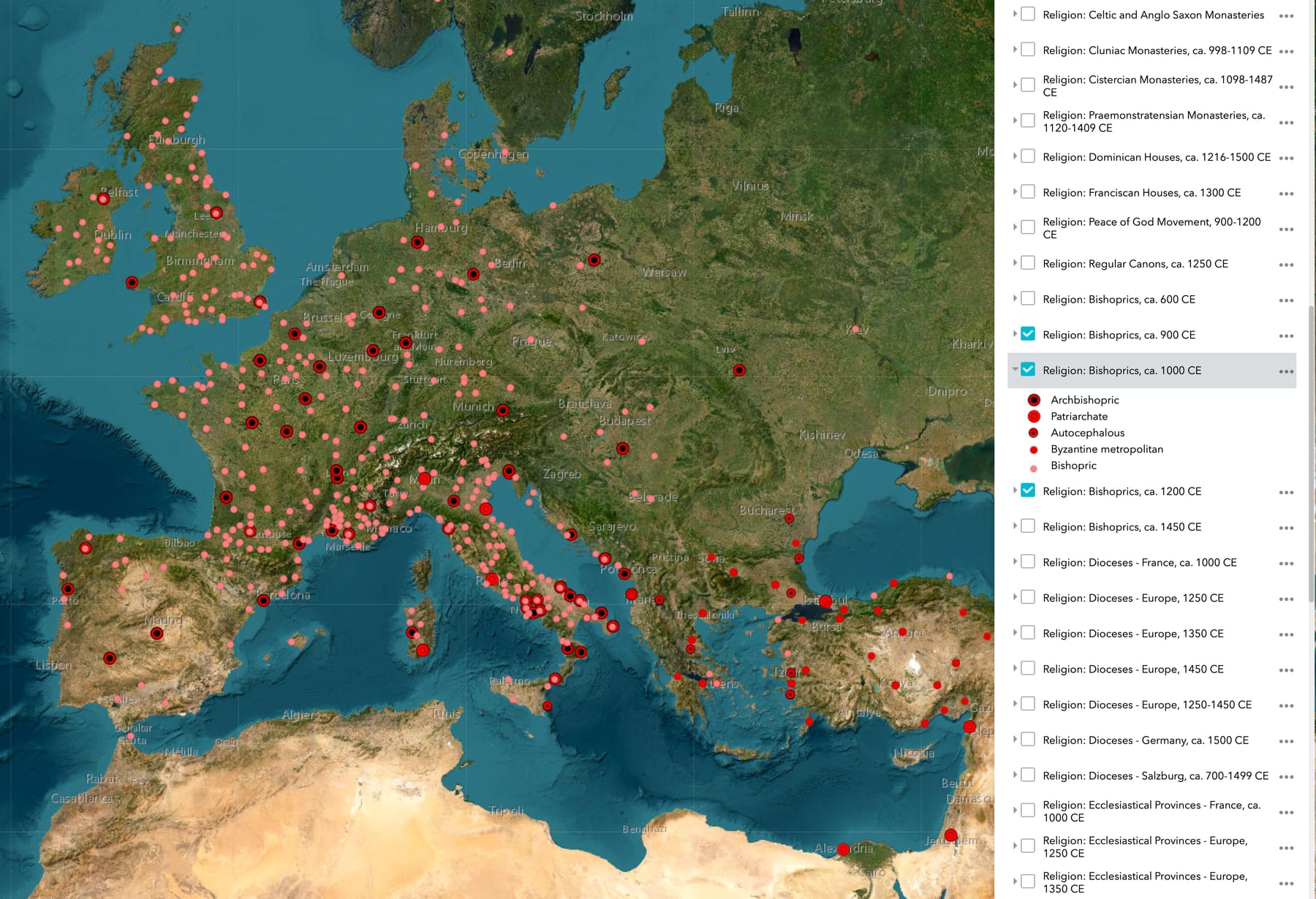
- Bartlett’s immediate goal is to show that one can measure European expansion institutionally by tracing the spread of bishoprics, since they were the most concrete and uniform units of the western Church.
- But the chapter also complicates that simple picture. By the end, Bartlett argues that the expansion of medieval Europe was not merely the spread of a religion or liturgy, but the territorial growth of a particular social order associated with Latin, Roman, and Frankish Europe.
- This makes the chapter foundational for the whole book: it introduces the geographic scope of expansion, shows where Latin Europe grew, and begins asking the deeper question of what exactly was expanding.
The Spread of Bishoprics, 950–1300
- Bartlett begins by arguing that bishoprics are a useful way to chart the expansion of Latin Christendom.
- They are useful because they were:
- concrete institutions
- tied to named bishops, dioceses, cathedral churches, saints, and endowments
- increasingly territorial
- relatively uniform across the western Church
- In theory, Latin Christendom was meant to be a fully ordered territorial body:
- every area should belong to a bishopric
- no area should belong to more than one
- Bishoprics were not just administrative markers:
- bishops ordained priests
- confirmed the faithful
- exercised judgment
- made the Church locally durable
- So, if bishoprics spread, Latin Christendom itself spread.
Older Core Regions of Latin Christendom
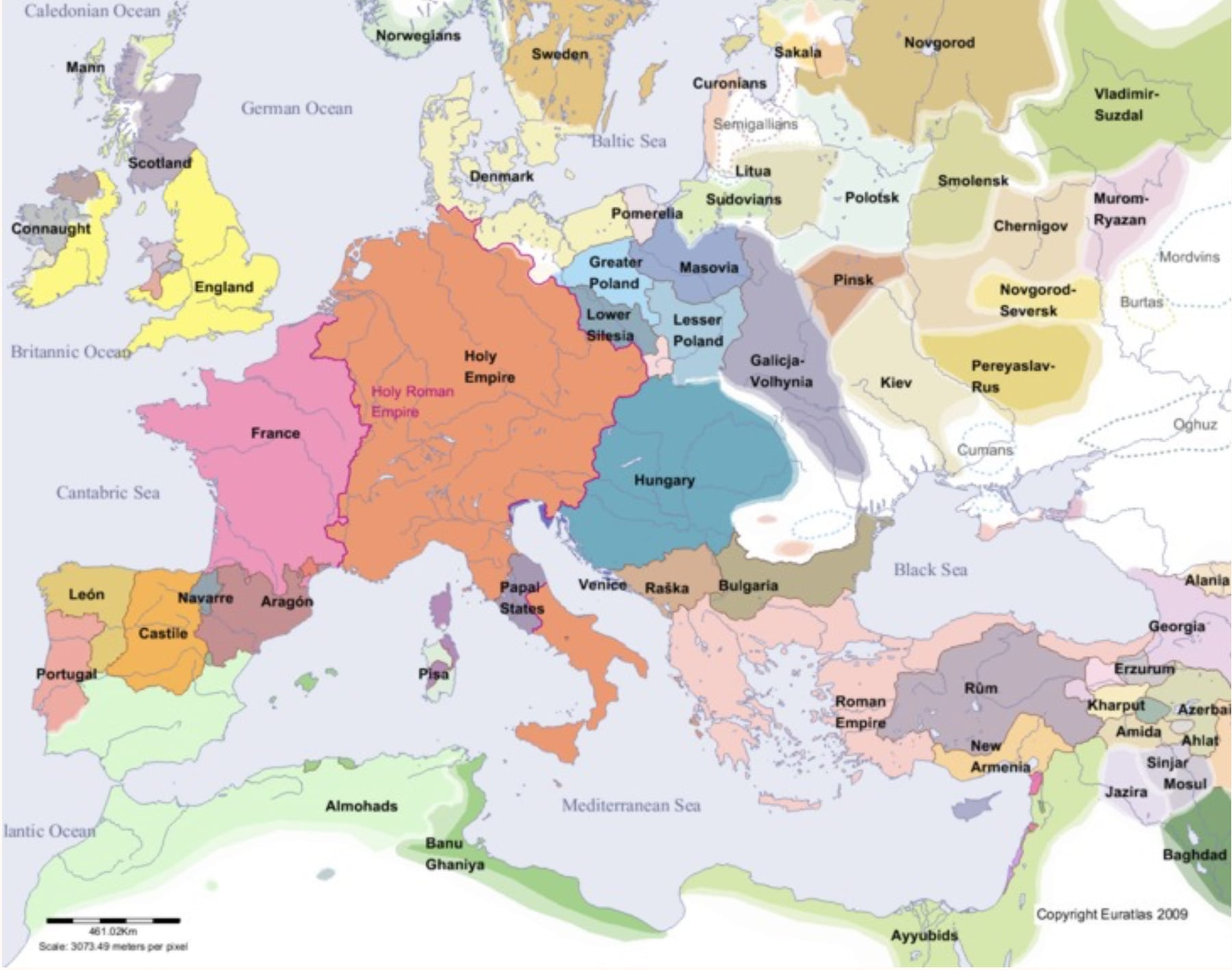
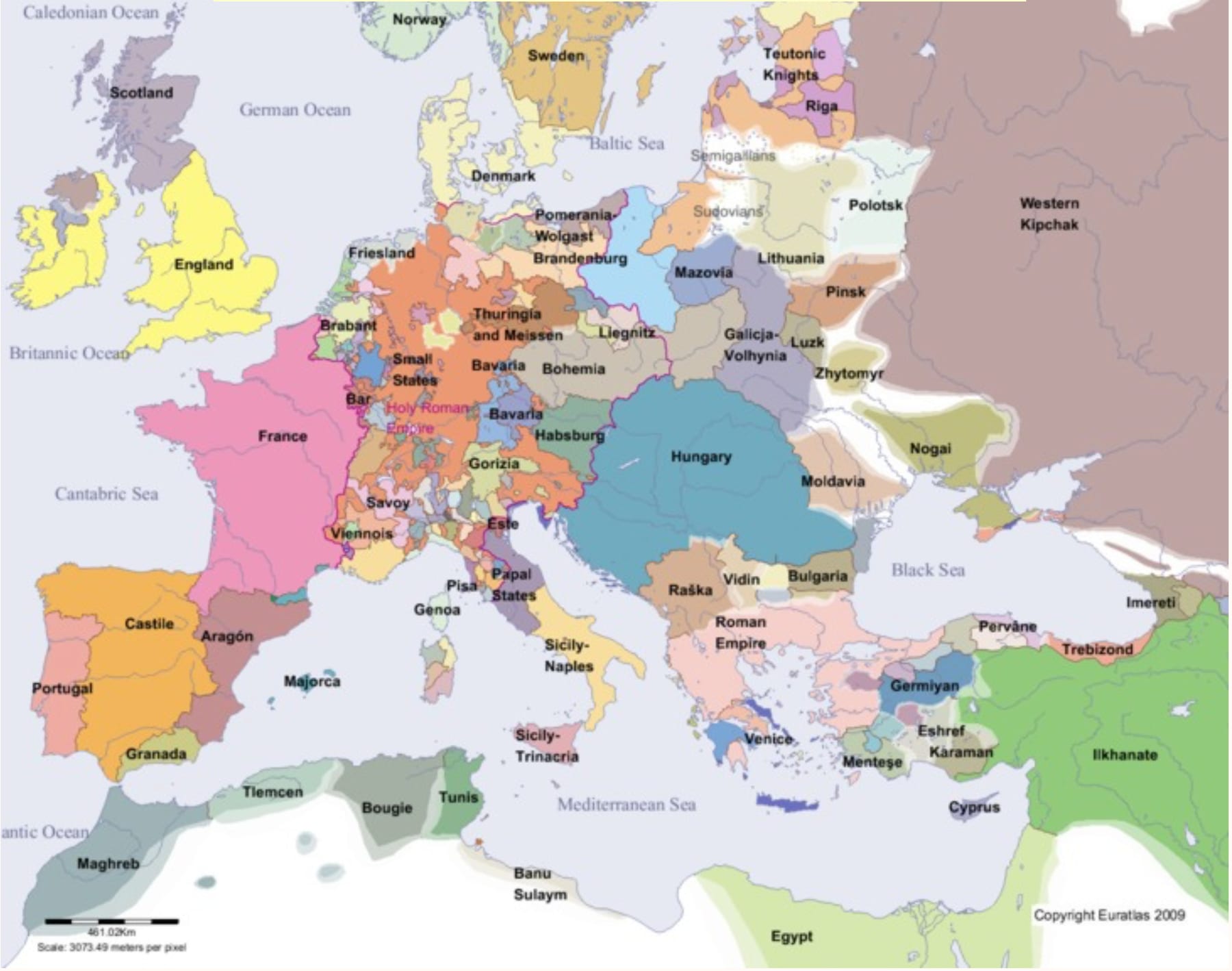
- By around 1200, there were about 800 bishoprics loyal to the papacy and using the Latin liturgy.
- The oldest and densest concentration lay in the former Roman world:
- Italy
- France
- the Rhineland
- These bishoprics often had very ancient origins:
- some went back to the early centuries of Christianity
- examples include Spoleto and Rheims
- Their geography reflected the old Roman civic world:
- city-based
- territorially regular
- deeply rooted in long-standing urban patterns
- This older core is important because later expansion moved outward from these already institutionalized Christian heartlands.
Early Medieval Adaptations Outside the Roman Core
- In places like Ireland and Anglo-Saxon England, Christianity had to adapt to societies that were not urban.
- As a result, early bishoprics there were different:
- not strongly city-based
- sometimes mobile
- often tied to a people, kingdom, or monastic community rather than a city
- Examples:
- “bishops of the West Saxons” before bishops of Winchester
- “bishops of the Hwicce” before bishops of Worcester
- One long-term trend of western Europe was the gradual replacement of these flexible early forms with the more standard territorial, city-based episcopal model.
- This mattered especially in the British Isles, where the eleventh and twelfth centuries saw efforts to reshape local churches into the continental Latin norm.
Ninth- and Tenth-Century Limits and Vulnerability
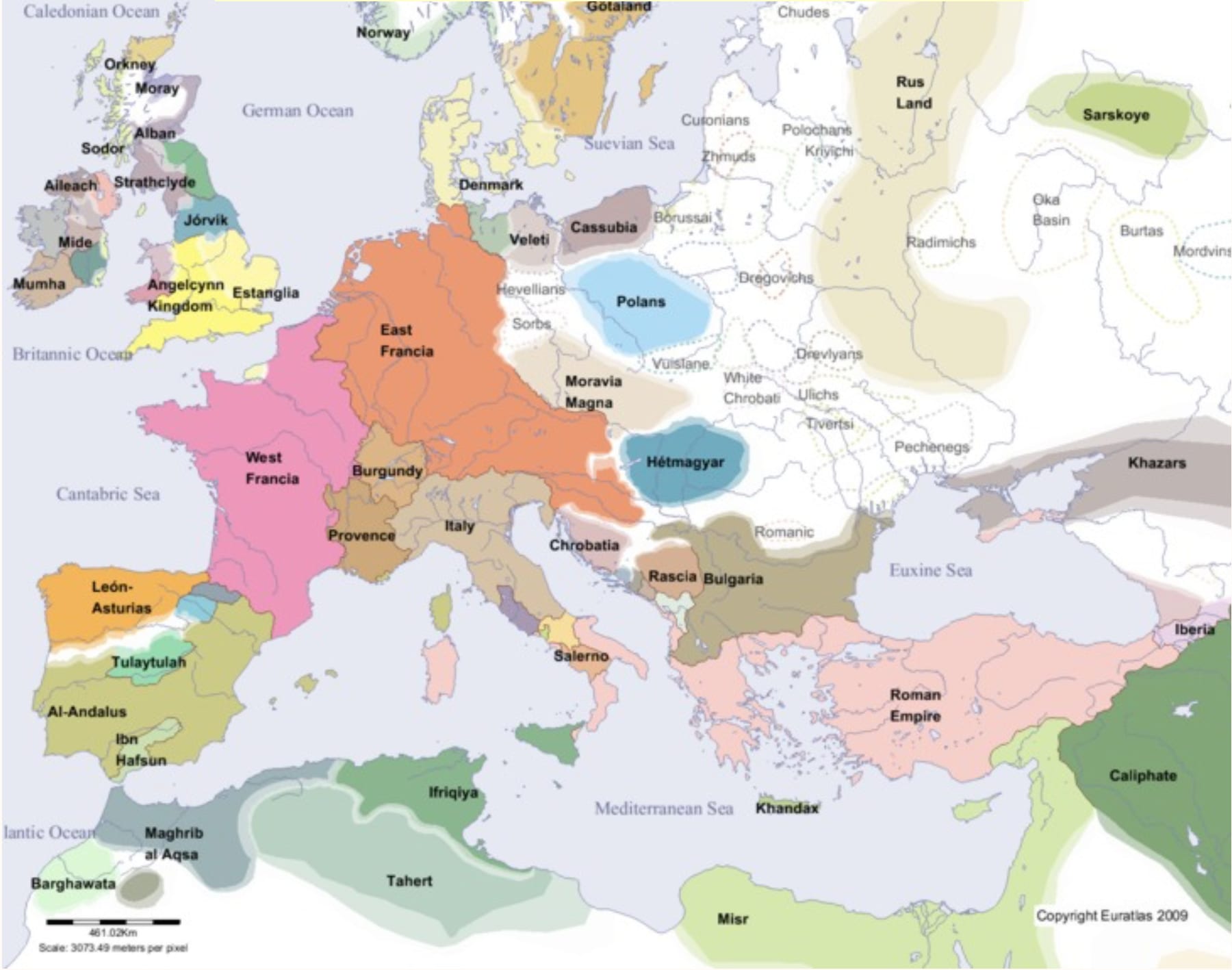
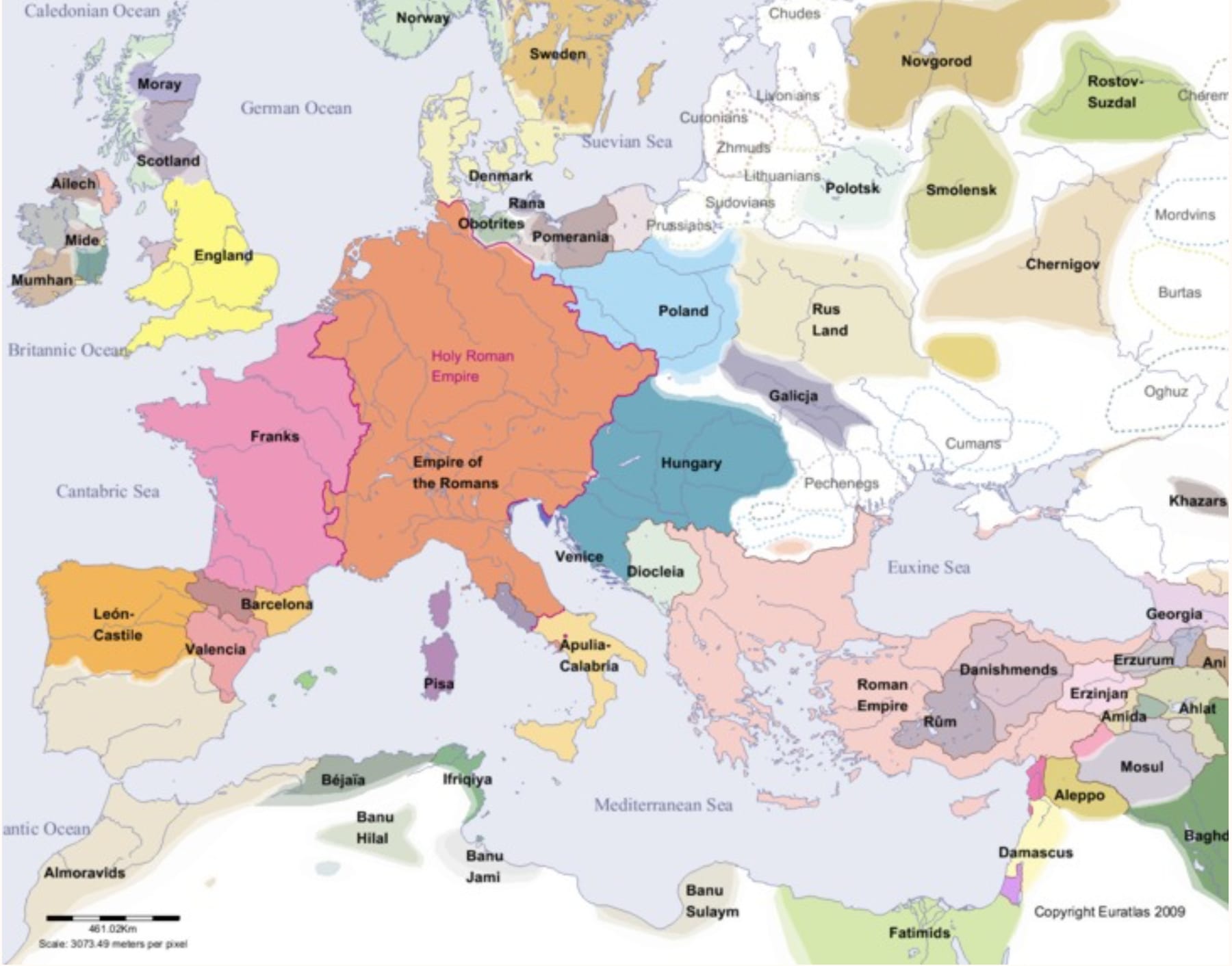
- Before the great expansion, Latin Christendom was relatively confined and fragile.
- By around 900, it was basically limited to:
- the former Carolingian Empire
- a narrow Christian strip in northern Spain
- the British Isles
- These borders were highly vulnerable.
- Western Europe could be attacked:
- from the north by sea by Vikings
- from the south by sea by Saracens
- from the east by land by Magyars
- Bartlett emphasizes that in the tenth century it faced all three.
- One of the major transformations of the High Middle Ages was that this world of defensive constriction was reversed: the borders of Latin Christendom began to expand on every side.
Eastern Europe in the Tenth and Eleventh Centuries
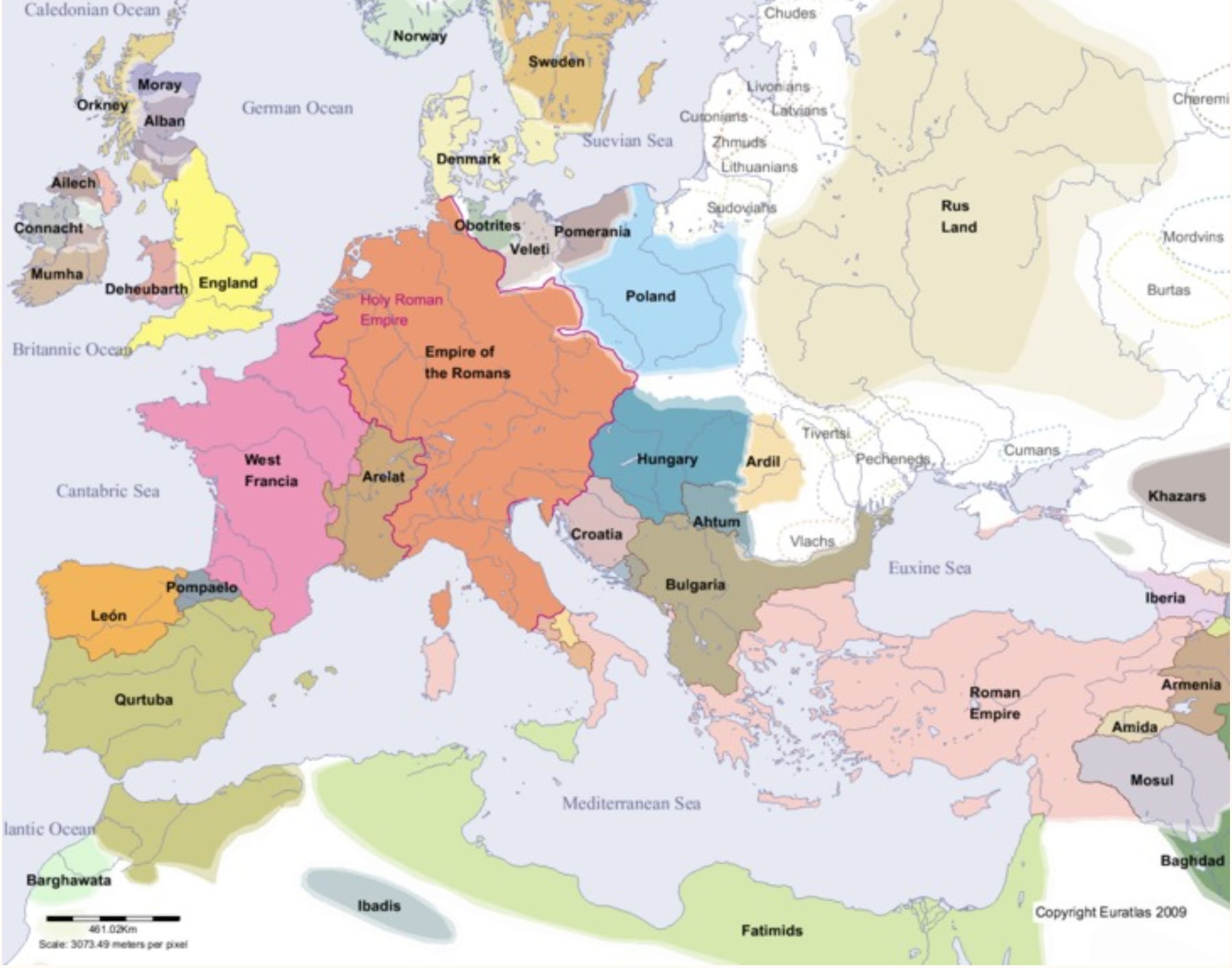
- The first major outward movement came under Otto I.
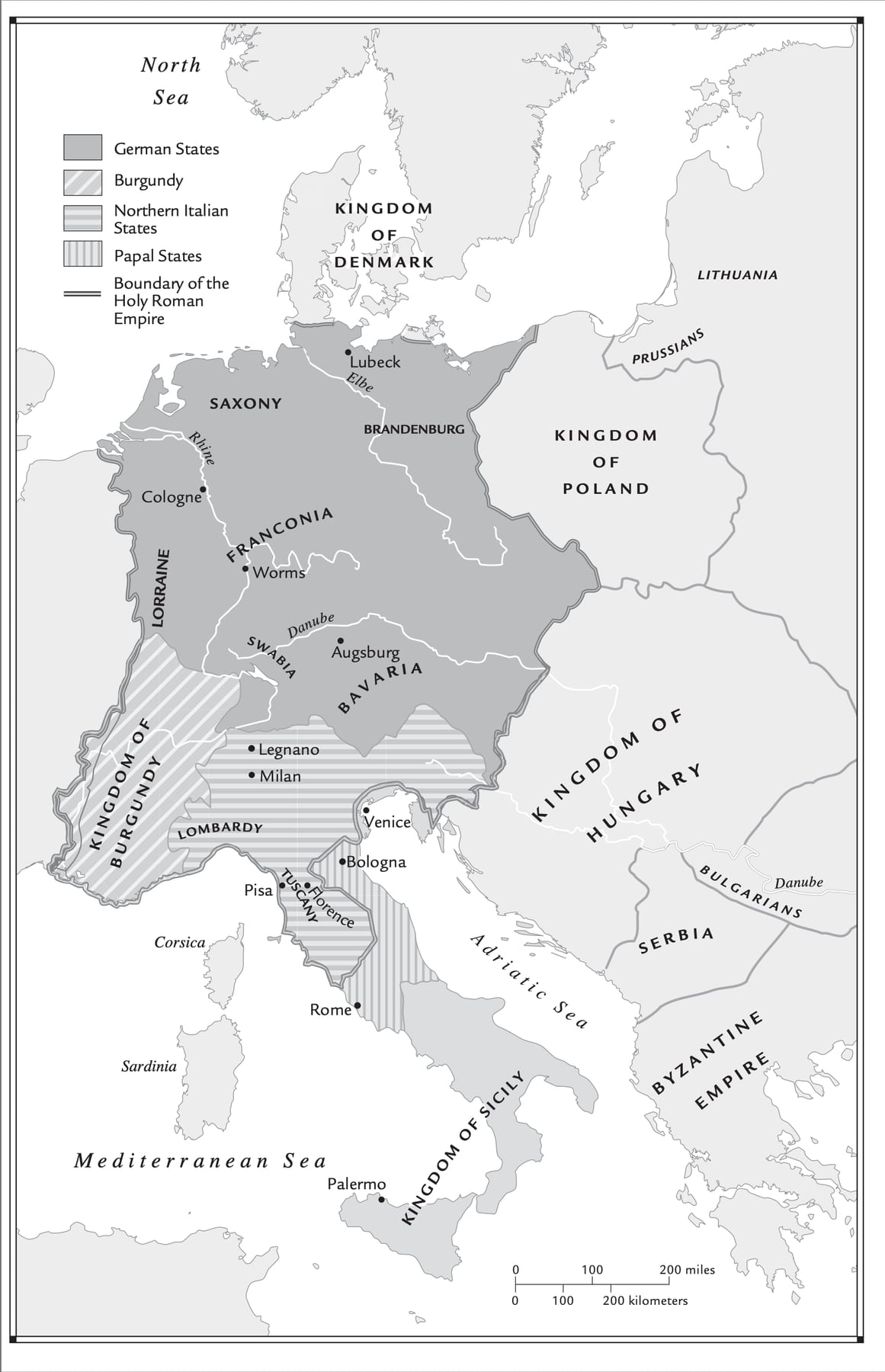
- In 948, he established or encouraged bishoprics along Germany’s northern and eastern frontiers.
- These served two purposes:
- consolidation of Ottonian conquests in pagan Slav lands east of the Elbe
- promotion of Christianity in Denmark
- In 968, Otto raised Magdeburg to an archbishopric, intended as a center for the conversion of the Slavs beyond the Elbe and Saale.
- Political questions shaped ecclesiastical expansion:
- would new converts join the Byzantine or western sphere?
- This was especially visible in Bohemia and Moravia, where the legacy of Constantine and Methodius and the Slav liturgy clashed with Latin-German influence.
- Eventually, the German-Latin model prevailed in much of east-central Europe:
- Prague bishopric by 973, tied to Mainz
- Poznań by 968
- Gniezno made an archbishopric in 1000
- Esztergom established in 1001
- The larger significance:
- Poles, Bohemians, and Magyars were drawn into a western orbit
- they looked increasingly to Germany and Rome
- paganism in east-central Europe was pushed onto the defensive
- Bartlett’s point is that these new churches did not just reflect conversion; they reoriented whole societies westward.
Scandinavia in the Tenth and Eleventh Centuries
- Scandinavia followed a similar but somewhat slower path.
- The earliest Danish sees, such as:
- Hedeby/Schleswig
- Ribe
- Århus
are attested in the mid-tenth century.
- Over time Denmark built a fuller diocesan network, and in 1103–4 gained its own archbishopric at Lund.
- English influence mattered in this process:
- Bartlett notes, for example, an English bishop at Roskilde in the 1020s
- Christianization in Norway, Sweden, and Iceland was less steady at first, partly because royal power was weaker.
- As monarchy strengthened and English influence expanded, Christianity consolidated.
- A striking example of transformation:
- Uppsala, once a famous pagan cult center associated with Thor, Odin, and Frey, became in 1164 the archiepiscopal seat of the Swedish Church.
- This gives the chapter one of its clearest symbolic reversals:
- a major pagan sacred center became a core node of Latin ecclesiastical order.
Southern Italy in the Eleventh and Twelfth Centuries
- The Mediterranean presented a different kind of expansion.
- In eastern and northern Europe, Latin Christianity often spread into less urbanized societies and could attract rulers through prestige.
- In the Mediterranean, however, Latin Christians confronted societies that were often at least as literate and sophisticated as their own.
- There, expansion came mainly through conquest.
- In southern Italy and Sicily, the Normans gradually imposed a unified political structure over a region previously divided among:
- Byzantines
- Lombard princes
- autonomous cities
- Muslims in Sicily
- Ecclesiastically, this meant:
- installing Latin bishops into Greek sees
- restoring dioceses in conquered Muslim regions
- creating new bishoprics, such as Aversa and Catania
- Bartlett gives the example of Ansgar, bishop of Catania, who restored a church neglected under Muslim rule and founded a strong monastic community there.
- Though Greeks and Muslims continued to exist in Sicily, the official hierarchy became a standard Latin network.
- The underlying pattern:
- political conquest was followed by ecclesiastical Latinization
- the Church became an instrument and sign of incorporation into western Europe.
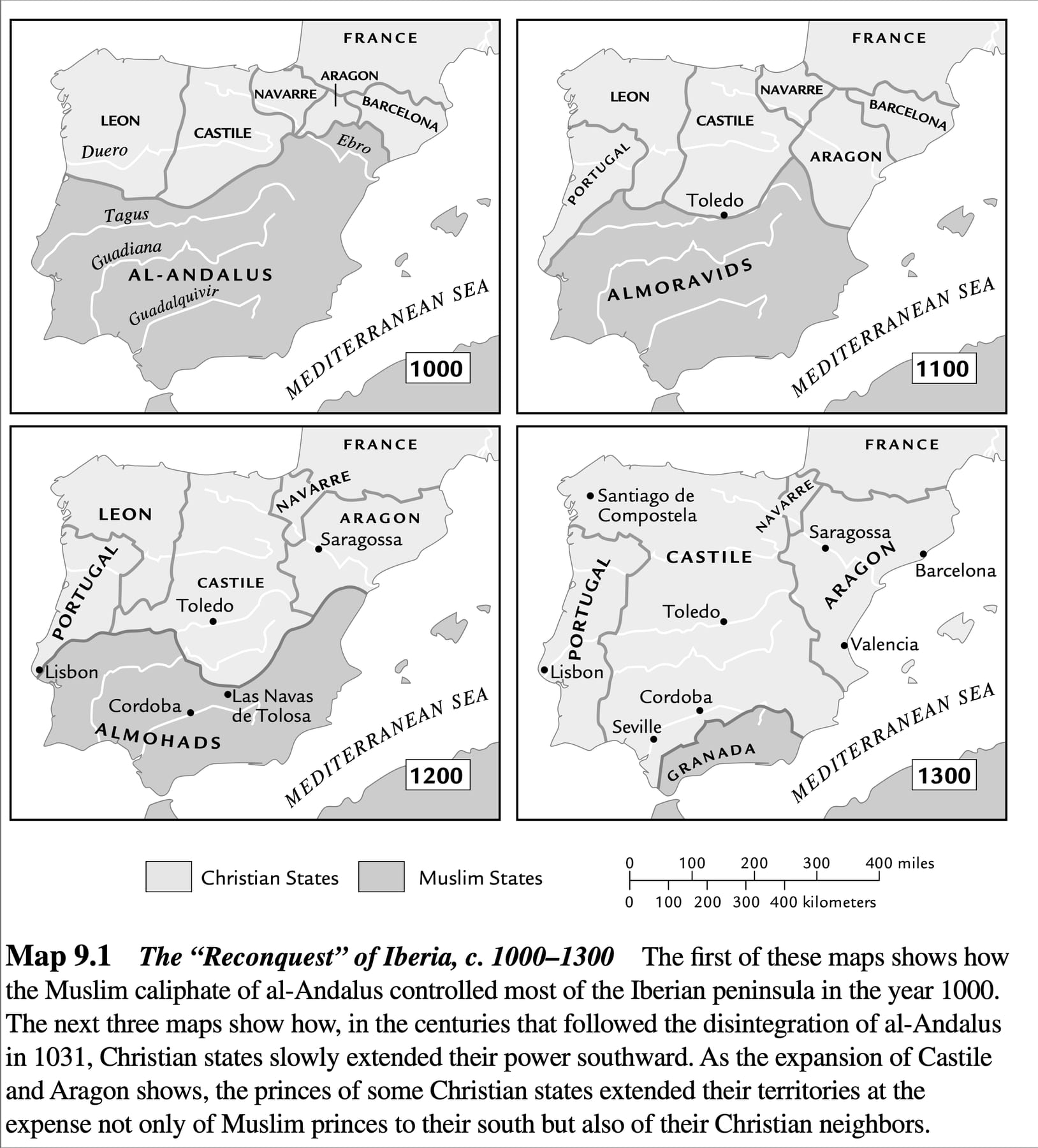
Spain in the Eleventh, Twelfth, and Thirteenth Centuries
- Spain is presented as the large-scale version of Sicily: a prolonged Reconquest tied closely to ecclesiastical expansion.
- Christian rule survived in the north after the Muslim conquests of the eighth century, and bishoprics endured or were restored in places like:
- Vic
- Barcelona
- Santiago
- From these footholds, Latin diocesan organization spread southward over the next three centuries.
- A decisive moment was the capture of Toledo in 1085 by Alfonso VI:
- Toledo was the old ecclesiastical center of the Visigothic kingdom
- it became the seat of Spain’s largest archdiocese
- Alfonso installed Bernard of Cluny as archbishop
- Bartlett quotes Alfonso’s charter, which casts the conquest in explicitly religious terms:
- a Christian king restoring what Muslims had taken
- the city transformed from a profaned space into a holy Christian center
- Other key examples:
- Lisbon captured in 1147 with help from northern crusaders and reorganized immediately as a bishopric
- Valencia captured in 1238, with the mosque turned into a cathedral
- Seville captured in 1248, with its mosque likewise converted and an archbishopric revived
- By the later thirteenth century there were 51 bishoprics in Spain and Portugal.
- The broader point:
- the Reconquest was not only military recovery of land
- it was also the building of a dense new Latin ecclesiastical order across Iberia.
The Eastern Mediterranean in the Eleventh, Twelfth, and Thirteenth Centuries
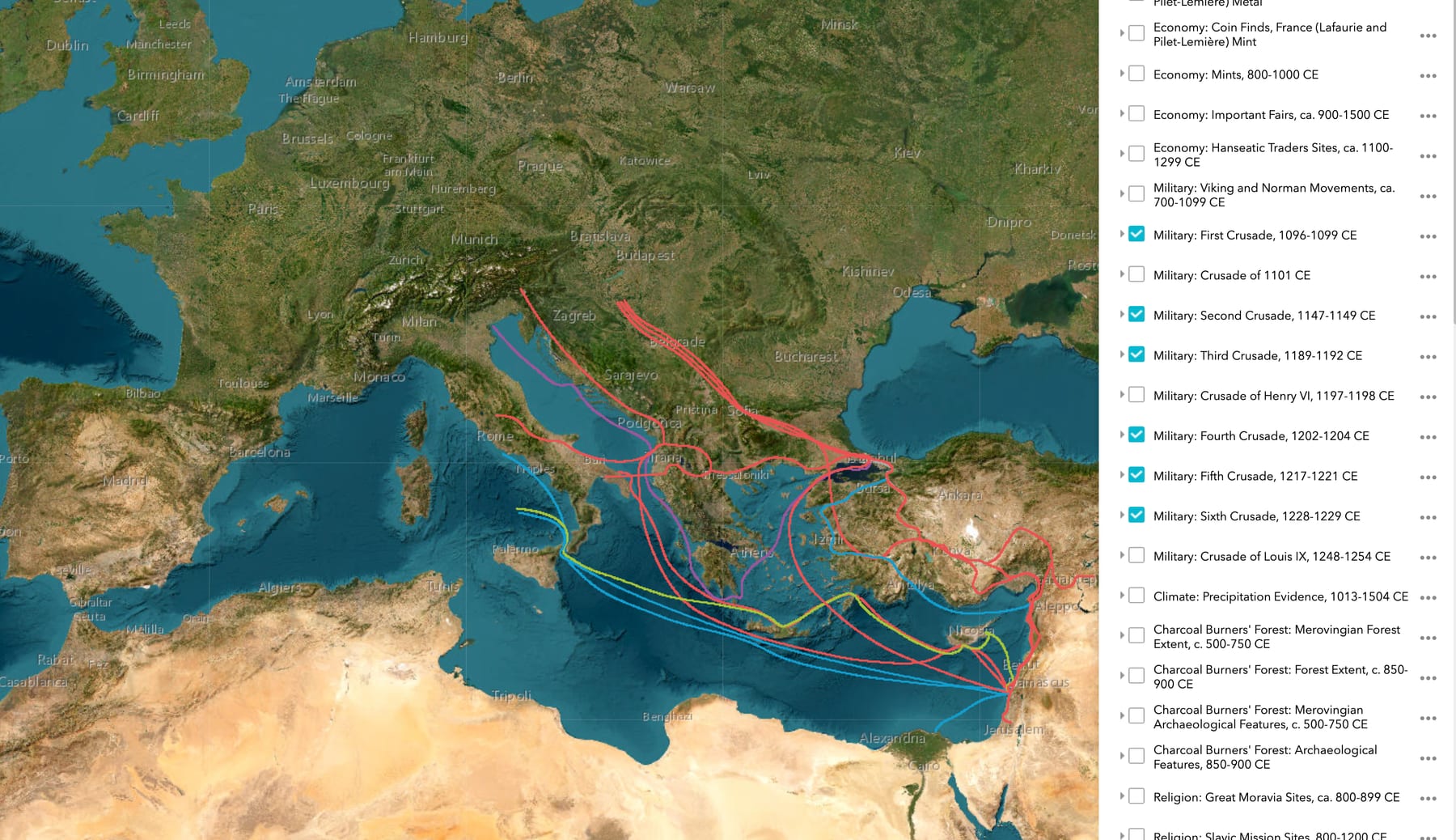
- The crusades produced the best-known case of western Christian expansion.
- After the conquests of 1096–99, the crusaders began to construct a Latin Church in the Levant.
- Major cities in Palestine and Syria became seats of Latin bishops.
- Jerusalem gained a Latin patriarch, and a hierarchy of patriarchates, archbishoprics, and bishoprics gradually emerged.
- Much of the earlier Greek ecclesiastical geography was reused, but heavily modified.
- The personnel were usually immigrants from the West:
- Bartlett lists the strongly French names of the first patriarchs of Antioch
- By the 1130s, the Latin Church in the Levant was at its greatest extent.
- But unlike Spain, this structure was unstable:
- it suffered repeated territorial losses
- by the end of the thirteenth century the crusaders had been expelled from the mainland
- The thirteenth century also brought Latin expansion against Greek Christianity, not only Islam:
- Cyprus acquired a Latin hierarchy after Richard I’s conquest
- after the sack of Constantinople in 1204, a Latin empire and Latin ecclesiastical structures were imposed
- Bartlett’s example of Athens, reorganized according to the custom of the church of Paris, illustrates how strongly western models were projected abroad.
- He also stresses the colonial nature of this church:
- at Constantinople, Venetian clergy dominated the cathedral chapter
- So this section shows expansion at its most overtly colonial:
- imported personnel
- imported institutional models
- conquest-backed Latin authority layered over Greek and Muslim lands.
The Baltic Region in the Twelfth and Thirteenth Centuries
- The Baltic was the last major zone of enduring European paganism.
- Here, expansion took the form of:
- mission
- apostasy
- holy war
- The first West Slav people to gain a Christian bishopric in the twelfth century were the Pomeranians, especially after the missionary efforts of Otto of Bamberg in the 1120s.
- Bartlett includes a striking episode:
- during the Wendish Crusade of 1147, crusaders approached Szczecin
- the Pomeranians, now Christian, hung a cross from their walls
- the crusaders withdrew in search of other targets
- This story shows how quickly ecclesiastical incorporation could change a people’s status:
- from pagan target to recognized Christian community
- Other bishoprics in Wendish lands, such as:
- Brandenburg
- Havelberg
- Ratzeburg
- Schwerin
- Lübeck
were often refoundations of earlier missionary sees lost in pagan reactions
- Official West Slav paganism effectively ended with the destruction of the temple at Arkona in 1168 by the Danish king Valdemar I
- Among the more distant Baltic peoples, conversion was much harder:
- Prussians
- Estonians
- Lithuanians
were more difficult to conquer and remained fiercely attached to their religion
- Mission first came through clerics like:
- Meinhard in Livonia
- Cistercian missionaries in Prussia
- But mission alone proved insufficient.
- Force increasingly took the form of crusade, then of military orders:
- Swordbrothers
- Knights of Dobrzyń
- eventually the Teutonic Knights
- Ecclesiastical organization followed conquest:
- in 1243, the papal legate William of Sabina divided Prussia into four bishoprics
- in 1251, Riga became an archbishopric over Livonia and Prussia
- The result was that within a few generations a large stretch of the eastern Baltic shore had been brought into the Roman Church.
- This, Bartlett says, is what is concretely meant by the expansion of Latin Christendom.
Problems of Explanation
- After describing expansion geographically, Bartlett turns to explanation.
- He asks: what actually caused this growth?
Latin as Rite and Obedience
- He first defines Latin Christendom as churches using:
- Latin liturgy
- rites approved by the papacy
- One notable feature of the western Church was its push toward uniformity:
- one liturgical language
- one cultic form
- The Carolingians, especially Charlemagne, had already sought this kind of liturgical unity.
- In the eleventh century, this became even sharper:
- the Mozarabic rite in Spain was replaced by the Roman rite
- the Slavonic liturgy was suppressed in Bohemia
- Over time, “Latin” became a meaningful term of self-identification for western Christians.
- Yet Bartlett says this cannot by itself explain expansion:
- liturgy may unify and symbolize a community
- but liturgy alone does not conquer lands or settle populations
- So the spread of Latin rite is better seen as partly a result of expansion, not its sole cause.
The Papacy and Institutional Drive
- Bartlett then considers the papacy.
- If Latin Christendom is understood as a network of churches obedient to the pope, then one can see a more active institutional center.
- The papacy did help direct expansion:
- it allied with aristocratic power
- used religious orders
- orchestrated crusades
- But Bartlett is careful:
- orchestration is not the same as execution
- papal orders did not themselves capture fortresses
- Material and lay forces remained essential.
- He also argues that the rise of an activist papacy itself needs explanation:
- why did papal leadership become so forceful at this particular moment?
- His answer is that the papacy was effective because it worked within a world already experiencing dynamic material growth.
- So the papacy was important, but it was not the whole explanation.
Franks, Core Regions, and Associated Expansion
- Bartlett next shifts from “Latins” to “Franks.”
- In the Carolingian age, the Christian West and the Frankish Empire had come close to overlapping.
- This Frankish Europe remained the heart of the West in the High Middle Ages.
- He suggests there was a kind of core region, running roughly from:
- south-east England
- through northern France
- to central Italy
- This core likely had:
- denser population
- higher economic activity
- greater innovation
- Bartlett highlights northern France and northern Italy as especially creative:
- new religious orders
- Gothic architecture
- scholasticism
- romance literature
- As warriors, traders, churchmen, and peasants from this core spread outward, they carried their religion with them.
- Bartlett compares this to the spread of English in the modern world:
- not because of anything magical in the language itself
- but because of the social, demographic, and political power of English speakers
- Likewise, the spread of Latin Christianity reflected the expansionary strength of the society that bore it.
- Still, religion cannot be reduced away entirely:
- no merely material explanation can explain why western armies marched to Jerusalem
- So Bartlett is moving toward a mixed explanation:
- material growth
- core-periphery dynamics
- and real religious motivation all mattered.
The Irish Anomaly and the Limits of “Latin Christendom”
- Ireland creates a major problem for any overly simple definition.
- Ireland had been Christian since the missions of Patrick and had even been a center of early missionary activity.
- On a purely religious definition, it was fully part of Latin Christendom from a very early date.
- Yet in the twelfth and thirteenth centuries, Ireland underwent processes very similar to those seen in frontier zones:
- conquest by a feudal cavalry elite
- settler colonization
- chartered towns
- expanded documentary literacy
- coinage
- ecclesiastical restructuring
- Bartlett notes that a colonial settlement in Munster could resemble one in Brandenburg
- This means Ireland was simultaneously:
- already Christian and Latin
- yet also a target of the same expansionary forces
- That makes “the expansion of Latin Christendom” an incomplete label if it excludes cases like Ireland.
Civilized and Barbarian: How Inclusion Worked
- Bartlett pushes the Irish example further by examining how outsiders described Ireland.
- Although the Irish were Christian, twelfth-century observers often described them as:
- barbarous
- socially deviant
- defective in church practice
- St Bernard condemned their customs and called them effectively “Christians only in name, pagans in fact.”
- Irish reformers themselves sought to remodel the Irish church along continental lines:
- clear diocesan hierarchies
- more Roman practices
- stronger alignment with broader western norms
- Bartlett quotes reform language celebrating the replacement of “barbarous laws” with “Roman laws.”
- Anglo-Norman invaders, meanwhile, could pursue land and wealth while cloaking conquest in the language of reform and religion.
- The deeper point:
- by the twelfth century, belonging to the Church in the fullest sense was not just about creed
- it also meant conforming to a recognizable social and legal order
- This logic extended beyond Ireland:
- the Welsh and Ruthenians could also be described as Christian only nominally if their customs seemed alien
- So medieval western expansion was shaped by two linked binaries:
- Christian / non-Christian
- civilized / barbarian
- These categories often reinforced one another.
Chapter Conclusion
- The chapter ends by redefining what was expanding.
- It was not only a liturgy, not only obedience to Rome, and not even only Christianity in a narrow doctrinal sense.
- What was expanding was a particular kind of society:
- Roman
- Christian
- increasingly standardized
- legally and socially recognizable to the elites of Frankish Europe
- By the eleventh century, Latin Christendom could therefore mean not just a religious community, but a civilization.
Key Concepts for The Expansion of Latin Christendom
- Latin Christendom
- The community of western churches using the Latin liturgy and recognizing papal authority, but in this chapter increasingly also a term for a wider social and civilizational order.
- Bishopric / Diocese
- The basic territorial unit of the medieval Church, centered on a bishop and cathedral, used by Bartlett as the clearest measurable sign of expansion.
- Territorialization
- The process by which ecclesiastical authority became more clearly tied to defined geographic space, replacing looser or older forms of organization.
- Core and Periphery
- Bartlett’s implicit model in which the most economically and culturally dynamic regions of western Europe acted as a core, projecting institutions and power outward into frontier regions.
- Associated Expansionism
- The spread of religion and institutions as a consequence of the outward movement of peoples who possessed military, demographic, and social advantages.
- Colonial Church
- A church structure imposed by foreign conquerors or settlers, staffed by immigrant clergy and tied to political domination, especially visible in places like the Levant, Cyprus, and post-1204 Greek lands.
- Civilized / Barbarian Binary
- A conceptual distinction used by medieval western elites to classify neighboring societies; it often overlapped with religious judgment and helped justify conquest or reform.
Questions for Reflection for The Expansion of Latin Christendom
- Why does Bartlett begin with bishoprics as a way of measuring expansion, and what are the strengths and limits of that method?
- How does the chapter distinguish between the spread of Christianity as belief and the spread of Latin Christendom as a social order?
- Why is Ireland such an important challenge to a simple religious explanation of expansion?
- In what ways did material growth, papal direction, and religious motivation work together rather than separately?
- How does Bartlett’s discussion of civilized/barbarian categories change the way we think about medieval conquest and colonization?
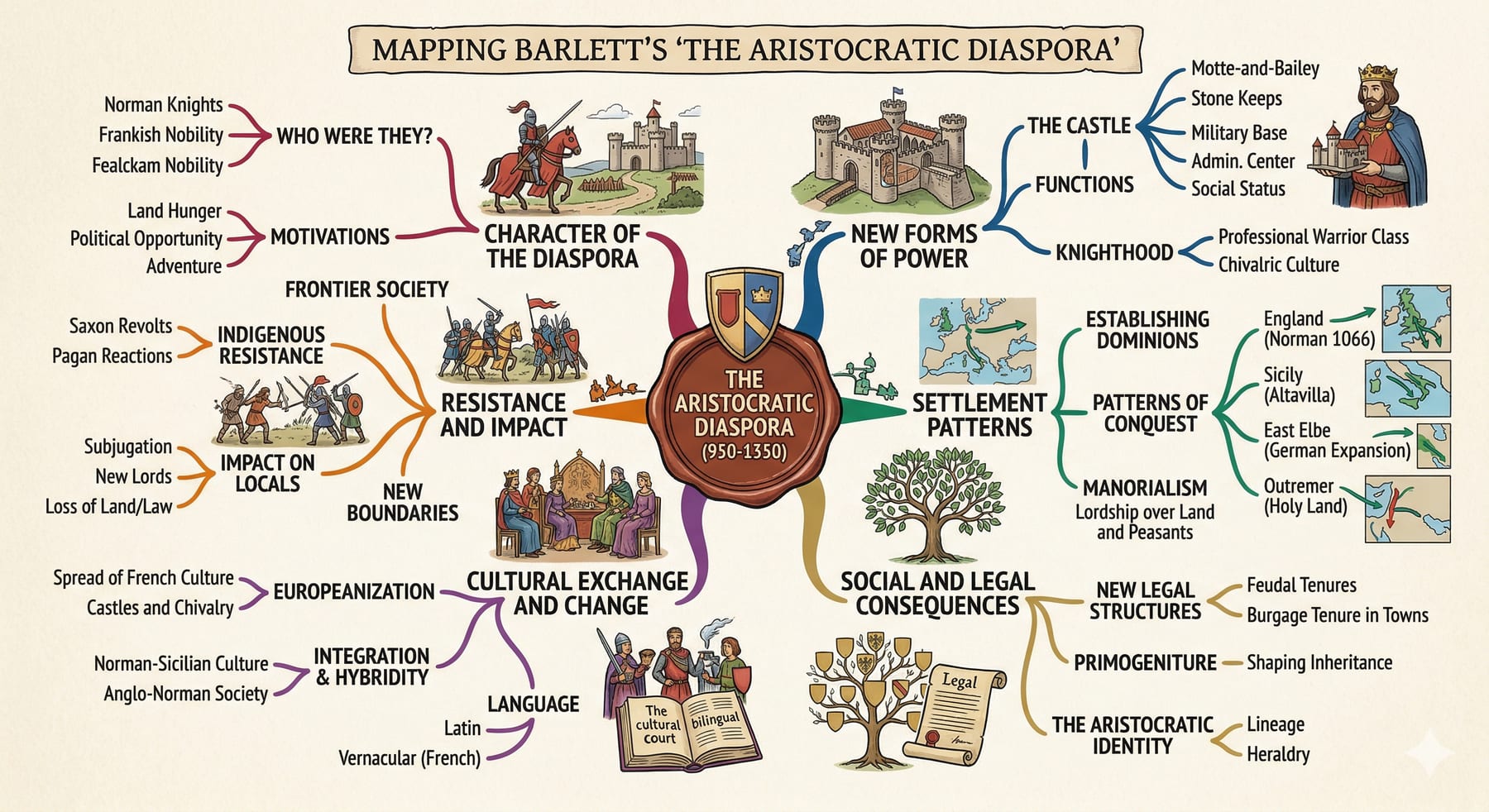
Chapter 2. The Aristocratic Diaspora
Chapter Objective
- This chapter explains how the expansion of medieval Europe was carried not only by churches, kings, and settlers, but by a mobile aristocratic warrior class that left the old Frankish heartlands and made fortunes across the British Isles, Iberia, southern Italy, the eastern Mediterranean, and eastern Europe.
- Bartlett’s main aim is to show that this movement was not random adventure. It produced:
- new lordships
- new dynasties
- in some cases, entirely new kingdoms
- The chapter also asks the deeper explanatory question: why did so many western aristocrats go outward in the eleventh to thirteenth centuries? Bartlett tests explanations based on crusading zeal, land hunger, family structure, feudal pressures, and the rise of a broader knightly class.
- In the broader argument of the book, this chapter shows how Europe’s expansion was embodied in the movement of armed noble families who transplanted western forms of lordship, settlement, and rule into frontier regions.
Opening Section (no formal subsection heading in excerpt)
- Bartlett opens by describing a broad diaspora of western aristocrats from the former Carolingian world.
- These men did not remain in their homelands:
- Normans became lords in England, Wales, Scotland, Ireland, southern Italy, Sicily, Spain, and Syria
- Burgundians went to Castile
- Lotharingians to Palestine
- Saxons to Poland, Prussia, and Livonia
- This movement overlapped with the crusades, but Bartlett in sists it cannot be reduced to crusading alone.
- In some places, aristocratic settlement happened without crusading
- in others, crusading rhetoric was added to a process of local land-grabbing already underway
- southern Italy is a key example, since the Normans built power there by fighting almost everyone, even the pope when necessary
- The Joinville family is Bartlett’s first major example of how one noble house could participate in several fronts of expansion.
- The family began as rooted nobles of Champagne
- over generations they joined crusades, founded towns, served powerful kings, and married into far wider networks
- A pattern emerges through the Joinvilles:
- Geoffrey III joined the Second Crusade
- Geoffrey IV died at Acre in the Third Crusade
- Geoffrey V and his brother Robert joined the crusade movement around 1199 and died in Syria and Apulia
- Simon de Joinville fought in the Albigensian Crusade and later in Egypt
- John de Joinville accompanied St Louis on crusade and became his famous biographer
- Geoffrey de Joinville rose to power in Ireland through aristocratic marriage and royal patronage rather than direct conquest
- Bartlett uses the Joinvilles to show the mixed character of this aristocracy:
- pious, since they endowed churches and joined crusades
- ambitious, since they sought office, land, and marriage alliances
- predatory, since they openly divided spoils and expected profits from plunder
- A vivid contrast appears in the brothers:
- John debates how to divide spoils in Damietta
- Geoffrey later regulates the division of prey in the Irish marches
- The point is that aristocratic migration was sustained by a class accustomed to both religious patronage and organized looting.
- The Grandmesnil family provides another example of the same outward movement.
- Descendants of a Norman landowner spread into:
- southern Italy
- Constantinople
- Wales
- Syria
- One branch married into the Hauteville circle in Italy
- another produced Robert of Rhuddlan, a marcher lord in north Wales
- Descendants of a Norman landowner spread into:
- Robert of Rhuddlan is described as a frontier conqueror who:
- built castles
- expanded territory
- plundered Welsh lands
- founded a borough at Rhuddlan
- Bartlett’s quotation about him emphasizes the violence, pride, and greed of this type of expansion.
- Bartlett widens the picture with further examples:
- the Sourdeval family appears in England, Sicily, the crusades, Wales, and Ireland
- French knights helped in the Reconquest in Spain, sometimes staying to become lords there
- Robert Burdet became governor of Tarragona
- his wife Sibyl is remembered patrolling Tarragona’s walls in armor, a striking example of how transplanted noble power could settle into new lands
- Bartlett then distinguishes French from German aristocratic expansion.
- French and French-speaking nobles spread farther west and south, and were especially prominent in the crusades
- German nobles also joined crusades, but their main zone of expansion was eastern Europe
- Key German pattern:
- rather than founding many dynasties in the Levant, German knights settled into Pomerania, Silesia, Bohemia, and Hungary
- they entered princely retinues and gradually Germanized the landed ruling class east of the Elbe
- Bartlett suggests that although French migration was more dramatic to contemporaries, German aristocratic settlement may have had the greater long-term historical effect.
Conquest Lordships
- Bartlett now turns from aristocratic migration in general to one of its clearest political results: the conquest lordship or conquest principality.
- He contrasts invited aristocracies, such as those in Scotland, Pomerania, and Silesia, with more violent frontier creations like Ulster and Brandenburg.
- John de Courcy and Ulster
- Ulster began through what Bartlett calls a kind of freelance splinter expedition
- In 1176–77, John de Courcy led 22 knights and 300 footmen north from Dublin
- He defeated the local king Rory Mac Dunlevy and took Downpatrick
- From this foothold he built a durable principality in eastern Ulster
- Bartlett shows that de Courcy’s rule had two sides:
- one side resembled traditional Irish kingship:
- raids
- shifting alliances
- cattle-spoil
- political fluidity, with Irish and Anglo-Normans appearing on both sides of conflicts
- the other side was more recognizably Anglo-Norman and colonial:
- motte-and-bailey castles
- a central stronghold at Carrickfergus
- a body of vassals
- a seigneurial administration
- monastic foundations tied to English houses
- coinage bearing his name and St Patrick’s
- one side resembled traditional Irish kingship:
- By the time of his fall in 1205, de Courcy had created more than a raiding zone.
- He had made a new territorial unit that contemporaries could call:
- lord of Ulster
- even prince of the realm of Ulster
- He had made a new territorial unit that contemporaries could call:
- Bartlett’s point is that conquest lordships were frontier creations that stabilized into new political structures.
- Albert the Bear and Brandenburg
- Brandenburg is presented as a larger, longer-lasting counterpart to Ulster.
- Its roots go back to the Nordmark, a frontier march of Saxony in the tenth century
- much of that structure collapsed in the Slav rising of 983
- in the twelfth century, it was rebuilt and extended under Albert the Bear
- Albert mattered because he combined:
- powerful family background
- frontier military experience
- ambition for territorial rule
- A crucial milestone was:
- his enfeoffment with the Nordmark in 1134
- and especially his capture of Brandenburg town on 11 June 1157, treated as the real birth of the principality
- Like de Courcy, Albert used:
- castles
- vassals
- military organization
- But the Ascanian project went further in long-term territorial development.
- Under John I and Otto III, the family:
- expanded landholdings
- founded towns such as Berlin, Frankfurt, and Strausberg
- encouraged settlement
- supported religious institutions
- turned “wilderness into cultivated land”
- Under John I and Otto III, the family:
- Bartlett then zooms in on the von Wedel family as a case study in how conquest principalities rewarded followers.
- Originally a family from Holstein
- later moved east and entered service under the dukes of Pomerania
- then also became vassals of the margraves of Brandenburg
- Their rise shows how frontier mobility worked:
- attach oneself to a rising lord
- receive land
- bring in settlers
- build castles
- found towns
- accumulate rights and revenue
- Specific examples from the von Wedels:
- settlement of new villages in the Neumark
- grants encouraging cultivation of woodland into new peasant farms
- heavy military obligations
- repeated castle-building
- founding towns and drawing annual cash revenues from them
- purchase of Land Schivelbein in 1319, which gave them a “quasi-princely” position
- The larger lesson of this subsection:
- conquest lordships were not just won by battle
- they were consolidated by settlement, castles, vassalage, town-founding, and administrative control
- frontier expansion turned dependent knights into regional magnates.
New Crowns
- Bartlett next argues that the highest possible reward of aristocratic expansion was not simply a lordship, but a crown.
- The eleventh to thirteenth centuries saw the making or remaking of kingdoms such as:
- Castile
- Portugal
- Jerusalem
- Cyprus
- Sicily
- Thessalonica
- These new kingdoms often required new dynasties, and western aristocrats supplied them.
- The house of Montferrat illustrates the most dramatic type of dynastic ambition.
- William the Old had sons who pursued crowns in the East
- one line touched the kingdom of Jerusalem
- Conrad of Montferrat defended Tyre, married into the royal line, and became king before being assassinated
- Boniface of Montferrat, leader of the Fourth Crusade, acquired the kingdom of Thessalonica
- The Montferrats are an example of spectacular ambition, but also of fragility: they repeatedly touched crowns they could not securely keep.
- Bartlett then broadens the point with a statistical claim:
- by 1350, most ruling dynasties of Latin Christendom traced their male-line ancestry back to Frankish roots
- in his reckoning, about 80 percent of Europe’s kings and queens were Franks by descent
- He makes two key arguments from this:
- Frankish aristocratic expansion had dynastic consequences on a continental scale
- French-speaking regions generated a disproportionate number of later ruling houses
- Bartlett distinguishes two phases of Frankish dynastic diffusion:
- a later phase tied to the high politics of the Capetian monarchy
- an earlier and more important phase tied to the aristocratic diaspora of the eleventh and twelfth centuries
- Examples of the earlier phase:
- Norman-connected lines in Scotland and England
- Burgundian lines in Portugal and León-Castile
- the Lusignans in Jerusalem and especially Cyprus
- The Portuguese case is especially important:
- during strong Burgundian influence under Alfonso VI
- the cousins Raymond and Henry of Burgundy received royal marriages
- Henry’s son later assumed the title king of Portugal
- This is a clear example of aristocratic migration turning into durable kingship.
- Bartlett also notes a contrast with German expansion:
- Germans founded important new territorial units like Brandenburg
- but eastern expansion generally happened inside already existing Christian polities such as Poland, Bohemia, and Hungary
- therefore it created fewer new crowns
- This difference helps explain why the aristocratic diaspora mattered differently in western/southern expansion than in eastern Europe.
The Nature of Aristocratic Expansionism
- In the final subsection, Bartlett shifts from description to explanation.
- He asks the central question directly:
- why did western aristocrats go so far afield to conquer and settle?
- He begins with the simplest explanation: land hunger.
- Many aristocrats had little or no land at home
- expansion offered a path from being land-poor to becoming landed
- He gives repeated evidence of a cycle:
- plunder leads to gift-giving
- gift-giving attracts followers
- followers enable more conquest
- conquest produces fiefs and lordship
- Examples:
- Normans in southern Italy enlarged their following by giving away spoils
- crusade chroniclers celebrated how a poor man might gain a town
- in frontier wars, footsoldiers could become mounted warriors through successful raiding
- Bartlett emphasizes the importance of the military retinue.
- It was a basic social organism of medieval aristocratic life
- followers expected:
- gifts
- reward
- eventually land
- the fief mattered because it made marriage, household formation, and long-term status possible
- This helps explain constant pressure for enfeoffment and the competitive scramble for lordship.
- But Bartlett does not think this alone is enough.
- Competition among retinues explains internal aristocratic dynamism
- it does not fully explain why the whole system expanded outward
- He notes that aristocratic society also had many natural openings through family extinction and turnover, so outward expansion cannot be reduced to simple feudal competition.
- He then considers overpopulation, especially through the famous example of the Hautevilles.
- Tancred de Hauteville had twelve sons
- they could not all be supported on the patrimony
- some left for southern Italy and eventually founded the kingdom of Sicily
- Pope Urban II’s rhetoric for the First Crusade also gestures toward this problem, describing a land overcrowded by its numbers.
- Yet Bartlett refuses to generalize too much from the Hautevilles.
- their case was exceptional
- aristocratic demography is uncertain
- it is not plausible to explain the whole movement as a simple result of aristocratic overbreeding
- So overpopulation may be part of the story, but not the whole cause.
- The most important explanatory move comes when Bartlett considers changes in family structure.
- Earlier aristocratic kin-groups may have been looser and broader
- by the tenth and eleventh centuries, they were increasingly replaced by more sharply defined lineages
- patrimony and primogeniture became more central
- younger sons, cousins, and women were more often excluded from the core inheritance line
- This had major consequences:
- aristocratic families became more stable, identifiable, and male-line centered
- but opportunities within them narrowed
- younger sons may have felt new pressure to seek fortune elsewhere
- Bartlett supports this with evidence such as:
- English inheritance rules where the eldest son succeeded to everything
- the Breton decision of 1185 against division of baronies and knight’s fees
- criticism from contemporaries asking, “Who made brothers unequal?”
- Bartlett remains cautious:
- he says the link between family narrowing and aristocratic diaspora is plausible, but not conclusively proven
- His most balanced conclusion is that the expansion likely came from a conjuncture:
- the old dynamism of war-bands and retinues
- the newer narrowing of aristocratic lineage and inheritance
- and the rise of a broader knightly class, some of whom were originally low-status and land-poor
- This is his final synthesis:
- a growing class of knights
- combined with primogeniture and dynastic concentration
- may have overloaded the system
- making outward movement a natural response
- Thus the men who took to the roads, ships, and frontiers were often the ones frustrated by an “empty and impoverished share” of family wealth.
Key Concepts for The Aristocratic Diaspora
- Aristocratic diaspora
- The outward migration of western European nobles into frontier or newly conquered regions, where they acquired land, office, and status.
- Conquest lordship / conquest principality
- A territorial power created by frontier warfare and settlement, then stabilized through castles, vassals, administration, and colonization.
- Retinue
- A lord’s body of armed followers bound by service, reward, loyalty, and the expectation of future landholding.
- Enfeoffment
- The grant of land or a fief in return for military service; a key mechanism for rewarding followers and building stable aristocratic power.
- Primogeniture
- The practice by which the eldest son inherits the principal estate intact, narrowing opportunities for younger sons and other kin.
- Dynastic diffusion
- The spread of aristocratic families into new ruling positions, including crowns, across Europe.
- Quasi-princely status
- A level of territorial, military, and fiscal power approaching princely authority without necessarily holding a crown.
Questions for Reflection for The Aristocratic Diaspora
- Why does Bartlett insist that crusading cannot fully explain the outward movement of western aristocrats?
- In what ways were families like the Joinvilles both deeply rooted in their home regions and radically international in their ambitions?
- What made a frontier lordship like Ulster or Brandenburg something more permanent than a raiding zone?
- Does Bartlett find land hunger, overpopulation, or primogeniture most convincing as an explanation for aristocratic expansion, or is his answer more mixed?
- How does the spread of Frankish dynasties across Europe change the way we think about the political consequences of medieval conquest and migration?
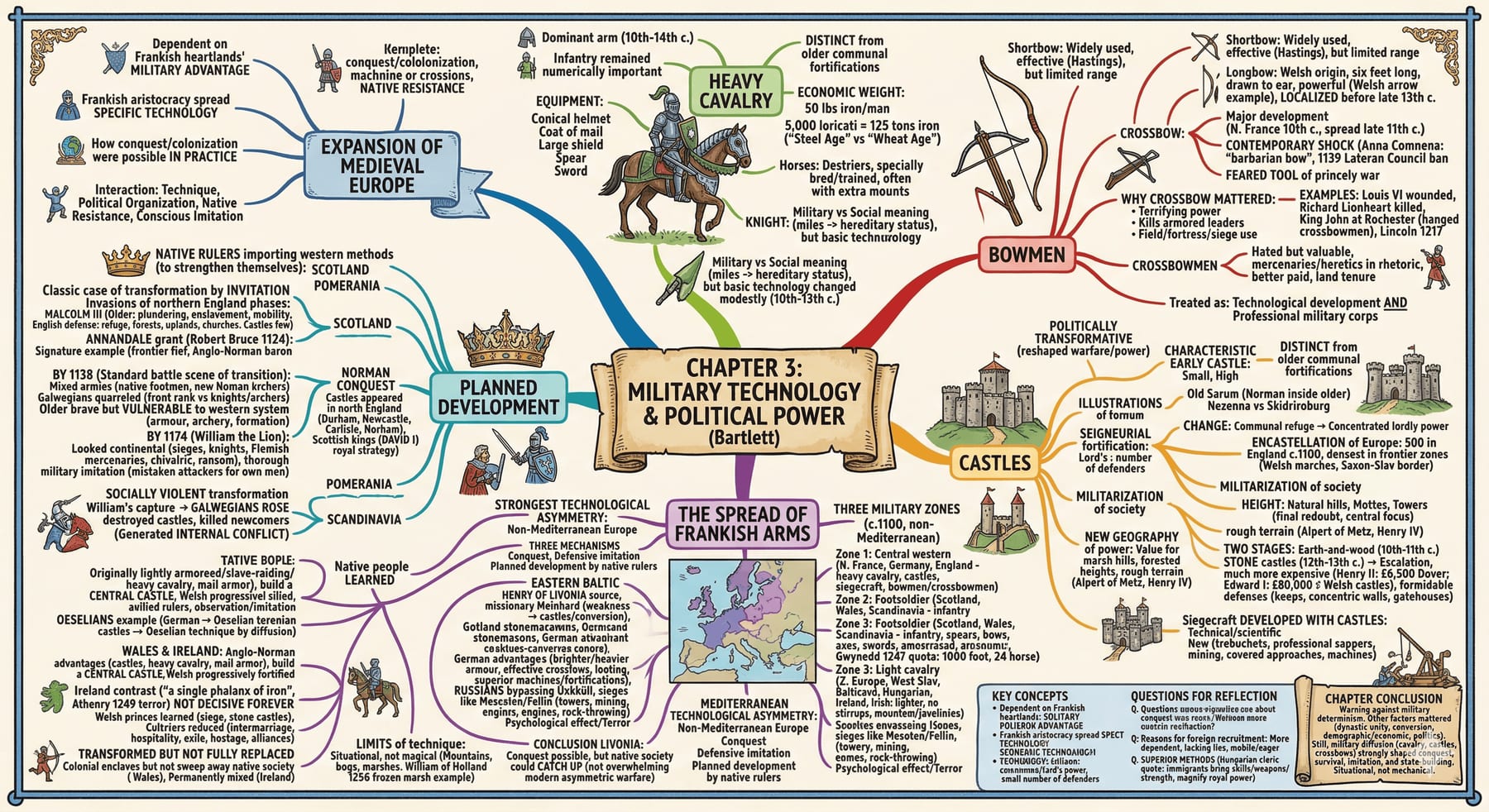
Chapter 3. Military Technology and Political Power
Chapter Objective
- This chapter argues that the expansion of medieval Europe depended in part on a military advantage possessed by the Frankish heartlands of north-western Europe.
- Bartlett’s central claim is that as the Frankish aristocracy spread, it also spread a specific military technology:
- heavy cavalry
- crossbow-based missile power
- castles
- improved siegecraft
- The chapter fits into the broader book by explaining how conquest and colonization were made possible in practice. Europe’s expansion was not just ideological or institutional; it was also carried by a style of warfare that gave western aristocrats a real edge over many neighboring societies.
- Bartlett does not argue that military technology alone determined outcomes. Rather, he shows how military technique interacted with political organization, native resistance, and conscious imitation by peripheral rulers.
Heavy Cavalry
- Bartlett begins with the dominant arm of medieval warfare: heavy cavalry.
- By the tenth century, military operations were already dominated by mounted armoured fighters.
- Infantry remained numerically important, and in some places grew in number, but cavalry retained tactical and social superiority through most of the period 950–1350.
- The standard heavy cavalryman’s equipment included:
- a conical helmet
- a coat of mail
- a large shield
- offensive weapons such as spear, sword, and sometimes mace
- the destrier, the heavy war-horse suited for combat
- Bartlett stresses the economic weight of this equipment:
- the full armament of a cavalryman required about 50 pounds of iron
- an army of 5,000 loricati would therefore represent around 125 tons of iron
- His point is that these men looked like “men of the steel age” living in a much poorer “wheat age.”
- This gives heavy cavalry a social meaning as well as a military one:
- they were expensive
- elite
- and materially difficult to reproduce quickly
- Their horses were also part of the system:
- specially bred and trained
- often accompanied by extra riding horses and spare mounts
- increasingly protected by armour and trappings
- A single knight should be imagined not as an isolated fighter, but as the center of a small mounted team.
- Bartlett also makes an important distinction between the military and social meanings of the knight.
- In the early eleventh century, miles often simply meant a heavily armed horseman
- by the thirteenth century, “knight” increasingly referred to a more exclusive hereditary status group
- Yet the military technology itself changed only modestly.
- The basic dominance of:
- mail-clad mounted men
- using lances, swords, and shields
remained stable from the tenth through the late thirteenth century.
Bowmen
- Bartlett next turns to missile weapons and identifies three bows:
- shortbow
- longbow
- crossbow
- The shortbow:
- widely used in medieval Europe
- common among Scandinavians
- effective in some situations, including Hastings
- but limited in range and penetration compared with the longbow
- The longbow:
- about six feet long
- drawn to the ear
- of south Welsh origin
- Bartlett includes a famous example of its power:
- a Welsh arrow passed through a mailed rider’s thigh, his clothing, the saddle, and then into the horse deeply enough to kill it
- However, before the late thirteenth and fourteenth centuries, the longbow remained highly localized, not the dominant weapon of Europe.
- The true major development of the period was the crossbow.
- It began to appear in northern France by the tenth century, but spread more fully after the late eleventh.
- It shocked contemporaries:
- Anna Comnena called it a “barbarian bow”
- the Lateran Council of 1139 tried to ban its use against Christians
- None of this stopped its rise. By the late twelfth century, large bodies of crossbowmen had become one of the most feared tools of princely war.
- Bartlett emphasizes why the crossbow mattered:
- terrifying penetrative power
- capacity to kill not just peasants but armored leaders
- ability to operate effectively in:
- field battles
- fortress defense
- sieges
- Examples:
- Louis VI was wounded by a crossbow bolt
- Richard the Lionheart was killed by one
- at Rochester in 1215, King John ordered captured crossbowmen hanged because they had killed so many of his men
- at Lincoln in 1217, royal crossbowmen decided the battle by killing horses and breaking the enemy’s fighting strength
- Crossbowmen were hated but valuable:
- often grouped with mercenaries and heretics in moral rhetoric
- yet paid better than ordinary infantry
- sometimes rewarded with land tenure specifically for crossbow service
- Bartlett treats the rise of the crossbow as both:
- a technological development
- the creation of a new professional military corps useful to rulers.
Castles
- Bartlett then turns to what he sees as perhaps the most politically transformative military development: the castle.
- He argues that the spread of castles between the tenth and thirteenth centuries reshaped both warfare and political power.
- He defines the characteristic early medieval castle by two main traits:
- it was small
- it was high
- This distinguishes it from older communal fortifications, which were much larger and meant to protect whole populations.
- By contrast, the new castle was:
- a seigneurial fortification
- built for a lord and his immediate following
- defensible by a small number of men
- Bartlett illustrates this with contrasts:
- Norman castles inside much larger older fortifications like Old Sarum
- the episcopal castle at Nezenna compared to the much larger earlier Saxon stronghold Skidrioburg
- The change in scale reflected a change in political function:
- from communal refuge
- to concentrated lordly power
- Because castles were small, they could be built in large numbers.
- This led to a vast encastellation of Europe:
- perhaps 500 castles in England around 1100, almost all newly built in the previous fifty years
- even greater density in frontier zones like the Welsh marches and the Saxon-Slav border
- Bartlett sees this as a broad militarization of society.
- Height mattered because castles were meant to allow a few defenders to dominate space.
- Height was achieved through:
- natural hills
- mottes (artificial mounds)
- towers or keeps at the summit
- The tower became the final and most important redoubt:
- the place of last refuge
- the key objective in castle warfare
- Bartlett uses examples from Suger’s Life of Louis the Fat to show how often the tower was the central focus of attack and defense.
- Castles also changed the geography of power.
- Men began to value:
- marsh hills
- forested heights
- rough remote terrain
because such sites were ideal for fortification
- Bartlett uses examples from:
- Alpert of Metz
- Henry IV’s castle-building in Saxony
to show that castle-builders now saw apparently marginal landscapes as politically strategic.
- He then separates two stages of castle development:
- earth-and-wood castles of the tenth and eleventh centuries
- stone castles of the twelfth and thirteenth
- Stone castles represented a major escalation:
- much more expensive
- much slower to build
- far more formidable
- Financial examples:
- Henry II spent about £6,500 on Dover alone
- Edward I spent roughly £80,000 on his Welsh castles
- These later castles had:
- tall keeps
- concentric walls
- elaborate gatehouses
- much greater staying power against assault
- As fortifications improved, so did siegecraft.
- New developments included:
- trebuchets
- professional sappers
- mining and undermining
- covered approaches
- more elaborate attacking machines
- Bartlett’s point is that the castle and the siege system developed together.
- Siegecraft became increasingly technical and scientific.
The Spread of Frankish Arms
- Having described the military system of the Frankish core, Bartlett turns to its political consequences.
- He argues that around 1100 non-Mediterranean Europe could be divided into three military zones.
- Zone 1: the central western zone
- northern France
- Germany
- England
- This was the zone of:
- heavy cavalry
- castles
- siegecraft
- increasingly, organized bowmen and crossbowmen
- Zone 2: the footsoldier zone
- Scotland
- Wales
- Scandinavia
- These societies fought mainly with:
- infantry
- spears
- bows
- axes
- swords
- Bartlett gives the military quota imposed on Gwynedd in 1247:
- 1,000 footmen
- only 24 well-armed horsemen
- That proportion shows the military contrast clearly.
- Zone 3: the light cavalry zone
- much of eastern Europe
- West Slav, Baltic, Hungarian lands
- and in some respects Ireland
- Irish horsemen were particularly light:
- without stirrups or true saddles
- fighting as mounted spearmen or javelineers
- In eastern Europe as well, cavalry was lighter, less heavily supported, and less integrated into the western heavy cavalry model.
- Bartlett notes that in the Mediterranean, Frankish military techniques also spread, but the contrast with local societies was less sharp.
- There, western forces faced:
- old traditions of stone fortification
- sophisticated siegecraft
- Muslim and Greek cavalry traditions
- As a result, western superiority was more limited:
- Muslims eventually expelled the crusaders from mainland Syria and Palestine
- Greeks recovered much from the Latin conquerors
- So the strongest technological asymmetry existed not in the Mediterranean, but in non-Mediterranean Europe.
- Bartlett argues that the world of knights and castles gradually expanded into the neighboring zones through three mechanisms:
- conquest
- defensive imitation
- planned development by native rulers
Conquest and Imitation in the Eastern Baltic
- The eastern Baltic provides Bartlett’s clearest example of the first two mechanisms.
- His main source is Henry of Livonia, who vividly describes the military edge of the Germans.
- The missionary Meinhard used military weakness as a lever for conversion:
- after Livonians suffered Lithuanian raids, he rebuked them for lacking fortifications
- he promised castles if they accepted baptism
- stonemasons from Gotland were brought in
- This is an important symbolic moment:
- stone castles entered Livonia together with Christian mission
- military superiority and religious conversion were directly linked
- Henry of Livonia repeatedly stresses the Germans’ military advantages:
- brighter and heavier armour
- more effective crossbows
- superior siege machines
- better fortifications
- Examples:
- enemies frightened by the “brightness of armour”
- Russians bypassing Üxküll because they recognized the Germans and did not know the art of the crossbow
- sieges like Mesoten and Fellin, where Germans used towers, mining, heavy engines, and rock-throwing machines that natives had never seen
- Bartlett emphasizes the psychological effect as well as the physical one:
- unfamiliar machines caused terror
- local peoples had no immediate answer to them
- But the technological gap was not absolute.
- Native peoples began to learn.
- Early attempts could be clumsy:
- Russians trying to imitate a machine and accidentally firing stones backward into their own ranks
- Yet within a generation, local groups were acquiring:
- siege weapon skills
- crossbow use
- knowledge of fortification
- The transfer happened through several channels:
- subject auxiliaries serving under German leaders
- allied local rulers receiving military advisers and equipment
- looting enemy corpses and captured fortresses
- observation and imitation
- Bartlett’s example of the Oeselians is key:
- they sent men to learn siege techniques from other locals who had already received them from the Danes
- “the German technique” became “the Oeselian technique” by diffusion
- The conclusion from Livonia:
- German superiority made conquest possible
- but native societies could catch up
- this was colonial military asymmetry, but not the overwhelming asymmetry of the modern gunpowder age.
Wales and Ireland
- Bartlett sees a similar pattern in Wales and Ireland.
- Anglo-Norman penetration began with military advantages:
- castles
- heavy cavalry
- mail armour
- A classic first act of conquest was to build a central castle.
- He quotes both a twelfth-century observer and the Brut y Tywysogion to show how Wales was progressively fortified by Norman castles.
- In Ireland, the contrast between invaders and natives could appear stark:
- Irish sources describe the Anglo-Normans as “a single phalanx of iron”
- at Athenry in 1249, the sight of mail-clad cavalry reportedly produced terror and rout among the O’Connors
- Yet again, the superiority was not decisive forever.
- Welsh princes learned:
- to use siege machinery
- to build stone castles
- Cultural barriers were reduced by:
- intermarriage
- hospitality
- exile
- hostage service
- temporary alliances
- This meant that Wales and Ireland were transformed, but not fully replaced.
- Bartlett’s judgment is that:
- Anglo-Norman military superiority allowed colonial enclaves and new lordships
- but it was not enough to sweep away native society completely
- Thus Wales became a half-conquered country, while Ireland remained permanently mixed in political and cultural control.
- Bartlett also underlines the limits of Frankish military technique.
- Heavy cavalry excelled in open terrain, but not always in:
- mountains
- bogs
- marshes
- He includes the example of William of Holland in 1256:
- heavily armored and mounted
- lured by lightly equipped Frisians into a frozen marsh
- fell through the ice and was killed
- The point is that superior technology was situational, not magical.
Planned Development: Scotland, Pomerania, and Scandinavia
- Bartlett’s third mode of diffusion is especially important: native rulers deliberately importing western military methods to strengthen themselves.
- This happened in:
- Scotland
- Pomerania
- Scandinavia
and elsewhere.
Scotland
- Scotland is Bartlett’s classic case of transformation by invitation rather than conquest.
- He traces the process through three phases of Scottish invasions of northern England:
- under Malcolm III
- in 1138
- in 1174
- These episodes show military and political change over time.
- Under Malcolm III, Scottish warfare looked older in form:
- plundering
- enslavement
- reliance on mobility and raiding
- English defense depended on:
- great refuge sites like Durham
- forests and uplands
- churches and saints
- At this point the north of England had very few castles.
- This soon changed on both sides of the border:
- after the Norman Conquest, castles appeared in the north of England:
- Durham
- Newcastle
- Carlisle
- Norham
- Scottish kings, especially David I, responded by inviting Anglo-Norman knights and barons into Scotland
- after the Norman Conquest, castles appeared in the north of England:
- The grant of Annandale to Robert Bruce in 1124 is Bartlett’s signature example:
- a large frontier fief
- held by an Anglo-Norman baron
- backed by castles
- embedded directly in royal strategy
- By 1138, Scottish armies were mixed:
- native lightly armed troops
- new Norman knights
- archers
- The Battle of the Standard becomes the great dramatic scene of transition.
- Bartlett highlights the quarrel before battle:
- the Galwegians demanded the front rank
- the king and his Anglo-Norman advisers preferred armored knights and archers
- This scene captures the internal social tension created by military modernization.
- In battle:
- the unarmoured Galwegians attacked first
- were checked by mail-clad opposition and arrow fire
- suffered heavily
- The message is clear:
- older forms of warfare could be brave
- but they were increasingly vulnerable to the western system of armour, archery, and formation.
- By 1174, under William the Lion, Scottish war already looked much more like continental war:
- siege operations
- knights
- Flemish mercenaries
- chivalric language
- ransom practices
- Bartlett notes that the Scottish and English knights had become so similar that King William may initially have mistaken attackers for his own men.
- This shows how thoroughly military imitation had worked.
- Yet the transformation was socially violent.
- After William’s capture, the Galwegians:
- rose
- destroyed new castles
- killed many newcomers
- Bartlett uses this to show that imported military systems did not simply strengthen kingdoms; they also generated internal conflict.
Pomerania and Scandinavia
- Bartlett sees parallel developments elsewhere.
- Pomerania:
- originally a lightly armoured, slave-raiding, decentralized society
- transformed over the twelfth and thirteenth centuries by inviting German knights
- the native dynasty used them to strengthen princely rule and survive outside pressure
- Scandinavia:
- adopted German heavy cavalry and siegecraft during the civil wars of the 1130s
- Saxons built machines at Roskilde
- German mounted warriors fought at Fotevik
- Crucially, this occurred under native dynastic control, not foreign conquest.
- Bartlett stresses that Scandinavian rulers and aristocracies remained independent while modernizing militarily.
- He explains why foreign military recruitment appealed to princes:
- foreign warriors were often more dependent on the ruler
- they lacked local kinship ties
- they were mobile and eager to advance
- In peripheral regions, an additional advantage existed:
- these outsiders brought superior military methods
- Bartlett quotes a Hungarian cleric summarizing the political logic:
- a kingdom of one race and custom is weak
- immigrants bring skills, weapons, and strength that magnify royal power
Chapter Conclusion
- Bartlett closes by warning against military determinism.
- He does not claim that heavy cavalry and castles alone explain the map of Europe in 1300.
- Other factors mattered:
- dynastic unity
- conversion to Christianity
- demographic and economic strength
- wider political conditions
- Still, he insists that one major strand in the making of Europe was the diffusion of:
- heavy cavalry
- castles
- crossbows and superior ballistics
from the heartland between the Loire and the Rhine outward to places like Ireland and Lithuania.
- Military technology did not mechanically determine politics, but it strongly shaped the possibilities of conquest, survival, imitation, and state-building.
Key Concepts for Military Technology and Political Power
- Heavy cavalry
- The core elite fighting arm of western Europe, based on armored mounted warriors using expensive iron equipment, trained warhorses, and shock combat.
- Crossbow
- The major missile innovation of the period, valued for its penetrative power and central role in field warfare, siege warfare, and fortress defense.
- Encastellation
- The widespread proliferation of castles across Europe, especially between the tenth and twelfth centuries, which reshaped military and political power.
- Seigneurial fortification
- A small, lord-centered defensive structure, unlike older communal fortifications; the castle was the clearest example.
- Siegecraft
- The technical art of attacking fortifications, including trebuchets, mining, towers, protective shelters, and specialized engineers.
- Military diffusion
- The spread of western European military methods into surrounding regions by conquest, imitation, and deliberate adoption by native rulers.
- Military asymmetry
- The unequal distribution of weapons, armour, fortifications, and techniques that gave Frankish and related forces an edge over many neighboring peoples.
Questions for Reflection for Military Technology and Political Power
- Why does Bartlett place so much emphasis on the combination of heavy cavalry, crossbows, and castles, rather than on any single weapon?
- In what ways did castles change not just warfare, but the political geography of Europe?
- Why was Frankish military superiority more decisive in non-Mediterranean Europe than in the Mediterranean world?
- How does the case of Scotland show that military modernization could be both a source of strength and a source of internal conflict?
- Bartlett says military technology interacted with politics rather than determining it. Which examples in the chapter best support that claim?
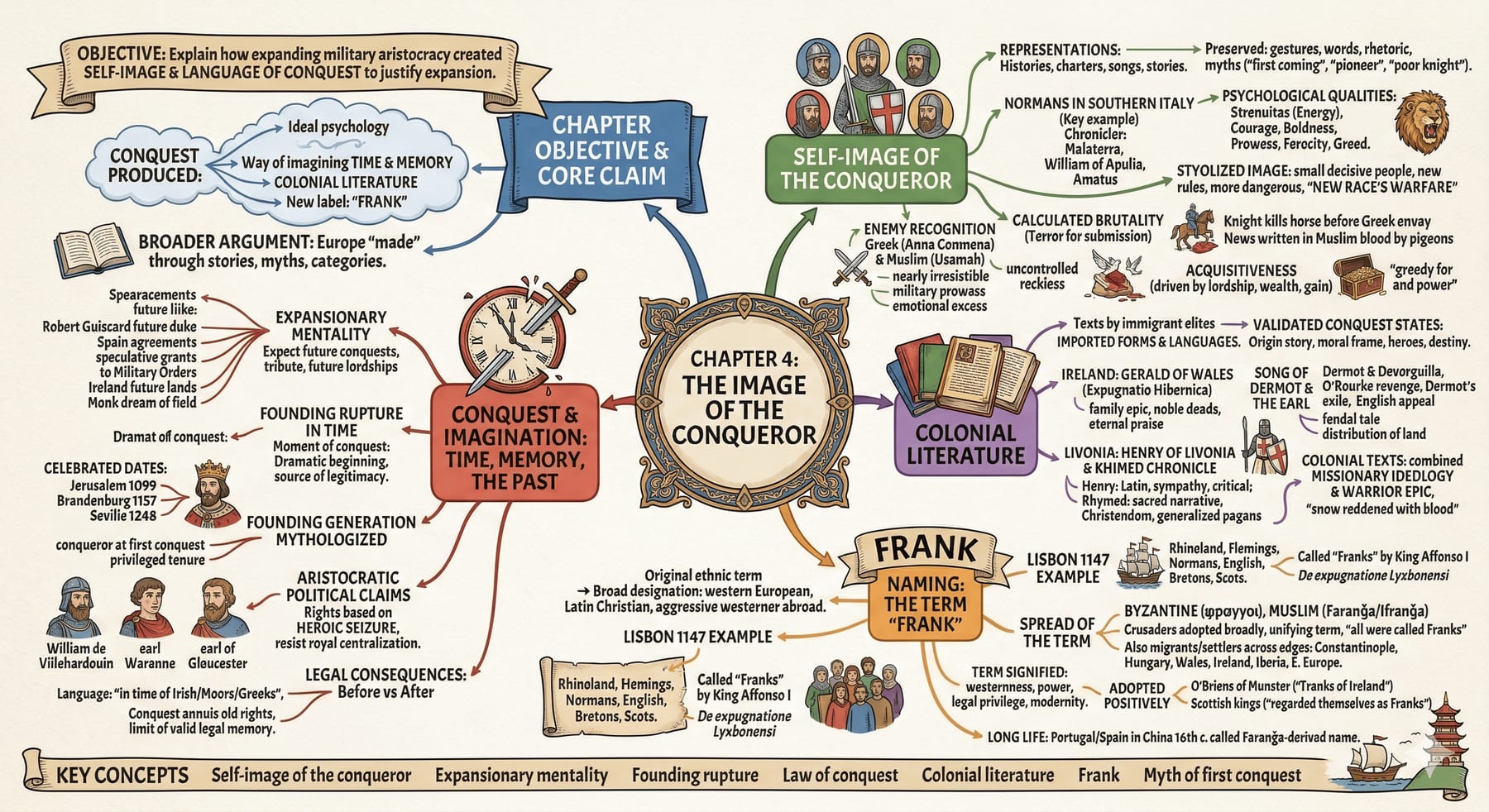
Chapter 4. The Image of the Conqueror
Chapter Objective
- This chapter explains how the expanding military aristocracy of western Europe did not merely conquer lands; it also created a self-image and a language of conquest that justified, glorified, and memorialized expansion.
- Bartlett’s aim is to show that conquest produced:
- an ideal psychology of the conqueror
- a way of imagining time, memory, and legitimacy
- a body of colonial literature
- and even a new collective label for aggressive westerners: “Frank.”
- In the broader argument of the book, this chapter shows that Europe was “made” not only through war, colonization, and institutions, but also through the stories conquerors told about themselves, the myths they passed down, and the categories by which they distinguished themselves from others.
Opening Section (no formal subsection heading in excerpt)
- Bartlett opens by arguing that western conquerors created representations of themselves in:
- histories
- charters
- songs
- stories
- These records preserved:
- the gestures and words of famous conquerors
- the rhetoric of expansionary violence
- recurring mythic motifs such as:
- the first coming of the conquerors
- the heroic military pioneer
- the rise of the poor knight or ambitious noble through foreign conquest
- The chapter is therefore about the self-image of the conqueror, not just his actions.
- Bartlett begins with the Normans in southern Italy as the clearest early example.
- Their chroniclers, especially Geoffrey Malaterra, William of Apulia, and Amatus of Monte Cassino, do not mainly explain Norman success by numbers or technology.
- Instead, they emphasize psychological and moral qualities:
- energy (strenuitas)
- courage
- boldness
- prowess
- ferocity
- greed for booty and power
- The image is highly stylized:
- the Normans are a small but decisive people
- they change the rules of warfare
- they are more aggressive and more dangerous than those around them
- Bartlett notes that these chroniclers portray the Normans as bringing a “new race’s warfare” into the Mediterranean world.
- A key feature of this self-image is calculated brutality.
- Bartlett gives memorable examples:
- a Norman strikes down a horse with a single blow in front of a Greek envoy so the envoy will carry home a terrifying story
- after Roger’s victory over Muslims near Palermo, messenger pigeons are released carrying news of defeat written in the blood of dead Muslims
- These stories are not presented as random savagery.
- Their point is political:
- terror is used to induce submission
- fear spreads the conqueror’s reputation ahead of further conquest
- Bartlett also stresses that Norman memorialists are quite open about acquisitiveness.
- The conqueror is not only brave but openly driven by:
- lordship
- wealth
- gain
- Malaterra says the Normans prefer foreign fields in hope of profit and are greedy for booty and power.
- This greed is presented almost as a natural trait of the conquering race.
- Bartlett then shows that this image was not confined to Norman self-praise.
- It appears, with variations, in the writings of their Greek and Muslim enemies as well.
- Anna Comnena describes westerners as:
- uncontrolled
- unstable
- avaricious
- reckless
- nearly irresistible once committed to violence
- Usamah ibn Munqidh similarly observes that among the Franks, no quality is more prized than military prowess.
- The important point is that even enemies recognized a distinct behavioral style in the western conquerors:
- fierce personal competition
- physical daring
- appetite for domination
- emotional excess
- Bartlett concludes that this was not just a literary topos; it was an interlocking network of self-presentation and hostile recognition.
Conquest and the Imagination: Time, Memory, the Past
- Bartlett next examines how successful conquest changed the conquerors’ sense of time and history.
- Conquerors and colonizers developed what he calls an expansionary mentality:
- they expected more conquests
- more settlement
- more tribute and rents
- more future lordships to be made by force
- One expression of this mentality is the abundance of prospective titles and grants.
- Conquerors behaved as if future acquisitions were already half-real.
- Examples:
- Robert Guiscard styled himself future duke of Sicily even before it was conquered
- rulers in Spain made agreements over Muslim lands not yet taken
- kings and nobles granted future tithes, lands, churches, and rights in territories still under enemy control
- The military orders were especially important recipients of such speculative grants.
- Bartlett gives examples from:
- the eastern Mediterranean
- Spain
- the Baltic
- These grants show that expansion was not merely something happening; it was something expected, budgeted, and imagined ahead of time.
- Ireland and Wales provide similar cases.
- Grants were made of:
- lands that a lord had acquired
- and lands he would in future acquire from Welsh or Irish enemies
- Bartlett notes even dream imagery reflecting this mentality:
- a monk dreams of a larger field of people not yet subject to Robert Guiscard, explained as the peoples he will later rule
- This shows how conquest reached into legal habits, political planning, and even symbolic imagination.
- Bartlett then turns from the future to the past.
- For descendants of a conquest elite, the moment of conquest became a founding rupture in time.
- Conquest was remembered as:
- a dramatic beginning
- a point from which history was reckoned
- a source of legitimacy
- Examples:
- the capture of Jerusalem in 1099 became a date of reference in the kingdom of Jerusalem
- the capture of Brandenburg in 1157
- the entry of Ferdinand III into Seville in 1248
- These moments were carefully dated and celebrated as fresh starts in history.
- Those who took part in the first conquest acquired special standing in collective memory.
- Examples:
- in Ireland, people could still speak generations later of “a conqueror at the first conquest of Ireland”
- in the Morea, descendants of the original conquerors held privileged tenure “as of conquest”
- This founding generation was mythologized, and participation in conquest could become the basis of legal privilege.
- Bartlett also shows how conquest memory could support aristocratic political claims.
- Descendants of conquerors argued that their rights were rooted in a collective heroic seizure of the land, not merely in royal delegation.
- Examples:
- William de Villehardouin tells the Byzantine emperor that the Morea was won by nobles who divided it among themselves by the sword
- the earl Warenne tells Edward I’s judges that his ancestors came with William the Bastard and conquered by the sword
- the earl of Gloucester claims Welsh liberties by ancestral conquest
- This means conquest memory did not simply glorify beginnings; it could be used to resist later royal centralization.
- Bartlett then turns to a crucial legal issue: what happened to rights from before the conquest?
- Charters often refer to:
- “in the time of the Irish”
- “in the time of the Moors”
- “in the time of the Greeks”
- This language preserves a strong consciousness that a conquest had divided history into:
- before
- and after
- But the legal consequences varied.
- In Ireland and Wales, conquest could be used to argue that earlier rights and liberties were effectively annulled unless confirmed under the new regime.
- Bartlett’s examples show that “since the conquest” often became the new limit of valid legal memory.
- Even where there was no outright dynastic overthrow, there could still be awareness of a social rupture.
- In Mecklenburg, a native Slav dynasty later confirmed rights that had existed “since the new plantation.”
- Bartlett’s larger point is that conquest created a new sense of time:
- a founding breach
- a before-and-after consciousness
- a belief that the present order was born from violent beginning.
The Literature of Conquest
- Bartlett next argues that conquest produced not just memory but a distinct literature of conquest.
- First-generation settlers and their descendants told stories about:
- arrival
- early battles
- traitors and heroes
- the original distribution of lands
- Part of this survives in both Latin prose and vernacular verse.
- He notes that some of the earliest French prose works are conquest narratives:
- Robert of Clari’s account of the Fourth Crusade
- Geoffrey de Villehardouin’s Conquest of Constantinople
- the French translation and continuation of William of Tyre, known as the Livre dou conqueste
- This is a major literary-historical point:
- French prose begins in large measure as a prose of conquest explanation.
- Ireland provides one of Bartlett’s richest examples.
- Two complementary texts narrate the Anglo-Norman conquest:
- Gerald of Wales, Expugnatio Hibernica
- The Song of Dermot and the Earl
- Gerald’s work is a partisan family epic celebrating the deeds of his relatives and the first wave of settlers from south Wales.
- He portrays their achievements as noble deeds worthy of eternal praise.
- The Song of Dermot and the Earl gives the same conquest in a different literary form.
- Its story begins with:
- Dermot’s abduction of Devorguilla
- O’Rourke’s revenge
- Dermot’s exile
- his appeal to the English
- This frames the conquest as a feudal tale of:
- betrayal
- rightful restoration
- knightly aid to a wronged ruler
- Bartlett points out that this was an ideologically convenient story for the colonists.
- The poem also includes a detailed account of the distribution of land among the first Anglo-Norman settlers, giving it the quality of a foundation charter.
- Bartlett then compares Ireland to Livonia, where conquest also generated both:
- a Latin prose chronicle
- a vernacular rhymed chronicle
- The main texts are:
- Henry of Livonia’s Chronicle
- the Livländische Reimchronik
- Henry’s chronicle is less simply triumphalist than Gerald’s.
- He shows sympathy for native peoples and criticizes harsh German judges.
- But it is still unmistakably a colonial text, written from within the immigrant society.
- The Livländische Reimchronik frames conquest in a more explicitly sacred narrative.
- It begins not with local geography but with:
- Creation
- Incarnation
- Pentecost
- The conquest of Livonia is presented as part of the long widening of Christendom.
- Germans are regularly called Christians, while their opponents are generalized as pagans.
- This makes conquest into a sacred-historical process, not merely a regional war.
- Yet even this sacred framework is blended with epic violence.
- Bartlett quotes jaunty and grimly ironic passages:
- sleeping men awakened by having their heads broken
- snow reddened with the blood of Christian and pagan heroes
- So conquest literature could combine:
- missionary ideology
- warrior epic
- colonial self-justification
- Bartlett’s overall conclusion for this section is that these texts are unmistakably colonial literature.
- They were:
- written by immigrants
- in imported literary forms
- in languages often not previously spoken in the conquered regions
- They validated conquest states and settler societies by giving them:
- an origin story
- a moral frame
- a roster of heroes
- and a sense of historical destiny.
Naming
- In the final subsection, Bartlett shows that conquest also gave western aristocrats a powerful collective name: Frank.
- Originally an ethnic term, “Frank” became in the eleventh and twelfth centuries a broader label meaning something like:
- western European
- Latin Christian
- especially aggressive westerner abroad
- The capture of Lisbon in 1147 is Bartlett’s key example.
- The crusading fleet that gathered there was ethnically very mixed:
- men from the Rhineland
- Flemings
- Normans
- English
- Bretons
- Scots
- The author of De expugnatione Lyxbonensi is fully aware of this diversity and frequently notes ethnic tension.
- Yet when he needs a general name for the whole expedition, he uses “Franks.”
- The Portuguese king Affonso I does the same.
- Though himself the son of an immigrant Frankish noble, he refers to this mixed western fleet as:
- the ships of the Franks
- and promises them Lisbon according to the customs and liberties of the Franks
- Bartlett’s point is that “Frank” became useful both:
- as a self-appellation
- and as a term used by outsiders to describe westerners as a group.
- Bartlett then traces the history of the term.
- Before the crusades, it had already existed as:
- an ethnic name
- a name for the realm of the Franks
- Muslims and Byzantines had long used forms of “Frank” for westerners in general.
- What changed with the First Crusade was that westerners themselves increasingly adopted the term in that broad sense.
- He gives several important examples:
- Muslim writers used Faranǧa / Ifranǧa
- Byzantines used φραγγοι
- Cardinal Humbert’s offended response to Cerularius reveals a moment when easterners equated Frank with Latin, while westerners were still adjusting to that usage
- crusaders began to describe themselves as Franks, especially when acting together far from home
- On crusade, “Frank” became a unifying term transcending local divisions.
- Ambroise, looking back nostalgically to the First Crusade, says that then no one asked who was Norman, French, Breton, Flemish, or English:
- all were called Franks
- Bartlett treats this as a real identity shift produced by movement, war, and shared enterprise.
- But the term also spread beyond crusading.
- “Frank” was used for settlers and migrants across the edges of Latin Christendom:
- in Constantinople
- in Hungary
- in Wales
- in Ireland
- in Iberia
- in eastern Europe
- Immigrant settlements could be governed by Frankish law.
- Colonists might be called immigrant Franks.
- Greeks under western rule could negotiate to be treated like privileged Franks.
- Bartlett shows that the term came to signify not just ethnicity, but a package of:
- westernness
- power
- legal privilege
- and modernity.
- The most striking examples come when local rulers adopt the term positively.
- The O’Briens of Munster called themselves the Franks of Ireland.
- In Scotland, a chronicler says recent kings of the Scots regarded themselves as Franks in:
- stock
- manners
- language
- style
- Bartlett’s larger point is that to be a Frank by the twelfth and thirteenth centuries increasingly implied prestige, power, and participation in the dominant western order.
- He ends by carrying the term into the early modern world:
- Portuguese and Spaniards reaching China in the sixteenth century could still be called by a name derived from Faranǧa
- This shows the extraordinary long life of the medieval label.
Key Concepts for The Image of the Conqueror
- Self-image of the conqueror
- The package of traits, stories, and values through which western conquerors represented themselves as energetic, brave, harsh, ambitious, and destined to rule.
- Expansionary mentality
- A mindset formed by successful conquest and settlement, marked by expectation of future gains, speculative titles, and anticipatory grants.
- Founding rupture
- The idea that conquest created a decisive break in time, separating a “before” from an “after” and serving as the origin of new legal and political orders.
- Law of conquest
- The body of assumptions and claims that treated rights gained by the sword as legitimate, often structuring privilege, tenure, and memory in conquest societies.
- Colonial literature
- Texts written by immigrant elites that explained, justified, celebrated, or morally framed conquest and settlement in newly acquired lands.
- Frank
- A term that evolved from a specific ethnic label into a broad designation for western Europeans or Latin Christians abroad, often with connotations of military aggression, privilege, and prestige.
- Myth of first conquest
- The memorialization of the first generation of conquerors as heroic founders whose deeds established the rights and identity of later settler society.
Questions for Reflection for The Image of the Conqueror
- Why do Bartlett’s conquerors define themselves so much through psychology—energy, boldness, ferocity, ambition—rather than only through weapons or institutions?
- How do prospective grants and future titles reveal an expansionary mentality before conquest is complete?
- In what ways did conquest create a new understanding of time, especially the distinction between rights “before” and “since” the conquest?
- How do texts like the Song of Dermot and the Earl or the Livländische Reimchronik function as more than chronicles—what political work are they doing?
- Why did the label “Frank” become so powerful across such different regions, and what did it come to represent beyond ethnicity?
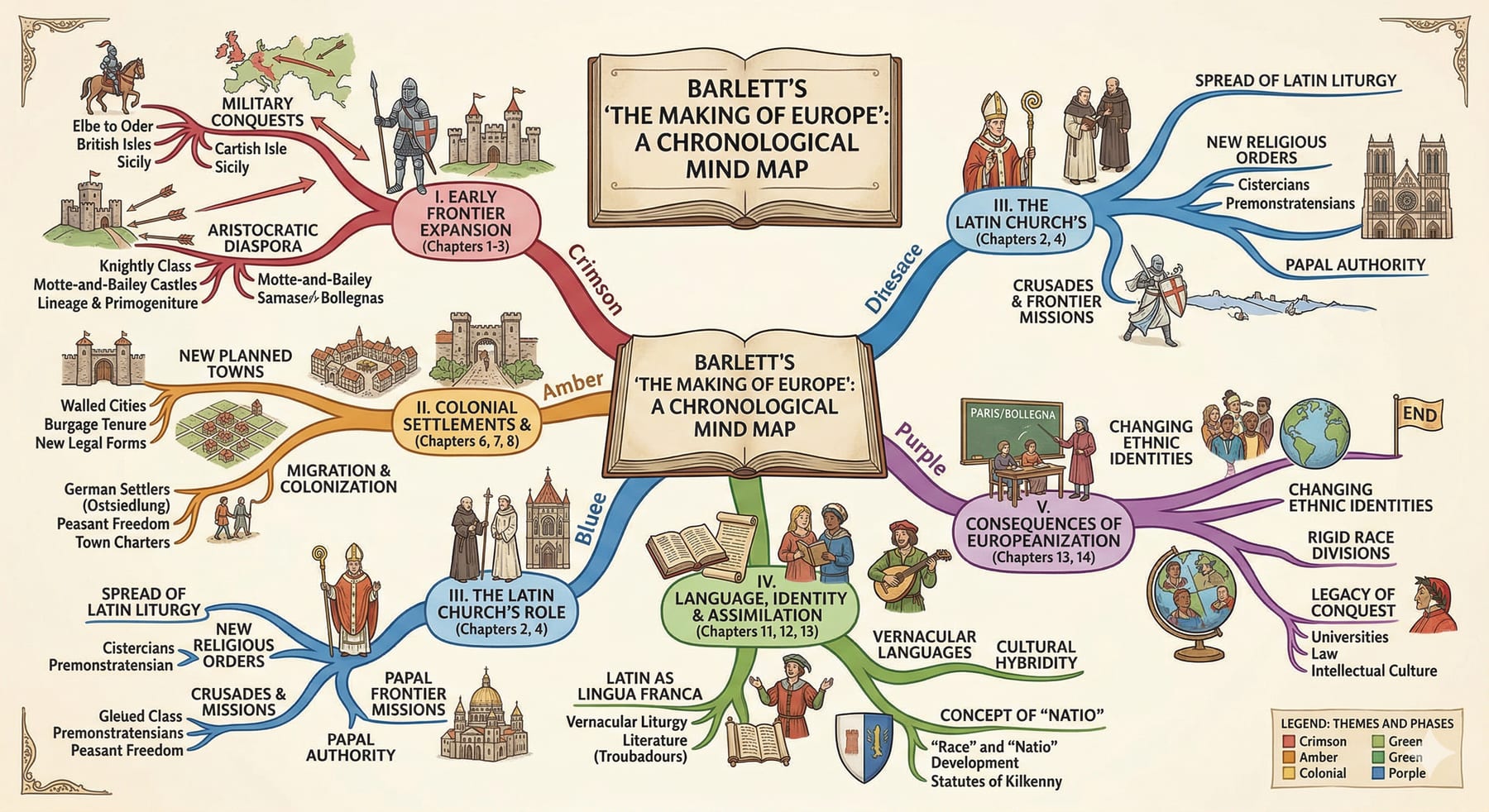
Chapter 5. The Free Village
Chapter Objective
- This chapter explains the demographic and institutional foundations of medieval European expansion by shifting attention from aristocrats and conquerors to settlers, especially peasant colonists.
- Bartlett’s main argument is that the expansion of Latin Christendom in the High Middle Ages depended not only on conquest, but on the organized movement of people into new lands and the creation of a distinctive legal and economic institution: the free village.
- The chapter fits the broader book by showing how conquered or underpopulated lands were actually filled, worked, and made productive. Military victory created opportunities, but durable expansion required:
- population growth
- migration
- planned settlement
- legal privileges strong enough to attract labor away from older societies.
The Demographic Background
- Bartlett begins with the simplest underlying question: if Latin Christendom expanded, was its population increasing?
- He is careful not to make population growth the sole explanation.
- demographic increase is not sufficient by itself
- other factors such as organization, prestige, and aggression also matter
- Still, medieval Europe was clearly not a case like modern western influence abroad without major settlement; here, migration and colonization were real, so demographic growth must be part of the story.
- He stresses the difficulty of medieval demographic history:
- unlike modern periods, there are no reliable censuses
- evidence is rare, local, fragmentary, and discontinuous
- Because of that, historians must work with:
- indirect evidence
- approximations
- impressionistic indicators rather than exact national statistics.
- Even so, Bartlett argues that the evidence points consistently toward population growth in the High Middle Ages.
- Main signs include:
- urban growth
- new town foundations
- expansion of cultivated land
- denser territorial organization
- large-scale planned settlement, especially in the east
- economic indicators such as price pressure suggesting more people pressing on resources.
- Examples he uses:
- in England, 132 new planned urban settlements were founded in the twelfth and thirteenth centuries
- the walls of Florence expanded from enclosing about 200 acres in 1172 to more than 1,500 acres by 1284
- some major western European cities may have approached 100,000 inhabitants by 1300.
- Bartlett then examines the strongest statistical case available: England, using Domesday Book (1086) and the Poll Tax returns (1377).
- He is cautious because both sources require assumptions:
- Domesday omits groups and counts households rather than all individuals
- Poll Tax figures exclude children and are shaped by evasion and plague losses
- But even with broad uncertainty, the trend is unmistakable:
- the English population rose substantially between the late eleventh century and the fourteenth-century peak.
- His estimated ranges:
- England in 1086: roughly 1.2 to 2.4 million
- England at its pre-plague peak: roughly 4 to 6.6 million
- These figures are not exact, but they establish the direction of change.
- Bartlett then compares possible medieval growth rates with early modern ones.
- His conclusion is that High Medieval population growth may have run at a pace comparable to England’s growth in the sixteenth to eighteenth centuries, which helps explain:
- rapid urbanization
- large-scale migration
- the availability of emigrants for frontier settlement.
- Final takeaway of this section:
- the expansionary centuries of Latin Christendom should be imagined against a backdrop of long-term demographic growth, even if precise figures remain uncertain.
Patterns of Migration
- Bartlett next argues that Europe’s population was not only growing, but moving.
- Some movement was local:
- villagers filling nearby towns
- settlers creating daughter hamlets nearby
- But much of it was long-distance migration:
- overland
- overseas
- sometimes carrying settlers hundreds or thousands of miles into unfamiliar climates and cultures.
- He suggests that the High Middle Ages deserves the label “migration period” as much as, or more than, the fourth to sixth centuries.
- The overall direction of movement is clear:
- outward from the western and central European core
- into the continental peripheries
- especially:
- the Celtic lands
- Iberia
- parts of the Mediterranean
- above all, the lands east of the Elbe.
- Bartlett makes an important distinction between land migration and sea migration.
- Across the sea, immigrant populations were usually thin:
- elites
- burghers
- some peasants
- Across contiguous land frontiers, however, migration could be massive enough to transform whole regions linguistically and culturally.
- This helps explain why the Ostsiedlung east of the Elbe had deeper long-term demographic effects than many overseas colonies.
- One reason: crossing the sea cost money, while land migration could often be undertaken much more cheaply and independently.
- Iberian Peninsula
- Expansionary migration began early in some areas, but accelerated after the capture of Toledo in 1085
- as Christian kingdoms moved south, they had to settle conquered Muslim lands
- some Muslim populations fled, while other zones were newly and deliberately settled
- Most settlers came from within Iberia, but some also arrived from southern France.
- Bartlett gives examples from Templar estates with tenants bearing names like:
- Raymond Gascon
- William of Condom
- Martin of Toulouse
- Richard of Cahors
- The scale was large:
- roughly 150,000 square miles were involved in the Reconquest settlement zone.
- The Ostsiedlung
- German settlement east of the Elbe was even larger in scale
- it began gradually in the twelfth century and expanded massively in the thirteenth
- it reached:
- Brandenburg
- Mecklenburg
- Silesia
- Bohemia
- Transylvania
- Estonia
- the Carpathian region
- Settlers included:
- farmers
- merchants
- miners
- Bartlett stresses that this migration permanently changed the map of Europe and had major long-term consequences.
- The Celtic lands and Mediterranean
- though smaller in scale, Wales, Ireland, Scotland, and the eastern Mediterranean also received outward-moving settler populations from the core regions
- This confirms that the migratory phenomenon was continental, not localized.
- Bartlett uses the Flemings as a vivid micro-example of this wider movement.
- Why Flemings matter:
- Flanders was densely settled, wealthy, urbanized, and central
- Flemings then appear all over Europe as:
- knights
- soldiers
- artisans
- urban settlers
- drainage experts
- peasant colonists
- Examples of Flemish mobility:
- numerous Flemings in the Norman Conquest of England
- Flemish mercenaries in twelfth-century civil wars
- Flemish knightly settlers in Scotland
- urban Flemish colonies in places like Vienna
- Flemish drainage settlers east of the Elbe
- probable Flemish migrants in Transylvania
- a substantial Flemish colony planted in south Wales around 1108
- Flemings among the first groups involved in the Anglo-Norman move into Ireland.
- The Welsh chronicle’s account of the Flemings in Rhos is especially revealing:
- they are described as a strange people sent by Henry I
- their homeland is imagined as overcrowded and threatened by the sea
- they displaced local inhabitants and remained hostile to them
- Bartlett also notes that this colony preserved its distinctiveness:
- Flemish language
- names
- place names
- durable antagonism with the Welsh.
- Gerald of Wales describes the Flemings as:
- brave
- sturdy
- enemies of the Welsh
- skilled in wool-work and trade
- ready for plough or arms
- Bartlett uses them to show how versatile migrant groups could be and how clearly the age’s expansionary population movement can be seen in one people’s story.
The Legal Framework
- Bartlett now moves from demographic movement to the institutional solution that made settlement work.
- His central point is that however different the environments of Iberia, eastern Europe, Ireland, or Palestine were, the social and legal arrangements created for settlers show remarkable similarities.
- He compares:
- a charter from Aragon in 1127
- with one from Wroclaw/Silesia in the thirteenth century
- Despite the geographic distance, both reveal a common pattern:
- land granted specifically to be settled
- an intermediary who undertakes settlement
- uniform plots for incoming settlers
- privileged allotments for the entrepreneur
- use of an already established nearby legal model
- These parallels show that colonization had become regularized and thought through.
- Bartlett then identifies the core problem that these legal systems addressed:
- in most of medieval Europe, lords had land but lacked enough men to work it
- Earlier responses included:
- enserfment: tying peasants to the land
- forcible transfer: moving captured populations to new sites
- He gives examples of forced population movement:
- Bretislaw I of Bohemia relocating the people of Giecz
- Robert Guiscard restoring Calabrian settlements with captives from Sicily
- a Welsh prince moving people and cattle after ravaging a district
- In such cases, the true prize was often the people, not just the land.
- But Bartlett argues that a newer and more dynamic solution appeared:
- instead of coercing labor, lords lured it
- by offering legal and economic advantages
- His key transitional story is Count Roger of Sicily in 1090:
- after raiding Malta and freeing Christian captives
- he offered them a choice:
- return home
- or settle in a new village in Sicily
- that village would be called Franca, a free village, free from servile dues
- This is one of the chapter’s most important examples because it captures the shift from forced labor transfer to attractive settlement policy.
- Bartlett then argues that the vast High Medieval movement of colonization was based on this latter model:
- the free village
- consciously designed to attract settlers
- especially in the Iberian peninsula and east of the Elbe.
- The legal logic is expressed in the Sachsenspiegel:
- peasants who establish a new village may receive hereditary tenure as rent-payers
- even if they were not born to that estate
- In other words:
- the peasant’s status improves
- the lord gains income and organized labor
- Bartlett sees this as a reciprocal, calculated seigneurial bargain.
- He also emphasizes the active managerial mentality of lords.
- Documents repeatedly use language such as:
- utilitas (usefulness/profitability)
- melioratio (improvement)
- reformatio (reform)
- This is the language of deliberate economic development.
- Bartlett connects this to broader trends:
- estate surveys
- accounts
- budget-minded lordship
- rulers increasingly asking what more land could yield
- Lords were becoming more hard-headed about extracting future income through improvement, not simply domination.
- His major case study is Wichmann, archbishop of Magdeburg.
- Wichmann:
- encouraged settlers from the Low Countries
- used locatores as middlemen
- fostered new villages
- wrote or promoted Magdeburg Law
- envisioned regional development centered on towns like Jüterbog
- This example shows how ecclesiastical princes could consciously combine:
- colonization
- legal privilege
- economic improvement
- and Christian expansion.
- The locator is especially important in this system.
- He functioned as an entrepreneur between lord and settlers:
- recruiting colonists
- organizing the division of land
- receiving hereditary privileges in exchange
- This is a sign that settlement had become not only legal policy but also a structured form of delegated economic enterprise.
The Meaning of Freedom
- Bartlett’s final subsection explains what “freedom” meant in the context of the free village.
- It did not mean modern political freedom in the abstract.
- It meant a package of practical incentives strong enough to make migration worthwhile.
- Settlers needed compensation for:
- long journeys
- breaking local ties
- clearing difficult land
- the uncertainty of new beginnings
- Lords therefore had to surrender some immediate income and rights to secure future gain.
- One common tool was the grant of exempt years.
- For a set number of years, settlers paid reduced or no:
- rents
- tithes
- and sometimes labor or military obligations
- Bartlett gives many examples:
- 10 years free from rent/tithes in some Teutonic and east Elbian settlements
- gradual rent scales after clearance in Hildesheim lands
- different exemption periods depending on whether land was open, scrub, or thick woodland
- in Silesia, the exempt period could range from 1 to 20 years.
- These exemptions were tied to the practical labor of colonization:
- felling trees
- clearing roots
- draining marsh
- turning woodland into ploughland
- Bartlett notes the distinction between land still worked by mattock and land ready for the plough, showing how carefully these arrangements were tailored to actual settlement conditions.
- Settlers could also be required to build houses, plant vines, or otherwise fulfill colonizing duties.
- So freedom was not absence of obligation; it was a structured bargain:
- lighter burdens now
- productive settlement in return.
- The rewards for settlers were substantial.
- Most important were:
- more land
- land on better terms
- more secure inheritance
- broader powers of disposal
- Bartlett emphasizes how large these holdings could be:
- in New Castile, a yugada may have meant around 80 acres
- east of the Elbe, holdings of around 80 acres were also common through two mansi
- Compared with crowded England or Picardy, this represented a major opportunity.
- The burdens on this land were usually relatively light:
- low fixed rents
- often rent in cash or produce
- little or no labor service
- Bartlett compares this with older regions like England, where peasant dues could consume a much larger share of output.
- His rough calculation suggests east Elbian settlers often paid only around 20–25 percent of output, much lighter than many tenants in the old country.
- A major part of freedom was hereditary tenure.
- Settlers were promised secure transmission to:
- wives
- children
- descendants
- sometimes wider kin
- In some areas, hereditary right became almost synonymous with German law.
- Beyond that came alienability:
- the ability to sell, mortgage, transfer, or dispose of land
- Lords sometimes limited this to ensure:
- resident cultivation
- no encroachment by knights, clerics, Jews, or Muslims in specific settings
- no absentee or speculative ownership
- But within those limits, settlers often enjoyed wide freedom to dispose of property.
- Bartlett stresses that freedom was also juridical.
- Settlers were freed not only from rents and dues, but from many older burdens of “native law.”
- East of the Elbe, ius Teutonicum often meant:
- exemption from Polish or princely exactions
- freedom from carting services or arbitrary levies
- reduced mediation by local officials
- access to higher or more direct forms of justice.
- This “access to the top” was important:
- settlers might bypass unwelcome castellans or chamberlains
- local courts might govern lesser matters internally
- doubtful cases could go to higher or chief courts under colonists’ law
- Similar principles appear in Spain:
- the right to be judged locally, “at your gate,” according to one’s own fuero
- So freedom included not just tax privilege, but a distinctive judicial path.
- Bartlett’s final point is that “freedom” condensed an entire colonizing program.
- Across Moravia, Silesia, Spain, Hungary, and Sicily, similar language recurs:
- secure liberty
- firm law
- free and free-born
- one and the same liberty for settlers of different statuses and languages
- The free village was therefore not just a fiscal concession.
- It was a deliberately constructed social order for settlement, recruitment, and development.
Key Concepts for The Free Village
- Free village
- A newly established settlement designed to attract colonists by granting them favorable economic and legal conditions, especially freedom from servile dues and heavy exactions.
- Demographic growth
- The long-term increase in population during the High Middle Ages that supplied the human material for migration, town growth, and colonization.
- Expansionary migration
- The outward movement of people from the western and central European core into surrounding frontier regions, both by land and sea.
- Ostsiedlung
- The large-scale eastward settlement of German-speaking populations beyond the Elbe, especially in the twelfth and thirteenth centuries.
- Locator (locatores)
- The entrepreneurial middleman who organized new settlement by recruiting colonists, dividing land, and receiving hereditary privileges in return.
- Ius Teutonicum / German law
- The package of legal privileges widely granted to settlers in eastern Europe, including lighter burdens, hereditary tenure, and special judicial arrangements.
- Exempt years
- Initial years during which new settlers were relieved of rents, tithes, or other dues so that they could establish viable farms and villages.
- Hereditary leaseholding
- The secure possession of land by settlers and their descendants in return for rent, replacing more servile or unstable tenures.
Questions for Reflection for The Free Village
- Why does Bartlett treat population growth as important but not sufficient for explaining expansion?
- How does the free village differ from earlier systems of labor control such as enserfment or forcible resettlement?
- Why were the legal and economic privileges of new settlers strong enough to draw people away from older societies?
- In what ways did institutions like the locator and German law help turn migration into a regularized process rather than an improvised one?
- What does Bartlett’s chapter suggest about the relationship between freedom, profit, and colonization in the High Middle Ages?
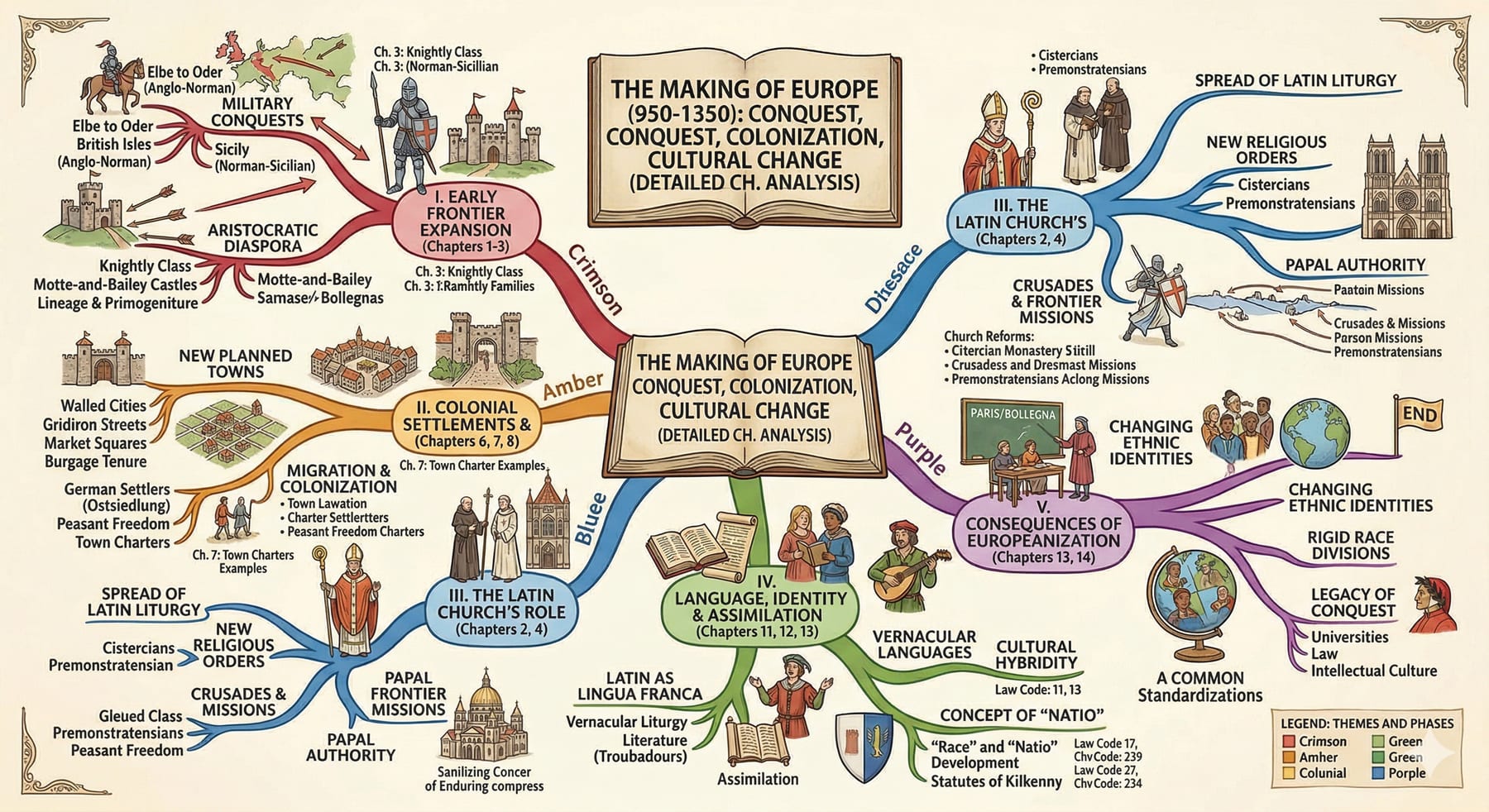
Chapter 6. The New Landscape
Chapter Objective
- This chapter explains how expansion physically remade the land. Bartlett moves from migration and legal privilege to the concrete transformation of woods, marshes, frontiers, and older settlement zones into planned villages, fields, mills, roads, churches, and renamed places.
- Its main purpose is to show that conquest and colonization did not end with military control or legal charters. They produced a new landscape: measured, cleared, cerealized, named, and socially reorganized.
- In the broader argument of the book, this chapter shows how Europe was “made” not only by rulers, knights, and bishops, but by the slow, material work of settlement, clearance, cultivation, and spatial ordering. It also shows how historians reconstruct this process through both written and non-written evidence.
Opening Example (before subsection headings)
- Bartlett opens with a vivid case from 1237:
- Bishop Thomas of Wroclaw granted Peter, the Schulze of Nysa, 200 Flemish mansi in a “black oak wood” to be cleared and settled.
- A century later, that woodland had become four villages, with:
- German names
- churches
- taverns
- watermills
- substantial Schulze holdings
- This example shows the central theme of the chapter:
- a natural landscape could be transformed within a century into a fully functioning human and institutional landscape
- Bartlett’s guiding question is: what were the mechanics of such a revolution?
Leaving Home
- Bartlett begins with the human side of landscape change: migration.
- New peasant settlement took many forms:
- piecemeal extension from existing villages
- large-scale planned villages carved out of woods
- settlement stimulated by monasteries or castles, which generated local demand for labor and food.
- He shows that monasteries could act as engines of settlement.
- At Pegau in 1101, a reformed abbey under Abbot Windolf not only rebuilt the monastery but cleared rough land, expanded fields, and created Abbatisdorf (“Abbot’s village”).
- Bartlett uses this to push back against the tendency to minimize the agrarian role of monasteries: in some cases, new abbeys really did generate new villages.
- Castles could do the same.
- Frontier fortifications often stood in wild or dangerous places.
- Once manned, they required nearby cultivators to supply them and benefited local settlement by providing protection.
- Examples:
- the Catalan frontier, where many villages originated in the orbit of tenth-century fortresses
- crusader fortifications between Jerusalem and Ascalon, where settlements arose “in the shadow” of castles
- Beth Gibelin, where the Hospitallers settled colonists on favorable hereditary terms; many settlers came from western Europe, including Gascons, Lombards, Burgundians, Flemings, and men from Carcassonne.
- Bartlett then turns to the actual process of migration, though he emphasizes that it is hard to document in detail.
- We get only fragmentary glimpses:
- the García brothers selling land because they wished to join new settlers in Moya
- emigrants leaving due to famine or poverty
- people disposing of patrimonies before leaving for frontier lands
- Lords trying to recruit settlers needed some way to communicate opportunity.
- Sometimes this happened informally, but Bartlett shows many cases of organized recruitment.
- Examples:
- Wiprecht of Groitzsch bringing peasants from Franconia to cultivate cleared land by hereditary right
- Count Adolf II recruiting settlers into Wagria from Flanders, Holland, Utrecht, Westphalia, and Frisia by advertising fertile land
- Albert the Bear drawing men from Holland, Zeeland, and Flanders into the newly conquered Slav lands
- These recruiting appeals often stressed:
- the fertility of the new land
- the chance to obtain good land
- sometimes even the chance to save one’s soul through participation in frontier expansion
- Bartlett quotes one appeal for the Wendish lands that combines all of this:
- the pagans are wicked
- the land is excellent
- and westerners can gain both salvation and land.
- He also offers a rare glimpse of the back-and-forth nature of migration.
- Some Frisian settlers in Wagria had temporarily returned home to settle the property they had left behind when an attack occurred.
- This is important because it shows migration as a process, not a single clean move:
- scouting
- return
- disposal of old property
- renewed movement eastward.
- Bartlett notes two modern migration themes that are hard to trace for the Middle Ages:
- remittances
- return migration
- But he does find evidence that return from beyond the Elbe was conceivable and even expected in some legal arrangements.
- This suggests that not every migrant succeeded, and some may have gone back.
- He also stresses that many migrants were not landless drifters.
- Some had land to sell.
- Others were ordinary peasant farmers with enough resources to move.
- His implication is that the typical migrant may often have been neither the richest nor the poorest, but someone with:
- incentive to leave
- and enough resources to survive the transition.
Laying Foundations
- Once migrants arrived, the first task was to organize space.
- Bartlett shows that new settlement required:
- demarcating boundaries
- measuring land
- laying out village sites
- assigning holdings
- organizing local leadership and infrastructure.
- In wooded country this could be technically difficult.
- At Henryków in Silesia, boundaries were traced using hilltop observations and smoke signals, then marked on trees.
- In the east Elbian lands, the key unit was the mansus.
- Villages were often planned in terms of a fixed number of mansi.
- Some standardization existed; for example, in parts of the Neumark, many villages had 64 mansi.
- This indicates highly planned settlement rather than random peasant sprawl.
- Bartlett notes that some large early grants were probably rough estimates rather than perfectly surveyed tracts.
- But in many cases, measurement was real and systematic.
- measuring rods and measuring lines were used
- surveyors existed
- settlers sometimes even paid to avoid remeasurement if they feared their burdens would rise
- The larger point is that these landscapes were often created through deliberate geometric planning.
- He gives a particularly revealing case from Prussia in 1236:
- the Teutonic Knights granted Dietrich of Tiefenau a castle and 300 Flemish mansi to measure out
- boundaries were specified
- pinewoods were not to count toward the assessed total
- This shows colonization as practical land management, involving rough geometry and fiscal calculation.
- Bartlett is careful to say that not all new settlement meant totally empty land.
- In eastern Europe there were often older settlements and named landscapes already present.
- In Sicily and Iberia, previous Muslim and older legal geographies often survived beneath the new layer.
- So colonial settlement could mean:
- pioneer occupation of empty or abandoned space
- or takeover and restructuring of pre-existing settlement patterns.
- Allocation of holdings could also be planned.
- In the Ostsiedlung, mansi were sometimes assigned by lot
- in Spain, land distribution developed its own specialists, such as partitores
- later this culminated in the great libros del repartimiento
- Bartlett’s point is that conquest and colonization produced not just villages, but procedures for distributing and legitimizing property.
- The locator reappears here as the crucial intermediary.
- He needed:
- capital
- reputation
- contacts
- and he was rewarded with:
- substantial holdings
- local office
- social dominance within the new village
- He needed:
- Some locatores were knights, some royal servants, some burgesses, perhaps occasionally peasants.
- If successful, they became local elites.
- Bartlett also shows that not every project succeeded.
- Some locatores failed for lack of money or settlers.
- Some sold out.
- Some urban and rural foundations collapsed before they took root.
- This is important because it keeps the chapter from sounding like effortless frontier success. Planned settlement involved real risk.
- One of the biggest capital costs in founding a village was the mill.
- Mills were expensive but extremely profitable.
- Because they were central to cereal agriculture, their construction was a major part of rural development.
- New villages could have:
- seigneurial mills
- or, more rarely, colonists or locators granted the right to build their own “free” mills
- This shows how the new landscape was not just divided into fields; it was equipped with the machinery necessary to process grain and sustain village life.
Questions of Scale
- Bartlett then asks how large these migration and settlement processes really were.
- He admits that exact quantification is difficult:
- no passenger lists
- few explicit references to emigration
- uneven evidence by region.
- For the German eastward migration, scholars have tried to estimate scale by counting newly created mansi.
- Bartlett cites the estimate of Walter Kuhn, who proposed roughly 200,000 German rural colonists east of the Elbe in the twelfth century alone.
- He also notes that these first-wave colonies then became staging grounds for further eastward migration in the thirteenth century.
- This underlines the cumulative, self-propelling character of the process.
- The situation in Ireland is more difficult because the documentation is thinner.
- Bartlett outlines a debate:
- some historians emphasize major peasant colonization
- others stress that the colonial element may have been important locally but not very large in relation to Ireland as a whole
- He notes some things that can be counted:
- thousands of soldiers in the first Anglo-Norman invasions
- over 400 knights’ fees
- more than 200 boroughs
- an anglicized clerical structure in the southeast
- But none of this automatically proves large-scale peasant immigration.
- The strongest case for peasant settlement comes from two kinds of evidence:
- early fourteenth-century tenant lists with many English and Welsh names
- signs of the implantation of the English language at a rural local level.
- Bartlett uses the Red Book of Ormond to show the variety of colonial Ireland.
- At Corduff:
- there were English-named free tenants and farmers
- and apparently Irish cottagers below them
- suggesting a local social hierarchy in which settlers formed a rural elite
- At places like Moyaliff and Gowran:
- settler communities appear more densely English in name and status
- English field names had already taken hold by the early fourteenth century
- Bartlett concludes that in parts of southern and eastern Ireland there really was an immigrant peasantry and a degree of partial anglicization.
- But he also notes that this settlement was regionally uneven:
- strongest in the south and east
- weaker in the north and west
- The reasons were practical:
- better access from English and Welsh ports
- better soils in the south and east
- This reinforces his general claim that landscape change depended heavily on geography and transport, not just conquest.
New Tools
- Bartlett next asks whether settlers brought not only more manpower, but better agricultural technology.
- In the Iberian peninsula, he says the answer is often no:
- settlers frequently had as much to learn as to teach
- in irrigated Muslim lands, the challenge was often preserving older systems rather than replacing them
- James I of Aragon, for example, confirmed the old irrigation customs of Valencia as they had operated “in the time of the Saracens.”
- In eastern Europe, however, Bartlett treats the issue as more serious and more debated.
- The key question is whether German settlers brought a superior plough technology.
- He explains the major distinction:
- the ard or scratch-plough: symmetrical, cuts grooves
- the heavy plough: asymmetrical, turns the soil, normally associated with mould-board and more powerful action
- The evidence is difficult and often fiscal rather than purely technical.
- Medieval documents distinguish:
- the Slavic/Polish plough
- also called uncus, Haken, or radlo
- from the German or big plough, also called plug/Pflug
- These were regularly taxed at different rates, with the German/big plough bearing roughly double the burden of the Slavic/small plough.
- Bartlett carefully works through the problem:
- were these simply fiscal units
- or actual different implements?
- He concludes that the distinction almost certainly reflected a real agricultural difference, not just an accounting fiction.
- The weight of the evidence suggests:
- the Germans introduced or spread the heavy plough
- into regions where the ard had been dominant.
- This does not mean every colonial success was purely technological.
- But Bartlett thinks the evidence, though limited, leans toward the view that settlers in eastern Europe brought a more productive plough system that helped support expanded arable cultivation.
Cerealization
- Bartlett then argues that the cumulative effect of new settlers, ploughs, and mills was not just “improvement” in a general sense, but a specific ecological shift: cerealization.
- By this he means the large-scale extension of grain-based arable agriculture.
- This transformed not only land use, but the whole human ecology.
- In many areas, a mixed environment rich in:
- fish
- honey
- game
- woodland products
- pasture
was pushed toward denser and more specialized grain production.
- Bartlett gives a symbolic example:
- in Silesia, a render in squirrel skins was replaced by a render in grain
- That substitution captures the broader move from diverse frontier resource use to agricultural monoculture.
- Lords and prelates welcomed this because cerealization turned underused land into a source of:
- rent
- tithe
- silver
- regularized income
- Prospective grants in eastern Europe increasingly anticipated future revenue from:
- newly cultivated land
- even villages not yet Germanized but expected to become so
- This shows that cerealization and Germanization could be imagined together as part of a planned future.
- Bartlett also shows how the clergy could merge agricultural and missionary language.
- He quotes Pope Honorius III on Livonia:
- pagan hardness is watered by grace
- holy preaching is a ploughshare
- the land is ready for harvest
- This vividly links the spread of cult and the spread of cultivation.
- Colonial writers often used the contrast between past and present to magnify settler achievement.
- In texts from Henryków and Lubiąż, the pre-settlement landscape is described as:
- wild
- wooded
- poor
- underdeveloped
- The incoming monks and settlers are then credited with:
- transforming the land
- bringing better tools
- civilizing idleness
- Bartlett notes, however, that such images often erase prior settlement and create a pioneer myth of empty land.
- He is careful not to romanticize cerealization.
- The new arable order also created a more vulnerable ecology.
- Woodland and wetland had not been useless:
- they supplied fuel, pasture, game, thatch, timber, berries, fish, and more
- Their reduction could produce imbalances.
- Examples:
- canons in Bremen had to be compensated when a marsh was settled because they lost firewood
- in the Fenland, people whose marshes had been converted to ploughland later lacked common pasture
- Bartlett also cites the argument that reduced pasture may have hurt manure supplies and threatened long-term yields.
- He even notes a possible biological cost:
- a decline in average human height between the early and late Middle Ages may have reflected dietary changes associated with cereal-heavy agriculture
- So the new landscape supported more people, but not necessarily healthier or more resilient populations.
Non-Written Evidence
- In the final major section, Bartlett reflects on how historians know any of this.
- Written evidence is valuable but limited:
- chroniclers focus on war, office, and churches
- charters survive unevenly
- much practical settlement work left no record
- Because of this, historians must turn to non-written evidence.
- He identifies three main kinds:
- archaeology
- village and field morphology
- place names
Archaeology
- Bartlett says archaeology has enormous future promise for the High Middle Ages, but that its present yield is still limited.
- Rural settlements, especially medieval ones, are hard to find and fund.
- He notes how few sites had been systematically excavated, even in areas of active research.
- His best example is Pfaffenschlag in Moravia, excavated by Vladimir Nekuda.
- This was a deserted high medieval colonial village with:
- sixteen houses
- a linear plan
- stone foundations
- internal room divisions
- and an asymmetrical ploughshare
- It provides a rare, concrete glimpse of a planned thirteenth-century settler village.
- Bartlett also mentions simpler archaeological methods like field-walking.
- For example, investigations in East Anglia using pottery sherds helped reconstruct the shifting pattern of rural settlement around churches.
- His point is that archaeology, even when incomplete, can recover aspects of landscape change that written texts omit.
Village and Field Morphology
- Bartlett treats the size, shape, and layout of villages and fields as another powerful source.
- But he is cautious:
- medieval maps are scarce
- scholars often must work backward from eighteenth- and nineteenth-century plans
- this involves real risk, since many centuries of change separate the evidence from the original settlement phase
- He notes that different scholarly traditions have treated this evidence with different levels of confidence.
- Even so, morphology can reveal planning.
- Earlier in the chapter, Bartlett already highlighted:
- regular village forms
- standard mansus sizes
- line-based measurement
- rectilinear field systems
- These make sense as traces of organized colonization rather than organic, unplanned growth.
Place Names
- Place names are Bartlett’s third major non-written source.
- They preserve the memory of:
- immigrant groups
- transplanted origins
- renaming by conquerors
- the linguistic layering of settlement history.
- East of the Elbe, he points to names such as:
- German Harkensee and Slav Harkensee, suggesting paired immigrant/native settlements
- Flemsdorf and Flemingsthal, indicating Flemish settlers
- Frankendorf and Frankenberg, indicating Franconian settlers
- Some place names were transplanted from older cores into newer frontiers, sometimes with “New” added, as with New Brandenburg.
- In New Castile, Bartlett describes a triple place-name layering:
- ancient pre-Roman or Roman names
- Arabic names from Muslim rule
- new Castilian names introduced by settlers and rulers
- He notes that Alfonso X consciously renamed some settlements, showing that naming itself was part of conquest and colonization.
- Bartlett’s larger conclusion is methodological:
- none of these forms of evidence is sufficient alone
- the strongest reconstruction comes from combining:
- documents
- archaeology
- field and village morphology
- place-name study
- He cites Herbert Helbig’s work on the Sorbian region as a model of this plural method.
- In places like Kreis Pirna, the correlation between:
- Slavic place names
- irregular field forms
- German names
- and regular village types
reveals the map of medieval colonization with remarkable clarity.
Key Concepts for The New Landscape
- New landscape
- The physically remade environment produced by migration, clearance, measurement, cultivation, and settlement during the High Middle Ages.
- Locator / Schulze
- The settlement entrepreneur and local magistrate who organized colonization on the ground and often became the dominant figure in the new village.
- Mansus
- The standard measured holding used in many eastern European settlements, central to planned village layout and fiscal organization.
- Cerealization
- The expansion of grain-based arable agriculture at the expense of mixed or uncultivated resource landscapes, producing a denser but often more ecologically vulnerable society.
- Planned village
- A deliberately laid-out rural settlement, often measured and allocated in regular holdings rather than growing incrementally.
- Heavy plough vs. ard
- The likely technological contrast between incoming German-style plough systems and older Slavic/Prussian scratch-plough systems in eastern Europe.
- Morphology
- The study of village and field form as historical evidence for settlement patterns and colonization.
- Toponymic layering
- The accumulation of place names from successive linguistic and political regimes, preserving the history of conquest, settlement, and renaming.
Questions for Reflection for The New Landscape
- How does Bartlett show that medieval expansion changed not only who ruled a region, but what the land physically looked like?
- Why are monasteries, castles, and locators all important in explaining how new landscapes emerged?
- Does Bartlett think settlers mainly brought more labor, better tools, or better organization—or some combination of all three?
- What are the gains and losses involved in cerealization, according to the chapter?
- Why does Bartlett end by stressing a plural method—documents, archaeology, morphology, and place names—rather than relying on a single kind of evidence?
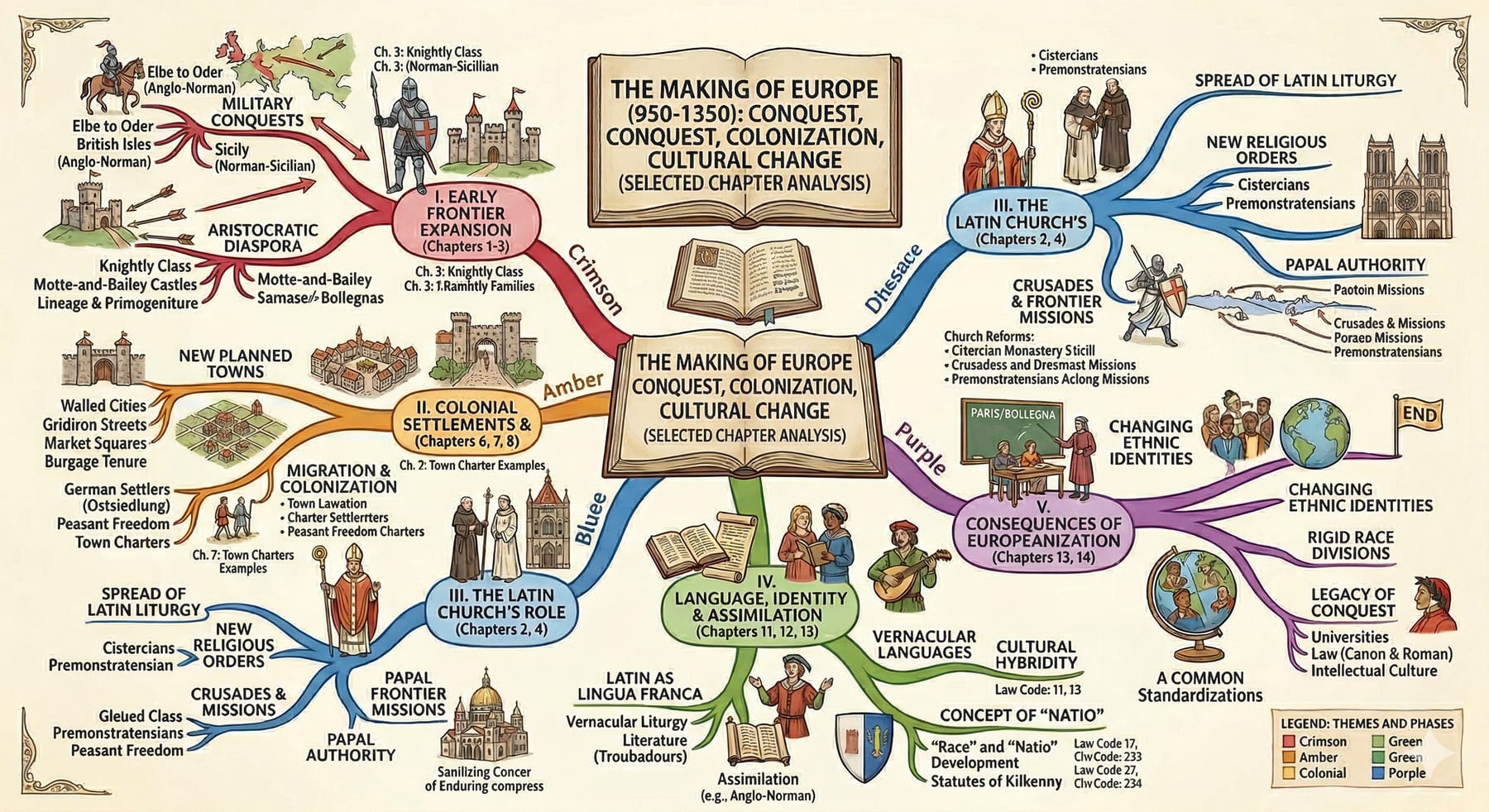
Chapter 7. Colonial Towns and Colonial Traders
Chapter Objective
- This chapter explains how the expansion of Latin Christendom was also an urban and commercial phenomenon.
- Bartlett’s main aim is to show that the High Middle Ages saw not just conquest villages and rural colonization, but the spread of:
- new towns
- urban liberties
- urban law
- merchant migration
- and long-distance trading networks that tied the edges of Europe back to its core.
- It fits the broader argument of the book by showing that Europe’s expansion was carried not only by knights, bishops, and peasants, but also by burgesses, urban institutions, and traders, who helped create more durable colonial societies and integrated distant regions into wider western networks.
Opening Section (economic towns vs legal towns)
- Bartlett begins by warning that “town” has two different meanings in medieval history:
- an economic meaning
- a legal meaning
- In the economic sense, a town is:
- more populous than its surroundings
- more specialized
- more commercial
- more deeply involved in exchange
- This is a relative category.
- A settlement that counts as a town in one time or region may not count as one in another.
- The dividing line is partly a matter of judgment.
- In the legal sense, a town is a settlement with a distinct juridical status:
- privileges
- liberties
- often a charter
- often a specific foundation date
- This is a contemporary and absolute category.
- A lord could create a legally urban settlement by granting status overnight, even if no real urban economy yet existed.
- Bartlett stresses that these two kinds of towns do not perfectly overlap.
- Some places were economically important before they were legally urban.
- Others had legal urban privilege but remained functionally small or rural.
- This means the history of medieval urbanization is really two stories:
- the growth of economically significant urban centers
- the diffusion of urban liberty and legal urban form.
- He uses eastern Europe and Ireland as clear examples:
- towns like Szczecin, Danzig, and Dublin existed as active commercial centers before receiving western-style urban law
- charters did not create them economically from scratch, but restructured them legally and institutionally.
- Dublin is Bartlett’s first major case.
- It was already urban before the Anglo-Normans.
- But the charters of Henry II and especially John’s charter of 1192 gave it a new legal form:
- defined territorial boundaries
- its own hundred-court
- legal privileges in pleading and procedure
- burgage tenure
- freedom in building
- guild rights modeled on Bristol
- exemption from toll throughout John’s lands
- debt protections
- and economic monopolies over retail and certain trades.
- Bartlett’s point is that urban law was never just about trade.
- It also meant:
- procedural privilege
- property rights
- freedom from older coercive legal burdens
- and collective status.
- It also meant:
- He then shows that in frontier zones many places granted borough status were not truly urban in an economic sense.
- Ireland is the strongest example:
- around 240 boroughs are known
- roughly one chartered settlement every 13 miles
- but perhaps fewer than a quarter were real towns economically
- Many were “rural boroughs,” essentially privileged rural settlements using the language of urban liberty as a magnet for settlers.
- This helps Bartlett make an important conceptual point:
- town freedom was itself an incentive for settlement
- people might move to a town because of liberty, not simply because of trade
- The bishop of Riga even said the city attracted settlers more by its freedom than by the fertility of its surroundings.
Families of Urban Law
- Bartlett next explains that urban privilege was not invented from scratch in each place.
- Instead, western Europe developed recognizable families of town law:
- daughter towns borrowing the law of a mother town
- sometimes across lordships and kingdoms
- sometimes with continuing legal dependence.
- One major family was the Cuenca–Teruel law code.
- This was a large and elaborate code with nearly a thousand clauses.
- It regulated everything from inheritance and homicide to irrigation, military obligations, public baths, and even flowers taken from vineyards.
- Granted first in Cuenca after its conquest in 1177 and almost simultaneously in Teruel, it spread southward with the Reconquest into Andalusia.
- Another important line of diffusion ran:
- Breteuil in Normandy
- to Hereford
- to Rhuddlan
- to Irish boroughs like Drogheda
- Here conquest and feudal expansion carried an urban legal model from Normandy into Wales and Ireland.
- In the east, the great mother cities were especially:
- Lübeck
- Magdeburg
- Their laws spread across hundreds of settlements as far as the eastern Baltic and Ukraine.
- Bartlett notes that relationships between mother and daughter towns varied:
- sometimes a town merely borrowed a law code
- sometimes it sought clarification later
- sometimes the mother town retained a kind of appellate or supervisory role
- Examples:
- Danzig received Lübeck law in writing from Lübeck in 1263
- Litoměřice requested Magdeburg law in 1282
- Środa/Neumarkt, itself a daughter of Halle, became the mother town for many Silesian settlements.
- Bartlett emphasizes that this was a highly textual process.
- law books circulated
- codes could be translated into vernaculars
- urban constitutions moved along trade routes and colonizing corridors.
- He also notes that some rulers modified imported laws.
- When Wroclaw received Magdeburg law, some fines were cut down.
- So there was both borrowing and adaptation.
- In some regions, these urban law families created networks that cut across princely boundaries.
- Magdeburg and Lübeck heard appeals and answered questions from far-flung daughter towns.
- This worried some princes, who saw external legal dependence as a threat to their authority.
- For example, the dukes of Opole tried to force Flemish-law settlements to seek rulings only within their own domain, especially through Racibórz.
- Bartlett’s larger point:
- in the High Middle Ages, rulers usually wanted towns badly enough that they tolerated or encouraged urban models originating outside their territories
- the result was an international urban network that spread western legal and institutional patterns outward from the core.
- He closes this subsection by noting that even the term “burgess” spread outward from the core lands of Lotharingia, northern France, and Flanders into:
- England
- Wales
- Scotland
- Ireland
- Bohemia
- and beyond
- The word itself is evidence that urban status was being culturally exported from the Romance-German core into surrounding regions.
Burgess Immigration
- Bartlett then moves from legal forms to the people who filled these towns.
- Urban colonization was not disembodied law; it required immigrant populations.
- In the core regions of western Europe, town growth often drew on nearby rural migration.
- But in frontier regions such as:
- eastern Europe
- Reconquest Spain
- the Celtic lands
town populations were much more often of distant origin.
- Spain
- Northern Spanish towns on the pilgrimage routes already had large numbers of settlers from beyond the Pyrenees in the late eleventh century.
- The Chronicle of Sahagún describes Alfonso VI assembling Gascons, Bretons, Germans, English, Burgundians, Normans, Provençals, Lombards, and others into a substantial town.
- After conquests, some cities had to be restored or repopulated, such as Tarragona and Jaén.
- Others, like Seville, saw large-scale redistribution of property and the recruitment of new settlers from across the peninsula, especially Old Castile, León, and New Castile.
- Eastern Europe
- German immigration frequently accompanied the spread of urban law.
- In Hodonín in 1228, Queen Konstanze explicitly says she summoned worthy Germans and settled them in the town.
- Cracow, reorganized under Magdeburg law in 1257, was reshaped both by German municipal form and by German-speaking burgesses.
- Duke Boleslaw even excluded the surrounding Polish rural population from burgess status, helping make the town especially German in culture and descent.
- Bartlett distinguishes two kinds of eastern urbanization:
- large commercial cities like Cracow and Riga
- and networks of small local market towns, especially in regions like Mecklenburg
- In Mecklenburg, rulers founded a dense network of small towns after 1218.
- These had parish churches, markets, tollbooths, and increasingly specialized institutions.
- Even where town names were Slavic, the urban culture was mostly German burgess culture.
- Bartlett argues that it was especially these small market towns, deeply tied to the countryside, that carried durable cultural transformation into the eastern European interior.
- Celtic lands
- Urbanization and anglicization went together in Scotland, Ireland, and Wales.
- The new chartered towns of these regions were marked by predominantly English immigrant populations.
- Bartlett uses Dublin as his clearest case:
- the guild merchant roll for c. 1175–1205 records about 2,800 names
- around 40 percent have identifiable toponymic surnames
- the strongest connection is with Bristol and its Severn hinterland
- many migrants came from south Wales, the border counties, the West Country, and English towns like London and Winchester
- strikingly, most of these immigrants were already townsmen, not rural peasants.
- Bartlett’s larger conclusion:
- frontier towns were not just new legal entities
- they were often colonial transplants, populated by immigrant burgesses who carried their law, language, habits, and commercial practices into new lands.
Trading Networks
Italian trade
- Bartlett then broadens the frame from urban settlement to long-distance commercial expansion.
- He argues that colonial towns and colonial traders were deeply connected.
- One of the clearest expansionary movements of the High Middle Ages was the spread of western maritime commerce from a limited sphere into a far-reaching Mediterranean and Black Sea network.
- The earliest phase involved cities such as:
- Amalfi
- Venice
- In the eleventh century, the initiative expanded to:
- Pisa
- Genoa
- By the later eleventh century, merchants from these cities were trading, raiding, blockading, and supporting crusading ventures all around the Mediterranean.
- Bartlett emphasizes that the Crusader States created extraordinary opportunities for Italian traders.
- These states depended on maritime supply but had no fleets strong enough of their own.
- The Italians therefore became indispensable.
- The clearest example is the Pactum Warmundi of 1123:
- after Venetian naval help against Egypt
- Venice received privileges in the kingdom of Jerusalem
- including quarters in towns, judicial autonomy, and major shares in future conquests like Tyre and Ascalon
- Within months, Tyre fell with Venetian aid.
- Bartlett explains the institutional shape of these settlements:
- a kind of miniature Venice or Genoa embedded in a foreign city
- with:
- church
- square
- bath
- oven
- warehouses
- market facilities
- their own court
- In Acre, for example, there were Venetian, Genoese, and Pisan quarters.
- These were commercial enclaves, but also clearly cultural and juridical colonies.
- Italians negotiated similar rights under:
- Latin rulers
- Greek rulers
- Muslim rulers
- So their commercial expansion was pragmatic rather than confined to one religious or political bloc.
- Bartlett then shows that these trading enclaves sometimes grew into real territorial colonies.
- Venice
- benefited massively from the Fourth Crusade in 1204
- acquired islands and territories in the Aegean
- and most importantly, Crete
- Crete became a genuine colonial possession:
- divided into “sixths” named after Venetian urban divisions
- settled by knights and footsoldiers from Venice
- organized with a Latin church hierarchy
- and retained by Venice until 1669
- This is one of the clearest cases in the chapter of urban-commercial power turning into full colonial rule.
- Genoa
- originally Venice’s rival
- gained ground especially after allying with the restored Byzantine emperor in 1261
- secured settlements at Pera, Chios, and around the Black Sea
- Around the Black Sea the Genoese established posts and colonies tied into the trade routes leading toward inner Asia and China.
- Bartlett’s key example is Caffa in Crimea:
- a Genoese consul is present by 1281
- notarial records from 1289–90 show a bustling colony with:
- fondacos
- churches
- hospital
- consular building
- immigrant population largely from Liguria and the Po basin
- later Caffa had walls, a citadel, many Latin and eastern churches, mosques, and a synagogue
- it became a major slave market and Black Sea trading hub
- and in 1347 was one route by which the Black Death entered western Europe.
- Bartlett compares the geography of these Italian maritime possessions to later maritime empires:
- islands
- headlands
- way-stations
- commercial bridgeheads
- Their importance rested heavily on sea power.
- Without western naval superiority, the crusading bridgeheads could not have endured.
- The Italians created not just trade, but a network for moving:
- goods
- people
- capital
- information
across the Mediterranean and beyond.
German trade
- In the north, Bartlett sees a parallel expansion through German trade in the Baltic.
- The key turning point is the definitive foundation of Lübeck in 1159, which he presents as the German gateway to the Baltic.
- He recounts the sequence:
- an earlier Slavic center had existed there
- Count Adolf began a new town in 1143
- it flourished quickly
- but Henry the Lion forced control from Adolf
- under Henry, merchants returned, churches and walls were rebuilt, and the town received “most honourable civic rights”
- the bishopric was moved there, and Lübeck became both a legal and commercial model.
- Commercial movement then radiated outward:
- Germans were active in Gotland by 1161
- then in Denmark and Russia
- eventually building a routine trade with Novgorod and across the Baltic
- The characteristic German vessel was the cog:
- a large cargo ship
- broad, flat-bottomed, square-sailed
- ideal for carrying bulk goods
- Bartlett treats the cog as the tool of German commercial expansion just as the galley and round ship served the Italians.
- Unlike the Italians, who usually inserted themselves into already urbanized worlds, the Germans often encountered the eastern Baltic as a region with limited urban development.
- Here they founded cities that were not only trading depots but colonial new towns in the stronger settlement sense.
- Riga is Bartlett’s great example.
- German merchants first traded at the mouth of the Dvina
- Bishop Albert chose a new site in 1200–1201
- Riga was founded in a field with a good harbor
- soon had walls, churches, and the headquarters of the Swordbrothers
- early merchant privileges resembled Gotland law
- by 1225 citizens could appoint their own judge
- a city seal and council followed quickly
- immigration from Westphalia and Saxony brought the population to perhaps 2,000–3,000 by the 1230s.
- Bartlett’s portrait of Riga is especially rich:
- turreted walls
- cathedral and churches
- cogs at the water’s edge
- Low German in the streets
- Yet he insists that despite its familiar north German appearance, it remained a distinctively colonial town:
- only a few days from pagan peoples
- center of missionary activity
- base of a military order
- regularly receiving crusaders by ship
- He concludes that Riga was both:
- a commercial city
- and “a city of God,” a colonizing and missionary stronghold.
- Bartlett ends by stressing that these maritime trading cities looked:
- overseas to Lübeck, Visby, Constantinople, Alexandria, Genoa
- and inland along trade corridors
- The unity of the medieval West, he says, was in part a traders’ unity.
Key Concepts for Colonial Towns and Colonial Traders
- Economic town
- A settlement that is relatively populous, specialized, and commercial in relation to its surroundings.
- Legal town
- A settlement with a formally granted juridical status, liberties, and privileges, often established by charter.
- Urban liberty
- The package of legal, fiscal, and personal privileges associated with town status, including freedoms from tolls, certain legal burdens, and seigneurial constraints.
- Family of urban law
- A group of towns modeled on the law of a “mother town,” often with continuing clarificatory or appellate links.
- Burgess
- A legally privileged urban inhabitant; the term itself spread outward from the core regions with western urban models.
- Rural borough
- A chartered settlement with urban legal status but limited or predominantly rural economic function.
- Colonial town
- A town shaped by immigrant populations, borrowed legal models, and frontier or conquest conditions, often serving as a node of cultural transplantation.
- Trading enclave
- A privileged foreign quarter or settlement within a larger city, enjoying special law, institutions, and commercial rights.
- Maritime colonial network
- A chain of ports, colonies, and privileged settlements linked by sea routes, especially visible in Venetian and Genoese expansion.
Questions for Reflection for Colonial Towns and Colonial Traders
- Why does Bartlett insist on distinguishing between the economic and legal meanings of a town, and what does that distinction change in the history of expansion?
- How did urban liberty function as an incentive for settlement even in places that were barely urban in economic terms?
- In what ways did families of urban law help spread western institutional forms across Europe without direct political uniformity?
- How do the cases of Dublin, Cracow, Mecklenburg, and Riga show different combinations of charter, immigration, and colonization?
- What is the relationship between colonial towns and colonial traders in Bartlett’s argument—did trade create the towns, or did towns stabilize and extend the trade?
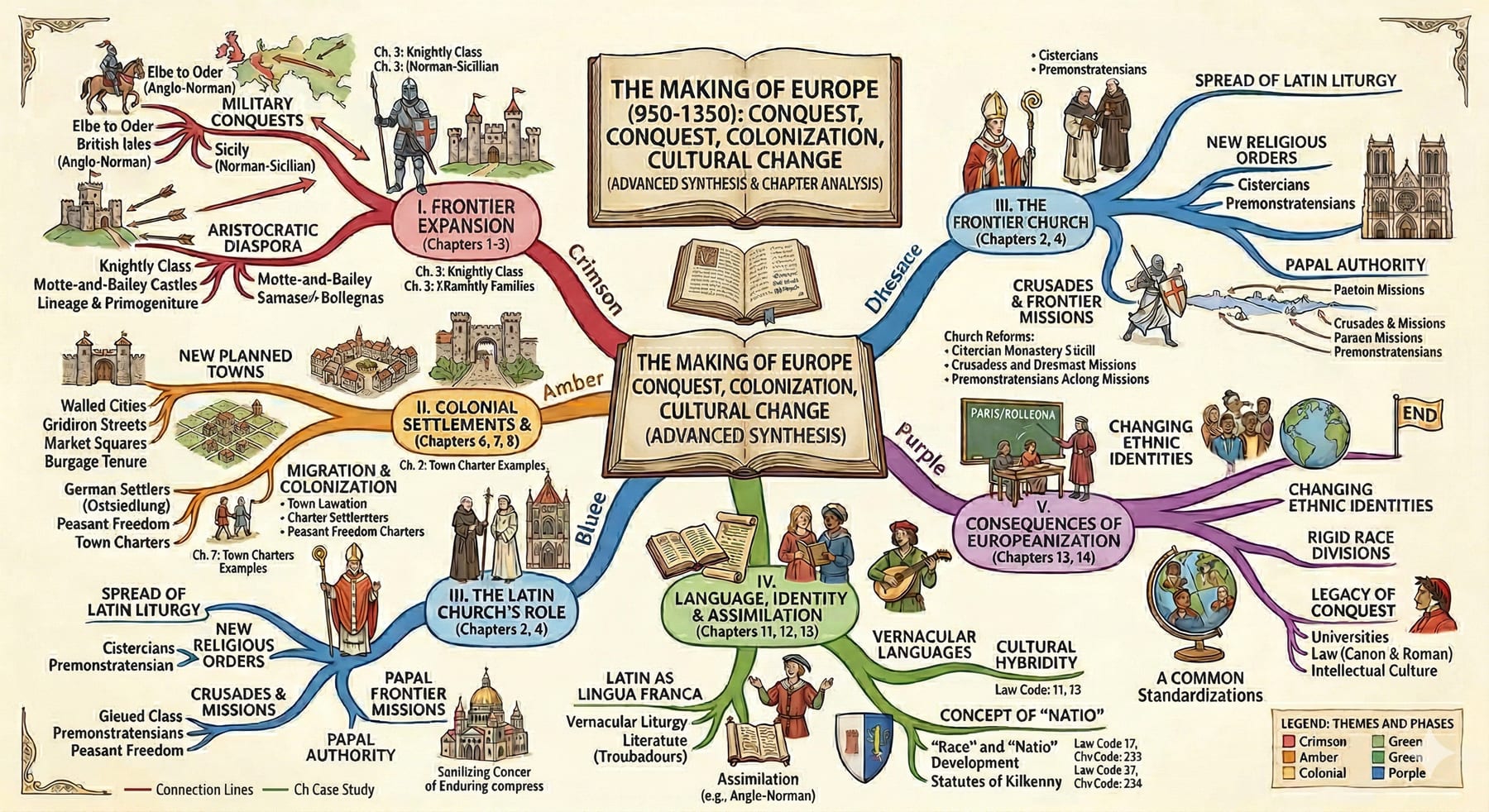
Chapter 8. Race Relations on the Frontiers of Latin Europe (1): Language and Law
Chapter Objective
- This chapter explains how conquest and colonization created mixed frontier societies in which different peoples lived side by side and had to negotiate relations through language and law.
- Bartlett’s main aim is to show that medieval “race relations” were primarily cultural, not biological:
- ethnicity was marked above all by customs
- language
- and law
rather than by modern ideas of fixed biological race.
- The chapter fits into the broader argument of the book by showing that Europe’s expansion did not simply produce conquest states and colonies; it also produced enduring problems of coexistence, hierarchy, pluralism, discrimination, assimilation, and legal restructuring wherever conquerors and subjects met.
Opening Section (before subsection headings)
- Bartlett begins by clarifying what he means by race relations in the medieval context.
- He notes that medieval vocabulary of peoples and nations could sound biological:
- gens
- natio
- “blood”
- “stock”
- But in practice medieval ethnicity was mostly cultural, not biological.
- He uses Regino of Prüm’s classic formulation:
- peoples differ in descent
- customs
- language
- law
- Bartlett argues that in medieval Europe the last three mattered most because they were malleable.
- languages can be learned
- legal regimes can be adopted
- customs can be changed
- This means that medieval ethnicity was, to a large extent, socially constructed and transformable across generations or even within a lifetime.
- He briefly notes the importance of customs:
- hair styles
- dress
- food
- bodily appearance
- These could signal ethnic belonging very sharply.
- Examples:
- the English in Ireland were warned against adopting Irish styles
- Irish poets attacked those copying English hair and manners
- disguise across ethnic lines could be achieved by changing appearance
- This opening matters because it frames the chapter’s deeper claim:
- frontier race relations were about cultural markers and power, not modern racial biology.
Language
- Bartlett treats language as one of the strongest medieval markers of peoplehood.
- Medieval scholars naturally linked language and nation because of the biblical story of Babel.
- He cites formulations such as:
- Isidore of Seville: races arose from languages, not the reverse
- “language makes race”
- In the core regions of Europe, Bartlett says, language areas were relatively stable and broad:
- English in England
- Langue d’oïl north of the Loire
- Langue d’oc south of it
- Low German in north Germany
- High German in south Germany
- By contrast, the frontier zones were linguistically mixed.
- There, languages of completely different families might coexist in the same town, neighborhood, or even street.
- Examples of frontier multilingualism:
- in Cracow, papal letters could be read in Latin, then explained in both Polish and German
- place names might exist in double form, one Slav and one German
- Irish settlements could take English suffixes like “-town”
- Arabic place names in Spain could be replaced by assertive Romance names such as Villafranca.
- Bartlett stresses that bilingualism was common and socially important.
- Examples:
- Otto I knew both German and Slav
- leaders in Frankish Morea might know French, Greek, and Turkish
- descendants of Anglo-Normans in Ireland later composed poetry in Irish
- in Sicily, a Greek-speaking man familiar with Arabic could spy on Muslim fleets for the Normans
- These examples show that frontier societies often required practical multilingual competence.
- This made interpreters indispensable.
- Bartlett notes:
- official translators in Valencia
- interpreters holding land for service on the Welsh border
- Mixed societies also became channels of cultural transmission:
- translations of Greek and Arabic learning entered Latin Europe especially through Spain and Sicily
- This is one of the chapter’s broader implications:
- ethnic mixture could generate not only conflict but also major intellectual transfer.
- Frontier language contact also produced borrowing.
- Examples:
- Polish took Low German terms of trade, shipping, and urban punishment from Hanseatic interaction
- Welsh absorbed English and French words tied to feudal and urban life
- Christian Romance-speakers in Iberia borrowed many Arabic terms, especially in areas of Muslim expertise such as irrigation, crops, and material life
- Bartlett shows that conquest did not mean one-way imposition only; it also produced selective absorption.
- Naming practices reflected this pluralism too.
- Frontier societies could produce:
- mixed or dual names
- one name for one linguistic zone, another for another
- binomial naming across ethnic lines
- Examples:
- Slavic princes bearing both German and Slavic names
- Przemysl Ottokar II even using different seals with different names for Czech- and German-speaking lands
- Mozarabs in Toledo carrying both Romance and Arabic names in documents
- Bartlett uses these examples to show how frontier identity could be layered and situational, not singular.
- Still, languages were not equal.
- The main expansionary languages were Romance and Germanic tongues.
- Languages such as Celtic, Slavic, Baltic, and Arabic were often on the defensive.
- Yet Bartlett cautions that linguistic change was not uniform or irresistible:
- native languages could revive
- some regions resisted absorption
- outcomes varied.
- He then shows how language could become politicized.
- Words for “language” often blurred into meanings like “people” or “nation.”
- Examples:
- Czech jazyk
- Welsh iaith
- Latin lingua
could all shade between speech community and ethnic community.
- This fed into political arguments.
- Examples:
- Bohemians and Poles could be said to belong together because of their linguistic closeness
- Polish claims to Pomerelia invoked common language
- the Bruce appeal to the Irish invoked common stock, language, and customs between Scots and Irish
- Bartlett’s point is that language was not only descriptive; it could become the basis of solidarity and political legitimacy.
- The negative side of this was the fear that enemies wanted to destroy a language.
- Examples:
- Poles accused the Teutonic Knights of trying to destroy Polish
- English rulers and settlers in Ireland sought to suppress Irish and spread English
- in Waterford, people could be punished or excluded for lacking English
- Bartlett notes, however, that such administrative efforts rarely explain language change by themselves.
- Real linguistic transformation usually came from:
- migration
- settlement
- prestige
- adaptation
rather than state decree alone.
- He ends this section with the stark issue of language death.
- Examples:
- Prussian, a Baltic language, disappeared by the seventeenth century under German pressure
- much Wendish west of the Oder vanished, surviving only in Sorbian enclaves
- in Toledo, Arabic long remained strong after the Christian conquest of 1085, but by the thirteenth century Latin and Romance overtook it, and by the fourteenth century Arabic documentary usage had essentially dried up
- These are some of Bartlett’s clearest examples of conquest and colonization permanently remaking Europe’s linguistic map.
Law
- Bartlett next argues that ethnicity on the medieval frontiers was marked not only by language and custom, but by law.
- The frontier world of the High Middle Ages was in many ways a great age of personal law:
- people might be judged differently according to whether they were German, Slav, Muslim, Welsh, Irish, and so on.
- He begins with the principle clearly stated in Prague in the twelfth century:
- just as Germans differ from Bohemians by nation, they should differ in law and custom
- Similar principles appear in Poland, Prussia, and Pomerania:
- Poles judged by Polish custom
- Germans by German custom
- So legal difference could formally constitute ethnic identity.
- Bartlett emphasizes that frontier courts faced especially difficult problems:
- mixed populations
- mutual suspicion
- parallel customs
- unequal power
- Responses varied.
- Sometimes the law was relatively race-blind:
- a new town like Salzwedel might state that Germans and Slavs alike must answer before the same judge
- in Daroca, Christians, Jews, and Muslims could be given one and the same law for certain injuries and accusations.
- More often, however, systems recognized or institutionalized ethnic distinction.
- Bartlett identifies a spectrum:
- one system with some ethnic procedural distinctions
- or fuller dualism/pluralism, where parallel courts and bodies of law existed for different groups.
- Toledo is the clearest example of legal pluralism.
- After its conquest in 1085, the city contained three main Christian ethnic groups:
- Mozarabs
- Castilians
- Franks
- Each had its own legal status and, apparently, its own judges.
- The Mozarabs in particular were to be judged according to the Liber iudiciorum / Fuero Juzgo, the old Visigothic code.
- Bartlett stresses that this was an unusual but revealing case of written ethnic law surviving under a new regime.
- The broader ideal here was one of parallel but recognized ethnic communities.
- Parallelism also appears for Muslim Mudejars in Iberia.
- In places like Tudela, submitting Muslim communities were guaranteed:
- their own qadi
- their own officials
- and judgment according to Islamic law
- Bartlett sees this as a way of reconciling subject populations to Christian conquest, at least initially.
- Comparable arrangements existed elsewhere:
- native Welsh law applied in some marcher lordships
- Germans in Prague and Hungary were promised their own judges
- So legal autonomy could protect either:
- subject populations
- or immigrant minorities
depending on the balance of power.
- Mixed cases posed obvious problems.
- One solution was parallel judging:
- Christian judge for the Christian
- Muslim judge for the Muslim
- Another was to privilege the defendant’s forum.
- Bartlett quotes the Roman-canonical principle:
- the plaintiff should follow the forum of the accused
- This appears in Cracow, where a Pole suing a town citizen must go before the town’s advocates, while the reverse case went before a Polish judge.
- Bartlett then turns to witnesses and testimony, one of the most sensitive points in frontier law.
- Because ethnic hostility could easily distort accusations, rules often limited who could testify against whom.
- Example:
- in the Sachsenspiegel, Saxon and Wend could not normally bear witness or give judgment against one another except in red-handed crime
- Muslims in Castile and Aragon were often guaranteed Muslim witnesses in cases against Muslims
- Bartlett interprets these rules as attempts, at least in part, to guard against ethnically motivated false accusation.
- But he is equally clear that frontier law also institutionalized inequality.
- The balance of power, not neutral justice, often determined outcomes.
- One classic measure is wergild.
- Examples:
- in Pomesania, a Prussian killing a free German might owe compensation on a scale that effectively equated a property-holding German colonist with native nobility
- in Reval, wounding an Estonian cost much less than wounding a German settler
- in the fuero of Sepúlveda, penalties for Christian-on-Muslim and Muslim-on-Christian homicide were radically unequal
- These examples show that frontier law mirrored ethnic hierarchy.
Languages of Law
- Bartlett then narrows the discussion to one especially revealing issue: what language could be used in court.
- In mixed societies, the right to plead in one’s own language was a major form of recognition and power.
- He gives examples of explicit linguistic regulation:
- Basques could be allowed to plead in Basque before a royal judge
- Waterford ordered that no one should implead or defend in Irish in court, but must use English or an English-speaking intermediary
- These are not minor administrative details; for Bartlett they reveal the relative standing of languages and the peoples who spoke them.
- The Sachsenspiegel again provides a key example.
- One recension states:
- an accused person may refuse to answer unless accused in his mother tongue
- But a later recension tilts this toward German:
- the accused must prove he does not know German
- if he has ever previously acted in German, that can be used against him
- even if he speaks only Slav, he effectively needs a German-speaking representative
- Bartlett sees this as a clear example of a formally mixed society in which German had become the dominant legal language.
- An especially striking case comes from Anhalt in 1293.
- There, because Slavic-speaking tenants were supposedly suffering procedural losses from ignorance and verbal slips, the rulers ordered that the Slav language be abandoned in court and that German suffice.
- Bartlett notes the ambiguity:
- this may have been presented as a practical reform
- but the result was still the elimination of Slav as a language of law.
- He then gives two contrasting larger trajectories:
- in Silesia, exemption from being impleaded in Polish formed part of long-term Germanization
- in Bohemia, requiring judges to know Czech formed part of late medieval Czech assertion
- The broader point is that the languages of law helped shape the future of ethnic identity itself.
The Case of Ireland
- Bartlett treats Ireland as the most extreme case of legal ethnic discrimination in frontier Europe.
- After 1171, the English Crown tried to reproduce the institutions and common law of England in Ireland.
- Royal records repeatedly insist that the laws of England and Ireland are and should be identical.
- But in practice this “English” law was primarily a settlers’ law.
- The native Irish had little or no access to its protection.
- Bartlett highlights the famous complaint from the Remonstrance of 1317–18:
- any non-Irishman can sue an Irishman
- but an Irishman is barred from action merely because he is Irish
- This is the so-called exception of Irishry.
- In common-law proceedings, a defendant could sometimes simply respond that the plaintiff was:
- Irish
- and not of free blood
- This made Irishness function almost like unfree status under English law.
- Bartlett illustrates this with a concrete inheritance case from 1297 involving Philip Benet.
- The whole dispute turns on whether Philip was legally English or Irish:
- if Irish, his son could not inherit in the same way
- if English, succession and possession followed a different track
- The litigation shows how central ascribed ethnicity was in Irish legal life.
- The disabilities extended beyond suing:
- Irish widows lacked normal dower rights
- Irishmen could not freely make wills
- The archbishop of Armagh later preached against those who obstructed Irishmen from making testaments.
- Most striking was homicide law.
- Killing an Irishman was not treated as felony in the same way as killing an Englishman.
- A killer might escape criminal punishment, though the dead man’s lord could recover compensation, generally standardized at 70 shillings.
- Bartlett suggests this resembles a kind of limited wergild system.
- The colonists feared, meanwhile, that compensatory ideas might spread too far and weaken the harsher criminal treatment given to the killing of Englishmen.
- Bartlett’s treatment of Ireland is important because it shows the harshest form of legal ethnic hierarchy in the book so far:
- not just separate law
- but partial denial of law to a conquered population.
Diversity and Uniformity of Law
- In the final subsection, Bartlett explains that frontier pluralism did not remain static.
- Different legal systems influenced one another, and over time many regions moved from pluralism toward uniformity.
- Sometimes colonization modified native law in ways some locals welcomed.
- Examples:
- in Wales and Prussia, female inheritance rights expanded under colonial influence
- the Treaty of Christburg (1249) records new converts accepting broader inheritance rules more gratefully than the older pagan system
- This shows that imported law could be both oppressive and selectively attractive.
- Ethnic law could also be acquired.
- Individuals or whole communities might obtain another people’s law.
- Examples:
- Prussians or Wends could obtain German law
- in Bohemia one could buy emphyteutic or German law
- law codes speak of people who are of Wendish or Prussian stock but are legally not Wends or Prussians
- Bartlett uses these examples to reinforce his opening claim:
- legal ethnicity and biological descent could diverge sharply.
- Whole communities could also be transferred into another legal regime.
- Example:
- in Brüsewitz, Slavs were granted German law
- in Brzeg, anyone with a house in the town, whatever his language, had to be under German law
- This made legal change one of the main motors of long-term Germanization in eastern Europe.
- Ireland again provides a contrast.
- There were repeated attempts to extend English law to the Irish:
- sometimes by Irish request
- sometimes by English administrators worried that legal diversity had bad effects
- But unlike in eastern Europe, general extension of settlers’ law in Ireland largely failed; until Tudor times, Irishmen needed individual grants to enjoy English law.
- Bartlett’s final conclusion is large and important:
- frontier Europe in the High Middle Ages was characterized by a strong revival or creation of personal law
- different races, peoples, and communities were governed differently
- But over the longer run, from the twelfth to the sixteenth centuries, there was a gradual movement:
- from personality to territoriality
- from pluralism to uniformity
- He illustrates this with:
- Talavera, where Mozarabs and Castilians were eventually fused under one law and one local identity
- Wales, where English law and English language ultimately displaced native legal autonomy
- the broader dominance of Christian law in Iberia and German law east of the Elbe
- This is Bartlett’s bridge to the later making of more homogeneous political societies.
Key Concepts for Race Relations on the Frontiers of Latin Europe (1): Language and Law
- Medieval ethnicity as cultural
- Ethnic identity in the medieval frontier world was shaped mainly by customs, language, and law, not by fixed biological race in the modern sense.
- Linguistic frontier
- A zone where radically different language groups coexisted within the same territory, often creating bilingualism, borrowing, conflict, and hierarchy.
- Language death
- The disappearance of a vernacular under pressure from migration, prestige, conquest, and institutional exclusion, as with Prussian, much Wendish, and eventually documentary Arabic in Toledo.
- Personality of law
- The principle that different peoples within the same territory could be judged by different legal systems according to ethnicity, religion, or status.
- Judicial pluralism
- The coexistence of multiple courts, judges, procedures, or substantive laws within one society, often structured along ethnic lines.
- Exception of Irishry
- The rule in colonial Ireland that native Irish often could not sue in English common-law courts, making Irishness a major legal disability.
- Languages of law
- The languages accepted in pleading and court procedure; these strongly shaped prestige, access to justice, and long-term ethnic power.
- From personality to territoriality
- Bartlett’s long-term model in which frontier pluralism gradually gave way to uniform territorial legal systems dominated by the conquering or colonizing power.
Questions for Reflection for Race Relations on the Frontiers of Latin Europe (1): Language and Law
- Why does Bartlett insist that medieval “race” was primarily about culture rather than biology, and what difference does that make for interpreting frontier societies?
- How does language function in the chapter as both a marker of identity and a tool of political power?
- In what ways did frontier law try to manage mixed populations through protection, parallelism, and discrimination at the same time?
- Why is Ireland the most extreme example of ethnic legal inequality in the chapter, even more than the religious frontier zones of Spain or Prussia?
- What does Bartlett’s movement from legal pluralism to uniformity suggest about the long-term effects of medieval conquest and colonization?
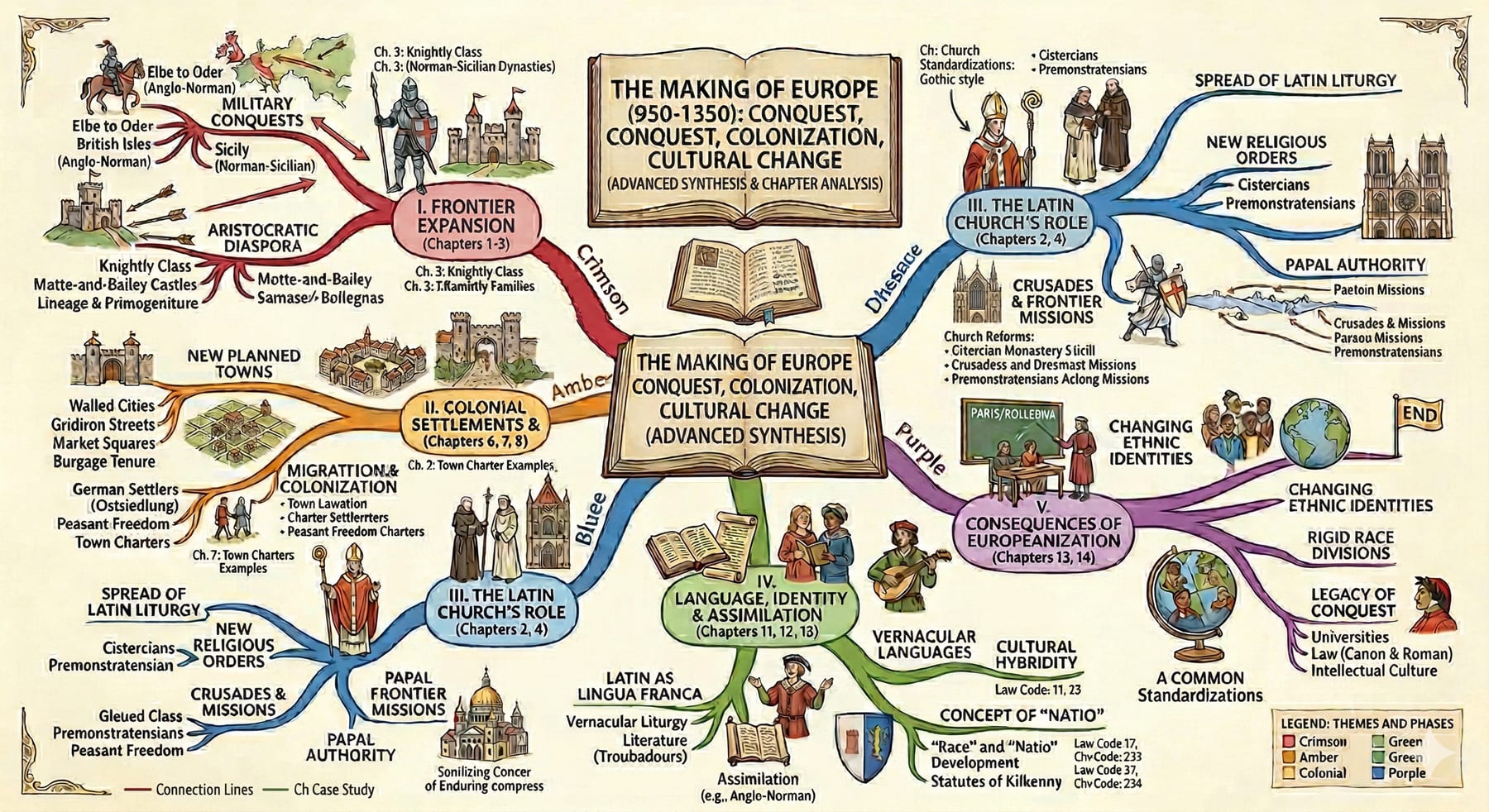
Chapter 9. Race Relations on the Frontiers of Latin Europe (2): Power and Blood
Chapter Objective
- This chapter explains how ethnic conflict in the frontier societies of medieval Europe was shaped not just by language and law, but by power: who controlled the Church, the princely court, and the towns.
- Bartlett’s main argument is that in ethnically mixed societies, competition for office, privilege, and influence increasingly took on a racialized form. Over time, this often hardened from cultural rivalry into more rigid and exclusionary forms of racism, including appeals to blood and descent.
- In the broader argument of the book, this chapter shows a later stage of conquest and colonization:
- not just coexistence under plural laws
- but the struggle to control institutions
- the hardening of ethnic boundaries
- and the gradual move from cultural difference to exclusionary racial ideology.
The Church
- Bartlett begins by showing that the Church was one of the most important arenas of ethnic competition in frontier regions.
- This was especially true in places where the conflict was not primarily religious:
- the lands of the Ostsiedlung
- the Celtic zones of the British Isles
- In these places, different Christian peoples confronted one another, so ethnic antagonism appears in relatively pure form, without being blurred by a Christian/non-Christian divide.
- The Church was such a charged arena because:
- ecclesiastical offices brought income and power
- clergy spoke for the community in matters of ritual, morality, and learning
- clerical office was at least in theory filled by recruitment, not inheritance
- That last point mattered greatly:
- a lay aristocracy changed slowly
- but the personnel of a bureaucracy like the Church could be ethnically transformed much more quickly.
- Bartlett emphasizes the pastoral problem of language.
- Priests had to preach, hear confession, advise, and console in the vernacular.
- This was widely recognized.
- Examples:
- complaints in Prague about bishops ignorant of Czech
- Gerald of Wales insisting that St David’s needed a bishop who knew the language of the people
- Michael Scot declining Cashel on the grounds that he did not know the local language
- The implication is clear:
- a foreign clergy could mean not just political intrusion, but a loss of communal voice.
- Bartlett notes some practical solutions:
- bilingual clergy, as in Bohemia
- requiring a priest to know both German and Slavic, or to keep a colleague who did
- occasionally ethnically differentiated parishes, as in early-thirteenth-century Szczecin, where Germans and Slavs were assigned to different churches
- But these were exceptions or temporary arrangements. More often, recruitment itself became a site of struggle.
- Poland
- The most vivid case is Jakub Swinka, archbishop of Gniezno (1283–1314).
- He lived during a period of significant German settlement and resisted Germanization within the Polish Church.
- Swinka’s stance was openly xenophobic:
- he referred to Germans as “dog heads”
- his statutes of 1285 aimed at the protection and promotion of the Polish language
- Main measures:
- priests were to explain the Creed, Lord’s Prayer, and Ave Maria in Polish
- schoolmasters had to know Polish and teach through it
- no one should receive a benefice involving cure of souls unless born in the land and able to command the language
- Bartlett presents this as a direct attempt to stop the Germanization of the clergy.
- The conflict became concrete in the case of Bishop John of Cracow, suspended in 1308.
- Witnesses accused him of:
- trying to expel the Polish people
- promoting foreigners and Germans
- denying benefices to worthy Poles
- even breaking an oath not to install Germans in Cracow’s church
- Whether every charge was true or not, Bartlett uses the case to show that ecclesiastical appointments had become a major theater of ethnic politics.
- Ireland
- In the Celtic lands, the situation was shaped by conquest.
- After the Anglo-Norman arrival, the English crown pursued an explicit policy of excluding native Irish from episcopal office.
- A royal letter of 1217 advised that no Irishman should be elected or promoted in cathedral churches in Ireland and that honest Englishmen should instead be advanced.
- Bartlett highlights Henry, archbishop of Dublin, as the archetypal clerical colonialist:
- London background
- royal servant
- reshaped Dublin’s see along Anglo-French institutional lines
- Later royal and administrative plans continued the same exclusionary logic:
- prefer English bishops
- prevent Irish clergy from sustaining their own race through church patronage
- require competence in the English language for benefices involving cure of souls
- Again, language and office were closely bound to ethnic control.
- Monastic orders
- Bartlett then turns to the regular Church.
- Here conflict worked a little differently because the great orders were international.
- The new orders had:
- jurisdictional centers in France, Italy, England, and Germany
- but not in Celtic or Slavic lands
- This meant that their very geography reflected the political and cultural dominance of the western core.
- In frontier regions, that produced tension.
- Examples:
- Scottish Franciscans gaining or losing autonomy with the fortunes of the Wars of Independence
- Brandenburg resisting a Dominican house being tied to a Polish province because provincial affiliation might imply later political claims
- German settlement helping transfer eastern territories into the Franciscan province of Saxony
- Bartlett shows that the organizational structure of orders could itself become a matter of ethnic and territorial conflict.
- Polish and Bohemian complaints about German mendicants
- German-speaking friars were accused of crowding out Slavic-speaking brethren and endangering the souls of the local people.
- Swinka again denounced orders that preferred foreigners to native Poles.
- Some foundations even wrote ethnic exclusivity into their rules:
- a hospital in Brześć was to maintain no German
- an Augustinian house at Roudnice was to admit only Czechs born of two Czech-speaking parents
- Bartlett uses these examples to show that ecclesiastical universalism could be overtaken by local ethnic protectionism.
- The Mellifont conspiracy
- Bartlett’s richest monastic case is the crisis among the Irish Cistercians.
- The Cistercians had deep roots in Ireland before the Anglo-Normans.
- But by the early thirteenth century, conflict with the international order culminated in the so-called “conspiracy of Mellifont.”
- Visiting Cistercian authorities found:
- resistance
- fortified monasteries
- disciplinary failures
- and strong local autonomy
- Stephen of Lexington, sent from the center, intervened forcefully:
- houses were suppressed
- abbots deposed
- monks dispersed overseas
- affiliations shifted from Irish to English or French mother houses
- Bartlett notes that Stephen himself admitted he had created many abbots “of a different tongue and nation.”
- He also imposed linguistic measures:
- no one should be admitted unless he could confess in French or Latin
- the Rule was to be expounded in French
- Stephen cast this as the pursuit of uniformity, but Bartlett presents it as a deeply revealing example of how international monastic reform could operate as ethnic colonization.
The Princely Court
- Bartlett next turns to the court as another focal point of ethnic antagonism.
- Courts were already, by nature:
- centers of patronage
- display
- cosmopolitanism
- foreign influence
- In frontier societies, this made them especially volatile when foreign rulers, queens, relatives, or counselors entered them.
- The structural reason is dynastic politics.
- Medieval rulers often married foreign brides.
- This brought in:
- foreign ladies
- chaplains
- servants
- relatives
- and possibly heirs with dual identity
- A court could therefore be culturally reoriented quite suddenly.
- Bartlett uses the Dalimil Chronicle as the classic expression of this anxiety.
- In the story of Duke Udalrich choosing a Czech peasant girl over a German princess, the chronicler spells out the fears:
- a foreign woman remains loyal to her own people
- she brings foreign kin
- she teaches the children German
- she changes customs
- the land is ruined through linguistic and cultural division
- This is a compact ideological statement of frontier nativism:
- court marriage becomes a threat to the nation itself.
- Bartlett notes that this was not merely literary fantasy.
- Bohemian nobles later insisted that Blanche of Valois’s French household be sent home and replaced by Bohemians.
- Their concern was that the queen’s foreign entourage might become a court faction alien to local society.
- Foreign kings could be even more disruptive.
- Bartlett points to the extinction of native dynasties in:
- Bohemia
- Poland
- Hungary
during the fourteenth century.
- This opened crowns to outsiders and intensified aristocratic concern about foreign rule.
- Bohemia under John of Luxemburg
- When John became king in 1310, he had to promise not to appoint foreigners to positions in the kingdom or allow them to acquire landed power.
- He soon violated this in practice by surrounding himself with German advisers and nobles.
- The Czech nobility protested and extracted renewed promises excluding foreigners from castle offices.
- Bartlett uses this to show that princely power on the frontier was continually vulnerable to being interpreted as ethnic betrayal if it leaned too heavily on outsiders.
- Sometimes the issue was not a foreign ruler, but a native ruler with foreign favorites.
- Examples from the Piast lands:
- Boleslaw II of Silesia preferring Germans to Poles and giving them estates
- local resentment leading to withdrawal of homage
- chroniclers blaming princely misrule on German counsel
- Similar complaints recur elsewhere in Poland, where German advisers are portrayed as dominating young rulers and bending policy to foreign interests.
- Bartlett’s point is that the court could easily become the most visible symbol of alien domination, even when the ruler was technically native.
The Burgess Community
- The third major arena of conflict is the town.
- Bartlett begins by stressing that the medieval urban population was an immigrant population everywhere, but this had special meaning on the frontiers.
- In regions like eastern Europe and the Celtic lands, many towns were ethnically distinct from the rural population around them.
- This often produced a strong town-country ethnic contrast.
- His Prague example is revealing:
- a German artisan insults St Wenceslas as a “peasant”
- after a miracle, the Germans learn to revere the Czech patron
- Bartlett uses the anecdote to show how town culture could equate itself with German urbanity while casting native society as rural and inferior.
- In eastern Europe, German was especially the language of:
- towns
- courts
- In Prague, a high proportion of new burgesses and councillors bore German names.
- Even Queen Blanche sought contact with subjects through German, not Czech, because German predominated in towns and royal surroundings.
- In Poland too, Cracow’s public and private business could still be conducted in German in the fifteenth century.
- The same broad pattern appears in the British Isles.
- Towns there were culturally distinct from the countryside.
- French was much more common in towns than in villages.
- In colonized Wales and Ireland, French and especially English became the languages of prestige and privilege.
- Bartlett notes that petitions from the “English burgesses” of north Wales insist that no Welshman ought to live in an enfranchised town.
- Frontier towns thus became linguistic islands.
- Yet Bartlett is careful not to overstate homogeneity.
- Native peoples still lived inside the walls:
- sometimes as laborers
- sometimes as artisans
- sometimes as merchants
- In the period of growth, this coexistence could be relatively workable.
- But as the later medieval recession set in, the tone darkened:
- shrinking opportunity sharpened ethnic competition.
- Cracow, 1311–12
- This is Bartlett’s major case of urban ethnic conflict.
- In the dynastic struggles over the Polish throne, the German burgesses of Cracow backed the wrong contenders against Wladyslaw Lokietek.
- When he regained control, reprisals followed.
- The chroniclers depict the burgesses as enemies of peace driven by “German rage.”
- Some were dragged through the streets by horses and then hanged.
- The most famous detail is the shibboleth:
- those unable to pronounce Polish words such as soczewic, kolo, miele, mlyn were executed.
- Bartlett presents this as one of the starkest examples of ethnic-linguistic persecution in the urban frontier world.
- Another symbolic change followed:
- the records of Cracow, formerly kept in German, began in 1312 to be kept in Latin
- Bartlett interprets this as part of the anti-German reaction.
- Over the following century Cracow was gradually Polonized:
- Polish-origin new burgesses rose sharply
- the city shifted from being a German city in Poland to a Polish city with a German minority.
The Growth of Racism in the Later Middle Ages
- Bartlett’s final subsection argues that the later Middle Ages saw a hardening of ethnic boundaries and a growth of something closer to racism in the stronger sense.
- He begins by situating frontier developments within a wider European pattern.
- Anti-Jewish sentiment unquestionably worsened over the medieval centuries, even if historians disagree over the decisive turning point.
- Bartlett then argues that the same general trend toward sharper exclusion can be seen on the peripheries of Latin Europe.
- Examples of hardening on the frontiers:
- in Baltic German towns, attitudes toward non-Germans became more negative
- among the Teutonic Knights, German birth became a stricter qualification only later
- in Wales and Ireland the English/Welsh divide became more sharply racialized in the later Middle Ages.
- Bartlett stresses that this harsher racism was not only colonial.
- Native populations could produce their own violent racial polemic.
- He returns to the Dalimil Chronicle, with its hostility to German settlers.
- He then cites the even more extreme De Theutonicis bonum dictamen, a Latin anti-German tract from fourteenth-century Bohemia.
- This tract depicts Germans as:
- naturally servile
- rootless intruders
- economic usurpers
- manipulators of councils and public wealth
- wolves, flies, serpents, whores
- It culminates in what Bartlett bluntly recognizes as a call for pogrom.
- The most important new development, though, is the growth of biological racism.
- Bartlett finds this most clearly in late medieval urban legislation.
- Guilds and councils increasingly imposed ancestry bars on membership and office.
- In eastern Europe this appears in the Deutschtumsparagraph:
- applicants had to prove German descent
- no Wends or others of disfavored stock could be admitted
- Examples from Beeskow:
- cobblers excluding Slavs, illegitimate children, and other socially or ethnically stigmatized groups
- bakers requiring proof of legitimate, upright German birth
- Some applicants had to produce Geburtsbrief documents naming parents and grandparents and attesting to proper German blood and tongue.
- Bartlett treats this as a major step:
- descent, not just culture or language, becomes the key criterion.
- Intermarriage rules reinforced this shift.
- Riga bakers, for example, expelled members who married non-German women.
- In Ofen/Pest, officeholding could require four German grandparents.
- This is no longer only about language or legal status. It is about genealogy.
- Ireland shows a parallel development.
- Urban statutes in places like:
- Drogheda
- Limerick
- Dublin
excluded people of Irish birth or blood from: - civic office
- guild membership
- apprenticeship
- Bartlett notes the increasing use of terms like “blood” in these rules, showing the same conceptual hardening.
- At the same time, colonists tried to prevent themselves from “going native.”
- The fullest example is the Statutes of Kilkenny (1366).
- These banned or discouraged:
- intermarriage with the Irish
- use of the Irish language by settlers
- Irish names
- Irish riding style and dress
- Irish sports like hurling
- Irish minstrels
- and Irish access to benefices or monasteries in English areas
- Bartlett reads this as the legislation of a colony that has lost momentum and fears assimilation as much as rebellion.
- He contrasts this later mood with an earlier, more confident pluralism.
- A Hungarian cleric had once praised kingdoms of many races and customs as stronger.
- By the later Middle Ages, that confidence had faded.
- In its place came:
- residential segregation
- legal disabilities
- cultural proscription
- sharper assertions of immemorial ethnic hatred.
- Bartlett ends with the most dramatic long-term example: the Mudejars of Spain.
- Initially they kept:
- their own law
- judges
- mosques
- and much of their communal autonomy
- Over time, however, this autonomy was eroded:
- Christian witnesses admitted against them
- Christian judges imposed in more cases
- Muslim jurisdiction diminished
- Arabic retreated
- By the late fifteenth and early sixteenth centuries:
- Jews were expelled
- Muslims were forcibly converted
- Morisco customs, names, costume, and language were attacked
- eventually the Moriscos themselves were expelled (1609–14).
- Bartlett’s final synthesis is powerful:
- Regino of Prüm had defined peoples by descent, customs, language, and law
- over the centuries, Muslims in Spain lost:
- their law
- then their language
- then their religion in the deepest sense of law
- then their customs
- and finally, in early modern Spain, even their stock became intolerable
- Here Bartlett locates the emergence of modern-style blood racism, visible in ideals of purity of blood.
Key Concepts for Race Relations on the Frontiers of Latin Europe (2): Power and Blood
- Institutional arenas of ethnic conflict
- Bartlett’s model that ethnic antagonism in frontier societies was especially intense where power was concentrated: the Church, court, and town.
- Clerical colonization
- The process by which ecclesiastical offices in frontier regions were filled by foreign or immigrant clergy, reshaping the ethnic voice and pastoral life of the Church.
- Court xenophobia
- Anxiety that foreign queens, kings, advisers, or entourages would alter language, customs, patronage, and even dynastic identity.
- Urban ethnic island
- A town whose dominant burgess culture is linguistically and ethnically distinct from the surrounding rural population.
- Deutschtumsparagraph
- A late medieval clause in guild statutes requiring proof of German descent for admission, marking a shift from cultural to genealogical criteria of identity.
- Going native
- The colonial fear that settlers would assimilate into native society, seen most clearly in late medieval Irish legislation like the Statutes of Kilkenny.
- Blood racism
- A harder form of exclusion in which descent and ancestry become decisive criteria of privilege, office, or membership, beyond language, law, or custom.
- Purity of blood
- The early modern Iberian ideology that descent untainted by Jewish or Muslim ancestry was a requirement for status and advancement, which Bartlett presents as the culmination of a long medieval process.
Questions for Reflection for Race Relations on the Frontiers of Latin Europe (2): Power and Blood
- Why does Bartlett focus on the Church, court, and town as the main institutional sites where ethnic antagonism became politically potent?
- How do cases like Jakub Swinka’s Poland or the Mellifont visitation show the tension between universal religious ideals and local ethnic struggle?
- Why were foreign queens, kings, and advisers so symbolically dangerous in frontier polities like Bohemia and Poland?
- What changed in the later Middle Ages that made ethnic boundaries harder, more defensive, and increasingly defined by descent rather than only language or law?
- How does Bartlett use the long history of the Mudejars and Moriscos to trace the path from medieval pluralism to something closer to modern racial ideology?
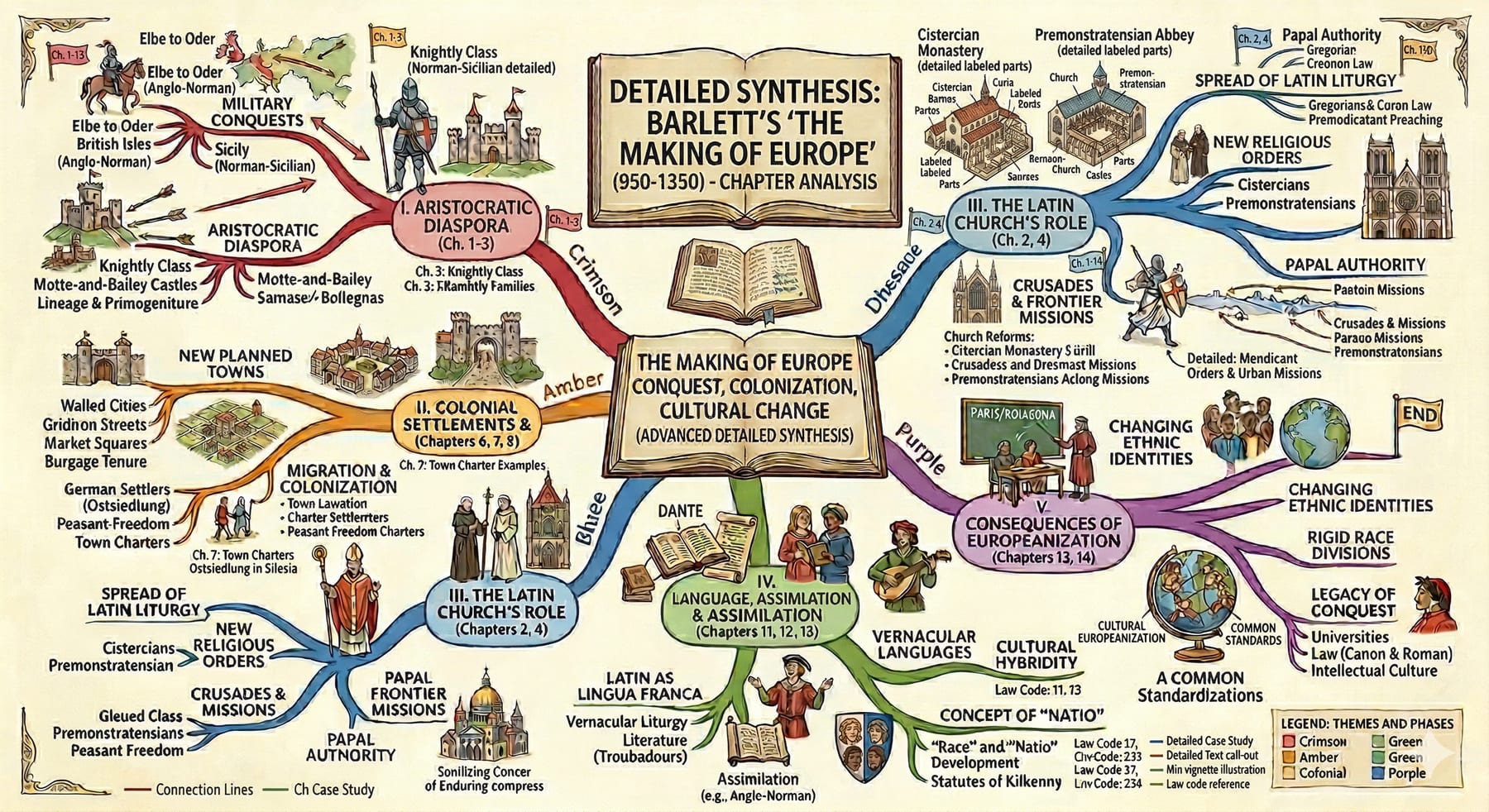
Chapter 10. The Roman Church and the Christian People
Chapter Objective
- This chapter explains how the expansion of medieval Europe was also the expansion of a more self-conscious, organized, and militant Latin Christianity centered on Rome.
- Bartlett’s main aim is to show that Europe’s expansion cannot be understood only in military, economic, or social terms. It also depended on:
- the growing authority of the papacy
- the emergence of a stronger idea of Christendom
- the spread of international religious orders
- and the unifying force of the crusades.
- In the broader argument of the book, this chapter shows how the peoples and frontiers described earlier were increasingly bound together by a common rite, obedience, identity, and holy mission, turning Latin Europe into a more integrated civilizational whole.
The Role of the Papacy
- Bartlett begins by returning to the opening definition of Latin Christendom as both:
- a rite
- and an obedience
- In the High Middle Ages, these two became more tightly connected:
- Rome was the standard of liturgy
- and the pope was the supreme authority over the western Church.
- He stresses that this was not entirely new.
- The papacy had long enjoyed prestige.
- What changed after the eleventh-century reform movement was:
- papal power became more effective
- papal decisions more enforceable
- liturgical uniformity more real
- As a result, Latin Christians increasingly understood themselves through:
- loyalty to St Peter
- obedience to the pope
- and participation in Roman forms of worship.
- Bartlett uses Gregory VII as the foundational figure of the high medieval papal monarchy.
- The Register of Gregory VII reveals a papacy building dense ties with aristocratic rulers, especially in:
- Italy
- France
- Germany
- Gregory’s correspondence shows the papacy not as passive prestige, but as an active political center forming alliances, exhorting magnates, and shaping power struggles.
- Bartlett highlights the alliance between the reform papacy and sections of the military aristocracy.
- He quotes John Mundy’s formulation that Europe was led by an alliance between “Europe’s aristocracies and the see of Peter.”
- Gregory’s dealings with figures like:
- Rudolf of Swabia
- Beatrice and Matilda of Tuscany
- Norman rulers in southern Italy
show how papal reform and aristocratic ambition could reinforce one another.
- The case of Rudolf of Swabia is especially revealing.
- Gregory first cultivates him diplomatically.
- Within a few years, Rudolf becomes anti-king against Henry IV.
- Gregory eventually recognizes Rudolf and grants absolution to his supporters.
- Bartlett’s point is that papal alliance could culminate in king-making and even something like holy war.
- Gregory’s letters also reveal the papacy’s changing geographical horizons.
- Bartlett notes a contrast:
- in the old Carolingian heartlands, letters went mostly to bishops and magnates
- beyond them, letters more often targeted kings and princes
- This reflects both:
- papal familiarity with the inner core
- and the fact that in outer regions, monarchs were the best partners for reform, Christianization, or anti-Muslim struggle.
- Gregory’s outreach extended to:
- England
- Spain
- Hungary
- Denmark
- Bohemia
- and beyond
- This shows the papacy imagining itself on a continental and even transcontinental scale.
- Bartlett also examines Gregory’s striking claims of papal proprietorship.
- Gregory asserted that lands such as:
- Hungary
- parts of Spain
- and even Russia in some sense belonged to St Peter
- Bartlett notes that these property claims did not become the final core of papal monarchy, but they gave the reform papacy an initial language of universal dominion.
- A central practical aspect of papal authority was liturgical uniformity.
- Gregory pressed for conformity in:
- ritual
- custom
- ecclesiastical discipline
- The sharpest example is Spain, where the old Mozarabic liturgy was replaced by the Roman rite.
- Bartlett treats this as a major victory of Romanization:
- local Christian diversity was subordinated to Roman order
- rite and obedience became visibly fused.
- He closes this section by emphasizing the broader machinery of papal expansion:
- more letters
- more legates
- more councils
- more effective intervention in distant regions
- What had once seemed novel in places like Bohemia, Wales, or Ireland became routine by the thirteenth century.
- By the age of Innocent III, papal authority had become a normal fact across the expanding Latin world.
The Concept of Christendom
- Bartlett next turns from institution to identity.
- Alongside the strengthening of papal power came a strengthening of the idea of Christendom itself.
- He begins with the phrase “the Christian name.”
- Medieval writers used it frequently:
- Christians defend it
- enemies attack it
- victories restore or glorify it
- Examples:
- Muslim defeats are described as humiliations to the Christian name
- crusaders and reconquerors defend or restore it
- Bartlett’s point is that the phrase does more than label belief. It creates a collective named community.
- He then pushes the point further:
- Christians are made by baptism, not born
- but in practice, most people in Latin Europe were baptized from birth
- As a result, Christian identity could take on a quasi-ethnic character.
- Medieval writers begin to speak of:
- the Christian people
- the Christian race
- the holy race of Christians
- Bartlett gives examples from crusading texts where “Christians” function almost like a people or nation among others.
- He highlights how this tendency intensified in contexts of expansion.
- When Latin Christians encountered:
- Muslims
- pagans
- Greeks
- Mongols
they increasingly thought of themselves as one collective group.
- This made Christian identity feel less like an abstract creed and more like a peoplehood.
- Bartlett then traces the territorialization of Christianitas / Christendom.
- Earlier, the word usually meant the Christian faith in the abstract.
- In the High Middle Ages, it increasingly meant a specific part of the world:
- a geographical region
- bounded
- inhabited by Christians
- distinct from what lay outside.
- He gives many examples of this territorial sense:
- the “bounds of Christendom”
- prelates coming from the breadth of Christendom
- campaigns fought for the extension of Christendom
- The concept becomes spatial, not merely doctrinal.
- This territorial sense is strongest where Christendom is imagined as expanding.
- Bartlett emphasizes the recurrent use of dilatio:
- expansion
- enlargement
- extension
- Examples:
- Roger in Sicily expands the Church in Muslim lands
- Iberian lords work for the expansion of the Christian faith
- the Teutonic Knights fight to expand the frontiers of the Christians
- This gives Christendom a frontier dynamic. It is a land that can grow at the expense of others.
- Naturally this implied a contrast with an outside.
- Bartlett shows the emergence of a mental geography:
- Christendom
- versus heathendom
- These are not just religions, but opposing territorial-civilizational spheres.
- The fall of Jerusalem in 1099, for example, is framed as:
- paganism diminished
- Christianity strengthened
- The world becomes a stage for the clash of large religio-territorial blocs.
- Bartlett then clarifies that the Christendom of this era was specifically Latin Christendom, not undifferentiated Christianity.
- The divide between Greek and Latin Christianity sharpened over time.
- In the older Mediterranean world, boundaries of rite and jurisdiction could remain ambiguous.
- But in the missionary zones of eastern and northern Europe, new converts had to choose more sharply:
- Rome
- or the Greek Church
- Examples:
- Russians chose east
- Poles and Magyars chose west
- This helped create a widening fissure inside Europe itself.
- The final stage of this process unfolded around the Baltic.
- There Latin Christians expanding into Livonia and neighboring regions came into contact with Russians following the Greek rite.
- Papal letters now insist that Russians under Latin authority must adopt Latin practices.
- By the thirteenth century, Greek and Latin Christians were in military conflict from Constantinople to Lake Peipus.
- Bartlett’s conclusion is that expansion sharpened the identity of both sides:
- Latins became more Latin
- Greeks more Greek.
The Religious Orders
- Bartlett next turns to the international religious orders, which provided the institutional skeleton for this expanding Latin world.
- He sees them as one of the great innovations of the period.
- He organizes western monastic development into four stages:
First stage: independent Benedictine monasteries
- In the tenth century, most monasteries followed the Benedictine Rule.
- Each house was largely independent.
- The abbot was supreme internally.
- Monks were expected to remain in their own house.
- These houses depended on substantial landed endowments.
Second stage: the Cluniac model
- The innovation associated with Cluny brought some links between houses.
- There were:
- tighter ties between Cluny and its dependent priories
- looser ties of confraternity among houses sharing Cluniac customs
- But Bartlett stresses that this remained a relatively simple and personal form of dependence, not a fully articulated international organization.
Third stage: the Cistercian order
- With the Cistercians in the twelfth century, something more sophisticated emerged.
- Their system was based on:
- affiliation
- delegated supervision
- annual chapters
- general legislation
- Each house was linked in a chain of dependence eventually leading back to Cîteaux.
- Bartlett contrasts this with Cluny:
- Cistercians created an administrative network, not just a prayer union
- They spread quickly and widely, from Burgundy to:
- Ireland
- Norway
- Spain
- and eastern Europe.
Fourth stage: the mendicant friars
- In the thirteenth century came the friars:
- especially Franciscans
- and Dominicans
- These retained the organizational sophistication of the Cistercians but abandoned:
- heavy endowment
- strict local immobility
- Friars were mobile, urban, and highly adaptable.
- Their personnel could be transferred wherever useful.
- Bartlett stresses that this mobility made them especially potent carriers of a common Latin culture.
- He summarizes the long movement as:
- greater administrative complexity
- greater mobility
- broader international reach
- The new orders could expand rapidly while retaining institutional coherence.
- This made them ideal instruments of frontier growth.
- Bartlett illustrates this with the Cistercians in northeastern Europe.
- Their spread from French mother houses through chains of daughter houses into:
- Silesia
- Poland
- Norway
- and beyond
shows how far the new Latin network reached.
- His example of Mogiła near Cracow, linked by a six-house chain back to Morimond, is especially effective:
- over a century, a structured spiritual and institutional corridor stretched more than 500 miles eastward.
- He stresses that this expansion relied on:
- written constitutions
- reproducible models
- transplantable personnel and practices
- The orders could found new houses without losing their identity.
- They were thus highly effective agents of cultural dissemination.
- The frontier benefited especially from the newer orders:
- Cistercians
- military orders
- Dominicans
- Franciscans
- Older Benedictines were relatively less important in newly conquered lands like Baltic Prussia or Reconquest Spain.
- Bartlett ends this section with a striking image:
- a Franciscan debating Muslims, Buddhists, and pagans at the Mongol court in 1254
- while carrying Peter Lombard’s theology and a French-style Madonna
- This neatly captures the orders as mobile, disciplined carriers of a standardized Latin civilization.
The Crusades
- Bartlett’s final section argues that the crusades gave Latin Christians a common goal and one of the strongest practical expressions of shared identity.
- They were the military counterpart to papal leadership and institutional religious expansion.
- He presents the crusade as:
- the “common enterprise of all Christians”
- widely praised and supported
- supra-national in language, symbolism, and aspiration
- Matthew Paris says the crusades mattered because on them depended the condition of the whole Church and even the Catholic faith itself.
- Crusaders themselves experienced this universalism.
- Fulcher of Chartres remarks on the extraordinary diversity of languages in one army:
- Bretons
- Germans
- others unable to understand one another
- yet united like brothers in the love of God
- Bartlett uses this to show how crusading turned Latin Christendom into something experientially pan-European.
- The symbols of crusading reinforced this:
- the cross
- not dynastic badges
- armies called the army or host of God
- The kingdom of Jerusalem is described as a new colony of Holy Christendom.
- This makes the crusades central to the book’s colonial theme as well.
- Bartlett stresses the importance of historical memory.
- Later crusaders consciously looked back to the First Crusade as a model.
- Examples:
- Louis VII wanting to follow the path of the forefathers
- the leaders of the Fourth Crusade recalling the election of Godfrey de Bouillon
- aristocrats decorating chambers with scenes from Antioch or Richard the Lionheart’s struggles with Saladin
- Crusading became part of family memory, aristocratic identity, and western self-understanding.
- One of Bartlett’s most important points is that crusading was generalized beyond the Holy Land.
- As early as 1108, appeals in Saxony invoked the First Crusade in order to redirect holy war against the pagan Slavs east of the Elbe.
- The province of Magdeburg is described as “our Jerusalem,” and western warriors are urged to imitate the men who had fought in the East.
- Bartlett sees this as an early attempt to transplant crusading ideology into a new frontier.
- The decisive moment came in 1147, with the Second Crusade.
- Holy war was now generalized:
- in the eastern Mediterranean
- in Iberia
- and in eastern Europe through the Wendish Crusade
- Though the Baltic results were modest, a crucial precedent had been set:
- armies bearing the cross could campaign against nearby pagans as well as distant Muslims.
- Bartlett then traces the implantation of crusade in the Baltic.
- In 1171, Pope Alexander III addressed Scandinavian rulers and peoples:
- praising their loyalty to Rome
- urging ecclesiastical obedience
- and offering crusading remission of sins against the Estonians
- This is important because it shows crusading ideology arriving in the Baltic together with:
- tighter ties to Rome
- greater ecclesiastical discipline
- and stronger expectations of support for local churches.
- The crucial next step came in Livonia.
- In 1199, Innocent III called on the Saxons to defend Livonian Christians in remission of sins.
- Although the first effort failed, the next bishop, Albert of Buxtehude, created something more durable: a military order.
- Bartlett now explains the remarkable appeal of the military orders.
- Their power came from fusing opposites:
- the violent knight
- and the disciplined monk
- Knights vowed poverty, chastity, and obedience while fighting for Christ.
- This “new knighthood” had enormous prestige and organizational strength.
- He traces the model back to the Templars:
- founded around 1118
- supported by Bernard of Clairvaux
- Bernard’s praise is central:
- the knight of Christ fights a double battle
- he kills without guilt
- even glories in the death of the pagan because Christ is glorified
- Bartlett uses this to show how fully Christianity had been militarized.
- Other orders then followed:
- Hospitallers militarized under Templar influence
- Teutonic Knights adopted the Templar rule
- Spanish orders like Calatrava emerged from the same model
- By 1200 these orders had become enormously wealthy, international, and politically important.
- The most original Baltic development was the creation of an Order State.
- Bishop Albert founded the Swordbrothers in 1202.
- In 1207, they were endowed with a third of Livonia.
- Bartlett calls this the first enduring Order State in history:
- a territorial lordship ruled by a crusading order
- In 1237, the Teutonic Knights absorbed the Swordbrothers and expanded into Prussia from Polish bases such as Toruń and Chelmno.
- The eastern Baltic littoral now fell into the hands of a great crusading order.
- Bartlett highlights the significance of this form:
- unlike dynastic lordships, military orders had:
- elective officials
- bureaucratic routines
- institutional continuity
- unlike dynastic lordships, military orders had:
- The death of a Master did not throw the polity into chaos.
- This made them especially effective instruments of sustained expansion.
- He also stresses their international financial role.
- The orders linked distant parts of Christendom through:
- property holdings
- banking
- capital transfers
- Examples:
- estates of one order in both Ireland and eastern Germany
- a Mecklenburg lord recovering deposited money from the Teutonic Knights after his father had left it in Acre
- Livonian clergy contributing to the campaign against Damietta by 1219
- Bartlett’s point is that the expansion of Latin Christendom created surprising new connections:
- money from one frontier could fund war on another
- distant regions were drawn into one coordinated religious-political system.
Key Concepts for The Roman Church and the Christian People
- Rite and obedience
- Bartlett’s definition of Latin Christendom as both a shared Roman liturgy and loyalty to papal authority.
- Papal monarchy
- The enhanced authority of the reformed papacy from the eleventh century onward, marked by stronger intervention, broader communication, and greater enforceability.
- Romanization
- The process by which local churches and rites were brought into conformity with Roman standards, especially in liturgy and discipline.
- Christendom
- Increasingly a territorial and civilizational concept: the lands and peoples in which the Christian name was revered, opposed to “heathendom.”
- Dilatio
- The idea of the expansion or extension of Christendom, a key term in the rhetoric of crusade and frontier conquest.
- International religious order
- The new type of highly organized, transregional religious institution, such as the Cistercians, Franciscans, Dominicans, and military orders.
- Military order
- A religious order that fused monastic vows with knighthood and holy war, such as the Templars, Hospitallers, Swordbrothers, and Teutonic Knights.
- Order State
- A territorial polity ruled by a crusading military order, most importantly in Livonia and Prussia.
- Crusading universalism
- The idea that crusade was the common enterprise of all Latin Christians, transcending local polities and binding Europe together.
Questions for Reflection for The Roman Church and the Christian People
- Why does Bartlett insist that Latin Christendom was defined by both rite and obedience, not by belief alone?
- How did the papacy transform itself from an old center of prestige into a more effective and interventionist power in the High Middle Ages?
- In what ways did the concept of Christendom become more territorial, ethnicized, and expansionary during this period?
- Why were the international religious orders so effective as carriers of a common Latin culture across very distant frontiers?
- How did the crusades and military orders help turn scattered frontier wars into parts of a single, wider project of Latin Christian expansion?
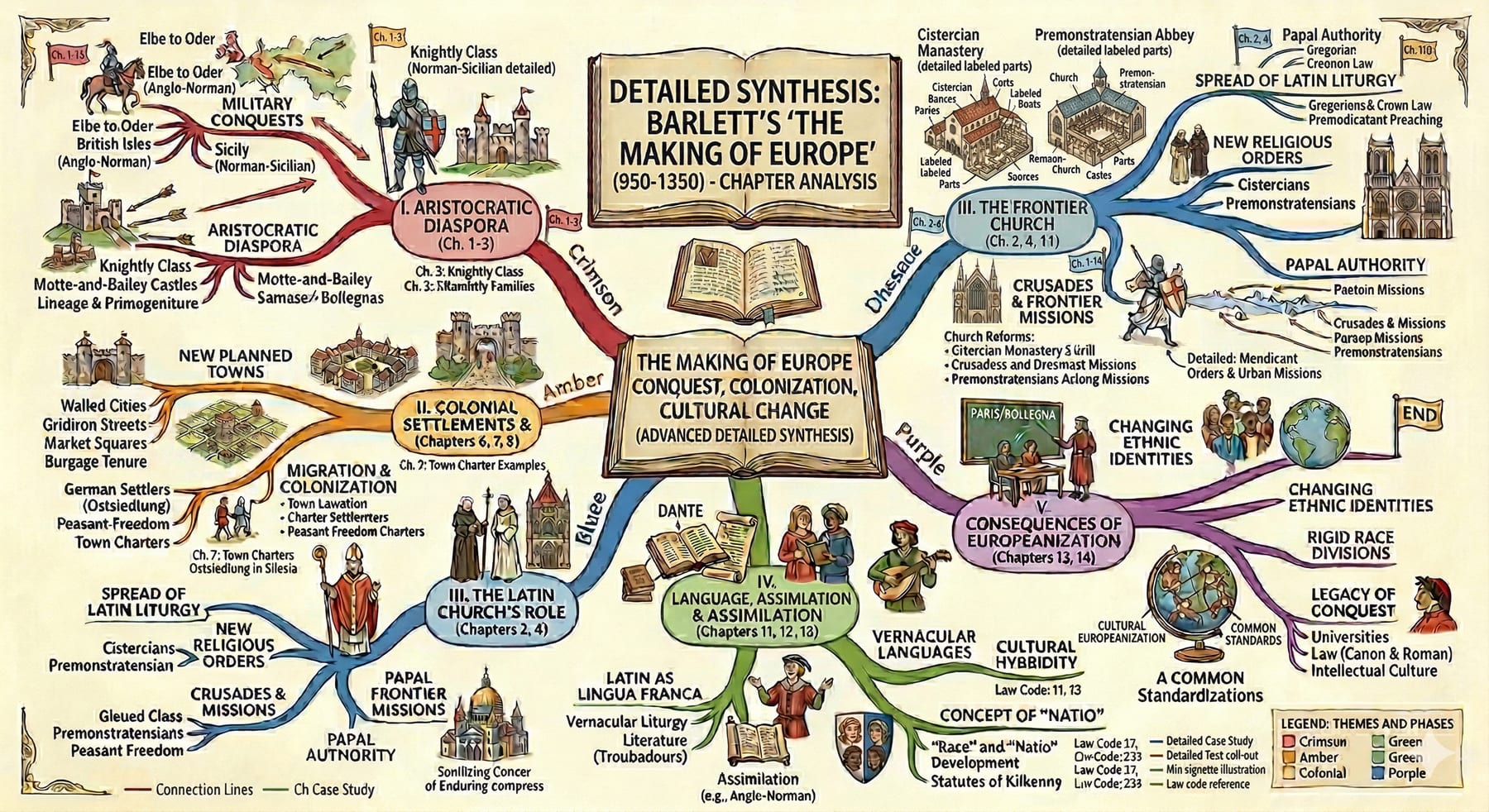
Chapter 11. The Europeanization of Europe
Chapter Objective
- This chapter explains what Bartlett means by the seemingly paradoxical phrase “the Europeanization of Europe.”
- His main argument is that during the High Middle Ages, Europe became more culturally recognizable as a shared civilization because a range of practices, institutions, and symbols spread outward from the old Frankish core:
- names
- saints’ cults
- coins
- charters
- universities
- These changes did not always depend directly on conquest. Sometimes they spread through imitation, adaptation, institutional borrowing, and convergent development.
- In the broader argument of the book, this chapter serves as a synthesis:
- earlier chapters described conquest, colonization, migration, law, church power, and frontier conflict
- this chapter shows the cultural result of those processes: by 1300, Europe was more internally homogeneous and more clearly identifiable as a civilizational unit than it had been around 950.
Opening Section (before subsection headings)
- Bartlett starts by clarifying that “Europe” in this context is not just a geographical label.
- It is a construct:
- an image of societies sharing important cultural features
- So “Europeanization” means the spread and strengthening of those shared features across the continent.
- He identifies the core zone of this process as:
- France
- Germany west of the Elbe
- north Italy
- These regions had a common background in the world of Charlemagne’s Frankish empire.
- From them, expansion moved outward:
- militarily
- socially
- culturally
- Bartlett is careful to say that this was not only military expansion.
- Even historians discussing places not conquered directly, such as:
- Hungary
- Spain
- Ireland
have used the term Europeanization to describe cultural and institutional transformation.
- His point is that Europe was becoming more similar to the culture of the old Frankish-Latin core even when formal conquest was absent.
Saints and Names
- Bartlett begins this section by linking saints and personal names.
- In medieval Europe, children were often named after saints, and so changes in naming patterns often reflected changes in cult and devotion.
- In the early Middle Ages, most regions had highly localized repertoires of names.
- A small group of names could often identify:
- a region
- an ethnic group
- even a particular aristocratic family
- Likewise, saints’ cults were usually very regional:
- each area had its own local holy figures
- dedications and names clustered around their relic centers
- Bartlett gives examples such as:
- the English Midlands with saints like Chad and Alcmund
- Merovingian Aquitaine, where the spread of local saints’ names had sharp geographical limits.
- He then shows how this compartmentalized world began to change in the eleventh and twelfth centuries.
- One mechanism was conquest.
- England after 1066 is his clearest example:
- Norman conquerors had a different naming culture from the Anglo-Saxons
- names like William, Henry, Robert displaced older English names like Alfred, Edward, Ethelred
- Bartlett stresses how sharp the divide originally was:
- in the eleventh century, names were a very reliable ethnic marker.
- Over the twelfth century, the English population gradually adopted the names of the conquerors.
- He gives a vivid story:
- a boy first named Tostig has his name changed to William because his companions mocked the old English name
- Bartlett uses this as a miniature example of cultural pressure and assimilation.
- The trend began among clergy and townsmen, then spread into the peasantry.
- By 1225, a Lincolnshire tenant list shows that most peasants bore Norman-derived names, while only a small minority kept Anglo-Saxon or Scandinavian ones.
- Yet the story of saints in England is more complex.
- The Normans at first often distrusted or despised native Anglo-Saxon saints.
- Examples:
- Lanfranc doubting the sanctity of English saints and dropping some from liturgical prominence
- a Norman abbot at St Albans destroying the shrines of pre-conquest saints
- Bartlett includes the striking story of the Norman Vitalis, who mocked St Ethelbert and immediately died, illustrating popular resistance to this contempt.
- Over time, however, immigrant elites adopted local cults.
- The climax is Henry III:
- though of French aristocratic descent
- he became deeply devoted to Edward the Confessor
- invested heavily in Westminster
- and named his son Edward
- Bartlett uses this to show an important counter-movement:
- conquerors spread their names
- but they could also absorb native saints and local sacred traditions.
- The same transplanting of saints occurred in frontier and crusading settings.
- Examples:
- English and Welsh settlers brought their saints to Ireland
- crusaders carried relics back west from the East
- western saints were installed in the eastern Mediterranean, as when churches in Damietta were dedicated to Edmund the Martyr and Thomas Becket
- Bartlett uses these episodes to show a new international mobility in cult.
- But conquest-driven transfer is only part of the story.
- Bartlett’s larger point is that everywhere in Latin Europe the cult of universal saints was gaining ground:
- Mary
- the apostles
- dominical cults such as the Holy Saviour, Trinity, Corpus Christi
- These increasingly overshadowed obscure local saints.
- Examples:
- Welsh churches adding Mary or Peter alongside local patrons
- Brittany showing growing devotion to universal saints after the friars
- Prussia and Reconquest Spain dominated by Marian, apostolic, and broadly shared cults rather than strongly local saints.
- This same shift transformed naming patterns.
- Highly localized name pools contracted and converged around a more universal Christian stock.
- Bartlett gives two dynastic examples:
- the Scottish royal line
- the rulers of Mecklenburg
- Early generations in both families bore clearly regional names:
- Duncan, Malcolm, Donald
- Niklot, Pribislaw, Wartislaw
- Later generations increasingly used names shared with neighbors and with wider Christendom:
- Henry
- John
- Margaret
- and other Christian or aristocratic imports
- He also uses the Hahót family in Hungary to show that assimilation did not always mean simply adopting native names.
- Over generations, old German family naming declines.
- But instead of becoming heavily Magyar, the family increasingly uses common Christian names such as John and Nicholas.
- Bartlett’s point is subtle:
- universal Christian naming could reduce ethnic distinctiveness without requiring complete imitation of the host culture.
- His conclusion for this section:
- naming and saints’ cults were transformed by both diffusion and convergence
- one part came from conquest, migration, and imitation
- but another part came from a wider shift toward a common Christian-European repertoire
- By the later Middle Ages, regional differences still existed, but the overall naming and cultic map of Europe was far more homogeneous than before.
Coins and Charters
- Bartlett next turns to two more concrete markers of Europeanization:
- coins
- charters
- Unlike names or devotions, these were not simply spoken or imagined; they were technical and material practices that had to be learned and reproduced.
- He begins with silver coinage.
- The minting of silver pennies spread across Europe from an identifiable center and did not arise independently everywhere.
- The Carolingian silver penny was the model.
- From there the practice gradually spread:
- into Saxony
- Bohemia
- Poland
- Hungary
- Denmark
- Norway
- Sweden
- Bartlett observes a recurring pattern:
- coinage often followed soon after conversion to Christianity
- This links monetization with wider incorporation into the Latin-Christian world.
- He gives several examples:
- Hungary: Christian hierarchy and coinage both emerge around 1000–1001
- Denmark: Harald Bluetooth and then Sweyn Forkbeard develop royal coinage
- Poland: native minting begins, lapses, then resumes more vigorously
- The millennium becomes, in Bartlett’s telling, a major moment of minting expansion from the Danube to the Baltic and North Sea.
- The Celtic lands show different patterns.
- Ireland
- early Norse rulers in Dublin minted coins imitating English types
- but a durable Irish coinage arrives only with Anglo-Norman rule, especially from 1185 under John, lord of Ireland
- Wales
- coinage is introduced mainly through Norman conquerors
- Scotland
- unlike Wales and Ireland, Scotland eventually developed its own lasting royal coinage
- around 1140, David I began issuing Scottish pennies
- Bartlett emphasizes Scotland as a particularly revealing case:
- it was borrowing English forms
- yet using them to strengthen its own monarchy.
- A similar process happened among the West Slavs east of the Elbe.
- Mid-twelfth-century rulers in places like:
- Old Lübeck
- Brandenburg
- Köpenick
began to strike their own coins on German or Bohemian models.
- Later, with the establishment of German colonial centers, minting spread along the whole eastern Baltic littoral.
- Bartlett’s point is that monetization could advance rapidly once it began.
- He stresses two things at once:
- transformation
- convergence
- Scotland, Scandinavia, and eastern Europe all developed coinages, but those coinages visibly belonged to the same broad Carolingian family.
- Even the crusader states minted Frankish-style silver coins exceptional in their local eastern context but understandable as part of western colonial expansion.
- Bartlett then turns to charters.
- Like coinage, formal written grants spread gradually out from the Carolingian world.
- He identifies a regular sequence in newly documented regions:
- first, outside powers issue grants concerning the region
- then local ecclesiastics issue documents
- then local secular rulers issue charters, though often drafted by ecclesiastical recipients
- finally, native secular chanceries emerge and issue routine written acts
- Pomerania is Bartlett’s model case.
- There:
- papal and imperial documents come first
- then Bishop Adalbert issues native ecclesiastical documents
- later Duke Casimir I speaks in his own person in a secular charter
- eventually a ducal chancery develops
- Bartlett presents this as a transition:
- from an undocumented and non-literate region
- into the world of seals, archives, and written political action.
- Similar developments appear elsewhere:
- Silesia
- Scotland
- Ireland
- In Scotland, charters derived from forms adapted in Norman England.
- In Ireland, native kings began issuing continental-style charters in the twelfth century.
- Bartlett notes that some historians interpret this as part of modernization and Europeanization.
- He places this against a wider background:
- a vast increase in documentation in the central parts of Europe
- the growth of formal chanceries
- a broader shift from sacral script to practical literacy
- The Carolingian chancery becomes, in his formulation, the father of all medieval European chanceries.
- Bartlett then makes an important conceptual move:
- coins and charters are not just useful objects
- they are objectifications of social relationships
- A coin is more than metal:
- it embodies trust, authority, exchange, and royal majesty
- A charter is more than parchment:
- it embodies rights, claims, transfers, obligations, and memory
- They are powerful because they make abstract relations tangible, portable, storable, and manipulable.
- He gives vivid examples:
- kings delighted in sending out their image and name through millions of coins
- royal disasters involved losing not only treasure but seals and records
- Edward I symbolically destroyed Welsh princely authority by melting their seal matrices into a chalice
- Bartlett’s argument is that these practices changed political culture itself:
- rulers and institutions increasingly stored power in archives and treasuries
- both charters and pennies became a kind of social currency.
- Final point of this section:
- the spread of coinage and charters marks incorporation into the Latin-Frankish world
- but also reveals how non-Frankish rulers actively adopted new techniques of power for their own purposes
- Many Celtic and Slavic elites took up these tools to strengthen themselves, even while thereby entering a broader European pattern.
The University
- Bartlett’s final section examines the university as a major instrument of European integration.
- The university, he argues, was one of the most powerful agencies of cultural homogeneity produced by the High Middle Ages.
- Universities grew out of the schools of:
- logic
- law
- theology
in the eleventh and twelfth centuries.
- By the thirteenth century, they had acquired a familiar form:
- corporate institutions
- degrees
- teaching staffs
- examinations
- internal discipline
- Bartlett emphasizes their extremely uneven geography.
- Before 1350, universities were concentrated mainly in a triangle roughly marked by:
- Cambridge
- Seville
- Salerno
- France and Italy dominated above all, especially:
- Paris for arts and theology
- Bologna for law
- Outside this zone, anyone wanting advanced education had to travel.
- This created a kind of metropolitan cultural dominance.
- Students from:
- Germany
- Scandinavia
- eastern Europe
- Ireland
- other peripheral regions
had to go to places like: - Paris
- Bologna
- Oxford
- Most of them later returned home.
- That meant Europe’s clerical and bureaucratic elites were increasingly shaped by a common educational experience.
- Bartlett’s main case is Denmark.
- In the Viking Age, the Danes were still pagan raiders and traders from the Christian viewpoint of the West.
- Gradual conversion and ecclesiastical organization brought Denmark into the Latin Christian world.
- By 1104, Lund was an archbishopric.
- This created the institutional setting for deeper cultural incorporation.
- The German chronicler Arnold of Lübeck noticed how the Danes had adjusted themselves to other nations.
- Among the signs:
- adoption of German clothing
- mounted warfare
- and sending sons to Paris for education
- Bartlett uses this to show that elite education abroad had become one of the clearest marks of Europe-wide cultural integration.
- The great example is Anders Sunesen, archbishop of Lund.
- Bartlett presents him as both:
- a product of Europeanization
- and an agent of it
- Sunesen:
- studied in France, Italy, and England
- absorbed advanced theology and law
- returned to Denmark
- became royal chancellor, major churchman, writer, reformer, and missionary leader
- Sunesen’s writings embody the dual process Bartlett is describing.
- His Hexaemeron brings Parisian theology into simplified Danish use.
- His Latin rendering of Scanian law takes native custom and clothes it in the conceptual language of Roman legal learning.
- Bartlett shows here how Europeanization worked:
- not by erasing the native immediately
- but by filtering it through a common learned framework.
- Sunesen also acted on the frontier.
- He joined crusading and missionary work in Estonia and Livonia:
- preaching
- teaching missionaries
- organizing religious symbols like crosses and holy water
- Bartlett uses him as a perfect hinge figure:
- Paris-trained
- Danish institutional leader
- frontier evangelizer among pagans.
- This lets Bartlett make a final comparative point.
- The speed of change in the twelfth and thirteenth centuries was much greater than in earlier centuries.
- He contrasts:
- slow earlier Benedictine spread over centuries
- with Sunesen founding a Dominican house only a few years after the order itself had been founded
- The mechanisms of transmission were now faster, more mobile, and better organized.
- The chapter closes by saying that by 1300, Europe was visibly an identifiable cultural entity.
- It could be recognized by:
- its saints
- its names
- its coins
- its chanceries
- its educational habits
- That is what Bartlett means by the Europeanization of Europe.
Key Concepts for The Europeanization of Europe
- Europeanization
- The spread across Europe of a more shared set of cultural, institutional, and social forms centered originally in the old Frankish-Latin core.
- Frankish core
- The regions of France, Germany west of the Elbe, and north Italy, which served as the main center of outward cultural influence in the High Middle Ages.
- Cultural convergence
- The process by which different European regions became more alike in practices such as naming, cult, documentation, coinage, and education.
- Universal saints / universal nomenclature
- The increasing dominance of widely revered saints such as Mary, Peter, John, and other apostles over older, highly localized saints and name traditions.
- Objectification of social power
- Bartlett’s idea that coins and charters matter because they give tangible form to rights, claims, authority, and exchange.
- Practical literacy
- The broader expansion of writing for administration, law, record-keeping, and government, beyond older sacral or monastic uses of writing.
- Chancery culture
- The routine production, storage, and use of formal written documents by rulers and institutions, following broadly Carolingian models.
- Metropolitan educational dominance
- The concentration of higher learning in core regions such as Paris and Bologna, which shaped elites from peripheral regions through common university formation.
Questions for Reflection for The Europeanization of Europe
- Why does Bartlett say that “Europe” is a construct, and how does that help explain the phrase “the Europeanization of Europe”?
- How do the histories of names and saints’ cults show both conquest-driven diffusion and broader Christian convergence?
- Why are coins and charters more than just material objects in Bartlett’s argument about cultural change?
- In what ways did rulers on the European periphery actively choose to adopt the tools and institutions of the Frankish-Latin core rather than simply have them imposed?
- How did the university help create a more common European elite, and why was that so important for the cultural unity of late medieval Europe?
Chapter 12. The Political Sociology of Europe after the Expansion
Chapter Objective
- This chapter draws together the consequences of the expansion described throughout the book and asks what Europe looked like politically and socially after the great age of conquest and colonization.
- Bartlett’s main argument is that the expansion of Latin Christendom did not simply add territory. It:
- changed the geopolitical map
- remade peripheral societies through settlement, towns, literacy, castles, and churches
- created enduring zones of ethnic hierarchy and conflict
- and spread institutional forms that made Europe more culturally uniform even as they produced sharply divided frontier societies.
- In the broader argument of the book, this chapter functions as a conclusion: Europe became both more homogeneous at the center and more polarized at the edges. Bartlett also links medieval expansion to later European colonialism, arguing that Europe was not only a future colonizer, but was itself formed through colonizing processes.
The Changing Shape of European Christendom
- Bartlett begins with the geopolitical transformation of Europe between 950 and 1350.
- Latin Christendom roughly doubled in area, and in many places this expansion involved:
- conquest
- clerical implantation
- aristocratic settlement
- urban and rural colonization
- One major result was a dramatic reversal of frontier status.
- Places once vulnerable to pagan or Muslim attack became centers of aggression, trade, and colonization.
- Examples:
- Hamburg, plundered by pagan Slavs around 1110, later became a major Hanseatic city tied into Baltic trade
- Pisa, attacked by Saracens in 1004, soon projected force into Sicily and North Africa
- Barcelona, sacked by al-Mansur in 985, became part of the basis for a later Catalan Mediterranean empire
- Bartlett’s point is that yesterday’s frontier victims became today’s predators and organizers of expansion.
- The frontier moved outward, and old border zones became interior centers of wealth and influence.
- He then emphasizes the growing naval dominance of western Christians.
- From the eleventh century, western mariners could land armies almost anywhere in the known Mediterranean.
- Examples:
- Italian fleets made expeditions possible at Almeria, al-Mahdiyyah, Damietta, and Constantinople
- in the north, Germans, Danes, and Swedes helped turn the Baltic into what Bartlett effectively treats as a Catholic lake
- This changed the strategic situation:
- Muslim sea power in the Mediterranean was pushed back
- pagan sea power in the Baltic was checked and reversed
- Bartlett sees Christian naval superiority as one of the distinctive marks of the High Middle Ages.
- These maritime gains supported a new pattern of commercial integration.
- Bartlett describes a giant “double pincer movement”:
- in the north, Hamburg and Lübeck
- in the south, Genoa and Venice
- Italians stretched eastward to Egypt and the Black Sea, and westward into the Atlantic world.
- Germans pushed through the Baltic and into eastern river systems, while also trading west toward England and Flanders.
- The result was an increasingly integrated western economic zone.
- Bartlett then turns to a subtler point: the relationship between Europe’s symbolic centers and its practical centers.
- In the early Middle Ages, key sacred sites were often geographically peripheral:
- Rome
- Santiago
- Jerusalem
- Rome was spiritually central but politically and economically off to the side.
- Jerusalem, the symbolic heart of Christianity, was far from the demographic and political centers of the Latin West.
- High medieval expansion changed this.
- Examples:
- Jerusalem was in Christian hands for about a century
- Rome could now look south and east to Latin-ruled territories
- Santiago, once exposed, became buffered by Christian-controlled lands, and its bells taken by al-Mansur were restored from Cordoba after Christian conquest
- Bartlett’s point is that by the thirteenth century, Europe’s sacred centers and its socio-economic core were more closely connected than before.
- He then distinguishes the two great frontier zones of Latin Europe:
- the Mediterranean frontier
- the northern/eastern frontier
- In the Mediterranean, Latin Christians confronted:
- Muslim and Greek societies
- equally or more urban, literate, and wealthy than themselves
- followers of monotheistic, scriptural religions
- In the north and east, by contrast, they encountered:
- less urbanized
- non-literate
- polytheistic
- “idolatrous” societies in medieval Christian eyes
- This distinction shaped both conquest and conversion.
- In the north and east, conversion could be part of a larger civilizational shift toward the Roman-Christian-Frankish world.
- Bartlett gives the example of the Pomeranians, where acceptance of Christianity was linked to attraction toward “the whole Roman world.”
- Christianization could accompany:
- writing
- towns
- minting
- social reorientation toward the West
- In the Mediterranean, the pattern was different.
- Muslim submission usually followed military defeat, but actual conversion to Christianity was rare.
- Muslims remained part of a powerful, literate, wider Islamic world with their own law and institutions.
- This meant that conquest there more often produced enduring subject communities, not wholesale religious absorption.
- Bartlett underlines the difference in Christian policy toward pagans and Muslims.
- Paganism received no official right of public survival.
- In places like Prussia, loyalty and Christianity were made equivalent, and rebels or apostates were harshly treated.
- By contrast, in the Mediterranean, Muslims could often continue under Christian rule as tolerated communities, as with the Mudejars in Spain.
- A paradox followed from this:
- in the north and east, once elites converted, native dynasties could survive
- in the Mediterranean, defeated Muslims more often remained visible as a subordinate but distinct population
- Bartlett gives the striking example that the dukes of Mecklenburg remained descendants of the old pagan princely line down to 1918, whereas in Muslim regions native rulers survived only inside subordinated unbelieving communities.
- He then stresses that frontier institutions were often similar to those in Europe’s core.
- New peasant settlements, chartered towns, drainage, mills, and monetization could occur in both core and frontier regions.
- Princes like Henry the Liberal of Champagne and Philip of Alsace could resemble frontier developers like Wichmann of Magdeburg.
- What distinguished the external frontier was:
- scale
- ethnic difference
- In places like Toledo, Prussia, and Silesia, settlement happened on a scale rarely matched in Picardy or Domesday England.
- And unlike internal settlement zones, frontier settlement brought enduring confrontation between peoples of different:
- languages
- races
- religions
- social forms
- This meant that frontier societies became especially charged with racial and religious tension.
- In many areas, immigrant elites ruled over native majorities that retained their own language and culture.
- Bartlett surveys several variants of this in eastern Europe:
- Brandenburg: near-total Germanization
- Silesia: strong Germanization, though mixed and uneven
- Poland, Hungary, Bohemia: privileged German urban minorities under native dynasties
- Prussia and Livonia: German political monopoly through the Teutonic Order ruling non-German majorities
- He stresses that the effects of these medieval migrations lasted into the modern world.
- German return migration from eastern Europe and the long political entanglement of Britain and Ireland are presented as examples of problems with deep medieval roots.
Transformation on the Periphery
- Bartlett next focuses on what expansion did to peripheral societies internally.
- He lists the major changes:
- immigrant aristocracies
- castles
- new towns
- peasant settlement
- documentary literacy
- Together, these amounted to a fundamental transformation of life on Europe’s edges.
- The political outcomes varied.
- Some frontier regions became:
- conquest states
- garrison societies
- or what Bartlett calls “half-conquered countries”
- Examples:
- Ulster
- Brandenburg
- the Ordensstaat of the Teutonic Knights
- Ireland
- Wales before 1282
- possibly the Crusader States
- In these places, a minority immigrant ruling class confronted a large native population and had to maintain itself through force, profit, and control.
- Bartlett emphasizes that native elites were not always simply resisters.
- Outsiders could be invited in by local rulers seeking advantage.
- Examples:
- Dermot MacMurrough bringing Anglo-Normans into Ireland
- the Muslim emir Ibn at-Timnah helping Norman footholds in Sicily
- Livonian appeals to Christian military help against Lithuanians
- Welsh princes tempted by English royal support against their rivals
- This shows that expansion often exploited internal native competition, not just external assault.
- Bartlett then turns to rulers who consciously embraced transformation.
- Major examples:
- Alfonso VI of León-Castile
- David I of Scotland
- Henry the Bearded of Silesia
- These rulers:
- married into western aristocracy
- fostered immigrant knights and burgesses
- encouraged new monastic orders
- developed towns
- minted coinage
- promoted Roman liturgy or German law
- In short, they rode the wave rather than resisting it.
- Bartlett argues that rulers who did this often preserved their dynasties.
- Scotland, Silesia, Pomerania, and Mecklenburg survived precisely because native dynasts adapted.
- By contrast, places like Gwynedd moved in similar directions too late or too weakly and were engulfed.
- He even suggests a counterfactual:
- had the Welsh rulers fully followed the Scottish or Mecklenburg path, the political outcome might have been different, though England’s stronger state power made that difficult.
- Bartlett then identifies three ways immigrant aristocracies could establish themselves:
- expropriation of the native elite
- assimilation into an existing framework
- occupation of a new ecological niche, especially through cleared land, new towns, and new cash flows
- He thinks the third was especially important, because it linked aristocratic implantation to deeper economic change.
- A major theme of this section is the decline of societies structured around direct predation.
- In many frontier societies before transformation, adult male status depended heavily on:
- raiding
- cattle theft
- slave-taking
- tribute
- Bartlett describes this as not merely lawless excess, but a basic social and economic system.
- Examples:
- Irish kings
- Lithuanian chiefs
- pagan Prussians, whose funeral rites praised the dead for theft and predation
- Ulster feasting financed by robbery and livestock accumulation
- The new order changed this.
- New peasant farms, towns, rents, tithes, and tolls provided a more regular source of elite support.
- The relative importance of direct predation declined.
- Bartlett notes the contempt of conquerors for old native raiding culture:
- in Prussia, the old funeral specialists disappeared
- in Ulster, native “freedom” ended with conquest and the older predatory customs declined
- The Church also benefited from this transformation.
- Tithes became enforceable in lands where they had not previously been extracted.
- Examples:
- Scotland under David I
- Ireland under Cathal Crovderg O’Connor
- Moravia under Bishop Bruno of Olomouc
- eastern frontier lands where making the land “tithable” was tied to settlement and Germanization
- Bartlett links the decline of predation and slavery to encastellation.
- Castles:
- protected local prey from slaving raids
- made it easier to dominate a settled peasantry
- gave lords a base for extracting rents rather than depending on raids
- Societies that once depended on slaving, such as those of Germans, Poles, Scots, or Lithuanians at different moments, increasingly shifted toward control of settled non-slave populations.
- This changed the very meaning of war.
- Earlier warfare often aimed at:
- tribute
- hostages
- slaves
- plunder
- High medieval conquest increasingly sought permanent domination.
- Bartlett’s key moment is the Wendish Crusade of 1147.
- Saxons, used to raiding and enslaving Slavs, suddenly asked:
- “Is it not our own land that we are destroying?”
- This marks the shift from plundering a frontier to seeking to possess it.
Medieval and Modern Colonialism
- In the last major section, Bartlett explicitly compares high medieval expansion to modern colonialism.
- He argues that there are clear similarities, but also one profound structural difference.
- The key difference is that modern imperialism often created functional differentiation:
- industrial cores
- raw-material peripheries
- long-term unequal dependence
- Medieval colonialism, by contrast, usually aimed at replication.
- When Anglo-Normans settled in Ireland, or Germans in Pomerania, or Castilians in Andalusia, they did not seek to create dependent extraction zones in the modern imperial sense.
- They sought to reproduce familiar:
- towns
- churches
- estates
- lordships
- legal forms
- Bartlett stresses that the result was usually not “colonies” as permanent dependencies, but new replicas of the core society.
- Travelers going from Burgos to Toledo to Seville, or from Magdeburg to Berlin to Wroclaw, would not feel they were crossing into decisively different social worlds.
- High medieval expansion spread social forms outward by cellular multiplication.
- This is why Bartlett is uneasy with the term core-periphery.
- It captures the directional movement of power outward, but can imply permanent subordination.
- That was not the typical medieval pattern.
- Medieval expansion was more a matter of cultural reproduction than functional dependency.
- Bartlett then identifies the main agents of this expansion.
- Not primarily strong monarchies, but consortia:
- knights
- priests
- merchants
- burgesses
- peasants as subordinate participants
- He describes the expansionary process as often freelance and entrepreneurial.
- Examples:
- Anglo-Norman penetration of the Celtic world
- Germans moving into eastern Europe
- the First Crusade
- the Teutonic Order in the Baltic
- This helps explain why medieval expansion often produced:
- autonomous or quasi-autonomous principalities
- not simple extensions of centralized royal states
- Examples:
- the Morea
- Norman lordships in southern Italy
- Valencia under the Cid
- Strongbow’s Leinster
- de Courcy’s Ulster
- Brandenburg under its margraves
- Even where monarchies mattered, as in Iberia, there remained a strong role for urban militias, fueros, and locally driven warfare.
- Bartlett contrasts this with later centralized monarchies, which often turned inward to fight rival western powers rather than continuing outward expansion.
- He makes an important argument that the strengthening of big kingdoms around 1300 may actually have slowed expansion.
- Earlier petty warfare had left resources and initiative for frontier ventures.
- Later, larger states increasingly monopolized aggression and directed it against each other.
- Examples:
- Charles of Anjou too entangled in western rivalry to sustain the eastern Mediterranean properly
- Philip the Fair powerful, but not expansionary in Christendom’s sense
- the coming dominance of conflicts like the Hundred Years’ War
- Medieval expansion was thus characteristic of the knightly-clerical-mercantile consortium, not the fully developed centralized state.
- Bartlett uses the First Crusade as the classic example:
- armies “without king, without emperor”
- yet capable of transforming the map of the Levant
- The Ordensstaat in the Baltic gives another case of a wholly new political form emerging from missionaries, merchants, settlers, and nobles rather than state planners.
- Bartlett is careful, though, to stress that these consortia were not harmonious.
- Clerics criticized conquerors’ greed.
- Merchants often preferred trade with Muslim powers to crusading destruction.
- Papal bans on war-material trade to Muslims were repeatedly ignored.
- A Frankish king like the king of Cyprus could prudently refuse to get involved in Venetian-Genoese rivalries.
- So medieval expansion was internally conflicted even while it was effective.
- Bartlett then turns to one of his most important concluding insights:
- the expansion of Europe was powered by international legal and institutional blueprints
- He argues that forms such as:
- the chartered town
- the university
- the international religious order
were powerful because they were: - legal
- codifiable
- transmissible
- reproducible
- These forms could be planted in new environments and still function.
- This explains how there could be replication without centralized political control.
- German town law, Norman customs, Spanish fueros, and Cistercian affiliation were all examples of portable blueprints.
- They allowed expansionary groups to create familiar and resilient institutions in alien lands.
- Bartlett compares this to the alphabet.
- Like the alphabet, these forms were relatively stripped of local cultural baggage, which made them highly adaptable and effective.
- Earlier local cultures were rich and rooted; the new forms were more abstract, lighter, and more mobile.
- That was their strength.
- Yet he insists these blueprints did have a local origin:
- they emerged from the world of post-Carolingian western Europe
- So the spread of universal-looking forms was still the spread of one historically specific local culture to a position of hegemony.
- Bartlett closes by emphasizing that the process was not smooth.
- It generated:
- grief
- resistance
- counter-state formation
- cultural hardening
- Examples:
- the Sicilian Muslim poet Ibn Hamdīs lamenting Christian conversion of mosques into churches
- the Welsh cleric Rhigyfarch grieving Norman domination in south Wales
- the rise of Lithuania as a powerful pagan state forged in resistance to the German threat
- Ireland as a half-conquered land where colonists themselves became Gaelicized
- Mudejar Muslims in Spain preserving religion and communal identity despite Christian rule
- His final synthesis is one of the book’s most important claims:
- the same forces that made much of Europe more homogeneous also created a surrounding ring of ethnically and linguistically divided societies
- these frontier problems then fed directly into later European racism and colonialism
- Bartlett ends with the striking conclusion:
- the Europeans who crossed oceans after 1492 came from a society already trained by centuries of conquest, settlement, legal segregation, cultural maintenance, and religious expansion
- Europe, the colonizer, was itself the product of colonization.
Key Concepts for The Political Sociology of Europe after the Expansion
- Replication rather than differentiation
- Bartlett’s core contrast with modern imperialism: medieval expansion usually reproduced the social and institutional forms of the Latin-Christian core instead of creating permanently specialized subordinate colonies.
- Geopolitical reversal
- The shift by which old frontier victims such as Hamburg, Pisa, and Barcelona became centers of trade, naval power, and expansion.
- Frontier polarization
- The process by which expansion created ethnically, linguistically, and religiously mixed and unequal societies on Europe’s edges.
- Half-conquered country
- A frontier polity where immigrant rulers and settlers established durable dominance in some zones but never fully subdued the native population.
- Consortium expansion
- Expansion led not mainly by centralized monarchies, but by mixed groups of knights, clerics, merchants, townsmen, and settlers.
- Portable legal blueprint
- Codifiable and transmissible social forms, such as the chartered town, university, and religious order, that could be reproduced in new settings and remain effective.
- Occidentation
- Bartlett’s idea that conversion in eastern and northern Europe often meant not just becoming Christian, but shifting toward the social norms of Romano-Germanic western civilization.
- Transformation from predation to extraction
- The shift from societies centered on raiding, tribute, slaving, and cattle theft to societies organized around rent, tithe, toll, and settled peasant exploitation.
Questions for Reflection for The Political Sociology of Europe after the Expansion
- Why does Bartlett argue that the expansion of Latin Christendom produced both greater homogeneity at the center and greater division at the frontier?
- In what ways did the Mediterranean and the northern/eastern frontiers differ so sharply that they produced different kinds of conquest, conversion, and subject populations?
- Why does Bartlett prefer to describe medieval colonialism as replication rather than as a simple core-periphery relationship?
- How important were portable legal and institutional blueprints—town law, religious orders, universities—to the success of medieval European expansion?
- What does Bartlett mean by saying that Europe was already a colonizing society before 1492, and how convincing is that claim in light of the examples from Ireland, Prussia, Spain, and Lithuania?
Gemini_Generated_Image_2x5i222x5i222x5i.png (image unavailable)