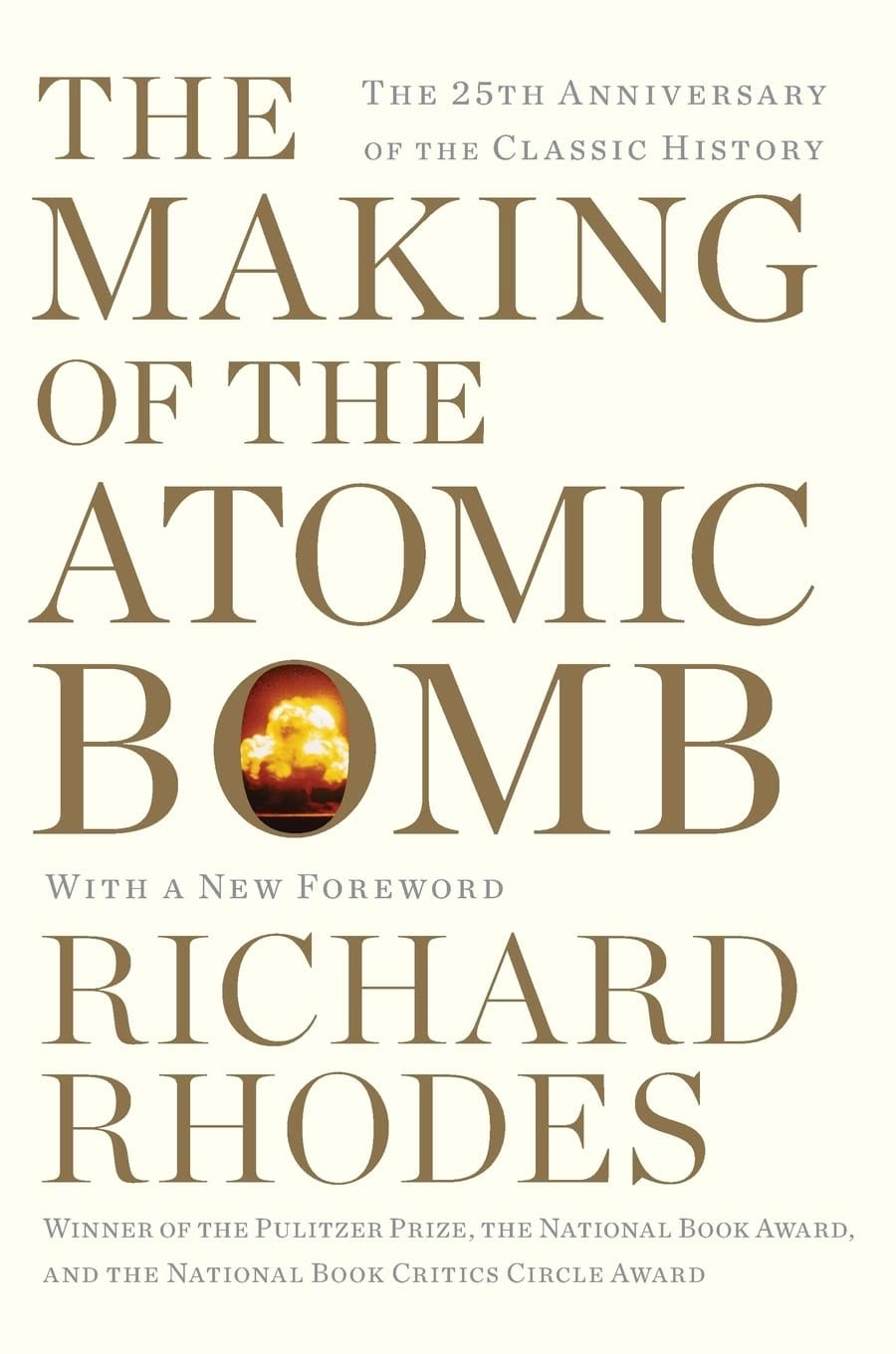
Making of the Atomic Bomb - Richard Rhodes.pdf (file not included in this release)
Executive Summary
Richard Rhodes’s The Making of the Atomic Bomb argues that the atomic bomb was not merely a military invention but the outcome of a long convergence of modern physics, European political catastrophe, industrial mobilization, and wartime moral pressure. The bomb emerged from discoveries originally pursued for knowledge rather than utility: atomic theory, radioactivity, quantum mechanics, the neutron, nuclear fission, and chain reactions. Rhodes’s central claim is that the bomb was both scientifically inevitable once fission was discovered and politically contingent in the way it was built, used, and integrated into postwar power.
The book’s significance lies in its fusion of scientific explanation, biography, political history, and moral reflection. Rhodes shows that the Manhattan Project was not just a secret military program but a compressed version of twentieth-century modernity: refugee science, total war, state bureaucracy, industrial capitalism, and apocalyptic technological power.
[!quote] Oppenheimer’s Scientific Principle
“The deep things in science are not found because they are useful.” — Page 21
Timeline of Events
| Year / Date | Event | Main People / Institutions | Significance |
|---|---|---|---|
| 5th century B.C. | Ancient atomism develops | Leucippus, Democritus | Introduces the idea that reality consists of atoms and void. |
| 1895 | X-rays discovered | Wilhelm Röntgen | Opens the experimental path toward radiation physics. |
| 1896 | Radioactivity discovered | Henri Becquerel | Reveals that atoms are not inert, indivisible units. |
| 1898 | Radium and polonium identified | Marie and Pierre Curie | Establishes radioactivity as a major scientific field. |
| 1900 | Quantum hypothesis proposed | Max Planck | Begins the quantum revolution necessary for nuclear theory. |
| 1905 | Einstein’s miracle year | Albert Einstein | Publishes work on relativity, quanta, and Brownian motion; strengthens atomic theory. |
| 1911 | Nuclear atom proposed | Ernest Rutherford | Shows that atoms have a small, dense, positively charged nucleus. |
| 1913 | Bohr model of the atom | Niels Bohr | Combines Rutherford’s atom with quantum theory. |
| 1914–1918 | First World War | European powers | Militarizes science and destroys the prewar European order. |
| 1919 | Rutherford achieves artificial transmutation | Ernest Rutherford | Demonstrates that nuclei can be altered by bombardment. |
| 1920s | Quantum mechanics matures | Bohr, Heisenberg, Schrödinger, Dirac, Pauli | Gives physicists the conceptual tools to understand atomic structure. |
| 1932 | Neutron discovered | James Chadwick | Provides the neutral projectile needed to penetrate nuclei. |
| September 12, 1933 | Szilard conceives neutron chain reaction | Leo Szilard | First clear conceptual step toward an atomic explosive. |
| 1933 | Hitler takes power | Nazi Germany | Drives Jewish and anti-Nazi scientists out of Central Europe. |
| 1934 | Fermi bombards uranium with neutrons | Enrico Fermi | Produces confusing results later understood as fission products. |
| 1938 | Hahn and Strassmann split uranium | Otto Hahn, Fritz Strassmann, Lise Meitner, Otto Frisch | Nuclear fission is discovered. |
| January 1939 | Fission announced publicly | Bohr, Frisch, Meitner, American physicists | The physics community recognizes the military implications. |
| August 1939 | Einstein-Szilard letter sent to Roosevelt | Einstein, Szilard, Roosevelt | Warns that Germany may develop atomic weapons. |
| 1940 | Frisch-Peierls memorandum | Otto Frisch, Rudolf Peierls | Shows that a small U-235 bomb may be feasible. |
| 1941 | MAUD Committee report reaches U.S. | British nuclear program, U.S. officials | Pushes the U.S. toward serious bomb development. |
| December 1941 | U.S. enters World War II | United States, Japan, Germany | Turns atomic research into urgent military policy. |
| December 2, 1942 | First controlled nuclear chain reaction | Enrico Fermi, Chicago Pile-1 | Proves that nuclear energy can be released and controlled. |
| 1942 | Manhattan Engineer District created | Leslie Groves, U.S. Army | Centralizes bomb production under military authority. |
| 1943 | Los Alamos laboratory begins | Oppenheimer, Groves | Bomb design becomes a concentrated scientific-industrial effort. |
| 1943–1945 | Oak Ridge and Hanford operate | Manhattan Project | Produces enriched uranium and plutonium. |
| 1944 | Plutonium gun design abandoned | Los Alamos | Reactor plutonium contains Pu-240, requiring implosion design. |
| July 16, 1945 | Trinity test | Los Alamos, U.S. Army | First nuclear explosion in history. |
| August 6, 1945 | Hiroshima bombed | Enola Gay, Little Boy | First wartime use of an atomic bomb. |
| August 9, 1945 | Nagasaki bombed | Bockscar, Fat Man | Second wartime use; plutonium implosion weapon used. |
| August 15, 1945 | Japan announces surrender | Japan, Allied powers | Ends World War II and begins the nuclear age. |
Key Concepts
Atomic Theory
The idea that matter consists of discrete units. Rhodes traces this from ancient Greek atomism to twentieth-century experimental physics. The book shows that the atomic bomb required more than belief in atoms; it required a detailed understanding of the nucleus.
[!quote] Democritus’s Atomic World
“In reality atoms and void.” — Page 40
Radioactivity
The spontaneous emission of energy and particles from unstable atoms. Radioactivity revealed that atoms were not permanent, indivisible objects but dynamic systems capable of transformation.
Nuclear Transmutation
The conversion of one element into another through nuclear reactions. Rutherford’s work made transmutation experimentally real, replacing alchemy with nuclear physics.
Quantum Mechanics
The theoretical revolution that explained atomic behavior in terms of discrete energy states, probability, and mathematical formalism. Rhodes presents quantum mechanics as the conceptual language needed to understand nuclear processes.
Neutron
A neutral nuclear particle discovered by James Chadwick in 1932. Because it has no electric charge, the neutron can enter atomic nuclei more easily than charged particles. This made it the key projectile for inducing fission.
Nuclear Fission
The splitting of a heavy atomic nucleus, especially uranium, into lighter nuclei, releasing energy and neutrons. Fission is the central physical discovery behind the bomb.
Chain Reaction
A self-sustaining process in which neutrons from one fission event trigger additional fissions. Szilard’s insight was that a chain reaction could release enormous energy very quickly.
Critical Mass
The minimum amount of fissile material needed to sustain an explosive chain reaction. Critical mass depends on material purity, geometry, density, neutron reflection, and assembly speed.
Cross Section
A measure of the probability that a nuclear reaction will occur when a particle strikes a nucleus. Rhodes emphasizes that the bomb depended on exact physical measurements, not speculation.
[!quote] Segrè on Measurement
“Solid numbers based on measurement” were paramount. — Page 10
Isotope Separation
The industrial process of separating U-235 from the more abundant U-238. Since chemically identical isotopes differ only slightly in mass, separation required immense technical infrastructure.
Plutonium Production
The creation of Pu-239 in nuclear reactors by neutron capture in U-238. Plutonium offered an alternative bomb fuel but created the design problem that led to implosion.
Gun-Type Weapon
A bomb design that fires one subcritical mass of fissile material into another. This was used for the uranium bomb dropped on Hiroshima.
Implosion Weapon
A design that compresses a plutonium core with precisely shaped explosive lenses. This was technically more difficult but necessary for plutonium because reactor plutonium could pre-detonate in a gun-type design.
Total War
The mobilization of entire societies, economies, and scientific establishments for military victory. Rhodes presents the Manhattan Project as a product of total war.
Moral Responsibility of Scientists
A recurring theme: scientists create knowledge, but states weaponize it. Rhodes does not absolve scientists, but he resists the simplistic claim that they could have prevented nuclear weapons by suppressing discovery.
Key Terms
- Atom — The basic unit of matter, later understood to contain electrons and a nucleus.
- Nucleus — The dense central core of the atom containing protons and neutrons.
- Electron — Negatively charged particle orbiting or existing around the nucleus.
- Proton — Positively charged nuclear particle.
- Neutron — Electrically neutral nuclear particle essential to fission.
- Alpha Particle — Helium nucleus emitted by radioactive materials.
- Beta Decay — Radioactive decay involving electron or positron emission.
- Gamma Radiation — High-energy electromagnetic radiation from nuclei.
- Isotope — Atoms of the same element with different numbers of neutrons.
- U-235 — Rare fissile uranium isotope usable in a bomb.
- U-238 — Common uranium isotope; not directly usable in a simple bomb but convertible into plutonium.
- Pu-239 — Fissile plutonium isotope produced in reactors.
- Moderator — Material, such as graphite or heavy water, that slows neutrons in a reactor.
- Pile — Early term for a nuclear reactor.
- Neutron Economy — Balance of neutrons produced, absorbed, lost, or used to continue fission.
- Tamper — Dense material surrounding a bomb core to hold it together briefly and reflect neutrons.
- Explosive Lens — Shaped chemical explosive charge used to create symmetrical implosion.
- Pre-detonation — Premature nuclear reaction that reduces yield.
- Yield — Explosive energy released, usually measured in tons or kilotons of TNT equivalent.
- Manhattan Project — U.S.-led wartime program to build atomic bombs.
- MAUD Committee — British committee that concluded an atomic bomb was feasible.
- Tube Alloys — British code name for atomic bomb research.
- Trinity — First nuclear test, conducted in New Mexico on July 16, 1945.
Part One: Profound and Necessary Truth
Chapter 1: Moonshine
Rhodes opens with Leo Szilard crossing a London street on September 12, 1933, when he conceives the idea of a neutron-induced chain reaction. This is the book’s symbolic origin point: the bomb begins not in a factory or military office, but in an act of theoretical imagination.
Szilard’s biography is central. Rhodes presents him as a politically alert, morally anxious, and intellectually restless Hungarian Jewish physicist shaped by the First World War, the collapse of empires, Berlin science, and H. G. Wells’s visions of world government. Szilard is not merely a scientist; he is a strategist of civilization who sees earlier than most that nuclear physics may become politically catastrophic.
Main ideas:
- Szilard’s 1933 insight anticipates the atomic bomb before fission is discovered.
- His imagination links science with geopolitical danger.
- Rhodes frames scientific discovery as both liberating and terrifying.
- The chapter introduces one of the book’s central tensions: knowledge pursued innocently can become militarily decisive.
[!quote] Szilard’s Moment
“Time cracked open before him.” — Page 22
Chapter 2: Atoms and Void
This chapter gives the deep intellectual prehistory of atomic theory. Rhodes begins with Greek atomism and follows the long path by which atoms moved from philosophical speculation into experimental reality.
The chapter explains that the atomic bomb required a real atom, not merely the idea of one. Nineteenth- and early twentieth-century physics gradually established that matter consisted of atoms and that atoms had internal structure. The discovery of radioactivity, electrons, and nuclear structure dissolved the older picture of atoms as solid indivisible units.
Main ideas:
- Ancient atomism supplied a metaphysical image, but modern physics supplied experimental proof.
- The atom became increasingly complex: not a billiard ball, but a structured system.
- Radioactivity implied that atoms contained enormous internal energy.
- Scientific realism about atoms emerged through measurement, not speculation.
Chapter 3: Tvi
The title refers to Niels Bohr’s soft, hesitant Danish pronunciation of “two,” symbolizing the peculiar mixture of awkwardness and genius that Rhodes attributes to him. The chapter centers on Bohr and the theoretical revolution that made atomic structure intelligible.
Bohr’s model of the atom combined Rutherford’s nuclear atom with Planck’s quantum hypothesis. Rhodes portrays Bohr as a scientific philosopher as much as a physicist: cautious, collaborative, and deeply committed to conceptual clarity. His influence extends far beyond a single model; he becomes the intellectual center of international physics.
Main ideas:
- Bohr gives structure to the atom by introducing quantized electron orbits.
- The old mechanical model of physics breaks down.
- Modern physics becomes international, collaborative, and increasingly abstract.
- Bohr’s Copenhagen circle becomes one of the central institutions of twentieth-century science.
Chapter 4: The Long Grave Already Dug
Rhodes shifts from scientific discovery to European catastrophe. The chapter places German science inside the militarized and nationalist culture that led to the First World War and later Nazism. The “long grave” suggests that Europe’s scientific brilliance coexisted with political self-destruction.
Otto Hahn, Lise Meitner, and the Kaiser Wilhelm Institutes appear in this setting. German chemistry and physics were among the most advanced in the world, but they were embedded in imperial ambition, war mobilization, and later racial politics.
Main ideas:
- German scientific institutions were powerful, prestigious, and closely connected to state power.
- World War I militarized scientific research and damaged the moral authority of European civilization.
- The same scientific culture that produced extraordinary discoveries was vulnerable to nationalism and authoritarianism.
- Rhodes begins connecting laboratory science to the machinery of war.
Chapter 5: Men from Mars
This chapter focuses on the extraordinary generation of Hungarian Jewish scientists who seemed, to their colleagues, almost extraterrestrial in ability: Leo Szilard, Eugene Wigner, Edward Teller, John von Neumann, and others.
Rhodes situates their brilliance in Budapest’s intense educational culture, Jewish assimilation, social ambition, and the instability of Central Europe. These “Martians” later become crucial to American science and the Manhattan Project.
Main ideas:
- Hungarian Jewish intellectual culture produced several of the century’s most important physicists and mathematicians.
- Anti-Semitism and political instability pushed talent westward.
- Refugee scientists became a strategic asset for the United States.
- Rhodes emphasizes biography as a force in history: individual migration changed the balance of wartime science.
Chapter 6: Machines
The focus shifts to experimental apparatus: particle accelerators, detectors, vacuum tubes, counters, and laboratory machinery. Rhodes shows that nuclear physics advanced because scientists learned to build machines capable of probing the nucleus.
Ernest Rutherford’s Cavendish Laboratory represents the older experimental tradition, while Ernest Lawrence’s cyclotron points toward Big Science: large teams, large budgets, and machines too expensive for lone investigators.
Main ideas:
- Nuclear discovery depended on instrumentation.
- The scale of physics increased dramatically in the interwar years.
- Lawrence’s cyclotron foreshadows the Manhattan Project’s industrial-scientific organization.
- The boundary between pure science and applied engineering becomes increasingly thin.
Chapter 7: Exodus
This chapter covers the forced migration of Jewish and anti-Nazi scientists after Hitler’s rise. Rhodes shows that Nazi racial policy crippled German science while strengthening Britain and the United States.
Einstein’s international fame, German anti-Semitism, and the refugee crisis form the chapter’s political core. The exodus is one of the book’s decisive historical ironies: the regime that feared Jewish influence expelled the very scientists who would help defeat it.
Main ideas:
- Hitler’s rise transforms nuclear physics from a European enterprise into an Anglo-American one.
- Anti-Semitism becomes strategically self-destructive for Germany.
- Refugee scientists carry knowledge, urgency, and political warning to the West.
- The future Manhattan Project is inseparable from fascist persecution.
Chapter 8: Stirring and Digging
Rhodes follows the scientific ferment of the early and mid-1930s. Neutrons become increasingly important as experimental tools, especially in Enrico Fermi’s work bombarding elements with neutrons.
The chapter captures the confusion before fission was understood. Scientists observed strange results when uranium was bombarded, but they lacked the conceptual framework to interpret them correctly. The title suggests both intellectual agitation and experimental excavation.
Main ideas:
- Fermi’s neutron experiments produce results that later prove crucial.
- Scientists are close to fission before they know what they are seeing.
- Experimental data often precede theoretical interpretation.
- The international physics community remains open and communicative, even as Europe moves toward war.
Chapter 9: An Extensive Burst
This chapter narrates the discovery of nuclear fission. Otto Hahn and Fritz Strassmann chemically identify barium after uranium bombardment; Lise Meitner and Otto Frisch interpret the result as the splitting of the uranium nucleus.
Rhodes gives special importance to Meitner, whose exile from Nazi Germany illustrates the intersection of scientific achievement and political exclusion. The phrase “an extensive burst” captures the sudden release of understanding: once fission is recognized, its implications spread rapidly.
Main ideas:
- Fission is discovered in Nazi Germany, creating immediate geopolitical urgency.
- Meitner and Frisch provide the theoretical interpretation that Hahn and Strassmann’s chemistry required.
- The discovery was scientifically inevitable given the state of neutron research.
- The military implications become apparent almost immediately: fission releases energy and additional neutrons.
Part Two: A Peculiar Sovereignty
Chapter 10: Neutrons
After fission becomes known, Szilard and other émigré scientists worry that Germany might exploit it first. The chapter centers on secrecy, communication, and the problem of responsible scientific behavior.
Szilard attempts to persuade scientists to withhold publication of fission-related work. This reverses the normal scientific ethic of openness. Rhodes presents the dilemma sharply: free exchange accelerates science, but in wartime it may also accelerate weapons.
Main ideas:
- Fission transforms nuclear physics into a security problem.
- Szilard emerges again as the scientist most alert to political danger.
- The scientific community struggles with voluntary secrecy.
- The neutron becomes the physical key to both reactors and bombs.
Chapter 11: Cross Sections
This chapter concerns the hard measurements needed to determine whether a bomb is feasible. Rhodes emphasizes that theoretical possibility was not enough. The project depended on nuclear constants: neutron absorption, scattering, multiplication, and fission probabilities.
The chapter also covers the Frisch-Peierls memorandum, which showed that a bomb using separated U-235 might require far less material than many had assumed. This was one of the decisive steps toward serious weapon development.
Main ideas:
- Bomb feasibility depended on quantitative nuclear data.
- The Frisch-Peierls calculation made the atomic bomb seem militarily practical.
- Britain’s MAUD Committee moved faster than the early American effort.
- Rhodes repeatedly stresses the difference between speculation and measurement.
Chapter 12: A Communication from Britain
British nuclear research becomes the catalyst for American action. The MAUD Committee concludes that an atomic bomb is feasible and potentially decisive. British communication to the United States helps overcome American hesitation.
Rhodes shows that the early U.S. program was slow, fragmented, and skeptical. British urgency helped convert possibility into policy.
Main ideas:
- Britain, despite wartime vulnerability, initially leads in bomb feasibility analysis.
- The MAUD Report gives the United States a concrete technical and military case.
- Anglo-American cooperation becomes essential, though not always equal.
- The atomic bomb moves from scientific question to state priority.
Chapter 13: The New World
This chapter follows the American transition from research to large-scale development. Fermi’s work on a controlled chain reaction becomes central. Arthur Compton, Vannevar Bush, James Conant, and other administrators begin shaping the institutional framework.
The chapter culminates in the realization that the United States has the industrial capacity to build what Britain cannot build alone. “The New World” means both America and the new nuclear era.
Main ideas:
- The U.S. converts scientific uncertainty into organized wartime development.
- Fermi’s reactor work proves that controlled nuclear energy is achievable.
- American industrial scale becomes decisive.
- The Manhattan Project begins to emerge as a coordinated system.
Chapter 14: Physics and Desert Country
Rhodes turns to Robert Oppenheimer and the founding of Los Alamos. Oppenheimer is presented as an unlikely but effective leader: intellectually brilliant, personally complex, politically vulnerable, and unusually capable of synthesizing theoretical physics.
General Leslie Groves chooses Oppenheimer despite doubts about his administrative experience and political associations. Los Alamos becomes the place where scattered theoretical, experimental, and engineering problems are integrated into bomb design.
Main ideas:
- Oppenheimer’s leadership is intellectual, charismatic, and synthetic.
- Groves supplies military authority and logistical force.
- Los Alamos concentrates elite scientific talent under wartime pressure.
- The desert laboratory symbolizes the fusion of pure physics and military secrecy.
Chapter 15: Different Animals
This chapter focuses on Oak Ridge, Hanford, and the industrial side of the Manhattan Project. Rhodes shows that building the bomb required factories as much as equations.
The phrase “different animals” points to the distinct technical problems of uranium enrichment and plutonium production. Electromagnetic separation, gaseous diffusion, thermal diffusion, and reactor breeding were different technological species, each requiring massive investment.
Main ideas:
- The Manhattan Project was an industrial megaproject, not merely a laboratory achievement.
- Oak Ridge separated uranium isotopes through multiple methods.
- Hanford produced plutonium in large reactors.
- Groves’s strategy was redundancy: pursue several methods simultaneously because no one knew which would work.
Chapter 16: Revelations
British scientists join Los Alamos and enrich the project with crucial expertise. The chapter also explores espionage and the flow of knowledge, especially through figures such as Klaus Fuchs.
The title suggests multiple revelations: technical discoveries, political secrets, and moral awakenings. As the bomb becomes real, scientists begin to understand that they are not simply racing Germany; they are creating a permanent transformation in world power.
Main ideas:
- The British mission strengthens Los Alamos technically.
- Espionage complicates the story of national ownership of nuclear knowledge.
- The bomb’s postwar implications become increasingly visible.
- Scientific internationalism survives inside a project of national military secrecy.
Chapter 17: The Evils of This Time
By early 1945, Germany is collapsing, but the bomb project continues. This chapter examines the moral and political question: if the original justification was fear of a Nazi bomb, what happens when Germany is no longer the target?
Rhodes covers discussions among scientists and officials about demonstration, use, postwar control, and Soviet relations. The chapter’s title evokes the moral weight of wartime decision-making.
Main ideas:
- The bomb’s purpose shifts from deterring Germany to ending the war with Japan and shaping postwar power.
- Scientists become divided over how the weapon should be introduced.
- The Franck Report and related petitions reflect moral opposition to surprise use.
- Political and military leaders increasingly treat use as expected rather than exceptional.
Part Three: Life and Death
Chapter 18: Trinity
This chapter narrates the final preparations and first test of an atomic bomb at Trinity on July 16, 1945. Rhodes presents Trinity as both technical climax and metaphysical rupture.
The implosion device had to work because plutonium could not be used safely in a simple gun-type weapon. Trinity therefore tested not merely a bomb but an entire theory of precision explosives, shock waves, neutron initiation, and plutonium compression.
Main ideas:
- Trinity proves that implosion works.
- The test transforms theoretical and industrial labor into visible destructive power.
- Oppenheimer and the Los Alamos scientists confront the reality of what they have made.
- The successful test strengthens the political momentum toward use against Japan.
[!quote] The Nuclear Threshold
“The bombs didn’t fix them.” — Page 19
Chapter 19: Tongues of Fire
The final chapter covers Hiroshima and Nagasaki. Rhodes moves from production and testing to human destruction. The atomic bomb leaves the realm of calculation and enters lived catastrophe: blast, fire, radiation, burns, death, and trauma.
The chapter also examines the military logistics of delivery, the selection of targets, and the political context of Japan’s surrender. Rhodes does not reduce the bombings to a single cause of surrender; he presents them as part of a complex endgame involving Soviet entry, Japanese internal politics, blockade, conventional bombing, and imperial decision-making.
Main ideas:
- Hiroshima and Nagasaki demonstrate nuclear weapons as city-destroying instruments.
- The human consequences exceed the abstract language of yield and strategy.
- The bombings force a new moral and political reality onto the world.
- The nuclear age begins not with deterrence theory but with burned cities.
Critical Analysis
Methodology
Rhodes’s method is synthetic and narrative. He combines:
- Scientific exposition
- Biographical portraiture
- Institutional history
- Military history
- Political decision-making
- Moral reflection
This is the book’s greatest strength. Rhodes makes the atomic bomb intelligible as a historical process rather than as a single invention. He explains the physics without reducing the story to technical detail, and he explains the politics without treating science as merely a tool of the state.
Strengths
- Exceptional integration of science and history: Rhodes explains nuclear physics in relation to the people, institutions, and crises that made it consequential.
- Strong biographical architecture: Szilard, Bohr, Fermi, Oppenheimer, Groves, Meitner, Hahn, Teller, and others are not decorative figures; their personalities shape events.
- Clear sense of contingency: Rhodes shows that while fission may have been scientifically inevitable, the bomb’s production and use depended on choices.
- Moral seriousness: The book does not treat Hiroshima and Nagasaki as mere strategic endpoints. It forces the reader to confront the human cost.
- Attention to refugee science: Rhodes demonstrates how Nazi persecution unintentionally empowered Allied nuclear research.
Limitations and Biases
- Scientist-centered narrative: Although Rhodes discusses industrial labor and military administration, the book’s emotional and intellectual center remains elite scientists.
- Less attention to Japanese perspectives until the end: The victims of Hiroshima and Nagasaki appear most forcefully in the final chapter, but the earlier narrative is dominated by Allied decision-making.
- Oppenheimer’s charisma can distort emphasis: Rhodes is aware of Oppenheimer’s flaws, but the narrative naturally gravitates toward him.
- Moral ambiguity rather than final judgment: Some readers may find Rhodes too unwilling to deliver a simple verdict on the bombings. His approach is analytical rather than prosecutorial.
- Postwar nuclear politics are foreshadowed more than fully developed: The book ends at the birth of the nuclear age, leaving the Cold War arms race for later works.
Overall Evaluation
The Making of the Atomic Bomb is powerful because it refuses to separate knowledge, power, and responsibility. Rhodes’s core achievement is showing that the bomb was neither an accident nor a simple military project. It was the result of modern science becoming inseparable from the modern state under conditions of total war.
The book’s deepest implication is that scientific discovery cannot be morally quarantined. Once knowledge exists, it enters institutions, rivalries, fears, and ambitions. The atomic bomb is therefore not only a weapon; it is a case study in what happens when human beings acquire powers before they acquire stable political forms capable of governing them.
Questions for Reflection
- Was the atomic bomb scientifically inevitable after the discovery of fission, or did its creation depend mainly on wartime political choices?
- How does Rhodes distinguish between the responsibility of scientists who discover knowledge and the responsibility of governments that weaponize it?
- Did the refugee scientists’ fear of Nazi Germany justify their role in initiating the American bomb project?
- How did the Manhattan Project transform the relationship between science, the military, universities, and the state?
- Why did the collapse of Germany not stop the momentum toward using the bomb against Japan?
- Was Hiroshima primarily a military act, a diplomatic signal, a technological demonstration, or some combination of all three?
- What does the atomic bomb reveal about the limits of national sovereignty in an age of civilization-ending weapons?
Connections
Influential Works and Intellectual Sources Mentioned or Implied
- Democritus and Leucippus — Ancient atomism; matter as atoms and void.
- Isaac Newton — Mechanical universe; classical physics.
- James Clerk Maxwell — Electromagnetism; field theory.
- Max Planck — Quantum theory.
- Albert Einstein — Relativity, quantum theory, mass-energy equivalence, political warning.
- Ernest Rutherford — Nuclear atom, transmutation, experimental nuclear physics.
- Niels Bohr — Atomic model, complementarity, scientific internationalism.
- Werner Heisenberg — Quantum mechanics; German wartime nuclear research.
- Enrico Fermi — Neutron bombardment, first controlled chain reaction.
- Leo Szilard — Chain reaction concept, Einstein letter, scientist activism.
- Lise Meitner — Theoretical interpretation of fission.
- Otto Hahn and Fritz Strassmann — Chemical discovery of uranium fission products.
- Otto Frisch and Rudolf Peierls — Bomb feasibility memorandum.
- Robert Oppenheimer — Los Alamos leadership.
- Leslie Groves — Military command of the Manhattan Project.
- Vannevar Bush and James Conant — U.S. science administration.
- Edward Teller — Bomb design, later thermonuclear weapons.
- John von Neumann — Mathematics, implosion design, computing, strategic thought.
- H. G. Wells — World-state imagination and Szilard’s political vision.
- The MAUD Report — British feasibility analysis for an atomic bomb.
- The Franck Report — Scientists’ warning against surprise atomic use.
- The Manhattan Project — Model of Big Science and wartime state-science fusion.
- World War I — Background catastrophe that militarized science and destabilized Europe.
- Nazism and anti-Semitism — Forces that expelled scientific talent and reshaped global physics.
- World War II strategic bombing — Context for Hiroshima and Nagasaki.
- Cold War nuclear deterrence — The postwar system implied by the bomb’s creation.
- Nuclear nonproliferation and disarmament movements — Later political attempts to govern the power created in 1945.