⬅️ Hub: History
📓 In your handwritten notebooks
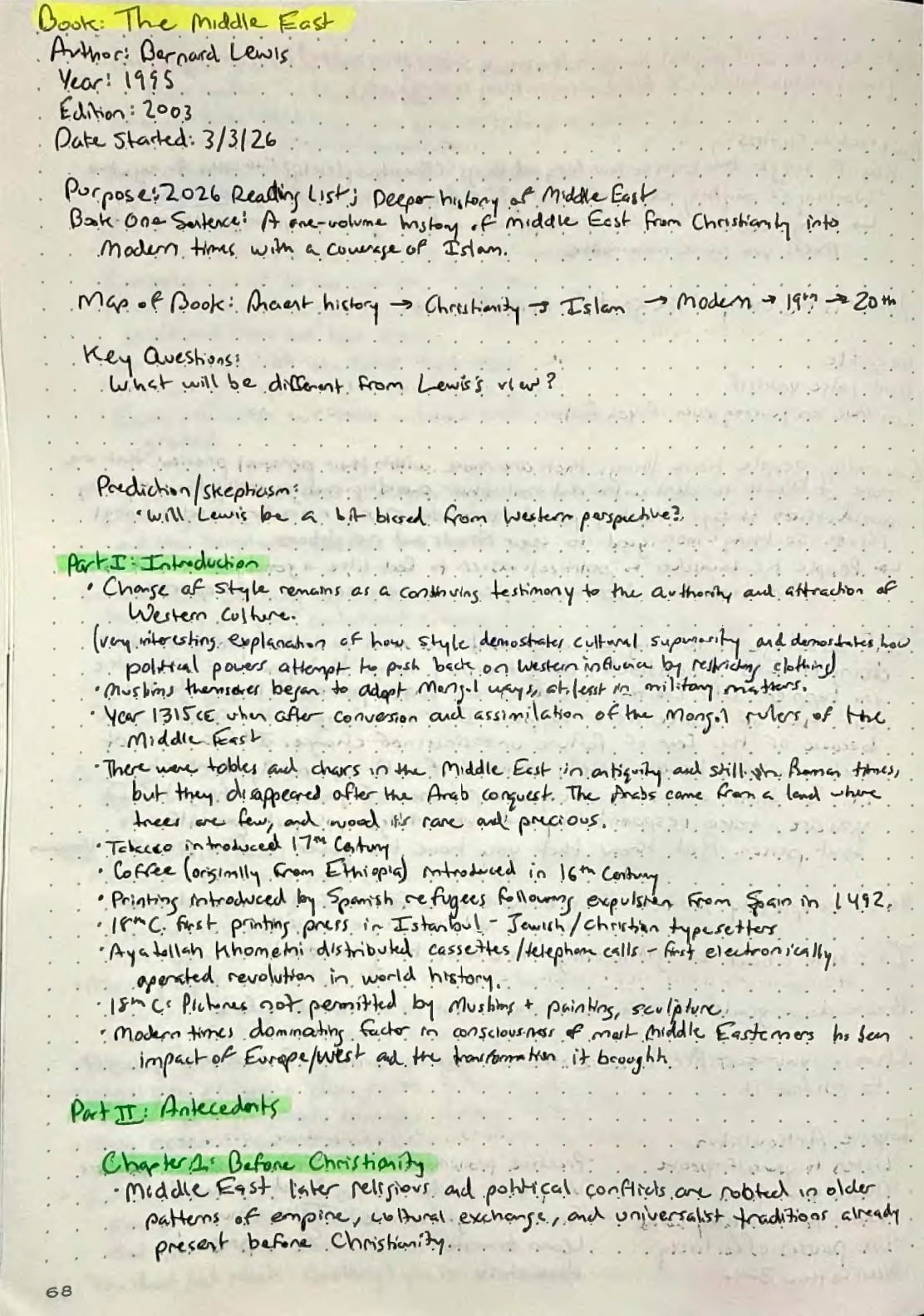
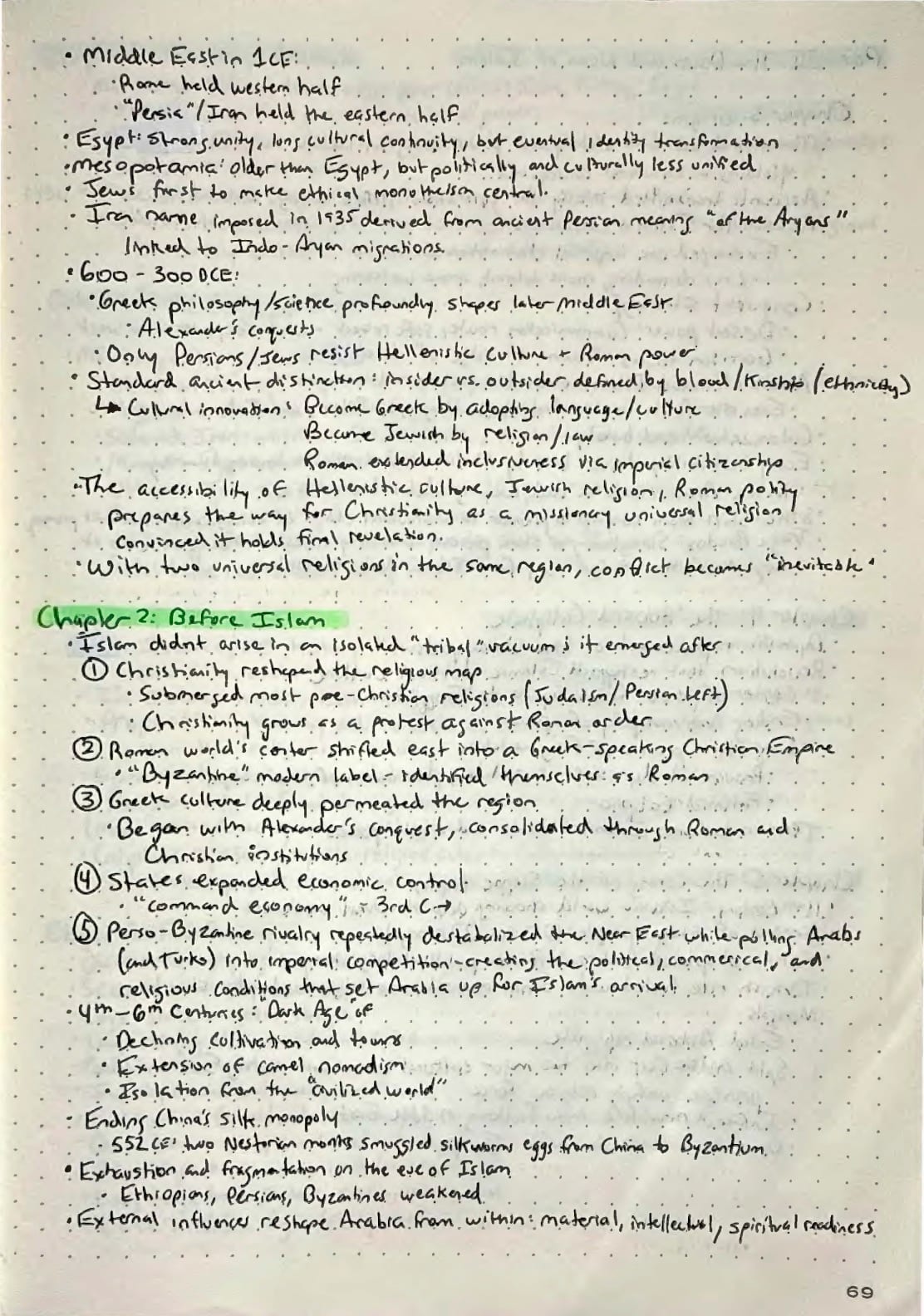
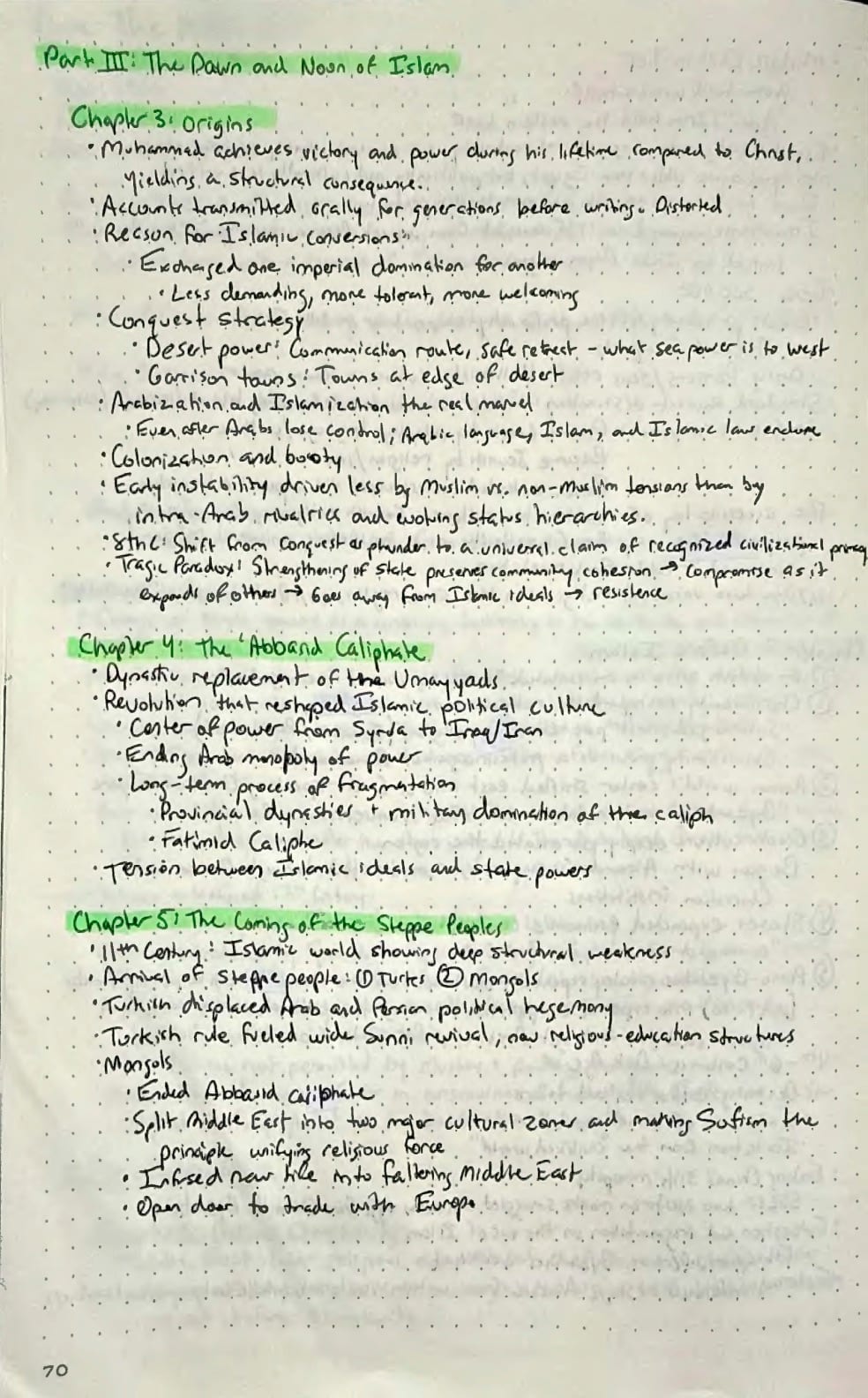
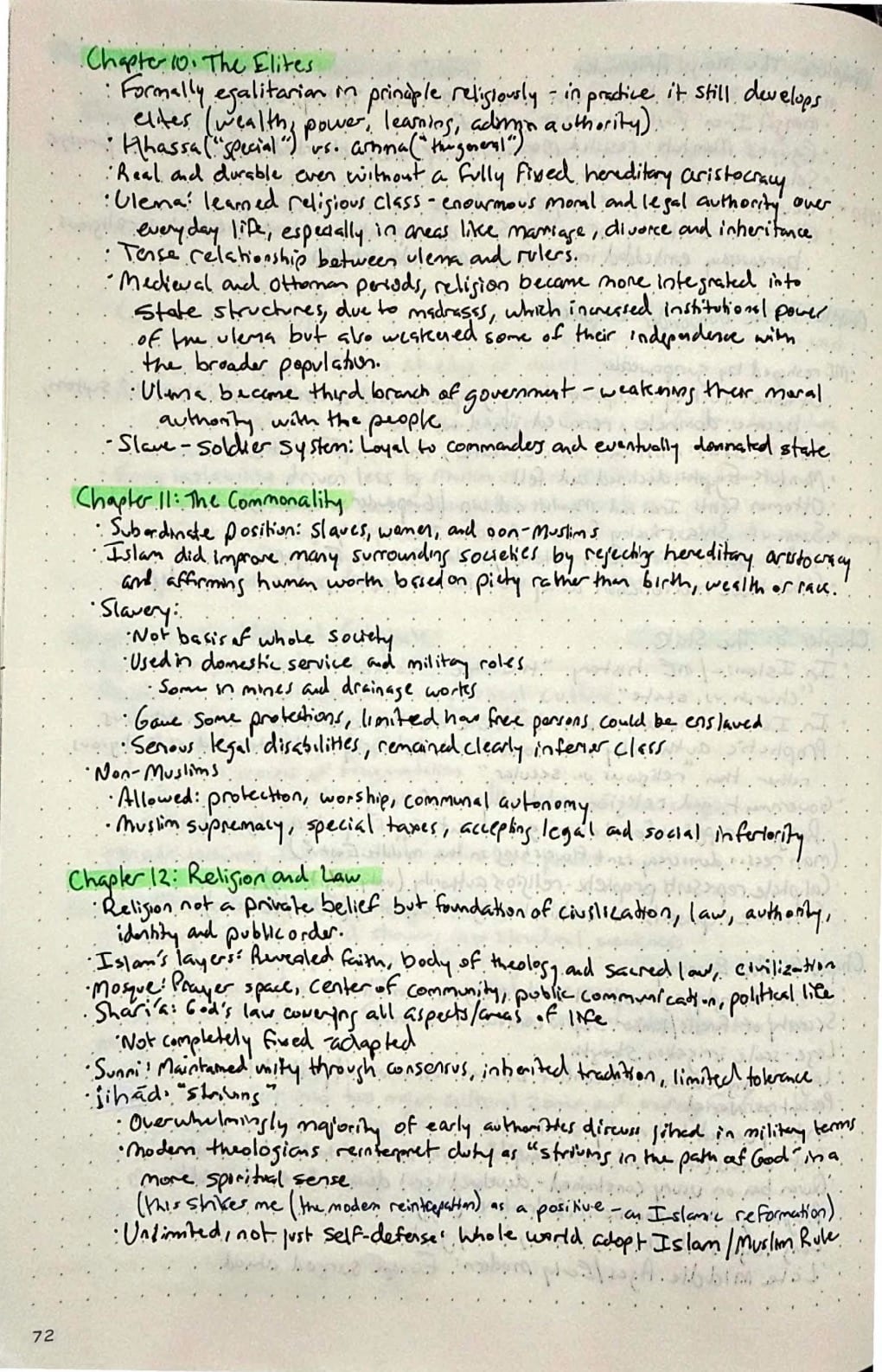
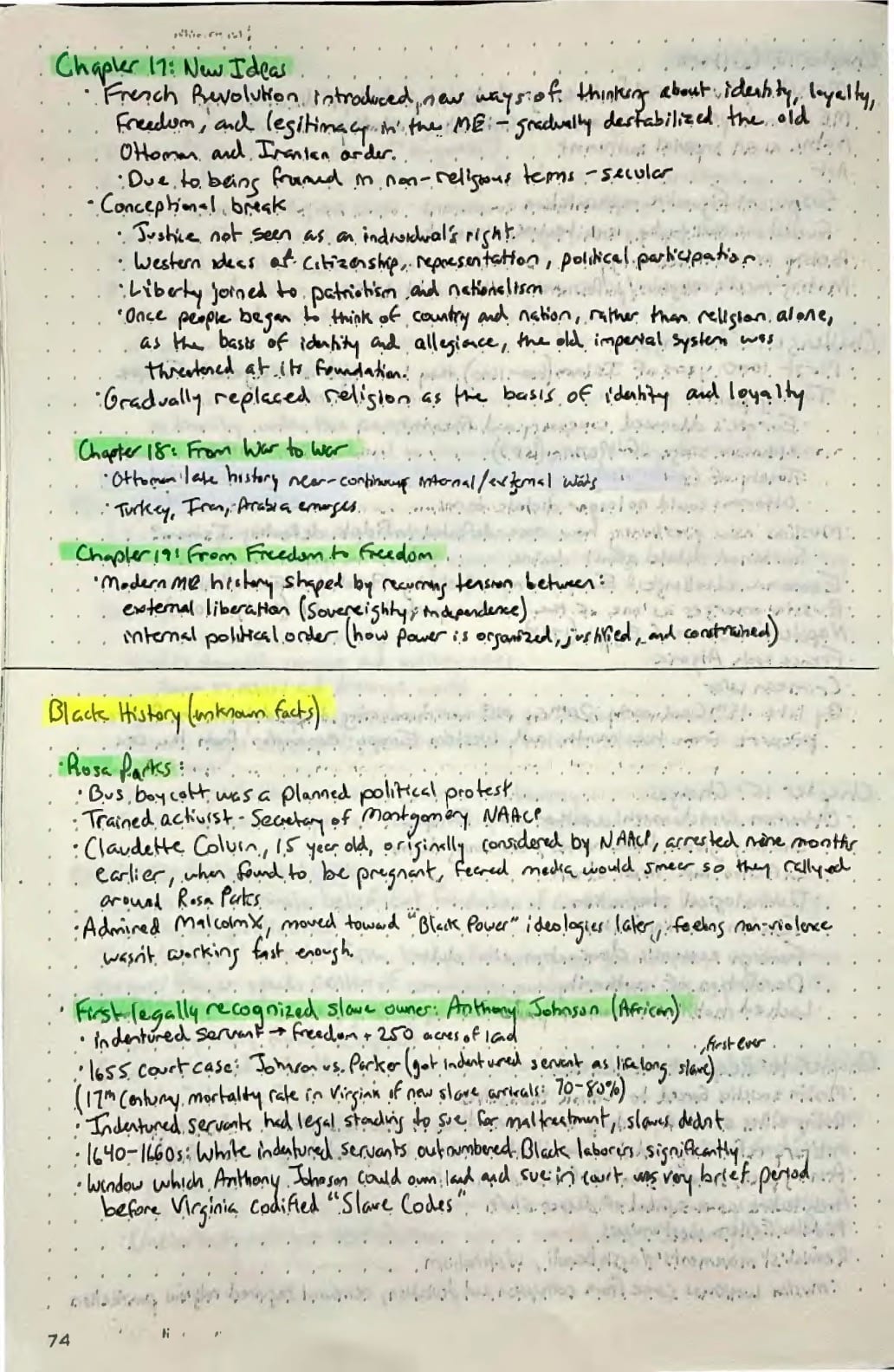
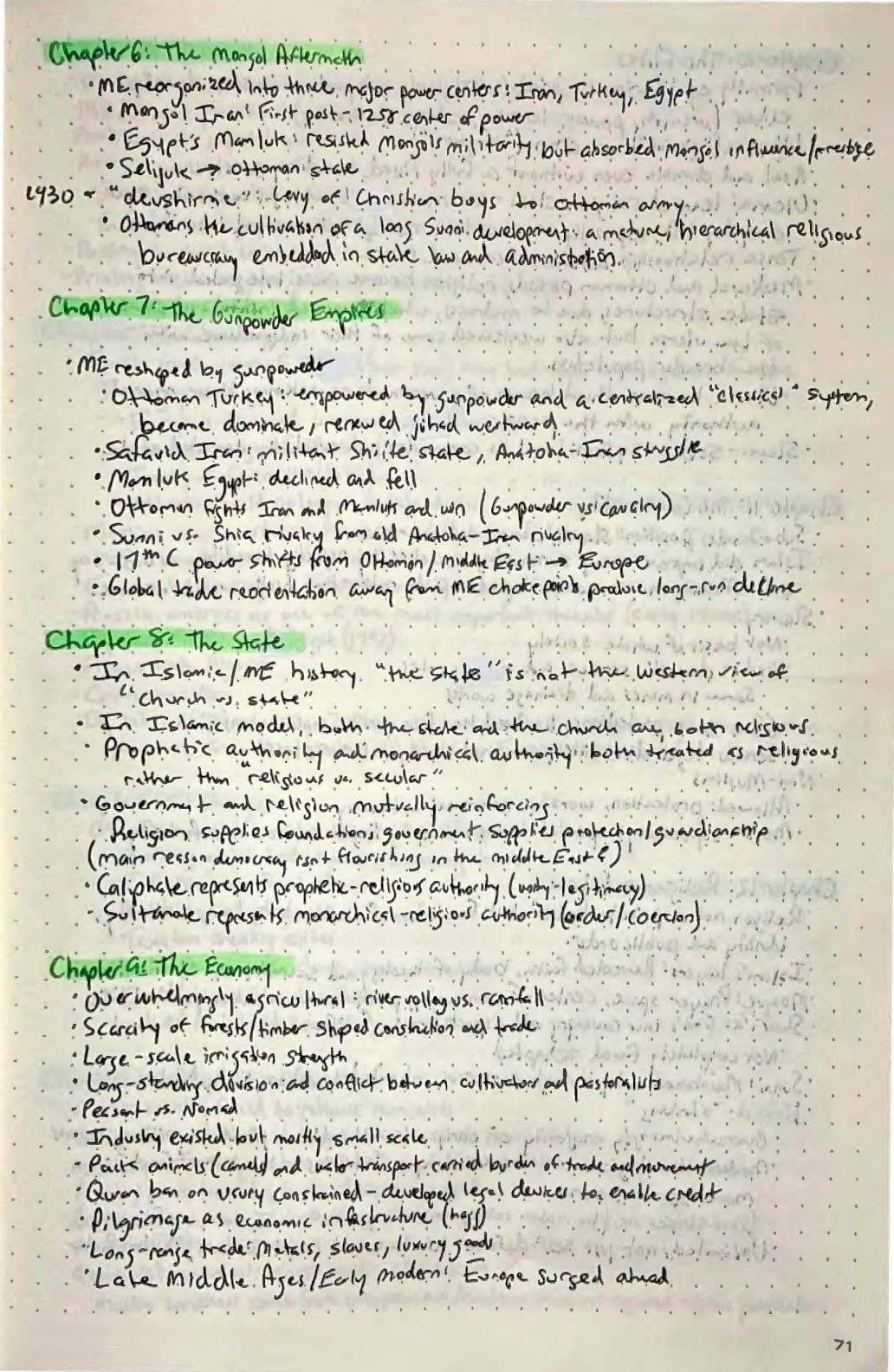
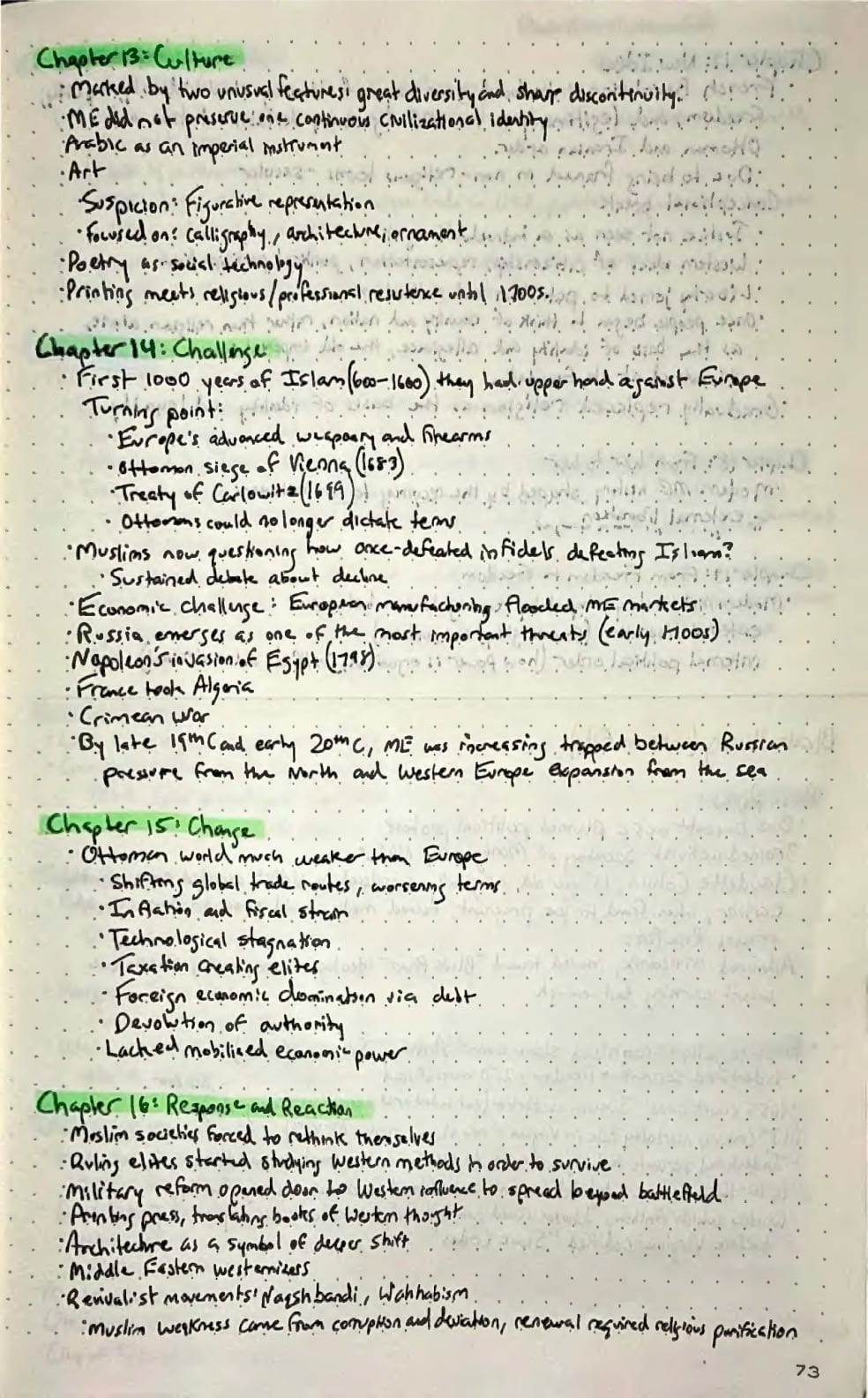
- Feb – March 21 2026, pp. 68–74 — *The Middle East — Bernard Lewis* → open PDF p77 (file not included in this release)
Index: Personal Journal
DESCRIPTION
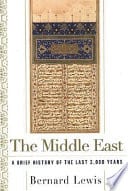
A 2000-year history of a region stretching from Libya to Central Asia ; concludes with the effects of the Gulf War.
The Middle East - Bernard Lewis - Chronology (book scan).pdf (file not included in this release)
AI Summary
**Introduction
Chapter objective
Lewis uses an everyday scene—the modern Middle Eastern coffee-house—as a “micro-history” of the region’s encounter with modernity. His aim is to show that, unlike Europe’s largely internal evolution, many of the most visible “modern” changes in the Middle East arrived from outside, especially from the West, and that these imports reshaped not only material life (clothes, furniture, media) but also identity, authority, language, and cultural self-understanding.
Main ideas
The coffee-house as a “compressed history” of Western impact
Lewis opens by describing the coffee-house patron—typically a man—drinking coffee/tea, smoking, reading a newspaper, playing a board game, and half-listening to radio/TV. The ordinariness of the scene is the point: the “modern” Middle Eastern public sphere is built out of objects and practices that encode a larger historical story of transformation.
The coffee-house as symbol
“The man in a coffee-house, sitting in a chair, by a table, reading a newspaper, encapsulates the changes that have transformed his life and that of his parents… symbolizing the immense and devastating changes which, coming out of the West, have affected the Middle East in modern times.” — Page 3
A key baseline contrast is methodological: European change is described as predominantly home-grown (with later American “family resemblance”), whereas Middle Eastern change is framed as heavily exogenous—coming from “profoundly alien” cultures and institutions.
Clothing as identity and the politics of visible change
Lewis treats dress as a primary indicator of civilizational and political shift because it is both practical and symbolic—an “identity signal” in societies where clothing historically marked religion, ethnicity, tribe, region, and even occupation.
- Religious boundary-making through clothing
- He notes scriptural and traditional injunctions against adopting the “strange apparel” of outsiders, and later Muslim warnings that imitating nonbelievers risks becoming like them.
- Headgear as the most sensitive marker
- Head coverings served as durable social classifiers (even carved onto Ottoman gravestones to signify status/profession). In Turkish usage, “putting on a hat” could mean apostasy/defection—an index of how charged headgear was.
Why Western-style uniforms spread: defeat, “magic,” and prestige
Lewis argues modernization began with the military: repeated defeats prompted rulers to adopt Western weapons, drill, organization—and even Western uniforms, which were not strictly necessary for effectiveness but carried the aura of “victory” and legitimacy.
- Even states hostile to the West still adopted Western military style, which Lewis reads as a lingering “testimony” to Western cultural authority/attraction.
- A practical religious detail reinforced resistance to Western hats: brims interfere with Muslim prostration prayer, where men pray with covered heads.
The fez, Atatürk, and “social symbolism” as statecraft
Lewis narrates a cycle of symbolic struggle around headgear:
- Mahmud II introduced the fez (tarbush) as a reformist compromise; it moved from “infidel innovation” to accepted Muslim symbol.
- Atatürk abolished the fez in 1925 and mandated European hats/caps—an act Lewis frames not as whim, but as deliberate social engineering (“master of social symbolism”).
Clothing as civilizational choice
“We want to wear civilized clothes” — Page 6
Lewis presses the implied definition: “civilized” is equated with modern, and modern with Western, raising the question (left hanging, but sharpened) of why older civilizations’ clothing becomes coded as “uncivilized.”
A historical analogy: Mongol imitation and the absence of “restoration”
To show this isn’t unprecedented, Lewis cites the 13th-century Mongol conquests: Muslim elites adopted Mongol dress, harness, hairstyles because Mongols represented the era’s dominant military power; after Mongol conversion/assimilation, Egypt ordered officers to revert to Muslim styles (1315). His sting: no equivalent “restoration” has occurred in modern Muslim armies.
Gendered limits of modernization
Lewis argues Westernization of women’s dress faced stronger resistance due to norms of modesty; even Atatürk never legally banned the veil, and change worked more through social pressure than enforcement. Coffee-houses remain overwhelmingly male spaces, and women’s public presence becomes another index of uneven modernization.
Institutions: the “Western coat and hat” of the modern state
Lewis extends the clothing metaphor from individuals to regimes: even anti-Western states may reject Western cultural norms yet retain Western-form institutions—written constitution, legislative assembly, elections—including (he notes) in post-1979 Iran, despite a lack of precedent in “ancient Iranian” or “sacred Islamic” models.
Furniture and material culture: chairs, tables, and the return of wood
The coffee-house patron sits on chairs at tables—objects Lewis calls Western reintroductions. He claims chairs/tables existed in antiquity (including Roman times) but disappeared after the Arab conquest, partly due to material ecology (wood scarcity; reliance on textiles/leather and floor-based seating). He reinforces the contrast via Ottoman miniatures where European guests are recognizable for sitting on chairs.
Coffee, tobacco, and the regulation of new habits
Lewis uses stimulants to show how imported practices trigger political-religious contestation:
- Tobacco: introduced by English merchants early 17th century; quickly popular.
- Coffee: earlier (16th century), originating in Ethiopia, spreading via Arabia to Egypt/Syria/Turkey; Istanbul coffee-houses attributed (in chronicles) to Syrian entrepreneurs; the Aleppan coffee-house owner allegedly returned home rich after three years.
- Authorities feared coffee-house sociability as a site for sedition; religious jurists debated lawfulness. Murad IV banned coffee and tobacco in 1633 and executed some users.
- A later fatwā legalized tobacco, justified by the legal principle that what isn’t forbidden is permitted, and by public suitability—illustrating how “modern” habits can become normalized through jurisprudential reasoning.
The press: information as a revolutionary social force
Lewis calls the newspaper one of the “most explosive and far-reaching” changes because it reorganizes how ordinary people understand world-scale events and their own political space.
Language shifts and scripts as modernization tools
He ties media to language history:
- Arabic becomes the region-wide print language after earlier local languages disappear in many areas; Hebrew is an exception—preserved liturgically/literarily and revived as a modern spoken language in Israel.
- Persian survives but is transformed through Arabic script and vocabulary; Turkish similarly absorbed Arabic script—until Atatürk replaces it with a Latin-based script, a “major cultural change,” later echoed in some post-Soviet Turkic republics.
Why printing “arrived late” (and from the West)
Lewis sketches a longer arc:
- The Middle East pioneered the alphabet; imported paper from China (8th century) boosted manuscript production.
- Yet printing “bypassed” the region en route to Europe; he mentions limited traces (woodblock printing; failed Mongol banknote printing).
- When printing arrives, it comes via the West, including through Spanish Jewish refugees after 1492, with non-Muslim communities helping prepare the way; the first Muslim press in Istanbul (early 18th century) relied on Jewish and Christian typesetters.
Newspapers as a product of revolution, empire, and statecraft
Lewis frames the newspaper’s Middle Eastern emergence as directly linked to European political upheaval:
- A French-embassy paper in Istanbul (1795) following the French Revolution is described as the first newspaper printed in that part of the world; Napoleon’s Egypt expedition produced additional French gazettes in Cairo.
- Pre-newspaper “public messaging” existed: coin inscriptions, Friday sermons naming rulers, public inscriptions for tax removals, and court poetry as PR. This becomes the bridge to how rulers can adapt newspapers to governance.
- Local vernacular presses are credited to rival reformers Muhammad ‘Alī of Egypt and Mahmud II of Turkey; early papers are official gazettes, and Lewis emphasizes a persistent conception of the press as government instruction.
The press as state mouthpiece
“The aim of the newspaper is to make known to the subjects the intentions and orders of the government.” — Page 11
- The Crimean War becomes a turning point: the telegraph enables frequent news cycles; a Turkish paper shifts to five issues/week, creating what Lewis calls an addictive “daily fix of news,” spreading the habit across the region.
- Missionaries and imperialists are credited (ironically) with providing the daily newspaper, alongside the growth of propaganda and censorship problems.
- Newspapers help create modern political language: reporting foreign events (e.g., Polish insurrection, American Civil War, Queen Victoria’s speeches) forces Middle Eastern journalists to develop new explanatory vocabularies—and produces the journalist as a new social type with no precedent.
Radio/TV and propaganda: “direct communication” in oral societies
Lewis extends “media modernity” beyond print:
- Radio begins early in Turkey (1925); in many colonized contexts, broadcasting is delayed; Egypt’s broadcasting expands especially after 1952.
- Foreign propaganda broadcasting begins (he claims) with Italian fascist Arabic service from Bari (1935), escalating into broader propaganda competition (Britain, Germany, France, USA, USSR) and intra-regional broadcasting for influence/subversion.
- In high-illiteracy settings, spoken mass media is revolutionary; he describes the 1979 Iranian Revolution as the first “electronically operated revolution,” using cassettes and telephones to distribute sermons and instructions.
Authority, images, and Islam: portraits versus calligraphy
Lewis notes that the media environment typically reflects regime type: limited democracies allow pluralism; many states are authoritarian; some are totalitarian with enforced unanimity.
He then focuses on a subtle but telling object: the ruler’s portrait in the café.
- Historically, figural images were contentious; a Turkish ambassador (1721) refuses a royal portrait gift because “pictures are not permitted among Muslims.”
- Yet portraiture existed in elite settings (Mehmed II painted by Bellini; Topkapı collections), and some Shīʿa popular iconography developed. The modern mass display of the ruler’s face (coins, stamps, walls) is nevertheless framed as a significant break, even “blasphemy” in conservative contexts.
- By contrast, framed calligraphy (Qur’anic verse or hadith) fits longstanding Islamic aesthetics: mosque worship is austere; representational art is often rejected as idolatrous, so abstract geometry and inscription become the decorative core.
The arts: early Western influence in painting, late influence in music
Lewis argues Western cultural influence appears early in the visual arts (even Iran by the 16th century via perspective/shadow and more individualized human figures), while other forms shift differently:
- Cinema is overwhelmingly successful: imported silent films in Egypt (1897), local production by 1917, first full-length features by 1927; Egypt becomes a major film producer globally.
- Some Western artifacts become so normalized their foreign origin is forgotten (eyeglasses, clocks/watches), and the “precise measurement of time” marks a deep change in social habits.
- Music is described as the “last and least effective” domain of Westernization, unlike painting/architecture/literature; Lewis suggests music is the final art outsiders truly internalize.
Why music resists assimilation
“…music, among the arts of a civilization, is the very last which a newcomer entering from outside can understand, accept, and perform.” — Page 15
Games as theological metaphor: chess vs. backgammon
Lewis uses coffee-house board games to connect daily leisure to classic Islamic intellectual debates:
- Chess symbolizes choice, foresight, and agency; backgammon symbolizes fate mediated by dice.
- He claims medieval theological debates over free will vs predestination used these games as metaphors, with predestination (backgammon) “victorious.”
Free will vs. predestination in a coffee-house idiom
“Is life a game of chess…? Or is it rather backgammon…? …predestination—backgammon rather than chess—was victorious.” — Page 16
Closing thesis: the Middle East as crossroads, and the West as “tempter”
Lewis ends by rebalancing the picture:
- The Middle East is an ancient civilizational crossroads—exporting and importing ideas, goods, and peoples (disciples, pilgrims, slaves, conquerors).
- Yet in “modern times,” the dominant factor in consciousness is the impact of Europe/the West, producing rapid enforced change, contested through reaction and response—sometimes irreversible, sometimes superficial, sometimes reversing.
- He critiques “imperialism” as an increasingly inadequate label as direct European rule recedes; he highlights Khomeini’s framing of the US as the “Great Satan,” interpreting this as a model of seduction rather than conquest.
From imperialism to temptation
“Satan is not an imperialist; he is a tempter. He does not conquer; he seduces.” — Page 18
The chapter closes by positioning the rest of the book as the “background” needed to understand the sources and trajectories of this unresolved struggle.
Key concepts (entire chapter)
- Modernization-as-import (exogenous modernity)
Lewis’s core framing: many “modern” features of Middle Eastern life entered from outside societies “alien” to indigenous traditions, producing transformation not merely of tools but of self-conception and social order. - Social symbolism as political technology
The state can engineer identity and allegiance through symbolic reforms (headgear, script, portraits). Atatürk’s hat reform becomes the model case: the point is to re-situate “civilization” as Western-coded modernity. - Media revolutions as re-makers of public life
Print and broadcast media do not merely “inform”; they produce new social roles (the journalist), new political language, new rhythms of attention (“daily fix”), and new tools for propaganda/censorship and regime control. - Seduction model of Western power
The West’s influence is depicted not only as political domination but as cultural temptation that can be desired, resisted, or moralized—captured in Lewis’s reading of the “Great Satan” metaphor.
Key terms (entire chapter)
- Fez / Tarbush: Ottoman-era brimless cap promoted as reform headgear; later a contested symbol of identity; abolished in Turkey (1925).
- Fatwā: a legal opinion by an Islamic jurist; here used to legalize tobacco after controversy.
- Firman (ferman): an official decree/authorization; used here for permission to publish a newspaper.
- Fathname: “victory letters” issued by Ottoman rulers to announce military successes (a pre-modern information practice).
- Aniconism: religious resistance to representational images; invoked to explain Islamic preference for calligraphy/geometry and suspicion of portraits.
- Kadi: a judge in Islamic law; referenced in grave-marker headgear symbolism.
- Janissary: elite Ottoman infantry corps; referenced via distinctive headgear carved on tombstones.
- Telegraph: communications technology that transforms news frequency and regional “news addiction” during the Crimean War era.
Critical analysis
Strengths
- Brilliant organizing metaphor: the coffee-house is an efficient analytical device that lets Lewis connect material culture (chairs, clothing) to institutions (constitutions, elections) and to consciousness (identity, “civilized” = Western).
- Concrete historical anchoring: the chapter repeatedly supplies specific rulers, dates, and mechanisms (Murad IV’s ban; the 1795 French-embassy paper; Crimean War telegraph) that make the “impact” argument legible as a chain of events rather than an abstraction.
- Attention to symbolism and incentives: Lewis is strong on why reforms “stick” even when not strictly functional (uniforms, headgear), emphasizing prestige, victory, and elite-driven signaling.
Weaknesses / possible biases
- Tendency toward a one-directional “West → Middle East” narrative: while he acknowledges the Middle East as historical crossroads, the framing can flatten internal dynamics, selective adoption, and local agency into a story of external intrusion and reaction.
- Loaded evaluative language: describing changes as “immense and devastating” may predispose readers toward a “dislocation” interpretation even where outcomes are mixed or contested; the chapter sometimes moves quickly from description to implied judgment.
- Broad generalizations: statements about what is “rare” or “typical” across “most” of the Middle East (women’s visibility, Western art music appreciation, media independence) can be heuristically useful but risk masking regional variation and class differences—some of which he notes but does not systematically analyze here.
Questions for reflection
- If “civilization” becomes synonymous with “Western modernity,” what conceptual resources remain for defining a non-Western modernity that is neither rejection nor imitation?
- Lewis treats symbolic reforms (hats, scripts, portraits) as decisive. What are the strongest counterexamples—cases where symbolism changed but deeper social structures did not, or vice versa?
- Does the “Satan as tempter” model better explain contemporary anti-Western movements than older models like “imperialism”? What does each model highlight or hide?
- How does the shift from manuscript culture to print to broadcast reshape who counts as a political actor (e.g., the journalist, the mass listener)?
- Is Lewis right that music is the last art outsiders can fully internalize? What would count as evidence for or against that claim in Middle Eastern history?
Connections
- Biblical and Islamic boundary markers: Zephaniah (1:8) on “strange apparel”; prophetic traditions about imitating unbelievers; clothing as identity boundary.
- Ottoman and Turkish modernization: Mahmud II (fez, reform symbolism), Atatürk (hat reform; script reform), Topkapı portrait references.
- Mongol conquests and cultural imitation: 13th-century Mongol dominance; 1315 reversion order in Egypt as historical analogy.
- Early modern debates and regulation: Murad IV’s coffee/tobacco ban; fatwā legalization; governance via sermons/coinage/poetry.
- European shocks as catalysts: French Revolution (1795 embassy newspaper); Napoleonic Egypt; Crimean War telegraph; rise of propaganda broadcasting (1930s).
- Iranian Revolution and modern communications: cassettes/telephone as revolutionary infrastructure; Khomeini’s “Great Satan” metaphor as interpretive frame.
Chapter I: Before Christianity (pp. 21–32)
Chapter objective
This chapter establishes the pre-Christian baseline of the Middle East at the start of the Common Era: its imperial structure (Rome vs. Iran/Persia), its shifting political geography and names, its evolving linguistic landscape, and the complex religious environment that eventually gives rise to (and helps explain) the emergence and spread of Christianity, and later Islam. Lewis’s broader goal is to show that the Middle East’s later religious and political conflicts are rooted in older patterns of empire, cultural exchange, and universalist traditions already present before Christianity.
The Middle East at the beginning of the Christian era: two empires, not modern states
Lewis opens by stressing how different the region looked around year 1 CE:
- The region was contested between two major imperial systems:
- Rome held the western half (eastern Mediterranean lands from the Bosphorus to the Nile delta).
- “Persia”/Iran held the eastern half (a major rival empire known to Greeks/Romans as Persia, to inhabitants as Iran).
- Modern national entities and borders are anachronistic here:
- Country names and the territorial units behind them were different.
- Languages and religions of inhabitants were often different from today.
- Some modern “continuities” are really revivals or deliberate re-evocations of antiquity, not unbroken survivals.
Older civilizations and regional continuity: Egypt vs. Mesopotamia
Egypt: strong unity, long cultural continuity, but eventual identity transformation
Egypt is presented as the most continuous ancient Middle Eastern civilization at the start of the Christian era:
- Geographic clarity (Nile valley + delta) helped preserve identity across conquests.
- Linguistic continuity and transformation:
- Hieroglyphic and demotic scripts persisted into early Christian centuries.
- Eventually supplanted by Coptic, the last form of ancient Egyptian, written in a Greek-based alphabet with added demotic-derived letters.
- Coptic becomes a major cultural language for Christian Egypt under Roman/Byzantine rule.
- After the Arab-Islamic conquest:
- Even Egyptian Christians adopted Arabic; “Copts” remained as a communal label, while the Coptic language survived mainly as liturgy.
- Names encode layered histories:
- “Egypt” (Greek adaptation) vs Arabic Misr (Semitic-related; in Hebrew Bible and other texts).
Interpretive point: Egypt illustrates how a civilization can preserve deep continuity while still undergoing a later identity re-formation through conquest, religion, and language shift.
- “Egypt” (Greek adaptation) vs Arabic Misr (Semitic-related; in Hebrew Bible and other texts).
Mesopotamia: older than Egypt, but politically and culturally less unified
Lewis contrasts Egypt with the Tigris–Euphrates region:
- Despite great antiquity, it lacked Egypt’s unity/continuity:
- Often divided into zones with different peoples/languages (Sumer/Akkad; Assyria/Babylonia).
- Naming conventions reflect outside lenses:
- Hebrew Bible: Aram Naharayim (“Aram of the Two Rivers”).
- Graeco-Roman: Mesopotamia (“between rivers”).
- Persian dominance in early Christian centuries:
- Center/south under Persians; imperial capital at Ctesiphon near later Baghdad.
- “Baghdad” is Persian in origin (“God gave”).
- “Iraq” as a historical term:
- Medieval Arab usage: a province (southern half of the modern state from Takrit south).
- Sometimes distinguished from adjoining SW Iran as ‘Iraq ‘Ajamī vs ‘Iraq ‘Arabī.
Syria/Levant and naming politics: “Syria” disappears and returns
Lewis shows how even a familiar modern term like “Syria” is historically contingent:
- “Syria” is a Greek term, uncertain origin; Herodotus suggested it was shortened from Assyria, but scholars propose other derivations.
- It becomes established under Roman/Byzantine usage but largely disappears after the 7th-century Arab conquest.
- In Muslim usage, the region is Shām, also applied to Damascus.
- “Syria” re-enters under European influence:
- Adopted as an Ottoman provincial designation in 1865.
- Becomes the name of a country under the French Mandate after WWI.
- Older local framing: Aram as a widely used pre-classical name, with sub-regional “Aram of Damascus” and “Aram of Zoba (Aleppo).”
Core argument here: The “map” of the Middle East is partly a story of terminology imposed, forgotten, and revived, often through imperial administrative habits.
Palestine/Israel and the western Fertile Crescent: layered political names
Lewis traces how political fracture and empire reshape local naming:
- Early Biblical framing: Canaan.
- After Israelite settlement: “land of Israel” / “land of the children of Israel.”
- After the Davidic kingdom splits:
- South: Judah
- North: Israel / later Samaria
- Coastal ethnonyms:
- Phoenicia and Philistia (Philistines disappear after Babylonian conquests).
- Roman administrative names reflected in New Testament usage:
- Judaea, Samaria, Galilee
- plus Idumea (from Edom; today Negev), and Peraea east of Jordan.
Languages before Christianity: from Akkadian/Canaanite to Aramaic; Arabic still marginal
Lewis frames language history as a major component of identity change.
Semitic language families and the rise of Aramaic
- Older Semitic families:
- Akkadian (Assyrian/Babylonian) in Mesopotamia.
- Canaanite (biblical Hebrew, Phoenician, Carthaginian) plus related languages in Syrian inscriptions.
- By the start of the Christian era:
- Many older languages have disappeared.
- Aramaic becomes the dominant international medium for commerce/diplomacy across a broad region (Fertile Crescent, Persia, Egypt, southern Turkey).
- Hebrew survives, but primarily as religion/literature/scholarship, not everyday speech.
Arabic and South Arabian
- Arabic is “historically the last” Semitic language to enter; around year 1 it is mainly confined to central/northern Arabia.
- Southwestern Arabian city cultures (Yemen) used South Arabian, related to Ethiopic (carried by colonists to the Horn of Africa).
- Some Arabic speakers had moved into Syrian/Iraqi borderlands even before the 7th-century conquests.
- After the Arab conquests:
- Aramaic in the Fertile Crescent is replaced by Arabic.
- Aramaic survives later mainly in Eastern Church rituals and a few remote villages.
“Turkey,” “Asia Minor,” and the evolution of “East” terminology
Lewis uses Anatolia to show how geographic names reflect the worldview of those who coin them:
- The land later called “Turkey” doesn’t acquire that name until the Middle Ages (and initially in Europe) with the arrival of Turks.
- Earlier common names: Asia, Asia Minor, Anatolia; Greek was dominant.
- Etymology and perspective:
- “Anatolia” = “sunrise” (Greek), like “Orient” (Latin) and “Levant” (Italian)—names reflecting a Mediterranean-centered worldview.
- As Europeans discover a vaster East, the old “East” becomes “Near,” then “Middle” East.
Persia vs. Iran: provincial name vs. national self-name
Lewis distinguishes exonyms and endonyms:
- Persia/Persis originally designates a province (Pars/Fars) near the Persian Gulf, not the whole country.
- Persians used “Persian” for their language because the Pars dialect became dominant nationally (analogy: Tuscan → Italian, Castilian → Spanish).
- The self-name Iran was imposed internationally in 1935; derived from ancient Persian aryânam meaning “of the Aryans,” linked to Indo-Aryan migrations.
The religious landscape: syncretism, then two universal monotheisms
Lewis shifts from ethnic/language complexity to religious complexity:
- Many ancient cults persisted in altered forms; Hellenistic/Roman rule produced syncretistic belief systems.
- Eastern cults gained Roman followers (Isis, Adonis, Cybele).
- Within centuries, these were replaced by two competing monotheisms arising in the region:
- Christianity, then Islam.
- Lewis argues Islam’s rise was “preceded and in a sense made possible” by Christianity, which was itself indebted to earlier predecessors.
- Both civilizations share roots in interactions among three universalist traditions: Jews, Persians, and Greeks.
Jewish ethical monotheism and the logic of chosenness
Lewis treats the Jews as the first to make ethical monotheism central:
- Earlier monotheistic flashes existed (e.g., Akhenaton) but were temporary/local.
- Hebrew Bible shows a development from tribal cult to universal ethical monotheism—and the awareness of isolation among polytheistic neighbors.
- Psychological-theological logic:
- A people convinced of unique truth might (in modern terms) claim discovery as an achievement.
- Lewis argues ancient devout Jews would find that presumptuous; instead they interpret uniqueness as God choosing them, a choice that imposes duties and can be burdensome.
Chosenness as burden
“You only have I known of all the families of the earth: therefore I will punish you for all your iniquities” — Page 26 (Amos 3:2)
Zoroastrianism, Persia, and the Jewish-Persian “affinity” after the Exile
Lewis parallels Jewish monotheism with Iranian religious development:
- Medes and Persians evolve toward belief in a supreme good deity opposed by evil—linked to Zoroaster; dating uncertain, but 6th–5th centuries BCE are presented as major Zoroastrian activity.
- The Babylonian Exile creates a pivotal contact:
- 586 BCE: Nebuchadnezzar destroys Judah’s kingdom and Temple; Jews exiled to Babylonia.
- Later: Cyrus the Mede/Persian overthrows Babylon and founds a Persian empire.
- Cyrus authorizes Jewish return and Temple rebuilding at state expense; Hebrew Bible grants Cyrus extraordinary honor.
Cyrus in Isaiah
“He [Cyrus] is my shepherd… even saying to Jerusalem, Thou shalt be built; and to the temple, Thy foundation shall be laid” — Page 27 (Isaiah 44:28)
Lewis then suggests (carefully) that post-Exile Judaism shows developments plausibly influenced by Iranian thought:
- Cosmic dual struggle (good vs evil; God vs Devil; human role).
- Judgment after death with heaven/hell reward or retribution.
- An anointed savior at end times ensuring final triumph of good.
He also notes political consequences: Roman authorities sometimes suspected Jews of Persian sympathy/collaboration.
The “Axial Age” and the entry of Greek thought into Middle Eastern religious history
Lewis invokes Karl Jaspers’ concept of the “axial age” (600–300 BCE) to place Middle Eastern developments in a wider human history:
- Major breakthroughs occur across distant cultures: Confucius/Lao-Tse, Buddha, Zoroaster, Israelite prophets, Greek philosophers.
- Persian expansion creates contact/conflict with Greeks, opening channels between Greek civilization and peoples of the Persian empire.
- Greek genius is framed as philosophical/scientific more than religious, but it profoundly shapes later Middle Eastern religious civilizations.
Lewis then narrates the geopolitical mechanism for Hellenization: - Alexander’s conquests spread Greek influence across Iran to Central Asia/India borders and down through Syria into Egypt.
- After Alexander: successor kingdoms based on Iran, Syria, and Egypt.
- Roman takeover:
- 64 BCE Pompey conquers Syria; soon takes Judaea.
- 31 BCE Actium ends Ptolemaic Egypt; Roman domination follows.
- In the age of Hellenistic culture + Roman power, only Persians and Jews resist—with different outcomes.
Parthians and Sasanids: state religion, orthodoxy, and repression
Lewis presents Persian political resilience and then a religious-political transformation:
- 247 BCE: Arshak leads revolt against Greek rule → Parthian dynasty; maintains independence and becomes Rome’s dangerous rival while remaining open to Greek cultural influence.
- 226–240 CE: Ardashir overthrows Parthians → Sasanid dynasty; “restorer” of Zoroastrian faith.
- Zoroastrianism becomes state religion, embedded in sovereignty and government.
- Lewis calls this possibly the first instance of a state-imposed orthodoxy with a hierarchical priesthood focused on detecting/repressing heresy, contrasting with Parthian and Roman tolerance/eclecticism.
Heresies, aftermath, and legacies
Lewis emphasizes the costs and downstream effects of merging religion and state:
- Zoroastrian clergy gain power with the state but perish when the state is overthrown by Arab conquest; Zoroastrianism declines without revival.
- Resistance to Islam in Iran comes more from Zoroastrian heresies than orthodox priesthood (the latter had been accustomed to authority).
- Notable Zoroastrian-related movements:
- Mithraism: spreads through Roman Empire (especially military), even evidenced in England.
- Manicheism: Mani (216–277 CE) blends Christian and Zoroastrian ideas; survives long persecution.
- Mazdakism: early 6th-century; a form of religious communism; later inspires dissident Shi‘ite movements.
Lewis also makes a broader comparative claim:
- Most ancient religions were ethnic → civic/political → died with their polity.
- Judaism is the key exception: it survives destruction of its territorial base through radical transformation.
Jewish resistance to Rome, exile, and the renaming of the land
Lewis summarizes Jewish political failure against Rome and the consequences:
- Jewish revolts repeatedly crushed; some perhaps aided by Persians.
- 66 CE revolt culminates in 70 CE destruction of the Second Temple.
- After Bar-Kokhba revolt (135 CE):
- Romans exile much of the population.
- Jerusalem renamed Aelia Capitolina; temple to Jupiter on Temple site.
- Judaea and Samaria abolished; land renamed Palestine after the “long-forgotten Philistines.”
Lewis inserts a vivid rabbinic anecdote to illustrate moral-political interpretations of Roman infrastructure:Roman “benefits” and cynical motives
“How fine are the works of these people… They have built markets… bridges… bathhouses.” … “All that they built, they built only for their own needs… markets to set whores… bathhouses, to beautify themselves; bridges, to collect tolls.” — Page 31
This functions as an example of how empire is experienced ambiguously: material improvements are interpreted through lenses of domination, exploitation, and moral corruption.
Inclusiveness: Greeks, Jews, and Romans as “convertible” civilizations, and why that matters
Lewis ends with a thesis about a distinctive ancient innovation: group boundaries that can be crossed.
- Standard ancient distinction: insider vs outsider defined by blood/kinship (ethnicity).
- Greeks and Jews bequeath classic “Other” categories:
- barbarian (not Greek) and gentile (not Jewish).
- Crucial innovation: these boundaries were formidable but not insuperable:
- One could become Greek by adopting language/culture.
- One could become Jewish by adopting religion/law.
- Neither sought converts aggressively, but both accepted them; “Hellenized barbarians” and “Judaized gentiles” were common by the Christian era.
- Lewis adds a moral-cultural distinctiveness:
- Greek tragedy’s sympathy for enemies (Aeschylus portraying Persian suffering) and Jonah’s concern for Nineveh as rare ancient examples.
- Romans extend inclusiveness further via imperial citizenship:
- Greek citizenship exists but remains largely inherited and city-bound.
- Roman citizenship gradually expands to the provinces.
Why this sets the stage for Christianity (and Islam)
Lewis’s final causal link:
- The accessibility of Hellenistic culture, Jewish religion, and Roman polity prepares the way for Christianity as a missionary universal religion convinced it holds final revelation.
- Islam later emerges with a similar mission-certitude, differing in content/method.
- With two universal religions in the same region, conflict becomes “inevitable.”
Key concepts (entire chapter)
- Imperial Bipolarity (Rome–Iran Rivalry)
The Middle East at Christianity’s dawn is structured less by nations than by competing empires, shaping administration, culture, and conflict patterns. - Historical Contingency of Names and Maps
“Countries” and labels (e.g., Syria, Palestine, Iraq) are not timeless; they appear, vanish, and reappear due to conquest, administrative practice, and later revival or European influence. - Linguistic Replacement as Civilizational Change
Major shifts (Akkadian/Canaanite → Aramaic → Arabic; Egyptian → Coptic → Arabic) mark deep transformations in identity and institutional life, not merely speech habits. - Universalist Roots of Later World Religions
Christianity (and later Islam) is framed as emerging from the interaction of Jewish ethical monotheism, Persian dualist moral cosmology, and Greek philosophical/scientific thought. - Convertible Boundaries and Inclusiveness
Unlike rigid blood-based identity, Greek culture and Jewish religion are portrayed as adoptable, while Roman citizenship becomes expandable—structural conditions that facilitate missionary universal religions.
Key terms (entire chapter)
- Demotic: A cursive late form of ancient Egyptian writing that survived into early Christian centuries before being replaced by Coptic.
- Coptic: The last stage of ancient Egyptian language, written with a Greek-based alphabet (plus demotic-derived letters); later survives mainly in Coptic Christian liturgy after Arabization.
- Aramaic: A Semitic language family that becomes a widely used international medium for diplomacy and commerce across much of the region before being displaced by Arabic after the 7th-century conquests.
- South Arabian: A Semitic language of the advanced city cultures of southwest Arabia (Yemen), related to Ethiopic.
- Shām: The Arabic/Muslim designation for the region formerly called Syria in Greco-Roman usage; also associated with Damascus.
- Vilayet: An Ottoman administrative province; used here for the Ottoman adoption of “Syria” as a provincial name (1865).
- Zoroastrianism: Iranian monotheistic-leaning religion centered on a supreme good deity opposed by evil; later becomes Sasanid state religion with enforced orthodoxy.
- Parthians: Iranian dynasty founded after revolt against Greek rule (~247 BCE); politically independent and a major rival to Rome, culturally open to Greek influence.
- Sasanids: Iranian dynasty founded by Ardashir (226–240 CE) that restores and institutionalizes Zoroastrianism as state religion with orthodoxy enforcement.
- Mithraism: A Zoroastrian-linked cult that spreads widely in the Roman Empire, especially among soldiers.
- Manicheism: Religion founded by Mani (216–277 CE), blending Christian and Zoroastrian ideas; historically resilient despite persecution.
- Mazdak: Early 6th-century Iranian religious figure associated (in Lewis’s description) with a kind of religious communism; later influences dissident Shi‘ite movements.
- Bar-Kokhba Revolt: Jewish revolt (135 CE) after which Romans intensified exile and renaming policies (Aelia Capitolina; Palestine).
- Aelia Capitolina: Roman name for Jerusalem after Bar-Kokhba, paired with a Jupiter temple on the former Temple site.
- “Axial Age”: Karl Jaspers’ term for 600–300 BCE as a period of parallel civilizational breakthroughs across Eurasia.
Critical analysis
Strengths
- Clear structural baseline: Lewis effectively shows why modern national categories can mislead when reading early Middle Eastern history, and he anchors the narrative in the dominant structural reality—empires.
- Strong integrative thesis: The triangulation of Jews–Persians–Greeks as shared roots of later Christian/Islamic civilizations gives the chapter a unifying explanatory arc rather than a mere survey.
- Effective illustrative anecdotes: The rabbinic dialogue about Roman markets/bridges/bathhouses is a compact depiction of how imperial “benefits” can be interpreted as exploitation, lending texture to structural claims.
Weaknesses / potential biases or leaps
- Speculative attribution of influence: Lewis says post-Exile Jewish developments “may plausibly” reflect Iranian influence; that is reasonable but not fully demonstrated here, and alternative explanations (internal development, broader Near Eastern currents) are not explored in the chapter excerpt.
- Teleological shading: The chapter’s ending frames Christianity (and then Islam) as the “inevitable” outcome of prior inclusiveness and universalism, and conflict as “inevitable” once two missionary religions coexist; this may compress contingency and political choices into a strong determinist conclusion.
- Civilizational generalization: Claims about uniqueness (e.g., Greeks/Jews’ compassion for enemies; Greeks/Jews/Romans’ distinctive inclusiveness) are rhetorically powerful but would need broader comparative support than is provided here.
Questions for reflection
- If empires—not nations—are the core political reality at Christianity’s birth, what modern misunderstandings arise when we read Roman–Iranian rivalry through present-day state categories?
- How convincing is the claim that Iranian religious ideas plausibly influenced post-Exile Jewish thought? What evidence would you want to confirm or falsify that claim?
- Lewis treats “convertible” boundaries (Greek culture, Jewish law/religion, Roman citizenship) as preparatory conditions for missionary religions. Are there counterexamples where boundary-crossing existed without producing universalist missionary movements?
- The rabbinic anecdote portrays imperial infrastructure as self-serving control. How does this shape our understanding of modernization narratives (development vs domination) in imperial settings?
- If conflict between Christianity and Islam is “inevitable” given shared convictions and proximity, what kinds of historical arrangements could have made coexistence less violent—or is “inevitable” overstated?
Connections
- Biblical texts and figures
- Akhenaton’s hymns as an early (limited) monotheistic example
- Amos 3:2 on chosenness and punishment
- Isaiah 44:28 and 45:1 on Cyrus as God’s “anointed”
- Jonah as an example of compassion for a foreign enemy (Nineveh)
- Thinkers
- Karl Jaspers and the Axial Age framing
- Historical events and rulers
- Babylonian Exile (586 BCE), Cyrus’s return decree, Temple rebuilding
- Alexander the Great’s conquests and Hellenistic successor kingdoms
- Pompey’s conquest (64 BCE), Actium (31 BCE), Roman domination
- Parthian revolt (Arshak), Sasanid restoration (Ardashir)
- Jewish revolts (66 CE; 70 CE Temple destruction; 135 CE Bar-Kokhba), renaming to Aelia Capitolina and Palestine
- Religious movements
- Mithraism, Manicheism, Mazdakism and later influence on dissident Shi‘ite movements
Chapter 2: Before Islam (pp. 33–47)
Chapter objective
Lewis explains how the Middle East was transformed in the six centuries between Christianity and Islam. His core aim is to show that Islam did not arise in an isolated “tribal” vacuum; it emerged after (1) Christianity reshaped the religious map, (2) the Roman world’s center shifted east into a Greek-speaking Christian empire, (3) Greek culture deeply permeated the region, (4) states expanded economic control, and (5) the Perso-Byzantine rivalry repeatedly destabilized the Near East while pulling Arabs (and Turks) into imperial competition—creating the political, commercial, and religious conditions that set Arabia up for Islam’s arrival.
Christianity’s rise and the remaking of religion and institutions
Lewis presents Christianity as the first and “by far the most important” development of the period, because it submerged most pre-Christian religions, leaving only Judaism and Persian religion as major survivors. A “last flicker” of pagan revival appears under Emperor Julian (361–363).
Christianity as protest, then as state power
- Early phase (to early 4th century): Christianity grows as a protest against Roman order; often persecuted; institutionally separated from the state, so it builds its own parallel structures:
- the Church with its own organization, hierarchy, law, and tribunals across the empire.
- After Constantine (311–337): Christianity “captures” the empire and is in turn “captured” by it:
- State authority joins persuasion.
- Under Justinian (527–569) Roman power is used both to suppress other religions and to enforce a single state-approved doctrine among competing Christian schools—so now “several Churches” exist, divided by theology and also by jurisdictional/regional loyalties.
The Roman world shifts east: Byzantium as “Rome,” Greek as imperial language
Lewis treats the eastward shift of the Roman Empire’s center of gravity as the second major change:
- Constantine founds Constantinople as eastern capital; after Theodosius (395) the empire splits:
- West (Rome) collapses under barbarian invasions.
- East survives for another thousand years.
“Byzantine” is a modern label; their self-identity is Roman
- “Byzantine” is modern scholarship; the inhabitants called themselves Romans, ruled by a Roman emperor, under Roman law.
- But culturally-linguistically:
- They called themselves Romans in Greek (rhomaioi), not Latin (romani).
- Greek becomes the primary language of government and culture; Latin lingers and leaves traces (even later in caliphal Arabic).
- Even non-Greek literatures in eastern provinces (Coptic, Aramaic, later Arabic) are deeply influenced by Hellenistic philosophy and science.
Hellenization: Greek culture shapes church, scripture, and governance
Lewis identifies the Hellenization of the Middle East as the third major development—begun earlier with Alexander and successors, but consolidated through Roman and Christian institutions.
- Christian theological disputes focus on philosophical subtleties that are “Greek” in character—unlike Roman or Jewish traditions.
- The New Testament is written in Greek; the Old Testament is widely accessible via Greek translation produced earlier in Alexandria’s Greek-speaking Jewish community.
- Governmental institutions of the eastern Roman state draw on late Hellenistic monarchical traditions distinct from the Roman caesars.
The growth of a “command economy”: expanding state control
Lewis adds another major change: steady growth of what we would call a command economy, especially from the 3rd century onward:
- State becomes increasingly involved in industry, trade, manufacture, and even agriculture.
- Authorities regulate remaining private entrepreneurs and impose state economic policies; the state increasingly bypasses private traders.
- Military supply becomes a model:
- Arms and equipment produced via state enterprises.
- Supplies gathered as taxes in kind; issued as rations.
- Agriculture:
- Evidence of shrinking cultivated land.
- Surviving imperial legislation shows recurring state anxiety about abandoned lands and efforts to resettle them via incentives.
- Lewis frames this as a major issue from Diocletian (284–305) through the 6th century—until Islamic conquests restructure economic function and power.
Perso-Byzantine rivalry and the coming of Islam: why two empires fall differently
Lewis stresses that both empires are overwhelmed by early Islamic expansion, but their fates diverge:
- Byzantium loses provinces but retains its core (Asia Minor), keeps Constantinople safe behind walls, and survives another 700 years, able to pass memory/records to a wider Christian world.
- Persia is fully conquered—capital and all territories incorporated into the Arab-Islamic empire:
- Zoroastrians cannot “flee” to a friendly core; they must submit or migrate to India.
- Old language and script largely forgotten; Persian transformed under conquest (Lewis analogizes: Anglo-Saxon → English).
- Recovery of pre-Islamic Iran becomes a modern scholarly project.
Iran’s two phases and the brutal intensity of imperial war
Lewis reviews Iran’s two main phases in these centuries:
- Parthians, then Sasanids.
- Ardashir (226–240) begins new wars; Shapur I (240–271) captures Roman emperor Valerian and memorializes it in rock carvings showing the shah on horseback with Valerian at his feet and foot on his neck; Valerian dies in captivity.
Lewis calls Perso-Roman / Perso-Byzantine rivalry the dominating political fact until Islam—arguing the endless wars likely contributed to both empires’ eventual vulnerability.
The Long Peace and the final war cycle
- Long Peace: begins 384 (Shapur III makes peace); apart from a brief clash (421–422), war resumes only in early 6th century and continues (with minor pauses) until 628—just before Islam rises to overshadow both.
More than territory: trade routes, silk, spices, and imperial strategy
Lewis says medieval historians emphasized territorial claims, but modern historians detect additional drivers—especially control of East–West trade.
Competing territorial claims
- Romans claim Armenia and Mesopotamia (often Persian-held), citing Trajan’s conquests as creating a permanent entitlement—an entitlement doctrine later shared by Muslims too.
- Byzantines add a religious argument: Armenia/Mesopotamia largely Christian, so allegiance owed to Christian emperor.
- Persians claim Syria, Palestine, even Egypt—once conquered by Cambyses (525 BCE); they sometimes invade/devastate and briefly hold these lands, finding sympathizers among non-Christians.
Trade as a strategic system: bypassing Persia
- Two “eastern imports” matter most: silk (China) and spices (India/Southeast Asia).
- Romans/Byzantines often pay in gold coin because they have little else acceptable in exchange; Persians profit as middlemen when they can dominate the silk routes.
- Byzantines seek routes beyond Persian control:
- Northern overland route through Eurasian steppe toward Black Sea.
- Southern sea routes through Indian Ocean → Persian Gulf/Arabia or Red Sea → overland via Egypt/Suez or western Arabian caravans.
- Persia tries to exploit or block trade, creating recurring struggle for influence among peoples beyond both empires’ borders:
- Turks in the north; Arabs in the south—both later become dominant in Islamic heartlands.
Imperial “desert and steppe policy”: clientage over conquest
Lewis explains why neither empire tried to conquer desert/steppe peoples:
- Too expensive/dangerous; returns insecure.
- Instead, both empires woo tribal peoples with aid, titles, honors; tribal chiefs (“phylarchs”) exploit the competition.
Ammianus Marcellinus provides elite Roman views: - Steppe peoples: warlike; death in battle seen as happy; natural death despised.
- Desert peoples: “Saracens… never found desirable either as friends or as enemies.”
Arabian frontier principalities: Petra, Palmyra, and Roman policy
Lewis traces how Roman policy creates the “efflorescence” of Arabian border states.
Petra and the failed Roman Yemen expedition
- 65 BCE: Pompey engages Nabataean Petra (Arabs culturally Aramaean; Aramaic written language), useful as buffer and trade intermediary.
- 25 BCE: Augustus sends expedition to conquer Yemen to control Red Sea route to India; it fails badly, and Rome avoids penetrating Arabia proper again—relying instead on caravan cities and border states.
Palmyra’s strategic-commercial role and Zenobia
- Palmyra (Tadmur) grows around a spring; operates a trans-desert route to Mesopotamia/Gulf; gains strategic importance.
- 3rd century: “Zenobia” (likely Arab name Zaynab) attempts to restore Palmyrene independence; defeated by Aurelian; Palmyra reabsorbed.
China, Central Asia, and Trajan’s expansion: a global trade horizon
Lewis widens the frame to the overland silk route:
- Late 1st century: Central Asian tribes revolt against Chinese suzerainty; leaders include Hiung Nu (linked to European Huns).
- Chinese general Pan Chao crushes rebellion, conquers regions later called Turkestan, brings silk route under Chinese control, and sends an embassy west; mission reaches Persian Gulf in 97 CE.
Lewis suggests this may help explain Trajan’s Middle Eastern expansion: - 106: Trajan conquers Petra → Provincia Arabia, legion at Bosra.
- Creates water route Alexandria → Clysma via Nile canal links; 107 Roman embassy sent to India; road traced from Syrian borderlands to Red Sea.
- Campaigns (114–116): occupies Armenia; agreement with Edessa’s Christian ruler; crosses Tigris; captures Ctesiphon; reaches Persian Gulf.
- After Trajan dies (117), Hadrian withdraws from eastern conquests but keeps Provincia Arabia.
Arabia’s “dark age,” then renewed relevance in the 6th century
Lewis argues that between the 4th and 6th centuries, Arabia declines into impoverishment and bedouinization as trade dries up:
- Evidence: fewer Roman coins; almost none in India after Caracalla (d. 217).
- 4th–6th centuries: “dark age” of:
- Declining cultivation and towns
- Extension of camel nomadism
- Isolation from the “civilized world”
- Lewis links this partly to the Long Peace (384–502): neither empire invests in expensive desert routes; subsidies cease; towns abandoned; oasis settlers revert to nomadism; southern tribes migrate north.
He identifies this as the period Muslims call Jâhiliyya (“Age of Ignorance”), contrasted with Islam as “Age of Light,” and emphasizes that Islam is presented in the Qur’an as restoration of Abraham’s religion.
The 6th-century reversal: renewed war, trade strategy, and Arab client states
When Perso-Byzantine war resumes, Arabia becomes valuable again:
- In peace, the cheapest route to the East is via river valleys to Persian Gulf with a short overland link; war makes it vulnerable, so Byzantium again seeks alternative routes beyond Persian control.
Northern route diplomacy: Turks and Byzantine mistrust
Byzantines negotiate with steppe khans; some play Persia and Byzantium off each other. Menander records a Turkic khan’s denunciation of Byzantine duplicity:
Ten tongues and one deceit
“Are you not those Romans, who have ten tongues and one deceit? … As my ten fingers are now in my mouth, so you have many tongues, using one to deceive me, another to deceive [the Avars] … … It is strange and unnatural for a Turk to lie.” — Page 43
Lewis’s point is not that Turks are naïve, but that imperial diplomacy produces recognizable patterns of accusation, bargaining, and mutual exploitation.
Southern route: the clearest strategic triangle
Lewis reconstructs the strategic logic among three parties:
- Byzantine goal: India trade link free of Persian interference
- Persian goal: block/disrupt that link
- Local peoples: keep trade flowing (profit) while preventing Byzantine monopoly/control.
Frontier states and proxy war: Ghassan vs. Hîra
Lewis describes the reappearance of Arab client principalities:
- Byzantine side: Ghassan (roughly modern Jordan)
- Persian side: Hîra
- Both Arab, Aramaic-influenced, Christian—but politically aligned with different empires.
In 527, Justinian encourages Ghassan to attack Hîra—an early example of war by proxy: - Ghassan chief receives Roman honors (Patrician), invited to Constantinople, given weapons, instructors, and Roman gold; Persian side likely similar.
The Red Sea theater: Tiran/Yotabe, Jewish actors, Himyar, Ethiopia, and Persia
Lewis highlights the Red Sea’s geopolitical-commercial importance.
Tiran/Yotabe as a micro-hub
- Island of Tiran/Yotabe has transit-trade settlement; records of leaders visiting Constantinople (473); inhabitants described as Jewish at one point (origins unclear).
- Initially independent and often anti-Byzantine; as Red Sea trade matters more, Byzantium brings the island under control and transfers it to a Ghassanid prince.
525 CE: Jewish monarchy in Yemen and the Ethiopia intervention
Lewis treats 525 as a turning point:
- Jews of Tiran subdued.
- At the southern Red Sea end, the Himyarite king converts to Judaism, creating a Jewish monarchy in southwest Arabia; Lewis suggests a possible link between Jewish presence at both ends of the Red Sea, both trade-connected and reportedly pro-Persian/anti-Byzantine.
- Byzantine policy is not only anti-Persian but anti-neutralist: it aims to eliminate/subjugate local forces and secure monopoly from one end of the Red Sea to the other.
- Byzantium uses Ethiopia as proxy:
- A militant Christian monarchy across the Red Sea becomes an international trading power (ships to India; troops in Arabia).
- Newly converted and fervent, Ethiopians respond to Byzantine diplomacy.
But Ethiopia cannot hold Yemen:
- Earlier Ethiopian attack on Mecca (507) fails.
- Persians eventually replace Ethiopians in Yemen; in Muhammad’s early life Yemen is ruled by a Persian satrap.
Strategic consequence: Persian control of southern Red Sea undermines the Byzantine plan for an open alternate route to the East.
Silk breakthrough: ending China’s monopoly
Lewis notes an ironic development that reduces the trade-route stakes:
- 552: two Nestorian monks smuggle silkworm eggs from China to Byzantium.
- By early 7th century, sericulture is established in Asia Minor; Chinese silk still prized, but the monopoly is ended.
Exhaustion and fragmentation on the eve of Islam
Lewis argues the 6th century ends with both powers weakened:
- Ethiopians expelled and weakened.
- Persians weakened by succession disputes and internal Zoroastrian religious conflict.
- Byzantines weakened after Justinian by major church disputes.
- Southern Arabian principalities disappear under successive foreign occupations.
External influences reshape Arabia from within: material, intellectual, spiritual readiness
Lewis’s closing argument is a causal bridge to Islam:
- Foreigners now present in Arabia (colonists, refugees, settlers) bring new artifacts and ideas.
- Trade routes and merchant movement grow due to ongoing imperial conflict.
- Northern border states rise again—Arab, yet patron-linked.
Arab responses: - Material: learn arms/armor/tactics—preparing for future conquests.
- Consumption: acquire new tastes through imported commodities.
- Intellectual/spiritual: learn writing, create a script for Arabic, begin writing their language.
- Most importantly: dissatisfaction with “primitive paganism” grows; search for better religion intensifies.
Religious options available: - Christianity: strong among border Arabs on both Persian and Byzantine sides; Christian settlers as far south as Najrân and Yemen.
- Judaism: present especially in Yemen and Hijaz; includes refugees from Judaea and converts; by 7th century Jews and Christians are thoroughly Arabized and part of Arab community.
- Persian religion gains few converts because it is distinctively national.
Finally, Lewis introduces the Hanîf: people who abandon paganism but refuse competing doctrines; early Islamic chronicles portray them as among the earliest converts to Islam.
Key concepts (entire chapter)
- Religious consolidation and state capture
Christianity transitions from persecuted movement to state-backed orthodoxy, producing multiple “Churches” and embedding religious doctrine in imperial power. - Eastward Roman continuity under Greek language and culture
The “Byzantine” empire is Roman in identity and law but Greek in language; it transmits Hellenistic intellectual traditions across Christian and later Arabic cultures. - Imperial rivalry as a system of trade control and proxy politics
Perso-Byzantine conflict is not only territorial; it is a long competition over trade routes, leveraging client states and local actors (Arabs, Turks, Ethiopia, Himyar, Red Sea micro-polities). - Arabia’s oscillation between marginality and strategic centrality
Arabia declines into Jâhiliyya during the Long Peace (trade dries up), then regains importance in renewed war as empires seek bypass routes—bringing foreigners, trade, and new religious options. - Pre-Islamic “readiness” thesis
Islam emerges after Arabs acquire military skills, literacy/scripting capacity, and spiritual dissatisfaction with paganism, amid nearby Christian and Jewish presence.
Key terms (entire chapter)
- Julian the Apostate: Emperor Julian (361–363), associated with a late pagan revival opposed by Christian historians.
- Constantine: Emperor (311–337) whose conversion begins the Christianization of the Roman state.
- Justinian: Emperor (527–569) who uses imperial power to enforce Christianity’s supremacy and a state-approved doctrine within Christianity.
- Rhomaioi: Greek term used by “Byzantines” for “Romans,” reflecting Roman identity expressed in Greek language.
- Command economy: Lewis’s modern label for growing state direction of economic life (industry, trade, agriculture), especially 3rd–6th centuries.
- Diocletian: Emperor (284–305) presented as a leading exponent of economic interventionism.
- Parthians / Sasanids: Successive Iranian imperial dynasties; Sasanids begin in 226 under Ardashir and intensify wars with Rome.
- Long Peace: Period beginning 384 with Shapur III’s peace; mostly no war until early 6th century; ends before renewed wars to 628.
- Phylarch: Greek term for a tribal chief in Roman frontier politics; key actor in imperial clientage systems.
- Provincia Arabia: Roman province created after Trajan’s conquest of Petra (106), governed by a legionary legate at Bosra.
- Zenobia (Zaynab): Palmyrene ruler who attempted to restore independence; defeated by Aurelian.
- Ghassan / Hîra: Arab client principalities aligned with Byzantium and Persia respectively; site of proxy conflict.
- Tiran / Yotabe: Small Red Sea island in the Straits of Tiran involved in transit trade and Byzantine strategic control.
- Himyarites (Himyaritic monarchy): Southern Arabian regime; becomes battleground for Persian and Ethiopian influence; Yemen later under Persian satrap.
- Nestorian monks: Christians who smuggle silkworm eggs to Byzantium (552), enabling local sericulture.
- Jâhiliyya: “Age of Ignorance” in Muslim memory for the pre-Islamic dark age, contrasted with Islam as “Age of Light.”
- Hanîf: People in early Islamic chronicles who reject paganism but decline existing doctrines; among earliest converts to Islam.
Critical analysis
Strengths
- System-level causality: Lewis convincingly ties macro-structures (imperial rivalry, trade routes, diplomacy) to micro-outcomes (client states, religious diffusion in Arabia), giving Islam’s rise a geopolitical-economic context beyond “internal Arab” explanations.
- Concrete illustrative episodes: The capture of Valerian (and the carved reliefs) and the Turkic khan’s “ten tongues” denunciation add vivid evidence for the brutality of rivalry and the cynicism of diplomacy.
- Balanced account of multiple drivers: He does not reduce events to religion alone; he integrates institutional (church-state), cultural-linguistic (Greek), and economic (command economy, trade) factors.
Weaknesses / potential biases or leaps
- Teleological framing of Islam as “restoration”: Lewis repeats the Islamic self-presentation (restoration of Abrahamic religion) and uses “dark age” language that may reproduce later Muslim interpretive categories more than it critically examines them.
- High-level generalizations about economic decline: The argument about drying trade and bedouinization is plausible and supported by coin finds, but it compresses regional variation and may over-privilege long-distance trade as the key driver of social transformation.
- Occasional moralized ethnographic contrasts: The Turkic khan’s claim “It is strange and unnatural for a Turk to lie” is presented as a quotation illustrating accusations; readers should treat it as rhetoric within diplomatic conflict, not as sociological fact about Turks.
Questions for reflection
- If Christianity “captured” the Roman Empire and was “captured” by it, what is gained and lost when a universal religion becomes a state instrument?
- Lewis frames the Perso-Byzantine wars as a major cause of both empires’ vulnerability to Islam. What alternative explanations (internal reforms, plague, demographic shifts) might complement or challenge this emphasis?
- How does control of trade routes translate into ideological and religious influence in frontier regions like Arabia?
- Is the concept of Jâhiliyya better understood as historical description, theological polemic, or cultural memory? How would you test the claim that Arabia “sank” into a dark age?
- The chapter suggests Islam’s earliest converts included people dissatisfied with paganism but unwilling to adopt Christianity or Judaism (Hanîf). What does this imply about the “market” of religious options and the kind of synthesis Islam offered?
Connections
- Previous chapter link (Before Christianity): Continuation of the Rome–Iran imperial frame and the role of Jews/Persians as surviving pre-Christian religions.
- Figures and empires
- Constantine, Theodosius, Justinian; Constantinople and the eastern Roman empire’s Greek language identity
- Diocletian and economic interventionism
- Ardashir, Shapur I, Valerian; Sasanid–Roman rivalry
- Trade and diplomacy
- Silk/spice routes; Byzantine “bypass Persia” strategy; Persian middleman profits
- Menander’s Turkic khan denunciation (576)
- Nestorian monks and the transfer of sericulture (552)
- Arabian frontier and Red Sea
- Petra, Palmyra, Zenobia; Ghassan and Hîra proxy war
- Tiran/Yotabe; Himyar, Ethiopia, Persian satrapy in Yemen
- Religious landscape in Arabia
- Christian and Jewish presence; Arabization of both communities; Hanîf as pre-Islamic seekers
Chapter 3: Origins (pp. 51–74)
Chapter objective
Lewis’s aim is to explain the origins of Islam in two simultaneous senses:
- Historical origins: what can responsibly be said about Muhammad, the early community, and the first decades after his death, given that our main narratives come from Muslim scripture and later transmitted traditions (often shaped by subsequent political and sectarian conflicts).
- Institutional origins: how the prophetic mission immediately became a sovereign political order, and how early disputes over succession, legitimacy, and authority produced enduring institutions (especially the caliphate) and sectarian trajectories (especially Shi‘a and Kharijites).
In the book’s broader arc, the chapter bridges the “pre-Islamic setting” (Rome–Persia rivalry, Arab client states, Christianity/Judaism in Arabia) to the creation of a new universal state and religion, showing how Islam’s early expansion, administration, and internal conflicts establish long-term Middle Eastern political patterns.
Sources and the historian’s problem: scripture, memory, and later disputes
Lewis begins by foregrounding a methodological problem:
- The earliest story of Islam’s founder and first companions is known mainly through:
- Scripture (the Qur’an),
- traditions and historical memories transmitted within the Muslim community.
- External/independent testimony appears only later, so:
- Medieval Muslim scholars already debated accuracy/authenticity of some biographical traditions while still affirming the religious message.
- Modern critical scholarship raises more questions, but without contemporary inscriptions/documents much early narrative remains “problematic” and critical reconstruction “tentative.”
Thesis-level implication: early Islamic history must be read with double awareness—religious certainty for believers versus evidentiary fragility for historians.
The Call and the Qur’an: revelation as the founding event
Lewis recounts the traditional beginning:
- Muhammad receives the first call in Ramadan on Mount Hira: Gabriel commands “Recite,” then delivers lines later identified as the opening verses of Sura 96.
- Lewis uses this to define the Qur’an:
- Arabic term combining “reading” and “recitation”
- the compilation of revelations “vouchsafed” to Muhammad by God (in Muslim belief).
The first call
“Recite in the name of thy Lord who created all things…” — Page 51
The revelations’ immediate social target is clear: Muhammad urges Meccans to abandon idolatry and worship one universal God.
Arabia and Mecca: social setting of a prophetic movement
Lewis sketches the Hijaz and Mecca as a frontier society:
- Muhammad is born (traditionally c. 571) in Mecca, in the Hijaz, among the Quraysh.
- Arabia’s economy and society:
- Mostly desert with scattered oases and caravan routes
- Nomads herd animals and raid rivals, oases, and borderlands
- Some farming where possible
- Trade booms when outside conditions reactivate trans-Arab routes—especially renewed Rome–Persia warfare in the 6th century, enabling certain towns (including Mecca) to flourish briefly.
Logic: Islam emerges in a society where tribal structures, raiding economies, and intermittent trade booms shape politics and status—and where Meccan elites have material incentives to resist destabilizing religious reform.
Meccan opposition and the Hijra: from persecuted minority to political community
Early converts and elite resistance
- Muhammad first gains converts in family circles, then broader groups.
- Meccan leading families oppose him as a threat to:
- the existing religious order
- the material foundations of their dominance
- their pre-eminence.
- Traditions include pressure/persecution; some converts flee to Ethiopia across the Red Sea.
The Hijra (622): founding of Medina and the Umma
- Agreement with emissaries from Yathrib:
- welcomes Muhammad as arbitrator
- pledges defense of him and the emigrant converts
- Migration to Yathrib (622) becomes Hijra, later the starting-point of the Muslim calendar.
- Yathrib becomes al-Madina (“the City”); the community becomes the Umma, whose meaning evolves with the community.
Transformative claim: Hijra is the decisive moment because it turns a persecuted movement into a political order.
Prophet and statesman: Islam’s distinctive founding pattern
Lewis argues Muhammad’s career differs crucially from Moses and Jesus (as portrayed in their followers’ writings):
- In Mecca: private individual facing hostility.
- In Medina: ruler with political and military authority; warfare with Mecca follows.
- After eight years: Muhammad conquers Mecca, replacing idolatry with Islam.
Lewis’s comparative point: - Moses dies before entering the promised land (people continue without him).
- Jesus is crucified; Christianity remains persecuted for centuries until Constantine empowers it.
- Muhammad, by contrast, achieves victory and power during his lifetime, exercising political sovereignty alongside prophetic authority.
This yields a structural consequence: - The Umma begins as community, becomes state, and will soon become empire.
Death of the Prophet and the birth of the caliphate: improvisation into institution
Muhammad dies (traditionally 8 June 632). For Muslims:
- his mission completed: restore true monotheism, abolish idolatry, deliver God’s final revelation and holy law.
- he is the Seal of the Prophets; no further prophets or revelations follow.
But governance and enforcement remain: - Defending and spreading divine law requires ongoing political/military power—sovereignty in a state.
Lewis highlights the succession crisis and its solution: - Muhammad is mortal; Qur’an insists that the Prophet’s death should not cause believers to “turn back.”
- The community chooses Abu Bakr as leader.
- His title: Khalifa—an Arabic word ambiguously meaning both successor and deputy:
- Khalifatu Rasul Allah (successor of the Prophet)
- or Khalifat Allah (Deputy of God), a much stronger claim.
- Lewis suggests the stronger claim likely wasn’t intended at first, but the improvisation generates the institution of the caliphate as supreme sovereign office of Islam.
Reliability of early narrative: oral transmission and factional coloring
Lewis returns to source-criticism:
- Accounts transmitted orally for generations before writing.
- Distorted by:
- memory (less problematic in pre-literate settings, he argues)
- but more importantly by disputes: personal, familial, tribal, sectarian, party—coloring versions that survive.
- Even basic facts (battle sequence/outcomes) may differ between competing versions.
Argument: historical uncertainty is not a side-note; it is built into the formative political conflicts that also generate sectarian identities.
A century that remade the world: conquest, empire, and lasting Arabization
Lewis emphasizes the scale and speed of transformation:
- At Muhammad’s death, Islam is still mostly confined to Arabia.
- Within a little over a century, the conquered lands become the realm of Islam in one of history’s swiftest changes:
- Expansion east toward India/China borders
- West across North Africa to Atlantic
- North into Europe
- South toward sub-Saharan Africa
- Islam becomes state religion; Arabic rapidly displaces other languages in public life.
Lewis adds a long-term outcome: - The caliphal empire disappears, but Arabic endures as vernacular (with exceptions: Europe in the west; Iran/Central Asia in the east) and as sacred language far beyond Arab rule.
Why many subjects accepted the new order
Lewis offers reasons conversion and collaboration increased:
- Many conquered peoples “exchanged one imperial domination for another” and found Arab masters:
- less demanding
- more tolerant
- more welcoming.
- Specific incentives:
- Taxes lower than Byzantine, especially for Muslims but also generally.
- Tolerance extended to all Christianities, less obsessed with orthodoxy disputes than Constantinople.
- Jews’ position improves relative to Sasanids and Christian Byzantines.
Desert power and the garrison towns: how a small ruling minority governs an empire
Lewis explains Arab conquest strategy as “desert power”:
- Arabs use the desert as:
- communication route (messages, supplies, reinforcements)
- safe retreat (hard for enemies to pursue)
- “road to victory”
- He draws an analogy: desert power is to Arabs what sea power is to later Western maritime empires; the desert trail across Suez is likened to an Arab “Suez Canal.”
Amsar (garrison cities) as engines of rule and Arabization
- Arabs establish bases at the edge of “desert and sown,” sometimes using existing cities (Damascus), often building new.
- Key garrison towns: Kufa, Basra, Qomm, Fustat, Qayrawan.
- These are called misr (plural amsar), a Semitic term meaning frontier/province; also related to “Egypt” name in Semitic languages.
- Social structure:
- Core: military cantonments with Arab fighter-colonists in tribal formations
- Outer town: artisans, shopkeepers, service providers from native population
- Growing inclusion of native civil servants
- Arabic becomes necessary for administration and advancement.
Claim: the garrison-town model is central to later Arabization and state formation, not merely to conquest logistics.
“Islam spread by conquest”: Lewis’s correction (no compulsion, but incentives and barriers)
Lewis explicitly disputes the simplistic claim that Islam spread by forced conversion:
- Primary war aim was not coercion.
- Qur’an: “There is no compulsion in religion” (2:256).
- Standard interpretation: “People of the Book” may practice religion under Islamic law’s conditions.
- Non-monotheists faced harsher options, but few existed in early conquered regions.
- People were offered inducements (notably tax advantages), but not compelled.
- Arabs did not initially seek to assimilate subjects into “Arabs”; instead early generations enforced social barriers even for converts:
- discouraging Arab women marrying non-Arab men (not the converse)
- denying full equality until later revolutionary changes ended Arab privilege and accelerated Arabization.
No forced conversion
“There is no compulsion in religion.” — Page 57
The “true wonder”: colonization, assimilation, and the creation of a conqueror aristocracy
Lewis argues the real marvel is not conquest but Arabization and Islamization:
- Arab political-military supremacy is brief; Arabs soon lose control and leadership to other peoples.
- Yet Arabic language, Islam, and Islamic law endure as permanent legacy.
Colonization pressures and land policy
Lewis presents a “widely accepted view” that overpopulation pressures in Arabia helped drive outward movement:
- Arabs migrate into fertile conquered lands beyond fallen imperial defenses.
- Arabs first arrive as ruling minority: soldiers, officials, landowners.
- State seizes former state lands and lands of enemies/refugees; grants/leases favorable terms to Arabs.
- Arab landowners pay lower taxes; cultivate via native labor and live in garrison towns.
The prestige mechanics of Arabization
Arab influence radiates from garrisons:
- Converts serve in army; Arabic becomes practical tool for government/commerce.
- Prestige of conqueror aristocracy + richness of imperial civilization + reverence for Qur’anic Arabic as sacred language—together accelerate assimilation.
Wealth, booty, and urban tensions: Mas‘udi’s fortunes and the social underside
Lewis uses early Arabic historiography (especially al-Mas‘udi) to illustrate the riches unleashed by conquest:
- Examples of immense fortunes attributed to:
- Caliph ‘Uthman (100,000 dinars and a million dirhams; estates; animals)
- al-Zubayr ibn al-‘Awwam (houses across Iraq/Egypt; thousands of horses/slaves; large cash)
- Talha ibn ‘Ubaydallah (high daily income; mansion built with plaster/bricks/teak)
- ‘Abd al-Rahman ibn ‘Awf (large herds; quarter of estate worth 84,000 dinars)
- Zayd ibn Thabit (ingots broken with axes; estates)
- Ya‘la ibn Munya (half a million dinars plus assets).
Lewis cautions exaggeration, but treats them as painting a “persuasive picture” of a wealthy conqueror aristocracy spending lavishly.
He then transitions to tensions:
- Not all prosper; grievances emerge.
- Displacement of old elites creates social strain:
- Byzantine magnates can withdraw to Byzantine core
- Persian magnates cannot; capital is in Arab hands; they must adapt locally—hence they heavily shape Islamic government and culture more than Byzantine residues.
- Rapid city growth in ex-Persian lands generates new conflicts; ex-Byzantine city life was already mature so change felt less severe.
Key causal claim: early instability is driven less by Muslim vs. non-Muslim tensions than by intra-Arab rivalries and evolving status hierarchies.
Intra-Arab civil war as the core early crisis
Lewis argues the most dangerous conflicts arise from rivalries between Arabs:
- Northern vs southern tribal origins
- early arrivals vs later arrivals
- those who benefited vs those who did less well
- “pure” Arabs vs “half-Arabs” (sons of Arab fathers and foreign concubines), whose numbers increase through conquest.
- Over time non-Arab converts become involved and grievances take religious form.
He also highlights the economic context of unity: - For the first time since Alexander, the region is united in a single imperial-commercial system.
- Byzantine gold and Persian silver circulate; exchange rates become legal issues; money-changers gain importance.
- Demand from new ruling class stimulates industry/trade; Arabs spend on luxury textiles; palace/mosque building adds demand.
But urban discontent often reflects resentment more than absolute hardship: - Half-Arabs resent exclusion from top ranks.
- Persian and other non-Arab converts demand equality promised by Islam’s universalism.
- A precarious urban underclass appears (runaway peasants, unskilled laborers, vagabonds, paupers, semi-criminals).
The Rightly Guided Caliphs: elective rule, sanctified memory, and early assassinations
Lewis describes the first four caliphs’ succession as non-hereditary (“electoral” in Sunni juristic parlance), revered by Sunnis as the Rashidun (golden age after the Prophet).
Yet the record is bloody:
- all but Abu Bakr die by assassination
- ‘Umar killed by a disgruntled Christian slave
- ‘Uthman and ‘Ali killed by Muslim Arab rebels/assassin—showing internal fracture a generation after the Prophet.
‘Umar’s administrative consolidation and the title “Commander of the Faithful”
- ‘Umar (634–644) central in forming functioning imperial government and later Muslim memory.
- Dispute: supporters of ‘Ali dissent, for some based on merit, others on a legitimate right of succession to the Prophet.
- Symbolic institutional shift:
- ‘Umar addressed as Amir al-Mu’minin (“Commander of the Faithful”), making authority explicitly political/military/religious.
- Succession: on death he appoints a shura committee of six to choose; they select ‘Uthman of the Umayyad clan.
‘Uthman’s crisis, the First Fitna, and the birth of Shi‘ism as “party”
Lewis argues caliphs ruled mainly by prestige—not coercive force—because they lacked standing armies/guards; their power depended on tribal levies and deference.
Under ‘Uthman:
- His character inspires less respect; religious bond weakens.
- Meccan aristocracy exploits access to power; nomadic tribes resent increasing authority.
- External achievement continues:
- Empire already holds Syria/Egypt/Iraq/most Iran
- naval victory over Byzantines at Battle of the Masts (654–5).
- But pause in warfare gives tribesmen leisure to nurse grievances—leading to inter-Arab civil wars.
Murder of ‘Uthman (656) as turning point
- Mutineers from Egyptian Arab army come to Medina with grievances; storm ‘Uthman’s quarters (17 June 656) and mortally wound him.
- First time a Muslim caliph is murdered by Muslim followers; Muslim armies fight each other.
- Mutineers install ‘Ali.
‘Ali and the emergence of the Shi‘a
Lewis explains why ‘Ali becomes focal:
- As husband of Fatima, alone he has little special claim in polygamous society.
- As the Prophet’s kinsman, pre-Islamic custom could support his candidacy for some share of authority.
- He attracts those disappointed with elective caliphs and hoping kin-rule would restore “true original message.”
- His supporters become shi‘atu ‘Ali (“party of ‘Ali”), later simply Shi‘a.
Mu‘awiya, the Umayyad turn, and dynastic succession by precedent
- ‘Ali is murdered (January 661) by assassin linked to radical religious sect—second precedent of caliph assassination.
- Mu‘awiya (governor of Syria) triumphs:
- Umayyad; cousin of murdered ‘Uthman; claims right/duty of vengeance per Arab custom and Islam.
- Holds long tenure since ‘Umar’s appointment.
- Commands disciplined frontier army with “lustre of holy war” and experience fighting Byzantines.
- Hasan (son of ‘Ali) renounces claim; Mu‘awiya recognized empire-wide.
Lewis defines the Umayyad phase: - Succession becomes in fact dynastic though never formally a principle.
- Later dynasties avoid fixed succession rules (primogeniture), influenced by anti-monarchical sentiment in Qur’an and early traditions.
- Mu‘awiya sets precedent by naming his son Yazid as heir.
Lewis includes a symbolic story:Dynasty by sword
“The Commander of the Faithful is that one!… And if he dies, then that one!… And if anyone objects, then this one!” — Page 65
Meaning: dynastic legitimacy is stabilized not by doctrine but by a coercive readiness to impose succession.
Interpreting the Umayyads: hostile tradition vs. modern reassessment
Lewis distinguishes historiographic lenses:
- Shi‘a view: Umayyads are usurpers/tyrants, persecutors of the Prophet’s descendants, corrupters of authentic Islam.
- Sunni histories written after Umayyad fall: still often see them as worldly and irreligious; their rule described as “kingship” (mulk) interrupting the caliphate ideal.
- Modern scholarship: more benign; credits Umayyads for maintaining stability and continuity amid disruptive internal struggles.
Lewis’s balanced thesis: - Umayyads preserve unity, continue conquests, build imperial administration.
- Cost: dilution of “pristine” Islamic message.
- They replace weakened religious legitimacy (broken by regicide/civil war) with an “Arab kingdom/Arab ascendancy” privileging pure Arabs.
Status hierarchy under Umayyads: - Top: “true Arabs” (pure descent both sides)
- Next: half-Arabs (Arab father, non-Arab usually slave mother) can rise partly but barred from highest levels; even talented commanders like Maslama excluded from succession due to maternal status.
- Below: non-Arab Muslim converts
- Bottom: non-Muslims (still majority then).
Yet non-Arabs are crucial in administration: - Umayyads rely increasingly on structures and personnel of the empires they replaced, tacitly setting aside some Islamic precepts in administration/taxation.
Sectarian critiques as political theology: Kharijites and Shi‘a
Lewis frames resistance as moral and armed, often expressed in religious terms, thus forming sects.
Kharijites: radical consent and tribal independence
- Origin: secede from ‘Ali during first civil war; later turn against him; his murderer was one of them.
- Ideology:
- Reject any authority not based on their freely given, revocable consent.
- Any believer, regardless of origin, can be caliph if chosen by believers.
Shi‘a: divine right of the Prophet’s family
- Opposite principle:
- Caliphate belongs by divine right to the Prophet’s family successors.
- Both movements generate rebellions seeking a more “authentically Islamic” order.
Karbala (680) and the Shi‘a transformation into a martyrdom-centered sect
Lewis treats the second civil war’s decisive religious moment:
- Husayn (son of ‘Ali, grandson of Prophet) leads an insurrection in Iraq.
- On 10 Muharram at Karbala, Husayn, his family, followers are defeated; about seventy killed; only survivor a sick child (‘Ali son of Husayn) left in a tent.
- The massacre becomes central to Shi‘ite perception of history:
- 10 Muharram becomes major event in Shi‘ite calendar
- rituals commemorate martyrdom, guilt, expiation, and the wickedness of killers.
- Lewis argues doctrinal Sunni–Shi‘a differences are “minor” compared to Christian denominational splits, but Shi‘ite psychology of persecution creates a barrier of experience/outlook affecting political behavior.
- Karbala accelerates Shi‘a shift from political party to religious sect, intensifying civil war and drawing in non-Arabs.
‘Abd al-Malik: administrative Arabicization, coinage, and the universal-state claim
Lewis highlights a consolidation moment after multiple rebellions:
- Under ‘Abd al-Malik (685–705) and later Hisham (724–743), “organization and adjustment” expands.
- Administrative reform: Arabic replaces Greek and Persian in administration and accounting.
Gold coinage as an imperial-religious declaration
Hard evidence: in 694 ‘Abd al-Malik issues new gold coinage:
- Previously: gold coins were a Byzantine prerogative; Arabs struck silver coins with modified designs; imported Byzantine gold.
- New gold dinars are seen as a challenge; Byzantine emperor goes to war.
- Inscriptions contain Islamic creed and Qur’anic verses (including those challenging Christian doctrines).
Coin as creed
“There is no God but God alone… Muhammad is the Prophet of God…” — Page 68
Lewis links coinage to architecture: - Dome of the Rock built 691–2 on Temple Mount; inscriptions include anti-Trinitarian and “People of the Book” admonitions.
- Coinage + roads/milestones = both religious and imperial program.
Lewis’s interpretive declaration: - The time for borrowing/adaptation has passed.
- Umayyad caliphate becomes a new universal polity; Islam becomes new universal dispensation, not a successor sect.
Jerusalem, sanctity debates, and polemical architecture
Lewis emphasizes the choice of Jerusalem as strategic-theological:
- Jerusalem not mentioned in Qur’an; early writings don’t use “Jerusalem.”
- On milestones it’s called Aelia, the Roman name meant to desacralize/erase Jewish/Christian associations.
- Dome on Temple Mount implies:
- Islam as final dispensation tied to Abraham
- replacing Solomon’s Temple
- continuing but correcting Jewish and Christian revelations.
- Repeated inscriptions reject Trinity (“God is one, without partner”), quote Sura 112, and warn “People of the Book” not to say “Three.”
Lewis states the underlying formula: - “Only religion can justify empire. Only empire can sustain religion.”
He extends this logic to the Great Mosque of Damascus via al-Muqaddasi’s story about competing with beautiful churches to capture Muslim hearts.
He also notes: - Jerusalem names evolve: Bayt al-Maqdis → al-Quds
- “Farthest mosque” (Qur’an 17:1) debated; sanctity contested (some called Jerusalem veneration a Judaizing error), only later settled in favor of sanctity.
Universal supremacy imagery: Qusayr ‘Amra and the “overlord” caliph
Lewis cites an early 8th-century wall painting at Qusayr ‘Amra:
- Caliph seated; six “infidel” rulers offer homage.
- Named in Greek and Arabic: Caesar (Byzantine emperor), Roderic (Visigoth Spain), Chosroes (Persia), Negus (Ethiopia); two others possibly China and Turk/Indian prince.
- Not humiliated captives; portrayed as subordinate rulers acknowledging superiority and primacy of caliph.
Point: ideology shifts from conquest-as-plunder to a universal claim of recognized civilizational primacy.
From reform to revolution: Islamic ideals vs. the reality of state power
Lewis describes late Umayyad attempts to rationalize fiscal systems into Islamic taxation; later tradition elevates the “pious caliph” ‘Umar ibn ‘Abd al-‘Aziz as uniquely deserving the title “caliph” (others called kings).
But grievances intensify:
- More half-Arabs and non-Arab Muslims increase pressure.
- Literature expresses belief that leaders have led community into sin.
- A “passive withdrawal” emerges: service to state seen as demeaning for truly pious Muslims.
Lewis reframes Islam itself as revolutionary: - It superseded earlier scriptures, not adding a “third testament.”
- Conquest overthrew political/ecclesiastical/social orders.
- Ideal Islam: no priests, no Church, no kings/nobles, no privileged estates—except accepted “natural” hierarchies (men over women; master over slave), softened by Islamic legal-moral status for slaves and property rights for women; tolerance for non-Muslims exceeds medieval Christendom’s, he claims.
But the state drifts: - Caliphate meant to serve Islam; authority derived from freely given, revocable consent.
- Many see state serving rich power-groups and operating increasingly like older Middle Eastern empires Islam replaced.
- Debate over killing ‘Uthman crystallizes political theory:
- murder against legitimate authority vs just execution of a ruler who misused/usurped office (Shi‘a: usurped).
The “tragic paradox” of Islamic political development
Lewis’s culminating interpretive thesis:
- Only strengthening the state can preserve community cohesion.
- Yet stronger state requires compromises that move toward centralized autocracy in older Middle Eastern style—away from Islamic ideal.
- Even when rebels win, outcome tends to reinforce state power further.
- Radical movements remain within Islam, not against it—testifying to Islam’s universalist appeal and revolutionary power.
Fall of the Umayyads and the shift eastward
After Hisham’s death (743):
- Four short reigns
- Tribal feuding resurges
- Kharijite and Shi‘ite sectarianism intensifies
- New powerful opposition rises in eastern Iranian Khurasan
- Umayyads challenged even in Syria, ignored elsewhere.
- Last Umayyad Marwan II (744–750) is able but too late.
- A new force/dynasty/era emerges from the East.
Key concepts (entire chapter)
- Source asymmetry and sectarian distortion problem
Early Islamic narrative depends heavily on Muslim transmitted accounts that were shaped by later disputes; hence historical reconstruction remains provisional without contemporaneous external evidence. - Prophecy-to-sovereignty fusion
Islam’s founding uniquely merges prophetic revelation with immediate state leadership; Muhammad’s Umma becomes state (and soon empire), setting a pattern where religious and political authority are structurally intertwined. - Garrison-city engine of imperial governance and Arabization
The amsar are designed as frontier military-administrative hubs; their demographic and institutional structure makes Arabicization and cultural assimilation possible. - Legitimacy crisis and sectarian political theology
Early civil wars force doctrines of rule: consent-based legitimacy (Kharijites) versus hereditary-divine legitimacy (Shi‘a), while Umayyads attempt stabilization through Arab ascendancy and administrative continuity with prior empires. - Empire–religion reciprocity (“only religion can justify empire…”)
Lewis argues universal empire and universal religion mutually sustain one another; the coinage and Dome of the Rock become performative declarations of this synthesis. - Tragic paradox of Islamic governance
State reinforcement preserves unity but drives compromises toward centralized autocracy, repeatedly undermining egalitarian-revolutionary ideals and generating recurring internal Islamic reform movements.
Key terms (entire chapter)
- Qur’an: Muslim scripture; the compilation of revelations recited by Muhammad; the term combines “reading” and “recitation.”
- Hijaz: Western Arabian region containing Mecca and Medina; Muhammad’s birthplace region.
- Hijra: Muhammad’s migration from Mecca to Yathrib (622); foundational event and starting-point of Muslim calendar.
- Yathrib / al-Madina: Pre-Islamic name of Medina; later “the City,” center of early Muslim polity.
- Umma: The Muslim community; its meaning evolves as community becomes state and empire.
- Khalifa: Title used by Abu Bakr; ambiguously means “successor” and “deputy,” generating the institution of the caliphate.
- Caliphate: Supreme sovereign office of Islamic world formed from early succession improvisation.
- Rashidun: “Rightly guided” first four caliphs; revered Sunni golden age of governance.
- Amir al-Mu’minin: “Commander of the Faithful,” title adopted under ‘Umar emphasizing political-military-religious authority.
- Shura: Consultative committee; ‘Umar appoints one to choose his successor.
- Shi‘a (shi‘atu ‘Ali): “Party of ‘Ali,” initially political supporters seeking Prophet’s family leadership; later a religious sect.
- Kharijites: Sect originating from secession from ‘Ali; radical consent-based legitimacy; any believer may be caliph.
- Mulk: “Kingship,” term used in later tradition to depict Umayyad rule as monarchic interlude rather than true caliphate.
- Misr / Amsar: Frontier/garrison towns; engines of early imperial administration and Arabization (e.g., Kufa, Basra, Fustat, Qayrawan).
- Battle of the Masts: Naval victory (654–5) demonstrating early Muslim maritime capability against Byzantines.
- Karbala: Site of Husayn’s defeat and massacre (680) central to Shi‘ite martyrdom memory; 10 Muharram commemorations.
- Dome of the Rock: Major early Islamic shrine built by ‘Abd al-Malik (691–2) on Temple Mount; inscriptions proclaim Islam’s supersession and anti-Trinitarian polemic.
- Aelia: Roman name for Jerusalem used in early Muslim references (e.g., milestones).
- Khurasan: Eastern Iranian province from which the opposition that ends Umayyad rule emerges.
Critical analysis
Strengths
- Methodological honesty: Lewis begins by clearly separating devotional certainty from historiographical uncertainty, preparing readers to treat origin narratives critically without dismissing their religious centrality.
- Institutional clarity: The chapter makes a strong case that the caliphate is an institution born from urgent improvisation, with ambiguity (successor vs deputy) that later becomes politically consequential.
- Concrete mechanisms of Arabization: The emphasis on amsar as demographic-administrative machines is a persuasive explanation of how a small conqueror minority can reshape language and culture without immediate mass conversion.
- Rich illustrative evidence: Mas‘udi’s fortune lists and the “sword” story about Yazid vividly render social stratification and coercive stabilization.
Weaknesses / potential biases or leaps
- Comparative downplaying of Sunni–Shi‘a doctrinal difference: Lewis asserts doctrinal differences are “minor” relative to Christian divisions; this may understate substantive theological divergences and risks reducing sectarian identity to psychology and political grievance alone.
- Normative framing in social “superiorities”: The discussion of “self-evident” superiority of man over woman and master over slave is presented as part of the Islamic ideal order; readers may see this as descriptive of medieval assumptions, but Lewis’s phrasing can appear to naturalize contested hierarchies rather than analyze them critically.
- Broad claims about tolerance: The claim that non-Muslims enjoyed tolerance/security in contrast to medieval Christendom is plausible in many contexts but highly variable across time and place; the chapter states it as a general contrast without detailed qualification here.
Questions for reflection
- If early Islamic history is filtered through later factional memories, what criteria should a historian use to decide which traditions are “usable” without external corroboration?
- Lewis emphasizes that Islam’s expansion wasn’t primarily forced conversion, but was driven by incentives and prestige. How should we weigh “no compulsion” against structural pressures like taxation and social mobility?
- Do the amsar model and Arab social barriers suggest Arabization was an unintended consequence of empire—or a deliberate policy? What evidence in the chapter supports either view?
- Is Lewis’s “tragic paradox” (stronger state = weaker ideals) a general law of revolutionary regimes, or is there something distinctive about Islamic political theology that intensifies it?
- How does the shift from elective legitimacy (Rashidun memory) to dynastic precedent (Umayyads) shape later Muslim debates about authority, rebellion, and “authentic Islam”?
Connections
- Previous chapter (Before Islam): the chapter’s Meccan trade boom explanation aligns with earlier emphasis on renewed Rome–Persia war reactivating caravan routes.
- Rome–Persia imperial background: conquest ends the old conflict and unifies Middle East trade routes for first time since Alexander, echoing the earlier Rome–Iran rivalry frame.
- Historians and sources: al-Mas‘udi as a key 10th-century narrator of early fortunes; al-Muqaddasi (via uncle’s explanation) on mosque-building rivalry with churches.
- Sacred geography: Jerusalem’s evolving names (Aelia → Bayt al-Maqdis → al-Quds) and the contested interpretation of Qur’an 17:1 (“farthest mosque”) tie to long-term Islamic sacralization debates.
- Sectarian foundations: emergence of Shi‘a through ‘Ali/Husayn/Karbala; emergence of Kharijites through secession and consent doctrine—core to later Middle Eastern political-religious divisions.
Chapter 4: The ‘Abbasid Caliphate (pp. 75–85)
Chapter objective
Lewis’s purpose is to explain why the ‘Abbasid takeover (747–750) was not merely a dynastic replacement of the Umayyads but a revolution that reshaped Islamic political culture: shifting the center of gravity from Syria to Iraq/Iran, ending the Arab monopoly on power, deepening bureaucratic and courtly “Middle Eastern” autocracy, and inaugurating long-term processes of fragmentation (provincial dynasties, military domination of the caliph) alongside an “Iranian intermezzo” and the rise of competing Shi‘ite movements culminating in the Fatimid caliphate. This chapter thus carries forward the prior chapter’s theme of the tension between Islamic ideals and state power, showing how the ‘Abbasids institutionalized that tension at a much larger, more cosmopolitan imperial scale.
The revolution begins: Abu Muslim and the black banners (747)
Lewis opens with a precise revolutionary scene:
- 25 Ramadan 129 / 9 June 747: Abu Muslim (a manumitted Persian slave) unfurls the black flags of revolt in Khurasan.
- The movement had been organizing for nearly thirty years, denouncing the “impious” Umayyads and advancing the claims of the Prophet’s kin—especially the ‘Abbasids, descendants of the Prophet’s uncle al-‘Abbas.
Why the revolt succeeded: Iranian grievances + Arab division
Lewis emphasizes two enabling conditions:
- Iranian Muslim discontent with Umayyad inequalities and exclusions.
- Arab fragmentation:
- Arab troops/settlers in the east were “half Persianized” by long residence.
- Tribal feuding persisted even as rebels advanced.
The march west and the enthronement of al-Saffāḥ (749–750)
- Abu Muslim seizes Khurasan, moves west across Iran toward Iraq.
- 749: armies cross the Euphrates, defeat Umayyad forces; in Kufa, Abu’l-‘Abbas is hailed caliph with title al-Saffāḥ.
- Victories in 749–750 in Iraq and Syria seal Umayyad defeat; ‘Abbasid authority becomes secure across the empire.
Lewis’s explicit conclusion:More than a dynastic swap
“This struggle… was more than a simple change of dynasty. It was a revolution in Islamic history.” — Page 75
Interpreting the ‘Abbasid victory: Persians vs. Arabs, and why that’s too simple
Lewis surveys (and critiques) a common older interpretation:
- Some historians—shaped by “national and even racial” theories—treated the ‘Abbasid accession as:
- Persian victory over Arabs,
- destruction of the Umayyad “Arab Kingdom,”
- establishment of a new Iranian empire under an Islamic veneer.
- He grants that at first glance the evidence can seem to support it:
- Persian prominence among rebel leaders and early ‘Abbasid ministers/courtiers,
- strong Persian element in political culture.
Lewis’s revision: inclusion, not displacement
He then explains why later research forces major revisions:
- Shi‘ism is Arab in origin, not an “Iranian national consciousness”:
- strongest early in southern Iraq’s mixed population
- carried into Iran by Arab colonists, who long remained central supporters.
- Abu Muslim’s revolt targeted Umayyad rule and Syrian predominance, not “Arabs as such.”
- The movement included many Arab supporters, including leaders and commanders.
- Outcome: it installed an Arab dynasty (the ‘Abbasids), and much remained Arab:
- high offices reserved for Arabs,
- Arabic remains the sole language of government/culture,
- Arabian land stays fiscally privileged,
- social doctrine of Arab superiority remains (at least formally).
Lewis’s key clarification:
- What Arabs lost was not initially “power itself,” but the exclusive right to the fruits of power—they now had to share with others, especially half-Arabs.
He marks the deeper “end of the Arab Kingdom” later: - with decline of Arab warriors as privileged caste,
- rise of Turkish guards in the capital,
- emergence of autonomous provincial dynasties.
Slave mothers and the sociopolitical logic of empire
Lewis uses genealogy to show how revolutions can accelerate long-term social change:
- Marwān II (last Umayyad) is son of a Kurdish slavewoman.
- al-Saffāḥ (first ‘Abbasid) is son of a free Arab mother (said to be why he was preferred to his brother).
- Yet that brother (son of a Berber slavewoman) succeeds as al-Mansūr (754–775), “founder of ‘Abbasid greatness.”
- With few exceptions, later dynasts are sons of great fathers and nameless foreign slave mothers.
Implicit argument: inherited noble Arab lineage matters less than court access, favor, and imperial structures—an early sign of “cosmopolitan empire” replacing tribal aristocracy.
The capital moves: from Syrian rule to Iraqi imperial cosmopolitanism
Lewis says the real meaning of the revolution is clearer in what followed:
- The “first and most striking change” is the capital’s transfer:
- from Syria (Umayyad base) to Iraq, the historic center of ancient cosmopolitan empires.
Baghdad as symbolic geography: Sasanid bricks in an ‘Abbasid palace
- al-Saffāḥ creates a temporary Euphrates capital.
- al-Mansūr builds a permanent new city on west bank of Tigris:
- at trade-route intersection,
- near Ctesiphon (Sasanid capital).
- A medieval author tells a symbolic story:
- during construction of a major Baghdad residence,
- builders are ordered to use bricks from Chosroes’ ruined palace at Ctesiphon.
Lewis’s point is cultural: the new Islamic empire is now building literally and figuratively on older Iranian imperial foundations.
- Baghdad’s official name: Madīnat al-Salām (“City of Peace”), but it is known as Baghdad.
- The ‘Abbasids rule for five centuries:
- first as effective rulers,
- later as nominal suzerains while real power shifts to other (mostly military) rulers.
Revolution meets governance: killing Abu Muslim, choosing continuity, building bureaucracy
Lewis highlights a standard revolutionary dilemma:
- Revolutionary regimes must choose between:
- supporters’ maximalist objectives
- and the requirements of governing empire.
- The ‘Abbasids choose consensus and continuity:
- radicals resent it,
- Abu Muslim (architect of victory) is executed, as are associates.
- This alienates extremists (who seek other outlets), but reassures mainstream Muslims and enables al-Mansūr to handle foreign war and domestic rebellion and lay foundations of ‘Abbasid rule.
The Barmecides: Central Asian Iranian administrators of empire
Lewis introduces the Barmecides as the key administrative family of early ‘Abbasid rule:
- Often called Persians, but more precisely Central Asian Iranians,
- descended from Buddhist priesthood of Balkh.
- Khālid al-Barmakī becomes chief minister (wazīr) under al-Mansūr, and the family dominates imperial administration until their fall under Hārūn al-Rashīd (803).
Iranianization of court and state: from “supershaykh” to Middle Eastern autocrat
Lewis lays out a structural transition:
- Moving capital east ends Arab monopoly; Islamized Iranians enter ruling elite and rise across administration; wazīrs become heads of state apparatus under caliph.
- Cultural-institutional consequences:
- Sasanid texts translated/adapted into Arabic,
- Sasanid traditions revived,
- Sasanid ceremonial and administrative models adopted.
- A major military shift:
- formation of a standing army on Persian model,
- reducing dependence on Arab tribal levies,
- thus further diminishing Arab influence at the capital.
Continuity with late Umayyads and the logic of autocracy
Lewis insists the break is less total than sometimes claimed:
- Early ‘Abbasids maintain and develop many Umayyad policies; late-Umayyad changes continue faster.
- The caliph transforms:
- no longer an Arab “supershaykh” presiding by intermittent consent of tribal chiefs,
- becomes an autocrat in old Middle Eastern style:
- claims divine origin of authority,
- rests on armed forces,
- rules through vast bureaucracy.
- Yet ‘Abbasids are weaker than ancient despots in two ways:
- no established feudal caste or priestly hierarchy backing them,
- and—by a key tenet—subject to divine law they cannot alter.
The state seeks religious unity: “official” theologians and the failed attempt to impose doctrine
To compensate for weakening Arab ethnic cohesion, caliphs emphasize Islamic identity and conformity:
- They attempt to impose unity of faith and culture across a diverse empire.
- Following Sasanid precedent, they stress the religious element of caliphal authority and sponsor “approved” theologians—creating something like a priesthood in a sociological sense (not sacramental).
- Actions include:
- rebuilding Mecca and Medina,
- regularizing pilgrimage routes from Iraq,
- inquisitorial persecution of deviant sects—especially Manichaeism, which attracted many followers.
The Mu‘tazila as attempted state doctrine (Miḥna) and the triumph of Sunni religious autonomy
Lewis narrates a key episode of church-state tension inside Islam:
- al-Ma’mūn (813–833) and successors attempt to impose Mu‘tazila doctrine as official state teaching and persecute others.
- The attempt fails.
- al-Mutawakkil (847–861), needing popular support against insubordinate Turkish soldiers, abandons and suppresses Mu‘tazila and adopts mainstream Sunni views.
Lewis draws a major institutional conclusion: - Sunni ‘ulema are strong enough to resist the ruler’s attempt to dictate doctrine—even when ruler is “rightful Sunni caliph.”
- The attempt at an “Erastian” Islam fails and is not repeated; orthodox dynasties thereafter do not try to command doctrine.
Peak and decline: Hārūn al-Rashīd and the fragmentation of authority
Lewis calls Hārūn al-Rashīd (786–809) the apogee, but also the start of decline:
- Provincial authority collapses rapidly under his successors.
Western breakaways: Spain, North Africa, Egypt
- Spain and North Africa (756–800) become virtually independent under their own amirs, acknowledging ‘Abbasids only nominally.
- Egypt (868) breaks away when governor Ahmad ibn Tulun (a Turkish praetorian) makes himself independent and extends rule into Syria.
- After brief interruptions, Egypt is “never again ruled from Baghdad.”
Consequences of an independent Egypt: - Creates a “No Man’s Land” between Syria and Iraq.
- Allows Bedouin tribes to recover independence and sometimes seize cities and form transient dynasties in settled lands.
Eastern disruption: Barmecide fall, civil war, and autonomous Iranian dynasties
- An internal convulsion during Hārūn’s reign leads to the Barmecides’ destruction and Hārūn taking power personally.
- After Hārūn’s death, civil war between sons:
- al-Amīn (Iraq/Baghdad base)
- al-Ma’mūn (Iran/eastern base)
- Often interpreted as Arabs vs Persians, but Lewis thinks it is better seen as continuation of social struggles plus regional rivalry (Iran vs Iraq) rather than national conflict.
- al-Ma’mūn briefly considers moving capital to Marv, but Baghdad/Iraq oppose fiercely; he returns.
- Iranian ambitions then channel into autonomous dynasties:
- Tāhir becomes virtually independent in Khurasan (820), founding a precedent for later rulers who keep nominal Sunni recognition of caliph while stripping him of real authority.
Fiscal crisis to military puppetry: the caliph hollowed out
Lewis describes how internal political economy drives institutional collapse:
- Even where fragmentation doesn’t block commerce/culture, dangers grow:
- spendthrift court + bloated bureaucracy → recurring financial crises
- loss of provincial revenues
- exhaustion/loss of gold and silver mines.
- Solution: tax-farming (farming-out state revenues), eventually to local governors as tax farmers.
- These governors become real rulers—especially when they are army commanders with force to enforce obedience.
- Under al-Mu‘tasim (833–842) and al-Wāthiq (842–847), caliphs become puppets of their generals, who can appoint/depose them.
“Commander of Commanders” and the formalization of dual sovereignty
- Early 10th century: breakdown complete.
- Symbolic moment: governor Ibn Rā’iq receives title amīr al-umarā’ (“Commander of Commanders”), recognizing a supreme authority besides the caliph—real political/military power—leaving caliph as formal head of state/faith and symbol of Sunni unity.
The Buyids in Baghdad (946) and the “Iranian Intermezzo”
Lewis marks a decisive humiliation:
- 17 January 946: the Shi‘ite Persian Buyid house (Būyeh), already ruling a quasi-independent Iranian state, occupies Baghdad.
- The Sunni caliph is controlled by a Shi‘ite ruler, kept as a useful legitimizing instrument; later Sunni rulers replace Buyids, but caliphal subordination remains.
- Until the Mongol conquest (1258), the caliphate becomes largely titular—expression of Sunni unity and a legitimizing authority for military rulers.
Iranian Intermezzo defined
Lewis introduces the “Iranian intermezzo”:
- Between decline of Arab power (9th c.) and establishment of Turkish power (11th c.), there is an interval of Iranian revival in a clearly national form:
- Iranian dynasties on Iranian territory with Iranian support
- fostering Iranian national culture in Islamic form.
- Dynasties listed:
- Tahirids (821–873)
- Saffarids (867–903)
- Samanids (875–999)
- Buyids (932–1055), plus others.
- All Muslim; not all “nationalist” in intent, but events and support structures push them into sponsoring Persian renaissance.
- Samanids are most active:
- capital Bukhara as cultural center
- Persian becomes official language
- birth of new Persian literature in Arabic script—Islamic in content yet distinctively Persian.
Shi‘ism under the ‘Abbasids: from broad ‘Alid claims to Imamate lineages
Lewis warns against equating the Buyid period’s Iranian revival with Shi‘ism:
- The ‘Abbasid victory changes Shi‘ite leadership logic:
- Under Umayyads, Shi‘ite claims often based on descent from ‘Ali (male line), not necessarily through Fatima.
- Claims could be advanced for descendants of ‘Ali by other wives and even for other kin lines—including the ‘Abbasids, whose rise began in a Shi‘ite sect.
- After ‘Abbasids “pre-empt” ‘Alid claims:
- Shi‘ism emphasizes descent directly from the Prophet through Fatima—becoming first dominant, then exclusive.
- Descendants of ‘Ali + Fatima become the Imams.
The split after Ja‘far al-Sādiq: Twelvers vs Isma‘ilis
- After 6th imam Ja‘far al-Sādiq dies (765), followers split:
- Supporters of Mūsā → Twelver Shi‘a:
- recognize a line of imams until the twelfth,
- the twelfth disappears; expected to return (messianic return).
- generally moderate; doctrinal differences from Sunnism are “comparatively minor.”
- Supporters of Ismā‘īl → Isma‘ilis:
- inherit extremist doctrines and insurrectionary methods,
- adapt them to new social realities.
Lewis explains why “new realities” produce sectarian explosion:
- Supporters of Mūsā → Twelver Shi‘a:
- Expansion of commerce/industry, city growth,
- proliferation and militarization of government,
- increased complexity/diversity of society,
- intellectual sophistication and “clash of cultures and ideas” → sectarian movements become the natural idiom of dissent in a theocratically conceived society.
Crisis movements and the Fatimid caliphate: a rival universal claim
Lewis traces escalating challenges:
- Late 9th/early 10th centuries: strains reach breaking point; Islamic rulers face challenges ranging from:
- armed violence of Carmathians (eastern Arabia; Syria-Mesopotamia)
- Isma‘ili preaching
- to more subtle criticism of peaceful moralists and mystics in Baghdad.
- Carmathians in Syria/Mesopotamia suppressed with difficulty; eastern Arabia rebels isolated.
- In Yemen, Isma‘ilis succeed in establishing durable power.
908–969: From North Africa to Cairo
- From Yemen, emissaries go to North Africa:
- 908: enthrone Isma‘ili pretender ‘Ubaydallāh as first Fatimid caliph (claiming descent from the Prophet through Fatima).
- First three Fatimids rule North Africa only.
- 969: fourth caliph al-Mu‘izz conquers Egypt and builds Cairo as capital.
Lewis underscores the magnitude: - First time a powerful independent Middle Eastern dynasty refuses even titular ‘Abbasid authority and instead founds its own caliphate, challenging Baghdad for headship of Islam and rejecting the Sunni caliphate’s theoretical basis.
Fatimid strategy: trade diversion as geopolitics
- Beyond politics/military/religion, Fatimids pursue economic policy:
- divert eastern trade from Persian Gulf to Red Sea
- strengthening Egypt, weakening Iraq.
Peak and decline
- Fatimids extend into Palestine, Syria, Arabia; for a time surpass Baghdad in power/influence.
- Peak in Egypt: al-Mustansir (1036–1094), empire includes North Africa, Sicily, Egypt, Syria, western Arabia.
- 1056–7: pro-Fatimid general briefly seizes Baghdad and proclaims Fatimid sovereignty from Abbasid pulpits; expelled next year.
- Thereafter Fatimid decline:
- breakdown visible first in civil administration
- rise of military autocrats in Cairo parallel to those in Baghdad
- caliphs become puppets, lose sectarian support
- regime overthrown; Egypt restored to Sunni allegiance.
Fatimid governance model: hereditary infallible Imam and “party-like” missionary apparatus
Lewis highlights how Fatimid rule differs structurally:
- Caliph is absolute monarch and—per followers—infallible Imam ruling by hereditary divine right.
- Centralized hierarchical government divided into:
- religious,
- military,
- bureaucratic branches.
- Wazīr (civilian) heads military and bureaucratic under caliph.
- Religious branch:
- graded network of missionaries (da‘wa) under a chief missionary (high political influence),
- runs higher learning and propaganda,
- likened to a Party in modern one-party states.
- Propaganda arm directs vast agent network throughout eastern provinces still under nominal ‘Abbasid rule; repeated outbreaks from Iraq to India border show its effectiveness; Isma‘ili teachings have “seductive appeal” in Islamic intellectual life.
Fatimid prosperity: commerce, fleets, and the missionary–merchant symbiosis
Lewis treats Fatimid Egypt as a major commercial-industrial renaissance:
- Aside from famines (Nile problems or military cliques), generally prosperous.
- Fatimids prioritize trade for prosperity and influence:
- wazīr Ya‘qūb ibn Killis initiates commercial drive.
- Egypt’s pre-Fatimid trade was “meagre”; Fatimids develop:
- plantations and industries,
- export trade,
- commercial networks with Europe and India.
- Western relations:
- ties with Italian city republics since Tunisian days,
- large seaborne trade; Fatimid fleets control eastern Mediterranean.
- Indian Ocean/Red Sea:
- contacts with India,
- sovereignty extended south over both Red Sea shores,
- Indian trade passes through ‘Aydhāb on Sudanese coast.
Lewis’s telling synthesis:
- Wherever the Egyptian merchant goes, the Isma‘ili missionary follows; similar ferment of ideas appears among Muslims from Spain to India.
Why the Fatimids fail to win: Shi‘ite division and the Buyid irony
Lewis concludes the chapter by explaining limits on Fatimid success:
- After al-Mustansir’s death (1094), Fatimids weaken, never again mounting serious challenge to Baghdad.
- One cause: Shi‘ite energies dissipated in conflict between Isma‘ili and Twelver Shi‘a.
- Twelvers have significant following, including several Iranian dynasties.
- Irony: at height of Fatimid challenge, the ‘Abbasids are under domination of Twelver Buyid amirs.
- Buyids, despite Shi‘ism, do not install an ‘Alid caliph (twelfth imam already “disappeared” ~70 years earlier).
- They keep the ‘Abbasids as Sunni cover and political instrument in the Sunni world.
Key concepts (entire chapter)
- Revolution vs dynastic change
Lewis treats the ‘Abbasid victory as a systemic revolution: it relocates the imperial center, transforms governing style, and permanently widens elite participation beyond “pure” Arabs. - End of exclusive Arab privilege (not immediate end of Arab rule)
The decisive shift is from Arab-exclusive access to state “fruits” to shared access (half-Arabs, Persians), while Arabic and many Arab privileges persist. - Imperial reversion to Middle Eastern autocracy under Islamic law constraints
The caliph becomes an autocrat with bureaucracy and standing army, but cannot fully become ancient-style despot because he lacks a feudal/priestly base and is bound by divine law. - Failed “Erastian” Islam and the autonomy of Sunni religious authority
The Miḥna-like attempt to impose Mu‘tazilism shows the limits of state power over doctrine; Sunni ‘ulema emerge as a durable counterweight. - Fragmentation with legitimizing caliphal shadow
As provinces break away and generals dominate Baghdad, the caliph becomes a symbol of Sunni unity and a legitimizer for effective rulers—formalized by titles like amīr al-umarā’ and later Buyid control. - Iranian Intermezzo
A period between Arab and Turkish predominance in which Iranian dynasties sponsor a Persian cultural renaissance in Islamic form, especially under the Samanids. - Isma‘ili statecraft: caliph-imam + missionary “party” + trade policy
The Fatimid model fuses divine hereditary legitimacy with a hierarchical propaganda apparatus and a deliberate economic strategy (redirecting trade) to contest Baghdad’s universal claim.
Key terms (entire chapter)
- Khurasan: Eastern Iranian province where Abu Muslim launches revolt (747); later base for semi-independent dynasties.
- Abu Muslim: Leader of the militant movement; manumitted Persian slave who leads ‘Abbasid revolution and is later executed.
- al-‘Abbasids: Dynasty claiming descent from the Prophet’s uncle al-‘Abbas; replaces Umayyads.
- al-Saffāḥ: Title of the first ‘Abbasid caliph, hailed in Kufa (749).
- al-Mansūr: Second major ‘Abbasid caliph (754–775), builder of Baghdad and “founder” of ‘Abbasid greatness.
- Baghdad / Madīnat al-Salām: New ‘Abbasid capital near Ctesiphon; “City of Peace” is formal name.
- Ctesiphon / Chosroes: Sasanid capital; symbolic reuse of palace bricks in Baghdad construction.
- Wazīr: Chief minister; under early ‘Abbasids, heads administrative apparatus beneath caliph.
- Barmecides: Central Asian Iranian family (from Balkh Buddhist priesthood) dominating early ‘Abbasid administration until fall in 803.
- Manichaeism: Religious movement targeted by inquisitorial persecution in ‘Abbasid efforts to impose Islamic conformity.
- Mu‘tazila: Theological school imposed by al-Ma’mūn as state doctrine; later suppressed.
- ‘Ulema: Sunni religious scholars; strong enough to resist imposed doctrine (Lewis’s key point).
- Tax-farming: Farming out state revenues, contributing to governors/generals becoming de facto rulers.
- amīr al-umarā’ (“Commander of Commanders”): Title given to Ibn Rā’iq, symbolizing formal separation of real executive power from caliphal authority.
- Buyids (Būyeh): Shi‘ite Persian dynasty that occupies Baghdad (946), controlling Sunni caliph while keeping him as legitimizing instrument.
- Iranian Intermezzo: Period of Iranian dynastic revival between Arab decline and Turkish ascendancy.
- Tahirids / Saffarids / Samanids: Key Iranian dynasties; Samanids foster Persian cultural renaissance centered at Bukhara.
- Imam (Shi‘a usage): Descendants of ‘Ali and Fatima regarded as rightful leaders; central to Twelver and Isma‘ili lines.
- Twelver Shi‘a: Shi‘ites recognizing twelve imams; twelfth disappears and is expected to return.
- Isma‘ilis: Shi‘ite group supporting Ismā‘īl; insurrectionary; founders of Fatimid caliphate.
- Carmathians: Violent rebel movement in eastern Arabia and Syria-Mesopotamia, challenging ‘Abbasid authority.
- Fatimids: Isma‘ili dynasty/caliphate founded 908; conquers Egypt 969; builds Cairo; challenges Baghdad.
- Cairo: Fatimid capital built after conquest of Egypt (969).
- Da‘wa (missionary network): Fatimid graded missionary-propaganda system, likened to a modern Party apparatus.
- ‘Aydhāb: Fatimid port on Sudanese coast through which much Indian trade passed.
Critical analysis
Strengths
- Multi-causal explanation of revolution: Lewis avoids monocausal “Persians beat Arabs” narratives by showing intertwined drivers—provincial grievances, Arab tribal fractures, administrative needs, and cultural inheritance—while still acknowledging ethnic tensions.
- Strong institutional storytelling: The chapter connects macro shifts (capital relocation, autocracy, standing army) to micro mechanisms (wazīr ascendancy, tax-farming, military coups), making “decline” legible as a sequence of governance choices.
- Concrete symbolic episodes: Reusing bricks from Chosroes’ palace captures the cultural meaning of Baghdad’s founding more powerfully than abstract description.
- Insight into religion–state boundaries: The Mu‘tazila episode is used effectively to argue that Sunni scholarly authority becomes structurally independent of the caliphate’s coercive reach.
Weaknesses / potential biases or leaps
- Tendency toward “classic decline narrative”: The account moves quickly from apogee to fragmentation; while grounded in events, it risks flattening periods of continued vitality (commerce/culture) into a primarily political-decline arc (Lewis himself briefly notes commerce could even expand amid fragmentation).
- Modern analogies can over-sharpen: Comparing Fatimid missionary organization to a modern one-party “Party” is suggestive but may import 20th-century political categories into medieval contexts; useful as heuristic, but it can obscure differences in coercion, membership, and institutional form.
- Limited space for alternative interpretations: Claims like “Shi‘ism is Arab in origin” are asserted as corrective; the chapter doesn’t pause to show competing evidentiary debates, so readers should treat them as Lewis’s synthesis rather than exhaustive argument.
Questions for reflection
- If the ‘Abbasid victory ended Arab exclusivity but maintained Arab privilege (language, fiscal status), what does that imply about how empires manage inclusion without surrendering dominance?
- Lewis argues the caliph becomes an autocrat yet remains constrained by divine law and lack of a priestly caste. How does that combination shape the stability (or instability) of Islamic governance compared to Byzantine or Sasanid models?
- Why did the attempt to impose Mu‘tazila doctrine fail, and what does that reveal about the relative power of state coercion vs. scholarly legitimacy in Sunni Islam?
- Is the “Iranian intermezzo” better understood as cultural renaissance, political decentralization, or both? How does Persian literary revival in Arabic script complicate ideas of “national” culture?
- The Fatimids used trade diversion (Gulf → Red Sea) as strategy. In what ways does economic geography function as “soft power” in medieval imperial competition?
Connections
- Chapter 3 (Origins): continuity of the “tragic paradox” theme—Islamic ideals vs. state needs—now applied to ‘Abbasid revolutionary government choosing continuity over radicalism (executing Abu Muslim).
- Earlier imperial models: repeated Sasanid influence (ceremonial, bureaucracy, standing army) and symbolic reuse of Ctesiphon materials show Islamic empire inheriting older Middle Eastern statecraft.
- Shi‘ism development (from Chapter 3): shift from broad ‘Alid claims to Fatima-descent exclusivity; division into Twelvers and Isma‘ilis after Ja‘far al-Sādiq.
- Later Middle Eastern political pattern: caliph as legitimizer under military rulers (amīr al-umarā’; Buyid control) anticipates later sultanates using caliphal symbolism.
- Trade politics from Chapter 2 (Before Islam): Fatimid trade strategy (Red Sea) echoes earlier Byzantine–Persian struggles over Gulf vs Red Sea routes.
Chapter 5: The Coming of the Steppe Peoples (pp. 86–101)
Chapter objective
Lewis argues that by the eleventh century the Islamic world was already showing deep structural weakness—political fragmentation, caliphal decline, sectarian challenge, and economic strain. The decisive turning point, however, is the arrival of steppe peoples (above all the Turks, later the Mongols) whose military dominance and religious seriousness reshaped Islamic government, social order, and religious institutions. The chapter explains (1) how Turkish military power displaced Arab and Persian political hegemony, (2) how Turkish rule fueled a wide Sunni revival and new religious-educational structures, and (3) how Mongol conquest ended the ‘Abbasid caliphate yet also redirected cultural geography—splitting the Middle East into two major cultural zones and making Sufism the principal unifying religious force for the masses.
Signs of internal weakness by the eleventh century
Lewis begins with a diagnosis of systemic fragility in Islamic state and society:
- Political fragmentation
- The empire breaks into autonomous sovereignties.
- The caliph’s prestige and power dwindle even in Baghdad.
- The administrative order built on Byzantine and Sasanid foundations collapses.
- Military autocracy replaces imperial governance
- Real power shifts to military rulers commanding troops.
- Even the caliph’s religious role as Sunni head is degraded, as large regions (Iran to Egypt, even Baghdad) fall under Shi‘ite princes and generals.
- Economic and monetary strain (later, but accelerating)
- Buyids briefly restore order in central provinces; Fatimids create Egypt’s greatest medieval prosperity.
- But eastern difficulties increase; key trade networks shrink:
- China trade dwindles,
- Russia/Baltic trade (strong in 8th–10th centuries) declines in the 11th,
- precious metals shortages stifle commerce and push toward a quasi-feudal economy.
- Cultural efflorescence but social narrowness
- 8th–10th centuries: translation of Greek learning into Arabic fuels a “Renaissance of Islam.”
- Yet this urban culture is fragile: concentrated among leisured city elites; its linkage to deeper Islamic religious life is “tenuous.”
Multi-front pressure in the eleventh and early twelfth centuries
Lewis frames the period as one of nearly simultaneous pressure from multiple directions:
- Europe
- Christian forces advance in Sicily and Spain (reconquest), culminating in Crusaders arriving in the Near East.
- North Africa
- A new Berber religious movement produces a new Berber empire in Spain and North Africa.
- Arab tribal invasions
- Bedouin tribes Hilāl and Sulaym burst from Upper Egypt into Libya and Tunisia, leaving devastation that Arab North Africa “never fully recovered” from.
- Caucasus
- Christian Georgians restore an empire from the Black Sea toward Daghestan and advance into Muslim territory.
Lewis then signals the central claim of the chapter:
- Christian Georgians restore an empire from the Black Sea toward Daghestan and advance into Muslim territory.
- The most permanent and consequential change is the wave from the east: Altaic steppe invaders, above all the Turks.
The Turks enter Islam: from imported military slaves to a thousand-year domination
Mamluks and the rise of Turkish military slavery
Lewis explains that Muslims first encountered Turks on the empire’s eastern frontier and also imported them as slaves:
- Mamlūk (Arabic: “owned”) refers to slave-soldiers trained from childhood for military service, distinct from domestic/economic slaves.
- Turkish slaves appear sporadically early, but systematic use begins with caliph al-Mu‘tasim (833–842):
- builds a large force of Turkish military slaves even before becoming caliph,
- later receives annual inflows as tribute from eastern provinces.
- Over time Turkish troops and commanders:
- oust Arabs and Persians from military—and therefore political—hegemony.
- As regimes become military, Turks become dominant for “a thousand years.”
- Early examples of Turkish-founded regimes:
- Egypt’s first independent dynasty (868) founded by a Turkish military slave; later Egyptian regimes follow similar patterns.
- In Iran, even national dynasties become dependent on Turkish soldiers; the Samanids are eventually supplanted by the Ghaznavids (962–1186), founded by a Turkish slave in Samanid service.
A new kind of conversion: whole Turkish peoples embrace Islam (960)
Lewis draws a distinction between:
- Earlier pattern: individuals or groups convert to Islam.
- New pattern (960): the Karakhanids, a Turkish dynasty beyond Islam’s frontier, convert with their people—the first whole free Turkish people to do so (an Arabic chronicler says “200,000 tents”).
Lewis argues the consequence is total civilizational identification: - After conversion, Karakhanids “forgot” pre-Islamic past and identify fully with Middle Eastern Islamic civilization.
A distinctive feature of Turkish Islam: total religious surrender and Sunni revival
Lewis proposes a defining trait:
- Turks surrender themselves to Islam more completely than Arabs or Persians did:
- conversion occurs on frontier between Islam and “heathendom,” in an intense atmosphere of faith,
- immediate involvement in holy war against their own non-Muslim kinsmen accelerates commitment.
- Turks “sink” national identity into Islam:
- no Turkish analogue to Arab nostalgia for pagan heroic age
- no Persian pride in pre-Islamic imperial glories
- pre-Islamic Turkish civilizations/literatures largely “blotted out,” leaving only fragments.
- The name “Turk” becomes synonymous with “Muslim” for Turks and Westerners alike.
- Turks’ “earnestness and seriousness” in loyalty to Islam becomes the seedbed for a Sunni revival under Turkish dynasties.
The geopolitical map around 1000: Turks in multiple forms
Lewis sketches the political layout at the opening of the eleventh century:
- Fatimid caliphate still powerful (Egypt → western Arabia → Syria), though sharing Syrian power with Bedouin dynasties.
- Iraq and western Iran under Iranian dynasties (especially Buyids).
- Former Samanid lands divided:
- Ghaznavids south of the Oxus (Turkish general + mamluk army; “classical Muslim state”)
- Karakhanids north of the Oxus (Turkish khan + free tribesmen; “Turkish state”).
Two great Turkish migrations: Kipchaks west; Seljuks into Islamic lands
Lewis describes massive migratory upheaval:
- Kipchaks move from Irtish to Jaxartes, displacing Oghuz; then move west into Eastern Europe (known as Polovtsi/Kumans).
- Oghuz forced into Islamic territory; multiple waves; the decisive wave is the Seljuks.
Rise of the Seljuks: from mercenaries to empire builders
- Seljuk and family enter Islamic territory late 10th century, settle near Bukhara, convert to Islam.
- Seljuk descendants (notably Tughrul and Chagri) serve Muslim dynasties (last: Ghaznavids), then break away and defeat them:
- capture key Khurasan cities.
- 1037: Friday prayers read in Seljuk leaders’ names in Marv and Nishapur—a signal of sovereign authority.
- Rapid westward conquest:
- all eastern Iran,
- then western Iran.
- 1055: Tughrul enters Baghdad and removes the last Buyid amir.
- By 1079, Seljuks take Syria and Palestine from local rulers and fading Fatimids.
- Crucially, Seljuks succeed where Arabs and Persians failed: they conquer most of Anatolia from Byzantium; it becomes and remains a Muslim Turkish land.
A new Sunni imperial order: caliph retained, “sultan” rises, unity returns (briefly)
Lewis presents Seljuk rule as a partial restoration of unity:
- Middle East largely unified under single authority for first time since early ‘Abbasids.
- Seljuks are Sunni and keep the ‘Abbasid caliphs as nominal rulers, strengthening the caliphate by:
- expanding the lands under caliphal suzerainty,
- eliminating sectarian regimes that denied caliphal headship.
- Real sovereignty, however, belongs to Seljuk Great Sultans:
- they sweep away petty sovereignties,
- defeat Byzantines and Fatimids.
The title “sultan” becomes formalized
Lewis notes:
- Chroniclers retrospectively call earlier rulers “sultan,” but Seljuks appear first to adopt it officially and mint it on coins—beginning a title that persists thereafter.
Seljuk fragmentation, Crusaders, and the eastern-led counteroffensive
After unity, disunity returns:
- After Malikshah dies (1092), civil war among sons; fragmentation resumes under branches/officers:
- Seljuk monarchies in Kirman, Iraq, Syria, Anatolia; loose allegiance to Great Sultan in Khurasan.
Crusader opportunity and limits
- 1096: Crusaders arrive; first thirty years disunity helps them:
- chain of Latin principalities (Antioch, Edessa, Tripoli, Jerusalem).
- Yet their dominance is geographically constrained:
- mostly coastal plains facing Mediterranean,
- interior reaction “preparing” from the east.
The Turkish-led reconsolidation: Zangi → Nūr al-Dīn → Saladin
- 1127: Zangi, Turkish Seljuk officer, seizes Mosul; builds powerful state in northern Mesopotamia/Syria.
- 1154: his son Nūr al-Dīn takes Damascus, forming unified Syrian power to confront Crusaders.
- The strategic issue becomes Egypt, where the Fatimid caliphate is collapsing:
- Kurdish officer Salāh al-Dīn (Saladin) sent to Egypt; serves as Fatimid wazir and as Nūr al-Dīn’s representative.
- 1172: Saladin abolishes Fatimid caliphate; restores ‘Abbasid titular supremacy in Egypt; rules effectively while ambiguously acknowledging Nūr al-Dīn.
- After Nūr al-Dīn’s death (1174): Saladin seizes Syria; launches jihād; in 1187 he defeats Crusaders and retakes Jerusalem.
- By death in 1193: Crusaders reduced to a narrow coastal strip; their later survival depends on Ayyubid fragmentation until Mamluk reconsolidation ends them in 13th century.
Anatolia becomes Turkish: migration, Konya, and civilizational replacement
Lewis stresses Anatolia’s transformation as demographic-cultural:
- Turkish occupation achieved more by migrating tribes than deliberate Seljuk policy.
- Seljuk prince Suleymān ibn Kutlumush sent to organize province; by late 12th century strong Turkish monarchy with capital Konya (Iconium).
- Over time central/eastern Anatolia becomes Turkish; waves of immigrants arrive; Turkish Muslim civilization replaces Greek Christianity.
New steppe threat: Kara-Khitay and Seljuk collapse in the east
Lewis moves back east to show continuing vulnerability:
- Kara-Khitay (from China, of Mongol stock) appear; conquer Transoxania; create empire from Oxus to Yenisei and borders of China.
- A jihād declared against them ends in Muslim defeat:
- Battle of Katvan Steppe (1141): Seljuk sultan Sinjar defeated and flees.
- News reaches Europe, boosting Crusader morale.
- Nomadic revolts accelerate Seljuk decline; after Sinjar dies (1157), his realm breaks into small states.
- Baghdad caliph briefly reasserts independence/religious authority with a short-lived caliphal state.
- Further east: Khwarezm’s Turkish governor builds short-lived empire that seems poised to inherit Seljuk lands.
Government and economy under Turkish supremacy: feudalization via Nizām al-Mulk
Lewis argues Turkish dominance produced major administrative-economic change:
- Seljuks rely on Persian bureaucracy; key figure: Nizām al-Mulk.
- He formalizes a trend already present in tax-farming: the move toward feudalism (land-based order):
- earlier abuses become new system rules,
- land granted/taken by officers in return for providing armed men,
- grants now confer rights to revenues (not just commissions),
- state compensates with rising tolls and levies beyond holy-law land and poll taxes.
Social consequences:
- Iranian aristocracy displaced/pauperized by Turkish military ruling class.
- Landowners hurt by non-resident overlords.
- Minted money becomes less common; merchants and artisans suffer.
The “New Preaching”: Hasan-i Sabbāh and the Assassins
Isma‘ili transformation after 1094
Lewis presents the main opposition as Isma‘ili Shi‘ism in a new form:
- After Fatimid caliph al-Mustansir dies (1094), Isma‘ilis split:
- one side supports the younger son ruling in Cairo,
- the other supports an elder son set aside and killed in Alexandria.
- Persian Isma‘ilis led by Hasan-i Sabbāh reject the Cairo caliph, sever ties, and create reformed Isma‘ilism known as the “New Preaching.”
Alamut, targeted murder, and political terror
- 1090: Hasan-i Sabbāh takes Alamut mountain fortress in northern Persia.
- From Alamut and later Syrian bases, “Grand Masters” command devoted followers who wage terror and assassination against Sunni rulers, acting “in the name of a mysterious hidden Imam.”
- Their victims include Nizām al-Mulk (assassinated 1092).
- The Assassin terror ends only with Mongol invasions (13th century), after which Isma‘ilism stagnates as a minor heresy.
Lewis calls this the last serious Shi‘ite attempt to overthrow Sunni establishment.
The Sunni revival: liberation, education, and institutional consolidation
Lewis argues a broad Sunni revival was already underway and becomes decisive under Turkish auspices.
Roots: religion separates from state (strength and weakness)
- The religious institution had long disentangled itself from the state, jealously guarding doctrine, law, education, social institutions.
- Advantage: autonomy; danger: lack of coordination.
- Crisis deepens when:
- rule becomes purely military and extractive (force + taxation),
- rulers become ethnically separate military caste,
- supreme authority sometimes held by sectaries denying orthodoxy.
- Result: “profound crisis” in a theocratically conceived society; soldiers govern, scribes administer with pre-Islamic ethos; heresies offer seductive alternatives.
Sunni revival begins in Khurasan, spreads west
- Early 11th century: revival begins in Khurasan (under Sunni Turkish Ghaznavids), the only major area not under Shi‘ite rule.
- Shi‘ites try and fail to win over Mahmūd of Ghazna (999–1030); he supports Karrāmīs (accused of heresy themselves) as spearheads of anti-Shi‘ite revival.
- Seljuks carry revival west to Baghdad; Sunnis see Seljuk capture as liberation from Buyids.
Three purposes of the Sunni revival
Lewis crystallizes the revival’s aims:
- Overthrow Shi‘ite regimes and restore the caliphate.
- Formulate and disseminate a Sunni answer to Shi‘ite ideas.
- Integrate the religious institution into political life (hardest).
Achievements: political restoration and intellectual victory
- Political goal largely achieved:
- Buyids and other Shi‘ite dynasties overthrown in the east; Sunni unity restored.
- After Fatimid caliphate suppressed (1171), khutbas/prayers for Sunni caliph in Baghdad heard across Islam from Central Asia into Africa.
- Assassins contained; their attempt to overthrow Sunni order defeated.
- Turks’ military strength and religious seriousness enable:
- conquest of Anatolia,
- repulsion of Western Christendom’s attack.
Madrasa system: Sunni institutional response to Shi‘ite education
Lewis links education to ideological contest:
- Sunnis build madrasa colleges in imitation of Fatimid Isma‘ili mission schools.
- After Seljuk conquest:
- Nizām al-Mulk establishes a Baghdad madrasa; others spread empire-wide.
- Saladin and successors extend madrasa system to Egypt.
Doctrinal outcomes: - Sunni formulations of Ash‘arī and Māturīdī schools displace Shi‘ite dogmatics for all but minorities.
- On popular level, much emotional content of Shi‘ism transfers to Sufism, which expresses mass mysticism but remains within Sunni fold.
Institutional payoff: a new Sunni “establishment” and dual sovereignty
- Religion not only recovers but improves its position:
- a new Sunni bureaucracy trained in madrasa replaces older scribes,
- men of religion gain recognized hierarchy and become a pillar of social-political order.
- The old dichotomy of religious vs political authority becomes institutionalized:
- parallel sovereignties of caliph and sultan.
- Turkish Islam remains militantly devoted to defense/advancement of faith, shaped by the “threefold attack”:
- Eastern heathen,
- Western Christian,
- internal heretic.
- Under Seljuks, religious earnestness reshapes governance; integration of religion into political authority continues and culminates under Ottomans.
The Mongols: catastrophic conquest, end of the caliphate, and re-channeling of civilization
Temujin becomes Jenghiz Khan (1206) and the steppe empire forms
Lewis narrates Mongol unification:
- Temujin unites tribes; becomes Jenghiz Khan.
- Spring 1206: assembly at Onon river; unfurls white banner with nine horsetails; Mongol empire begins.
- By 1218: northeastern Asia subdued; he turns west; general Jebe Noyon conquers Kara-Khitay up to Jaxartes, bordering Muslim Turkish Shah of Khwarezm.
The spark at Otrar and the Mongol invasion of Islam (1219–1243)
- At Otrar on the Jaxartes: Khwarezmian governor pillages a Mongol caravan; ~450 merchants (most/all Muslims) killed.
- Mongol response:
- 1219–1220: Bukhara, Samarqand, Transoxania conquered.
- 1221: cross Oxus, take Marv and Nishapur, conquer eastern Iran.
- After Jenghiz Khan dies (1227): brief respite; then renewed assault:
- 1230 new offensive; 1240 western Iran conquered; incursions into Georgia, Armenia, northern Mesopotamia.
- 1243 Mongols crush Seljuk sultan of Anatolia.
Hūlāgū and Baghdad (1258): the caliphate ends
- Mid-13th century: Hūlāgū, grandson of Jenghiz, ordered by Great Khan (in Peking) to conquer lands of Islam as far as Egypt; he crosses Oxus, crushes resistance and the Assassins.
- January 1258: Baghdad besieged; 20 February 1258 caliph al-Musta‘sim and many family members executed; House of ‘Abbas ends after almost five centuries as titular heads of Sunni Islam.
Lewis offers two calibrations: - Symbolically, destruction of caliphate ends an era; civilization flows in “new channels.”
- Practically, moral impact is less than often claimed:
- caliphate already long dead as effective institution,
- Mongols “lay the ghost” rather than destroy a living organ,
- sultanate already recognized; sultans start taking religious titles formerly reserved to caliphs.
Reassessing Mongol damage: devastating but not uniformly permanent
Lewis challenges older sweeping blame narratives:
- Earlier historians blamed Mongols for all subsequent Middle Eastern decline; modern historians moderate this.
- Mongol blows were crushing locally (devastation, depopulation), but:
- Egypt was never conquered; becomes and remains chief center of Arabic culture.
- Syria suffered raids but after Mamluk victory at ‘Ayn Jālūt (1260) it is protected within Egyptian sultanate.
- Anatolia was reshaped by Mongol shadow but becomes cradle of “last and greatest” Islamic empire.
- Iran: damage severe in places but uneven; southern dynasties submit voluntarily and preserve flourishing cities.
Lewis provides a “recovery and renaissance” narrative for Iran:
- Post-Mongol Persian cultural flowering in Shiraz (near Persepolis); notable figures:
- poets Sa‘dī (1184–1291), Hāfiz (c. 1320–1389),
- astronomer Qutb al-Dīn (d. 1310),
- architect Qawām al-Dīn (d. 1439), builder of Gawhar Shād Mosque in Mashhad.
- Even where overrun, recovery is rapid:
- Mongol stability,
- reconstruction of town life, trade, and sciences,
- after conversion to Islam (1295), they foster Islamic learning; by 14th century build Islamic monuments.
Mongols as connectors: Middle East–Far East integration and Europe’s overland opening
Lewis suggests one “positive” civilizational effect:
- Mongols unite Middle East and Far East under one dynasty, boosting trade and cultural contact.
- Open new contacts with Europe; Europeans use opportunity to explore overland routes to China.
He gives a concrete example: Rashīd al-Dīn’s Jāmi‘ al-Tawārīkh (“Assembly of Histories”): - Rashīd al-Dīn (1247–1318): Jewish convert to Islam; physician, scholar, wazir.
- Under Ghazan and Öljeitü, compiles universal history with team including:
- two Chinese scholars,
- Buddhist hermit from Kashmir,
- Mongol specialist in tribal tradition,
- Frankish monk,
- Persian scholars.
- Writes history from England to China; Lewis notes this anticipates Europe’s universal histories by “half a millennium.”
The one permanent damage: Baghdad/Iraq’s long decline
Lewis identifies a specific enduring consequence:
- Baghdad and Iraq never regain central position.
- Mongol conquest breaks civil government; irrigation collapses → prosperity collapses.
- Iran recovers under new regime; Iraq’s ruin remains unchecked.
- Mongol rulers base capital in Azerbaijan; Tabriz grows rich; Iraq becomes frontier province exposed to Bedouin incursions who stay, not pass through.
- East–West trade routes shift away from Iraq:
- north/east to Anatolia and Iran,
- south/west to Egypt and Red Sea,
- leaving Iraq in stagnation.
Two cultural zones after the caliphate: Persian north, Arabic south
Lewis argues that after 1258 a clearer cultural bifurcation emerges:
- Northern zone: Persian civilization
- Center: Iranian plateau
- Extends west into Anatolia and Ottoman Europe; east into Central Asia and Muslim empires of India.
- Arabic remains language of religion and religious sciences (law, hadith, theology) but Arabic literature is little known.
- Literary/artistic life dominated by Iranian traditions begun in Iranian Intermezzo, continued under Turkish dynasties, renewed under Mongols.
- Persian remains spoken and cultural language in Iran; Turks in Central Asia/Anatolia develop new literatures deeply influenced by Persian classics.
- Southern zone: Arabic-speaking centers
- Includes derelict Iraq and new Egyptian center extending into Africa.
- Persian language/literature little known; literary culture continues in older Arabic humanities (though with some Persian artistic/architectural influence).
Political dominance of Turk and Mongol, including the Mamluk model in Egypt
Lewis stresses a political constant:
- Turkish/Mongol dynasties dominate from Mediterranean to Central Asia and India.
- Even Syro-Egyptian Mamluk empire is maintained and defended by imported mamluk ruling class of Turkish stock (mainly Kipchak north of Black Sea), later supplemented/supplanted by Circassians and other Caucasus peoples.
Sufism becomes the mass expression of Islamic unity
Lewis concludes by identifying the new unifying force in a fractured world:
- With increasing cultural diversity and political conflict between the two zones, religion is the chief unifying factor—especially in its Sufi form.
- Key intellectual bridge: the compromise between mysticism and orthodoxy achieved by al-Ghazālī in Seljuk times.
- Sunni revival reunites Islam, but incompletely:
- countryfolk and nomads remain outside,
- nomads crucial as civil government collapses and peoples move.
- Turks in particular deeply shaped by Sufism:
- first converted by wandering monks/mystics (often Turkish),
- their faith differs from scholastic dogmatism.
- Ghazālī’s compromise enables interpenetration of mysticism and theology.
- Heathen conquest/rule drives theologians and people into alliance; thereafter Sufi and dogmatist share Sunni orthodoxy, though with variation and conflict.
- Since the 13th century, the Sufi brotherhood becomes the characteristic religious form for the masses:
- binding force of unity and loyalty,
- sometimes source of intellectual culture,
- sometimes political power.
- The rival dynasties of Turkey and Iran that contest mastery at the dawn of the modern age are deeply shaped in their origins by Sufi ideals and organizations.
Key concepts (entire chapter)
- Steppe-driven political transformation
The decisive long-term change comes from steppe peoples (Turks, later Mongols) who become the primary military and political actors, creating a millennium of Turkish dominance and reshaping institutions. - Two pathways into Islamic power: slave-soldier takeover vs. mass ethnoconversion
Turks enter first as mamluk military slaves who seize regimes from within; later whole Turkish peoples (Karakhanids) convert collectively, creating Muslim Turkish kingdoms beyond Islam’s former frontier. - Sunni revival as ideological and institutional reconstruction
Under Turkish power, Sunni Islam rebuilds political legitimacy (restoring caliphal headship), intellectual defenses (Ash‘ari/Maturidi formulations), and institutions (madrasas, a recognized Sunni hierarchy), producing a durable religious establishment alongside political sovereignty of sultans. - Feudalization through fiscal-military reform
The shift from money- and tax-based administration to land grants in exchange for military service converts earlier tax-farming “abuses” into a new land-based order with profound social disruption. - Mongol conquest as civilizational re-channeling rather than total collapse
Mongols end the ‘Abbasid caliphate (symbolically epochal), yet do not destroy Islam’s already-shifted power structures; impacts vary regionally, with Egypt spared, Iran recovering and sometimes flourishing, and Iraq suffering lasting decline. - Post-1258 cultural bifurcation and Sufi integration
The Middle East divides into a Persianate northern zone and an Arabic southern zone; Sufism becomes the mass unifier bridging elites and nomads, especially among Turks.
Key terms (entire chapter)
- Mamlūk: Military slave (“owned”) trained from childhood; distinct from domestic/economic slaves; central to Turkish military rise.
- Buyids: Shi‘ite Iranian rulers who briefly restore order/prosperity in central provinces before Seljuk “liberation” of Baghdad.
- Fatimids: Isma‘ili Shi‘ite caliphate centered in Egypt; later abolished by Saladin (1172).
- Ghaznavids (962–1186): Turkish dynasty founded by a Turkish slave; key Sunni power in the east.
- Karakhanids: First free Turkish people to convert en masse to Islam (960), forming first Muslim Turkish kingdom beyond Jaxartes.
- Oxus / Jaxartes: Major Central Asian rivers (Amu Darya / Syr Darya) marking key frontiers and migration corridors.
- Oghuz / Kipchaks (Kumans/Polovtsi): Steppe peoples whose migrations drive westward displacement and Seljuk movement into Islam.
- Seljuks: Leading Oghuz wave; Sunni Turkish dynasty that builds empire, takes Baghdad (1055), conquers Anatolia.
- Sultan: Title used officially by Seljuk Great Sultans and minted on coins; enduring title for supreme power.
- Zangi / Nūr al-Dīn: Turkish leaders who reconsolidate Muslim power in Syria against Crusaders (Zangi takes Mosul 1127; Nūr al-Dīn takes Damascus 1154).
- Salāh al-Dīn (Saladin): Kurdish officer who abolishes Fatimids (1172) and retakes Jerusalem (1187).
- Kara-Khitay: Steppe people of Mongol stock from China; defeat Seljuks at Katvan Steppe (1141).
- Nizām al-Mulk: Seljuk minister who systematizes feudalizing land-for-service order and sponsors madrasa system.
- Hasan-i Sabbāh / Alamut: Isma‘ili leader who seizes Alamut (1090) and leads “New Preaching”; origin of “Assassins.”
- Assassins: European term derived (Lewis says) from Arabic hashish; denotes Hasan-i Sabbāh’s sect known for targeted killings.
- Madrasa: Orthodox Sunni college system created partly in imitation of Fatimid mission schools; spreads across empire and into Egypt.
- Ash‘arī / Māturīdī: Sunni theological schools whose authoritative formulations displace Shi‘ite dogmatics for most.
- Sufism / Sufi brotherhood: Mystical Islam that becomes main mass expression of religious life and unity after 13th century.
- Jenghiz Khan (Temujin): Mongol unifier proclaimed 1206; launches westward conquest.
- Hūlāgū: Mongol prince who conquers Iran and sacks Baghdad (1258), ending Abbasid caliphate.
- ‘Ayn Jālūt (1260): Mamluk victory over Mongols that protects Syria from further Mongol advance.
- Rashīd al-Dīn / Jāmi‘ al-Tawārīkh: Persian historian and wazir who compiles a universal history with multinational team under Mongol patrons.
Critical analysis
Strengths
- Integrated causality across domains: Lewis connects political-military shifts (Turkish and Mongol dominance) to institutional religion (Sunni revival, madrasas, caliph–sultan duality) and socioeconomics (feudalization, precious-metal shortages) in a coherent narrative arc.
- Nuanced reassessment of Mongol impact: He avoids older monocausal blame, differentiating regional outcomes (Egypt spared, Iran recovers, Iraq permanently damaged) and supports the nuance with specific examples (Shiraz renaissance; Rashīd al-Dīn project).
- Clear institutional picture of Sunni consolidation: The threefold aims of Sunni revival and the madrasa system’s “counter-mission” logic give a strong explanation for how Sunni orthodoxy becomes socially entrenched.
Weaknesses / potential biases or leaps
- Civilizational generalizations about “Turkish surrender”: Lewis’s claim that Turks uniquely “blotted out” pre-Islamic past and that “Turk” became synonymous with “Muslim” is a powerful thesis, but it risks overgeneralizing across diverse Turkish groups and eras; the chapter offers limited internal evidence beyond narrative assertion.
- Teleological framing of Sunni “victory”: The story of Sunni revival can read as inevitability driven by Turkish seriousness; it may underplay local variation, contingency, and the ongoing persistence of Shi‘ite and heterodox currents even after political suppression.
- Modernizing labels (“feudalism,” “quasi-feudal”): These are helpful shorthand, but they can smuggle European medieval categories into different institutional contexts; Lewis’s mechanism (land-for-service from tax-farming) is clear, yet the label may oversimplify complex agrarian relations.
Questions for reflection
- Lewis argues that Turkish dominance produced a Sunni revival that “integrated” the religious institution into political order. Does institutionalization strengthen religion’s moral authority—or risk making it a state-adjacent bureaucracy?
- If the caliphate was already effectively “dead,” what exactly did the Mongols change by killing the caliph—symbolic legitimacy, legal theory, or the emotional imagination of Muslims?
- Why is Iraq the one region Lewis identifies as suffering permanent Mongol damage? What does the irrigation-collapse mechanism suggest about the vulnerability of “hydraulic” civilizations?
- The Sunni madrasa system is described as modeled partly on Isma‘ili mission schools. How often do ideological rivals copy each other’s institutional technologies, and what does that do to the content of belief?
- If Sufism becomes the mass expression of unity after the thirteenth century, what does that imply about the limits of scholastic theology and the political state in binding together nomads, peasants, and urban classes?
Connections
- Chapter 4 (The ‘Abbasid Caliphate): continuation of the earlier trajectory—caliph weakened, military rulers rise; now the Turks become the dominant military caste and formalize caliph–sultan dual sovereignty.
- Fatimids and Isma‘ilis: the decline of Fatimid power and the post-1094 Isma‘ili split connects directly to the “New Preaching” of Hasan-i Sabbāh and the Assassins.
- Crusades and reconsolidation: links European crusading advance (1096) to Turkish-led internal reconsolidation (Zangi, Nūr al-Dīn) and then Saladin’s seizure of Egypt and jihad (1187).
- Al-Ghazālī: identified as providing the theological-mystical compromise enabling Sufism and orthodoxy to merge as mass religious form.
- Long-run cultural geography: post-Mongol split into Persianate north and Arabic south anticipates later rivalry of Turkey and Iran in the early modern period.
Chapter 6: The Mongol Aftermath (pp. 102–110)
Chapter objective
Lewis explains how the centuries after the Mongol conquests and the destruction of the ‘Abbasid caliphate reorganized the Muslim Middle East into three major power centers—Iran, Turkey, and Egypt—each shaped differently by Mongol rule and prestige. The chapter’s purpose is to trace:
- how Mongol Iran (the Il-Khans) became the first post-1258 center of power and the hub of westward Mongol ambition;
- how Egypt’s Mamluk regime resisted the Mongols militarily but still absorbed Mongol influence and prestige, while turning Egypt into the strategic base for the “wars of reconquest” against Crusaders and against Mongol pressure; and
- how the breakdown of Seljuk Anatolia and renewed frontier warfare in western Anatolia produced the Ottoman state, culminating in the conquest of Constantinople (1453) and the mature integration of a Sunni religious establishment into state power.
In the broader argument of the book, this chapter continues the theme from the “Coming of the Steppe Peoples”: steppe conquests do not simply destroy; they re-channel political and religious institutions and create the foundations of the early modern Middle East.
Three post-Mongol centers of power: Iran, Turkey, Egypt
Lewis begins by identifying the new post-caliphal geopolitical triangle:
- Iran: ruled by Mongol khans—initially pagan, later Muslim—who still retain a Mongol identity and key traditions.
- Turkey/Anatolia: ruled by Turkish Muslim princes; initially under Mongol overlordship and deeply influenced by Mongol Iran.
- Egypt: ruled by Mamluk (mostly Turkish) sultans; successfully resists Mongol conquest but “submits” in many ways to the prestige and influence of the era’s world masters.
- Two additional Mongol khanates on the margins—Russia (Golden Horde) and Central Asia—also affect Middle Eastern politics, especially after converting to Islam.
Il-Khanid Iran: Mongol rule, tolerance, and the westward frontier war
Hūlāgū’s Iran-based state and the Il-Khan title
After the conquest of Baghdad, Hūlāgū relocates the main Mongol center to northwest Iran, from which he and his successors rule for roughly eighty years. They are called Il-Khans (“territorial rulers”), signaling formal subordination to the Great Khan in Mongolia.
- Lewis emphasizes relatively stable internal governance:
- Iran is “quietly and peacefully governed” by the Il-Khans.
- Before conversion, they practice broad religious tolerance, giving opportunity across faiths.
External ambition: Anatolia vassalage vs. decisive struggle with Egypt
- In Anatolia, Il-Khans humble Seljuk sultans but settle for:
- an occupation zone and
- vassalage of local Anatolian princes.
- The major contest is against the Mamluk sultanate of Egypt:
- 1259: Hūlāgū campaigns west; moves through Armenia and Upper Mesopotamia; takes Aleppo and Damascus.
- September 1260: at ‘Ayn Jālūt (“spring of Goliath”) in Palestine, a Mongol raiding force is defeated decisively by a Mamluk army commanded by Baybārs, a Kipchak Turk.
- Egypt reoccupies all Syria immediately; later Mongol invasion attempts fail against Mamluk defense.
Mongols and Europe: failed alliance plans and Baybārs’ counter-diplomacy
Lewis highlights “interesting but inconclusive” diplomacy:
- Mongols and Christian Europe explore coordination for a two-front war against the shared “Islamic enemy,” but these missions produce no result.
- Baybārs counters by allying with Berke Khan of the Mongol successor-state in Russia:
- Berke declares independence,
- converts to Islam,
- his realm becomes the Golden Horde, increasingly Muslim with a predominantly Kipchak Turkish population.
Logic: diplomatic alignments are not simply “Mongols vs. Muslims.” Conversion and rival Mongol-state interests create cross-cutting alliances.
Il-Khan–Mamluk conflict, Il-Khan conversion, and Iran’s renewed fragmentation
- The Iran–Egypt conflict continues for decades, even after Ghazan Khan converts to Islam.
- A final peace is made in 1323.
- After the Il-Khan Abu Sa‘īd dies (1336), Iran again splinters into small local dynasties—short-lived and unstable.
Timur (Tamerlane): last convulsion of the steppe invasions
Lewis presents Timur as the final shock-wave of Altaic conquest:
- Timur Lang (“the Lame,” “Tamerlane”) rises as ruler of a Mongol fief in Central Asia.
- 1380 onward: he conquers Iran in seven years; defeats the Golden Horde’s khan twice; raids India; annexes Iraq; overruns Syria; forces the Mamluk sultan’s homage.
- 1394 & 1400: invades Anatolia; in 1402 crushes the Ottomans at Ankara, capturing Sultan Bayezid.
- Dies in 1405 preparing invasion of China.
Lewis emphasizes Timur’s identity and religious posture: - Born in a Turkicized, Islamized tribe of Mongol origin; of modest background; marries into Jenghizid line for legitimacy.
- Leads mixed Mongol-Turkish forces (Mongols dominant element; Turks majority).
- Claims pious Islam, shows deference to Islamic holy places and personnel; yet his conquests are “more destructive” than Hūlāgū’s and represent the “last convulsion” of the Altaic invasions.
Post-Timur: Turkomans, Timurid cultural brilliance, and Egypt replaces Iraq as Arab-world base
Timurids as cultural (not durable political) legacy
Lewis calls Timur a conqueror, not an empire-builder:
- After his death, his empire collapses.
- Ottomans and Mamluks reassert control in Anatolia/Syria.
- In western Iran, Mesopotamia, and eastern Anatolia, two Turkomans confederations dominate:
- Black Sheep and White Sheep.
- Timurids survive mainly in eastern Iran/Transoxania; capitals Bukhara, Samarqand, especially Herat, become centers of brilliant civilization.
- Timurid age becomes a major classical period in:
- art, architecture, science,
- Persian and eastern Turkish literature,
- shaping Turkish cultural development from Constantinople to India.
Egypt as the strategic base of the Arabic-speaking world
Lewis explains why the center shifts from Iraq to Egypt:
- Iraq is disorganized, weak, remote from the Mediterranean—unfit as base in the age of Crusades and later maritime trade/invasion.
- Egypt offers:
- a vital trade route,
- a single-river irrigated valley that “by its nature” demands centralized government.
- Egypt becomes:
- base for reconquest ejecting Crusaders,
- resource pool enabling Mamluks to repel Il-Khans and save most of Arab world from Mongol conquest.
The Mamluk state: Baybārs, shadow caliphs, and a quasi-feudal military order
1250 crisis and Shajar al-Durr’s “presence of mind”
Lewis gives a vivid succession story:
- 1250: Egyptian Ayyubid sultan dies during crusade of Louis IX of France.
- His concubine Shajar al-Durr (“Tree of Pearls”) keeps the death secret, issues orders in his name until his son Turan Shah arrives.
- Turan Shah defeats and captures Crusader army; Louis IX and followers escape only by surrendering gains and paying large indemnity.
- Then the Mamluks—led by Baybārs—turn on Turan Shah and murder him.
This story illustrates Lewis’s theme: crises enable military slaves to seize sovereign power by controlling continuity and coercion.
Female sultan controversy and caliphal reprimand
To preserve Ayyubid legitimacy, Mamluks proclaim Shajar al-Durr “sultan,” triggering opposition:
- Syrian Ayyubid princes demand her removal.
- The Baghdad caliph protests a woman enthroned—adding humiliation by noting she was a former inmate of his harem, sent as a gift.
- He orders Mamluks to choose a male sultan, with a cutting line preserved by an Egyptian chronicler:
A caliph’s rebuke to Egypt
“If there is not a man left among you whom you can appoint, tell us and we shall send you one.” — Page 105
Baybārs’ sultanate: unity of Egypt and Syria, and the Cairo “shadow caliphate”
- 1260: Baybārs makes himself sultan soon after victory over Mongols.
- Like Saladin, he unites Muslim Egypt and Syria—more permanently—and defeats enemies from east and west while constructing a new social order.
- He also relocates the caliphate symbolically:
- welcomes an ‘Abbasid refugee from Baghdad’s fall,
- installs him in Cairo, creating a line of shadow caliphs.
Lewis’s evaluation is blunt:
- Cairo caliphs are helpless—“minor court pensioners” with ceremonial duties at sultan accessions.
- Their line ends in 1517 when Ottomans conquer Egypt and let the caliphate “pass into oblivion.”
Mamluk “quasi-feudal” system and Mongol prestige inside the bastion of resistance
Lewis underlines the irony: even resisting Mongols militarily, Mamluks absorb Mongol prestige:
- Mamluk system is quasi-feudal, adapted from Seljuk model brought by Ayyubids.
- Profoundly influenced by Mongol example and Mongol émigrés seeking careers in Egypt.
- Mamluks imitate Mongol arms/tactics—and even dress and manners—because “Mongol prestige stood high.”
How Mamluk feudalism differs from the Western model
- Officers receive land grants for life or limited periods; they reside in Cairo or district towns, not on estates.
- They seek revenue, not possession—so:
- no Western-style castles/manors,
- no strong local lordships,
- no “subinfeudation,”
- fief division not permanent; subject to periodic territorial reassessment.
Mamluk elite composition, language, and succession patterns
- Mamluks are imported slaves trained in Egypt:
- initially mainly Kipchak Turks,
- later include Mongol deserters and others (especially Circassians), plus occasional Greeks/Kurds/Europeans.
- Dominant-class language remains Turkish or Circassian; some sultans barely speak Arabic.
- State structure: elaborate dual administration (civil and military), both controlled by Mamluk officers with civilian staffs.
- Succession:
- until 1383, roughly hereditary succession,
- later Circassian phase: throne held by strongest commander; sons may be nominal heads during interregnum while real succession decided.
Egyptian trade policy, crisis, and Europe’s response
Lewis emphasizes trade as Egypt’s lifeline:
- European trade and transit trade to the “further East” via Near East is vital—especially for customs revenues.
- During strong periods, Mamluks protect and encourage this trade, bringing prosperity.
But shocks follow: - 1400–1: Timur’s forces ravage Syria and sack Damascus.
- Plague, locusts, and unleashed Bedouin raids deepen damage.
- Mamluk sultanate suffers a blow to economic and military strength from which it never fully recovers.
In the 15th century, fiscal crisis produces a new extraction strategy: - State tries to maximize revenue from transit trade by monopolizing key local and transit products.
- Rising prices provoke a European response with “far-reaching effects” on Egypt’s economy.
Anatolia after the Mongol shock: frontier dervishes, warriors, and Ottoman emergence
Lewis transitions to Anatolia’s transformation:
- Under Seljuk Konya/Rum, Anatolia became integrated into Islamic civilization:
- centralized monarchy curbed frontier tribes,
- a theologian hierarchy scrutinized their faith,
- bureaucrats, jurists, merchants, artisans imported classical Islamic urban patterns.
- Mongol invasion shatters Seljuks beyond repair:
- after half-century decline, Seljuk state disappears early 14th century.
- collapse of central authority + new waves of Turkish nomads fleeing Mongols → frontier war resumes.
- late 13th–14th c. western Anatolia dominated by:
- in religion: dervishes
- in politics/war: frontier warriors.
- Expansion against Byzantium extends Turkish-Islamic rule across western Anatolia.
The Ottoman principality becomes empire: Osman to Murad II
Osman and early expansion
- One principality grows into a major empire, named for founder Osman (traditionally active early 14th century).
- Its frontier position near Byzantine Bithynia and Constantinople’s defenses gives it unusual opportunity and attracts supporters.
- 1326: Ottomans take Brusa (Bursa); becomes capital.
- 1354: Ottomans cross Dardanelles; soon take Gallipoli and Adrianople, their main European base for nearly a century.
- Key victories:
- Maritza (1371) and Kosovo (1389) bring much of Balkans under Ottoman rule; others become vassals.
- Pattern: European conquests are preceded by expansion in Anatolia, strengthening home base.
Commerce enters: Genoese alliance logic
Lewis stresses the Ottoman entry is not only military:
- Genoese approach Ottomans for military help and offer financial aid.
- Byzantine historian Kantakouzenos records Genoese promise of “vast sums of money” and lasting gratitude; first Ottoman–Genoese commercial treaty (1352) reaffirms a fundamental theme of Europe–Middle East history.
Bayezid I: imperial ambition, “Sultan of Rum,” Nicopolis, and Ankara catastrophe
- Bayezid I (1389–1401) seeks to reshape realm:
- conquers Turkish emirates and incorporates Anatolia.
- Uses “sultan” title early; Bayezid sharpens it by requesting Cairo “caliph” recognition as “Sultan of Rum.”
- This implies claim to Seljuk Anatolian monarchy and perhaps broader Middle Eastern Islamic empire.
- Nicopolis (1396): victory over Western European chivalry strengthens Bayezid’s ambitions.
- Ankara (1402): defeat and capture by Timur; Bayezid commits suicide; Ottoman possessions shrink; civil war among sons; dervish-led revolt (probably social) follows.
- Mehmed I (1413) restores unity after civil war; early reigns focus on consolidation and suppressing rebellions.
Murad II: renewed expansion and emergence of Turkish “national consciousness”
- Under Murad II (1421–1444; 1446–1451):
- conquests resume; major victories in Europe (Greeks, Serbs, Hungarians, Crusaders).
- Anatolian acquisitions recovered.
- Then peace and consolidation: Ottomans build a real Islamic court and patronize poets, writers, scholars.
- New feature: emergence of Turkish national consciousness in literature; Murad encourages it and writes poetry; Oghuz legends and descent from Oghuz Khan incorporated into dynastic tradition.
The devshirme and the Janissaries: harnessing Christian energies to an Islamic dynasty
Lewis presents the devshirme as a key institutional innovation strengthening Ottoman state:
- Late 14th century beginnings; regular from ~1430: levy of boys from Christian population for Ottoman army and state service.
- Quoted description from Ottoman historian Sadeddin (Hoca Efendi) via translator William Seaman explains the rationale: select able youths, “ennoblize” by Islam, train as auxiliaries; this both enriches them and helps subdue unbelievers; wages structured; they become the Janissaries (“new army”).
Devshirme as statecraft
“…there should be choice made… out of the children of unbelievers… whom they should likewise innoblize, by the faith of Islam… a way to subdue the strongholds of the unbelievers…” — Page 109
Lewis’s interpretive conclusion: - The devshirme harnesses both:
- Christian population “energies”
- and the frontier-warrior spirit
- solving the problem of reconciling an army formed by frontier traditions with a state evolving toward orthodox Islamic patterns.
Ottoman maturity: final integration of Sunni religious institution and the fall of Constantinople
Lewis argues the Ottoman state completes a process earlier chapters traced:
- In the Ottoman polity, Islamic religious institution reaches maturity and is finally integrated into Sunni governance:
- a graded hierarchy of professionally trained religious scholars,
- territorial jurisdictions,
- defined functions and powers,
- under a supreme religious authority recognized as highest instance of Holy Law.
- Ottomans make what Lewis calls perhaps the only serious attempt (in a materially advanced Muslim state) to make Holy Law the effective law of the land, giving scholars and judges unprecedented authority and status.
Finally, the chapter closes with a dramatic unification of the empire’s two halves: - Mehmed II succeeds Murad (1451); empire still divided:
- Anatolia: old Islamic territory shaped by Middle Eastern Islam
- Rumelia: newly conquered frontier march shaped by frontier warrior ideals and dervish religiosity
- 29 May 1453: Janissaries breach Constantinople’s walls; last Constantine dies fighting; crescent raised above Hagia Sophia; sultan takes imperial city as residence—creating the needed link between old and new Ottoman capitals (Brusa and Adrianople) and consolidating Ottoman imperial identity.
Key concepts (entire chapter)
- Post-caliphal tri-polar order
After 1258, Muslim Middle Eastern power consolidates around Il-Khanid Iran, Mamluk Egypt, and emerging Turkish Anatolia, each shaped by Mongol military realities and prestige. - Mongol prestige without Mongol victory
Even where Mongols are defeated (Egypt), Mongol “prestige” drives imitation in arms, tactics, and court culture—showing that cultural influence can outlive military failure. - Shadow legitimacy as political technology
The Cairo “shadow caliphate” illustrates how caliphal symbolism becomes a legitimizing ornament for sultans rather than an effective institution. - Frontier dynamism as state-formation engine
After Mongol disruption, western Anatolia’s frontier zones—dominated by dervishes and warriors—generate expansionist principalities, one of which becomes the Ottoman empire. - Devshirme synthesis of empire
The Ottoman levy of Christian boys institutionalizes a mechanism for binding conquered populations and frontier-warrior energies into a centralized Islamic dynastic state. - Ottoman completion of Sunni institutional integration
Lewis treats the Ottomans as the culmination of a long Sunni development: a mature, hierarchical religious bureaucracy embedded in state law and administration.
Key terms (entire chapter)
- Il-Khans: Mongol rulers of Iran, “territorial rulers” acknowledging Great Khan supremacy.
- ‘Ayn Jālūt (1260): Palestine battle where Mamluks under Baybārs crush Mongol raiding force and reoccupy Syria.
- Baybārs: Kipchak Turk; Mamluk commander at ‘Ayn Jālūt; becomes sultan and unites Egypt–Syria, brings shadow caliphate to Cairo.
- Berke Khan / Golden Horde: Mongol successor state in Russia; Berke converts to Islam; becomes Muslim Kipchak-Turkish state.
- Ghazan Khan: Il-Khan who converts to Islam; conflict with Egypt continues afterward.
- Timur Lang (Tamerlane): Turco-Mongol conqueror; last major “convulsion” of steppe invasions; defeats Ottomans at Ankara (1402).
- Black Sheep / White Sheep: Turkomans confederations controlling western Iran–Mesopotamia–eastern Anatolia after Timur.
- Shajar al-Durr: Ayyubid sultan’s concubine; manages 1250 succession crisis; briefly proclaimed “sultan.”
- Shadow caliphs (Cairo caliphate): Ceremonial ‘Abbasid caliphs installed by Baybārs in Cairo; powerless; ends 1517.
- Quasi-feudal (Mamluk system): Land-revenue grants to officers without residence or subinfeudation; periodic reassessment.
- Kipchak: Turkic steppe population; major source of early Mamluks; Baybārs described as Kipchak Turk.
- Circassian Mamluks: Later dominant element in Mamluk ruling class; second Mamluk sultanate.
- Konya/Rum Seljuks: Anatolian Seljuk sultanate; integrated Anatolia into Islamic civilization before Mongol shock.
- Osman / Ottoman: Founder of dynasty; empire named after him.
- Brusa (Bursa): Early Ottoman capital after 1326 conquest.
- Adrianople (Edirne): Ottoman European base after 1354–; main base in Europe for nearly a century.
- Devshirme: Ottoman levy of Christian boys for state/army service (regular from ~1430), producing Janissaries and administrators.
- Janissaries: “New army” formed from devshirme recruits; decisive in 1453 assault.
- Oghuz Khan: Legendary ancestor integrated into Ottoman dynastic tradition during Murad II’s reign.
- Mehmed II: Ottoman sultan (from 1451) who conquers Constantinople (1453).
Critical analysis
Strengths
- Clear “re-channeling” framework: Lewis shows how post-1258 power does not revert to old caliphal unity but reorganizes around new centers (Iran/Egypt/Turkey) with different relationships to Mongol influence—offering a coherent map for later Middle Eastern history.
- Concrete narrative episodes: The chapter’s vivid vignettes (Shajar al-Durr’s secrecy; caliph’s insult; Baybārs installing shadow caliphs; devshirme rationale) illustrate how institutions are forged in crisis, not merely designed.
- Institutional continuity across dynasties: By connecting Seljuk, Mongol, Mamluk, and Ottoman structures (quasi-feudal grants; military caste; religious hierarchies), Lewis strengthens the book’s overarching claim about long-run institutional patterns.
Weaknesses / potential biases or leaps
- Eurocentric teleology risk in Ottoman arc: The narrative builds toward 1453 as climax, which is historically central but can make earlier developments appear mainly “preparatory,” underplaying parallel trajectories (Iranian states, Mamluk internal dynamics) that remain pivotal after 1453.
- Broad claims about “only serious attempt” at Holy Law enforcement: Lewis’s assertion about Ottoman seriousness in implementing Holy Law is strong and comparative; the chapter offers it as conclusion rather than demonstrating comparisons in detail here.
- Limited exploration of popular experience: The chapter is state- and elite-focused (khanates, sultans, institutions). For readers interested in social history, it leaves less analysis of how peasants, townspeople, and non-elite religious life experienced these shifts beyond institutional summaries.
Questions for reflection
- If Mongol military power was checked at ‘Ayn Jālūt, why did Mongol prestige remain influential enough for Mamluks to imitate Mongol arms and manners? What does that imply about how “world power” shapes culture?
- Lewis describes Cairo’s ‘Abbasid caliphs as ceremonial “pensioners.” What does “shadow legitimacy” do for rulers, and what does it cost in terms of religious authority?
- The devshirme converts and promotes Christian boys into imperial service. Is this best understood as coercion, opportunity, or a third category (imperial incorporation)? How should a modern reader evaluate it?
- Why does the collapse of Seljuk authority plus nomad influx produce a frontier religious-military culture (dervishes + warriors) particularly fertile for Ottoman expansion?
- Lewis argues Egypt’s geography “demands” centralized government. How far do ecological-geographic constraints determine political forms, and where do contingent choices intervene?
Connections
- Chapter 5 (Coming of the Steppe Peoples): continues the steppe-driven transformation of governance and religion; here the “aftershock” produces Il-Khanid Iran, Mamluk Egypt, and Ottoman Turkey.
- ‘Ayn Jālūt (1260): reappears as decisive Mamluk victory safeguarding Syria and preventing full Mongol absorption of Arab heartlands.
- Timur and Ankara (1402): connects to prior chapter’s depiction of Mongol/steppe convulsions; here it becomes the key interruption in early Ottoman imperial consolidation.
- Saladin and Ayyubids: Baybārs explicitly compared to Saladin as unifier of Egypt and Syria; Ayyubid collapse enables Mamluk seizure.
- Sunni institutional integration: reprises Chapter 5’s theme of Sunni religious establishment maturation; Lewis now assigns its “final integration” into polity to the Ottomans.
Chapter 7: The Gunpowder Empires (pp. 111–129)
Chapter objective
Lewis argues that the early modern Middle East was reshaped by the emergence of three “gunpowder empires”—Ottoman Turkey, Safavid Iran, and (briefly as a great-power contender) Mamluk Egypt—whose fates were determined by their relative willingness and ability to adopt firearms, and by the new global economic geography created by European oceanic expansion. The chapter shows:
- how the Ottomans, empowered by gunpowder and a centralized “classical” system, became the dominant Islamic power and renewed the jihād westward;
- how the Safavids created a militant Shi‘ite state that revived the old Anatolia–Iran rivalry as both geopolitical and sectarian struggle;
- how the Mamluks declined and fell—first economically (Portuguese sea route to India) and then militarily (Ottoman guns vs. Mamluk chivalric cavalry);
- and how, even at the peak of Ottoman power, long-run decline began through global shifts (Atlantic economy, European mercantilism and credit) and internal institutional decay (timar/sipahi breakdown, janissary degeneration).
This chapter connects the book’s earlier story of steppe empires and post-Mongol state formation to the modern balance-of-power problem that Europeans later call the “Eastern Question.”
Mehmed II and the post-1453 Ottoman stance: empire, prestige, and the priority of jihād
Lewis opens with the consolidation after 1453:
- Constantinople’s conquest completes the Ottoman unification of:
- two continents (the European and Asian halves of the empire),
- two traditions (Islam + frontier warrior culture),
transforming a frontier principality into an imperial state and making the Ottomans the Islamic spearhead toward Europe.
- Mehmed II’s later campaigns expand in both Europe and Asia:
- subjugates the last Greek despotates in the Morea,
- makes Serbia and Bosnia Ottoman provinces,
- takes Greek islands,
- in Asia takes Amasra (from Genoese), Sinope (from its Muslim amir), Trebizond (from its Greek emperor).
Mehmed II’s restraint toward Muslim rivals
Lewis stresses a strategic and moral-political principle:
- Mehmed defeats Uzun Hasan (Turkoman ruler in eastern Anatolia/Mesopotamia) in 1473 but avoids pressing east.
- In a quotation via Kemalpashazade, Mehmed frames it as improper to destroy established Muslim dynasties, and as a distraction from the serious business of jihād in Europe.
Limits of victory among Muslim rulers
“…to seek the destruction of ancient dynasties of the great sultans of the people of Islam is not good practice.” — Page 111
Decline of the Mamluks: an “Arab Byzantium” crushed by trade disruption and firearms
Lewis argues that, while Ottoman prestige rose, the old Syro-Egyptian order decayed.
The Mamluk sultanate’s late strength and cultural role
- In Egypt and Syria, despite eastern influences, an older Arabic Islamic culture persists into a “long silver age.”
- Mamluk soldiers defend the Nile valley; scribes and scholars (many descendants of Mamluks) keep the state running and preserve and enrich classical Islamic heritage.
Multiple causes of weakening
Lewis lists compounded stresses:
- Timur’s devastating war,
- financial malpractice and economic dislocation,
- plague, drought, famine,
- breakdown of Mamluk order and society.
Final external blows: Portuguese sea power and Ottoman gunpowder
- Economic blow (Portuguese route to India)
- Portuguese opening of direct sea lanes between Europe and India outflanks Egyptian commerce.
- Immediate fiscal crisis for Mamluk Sultan Qansawh al-Ghawri (1500–1516):
- encouraged by Venice, he sends a fleet to India; initial successes end in defeat.
- Portuguese then systematically destroy Muslim merchant shipping in the Indian Ocean, even entering Persian Gulf and Red Sea.
- Military blow (Ottoman firearms)
- Relations between Ottomans and Mamluks worsen; a war (1485–1490) is inconclusive and even favors Mamluks at moments.
- But the balance shifts rapidly because Ottomans adopt handguns and cannon “readily, extensively and with great effect,” while Mamluks resist firearms.
- Mamluk reluctance is not only material (metal scarcity) but ideological:
- the amirs cling to “lawful” and “honourable” weapons (lance, sword, bow),
- despise firearms as unworthy and unchivalrous.
- Late improvisations assign firearms to marginal units (black slaves, sons of Mamluks, militia of artisans/foreign mercenaries), but decisive striking arm remains cavalry and is hopelessly outclassed by Ottoman musket infantry and artillery.
The Safavid challenge: revival of Anatolia–Iran rivalry as Sunni–Shi‘ite war
Lewis pivots: before the Ottomans finish the Mamluks, they must confront a more dangerous Muslim rival—Safavid Iran.
Safavids create a unified Shi‘ite state and ideological threat
- Half a century after 1453, Safavids arise from a radical Shi‘ite movement and create a united and powerful state across the Iranian plateau—a historic reversal after long fragmentation.
- Because the Safavids are militant and based near Ottoman borders, they transform older Anatolia–Iran rivalry into a sectarian confrontation:
- Iran still has millions of Sunnis (perhaps a majority),
- Ottoman lands contain many Shi‘ites suspected of sympathizing with Safavid regime,
- each side views the other as heretical and illegitimate.
- The threat is intensified by Safavids’ Turkish origins and support among Turkish Anatolians.
Ottoman preemption: deportations, revolt, Selim I
- 1502: Bayezid orders deportation of Anatolian Shi‘ites to Greece and mobilizes frontier forces.
- 1511: a dangerous Shi‘ite revolt erupts in central Anatolia.
- 1512: Bayezid abdicates; Selim I (1512–1520) takes power.
Chaldiran (1514): decisive but not conclusive
Lewis highlights diplomatic irony:
- Selim writes to Shah Isma‘il in Persian (polished courtly language); the shah replies in Turkish (rural/tribal idiom).
War outcome: - 23 Aug 1514: Ottoman janissaries and artillery crush Iranian forces at Chaldiran.
- 7 Sep: Selim occupies Safavid capital Tabriz but, like Mehmed II, does not pursue deeper conquest; Safavids survive in Iran.
- Long struggle follows, fueled by repression of Shi‘ites in Turkey and Sunnis in Iran—“blood of martyrs” deepening fear and hatred.
Lewis frames the conflict as both geopolitics and religious propaganda: - A war for leadership of Islam and control of Middle East fought by arms and by Sunni–Shi‘ite ideological struggle.
- Ottomans contain but do not destroy Iran.
Ottoman conquest of the Arab heartlands (1516–17) and renewed jihād westward
With Persia contained, the Ottomans move south:
- 1516–17: Ottomans overthrow the “tottering” Mamluk sultanate and take Egypt, Syria, western Arabia.
- Ottoman sovereignty/suzerainty extends:
- west across North Africa to Morocco’s border,
- south along both Red Sea shores (Africa + Arabia),
- east into the Indian Ocean,
- later to Iraq (after struggle with Iran), reaching the Persian Gulf.
- Ottomans now rule Mecca and Medina and the Arab heartlands—gaining prestige and responsibility.
Then the empire resumes its “major task”: Europe.
Süleyman the Magnificent and the Ottoman “high-water mark”
- Under Süleyman (1520–1566) the empire peaks:
- Mohács (1526) shatters Hungary; Kemalpashazade describes Ottoman charge and janissary gunfire in quasi-epic prose.
- Vienna siege (1529) marks maximum push into Central Europe.
- Maritime theaters:
- Ottoman fleets challenge Portuguese in Indian Ocean,
- North African control brings Muslim naval power into western Mediterranean and even Atlantic raids.
Lewis explicitly frames this as a reversal:
- Crusade finished; jihād begins again. Europe sees Ottomans as mortal threat—Richard Knolles calls Turkish empire “the present Terror of the World.”
The hidden beginnings of Ottoman decline: Vienna, Lepanto, and the “real” defeats
Lewis argues that the 16th century is both climax and start of ebb.
Vienna as boundary marker
- First failed Vienna siege begins a century-and-a-half struggle; second failed siege (1683) ends with total and final Ottoman defeat in Central Europe.
Indian Ocean defeats matter more than Lepanto
- Ottomans attempt to assert power in Red Sea, Persian Gulf; even send artillerymen to Southeast Asia—ultimately futile against European naval forces; Ottomans abandon South/Southeast Asia to Western maritime powers.
- Lepanto (1571): major Christian victory celebrated widely, but Lewis says it was less important than the destruction of Ottoman fleets in Asian waters.
- Ottomans rebuild Mediterranean fleet; Sokollu Mehmed Pasha claims empire could outfit fleet with “silver anchors… silken rigging… satin sail” if desired—emphasizing the still-imposing facade of power.
The empire’s resources after Lepanto
“The might of our Empire is such that if it were desired to equip the entire fleet with silver anchors, silken rigging, and satin sail, we could do it.” — Page 116
Europe’s fear and the Persian “buffer”: Busbecq’s warning
Lewis uses a European observer to show how formidable Ottomans still looked:
- Busbecq, ambassador to Süleyman, fears for Christian survival and says Persia only delays fate; once Turks settle with Persia, they will attack Europe with whole East’s might.
- Lewis notes Ottomans never “settle with Persia”; rivalry continues into early 19th century—by then neither threatens the West.
Safavids learn gunpowder: from Chaldiran shock to Shah ‘Abbas’ reforms
Lewis contrasts Mamluk collapse with Safavid adaptation:
- Like Mamluks, early Safavids disdain firearms and are taught harshly by Ottoman gunners.
- Unlike Mamluks, they survive and adapt:
- by 16th–17th centuries, shahs acquire handguns and artillery; European manufacturers and experts supply and train them (Venice, Portugal, England).
A Venetian envoy (1572) describes Persian soldiers using arquebuses with facility alongside bows and swords—symbolizing transitional military hybridity.Hybrid Persian arms
“They use for arms, swords, lances, arquebuses… They use them with such facility that it does not hinder them drawing their bows nor handling their swords…” — Page 117
- by 16th–17th centuries, shahs acquire handguns and artillery; European manufacturers and experts supply and train them (Venice, Portugal, England).
Shah ‘Abbas (1587–1629): infantry, artillery, capital shift, and Hormuz
Lewis presents Shah ‘Abbas as the Safavid peak:
- Builds new infantry and artillery on Ottoman model, aided by English brothers Anthony and Robert Shirley (arrive 1598).
- Strategic sequencing:
- makes peace with Ottomans, cedes Georgia/Azerbaijan (including Tabriz) to focus east,
- defeats Uzbeks and recovers eastern provinces,
- returns west and in 1603 retakes Tabriz; later takes territory including much of Iraq from Ottomans.
- Maritime-commercial turning point:
- English East India Company appears (1616).
- In 1622, English merchants help Persians retake Hormuz from Portuguese (held since 1514); celebrated by an epic poem.
- Moves capital to Isfahan (1597) for centralized oversight of eastern and western fronts; city’s architecture gives rise to proud saying “Isfahan is half the world.”
After ‘Abbas, Safavid decline accelerates: - Ottomans regain Baghdad and other territories,
- Afghans and Uzbeks resume raids,
- Russian mission arrives in Isfahan (1664) and Cossacks raid Caucasus—foreshadowing Russian ascent.
The northern front: Russia’s advance and Ottoman inability to stop it
Lewis treats Russia as a major new factor:
- 1480: Ivan the Great ends “Tatar yoke.”
- Russia pursues former Muslim overlords:
- Kazan (1552) captured,
- Astrakhan (1556) seized on Caspian.
- Ottomans attempt countermeasures (expedition; plan for Don–Volga canal and moving fleets to Caspian) fail.
- Crimean Tatars temporarily delay Russian advance; Black Sea remains under Turkish/Tatar control for a time; slave and food trade continues.
- In 17th century, Astrakhan becomes base for expansion into northern Caucasia; Don Cossacks seize Azov (1637); tsar refuses it to avoid full war but “road to Black Sea” is marked.
Europe’s changing relationship to the Ottomans: Sitvatorok and the Atlantic shift
Lewis identifies a symbolic diplomatic milestone:
- Treaty of Sitvatorok (1606) between Holy Roman Emperor and Ottoman sultan:
- negotiated on frontier between equals (not dictated by victors in Istanbul),
- Turkish text uses Ottoman title Padishah for Habsburg monarch (previously “king of Vienna”).
- This reflects the slow shift in political-military balance:
- 17th century begins with grudging equality; ends with admission of defeat.
Economic shift is deeper: Atlantic commerce, mercantilism, credit, bullion
Lewis argues the economic shift is more decisive than the military shift:
- After oceanic discovery voyages, European commerce/power shifts:
- Mediterranean → Atlantic,
- central/southern Europe → maritime West.
- Western advantage mechanisms:
- Atlantic-capable ships: bigger, heavier, more maneuverable, carry more guns and cargo; travel farther cheaper.
- Colonization yields new crops; American bullion + advanced credit enables broader trade offerings in Middle Eastern markets.
- Producer-directed economies/mercantilism and trading companies concentrate capital and power beyond “consumer-oriented” Ottoman economy; Europeans control spice trade from both ends once rulers in India/Indonesia.
- He adds a crucial qualifier: decline isn’t only because West rises; internal Muslim changes matter too.
The “classical Ottoman system” at its height—and why that success becomes stagnation
Lewis sketches why Europeans admired and feared Ottoman absolutism:
- In early 16th century, Ottoman system appears as model of efficient centralized absolutism; some Europeans even see it as paradigm for modern monarchy.
- Irony: while Machiavellian thinkers contrast French weakness with Turkish might, the processes in France and Turkey eventually reverse roles:
- France centralizes and strengthens,
- Islamic empires fragment: courtiers become magnates, provinces principalities, slaves become masters; “lord of world” becomes puppet.
Suleyman’s “perfect machine” (1520) and the paradox of no stimulus
- Upon investiture (1520), Süleyman inherits a “perfect machine” of absolutist government:
- empire from Hungary to Persian borders, Black Sea to Indian Ocean.
- Holy Law is unalterable but also grants near-absolute power; religious scholars prop authority.
- Government and army are personal slaves—privileged against masses, rightless against sovereign.
- Slave system and cadre replacement prevent hereditary aristocracy at center.
- Timar-based feudal gentry are revocable but stable enough to secure agricultural prosperity.
- Critical thesis: the very conditions that forced Europe into innovation (new war apparatus, finance) presented Ottomans no difficulty, so no stimulus—Europe advances, Turks remain stationary and then fall back.
Ottoman institutional breakdown: timar/sipahi decay and rise of provincial notables (a‘yān)
Lewis says Ottoman historians date decline from Süleyman’s death; early signs appear in late 16th century, documented in state “memorials.”
Sipahi decline and the fiscal turn to tax-farming
- Sipahis (feudal cavalry backbone) decline due to:
- sultan’s preference for professional slave troops (more efficient, less independent),
- firearms-driven military specialization reducing cavalry importance.
- The timar (military fief) is revocable/conditional; in practice heirs often confirmed, but not by right; transfers common.
- Late 16th century: fiefs increasingly terminated at death/transfer and incorporated into sultan’s domain; land registers show fief land decreases and domain increases (especially in Asia).
- Standing army grows; costs rise; vacant fiefs seized to fund cash needs.
- Revenues farmed out via leases/tax-farms/usufruct assignments:
- terms initially short, later life interests, then heritable/alienable by abuse.
- system spreads; even sipahis farm out their own timar revenues.
- This produces a new influential provincial propertied class that intercepts revenue and, as central control weakens, expands holdings and usurps functions.
Lewis identifies them by name: - a‘yān (“notables”): once general for local merchants/notables, now a defined class of landlords with political functions; central government eventually delegates provincial administration to them, especially in 18th century, making them resemble freeholding landed gentry.
Janissary degeneration: from devshirme elite to hereditary armed rabble
Lewis describes a parallel decay in the slave establishment.
Original janissary ideal: celibate slave soldiery
- Janissaries begin as closed privileged corps, recruited from Christian captives/slaves mainly via devshirme, linked to Bektashiyya order, dedicated and celibate.
- Regulations of Janissary Corps (Kavânîn-i-Yenicheriyân) emphasize marriage was unlawful except limited cases.
Janissary celibacy ideal
“From time immemorial it has been unlawful for janissaries to marry… The state of a janissary is a state of celibacy…” — Page 124
Breach: marriage → inheritance → purchase → mass corruption
- Marriage becomes common under Süleyman; Selim II recognizes it as a right.
- 1568: Selim II permits janissaries to enroll sons as cadets; these “sons of slaves” become majority by 1592—less selected and trained than devshirme recruits.
- Late 16th-century war with Iran: corps thrown open for purchase; “vile rabble” enters, according to historian Selaniki Mustafa and later Koçu Bey—listing peasants, townsmen, gypsies, Jews, foreigners, tradesmen, criminals—leading to collapse of tradition and discipline.
“Vile rabble” in the corps
“…a vile rabble of contemptible interlopers entered the respected household… the regiments… were opened to peasants… Gypsies, Jews… highwaymen and pickpockets…” — Page 125
Result: - With devshirme abandoned and freeborn Muslims admitted, janissaries become hereditary corporation with guarded privileges; nominal “slaves” often masters; nominal “soldiers” become armed rabble effective in street politics but poor against disciplined enemies.
Caucasian slaves and factional politics at the center
- Abandoning devshirme reduces supply for palace school; Caucasus slave import rises (Georgians, Circassians, Chechens, Abaza).
- Caucasians become prominent among generals and ministers; first grand vizier clearly Caucasian slave origin: Hadim Mehmed Pasha (Georgian eunuch), 1622–3.
- Court politics polarize:
- grand vizierate + freeborn bureaucracy + much religious hierarchy
- vs palace and harem networks with influence through administrative apparatus.
Ottoman rule and Europe: tolerance, refugees, peasant conditions, fascination
Lewis offers a corrective to purely conflict-based narratives.
Comparison to modern ideological confrontation (with limits)
- He compares Ottoman–Europe confrontation to Cold War in that West faced a militant expanding polity with mission ideology.
- But unlike Cold War:
- dogmatism existed on both sides,
- “greater tolerance” on Turkish side,
- refugee flow in 15th–16th centuries went West → East, not East → West.
Refuge and continuity
- Jews expelled from Spain (1492) and dissident Christians find refuge in Ottoman lands.
- When Ottoman rule ends in Europe, Christian nations retain languages/religions/cultures; same is not true for Muslims after loss of Balkans or Moorish Spain.
Peasant welfare under Ottoman fief structure
Lewis argues conquered peasants often benefited:
- Ottoman government brings unity/security; destroys old hereditary landowning aristocracy; estates granted as fiefs.
- But Ottoman fief is revenue-collection right, not hereditary jurisdiction; peasants enjoy quasi-hereditary tenure protected against fragmentation and concentration; taxes “modestly assessed and humanely collected” compared to prior regimes.
- Later European visitors note Balkan peasant contentment relative to parts of Christian Europe; contrast was sharper during European peasant revolts.
- Even devshirme has “positive aspects”: extreme upward mobility possible, unlike aristocratic Christendom.
Ottoman fascination and renegades
- Ottoman empire feared; also an attractive market and a source of fascination.
- “Renegades” (European term) or muhtadī (“those who have found the true path,” Muslim term) make careers in Ottoman service.
- Luther warns oppressed peasants might prefer Turks over greedy Christian rulers.
- A portion of European literature on “Turkish menace” praises Turkish order and urges imitation.
The emblem of decline: Suleyman’s secret death, “Selim the Sot,” and the Eastern Question
Lewis closes with a symbolic narrative:
- 5–6 Sept 1566: Süleyman dies during siege of Szigetvár; grand vizier hides death, partially embalms body, carries it three weeks until Selim II safely installed, then reveals secret.
- The image becomes metaphor:
- dead sultan still “commanding” behind curtains = a system living on appearance,
- successor Selim II (“Selim the Sot”) embodies decay.
- Ottoman withdrawals: from Vienna and Indian Ocean; facade of military might hides real decline.
- Temporary restorations:
- Murad IV (1623–1640),
- Köprülü grand viziers Mehmed and Ahmed (1656–1678),
allow some recovery and even second Vienna attempt (1683).
- But 1683 defeat is final; now Ottoman weakness—not strength—becomes Europe’s problem, called the Eastern Question.
Key concepts (entire chapter)
- Gunpowder asymmetry as imperial selector
The Ottomans’ readiness to adopt handguns and cannon (and integrate them into infantry/artillery structures) becomes decisive against regimes that cling to older chivalric weapons (Mamluks; early Safavids). - Sectarianization of geopolitical rivalry (Ottoman–Safavid)
The old Anatolia–Iran rivalry becomes a Sunni–Shi‘ite ideological war of legitimacy and propaganda, magnified by demographic interpenetration (Sunni Iran; Shi‘ite Ottoman subjects) and Turkish links across border. - Global trade reorientation and structural economic divergence
Oceanic routes, Atlantic shipping advantages, bullion inflows, mercantilist companies, and credit systems shift world commerce away from Middle Eastern chokepoints, producing long-run decline that cannot be explained by military events alone. - Success-as-stagnation paradox
Ottoman “perfect machine” solves the 16th-century challenge too easily, providing no stimulus for innovation while Europe is forced into rapid development—leading to relative decline. - Institutional decay via fiscal monetization
The move from service-based timar/sipahi order to cash extraction and tax-farming produces provincial landlord-notables (a‘yān) and weakens central control, creating proto-decentralization inside an absolutist shell. - Slave-system inversion
The devshirme-based elite corps (janissaries, palace school) declines when recruitment shifts to inheritance and purchase; “slaves” become privileged corporate masters rather than disciplined instruments of the sultan.
Key terms (entire chapter)
- Fatih: “the Conqueror,” title of Sultan Mehmed II after Constantinople’s conquest.
- Jihād: Here, primarily the continuing religiously conceived war against Christian Europe; Mehmed II prioritizes it over eastward Muslim wars.
- Qansawh al-Ghawri: Mamluk sultan (1500–1516) facing crisis from Portuguese trade disruption.
- Safavids: Shi‘ite dynasty of Iran; creates unified militant state; rival of Ottomans.
- Chaldiran (1514): Battle where Ottoman janissaries and artillery defeat Safavids; Selim occupies Tabriz but does not destroy Iran.
- Janissaries: Ottoman elite infantry corps crucial to gunpowder battlefield success; later degenerates into hereditary privileged corporation.
- Mohács (1526): Ottoman victory over Hungary; symbol of Ottoman peak.
- Lepanto (1571): Major naval battle; celebrated in Europe; Lewis argues Asian-water defeats mattered more long-term.
- Busbecq: Habsburg ambassador; fears Ottoman power; sees Persia as delaying but not preventing Ottoman threat.
- Arquebus: Early firearm used by Persian soldiers; Venetian envoy describes combined use with bow and sword.
- Shah ‘Abbas (1587–1629): Safavid ruler who reforms army, shifts capital to Isfahan, leverages European rivalry, retakes Hormuz with English help.
- Isfahan: Safavid capital moved there (1597); “Isfahan is half the world.”
- Kazan / Astrakhan: Volga and Caspian points seized by Russia (1552, 1556), opening Russian southward expansion.
- Treaty of Sitvatorok (1606): Habsburg–Ottoman treaty negotiated as between equals; Turkish text uses “Padishah” for Habsburg ruler.
- Padishah: Ottoman imperial title; its use for Habsburg monarch signals status shift.
- Timar: Ottoman revocable military fief; its erosion helps fund standing army and triggers tax-farm system.
- Sipahi: Feudal cavalryman supported by timar; class decays with gunpowder warfare and fiscal change.
- Tax-farming: Leasing state revenues for cash; becomes life/heritable by abuse; feeds rise of provincial notables.
- A‘yān: Provincial “notables,” a class of landlords with political functions, increasingly delegated provincial governance.
- Devshirme: Earlier levy system for recruiting Christian boys into Ottoman slave-military/palace institutions; later abandoned.
- Bektashiyya: Mystical fraternity associated with janissary corps.
- Koçu Bey / Selaniki Mustafa: Ottoman writers cited lamenting janissary corruption and social “riff-raff” recruitment.
- Eastern Question: European label for the problem posed by Ottoman weakness after 1683.
Critical analysis
Strengths
- Powerful integrative thesis: Lewis links firearms, institutional structure, sectarian rivalry, and global economic shifts into one explanatory framework—avoiding a purely military or purely cultural story.
- Strong use of primary-style voices: The chapter’s citations (Kemalpashazade, Venetian envoy, Busbecq, Sokollu, Selaniki, Koçu Bey) provide texture and contemporaneous perspective, especially on legitimacy, military change, and institutional decay.
- Institutional mechanics are clear: The timar-to-tax-farm shift and the a‘yān rise are presented as a concrete pathway from centralized absolutism to provincialized power—even without formal constitutional change.
Weaknesses / potential biases or leaps
- Risk of over-idealizing the “classical Ottoman machine”: The account emphasizes coherence and efficiency and then sharp breakdown, which can underplay long-term continuities, regional variation, and the ways the “machine” may have contained dysfunctions earlier than the memorialists admit.
- Normative framing of “consumer-oriented” Muslim societies: Lewis contrasts European mercantilism and producer-directed systems with Ottoman “consumer-oriented” culture; the typology is suggestive but may simplify diverse economic practices across Ottoman provinces and time.
- Comparative claims on tolerance and peasant welfare: Lewis argues Ottoman tolerance and Balkan peasant welfare were comparatively better. The chapter provides reasons (fief-as-revenue, modest taxes) but the claim remains broad and would require careful regional/temporal qualification beyond this narrative.
Questions for reflection
- Lewis shows the Mamluks losing partly because firearms violated an “honourable” military ethos. In what other societies does a moral code about weapons or tactics prevent adaptation—and when does it break?
- The Ottoman–Safavid rivalry is presented as sectarian and geopolitical. Which element mattered more for mobilization on the ground—doctrine, identity policing, or strategic geography?
- If Ottoman success removed the “stimulus” that drove Europe into innovation, how should we think about the role of existential pressure in state modernization more generally?
- The shift from timar service to tax-farming created a‘yān notables who mediated state–peasant relations. Does that resemble state-building (creating local governance capacity) or state decay (loss of central control)—or both?
- Lewis notes refugees and “renegades” moving into the Ottoman world. What does that imply about early modern “freedom,” opportunity, and tolerance as lived realities rather than slogans?
Connections
- Chapter 6 (Mongol Aftermath): continues the story of Ottoman maturation, devshirme/Janissary system, and integration of Sunni establishment; now shows how that system both powers expansion and later decays.
- Chapter 4–5 (Caliphate decline and steppe peoples): the rise of military slaves and their eventual domination (janissaries “often his masters”) echoes earlier patterns of military caste rule in ‘Abbasid and Seljuk eras.
- Portuguese in the Indian Ocean: echoes earlier chapters’ emphasis on trade-route geopolitics; now Europe’s oceanic route breaks the old Red Sea/Levant chokepoint advantage.
- Ottoman–Safavid sectarian split: develops earlier Sunni–Shi‘ite story into a state-level rivalry shaping the region for centuries.
- Eastern Question: links the gunpowder-empire arc to Europe’s later problem of managing Ottoman decline—bridge to the modern period.
Chapter 8: The State (pp. 133–156)
Chapter objective
Lewis’s goal is to explain how Islamic political authority developed as a distinctive kind of religio-political order—neither a Christian-style “State vs. Church” system nor a simple “theocracy” in the Western sense. He builds the argument by:
- contrasting Byzantine and Sasanid theories of sovereignty (and their administrative forms) with the Muslim conquest experience;
- explaining why Islam has no “Caesar” and no institutional “Church,” and what that implies for the caliph’s role;
- tracing how early Islamic anti-monarchical, consultative tribal habits evolved into dynastic rule and then into dual sovereignty (caliph as “dignified,” sultan as “efficient”);
- and describing the practical machinery of rule—bureaucracy, councils, vizierates, finance, taxation—alongside the ambivalent moral psychology of government in Islamic thought.
In the book’s broader argument, this chapter provides the “cross-section” institutional anatomy underlying earlier narrative history (caliphate, sultanate, Ottoman administration), clarifying what “the state” meant across Middle Eastern Islamic history.
Muhammad’s letters and the two imperial archetypes: “Caesar” and “Chosroes”
Lewis opens with Muslim tradition that Muhammad wrote to rulers of unbelievers, including the two most important figures:
- “Caesar”: Byzantine emperor in Constantinople, heir of Roman emperors and ruler of a Christian empire.
- “Chosroes”: Persian emperor, rival claimant to universal sovereignty in the Middle East.
This sets up the chapter’s method: Islamic concepts of state authority were formed in contact with—and in reaction to—these two imperial models.
Christian empire: imperium and sacerdotium (distinction without separation)
Agapetus on Christian kingship under law
Lewis cites Agapetus’s address to Justinian (c. 530) to define Christian imperial dignity:
- The emperor’s authority is a divine gift modeled on heavenly kingship, but bounded by justice and law; he is “under the kingship of the law of justice.”
Christian kingship under law
“…He gave you the sceptre of earthly power after the likeness of the heavenly kingdom… being yourself under the kingship of the law of justice…” — Page 133
Justinian: priesthood and imperial authority as “twin gifts”
Lewis highlights Justinian’s famous formulation (preface to the sixth novella):
- God grants two supreme institutions: priesthood (divine matters) and imperial authority (human matters); distinct functions, same source.
Two powers, one source
“The greatest blessings… the priesthood and the imperial authority… both proceed from one and the same source…” — Page 134
Lewis uses this to emphasize: Christianity contains an implicit politics/religion distinction (render to Caesar / render to God), even when the state dominates the church in practice.
Byzantine sovereignty: universal mission and gold coin symbolism
Key features Lewis stresses:
- Later Byzantine emperor titles: basileus (“monarch”) and autokratōr (“autocrat”); decrees issued “in the name of the Lord Jesus Christ.”
- Emperor bears ultimate responsibility for both Church and State; duty to impose “right opinion” (orthē doxa) as defined by ecclesiastical authorities.
- Universalist self-conception: emperor as kosmokratōr (ruler of world) and even khronokratōr (ruler of time).
- The gold coin (solidus/denarius) is a potent emblem of universal sovereignty, recognized worldwide.
Lewis then sketches administrative reforms (Constantine and successors): - professional departments (security, foreign policy, finance),
- smaller provinces grouped under prefectures,
- and a disciplined mobile imperial army attached to the emperor—key for resilience.
Persian empire: sacral kingship, aristocracy, and unstable despotism
Shapur I’s divine kingship formula
Lewis quotes Shapur I’s inscription (260 CE) describing himself:
- “King of Kings of Iran and of non-Iran… of the race of the gods… ruler of the land of Iran.”
“King of Kings” ideology
“…King of Kings of Iran and of non-Iran, of the race of the gods…” — Page 135
This becomes a foil for later Islamic encounters with sacral monarchy.
Chosroes I and the Mazdakite crisis: reform amid structural fragility
Lewis presents Sasanid weakening as rooted in internal social struggle:
- Under Kavadh, Mazdak leads a communistic/religious movement (possibly Manichaean), used by the king against feudal nobles.
- Chosroes I (“Anushirvan”) suppresses Mazdakites, attempts to reorganize state and army, temporarily restoring strength.
- Yet the empire remains structurally unstable:
- feudal order breaks and is replaced by military despotism and a paid standing army,
- privileged classes keep tax exemptions but become dependent on court,
- independence persists; nobles and military commands re-feudalize amid wars and strife.
On the eve of Islam: disintegration and heresy as state corrosion
Lewis emphasizes why Iran collapses swiftly to Muslim conquest:
- Early 7th c.: central authority disintegrates; hereditary princes rule provinces; after initial imperial defeat, provinces fall one by one.
- Religious upheaval parallels political crisis:
- Zoroastrian heresies (Manichaeism and offshoots) undermine cohesion and authority of priestly-royal establishment.
- Sasanid legacy for Islam:
- despotism tempered by deposition/assassination,
- elaborate court ritual that fascinates Arab conquerors,
- and a bureaucratic/clerical heritage: Persian scribal aristocracy reappears in Islamic administrations.
Persian “state church” and aristocratic society
Lewis contrasts Parthians and Sasanids:
- Sasanids introduce a kind of state church that sanctifies royal power and shapes politics.
- Hierarchical priesthood under a High Priest holds land, tithes, privileges; upper clergy drawn from aristocracy—“noblesse de robe.”
- Society is intensely aristocratic: status derives from closed upper classes; but Islamic “democratization” fatally undermines this structure.
Why Byzantium survived and Persia fell: geography, capitals, and rallying centers
Lewis compares the two conquered empires:
- Both empires have plateau cores (Anatolia vs Iran) with dominant cultures (Greek-Christian vs Persian-Zoroastrian) and peripheral territories with different languages/religions (notably Aramaic-speaking Christians).
- Key difference: capital placement
- Constantinople is behind Anatolian plateau and walls; Arab sieges fail; empire regroups and survives for centuries.
- Ctesiphon lies in Iraq on near side of Iranian plateau; falls early (637), leaving magnates no rallying center.
Lewis uses this to explain divergent institutional afterlives: Byzantium transmits memory and institutions; Persia’s polity collapses and is rebuilt inside Islamic frameworks.
Islam’s founding difference: “no Caesar,” no Church, and a caliph who is not a priest
Lewis draws the sharp contrast with Christianity:
- Christians spend three centuries as persecuted minority, so they build the Church as separate institution.
- Muhammad is “his own Constantine”: Islam becomes political allegiance during his life; Medina becomes a state with Prophet as sovereign; this memory is embedded in Qur’an and earliest traditions.
“There was no Caesar”: God as head of state
Lewis’s core claim:
- For Muhammad’s community, the “choice between God and Caesar” does not arise.
- In Muslim teaching, God is head of state, and Muhammad rules on God’s behalf.
- Muhammad has no successor as prophet, but as sovereign he is succeeded by caliphs.
Why “pope and emperor in one” is misleading
Lewis warns against a common Western analogy:
- Caliphate is a religious office whose purpose is safeguarding prophetic heritage and enforcing Holy Law.
- But the caliph has no priestly function, is not part of the ‘ulema, and does not expound doctrine; he protects and upholds faith by maintaining law, order, defense, and expansion.
He notes the conquest term futūḥ (“openings”), capturing an ideological interpretation of expansion.
Caliphal titles and the problem of sovereignty: elective ideals vs. dynastic realities
Lewis explains caliphal titles as indexing functions:
- Imam: leader (especially in prayer) used by jurists/theologians.
- Amīr al-mu’minīn: commander of the faithful, stressing political-military authority; most common title.
- Khalīfa: used by historians; appears on coinage.
Territorial-less titulature
- Islamic sovereignty titles avoid territorial/ethnic labels; rulers claim to be ruler of Muslims generally.
- During Ottoman–Safavid wars, each uses “sultan of Turkey” / “shah of Iran” to belittle the other; neither uses such labels for themselves.
The classic questions of caliphal theory
Lewis lists core issues debated by jurists/theologians:
- Who is caliph? How chosen? Duties? Limits? Can he be deposed? Succession rules?
Positions: - Shi‘a: hereditary in Prophet’s line; most caliphs are usurpers.
- Sunni: elective; any Quraysh eligible; election procedure never authoritatively defined; some permit quorums as small as one elector, enabling nomination by reigning caliph.
Four stages of the caliphate institution
Lewis divides institutional evolution:
- Patriarchal / Rashidun (elective-ish): ends in regicide and civil war.
- Umayyad and ‘Abbasid dynastic heredity in practice (without primogeniture).
- Increasing resemblance to ancient empires rather than Prophet’s Medina model.
Anti-monarchical Arabia and the “super-sheikhdom” origins of Islamic authority
Lewis roots Sunni elective theory in tribal political culture.
“Unkingly tribes” and the stigma of “malik” for humans
- Verse from poet ‘Abīd ibn al-Abras describes tribe as laqāḥ: never submitted to a king.
- Arabs (like Israelites in Judges/Samuel) distrust kings; monarchies exist but are marginal (southern Arabia; northern border principalities influenced by Byzantium/Persia).
- Qur’anic usage:
- malik is divine epithet (holy) but negative for human rulers (e.g., Pharaoh; Queen of Sheba’s warning that kings pillage and debase nobles).
Al-Jāḥiẓ on Mu‘āwiya and the transformation into “Caesar/Chosroes” tyranny
Lewis uses al-Jāḥiẓ’s polemical line to express early Muslim resentment of monarchical turn:
Imamate becomes kingship
“…the year of division and force and oppression… in which the imamate became like the kingdom of Chosroes and the caliphate like the tyranny of Caesar.” — Page 141
Lewis notes the accusation is early/polemical, but he treats it as capturing a real process completed under late Umayyads and (ironically) finalized under ‘Abbasids.
Tribal chief model: consent, “those who bind and loose,” and consultation
Lewis reconstructs the tribal template:
- Chief (shaykh/sayyid) holds office as long as he retains freely given consent of “those who bind and loose” (senior respected men who appoint and can dismiss).
- Chief is first among equals; arbitrator; true command only in battle; expected to apply inherited custom.
- Succession not rule-bound; even if usually within noble family, selection depends on personal qualities and ability to retain loyalty; prestige more than authority.
Islam reinforces anti-monarchical sentiment: - Brotherhood and equality of believers; primacy by merit.
- Elective succession remains enshrined in Sunni theory even as dynastic nomination becomes common.
Lewis’s interpretive synthesis: - Early caliphate is an enlarged “super-sheikhdom”: tribal authority scaled to a united religio-political community, with Islamic law progressively replacing tribal custom; expanding warfare increases the command function.
Consultation and councils: shūrā, majlis, and Ottoman divan practice
Majlis as oligarchic council and its transformation
- Tribal chief presides over majlis/jamā‘a of notables: justice, decisions, receiving visitors, hearing poets, discussing current concerns.
- Early caliphate preserves this but adds etiquette/ceremony.
- Empire growth makes old majlis inadequate; Mu‘āwiya uses delegations (wafd) to secure Yazid’s nomination; ‘Umar’s famed shūrā becomes classic but not repeated.
Consultation praised, but not enforced
- Qur’anic verses often cited to endorse consultation; later writers contrast consultation with arbitrary rule.
- Yet consultation is recommended, not legally mandated; trend moves toward increasing personal authority.
- Sudayf (an ‘Abbasid partisan) laments the revolution’s results:
Revolution’s disappointment
“Our leadership, which was consultative, has become arbitrary. Our succession… is now by inheritance.” — Page 144
Lewis then notes that even autocrats maintain public sessions for petitions, access controlled by intermediaries (chamberlains etc.).
Ottoman institutionalization: divan-i hümayun and the sultan’s withdrawal
Lewis gives a detailed Ottoman example:
- Divan becomes a regular institution: fixed membership, meeting schedule, public petition sessions.
- Anecdote: peasant asks “Which of you is the sultan?”; embarrassed sultan withdraws and watches behind a screen; Mehmed II codifies sultan behind a screen; later Süleyman ceases even that.
- By 16th century: divan meets four times/week; public mornings; private lunch then deliberation; council is consultative, but final responsibility rests with grand vizier and sultan.
Lewis situates councils historically: - Permanent consultative councils appear more clearly after steppe peoples and Mongols:
- Ilkhanid “great divan” (dīvān-i buzurg) possibly related to Mongol kurultay.
- Mamluk supreme council becomes rare later.
- Ottomans also use meshveret for ad hoc consultations; early tradition even makes Ottoman founding a meshveret choosing Osman. Lewis says even if mythic, it’s revealing that chroniclers chose it.
From caliphal decline to sultanic sovereignty: amirs, “amir of amirs,” malik, and sultan
How provinces slipped away: separation-of-powers control breaks down
Lewis explains a mechanism for caliphal loss of provinces:
- Baghdad divides provincial control among:
- governor (army/order),
- finance intendant (tax collection/remittances),
- postmaster (couriers + intelligence).
- Central control collapses when governor co-opts the others and turns governorship into autonomous/hereditary principality.
Result: - By 10th c.: empire becomes hereditary principalities acknowledging caliph only in prayer/coin; Fatimids even reject suzerainty; later restored but hollow; Mongol destruction (1258) ends what remained; shadow caliphs in Cairo end in 1517.
“Commander of commanders” and Iranian echoes
- Real rulers become military commanders (amirs) and amīr al-umarā’ (“amir of amirs”), echoing Iranian “commander of commanders” pattern (and “priest of priests,” “king of kings”).
- From mid-10th century, rulers use title malik (“king”) in inscriptions and coins:
- first among Iranian dynasties, then Seljuks, Ayyubids, others.
- Means local sovereignty under loose imperial suzerainty (analogous to European kings under Holy Roman Emperor).
- Malik al-mulūk (“king of kings”) echoes shahanshah; condemned in early tradition (only God is king of kings) but used anyway by Buyids, Ayyubids, later dynasties.
Sultanate as universal political sovereignty (parallel to caliphal religious primacy)
Lewis narrates the emergence of the Great Sultanate:
- Sultan originally abstract noun (authority); used informally for officials and sometimes caliphs.
- Becomes official regnal title with Seljuks; now claims unique universal political sovereignty over Islam, parallel to caliph’s religious primacy.
- Seljuk Sultan Sanjar’s letter (1133) expresses sultanic ideology: kingship of world granted by God, ratified by caliph.
When caliphs later try independent political action, sultans protest: caliph should focus on prayer/Imamate and protect rulers; sultans handle government.
Two religious authorities: prophetic vs. monarchical, and “twin brothers” doctrine
Lewis clarifies the conceptual difference medieval Muslim writers draw:
- Not Christian imperium/sacerdotium; not modern secular/religious split.
- Instead, two kinds of religious authority:
- prophetic (promulgating divine law),
- monarchical (maintaining order by political/military means, independent of but not contrary to God’s law).
A maxim summarizes orthodoxy + stability:Religion and government
“Islam (or religion) and government are twin brothers… Islam is the foundation, and government the guardian…” — Page 149
Lewis adds a useful modern analogy:
- Bagehot’s “dignified” vs “efficient” parts:
- caliph = authority (dignified),
- sultan = power (efficient).
- sultan empowers caliph; caliph authorizes sultan; caliph reigns not rules.
He notes the later outcome:
- After Seljuk breakup, “sultan” becomes common for any independent Sunni ruler.
- By 16th c.: three major states (Turkey, Egypt as sultanates; Iran as shahdom).
- After Ottoman conquest of Egypt (1517), shadow caliph ends; sultans rule as sovereigns—“each sultan his own caliph”—until late 18th-century revival of caliph title in new circumstances.
Bureaucracy: diwans, wazirs, and the administrative “science” of government
Lewis turns from legitimacy to machinery.
Diwans as departments and “inspection of grievances”
- Administration divided into dīwāns (departments):
- chancery and finance most important,
- plus army, public works, security, domains, royal slaves/freedmen, couriers + intelligence, pious foundations, charities.
- Supervisory diwans; and a dīwān of inspection of grievances functioning like a court of appeal for matters not fully covered by Holy Law.
Wazirate: Abbasid innovation and later transformations
- Wazīr (burden-bearer) likely Arabic or Persian-influenced; Abbasid innovation, partly Sasanid-inspired.
- Under caliphs: head of chancery and finance; usually civilian from scribal class.
- Under Buyids: wazir exists but often a military officer.
- Under sultans: wazir regains importance because sultans are “men of the sword,” sometimes illiterate and unfamiliar with Arabic/Persian administrative languages.
- Later, military officers dominate bureaucracy; in Mamluk Egypt bureaucracy headed by dawādār (“ink-holder”), a high military office.
Ottoman grand vizier as executive hub
- Ottomans appoint multiple viziers; grand vizier has sweeping civil/military/judicial power.
- Lütfi Pasha reports grand vizier income ~2.5 million aspers; details his spending and charity—showing the office’s immense resources.
Finance and taxation: two treasuries, lawful taxes, and the inevitability of “mukūs”
Lewis stresses that much government is finance.
Defterdar and the two treasuries
- Specialized financial official emerges: defterdār (keeper of registers).
- Islamic law and practice require two treasuries:
- general (public/state needs),
- special (khāṣṣa) (religious/head-of-community expenditures), though boundaries blur and special sometimes covers general deficits.
- General treasury main charges:
- capital troops,
- court expenses; a text from al-Ma’mun gives 6,000 dinars/day.
- Special treasury pays for:
- pilgrimage,
- frontier fortresses for jihād,
- salaries of qāḍīs and religious functionaries,
- courier system,
- ransom of captives, ambassadors, patronage, etc.
Lawful taxes and “unlawful but universal” imposts
Holy-Law taxes:
- kharāj (land tax),
- jizya (poll tax on non-Muslims),
- zakāt / ‘ushr (tithe on Muslims).
Supplemental imposts: - mukūs: duties, tolls, and miscellaneous levies condemned by jurists but “universally collected.”
Revenue sources for special treasury: - caliph’s private estates,
- fines, confiscations, escheat.
Currency zones, revenue lists, and decline
- Former Sasanid zones: silver dirham (Iraq/Iran/Central Asia/NW India).
- Former Byzantine zones: gold dinar (Levant/Egypt/western Arabia).
- Exchange theoretically 10:1 but fluctuates widely; sometimes 20+ dirhams per dinar.
Lewis gives striking in-kind tax examples (revealing administrative reach and local specialization): - Sind: elephants, waist-wrappers, sandals, aloeswood.
- Qumis: silver ingots and pomegranates.
- Fars: massive quantities of pomegranates/quinces, rosewater, preserved fruits.
- Isfahan: honey and wax.
- Sijistan: garments and sugar.
- Armenia: carpets, cloth, salted fish.
Over time: - payments in kind replaced by money payments;
- revenues decline partly due to economic change but also due to interception by provincial rulers, commanders, and tax farmers.
Lewis contrasts with Ottoman archival detail (example budget 1669–70) showing revenues/expenditures and large military and palace shares, plus separate in-kind provisioning lists for imperial kitchens/workshops.
Muslim ambivalence about government: divinely ordained but morally contaminating
Lewis ends with a paradox: the state is necessary but dangerous.
- Doctrine: state is divinely ordained, necessary for order and God’s purpose.
- Popular moral sentiment: government is evil and contaminating; a saying (doubtfully prophetic) claims government and paradise can’t be combined.
Illustrative maxims/stories: - A 9th-century wazir says: “The basis of government is jugglery… if it lasts, it becomes policy.”
- Caliph al-Mansur defines a happy man as one who doesn’t know him and whom he doesn’t know—less entanglement with government equals happiness.
- Pastoral image: ruler as shepherd accountable to God.
- Reverse pastoral image: ‘Amr ibn al-‘As refuses a post where he’d “hold the horns” while another “milked the cow” (revenue), illustrating suspicion of being used for extraction.
Lewis closes with collected statecraft maxims linking justice, booty, Friday prayer, and jihād; and a final “classical ideal” line about ruling by respect and love without hatred or contempt.
Key concepts (entire chapter)
- No Church / No Caesar model
Islam lacks a separate ecclesiastical institution and a Caesar-like rival authority; God is head of state, and sovereignty is inherently religio-political, though differentiated in functions. - Caliph as protector, not priest
The caliphate is a religious office aimed at safeguarding the prophetic heritage and Holy Law, but the caliph does not act as theologian or priest and is not part of the ‘ulema. - Super-sheikhdom origin of Sunni elective theory
Sunni political ideals derive from tribal leadership by consent (“those who bind and loose”), consultation, and anti-monarchical sentiment; elective theory persists as doctrine even when dynastic practice dominates. - Dual sovereignty (caliphate–sultanate) as two religious authorities
The caliphate represents prophetic-religious authority (unity/legitimacy); the sultanate represents monarchical-religious authority (order/coercion), producing a “dignified vs efficient” division rather than a secular–religious split. - State growth through bureaucratic specialization and fiscal necessity
Departments (dīwāns), vizierates, financial offices, and extra-legal imposts (mukūs) expand as political and military demands outgrow Holy-Law tax bases. - Moral ambivalence toward government
Government is necessary for order and religious mission, yet viewed as morally compromising—an enduring tension in Muslim political culture.
Key terms (entire chapter)
- Imperium / Sacerdotium: Roman-Christian conceptual distinction (imperial vs priestly authority), used as contrast to Islam’s lack of such separation.
- Orthē doxa: Greek “right opinion,” used for Byzantine emperor’s duty to impose orthodoxy.
- Shahanshah: Persian “king of kings,” echoed later by Arabic malik al-mulūk.
- Futūḥ: “openings,” term for early Islamic conquests, implying opening world to Islam.
- Imam: In Sunni juristic usage, the caliph as leader (especially prayer leadership).
- Amīr al-mu’minīn: “Commander of the faithful,” emphasizing political-military authority.
- Khalīfa: Caliph; used by historians and coinage; etymologically successor/deputy.
- Shūrā: Consultation; also refers to ‘Umar’s classic consultative committee.
- Majlis / Jamā‘a: Council/assembly of notables; tribal governance form adapted into early caliphate etiquette.
- Wafd: Delegation sent/received to win support (e.g., Mu‘āwiya securing Yazid).
- Divan-i hümayun: Ottoman imperial council with set membership and schedule; public petitions and private deliberations.
- Meshveret: Ad hoc consultations convened by sultan/grand vizier; early Ottoman chronicles use it as founding myth.
- Kurultay: Mongol tribal council; possible model for Ilkhanid “great divan.”
- Amīr al-umarā’: “Amir of amirs,” supreme military commander title echoing Iranian patterns.
- Malik / Malik al-mulūk: King / king of kings; used by local sovereigns under loose suzerainty; latter condemned in tradition but used.
- Sultan: Authority; becomes Seljuk official universal political sovereignty title parallel to caliph’s religious primacy.
- Dīwān: Administrative department (chancery, finance, etc.).
- Wazīr: Vizier; chief of administration under caliphs/sultans; evolves with regimes.
- Dawādār: Mamluk “ink-holder,” high military official heading bureaucracy.
- Defterdār: Keeper of registers; intendant of finances.
- Khāṣṣa: “Special” treasury for religious/head-of-community expenditures.
- Kharāj / Jizya / Zakāt (‘Ushr): Land tax / poll tax / tithe taxes specified by Holy Law.
- Mukūs: Extra-legal duties/tolls/imposts condemned by jurists but widely collected.
- Dirham / Dinar: Silver and gold currency standards tied to former Sasanid and Byzantine zones; exchange fluctuated.
Critical analysis
Strengths
- Conceptual clarity through comparison: Lewis’s Byzantium/Persia contrast makes Islam’s state model easier to see: neither Christian dualism nor Persian sacral aristocracy maps neatly onto caliphal authority.
- Institutional realism: He repeatedly shows how juristic ideals (consultation, lawful taxes) coexist with practical necessities (arbitrary authority, mukūs, tax interception), avoiding purely normative accounts.
- Strong linkage of ideology and machinery: The chapter ties titles and theories (imam, sultan, “twin brothers”) to concrete institutions (divans, viziers, treasuries), clarifying why governance forms change.
Weaknesses / potential biases or leaps
- Risk of over-generalizing “Islam has no Caesar”: The claim is analytically useful, but historically there were repeated tensions between caliphs, jurists, military rulers, and charismatic leaders; “no Caesar” can understate internal rival sovereignties that functioned similarly even without a separate church.
- Bagehot analogy as heuristic: “Dignified vs efficient” clarifies caliph–sultan dynamics, but importing a modern constitutional metaphor might blur distinct Islamic legal-theological foundations of legitimacy.
- Elite and textual focus: The chapter’s strength is institutional-textual analysis; it less often shows how ordinary subjects experienced “twin brothers” ideology, tax practices, and petition systems beyond illustrative anecdotes (peasant at divan; ‘Amr’s cow metaphor).
Questions for reflection
- If Islam has “no Caesar” and no Church, what institutions or actors historically played Caesar-like roles (military rulers, bureaucracies, jurists), and how did they compete or cooperate with caliphs and sultans?
- Lewis shows consultation praised but not enforceable. What conditions make consultation real rather than ceremonial—military weakness, fiscal dependence, factional balance, or something else?
- The “twin brothers” maxim claims religion needs government and government needs religion. In what periods of Middle Eastern history does this mutual dependence seem strongest—and when does it break down?
- Holy-Law taxes were supplemented by condemned mukūs. Is this best understood as corruption, administrative necessity, or evolution of state capacity beyond legal ideals?
- Lewis ends with moral ambivalence toward government. How might that cultural suspicion shape administrative recruitment, intellectual life, and patterns of political withdrawal or rebellion?
Connections
- Chapter 3 (Origins): reinforces the idea that Muhammad fused prophecy and sovereignty; here Lewis formalizes its institutional implications (“no Caesar,” caliph as protector not priest).
- Chapter 4–5 (Abbasids and Steppe Peoples): clarifies how military amirs and “amir of amirs” hollowed caliphal authority and paved the way for sultanate dual sovereignty.
- Chapter 6–7 (Ottomans and Gunpowder Empires): the Ottoman divan, grand vizierate, and fiscal archives exemplify the bureaucratic and consultative institutions Lewis anatomizes here.
- Earlier discussions of Sasanid legacy: echoes prior emphasis that Abbasid institutions and court ritual borrow heavily from Sasanid models, especially via scribal aristocracy and state-church kingship ideas.
Chapter 9: The Economy (pp. 157–178)
Chapter objective
Lewis’s purpose is twofold:
- Methodological: explain why the economic and social history of the pre-modern Middle East is comparatively underdeveloped—above all because most medieval Middle Eastern states were destroyed and their archives lost, with the major exception of the Ottoman Empire, whose records survived into the modern age and have begun to illuminate earlier centuries.
- Substantive: provide a tentative outline of how Middle Eastern economies and societies worked (especially agriculture, industry, trade, and slavery), and how their evolution clarifies the political structures that depended on them.
In the broader argument of the book, this chapter supplies the socioeconomic “cross-section” complementing Chapter 8 (“The State”): it explains what kinds of production, transport, and exchange could sustain caliphates, sultanates, and empires—and why long-run structural changes helped shift the balance toward Europe.
Documentation problem: why Middle Eastern economic history is harder to write
Lewis begins by diagnosing the archival asymmetry:
- Medieval Western European states evolved into modern states; their records remained practically useful, so archives were preserved and later became a rich source base for historians.
- By contrast, most medieval Middle Eastern states were overthrown and their archives neglected, dispersed, and lost—making economic and social reconstruction much harder.
- Exception: Ottoman Empire maintained continuity until the early 20th century; Ottoman archives survived the transition from “practical records” to “historical resources,” yielding major advances in Ottoman and even earlier history.
- But the archives are immense and difficult; much work remains before Middle Eastern social/economic history can match the “normal” proficiency level of better-documented fields.
Cross-sections: agriculture as the overwhelming base
Lewis frames agriculture as the foundation of livelihood and state revenue:
- Historically and across most of the region, agriculture is “overwhelmingly” the most important economic activity:
- most people depend on it,
- states drew most revenue from it until recent times.
Two agricultural regimes: river-valley vs rainfall farming
- River-valley economies (higher-yield, more reliable):
- Nile
- Tigris–Euphrates
- Oxus and Jaxartes (Central Asia).
- Rainfall agriculture (harder, lower yields):
- Syrian valleys, Syro-Palestinian coastlands, parts of Iran, most of what is now Turkey.
- Lewis stresses this was relatively “poor and undeveloped” compared to rainfall farming in Western Europe and China.
Timber scarcity as structural constraint
- Regional lack of forests/timber is a major feature:
- biblical Lebanon cedars once supplied Jerusalem,
- by Islamic Middle Ages timber had to be imported from Africa and especially India/Southeast Asia (tropical hardwoods).
Crops and diffusion: the Middle East as a corridor of botanical globalization
Lewis combines a crop-history survey with a bigger thesis: the Islamic Middle East expanded crop diversity more than it revolutionized agricultural technology.
Cereals and rice: a conquest anecdote
- Core cereal is wheat (after earlier barley/millet/primitive wheat).
- Rice introduced from India; its spread can be traced westward through Iran/Iraq to Syria/Egypt.
- Lewis adds a story from the Basra region conquest: Arabs find baskets of dates and unhusked rice; commander fears rice is poison and forbids it until a horse eats it safely; then they cook it and find it “a most tasty food.”
- The anecdote illustrates how conquest and movement exposed Arabs to new staples.
Oils, sugar, and the plantation model into the Atlantic world
- Oils are central for food, lighting, toiletries/soap:
- olive is chief oil crop in many areas; also many oil-seeds.
- Sugar cane spreads westward under Arab-Muslim rule:
- in Persia called sheker and qand (Lewis notes both survive in English),
- little known in Greco-Roman world (often medicinal), replaced by honey for sweetening,
- becomes a major export of the Islamic Middle East to Christian Europe,
- plantation system carried from North Africa to Muslim Spain, then Atlantic islands, then New World.
Spices: preservation needs and trade centrality
- Spices were both grown locally and imported heavily from South/Southeast Asia; they became important exports to the West until Europeans dominated direct sea routes to Asia.
- In hot climates without refrigeration, salted/pickled meat and other foods needed spices/condiments to remain edible and palatable.
Fibres and writing materials: flax, cotton, mulberry-silk, papyrus
- Flax ancient (Egyptian mummy wrappings); cotton introduced from farther east and spreads westward from Persia; mulberry supports silkworm cultivation from 6th century; Persian and Syrian silks prized.
- Papyrus from Nile reed is key writing material until parchment and later paper.
Fruits/vegetables and language traces
- Traditional fruits: vines, figs, dates; vine cultivation for wine declines after Islam.
- Many fruits/vegetables arrive from Persia and beyond:
- peach, apricot; spinach, aubergine, artichoke retain Persian/Arabic naming traces in the West.
Citrus naming puzzle: “Portugal” as orange
Lewis offers a linguistic-botanical case study:
- In many Middle Eastern languages today, “orange” is called “Portugal” (Arabic bortaqal, Turkish portakal, etc.), because Portuguese merchants introduced the sweet orange to the Middle East in early 16th century.
- Yet earlier citrus existed (citron turunj; bitter nârang), referenced in Persian and Talmudic sources, and by the 9th-century poet Ibn al-Mu‘tazz (nârang compared to a girl’s cheeks); lemons probably introduced from India around then; lemon/lime spread widely into Europe under their Perso-Indian names.
New world and Asian beverages: tobacco, tea, coffee, and the social function of coffeehouses
Tobacco and American crops
- West Europeans introduced American plants: tobacco, maize, potatoes, tomatoes.
- Ottoman historian Ibrahim Pechevi (c. 1635) claims tobacco came in 1600–01 via English merchants, marketed as a remedy; it spread from pleasure-seekers to even “great ulema.”
Tea: early knowledge, late mass adoption
- An early medieval Arab traveler describes Chinese tea (called sakh) as a taxed royal monopoly commodity; al-Biruni later gives fuller cultivation/use account.
- Tea may have entered Iran via Mongols (13th c.) but didn’t spread west; mass tea drinking in Iran grows in early 19th c. (reintroduced from Russia), with tea cultivation encouraged in Iran and Turkey in 20th c. to reduce dependence on coffee.
- Maghreb tea culture begins c. 1700 via French/English merchants; mint tea becomes Moroccan national drink.
Coffee: Middle Eastern monopoly and the coffeehouse as “tavern substitute”
Lewis devotes major attention to coffee as an economic and social institution:
- Coffee likely originates in Ethiopia; introduced to Yemen in 14th–15th centuries; used by Sufi shaykhs to stay awake during devotions; spreads socially from Sufi circles to learned/common people.
- By 1511 coffee drinking is attested in Mecca; then spreads west to Egypt/Syria/Ottoman lands and east to Iran (where it remains major beverage until early 19th c.).
- Coffee becomes a Middle Eastern monopoly for a time; Europeans’ first descriptions are disdainful:
- Venetian envoy (1585) depicts coffeehouse patrons as idle “base” people.
- English traveler George Sandys (1610) calls coffee “black as soote.”
- Nevertheless Europeans adopt coffee and coffeehouses; coffee becomes a major export (especially from Yemen) and compensates Egyptian merchants who were losing spice trade.
- First European coffeehouse opens in Vienna after second Turkish siege; owned (with exclusive rights) by an Armenian as reward for intelligence work.
Lewis then explains why coffeehouses and teahouses mattered socially: - Islam bans alcohol, though ban is imperfect; drinking must be discreet; monasteries and Zoroastrian mages become poetic symbols of taverns.
- Muslim cities lack a public tavern culture like the West; coffee/tea houses fill that void as public sociability centers.
- Early complaints: coffeehouses become centers of slander, sedition, and gambling.
Technology, irrigation, and the puzzle of limited innovation
Lewis argues the Islamic Middle East’s major “technical” strength is irrigation, not mechanical innovation.
Rudimentary tools and weak incentives to innovate
- The simple wooden plough (often without mould-board) continues from antiquity into modern times; used with oxen/mules/buffalo, not normally horses.
- In rich river valleys, plentiful harvests (sometimes multiple crops/year) reduce the incentive for innovation that harsher climates created elsewhere.
- Another proposed reason: absence of two European phenomena:
- monasteries as experimental agricultural communities,
- the educated “gentleman farmer.”
- Middle Eastern educated elites generally didn’t farm; farmers weren’t educated; thus the mix of intellect + skill + involvement needed for improvements was lacking.
The great contribution: irrigation “hydraulic” organization
- Islamic-era agricultural technology adds little beyond irrigation, but it vastly enriches crop variety.
- Irrigation skill: building/maintaining dykes, reservoirs, canals to preserve and distribute floodwaters; requires technocrats and bureaucrats.
- Some historians see centralized irrigation works as the nucleus of bureaucratic state and command economy.
Decline in agriculture: soil exhaustion, erosion, nomads, and the “goat”
Lewis argues for a long-run decline in yields and revenue from late Roman times onward, with multiple mechanisms.
Soil exhaustion, salinization, and fallow patterns
- Egypt’s Nile fertilization reduces need for fertilizers; elsewhere fertilizers were scarce, leading to soil exhaustion.
- Iraq suffers salinization from river-borne salts; drained in peace, accumulates in disorder.
- Farmers often use biennial system: cultivate one year, fallow the next (except river valleys).
Erosion and desert encroachment: breakdown of order
- When civil order breaks down, nomads enter cultivated land; deserts extend at expense of sown.
- Defenses against desert depend on civil authority; when defenses fail, desert encroaches.
- Lewis adds a vivid ecological culprit: the goat:
- tears out grass (unlike sheep), exposing topsoil,
- eats tree bark, killing trees and opening land to wind erosion.
- Ibn Khaldun (14th c.) describes North Africa as ruined and devastated compared to past flourishing, attested by ruins/statues.
Evidence of agricultural decline and rural flight
- Archaeological and documentary evidence suggests long decline in output and revenue; accompanied by population decline and rural-to-urban flight, attributed to taxation burdens and moneylender exactions.
Lewis adds a cultural-political explanation: - Low esteem for agriculture among government and upper classes (and partly religion) contributes:
- Islam born in caravan city; Prophet from merchant patriciate.
- Conquerors rule from garrison cities that become centers of culture; countryside remains attached to older religions for long.
- Even after conversion, stigma of peasantry persists; pattern repeats in India and Balkans where Muslim townsfolk rule non-Muslim peasants.
- Traditions praise commerce more than farming; shari‘a is largely urban-focused, with little attention to peasant concerns beyond taxes.
- Later state direction and military officers’ land control worsen long-run agricultural stewardship.
Animals, taboo, and the peasant–nomad conflict
Pastoral economies and the “pig argument”
- Semi-arid lands support sheep/goats rather than large cattle; provide meat, wool/hides, yoghurt/cheese.
- Camel nomadism is ancient and remains central for Bedouin transport and warfare; horses gain prominence after Islam with new bloodstock and expanded grazing.
- Pig taboo shared with Judaism; some historians argue pig husbandry sets geographic limit of Islamic expansion (Spain, Balkans, western China) where pork-eating peoples never became Muslim despite centuries of rule.
Egyptian incubation and technology transfer
- French traveler Jean de Thévenot (1655) describes Egypt’s artificial chicken hatching in ovens heated with dung; he notes it can be exported (Florence, Poland).
- Lewis uses this as an example of notable technique innovation and transfer within/through the region.
Peasant vs nomad: Cain and Abel as archetype
- Unlike Western Europe where agriculture and stock-raising can be integrated, Middle East shows enduring separation and conflict between peasant and nomad.
- Lewis frames the conflict as old as the Cain and Abel story:
- one offers animal (stock-raiser), one offers fruits (cultivator),
- God accepts nomad offering, rejects peasant’s; Cain kills Abel.
- Historically, nomads often prey on peasants; cultivated lands are near deserts and vulnerable when state defenses weaken.
Industry and energy: textiles dominate; limits of power sources
Textiles as leading industry and export
- Textiles are the “major industry of the Middle Ages,” with many Middle Eastern-derived names in European languages:
- muslin (Mosul), damask (Damascus), gauze (qazz), mohair (mukhayyar), taffeta (tâftah).
- Raw materials come from both worlds:
- peasants supply flax/cotton,
- nomads supply wool/hides.
- Timber remains scarce and expensive.
Minerals and the pull of gold and silver
- Mining in prehistoric/ancient Middle East is old, but many mines are exhausted by antiquity; Muslim states increasingly rely on imports from remote provinces and beyond.
- Gold/silver scarcity in central lands (Fertile Crescent/Egypt) pushes reliance on:
- Armenia/Iran/Upper Egypt/Sudan (some mines),
- African gold mines (e.g., ‘Allâqî south of Aswan) as crucial source.
- Lewis links the quest for gold and slaves to Islamic expansion south of the Sahara.
Rudimentary industrial energy and machines
- Energy sources mostly human/animal muscle; automata appear mainly as toys.
- Only major machines are:
- the mill (wind/water, but few compared to medieval West and used mainly for irrigation and grinding, not industry),
- and missile launchers (catapults etc.) for war.
- Lack of progress in energy generation linked to scarcity of fuel and power sources (no firewood/charcoal/coal like Western Europe; limited waterfall power). Petroleum exists but is used only via natural seepage (sacred flames; weapons mixtures).
Transport and manufacture: pack animals and ships, not carts and roads
Lewis argues transportation dynamics shape production patterns.
Wheeled transport is rare; pack and water transport dominate
- Due to wood/metal scarcity, wheeled vehicles are rare; few roads made for them; travelers remark on carts as unusual.
- Volney (18th c.) notes no wagons in Syria, perhaps from fear of government seizure.
- Transport typically by pack animals or water:
- camel can carry huge loads, travel far without water (ideal in dry Middle East),
- but camels fail in humid Balkans, impeding Ottoman supply.
- Water transport is critical; shipbuilding develops for Mediterranean, eastern seas, and inland waterways.
- Rome’s cost comparison: carting wheat 75 miles costs more than shipping it across Mediterranean—implying similar logic in Islamic times.
Manufacturing scale: domestic production with limited wage labor and state role
- Typical production is domestic/small workshop, aimed at local needs; only some goods (notably carpets) reach major export scale.
- Some wage-labor and larger organization attested (flax workers; sugar refining in medieval Egypt).
- State intervenes:
- patronage/investment,
- sometimes monopolies (especially tirāz).
Tirāz: textiles as political honor system and state monopoly
- Tirāz means brocade/embroidery that is a royal prerogative; evolves into a system of honors.
- Because of its status, tirāz manufacturing becomes state monopoly with state-owned workshops and state-employed directors; later becomes more diffuse.
Price-fixing and monopolies: from Diocletian to Mamluk Barsbay
- States sometimes fix prices (practice traced to Diocletian).
- Hadith: “Only God can fix prices” is framed as eloquent laissez-faire statement, but authorities repeatedly attempt “fair price” controls; usually fail.
- Some rulers attempt monopolies:
- in late Mamluk Egypt, reasoning shifts from taxing pepper to taking pepper trade entirely.
- Sultan Barsbay (1422–38) pushes monopolies to extremes; disruption of transit trade helps motivate Portuguese to sail around Africa.
Commerce, money, and banking: why the Islamic world was uniquely suited to long-range trade
A single zone of communication and mobility
Lewis emphasizes the commercial advantages created by Islamic unity:
- Political and cultural unification from Morocco to India/China borders (at times under single authority) creates uniquely favorable conditions for large-scale commerce.
- Arabic functions as a universal interregional language, enabling communication across the entire zone.
Usury ban and legal devices (hiyal)
- Qur’an permits buying/selling but forbids usury; ban treated seriously and interpreted by most jurists as any interest (not just excessive).
- To allow credit and commerce, merchants/jurists develop hīla shar‘iyya (“legal devices”) that formally respect law while enabling credit, partnerships, investment, and even banking.
Hajj as commercial and identity infrastructure
- The annual hajj gathers Muslims from across world; it strengthens common identity and supports long-distance commercial networks.
Urban cultural unity vs. Europe’s fragmentation
- Lewis claims cities of Islamic world share a level of unity in values, standards, and customs “without parallel” in medieval Christendom.
- Rashid al-Din quips: Franks speak 25 languages, none understands another—reflecting Muslim perception of Europe’s linguistic fragmentation.
- Unlike Latin’s narrow clerical role, major Islamic languages function as universal communication media that supplant local dialects at higher levels; high physical/social mobility helps create wide communications network by land and sea.
Limits of long-range trade: high-value goods
- Long-distance travel is hazardous (bandits/pirates), slow, arduous, expensive; sea is cheaper.
- Therefore long-range trade focuses on high-value goods:
- not bulk foodstuffs (local production dominates),
- but essential minerals, slaves, and luxury goods.
Slavery as a long-range trade: paradoxical expansion through “humanizing” law
Lewis makes a pointed argument: the major expansion of long-range slave trade is tied to Islamic legal reforms.
The paradox: freedom as “natural condition” increases external slave sourcing
- In ancient empires, slaves often recruited locally via:
- criminals/debtors,
- abandoned children,
- parents selling children or self-sale.
- Islamic law progressively ends these pathways:
- “natural condition” is freedom,
- freeborn subjects (Muslim or protected religions) cannot be enslaved for debt/crimes (except armed rebellion),
- abandoned children presumed free unless proven slave,
- only infidels captured in holy war may be enslaved as lawful booty.
- Internal slave reproduction is insufficient for demand, so a vast traffic develops in newly enslaved non-Muslims from beyond frontiers.
- Male slaves’ price increased by castration for eunuch demand; since mutilation is forbidden in Islam, eunuchs are “manufactured” on frontiers before entering Islamic territory.
Three main slave-supply regions
- Europe (Slavs, West Europeans)
- “Slave” derives from Slavic peoples; they supply Muslim Spain and North Africa, often via West European merchants.
- Ottomans in Balkans cut out middlemen and obtain Slavic slaves directly.
- Barbary corsairs raid widely (even Iceland 1627; Ireland 1631). Lewis cites a priest’s description of captives sold in Algiers and families separated.
- Tatars raid Russia/Poland/Ukraine annually, sending “harvest of the steppes” to Istanbul; ends with Russian annexation of Crimea (1783).
- Eurasian steppe (Turks → later Caucasus)
- Turks from steppe are captured/purchased from Black Sea to China/Mongolia; main “white slaves” in eastern Islamic world; used especially for military.
- After Turkic steppe Islamizes, supply shifts to Caucasus (Georgians, Circassians) for Ottoman and Persian lands; blocked later by Russian conquest in early 19th c.
- Sub-Saharan Africa (longest-lasting trade)
- Massive black slave importation grows with Muslim expansion into Africa:
- East Africa by sea (Red Sea/Persian Gulf) to Arabia/Iran,
- Sudan by caravan down Nile to Egypt,
- West Africa across Sahara to Mediterranean lands from Morocco to Egypt.
- Used in agriculture/industry/commercial/domestic, but Lewis stresses medieval Islamic economy is not primarily based on slave labor (unlike ancient world).
Luxury goods: textiles, incense, spices, and the great commercial reversal
Textiles and silk as political economy
- High-value textiles (especially silk/brocade) are the most important luxury goods; silk often a royal monopoly and has diplomatic significance (robes of honor to “barbarian” princes).
Incense as “oil trade of the ancient world”
- Incense and aromatics from southern Arabia and beyond are crucial in Greco-Roman and Christian ritual; some modern historians compare it to oil trade in importance.
- Islam does not use incense; its importance declines in Islamic world but persists for Christian Europe.
Spices and pepper
- After incense decline, spices—especially pepper from Malabar—become central; pepper merchants are wealthy and respected.
Why Middle Eastern commerce declined: Lewis’s argument against “Discovery-caused decline”
Lewis offers a strong revisionist claim: Europe’s oceanic voyages did not cause the decline; they accelerated a decline already underway.
The reversal: Islamic Middle Ages ahead, later behind
- In the high Middle Ages, Islamic Middle Eastern commerce is ahead of Europe: richer, larger, better organized, more sophisticated networks.
- By end of Middle Ages, roles reverse.
Discovery thesis rejected (as sole cause)
- Trade did not end immediately with Portuguese arrival; it continued for more than a century after Vasco da Gama.
- Lewis argues the “Discoveries” are a consequence as well as an accelerator; historian must seek causes elsewhere.
- He finds it remarkable that small Portugal could dominate in East and more remarkable that major Middle Eastern powers (Mamluks, Ottomans, Safavids) could not compete economically or defeat them at sea.
Not just Islam: comparative Mediterranean decline
- Similar decline occurs in remaining Byzantine territories and in Mediterranean Europe (notably Italy), which are outperformed by northwest Europe.
- Religious attitudes/Holy Law cannot be sole explanation:
- they didn’t prevent earlier flourishing,
- their absence didn’t save Byzantium/Italy.
Material and political causes
Lewis lists major drivers:
- Precious metal scarcity: exhaustion or loss of mines leaves Islamic states short of money just as Europeans gain American bullion.
- Demographic/ecological shocks: Black Death affects both, but Islamic lands suffer more from destructive invasions:
- Mongols in the East,
- Hilali Bedouin in North Africa.
- Military aristocracy dominance: perhaps most destructive long-run factor:
- states increasingly dominated by military elites with little concern for commerce or production.
- Italian takeover of Mediterranean trade: achieved through better methods rather than conquest or pressure.
- Weak export surplus: apart from a few products (sugar, later coffee), Middle Eastern agriculture/industry no longer produce exportable surplus; traders rely on transit trade between Europe and farther East; diversion of that transit trade thus becomes devastating.
- European technological/financial advantages: Western traders gain skills/resources to dominate Middle Eastern markets, and Ottoman unity/stability actually facilitates their access.
- Lewis’s closing image: Ottoman armies rule land and fleets rule seas for a time, but the European merchant “quietly and peacefully” captures the markets.
Key concepts (entire chapter)
- Archival discontinuity thesis
The relative weakness of Middle Eastern economic history stems from state collapse and archival loss; Ottoman continuity uniquely preserves records and enables modern research. - Agriculture-first political economy
Pre-modern states are fundamentally agrarian revenue machines; river-valley irrigation systems enable higher yields and shape bureaucratic capacity. - Botanical diffusion without major mechanization
Islamic-era farmers/merchants transform diets and crops through wide diffusion (rice, sugar, cotton, citrus, etc.) even while mechanized innovation remains limited; irrigation is the chief technological achievement. - Peasant–nomad antagonism as structural feature
Persistent division of labor and conflict between cultivators and pastoralists shapes security, erosion, and the vulnerability of cultivation to political disorder. - High-value long-distance trade model
Because transport was risky and expensive, long-range commerce focused on minerals, slaves, and luxury goods rather than bulk staples—an economic structure vulnerable to shifts in transit routes and precious metal supplies. - “Humanizing law → external slave sourcing” paradox
By restricting enslavement of freeborn subjects, Islamic law increases reliance on frontier capture and long-distance slave imports. - Decline-causation revisionism
European “Discoveries” accelerated but did not cause Middle Eastern commercial decline; deeper causes include bullion scarcity, invasions, and military aristocracy dominance, plus European financial-technological superiority.
Key terms (entire chapter)
- Ottoman archives: Surviving state records that uniquely enable modern economic/social history research for the region.
- River-valley economies: High-yield irrigated systems (Nile, Tigris–Euphrates, Oxus, Jaxartes).
- Sheker / Qand: Persian terms for sugar; Lewis notes both survive in English usage.
- Turunj / Nârang: Early citrus terms for citron and bitter orange-like fruit; sources for Hebrew/Arabic and Western naming.
- Qahwa: Coffee; spreads from Yemen via Sufi usage; becomes major Middle Eastern export.
- Tirāz: Royal brocade/embroidery and honor system; state-controlled textile monopoly workshops early on.
- Hīla shar‘iyya: “Legal device” used to structure credit and commerce while formally respecting the usury ban.
- Hajj: Annual pilgrimage to Mecca; major driver of long-distance movement and shared identity, supporting commerce.
- ‘Allâqî: Gold-mining area south of Aswan; important African gold source for Islamic world.
- Barsbay (1422–38): Mamluk sultan whose aggressive monopolies disrupt transit trade and help motivate Portuguese sea-route search.
- Bimetallist economy: Practical system created by simultaneous gold (Byzantine) and silver (Sasanid) coin zones requiring exchange.
- Barbary corsairs: North African raiders who capture European slaves (e.g., Iceland 1627; Ireland 1631).
- “Harvest of the steppes”: Tatar raids capturing Slavic slaves shipped to Istanbul until 1783.
Critical analysis
Strengths
- Strong methodological framing: By foregrounding archives and state continuity, Lewis explains why the field looks “thin,” which helps readers calibrate certainty and avoid overconfident economic narratives.
- Concrete micro-histories within macro-claims: The rice “poison” story, citrus naming puzzle, coffee’s Sufi origin narrative, and incubation technique illustrate how trade, conquest, and culture change everyday life.
- Revisionist but grounded decline argument: Lewis avoids a simplistic “Europe discovered sea routes, therefore Middle East declined” narrative and offers a multi-causal account (bullion, invasions, militarization, export limits).
Weaknesses / potential biases or leaps
- Cultural explanation risk: The argument that low esteem for agriculture and urban bias in shari‘a contribute to agricultural decline is plausible but broad; it risks treating elite attitudes as primary causes without quantifying their relative weight against ecological and fiscal coercion.
- “Goat” and desertification emphasis: The goat explanation is vivid and likely captures a real mechanism, but it can oversimplify complex land-use dynamics (climate variation, state policy, irrigation breakdown, population shifts).
- Strong slave-trade paradox framing: Lewis’s “humanizing law → expanded external slave trade” thesis is conceptually sharp, but it compresses diverse regional practices and timelines; the chapter treats it at a high level rather than through case-by-case evidence.
Questions for reflection
- If economic history depends so heavily on archives, how should historians responsibly reconstruct economies when archives are missing—through archaeology, travel accounts, numismatics, or comparative models?
- Lewis suggests Islam’s urban legal and cultural focus contributed to agriculture’s low prestige. How might a society’s legal “attention” shape real investment priorities over centuries?
- The chapter argues long-distance trade centered on minerals, slaves, and luxuries. How does that trade profile shape political incentives (warfare, frontier expansion, monopolies) compared to a bulk-staple economy?
- If the Portuguese “Discoveries” accelerated but didn’t cause Middle Eastern decline, what internal reforms (financial, naval, commercial) might have changed the trajectory—and why didn’t they occur?
- Coffeehouses replaced public tavern culture under alcohol prohibition. How do religious constraints re-route social life into alternative institutions, and how do those institutions become politically contentious (slander, sedition, gambling)?
Connections
- Chapter 7 (Gunpowder Empires): reinforces the argument that Portuguese sea power and altered trade routes hurt Mamluk and Ottoman economies; here Lewis adds that route diversion accelerated but didn’t cause deeper decline.
- Chapter 8 (The State): economic machinery (tax-farming, monopolies, price-fixing, diwans) parallels Lewis’s institutional anatomy; Barsbay’s monopolies exemplify state attempts to capture trade profits.
- Ibn Khaldun: cited on North African devastation as evidence of long-run decline and erosion.
- Rashid al-Din: cited on Europe’s linguistic fragmentation, highlighting Islamic world’s perceived communicative unity—key to long-range commerce.
- Mongol and Hilali invasions: appear again as major shocks worsening decline in Islamic lands relative to Europe.
Chapter 10: The Elites
Chapter Objective
Lewis’s aim in this chapter is to explain how “elite” status worked in Islamic societies—what made someone part of the khâssa (“the special”) as opposed to the ʿâmma (“the general”)—and why the composition of elites (bureaucrats, religious scholars, soldiers, merchants, landholders) mattered for how Middle Eastern states were governed across centuries. He also uses the topic to make a methodological point: because most surviving written evidence comes from elites, our historical view is structurally “elite-shaped.”
The Basic Distinction: khâssa and ʿâmma
- Lewis begins with a tension:
- Islamic doctrine is egalitarian among believers (no inherent superiority by birth, race, lineage, etc.).
- But social inequalities were still entrenched in practice—some sanctioned by law (e.g., man/woman, free/slave, believer/unbeliever), others emerging through power, wealth, and learning.
- He argues that elite formation is a near-universal social tendency:
- People with wealth/power/learning try to pass advantages to children, producing proto-hereditary privilege, even where ideology resists it.
- Yet the Middle Eastern pattern differs from some European cases:
- Political regimes often didn’t last long enough to stabilize a permanently entrenched aristocracy (frequent coups, civil conflict, and especially conquest).
- New conquerors install a new elite of “kinsmen, henchmen, and supporters.”
- Lewis highlights two long-run “exceptions” in which ethnic origin did confer unusually durable advantage:
- Arabs in the earliest period of Islamic polity formation.
- Turks from the later Middle Ages into modern times, with near monopoly of sovereignty and military command—though both later “merged” into broader governing cultures in different ways.
**Social Ranking in Law: kafâ’a and marriage-status equality
Lewis notes that Islamic jurists discuss social ranking most explicitly in one domain: marriage suitability, under the principle of kafâ’a (“equality” or comparability of status in marriage).
- What kafâ’a does (in Lewis’s account):
- Not a charter for aristocratic privilege.
- A mechanism to protect the “honour” of respectable families, allowing guardians to prevent or annul an “unsuitable” match (under certain conditions).
- Gender asymmetry is explicit:
- A woman marrying “down” is treated as dishonouring her family; a man marrying “down” is not treated the same way (because jurists assume women are socially inferior in any case).
- Jurists disagree over what counts as “equality”:
- For some, it’s primarily religious/pious parity.
- Others broaden it to pedigree, occupation, wealth, and even how recently a family entered Islam or freedom (for descendants of converts/manumitted slaves).
Equality among Muslims (Malik ibn Anas)
“All the people of Islam are equal to one another, in accordance with God’s revelations.” — Page 180
What Actually Made Someone “Elite”
Lewis insists the khâssa/ʿâmma divide cannot be reduced to one variable.
- Not purely economic
- Literary cultures recognize the “poor gentleman / rich parvenu” theme; but sustained intergenerational poverty is hard to reconcile with remaining khâssa.
- Not purely birth/status
- Birth into a khâssa household creates an expectation, and social sentiments can outlast real wealth/power.
- Occupation and education matter
- Medieval writers classify trades and professions by prestige.
- Education is especially powerful in a scripture-centered civilization:
- Elite cultural unity was reinforced by mastery of major literary languages—first Arabic, then also Persian, then Turkish—forming a shared “classical” canon, etiquette, and norms.
- Religious boundary hardens over time
- Earlier courts (Lewis cites ʿAbbasid Baghdad and Fāṭimid Cairo) could include non-Muslim intellectuals within elite circles.
- Later centuries see harsher attitudes and reduced intellectual/social mixing across religions, even if non-Muslim specialists (notably physicians) remain employed.
A Methodological Warning: The Sources Are Elite-Centered
- Lewis reminds the reader that nearly all surviving literary/documentary evidence was produced by elites, so:
- Historical narratives naturally foreground elite interests and concerns.
- Serious scholarship on peasants, artisans, and urban poor becomes more feasible mainly in the Ottoman period, because of richer archival survival.
The Two Main Producer-Elites of Text: Bureaucrats and Men of Religion
The Bureaucracy as a Long-Continuity Institution
Lewis portrays bureaucracy as an ancient Middle Eastern invention shaped by irrigation, accounting, and recordkeeping.
- Early origins and continuity:
- From Old Kingdom Egypt onward: irrigation projects, towns, trade, palaces/temples required accounts and records, producing a class of scribes.
- Bureaucratic tradition persists through successive civilizations (pharaonic, Hellenistic, Roman, Byzantine, Arab-Islamic).
- Lewis uses Ezra the scribe as an emblematic “prototype.”
- Defining features:
- Administration is continuous and written (letters, accounts; literacy and numeracy are core).
- Bureaucracies are hierarchical, role-defined, and organized by supervision/accountability.
- Recruitment and pay:
- The bureaucrat is typically a salaried employee paid for a job (ideally in cash).
- Paying officials with grants (in fiscal crisis) is framed as a recipe for administrative breakdown.
The “Astonishing” Continuity After the Arab Conquests
Lewis emphasizes that conquest didn’t instantly change administration “on the ground.”
- Egyptian papyri suggest:
- Christian officials continued collecting taxes, writing documents, even using older dating conventions; only the “destination” of revenue changed—day-to-day bureaucracy stayed the same at first.
- Change is gradual: bilingual documents appear, then Arabic predominates; Greek disappears by the late eighth century.
- Cultural/political implication:
- Arabs, as military masters, still depended on clerks who alone understood accounts and correspondence—so old bureaucratic families kept their leverage and often simply learned Arabic and sometimes adopted Islam.
- Lewis notes later Muslim complaints (e.g., in Egypt) that Copts still “run the administration”—evidence of persistence of non-Muslim bureaucratic presence.
Bureaucratic Self-Consciousness and “Bureaucratic Nobility”
Lewis argues that beyond caliphs and generals, bureaucratic department heads and fiscal officials sustained governance across generations, creating something like a scribal aristocracy.
Bureaucrats as the ruler’s senses and hands
“You are, therefore, for kings the ears with which they hear, the eyes with which they see, the tongues with which they speak, the hands with which they strike.” — Page 185
Education, Patronage, and Two Literate Cultures
- No Chinese-style public examinations developed indigenously (Lewis notes exams as a Chinese invention later imported from the West); recruitment was largely apprenticeship and patronage, reinforcing patron-client politics.
- Two literate “knowledge systems” emerge:
- adab: cultured learning—poetry, history, belles-lettres, what a cultivated person “should” know.
- ʿilm: “knowledge” in the religious sciences—Qur’an, hadith, prophetic biography/precedent, theology and law.
- Later medieval shift:
- With steppe invasions (Turks, Mongols) and intensified Sunni/Shiʿa and dynastic conflicts, bureaucratic training becomes more explicitly Islamized, often produced through ulema-centered education.
- Bureaucrats as a distinct class:
- Called kâtib (scribe); identified by special dress (Lewis mentions the darrâʿa cloak) and headed ceremonially by the vizier (with inkpot emblem).
The Ulema: “No Priesthood,” Yet a Clerical Class
Lewis’s core move here is to distinguish:
- theological claim: Islam has no priesthood (no ordination/sacraments).
- sociological reality: a professional class of religious experts emerges anyway.
- Islam’s non-priestly ideal:
- In principle, anyone qualified can lead prayer, preach, officiate rites; no clerical mediation.
- Lewis compares this to post-Temple Judaism: rabbis as teachers/jurists, not priests.
Learning not as status or income (Ethics of the Fathers)
“Do not make it either a crown with which to shine, or a spade with which to dig.” — Page 187
- Professionalization:
- As law and commentary expand, full-time specialists become necessary.
- Systems of certification develop (teacher-granted authorization to teach/interpret).
- Material support requires institutions; thus a de facto clergy-like class emerges with distinctive garb (notably the turban).
- Key religious-legal roles within the ulema:
- qâdî (state-appointed judge applying Holy Law),
- muftî (jurisconsult issuing opinions),
- muhtasib (market/morals inspector tied to “command good and forbid evil”).
- Lewis notes that until the nineteenth century there were no advocates as a recognized profession in Muslim jurisprudence.
- Early state–ulema distance:
- The pious ideal often treats state service as morally compromising (state revenue viewed as extortionate; refusing office proves integrity).
- The qâdî becomes a stock figure of ridicule; the independent muftî is more respected; ulema institutions rely heavily on waqf endowments.
- A “modus vivendi” and a split ulema:
- Rulers avoid openly violating Holy Law; consult ulema as needed.
- Ulema divide into:
- “upright” non-officeholders with high moral authority,
- officeholders who gain power but lose religious prestige—damaging both state and religion in Lewis’s telling.
Madrasas, Religious Crisis, and Ottoman Institutionalization
Lewis links institutional change to periods of existential threat.
- 12th–13th centuries: “closing of ranks”
- Islam faces enemies “from West, East, and within,” prompting state servants to become more religious and religious classes less hostile to the state.
- Madrasa as a key mediator:
- Evolves from mosque-based instruction and earlier academies/libraries.
- Lewis cites al-Maʾmûn’s “House of Wisdom” in Baghdad and traces models through Gondeshapur, and earlier Greek schools at Alexandria and Antioch.
- Classical madrasa form is dated to the 11th century, spreading widely; becomes more organized (syllabus, stipends, student support).
- Ottoman era: ulema become a state “branch”
- Lewis argues Ottoman structures integrate religious officials into government (qâdîs and muftîs as appointed officials with regional jurisdictions).
- A hierarchy forms, headed by the sheykh al-Islam (chief muftî of the capital), analogized (carefully) to a “primate.”
- Consequence: distance from the people
- As ulema move closer to the state, they lose popular influence.
- Sufi sheykhs and brotherhoods (dervishes) provide the “missing” spiritual communion and social solidarity for ordinary Muslims.
“Men of the Sword” and “Men of the Pen,” Plus Other Elite Specialists
Lewis reports a common medieval division:
- Men of the sword = military.
- Men of the pen = bureaucratic + religious classes.
He then adds other elite knowledge-workers who don’t fit neatly:
Physicians and the Rise-and-Fall Comparison with Europe
- Medieval Islamic medicine draws heavily from Hellenistic sources but is advanced and institutionally supported (hospitals, research, texts).
- By early modern times, the Islamic world falls behind; modernization comes slowly via translations, refugee physicians, Ottoman Christians studying in Europe, and 19th-century reforms (sending students to Europe; creating new schools).
Poets and Historians as Political Technologies
- Poets function as a kind of portable media:
- praise, propaganda, news dissemination, celebration of private/public events.
- Historians shape posterity:
- Earlier historians often belonged to bureaucratic/religious classes and could sustain some independence.
- Later rulers appoint court historians; in the Ottoman Empire this becomes formalized in an Imperial Historiographer office continuing for centuries.
The Military Elite Across Empires: Rome, Persia, Arabia, the Caliphates
Roman and Persian Foundations
- Roman defense/policing relied on legions plus auxiliaries; Lewis highlights relatively small peacetime deployments even in Syria, and notes specialized units (camel-riders, mounted archers).
- He traces the Arabic term shurṭa (police) to an auxiliary cohort.
- Persian military power:
- Elite cavalry traditions (cataphracts; Parthian archers).
- The stirrup as an innovation increasing mounted shock power.
- Under Chosroes I, reforms push toward professionalization and hierarchical command.
Early Islam: From Tribe-in-Arms to War-Machine
- Pre-Islamic Arabia largely lacks the concept of a standing professional army; warfare is tribal mobilization.
- Under Muhammad and successors:
- Continuous warfare and expansion produce specialization.
- A distinction emerges between combatants/non-combatants and between long-term specialists and campaign volunteers.
- Lewis links this to later juristic formulations of jihâd obligations (individual duty in defense; collective/community duty in attack).
- Organization during conquests:
- Soldiers often live with families and pursue other work, but war becomes the main livelihood, fed by booty.
- Armies settle in camps that become garrison cities (Basra, Kufa, Fustât, Qayrawân, Qomm).
- Syria develops something closer to a standing army under the Umayyads; Iraq/Egypt revert more to tribal militia patterns.
From Arab Armies to Mixed Imperial Forces
- Early caliphate armies are overwhelmingly Arab; locals in Syria/Egypt are not readily recruited (Lewis attributes this to long Roman/Byzantine demilitarization).
- Eastern provinces differ: Iranians retain memories of imperial greatness and expect a role in government and armies; Berbers become significant in the West.
- The mawâlî (non-Arab converts as clients) enter armies, first subordinately; frontier peoples drive expansion (Berbers in Spain; Iranian/Central Asian converts spreading Islam further).
- ‘Abbasid reforms:
- Abolishing automatic pensions for Arabs; pay tied to actual service; dual structure of professionals + campaign volunteers.
The “Slave Army” System: Solving (and Recreating) Autocratic Problems
Lewis calls the slave-soldier institution a distinctive Middle Eastern solution to a general autocratic dilemma: how to get loyal servants without creating an independent hereditary nobility.
- The new distinctive form:
- Not just slaves with weapons, but slave soldiers forming slave armies, commanded by slave generals, culminating in “slave kings/dynasties.”
- Lewis uses Paul Rycaut’s observation as a vivid illustration of the logic: rulers prefer servants whose status depends entirely on the ruler’s “breeding and education,” who can be raised “without envy” and destroyed “without danger.”
The autocrat’s logic of trained dependents (Paul Rycaut)
“Such as these he is served by, whom he can raise without envy, and destroy without danger.” — Page 197
- Structural features meant to prevent aristocracy:
- Alien origin, cultural/linguistic distance from subjects, severed kinship networks.
- Replacement by new intakes rather than hereditary succession.
- But the system “fails” in a predictable way:
- Loyalty shifts from sovereign to regiment/officers.
- Slave commanders become provincial masters and sometimes rulers, even founding dynasties; in Egypt the logic extends to the sultanate.
- Origin point and scale:
- Lewis attributes the regimented system especially to the ‘Abbasid caliph al-Muʿtaṣim (833–842), with Turkish slaves trained from youth.
- The model becomes widespread across Muslim states for centuries.
Merchants, Land, and the Problem of “Feudal” Labels
Merchants and the dignity of commerce
Lewis pushes against stereotypes that merchant life is inherently low-status in Islamic moral imagination.
- He cites al-Jâḥiẓ praising merchants and condemning officials:
- merchants as secure, dignified, independent; officials as exposed to humiliation and sycophancy.
- commerce validated by the prophetic setting (a merchant community receiving the final revelation).
- He adds al-Ghazâlî defending commerce as preparation for the afterlife and sketching an “ideal merchant.”
Landownership: why “feudalism” misleads
- In an agricultural economy, land control is crucial—yet Lewis argues the Western European “feudal” vocabulary often misfires in Middle Eastern contexts.
- Key structural claim:
- Independent smallholding exists but is often rare/atypical, especially where agriculture depends on artificial irrigation that invites central coordination and control.
- The dominant pattern is various forms of large landowning.
Legal forms of tenure and the state’s fiscal shadow
Lewis distinguishes several tenure arrangements:
- milk (“freehold”-like) tenure
- Roughly comparable to English “freehold.”
- In the Ottoman period, concentrated in cities and peri-urban zones; often vineyards, orchards, gardens.
- Early conquest-era grants
- Lands acquired by the new Arab state (former Byzantine/Persian state lands, abandoned estates, “dead lands”) could be granted to individuals.
- Grants functioned as permanent and heritable; recipients paid a tithe to the treasury and collected taxes from peasants—the difference became their income.
- Lewis suggests a link to Byzantine emphyteusis.
- Later shift: tax-right assignments for service
- Instead of land as property, the state delegates fiscal rights (the right to collect taxes) in lieu of salary, increasingly for military service.
- In principle: functional, revocable when service ends; in practice: often becomes permanent/heritable by abuse.
- Tax-farming as intermediary power
- Tax collection delegated to a tax-farmer (tribal chief, communal head, entrepreneur).
- The tax-farmer’s incentive is short-run recovery/profit, unlike a long-term state/owner interest in land prosperity.
From decentralization to “notables” and the blurry state/private line
- In unstable times, protective arrangements can consolidate small holdings into larger units; regime change often triggers redistributions.
- The boundary between private land and state land is often unclear:
- Strong state periods: state expands at private expense.
- Weak state periods: individuals “usurp” state powers and sometimes property; even tax-farms can become quasi-hereditary.
- Lewis’s caution about terminology:
- Like “feudalism,” “gentry” and “nobility” are of limited value, but signs of hereditary landholding classes appear episodically.
- Rulers generally try to prevent these classes, preferring wealth/authority to derive from the state, not inheritance.
The Chapter’s Big Political Through-Line: State Power vs Self-Sustaining Social Forces
Lewis ends by framing a long struggle:
- Autocratic states try to prevent or uproot social groups that can limit them (landowners with inherited wealth; ulema with public recognition).
- Such intermediate powers grow when central authority is weak and are crushed/replaced after strong reconquest.
- Modernity changes the balance:
- Modern communications and weapons remove practical obstacles to central autocracy.
- Result: even minor modern dictators can exercise tighter control than the mightiest premodern caliphs/shahs/sultans; the old restraints erode, and the search for new constraints continues.
Key Concepts (Entire Chapter)
- Elite Formation under Egalitarian Ideology: The persistent sociological tendency for privileged groups to form and reproduce themselves even when religious doctrine rejects hereditary rank—producing tension between principle and practice.
- Elite-Centered Historical Visibility: The idea that what we can “know” historically is filtered through the surviving writings of elites; the archive itself is socially stratified.
- Bureaucratic Continuity across Civilizational Rupture: Conquests can swap rulers without immediately swapping administrative personnel, routines, or documentary practices—statecraft persists through scribal expertise.
- Autocratic Staffing Problem and the Slave-Soldier Solution: A structural strategy to secure loyalty while blocking hereditary aristocracy—effective militarily, destabilizing politically because armies become corporate power centers.
- State–Society Power Struggle: A recurring contest between central rulers and self-sustaining social groups (ulema, landholders, provincial notables), intensified and transformed by modern technology. m
Key Terms (Entire Chapter)
- khâssa: The “special” (elite) portion of society—those with privileged standing (status, learning, office, wealth), contrasted with the general mass.
- ʿâmma: The “general” populace (non-elite), an undifferentiated remainder in elite discourse.
- kafâ’a: Juristic principle of suitability/equality in marriage, invoked to protect family honor by preventing “unequal” matches (especially women marrying “down”).
- kâtib: A bureaucratic scribe/secretary; part of a self-conscious administrative class.
- darrâʿa: Cloak associated with scribes/bureaucrats (a marker of group identity).
- adab: Elite “cultural” learning—literary and historical cultivation expected of the educated.
- ʿilm: “Knowledge,” especially the religious sciences (Qur’an, hadith, law, theology) cultivated by ulema.
- ulema: Class of religious scholars and legal experts (qâdîs, muftîs, etc.), becoming in practice a clerical estate.
- qâdî: Judge appointed by the ruler to administer Holy Law.
- muftî: Jurisconsult issuing legal opinions (fatwas) on disputed questions.
- muhtasib: Inspector of markets/morals charged with “commanding good and forbidding evil.”
- waqf: Pious endowment in mortmain supporting religious/educational functions and ulema institutions.
- madrasa: Seminary/college that becomes the principal institution of higher education, shaping both religious and broader elite formation.
- shurṭa: Police force; Lewis links the term to an earlier “auxiliary cohort” policing function.
- mawâlî: Non-Arab converts attached as clients to Arab tribes, increasingly integrated into military roles.
- jihâd: Juristically framed obligation: individual duty in defense; collective duty in attack (as Lewis presents it).
- milk: Islamic-law tenure roughly comparable to freehold; in Ottoman evidence concentrated in cities/peri-urban agriculture.
- Tax-farm: Contractual delegation of tax collection to an intermediary who remits an agreed sum and keeps surplus, often incentivizing extraction.
Critical Analysis
Strengths
- Structural clarity across long time spans: Lewis connects elites to institutions (bureaucracy, ulema, armies, land tenure), making the chapter more than a taxonomy—it’s an argument about how durable governance works.
- Methodological honesty about the archive: He foregrounds the elite bias in sources rather than letting it invisibly determine conclusions.
- Compelling political mechanism: The “slave-soldier solution” is presented as a coherent answer to a recurring autocratic problem, with attention to predictable unintended consequences (armies becoming autonomous power centers).
Weaknesses / Potential Leaps
- High-level generalization risk: The chapter often speaks in broad regional-civilizational terms (“Islamic society,” “the Middle East”), which can compress local variance and temporal discontinuities into a single narrative arc.
- Teleological undertone in the modern conclusion: The claim that modern technology “finally” decides the struggle in favor of autocracy can read as overly sweeping; it may underweight countervailing modern forces (mass politics, parties, global constraints), even if his point about coercive capacity is strong.
- Normative shading: Descriptions of “extortion” as the moral frame for state revenue in pious discourse are historically grounded, but the chapter sometimes moves quickly from moral rhetoric to institutional effect; more examples (case-specific fiscal regimes) would strengthen the causal chain.
Questions for Reflection
- If most surviving sources are elite-produced, what methods (or alternative archives) best recover the lived experience of the ʿâmma, and how might that alter standard narratives?
- Does Lewis’s “slave-soldier” mechanism explain political instability better than cultural explanations? Where would you test it with comparative cases outside the Middle East?
- When and why do religious scholars gain moral authority by refusing office—and when do they lose it by entering state structures?
- How persuasive is Lewis’s warning against importing “feudalism” into Middle Eastern agrarian history? What conceptual vocabulary would replace it without losing analytic precision?
- If modern technology expands coercive centralization, what new institutional “restraints on tyranny” could plausibly replace older intermediating powers?
Connections
- Thinkers / texts: Malik ibn Anas (jurisprudence on equality), Ethics of the Fathers (rabbinic warning about learning and status), Ezra the scribe (bureaucratic archetype), al-Maʾmûn (House of Wisdom), al-Jâḥiẓ (merchant apologetics), al-Ghazâlî (ideal merchant), Paul Rycaut (Ottoman slave-elite logic).
- Institutions: madrasa, waqf endowments, Ottoman office of sheykh al-Islam, imperial historiographer, slave regiments.
- Historical events/forces: Arab conquests and administrative continuity in Egypt; Sunni/Shiʿa conflicts and dynastic struggles; Crusaders and Mongols (as stressors shaping military institutions); Roman–Persian frontier military systems; modernization’s impact on autocracy.
Chapter 11: The Commonalty (pp. 205–217)
Chapter objective
Lewis’s aim is to sketch the lived social structure of “ordinary people” in Islamic societies—the ʿâmma (common people)—and to clarify how Islam’s egalitarian moral claims coexisted with durable legal and social hierarchies. He also makes a historiographical point: because writing and record-keeping were long dominated by elites, the commonalty is often historically silent, especially before the Ottoman archival period. The chapter therefore:
- defines the core egalitarian message and its precedents,
- identifies the basic, widely shared “inferiorities” (slave/child/woman/unbeliever) that limited equality in practice,
- explains how Islamic law both restricted and normalized these hierarchies (especially slavery and dhimmi status),
- surveys glimpses of the urban masses (guilds, police, underworld, beggars, brigands),
- and describes recurring forms of popular resistance (sectarian revolts, slave uprisings, banditry, nomadic incursions).
Islam as an egalitarian message (and its precedents)
Lewis begins by granting the partial truth of the common claim that Islam is egalitarian:
- Compared with surrounding societies at Islam’s rise—Iranian stratified feudalism, Indian caste, and Byzantine/Latin aristocracies—Islam brought a powerful equality message and explicitly rejected tribal/social systems of inherited privilege.
- He anchors this in Qur’an 49:13: humans created from one male and one female; tribes exist for mutual recognition; nobility is measured by God-fearing piety.
- He emphasizes prophetic and early-caliphal precedents against privilege by birth, wealth, or race and in favor of merit and piety.
Lewis then situates Islam in a longer moral tradition: - New Testament equality language (Galatians 3:28; similar in 1 Corinthians and Colossians) and Job 31:15’s shared humanity of master and slave.
- But across Judaism, Christianity, and Islam, “common humanity” does not erase social differences; it typically means differences confer no religious privilege, not that differences disappear.
The “four necessary characteristics” for full equality: free, adult, male, co-religionist
Lewis’s core analytic move is comparative and blunt:
- Historically, in all three religions, the full enjoyment of equality tends to apply in practice to those who are free, adult, male, and co-religionists.
- Embedded presumption: slave, child, woman, unbeliever are “inferior” in significant respects; traditions develop rules for how some inferiorities can end.
Lewis stresses the asymmetry in “exit” from inferiority: - Slave may be freed (by master).
- Unbeliever can end unbelief by conversion.
- Child grows into adulthood.
- Woman is (in the traditional view) fixed permanently in inferiority.
He adds “intermediate statuses” that matter socially and legally: - Freedman between free and slave.
- Adolescent between child and adult.
- Eunuch between male and female social spaces.
- Between believer and unbeliever: those holding “some part” of truth but not all—here the three religions diverge most.
Outsiders: gentile vs unbeliever, and why Islam/Christianity “require” conversion
Lewis’s comparative argument:
- For Jews, the outsider is the gentile, closer to Greek “barbarian” than to Christian/Muslim “unbeliever.” Outsiders may join, but conversion is not expected or required; rabbinic teaching can affirm “righteous of all peoples” share Paradise.
- For Christians and Muslims, outsiders who resist conversion are “deniers” (of God’s word or major part of it), liable to disabilities in this world and eternal punishment in the next.
This difference matters because it frames unbelief as willed refusal rather than mere cultural distance, shaping the logic of disabilities and the moral psychology of toleration.
Why the “three inferiorities” are politically sensitive: home authority and communal primacy
Lewis makes a key distinction between kinds of inferiority:
- The unbeliever’s inferiority is “voluntary” and can be ended by conversion (a simple act of will).
- The slave’s status can change only through legal process and depends on the master’s will.
- Women cannot change status in this framework.
Then he explains why challenges to these hierarchies are so explosive: - In Islamic lands, slavery and gender hierarchy are experienced as part of personal-status law (family/home), “the inner citadel” of the sharīʿa.
- Non-Muslim subordination is public: its purpose is maintaining Islam’s supremacy in polity and society, not safeguarding the home.
- Any attempt to change these legal subordinations would challenge the free male Muslim in two sensitive areas:
- personal authority in the home,
- communal primacy in the state.
Lewis notes that many radical movements demanded equality across class, wealth, Arab/non-Arab, and race—yet strikingly none challenged the three “sacrosanct distinctions” of slave, woman, unbeliever.
Slavery in Islamic law and practice: restrictions, protections, and expansion through import
Lewis’s portrait is double-edged: legal “humanizing” rules coexist with massive growth in slave supply.
Legal disabilities and limited protections
- Slaves face serious disabilities:
- cannot hold office with jurisdiction over freemen,
- cannot give evidence,
- count “for less” in legal penalties (half penalty for same offence against a free person).
- But they have some civil rights:
- property/inheritance in limited matters,
- entitlement to medical care, food, support in old age; a qāḍī can compel manumission if owner fails obligations.
- Owners are enjoined not to overwork and to treat slaves humanely; slaves may marry with owner consent; rare cases of slave marrying a free woman; a master cannot marry a slave woman unless he first frees her; multiple lawful manumission procedures exist.
Nubia treaty story: externalizing slave and eunuch supply
Lewis provides a detailed example (and flags authenticity uncertainty):
- Muslim historiographic tradition: in 31 AH (651–62), Arab armies in Egypt fight Nubians; conclude an armistice: mutual non-raiding; Nubians deliver 360 slaves annually; Muslims deliver meat and lentils.
- The treaty’s quoted clause specifies slave quality (male/female; not too old; not children) and threatens war if terms violated.
- Even if authenticity is doubtful, jurists largely accepted it to justify an arrangement: Nubia remains outside Muslim empire but tributary, serving as a channel for slaves/eunuchs because Islamic law forbade enslavement and mutilation within Muslim territory; import solves demand.
Slaves in the economy: not “slave-based,” but with concentrated exceptions
Lewis’s economic-social claim:
- Islamic world is not primarily slave-based like Greco-Roman:
- agriculture relies on free/semi-free peasants,
- industry on free artisans.
- Exceptions: large-scale slave gangs (mostly black Africans) used in:
- draining salt flats in southern Iraq (harsh conditions lead to slave risings),
- gold mines of Upper Egypt and Sudan,
- Sahara salt mines.
- Main uses:
- domestic (palaces, homes, markets, mosques—mainly African origin),
- military (in growing numbers—predominantly “white”).
Slave women, harems, and “hidden power”
- Slave women acquired in great numbers:
- as concubines and menials (not always clearly separable),
- some educated and trained as performers,
- royal harem women—especially favorites and mothers of sultans—could wield decisive, hidden political influence.
- Slavery persists into modern times; abolition arrives via colonial empires in 19th c. and independent states in 20th c.
Women: improved position vs. enduring legal inferiority
Lewis presents women’s status as an improvement over pre-Islamic Arabia, followed by later “backsliding” under inherited customs:
- Islam improves women’s position by granting property and other rights and outlawing female infanticide.
- Yet women’s position remains poor and worsens as original Islamic impetus is modified by pre-existing attitudes/customs.
- Polygamy remains lawful (limited to four wives) and is said to be rare except among rich/powerful; concubinage is common and lawful.
- A free woman may own male slaves but has no sexual rights over them; jurists define women primarily by family roles (daughter/sister/wife/mother), not as autonomous persons.
- In some property matters women are equal; for religious offences they may face lesser penalties (e.g., for apostasy), but jurists treat this as inferiority, not privilege.
- Formal inferiorities include:
- inheritance and testimony: a woman valued as “half a man.”
Dhimmīs: “people of the pact,” autonomy plus subordination
Lewis defines the dhimma system as a contractual status for tolerated monotheists:
- Dhimmī / ahl al-dhimma: protected non-Muslim subjects—mainly Christians and Jews, and in the East Zoroastrians.
- The dhimma is conceived as a pact between Muslim ruler and non-Muslim communities:
- dhimmīs recognize Islam’s supremacy and accept subordinate status (including jizya poll tax),
- in return receive security of life/property, protection, freedom of worship, and wide internal autonomy.
Lewis adds nuance:
- Legal rules sometimes fall short of Islamic moral ideals, but social realities can be better than law: dhimmīs can be wealthy and exercise economic power; women may exercise authority in home/market/palace; slaves can become soldiers, commanders, even monarchs.
Enforcement gap and comparative Sunni/sectarian claim
- Repeated re-enactment of dhimmi restrictions suggests they were not consistently enforced.
- Lewis claims dhimmīs generally fared better under Sunni than “sectarian” rulers; Jews/Christians often serve in administration; campaigns against them are occasional and usually triggered by perceived offensive overreach.
Persistent disabilities and social signaling
Even when loosely enforced, the restrictions could always be invoked:
- dhimmīs cannot testify in Muslim courts,
- compensation for injury counts less (like slaves and women),
- cannot marry Muslim women (penalty severe), while Muslim men may marry Jewish/Christian women,
- distinctive dress markers,
- restrictions on mounts (no horses; only donkeys/mules),
- places of worship: may repair old but not build new (in law).
Lewis’s additional claim: - Since dhimmīs could acquire wealth but not the normal social/political advantages from that wealth, they sometimes pursue influence through intrigue, which harms both dhimmīs and the Muslim polity.
Opportunity and mobility: “pristine egalitarianism” and its Ottoman narrowing
Lewis returns to the free, male Muslim’s opportunity structure:
- Early Islamic revelation brings “immense and revolutionary” social change; doctrine opposes hereditary privilege, including monarchy in principle; even diluted, it prevents emergence of “brahmins or noblemen” and preserves a society where merit/ambition can be rewarded.
- By later Ottoman times, egalitarianism is restricted:
- ending slave recruitment for government service closes a major mobility channel,
- persistence of privileged groups (notables and ulema) reduces openings.
- Yet Lewis claims that even in early 19th century, a poor man had better chance of rising in Ottoman Empire than in Christian Europe, including post-Revolutionary France.
Why historians “ignore the masses”: evidence constraints and the Ottoman exception
Lewis addresses the common accusation that historians focus only on elites:
- The accusation is “largely true,” but historians are constrained by evidence: writing was long the perquisite of the powerful/wealthy/learned or those employed by them; they are the ones who leave records.
- Scholars have tried to reconstruct the “silent masses” from scraps; progress exists for Greco-Roman, Christian Europe, and to some extent Ottomans; for medieval Islam, the task is barely begun.
- From late 15th century, Ottoman archives offer surprisingly rich evidence for ordinary life in cities and villages; for medieval times it’s harder but possible—especially in Egypt where documents survived.
Urban commonalty: guilds, police, and the apprentice militia
Lewis’s “most concrete” portrait of the ʿâmma is urban:
- City population is diverse and active:
- artisans and craftsmen (masters/journeymen/apprentices).
- Many organized in guilds, sometimes ethnically or religiously homogeneous, sometimes not; sometimes concentrated in distinct quarters.
- While political/military/religious establishments are part of khâssa, each has lower-ranking, poorly paid elements who live like the masses.
- Order maintained by multiple police forces:
- some are military units,
- most locally recruited:
- ʿasas (night watch),
- ahdāth (militia recruited chiefly from young apprentices).
The underworld: criminals, entertainers, quacks, peddlers, beggars
Lewis says some Arabic texts illuminate manners and language of the “submerged underworld”:
- Criminals: thieves, tricksters, confidence men, assassins.
- Entertainers: tumblers, jugglers, dancers; includes itinerant preachers and storytellers.
- “Quacks”: provide rudimentary medical care for masses—doctors/dentists/apothecaries/psychiatrists in one.
- Magic/amulets/astrology vendors.
- Peddlers: supply cheap goods for mass consumption.
- Beggars: most visible in sources; perform a “religious function” by giving the pious opportunity for almsgiving; sources relish cataloging beggar tricks.
Lewis inserts a striking cultural example: a tenth-century beggars’ vaunt, claiming global range and “beggars’ brotherhood” pride.Beggars’ brotherhood pride
“We exact a tax from all mankind, from China to Egypt… The whole world is ours… the lands of Islam and the lands of unbelief alike… We are the beggars’ brotherhood…” — Page 214
Brigands and bandits: crime, protest, and folk hero cults
Lewis distinguishes bandit types:
- Some are simple criminals, treated as such.
- Others express recognizable social protest and can become admired, even objects of popular/literary cult.
Examples: - Saʿālīk (“brigand poets”) of pre-Islamic Arabia:
- tribal outcasts outside protection of tribe,
- produce distinctive poetry admired by medieval and modern literary historians.
- Celâlî bands in Ottoman Anatolia (16th–17th c.):
- recruited from discharged soldiers, landless peasants, unemployed madrasa graduates, and other discontents,
- some leaders enter folklore and folk poetry.
Revolts from below: slave rebellions and popular religious-social movements
Slave revolts: the Zanj and a “grotesque” parody-state
Lewis notes that historical memory often condemns or forgets certain resistances.
- East African slaves employed in Iraqi agricultural projects revolt repeatedly; the most important rebellion lasts 15 years (868–883), defeats imperial armies, and threatens Baghdad caliphate.
- A “somewhat grotesque” revolt in Egypt (1446):
- about 500 black slaves tending horses outside Cairo seize arms,
- form a miniature state and court,
- leader titled “sultan” enthroned; followers receive court-officer titles,
- survive by raiding caravans; eventually collapse due to internal quarrels among rival claimants.
Sectarian movements as vehicles for social grievance
Lewis argues a more serious threat is popular revolt articulated in religious terms but driven by socioeconomic discontent:
- Kharijites:
- protest autocratic state,
- draw support from nomads (Arabs and others) who see authority as attack on personal freedom/dignity.
- Shiʿa:
- by advancing claims of Prophet’s descendants, challenges legitimacy of rulers,
- provides expression for grievances and outlet for anger of oppressed/dispossessed.
- Some movements actually take power—‘Abbasids (8th c.), Fatimids (10th), Safavids (16th)—and inevitably disappoint raised expectations, pushing some followers toward more extremist movements.
- Even Sufi brotherhoods, usually pacific, sometimes join dangerous risings with popular support.
“Medieval Islam was a civilization of cities”: peasants as the silent majority
Lewis insists against a romantic “desert Islam” idea:
- Medieval Islam is primarily a civilization of cities; its historiography, literature, and law focus on urban problems and conditions.
- Until Ottoman times, no comparable archives allow study of peasant daily life; peasant literature is rare even in recent times.
- Much can be known about technology/irrigation/land use/tenure, but little about peasants’ thoughts and feelings—peasants “are the silent ones.”
- When peasants rise socially (merchant, ulema, landowner, officer), they stop reflecting peasant viewpoint; only some bandits/rebels remain connected but are poorly known.
- Even in modern times it is hard to know what peasants “really think”; folklore, folktales, proverbs are best evidence; Ottoman archives provide virtually the only detailed evidence of peasant life through complaints/disputes/investigations.
The nomads: necessary, controllable only when states are strong, sometimes dynastic founders
Lewis ends by placing nomads as a permanent “nearby” presence:
- Nomads are rarely far away; they raise animals for food/clothing/transport and raid as supplement.
- Types include:
- Berber nomads in northwest Africa,
- Bedouin Arabs in North Africa and southwest Asia,
- nomadic Turkish and Iranian tribes on Anatolian/Iranian plateaux and Central Asia.
- Because Middle East has strong separation between farming and stock-raising, nomads remain economically necessary and can preserve distinctive life despite governments’ efforts to control them.
- When governments are strong, nomads are relatively quiet; when weak, nomads become assertive:
- raid villages/oases,
- pillage caravans,
- graze herds on former farmlands.
- Sometimes, inspired by a religious teacher calling for “authentic Islam,” nomads can invade settled lands and found new dynasties.
Key concepts (entire chapter)
- Egalitarian principle vs structured inequality
Islam asserts equality and rejects privilege by descent, but lived equality historically narrows to free/adult/male/co-religionist, leaving slave/child/woman/unbeliever in legally structured inferiorities. - Personal-status vs public-status hierarchy
Slavery and gender are embedded in personal-status law (home/family), while dhimmi inferiority is a public status aimed at maintaining Islam’s supremacy in polity—making all three highly resistant to reform. - Evidence constraint and the “silent masses” problem
The commonalty is historically hard to recover because writing is dominated by elites; Ottoman archives partially solve this for later centuries. - Urban-centered civilization with rural invisibility
Medieval Islamic law and literature are city-focused; peasants are the demographic majority yet remain culturally and archivally underrepresented. - Religious idiom as vehicle for social protest
Popular grievances frequently express themselves through religious movements (Kharijites, Shiʿa, sometimes Sufi brotherhoods), allowing discontent to attach to legitimacy claims.
Key terms (entire chapter)
- ʿÂmma: the common people; the non-elite majority whose daily life is hard to document in medieval sources.
- Khâssa: the “special” people; elites contrasted with the ʿâmma.
- Dhimmī / Ahl al-dhimma: protected non-Muslim subject communities (mainly Christians, Jews, and in the East Zoroastrians) living under a pact recognizing Muslim supremacy in exchange for protection and autonomy.
- Dhimma: the contract/pact defining dhimmī status and obligations/rights (including payment of jizya).
- Jizya: poll tax paid by dhimmīs; symbol of subordination and exemption for Muslims.
- Freedman: intermediate legal-social status between slave and free; legally free but with lingering obligations.
- Eunuch: intermediate gender-space figure; can move between male and female spaces.
- ʿAsas: night watch in cities.
- Ahdāth: urban militia recruited principally from young apprentices.
- Saʿālīk: pre-Islamic “brigand poets,” tribal outcasts who produce a distinctive poetry genre.
- Celâlî: Ottoman Anatolian brigand bands (16th–17th c.), often from discharged soldiers, landless peasants, unemployed religious graduates.
- Zanj revolt (868–883): major uprising of East African slaves in Iraq that threatens the ‘Abbasid caliphate.
Critical analysis
Strengths
- Clear analytical scaffolding: The “four characteristics” framework gives a sharp tool for comparing Islam with Judaism and Christianity while still explaining internal Islamic hierarchies.
- Strong distinction between private and public hierarchies: Treating slavery/gender as personal-status and dhimmi status as public supremacy clarifies why reforming any of the three threatens both home authority and political primacy.
- Use of vivid micro-history: The Nubia treaty clause and the 1446 slave “mini-state” give concrete examples of how systems functioned and how resistance could look.
Weaknesses / potential biases or leaps
- Broad generalizations across time and place: Lewis often speaks at the civilizational level (“Islamic lands,” “medieval Islam”), which can flatten variation (regional differences in dhimmi enforcement, women’s economic agency, the prevalence of slave labor).
- Normative phrasing and “inferiority” language: The chapter intentionally adopts the traditional religious worldview as an explanatory object, but the language can sound as if it endorses categories rather than describing them, unless the reader keeps the analytic frame in view.
- Causal claim about “intrigue”: The suggestion that dhimmīs’ exclusion from normal political avenues pushed them toward intrigue is plausible but asserted more than demonstrated; it would benefit from more specific cases and counterexamples.
Questions for reflection
- If Islam’s egalitarian message was strong enough to block hereditary aristocracy but not strong enough to challenge the “three sacrosanct distinctions,” what does that reveal about where societies draw the line between moral ideals and lived power?
- Lewis argues that the commonalty is “silent” because writing belonged to elites. What alternative evidence (material culture, court records, folklore, travelogues) most reliably counters elite bias—and what new distortions does each introduce?
- Why do Kharijite and Shiʿite movements become vehicles for social grievance? Is religious language mainly cover for economics—or does it genuinely organize political imagination and collective action?
- The 1446 “slave court” parody-state mimics Mamluk titles and offices. What does that tell you about how legitimacy and authority are learned and reproduced even by rebels?
- Lewis ends with nomads sometimes founding new dynasties under “authentic Islam” preaching. What conditions make nomadic religious mobilization politically decisive rather than episodic raiding?
Connections
- Chapter 10 (The Elites): complements the elite-centered analysis by showing what lies below; reinforces the methodological point that historical evidence is elite-generated and that Ottoman archives uniquely illuminate ordinary life.
- Chapter 9 (The Economy): intersects with Lewis’s earlier discussion of slavery as largely domestic/military with notable economic exceptions; here he adds legal disabilities and concrete treaty logic for slave import channels.
- Chapter 5 (Steppe Peoples) and nomad politics: Lewis’s ending on nomads—quiet under strong states, dangerous under weak ones, sometimes dynastic founders—echoes the steppe dynamic described earlier.
- Sectarian movements: Kharijites and Shiʿa recur as recurring vehicles for legitimacy crises and popular discontent, connecting back to early civil wars and later state formations (‘Abbasids, Fatimids, Safavids).
Chapter 12: Religion and Law (pp. 218–243)
Chapter objective
Lewis’s aim is to explain how the Middle East’s Islamic civilization is structured by a fusion of religion and law: Islam is not only a set of beliefs, but a comprehensive normative system (the sharīʿa) that organizes worship, morality, and social life—and shapes political authority, toleration, war, and popular religiosity. He also shows how, in practice, this “divine-law” ideal had to coexist with state discretion (rules and punishments beyond sharīʿa) and with social-religious movements (especially Sufism/dervish orders) that met needs the official legal-religious establishment could not.
Islam’s dominance and the fate of non-Muslims under Muslim rule
Lewis begins with a broad historical pattern:
- Islam becomes the dominant religion from the mid-7th century onward, but begins as a minority of conquerors and rulers; the timing and mechanism of mass conversion remain unclear.
- A key exception: according to tradition, Caliph ʿUmar restricts non-Muslims from living in “the Holy Land,” meaning Arabia (the Prophet’s homeland), though Christianity persists in parts of southern Arabia for centuries and Judaism survives into modern times.
- Elsewhere, outcomes vary:
- Armenia/Georgia/Ethiopia retain Christianity (sometimes independence).
- In the Fertile Crescent and Egypt, churches continue to flourish and even benefit from relief from Byzantine pressures to enforce doctrinal uniformity.
- In North Africa, Christianity dies out.
- Jewish communities generally receive a protected status similar to Christians and (in Lewis’s framing) experience an improvement relative to some Christian-rule periods.
- Zoroastrians fare badly; some flee to India (Parsees); orthodox Zoroastrianism shrinks in Iran, while dissident groups persist more strongly (Lewis highlights Mani/Manichaeans as a notable example).
Main claim: even where minorities survive and contribute, the resulting civilization is “in the profoundest sense” an Islamic civilization, shaping arts, science, and even the inner life of non-Muslim communities.
What “Islam” means: religion, law, and civilization
Lewis distinguishes layered meanings:
- Islam / Muslim as “surrender” to God, but also likely connoting “entirety” (a complete devotion to God alone, i.e., monotheism, against pagan polytheism).
- Muhammad’s mission is framed in Muslim tradition as continuation and completion of a monotheist sequence: earlier prophets brought earlier scriptures (Torah, Psalms, Gospel), completed and superseded by the Qur’an; earlier revelations are considered corrupted by custodians.
- “Islam” can mean:
- the timeless true faith (hence Adam/Moses/Jesus as “Muslims” in that sense),
- the final phase (Muhammad/Qur’an),
- the elaborated complex of theology, law, and custom,
- or the total civilization (“Christendom” analogue) describing what Muslims actually did historically.
The mosque: building, not “church”; aesthetics shaped by law and theology
Lewis emphasizes a structural difference with Christianity:
- The “mosque” (Arabic masjid, “place of prostration”) is a building, not a church-like institution with separate hierarchy, jurisdiction, and corporate structure.
- Early conquests sometimes involved shared use or conversion of existing churches; Lewis gives examples of:
- Damascus’s Church of St John,
- Hagia Sophia in Constantinople turned into imperial mosque—externally by crescent and minarets; internally by removing/covering images and inscribing Qur’anic text.
- Interior principles:
- no altar/sanctuary because Islam has no sacraments and no ordained priesthood; the imam is a prayer leader, not a priest.
- the minbar (pulpit) for Friday prayer and the mihrāb niche marking direction of Mecca.
- worship as disciplined communal submission, with no drama/mystery; sculpture rejected as near-idolatry; decoration shifts to geometry and inscriptions—calligraphy becomes central devotion and aesthetic.
- The minaret symbolizes unity-and-variety: same function across Islam, but regional forms echo earlier structures (Lewis cites Babylonian step-towers, Syrian church steeples, Egyptian lighthouses).
The mosque as political center: khutba and sovereignty
- In garrison towns, the mosque functions like forum/agora: announcements, installation/dismissal of officials, news of war and conquest, etc.
- A potent symbol: the preacher holds a sword (if taken by assault) or a staff (if surrendered) to represent the sovereignty of Islam.
- Political authority is signaled by mention in the khutba (Friday sermon); omitting a suzerain’s name is effectively a declaration of independence.
Revelation, hadith, and the construction of the sharīʿa
Lewis explains Islam’s legal-theological architecture:
- Qur’anic injunction to obey God, Prophet, and “those in authority” (4:59) is used to authorize hadith (reports about Muhammad’s words/deeds) as binding guidance.
- Collections of hadith become revered; together with Qur’an they form the basis of sharīʿa—described as a major intellectual achievement of Islamic civilization.
Lewis illustrates a cross-cultural contrast via an anecdote: - Late 18th century Muslim traveler Mīrzā Abū Tālib is astonished that the English House of Commons makes laws and fixes penalties; he explains to his readers that (unlike Muslims) the English lack divine law and must legislate “in accordance with necessities of time and circumstance.”
Divine law vs. human governance: qāḍī, muftī, fatwā; and the “furtive” reality of legislation
Lewis’s central legal claim:
- In principle, Muslims view valid law as God’s law via revelation, amplified by jurist-theologians; therefore jurists and theologians are branches of the same profession.
- “Doctors of the Law” are not state officials; their rulings aren’t formally binding or unanimous.
- The qāḍī (state-appointed) applies law in court, not interpret it.
- The muftī issues opinions (fatwā) that can be cited as authority, though not as enacted law.
What sharīʿa covers: code, ideals, and constitutional gray zone
- Sharīʿa aims to cover all of life, but its provisions operate differently:
- personal status (marriage, divorce, inheritance, property) functions as enforceable normative code,
- other areas resemble ideals to which people aspire,
- political/constitutional provisions sit somewhere between, varying by time and place.
How “new law” exists without admitting legislation
Lewis argues the real world forced adaptation:
- Over 14 centuries, rulers and jurists faced problems revelation didn’t specify; solutions emerged as:
- custom (from below),
- regulations (from above),
- interpretation (from jurists)—often highly skillful reinterpretation of sacred texts.
- Yet because acknowledging “legislation” conflicted with the ideal, lawmaking was “disguised…almost furtive,” leaving no place for legislative assemblies that became starting points for European democracy.
- A key juristic principle allows change: rules change as times change, but within constraints.
State discretion:
siyāsa
and Ottoman
kānūn
Lewis identifies two practical engines of legal adaptation:
- Ruler’s discretionary power and consensus of learned/powerful.
- Sunni jurists define the Islamic state as theocracy (God source of sovereignty), with ruler as God’s instrument—“shadow of God on earth.”
- But practical government required rulers to punish and regulate beyond sharīʿa—captured by siyāsa, a term moving from “management of horses” to policy/politics, and in medieval/Ottoman usage: discretionary powers and punishments, sometimes especially capital punishment.
- Ottomans formalize this with elaborate rules called kānūn, regulating provinces, departments, and central government—kānūn cannot supersede sharīʿa but can “amplify and update” it using local custom and ruler edicts.
- This depends on ulema support/acquiescence; from the 11th century onward, threats “at home and abroad” draw rulers and ulema together; by Ottoman times ulema (especially legal scholars) become part of the apparatus of government.
Orthodoxy without a Church: ijmāʿ, ijtihād, taqlīd, and “heresy” as social deviation
Lewis’s theological-institutional thesis:
- Islam produces no Church and no Christian-style orthodoxy enforced by councils, popes, or inquisitors; ulema may formulate doctrine, but no constituted ecclesiastical authority imposes a single dogma.
- Instead, a universally accepted test is ijmāʿ (consensus), understood as “climate of opinion among the learned and powerful,” grounded in the hadith: “My community will not agree upon an error.”
- This doctrine explains:
- coexistence and mutual tolerance of multiple sharīʿa schools (Hanafi, Shafi‘i, Maliki, Hanbali).
The narrowing of interpretive freedom: “closing the gate”
- Early Islam leaves wide scope for ijtihād (independent reasoning).
- Over time variation is reduced; by about 900 CE Sunni consensus forms that major issues are solved and “the gate of ijtihād was closed,” though “new problems” keep arising (Lewis cites coffee, tobacco, firearms).
- Shi‘a reject closure; their scholars are mujtahid, but Lewis notes they were not necessarily more innovative in practice.
- Result: shift from ijtihād to taqlīd (acceptance of established doctrine), creating an “orthodoxy” not church-imposed but socially recognized.
Bidʿa (innovation) vs Christian heresy
Lewis emphasizes that the closest analogue to “heresy” is often bidʿa—innovation:
Innovation as the worst novelty
“The worst things are those that are novelties. Every novelty is an innovation, every innovation is an error, and every error leads to Hellfire.” — Page 227
- Key distinction:
- Christian heresy is primarily theological error.
- bidʿa is primarily social breach of tradition—newness is suspect because revelation is final/perfect.
- Related reproaches:
- ilhād (deviation from the right path),
- ghuluww (excess/going beyond limits), originally applied to Jews/Christians in Qur’an 4:171, later to Muslim deviations.
- Controlled pluralism exists: difference of opinion can be mercy (Lewis cites an attribution to Abu Hanifa / later to Prophet), but excess produces categories like ghulāt and malāhida, and theologians disagree on where lines fall (e.g., Isma‘ilis often judged outside fold in doctrine, yet tolerated socially if not disruptive).
Apostasy as the hard boundary; tolerance as a structured legal system
Lewis makes a sharp legal boundary claim:
- “Heresy” isn’t a formal category in Muslim law; the gravest charge is unbelief/apostasy.
- A sectarian with erroneous views might still remain legally Muslim (rights in marriage, property, office; protected in war/rebellion) until pushed into apostasy.
- Apostasy is treated as treason against the community; punishment is death (some allow repentance; others not).
- Lewis notes polemical overuse of apostasy accusations (al-Jahiz’s line about theologians hastening to denounce dissidents; Ghazali’s complaint about turning paradise into a theologians’ waqf), and later decline in prosecutions as law becomes systematized and enforcement regularized; even Ibn Taymiyya prefers quarantine/admonition unless innovation is extreme and aggressive.
Tolerance is “structural,” defined by law: - No tolerance for atheists/polytheists: in conquest they face conversion or death (sometimes commuted to slavery).
- Required tolerance for “people of the book” (recognized revealed religions), but with fiscal and status disabilities.
- No tolerance for apostate Muslim.
Lewis offers a telling illustration of Sunni minimalism about doctrinal boundaries (two competing “last words” traditions about al-Ash‘ari, one inclusive, one denunciatory), and he concludes: the shahāda (“God is one, Muhammad is Prophet”) is core; “the rest is detail.”
Worship obligations and social effects: the Five Pillars and prohibitions
Lewis transitions from belief boundaries to practice.
Pillars
- Shahāda as first pillar: declaration of faith.
- Salāt: ritual prayer five times daily; personal spontaneous prayer (duʿāʾ) also exists.
- Friday: sanctified for communal prayer but, unlike Jewish/Christian sabbath, not necessarily a rest day; rather heightened market/public activity; weekly holiday becomes more common in Ottoman times and nearly universal today.
- Hajj: obligatory pilgrimage at least once; Lewis stresses its immense social, intellectual, and economic consequences—unparalleled voluntary mobility in pre-modern societies. Pilgrims may sell slaves to fund travel; merchants combine pilgrimage with trade; scholars use it to meet colleagues and acquire books. The pilgrimage sustains a communications network and deepens awareness of a unified Muslim whole.
- Fasting (Ramadan) and zakāt as almsgiving/tax-like levy: zakat evolves from charity to tribute-like marker of entering Islam, yet retains almsgiving meaning.
Prohibitions with economic-social impact
Lewis highlights bans on pork, alcohol, fornication, interest—shared in parts with Judaism/Christianity, but alcohol ban “uniquely Muslim”—and notes the far-reaching social/economic effects.
Jihād: legal doctrine, moral risk, and historical transformations
Lewis treats jihād as another key obligation:
- Community duty in offense; individual duty in defense; literal meaning “striving in the path of God,” though most early authorities interpret it militarily; manuals regulate conduct and booty division, and include rules on noncombatants and prisoners (and rights to enslave/concubinage for vanquished non-Muslims).
- He contrasts Muslim jihād with Christian “holy war” traditions:
- Christian wars usually have limited aims (defense/reconquest),
- Muslim jihād is perceived as unlimited until all world accepts Islam or submits to Muslim rule (people of the book tolerated with disabilities; idolaters/polytheists face conversion/death/slavery).
Four lawful war targets; only two are jihād
- War may be waged against: infidels, apostates, rebels, bandits; only first two count as jihād; difference matters especially for enslavement: non-Muslims liable, Muslims not even if rebels/bandits.
- Jihād’s object is not forced conversion but removing obstacles; Lewis notes similar reasoning by St Thomas and St Bernard regarding crusade.
Lewis integrates early hadiths to show ethos and dangers of abuse:Paradise and swords
“Paradise is in the shadow of swords.” — Page 234
[!quote] Jihād under any ruler
“Jihâd is your duty under any ruler, be he devout or tyrannical.” — Page 234
[!quote] Dragged to paradise
“God marvels at people who are dragged to paradise in chains.” — Page 234 - Jurists insist on pious motivation to prevent jihād’s misuse by raiders/looters.
Historical evolution: spent force → revival → Ottoman climax → modern anti-imperial pattern
- In early Arab expansion, jihād is vigorous and future completion seems plausible; Byzantines sometimes dismiss it as booty-seeking, yet Leo VI in the Taktika respects its doctrine and even suggests Christians might adopt something like it.
- Lewis argues Christian “crusade” impulses partly reflect Muslim jihād:
- Arab raid on Rome/Ostia (846) prompts synod and papal promises of heavenly reward for those who die fighting Muslims; later papal promises echo jihād logic and prefigure Crusade.
- But in core Islamic lands, jihād becomes “spent” for a time:
- failures to conquer Anatolia/Constantinople lead to acceptance of a more permanent frontier and stable non-Muslim state beyond it; “truce” becomes de facto peace.
- Crusaders’ initial occupation of Jerusalem triggers limited Muslim concern; some Muslim rulers even ally with crusaders amid intra-Muslim rivalries.
- A later revival: counter-crusade under Saladin, precipitated by Reynald of Châtillon’s provocations (caravan attacks including pilgrims; Red Sea raids reaching ports of Medina and near Mecca). Egypt dispatches fleet; raiders largely destroyed; Saladin defeats Latin kingdom and crusade.
- Saladin’s jihād is limited; successors revert to diplomacy; al-Malik al-Kamil even cedes Jerusalem to Frederick II in a deal (1229).
- Lewis says Muslim attention focused more on internal threat of Isma‘ili Shi‘ism and the Fatimid anti-caliphate; Sunni narrative credits Saladin most for abolishing Fatimids and restoring Abbasid name in khutba in Egypt.
- Ottomans later resume “classical jihād” against Christendom with religious seriousness, until Vienna 1683; 이후 expansionist jihād no longer poses comparable challenge.
- In late 19th–early 20th centuries, jihād increasingly becomes anti-imperial resistance as European powers conquer Muslim lands; localized frontier jihāds persist (Afghanistan 1896: Kafiristan → Nuristan; West Africa jihāds).
Internal jihād and dissent: opposition to rulers, skepticism, and the dervish problem
Lewis notes “internal jihād” is not unknown:
- Shi‘a traditions easily frame Sunni rulers as usurpers; Sunnis sometimes accept internal jihād under heathen Mongol rule or against rulers seen as betraying Islam.
He adds a counterpoint: even classical jihād isn’t universally embraced. - Ottoman historian Esad Efendi recounts a Bektashi dervish (during 1690 war with Austria) urging soldiers not to die for “nonsense” while emperors enjoy palaces—Lewis notes possible apocrypha (written when Bektashi dissolved), but says it reflects suspicion of dervish orders’ commitment to basic doctrine.
Dervish skepticism about holy war
“Hey, you fools, why do you squander your lives for nothing? … While the Ottoman emperor enjoys himself in his palace… I can’t think why you should give your lives fighting on the mountaintops!” — Page 238
Sufism and the dervish orders: popular religion, ancient survivals, and political power
Lewis’s argument: Sufism grows because official Sunni worship and ulema legalism cannot meet expanding spiritual/social needs of the masses.
Deep roots and syncretic survivals
- Lewis claims many dervish beliefs/practices preserve elements of older rites:
- dance cults of the Aegean,
- seasonal rituals of Egypt/Babylon/Persia,
- shamanistic ecstasies of Central Asian Turks,
- Neoplatonic mysticism.
From Shi‘a revolutionary hopes to Sufi mainstreaming
- Early seekers sometimes turn to dissident groups and especially Shi‘a schools claiming Sunni rule took a wrong turn.
- Shi‘a revolutionary projects fail (suppressed or succeed then disappoint); as Shi‘ism wanes (in this specific narrative), Sufism rises.
Tariqa/tarikat: organization and “pastoral” function
- Sufism begins as individual mystical experience, becomes mass social movement organized in brotherhoods:
- Arabic ṭarīqa, Turkish tarikat.
- Unlike Shi‘a, Sufis usually do not formally reject Sunni positions and are mostly politically quietist; some maintain government links.
- Example: Bektashis have close relationship with Ottoman janissaries.
- Sufi brotherhoods supply what Sunni worship/legalism lacks:
- saints/leaders act as pastors and guides,
- worship uses music, song, dance,
- aims at mystical union with God,
- Sufis remain “part of the people,” retaining influence that ulema often lose when absorbed into government.
Al-Ghazālī: integrating Sufism into Sunni mainstream
Lewis presents al-Ghazālī as the intellectual bridge:
- Sufism influences intellectuals; al-Ghazālī (1059–1111) brings Sufi teaching into Islamic mainstream.
- Biographical arc:
- born in Tus (Khurasan), studies in Nishapur and Baghdad,
- appointed professor in Nizamiyya (founded by Nizam al-Mulk) in 1091,
- resigns 4 years later, withdraws for 10 years of soul-searching, studies, and travel (Mecca, Jerusalem, Damascus, Alexandria),
- finds truth in Sufism after failing to satisfy needs through scholastic theology, rational philosophy, or Shi‘ite doctrines; returns and founds Sufi lodge in 1106.
- He is not a radical: defends Sunni orthodoxy against Shi‘ite esotericism and philosophers, while criticizing intellectualism and scholastic obsession with “words and arguments about words,” elevating subjective religious experience. His later honorific: Muhyi’l-Dīn (“reviver of the faith”).
Rūmī and the problem of “relativist” mysticism
Lewis uses Rumi to show why ulema fear Sufism:
- Some Sufi teachings appear to blur boundary between Islam and other faiths.
- Rūmī’s poetry exemplifies this for scholastics.
Beyond sacred geography
“If the image of our Beloved is in the heathen temple / Then it is flagrant error to walk round the Ka’ba… If in the synagogue we sense the fragrance of union with Him / Then that synagogue is our Ka’ba.” — Page 240
[!quote] Placeless identity
“I am neither Christian nor Jew, neither Magian nor Muslim… My place is placeless, my trace is traceless…” — Page 240–241
Lewis then explains ulema suspicion: - accusations of pantheism (denying transcendence), saint-veneration/idolatry, miracles, suspect ecstasy methods, and negligence of God’s law in pursuit of union.
- political fear: dervish leaders can mobilize “dangerous pent-up energies”; there were dervish rebellions under Seljuks and Ottomans.
State management of dervish orders: Mevlevi conformity and dervish politics in modern resistance
Lewis argues states often manage risk by co-opting an order:
- Mevlevi (Rumi-founded; “dancing dervishes”) are described as the most conformist:
- mostly urban middle/upper class,
- sophisticated doctrines with minimal divergence from approved doctrine.
- They gain Ottoman favor by late 16th century; in 1648 the head officiates at the girding of the sword of Osman (accession ceremony); later heads participate as well.
Lewis adds two important political notes: - Orders could feud and could become “defenders of innovation” (17th-century Ottoman dervishes defending coffee and tobacco, which ulema condemned along with music and dancing as blameworthy innovation).
- In late 18th–early 19th centuries, as Russia/Britain/France extend rule in Transcaucasia/India/Algeria, dervish orders often lead popular resistance to imperialism, more than ulema—because ulema had developed a practice/doctrine of submission to whichever authority could seize and wield effective power.
Key concepts (entire chapter)
- Sharīʿa as civilization-forming system: divine law derived from Qur’an and hadith, elaborated by jurists, structuring personal status, morality, public order, and political legitimacy.
- Legal change without “legislation”: practical adaptation occurs through custom, regulation, and interpretation, but is culturally constrained to appear non-legislative (“furtive”), limiting the institutional space for representative legislative bodies.
- Dual legality: sharīʿa + siyāsa/kānūn: rulers exercise discretionary authority for governance and punishment; Ottoman kānūn codifies this as supplementary regulation that cannot abrogate sharīʿa.
- Orthodoxy by consensus, not Church: absence of councils/popes; doctrinal boundaries policed mainly through ijmāʿ and social recognition, enabling pluralism within limits (multiple legal schools) while maintaining a core tradition.
- Innovation-as-social-offense: bidʿa targets novelty more than theological wrongness; tradition (Sunna) becomes defining criterion of Sunni identity, and deviation is framed in social and communal terms.
- Jihād as law, ideology, and historical variable: legal doctrine defines enemies and rules; historical practice shifts from expansionism to frontier peace, to counter-crusade revival, to Ottoman climactic challenge, to modern anti-imperial resistance.
- Sufism as popular pastoral alternative: dervish brotherhoods fill gaps left by ulema legalism, offering ecstatic worship and social solidarity, but raise doctrinal and political anxieties that states alternately suppress or co-opt.
Key terms (entire chapter)
- Masjid: “place of prostration,” mosque as building not church-like institution.
- Minbar: pulpit used in Friday prayer; also political announcement platform.
- Mihrāb: niche in qibla wall indicating direction of Mecca.
- Khutba: Friday sermon; naming rulers signifies sovereignty/allegiance.
- Hadith: reports of Prophet’s words/deeds; with Qur’an foundation of sharīʿa.
- Sharīʿa: Holy Law; comprehensive normative system, especially binding in personal status.
- Qāḍī: state-appointed judge applying law.
- Muftī / Fatwā: jurisconsult and legal opinion cited as authority.
- Siyāsa: ruler’s discretionary authority beyond sharīʿa, often punishments.
- Kānūn: Ottoman regulatory codes supplementing sharīʿa via custom and edicts.
- Ijmāʿ: consensus (climate of opinion among learned/powerful); basis for Sunni orthodoxy and plural legal schools.
- Ijtihād / Mujtahid: independent reasoning / practitioner of it (especially Shi‘a ulema).
- Taqlīd: acceptance/imitative adherence to established doctrine (contrasted with ijtihad).
- Bidʿa: blameworthy innovation; novelty treated as social-religious breach.
- Ilhād / Ghuluww: deviation / excess beyond proper limits.
- Shahāda / Salāt / Hajj / Zakāt: key pillars (faith declaration; ritual prayer; pilgrimage; almsgiving levy).
- Jihād / Shahīd: striving in path of God (often military); martyr (“witness”).
- Ṭarīqa / Tarikat: Sufi brotherhood/order.
- Bektashi / Mevlevi: Sufi orders; Bektashi linked to Janissaries; Mevlevi (Rumi) “dancing dervishes,” co-opted in Ottoman ceremony.
Critical analysis
Strengths
- Institutional clarity: Lewis explains how Islam can lack a “Church” yet still generate strong normativity through sharīʿa, consensus, and social sanction—helpful for understanding governance, toleration, and public order.
- Persuasive realism about law-making: The “furtive legislation” point captures a real tension between divine-law ideology and practical governance—especially when paired with siyāsa/kānūn as the state’s workaround.
- Strong “popular religion” account: The Sufism/dervish sections provide a concrete mechanism for why non-legalistic forms of religiosity become dominant among masses and politically consequential under imperial pressure.
Weaknesses / potential biases or leaps
- Civilizational generalization: Lewis often describes “Islam” as a unified system; the framework is illuminating but risks underplaying regional variations in legal practice, institutional strength, and the diversity of lived religious life.
- Sufism as “survivals”: The claim that dervish practices preserve ancient cultic elements is suggestive but broad; it can feel like a sweeping genealogy that would need finer historical demonstration order-by-order.
- Jihād narrative emphasis: The chapter’s jihād arc is powerful, but its “spent force” description in central lands before Saladin may understate continued frontier warfare and local religious militarism (Lewis does acknowledge frontier jihāds elsewhere).
Questions for reflection
- If lawmaking must be disguised under a divine-law ideology, what kinds of institutions (courts, jurists, executive edicts, customary practice) become the real engines of political change—and what does that do to accountability?
- Lewis presents ijmāʿ as “climate of opinion among learned and powerful.” How might that shape whose interests become “orthodoxy,” especially when learned elites are tied to state structures?
- If bidʿa targets novelty as such, how can societies still adapt to new phenomena (coffee, tobacco, firearms)? What social processes determine whether a novelty becomes accepted custom?
- Lewis suggests Sufi orders often led anti-imperial resistance more than ulema. What does that imply about the relationship between religious authority, popular legitimacy, and political mobilization?
- The chapter treats jihād as both legal doctrine and historical practice. How do doctrinal texts constrain action when political reality shifts (frontier peace, diplomacy, alliances, modern warfare)?
Connections
- Chapter 8 (The State): reinforces “no Church” and the role of law as religious science; complements the caliph/sultan legitimacy framework with the law’s internal mechanics (qāḍī, muftī, siyāsa).
- Chapter 9 (The Economy): links directly through examples of “new problems” jurists faced (coffee, tobacco) and through pilgrimage as a driver of mobility and exchange.
- Chapter 10–11 (Elites/Commonalty): matches the earlier claim that ulema became state-linked while Sufi brotherhoods remained “part of the people,” retaining popular influence.
- Historical actors/events: Saladin and the counter-crusade (provoked by Reynald of Châtillon’s Red Sea raids); Ottomans as late classical jihād power; al-Ghazālī as Sunni–Sufi bridge; Rūmī and Mevlevi order; Bektashis and Janissaries; Vienna 1683 as end of classical Ottoman challenge.
Chapter 13: Culture
Chapter Objective
Lewis’s goal in this chapter is to explain what is distinctive about Middle Eastern “culture” across the last two millennia, especially when compared to other long-lived civilizations. His core claim is that the region is marked by deep diversity and (more importantly) cultural discontinuity—a repeated pattern of conquest, conversion, and linguistic/administrative replacement that severed later societies from much of the ancient past. He then traces how Islamization became the dominant civilizational framework shaping language, arts, literature, historical writing, scholarship, science, and technologies of knowledge transmission.
Diversity and Discontinuity
- Diversity in antiquity
- Unlike China (script/philosophy/religion continuity) or India (Hindu/Sanskritic cohesion), the ancient Middle East lacked a single unifying cultural “binder” across the whole region. Multiple centers developed along different trajectories, never fully collapsing into one homogeneous civilizational identity.
- Discontinuity as the defining feature
- Lewis emphasizes that, compared to India and China’s living access to ancient records, the ancient Middle East became “lost… forgotten, and literally buried”: languages died, scripts became unreadable, cults and gods receded into specialist knowledge, and even a collective civilizational name did not persist into modern usage.
Lost and Buried
“the ancient Middle East was lost, forgotten, and literally buried.” — p. 244
- Lewis emphasizes that, compared to India and China’s living access to ancient records, the ancient Middle East became “lost… forgotten, and literally buried”: languages died, scripts became unreadable, cults and gods receded into specialist knowledge, and even a collective civilizational name did not persist into modern usage.
- Why discontinuity happened
- Lewis attributes the “submergence” of ancient cultures chiefly to successive civilizational overlays:
- Hellenization
- Romanization
- Christianization
- Islamization (the last and most enduring, shaping the region from the seventh century onward)
- A further consequence: recovery of pre-Islamic antiquity becomes largely a modern scholarly enterprise, initially driven mostly by non–Middle Eastern scholars; and modern Islamic revival movements sometimes contest the value/legitimacy of that pre-Islamic link.
- Lewis attributes the “submergence” of ancient cultures chiefly to successive civilizational overlays:
- Contrast with Europe after Rome
- Lewis contrasts Western Europe’s post-Roman “barbarians,” who sought legitimacy via Roman forms (Latin, imperial structures, Christian continuity), with the Muslim Arab conquerors who brought a new religion, language, scripture, and political legitimacy, rather than adopting the conquered civilization’s legitimizing inheritance.
Islamization, Language, and Cultural Adaptation
- Islam as identity and legitimacy
- Islamic rule marks the formation of a new polity where Islam supplies not only belief but political legitimacy and authority.
- Arabic’s civilizational role
- Arabic becomes the principal language of government, law, administration, commerce, and culture—analogous to Greek (Hellenistic world) and Latin (medieval/early modern Europe).
- Later literary languages (notably Persian and Turkish) re-emerge, but are written in Arabic script and absorb extensive Arabic vocabulary.
- Survivals and “unavowed” inheritance
- Lewis argues that pre-Islamic survivals did persist, but unlike Europe, these survivals did not confer legitimacy and were not “avowed.” One place survivals can be detected is in lexical remnants embedded in Arabic usage (vernacular and, to a lesser extent, classical Arabic and even Qur’anic language).
- Loanwords and “loan translations” as evidence of adaptation
- Lewis uses etymologies to show cultural layering and adaptation:
- Recognizable borrowings: kīmiyā’ (chemistry), falsafa (philosophy).
- Disguised institutional terms: shurṭa (police force) with Roman roots; possibly ‘askar (army) from Latin exercitus.
- A striking example: ṣirāṭ (“straight path”) linked to the Roman strata (“road”), akin to “street.”
- kharāj (land tax) traced through Aramaic to Greek khorēgia.
- Loan translation example: Umm al-Qurā (“mother of towns”) possibly calqued from “metropolis.”
- Lewis uses etymologies to show cultural layering and adaptation:
- By the end of the Middle Ages: a stabilized map
- The region’s predominant languages solidify into three major zones:
- Arabic (from Arabia across the Fertile Crescent and North Africa).
- Persian (Iran and eastward extensions; Tajik and Dari as variants).
- Turkic languages (a vast Eurasian belt; Ottoman Turkish as a western representative).
- Smaller survivals and non-standardized languages persist (e.g., Aramaic, Coptic, Berber, Kurdish), and Hebrew survives liturgically and later returns as a spoken national language in modern times.
- The region’s predominant languages solidify into three major zones:
The Arts: Status, Constraints, and Media
- Hierarchy of arts and social status
- In Lewis’s account, literature holds the highest prestige; musicians are often socially marginal (frequently slaves or inferiors), and visual arts are largely the work of craftsmen—often non-Muslims early on.
- Over time (especially in Ottoman Turkey and Safavid Iran), painters gain more courtly recognition; architects occupy a special, more prestigious category because they combine artistry with state organization and public works.
- Material culture and domestic interiors
- Lewis stresses the contrast with antiquity: tables/chairs recede; interiors rely on textiles and portable furnishings (carpets, mattresses, cushions), complemented by metalwork, ceramics, glass, and carved wood screens.
- Painting: from continuity to Islamic forms
- Early Umayyad frescoes show continuity with Byzantine and pre-Islamic Persian techniques/themes, but are gradually assimilated into an Islamic aesthetic.
- Human figures (including nude forms) disappear from many public decorative contexts, replaced by ornamental and especially calligraphic design; later, painting reappears in Safavid/Ottoman palace contexts.
- The major flourishing becomes book illustration, especially among Persians and Turks; sculpture remains effectively forbidden, and portraiture is suspect though not absent.
- Portraiture and aniconic boundaries (example: 1721 Paris embassy)
- Lewis illustrates cultural difference via Yirmisekiz Çelebi Mehmed Efendi’s 1721 Paris mission: the French king offers a diamond-adorned royal portrait as a diplomatic gift; Mehmed refuses on religious-cultural grounds and receives a jeweled belt instead.
- Mehmed is unimpressed by wall-hung pictures but marvels at tapestry’s realistic emotional depiction:
Tapestry as “Realism”
“Thus, at first glance, the condition of each person is known.” — p. 250
Music, Poetry, and the Social Functions of Literature
Music under Islamic conditions
- Because most Muslim worship does not employ music (except some dervish orders), Muslim musicians lacked the stabilizing institutional patronage the Church provided in Christendom.
- Without standardized musical notation, compositions were preserved mainly by memory; what remains is theoretical literature, descriptions, surviving instruments, and living performance traditions.
Classical Arabic poetry and the
qaṣīda
- Origins and authenticity debates
- Traditional accounts place classical Arabic poetry’s beginnings in the sixth century with the development of a formal literary language and the qaṣīda form.
- Modern scholars debate authenticity of much early corpus, suggesting later reconstruction or “revival” processes; more secure authenticity emerges by the Umayyad period.
- Structure and evolution
- The early qaṣīda begins as tribal boasting; it typically opens with an erotic prelude at the abandoned campsite, then moves into praise/vaunt.
- Under Umayyads and later courts, the boast shifts into panegyric praising rulers/patrons.
- Lewis details recurring motifs: ruins, mourning, the dream visitation, the dangerous nocturnal visit, rivals (guardian, slanderer, censor), and separation tied to the tribe’s departure—often signaled by the raven.
Love poetry as a cultural “mirror”
- Lewis uses love poetry because it is universally accessible and because shifting “love situations” reflect broader social change.
- Umayyad Hijaz: wealth, pleasure, and erotic verse
- Conquests create a wealthy urban pleasure culture in Medina; households of slave girls/singers/dancers coexist with free Arab women in a more openly erotic milieu (to pious consternation).
- Survival and authentication of this poetry are difficult: fragments, later anthologies, romanticized tradition.
- Law and morality reshape themes
- Islamic law condemns illicit sex strongly; Lewis notes (as reported) caliph ‘Umar’s disapproval of erotic verse-making, and the rise of chastity motifs.
- Emergence of ‘Udhrī (chaste, “platonic” love) as a compromise between sensuality and new religious morality, with scholarly dispute about how “platonic” it really was.
- ‘Abbasid Baghdad: courtly constraints and new themes
- With the capital shift to Iraq: social structures change (harem seclusion, guards/eunuchs), altering love poetry’s plausibility; slave girls and professional companions replace older tribal romance scenarios.
- Lewis gives a sharp anecdote: a poet asks a city lady to send her image in dreams; she replies she will come in person if he sends three gold dinars.
- Persian influence introduces new fashions; secrecy now attaches more to drinking than adultery—wine becomes a major poetic theme despite prohibition, often sourced via tolerated non-Muslims.
- Wine, Sufism, and symbolic language
- Bacchic/erotic imagery is used by Sufi poets to symbolize mystical union with God; Lewis notes a parallel with the Song of Songs tradition.
Other poetic genres: hunting and propaganda
- Hunt poetry functions as cultural history:
- Hunting shifts from subsistence to elite recreation and quasi-military training, especially in large royal hunts—organization, supply, command/control “war-game” analogs.
- Poets celebrate mounts, weapons, hawks/hounds/leopards, rivalry, thrill of the kill, and post-hunt festivities.
- Poetry as publicity, propaganda, and power
- Panegyric and satire perform functions later filled by journalism and PR; Lewis even likens praise-verses to memorable “jingles.”
- Satire is framed as “practical” weaponry; Lewis notes a semantic proximity between Arabic hijā’ and Hebrew hegeh (“witchcraft/casting a spell”), implying satire’s socially operative force.
- The Prophet’s awareness of poetic propaganda appears in traditions: he employed praise-poets and acted against hostile satirists (including an instance where both satirist and singer are executed).
- Poets become a profession with known remuneration practices; rulers and factions maintain poet “staffs.”
- Lewis warns that Sayf al-Dawla’s poets still “mislead” unwary historians today.
- Fatimids employ ideological poets; even maintain Sunni vs Ismā‘īlī poet groups attached to chancery.
- Poetry as economic instrument (two examples)
- Farazdaq attacks an Iraqi governor for land expropriation (outcome unknown).
- A vivid “commercial” story: al-Dārimī composes verses about a black veil; popularity spikes and all veils sell—Lewis calls it possibly the earliest “singing commercial.”
Narrative and prose forms
- Epic and romance
- Arabs produce relatively little “formal” medieval narrative poetry compared to European epics/ballads; Persian culture revives epic traditions, culminating in Firdawsī’s Shāhnāma, culturally comparable (for Perso-Turkish civilization) to Homer/Virgil in the West.
- Persian/Turkish versified romances (often tragic) become major vehicles for book illustration.
- Maqāma
- A distinctively Arab literary genre: short episodic pieces in saj‘ (rhymed/rhythmic prose) with verse insertions, featuring narrator/hero, blending travelogue, dialogue, sermon, argument, and social commentary—often humorous.
- Cross-confessional literary ecology
- Persian/Turkish poetry is “entirely Muslim”; Arabic poetry is predominantly Muslim but includes Christian components; Jewish poets largely use Hebrew, whose poetry in Islamic lands closely follows Arabic prosody/themes.
- Humor and parody (examples)
- Lewis highlights parody even of sacred genres:
- A secretary’s absurdly repetitive report about shipwrecked galleys, and the prince’s equally repetitive reply.
- Ash‘ab is challenged to narrate a hadith; he gives an impeccable chain and then jokes that one narrator forgot one “quality” and he forgot the other.
- Lewis highlights parody even of sacred genres:
Theatre and Dramatic Performance
- Disappearance and partial survivals
- Formal theatre fades in the Islamic Middle Ages (possibly due to association with pagan rites), but popular performances remain: storyteller, mime, clown, dance, improvised comic scenes.
- Byzantine testimony as cultural evidence
- Anna Comnena describes Seljuk performers mocking her father’s gout—showing cross-cultural observation and the presence of burlesque performance at elite courts.
Gout as Comedy
“The gout became a subject for comedy.” — p. 259
- Anna Comnena describes Seljuk performers mocking her father’s gout—showing cross-cultural observation and the presence of burlesque performance at elite courts.
- Puppets and shadow plays
- A “connected play” with narrative thread and semi-prepared text appears by the fourteenth century (Egypt and Turkey), using puppets or shadow projection, often comedic but socially/politically sharp.
- Shadow-play likely arrives from East Asia through Turk/Mongol-era connections.
- Human-actor theatre and minorities
- Ottoman-era theatre with human actors likely introduced by Jewish refugees (especially from Spain), later also Armenian/Greek troupes; still limited until nineteenth-century European influence.
- Shī‘ite passion play: ta‘ziya
- A separate dramatic form with major impact: the ta‘ziya, commemorating Husayn’s martyrdom at Karbala on the tenth of Muharram.
- Lewis stresses its comparative modernity: earliest descriptions date from the late eighteenth century.
Historiography and the “Historical Mind” in Islam
- Prose’s instructive purpose
- Much classical prose aims to inform/instruct, especially to preserve the past: history, biography, literary history.
- Islam’s strong sense of history
- Lewis argues Islamic civilization is historically saturated from early on: Qur’an and tradition frame history as moral instruction and guidance.
- He quotes Qur’an 11:120 as a justification for history’s strengthening and exhortative function.
History as Exhortation
“We tell you stories of the apostles… an exhortation and a memorial for the believers.” — p. 261
- Ijma‘ and communal significance
- The doctrine of ijmā‘ (consensus) shifts “divine guidance” after Muhammad’s death to the Muslim community, giving continuing significance to the community’s acts and experiences.
- Rulers, legitimacy, and record-keeping
- Muslim rulers are concerned about how actions will be recorded; historiography begins with biographies of the Prophet/companions and tribal heroic sagas; most dynasties leave annals/chronicles, making Islamic-era history unusually well documented.
- Limits: “Muslim history” as the meaningful history
- For Sunni historians, providentially guided Muslim history yields authoritative guidance for religion and law; non-Muslim histories are often treated as lacking comparable value, receiving limited attention.
- Range and genres
- Lewis emphasizes the breadth: local/regional/imperial/universal; biography (rarely autobiography); occupational histories (poets, scholars, soldiers, judges, mystics); and multiple styles—from heroic narrative to legal-theological precedent history and later more bureaucratic civil-service oriented history.
Scholarship, Translation, and Science
- Language sciences and the Qur’an
- Because the Qur’an is recited and studied in Arabic (and translation can be viewed as impious), Islamic learning invests heavily in grammar/lexicography to make scripture accessible—producing major dictionaries and reference works.
- The translation movement (especially Greek science/philosophy)
- Ninth-century translators render major Greek works into Arabic (math, astronomy, medicine, chemistry, philosophy, etc.), sometimes via Syriac intermediaries; translators are often non-Muslims with necessary language expertise.
- Lewis notes selectivity: Greek historians and poets are not prioritized (history of “pagans” seen as lacking value; poetry viewed as untranslatable).
- Islamic science as enrichment, not mere preservation
- Lewis insists medieval Islamic science added substantial original contributions:
- Practical experimentation/observation supplements theoretical Greek heritage.
- Adoption of “Arabic numerals” (from India) becomes the base for new arithmetic; trigonometry largely and algebra entirely are Middle Eastern innovations; Omar Khayyam appears as an exemplar.
- Scientific communities are cross-confessional: Christians and Jews play major roles, integrated into a shared scholarly civilization.
- Lewis insists medieval Islamic science added substantial original contributions:
- Transmission to Europe: Rhazes and Avicenna
- Lewis highlights:
- al-Rāzī (Rhazes) and his smallpox work.
- Ibn Sīnā (Avicenna) and the Canon, translated into Latin by Gerard of Cremona, shaping European medicine for centuries.
- Lewis highlights:
- A medical “reverse transfer”: Ottoman inoculation
- Lady Mary Wortley Montagu’s 1717 letter from Edirne describes Turkish “engrafting” (inoculation) practices and how the method later reaches England and beyond.
“Engrafting”
“The Small Pox… is here entirely harmless by the invention of engrafting.” — p. 266
- Lady Mary Wortley Montagu’s 1717 letter from Edirne describes Turkish “engrafting” (inoculation) practices and how the method later reaches England and beyond.
Paper, Printing, and the Politics of Knowledge
- Paper as a civilizational accelerator
- Introduced from China (traditionally dated to 751 CE after Arab-Chinese conflict and captured papermakers), paper spreads rapidly westward, reaching Spain by early tenth century.
- Effects:
- Cheaper, faster book production boosts scholarship and education.
- Proliferation of paperwork expands government and commercial administration.
- Lewis gives a telling bureaucratic rationale: Harun al-Rashid prefers paper because it cannot be erased/altered without traces.
- Printing resisted
- Ottoman decree of Bayezid II (1485) forbids printing; later, Jewish refugees from Spain establish presses (Istanbul, Salonika, others), but under restrictions: not to print in Turkish or Arabic characters (partly sacrilege concerns, partly guild interests of scribes/calligraphers).
- Armenian and Greek presses appear in Istanbul (1567; 1627), still under similar restrictions.
- Meanwhile, Arabic type is developed and Arabic texts printed in Italy (early 1500s), mostly for Arabic-speaking Christians; the earliest surviving Arabic printed text cited is a 1514 Christian prayer book.
- Official authorization of Arabic-script printing in the Middle East (18th c.)
- Printing in Arabic characters is officially authorized only in the early eighteenth century:
- Initiative comes from Said Efendi (exposed to printing in Paris, 1721).
- Key collaborator: Ibrahim Müteferrika, Hungarian-born convert and Ottoman official; they submit a memorandum on printing’s usefulness.
- The chief mufti issues a fatwā permitting Turkish printing in Arabic characters for non-religious subjects; religious texts (Qur’an, exegesis, hadith, theology, law) remain excluded.
- An imperial ferman authorizes the press in 1727; first book (a two-volume dictionary) printed in 1729.
- Printing in Arabic characters is officially authorized only in the early eighteenth century:
Key Concepts (entire chapter)
- Cultural discontinuity: The repeated “breaks” that sever later Middle Eastern societies from ancient languages, scripts, and religious traditions—producing a weaker continuous cultural memory than in India/China.
- Islamization as civilizational re-foundation: Islam is not only religion but a framework of identity, legitimacy, and cultural authority, restructuring language, institutions, arts, and historiography.
- Language as an imperial instrument: Arabic’s rise as a comprehensive administrative and cultural medium, later shaping Persian and Turkish through script and vocabulary absorption.
- Aniconism and aesthetic substitution: Suspicion toward figurative representation pushes artistic prestige toward architecture, ornament, and especially calligraphy; figurative art survives in particular media (book illustration, some court contexts).
- Poetry as social technology: Poetry functions as moral discourse, entertainment, patronage economy, and political propaganda—an institutional substitute for later media systems (press/PR).
- Providential historiography: For Sunni traditions especially, Muslim history is meaningful because it reveals God’s purpose and provides legal/religious precedent; non-Muslim history is deprioritized.
- Selective translation and pragmatic learning: The translation movement targets “useful” sciences/philosophy more than pagan historiography or poetry, shaping how knowledge is imported and repurposed.
- Knowledge technology and institutional resistance: Paper accelerates scholarship and bureaucracy; printing meets religious/professional resistance, delaying mass textual reproduction in Arabic script until the 1700s.
Key Terms (entire chapter)
- Hellenization / Romanization / Christianization / Islamization: Successive civilizational transformations that reshape languages, institutions, and cultural memory.
- Qur’ān: Islamic scripture; central to Arabic primacy and to language sciences.
- ijmā‘ (consensus): Doctrine that after Muhammad, divine guidance continues through the Muslim community’s consensus.
- qaṣīda: Classical Arabic ode; originally tribal boast with an erotic prelude; later courtly panegyric.
- dīwān: A poet’s collected works (or collection of verse).
- ‘Udhrī: A chaste/“platonic” love-poetry mode associated with the tribe of ‘Udhra; interpreted as adapting eros to religious morality.
- hijā’: Satire; treated as socially operative speech with practical aims.
- maqāma: Distinctively Arab prose-verse “session” genre in saj‘, blending narrative and social commentary.
- saj‘: Rhymed (often rhythmic) prose used in maqāmāt.
- ta‘ziya: Shī‘ite passion play commemorating Karbala; earliest descriptions late 18th century.
- fatwā: Juridical opinion; here used to authorize limited printing in Arabic script for non-religious Turkish books.
- ferman: Imperial decree; authorizes establishment of a Turkish press in 1727.
Critical Analysis
- Strengths
- Comparative clarity: The India/China/Europe contrasts sharpen what Lewis thinks is distinctive—especially the concept of discontinuity.
- Concrete micro-evidence: The chapter is rich in illustrative detail—loanwords (ṣirāṭ/strata), embassy anecdotes (portrait vs belt), and literary stories (the “singing commercial”) that make large claims vivid.
- Institutional focus: Lewis consistently ties “culture” to institutions of legitimacy (Islam), knowledge transmission (history/translation), and technology (paper/printing), which helps avoid purely aesthetic or “spirit of the people” explanations.
- Weaknesses / potential biases
- A strong “loss” framing: The emphasis on what was “buried” can understate forms of continuity that operate through practices, social structures, and reinterpretations rather than direct preservation of ancient texts and scripts. (Lewis acknowledges survivals but often treats them as minor or unavowed.)
- Normative undertone about historical interest: The claim that non-Muslim history was “meaningless” or of “no value” is reported as a historiographical attitude, but the chapter can read as if that attitude is the core explanation for limited engagement with ancient/non-Muslim pasts—potentially oversimplifying variation among scholars, regions, and periods.
- Elite-text bias: Much evidence comes from courts, scholars, and literary anthologies; popular continuity (oral tradition, local customs, vernacular practices) is present but less systematically treated, which may skew the cultural portrait toward literate elites.
Questions for Reflection
- If “discontinuity” is the core feature, what kinds of continuity might still persist beneath language/script change (ritual, law, family structure, economic practice), and how would we detect it?
- Lewis implies legitimacy in Islamic polities depended less on inheriting conquered traditions than in post-Roman Europe. What alternative mechanisms of legitimacy replaced “Roman inheritance” in Islamic contexts?
- How does the chapter’s account of poetry-as-propaganda reshape how you should read medieval chronicles that rely on poetic praise (e.g., Sayf al-Dawla’s court)?
- Printing is delayed in Arabic script for centuries. How much of the later “modernization gap” (if any) can reasonably be attributed to knowledge-technology adoption versus political/military/economic factors?
- Lewis treats translation as “use-driven” (science/philosophy yes; pagan history/poetry no). How might that selectivity shape a civilization’s later ability to narrate itself historically?
Connections
- Religious texts and thinkers
- Qur’an 11:120 (history as exhortation).
- The “Song of Songs” as an analogy for erotic imagery used in religious/mystical contexts.
- Historical actors and events
- Umayyads and ‘Abbasids; shift from Syria to Baghdad as cultural pivot.
- Harun al-Rashid and bureaucratic paper use.
- Sultan Bayezid II’s 1485 printing ban.
- Said Efendi (Paris 1721) and Ibrahim Müteferrika (Ottoman printing).
- Karbala / Husayn / Muharram rituals (ta‘ziya link), connecting to earlier chapters on Shi‘ism and martyrdom.
- Writers and observers
- Anna Comnena (Seljuk court performance).
- Lady Mary Wortley Montagu (1717 inoculation).
- Science and transmission
- al-Rāzī (Rhazes), Ibn Sīnā (Avicenna), Gerard of Cremona; translation into Latin and impact on Europe.
Chapter 14: Challenge (pp. 273–285)
Chapter objective
Lewis’s purpose is to mark the transition into “modern” Middle Eastern history by explaining the external challenge posed by Europe—first as a long religious–military rival on Islam’s northwestern frontier, then as a technologically, diplomatically, and economically dominant power capable of reshaping the region. He argues that “modernity” in the Middle East is often dated by historians to “Western impact,” but that impact arrived through multiple turning points (Vienna 1683, Küçük Kaynarca 1774, Napoleon in Egypt 1798) rather than a single rupture.
Islam’s world-map and why Europe was the “different” frontier
Dār al-Islām vs. Dār al-Ḥarb
- In Islamic self-perception, the civilized world is the Dār al-Islām (“House of Islam”)—lands under Islamic law and Muslim government—surrounded by the Dār al-Ḥarb (“House of War”).
- But Muslims did not treat all “outside” regions equally:
- To the east and south were many peoples—some civilized and useful to learn from, some barbarous—but no rival world-faith or imperial competitor comparable to Islam.
- China and India posed no serious strategic-religious threat; even the Mongol invasion was ultimately absorbed through conqueror conversion and assimilation.
Christendom as the rival “world system”
- On the northwestern frontier, by contrast, Muslims recognized in Greek and Latin Christendom a true counterpart: a missionizing faith claiming final revelation, backed by states and empires.
- Over time, “the Christian” becomes the archetypal infidel, and Christian Europe the archetype of the House of War.
- Muslims respected Byzantium as heir to Greece and Rome but tended not to fear it, since the long relationship culminated in Byzantine retreat and the Ottoman capture of Constantinople (1453).
Medieval exchange: Islamic contributions vs. European “hand-skills” and weapons
Asymmetry of cultural prestige
- Lewis stresses that medieval Islamic civilization contributed enormously to Europe—both original works and adapted inheritances (Greek science/philosophy; Indian numbers; Chinese paper; crops and cultivation methods).
- European “contributions” were fewer and for a long time mainly material and technical, because Muslims were predisposed to reject ideas from what they saw as a superseded religion and primitive society.
The decisive Western import: weapons
- Europeans were “clever with their hands”: clocks/watches, eyeglasses/telescopes appear in the Middle East by the fifteenth century; even some plants are adopted (peas retain an Italian name in Arabic/Turkish).
- After the discovery of America, additional crops arrive; Lewis singles out tobacco as “most portentous.”
- But “by far” the most important Western contribution to “life—and death” is weaponry.
Lewis anchors this with a vivid diplomatic rationale attributed to Saladin:Weapons purchases as strategic advantage
“there is not one of them that does not bring and sell us weapons of war, to their detriment and to our advantage.” — p. 275
- The arms traffic continues despite repeated condemnation:
- Church policy is “unequivocal,” with papal bulls excommunicating those who supply arms/materials useful to Muslim enemies.
Firearms and Ottoman advantage inside the Muslim world
- Firearms become the most important Western military import; initial resistance to “infidel” and “unchivalrous” weapons gives way.
- The Ottomans adopt firearms on a vast scale, gaining a decisive advantage over other Muslim powers competing for mastery of the Middle East.
Turning points: why 1683–1699 matters (Vienna → Carlowitz)
Turning points as historian’s devices—but still useful
Lewis cautions that “turning points” are partly artificial—tools for exposition rather than clean historical facts.
Vienna (1683) as the visible inflection
- Lewis contrasts the two Ottoman sieges of Vienna:
- 1529 = crest of conquest wave; failure not decisive.
- 1683 = unequivocal failure followed by crushing defeats, loss of provinces, and destruction of Ottoman armies.
Carlowitz (1699): new diplomacy, new hierarchy
- The Treaty of Carlowitz (1699) marks a “new stage” not only between Ottomans and Habsburgs but between Christendom and Islam.
- Diplomatic novelty:
- Earlier: few treaties, mostly dictated terms.
- Sitvatorok (1606): first negotiation as equals.
- Carlowitz: Ottomans compelled to sign peace after unmistakable defeat, on terms shaped by victors; they then seek mediation from England and Holland to counterbalance nearer enemies—setting a long-term pattern.
- Consequence: Vienna/Carlowitz inaugurate “almost unrelieved Muslim retreat” before Christian power.
Lewis embeds the Ottoman shock in a contemporary verdict:Ottoman recognition of catastrophe
“This was a calamitous defeat, of such magnitude that there has never been its like since the first appearance of the Ottoman state.” — p. 277
- He highlights a new diagnostic frame:
- debates about decline existed earlier,
- but now articulated as “us vs. them”: why were “miserable infidels” now winning?
The deepening challenge: trade reversal, Safavid decay, and the northern threat
Economic pressure as part of the “challenge”
- As European production and colonial supply expand, Middle Eastern markets are flooded with cheaper goods; even commodities once exported from the Middle East (coffee, sugar, cotton) are later produced elsewhere and exported back.
Iran: Safavid achievements masking decay
- Lewis notes Safavid Iran’s major cultural achievements (arts, architecture, painting, industrial arts) alongside rapid internal decay; by early 18th century Iran is invaded from multiple directions (Afghans east; Ottomans west; Russians north).
Austria and Russia: the new dominant northern pressures
- The rivalries among Muslim powers become increasingly overshadowed by Austria and especially Russia.
- Russian superiority becomes unmistakable in late 18th century offensives; Russian naval squadrons even enter the Mediterranean and threaten Anatolia and Syria.
Küçük Kaynarca (1774): humiliation codified and leverage institutionalized
Lewis treats the treaty as a major marker of modern subordination:
- The Treaty of Küçük Kaynarca (1774) records Ottoman “utter humiliation” and marks a turning point in Europe–Middle East relations; Catherine II calls it a success unprecedented for Russia.
He organizes Russia’s gains into three headings:
1) Territory (strategic footholds + Crimea pathway)
- Russia gains key Black Sea points: Kertch, Yenikale, Kinburn; Crimea is declared “independent,” removing it from Ottoman influence and opening the way to Russian annexation (1783).
Lewis stresses why Crimea was psychologically different: - Unlike losing recent Christian-majority European conquests, Crimea is an “old Muslim land and people” (Turkish-speaking Muslims), making it the first loss of this kind to Christian conquerors—a “bitter blow” to pride.
2) Trade (commercial penetration)
- Russia gains freedom of navigation and commerce in the Black Sea and through the Straits, plus access to ports and overland trade—an important step toward wider 19th-century European commercial penetration.
3) Influence (internal leverage through “representation” and consulates)
- Russia gains a special status in Moldavia and Wallachia (greater autonomy and Russian influence), a right to open consulates at will, and the right to make representations regarding a Russian church in Istanbul (Article VII).
Two-front encirclement: Russia overland and Europe by sea
Europe’s “two-end” expansion since the 15th–16th centuries
- Lewis frames European advance as expansion at both ends:
- Russia overland,
- Western Europe across seas,
- both beginning as reconquest (Russia vs. Tatars; Iberia vs. Moors) and then becoming counterattack into Muslim lands.
- The voyages of discovery are, for many Europeans, a continuation of Crusade/reconquest against the same enemy; Portuguese in Asian waters confront Muslim rulers from Turkey to India; later Spaniards/French/Dutch/English build West European hegemony in Africa and southern Asia.
Indirect but decisive economic consequences
- Lewis argues that the consolidation of Dutch and British power in Asia—more than earlier Portuguese circumnavigation—greatly reduces the spice trade through the Red Sea and Persian Gulf.
- Western interest shifts toward strategic routes through the Middle East, sharpened by the global Napoleonic era.
Direct Western intervention: Egypt (1798) and the “double lesson”
Napoleon in Egypt (1798–1801)
- First major Western expedition into the Middle East heartlands since the Crusades: Bonaparte’s army occupies Egypt easily; push into Palestine fails; French withdraw in 1801.
- Crucially, Lewis emphasizes:
- locals did not expel the French; it was mainly a French–British struggle.
- the episode teaches two lessons:
- a small Western force can seize a core province with ease,
- only another Western power can eject it.
19th-century “nibbling,” alliances, and the geopolitics of the route to India
European edge-taking: Algeria, Aden, Persian Gulf
- Western powers prioritize commerce/diplomacy and rivalry with one another; they interfere heavily but “nibble at the edges” rather than strike central lands.
- French annex Algeria (1830).
- Britain secures Aden (1839) and naval paramountcy in the Persian Gulf (Treaty of 1853).
Crimea War and Western troops on Ottoman soil
- Russian pressure leads to the Crimean War: Britain and France ally with Turkey (1854), ending with Treaty of Paris (1856) and Turkey’s admission to the “Concert of Europe,” with guarantees of independence and integrity.
- Lewis underscores this as the first major conflict where West European allies have troops present in large numbers on Turkish soil, producing “immense changes.”
Late 19th–early 20th century squeeze: Central Asia, North Africa, Germany, and partitioned influence
Russian advance into Central Asia and renewed pressure on Turkey
- Russia expands into Central Asia, subjugating Bukhara, Khoqand, and Khiva (annexation + protectorates).
- Russia repudiates Black Sea restrictions in 1870 and wages war (1877), reaching San Stefano near Istanbul and imposing a harsh treaty; revised at Berlin (1878) through Western (mainly British) diplomacy.
- Russia then annexes trans-Caspian regions (1881 onward), reaching the borders of Iran and Afghanistan by 1884.
Western expansion in parallel: Tunisia and Egypt
- French occupy Tunisia (1881); British occupy Egypt (1882). Lewis notes that indigenous monarchies and political systems often remain formally intact but under military occupation and overall control—parallel to Russian Central Asia.
Germany enters the game: concessions and the Baghdad Railway
- British diplomacy seeks to preserve Ottoman integrity as a shield for the route to India, but by the 1880s Germany becomes a mounting factor:
- German financiers/industrialists gain concessions,
- German officers reorganize the Ottoman army,
- German scientists/archaeologists explore Asian provinces,
- 1889 begins work on the Baghdad Railway, intended to link Berlin to the Persian Gulf via Istanbul, Aleppo, Baghdad, Basra.
Partitioning Iran and tightening control
- Britain maintains Egypt partly because of perceived German threat; Britain and Russia agree in 1907 to divide Iran into spheres of influence to block further German expansion from Ottoman Iraq.
- Russia invades northern Iran in 1911; until WWI Iran is effectively under Russian domination (despite resistance).
- France extends influence in Morocco and establishes a protectorate (1912); Italy attacks Ottomans (1911) and annexes Tripolitania and Cyrenaica.
Lewis’s culminating image: the “pincer movement”
Lewis closes with a structural metaphor:
- The Islamic Middle East is caught in a pincer movement produced by European expansion from both ends since the sixteenth century:
- the Russian arm descends from the north, squeezing Turkey and Persia,
- West Europeans arrive around Africa and then across the Mediterranean into the Arab world.
Key concepts (entire chapter)
- Modernity as external “challenge” rather than internal stage
Lewis frames the start of “modern Middle Eastern history” as the period when European power (military, economic, diplomatic) becomes the main driver of transformation—though dated to multiple possible inflection points. - World-systems rivalry: Islam vs. Christendom
Europe is not just another “infidel” region but a rival faith-civilization with mission and state backing, producing a uniquely intense and long confrontation. - Turning points as heuristic
The Vienna/Carlowitz “turn” is real in consequence, but Lewis insists turning points are interpretive devices; power shifts develop gradually and unevenly. - Institutionalized subordination through treaties and “rights”
Küçük Kaynarca exemplifies how military defeat becomes durable political leverage—territory, trade access, and internal “representation” rights that can be expanded by reinterpretation. - Encirclement logic (overland + maritime empire)
The Middle East becomes strategically vulnerable as European expansion proceeds simultaneously from Russia’s overland push and Western Europe’s sea-borne empires, culminating in direct interventions.
Key terms (entire chapter)
- Dār al-Islām: “House of Islam,” lands ruled by Muslims where Islamic law prevails.
- Dār al-Ḥarb: “House of War,” lands outside Islam, inhabited by those not yet converted or submitted.
- Treaty of Carlowitz (1699): peace after Ottoman defeat, inaugurating new diplomacy and long retreat relative to Christian power.
- Treaty of Küçük Kaynarca (1774): humiliating Ottoman treaty granting Russia strategic territory, trade privileges, and influence mechanisms.
- Concert of Europe: European diplomatic system; Turkey admitted after the Crimean War settlement, tied to “integrity” guarantees.
- Levant Company: British chartered trading company that funded the British embassy in Istanbul into the 19th century, signaling primacy of commerce.
- Baghdad Railway: German-backed rail project (work begins 1889) intended to link Berlin to the Persian Gulf via Ottoman cities.
- Spheres of influence (Iran, 1907): Anglo-Russian agreement dividing Iran into zones to block German expansion.
Critical analysis
Strengths
- Coherent macro-structure: Lewis integrates religious worldview (Dār al-Islām/Dār al-Ḥarb), military turning points (Vienna/Carlowitz; Kaynarca), and economic/diplomatic instruments (trade access, consulates, “representation,” spheres of influence) into a single explanatory arc.
- Good use of “small” details to show big mechanisms: Saladin’s justification for keeping European merchants because they supply arms makes the geopolitics of technology transfer concrete rather than abstract.
- Anti-simplification on historical periodization: His warning about turning points being historian’s devices helps prevent naive “one date explains everything” thinking, even while still using Vienna/Carlowitz for exposition.
Weaknesses / potential biases or leaps
- Euro-impact framing risk: The chapter’s organizing principle (modernity as Western impact) can underweight internal social, administrative, and ideological dynamics that also shaped “modern” trajectories—though Lewis sometimes nods to internal decay (e.g., Safavid).
- Civilizational binary: The Islam/Christendom “two world systems” frame is powerful but can flatten the complexity of cross-border cooperation, commerce, and intra-European/intra-Muslim rivalries (which the narrative does mention but largely as background).
- Emphasis on state-level diplomacy: The story is mostly told through treaties, armies, and great-power maneuvers; social consequences inside Middle Eastern societies (class, provincial politics, intellectual movements) are implied rather than developed in this chapter.
Questions for reflection
- If “turning points” are partly artificial, how should historians decide when “modern” begins—by military defeat, institutional change (diplomacy), economic dependency, or cultural self-perception shifts?
- Does the Dār al-Islām/Dār al-Ḥarb framework help explain policy choices, or does it mainly reflect elite ideology that can diverge from practical statecraft?
- Küçük Kaynarca shows how treaties can create “internal” leverage (consulates, representations). What modern analogues exist where legal language enables expanding intervention over time?
- How decisive was technology transfer (firearms, military expertise) compared to organizational and fiscal capacity in shifting the balance of power?
- Lewis’s “pincer movement” thesis emphasizes external encirclement. What internal reforms might have broken or softened the pincer—and why were they difficult to implement?
Connections
- Earlier chapters on jihād and Ottoman–European confrontation: the failed 1683 Vienna moment appears elsewhere as the end of the “classical” Ottoman jihād challenge to Christendom.
- Chapter 9 (Economy): complements the argument about changing terms of trade and European commercial dominance; Lewis elsewhere argues “Discoveries” accelerated but did not cause Middle Eastern commercial decline.
- Chapter 12 (Religion and Law): the Dār al-Islām/Dār al-Ḥarb framing and Islam/Christendom rivalry echoes the chapter’s discussion of legal-religious worldview and holy-war concepts.
- Historical actors/events mentioned: Bonaparte in Egypt (1798–1801); treaties of Carlowitz (1699) and Küçük Kaynarca (1774); Russian annexation pathway to Crimea (1783); Crimean War and Treaty of Paris (1856); occupations of Algeria (1830), Aden (1839), Tunisia (1881), Egypt (1882); Baghdad Railway (begun 1889); Anglo-Russian spheres in Iran (1907); Russia in northern Iran (1911) and Italian annexations in Libya (1911).
Chapter 15: Change (pp. 286–304)
Chapter objective
Lewis’s aim is to explain how the Middle East entered the “challenge of modernity” through structural change, not just military defeat. He argues that by the 19th century the Middle East—especially the Ottoman world—had become much weaker relative to Europe (and possibly weaker even in absolute economic terms), and that this weakness expressed itself through:
- shifting global trade routes and worsening terms of trade,
- inflation and fiscal strain,
- technological stagnation (agriculture/industry/transport),
- transformation of landholding and taxation from timar to tax-farming and malikâne, producing new provincial elites,
- foreign economic domination via capitulations, berats, loans, banks, and debt-control institutions,
- and an internal political reconfiguration: devolution of authority from the sultan to provincial notables, palace factions, the Porte, and corporate groups.
This chapter fits the book’s broader argument by showing that “modernity” arrives as a combined external pressure + internal institutional and economic transformation, setting the stage for later reforms, nationalism, and the collapse/partition of empires.
European economic and political influence: why it surged
Lewis begins with a “big diagnosis”:
- By the 19th century, the Middle East was far weaker than in the 16th-century “great days.”
- Several forces converged:
- higher costs of war/armament,
- inflation and sustained price rises from the 16th–18th centuries,
- deflection of transit trade by transoceanic routes (Atlantic, around Africa, into South Asian waters),
- an unfavorable balance with the East and a steady flow of precious metals eastward (toward Iran/India),
- and a lack of technological progress in agriculture/industry/transport.
- A key internal shift: the state’s need for cash leads to abandonment of older military land grants in favor of tax-farming, with damaging consequences for countryside and center.
- Demographic decline is presented as likely (though Lewis notes uncertainty): population in Turkey/Syria/Egypt may have been lower in 1800 than in 1600.
Prices, bullion, and the commercial reversal: why Ottoman trade became structurally disadvantaged
Lewis connects Middle Eastern price shifts to global bullion flows:
- The Middle East experiences a version of the wider early modern inflation associated partly with American gold/silver, with purchasing power higher than in Western Europe but lower than in Iran/India.
- Persian silk becomes a key demand item for Ottomans and Europeans; by contrast, Europe has little persistent demand for Ottoman products.
- Ottoman exports to Europe narrow:
- grain and textiles are important,
- but manufactured textile exports decline steadily—cotton cloth persists longest.
- Imports surge the other way:
- Europe sends manufactured textiles (including Indian cloths) into Middle Eastern markets,
- while importing Ottoman raw materials (cotton, mohair) and especially silk, much of it Iranian.
- Despite Western bullion inflows, Ottoman records show chronic shortages of precious metals even for minting.
Technological and infrastructural stagnation: agriculture, industry, shipbuilding, transport
Lewis argues that the Middle East did not experience European-style revolutions:
- Agriculture gained some new crops from the West, but overall the picture is stagnation:
- no parallel to European agricultural revolution,
- still less to industrial revolution.
- Industry remains mainly handicrafts; they flourish until late 18th century but show little technological development.
- Two especially important “backwardness” zones:
- shipbuilding
- weapons (including reliance on European naval engineers and imported vessels).
- Transport remains premodern:
- little effort to improve roads/canals,
- wheeled transport “almost unknown” in much of Middle East by early 19th century; mainly pack animals and boats.
Trade displacement and the Black Sea: how Kaynarca’s “commercial clauses” hollowed Ottoman control
Lewis extends the economic argument into geopolitical-commercial space:
- Oceanic routes bypass the Middle East, diverting and even controlling parts of the Persian silk trade (important for Ottoman revenue).
- Black Sea changes are especially damaging:
- Russian expansion on the northern shore increases East European trade.
- Under Küçük Kaynarca, Russian merchants and ships gain new rights: direct trade with Ottoman subjects and passage through Straits into Mediterranean, bypassing Istanbul.
- Other European powers claim similar rights; Black Sea trade is “to a large extent” lost—especially to Greeks.
Lewis quantifies the collapse of Ottoman share in European trade:
- With France: from one half in late 16th century to one-twentieth in late 18th.
- With Britain: from one-tenth mid-17th century to one-hundredth by end of 18th.
Social consequences inside the Ottoman world: winners and losers of globalization
Lewis highlights a key distributive effect:
- European imports are cheaper and sometimes better, driving local products out.
- New export markets open for Ottoman agricultural products, especially from Christian Balkan provinces.
- This produces a social stratification by religion and occupation:
- Decline of traditional crafts impoverishes artisans/craftsmen (mostly Muslims), pushing them toward unskilled labor.
- Christian minorities gain new opportunities as farmers, merchants, shippers; wealth + education leads to influence; trade shifts increasingly into European or minority hands (mostly Christian; sometimes Jewish).
Arab provinces as deeper decline
- In Iraq, Syria, Egypt:
- cultivation and population shrink,
- industry declines (quality and number of craftsmen),
- ports decline.
- Egypt population estimates (Lewis presents as “said to have”):
- ~8 million Roman times → ~4 million (14th c.) → ~3.5 million (1800).
Lewis attributes the decline partly to political breakdown:
- ~8 million Roman times → ~4 million (14th c.) → ~3.5 million (1800).
- weakening authority and rise of local rulers,
- damage by nomads and imported soldiery,
- ruling groups’ lack of interest in economic development,
- and structural scarcities (timber, minerals, water; fuel/energy constraints).
Diagnosing Ottoman decline: relative failure to keep pace, not simply “internal decay”
Lewis offers an interpretive framing:
- Ottoman decline results less from internal change than from inability to match Western advances in science/technology, war/peace arts, and government/commerce.
- Leaders recognized the problem, but faced “institutional and ideological barriers” to adopting new ways.
Science blocked by juristic-literary “dikes”
“The scientific wave broke against the dikes of literature and jurisprudence.” — p. 289
Lewis offers a modern analogy: - Ottoman collapse under new conditions is likened to Soviet collapse “in our own day,” with nationalism and liberalism as explosive forces and ideologies bankrupting.
He then adds an important differentiating point: - Middle Eastern economic weakness was not due to too much central control (unlike the USSR); rather, central control was often lacking. The Ottoman world was relatively consumer-oriented, while the West became producer-oriented through mercantilism and the corporate trading company backed by state power.
Mercantilism, corporations, and the “coffee lesson”: how the West captured markets peacefully
Lewis illustrates global reversal through a “single cup” narrative.
Corporate power and market capture
- Western trading corporations + business-minded governments create concentration of economic energies “unknown” in the East; Western merchants later manufacturers and governments establish almost total control of Middle Eastern markets and even major manufactures.
- English merchants flood Ottoman and Persian ports with Indian cotton cloths; Middle Eastern textiles, once admired, are displaced first abroad then at home by cheaper and better-marketed Western goods.
Coffee and sugar: Middle Eastern innovations turned colonial imports
Lewis’s story:
- Coffee and sugar were introduced to Europe from the Middle East. In late 17th c., coffee was an important Middle Eastern export to Europe.
- By early 18th c.:
- Dutch grow coffee in Java for European markets;
- French export West Indian coffee to Turkey; by 1739 it appears as far as Erzurum.
- Sugar:
- refined in India/Iran; Europe imported sugar from Egypt/Syria/North Africa; Arabs transplanted it to Sicily/Spain.
- French build a refinery at Marseilles (1671, Colbert’s order) and export colonial sugar to Turkey.
- Turks begin sweetening coffee; West Indian sugar’s cheapness quickly dominates the market.
- By end of 18th c., a Turk/Arab drinking coffee is consuming colonial coffee and sugar imported by Europeans—“only the hot water” is local; by 19th c., even utilities could be European-run.
Capitulations: from limited trading privileges to extraterritorial leverage
Lewis explains the capitulations system as a key legal infrastructure of European economic domination:
- Western imports to Europe face protective tariffs; Western trade in Middle East is sheltered by capitulations—effectively free/unrestricted entry.
- “Capitulations” (capitula = chapters) are itemized privilege documents granted by Muslim rulers to Christian states; they allow foreign merchants to live and trade without incurring the disabilities imposed on local non-Muslim subjects.
- Granted first to Italian maritime states (14th–15th c.), then extended to France (1569), England (1580), others.
Lewis quotes a translated 1580 English capitulation: safety, freedom to buy/sell, no head-tax, internal disputes judged by their consuls, friendly treatment by Ottoman warships, etc.
He then shows these relations were also strategic: - Murad III’s letter to Elizabeth (1590) urges war against Spain and promises Ottoman harassment of “Spanish infidels.”
Berats and “protected persons”: how privileges spread to locals and reshaped society
Lewis argues capitulations mutated with Ottoman weakness:
- As Muslim power declines, protection of a European power becomes a commercial/fiscal advantage.
- European missions distribute berats (certificates of protection) beyond original intent (protect local agents of consulates).
- Abuse becomes widespread: berats sold/granted to local merchants, giving them privileged status; Ottoman authorities attempt to curb it and fail.
A revealing response by Selim III: - Unable to beat European consuls, Selim III imitates them and issues berats to Ottoman Christian and Jewish merchants to help them compete; the result is a new privileged class dominated by Ottoman Greeks; later extended to Muslim merchants, but few use it.
Lewis frames this as “exceptional”: - In many places, a simple economy stimulated by advanced commerce generates endogenous change.
- Here, outsiders are the main agents and beneficiaries: Europeans externally and religious minorities internally, viewed as marginal by the majority. A Turkish phrase distinguishes “Franks” from “sweet-water Franks” (Europeanized Levantines).
He provides striking early 20th-century evidence of minority dominance in finance: - 1912 list of 40 private bankers in Istanbul: 12 Greeks, 12 Armenians, 8 Jews, 5 Levantines/Europeans (among identifiable names).
- 34 stockbrokers: 18 Greeks, 6 Jews, 5 Armenians, no Turks.
Minority protection and missionary infrastructure: “religion” as a channel of political penetration
Lewis identifies a second vector of Western infiltration: gaining power via protected minorities.
- Russia claims protectorate over Orthodox Christians after Kaynarca; this gives it leverage over a large portion of Ottoman subjects (Balkans, Greek lands, minorities in Anatolia and Syria).
- France develops protectorate over Roman Catholic subjects, including the politically significant Maronite church in Lebanon.
- Britain (and Germany) are disadvantaged as Protestant powers; Protestant communities are small despite missionary efforts; Britain experiments with protecting other groups (Jews, Druze); Germany ultimately extends protection to the Ottoman Empire as a whole.
Protection takes many forms: - welfare and “rights” claims become, under capitulations, a near-unlimited right of interference in Ottoman internal affairs.
- missions, schools, cultural institutions expand; they draw Muslim as well as minority pupils; students flow to Western universities; Western colleges appear in Middle Eastern cities; education becomes a tool of cultural, then economic/political influence.
- Missionaries convert few Muslims (apostasy punishable by death in Islamic law), but have some impact among Christian communities (conversions to Protestantism or Catholicism).
- Disputes over Christian holy places in Palestine become internationalized and contribute to tensions leading to the Crimean War.
- Embassies/consulates gain extensive jurisdiction: administer laws, have courts, prisons, and even post offices.
Military instruction: Europe as teacher, Islam as pupil
Lewis treats military reform as a central “change mechanism.”
- The battlefield proves European military superiority; Muslim states turn to Europe.
- Early period: individuals seek fortunes as advisers; later 18th c.: private arrangements insufficient.
- Concrete example: 1793 the sultan sends to Paris a list of desired French officers/technicians; later a longer list to the Committee of Public Safety; by 1796 a new French ambassador arrives with a group of French military experts.
- Franco-Turkish cooperation pauses during 1798–1802 war, resumes with alliance and peaks during 1806–07 Anglo-Russian attack.
- New missions in the 1830s:
- Mahmud II seeks aid; Prussian mission (1835), British naval mission (1838), continuing into 20th c.
- Egypt:
- Muhammad ‘Ali recruits foreign experts; in 1824 invites French mission—first of many.
- Iran:
- slower change; missions from France (1807–08) and Britain (1810); limited effect; real modernization begins only in 20th c.
- Ramifications: students sent to Western academies, Western teachers in Middle Eastern staff colleges, advisers as executives, and supply of arms/equipment/skills—an early form of what becomes much larger after 1950.
19th-century economic integration: cash crops, infrastructure, and foreign enterprise
Lewis describes a phase of “development” tightly bound to foreign capital and privileges:
- European powers become directly active in internal economic affairs; Middle East is increasingly integrated into global trade/finance; changes touch almost every aspect of life.
- Agriculture:
- neglected land returns to cultivation due to improved security, reclamation, and irrigation systems.
- cash crops expanded for export: cotton, silk, tobacco, dates, opium, coffee, wheat, barley.
- shift from subsistence to cash crops plus legal westernization changes land tenure: decline of communal/tribal ownership, growth of European-style freehold.
- expansion is partly indigenous (governments and new freehold class), but capital largely from abroad (loans/investment); European companies dominate resource exploitation, protected by capitulatory extraterritorial privileges.
- Services and infrastructure:
- telegraph, ports, railways (Egypt, Turkey, Syria, Iraq), municipal water/gas/transport, later electricity/telephones—foreign enterprise and skills decisive.
- Steamship and route revolution:
- foreign lines connect Ottoman ports to Europe (Austria 1825, then French/British/Russian/Italian).
- 1837 British steamship service connects Europe–Alexandria and India–Suez with overland transfer; railways from 1851 and Suez Canal 1869 restore Egypt as main route to southern Asia and a global node.
- steam navigation in Caspian and Persian Gulf links Iran more tightly to Russia and Western Europe.
Financial penetration: loans, banks, and “receivership” government
Lewis presents foreign finance as institutional domination.
Ottoman loans and debt administration
- Crimean War begins a new phase: first international loan raised in London (1854) £3m at 6%; second (1855) £5m at 4%.
- Between 1854–1874: loans nearly yearly; nominal total ~£200m.
- Banks expand:
- Bank of Egypt (1855), Ottoman Bank (1856), Anglo-Egyptian Bank (1864), plus European bank branches.
- Banks are entirely European; local banks arise only after WWI; local control only after WWII.
- Loans to Turkey are on unfavorable terms; much spent on budget or uneconomic projects → default (“Crash” of 6 Oct 1875).
- 1881 decree creates Council of the Administration of the Public Debt, controlled by foreign creditors; certain revenues ceded “absolutely and irrevocably” until liquidation.
- By 1911 Council staff (8,931) exceeds Ottoman Ministry of Finance staff.
Egypt’s parallel receivership
- Egypt’s indebtedness leads to Law of Liquidation (1880): half revenues to Egyptian government administration; rest largely to service debt (with sinking fund).
- Later loans continue, but creditor institutions ensure more productive use of capital.
Mass life changes little: demographic growth, stagnant living standards, and social “de-bonding”
Lewis insists that macro-change did not translate into broad welfare gains:
- Despite expanding European enterprise and minority beneficiaries, the mass of population changes little.
- One measurable shift: population begins to rise in 19th century after stagnation/decline.
- Istanbul/Anatolia/Islands: 6.5m (1831) → 11.3m (1884) → 14.7m (1913).
- Egypt: 3.5m (1800) → 4.58m (1846) → 6.8m (1882) → 9.71m (1897) → 11.29m (1907).
- Yet living standards of rural/urban working populations show few improvements, perhaps deterioration.
- A new fracture opens:
- elites Westernize socially without corresponding lower-class changes,
- weakening the old network of loyalties/obligations/shared values and enabling new conflicts and leaderships.
Internal Ottoman devolution: from timar-sipahi order to malikâne and a‘yān power
Lewis now turns to institutional political economy.
Timar and sipahi decline
- Traditional Ottoman agrarian–military–fiscal “kingpin” is sipahi cavalry holding timar.
- System peaks early–mid 16th; declines thereafter; disappears early 19th.
- As sipahis lose importance:
- replaced militarily by regular troops,
- replaced economically in countryside by tax-farmers.
From tax-farm to
malikâne
(life-hold quasi-freehold)
- Vacated timars increasingly reincorporated into imperial domain to raise revenue.
- Revenues not collected directly; sold as tax-farms:
- initially one-year advance purchase for right to collect taxes.
- over time, the lease lengthens; becomes malikâne: formally a term-limited tax-farm, but in practice life tenure and even heritable/alienable by abuse.
- Malikâne becomes widespread by late 17th and general in 18th despite abolition attempts.
A‘yān as rural rulers and local government
- Malikâne gives economic basis to a‘yān, who become real rulers of countryside; central weakness helps them acquire political power and autonomy; tax-farms convert into freehold by purchase, grant, prescription, or usurpation.
- Origins are diverse: landowners, traders, former sipahis, court/harem functionaries investing via agents.
- They begin to resemble landed gentry, choosing leaders recognized rather than appointed by government.
- Their functions expand to law and order; they raise their own armed forces; some become hereditary territorial rulers; Istanbul delegates much provincial affairs to them.
- 1786 attempt to replace them with city provosts fails; rule of a‘yān restored.
Derebeys and near-feudal principalities
- From early 18th c., Anatolian local rulers assume control of large areas: derebeys (“valley lords”).
- They form autonomous hereditary principalities in vassalage-like relationship; contribute levies in wartime; given formal titles by the Porte but effectively independent.
- By early 19th c., almost all Anatolia is controlled by derebey families; only Karaman and Anadolu provinces remain under direct Istanbul rule.
Parallels in Balkans and Arab provinces
- Balkans: figures like Tepedelenli ‘Ali Pasha (Yannina) and Pasvanoglu Osman Pasha (Vidin) raise armies, levy taxes, coin money, and maintain diplomacy; Greek retainers acquire skills and taste for independence.
- Arab provinces:
- Egypt becomes virtually autonomous.
- Iraq and central/southern Syria governors act as independent dynasts.
- Arabia: Ottoman authority weak; rise of House of Sa‘ud inspired by Wahhabis openly flouts Ottoman power.
Changing recruitment and the rise of hereditary careers: devshirme fading, ulema wealth, and Lady Montagu
Lewis links the state’s staffing crisis to the reshaping of central power.
- By 18th century, Caucasian slaves provide bulk of Palace School intake (pages), but Balkan-origin men remain; recruitment opens to freeborn Muslims (first by abuse, then custom).
- As devshirme intake reduces/ceases, slave recruitment does not fully replace it; shortage weakens barriers separating branches of service; civilians can hold offices once reserved for the slave elite.
- Two main civilian career structures:
- bureaucracy (often descendants of devshirme),
- religious hierarchy (ulema).
- Professions become hereditary; especially among ulema, who use pious foundations to preserve and transmit family property.
Lewis integrates Lady Mary Wortley Montagu (1717) as an outside observer who depicts ulema as combining “Law or the Church,” holding profitable employments and revenues, and being “real authors” of revolutions (soldiers as actors).Ulema as the real power behind revolutions (Montagu)
“You may easily judge the power of these men who have engross’d all the Learning and allmost all the Wealth of the Empire. ’Tis they that are the real Authors, thô the Souldiers are the Actors of Revolutions.” — p. 302
Struggles at the center: the Porte vs the palace and the fracturing of the old order
Lewis concludes with a political anatomy of the late Ottoman center.
- As sultan loses provinces to a‘yān/derebeys, he also shares central power with hereditary authority-holders; the long Ottoman struggle to prevent a hereditary proprietorial ruling class fails.
- Lewis admits that current Ottoman studies can’t identify factions precisely; but outlines key “shapes.”
The Grand Vizierate / Sublime Porte
- As the sultan and council weaken, grand vizierate becomes effective center of authority and government.
- Bureaucracy develops corporate loyalty; offices house administrative families (origins in Balkans), and open careers to educated freeborn Muslims in capital and provincial towns.
The imperial palace faction
- Rival is palace: becoming a hereditary social group but still fed by Caucasian and African slave intakes.
- Chief Black Eunuch (Aga of the Girls / Kızlar Ağası) becomes highly influential.
- Palace controls access to sovereign and can influence appointments; vizierate sympathizers denounce such periods as “rule of odalisques and eunuchs.”
Not a simple binary
- Lewis cautions it’s not just Porte vs palace:
- each subdivides into cliques and coalitions.
- other interests: janissaries and ulema (independent corporations), central/provincial bureaucracy, provincial notables/princes (with agents and cash in Istanbul), merchants/financiers (chiefly Greek), remnants of feudal cavalry.
Despite chaos, empire persists:
- Even in “darkest” 18th c., Ottomans can still protect almost all Muslim provinces from permanent foreign/local loss and still find loyal/competent servants to prevent worst outcomes.
- But by end of 18th c., sultan and advisers recognize crisis:
- cannot halt territorial disintegration or authority contraction,
- and their moderate war successes owe more to enemy rivalries and the new upheaval in France than to Ottoman strength.
Key concepts (entire chapter)
- Relative (and possibly absolute) economic decline: Middle East weakens vs Europe due to war costs, inflation, trade-route bypass, unfavorable balances, and technological stagnation.
- Consumer-oriented vs producer-oriented political economy: Ottoman world lacks mobilized economic power; Western mercantilism and corporate organization create concentrated commercial force that captures markets.
- Legal infrastructure of penetration: Capitulations and berats evolve from limited merchant privileges to broad extraterritorial leverage and internal stratification.
- Fiscal-military transformation: Shift from timar/sipahi to tax-farms and malikâne creates new landed notables (a‘yān) who become provincial rulers and weaken central sovereignty.
- Foreign finance as sovereignty constraint: Loans, European-controlled banks, and debt administrations (Ottoman Public Debt Council; Egypt’s liquidation regime) convert dependency into institutional control.
- Elite Westernization and social de-bonding: upper-class Westernization without mass uplift breaks older moral-economic ties and facilitates new conflicts and leadership.
Key terms (entire chapter)
- Timar: Ottoman military land grant supporting sipahi cavalry; fiscal-military cornerstone of early Ottoman order.
- Sipahi: cavalryman holding a timar; declines after 16th century.
- Tax-farming: sale of tax-collection rights for cash; initially annual, later extended, often becoming quasi-property.
- Malikâne: evolved tax-farm tenure; nominally time-limited but effectively life tenure and often heritable/alienable; foundation of provincial notables’ power.
- A‘yān: provincial notables who become de facto rural rulers, raising armed forces and governing locally.
- Derebeys: Anatolian “valley lords” forming autonomous hereditary principalities in the 18th–early 19th centuries.
- Capitulations: treaty privileges granted to foreign Christian states allowing residence/trade under their own rules and courts, expanding into extraterritorial dominance.
- Berat: certificate of protection distributed by European missions (and later Ottoman government) conferring commercial/legal advantages.
- “Sweet-water Franks”: Turkish phrase for Europeanized Levantines (local intermediaries resembling Europeans).
- Council of the Administration of the Public Debt (1881): creditor-controlled Ottoman debt body with ceded revenues “absolutely and irrevocably.”
- Kızlar Ağası (Aga of the Girls) / Chief Black Eunuch: powerful palace officer controlling access and influence.
- Sublime Porte: later term for the grand vizier’s office as center of effective government.
- Wahhābīs: revivalist movement inspiring the House of Sa‘ūd, challenging Ottoman authority in Arabia.
Critical analysis
Strengths
- Multi-causal integration: Lewis combines trade-route shifts, fiscal-military change, technological stagnation, and foreign legal/financial instruments into one coherent model of “modern change.”
- Concrete explanatory stories: The “coffee cup” vignette is an effective micro-case of global commodity reversal and colonial production replacing Middle Eastern supply.
- Institutional specificity: Naming malikâne, a‘yān, derebeys, capitulations, berats, and the Debt Council avoids purely cultural explanations and shows how power operated through contracts, tenure, and bureaucratic structures.
Weaknesses / potential biases or leaps
- Risk of Eurocentric “benchmarking”: The chapter measures stagnation largely by absence of European-style agricultural/industrial revolutions; the comparative frame clarifies the gap but can obscure indigenous constraints and alternative rationalities.
- Minority “beneficiary” framing: Lewis documents minority roles in finance/trade, but the framing can slide toward implying minorities were the internal agents of change, potentially underplaying the diversity of Muslim participation and regional variation (he does note later extension to Muslim merchants, but says few used it).
- Analogy to the USSR: The Soviet comparison can illuminate “system collapse under new conditions,” but it also risks flattening differences in state structure, ideology, and the global context of decline.
Questions for reflection
- Lewis emphasizes that European economic domination worked through law (capitulations) and finance (debt councils) as much as guns. Which instrument created the most durable loss of sovereignty—and why?
- The malikâne/a‘yān transformation looks like decentralization driven by fiscal strain. Is this best understood as “state failure,” rational fiscal adaptation, or a predictable outcome of a cash-based military revolution?
- How does the “coffee cup” story change the way you think about global trade as a political system (colonies, tariffs, corporate power) rather than a neutral market process?
- Lewis suggests elite Westernization weakened the old networks binding classes together. What kinds of legitimacy and solidarity can replace patronage-and-custom when elites culturally detach from the masses?
- If technological stagnation is partly due to resource scarcities (timber, fuel, water) and political instability, what reforms would have mattered most: property rights, public works, education, or military restructuring?
Connections
- Chapter 7 (Gunpowder Empires): continues the earlier story of timar decline and rise of provincial notables; here Lewis gives the late-stage malikâne/a‘yān and derebey outcomes.
- Chapter 9 (Economy): echoes Lewis’s earlier emphasis on trade-route bypass and the shift from exporting manufactured goods to exporting raw materials; here he adds quantified collapse of Ottoman trade shares and commodity reversals (coffee/sugar).
- Chapter 10–11 (Elites/Commonalty): aligns with the rise of new elites (a‘yān, derebeys, ulema hereditary careers) and the limited improvement in mass living standards despite structural change.
- Chapter 14 (Challenge): dovetails with the external military challenge by showing the economic/legal/financial channels through which European power embedded itself inside Ottoman lands.
- People/events mentioned: Selim III (berats); Mahmud II (missions); Muhammad ‘Ali (Egypt reforms); Wahhabis and House of Sa‘ūd; Lady Mary Wortley Montagu; Crimean War (loans); Suez Canal (1869); Ottoman default 1875 and Public Debt Administration 1881.
Chapter 16: Response and Reaction (pp. 305–314)
Chapter objective
Lewis’s goal is to explain how Muslims (especially in the Ottoman world) psychologically and institutionally adjusted to a historically novel condition: the shift from being a triumphant, expanding community convinced of divine favor to being a reactive polity whose survival could depend on Christian powers. He traces:
- the slow breakdown of inherited medieval assumptions of Muslim superiority and inevitability of victory,
- the initial “controlled” reform impulse (especially military),
- the unintended “flood” of European ideas and institutions that followed,
- the growth of religious revivalist reaction (Sufi-Naqshbandi and Wahhabi),
- and the competing political answers of the nineteenth century: authoritarian Enlightenment-style reform vs. liberal constitutionalism, followed by pan-Islamism and, emerging at the end, the idea of nation.
Inherited worldview: divine mission, universal jihād, and the expectation of limitless expansion
Lewis begins by reconstructing a deep background belief-system:
- Muslims were accustomed to seeing themselves as bearers of God’s truth with a sacred duty to bring it to mankind.
- The Islamic community embodied God’s purpose on earth; rulers were heirs of the Prophet charged with applying Holy Law and extending its domain without principle limits.
- Lewis gives a striking example of enduring confidence: a sixteenth-century Turkish author (writing about the European discovery and conquest of America) hopes that the “New World” would eventually be illuminated by Islam and added to the Ottoman realm.
- The default relation between Islam and infidel neighbors is conceived as perpetual war that ends only with the universal triumph of Islam and the entry of the world into the House of Islam.
- Victory in this world was interpreted as a sign of divine favor since the Prophet’s time, reinforced by Ottoman successes of the 15th–16th centuries and revived by some later 18th-century military successes.
Lewis’s hinge-point: - Modernity forces a painful readjustment: events are now determined not by the Muslim state but by the Christian adversary, and Muslim survival can depend on Christian help.
Military defeat as “the most cogent argument”: Carlowitz and the first Ottoman curiosity about the West
Lewis identifies the first major Ottoman defeat as the catalyst:
- After the Treaty of Carlowitz, Ottoman ruling circles begin to explore Western methods and identify what might be worth imitating.
- The initial diagnosis is narrowly military:
- Christian armies are superior,
- therefore Ottoman advantage might be regained by adopting Western weapons, techniques, and training.
- Throughout the 18th century, the Ottoman government repeatedly establishes training schools using European instructors to teach Turkish officers and cadets.
The unintended consequence: teachers bring books, books bring “explosive” ideas
Lewis argues that the military opening creates a cultural breach:
- Young Muslims who once despised Westerners now receive them as teachers and must learn their languages and read their manuals.
- By the end of the 18th century, French learned for artillery/engineering manuals becomes a gateway to wider reading.
- Some imported ideas prove “more explosive” than anything the artillery instructors teach—an early statement of how technical modernization becomes political destabilization.
Breaches beyond the army: printing, limited translation, and the “architecture of mood”
Lewis uses cultural examples to show both the slowness and symbolic importance of Western influence.
Printing: late authorization, small output, then reactionary reversal
- In 1729, Ottoman resistance to printing is finally overcome and a Turkish printing press is authorized.
- It produces seventeen books before being closed in 1742.
- Among them:
- a treatise on European military arts,
- a long description of France by a Turkish ambassador who visited in 1721.
- Yet overall Western cultural influence remains “very small”:
- translations are minimal,
- most are practical and political/military.
- Lewis notes reactionary movements could contain or reverse intrusions—such as the movement that destroyed the first printing press in 1742.
Architectural symbolism: from mosque-centered confidence to palace-centered display
Lewis treats architecture as a “text” revealing self-perception:
- Classical Ottoman identity: empire “above all an Islamic state”; its most characteristic and magnificent buildings are places of worship; even Topkapi Palace appears architecturally modest by comparison.
- He gives a crowd-chant at a new sultan’s accession as emblematic of older values:
God above the sovereign
“Sultan, do not be proud, God is greater than you.” — p. 307
Lewis then reads “mood change” through two buildings: - Nuruosmaniye Mosque (1755): structurally Ottoman imperial style, but ornamentation suggests Italian baroque; Lewis calls it the first sign of faltering self-confidence—an “alien decoration” in a central sacred building.
- Dolmabahçe Palace (1853): two changes:
- the palace, not the mosque, becomes the chief state display project,
- traditional aesthetic standards collapse into an eclectic Europeanized mixture (“wedding-cake” architecture), symbolizing ambitious aims and confused reform directions.
Renewed stimulus: Kaynarca, Crimea, and Egypt; plus a new internal threat—provincial autonomy
Lewis argues that the “pressure” returns more forcefully at the end of the 18th century:
- Even if military defeat was the primary stimulus, it was partly blunted by intermittent Ottoman successes in the 18th century.
- The stimulus becomes “unmistakable” again after:
- Küçük Kaynarca,
- the loss of Crimea,
- and the French conquest of Egypt.
Then a second threat appears in the early 19th century:
- Not only foreign enemies, but local leaders/movements seeking autonomy or independence.
- Some continue an 18th-century trend: regional autonomies won by a‘yān, derebeys, and insubordinate pashas.
1808 “charter”: the sultan compelled to recognize provincial privilege
- When Istanbul tries to restore authority, provincial resisters mobilize.
- In 1808, a coalition of a‘yān and derebeys meets in Istanbul and—together with some central dignitaries—signs a mutual-support agreement stating claims.
- Sultan Mahmud II ratifies it against his will: a charter recognizing “feudal privileges and regional autonomies.”
Muhammad ‘Ali in Egypt: modernization and quasi-monarchical autonomy
- In central provinces, the sultan gradually restores authority; in remoter provinces (especially Arabic-speaking) it is harder.
- In Arabia, Iraq, Lebanon, and above all Egypt, rulers contend for real power with only nominal Ottoman allegiance.
- Muhammad ‘Ali Pasha (governor 1805–1848) fights the sultan diplomatically and militarily; European intervention prevents him from defeating the sultan completely.
- He nevertheless makes Egypt an autonomous hereditary principality and launches modernization.
- His successors remain until mid-20th century; their titles change (pasha → khedive → sultan → king) as symbols of quasi-monarchical status and later independence.
Western domination and the decisive role of “Middle Eastern westernizers”
Lewis makes a subtle argument about agency:
- Western influence/domination from late 18th to mid-20th century transforms life at every level.
- Some changes are imposed by Western rulers/advisers, who are often cautious and conservative.
- But Lewis claims the most crucial changes come less from Westerners than from Middle Eastern westernizers—local reformers adopting and repurposing Western models.
Reform logic: military modernization and administrative centralization
Lewis presents a coherent reform-program logic:
- In some places (notably Turkey and Egypt), governments attempt state-led industrialization in the early 19th century; these programs have little permanent effect.
- Later in the 19th century, governments shift focus to “social overhead capital”:
- irrigation, transport, communications,
- leaving productive sectors mostly to private enterprise—often meaning foreigners and minorities (except agriculture).
- The main governmental effort is directed toward two interlinked aims:
- military modernization
- administrative centralization
- Purpose: restore/maintain authority at home (against separatists/dissidents) and abroad (against stronger enemies).
“The sluice became a flood”: why military reform forces total transformation
Lewis argues modern armies require a whole modern state:
- Modern army requires:
- educated officers → education reform,
- departments to maintain forces → administrative reform,
- factories/supply → economic reform,
- money → major financial innovations/adventures.
- Reformers intend to open only a controlled “sluice” between Islam and Christendom; instead they start a flood they can’t control.
- European technology brings European ideas that disrupt the old order; dissemination accelerates through education, diplomacy, trade, travel, language study, translations, printing, and from the 1820s periodical/daily newspapers.
Controlled opening becomes uncontrollable flood
“The military reformers had intended no more than to open a sluice… Instead they started a flood which they could not control.” — p. 309
Reaction: religious revivalism as the first mass response to Western impact
Lewis describes the emotional “malaise” and the earliest reaction form:
- Western arms shatter the conviction of superiority, producing deep malaise.
- First response: reform movements (technology + army + state).
- But intrusion of alien powers and ideas evokes a powerful reaction—first expressed in religion.
Two 18th-century movements: Naqshbandi revival and Wahhabism
Lewis contrasts two “reaction” movements:
- Reformed Naqshbandi dervish order (Sufi origin)
- Introduced from India; spreads to Arab lands, Turkey, Caucasus.
- In Egypt, an Indian Naqshbandi scholar stimulates revival of Arabic learning and early “Egyptian renaissance,” later aborted by French invasion.
- In Arabia, another Indian Naqshbandi celebrates ancient Arabs and “pure original Islam” corrupted by later accretions—an idea that may feed into Wahhabism.
- Wahhabis (anti-Sufi, puritanical, militant)
- Oppose Sufi mysticism as decay and corruption.
- Puritan in doctrine, militant in action: conquer much of Arabian peninsula and by end of 18th century challenge Ottomans on Fertile Crescent borders.
- Their power is destroyed in 1818, but the faith survives, revives repeatedly, influences other lands indirectly; even where strict doctrine finds few disciples, broader revivalism increases militancy against European invaders.
Lewis’s key claim about later resistance: - When invaders came, resistance was led less by sultans/viziers/soldiers/scholars than by popular religious leaders of these revivalist movements who could mobilize passions and energies.
Adaptation and collaboration: learning the masters’ languages in colonial settings
Lewis describes the “next phase” of response as most visible in colonies:
- In Russian Central Asia, British India, French North Africa, leaders urge learning the rulers’ languages to access modern knowledge.
- In Middle Eastern heartlands (before direct foreign masters), reforming rulers and modernizing intellectuals deliver the same lesson.
Competing political answers in the 19th century: authoritarian modernization vs. liberal constitutionalism
Lewis identifies a persistent struggle between two imported intellectual lineages:
Trend 1: Central European Enlightenment → authoritarian reform
- Ideas from Central European Enlightenment appeal to authoritarian reformers:
- they “know best” and distrust popular government,
- masses are inert and habituated to obey,
- intellectuals and soldiers should teach/command.
Trend 2: Western European liberalism → constitutionalism and rights
- Alternative inspiration: Western (not Central) Europe → political liberalism (and some economic).
- People have rights; advancement requires representative and constitutional government.
- Freedom is seen as basis of Western power, wealth, greatness.
“Freedom” as individual immunity and participation (before “independence” becomes dominant meaning)
- Early 19th century Middle Easterners (before direct colonization) use freedom primarily in the Western individual sense:
- protection from illegal/arbitrary government,
- and increasingly, participation in forming/conducting government.
- Not yet primarily the collective meaning of “absence of alien domination” (which later becomes dominant).
Experiments with councils and constitutions: from nominated advisory bodies to elected parliaments
Lewis provides a concise chronology of constitutional experimentation.
Early consultative councils (appointed)
- Early 19th century: Turkey and Egypt convene appointed councils for agriculture, education, taxes.
- 1845: Ottoman sultan convenes assembly of provincial representatives (two per province), selected from respected and trusted men with intelligence and knowledge. It fails and is abandoned; similar outcome in Iran.
Constitutionalism gains ground (1860s–1870s)
- 1861: Tunis proclaims the first constitution in any Islamic country; suspended 1864.
- 1866: Egypt convenes consultative assembly of 75 delegates elected via restricted, indirect franchise for 3-year term.
- 1876: Ottoman constitution promulgated by Sultan Abdulhamid II amid “great fanfare,” aided by constitutional activists (some exiled in 1867).
The short first Ottoman constitutional interlude
- Two elections are held; parliament begins to show vigor; sultan dismisses it.
- Parliament sits for about five months total and does not meet again for thirty years.
Egypt as the main continuing case (until WWI)
- After Ottoman prorogation, parliamentary elections survive only in Egypt.
- 1883 “Organic Law” creates two quasi-parliamentary bodies with restricted electorates and limited powers; merged and expanded somewhat in 1913; ends with war in 1914.
1905 as catalytic symbol: Japan defeats Russia → “constitutionalism as elixir”
- 1905: Japan defeats Russia—the first Asian victory over a European power in centuries—seen as an unmistakable message; even Russia adopts a form of parliamentary regime under pressure.
- Constitutionalism appears as “elixir of life.”
- 1906: Iran’s constitutional revolution compels shah to accept national assembly and liberal constitution.
- 1908: Young Turks force restoration of Ottoman constitution, creating a longer parliamentary interlude.
Lewis then judges these reforms’ motivations and outcomes: - They are European-inspired and aimed at facing Europe on equal terms.
- They are also “propitiatory” gestures to qualify for loans/benefits and ward off intervention and occupation.
- They largely fail at these aims; some argue they even accelerated bankruptcy/disorder/control/occupation.
Pan-Islamism: religious unity as geopolitical counter-strategy (and its limits)
Lewis ends by returning to the “religious terms” of reaction:
- As European advance continues, Muslims again respond religiously: pan-Islamism as a common front of Muslim peoples against Christian empires.
- Origins: 1860s–1870s, partly inspired by German and Italian national unifications.
- Some Turks imagine the Ottoman Empire could play for Muslims the role Prussia played for Germans and Piedmont for Italians:
- but unity is conceived as religious/community solidarity, not ethnic, linguistic, or territorial nationalism (which then would have had little appeal).
Official vs radical pan-Islamism
- A limited, controlled pan-Islamism becomes official Ottoman policy:
- domestically: strengthen loyalty among Muslim subjects against subversives,
- abroad: appeal to non-Ottoman Muslims, especially Muslim subjects of European empires.
- But the external task calls for a more militant pan-Islamism than official Ottoman variety; this is supplied by a succession of leaders with considerable influence.
- Yet Lewis’s final note is that pan-Islamism is not the main program of radical elites; it is overshadowed by:
- European liberal ideologies,
- and a new idea: the country or nation.
Key concepts (entire chapter)
- Psychological readjustment to reversed providence: The central “modern” trauma is not only defeat but the need to accept a world where Christian powers determine events and Muslim survival can depend on them.
- Technological reform as ideological breach (“sluice → flood”): Military modernization brings language learning, reading, translations, printing, and new media that disseminate disruptive political ideas far beyond intended technical scope.
- Architecture as political psychology: The shift from mosque-centered monumental self-confidence to palace-centered Europeanized display symbolizes faltering identity and reform confusion.
- Religious revivalism as anti-encroachment mobilization: Naqshbandi reform and Wahhabism channel crisis into purification narratives and produce leadership for popular resistance.
- Competing modern political imports: Two main reform ideologies—authoritarian “enlightened” modernization vs liberal constitutionalism—compete across 19th–early 20th centuries.
- Pan-Islamism vs nationalism: Pan-Islamism emerges as a religious unity strategy against Christian empires, but is eclipsed among radicals by liberalism and the rising concept of the nation-state.
Key terms (entire chapter)
- Treaty of Carlowitz: marks the first major Ottoman defeat and stimulates initial systematic interest in Western methods.
- Nuruosmaniye Mosque (1755): Ottoman imperial mosque with Italian baroque ornamentation; Lewis treats as first sign of faltering self-confidence.
- Dolmabahçe Palace (1853): Europeanized palace architecture replacing mosques as display of imperial resources; symbol of reform confusion and cultural collapse.
- Küçük Kaynarca: treaty that renews reform stimulus along with loss of Crimea.
- A‘yān / Derebeys: provincial notables and “valley lords” whose autonomies force the sultan to recognize regional privileges (1808).
- Mahmud II: sultan compelled to ratify the 1808 agreement recognizing provincial autonomies.
- Muhammad ‘Ali Pasha: Egyptian governor who makes Egypt an autonomous hereditary principality and drives modernization; his dynasty’s titles evolve (pasha → khedive → sultan → king).
- Naqshbandi: Sufi order reformed and spread from India; linked to revival of Arabic learning and early renaissance impulses.
- Wahhabis: puritanical anti-Sufi revivalist movement; conquers much of Arabia, challenges Ottomans; crushed 1818 but ideology survives and revives.
- Young Turks: Ottoman officers compelling restoration of the 1876 constitution in 1908.
- Pan-Islamism: concept of Muslim unity against Christian empires; becomes limited Ottoman policy and also inspires more militant non-official variants.
Critical analysis
Strengths
- Clear causal chain from military reform to political upheaval: Lewis convincingly shows why “modernization” is not modular—modern armies require modern state capacity, and modern education/media propagate destabilizing ideas.
- Excellent use of symbolic evidence: The architectural reading (mosques vs palaces; baroque ornament; Dolmabahçe eclecticism) provides an accessible cultural index of shifting identity and confidence.
- Balanced response typology: The chapter’s triad—reform, religious revival, constitutionalism/pan-Islamism—helps categorize otherwise confusing 19th–early 20th-century developments.
Weaknesses / potential biases or leaps
- Elite-centered lens persists: Even while discussing popular religious leadership, the narrative is still driven by treaties, rulers, and reform ideologies; the lived experience of the commonalty appears mainly through its mobilization by leaders rather than through everyday social change.
- Potential overstatement of printing’s early impact: Lewis notes only seventeen books printed before closure and translation numbers remain minimal; the later claim about newspapers and dissemination is plausible, but the chapter itself offers limited quantitative detail on reach beyond reform elites.
- Constitutional reforms judged mainly by failure to prevent occupation: The “propitiation” interpretation and claim that experiments may have accelerated bankruptcy/occupation is provocative; it would benefit from more explicit causal pathways or case-specific evidence in the chapter text.
Questions for reflection
- Lewis argues modern armies require modern education, administration, industry, and finance—so reform becomes systemic. Is it possible to modernize “just the army” without producing political liberalization or ideological disruption?
- The chapter frames architectural change (Nuruosmaniye → Dolmabahçe) as a barometer of self-confidence. What other cultural signals might similarly reveal a society’s shifting perception of itself under external pressure?
- Why did religious revivalism (Naqshbandi/Wahhabi) become a primary idiom of resistance, while constitutionalism became a primary idiom of reform? What social groups benefited from each?
- Lewis notes that early “freedom” meant individual rights against arbitrary government, not national independence. How does the later shift to “freedom = independence” change political goals and coalition-building?
- Pan-Islamism begins as a religious unity idea but is soon overshadowed by liberalism and “the nation.” What makes national identity politically more effective than religious civilizational identity in mobilizing modern politics?
Connections
- Chapter 14 (Challenge): continues the story of European military-diplomatic pressure (Carlowitz, Kaynarca, Egypt) by analyzing the internal response spectrum—reform, reaction, constitutionalism, pan-Islamism.
- Chapter 15 (Change): parallels Lewis’s structural account of capitulations, provincial notables, and central devolution; here he adds the ideological/political consequences (sluice→flood; councils/constitutions).
- Chapter 12 (Religion and Law): revival movements (Sufi and Wahhabi) connect to earlier discussion of Sufism, bidʿa, and reformist purification as responses to crisis.
- Historical events/figures: Carlowitz; authorization and closure of the first Ottoman printing press (1729–1742); Nuruosmaniye Mosque (1755); Dolmabahçe Palace (1853); 1808 charter of provincial autonomy; Muhammad ‘Ali’s Egyptian dynasty and title escalations; Tunis constitution (1861); Egypt assembly (1866); Ottoman constitution (1876) and prorogation; Japan–Russia war (1905); Iran constitutional revolution (1906); Young Turks (1908); rise of pan-Islamism (1860s–1870s).
Chapter 17: New Ideas (pp. 315–331)
Chapter objective
Lewis’s purpose is to explain how European political ideas—above all those unleashed by the French Revolution—entered the Ottoman Middle East and progressively replaced religion as the primary basis of identity, loyalty, and legitimacy. He argues that earlier cross-civilizational exchanges were mainly material (goods, techniques, weapons), but the Revolution introduced an intellectual “infection” that spread first among Christian subjects and then increasingly among Muslims. The chapter traces:
- why earlier European intellectual movements (Renaissance/Reformation/Enlightenment/Scientific Revolution) had little impact,
- why the French Revolution did penetrate,
- how revolutionary propaganda and French occupation (Ionian territories; Egypt) taught “liberty” and “national glory,”
- how these ideas collided with the Ottoman millet system (religious communities as political units),
- how minorities pursued three incompatible objectives (equal citizenship, national independence, and preservation of communal privilege),
- how patriotism and nationalism differed and arrived in two “waves,”
- and why Iran’s reception differed from the Ottoman case.
This chapter fits the book’s modernity arc by showing that the “challenge” and “change” of Europe become politically transformative only when Europeans export a new legitimacy vocabulary—citizenship, nation, popular sovereignty—capable of dissolving empires built on dynastic rule and religious hierarchy.
Ali Pasha’s “prophecy” and the arrival of nationalism
Lewis opens with a concrete elite warning:
- In 1862 Ottoman foreign minister Ali Pasha remarks that even Italy—“a single race speaking the same language and professing the same religion”—struggles through disorder toward unity; if Turkey allowed “different national aspirations” free scope, it would take “a century and torrents of blood” to reach stability.
- Lewis judges Ali Pasha a good prophet but too late: the “virus of nationalism” had already entered the Ottoman body politic and was already weakening it.
A century and torrents of blood
“It would need a century and torrents of blood to establish even a fairly stable state of affairs.” — p. 315
Why earlier European ideas didn’t penetrate; why the French Revolution did
Earlier East→West flow; later West→East mostly material
- Lewis emphasizes that in medieval times the direction of “ideas” flowed mainly East→West: Western Europe as “poor and backward” pupil of the Islamic world (medicine, mathematics, astronomy, philosophy, even theology).
- By the end of the Middle Ages, the Islamic East no longer had much to teach Europe, and Europe no longer needed teaching. Some aesthetic influences remained (e.g., turquerie; Thousand and One Nights; possible influence on Robinson Crusoe), but these were culturally minor.
“Intellectual communication was virtually zero”
- In the reverse direction, Lewis claims intellectual communication was near nonexistent:
- Europe once had little to offer,
- and once Europe did have more to offer, the Islamic world had lost receptivity—particularly to ideas from Christendom, viewed as an earlier superseded religious stage.
- There were limited “useful” imports (military geography/cartography, early New World description/map), but they left little imprint on intellectual life.
- Thus major European intellectual movements—Renaissance, Reformation, Enlightenment, Scientific Revolution—passed unnoticed in the Middle East.
French Revolution: first European idea-wave with major Middle Eastern impact
Lewis gives two main reasons the Revolution mattered:
- Not expressed in Christian terms (even anti-Christian)
- Earlier movements were “Christian” and therefore discounted as irrelevant.
- The French Revolution was different: it carried no “taint” of rival religion; thus could be evaluated on its own merits as a potential explanation for Western power and wealth.
- Actively exported by France
- The French promoted their ideas among Middle Eastern peoples.
- Initial response was small and mostly among Christian subject communities, but it spread rapidly there and then affected Muslim rulers and elites too.
Lewis introduces a recurring Ottoman metaphor: the new ideas are like a “Frankish disease.”
Liberty, equality, fraternity: what was familiar and what was truly new
Familiar: fraternity and intra-Muslim equality
- Lewis argues fraternity (brotherhood of believers) and equality among believers were not alien to Islam; Islam opposed ethnic/aristocratic privilege in principle, even if privilege re-emerged in practice.
“Equality” across religion was different, but convertible
- Equality between believer and unbeliever was foreign to the old order, but Lewis notes the barrier could be removed by conversion.
- By contrast, inequality of slave and woman was deeply embedded; at the time it aroused little strong feeling.
Lewis marks a later asymmetry: - Abolition of chattel slavery was mainly Western-driven and did not provoke much debate.
- Women’s emancipation, though influenced by the West, was mainly internal and generated intense internal conflict; it becomes a central grievance for later Islamic militants, symbolized by women’s dress politics (e.g., post-revival return to full traditional attire).
The genuinely new idea: liberty as citizenship and political participation
- In Islamic usage, “free/freedom” meant primarily legal non-slavery (and secondarily certain immunities from exactions), not political liberty.
- In Muslim political thought, the opposite of tyranny was justice, framed as a ruler’s duty rather than the subject’s right.
- Concepts like citizenship, participation, representation enter through revolutionary France’s influence/impact.
Revolutionary propaganda in Istanbul: the embassy as an idea-factory
Lewis gives specific episodes of French revolutionary activity:
- The French embassy in Istanbul becomes a propaganda center:
- revolutionary texts translated into Turkish, Arabic, Greek, Armenian,
- imported from France or printed on an embassy press.
- 1793 celebration: tricolour flags on French ships opposite Seraglio Point; French ambassador praises flags of powers not “soiled” by the “league of tyrants”; festivities end with a republican carmagnole danced around a tree of liberty planted in Ottoman soil.
Lewis highlights Ottoman complacency: - European embassies (Austrian, Prussian, Russian) demand Ottomans restrict French symbols.
- Ottoman chief secretary replies: the Ottoman Empire is a Muslim state; they don’t pay attention; foreign guests may wear what headgear they like; it’s none of the Porte’s business.
- Early Turkish assumption: Islam “immunized” them from Western ideological contagion.
“You are troubling yourselves for nothing”
“No one among us pays any attention to those badges of theirs… You are troubling yourselves for nothing.” — p. 319
The “old friend becomes a new neighbor”: Ionian Islands and Greek contagion (1797–99; 1807–14)
Lewis then shows how revolutionary France became geographically present:
- Treaty of Campo Formio (1797) ends Venice and gives France the Ionian Islands and adjacent Greek/Albanian coasts; French rule is brief but influential.
- Reports from Ottoman Greece describe:
- decrees abolishing nobility privileges,
- freeing peasants from forced labor,
- elections,
- talk of liberty and equality.
- Ottoman historian claims the French invoked ancient Greek statehood to incite Orthodox subjects to republicanism and “corrupt” the minds of neighboring Ottoman subjects.
Egypt (1798): Muslim province conquered, and “ancient glory + modern freedom” exported
- The message becomes more acute when the French conquer Egypt—an overwhelmingly Muslim Ottoman province—with alarming ease and then deploy similar rhetoric of ancient glory and modern freedom.
Lewis’s key synthesis: - “Freedom as citizenship” is initially an acquired taste with limited appeal.
- Its potency multiplies when mixed with two other new ideas: patriotism and nationalism—substituting country and nation for religion as the determinants of identity/loyalty/legitimacy.
Ottoman counter-propaganda: the French as Satan’s whisper
Lewis cites a contemporary refutation issued by the sultan’s government (in Turkish and Arabic):
- It accuses the French of abandoning religion, denying resurrection and judgment, proclaiming human equality and self-disposal of life, creating Satanic principles and laws, legalizing forbidden desires, sowing sedition among religions and states, and deceiving every party by pretending “we belong to you.”
Lewis interprets the recurring invocation of Satan as revealing: the threat is framed as an “insidious whisperer” working inside hearts—language that reappears in later anti-Western polemics.
The millet system: religious communities as political units (and why ethnicity comes late)
Lewis argues that Ottoman tolerance was not “equal rights,” but a structured hierarchy:
- The traditional Ottoman order is openly unequal (in Islamic legal terms); equality with unbelievers would have been seen not as virtue but as dereliction of duty.
- Yet Islam differs from many regimes by giving unbelievers a recognized legal status (dhimma) with a toleration level that other states reached only after disestablishment or weakening of religion.
- In the Ottoman Empire, minorities were organized into millets—religio-political communities with internal rules and laws administered by their chiefs, so far as consistent with the state’s interests; in return they accept allegiance and dhimmi disabilities.
Four major millets and their internal diversity
Lewis lists four major millets (ranked): Muslims, Greeks, Armenians, Jews.
- Muslim millet / millet-i ḥākime (“dominant millet”):
- multi-ethnic and multilingual: Turkish, Arabic, Kurdish, Albanian, Greek, Balkan and Caucasian languages.
- Greek millet (Orthodox):
- includes ethnic Greeks plus Serbs, Bulgars, Romanians, Albanians, and also Arabic- and Turkish-speaking Orthodox Christians in Asia.
- Armenian millet:
- more homogeneous (Armenian Church members), but includes Turkish-speakers writing Turkish in Armenian characters; at times also includes Copts and Jacobites via Monophysite links.
- Notably excludes Catholic/Uniate Greeks or Armenians and later Protestant converts.
- Jewish millet:
- includes Spanish-speaking Sephardi immigrants post-1492, Arabic-speaking Jews of Syria/Iraq, Greek-speaking Jews of the Morea, and other smaller linguistic groups.
Ethnic stereotypes exist, but religion is the primary identity
- Lewis acknowledges internal ethnic divisions produced solidarity groups and stereotypes, but argues that under the classical millet logic, ethnicity did not define “ultimate allegiance.”
- Crucially:
- Urban “civilized” people didn’t call themselves “Turks” (that term was for Anatolian peasants/nomads).
- “Arab” was reserved for Bedouin desert-edge peoples; city dwellers called the language Arabic but not themselves Arabs.
- Only under modern European nationality ideas did literate urban populations adopt ethnic labels as primary self-description.
Minorities and nationalism: three objectives that could not coexist
Lewis says European nationality ideas hit the Christian millets first:
- Greeks and Serbs, then other Balkan peoples, then Armenians adopt nationalism; even Jews develop nationalism in time.
- He gives a specific early Zionist-like example: Rabbi Yehuda Alkalai (Sarajevo, 1843) argues Jews should return to the Holy Land and rebuild by their own efforts rather than waiting for divine redemption.
The three objectives
Ottoman Christian minorities pursue three increasingly irreconcilable aims:
- Equal citizenship in the Ottoman state (equal rights regardless of religion)
- Promoted by European powers and embraced by Ottoman liberals/reformers.
- Lewis adds a material driver: non-Muslims prosper in the Revolutionary/Napoleonic era and early 19th century (education, outside connections), making old inferiority more irksome. Reform edicts enact formal equalization; implementation imperfect but real.
- Independence / autonomy on national territory
- Serbs and Greeks, then other Balkan peoples establish independent states with irredentist claims.
- Armenians, dispersed and majority nowhere, face a harder path and special bitterness; Lewis notes their lack of modern sovereignty until the post-Soviet independence of Armenia.
- Retention of millet privileges and autonomies
- Keep religious-law jurisdiction, education systems, language/culture.
- New European innovation: conscription turns prior exclusion from arms into valued exemption; poll tax becomes “military exemption tax.”
Lewis underlines incompatibility: - Equal citizenship means levelling down too; patriarchs dislike it.
- Cevdet Pasha records a telling reaction to the 1856 reform edict: some Greeks complain that being put “on the same level” with Jews is offensive; they preferred Islam’s supremacy.
“We were content with the supremacy of Islam”
“The government has put us together with the Jews… We were content with the supremacy of Islam.” — p. 324
Phanariots and the decline of Greek trust in Ottoman service
Lewis uses the Greek case to show how independence erodes imperial trust:
- Greek aristocracy in Istanbul (the Phanariots) had a symbiotic relationship with Ottoman state in 17th–18th centuries.
- They monopolized posts such as Grand Dragoman (official interpreter but effectively day-to-day foreign affairs manager); Greek interpreters accompanied Ottoman ambassadors; Phanariots also governed Danubian principalities (future Romania).
- Greek independence efforts provoke suspicion; early in Greek War of Independence the Grand Dragoman is hanged for alleged rebel intelligence (probably unfounded).
- The decline is gradual: as late as 1840 Ottomans send a Phanariot Greek envoy to Athens, but Greeks as a whole lose and never regain former trusted positions.
Jews, Armenians, and shifting minority hierarchies inside the empire
Lewis sketches a re-ranking:
- In the 16th century Jews were uniquely useful: they had European skills/knowledge and were not suspected of sympathy with Christian enemies.
- Later Jews suffer from Ottoman decline:
- lack European protector advantage,
- no strong educational revival until later 19th century,
- gradually replaced in business/government by Christians (Greeks, Armenians, and later Arabic-speaking Christian minorities of the Levant).
Armenians as “millet-i Sadika” (faithful millet) and the new cycle of radicalization
- Armenians become main beneficiaries for a time:
- regarded as loyal (“millet-i Sadika”),
- profit from Western education and commerce,
- cooperate with Young Turks in 1908; even have an Armenian foreign minister briefly.
- But prosperity + cultural revival ends symbiosis:
- Armenians become receptive to new ideas from West and East: national independence and liberal democracy; mission-school Christian reassertion; Russian protection and revolutionary methods.
- Treaty of Berlin (1878), Article 61: Ottoman reforms in Armenian provinces and security against Circassians/Kurds, with European powers supervising application—Lewis treats the supervision clause as the key political message.
- The Bulgarian template (insurrection → repression → intervention → independence) encourages Armenian hopes.
- Result: from 1890, especially 1895–96, rebellion/repression and massacre cycles; many Armenians killed, including by Hamidiye irregulars authorized by Abdulhamid II; endemic raiding and hostility between Armenian and Muslim villagers/nomads.
- Structural disadvantage: Armenian-majority areas are scattered; Armenians become minorities in many provinces amid anxious Muslim majorities; Armenian heartlands and ancient capital are in Tsarist empire, which does not want a free Armenia.
Muslims “lose immunity”: patriotism first, nationalism later
Lewis then turns to Muslims, arguing they also eventually “succumb” to European ideas:
- Liberal, patriotic, nationalist ideas penetrate Muslim communities; these ideas undermine the old legitimacy structure and destroy the old political order.
- Two-stage sequence:
- Patriotism from Western Europe,
- later Nationalism from Central/Eastern Europe.
Pre-modern identity existed, but not as political sovereignty
- Arabs, Persians, Turks had strong cultural heritage consciousness; love of birthplace existed.
- But before Western intrusion, the nation/homeland as unit of political sovereignty was not accepted or even known; identity was the Faith, allegiance to ruler/dynasty ruling in the Faith’s name.
Patriotism: civic loyalty to a homeland-state
- Western patriotism originates in Greece/Rome; in Britain/France/US links to:
- unifying diverse populations into one allegiance,
- growing belief that the people are source of sovereignty.
- Some Ottoman observers thought patriotism could bind diverse Ottoman communities into loyalty to a homeland and thus to the Ottoman state.
Egypt: especially suited to patriotism
- Egypt’s geography/history (single river valley/delta) yields continuity and homogeneity; Khedivial dynasty’s ambitions encourage a distinct Egyptian entity.
- Yet even in Egypt, acceptance is slow and contested; not fully accepted by all Egyptians “even at the present day” (Lewis’s remark).
Nationalism: ethnic-linguistic descent-based identity that subverts empires
- From mid-century patriotism is superseded by nationalism:
- patriotism fits Western Europe (state and nation identified),
- nationalism fits Central/Eastern Europe (Germany fragmented, Austria-Hungary multiethnic, Tsarist empire “prison-house of nations”).
- Lewis argues nationalism is more intelligible and acceptable in the Middle East than liberal Western patriotism because Middle Eastern conditions resemble Central/Eastern Europe’s multiethnic realities.
He adds a conceptual contrast: - For the patriot: the state is legitimate and independence presumed; freedom concerns individual status.
- For the nationalist: the state may be alien/oppressive; freedom means national independence and unity.
Lewis notes the sequence within the Orthodox world: - Nationalism disrupts even the Greek millet itself as non-Hellenic Orthodox begin resisting Greek ecclesiastical dominance; the ferment later destroys the Ottoman Empire.
Iran: slower infection, different minority structure, strong patriotism potential
Lewis concludes with Iran as comparative case:
- Iran is farther from Europe and buffered by Russia and Ottoman Empire; Western ideas arrive slower and weaker.
- Minorities are less threatening than in Ottoman Empire:
- Jews and Zoroastrians culturally integrated (Persian-speaking; ancient roots), but socially isolated and politically powerless.
- Armenians are the only sizable Christians and retain strong separate ethnic-linguistic identity.
- Muslim ethnic-linguistic minorities (Azeris, Kurds, Kashgai, Arabs, Turkmen, Baluchi) exist, but Lewis claims ethnic differences matter less because most are Shi‘a Muslims bound by stronger religious-cultural affinity than nationality notions from Europe.
Why Iran is suited to patriotism
- Iranians retain pride in pre-Islamic past (mythic more than historical), which remains vivid in literature/art/self-perception.
- They retain Persian language (Arabic script and loanwords, but still Persian).
- Since Safavids (16th c.), Iran is a distinct realm unified under royal government and defined by Persian culture and especially Shi‘ite faith, sharply distinguishing it from Sunni neighbors.
- Patriotism comes late but becomes irresistible even for anti-Western, anti-modern, anti-secular Shi‘ite radicals.
Lewis closes with the famous “sick man” remark (1853), placing the Ottoman question in European strategic discourse:The “sick man”
“We have a sick man on our hands, a man gravely ill…” — p. 331
He ends on a dark note: there were “physicians” at home and abroad making some progress, but time and tranquillity were not allowed.
Key concepts (entire chapter)
- Idea-transmission reversal: A shift from East→West intellectual influence (medieval) to West→East mainly material transfer (early modern), then finally to West→East ideological transfer with the French Revolution.
- Revolutionary ideas as “infection”: French revolutionary doctrines spread like a disease—first through Christian millets and then into Muslim elites—undermining the religious-legal basis of empire.
- Liberty as citizenship: Political liberty (rights, participation, representation) is conceptually new in Ottoman-Islamic usage, where the tyranny/justice frame dominates.
- Millet logic vs nation-state logic: Ottoman order organizes identity by religion; nationalism reorganizes identity by language/culture/descent and makes the nation the unit of sovereignty—an inherently empire-dissolving move.
- Minority objectives trilemma: Equal citizenship, national independence, and preservation of communal autonomy/privilege cannot be simultaneously sustained; their collision accelerates imperial instability.
- Two-wave political import: Western-European patriotism (state-binding) precedes and is superseded by Central/Eastern-European nationalism (state-subverting), both arriving as opposition ideologies.
- Iranian exceptionalism in receptivity: Iran’s pre-Islamic memory, Persian language, and Safavid Shi‘ite state formation make it especially receptive to late-arriving patriotism and less vulnerable to minority-driven fragmentation.
Key terms (entire chapter)
- Tour d’horizon: Diplomatic survey of the international scene; Ali Pasha’s 1862 letter uses this format.
- Millet: Ottoman religio-political community (Muslim, Greek Orthodox, Armenian, Jewish) with internal administration and limited legal autonomy.
- Millet-i ḥākime: “dominant millet,” the Muslim millet in Ottoman hierarchy.
- Dhimmi status: legally recognized but subordinate non-Muslim status under Islamic law; provides protection and autonomy with disabilities.
- Phanariots: Greek patrician families in Istanbul’s Phanar district who monopolized key Ottoman posts (notably Grand Dragoman) in 17th–18th centuries.
- Grand Dragoman: Chief interpreter of the Porte; functioned as practical manager of foreign relations and embassy business.
- Hamidiye: Locally raised irregular force authorized by Abdulhamid II, used against Armenian insurgents and sympathizers; associated with 1890s violence.
- Patriotism (Lewis’s sense): Political duty and loyalty to a homeland-state; emphasizes individual rights/status within an assumed independent state.
- Nationalism (Lewis’s sense): Identity defined by language/culture/descent; aims at independence and unity against alien/oppressive states.
- Millet-i Sadika: “faithful millet,” Ottoman label for Armenians as a loyal minority.
- Article 61 (Treaty of Berlin, 1878): Ottoman reform/security commitments in Armenian provinces with European power supervision.
Critical analysis
Strengths
- Precise mechanism of ideological entry: Lewis does not treat nationalism as an abstract inevitability; he pinpoints channels (French embassy propaganda, translated texts, brief French rule in Greek areas, Egypt invasion) and shows how ideas attach to existing grievances and identities.
- Powerful institutional contrast: The millet system provides a clear baseline for understanding why the nation-state idea is so disruptive: it reframes sovereignty and allegiance away from religion and dynasty.
- Nuanced minority analysis: He shows that minorities were not unified: they pursued conflicting goals and their internal class interests (e.g., Phanariots) could clash with egalitarian reforms.
Weaknesses / potential biases or leaps
- “Infection” metaphor risk: Treating ideas as disease can obscure agency and rational calculation: minorities and Muslims often adopted nationalism not only because it “spread,” but because it offered concrete solutions (security, rights, statehood) under shifting power.
- Selective periodization: The claim that Renaissance/Reformation/Enlightenment passed “unnoticed” is plausible at mass scale, but the chapter may underplay limited elite awareness or indirect influence through diplomacy, trade, and translation intermediaries.
- Compressed Armenian section: Lewis explains Armenian hopes via the Bulgarian template and Berlin Article 61, but the chain from treaty clauses to mass violence is narrated briskly; readers may want more on regional local dynamics, Kurdish/Circassian roles, and state capacity limits.
Questions for reflection
- Lewis says political “liberty” was new because Muslim discourse contrasted tyranny with justice (ruler’s duty) rather than freedom (subject’s right). How does that shift in moral vocabulary change what political reform even means?
- The millet system kept ethnic identities secondary to religion for centuries. What conditions (education, commerce, foreign protection, propaganda, warfare) cause ethnicity to become a primary allegiance?
- For Ottoman Christians, Lewis gives a trilemma: equal citizenship, independence, and communal autonomy cannot all persist. Which objective tends to dominate when imperial power weakens—and why?
- Lewis argues nationalism is more intelligible in the Middle East than liberal Western patriotism. Does that imply multiethnic empires are structurally doomed once mass literacy and political mobilization rise?
- Iran’s case suggests that a strong pre-Islamic memory + language continuity + confessional distinction can produce powerful patriotism even among anti-Western radicals. How can anti-modern movements use modern national frameworks without accepting modern secularism?
Connections
- Chapter 14 (Challenge): provides the geopolitical/military background; “New Ideas” explains the ideological penetration that converts challenge into internal legitimacy crisis.
- Chapter 15 (Change): complements the economic and institutional story (capitulations, berats, minority prosperity) by showing how new prosperity and European connections make legal inferiority politically intolerable.
- Chapter 16 (Response and Reaction): follows directly: where Chapter 16 maps reforms, constitutionalism, and pan-Islamism, Chapter 17 explains the imported conceptual toolkit—liberty/citizenship, patriotism, nationalism—that drives those debates.
- Thinkers/figures/events: Ali Pasha (1862); Ottoman chief secretary of the Porte; Campo Formio (1797); French rule in Ionian territories; French conquest of Egypt (1798); Cevdet Pasha on 1856 reform edict; Phanariots and Grand Dragoman; Rabbi Yehuda Alkalai (1843, Sarajevo); Abdulhamid II and Hamidiye; Treaty of Berlin Article 61 (1878); Safavid formation (Iran).
Chapter 18 — From War to War
Chapter Objective
Bernard Lewis’s aim in this chapter is to explain how (1) the Ottoman Empire’s late history became a near-continuous sequence of internal and external wars, and (2) how that prolonged crisis ended not in a restored Ottoman order, but in fragmentation, foreign dominance, and new state formations—with Turkey, Iran, and Arabia emerging (by different routes) as the principal surviving independent Muslim polities. The chapter also reframes the “inter-war” years (1918–1939) as a Middle Eastern intervention/interlude that effectively spans both world wars and the uneasy “peace” between them.
The Ottoman Empire’s “continuous warfare” and the kinds of enemies it faced
- Lewis opens by stressing that for more than a century before dissolution, the Ottoman state fought both external rivals and internal challengers.
- External rivalry with Iran culminates in a last Ottoman–Iranian war (1821–23), closing a centuries-long contest over regional predominance and the frontier line. Lewis’s larger point: the old Ottoman–Iranian duel ends not with a clear Muslim victor, but with the eclipse of both and their replacement by competing outside powers whose rivalry dominates the region for nearly two centuries.
- Internal enemies fall into two principal types:
- Nationalist independence movements: Lewis emphasizes that these were Christian and (with external backing) “almost all” ultimately succeeded.
- Provincial strongmen (pashas): ambitious governors exploiting disorder to carve out autonomy—most notably Muhammad ʿAlī Pasha in Egypt, who creates a quasi-independent dynastic state while remaining nominally under Ottoman suzerainty.
Provincial autonomies and the early “Arab” cultural-economic stirrings
- Lewis notes that many of the most effective provincial strongmen in Arab lands were not Arabs, but Turkish-speaking Ottomans of Balkan/Caucasian origin—an important reminder that “Arab provinces” were often administered by a broader Ottoman ruling class.
- Two areas stand out where Arabic-speaking leaders achieved meaningful autonomy:
- Lebanon: local (Christian and Druze) rulers create a virtually autonomous mountain principality, later a nucleus for “Greater Lebanon,” and Lewis links this to the beginnings of an Arab cultural and economic renaissance from the mid-century.
- The Gulf / Arabian peninsula: local chiefs turn Ottoman–Iranian–British rivalries to their advantage; Lewis highlights Kuwait and even pauses to explain its name origin, emphasizing the emergence of durable local ruling houses (e.g., the Ṣabāḥ family).
Wahhabism as the one Arabian movement that challenged Ottoman legitimacy
- Lewis distinguishes most tribal/provincial autonomies from the one movement that challenged the Ottoman state’s legitimacy: Wahhabism, founded by Muḥammad ibn ʿAbd al-Wahhāb (1703–1787), calling for a return to “pure” Islam and rejection of later accretions (superstition, false beliefs, corrupt practices, and the regimes supporting them).
- The movement becomes politically-military potent through alliance with Muḥammad ibn Saʿūd, producing a conquering “warriors of the faith” dynamic that threatens Syria and Iraq’s borderlands.
- Lewis offers a pointed comparative explanation for why the Ottomans could repel the Wahhabi-Saudi threat even when Byzantium and Persia failed against early Islam: the Ottomans possessed a decisive technological edge (artillery) in the 18th–19th centuries.
Artillery and asymmetry
“In the eighteenth and nineteenth centuries, the Ottomans had artillery.” — p. 333
From Ottoman retreat to the “Eastern Question”: great-power rivalries as Ottoman life support
- Lewis’s pivot: Ottoman armies could crush internal Bedouin rebellions, but could not repel European powers; the empire’s survival increasingly depends on European rivalries.
- Ottoman retreat becomes what European diplomacy calls the “Eastern Question”:
- The empire’s continued existence rests not only on Ottoman defense but on other European states’ fear of Russian aggrandizement, and Ottoman skill in exploiting those rivalries.
- Lewis illustrates with a chain of interventions: British/Dutch help in 1699 diplomacy; Britain vs France and vice versa during Revolutionary/Napoleonic conflicts; a Prussian mediator moderating Russia’s terms (1829); the Crimean War with Britain/France fighting alongside the Ottomans; and Britain’s diplomatic role in 1878 to postpone collapse—while also securing a “preliminary share” of the inheritance.
Iran’s parallel challenge: the Great Game, reform efforts, and constitutionalism under pressure
- Lewis parallels Iranian experience with Ottoman: Iran is squeezed chiefly by Russia (north) and Britain (south/India) after France disengages and before Germany appears strongly.
- Iran has structural advantages (minorities less geopolitically explosive), but reform outcomes are weaker: reforms are less thorough, centralization is blunted by regional/tribal particularism, which in turn weakens resistance to imperial advance.
- Russian vs British methods: Russia tends toward conquest treaties; Britain toward accords/concessions—but each can use the other’s tools. Lewis’s concrete examples:
- British telegraph line (1864) as part of communications to India.
- The Reuter Concession (1872): sweeping exclusive rights (minerals, bank, telegraphs, railways) with customs pledged—ultimately canceled amid difficulties and Russian opposition.
- The Russian-backed Cossack Brigade (1879), nominally the shah’s guard but trained/armed/officered by Russia.
- 1905 is a regional inflection point: Russia’s defeat by Japan and constitutional reforms in Russia make “constitutionalism” look like a workable modern weapon; Iran’s Constitutional Revolution begins (Dec 1905), the Majlis meets (Oct 1906), and the shah signs a constitution.
- But international structure turns sharply against Iran: the Anglo-Russian entente (1907) effectively partitions Iran into spheres, narrowing Iranian autonomy just as constitutional politics begins, and by 1914 Russian occupation in the north is already underway.
The Young Turk Revolution: hope, opportunism, and acceleration into war
- Lewis treats the Ottoman constitutional moment (1908) as initially euphoric—multi-ethnic embracing and promises of freedom—yet rapidly disillusioning.
Revolution’s collapsed promise
“There are few movements… [whose] hopes have been so swiftly and finally disappointed.” — p. 336
- Lewis then stresses how quickly external actors exploit the moment: Austria-Hungary annexes Bosnia-Herzegovina, Bulgaria declares independence, Crete moves toward union with Greece; internal counterrevolution is suppressed (1909).
- The empire is then hit by a new sequence of wars:
- Italian attack on Tripoli (1911)
- First Balkan War (1912–13) and Second Balkan War (1913), leaving Turkey with only a small recovered European frontier line.
- Young Turk democracy collapses into a 1913 coup and de facto military dictatorship; in 1914, the regime “blunders” into World War I on the side of the Central Powers.
World War I: jihad, campaigns, internal rupture, and the empire’s end
The jihad call and the failure of imperial Muslim mobilization
- Ottoman war entry includes naval attacks on Russian Black Sea ports and a proclaimed jihād by the sultan-caliph. The strategic hope: Muslim subjects of Britain/France/Russia would revolt. Lewis’s verdict: they did not.
Early Ottoman successes and Allied counterpressure
- Early successes: recapture of Kars; brief capture of Tabriz; Suez Canal attack attempt.
- Allied counteractions: Russia and local help take/hold Van; British occupy Basra (initially to protect an oil pipeline) and expand up the rivers toward Baghdad; Gallipoli campaign fails but shows how close the war comes to the Ottoman heartland.
- A key structural shift: after the 1917 Russian Revolution, eastern pressure slackens, but British southern advance becomes unstoppable.
Armenians and Arabs as the two major internal exceptions
- Lewis claims most Ottoman subjects remained loyal, but identifies two major exceptions: Armenian nationalist elements and the Arab revolt.
- Armenian episode (as Lewis narrates it): volunteer units formed by Russia; guerrilla bands; uprisings (Van, Zeytun). In spring 1915, amid multiple external threats, the Ottoman government decides on deportation/relocation—Lewis notes the practice’s long regional precedent and then describes the lethal consequences: inadequate escort, mass death by hunger/disease/exposure, and large-scale murder by locals and escorts.
- Lewis adds a complicating claim: the central government made some effort to curb abuses—telegrams, and “almost fourteen hundred” courts-martial, some death sentences—yet these efforts had limited effect, worsened by accumulated intercommunal bitterness; Istanbul/Izmir exempted, and many survivors consigned to Syria/Iraq.
The Arab Revolt: geography, symbolism, patrons
- Lewis argues the Arab revolt is better positioned and supported than the Armenian case: launched in the Hijaz under Sharif Husayn, in a quasi-autonomous, purely Arab-Muslim territory containing Mecca/Medina, easily accessible to Britain.
- He underscores the revolt’s moral significance (holy places’ ruler denouncing the sultan’s jihad) even if its military weight is small; and he contrasts British follow-through with Russia’s revolutionary collapse.
- Campaign endgame: Britain takes Baghdad and Jerusalem (1917), Damascus (1918); armistice signed aboard HMS Agamemnon at Mudros.
- Lewis frames WWI as the culmination of Islam’s retreat before the advancing West, with Iran overrun despite neutrality and Ottoman Arab territories lost to Britain/France—except Anatolia, where Turks later establish an independent republic.
Postwar settlements: hopes, disappointments, and the mandated state-system
- Lewis rejects standard European “inter-war” framing and proposes “interlude/intervention” for the Middle East, potentially including both world wars and the uneasy peace between them.
- The old Ottoman order is described as a functioning political structure and culture—legitimate for most Muslims—showing some late signs of recovery, cut off by WWI entry and imperial collapse.
- After WWI, hopes briefly rise: Muslim nationalist regimes in Central Asia/Transcaucasia; Anglo-French promises of self-determination; even a Tripolitanian republic (1918). These hopes are quickly crushed: Red Army restoration; Italian conquest; Libya’s creation (1934).
- In Southwest Asia, Britain and France divide the Fertile Crescent into new states under League of Nations mandates: Iraq monarchy under Faisal; Syria/Lebanon under France; Palestine under Britain; Transjordan under Abdullah.
Arabia’s divergent trajectory: Ibn Saud, state-building, and limited wars
- Unlike the mandated Fertile Crescent, much of Arabia retains effective independence beyond Aden and Gulf sheikhdoms under British influence.
- Lewis emphasizes the “second and more successful” Wahhabi-Saudi expansion: by 1914 ʿAbd al-ʿAzīz ibn Saud holds much of eastern Arabia and works with Britain against the Turks; after WWI he resumes conquest, carefully avoiding British-protected eastern polities while targeting the Hijaz and Yemen as remaining rivals.
- The Hijaz campaign: 1924 operations, capture of Mecca/Medina/Jedda by 1925; Husayn abdicates; Ibn Saud proclaimed King of Hijaz and Sultan of Najd (1926), kingdom renamed Saudi Arabia (1932); consolidation includes treaties with Turkey, Iran, Iraq, and eventually Transjordan.
- Yemen war (1934): Saudi military victory but settlement preserves Yemeni independence with British mediation—illustrating Ibn Saud’s mix of force, pragmatism, and respect for imperial constraints.
Turkey and Iran escape colonization: Atatürk and Reza Shah as modernizers
- Lewis’s dramatic claim: by 1918, Turkey and Iran appear close to losing independence; yet both escape by different routes.
- Turkey: Mustafa Kemal organizes Anatolian resistance (1919), defeats occupiers, annuls imposed treaty, abolishes sultanate, proclaims republic, and conducts comprehensive modernization and uniquely deep secularization.
- Iran: a 1919 Anglo-Persian agreement aiming at British ascendancy is rejected; Bolshevik pressure complicates; Reza Khan seizes power (1921) and founds the Pahlavi dynasty (1925), modernizing and centralizing but not disestablishing Islam.
- Lewis adds an important “demonstration effect”: Kemalist nationalism is presented as the first successful nationalist revolution in Asia/Africa, giving wider anti-imperial hopes—yet Kemal’s secular Europeanizing project alienates many Muslims who initially celebrated his victories.
Mandates, indirect rule, and the nationalist grind
- Lewis argues that violence across Arab countries showed direct rule was unworkable; Britain and France increasingly pursue indirect rule through local governments.
- Yet the concessions given are “too small and too late,” often signed with unrepresentative governments or under external threat (e.g., Anglo-Egyptian Treaty of 1936 under Italian pressure).
- Formal independence comes to Egypt and Iraq, but with continuing British basing, turning nationalism into a struggle for “real” independence (troop withdrawal; abrogation of unequal treaties).
Two “exceptions” Lewis highlights: Lebanon and the Palestine/Israel trajectory
Lebanon as a pluralist, semi-free enclave within the Arab world
- Lebanon is treated as a special case: not purely a new invention, but a historic autonomy expanded into “Greater Lebanon” by France. Lewis underscores its role as a refuge for Christians and non-Sunni Muslims, unusual patterns of independent smallholders north of Beirut, and a bourgeoisie contributing materially and intellectually to Arab revival—sustaining pluralism and relatively freer economic/political life.
Zionism and mandate Palestine: intensifying the Arab anti-mandate struggle
- Lewis narrates Jewish presence in Palestine as ancient but not majority since late Roman times; late 19th-century immigration introduces a new political factor: Zionism—partly religious tradition, partly nationalist ideology, and increasingly a response to persecution—forming the nucleus of what becomes Israel.
- Britain’s Balfour Declaration (1917) recognizes an undefined “National Home for the Jews,” incorporated into the Palestine Mandate; Lewis argues this makes Arab struggle against the mandate and Jewish presence especially acute.
The 1930s–1940s: Fascist/Nazi challenge and the erosion of liberal constitutionalism
- Lewis claims Western constitutional institutions begin to lose appeal in the 1930s–40s, in part because they are limited to small Westernized elites and fail to resonate socially, politically, or symbolically.
- He then analyzes the puzzle of Arab sympathy for the Axis. He notes the apparent contradiction (Nazi racial ideology), but explains how anti-Jewish propaganda could gain traction and how Nazi persecution—driving Jewish migration—created conditions Nazis could exploit, while British restrictions alienated Zionists and inflamed Arab resentment.
- Lewis also frames Axis sympathy as strategic opportunism—hedging when Axis victory seemed plausible—and as a classic geopolitical maxim:
Geopolitical maxim
“The enemy of my enemy is my friend.” — p. 349
- He gives examples of later-famous figures (Nasser, Sadat) and discusses propaganda/penetration campaigns shaping new political activists.
World War II in the Middle East: disappointment, presence, and new regional organization
- Lewis argues both sides disappointed Middle Eastern supporters; military contributions from the region exist but are not decisive (Arab Legion; “Orient Legions”; Jewish brigade). More important is the strategic use of territory/resources, including the 1941 Anglo-Soviet invasion of Iran; Turkey stays neutral until declaring war at the end to qualify among victors.
Late-entry realism
“We wanted to be on the guest list, not on the menu.” — p. 350
- He notes wartime requests to bomb Auschwitz and Tel Aviv were both rejected on the same “military purpose” logic—illustrating how strategic rationales overrode moral/political appeals.
- Postwar organization: the Arab League (1945) is founded (initially British-sponsored) but quickly follows members’ divergent aims rather than British direction.
Petroleum: communications revolution and social transformation
- Lewis traces oil’s early development: drilling in the Apsheron peninsula (1842), refinery at Baku (1863), pipeline (1877–78), and Baku supplying the bulk of Russia’s oil pre-revolution; then concessions in Iran and beyond, especially the D’Arcy concession leading to the Anglo-Persian/Anglo-Iranian oil company and a broader concessionary system across the region.
- He emphasizes oil’s indirect transformative effects: the internal combustion engine accelerates movement of people/ideas/commodities; motor vehicles displace animal transport; mass communications (press, cinema, radio, television) spread, making social transformation visible and general.
What Britain and France wanted—and what the interlude produced
- Lewis summarizes a scholarly consensus: Britain and France were driven primarily by strategic motives (buffer/junction/nodal point/base), including denial of the region to rival powers and protection of other imperial possessions (British India; French North Africa).
- Cultural/religious “missions” mattered more for France (protection of Christians/Catholics; dissemination of French culture) than Britain.
- He downplays economic gain as an original motive (and stresses cost anxieties); oil becomes significant late and initially more strategically than economically.
- Lewis then diagnoses structural weaknesses: Anglo-French unwillingness to incur costs or use force decisively; rising doubt about feasibility; internal bickering and bureaucratic friction; vulnerability to more ruthless challengers (Italy/Germany) and to local opposition.
Imperial fatigue
“…give the whole place back to the Turks…” — p. 353
- Yet in his balance sheet, Lewis argues that by 1939 life is materially better than in 1914/1918 for most people (higher living standards, amenities, longevity prospects, new infrastructure/services)—though benefits are “attenuated” compared with direct colonies like India/North Africa.
- He adds a further gain: wider knowledge of English and French, giving access to modern science/culture, and an interlude of relatively greater (though limited) liberal economy and political freedom, much of which later disappears.
Key Concepts (entire chapter)
- Eastern Question: The diplomatic framing in which European powers treat the Ottoman Empire’s decline as a problem of international balance—especially regarding Russian expansion—so Ottoman survival becomes partly a function of great-power rivalry management rather than Ottoman strength alone.
- Mandate State-System: Post-WWI reordering in which Britain and France administer newly defined political entities under League of Nations mandates, promising preparation for independence while embedding strategic control and indirect rule.
- Demonstration Effect of Modernization/Nationalism: Non-Western victories or reforms (Japan vs Russia; Kemalist success) function as proof that “Western weapons” (constitutionalism, nationalism, modernization) can defeat or defy Western power—though ideological content (e.g., Kemalist secularism) can limit broader Muslim emulation.
- Oil as a Social-Political Accelerator: Petroleum matters not only as revenue or strategic resource, but as a catalyst for internal connectivity, faster circulation of ideas, and visible social transformation through motor transport and mass communications.
Key Terms (entire chapter)
- Wahhābism: A reformist movement calling for a return to the Prophet’s “authentic” Islam and rejection of later corruptions; politically empowered through alliance with the House of Saʿūd.
- Majlis: The Iranian national assembly created during the Constitutional Revolution; first convened in 1906 and central to Iran’s constitutional experiment.
- Cossack Brigade: A Russian-trained, armed, and partly officered force in Iran, formally tied to the shah but practically a lever of Russian influence.
- Balfour Declaration: Britain’s 1917 statement supporting an undefined “National Home for the Jews,” later embedded in the Palestine Mandate.
- Mandate: League of Nations framework through which Britain/France administered ex-Ottoman territories as “preparation” for independence while maintaining strategic control.
- Arab League: Founded in 1945 to group Arab sovereign states for joint political objectives; initially encouraged by Britain but rapidly acting on members’ aims.
Critical Analysis
- Strengths
- Comparative architecture: Lewis’s parallel treatment of Ottoman and Iranian challenges (reform, centralization, imperial pressure) is analytically useful because it shows how similar pressures produce divergent outcomes depending on institutions, geography, and external constraints.
- Mechanism-based explanations: He frequently explains outcomes via concrete mechanisms—e.g., artillery’s role in suppressing Wahhabi-Saudi forces, or how the 1907 entente structurally strangles Iranian constitutionalism—rather than relying only on narrative.
- State-system insight: The chapter clearly shows how WWI produces not merely “defeat” but a new administrative map, and how mandates blend promises of independence with strategic rule.
- Weaknesses / potential biases
- Normative weighting of “order”: Lewis’s description of the Ottoman system as a functioning political culture where each person “knew his position” can read as valuing stability and legibility, potentially underplaying how oppressive that legibility could be for some populations.
- Framing of the Armenian catastrophe: Lewis includes evidence of Ottoman efforts to curb abuses (telegrams; courts-martial) while also describing massive death; his emphasis on the state’s partial restraining efforts and on “bitterness” between communities may strike readers as a choice of framing that can shift perceived responsibility.
- Broad-brush institutional judgments: Claims like constitutional institutions being “alien” and “ineffective” can be illuminating as interpretation, but they risk flattening variation among countries and social groups; Lewis often signals general patterns more than granular local causation.
Questions for Reflection
- If the Ottoman Empire’s survival in the 19th century depended partly on great-power rivalries (the “Eastern Question”), how should we judge the empire’s agency—was it strategic adaptation or structural dependence?
- Lewis suggests constitutionalism and nationalism became “weapons” against the West after Japan and Turkey’s examples. Under what conditions do imported political forms become locally legitimate rather than “alien”?
- The mandate system created new borders and state names. To what extent do later Middle Eastern conflicts follow from these administrative decisions versus deeper pre-war social and political divisions?
- Lewis argues oil’s biggest early impact was accelerating mobility and communications. How might that reshape religious authority, nationalist organizing, and social class formation even before oil wealth transforms state finance?
- Lewis’s assessment of the Anglo-French “interlude” includes material improvements and language/science gains but also weakened legitimacy and strategic domination. What would count as a “successful” external intervention in a region’s political development—and who gets to define success?
Connections
- Earlier themes in the book:
- The Ottoman decline and Europe’s strategic problem of Ottoman weakness (“Eastern Question”).
- Thinkers / figures / movements mentioned:
- Muhammad ibn ʿAbd al-Wahhāb and Ibn Saʿūd (Wahhabism / Saudi state formation).
- Sharif Husayn, Faysal, Abdallah (Arab Revolt and postwar monarchies).
- Mustafa Kemal Atatürk and Reza Shah Pahlavi (surviving independent modernization projects).
- Zionism and the Balfour Declaration (mandate Palestine and Arab-Jewish conflict intensification).
- Nasser and Sadat (later prominence; wartime Axis sympathy context).
- Major events:
- Young Turk Revolution (1908), Balkan Wars, World War I (Gallipoli, Basra/Baghdad, Mudros armistice), postwar mandates, World War II, and the rise of oil as strategic/social force.
Chapter 19 — From Freedom to Freedom
Chapter objective
This chapter explains what happened to the Middle East after “freedom from empire” (the post–World War II retreat of European colonial power and, later, the end of the Cold War) and why the region’s central political question quickly became “freedom for whom, and of what kind?” Lewis’s larger argument is that modern Middle Eastern history is shaped by a recurring tension between external liberation (sovereignty, independence) and internal political order (how power is organized, justified, and constrained)—with modernization repeatedly imported, adapted, and contested, rather than cleanly adopted or rejected.
Independence first: the postwar wave of statehood
- Lewis begins by emphasizing that, across the postcolonial world, the dominant early priority was sovereign independence—removing unequal treaties, foreign bases, and direct European authority.
- He sketches a timeline of newly independent Arab states after 1945, showing how independence spreads across North Africa and the Gulf (e.g., Libya 1951; Sudan/Tunisia/Morocco 1956; Kuwait 1961; Algeria 1962; South Yemen 1967; Gulf states 1971).
- A major structural change arrives in the early 1990s with the collapse of the USSR, producing new independent states in the Transcaucasus and Central Asia—many historically tied to the Middle East by religion, language, and empire (including a “Turkish world” of states analogous to the Arab world). Lewis stresses these new states were ill prepared for national and personal freedom and remained subject to lingering Russian interests.
Conflicts after independence: internal fractures and regional instability
Lewis argues that independence does not end conflict; it shifts conflict into internal, intra-regional, and international forms.
Internal conflict and civil war
- Many new states lacked homogeneity and were “riven” by rivalries—religious/sectarian, ethnic/tribal, regional/local—often escalating into rebellion, revolution, or civil war.
- Lebanon becomes the emblematic case: repeated civil wars (1958; 1975–76; and recurring conflict 1983–91) compounded by outside intervention.
- Southern Arabia/Yemen/Oman: the 1962 overthrow of the Yemeni imamate with Egyptian support triggers long conflict involving Saudi and Egyptian forces; later, North/South Yemen reunification (1990) is followed by civil war (1994); the Dhofar rebellion (1965–75) is suppressed with Iranian help and shaped by Cold War alignments (South Yemen as a Marxist Soviet-aligned state).
- Other internal coercive struggles: Kurdish conflicts in Turkey and Iraq; Iraqi repression of the Shīʿa majority in the south/center; Sudan’s war between Arab Muslim north and non-Arab non-Muslim south; Jordan’s confrontation with the PLO (September 1970); Algeria’s early-1990s civil war involving a powerful Islamist challenge to state legitimacy.
Inter-Arab disputes and the Kuwait watershed
- Lewis highlights the Arab League principle against armed conflict between Arab states, but notes persistent territorial claims (Morocco–Mauritania; Egypt–Sudan; Syria–Lebanon; Iraq–Kuwait), culminating in the first major violation: Iraq’s 1990 invasion and annexation of Kuwait.
- Attempts at pan-Arab union largely fail; the most notable is the United Arab Republic (Egypt + Syria, 1958–61), after which Syria secedes. Lewis’s broader point: despite “artificial” origins, post-imperial Arab states have been surprisingly durable—rarely joining together and not being “pulled apart” (Yemen as the partial exception).
The two great war complexes: Israel–Arab wars and Iraq–Iran
Lewis identifies two conflict systems as uniquely consequential.
The Arab–Israel wars: origins, wars, and changing actors
- He traces the conflict’s roots to pre-1948 struggles over the Jewish national home (Ottoman era into the British Mandate), intensified by the rise of Nazism, the Holocaust, and refugee pressures, as well as Britain’s untenable position and the eventual UN partition plan.
- UN partition (29 Nov 1947) produces a Jewish state, an Arab state, and an internationalized Jerusalem, but with no enforcement mechanism; Arab League opposition (Dec 1947) and the end of the Mandate lead to Israel’s declaration of statehood (14 May 1948) and invasion by neighboring Arab states.
- Despite expectations that Israel could not survive, Lewis emphasizes Israel’s unexpected strength and Arab disunity, leading to armistice agreements (Rhodes, 1949). The Arab side treats these as armistice lines rather than recognized borders.
- Refugees: he notes contradictory evidence on whether Palestinian Arabs “fled” or were “driven,” suggesting both occurred in different places; he highlights the estimated figure of 726,000 and stresses the distinctive long-term outcome: unlike other postwar displaced populations, Palestinians were not broadly repatriated or resettled and remained stateless for generations (with Jordan as the major exception via citizenship), while Israel absorbed large numbers of Jews fleeing/expelled from Arab countries.
A “Greek tragedy” logic of escalation
“it seems that the participants were like characters in a Greek tragedy, in which at every stage the various actors had no choice but to take the next step on the path to war.” — p. 365
- Lewis assigns responsibility for major wars in a relatively balanced way: 1948 and 1973 initiated by Arab governments; 1956 and 1982 by Israel; 1967 is complex and appears structurally “overdetermined” by sequential moves that narrowed options.
- He treats 1967 as the most dramatic, producing Israeli control of the West Bank, Gaza, Golan, and Sinai; subsequent diplomacy includes the Egypt–Israel peace treaty (1979) and Israel–Jordan peace treaty (1994), with negotiations with Syria underway at the time of writing.
- A crucial shift after 1967: Palestinian political agency becomes central. The PLO—previously more inter-Arab instrument—becomes a major actor; the conflict evolves from external attacks and publicity-driven operations toward the Intifada, focused on resisting occupation locally, culminating in mutual recognition and interim autonomy arrangements (1993 onward).
Superpower involvement: “conservation of conflict”
- Lewis argues that superpower rivalry “contained” crises but also impeded resolution; international agencies repeatedly produced tactical pauses rather than strategic settlements—so that the system conserved conflict more than it solved it.
- He shows the Cold War arc: early Soviet tactical support for Israel (anti-British strategy, Czechoslovak arms); 1956 US + USSR pressure against Britain/France/Israel in Egypt; later Soviet alignment with Egypt and Arab states, and US alignment with Israel—turning the conflict into a major Cold War theater.
Iraq–Iran and the Gulf War: different international logic, higher devastation
- In contrast to the Arab–Israel wars, the Iraq–Iran war (1980–88) lacks strong international patrons willing to force an end; both regimes are broadly antagonized, and external actors show limited appetite for risk—allowing a long, devastating conflict “greater” than the Arab–Israel wars combined in death and destruction.
- Lewis insists the war’s meanings were “multi-aspect”: personal (Khomeini vs Saddam), ethnic (Persian vs Arab), ideological (Islamic revivalism vs secular modernism), sectarian (Sunni vs Shīʿa), economic (oil), and classic power politics (territory/hegemony). He also notes strong nationalist loyalty on both sides: Iranian Arabs do not rally to Iraq; Iraq’s Shīʿa largely do not side with Iran.
- Iran initially counters and advances into Iraq; Iraq—with US intelligence/logistical help and Arab financial support—halts Iran and secures a slightly better end position. Saddam then misreads the post–Cold War transition and invades Kuwait (1990), correctly expecting a quick military result but disastrously miscalculating political consequences.
- Lewis frames the 1990–91 war as signaling a new pattern: Middle Eastern actors increasingly provoke or invoke reluctant outside intervention rather than being directly directed by empires. Both superpowers are withdrawing—one by incapacity, the other by lack of desire for imperial policing.
- Postwar decision not to remove Saddam: Lewis suggests this reflects reluctance to recreate mandate/protectorate arrangements (“proconsul in Baghdad”); consequences include Saddam’s brutal repression of Kurds and Shīʿa uprisings. The region becomes “freer” and “more dangerous.”
After liberation: “what kind of freedom?”
Lewis pivots from sovereignty to regime-type.
The post–Cold War choice and the Palestinian case
- The end of bipolar discipline forces a regional choice: peaceful settlement or spiraling internal conflict; Lewis argues fear of chaos and the presence of internal destabilizing forces helped propel Israel, the PLO, and Arab governments toward negotiations and partial transfers of authority.
- With Palestinian autonomy prospects, the question becomes the chapter’s title problem: after “freedom from foreign rule,” what kind of freedom will exist within the polity?
Imported state-forms and the attraction of authoritarian solutions
- Britain and France built institutions “in their own images” (parliamentary republics and constitutional monarchies), but after their departure most collapsed or were abandoned and other models were sought.
- Lewis emphasizes the lingering ideological impact of Axis-era and other anti-liberal currents: ethnic nationalism (more intuitive than patriotism in new/uncertain states), and authoritarian ideologies (more attractive than liberalism), because they “fit” regional social realities and traditions better than Western individualism at that historical moment.
Regime change after 1948: coups, revolutions, and the legitimacy crisis
Lewis links Arab political upheavals to the shock of failing to prevent Israel’s creation and survival.
- The 1948 defeat triggers “heart-searching” and the downfall of rulers held responsible. Syria experiences a coup (Husni Za’im, 1949) and a cycle of military interventions; later Syria moves toward Baʿth dictatorship after UAR membership and secession.
- Jordan’s King Abdullah is assassinated in 1951, yet the Hashemite monarchy survives succession.
- Egypt undergoes the most dramatic shift: Faruq is removed (1952–54), monarchy abolished, republic proclaimed; Naguib is replaced by Nasser and the regime becomes less overtly military but remains authoritarian.
- Iraq’s monarchy falls in 1958; military rule gives way to Baʿth dictatorship, and Syrian/Iraqi Baʿth branches become hostile rivals.
- Lebanon is singled out as the border state that retained parliamentary democracy the longest—until civil war, driven substantially by external intervention.
- Across the region: even where regimes change repeatedly, core dilemmas persist—especially Israel’s survival and success, which exceeds what simple explanations (desperation vs overconfidence in 1948–49) can sustain after later wars.
Explaining Israel’s success: external blame vs internal diagnosis
Lewis maps two interpretive families:
- Externalist/anti-imperialist account: Israel as Western bridgehead; Zionism as imperial tool; later, some explanations borrow European antisemitic imagery (but “roles reversed”).
- Internalist reform account: Israel’s comparative advantage reflects differences in science/technology, economic/social structure, and political liberties; Israel is seen not merely as Western instrument but as part of Western civilization—folding the Israel problem into a longer Muslim debate over Western wealth/power vs Muslim weakness.
Pan-Arabism, development, socialism: the “planned modernization” trap
Lewis presents a sequence of attempted remedies:
- Pan-Arabism as cure for fragmentation and weakness reaches a high point during anti-imperial struggle but declines as independent states consolidate and leaders refuse to surrender sovereignty; Europe shows that “disunity” does not necessarily block progress.
- Focus shifts toward rapid economic development within national sovereignty, especially as standards of living fall amid population growth.
- The dominant policy answer becomes authoritarian socialism: market development is “too slow,” democracy too unstable; central planning is framed as the only route to rapid modernization—encouraged by Soviet prestige.
- Lewis argues socialism is imposed “from above,” and ultimately fails (including “Arab socialism” variants). By the early 1990s, both Arab and Marxist socialism are judged failed; reforms often impede development.
- Yet these policies succeed politically in one sense: they underpin ruthless dictatorships that destroy both traditional Islamic “decencies” and Western liberties, borrowing totalitarian models from Central/Eastern Europe.
Modernization without Westernization: what gets adopted and why
Lewis draws a key distinction:
- Even regimes hostile to the West accept the material infrastructure of modernity—transport, communications, and military technology—without treating them as inseparable from Western political philosophy.
- Strikingly, even an anti-Western system like Iran retains Western institutional forms (written constitution, elected parliament), despite lacking precedent in classical Islamic governance traditions.
Revolution as a Western import—and Iran’s “electronic age” revolution
Lewis argues that “revolution” as a modern political idea is itself a Western legacy, distinct from older Islamic rebellions and traditions of resisting tyranny.
- Islamic history includes rebellions and a tradition of limiting obedience to rulers; jurists discuss when rulers forfeit allegiance and may be deposed—but the modern revolutionary idea (Holland/England/America/France) is new. Early “self-styled” modern revolutions include Iran’s constitutionalists (1905) and the Young Turks (1908).
- “Revolutionary” legitimacy becomes widespread—many regimes claim it after coups and violent removals, even when social transformation is shallow.
- Iran 1979 is treated as a rare “classical” revolution: mass participation, major shifts in political and economic power, and deep social transformation—comparable to France and Russia.
- Lewis frames Iran’s revolution as occurring within an ongoing modernization process that “required a shift in political power” to continue—yet could also be “deflected” or “annulled,” a claim many Iranians increasingly accept after the regime consolidates.
Islam as mobilization language and enemy-definition
- The revolution is “Islamic” because Islamic symbols and slogans can mobilize mass struggle; it defines enemies as both external and internal: “infidel abroad” and “apostate at home.” The apostate includes Muslim rulers and Muslims who, in the revolutionaries’ view, import alien ways and subvert Islamic community and law; the goal is to purge “infidel accretions” and restore the divinely given order.
The revolution’s enemy-map
“These were familiar from history, law and tradition: the infidel abroad, the apostate at home.” — p. 376
Anti-Western rhetoric, selective Western borrowing
- Lewis argues the rejection of the West is not comprehensive; modern tools remain attractive. He calls Iran’s revolution “the first truly modern revolution of the electronic age,” led by an exiled Khomeini whose cassette sermons and telephone coordination helped direct events.
“Electronic age” revolution
“The Islamic revolution in Iran was the first truly modern revolution of the electronic age.” — p. 377
- He adds a darker borrowing: revolutionary “style and method” (summary trials/executions, mass exile, confiscation, repression + indoctrination) resembles Robespierre and Stalin more than early Islamic exemplars—“thoroughly revolutionary” rather than “Islamic.”
- The Iranian revolution’s appeal spreads transnationally: strongest among Shīʿa communities, but initially influential even where Shīʿism is little known; Lewis compares this to the fascination of Western radicals with Paris/Petrograd, including the same willingness to excuse horrors and anxiety about outcomes.
- Over time, Iran suffers war, repression, and economic crisis; internal factional conflict (better described as ideologues vs pragmatists than simply extremists/moderates) reduces—but does not erase—the revolution’s appeal; parallel Islamist movements develop elsewhere.
The big post-independence debate: Islam vs democracy
Lewis crystallizes the region’s regime question as a competition between two ideological streams:
- Islamic solution: after imported models fail, the argument gains strength that foreign ways brought harm; the remedy is returning to Islam’s faith and law, purging foreign “accretions,” and building a true Islamic order.
- Democratic solution: not elite-run “shoddy imitations,” but authentic, free institutions functioning from local to national levels.
- Lewis highlights an organizational asymmetry: where both are oppositional, fundamentalists enjoy a mosque-based network for meeting/communication that even tyrannies cannot fully control; regimes sometimes strengthen Islamists by eliminating other oppositions. The only other comparably cohesive actor is the army, which can serve either democratization (Turkey) or fundamentalism (Sudan).
- He expects continuing tension between Islamic state traditions and Western ideas of religion/state separation. Nonetheless, he argues democracy is not dead; in some countries parliamentary/constitutional systems strengthen and tentative liberalization appears.
Cultural and social transformation: Westernization that persists (even under backlash)
Lewis ends by noting that even radical anti-Western politics did not fully reverse cultural Westernization.
The arts and architecture shift first
- “Traditional arts” begin changing early: miniature painting and older decorative traditions decline by the late 18th century; 19th-century art and architecture increasingly follow European patterns, including mosque architecture adopting Western artistic notions and techniques; attempted “returns” often become conscious neo-classicism.
- Sculpture is a special point of resistance due to the ban on graven images; public statues of modernizers like Atatürk and the Shah are denounced as “pagan idolatry.”
- Literature Westernizes more slowly from the mid-19th century as traditional forms lose prestige outside limited “die-hard” circles.
Key concepts (chapter-level)
- From sovereign freedom to civic freedom: the transition from anti-imperial independence to the internal question of liberties, institutions, and regime constraints (the “second freedom” problem).
- Conservation of conflict: superpower and international involvement can freeze disputes into cycles of limited war and managed stalemate rather than decisive settlement.
- Modernization without ideological conversion: adoption of Western-origin technologies and state infrastructure without accepting Western political philosophies as authoritative.
- Revolution as imported legitimacy: “revolutionary” status becomes a primary claim to legitimacy even when regime change is shallow (elite replacement) rather than transformational.
- Organizational advantage of Islamist opposition: mosque/preacher networks provide durable mobilization capacity under repression, competing chiefly with the army as an independent political force.
Key terms (chapter-level)
- Arab League (League of Arab States): regional organization formed in 1945; Lewis uses it to frame norms against inter-Arab war and the political consolidation of postcolonial Arab states.
- United Arab Republic (UAR): attempted Egyptian–Syrian union (1958–61), emblematic of the limits of pan-Arab state fusion.
- Intifada: the late-1980s/early-1990s phase shifting Palestinian resistance into the occupied territories, focused on undermining occupation rather than publicity abroad.
- Baghdad Pact: Western-sponsored Cold War alliance (mid-1950s) whose attempted inclusion of an Arab state (Iraq) proved politically counterproductive in the Arab world.
- “Arab socialism”: locally adapted socialist programs claimed to be more humane and culturally suitable than orthodox Marxism, but judged by Lewis to have failed in development outcomes.
- Islamic Revolution (Iran, 1979): treated by Lewis as a “classical” mass revolution comparable in form to French/Russian cases, and as a model with transnational resonance.
Critical analysis
- Strengths
- Strong comparative framing: Lewis repeatedly clarifies what is distinctive by comparing the Middle East to postwar Europe, decolonizing Asia, and the Cold War system—especially effective in contrasting Arab–Israel “managed” wars with the “unmanaged” Iraq–Iran catastrophe.
- Useful causal layering: he avoids single-cause explanations and instead shows how legitimacy, ideology, institutions, and external systems interact (e.g., how the Cold War both stabilizes and immobilizes).
- Nuanced point about selective borrowing: the chapter insightfully undercuts simplistic “anti-Western” narratives by showing how regimes reject foreign control while keeping imported tools and even institutional forms.
- Weaknesses / possible biases
- The chapter’s language can tilt toward a civilizational diagnosis (Israel as “part of the West,” Muslim “problem of Western wealth and power”), which risks compressing diverse local political economies into a single long “Muslim response” storyline.
- His treatment of “Islam vs democracy” emphasizes Islamist organizational advantage (mosque networks) and state repression dynamics, but gives less space here to non-Islamist civil-society structures (labor, professional associations, universities) that also mattered in different cases.
- The framing of revolutionary “methods” as European (Robespierre/Stalin) may be analytically illuminating, but it can also read as a normative contrast that downplays indigenous coercive repertoires and the complexity of revolutionary state-building under war and sanctions.
Questions for reflection
- If independence is the first freedom, what institutional or cultural conditions make “the second freedom” (internal liberty) more likely—especially after long periods of authoritarian modernization?
- Lewis argues superpower management can “conserve conflict.” What contemporary international interventions (inside or outside the Middle East) look more like conservation than resolution?
- How should we judge “selective modernization”—adopting technology and state machinery while rejecting liberal constraints? Is this stable, or does it generate new contradictions over time?
- In Lewis’s account, Islamist movements gain a structural advantage through mosque networks and the elimination of competing oppositions. What would a functional democratic “network” look like under similar repression?
- Lewis suggests many post-1948 regime changes did not solve underlying dilemmas (Israel, development, legitimacy). What would count as solving those dilemmas rather than merely re-labeling regimes?
Connections
- People / leaders
- Ayatollah Khomeini (Iranian Revolution; exile communication via cassettes/telephone).
- Saddam Hussein (Iraq–Iran war; invasion of Kuwait; miscalculation after Cold War shift).
- Gamal Abdel Nasser, Muhammad Naguib, King Faruq (Egyptian regime change).
- King Abdullah of Jordan (assassination, 1951).
- Robespierre and Stalin (as comparative models for revolutionary repression methods).
- Atatürk and the Shah (statues as “idolatry” grievance).
- Institutions / movements
- Arab League (state formation, inter-Arab norm, Kuwait rupture).
- United Nations (partition plan; postwar diplomacy; conflict management).
- PLO and Intifada (shift to Palestinian-centered politics after 1967; local resistance).
- Baghdad Pact / NATO (Cold War alliance politics and Arab reactions).
- Events
- Arab–Israel wars (1948–49, 1956, 1967, 1973, 1982) and peace treaties (1979, 1994).
- Iraq–Iran war (1980–88) and Gulf War (1990–91) as turning points in external intervention patterns.
- Collapse of the Soviet Union (1991) and emergence of post-Soviet Muslim republics.
Highlights
physical book