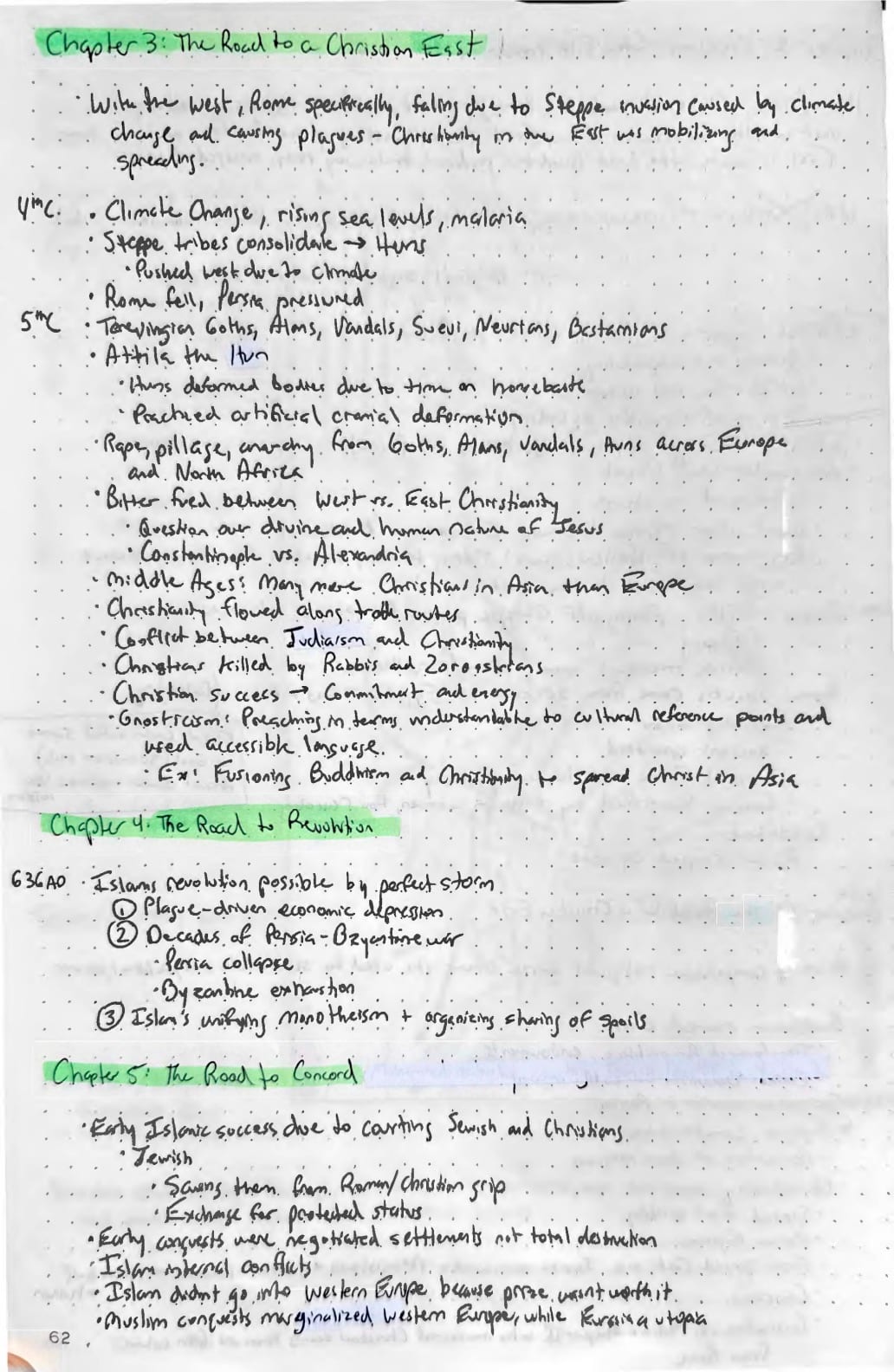
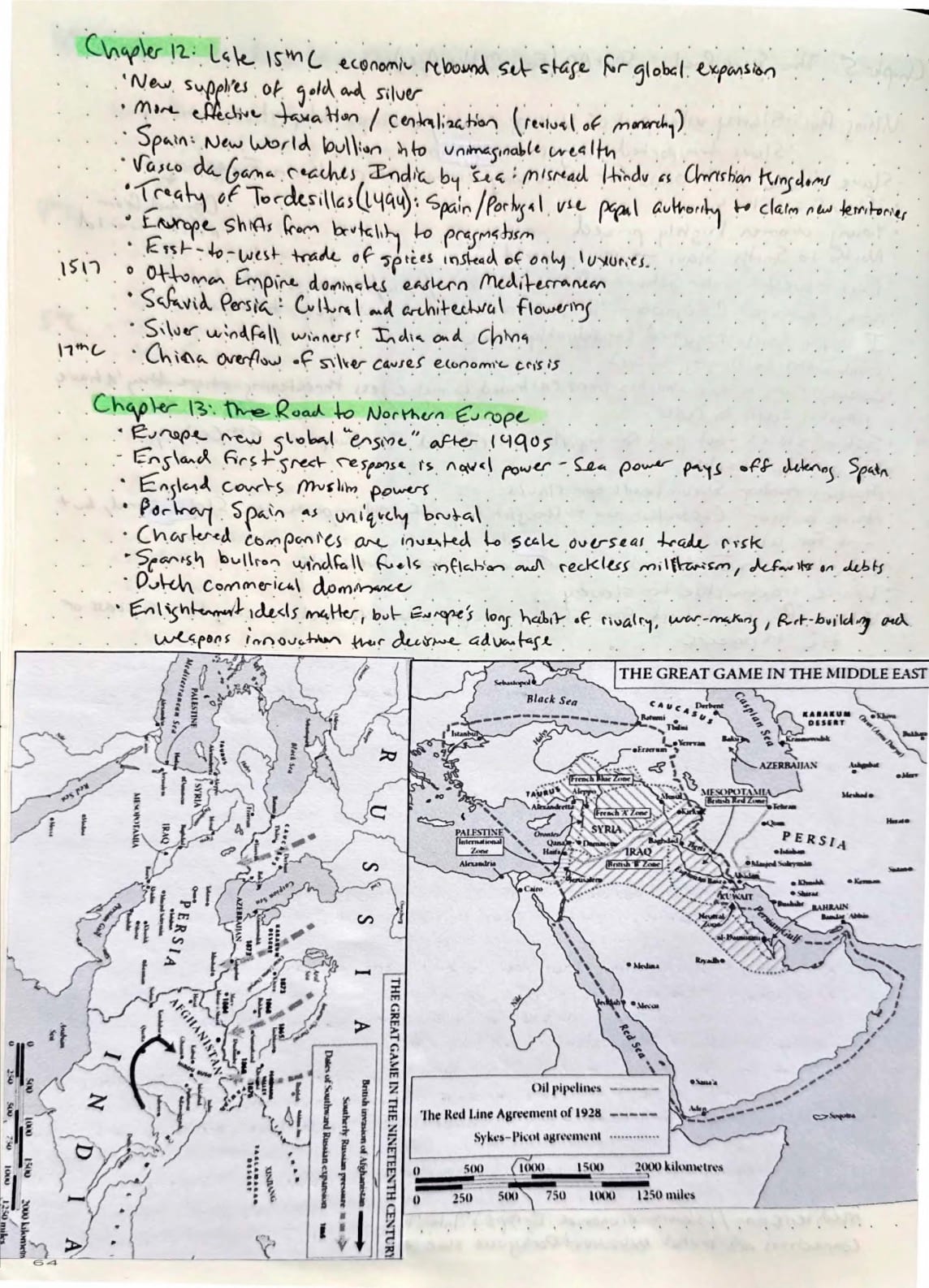
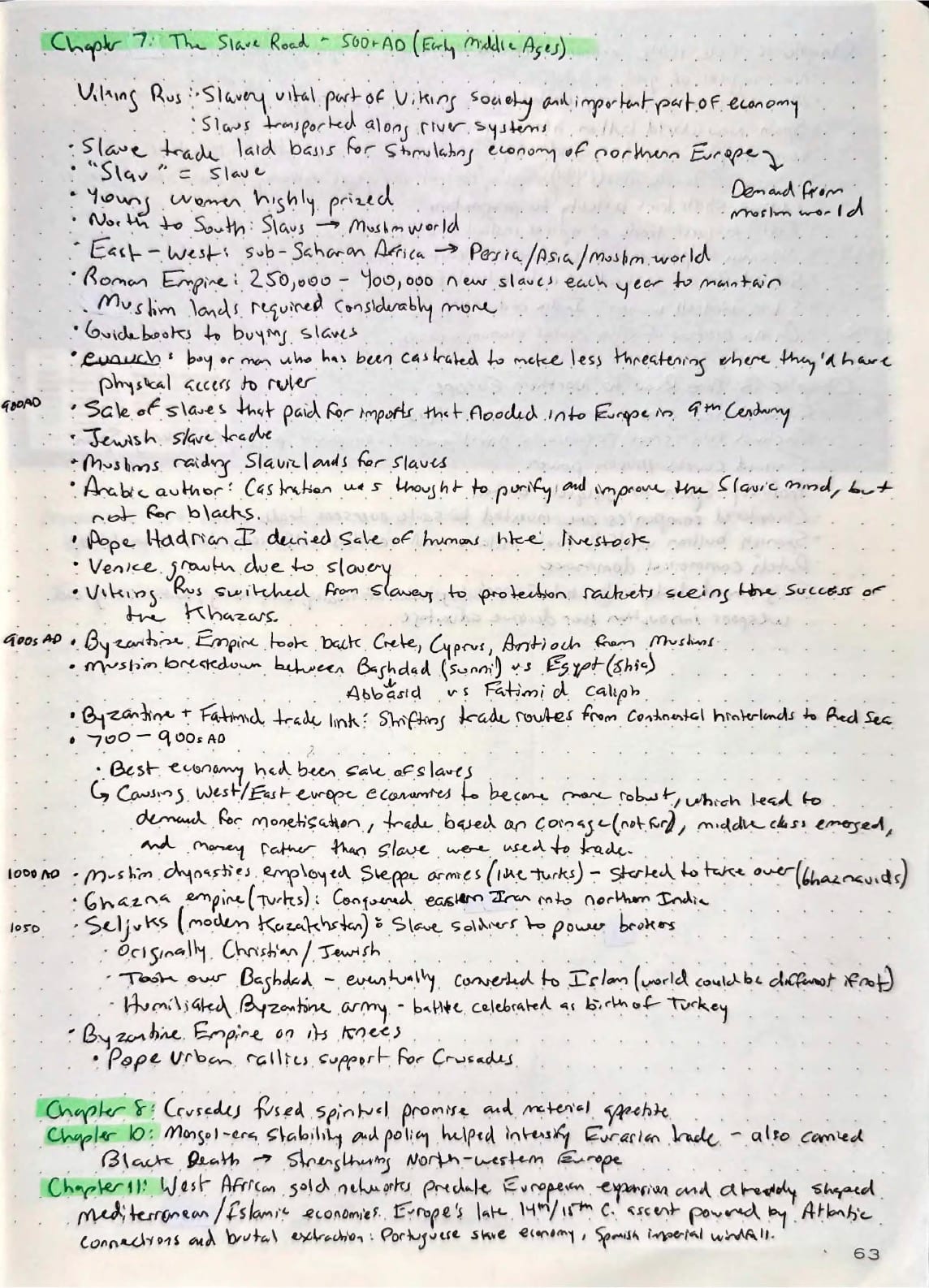
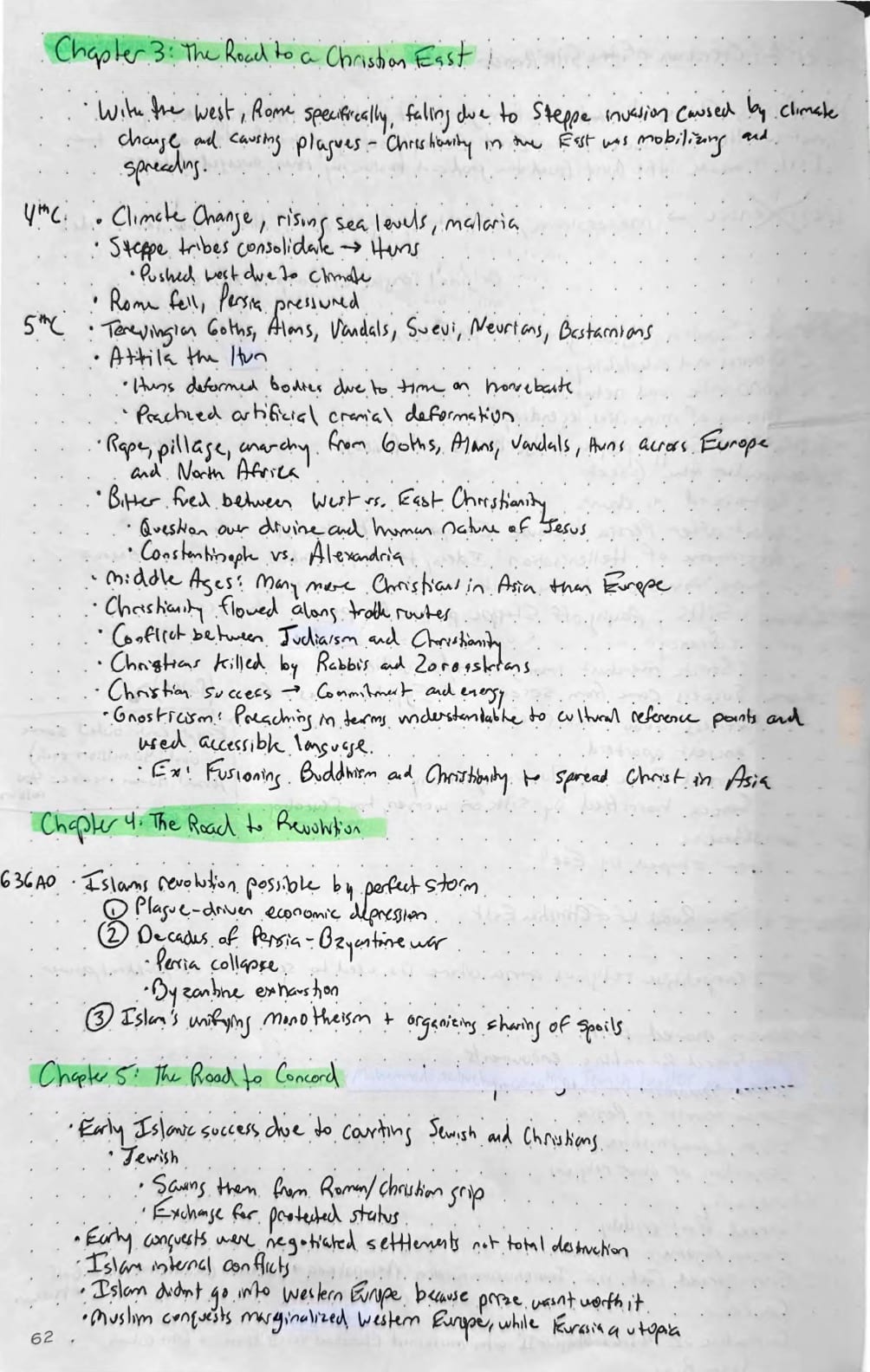
📓 In your handwritten notebooks
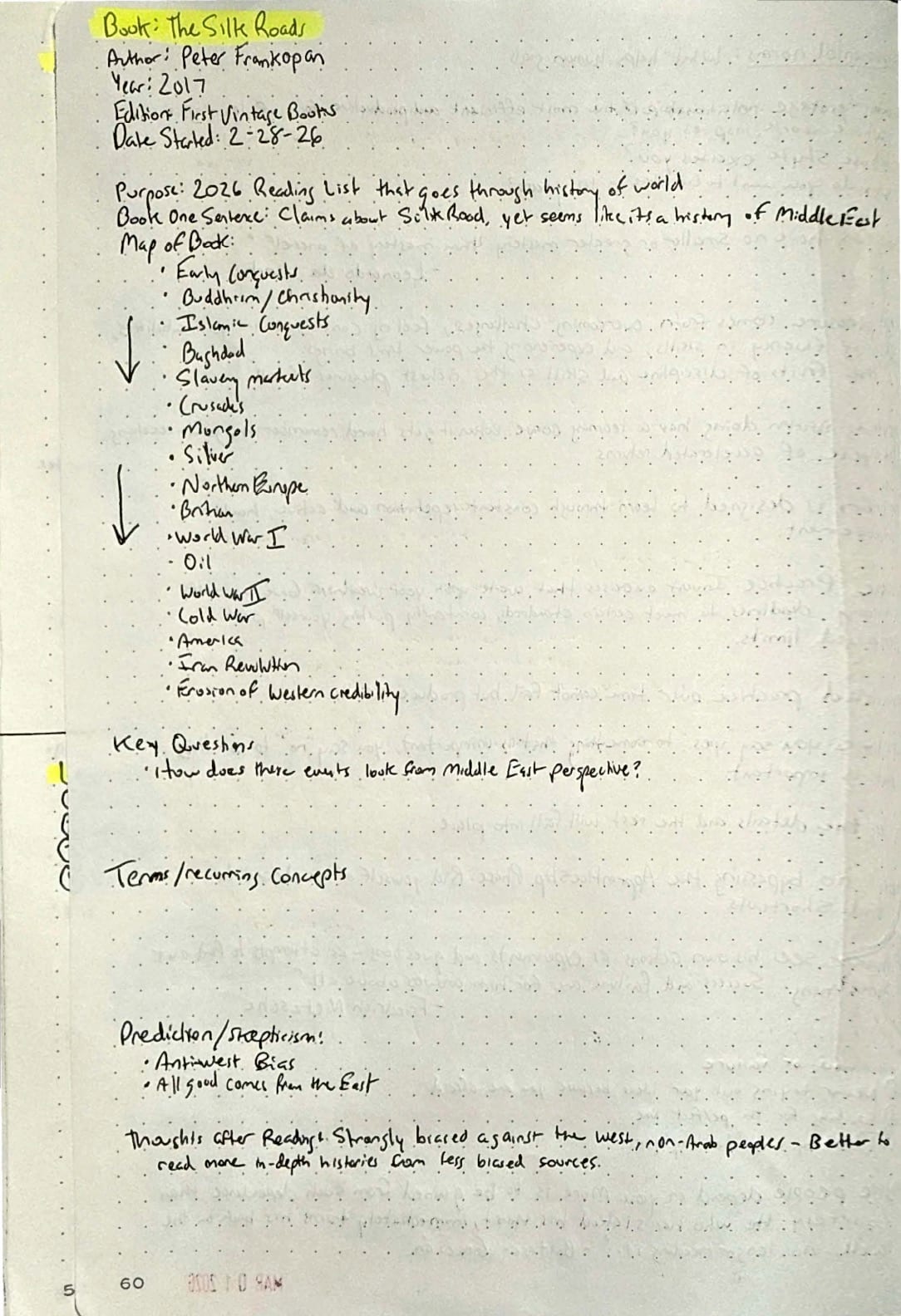
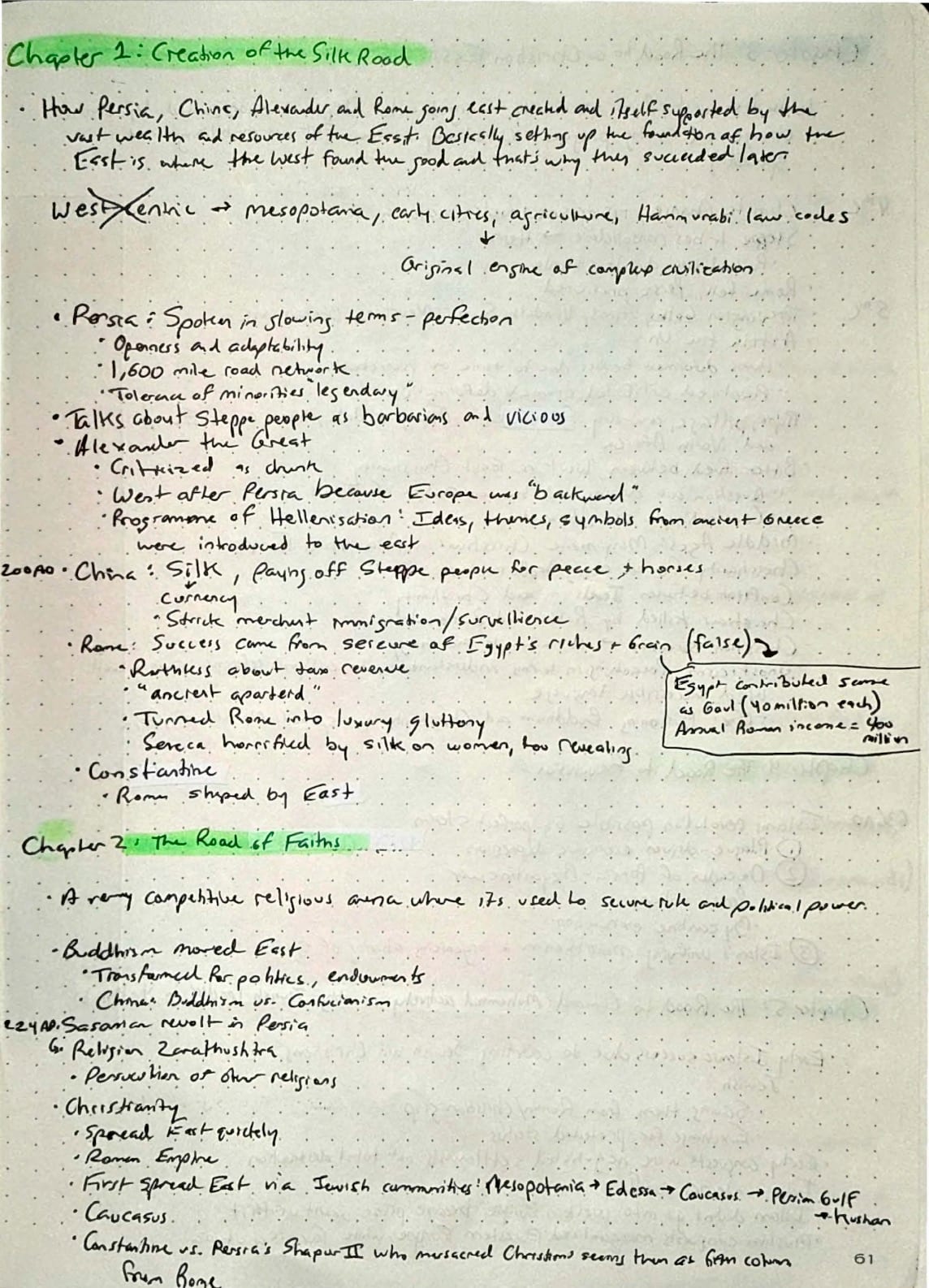
- Feb – March 21 2026, pp. 60–64 — The Silk Roads → open PDF p67 (file not included in this release)
Index: Personal Journal
DESCRIPTION
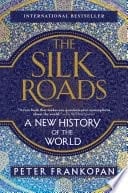
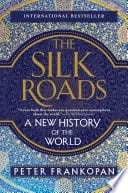
INTERNATIONAL BESTSELLER • Far more than a history of the Silk Roads, this book is truly a revelatory new history of the world, promising to destabilize notions of where we come from and where we are headed next. “A rare book that makes you question your assumptions about the world.” —The Wall Street Journal From the Middle East and its political instability to China and its economic rise, the vast region stretching eastward from the Balkans across the steppe and South Asia has been thrust into the global spotlight in recent years. Frankopan teaches us that to understand what is at stake for the cities and nations built on these intricate trade routes, we must first understand their astounding pasts. Frankopan realigns our understanding of the world, pointing us eastward. It was on the Silk Roads that East and West first encountered each other through trade and conquest, leading to the spread of ideas, cultures and religions. From the rise and fall of empires to the spread of Buddhism and the advent of Christianity and Islam, right up to the great wars of the twentieth century—this book shows how the fate of the West has always been inextricably linked to the East. Also available: The New Silk Roads, a timely exploration of the dramatic and profound changes our world is undergoing right now—as seen from the perspective of the rising powers of the East.
AI Summary
Chapter 1: The Creation of the Silk Road
1) Why the story starts in the Middle East and Central Asia
The chapter opens by flipping the usual “West-centric” frame: the author treats the center of Asia and the lands around Mesopotamia as the original engine-room of complex civilization—early cities, organized agriculture, and early law codes (e.g., Hammurabi).
From the beginning, the key point is geographic: the most consequential corridors run across the heart of Asia, not along Europe’s edges.
2) Persia as the early infrastructure-and-administration superpower
Persia is presented as the first great empire to systematize the region at scale through a combination of:
- Openness and adaptability (even adopting “foreign customs,” per Herodotus).
- Administrative capacity (bureaucracy, recordkeeping, market oversight).
- Hard infrastructure: a famous road network enabling extremely fast communication across huge distances (over 1,600 miles in about a week, in Herodotus’ telling).
- Agricultural and irrigation investment that underwrites cities and population growth.
Persia also sells itself ideologically as stable, fair, and justice-based, with the Behistun inscription and the idea that justice is the “bedrock” of rule; the author stresses Persian reputations for tolerance (including the release of Jews from Babylonian exile).
At the same time, wealth and trade are tied to power: prosperity funds expansion and spectacular consumption (lavish building materials imported from across regions).
3) The steppe frontier problem: nomads as both partners and threats
A recurring driver of Silk Road dynamics is the uneasy relationship between settled empires and steppe nomads. Persia faces persistent northern pressure from steppe peoples—often described in extreme terms for ferocity—yet they are also crucial suppliers, especially of horses.
The chapter uses Cyrus the Great’s death during a campaign against the Scythians as a vivid example of the risks of that frontier.
4) Alexander: conquest of Persia, then a “fusion” legacy
Alexander is portrayed as the man who turns Persian imperial space into a launchpad for wider Eurasian connection. The author emphasizes that for Greeks, the high-value world was to the east, so Alexander’s strategic imagination fixates on Persia rather than Europe.
His victory at Gaugamela (331 BC) opens the empire, followed by rapid capture of major nodes and the Persian communications network.
Importantly, the chapter stresses Alexander’s governance choices as much as his battles: reliance on local elites, clemency as an instrument of stability, and symbolic adoption of Persian customs/titles to present himself as heir rather than mere invader.
5) The Hellenistic “afterlife”: cities, coins, language, and cultural cross-pollination
After Alexander’s death, the eastern empire doesn’t simply “snap back.” Seleucus builds a durable successor structure, and the chapter argues this begins a sustained new era between the Mediterranean and the Himalayas.
Key effects:
- Hellenisation via institutions and symbols, especially coinage and iconography.
- Greek as a living administrative language deep into Central and South Asia; even Ashoka’s edicts appear with Greek translations.
- Religious/artistic competition and borrowing: the chapter links the emergence of Buddha statues to the prior presence of Greek visual models (Apollo imagery) and argues this competitive environment pushed Buddhists toward new representation.
Overall, the conquest corridor becomes a cultural highway, not just a military one.
6) China’s westward push: horses, silk, tribute, and the “birth” moment
A second major engine is Han China’s expansion into the “western regions” (Xiyu), driven heavily by security needs and an intense demand for horses to fight or deter steppe powers.
The chapter highlights famed Central Asian horses (including the “heavenly” horses of the Fergana valley) as prestige military assets embedded in myth and symbolism.
China’s relations with the Xiongnu include extensive tribute diplomacy, with silk at the center—prized materially and politically as a status marker for nomad leadership.
But tribute is also framed as humiliating and costly, pushing the Han toward decisive campaigns; after securing the Gansu corridor, China effectively opens the door to transcontinental networks—presented as the “birth of the Silk Roads.”
7) Silk is not just luxury: it becomes money, logistics, and state capacity
The author makes silk central not simply because it travels far, but because it solves problems:
- As a reliable medium of payment (especially for troops where coinage is impractical and grain spoils).
- As a state-managed trade object: records, passes, designated routes, and accounting systems at frontier towns show bureaucratic sophistication and an early form of trade governance.
This becomes the chapter’s bridge to a broader claim: people treat “globalisation” as modern, but the author insists that two thousand years ago it was already real, creating opportunities and pressures that forced innovation.
8) Rome becomes an empire by turning east—and its wealth turbocharges long-distance trade
Rome’s big pivot is framed as strategic reorientation away from Europe and toward the Eastern Mediterranean and Asia, with Egypt as the decisive prize.
The chapter treats the fall of Cleopatra and the rise of Augustus as the hinge: Egypt’s capture transforms Rome’s internal economy (grain prices down, interest rates down, a boom climate, and new monumental building).
That wealth is not “neutral”: it is explicitly tied to extraction through taxes and administrative control (poll taxes, census logic extended to other provinces).
Rome’s encounter with the East also generates a moral-cultural narrative: Asia is portrayed as rich and alluring but “softening” to Roman martial virtues (as observers like Sallust frame it).
9) Luxury backlash and the economics of desire: silk as scandal
As luxury imports grow, elite commentary swings between fascination and disgust:
- Literary satire captures the vulgar excess of new wealth (Trimalchio’s dinner in Satyricon).
- Conservative outrage focuses sharply on Chinese silk: Seneca condemns its transparency and sexualized effect; laws attempt to restrict men’s wearing of it.
- Pliny complains about the outflow of wealth (the chapter cites “100 million sesterces” annually) and treats it as a major economic drain—yet also notes evidence that large-scale long-distance contracting and shipping had become routine.
Rome’s consumption, in the author’s telling, reshapes the entire route system, strengthening intermediary towns and cities and stimulating monumental urban development along trade corridors.
10) Great-power rivalry reorganizes states: Rome vs Persia, and the Sasanian turn
Rome’s strategic fixation is not actually “China,” but Persia—as rival, gatekeeper, and target. The chapter uses episodes like Trajan’s rapid campaign and the “PERSIA CAPTA” coinage to show how seriously Rome pursued eastern domination (even if such gains proved fragile).
A crucial twist: Rome’s pressure helps galvanize Persian transformation. The Sasanians emerge with centralizing reforms, accountability mechanisms (official seals), and tighter regulation of markets and urban systems, alongside irrigation and infrastructure expansion—strengthening Persia as a commercial and administrative power.
11) Rome’s strain, Diocletian’s control measures, and Constantine’s new capital
As frontiers harden and expansion slows, Rome faces the classic imperial problem: rising defense costs versus stressed revenues; the chapter portrays Diocletian’s aggressive fiscal response (asset surveys, price controls) as dramatic and unpopular.
This sets up Constantine’s “geographic solution”: a new city at the junction of Europe and Asia—Constantinople—as a statement that the empire’s center of gravity is tied to the eastern routes.
12) The closing argument: the ancient world was already deeply interconnected—and the East shapes the West
The chapter ends by insisting that, while most people lived locally, long-distance exchange connected tastes, goods, symbols, and institutions across Eurasia.
It warns against simplifying antiquity into a neat “Rome → Western Europe” story, emphasizing that Rome consistently looked east and was shaped by it, in a world where east and west increasingly oriented toward each other.
Even Christianity is framed as another major “from-the-East” force that will radiate outward.
Bottom line
The Silk Roads didn’t begin as a single road or a purely commercial project; they emerged from empire-building, frontier security, and state capacity—Persian infrastructure, Alexander’s conquest-and-fusion legacy, Han China’s westward push, and Rome’s eastward turn after Egypt. Once these powers created and stabilized corridors, goods (especially horses and silk), money-flows, and cultural competition stitched Eurasia together—producing an ancient version of globalisation where trade reshaped cities, ideologies, and even where “Rome” decided its true center should be.
Chapter 2: The Road of Faiths
1) The Silk Roads carried religions and worldviews, not just goods
The chapter opens by arguing that the same routes linking the Pacific, Central Asia, India, the Gulf, and the Mediterranean also moved “ideas,” especially ideas about the divine—creating an increasingly crowded, competitive religious environment where beliefs were borrowed, refined, and repackaged.
2) Faith becomes a political technology of rule
Because many societies read victory, prosperity, and survival as signs of divine favor, religious competition becomes inherently political: triumph in war or diplomacy is tied to demonstrating cultural supremacy and divine “benediction.”
That creates incentives for rulers to invest in “spiritual infrastructure” (temples, shrines, endowments) and to form mutually reinforcing alliances with priesthoods—while also actively shaping religion to strengthen legitimacy rather than simply submitting to doctrine.
3) Buddhism spreads west and east—and evolves to compete
Ashoka and early diffusion. After Alexander carries Greek ideas east, Buddhist ideas begin flowing west as well—accelerating after Ashoka’s patronage in the third century BC. The text points to inscriptions suggesting Buddhist principles reached as far as Syria, and notes the (debated) parallels between Buddhism and the Therapeutai in Alexandria.
Rulers’ choices: tolerate, suppress, or adopt. As Buddhism enters new regions, local rulers must decide how to respond; Menander (a Bactrian king) is presented as an example of adoption, persuaded in the Milindapañhā by a monk whose qualities contrast with worldly superficiality.
Kushan “statecraft” and divine kingship. In the Kushan Empire, rulers patronize Buddhism but also reshape it for dynastic legitimacy, blending ideas to appeal broadly. The chapter emphasizes a ruler-cult model: temples of the “divine family,” coinage presenting rulers as saviors, and an inscription calling the king “Great king, king of kings and Son of God.”
A “revolution” in Buddhist practice (more tangible, more public). Buddhism shifts from an intensely internal path (escape from suffering toward nirvana via the “noble paths”) to a more outward-facing religious life: stupas become pilgrimage nodes; offerings and even music-making are framed as spiritually efficacious; and endowments/gifts to monasteries are tied to salvation, with texts specifying acceptable precious donations.
Rising prosperity and expanding commerce support monastic centers that translate and disseminate texts, making Buddhism more accessible—“commerce opened the door for faith to flow.”
Merchants as missionaries and infrastructure builders. Sogdian merchant networks (efficient credit, dependable stopping points) help transmit Buddhism north and east; stupas appear along trade routes, and travelers leave inscriptions and images seeking protection and success.
Deep penetration into China. By the early fourth century, sacred sites dot Xinjiang; by the 460s, Buddhist ideas and imagery are mainstream in China and compete with Confucianism, aided by the Northern Wei (outsiders from the steppes) who use Buddhist monumentalism and endowments to bolster legitimacy.
Limits and backlash in Persia. Buddhism also pushes westward (Persian Gulf caves, finds around Merv, and loan-words), but as Persian identity reasserts amid a broader renaissance, Buddhists are persecuted: shrines are abandoned and stupas destroyed.
4) The Sasanian “Persian revival” hardens religion into identity and coercion
The chapter frames late antiquity as a “maelstrom of faith wars,” with a turning point in Persia when the Sasanians seize power (224 AD) and pursue a full-scale state transformation that emphasizes continuity with ancient Persian glory.
They fuse propaganda and religion into politics: ancient sites are appropriated, coinage is redesigned, and a fire altar becomes a provocative marker of a new religious posture.
Zoroastrianism is promoted unambiguously: the cosmos is framed as conflict between Ahura Mazda and Angra Mainyu, with fire and purification central; this worldview supports militarism, discipline, and administrative order.
A powerful priesthood (e.g., Kirdīr’s inscriptions) celebrates expansion and the building of fire temples/priestly colleges while describing suppression of rival faiths—Jews, Buddhists, Hindus, Manichaeans—and persecution that includes destroying “idols” and demolishing “sanctuaries.”
Christians are targeted too, and the chapter suggests Zoroastrian hardening is partly a reaction to Christianity’s rapid spread along trade routes (mirroring Buddhism’s earlier pattern in the east).
5) Christianity’s early story is profoundly “eastern”—and geopolitically dangerous
The author argues that early Christianity is Asian in origin and texture: centered on Jerusalem, rooted in Judaism, and first transmitted in Aramaic rather than Greek.
Roman policy initially wavers: Pliny asks Trajan how to handle Christians; Trajan counsels case-by-case restraint and rejects anonymous accusations—yet later persecution intensifies, with Christians killed in large numbers and martyr literature flourishing.
Christian writers (like Tertullian) protest prejudice, emphasizing Christians’ ordinary social integration.
The chapter stresses Christianity’s rapid eastern spread: through Jewish communities in Mesopotamia, via traders, with Edessa as a strategic crossroads; then into the Caucasus and the Persian Gulf (tombs near Bahrain), and as far east as Kushan territories.
Deportations under Shāpūr I also help plant Christian communities and institutions further east.
As Persian Zoroastrianism becomes a tool of state power, it can look like an ideology of occupation—prompting some in borderlands to treat Christianity as an “antidote” to heavy-handed central imposition.
The Armenian conversion tradition is presented as a later, Christian-biased narrative—but the story (Tiridates “turning into a pig,” healed by St Gregory) underscores how conversion accounts function as propaganda and legitimacy tales.
6) Constantine’s conversion reshapes Rome—and triggers catastrophe for Christians in Persia
Constantine’s conversion story centers on Milvian Bridge (312 AD) and the vision of a cross-shaped light; later Christian accounts portray an aggressive program against pagan cults, though the chapter notes his motivations were likely more complex (including political calculation and continued Sol Invictus imagery).
Still, the shift is real: persecutions end; gladiatorial games are abolished by law; and Jerusalem becomes the empire’s spiritual centerpiece, with massive building works and direct imperial involvement in the Holy Sepulchre project.
The twist is geopolitical. Constantine begins presenting himself as protector of Christians everywhere, including beyond Rome’s borders. His letter to Shāpūr II “commending” Persian Christians for protection reads like a veiled threat given recent Roman fortification and frontier advances.
Persian anxiety spikes; Shāpūr II strikes in the Caucasus; Constantine prepares a massive punitive expedition—but dies before it launches.
Afterward, Shāpūr II unleashes severe reprisals against Persian Christians, treating them as a fifth column aligned with Rome; executions include bishops and priests, and the chapter explicitly ties this “bloodbath” to Constantine’s fusion of Roman imperial policy with Christianity.
The chapter ends on an irony: Constantine is remembered for Christianising Europe, but the cost is a major compromise of Christianity’s future in the East.
Bottom line
This chapter argues that the Silk Roads created a hyper-competitive religious arena where faith served both spiritual needs and political legitimacy: rulers funded temples, shaped doctrine, and used divine sanction as a tool of rule. The spread and adaptation of Buddhism and Christianity depended heavily on trade networks and state patronage—but the same dynamics also produced persecution and “faith wars,” culminating in the paradox that Constantine’s Christian turn strengthened Christianity in the Roman world while helping provoke brutal repression of Christians across Persia and the eastern routes.
Chapter 3: The Road to a Christian East
1) Climate disruption on the steppe reshapes geopolitics
The chapter frames the mid–late Roman world as entering a phase of environmental stress, with signs ranging from shifting sea levels and disease patterns in Europe to changes in the Aral Sea, steppe vegetation (pollen), and glacier advances in Central Asia.
A Sogdian trader’s letter from the early 4th century depicts the human effects—famine, urban collapse, and the destruction of trading communities—making the crisis feel immediate and commercial as well as political.
2) The Huns become the “system shock” that pushes peoples into motion
The chaos helps steppe groups consolidate, culminating in the westward pressure associated with the Huns; the text links the migration wave (c. 350–360) to harsher steppe conditions and intensified competition for resources.
The knock-on effects reach the Roman frontier, including refugee flows and a major Roman defeat in 378 (with Emperor Valens killed), after which the frontiers buckle.
3) Rome and Persia briefly converge because the steppe threatens both
The same steppe danger hits Persia—eastern provinces destabilize, irrigation systems break down, and raids reach deep into Mesopotamia; a major 395 strike even reaches toward Ctesiphon.
Facing a common enemy, Rome and Persia form a striking alliance that includes building (and helping fund/defend) a vast fortified wall in the Caucasus corridor—nearly 125 miles long, studded with forts, protected by a canal, and garrisoned by tens of thousands.
4) Western Rome collapses—and people interpret the disaster through religion
While Persia invests in defense, the western Roman world spirals: frontier breaches, the sack of Rome in 410, and cascading losses across provinces.
The chapter emphasizes the depth of breakdown (not just “transition”): literacy falls, stone-building fades, long-distance trade collapses, and even industrial indicators (like smelting traces in Greenland ice cores) contract dramatically.
Contemporaries debate the meaning: one Christian writer reads conquest as divine punishment for sin, while a pagan historian blames Rome’s abandonment of its old gods.
5) A weakened Rome makes Christianity less politically “toxic” in Persia—so Persia tries to institutionalize it
With Rome enfeebled, Christianity seems less like an imperial spear-point; Persia’s ruler (Yazdagird I) sponsors a series of councils beginning in 410 (and again in 420 and 424) to regularize doctrine and structure.
These councils aim to: centralize authority under Seleucia-Ctesiphon, fix governance issues (appointments, double hierarchies), coordinate festivals, stop appeals to “western bishops,” and accept the Nicene creed and canons.
The author presents this as a missed hinge-point: Christianity could have developed as a two-armed institution spanning from the Atlantic to Central Asia—but it doesn’t, because unity fails.
6) Internal feuds and militant backlash derail the project and revive persecution
Instead of a stable “golden age,” bitter infighting erupts; worse, acts of Christian militancy (including vandalizing Zoroastrian fire temples) force the Shah into a politically compromising position and push policy away from tolerance—triggering a new persecution cycle.
7) Christological civil war splits east and west—and state power makes it uglier
The chapter then traces how theological disputes in the west (Nestorius vs Cyril) become entangled with power politics, including bribery and factional maneuvering, with the flashpoint being whether Mary is Theotokos or only Christotokos.
The Council of Chalcedon (451) imposes a definition of faith backed by threats of expulsion, and the eastern church reacts furiously—turning doctrinal conflict into institutional rupture.
Imperial enforcement hardens the divide: the closure of the Edessa school (a multilingual intellectual engine of eastern Christianity) drives scholars into Persia; later, even a 532 peace treaty clause expects Persian officials to help arrest “non-Chalcedonian” clerics.
8) The Church of the East responds by going outward—mission and expansion without an “iron fist”
While western authorities focus on policing orthodoxy, the eastern church builds one of the largest missionary programs in history, spreading into Arabia (including Yemen), Sri Lanka, and even among steppe peoples.
By the mid-6th century, there are archbishoprics deep in Asia—cities like Merv and Kashgar appear as early Christian centers long before many famous European missions.
9) Persian stability and prosperity create a platform for Christian growth—and for Silk Road connectivity
The chapter attributes part of Christianity’s eastern success to moments of Sasanian tolerance and state confidence; it even describes Persian rulers shifting from persecutors to patrons of church organization.
Tolerance is linked with economic growth: new city-building, irrigation, bureaucracy, regulated bazaars, and expanded long-distance trade connecting the Gulf, India, Sri Lanka, China, and the Mediterranean.
10) Christianity expands in a crowded religious marketplace—and adapts to win
The chapter widens into the competitive ecology of belief: Judaism, Zoroastrianism, Buddhism, and Christianity all clash and borrow. It highlights episodes like:
- State-backed religious violence in Himyar (southwest Arabia), where Judaism becomes dominant and Christians are martyred; later reprisals follow a failed foreign intervention.
- Zoroastrian pushback in Persia after elite conversions, prompting martyr narratives like the story of Qardagh, crafted to inspire confidence to convert.
- Missionary “translation” strategies: clerics explicitly try to reconcile Christian concepts with Buddhist ideas (even portraying Christianity as broadly compatible), and some produce hybridized “gospels” to make the message culturally legible.
The chapter also emphasizes that religious competition is fought with public spectacle and monuments—cave temples, Bamiyan’s colossal Buddhas (later destroyed in 2001), and other visible assertions of moral/theological superiority.
11) The apparent Christian “takeoff” ends with a new rupture: Islam
By 635, missionaries in China persuade the emperor to recognize Christianity as legitimate, and the text portrays the mid-7th century as a moment when Christianity seems poised to link the Atlantic to the Pacific.
Then the pivot: a debilitating war weakens existing powers and opens the networks to a new entrant—Islam—introduced as a revolutionary new cosmology arriving at the moment Christianity looked most ascendant.
Bottom line
This chapter’s core claim is that the “Christian East” wasn’t a sideshow—it was built by the same forces that shaped the Silk Roads overall: climate-driven steppe migrations, imperial collapse and alliance-building, and the creation (and breakdown) of institutions. As Rome’s western order disintegrates under steppe pressure, Persia and the eastern church seize the opportunity to organize, evangelize, and embed Christianity across Asia—yet doctrinal civil war, periodic persecution, and finally the geopolitical shock that enables Islam prevent Christianity from completing what looked like an inevitable continental conquest.
Chapter 4: The Road to Revolution
1) Islam rises out of a century of catastrophe
The chapter sets the stage by arguing that Islam emerges after a long buildup of crisis—especially the bubonic plague that erupts in 541, spreads rapidly along trade/communication networks, and devastates populations from the Mediterranean into the Near East and as far as China. The demographic shock produces chronic economic depression and constricts state capacity.
2) Plague weakens Byzantium’s “balanced” strategy and poisons internal politics
Justinian’s early successes (reconquests and flexible frontier management) become harder to sustain as manpower shortages, inconclusive wars, and rising costs drain an already stressed treasury—worsened by the plague’s economic impact.
Public mood turns against Justinian, with elite critics (notably Procopius) accusing him of wasting Roman wealth on “barbarians” through payoffs and favors.
3) A new, aggressive foreign policy escalates conflict on multiple fronts
Justinian’s successors abandon subsidizing neighbors and adopt a confrontational posture. The chapter highlights Justin II’s refusal to pay the Avars and his threats, signaling a hardened imperial stance.
At the same time, new steppe power (the Türks) rises as a trade force; their leaders and wealth are described in conspicuously theatrical terms, underscoring that commerce and diplomacy are now steppe tools too.
4) Byzantium gambles on a grand alliance—then loses credibility
Türk envoys propose a joint assault to destroy Persia; Constantinople accepts, issues threats, and reopens hostilities. The gamble fails: Roman operations go badly, Persia counterattacks, and the key fortress-city Dara falls after a long siege (574), triggering crisis at the top.
The Türks conclude the Romans are duplicitous and unreliable—an early example of how credibility on the Silk Roads matters as much as armies.
5) War becomes explicitly religious—and destabilizes the Arabian client system
As the conflict drags on, the chapter emphasizes a “religionization” of politics and war: sacred images are used to discipline troops; Christian writers frame service to emperor as service to God; anti-Zoroastrian polemics intensify.
This has consequences on the empire’s margins, especially in Arabia. Constantinople had cultivated Arab allies and converts, but doctrinal differences and increasing religious rigidity sour relations with important partners—creating openings for Persia to exploit.
6) A brief “Versailles moment” for Byzantium plants the seeds of the next explosion
A turning point comes when Persian internal revolt forces Khusraw II to flee to Constantinople and buy Roman support with major concessions, including strategic frontier gains and the return of key points like Dara (the chapter frames this as humiliating overreach bound to provoke backlash).
7) Persia’s counterstroke nearly annihilates Byzantium
When Emperor Maurice is murdered and Byzantium is politically unstable, Khusraw II uses the moment to renegotiate by force. Persian advances accelerate dramatically: the chapter tracks cascading losses culminating in the capture of Jerusalem (614) and seizure of the True Cross as a trophy—psychological warfare designed to signal civilizational and religious triumph.
Heraclius’ response is described as desperate and transformational: radical fiscal measures (cutting pay, seizing church metals), and rebranding the war as defense of the Christian faith.
Persian power reaches its apparent apex: Alexandria falls in 619, Egypt collapses quickly, and by 626 Persian forces are camped within sight of Constantinople’s walls, reinforced by an Avar alliance from the north—creating the sense of inevitable extinction.
8) Constantinople survives—then Heraclius reverses the war with a high-risk counteroffensive
The siege fails; allied cohesion breaks (Avars withdraw; Persians pull back amid Türk pressure).
Heraclius then executes a stunning reversal: he allies with the Türk Khagan and strikes deep, crushing a Persian army near Nineveh (627) and advancing toward Ctesiphon as resistance collapses.
Khusraw is murdered; the settlement includes territorial returns and the restoration of fragments of the True Cross—an apparent Byzantine miracle-victory.
9) Victory destabilizes both empires—and religion turns vindictive
Even after the military turnaround, Persia spirals toward internal collapse and coups.
Heraclius’ triumphalism hardens into coercion: Jews in Jerusalem are punished (including alleged forced baptisms and exclusion zones), and eastern Christians deemed doctrinally “nonconformist” are pressured into imperial orthodoxy—creating new resentments and fractures precisely when the region is exhausted.
10) Arabia becomes the crucible: monotheism advances; Muhammad’s message finds fertile ground
The chapter stresses that Arabia is not isolated from imperial war: trade disruption and contraction hit Mecca’s merchant elite (Quraysh) hard, while religious competition intensifies and polytheism is portrayed as declining in the late 6th/early 7th centuries.
Into this environment, Muhammad’s revelations (traditionally 610) are presented as a coherent explanation for upheaval—combining divine mercy with severe warnings and apocalyptic urgency. The author flags that early Islamic sources are complex and later political motivations complicate reconstruction, but also notes broad scholarly agreement on a crowded prophetic and religious marketplace in this period.
11) The key innovation: unity plus incentives turns belief into a revolutionary engine
A central theme is that early Islam forges a new identity built around unity—particularly potent because the old Roman/Persian system of managing Arabian clients (payments, titles, rivalry manipulation) is breaking down amid war exhaustion.
After the hijra (622), Muhammad’s community turns to armed resistance and raids; early victories and spoils function as proof of divine favor and as a recruiting mechanism. A truce (treaty of al-Hudaybiya) accelerates conversion, and the religious center is decisively anchored in Mecca: the qibla shifts to Mecca (628) and the Kaaba is reframed as sacred within an Abrahamic lineage, preserving familiarity while redirecting devotion.
12) Expansion succeeds because Persia collapses—and because conquest is financially organized
The timing is decisive: Persia descends into anarchy (multiple rival kings) between 628 and 632, and Arab forces exploit weakly defended frontier towns that capitulate quickly.
The chapter argues that expansion is powered not only by zeal but by a highly practical distribution system: booty is allowed and structured so early adopters gain more—formalized in the early 630s with a dīwān overseeing distribution (including a fixed share for the Caliph). This aligns religious loyalty with material incentives and creates a self-reinforcing motor for conquest.
13) The old order collapses in two decisive battles—and the “heart of the world” opens
Both empires react too late. Persia suffers the crushing defeat at Qādisiyyah (636), undermining elite resistance; Byzantium is smashed at Yarmuk (636) after underestimating the Arab force.
Cities surrender in sequence; Ctesiphon eventually falls and its treasury is taken—symbolizing that Persia, already weakened by the earlier Byzantine war, is now absorbed by the new Islamic movement.
Bottom line
This chapter’s claim is that Islam’s “revolution” was made possible by a perfect storm: plague-driven economic depression, decades of Perso-Byzantine war that militarized religion and hollowed out institutions, and the resulting collapse of Persia alongside Byzantine exhaustion. Into that vacuum, Muhammad’s movement fused a unifying monotheism with concrete political and economic mechanisms (especially organized sharing of spoils), enabling rapid expansion that cracked both empires in 636 and seized the central nodes of the Silk Roads.
Chapter 5: The Road to Concord
Early Islamic success wasn’t only about battlefield wins or the collapse of Persia; the chapter argues that support from Christians and especially Jews was a major accelerant. In the early 620s, Muhammad actively courted Jewish leaders in Yathrib (later Medina), securing cooperation through a formal agreement promising mutual defense, protection of Jewish faith and property, and reciprocal “advice and counsel.” The broader point is that early Muslim leadership worked hard to lower fear among Jews and Christians as Muslim authority expanded.
Jews as allies, liberators, and strategic partners
News of Arab advances was welcomed in some Jewish communities because it weakened the Roman/Christian grip on Palestine. Some interpreted events in messianic terms (even if others rejected Muhammad as a prophet “armed with a sword”), and later stories portray Muslims as deliverers from Roman persecution and forced baptisms. Beyond theology, the chapter stresses practical cooperation: at Hebron, Jewish leaders offered tactical help (showing where to breach defenses) in exchange for protected status and permission to build a synagogue near the cave of Machpelah.
Christians, sectarian fractures, and Islam’s “familiar” message
The same logic applied to Christians—especially in a region crowded with doctrinal disputes and persecuted sects. The chapter emphasizes how Islamic messaging could sound recognizable rather than alien: a simple monotheism, respect for “People of the Book,” and an ideal of a unified community of believers (umma). Some Christian observers even admired Muslim piety and discipline, and early boundaries between “new religion” and “variant Christianity” could appear blurry.
Conquest through negotiation, light rule, and pragmatic coexistence
A central theme is that the early conquests often worked through negotiated settlements rather than total destruction. Cities like Damascus and Alexandria are presented as reaching terms that protected churches and populations in return for recognizing new overlordship and paying taxes—helping explain how expansion could proceed quickly. Early rule is described as relatively unobtrusive: garrisons set apart from urban centers, sometimes new cities founded for Muslim administration, and evidence suggesting religious coexistence (including continued building of churches).
The chapter also highlights administrative continuity and hedging behavior during regime change: Roman coinage and familiar legal norms persisted for decades, and artifacts like lamps from Jerash with a Christian inscription on one side and an Islamic invocation on the other capture how locals navigated uncertainty. A contested “Pact of Umar” is cited as one possible attempt to formalize rules for interfaith life (constraints plus protections, and an emphasis on coexistence).
Concord fractures from within: succession struggles and hardened boundaries
After Muhammad’s death, the chapter shifts from outward expansion to internal conflict—a battle over authority, interpretation, and legitimacy. It notes ferocious factional struggles (including assassinations of early caliphs) and argues that efforts to standardize Muhammad’s message into a single Qur’anic text were bound up with these political fights. As rival groups competed to claim the mantle of true guardianship, attitudes toward non-Muslims hardened and conversion efforts intensified.
A vivid example of ideological struggle is the “coin wars.” As Islamic coinage asserted Muhammad’s prophethood, Byzantium responded by placing Jesus Christ prominently on coins; the Islamic response briefly mirrored this visual language—possibly even depicting Muhammad (or the caliph) as protector—before the later development of more distinct Islamic iconography.
Expansion continues at the edges, but Europe offers poor prizes
Even while the center argued, commanders on the periphery pushed into North Africa and across into Europe. The famous clash in 732 (between Poitiers and Tours) is presented less as a civilizational “hinge” and more as a reminder that further attacks depended on whether there were rewards worth taking—and the chapter’s answer is that western Europe, in this period, was not especially wealthy.
The economic reversal: Europe contracts while the Islamic world becomes the hub
The chapter draws a stark contrast: Muslim conquests deepened Europe’s marginalization. Mediterranean trade withered; major cities like Athens and Corinth shrank; and shipwreck evidence (used as a proxy for shipping volume) “disappears” after the seventh century—implying long-distance trade largely collapsed.
By contrast, the Muslim empire united the former economic heartlands of the Roman and Persian worlds—linking Egypt and Mesopotamia into the core of a vast political and commercial system stretching from the Himalayas to the Atlantic. Central Asia becomes a decisive engine of change: the chapter claims the Abbāsid revolution (750) was powered by Central Asian cities where arguments were sharpened and rebellions financed.
Money, routes, and Central Asia: tribute, trade, and new frontiers
The empire’s wealth is explained through control of cities (tax bases), trade routes, ports, and resources—plus enormous windfalls from conquest. The chapter cites trans-Saharan trade and the prosperity of places like Fez, and it gives headline figures like the estimated proceeds from conquering Sindh (60 million dirhams), emphasizing how conquest fed both immediate plunder and long-term fiscal capacity.
To the east, Muslim expansion is tied to steppe instability and culminates in contact with Tang China: victory at the Talas River (751) is presented as a boundary moment, with knock-on effects including upheaval in China (the An Lushan revolt) and shifting power among steppe peoples.
Uighurs, Baghdad, and the “City of Peace”
On the eastern frontier, the Uighurs emerge as a major force—building semi-urban centers, dominating long-distance trade (especially silk), and adopting Manichaeism partly to maintain identity between Islam and China. The chapter uses Central Asian art and archaeology to underline the scale of wealth and cosmopolitan exchange the Muslims encountered and absorbed.
This wealth helps fuel large-scale urban investment, culminating symbolically in Baghdad (Madinat al-Salam, “City of Peace”), portrayed as the new center of gravity for imperial power, commerce, and prestige.
A knowledge-and-consumption boom: paper, travel writing, and scholarship
Prosperity shows up not only in treasuries and palaces but in a commercial culture of markets, luxury imports, and increasingly refined tastes. The chapter links this to an “information appetite,” stressing how (by the later eighth century) the wider availability of paper made recording and disseminating knowledge easier—helping trigger a surge of writing across sciences, mathematics, geography, and travel.
It also depicts an intellectual golden age driven by translation and cross-cultural synthesis: texts from Greek, Persian, Syriac, Sanskrit and more move into Arabic; elites sponsor scholarship (including non-Muslim intellectual families); and celebrated thinkers (e.g., Avicenna, al-Farabi, al-Khwarizmi) exemplify the blend of rigorous study, commentary, and mathematical innovation (including the concept of zero).
Against this, the chapter frames much of Christian Europe as materially poorer and intellectually constrained, even citing Muslim commentators who believed Christianity had smothered the sciences once cultivated by Greeks and Romans—turning non-Islamic lands into places “not worth describing.”
Tolerance—and its limits
The chapter does present evidence of minority communities surviving and sometimes flourishing under Muslim rule (including Christian leadership in Baghdad maintaining relations with the caliph and sustaining missions into Asia). But it insists this picture isn’t uniform: the Islamic world fractured into rival political-religious centers; Sunnī and Shīa arguments hardened early; and periods of tolerance alternated with persecution and coercive proselytization. One striking example is Bukhara, where attendance at Friday prayer was incentivized with payment—producing conversions that could be shallow and mediated (people unable to read Arabic needing instruction on what to do during prayers).
Bottom line summary
Bottom line: The chapter argues that early Islamic expansion succeeded as much through interfaith conciliation, negotiated submission, and pragmatic governance as through military strength; but as internal succession conflicts intensified, religious boundaries hardened. The resulting empire nonetheless created a new Eurasian center of gravity—uniting old Roman-Persian heartlands into an extraordinarily wealthy, trade-linked, and intellectually dynamic “cosmopolitan utopia,” while much of western Europe slid into economic and cultural marginality.
Chapter 6: The Road of Furs
1) Baghdad’s wealth radiates outward—and sparks new northern routes
At its height, Baghdad is portrayed as a dazzling consumer capital, with opulent homes, crowded markets, and elite leisure along the Tigris. The chapter’s key move is to treat this prosperity as a magnetic force that pulled goods, people, and information into new circuits far beyond the Islamic world, creating routes that “snaked in all directions.”
2) The steppe is imagined as apocalyptic “outside”—and also as a real economic partner
The chapter pairs wealth with anxiety about what lies beyond the frontier. It recounts the caliph al-Wāthiq sending an expedition (in the 840s) to investigate a legendary wall holding back savage forces; the wall is described as being ritually “checked” with hammer strikes, and some historians speculate this could refer to a real fortification (possibly near the Jade Gate).
More broadly, the world is framed as split between an ordered realm (Iran) and a chaotic realm (Turan), reinforcing the sense that the steppe is terrifyingly other.
3) Ibn Fadlan’s travel account shows cultural shock—and religious “messiness” on the steppe
Ibn Fadlan, dispatched to the Volga Bulghars, becomes the chapter’s window into steppe life: he’s horrified by nomadic customs, hygiene, and sexual modesty norms, and he records a patchwork of beliefs and rituals among different tribes.
Islam spreads, but unevenly: some groups perform piety to impress visitors, yet still invoke Tengri (“bir tengri”) rather than Allah when distressed, revealing a syncretic religious landscape.
The chapter also emphasizes the role of roaming sufis and other intermediaries (including merchants) in winning converts by blending Islamic tenets with local shamanic/animist expectations—often through classic “leader converts, then the people follow” dynamics.
4) Nomad life isn’t “aimless”: it’s structured—and economically productive
Against the stereotype of chaos, the chapter insists steppe societies are organized around the logic of herding and pasture management, with clearly demarcated zones (illustrated by a Byzantine description of Pecheneg subdivisions).
Economically, the steppe supplies the settled world with horses, farm produce, and valuable trade items—wax, honey, and amber among them—while the decisive commodity is animal pelts.
5) “Furs” become money, status, and the engine of a new “fur road”
Furs are prized for warmth and prestige—so much that one caliph is said to have run experiments to test which pelts insulate best.
They also function as a monetary system in an unmonetized economy: pelts have set exchange rates (e.g., squirrel skins priced against a silver coin and even a loaf of bread).
Crucially, the chapter claims that the Islamic world’s surge in disposable wealth after the great conquests helped create an explicitly northern trade corridor—a “fur road”—and cites estimates as high as half a million pelts exported annually.
6) Trade reshapes cities and politics—pushing tribes toward consolidation
Proximity to markets becomes destiny: towns closest to the steppe boom (Merv, Rayy, Balkh) experience sharp upswings and are celebrated in glowing terms as commercial hubs.
But increased wealth raises the stakes. Rivalry over pasture, water, and market access forces a structural choice: fragmentation through conflict or consolidation through cooperation.
7) The Khazars create a stable “hinge” between Byzantium, the steppe, and the Islamic world
The chapter presents the Khazars as the linchpin of a prosperous western-steppe equilibrium: effective resistance to early Muslim pressure and strategic importance to Byzantium lead to unusually strong alliances, including marriage ties.
Trade-driven stability transforms Khazar society: tributary structures expand, leadership becomes more sacral, and towns develop—especially Atil, a cosmopolitan capital with separate courts handling disputes among Muslims, Christians, and pagans.
8) Khazar conversion to Judaism shows religion as identity strategy in a contested border world
Rather than adopting Islam, the Khazars convert to Judaism in the mid-9th century, after weighing pressures and incentives from Jews and Arabs; envoys ask Byzantium for Christian instruction, and debates follow, but Judaism wins.
The conversion is framed as a deliberate identity choice between rival civilizational poles (Islamic and Christian), with later correspondence describing how the Khazar ruler chose the “religion of Israel.”
Material evidence appears in coinage: coins minted in Khazaria suggest Judaism was formally adopted as state religion in the 830s, and the chapter highlights the striking legend “Mūsā rasūl allāh” (“Moses is the messenger of God”) as both savvy and defiant.
9) Jewish merchants—and then Viking “Rus”—extend the Silk Roads into northern Europe
The chapter stresses Jewish merchants as long-distance connectors (linguistically and geographically), moving goods across routes linking Mediterranean ports, the Tigris/Euphrates basin, Central Asia, and even toward China.
Then it re-centers the Viking story: the most consequential Viking movement is east and south via river systems, with dangerous portages and raids; those who reach Caspian/Black Sea markets profit massively.
Coin hoards across northern Russia, Finland, Sweden (especially Gotland) are used as evidence for the scale of this commerce—silver returns in the tens or even hundreds of millions of coins.
And the chapter ends with the blunt economic underside: to make the journey worth it, goods had to move in volume, and the most lucrative commodity shipped south is said to have been slaves—human trafficking as a major profit center.
Bottom line summary
This chapter argues that the “Silk Roads” also ran north: Baghdad’s prosperity helped create a “fur road” that bound the Islamic world to the steppe and forest belts through pelts that functioned as luxury, currency, and a driver of political consolidation. As trade intensified, it produced new hinge-powers (especially the Khazars, whose urbanization and Jewish conversion are treated as strategic identity-building) and extended Eurasian exchange into Scandinavia via the Rus—where the wealth of interconnection is measured in silver hoards and, grimly, in the slave trade.
Chapter 7: The Slave Road
This chapter argues that, in the early Middle Ages, human beings—especially enslaved Slavs—functioned as a core “export commodity” that financed Europe’s growing connection to the wealthy markets of the Islamic world and, later, Byzantium.
1) Viking-Rus’ expansion was powered by slaving and river logistics
The Rus’ are depicted as aggressively predatory raiders who captured large numbers of locals and moved chained captives down the river systems toward southern markets. The scale of Slavic enslavement was so large that “Slav” becomes associated with “slave” as a generalized term for the unfree.
The chapter stresses that this was not incidental brutality but a structured commercial practice: captives were treated as “articles of trade,” transported through dangerous rapids, and selectively sold—especially young women, who were “highly prized.”
2) Demand in the Muslim world created a northern European boom
A major driver was the purchasing power of cash-rich markets feeding Baghdad and the broader Islamic world, including North Africa and Spain. That demand helped stimulate a surge of trade and urban growth around the Baltic (with expanding towns and rising volumes of coin finds), including large quantities of coins minted deep in Central Asia turning up across the northern river routes.
The chapter widens the lens: the slave trade was not only “north-to-south.” It notes huge imports from sub-Saharan Africa and high valuation of Turkic slave-soldiers, then suggests—by analogy with Rome’s massive annual demand—that the Islamic-world market could have absorbed even larger numbers of new slaves.
3) Slavery was systematized: markets, “quality control,” and elite consumption
Frankopan emphasizes how normalized and technical slave buying became, pointing to guidebooks that treated slave-purchasing as a sophisticated “art,” offering criteria for evaluating bodies and temperaments.
Slave markets flourished across central Europe: Córdoba reportedly held more than 13,000 Slavic slaves (961), and Prague becomes a major hub drawing Rus’ and Muslim merchants trading not just tin and furs but people. Slaves were also exchanged as diplomatic gifts—e.g., Slavic eunuchs and “beautiful” Slavic girls presented to an Abbasid caliph.
4) The “luxury imports” entering Europe were funded by human trafficking
A key claim is causal: the influx of silks, spices, and “drugs” (medicinals) into Europe was paid for by slave sales.
This trade involved multiple intermediaries: merchants in Verdun profited selling eunuchs; long-distance traders (including Jewish merchants in the sources cited) appear repeatedly in the traffic of boys, girls, and eunuchs, including gruesome practices tied to castration.
The chapter also shows how far Islamic commercial influence reached: a traveler is astonished to find Indian spices in Mainz and silver dirhams in circulation, while King Offa of Mercia (c. 800) copies Islamic coin designs, and Abbasid coins appear in hoards in England—evidence of a market network sprawling to Europe’s fringes.
5) Mediterranean complicity—and Venice’s rise—sat on top of this commerce
Muslim traders were active across Mediterranean slave routes, with major markets in places like Marseilles and Rome. Christian authorities sometimes condemned the practice (a pope denounces selling humans “like livestock”), but commerce continued.
Frankopan adds a cultural afterimage: the Italian greeting “ciao” traces back to “schiavo” (“I am your slave”).
Venice becomes the chapter’s emblem of how slave profits could be converted into enduring urban magnificence: its early merchants entered the slave trade, later accepted formal restrictions (and loopholes), and ultimately built a dazzling city whose early growth is tied directly to trafficking.
6) Power shifts: from Khazar taxes to Rus’ domination, then a pivot toward Byzantium
As patterns evolve, the Rus’ shift from long-distance trafficking toward tribute and “protection” systems, noticing the Khazars’ wealth from taxing trade through Atil and similar nodes. The Rus’ redirect tributary flows, then move to outright confrontation; Atil is sacked and destroyed in 965, removing the Khazars as a key intermediary and increasing profits flowing north.
Meanwhile, instability in Baghdad—political fragmentation, shocks like Basra’s sack (923), and severe winters and famine—weakens old commercial patterns; the Buyids reduce the caliph to a figurehead, and the Fatimids rise in Egypt (969), deepening sectarian and legitimacy rifts in Islam.
As opportunities change, the Rus’ focus more on routes to the Black Sea and turn toward Constantinople, first as a target of raids and later as a regulated market where their entry is controlled; the conversion of Vladimir (988)accelerates cultural and institutional integration with Byzantium.
7) Byzantium’s recovery and new Egypt links reshape the “center of gravity”
The Byzantine Empire recovers territory and stability (including major gains like Antioch), inaugurating a “golden age” with institutional and cultural revival.
At the same time, trade routes reorient: maritime lanes and Red Sea connections become more important, boosting Egyptian cities and sending merchant shipping to Constantinople “around the clock.” Egyptian textiles—especially linen from Tinnīs—are described as extraordinarily prized.
Importantly, the chapter argues that northern networks didn’t need to “choose” between Christian and Muslim markets; having multiple sourcing options could be advantageous, and Byzantine/Persian silks appear as prestige goods in Scandinavia.
8) A Christian “eastward pull”: relics, pilgrimage, mercenaries, and dynastic Europe
As western horizons expand, pilgrimage to Jerusalem gains prestige, while Constantinople’s relic collections make western Europe’s material Christian heritage look thin by comparison.
Men from Scandinavia and the British Isles join the Varangian Guard, and Constantinople becomes a cosmopolitan magnet.
Kiev emerges as a central hub of this connected world: the ruling house forges marriage ties across Europe (France, Norway, Sweden, Hungary, Poland, and links to Constantinople), making the dynasty exceptionally well networked.
9) The “currency” changes: from slaves to money
A central economic turning point is that, while slaves had been the base commodity underwriting trade with the east, growing European and eastern economies—energized by inflows of Islamic silver coinage—drive urban expansion, social stratification, and a shift toward coin-based monetization. Trade increasingly runs on money rather than on people.
10) Steppe soldiers become rulers: Ghaznavids, Qarakhānids, Seljuks—and the road to Crusade
The chapter mirrors Europe’s use of foreign warriors with the Islamic world’s use of ghulām (slave troops): as steppe soldiers rise into command, they begin seizing power.
This produces new states and cultural patronage (e.g., Ghazna’s empire and literary splendor), and refined court cultures in Central Asia.
The Seljuks’ ascent culminates in their entry into Baghdad (1055), formalizing their authority; their background is portrayed with irony (names suggesting earlier non-Muslim affiliations) and their conversion to Islam is framed as a legitimacy move.
Byzantium suffers disaster at Manzikert (1071), symbolically humiliating the emperor, though the Seljuks’ primary struggle is with Fatimid Egypt over Jerusalem, and cooperation with Constantinople persists until Seljuk succession crises and Anatolian warlords destabilize the region.
At the end, the chapter links these pressures to the launch of the First Crusade: the emperor appeals to Pope Urban II despite the recent schism; envoys reach him at Piacenza (March 1095); Urban calls for aid at Clermont, and in 1096 tens of thousands set out for Jerusalem.
While faith and atrocity reports motivate many, the chapter insists the most consequential implications are worldly: a new era of European competition for land, riches, and prestige in the eastern Mediterranean is about to begin.
Bottom line summary
The chapter’s bottom line is that early medieval “globalization” across Europe, the Islamic world, and Byzantium was financed first and foremost by slavery—with Slavic captives underwriting the flow of silver, spices, and silks that grew northern towns and merchant networks—until expanding monetized economies reduced reliance on human cargo; at the same time, shifting trade routes and the rise of steppe-powered empires (especially the Seljuks) destabilized the Byzantine frontier and helped trigger the First Crusade, turning Europe’s eastward pull into organized military expansion.
Chapter 8: The Road to Heaven
1) The First Crusade is framed as both sacred salvation and a new western confidence
The chapter opens with the capture of Jerusalem on 15 July 1099 and stresses the brutal, ecstatic tone of the moment: immense suffering on the march, emotional release at the walls, and a massacre after the breach.
The victory is presented (in western Christian storytelling) as the start of a new era: western Europeans see themselves as the agents of Christendom’s rescue and begin imagining a world newly dominated by the Latin west.
2) “Outremer” becomes a colonial project, not just a pilgrimage
The conquest quickly turns into state-building: new Latin-ruled colonies are founded and governed with western feudal customs, reshaping law, property, and taxation to make the Levant function more like western Europe.
The papacy then spends the next generations pushing the obligation to defend these territories, elevating the ideal of fighting there into an especially prestigious form of piety (including the glamor of military orders like the Templars).
3) “The road to Jerusalem” is turned into “the road to heaven”
Urban II’s original offer of absolution expands into a broader theology of crusading: fighting and dying against the “infidel” becomes portrayed as a path to salvation. The journey east is reimagined as a route not only across geography but toward paradise.
4) The Crusade’s “hero story” is selective propaganda—and it strains Christian unity
Bohemond becomes the poster figure in western narratives, symbolizing a supposed transfer of power from east to west.
But the chapter undercuts this: Crusade leaders had sworn to return former Byzantine territories; Bohemond works to evade those oaths and seizes Antioch for himself, and propaganda later downplays that he wasn’t even present at Jerusalem’s fall.
This is one of the chapter’s recurring claims: crusading ideals could be “hijacked” by opportunists seeking wealth and power.
5) The Muslim reaction is initially fragmented, while Jews and Byzantines pay a heavy price
In the Muslim world, reaction to the crusaders is described as limited and local at first; elites in Baghdad/Cairo are portrayed as reluctant to mobilize, even while some voices rage at their inaction.
Meanwhile, the chapter emphasizes two groups harmed by the crusading surge:
- Jews in Europe and Palestine, including Rhineland massacres tied to escalating anti-Semitic violence.
- Byzantium, which experiences the Crusade not as rescue but as betrayal and encroachment.
6) The Crusades reorder Mediterranean power through commerce—especially for Italian city-states
A major through-line is that crusading created extraordinary commercial opportunities. Italian city-states had already been expanding; now fleets from Genoa, Pisa, and Venice move early to Syria/Palestine, using crusaders’ dependence on supplies and naval sieges to extract stunning concessions (churches/markets/quarters, plunder shares, tax immunity, jurisdictional privileges, and slices of captured cities).
Competition between these rivals becomes violent, and Venice is portrayed as the long-term winner—helped by geography, infrastructure, and the ability to leverage military aid into deeper monopolies and privileges (with religion and profit openly intertwined).
7) Trade and coexistence persist alongside religious rhetoric, and ideas flow westward
The chapter argues that Europe’s twelfth-century economic blossoming sits on surprisingly stable working relations with Muslim neighbors: trade continues “daily,” and practical treaties and enforcement help keep commerce running even amid political hostility.
Alongside goods, knowledge moves: western scholars seek Muslim learning (mathematics/astronomy), and translations from both Muslim and Byzantine worlds reshape western intellectual life.
8) Luxury demand and shipping hubs deepen Europe’s entanglement with eastern networks
Silks and textiles (including “Cloth of Antioch”), plus spices routed through hubs like Constantinople, Jerusalem, and Alexandria, become prestige markers that enable elite differentiation and reveal rising wealth and aspirations in Europe.
The chapter also notes an irony: crusading expansion can enrich Muslim middlemen who exploit new western markets.
9) Escalation: rivalries, Saladin’s rise, and the collapse of the Kingdom of Jerusalem
As anti-western anger grows in Constantinople and violence erupts against Italian communities, Saladin exploits the situation and positions himself as a better partner for Byzantium than the Latin west.
In the Holy Land, internal dysfunction and reckless leadership (especially Reynald of Châtillon) are portrayed as accelerating disaster; Saladin defeats the crusaders at Hattin (July 1187), executes key enemies, and Jerusalem soon surrenders.
10) Retaliation fails, and crusading drifts further into opportunism—culminating in 1204
The papacy frames Jerusalem’s fall as divine punishment and tries to rally Europe, but the major counter-expedition of 1189–92 is described as a fiasco (leadership conflict, shifting priorities, and attention turning to commercially vital Acre rather than the Holy City).
A later crusade, organized around Venetian shipping and aimed (quietly) at Egypt, spirals into attacks on Christian Zara and then into a bargain that redirects the army to Constantinople, where the crusaders sack the city in 1204—justified by clerical rhetoric and resulting in extreme plunder and desecration.
The aftermath is presented as systematic dismemberment: the empire is partitioned using tax registers, and western powers scramble for strategic bases and market access.
11) Europe’s “road to heaven” runs into Asia’s reality: rumor, Prester John, and the Mongols
Later expeditions refocus on Egypt (Damietta/Cairo), and desperate crusaders cling to rumors of miraculous eastern Christian allies—Prester John and “King David.”
The chapter ends by flipping the image: what approaches from the east is not deliverance but the Mongols—an oncoming force experienced as a path “to hell,” not heaven.
Bottom line summary
This chapter’s bottom line is that the Crusades fused spiritual promise with material appetite: they recast warfare as a route to salvation while simultaneously enabling western Europe—especially the Italian city-states—to seize commercial leverage, expand colonial footholds, and ultimately turn on fellow Christians for strategic advantage (most dramatically in the sack of Constantinople), even as myths about a saving Christian “East” collapsed into the far more destabilizing reality of Mongol power.
Chapter 9: The Road to Hell
1) The Mongols were feared as “barbarians,” but they rose through disciplined strategy
Contemporary observers described the Mongols as lawless, animal-like nomads, but the chapter’s core correction is that their success came from the opposite: ruthless planning, streamlined organization, and clear strategic goals. Their transformation is tied to Temüjin (Genghis Khan), who built power patiently through alliances, well-chosen enemies, timing, and a merit-based inner circle whose loyalty was reinforced by regular distributions of booty and status.
2) Empire-building depended on conquest, administration, and the absorption of skilled peoples
By 1206, Genghis Khan had unified the steppe. Expansion westward brought key groups under Mongol rule, especially the Uighurs, valued not only for their territory but for literate culture—scribes, bureaucrats, and expertise that strengthened Mongol administration and helped educate the ruling family. Campaigns also pushed into Jin China (including the sack of Zhongdu), while opportunities opened in Central Asia as the region’s political consolidation made it easier for the Mongols to defeat major rivals and roll forward.
3) Terror was a tool: violence was selective, theatrical, and meant to force rapid surrender
The invasion of Khwārazm and the devastation of cities like Nīshāpūr are used to show how Mongol brutality functioned as strategy: annihilating one place and staging grotesque punishments created reputational fear that pressured other towns to submit without fighting. The chapter emphasizes psychological warfare (public warnings, exemplary cruelty) alongside the practical bargain: surrender could be rewarded; resistance invited destruction.
4) The Mongols also rebuilt and invested—later histories over-emphasized only ruin
Alongside the horrors, the chapter highlights a less remembered pattern: some conquered cities were re-energized through investment, reconstruction, and the movement of artisans and administrators. It argues that later Persian accounts may have exaggerated death tolls and devastation (even if violence was very real), and that the enduring “barbarian destroyer” image is partly a legacy of how histories were written afterward.
5) Military superiority included advanced siege craft and fast information transfer along the Silk Roads
Mongol conquest wasn’t only cavalry shock: the chapter notes sophisticated siege operations (large crossbows, stone-throwers, incendiary projectors) and later adoption of technologies pioneered in the Crusader world. Control of Silk Roads networks mattered because it enabled the rapid spread of techniques and intelligence across immense distances.
6) Europe’s “apocalypse moment” came from Mongol campaigns under Ögödei, not only Genghis
After Genghis Khan’s death (1227), the empire’s expansion intensified under his successor Ögödei. The Mongols devastated Rus’ towns (including Kiev) and then struck into Central Europe in 1241, defeating major forces and provoking continent-wide panic. The chapter insists Europe was not saved by heroic resistance; it was saved by contingency—Ögödei’s sudden death—because Mongol leaders had to return east for the succession struggle.
7) European diplomacy misread the Mongols—and Mongol letters revealed a global-dominion worldview
European rulers and the papacy sent embassies to learn about the Mongols, urge them not to attack Christians, and even press conversion. Envoys like John of Plano Carpini and William of Rubruck reported a powerful but culturally alien world centered on Karakorum. The Great Khan’s reply to the pope was stark: the pope and princes should come in person and submit—backed by a seal invoking “eternal Tengri,” not Christian authority.
8) Mongol fear reshaped Christian politics, briefly pushing church reunification
One striking claim is that the Mongol threat did what priests and princes could not: it encouraged Armenians and Byzantines to explore reconciliation with Rome, with talk of healing the schism to create a unified front against future attacks.
9) The Mongols pivoted to the richest prizes: China and the Islamic heartlands
The chapter argues Europe wasn’t the best prize. Mongol focus shifted to finishing the conquest of China (culminating in the Yuan dynasty and the creation of Beijing as a Mongol imperial capital) and to the “pearls” of the Islamic world—most dramatically the sack of Baghdad in 1258, the killing of the caliph, and the seizure of immense luxury wealth. It also notes Mongol preference for textiles and silks as elite markers, sometimes demanded with “shopping-list” specificity in tribute.
10) The decisive contest in the eastern Mediterranean became steppe-system vs steppe-system: Mongols vs Mamluks
The chapter reframes the era: Europe’s Crusades were a sideshow compared with the larger struggle among steppe-derived military systems. Egypt’s Mamluks—descended from slave-soldiers recruited from the Black Sea/steppe world (including some with Mongol connections)—stopped the Mongols at Ayn Jālūt in 1260, their first major setback, and then capitalized on the Mongols’ earlier “consolidation” of Syria to expand quickly.
11) Europe’s view of the Mongols flips again: from demons to potential allies—then disappointment
After 1260, Latin Europe and remaining Crusader interests repeatedly tried to form alliances with Mongol rulers in Iran (the Īlkhānids) against the Mamluks, while the Mongol world fractured into competing khanates (Yuan China, Chagatai Central Asia, the Golden Horde, and the Īlkhānids). A high point of alliance-dreaming comes with Rabban Sauma’s embassy to western Europe and Edward I’s enthusiasm for a joint campaign to recover Jerusalem. But coordination fails as European rulers focus on nearer priorities, and the last Crusader footholds fall in 1291.
12) The Crusades’ legacy endures, but control of the Holy Land slips away; Italian maritime powers keep expanding
The chapter closes by arguing that the Crusades reshaped the medieval west (papal power, ideals of knighthood and piety, and the sense of European Christian unity), yet ultimately proved too costly and fragile to sustain in the Levant. After the Holy Land is lost, it fades from the center of European strategy—even as Italian city-states do not retreat but “burrow” deeper into Asian trade and look to extend their reach further.
Bottom line summary
This chapter’s bottom line is that the Mongols’ world-shaking rise was driven less by chaos than by disciplined organization, calibrated terror, and the ability to absorb administrative and military expertise; their expansion traumatized Europe but largely bypassed it in favor of richer targets in China and the Islamic heartlands, where the sack of Baghdad signaled a new global balance—until the Mamluks (a rival steppe-derived military regime) halted Mongol momentum, the Crusader project collapsed in the Levant, and Europe’s lasting winners became the maritime powers who converted shifting geopolitics into deeper long-distance trade.
Chapter 10: The Road of Death and Destruction
1) Italian city-states reroute commerce as the Levant becomes harder to use
With trade through the Holy Land increasingly constrained, Genoa and Venice push into new corridors—especially Black Sea colonies (Crimea/Sea of Azov) and Armenian Cilicia (Ayas)—to keep eastern goods flowing.
2) Profit, violence, and slavery sit at the center of this new commercial map
They exploit price differentials in grain shipping and also resume large-scale slave trading, selling captives into Mamluk Egypt even as the papacy tries to ban it.
Commercial rivalry among the Italian powers becomes militarized, and the chapter even links Genoese wartime captivity to cultural legacy: Marco Polo’s travels get recorded because Rustichello writes them down in prison.
3) Mongol governance makes the Black Sea route unusually attractive
A key explanation for the Black Sea boom is Mongol fiscal policy: export duties through Black Sea ports are described as low (around 3–5%), sharply undercutting heavier levies elsewhere (e.g., Alexandria), which creates a powerful incentive to route goods through Mongol-controlled space.
Frankopan stresses that this reflects a broader point: Mongol success rests not only on force, but on administrative competence and predictable rule for commerce.
4) The Mongol “system” is built for scale: assimilation, rewards, and pragmatic tolerance
The empire’s durability comes from deliberate policies: breaking down tribal identities, reorganizing loyalties, standardizing practices, dispersing conquered peoples, and running a reward system that encourages a harsh meritocracy.
Religiously, the Mongols are portrayed as unusually tolerant and opportunistically flexible—allowing multiple faiths and enabling missionaries and monasteries to operate across Central Asia.
This administrative imprint even shows up linguistically and institutionally in Russia (loanwords tied to trade/finance and a relay-based postal system).
5) Eurasia becomes more tightly connected—by security, information, and merchant know-how
European horizons expand as envoys, missionaries, and merchants circulate; stories about Asia’s wealth flood west, and practical handbooks emerge to reduce risk and prevent merchants being cheated (taxes, weights/measures, coinages, spice identification).
The chapter emphasizes that Mongol stability makes long-distance travel and trade feel unusually safe on key routes.
6) Global trade surges—especially in the Indian Ocean and the China seas
The text highlights the scale of maritime trade around China, with Guangzhou as a major hub; shipwreck evidence shows high-value imports (e.g., pepper and frankincense) arriving from across southern Asia and likely beyond.
This is paired with a bigger claim: Mediterranean commerce is substantial, but Pacific/Indian Ocean trade is enormous by comparison.
7) Money links the system—until disease rides the same arteries
A common silver-based exchange system expands across Eurasia; the chapter notes major shifts in silver’s value and coin output, then pivots to its central punchline: the most transformative “thing” carried along the routes is plague.
Plague spreads rapidly in the 1340s; the siege at Caffa (1346) becomes a notorious transmission episode, and by 1347the disease reaches Constantinople and then Mediterranean Europe.
8) The Black Death produces apocalyptic fear, scapegoating, and staggering mortality
Contemporaries interpret plague through religious panic and signs; responses range from prayer/flagellation to moralizing social behavior.
Fear fuels anti-Jewish violence, including rumors of well-poisoning and pogroms, prompting papal interventions.
The chapter underlines the magnitude of loss (e.g., reports of massive death in Florence and Venice).
9) Paradoxically, the plague becomes a turning point in Europe’s rise
Frankopan argues the plague catalyzes long-run change: labor becomes scarce, wages rise, tenants gain leverage, rents and interest rates fall, and consumption patterns shift as wealth distributes more broadly.
The post-plague divergence matters: north-western Europe’s freer competition and social flexibility accelerate growth, helping lay foundations for later industrial transformation.
10) Venice consolidates commercial dominance—and Europe’s orientation begins to pivot west
As Genoa stumbles in later rivalry, Venice tightens control over the spice trade, moving huge volumes and acting as a major conduit even for fine art pigments (including lapis lazuli).
The chapter then drives toward its late-medieval hinge: with religious anxiety and geopolitical shocks in the background, Columbus’s 1492 voyage and da Gama’s later route to the Indian Ocean signal a structural shift—Europe is no longer the endpoint of Silk Roads networks but is positioning to become the center of new global routes.
Bottom line summary
Chapter 10 argues that Mongol-era stability and policy helped intensify Eurasian trade (and enrich players like Venice and Genoa), but the same connected networks also carried the Black Death—an event so catastrophic it reshaped Europe’s social and economic structure, ultimately strengthening north-western Europe and setting the stage for a decisive reorientation of trade and power as Atlantic voyages in 1492 and after began shifting Europe’s center of gravity from east-facing routes to westward expansion.
**Chapter 11: The Road of Gold
Main ideas (by movement of the chapter)
- A “new world” connection reorders global routes—and powers Europe’s rise (and others’ suffering).
Frankopan frames the late 1400s as a turning point: Spanish and Portuguese expeditions stitched together the Americas, Africa, Europe, and (eventually) Asia into faster, larger flows of goods/people/ideas, pushing Europe toward “centre-stage,” while building an empire-system grounded in superior military/naval force and large-scale violence. - West African gold networks predate European expansion and already shaped Mediterranean/Islamic economies.
The chapter stresses that “the land of gold” was not a European discovery: trans-Saharan routes moved West African gold north, with chemical analysis linking Egyptian coinage to West African sources; Wangara traders played a key long-distance role (analogous to Sogdians in Asia), and trade nodes helped cities like Djenné, Gao, and Timbuktu flourish. - Mali/Timbuktu’s wealth and prestige were globally legible—and Europe knew of the riches, not how they worked.
Timbuktu is presented not only as a commercial hub but as an intellectual one (mosques, manuscripts, scholars). Mansa Musa’s pilgrimage and lavish gold-giving fed stories of almost unimaginable wealth; European merchants (especially Genoese) were deeply involved in North African trade but still lacked a clear picture of how wealth moved beyond the Saharan “blanket.” - Portuguese expansion: part crusading rhetoric, part state strategy, heavily enabled by Atlantic islands and forts.
The Portuguese build shipping links, seize Ceuta (symbolically more than profitably), seek papal backing with anti-“Saracen” language, and then create an expanding Atlantic infrastructure: island bases (Canaries/Madeira/Azores), sugar economies (with environmental destruction), and fortified hubs like Arguim and São Jorge da Mina to control sea lanes and catalog/tax trade under a crown monopoly. - The real “breakthrough” wasn’t gold—it was people: the 15th-century African slave trade as the high-profit engine.
Frankopan’s pivot is explicit: captains find the best money in trafficking humans; enslaved labor becomes highly lucrative in Portugal, socially normalized among elites, and fiscally attractive to the crown via taxes (quinto). He includes vivid scenes of capture, family separation, raids, and the religious/royal imprimatur (banners with the cross), underlining how violence, profit, and legitimation align. - Slave-raiding also drives geographic knowledge and further exploration down the African coast.
Pursuit of “easy pickings” pushes ships southward; violence against local leaders is described as routine, and emissaries are used to build alliances against Spanish competition. Columbus appears here as someone learning the logistics of long voyages from Portuguese experience. - Columbus sells a story: hype, misinformation, and a propaganda letter that outruns reality.
Columbus claims “India beyond the Ganges,” spices, mines, and trade with the Great Khan; in practice he is confused by what he sees, and the text portrays his famous report as exaggeration and deception, repeated on later voyages with shifting “proofs.” Meanwhile, critics returning to Spain call the enterprise a farce and note the lack of gold. - A real windfall arrives—pearls—then conquest follows once gold/silver and empires come into view.
Pearl finds near the Paria region ignite a rush; tales of easy trade for pearls spread. Soon Spanish contact with the Aztec and Inca worlds shifts exploration into conquest, underwritten by European weaponry and a willingness to enslave and kill. - Catastrophe for Indigenous peoples: violence plus epidemics collapse populations and societies.
The chapter highlights massacres, de las Casas’ horror, and enormous demographic collapse (e.g., Taíno numbers), then stresses disease (smallpox, measles) and famine feedback loops as decisive forces that shattered communities. - Silver/gold flood Europe; Spain becomes the political hegemon; administration professionalizes to extract and tax the flow.
Treasure fleets create an Atlantic network rivaling (and surpassing) Asian routes in value; European observers marvel at the artistry and quantities; the crown systematizes mapping, pilot training, and taxation; Charles V’s power is amplified by this wealth, reshaping European politics. - Slavery is re-exported into the New World—regulated early—and tied to wealth concentration.
Spain turns to enslaved Africans (purchased through Portuguese markets) as a labor solution; licenses and regulation follow quickly. African rulers (notably Kongo’s king) protest kidnappings and branding; Portugal dismisses complaints and frames slavery as mutually profitable. - Piracy and raiding become a parallel economy; Europe’s “Golden Age” feeds culture and a new origin story.
Some treasure is intercepted by French/North African pirates and raiders; states issue letters of marque and counter-piracy contracts. At home, wealth produces patronage, luxury consumption, and confidence. Frankopan ends with the claim that Europe “reinvents” the past—appropriating Greece/Rome—so the Renaissance is less a “rebirth” than a “birth” of Europe as the world’s center.
Bottom line summary
Europe’s late-15th/16th-century ascent wasn’t a smooth flowering of ancient inheritances; it was powered by new Atlantic connections and brutal extraction—especially slavery, conquest, and disease-driven collapse—while West Africa’s long-standing gold networks and the Portuguese slaving economy set key preconditions for the Spanish imperial windfall that made Europe the new global center.
Chapter 12: The Road of Silver
1) A late-15th-century economic rebound set the stage for global expansion
The chapter starts by arguing that trade began accelerating again after the fifteenth-century shocks, helped by new supplies of precious metals (gold and especially silver) and more effective taxation/centralization (“revival of monarchy”).
It pairs this with a global hint: a Korean traveler describes booming commerce in China (ships “like clouds” at Suzhou), but the author insists the decisive “solution” was going to come from Iberia, not the Chinese coast.
2) New World bullion turns Spain into a clearinghouse for unimaginable wealth
As American riches begin arriving, Seville becomes a bottleneck where gold and silver are “stored like wheat,” so abundant that the customs house overflows.
This bullion surge is treated as the fuel that makes Europe newly able to pay for Asian luxuries at scale.
3) Da Gama succeeds where Columbus fails: a sea route to India and a new global map
Vasco da Gama’s voyage is presented as a world-changing breakthrough: Portugal wants both religious prestige (striking Islam, spreading Christianity) and the concrete prize of eastern riches—and da Gama actually reaches India by sea.
But the chapter stresses early misunderstanding: Europeans misread Hindu temples and rituals as Christian forms, and return home with exaggerated ideas about “Christian kingdoms” in the East ready to fight Islam.
4) Iberian powers carve up the world with papal sanction
Spain and Portugal use papal authority to legitimize claims to new territories, culminating in the Treaty of Tordesillas (1494) drawing a global boundary line—west for Spain, east for Portugal—later mirrored by negotiations in the Pacific after Magellan’s circumnavigation.
5) The “end of Venice” is predicted—yet old routes persist and the new route is dangerous
Venetians panic that Lisbon will replace Venice as Europe’s commercial hub, since sea transport can evade the tolls of overland routes.
But the chapter complicates this: many Portuguese ships never return, making the sea route risky and preventing instant replacement of older networks.
6) Violence gives way to pragmatic coexistence, while spice trade explodes into mass consumption
Portuguese expansion initially mixes aggressive brutality and fortress-building (including atrocities at sea), provoking pushback from Egypt and others.
Over time, however, ideology softens into pragmatism: Europeans, heavily outnumbered, learn the same lesson as earlier crusader enclaves—survival requires workable relations—while Asian rulers compete to offer better terms to attract European money.
The result is a vast increase in east-to-west trade, especially spices, which shift from elite luxury to mass-market commodity; Portugal builds a chain of ports and colonies, and spice revenues become a major pillar of the state.
7) Ottoman and Safavid “golden ages” are partly financed by transit taxes on this global boom
After 1517 the Ottomans dominate the eastern Mediterranean and become a systemic rival, with competition extending into the Indian Ocean and Persian Gulf.
The chapter argues that rising trade volumes expand Ottoman revenues and fund grand building programs (Sinān’s works and major mosques), while Safavid Persia experiences its own cultural and architectural flowering (notably Isfahan’s transformation).
8) The real winners of the silver windfall are in Asia—especially India and China
Europe becomes a transit hub for bullion from immense sources like Potosí, supercharged by new extraction techniques, and then ships vast quantities of silver east to pay for Asian goods.
India “shines” in this era: European purchasing power injects hard currency, which fuels trade (including the lucrative horse market tied to Central Asia), infrastructure, and the expansion of the Mughal Empire under Bābur’s dynasty, culminating in spectacular imperial culture and construction.
Even the Taj Mahal is framed not only as romance but as a monument made possible by globalized trade and bullion flows—shadowed by the suffering inflicted in the Americas that made those flows possible.
9) Manila creates a Pacific “silver highway” that bypasses Europe—and weakens older intermediaries
With Manila’s foundation (1571), goods and especially silver move across the Pacific between the Americas and Asia without necessarily passing through Europe; Manila becomes a hyper-diverse emporium and a major node in world trade.
This shift contributes to declining Ottoman revenues, since so much bullion now routes through the Philippines into Asian markets.
10) China becomes the ultimate sink for silver—then silver destabilizes China
Silver ends up in China for two core reasons: (1) China’s capacity to produce luxury exports at scale (porcelain and silk), and (2) favorable gold–silver ratios that make buying and arbitrage especially profitable.
The influx supports cultural and intellectual flourishing, but China often prefers to remain politically “passive” and increasingly introspective while letting foreigners bring trade to them.
Ironically, China’s preference for silver becomes an Achilles heel: oversupply pushes down silver’s value, drives inflation, and contributes to serious seventeenth-century economic and political crisis.
11) The chapter ends with a forecast: the center of gravity will shift again—toward northern Europe
Invoking Adam Smith’s later judgment that the discoveries of America and the Cape route were epochal, the chapter argues that while the first post-1490s century “belonged” to Spain and Portugal, the next two will belong to northern Europe—above all, a Britain about to become dominant.
Bottom line summary
The chapter’s bottom line is that silver rewired the world: New World bullion and new sea routes turned Iberia into the gateway of global trade, but the greatest gains flowed into Asia—fueling Ottoman and Safavid building booms, Mughal consolidation and grandeur, and Chinese export power—until the same silver torrents (accelerated by Manila’s Pacific link) destabilized China through inflation and crisis, setting up the next shift in global leadership toward northern European powers.
Chapter 13: The Road to Northern Europe
- Europe becomes the new global “engine” after the 1490s. Decisions from Madrid and Lisbon now have worldwide consequences, and Spain’s flood of American bullion is framed (by Catholic voices) as divine favor—an especially bitter message for Protestant England.
- England’s first great response is naval power. Facing threats of invasion and isolation, Elizabethan England invests heavily in dockyards and ship design, building faster, longer-range, more heavily armed ships.
- Sea power pays off: deterrence and plunder. The Spanish Armada’s failure (1588) and the capture of the treasure-laden Madre de Deus (1592) show how naval superiority can decide security—and instantly generate wealth on a national scale.
- Pragmatic alliances override “civilizational” lines. England courts Muslim powers (North Africa and especially the Ottomans) because shared enemies (Spain, Catholic rivals) and trade opportunities matter more than religious divides; the Ottomans grant English merchants unusually generous privileges.
- Religious polemics turn into diplomatic language. English and Ottoman letters emphasize common opposition to “idolatry” (Catholic imagery), creating a surprising rhetorical bridge between Protestant and Muslim rulers.
- Cultural spillover: the Muslim world enters English imagination positively. Shakespearean references (e.g., Merchant of Venice, Othello) reflect (and reinforce) the idea that Muslim rulers and soldiers can be credible partners, while Spain is cast as the villain.
- Anti-Spanish propaganda becomes a strategic asset. Bartolomé de las Casas’s account of atrocities in the Americas is translated and circulated through Protestant Europe to portray Spain as uniquely brutal—useful for mobilizing fear and moral outrage.
- But “virtue” is selective: England participates in slavery too. Despite moralizing against Spanish cruelty, English elites back ventures in the Atlantic slave trade (e.g., John Hawkins), exposing how profit can override proclaimed principles.
- England searches for alternate routes—and stumbles. Expeditions for the North-West Passage and routes via the Arctic/Russia fail disastrously; attempts to open Persian links are cautious and often avoid religious controversy when it threatens trade.
- Chartered companies are invented to scale overseas risk. A growing cluster of monopolistic, crown-chartered companies (Turkey, Levant, East India, etc.) is created to pool capital and extend England’s reach—even if early results are meagre.
- Spain’s windfall creates destabilizing side effects. Bullion fuels inflation and reckless militarism; Spain repeatedly defaults on debts, and heavy taxation plus religious pressure help ignite revolt in the Low Countries.
- The Dutch “miracle” grows out of pressure, migration, and opportunity. Spanish embargoes and conflict unintentionally concentrate skilled people and resources in the northern provinces; once pressure eases, the Dutch surge into global trade to keep wealth from being siphoned off by Iberian rulers.
- Dutch commercial dominance is engineered, not accidental. Early expeditions bring enormous returns; shipping to Asia and across the Atlantic expands rapidly, supported by efficient ships (fluyts), meticulous intelligence (manuals, maps), and language tools.
- The VOC/WIC model shows how to build a world-straddling corporation. The Dutch consolidate competing ventures into powerful monopolies, then use force and forts to displace rivals across the East Indies, West Africa, and the Atlantic—becoming major players in gold, sugar, and slave trafficking.
- Wealth reshapes culture: the Dutch Golden Age. Global trade transforms Dutch cities and patronage; the influx of Asian goods influences material culture (e.g., ceramics), while new fortunes underwrite a boom in art and civic self-confidence.
- Frankopan’s core interpretive claim: Europe rises through organized violence. Enlightenment ideals matter, but Europe’s long habit of rivalry, war-making, fort-building, and weapons innovation is portrayed as the decisive advantage that lets Europeans dominate overseas.
- War drives finance and shifts Europe’s center of gravity north-west. Constant conflict pushes the development of sovereign debt markets and sophisticated finance (London/Amsterdam), while older Mediterranean hubs lose primacy—Venice increasingly reinventing itself as a cultural destination.
Bottom line (Chapter 13)
Northern Europe—especially the Dutch Republic, with England close behind—moves from the margins to the center by combining naval innovation, corporate organization (VOC-style), and an unusually intense European ecosystem of war, finance, and competition that proves exportable overseas.
Chapter 14: The Road to Empire
- Not everyone keeps up with north-west Europe’s acceleration. The Ottoman world is portrayed as comparatively static: limited urban growth, inefficient tax collection (tax farming), high military costs, and added stress from climatic change.
- Institutional differences shape capital accumulation. Frankopan contrasts inheritance norms: Islamic legacy rules distribute wealth more broadly (including stronger provisions for women), which narrows inequality but makes dynastic capital accumulation harder; European primogeniture concentrates wealth and enables huge fortunes.
- A backlash against “globalization” appears early. Moral critics in the Low Countries and England warn that luxury corrodes virtue; some respond by seeking a “reset” in New England—an austere alternative to Europe’s commercialized, status-driven culture.
- The alternative to fleeing west is pushing east. The East India Company (EIC), chartered in 1600, begins carving footholds (e.g., Surat) and edging out Portuguese positions—but must compete against the stronger Dutch VOC for decades.
- Anglo–Dutch rivalry triggers an English “maritime revolution.” The Navigation Act and naval wars drive England to pour resources into building a modern navy, overseen and systematized by figures like Samuel Pepys; shipbuilding, navigation training, doctrine, and merit-based promotion are emphasized.
- Professionalization becomes a strategic weapon. English naval reforms favor heavy, specialized ships; codified learning; and meritocratic advancement, producing dramatic improvements in effectiveness and survivability for officers over time.
- Naval power and commerce reinforce each other. As the navy extends reach, the EIC’s long effort in Asia finally “ripens,” aided by privileged trade terms and the ability to undercut rivals through tax exemptions.
- Madras, Bombay, Calcutta: corporate city-building with quasi-state authority. The EIC negotiates customs-free concessions and gradually turns outposts into major hubs; the company’s lines with government blur, and it gains state-like powers (coins, alliances, armed forces).
- Elihu Yale as a case study in personal enrichment and institutional power. A Massachusetts-born EIC servant rises to governor of Madras, returns extraordinarily wealthy amid corruption rumors, and later endows the school that becomes Yale—illustrating how imperial commerce creates new elites and institutions at home.
- China trade shocks expand opportunities and ideas. When Qing restrictions ease, exports of tea and porcelain surge; contact deepens beyond commerce (e.g., Leibniz learning from China-related texts), and the prospects of extreme wealth in Asia become widely understood.
- Why Britain “wins” (in this telling): multiple causes, with geography as the trump card. The excerpt highlights factors like comparatively lower inequality, higher calorie consumption for lower classes, rising work intensity, innovation, and demographic patterns—while stressing Britain’s island geography and lack of land frontiers as a decisive fiscal-military advantage.
- Imperial money corrupts domestic politics and status culture. “Nabobs” (newly rich returnees) are mocked and feared; critics like William Pitt and Edmund Burke condemn how fortunes “imported” from Asia warp Parliament and society—even as elites benefit from the same system.
- The EIC shifts from trade to coercion—and to drugs. The company becomes an occupying power; opium production in India is used to fund purchases of Chinese goods (especially tea), creating a grim symmetry: Western addiction to luxury goods paired with rising drug addiction in China.
- Bengal becomes the turning point: extraction and catastrophe. After interventions in Bengal (mid–18th century), massive “presents” flow to EIC employees; grain prices spike, and the famine of 1770 kills millions—while company leadership claims its duty is to shareholders, not local welfare.
- A “too big to fail” bailout links India to American revolution. EIC crisis leads the British government to rescue it; the Tea Act (1773) is intended to raise revenue and shore up the company, but sparks colonial fury and culminates in the Boston Tea Party (16 December 1773).
- From a global lens, American independence is an imperial finance story. Britain tries to balance demands across continents, using taxes from one place to fund obligations in another; colonists see parallels with how Bengal is treated, and the break becomes part of the same imperial overreach.
- Empire “proper” is born—and the old Silk Roads fade. The conquest of Bengal marks Britain’s shift from settler colonies to ruling other peoples; as India falls under British control, overland routes lose oxygen and Central Asia “fades,” just as southern Europe earlier declined in relative importance.
- Strategic lesson: lose America, hold India. The loss of the thirteen colonies hardens British resolve; Cornwallis’s appointment as governor-general of India is framed as using hard-earned experience to prevent another imperial unraveling.
Bottom line (Chapter 14)
Britain’s empire emerges from a fusion of naval-military professionalism, corporate power (the EIC as quasi-state), and global financial linkages—producing staggering wealth, corruption and extraction (especially in Bengal), and even blowback across the Atlantic that helps trigger American independence.
Chapter 15: The Road to Crisis
- Britain’s post–American Revolution anxiety becomes the backdrop for a new kind of imperial strategy. The loss in America is framed as a shock that revealed the empire’s vulnerability, pushing Britain to obsess over protecting “stepping stones” and communications lines linking far-flung possessions back to London.
- The chapter reframes the origins of 1914 as an “Asia problem,” not just a European one. It argues that empires didn’t collapse mainly because of misunderstandings among European capitals, but because decades of competition over Asia built pressure until Britain effectively “gambled” imperial survival on a European war; Russia’s “shadow” in the east is presented as a central driver alongside (not merely behind) German power.
- Russia’s expansion is shown as both pragmatic and transformative—at first relatively “soft,” then increasingly forceful. Early incorporation of steppe peoples is described as tactful (local elites rewarded, tax and service exemptions), while the economic payoff comes from securing fertile steppe lands and reducing frontier-defense burdens—fueling growth and changing Russia’s capacity to project power.
- The Caucasus and Persia become the early pressure points that alert Britain to Russia’s ambitions. Russia’s gains against the Ottomans and its defeats inflicted on Persia shift the regional balance and signal a tightening Russian grip along its southern frontier—precisely where Britain fears routes toward India might open.
- Napoleon’s “India obsession” pulls Britain into Persian diplomacy, and then Britain’s pivot to Russia poisons trust. Britain sends Sir Gore Ouseley to counter French designs in Persia, but once Napoleon invades Russia, Britain recalculates and aligns with Russia—culminating (from the Persian perspective) in betrayal when Ouseley drafts the Treaty of Gulistan (1813) that hands major Caspian territories to Russia.
- Russia’s reach is portrayed as global—and its ideology hardens with conquest. The chapter highlights Russian settlements in North America (Alaska through Fort Ross in California), and then emphasizes a turn toward civilizational contempt and brutality on the southern frontier, especially in Chechnya under General Ermolov—laying foundations for resistance and long-term enmity.
- British panic over India produces disastrous “brinkmanship,” especially in Afghanistan. When Russia encourages Persian moves toward Herat, Palmerston warns that the barrier to India is being removed; Britain responds first with pressure (Kharg) and then with a destabilizing regime-change attempt in Afghanistan (backing Shah Shuja). Initial gains collapse into unified backlash; the retreat from Kabul in 1842 becomes a catastrophe remembered as near-total annihilation.
- British influence missions in Central Asia backfire, revealing how “the Great Game” is often a British fantasy. Attempts to charm or manage the khanates fail; envoys are executed, and the region is shown as uninterested in being recruited into Anglo-Russian rivalries on British terms.
- From fear to escalation: Britain turns to covert disruption and then open war to “teach Russia a lesson.”The chapter describes Henry Rawlinson urging buffers or attacks and funneling arms/money to Imam Shamil, while tensions over the Ottoman Empire are “deliberately escalated” into the Crimean War, explicitly framed by Palmerston as a project to curb Russian ambition.
- The Crimean War’s fallout ripples far beyond Crimea: Marx, Italy, and a punitive peace that backfires.Marx uses the war to sharpen critiques of imperialism and elite rule; Cavour leverages the peace talks momentum for Italian unification; and the 1856 settlement neutralizes the Black Sea and demilitarizes the coast—intended to strangle Russia, but likened to a “Versailles moment” because it provokes reform and renewed ambition instead.
- Attempting to weaken Russia actually modernizes it. Defeat drives sweeping military reform and, most dramatically, abolition of serfdom—followed by rapid industrial and railway growth; the chapter’s punchline is that Britain’s containment effort helps “let the genie out of the bottle.”
- Post-Crimea Russia intensifies its drive into Central Asia and the Far East, explicitly in anti-British terms.Ignat’ev pushes missions aimed at raising Russian influence and lowering Britain’s, seeking routes toward India; Russia gains protectorates/vassals in Central Asia and expands a transcontinental trade/communications network—even while financial strain contributes to selling Alaska.
Bottom line summary
The chapter’s bottom line is that Britain’s nineteenth-century “imperial crisis” was driven by fear of Russia’s accelerating expansion and modernization across Asia; Britain’s attempts to block it—through bungled interventions (especially Afghanistan) and punitive war (Crimea)—often backfired, helping catalyze the very Russian reforms and forward momentum that made the long-term geopolitical collision harder to avoid.
Chapter 16: The Road to War
- Russia’s resurgence changes the balance of power (and exposes Britain’s limits).
As Russian confidence rose in the late 1800s, St Petersburg moved to overturn the Black Sea restrictions of the Treaty of Paris. Britain objected loudly, but ultimately couldn’t translate economic strength into diplomatic leverage; Russia got the freedom to arm and operate in the Black Sea again, celebrated as a national triumph. - Imperial symbolism follows strategic anxiety.
Britain’s unease about Russia’s march through Central Asia bled into domestic politics and imperial self-presentation. Debates over upgrading Victoria’s title culminated in 1876 with her becoming “Empress” as well as Queen—explicitly framed as shoring up confidence in India in the face of Russian advance. - The Great Game becomes an everyday system: spies, bribery, “buffer states,” and proxy control.
Britain and Russia built intelligence and influence networks across the borderlands (Persia–Afghanistan–India), using local intermediaries, gifts, and payments to cultivate elites and clergy. British fears drove hard measures (including invasions of Afghanistan and attempts to lock Persia into commitments against Russian movement), while Russian bluster and opportunism mixed with real expansion on the ground. - Infrastructure and finance make rivalry feel irreversible.
Railways and banking weren’t side stories: they were strategic arteries. Russia’s growing rail links and booming trade in the east intensified British alarm, because transport capacity translated into the ability to move troops and reshape commerce. Britain’s own Asian posture—especially in China—rested on coercive commercial expansion (notably the opium trade) and maritime supremacy, both threatened by Russia’s rising land power. - Persia becomes the pressure point where war feels plausible.
Competition in Persia centered on loans, concessions, and the fear that Russia could turn financial leverage into political control—especially around strategically crucial ports like Bandar Abbas and the Straits of Hormuz. British officials became convinced they might be forced into war to prevent a Russian foothold in the Persian Gulf, even as “Russian agents” seemed to appear everywhere in official reporting. - Overstretch pushes Britain toward a new strategy: bind Russia rather than fight it.
Britain’s global burdens (e.g., wars and crises elsewhere) made direct confrontation ruinously expensive. The solution advanced by Edward Grey was to redirect Russia’s attention toward Europe and stabilize Asia through agreement—accepting Russian influence in some arenas to keep India secure. This logic becomes central to the diplomatic realignments of the early 1900s. - Alliance politics “fossilize” Europe into blocs—because of Asia, not just Europe.
France’s fear of Germany drove it toward Russia; Britain’s fear of Russia (and fear of Russia drifting toward Germany) drove it to tighten alignment with France and then formalize terms with Russia. The 1907 Anglo-Russian Convention drew lines in Persia and limited Russian action in Afghanistan—meant to relieve strain on India—but it effectively locked Britain into a system where keeping Russia and France close mattered more than staying on good terms with Germany. - Germany’s insecurity is not a cartoon villain story; it’s a response to encirclement fears (which then escalates).
German leaders saw themselves at risk of being trapped between France and Russia. Military planning becomes both massive and deterministic: Schlieffen’s plan envisioned knocking out France quickly before turning east; Russia drafted its own detailed mobilization and counterattack planning. These preparations made crises more brittle because states believed they had to act fast—or lose their chance. - The Ottoman arena and the Straits sharpen Russian nerves and widen the stakes.
German involvement with the Ottoman world (military reform, influence, and broader “eastern” ambitions) alarmed Russia, especially because control of the Straits mattered to Russian security and exports. Anxiety over naval balance and access routes fed the broader spiral of suspicion and preemption. - 1914 arrives as a shock because daily life still felt normal—until it didn’t.
The chapter stresses the eerie calm early in 1914 (economic optimism, cultural exchange, even honors for German figures in Britain) before Sarajevo abruptly transforms the situation. Modern historians’ “sleepwalkers” framing emphasizes anxiety and misunderstanding more than bravado; Grey’s “lamps are going out” captures how quickly decision windows closed. - Frankopan’s key causal claim: fear of Russia is the hidden driver of the war’s outbreak.
After Sarajevo, Germany’s calculus is shaped by the growing Russian threat; Russia’s leaders believe war is inevitable and prefer sooner rather than later; France is committed to Russia; and Britain’s overriding concern is that if it fails Russia, it risks losing the “friendly cooperation” in Asia that protects the empire. Public talk may center on mediation and Belgium, but the deeper logic is imperial survival tied to Russia’s alignment. - After the carnage, memory and blame simplify the causes.
Once war’s scale becomes undeniable, societies need a usable story: valor, sacrifice, and a clear aggressor. The Versailles “war guilt” framing is presented as a political attempt to justify reparations that also fuels backlash and future instability, while the war’s financial consequences weaken Europe and shift power outward.
Bottom line
The chapter argues that World War I cannot be understood only as a European clash of alliances and pride: it was the culmination of a decades-long struggle over the Silk Road heartlands—especially Britain’s need to protect India and Russia’s accelerating rise across Central Asia and Persia—which hardened diplomacy into rigid blocs and made 1914’s crisis decisions feel existential, fast, and irreversible.
Chapter 17: The Road of Black Gold
1) “Black gold” enters the story through a very modern pattern: speculative capital + political access
Frankopan opens with William Knox D’Arcy’s leap from small-town Australian lawyer to global plutocrat after an extraordinary gold strike at Mount Morgan, giving him the wealth (and investor profile) to bankroll risk in Persia.
Persia is portrayed as a place where access is bought: intermediaries sell connections, great powers court the court, and bribery becomes a normal cost of doing business.
2) Oil in Persia isn’t “discovered” so much as financially unlocked—after earlier failures and backlash
The chapter stresses that the possibility of oil was long suspected (surface seepages, early surveys) and that foreigners had chased sweeping concessions before—like de Reuter’s 1872 rights over minerals including petroleum—only to be derailed by local opposition and international pressure.
Critics like Jamāl al-Dīn al-Afghānī framed these concessions as foreign domination over “Islam,” revealing how resource politics quickly becomes identity politics.
3) The D’Arcy concession shows how an empire can be “signed away” on paper
Through Kitabgi’s behind-the-scenes work and Marriott’s negotiations—complete with “greasing palms”—D’Arcy wins a 60-year, nationwide privilege to search for and exploit petroleum and related products, plus rights to pipelines and refineries, in return for upfront cash, shares, and a profit royalty.
The deal also intensifies Great Power rivalry: Russia pressures Persia, while D’Arcy tries to avoid “umbrage” by excluding the northern provinces.
4) Breakthrough comes only after near-abandonment—then a decisive 1908 strike rewires the region
After years of cost, technical failure, and anxiety, Burmah Oil orders the operation wound down—then George Reynolds’ team hits a major gusher at Masjed Soleymān on 28 May 1908; the famous coded message points to Psalm 104.
A pipeline quickly links the field to Ābādān (refinery/export hub), physically inaugurating the oil infrastructure that will later sprawl across Asia.
5) Oil becomes state strategy: the Royal Navy’s fuel shift pulls Britain into ownership and control
Admiral Fisher’s push to move battleships from coal to oil is framed as a revolution in speed and naval dominance; Churchill absorbs the strategic implication and drives policy.
By 1913–14, Britain moves from “buying oil” to “owning supply”: Churchill argues for controlling stakes in reliable sources, and by summer 1914 the government is positioned to buy 51% of Anglo-Persian, securing operational control.
6) World War I turns oil from advantage into necessity—and reshapes the Middle East map
Once war begins, the Ottomans consider holy war and agitation against British/Russian rule; Britain responds immediately with force to secure the oil node—sending troops from Bombay to protect Ābādān and then occupying Basra in November 1914.
At the same time, Britain makes sweeping promises to Arab leaders (including Sharif Husayn) it cannot reliably deliver, as a tool to destabilize Ottoman power and protect strategic arteries like Suez.
Frankopan emphasizes that the Dardanelles/Gallipoli disaster and the Sykes–Picot carve-up sit inside a broader contest over “communication and trade networks” linking Europe to the Near East and Asia—not just European trench-war logic.
7) Oil pressures drive wartime policy and postwar planning
A German briefing memo is cited as reading Britain accurately: keep Suez; keep the Persian/Mesopotamian oilfields.
Inside Britain, Hankey calls Persian and Mesopotamian oil “the only big potential supply,” making control of these fields a “first-class war aim,” while consumption figures show why panic grows (naval/army mechanization rapidly outstrips reserves).
8) The chapter links oil control to longer-term blowback
Alongside the business triumph, the concession is presented as a seed of political turmoil: foreign control of “crown jewels” fuels deep resentment and nationalism, with a longer arc toward suspicion of the West.
Bottom line summary
This chapter argues that oil didn’t just power the modern world—it reorganized it: a privately won Persian concession (secured through money and court politics) became a strategic asset so decisive that Britain moved to state control, fought to protect the fields during World War I, and helped redraw the Middle East around pipelines, ports, and imperial logistics—while planting the resentments that would later explode against foreign domination.
Chapter 19: The Wheat Road
1) The chapter reframes the build-up to World War II through food, not just ideology
It opens with an unsettling vignette: a British lifestyle magazine praising Hitler’s Alpine home and charm, then—nine months later—Hitler exulting when he receives Moscow’s agreement to a non-aggression pact.
Frankopan uses this contrast to set up the chapter’s thesis: behind diplomacy and propaganda sits a concrete struggle for resources—especially grain.
2) The British/French guarantee to Poland helped create the opening for the Nazi–Soviet pact
Chamberlain’s pledge to support Polish independence is presented as a turning point that “sealed” Poland’s fate by pushing Hitler to seek a deal with Stalin.
Germany and the USSR suddenly shared an interest in destroying the state between them, enabling talks that culminated in a public agreement plus a secret annex dividing spheres of influence.
3) Stalin’s motive: buy time after famine and self-inflicted weakness
Stalin’s pact is framed as a calculated pause. The Soviet Union needed time to recover from catastrophe: mass famine in the early 1930s and then purges that “annihilated” the Red Army’s senior leadership.
In other words, détente wasn’t trust—it was strategic breathing room.
4) Hitler’s motive: escape vulnerability by securing an “eastern Silk Road” of essentials—above all wheat
Hitler is portrayed as obsessed with Germany’s structural weakness: insufficient domestic agriculture and dependence on imports. He explicitly points to Ukraine as the answer—so Germany can’t be starved as in World War I.
The pact then becomes a resource bridge: negotiations focus on shipments of Soviet wheat and oil needed to sustain the invasion of Poland and what follows—“Stalin was fuelling Hitler’s war.”
5) War begins with Poland, and the alliance radiates fear across the wider “imperial” map
After the agreement, Germany attacks Poland; the campaign includes a deliberate effort to decapitate the Polish elite as a precondition for domination.
The pact also alarms British planners about knock-on effects in Central Asia and the Middle East—especially vulnerability of imperial routes and oil interests—because German–Soviet cooperation could redraw connections and threaten Britain’s position far from Europe.
6) Dependence on Soviet supplies becomes the trigger for the next gamble: invading the USSR
The arrangement is depicted as fragile: negotiations over deliveries (notably wheat and oil) are tense and unpredictable, and German officials fear over-dependence on Moscow. That insecurity is presented as a key reason Hitler chooses invasion—dressed up as anti-Bolshevism, but driven by “raw materials, and above all, food.”
7) The “Hunger Plan”: conquest is designed as a food-extraction system that requires mass death
Herbert Backe and other planners propose dividing the Soviet Union into a southern “surplus” zone (Ukraine/southern Russia/Caucasus) and a northern “deficit” zone to be cut off. The plan is to seize southern production and divert it to Germany, accepting that millions must starve as the price of German provisioning.
The minutes of a planning meeting explicitly anticipate starvation on a massive scale (“x million people will doubtlessly starve”), and follow-up documents speak of “many tens of millions” becoming “superfluous.”
8) The resource war merges into an extermination war
As the invasion approaches, directives emphasize brutality, collective punishment, and the elimination of perceived enemies; the language describes a “war of extermination” and orders no mercy for political commissars.
Frankopan’s point is that the genocide and the food policy are intertwined: the campaign is structured to win by stripping the land and crushing resistance, even if that means mass civilian death.
Bottom line summary
This chapter’s bottom line is that the route to WWII’s greatest horrors runs through grain: the Nazi–Soviet pact, the partition of Poland, and then Operation Barbarossa are framed not only as ideological moves but as a brutal attempt to secure the Ukrainian and southern Russian breadbasket—backed by explicit plans to feed Germany by extracting “surplus” and letting (or causing) millions to starve in the “deficit” zones, turning resource strategy into organized mass death.
Chapter 20: The Road to Genocide
1) Barbarossa is presented as a resource war first—wheat as the prize, annihilation as the method
German officers and soldiers are told that victory “rested on taking the wheatfields of the south,” and commanders frame the campaign as one that must be executed with “unprecedented severity,” fusing anti-Slav contempt, anti-Bolshevism, and anti-Semitism into a mindset that makes mass murder operationally normal.
2) Nazi colonization dreams draw explicitly on two imperial templates: Britain in India and the U.S. frontier
Hitler’s inner vision is not only military conquest but a settler empire: Crimea as a German resortland, “pearls” of settlement, and a small ruling colonial layer over a huge subject population—explicitly likened to the British Raj.
He also cites the United States as a model for pushing natives aside (or exterminating them), casting the Volga as Germany’s “Mississippi” and imagining a new Europe-centered “land of unlimited possibilities” built on Ukraine’s and southern Russia’s fields.
3) The opening moment depends on timing, surprise, and Soviet trade deliveries
The chapter emphasizes how closely planners tied invasion timing to harvest cycles, and notes that Soviet–German trade before the invasion included massive deliveries (grain, petroleum, ores), with another major consignment arriving in May 1941.
4) Stalin misreads the threat, then collapses into shock when the invasion begins
Despite mounting warnings, Stalin rejects pre-emptive or defensive moves and dismisses intelligence reports as disinformation; on 22 June 1941 the invasion begins and the Soviet leadership initially struggles to process that it is a fight “to the death.”
5) Early German victories are real—but the “surplus-zone” plan quickly runs into logistics and reality
The Wehrmacht advances with terrifying speed (encirclements, captured cities, Moscow threatened), and Nazi policy turns captured people into forced labor at vast scale—“slavery had returned to Europe.”
But the advance overextends supply lines and begins to starve itself of essentials (fuel deliveries collapse, equipment shortages mount), and Germany’s food situation worsens rather than improves; grain shipped back after Barbarossa is far less than what had been imported from the USSR in 1939–41.
Scorched earth, contradictory priorities, and pessimistic harvest expectations (at best a fraction of pre-invasion yields) mean the conquest does not produce the bottomless breadbasket the planners promised.
6) Food failure drives policy into deliberate mass starvation—and accelerates mass killing
Facing deficits, Nazi leadership chooses who must not be fed: first Soviet POWs, with rations repeatedly cut and “non-working” prisoners denied food; by February 1942, about 2 million of 3.3 million Soviet prisoners are reported dead, largely from starvation.
The chapter links this to early experimentation with killing techniques (including carbon monoxide vans), trialed in places later infamous for industrial-scale murder.
Frankopan’s connective claim is explicit: when the grainlands fail to deliver, Nazi planning pivots from deportation fantasies to the “solution” of eliminating “surplus” people—first Russians, then Jews.
7) The Holocaust is framed as a bureaucratically enabled “response to a problem”
The chapter sketches earlier deportation schemes (including Madagascar) and the way different actors—sometimes with horrifying pragmatism—imagined bargaining with, or exploiting, German policy to move Jews to Palestine.
Then it shows the hardening turn: camps and registrations make mass removal and killing administratively easy, and Eichmann is quoted explicitly weighing murder as a “humane” solution to feeding constraints; the text ties the failure to extract wheat to the turn to genocide and names Wannsee (20 January 1942) as the moment the “Final Solution” is formalized as an answer to scarcity.
8) Eurasian routes matter: Iran becomes a strategic hinge for both oil security and supplying the USSR
Britain fears German influence in Iran and the consequences for oil and India; the Allies occupy Iran in July 1941, and the chapter describes the Persian Corridor (from Gulf ports through Tehran and onward) and dangerous Arctic convoys as crucial channels to send matériel to the Soviet Union.
9) The war turns on multiple fronts, then ends by dividing Europe—and reshaping the postwar order
The text flags turning points (El Alamein, Midway) and highlights Germany’s 1942 push for Caucasus oil (Operation Blue) and the strategic bind at Stalingrad, where oil remains the central objective.
After victory, exhaustion and realpolitik dominate: the Allies bargain over Eastern Europe’s fate, the Iron Curtain descends, and even British planners contemplate the possibility of a future conflict with the USSR.
The chapter closes by arguing that postwar memory is selective and that the deeper question returns to control of Eurasia’s networks—the same “center of the world” logic that shaped the conflict in the first place.
Bottom line summary
Frankopan’s bottom line is that Nazi expansion east was driven by a colonial, resource-obsessed vision (especially wheat—and later oil), and that when the promised breadbasket failed to materialize, the regime converted scarcity into policy by defining whole populations as “surplus” and solving the problem through starvation, forced labor, and ultimately the bureaucratized mass murder of the Holocaust—while the struggle for Eurasia’s routes (from Iran’s corridor to the Arctic convoys) helped decide the war and then shaped the Cold War world that followed.
Chapter 21: The Road of Cold Warfare
1) The Cold War “begins” early, and Iran becomes a strategic prize
The chapter opens by arguing that the contest to control the “heart of Asia” was already underway before WWII ended. A key example is the January 1942 “Tripartite Treaty,” where Britain and the Soviet Union publicly claim they are protecting Iranians while explicitly reserving the right to use Iran’s roads, rivers, pipelines, airfields, and communications infrastructure as they wish—occupation in practice, “help” in rhetoric.
2) British behavior in Iran undermines legitimacy and fuels resentment
American observers suspect Britain is using wartime circumstances as a pretext for long-term control, while British officials’ own racialized contempt worsens relations and makes anti-imperial feeling more durable.
This matters because it sets the political conditions for mass support behind leaders who promise dignity, sovereignty, and a new deal on oil.
3) Soviet pressure and local left-wing mobilization reveal how contested Iran is
In 1944, when talks emerge about a northern Iranian oil concession to Americans, Soviet-backed forces and sympathizers help inflame street politics, making it look as if Moscow might use intimidation (or worse) to block Western access and shape Iran’s direction.
4) Mossadegh’s rise channels a broad nationalist argument: oil + dignity + non-alignment
Mossadegh emerges as a politician who captures the moment: Iran should not be manipulated by outside powers, and it should be free to negotiate with “every state” that wants to buy oil.
Frankopan anchors this to a concrete grievance: the distribution of oil wealth looks like extraction. In the early 1940s, Britain collects more in taxes from Anglo-Iranian than Iran receives in royalties, and the gap widens by 1945—supporting the argument that the country’s resources enrich others disproportionately.
The issue is not only money but humiliation; “no material benefits” can compensate for “loss of dignity,” and everyday practices inside the oil enterprise reinforce that degradation.
5) The broader backdrop is imperial retreat and a power vacuum
Britain’s position weakens across Asia and the Middle East. The chapter frames a chain of retreats and disorder—Burma and Southeast Asia, then the rushed exit from India (announced for 1947) and the enormous human upheaval that follows (at least 11 million people crossing new borders).
In Palestine, Britain’s effort to manage the balance of interests produces a public relations disaster, including the episode of a ship carrying more than 4,000 Jewish refugees being rammed by British destroyers in 1947.
In Iraq, attempts to extend base rights and maintain influence trigger strikes, riots, and political collapse—another sign that old imperial arrangements are losing authority.
6) The Soviet Union rebrands itself as the future—and Western leaders grasp the danger late
Frankopan portrays the USSR after 1945 as newly confident and ideologically expansive, selling a story of destiny and global transformation; Stalin’s 1946 framing blames “monopolistic capitalism” for war and suffering, presenting Communism as the alternative.
This context helps explain why Western policymakers see Iran as pivotal: if Iran falls into the Soviet orbit, the “whole Middle East” is at risk.
7) U.S. policy shifts: Iran moves from “not worth meeting” to frontline containment state
The chapter stresses how quickly American priorities change. Kennan-style interpretations of Soviet insecurity and expansionism feed a strategy of bolstering Iran. The U.S. launches Voice of America broadcasts in Farsi (1949), expands aid sharply (1950–1953), and treats Iran as a key piece in preventing absorption into the Soviet bloc—an early stage of building an American client state.
8) Oil becomes the central “prize,” and the U.S. and Britain divide the region’s energy map
A major inflection point is the recognition that the “center of gravity” of world oil is shifting to the Persian Gulf—and that this is “the greatest single prize in all history.”
The British respond defensively, seeing Middle Eastern oil as their last great postwar asset and fearing American encroachment. The two powers reach an explicit (and blunt) understanding that effectively allocates zones of oil influence (Persia to Britain; Bahrain and Saudi Arabia to the U.S., etc.).
9) The U.S. and Britain then behave differently—and those differences matter
American policymakers initially conclude it’s smarter to renegotiate concessions gracefully than to face forced nationalizations. The result is a dramatic shift in revenue flows: Aramco’s payments move heavily toward Saudi Arabia after U.S. tax-credit changes, and similar renegotiations cascade across the region.
Frankopan frames this as a transfer of wealth that begins to shift the world’s economic center of gravity, now carried by pipelines and oil rather than spices or silks.
Britain, by contrast, is trapped. With Anglo-Iranian majority-owned by the British government, its revenues are intertwined with national solvency; U.S. officials like Dean Acheson argue that conceding to Iran could destroy confidence in Britain’s power and the pound.
In this telling, British alarm about “Communism” is mixed with (or even subordinate to) panic about bankruptcy and losing the last pillar of overseas strength.
10) Nationalization becomes inevitable—and triggers escalation
When improved terms are offered elsewhere (e.g., Iraq) but withheld from Iran, outrage intensifies. Mossadegh’s program becomes explicit: nationalize Iran’s oil industry “without exception.”
His rise to Prime Minister in 1951 leads to immediate nationalization of Anglo-Iranian, which Britain interprets as an existential threat (a precedent that could spread to Suez), prompting contingency plans including potential military seizure of Abadan.
11) Britain’s embargo fails—and regime change becomes the “solution”
Britain attempts to break Mossadegh through an oil embargo and punitive economic pressure, but the chapter emphasizes how this hardens Iranian resolve rather than forcing capitulation.
By late 1952, Britain approaches the CIA for “joint political action” to remove Mossadegh: a coup (Operation Ajax).
12) Operation Ajax shows how modern power is exercised: money, media, street politics, and “legality”
Frankopan describes the coup mechanics in detail: persuading the Shah (including signaling through media), cultivating elites (including bribery), paying for crowds, and recruiting clerical allies like Kashani—while framing the removal as “legal or quasi-legal.”
The operation initially goes wrong (exposure, timing failures), the Shah flees, and then events swing back rapidly; Mossadegh is arrested and ultimately confined and exiled until his death.
13) The long-term legacy is blowback and a credibility problem for the U.S.
The chapter’s argument about consequences is blunt: Mossadegh becomes a symbolic progenitor for later anti-Western movements and leaders, united (despite differences) by the belief that the West is “duplicitous and malign” and that liberation means liberation from outside influence.
For the U.S., the coup marks a watershed: it steps into Britain’s fading role, tries to control the region, and simultaneously weakens its own moral messaging by posturing about democracy while enabling regime change—setting up future “breakdown in trust” and “collapse of credibility.”
Bottom line summary
Frankopan’s core claim is that postwar “cold warfare” in the Middle East crystallizes around Iran because whoever shapes Iran shapes Eurasian energy and strategy: Britain and the USSR treat Iran’s wartime “alliance” as an infrastructure seizure, British arrogance and extractive oil arrangements fuel nationalist revolt, and the U.S.—increasingly driven by containment and by oil’s emergence as the decisive global prize—backs a coup to keep Iran in the Western orbit, winning the short-term contest while planting long-term distrust and anti-Western politics that echo for decades.
Chapter 22: The American Silk Road
1) The U.S. inherits the Middle East “problem” Britain can no longer manage: interests vs. ideals
After Mossadegh is removed, Washington finds itself trying to secure strategic interests while relying on rulers and methods that clash with democratic rhetoric. The chapter treats this as the defining tension of America’s new role in the region.
2) Iran becomes a test case for how the U.S. exercises power: corporate coordination, legal flexibility, and state-building projects
To restart Iranian oil (and prevent economic collapse that might open the door to Soviet influence), the U.S. pressures American oil majors into a consortium to take over infrastructure—explicitly subordinating “commercial interest” and even antitrust enforcement to national security.
Alongside oil, the U.S. funds development schemes (microfinance, co-ops, dams, rural reform efforts) and sharply expands aid—trying to stabilize society from below while keeping the Shah aligned from above.
3) “Northern Tier” containment: a belt of pro-Western states built to block the USSR and secure oil flows to Europe
The chapter describes a strategic architecture stretching from Turkey through Iraq and Iran to Pakistan: military bases, “listening posts,” and alliances designed to protect Gulf oil, support European recovery, and prepare for possible superpower conflict. This culminates in the Baghdad Pact (1955) as a formal instrument of Western influence.
4) U.S. mistakes create openings for Moscow—especially in Afghanistan—and the region learns to play both sides
Washington’s clumsy refusal to support Kabul (1954) is portrayed as a major self-inflicted wound: the USSR steps in with arms, infrastructure, and landmark projects like the Salang Tunnel, creating long-lived Soviet influence. The broader dynamic becomes bargaining—local leaders extract resources from both superpowers by leveraging their rivalry.
5) Suez is the pivot: U.S. chooses Middle Eastern oil stability over old European allies
Nasser’s nationalization of the Suez Canal triggers the 1956 invasion by Britain, France, and Israel; the operation backfires (canal closure, oil disruption, propaganda disaster) and the U.S. forces a humiliating withdrawal by applying financial pressure. The chapter frames Suez as the moment Britain’s imperial era visibly ends—and America’s responsibility for the region becomes unavoidable.
6) The Eisenhower Doctrine: fill the “vacuum” before the USSR—and also counter Arab nationalism
After Suez, Washington seeks authority and funds to provide military/economic aid and intervene against aggression, explicitly to stop Soviet penetration. But the chapter stresses another target: Nasser’s rising pan-Arab nationalism, which threatens Western “assets” and can unify Arab politics against outside influence and against Israel.
7) Iraq’s 1958 revolution signals contagion risk—and draws the U.S. deeper into covert politics
The overthrow and brutal killings of Iraq’s monarchy are presented as a psychological shock, interpreted in the West as a likely gateway to Communist takeover. The chapter describes U.S. planning for overt/covert action in Iraq, notes the murky record around attempted coups, and places early Saddam Hussein in that world of plots and power struggles.
8) The real Cold War “board” is the USSR’s southern underbelly: missiles, surveillance, and bases
Frankopan shifts the lens from Berlin to Central Asia: Soviet missile testing (Baikonur/Tyuratam), ICBM development, and Sputnik intensify the need for intelligence. Pakistan (especially Peshawar) becomes crucial for U.S. surveillance (including U-2 flights and the Gary Powers incident), locking Washington into partnerships that prioritize strategic utility.
9) A consistent tradeoff emerges: U.S. security goals empower authoritarian strongmen and weaken local political development
To secure bases and alignment, the U.S. backs coups and military regimes (e.g., Ayub Khan in Pakistan), supplies large quantities of weapons, and tolerates martial law—because it’s faster and “safer” than slow social reform. The chapter argues this stifles democracy and seeds long-term instability.
10) Iran’s “success story” is built on repression and corruption—and it manufactures its own opposition
Despite optimistic U.S. reporting and massive infrastructure spending, the chapter emphasizes widening inequality, corruption among elites, failed development experiments, and rising resentment. Khomeini’s denunciations, popular unrest, the Shah’s hardening repression (Savak), and exile politics are shown as the predictable outcome of prioritizing geopolitical reliability over legitimacy.
11) OPEC marks the structural power shift: producers coordinate to claw leverage back from Western consumers
Founded in 1960, OPEC is framed as the institutional expression of a broader anti-extractive impulse associated with figures like Mossadegh and Nasser—less a party than a mechanism to align producer interests, control supply, and push power away from Western corporations and governments. The 1967 oil-shipment suspensions after the Six-Day War foreshadow what will become a recurring global vulnerability, even if that episode’s immediate impact is limited.
Bottom line summary
The chapter’s bottom line is that America replaces Britain as the main power trying to control the strategic spine of Eurasia—especially Middle Eastern oil and the USSR’s southern frontier—using a mix of corporate-state coordination, aid and infrastructure, alliances and bases, and (often) authoritarian clients; this buys short-term containment advantages but deepens nationalist backlash, legitimizes coercive rule, and accelerates a producer-driven rebalancing of power through institutions like OPEC—setting the stage for a new Great Game.
Chapter 23: The Road of Superpower Rivalry
- Britain retreats; the U.S. inherits the job of “holding the Middle East.” After the 1967 war, Britain concludes it can’t sustain influence “east of Suez” and announces withdrawal from defense commitments in 1968—leaving the U.S. to carry the burden. At the same time, Iraq hardens against Western oil control, nationalizing parts of older concessions and framing itself as fighting “imperialism” and “oil monopolists.”
- Moscow exploits anti-Western openings and builds a parallel influence network. The USSR looks to extend political and military influence across the region, turning small wins into propaganda victories (e.g., touting Soviet support for Iraq’s Rumaila field) and presenting itself as helping Arabs build national oil industries while Western control “falls apart.”
- Superpower competition expands globally, feeding backlash—and the Middle East becomes a central arena. The chapter links Middle Eastern attitudes to broader Cold War flashpoints (Cuba, Vietnam) and describes how disillusionment with the U.S. becomes a political force (including sharply anti-American rhetoric attributed to Khomeini).
- The USSR copies the U.S. playbook: ports, airfields, advisors, and Indian Ocean footholds. Soviet soft loans, weapons, technicians, and infrastructure projects create potential military utility (deep-water port at Umm Qasr; multiple Iraqi airfields), while Soviet naval redeployments and access points (Aden/Mogadishu/Berbera) build leverage over routes like the Suez Canal.
- Regional states learn to play both sides rather than submit. Afghanistan develops a “bi-tarafi” posture—seeking aid from both blocs while concluding neither superpower is the paradise it claims. Iran’s Shah publicly postures against communists while maintaining diplomatic and trade ties with the USSR and even purchasing Soviet weapons—illustrating the tightrope the region walks.
- Oil becomes the decisive lever—and a direct accelerator of political power. Gaddafi’s early demands for higher Libyan oil revenues trigger an “avalanche”: OPEC pushes for better terms and production threats. Oil prices quadruple within three years; Iran’s oil revenues jump sharply (eight-fold in 1972–73) and state income surges, while Iraq’s revenues soar over the 1970s.
- The 1973 war shows oil can be used as a weapon—and it shocks the West into energy panic. During the Yom Kippur War, Saudi-led coordination cuts production and prices spike. Nixon responds with emergency conservation measures and frames “Project Independence” to reduce reliance on Middle Eastern oil; the posted price rises dramatically in late 1973.
- Wealth transfer transforms societies and politics: boom in producers, stagnation and strain in consumers.Oil-producer revenues leap (from tens of billions to far higher within a few years), fueling massive construction and state ambition. But the chapter argues the torrent of cash also encourages demagoguery, tighter autocratic control, and a slowdown of pluralistic democracy in many oil states.
- The boom bankrolls an arms surge—and nuclear technology becomes part of the marketplace. The Middle East becomes the largest destination for arms imports; Iran’s spending and procurement explode, and an Iran–Iraq arms race accelerates. Alongside weapons sales, the chapter highlights how nuclear power tech is promoted or tolerated when convenient, even as later decades treat such programs as inherently suspect.
- “Atoms for Peace” and its aftermath: nuclear cooperation as Cold War incentive, then proliferation anxiety. The U.S. actively encourages nuclear development as a strategic tool (including shared materials for research), supports the Shah despite warnings, and signs major reactor and fuel-cycle agreements with Iran in the mid-1970s—while intelligence chatter persists about potential weapons intent. Iraq simultaneously pursues nuclear capability with foreign assistance, and Pakistan’s program advances amid Western hypocrisy and commercial incentives.
- Iran becomes the case study in American overcommitment and strategic misread. U.S. officials conclude they have “no visible strategic alternative” to reliance on Iran; Carter praises Iran as an “island of stability,” even as corruption, inequality, and unrest intensify. Khomeini offers a broad coalition platform (Islamic law, anti-corruption, ending unjust laws, ending foreign intervention), the Shah departs, and U.S. policy is described as having read the situation far too late—leaving America “badly out of position.”
Bottom line summary
Frankopan’s bottom line is that late Cold War competition across the old Silk Road spine becomes a struggle over oil, bases, arms, and political loyalty: the 1970s oil revolution shifts wealth and leverage sharply toward producers, fuels authoritarian consolidation and militarization (including nuclear ambitions), and exposes the limits of U.S. strategy—most dramatically when Washington’s dependence on the Shah collapses into the Iranian Revolution, reshaping the entire balance of superpower rivalry in Eurasia.
Chapter 24: The Road to Catastrophe
This chapter argues that the Iranian Revolution toppled the US-built regional order in the late 1970s, triggering a chain reaction across the “spine” of Asia—Iran, Afghanistan, and Iraq—where short-term, improvised great-power moves (often centered on oil and Cold War rivalry) produced long-term blowback and set the stage for the crises that followed the invasion of Kuwait.
1) Iran’s revolution breaks the US “system” in the region
Frankopan frames pre-revolution Iran as a situation where corruption, economic strain, and political brutality created fertile conditions for Khomeini’s movement—while Washington ignored warnings and clung to the hope it could manage events. The return of Khomeini in February 1979 quickly became a decisive turning point: the monarchy collapses, the embassy locks down, and the new Islamic Republic consolidates power through referendum and constitution.
The revolution’s shockwaves were not just ideological. The chapter emphasizes the global economic consequences (especially energy markets) and the sense in Washington that a reliable strategic position had suddenly become precarious.
2) Afghanistan becomes the next flashpoint—and the Soviet invasion reframes everything
With Iran no longer a dependable pillar, Afghanistan’s instability becomes more dangerous in Cold War terms. The US (and USSR) interpret events through a zero-sum lens, with both sides fearing the other is about to exploit the vacuum. The Soviet move into Afghanistan turns a crisis into a strategic emergency for Washington and pushes US leaders toward more explicit military doctrine regarding the Gulf’s importance.
3) The hostage crisis exposes US limits and drives “imperial” posture around Gulf oil
The embassy hostage crisis and the failure to resolve it cleanly are treated as a credibility rupture: sanctions and threats don’t deliver results, allies prove reluctant, and US actions start to look simultaneously aggressive and ineffective. The “Carter Doctrine” emerges here as a clear statement that outside control of the Persian Gulf would be treated as an assault on vital US interests—“imperial policy in all but name,” as the chapter puts it.
The attempted rescue operation (Eagle Claw) ends in disaster, deepening the perception of American weakness and encouraging calls for a visible US military presence in the area.
4) Saddam attacks Iran; the US chooses a “balance” strategy that steadily becomes pro-Iraq
When Iraq invades Iran in 1980, the chapter stresses that Saddam’s decision is best explained as his own gamble (and his paranoia/ambition), not as a US-directed plot—though Iranians claimed otherwise at the time.
As the war evolves, Washington comes to see an Iraqi collapse as strategically unacceptable and gradually “bets big” on Saddam. This includes: rebuilding Iraq’s standing, financial support and credit, access to dual-use technology, persuading regional states to finance Iraq, sharing intelligence, and shaping oil-export infrastructure—paired with efforts to restrict Iran’s ability to obtain arms (Operation Staunch).
A major moral/strategic theme here is that strategic priorities routinely outrank principles: the US is portrayed as downplaying Iraq’s chemical weapons use to preserve the alignment and avoid handing Iran propaganda wins.
5) Afghanistan “victory” comes with delayed costs: empowering hardliners, networks, and future enemies
US policy in Afghanistan shifts from containment to driving the Soviets out altogether, with a major escalation in weapons and support. The chapter highlights how this aid flows through fractured insurgent networks and empowers figures who later become major problems for the US (and others).
It also emphasizes unintended consequences of patronage: commanders like Jalaluddin Haqqani gain stature, Saudi money and volunteers (including Osama bin Laden) become influential conduits, and the broader ecosystem of militants and resources grows in ways that only become fully clear later.
6) Iran-Contra (Irangate) confirms the “double-dealing” narrative and poisons trust—especially in Iraq
The chapter treats the Iran-Contra scandal as a moment that publicly exposes the gap between US declared policy and covert practice: arms going to Iran while Iraq believed it had US backing, and proceeds supporting anti-Communist forces elsewhere. Reagan’s televised effort to justify limited transfers as geopolitically necessary fails to contain the political fallout.
For Saddam, the scandal is interpreted as betrayal and becomes psychologically decisive: it helps build a siege mentality in Baghdad, with conspiracies everywhere and a belief that Washington is personally targeting him.
7) The road to Kuwait: mixed signals, paranoia, and a catastrophic “green light” reading
After Irangate, US efforts to rebuild credibility with Iraq (credit, trade, relaxed restrictions) don’t repair trust; they feed Iraqi suspicion that America is laying a trap.
The final sequence is stark: loan guarantees are abruptly cancelled in July 1990 and sanctions imposed, reinforcing Saddam’s sense of US duplicity. Days later, the US ambassador April Glaspie tells Saddam the US has “no opinion” on Arab-Arab disputes like Kuwait; Frankopan presents this transcript as Saddam asking for—and receiving—a green light. Iraq invades Kuwait the following week, and the chapter closes by arguing this invasion reshaped global affairs for decades and accelerated the emergence of a “New Silk Road” focus on these central states.
Bottom line
Frankopan’s “catastrophe” is less a single event than a cascade: Iran’s revolution collapses the old US security architecture, Afghanistan and Iraq become arenas for improvised Cold War/oil-driven statecraft, and a pattern of short-term deals (arming proxies, backing dictators, covert double-games) produces long-term instability—culminating in the Kuwait invasion that, in his telling, locks the world into decades of conflict centered on the core Silk Road states.
Chapter 25: The Road to Tragedy
1) Kuwait (1990) becomes the hinge that defines America’s “post–Cold War” posture
Frankopan frames Saddam’s invasion of Kuwait as the trigger for an era-defining sequence. The U.S. decision to go to war is explicitly anchored to Persian Gulf oil access and protecting “friendly states”—a statement he treats as setting the tone for decades of policy.
2) The Gulf War is fast and “limited”—but regime change is never far away
Operation Desert Storm quickly achieves its stated aims and stops short of Baghdad; leaders publicly justify ending early as avoiding “mission creep” and not wanting to get bogged down governing Iraq.
But the chapter stresses the dual track: containment in public, destabilization in private, with a covert plan approved soon after the ceasefire to create conditions for Saddam’s removal (including significant funding).
3) The 1990s model mixes moral language with coercive tools that crush civilians
In the “unipolar moment,” the U.S. embraces an ambitious mission to spread democracy while protecting interests “almost no matter what the price.”
Iraq becomes the main demonstration: sweeping sanctions under UN Resolution 687 hit hardest at the poor (Frankopan cites the notorious exchange about the human cost), and the West then imposes large no-fly zones without a UN Security Council mandate—showing willingness to intervene unilaterally when it suits.
4) The U.S. simultaneously tries “engagement” with Iran and the Taliban—then escalates into a cycle of mistrust
Clinton-era outreach to Iran runs alongside rising suspicion of Iranian-linked attacks and mutual grievance (including Iran’s rebuttal that the U.S. hadn’t prosecuted those responsible for downing Iran Air 655).
In Afghanistan, early contacts with the Taliban include assurances that they want good relations and that Afghan territory won’t be used for terrorism—yet bin Laden is treated as a protected “guest,” which creates a built-in collision.
5) 1998 is portrayed as the lost off-ramp
The chapter emphasizes that serious capture planning for bin Laden existed by spring 1998, but was not authorized; then the East Africa embassy bombings force Washington into cruise-missile retaliation.
That response fails to solve the problem and instead hardens Taliban attitudes, strengthens bin Laden’s “underdog” image, and deepens anti-American feeling—setting up the next escalation.
6) 9/11 reframes the project as “reordering” the center of Asia
Frankopan describes 9/11 as producing an immediate doctrine: the U.S. will punish not just terrorists but those who “harbour” them, and it quickly pressures Pakistan into a binary choice.
More importantly for the book’s thesis, he argues Washington’s attention pivots from a manhunt to a strategic program: reshape the political map of the region—explicitly envisioning new regimes beyond Afghanistan.
7) Iraq 2003 becomes the template for the tragedy: certainty, weak evidence, and fantasy planning
The chapter claims the case for war depended on overstated or distorted intelligence—later contradicted by inspectors and by what was found after invasion. It highlights the mismatch between confident public claims and what turned out to be false (e.g., the “mobile biological labs” episode).
It also stresses the wishful economics: officials argue Iraq’s oil wealth will fund quick reconstruction and that the war will be light and short—assumptions presented as catastrophically unrealistic.
8) The outcomes are long wars, immense costs, and Western credibility damage
Instead of quick stabilization, the wars become grinding and expensive; the chapter points to bleak governance outcomes in Iraq years after Saddam and to Afghanistan’s sense of betrayal.
Frankopan also stresses the reputational blow to the West: Guantánamo’s legal limbo, misrepresented evidence, media-management, and then the wider ecosystem of renditions, torture, and drone strikes—undercutting democracy rhetoric.
9) Iran closes the loop: sanctions, global spillovers, and a new form of covert force
The chapter ends by widening the lens: sanctions are depicted as often counter-productive and disproportionately harmful to the poor—while oil-market effects ripple globally.
At the same time, Washington keeps military threats “on the table” and (Frankopan suggests) escalates covert cyber pressure, pointing to Stuxnet as an emblem of a new era of acceptable “cyber-terrorism” when conducted by Western states.
Bottom line summary
Frankopan’s bottom line is that the “tragedy” of the late 20th and early 21st centuries is driven by the same recurring logic: secure the strategic spine of Asia (and its energy arteries), use force and coercion when needed, and treat regime change as an available tool—but the gap between lofty ideals and improvised power politics produces blowback, prolonged wars, radicalization, civilian suffering under sanctions, and a steady erosion of Western credibility that keeps generating the next crisis.
Conclusion: The New Silk Road
- The West’s recent “Silk Road wars” look strategically myopic when viewed as a connected system.
Frankopan argues that U.S./European policy treated Afghanistan, Iran, and Iraq as separate problems—missing the broader historical pattern that the entire belt linking east and west was entering a new period of upheaval and reconfiguration. - The turbulence from Turkey to China is framed as “birth pains” of a region re-emerging as the world’s center of gravity.
He lists concurrent fractures and identity struggles across Turkey, Ukraine, Syria, the Caucasus, Central Asia (including Kyrgyzstan’s instability), and China’s Xinjiang—presented not as isolated crises but as signs of a vast pivot back toward the historic “middle” of the world. - The engine of the resurgence is resources—energy, minerals, and even soil and grain—and disruptions there ripple into everyday life worldwide.
The region is “groaning” with oil and gas (Caspian reserves, major fields and gas deposits), coal and hydrocarbons (Donbas), precious metals and rare earths (Tian Shan belt; Kazakhstan minerals), and strategic nuclear materials; even fertile “dark earth” and grain output are portrayed as globally consequential (e.g., export bans and Ukraine shocks rapidly moving world cereal prices). - What looks like “backward despotism” to Western eyes is paired with real money, ambition, and state capacity to build.
He leans on striking examples of authoritarian pageantry and corruption in Central Asia and the Caucasus, then contrasts that with booming cities, luxury infrastructure, and explosive new spending power (airports, hotels, museums, new capitals, high-end real estate buying abroad). - The “new Silk Roads” are literal infrastructure: pipelines, rail corridors, and transport webs that re-knit Eurasia.
Energy pipelines crisscross the region, and the book stresses how energy can be used as leverage (price hikes/supply cutoffs). Rail links expand dramatically (notably China–Europe freight routes) with ambitious growth forecasts, and air travel patterns show dense connectivity with the Gulf/India/China—often more than with Europe. - China is portrayed as the most deliberate architect of the new connectivity.
Beijing builds transport and industrial networks into its western interior, funds and constructs telecom and data infrastructure (via major firms and soft loans), seeds cultural/educational presence, and extends investment footprints well beyond Eurasia (Caribbean, Pacific, Africa) as part of a broader competition for resources and influence. - Institutions and narratives are shifting too: “New Silk Road” becomes explicit policy language.
The conclusion points to Western strategic “rebalance” documents (U.S. pivot to Asia-Pacific; UK long-range transition forecasts), to the growing role of the Shanghai Cooperation Organisation, and to competing “New Silk Road” visions—invoked by U.S. officials and especially by Xi Jinping’s call for a “Silk Road Economic Belt.”
Bottom line summary
Frankopan’s bottom line is that the old Silk Road core is reasserting itself: resources and geography are pulling global power, trade, and strategic attention back toward the Eurasian spine, while China (more than any Western state) is methodically rebuilding the networks—pipelines, rail, telecoms, finance, and institutions—that will shape the next world order.
Highlights
PHYSICAL BOOK
Distilled Knowledge
Source contribution
Frankopan re-centers world history on the Eurasian corridors through which empires, religions, commodities, disease, technologies, capital, and political power moved. The result weakens stories in which Europe or Christianity develops largely from internal causes and the East appears only when it encounters the West.
Reusable routes
- Moral Genealogy Is Not Moral Ownership — adds network transmission to the distinction between contribution and exclusive ownership.
- How the World Made the West — companion critique of bounded civilizational development.
- Christianity as Western Foundation? — forces Christian-foundation arguments to include eastern churches, Jewish origins, Islamic powers, translation, trade, and material exchange.
Claims to carry forward
- The geographic and commercial “center” of world history changes with the question and period; modern Atlantic centrality should not be projected backward.
- Religion traveled through imperial and trade networks and was changed by the conditions of transmission.
- European development depended on eastern commodities, knowledge, routes, rivalries, and political systems.
- A re-centered narrative can correct Eurocentrism without turning the Silk Roads into a new single engine of history.
Evidence boundary
The book’s panoramic scale and organizing metaphor select for east-west connectivity. Regional histories, maritime networks, local institutions, and actors outside the central corridors can be compressed. Its contemporary claims about China, infrastructure, and strategic rebalancing require live verification before publication.
Position and writing route
- My Assessment of Christianity as a Western Foundation
- Christianity Neither Invented Nor Merely Obstructed the Modern West