Filed with 60.23 History · Related: 60.13 Wars · 60.14 Colonialism
- Persecution of Christians in the Eastern Bloc - Wikipedia
- Across Eastern Europe following World War II, parts of the former Nazi Germany liberated by the Soviet Red Army and Yugoslav Partisans became one-party communist states and the project of coercive conversion to atheism continued.4(https://en.wikipedia.org/wiki/Persecution_of_Christians_in_the_Eastern_Bloc#cite_note-4)[[5]](https://en.wikipedia.org/wiki/Persecution_of_Christians_in_the_Eastern_Bloc#cite_note-5) The Soviet Union ended its war time truce against the Russian Orthodox Church, and extended its persecutions to the newly communist Eastern bloc. While the churches were generally not as severely treated as they had been in the Soviet Union, nearly all their schools and many of their churches were closed, and they lost their formally prominent roles in public life. Children were taught atheism, and clergy were imprisoned or killed by the thousands.6(https://en.wikipedia.org/wiki/Persecution_of_Christians_in_the_Eastern_Bloc#cite_note-:0-6): 508 In the Eastern Bloc, Christian churches, along with Jewish synagogues and Islamic mosques were forcibly “converted into museums of atheism.”7(https://en.wikipedia.org/wiki/Persecution_of_Christians_in_the_Eastern_Bloc#cite_note-FranklinWiddis2006-7)[[8]](https://en.wikipedia.org/wiki/Persecution_of_Christians_in_the_Eastern_Bloc#cite_note-Bevan2016-8)
- According to some sources, the total number of Christian killed under the Soviet regime owing to their faith has been estimated to range around 12 to 20 million.9(https://en.wikipedia.org/wiki/Persecution_of_Christians_in_the_Eastern_Bloc#cite_note-9)[[10]](https://en.wikipedia.org/wiki/Persecution_of_Christians_in_the_Eastern_Bloc#cite_note-10)[[11]](https://en.wikipedia.org/wiki/Persecution_of_Christians_in_the_Eastern_Bloc#cite_note-ReferenceA-11)
Psychology, Religion, and Spirituality -- James M_ Nelson [Nelson, James M_] -- 2009 -- Springer -- 9780387875729 -- 06549efd4b3f099e97f1e4d1cffd17c3 -- Anna’s Archive.pdf
- “The topic of violence and religion also includes the problem of secular vio- lence directed against religious individuals. Religious people who die as a result of antireligious violence may be victims who have no choice or martyrs—those who choose to die rather than give up their religious commitment under coercion (Bergman, 1996). Sometimes these individuals are missionaries sent to another country to provide service or spread a religious message (Mariani, 2002, p. 47), but most often they are people living in their homeland. Persecution ranges from harass- ment by others when attempting to carry out religious practices (e.g., Forest, 1997, p. 32) to death as a victim or martyr. It is an enormous problem, as the 20th century saw the worst persecution of Christians since Roman times. For instance, millions of Orthodox believers perished in purges by atheists in the former Soviet Union. In the anti-Christian campaign by Stalin and Soviet communism, many churches were closed, and monks were arrested and deported to labor camps. As many as 40,000 Orthodox priests were killed or died from abuse during the first half of 1936 alone, and it is believed that the total number of priests, monks, and nuns killed during the purges of the1930s are in excess of 200,000 (Forest, 1997, pp. 134–149; Wynot, 2004). Estimates of the total number all Christian martyrs in the former Soviet Union are about 12 million. Estimates from the 20th century of Christians who died from secular antireligious violence worldwide are over 25 million, more than all previous centuries combined (Bergman, 1996).”Psychology, Religion, and Spirituality -- James M_ Nelson [Nelson, James M_] -- 2009 -- Springer -- 9780387875729 -- 06549efd4b3f099e97f1e4d1cffd17c3 -- Anna’s Archive, page 435
CHRISTIAN MARTYRDOM: A GLOBAL DEMOGRAPHIC ASSESSMENT (file not included in this release)
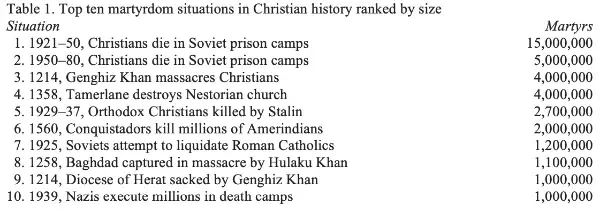
The Tablet 1999-01-23- Vol 253 Iss 8267 — Volume 253, Issue 8267, 1999-01-23 — Tablet Publishing Company — 058cbd3a8869e73ae3ee34aecb8a65df — Anna’s Archive.pdf (file not included in this release)
The number of people who died in the Gulag system in the Soviet Union is estimated to be around 1.6 million. However, estimates can vary, with some historians suggesting numbers as high as 2.7 million.
Breakdown by Years
The deaths in the Gulag system occurred over several years, but the most significant periods were during the Great Purge (1937-1938) and World War II (1941-1945). Here is a rough breakdown of deaths by key periods:
- 1930-1933: Approximately 100,000 to 200,000 deaths
- 1937-1938 (Great Purge): Approximately 200,000 to 300,000 deaths
- 1941-1945 (World War II): Approximately 600,000 to 800,000 deaths
- 1946-1953: Approximately 200,000 to 400,000 deaths
Religious Demographics
The religious demographics of those killed in the Gulag system were diverse, reflecting the multi-ethnic and multi-religious composition of the Soviet Union. The primary religious groups affected included:
- Orthodox Christians: The largest religious group in the Soviet Union, they constituted a significant portion of those imprisoned and killed in the Gulag.
- Muslims: Significant numbers of Muslims, particularly from Central Asian republics and the Caucasus, were also imprisoned and killed.
- Jews: Jews were disproportionately represented among the intelligentsia and political prisoners, leading to a higher percentage being sent to the Gulag.
- Catholics and Protestants: Members of these smaller Christian denominations were also imprisoned, particularly those from Western Ukraine, the Baltic states, and other regions annexed by the Soviet Union.
- Other Religious Groups: Other smaller religious groups, including Buddhists, Shamanists, and various indigenous religious practitioners, were also affected.
The exact breakdown by religious affiliation is challenging to determine due to the lack of specific religious data in Soviet records. The Soviet regime often targeted individuals based on perceived political threats rather than purely religious affiliations, although religious identity could exacerbate suspicions of disloyalty.
The claim that around 20 million people were killed by the Soviet Union encompasses a range of events, including political purges, forced collectivization, famine, and the Gulag system. Here is a breakdown of estimated deaths by years and reasons, along with some information on the demographics affected:
Estimated Deaths by Years and Reasons
| Period | Estimated Deaths | Main Causes | Demographics Affected |
|---|---|---|---|
| 1921-1923 | 5 million | Famine (result of Civil War and policies) | Mainly peasants |
| 1930-1933 | 6-8 million | Forced Collectivization, Famine (Holodomor) | Peasants, especially Ukrainians |
| 1937-1938 | 700,000-1.2 million | Great Purge | Political opponents, ethnic minorities, military, intelligentsia |
| 1941-1945 | 1-1.5 million | WWII Repression, Deportations, Gulag | Ethnic minorities (e.g., Crimean Tatars, Chechens), prisoners |
| 1946-1953 | 1-2 million | Post-War Repressions, Gulag | Political prisoners, various ethnic groups |
| Total | ~20 million | Various reasons including repression, famine, forced labor | Various groups |
Detailed Breakdown of Causes and Demographics
Famine and Forced Collectivization (1921-1923, 1930-1933)
- Main Causes: Government policies leading to famine, forced collectivization of agriculture.
- Demographics: Predominantly peasants, especially in Ukraine, Kazakhstan, and Russia.
The Great Purge (1937-1938)
- Main Causes: Political repression, execution of perceived enemies of the state.
- Demographics: Political opponents, military leaders, intelligentsia, ethnic minorities (e.g., Poles, Germans).
World War II Repressions and Deportations (1941-1945)
- Main Causes: Suspicion of collaboration with Nazi Germany, strategic deportations.
- Demographics: Ethnic minorities (e.g., Crimean Tatars, Chechens, Volga Germans), prisoners of war.
Post-War Repressions and the Gulag System (1946-1953)
- Main Causes: Continued political repression, labor camps.
- Demographics: Political prisoners, religious minorities, ethnic groups seen as threats.
Religious and Political Demographics
- Orthodox Christians: As the largest religious group, they were heavily affected, particularly the clergy and devout followers.
- Muslims: Central Asians, Caucasians, and other Muslim communities faced significant repression.
- Jews: Many Jews, particularly those involved in political movements or intellectual activities, were targeted.
- Catholics and Protestants: These groups, especially in annexed territories like the Baltic states and Western Ukraine, faced persecution.
- Ethnic Minorities: Various ethnic groups, including Poles, Germans, Crimean Tatars, Chechens, and others, were often targeted for deportations and executions.
- Political Opponents: Members of opposition parties, former Tsarist officials, and anyone perceived as a threat to the regime.
This table and breakdown provide a broad overview of the estimated deaths caused by Soviet policies and actions, though exact numbers and details can vary based on different historical sources and interpretations.