📓 Handwritten journal
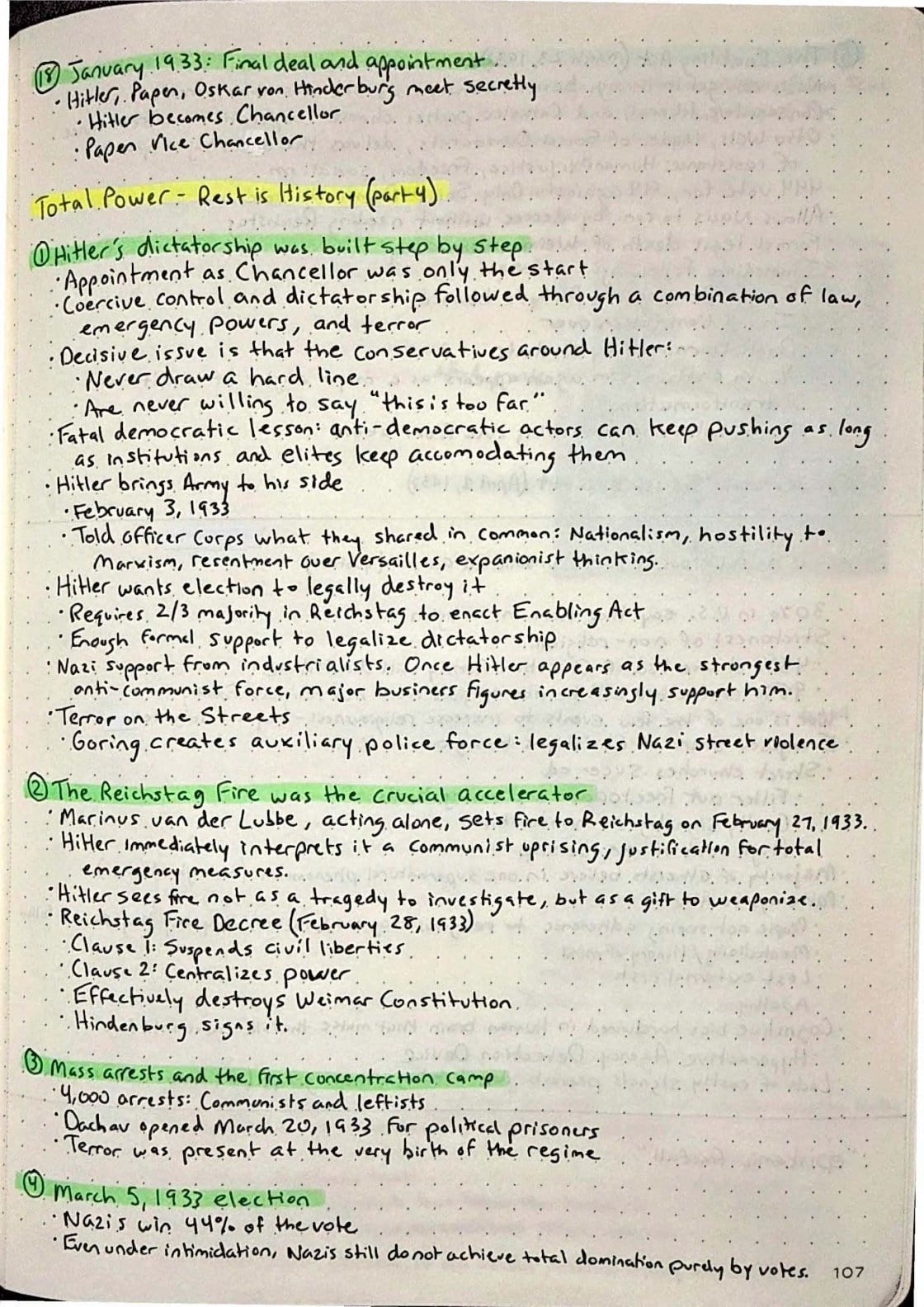
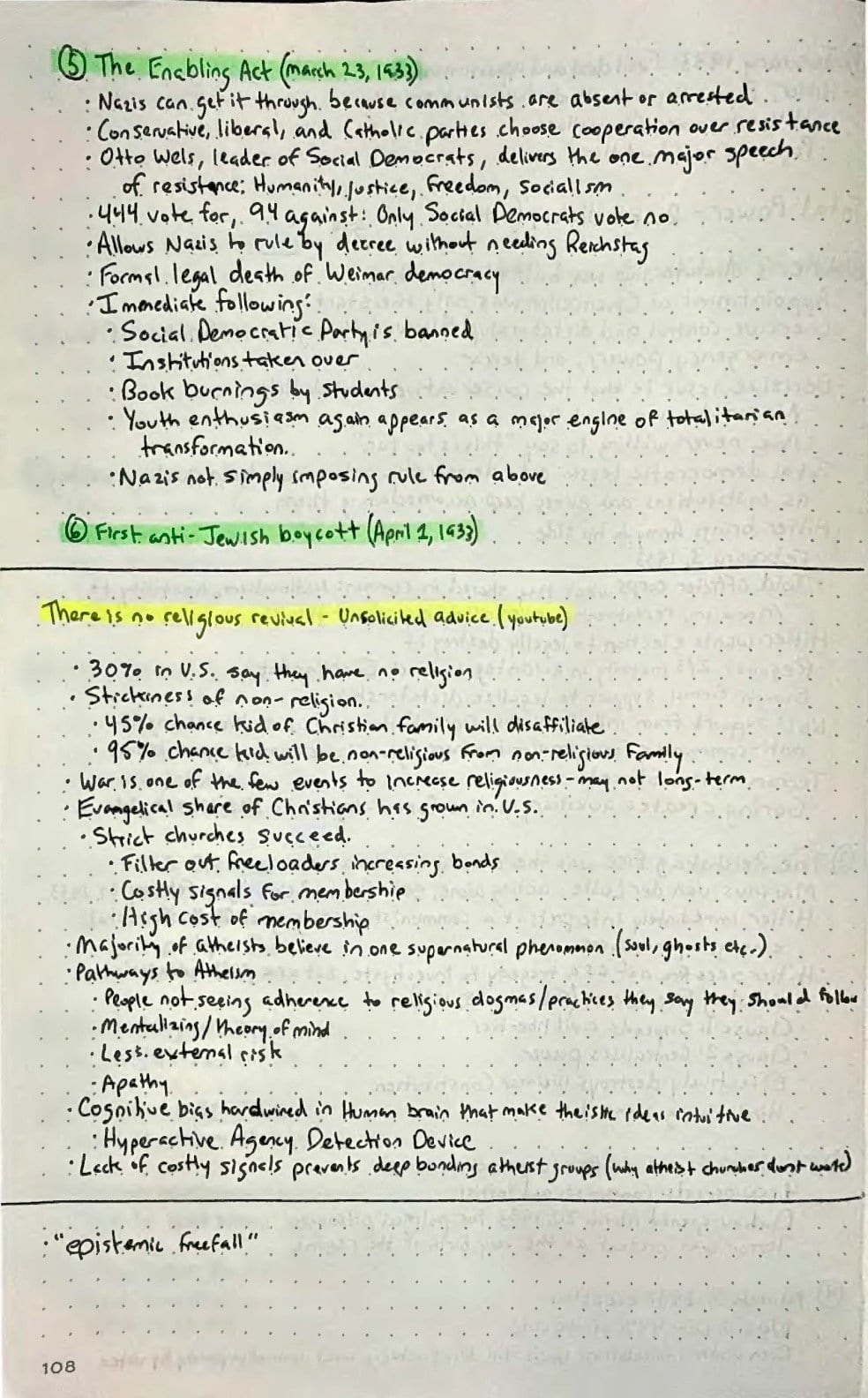
Journal connection: A multi-page run follows the podcast’s explanation of Nazism’s preconditions, electoral breakthrough, elite accommodation, dismantling of democracy, church-state settlement, and early consolidation of power.
Source boundary: These are handwritten podcast notes; verify exact dates, quotations, and causal claims against the episode and historical scholarship.
PDF++ pages: p. 98 (file not included in this release) · p. 99 (file not included in this release) · p. 100 (file not included in this release) · p. 102 (file not included in this release) · p. 105 (file not included in this release) · p. 106 (file not included in this release) · p. 107 (file not included in this release) · p. 108 (file not included in this release) · p. 116 (file not included in this release) · p. 117 (file not included in this release) · p. 118 (file not included in this release)
Embedded preview:
Journal - Feb-March 21 2026.pdf (file not included in this release)
Open the journal index
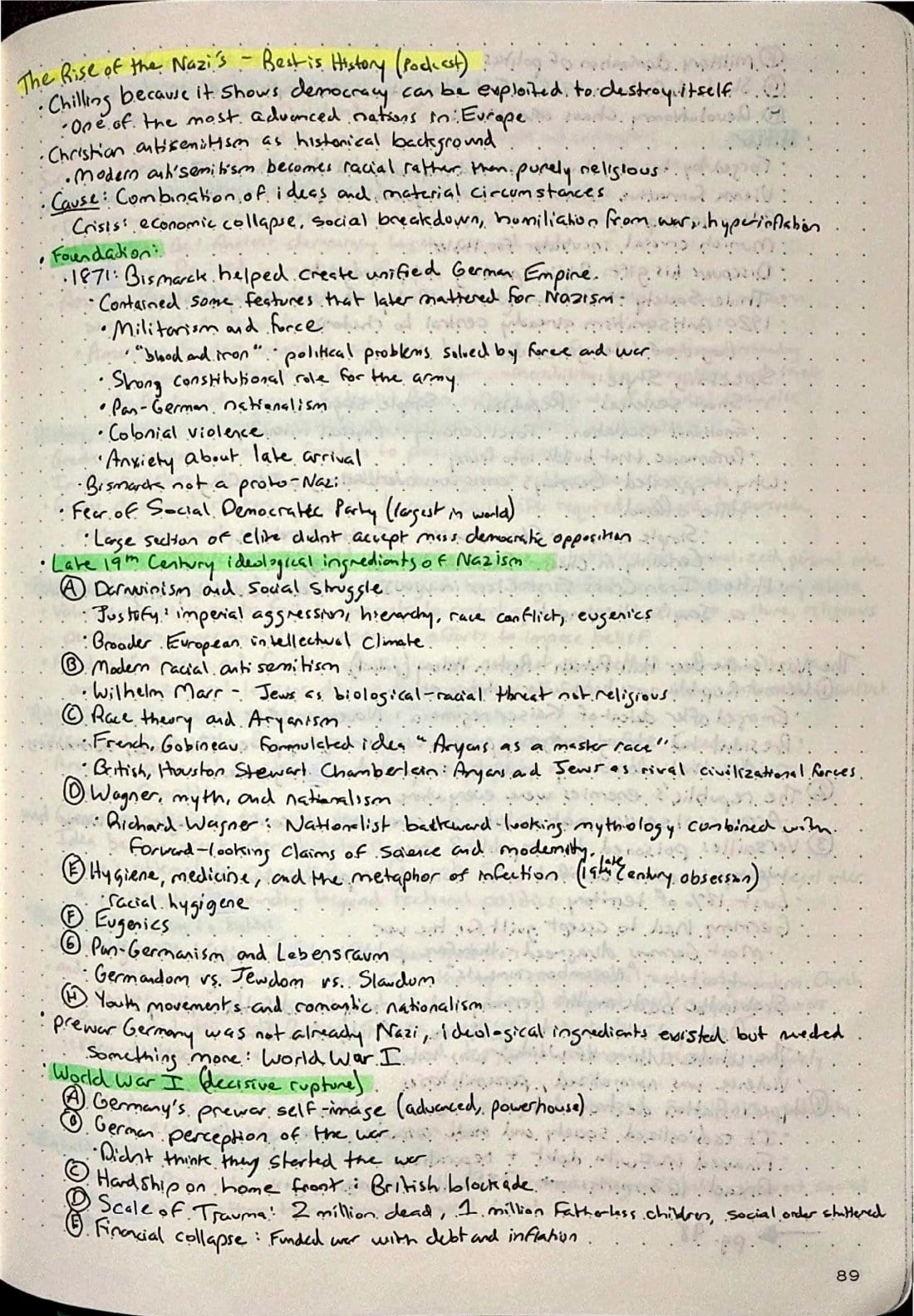
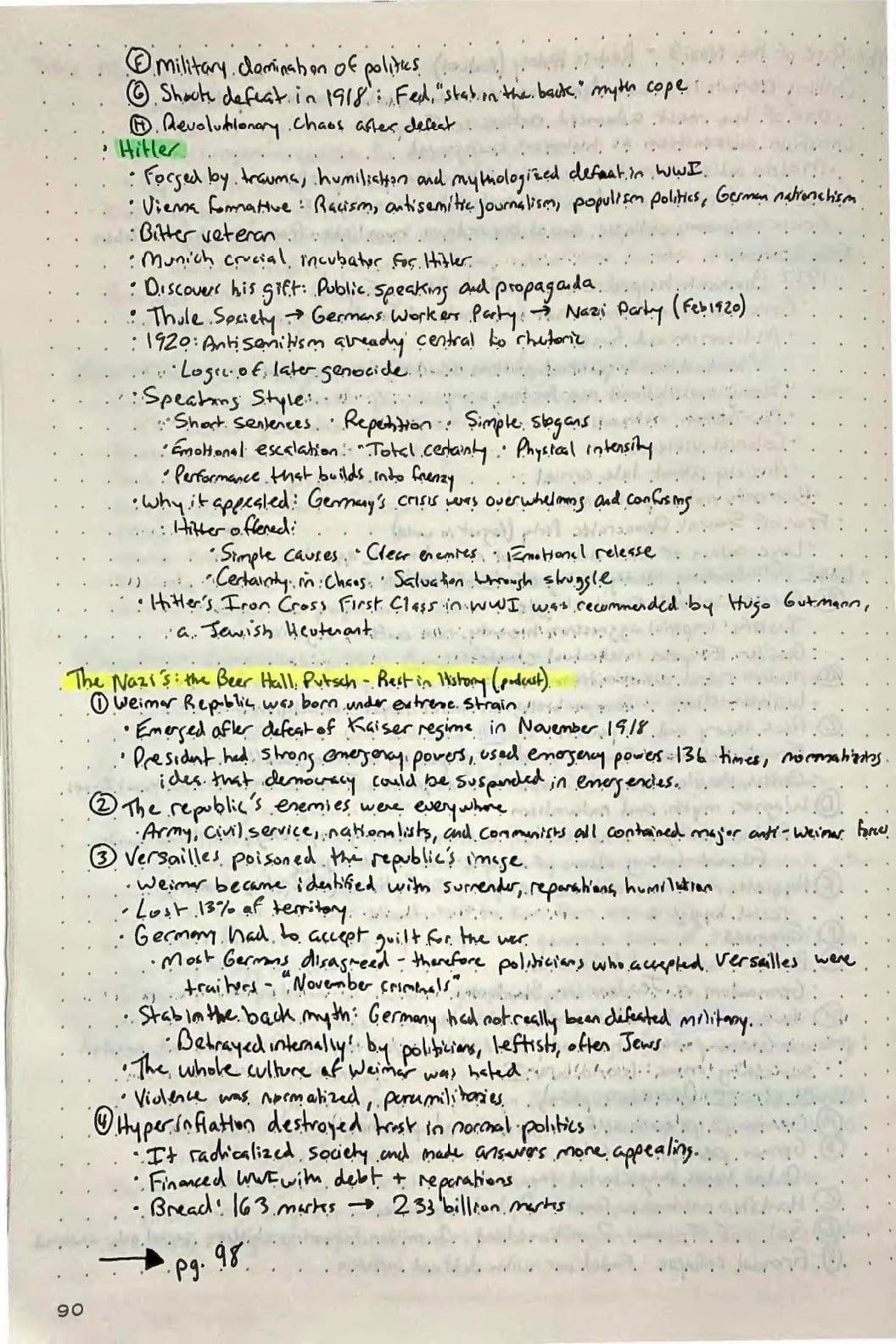
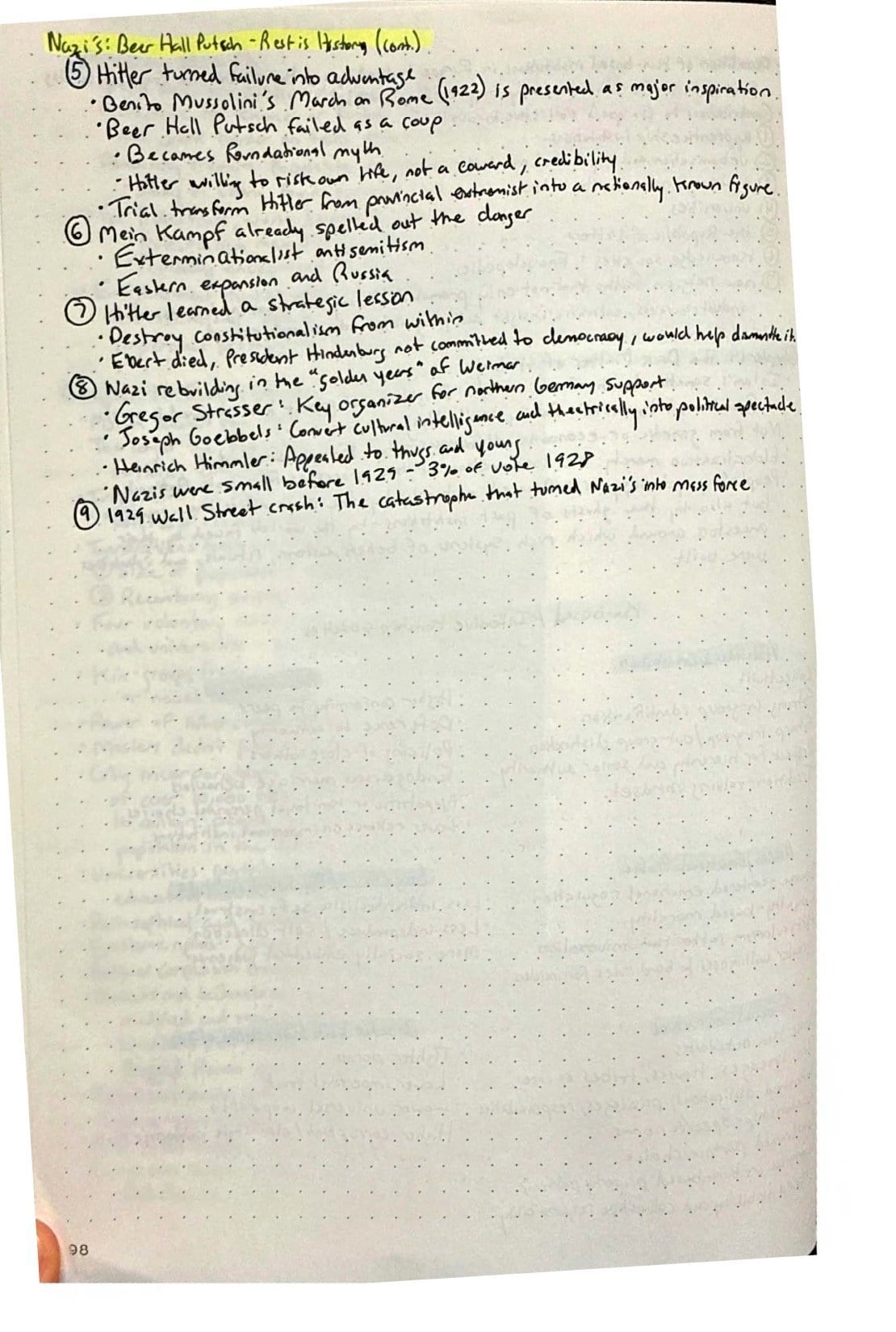
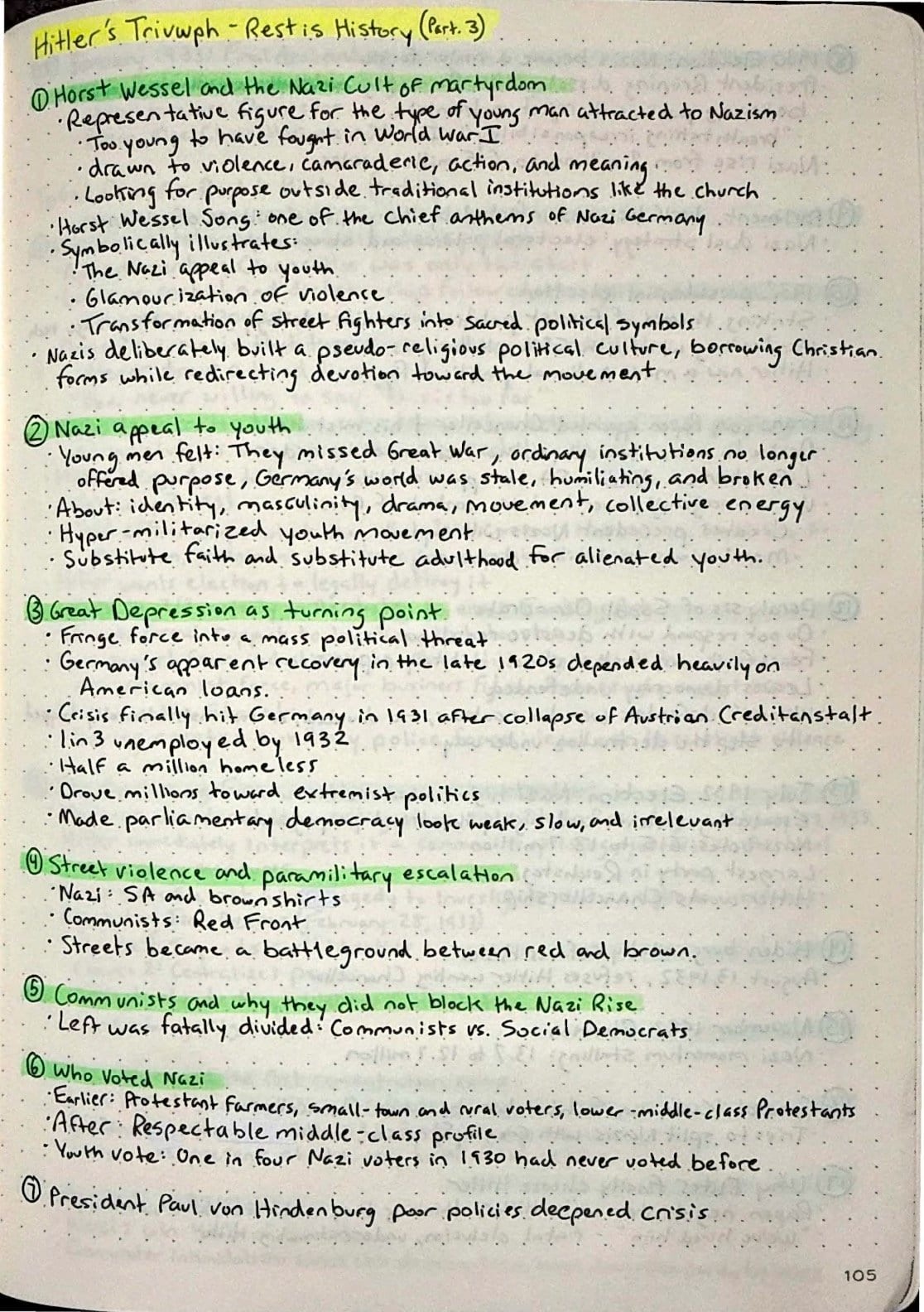
The Rise of the Nazis
Overview
- This episode is the opening installment in a series on the rise of Nazism, framed around the 90th anniversary of Hitler becoming Chancellor of Germany on January 30, 1933.
- The hosts are trying to answer two large, unsettling questions:
- How did the Nazis use democratic processes to destroy democracy from within?
- How did a highly educated, industrialized, culturally sophisticated society like Germany fall under Hitler’s rule?
- The discussion is not yet a full narrative of Nazi rule. It is mainly about the deep background:
- the historiography of Nazism
- the political culture of Germany before 1914
- the ideological climate of late 19th-century Europe
- the impact of World War I
- Hitler’s early life and political emergence in Munich
1. Framing the problem: why the rise of Nazism remains so haunting
- The hosts begin with the symbolic moment:
- January 30, 1933
- President Paul von Hindenburg appoints Adolf Hitler Chancellor in Berlin.
- They stress that this moment is especially chilling because:
- the Nazis did not come to power in a Bolshevik-style revolution
- they did not stage a straightforward coup
- they rose through mass support, electoral strength, coalition bargaining, and constitutional maneuvering
- Key implication:
- Nazism remains terrifying because it suggests that democracy can be exploited to destroy itself
- Another reason it is so disturbing:
- Germany was not a backward, marginal, primitive state
- it was seen as one of the most advanced nations in Europe:
- economically
- scientifically
- educationally
- culturally
- Main idea:
- Nazism forces people to confront whether modernity itself contains destructive possibilities, not just progress.
2. Major historical explanations for Nazism
The hosts outline several influential interpretations historians have used to explain where Nazism came from.
A. The
Sonderweg
thesis
- Some historians argued Germany followed a “special path” (Sonderweg):
- it modernized economically
- but failed to modernize politically in a liberal-democratic way
- In this view, Germany remained:
- more militaristic
- more authoritarian
- more reactionary
- less bourgeois-liberal than Britain or France
- The hosts suggest this view was once influential but is less convincing to many historians today.
B. Continuity from Bismarck or the Kaiserreich
- Some historians saw a line of continuity from:
- Bismarck
- the Second Reich
- the Kaiser’s Germany
- eventually to Hitler
- Fritz Fischer is mentioned as arguing that Germany’s war aims in 1914 prefigured later Nazi ambitions.
- Friedrich Meinecke is mentioned as blaming Bismarck, suggesting a line from German unification in 1870–71 toward Hitler.
- The hosts are cautious about overly direct continuity claims.
C. Marxist / class struggle interpretation
- A more traditional Marxist reading says Nazism was a product of:
- capitalism
- class conflict
- big business using fascism to crush the left
- They mention that many communists at the time held this view.
- Bertolt Brecht is referenced as advancing the idea that Hitler was brought to power by big business.
- The hosts note that many historians today do not fully accept this as the complete explanation.
D. A.J.P. Taylor’s provocative interpretation
- A.J.P. Taylor argued that:
- Hitler was not some radical aberration
- he was in some sense a “normal” German leader
- Nazism reflected deep wishes in German society
- The hosts treat this as intentionally provocative and incomplete.
- Key criticism:
- it underplays Germany’s liberal and democratic traditions.
E. Christian antisemitism as historical background
- Another explanation links the Holocaust and Nazism to centuries of Christian antisemitism:
- Jews cast as enemies of Christ
- old religious prejudice providing cultural groundwork for modern hatred
- The hosts think this must be part of the background.
- But they also stress an important distinction:
- modern antisemitism becomes racial rather than purely religious
F. Materialist explanation: crisis radicalizes politics
- The hosts also raise the idea that Nazism emerged from:
- economic collapse
- social breakdown
- humiliation after war
- hyperinflation
- the Great Depression
- This creates a tension in the episode:
- are the roots of Nazism mainly in ideas?
- or mainly in material circumstances?
- Main takeaway:
- the episode suggests Nazism came from a combination of both.
3. Why start with Bismarck and the German Empire?
- The hosts say it makes sense to begin in 1871, when Bismarck helped create a unified German Empire.
- Before 1871:
- there was a German language and culture
- but no unified German state
- Why Bismarck matters:
- the political order he created may have contained some features that later mattered for Nazism
Key features of Bismarck’s Germany that may matter later
- Militarism and force
- Bismarck’s famous emphasis on “blood and iron”
- political problems solved by force and war
- A strong constitutional role for the army
- the army functioned almost like a state within the state
- it answered to the Kaiser more than to civilian parliamentary forces
- Pan-German nationalism
- the idea that all Germans shared a historic destiny and should be united
- Colonial violence
- German imperial behavior, including atrocities such as the massacre of the Herero in southwest Africa
- Anxiety about late arrival
- Germany felt like a powerful but anxious newcomer to great-power competition
- Britain and France seemed to have a head start through empire and global dominance
Important nuance
- The hosts do not say Bismarck was proto-Nazi in a simple sense.
- They stress:
- Bismarck was reactionary, but so were many European statesmen
- Germany also had strong democratic elements
- the German Empire had a broad franchise and a large trade union movement
- So the key point is not “Bismarck = Hitler.”
- The key point is that some structural and cultural tensions in imperial Germany later fed into the Nazi crisis.
4. Tension inside the German political system
A major theme is that Germany combined modernization with deep political mistrust.
Key point: fear of the Social Democrats
- The Social Democratic Party (SPD) became the largest mass democratic party in the world.
- But conservative elites often treated it as:
- illegitimate
- dangerous
- subversive
- Groups that were suspicious of the SPD included:
- the judiciary
- police
- business elites
- conservative establishment figures
- The hosts contrast this with Britain’s stronger tradition of recognizing the legitimacy of opposition.
- Main idea:
- one weakness in German political culture was that large sections of the elite did not fully accept mass democratic opposition as legitimate.
5. Late 19th-century ideological ingredients of Nazism
This is one of the most important sections of the episode.
A. Darwinism and social struggle
- The hosts argue that the 1880s and 1890s are crucial for understanding the ideological background of Nazism.
- Darwinian ideas were widely adapted into social and political thought:
- struggle
- competition
- survival of the fittest
- contempt for weakness
- This reshaped older moral assumptions.
- It helped justify:
- imperial aggression
- hierarchy
- race conflict
- eugenics
- Key point:
- this was not just German; it was a broader European intellectual climate.
B. Modern racial antisemitism
- The hosts distinguish older Christian antisemitism from newer racial antisemitism.
- Wilhelm Marr is named as especially important:
- he helped redefine antisemitism in racial terms
- not “Jews as religious error”
- but “Jews as biological-racial threat”
- He is said to have coined the term antisemitism and founded the League of Antisemites.
C. Race theory and Aryanism
- In France, Gobineau is mentioned as helping formulate the idea of the Aryans as a master race.
- These ideas were later translated into German and entered German political culture.
- The British writer Houston Stewart Chamberlain is presented as especially important:
- history as struggle between races
- Aryans and Jews as rival civilizational forces
- race as the engine of history
D. Wagner, myth, and nationalism
- Richard Wagner is discussed as a major cultural influence:
- nationalist mythology
- Germanic heroic themes
- antisemitism
- Wagner represents a key tension later central to fascism:
- backward-looking mythology
- combined with forward-looking claims of science and modernity
E. Hygiene, medicine, and the metaphor of infection
- The late 19th century saw an obsession with:
- hygiene
- cleanliness
- disease
- contamination
- These medical metaphors became political and racial metaphors.
- This helped produce concepts like:
- racial hygiene
- societies as healthy or diseased organisms
- Jews as infection or bacillus
- Later Nazi thinking would draw heavily on this language.
F. Eugenics
- Eugenics is described as widespread across the political spectrum, not just on the right.
- Many intellectuals in Britain and elsewhere believed:
- society should breed out weakness or defect
- criminals or the “unfit” should be eliminated from the social body
- George Bernard Shaw is mentioned as an example of a figure associated with such views.
- Key point:
- Nazism radicalized currents that already existed in mainstream European intellectual life.
G. Pan-Germanism and
Lebensraum
- Pan-German movements imagined collective racial blocs:
- Germandom
- Jewdom
- Slavdom
- These were seen as locked in apocalyptic competition.
- The anthropologist Ludwig Woltmann is mentioned as promoting the idea that superior races need space.
- This anticipates the later Nazi idea of Lebensraum:
- living space
- territorial expansion as a biological necessity
H. Youth movements and romantic nationalism
- The hosts discuss groups of idealistic young men:
- hiking
- singing nationalist songs
- bonding in nature
- celebrating brotherhood and ethnic rootedness
- These are compared to things like the Boy Scouts in Britain.
- Main idea:
- Nazism later drew strength from a preexisting culture of:
- masculine fellowship
- romantic nationalism
- anti-urban nostalgia
- heroic communal identity
- Nazism later drew strength from a preexisting culture of:
6. Important caution: prewar Germany was not already Nazi
This is a major balancing point in the episode.
- The hosts warn against overstating the continuity.
- Jews in Germany before World War I were:
- a small minority
- highly integrated
- often assimilated
- professionally successful
- Most Germans were not fixated on exterminatory antisemitism.
- The hosts emphasize:
- had Nazism not happened, historians likely would not treat every marginal racist crank in the 1890s as historically central
- Main idea:
- the ideological ingredients existed, but they were not enough on their own
- something more was needed to radicalize and mobilize them
That “something more” is presented as World War I.
7. Why World War I is the decisive rupture
The First World War is portrayed as absolutely central.
A. Germany’s prewar self-image
- Germans before 1914 often believed they lived in:
- Europe’s most advanced state
- an industrial and scientific powerhouse
- a modern, rising nation
B. German perception of the war
- Germans generally did not think they had started the war.
- Many believed:
- Germany was encircled
- Russia and France were the real aggressors
- Germany was defending itself and supporting Austria
C. Hardship on the home front
- The British blockade caused severe suffering.
- The episode mentions:
- the “turnip winter”
- shortages
- substitute foods
- widespread deprivation
D. Scale of trauma
- Massive losses are emphasized:
- around 13 million men mobilized
- nearly 2 million German dead
- 500,000 widows
- around 1 million fatherless children
- The social order was shattered.
E. Financial collapse
- Germany funded the war heavily through:
- debt
- inflation
- Taxation covered only a small proportion of wartime spending.
- This set up later monetary and political instability.
F. Military domination of politics
- By the end of the war, effective power had shifted toward generals:
- Paul von Hindenburg
- Erich Ludendorff
- Democratic politics were marginalized.
G. Shock of defeat in 1918
- The sudden collapse in November 1918 stunned Germans.
- Many had not been psychologically prepared for total defeat.
- Crucially:
- Allied armies were not occupying Germany itself at the moment of surrender
- so many Germans found it easier to believe they had not really been militarily defeated
- This fed the “stab-in-the-back” myth:
- Germany had supposedly been betrayed internally
- by politicians, leftists, and often Jews
H. Revolutionary chaos after defeat
- The Kaiser fell.
- A republic was proclaimed almost abruptly.
- Berlin saw fighting between left-wing factions.
- The revolutionary atmosphere intensified fears of disorder, betrayal, and national collapse.
Main idea of this section
- World War I turned preexisting resentments and fringe ideas into politically explosive forces.
- It brutalized society, discredited old institutions, and created a vast audience for radical explanations.
8. Hitler’s emotional response to defeat
- One of the most dramatic moments in the episode is the quotation about Hitler hearing of Germany’s collapse in a hospital after being gassed near Ypres.
- He reacts with:
- grief
- humiliation
- rage
- a sense of cosmic betrayal
- The hosts use this moment to show how Hitler later built his worldview around the idea that:
- Germany’s sacrifice had been made meaningless
- traitors had stabbed the nation in the back
- Main significance:
- Hitler’s politics were forged not simply by theory, but by trauma, humiliation, and mythologized defeat.
9. Hitler’s background before politics
The hosts stress that Hitler was originally a nobody.
Key details
- Born in Braunau am Inn in Austria in 1889
- Son of:
- Alois Hitler, a minor customs official
- Clara Hitler
- No remarkable or exotic family background
- The hosts explicitly reject myths such as:
- Jewish ancestry
- physical oddities as explanatory causes
- As a boy, he is described as fairly normal.
- Later as a teenager:
- sullen
- lazy
- dreamy
- alienated
- wants to be an artist
- His father opposes this ambition.
- His father dies in 1903.
- Hitler leaves school and drifts.
Vienna as formative
- After his mother dies in 1907, Hitler goes to Vienna.
- He fails twice to get into the Vienna Fine Arts Academy.
- Lives in poverty, in men’s hostels, selling postcards.
- This is important because Vienna provides an atmosphere saturated with:
- racism
- antisemitic journalism
- populist politics
- German nationalism
10. Vienna and the shaping of Hitler’s worldview
A. Political antisemitism in Vienna
- The hosts stress that Vienna’s public culture was more aggressively antisemitic than mainstream Germany’s.
- Hitler was exposed daily to antisemitic newspapers and rhetoric.
B. Georg Ritter von Schönerer
- A major ideological influence:
- radical pan-German nationalist
- fiercely antisemitic
- anti-Christian in orientation
- Important ideas associated with him:
- wanted Jews expelled from public life
- used the greeting “Heil”
- followers called him “Führer”
- wanted to replace Christian dating and festivals with Germanic ones
- Main significance:
- some key symbolic and rhetorical elements of Nazism already existed in Vienna’s extreme nationalist politics.
C. Karl Lueger
- Mayor of Vienna
- Modernizer and populist
- Combined:
- municipal activism
- social appeals to lower-middle-class voters
- virulent antisemitism
- Important because he showed how antisemitism could work as mass politics, not just fringe theory.
D. Wagnerian cultural influence
- Hitler’s obsession with Wagner is emphasized again.
- Wagner offered:
- heroic myth
- Germanic destiny
- grand struggle
- recognition of the unrecognized hero
- This fit Hitler’s self-image as a resentful failure waiting to be vindicated.
Main takeaway
- Vienna did not yet make Hitler the Führer.
- But it supplied him with:
- racial politics
- antisemitic frames
- populist style
- German-national myth
- models of mass leadership
11. Hitler and the First World War
- Hitler moves to Munich before the war.
- In 1914, like many others, he is enthusiastic about war.
- The war gives him:
- purpose
- identity
- belonging
- discipline
- He serves as a dispatch runner and is considered brave.
- He wins the Iron Cross.
- The hosts suggest that the war helps brutalize him:
- death becomes normalized
- suffering becomes ordinary
- violence becomes politically imaginable
- After the war, he is not just a failed artist anymore.
- He is a bitter veteran shaped by defeat and resentment.
12. Munich after the war: chaos, revolution, and counterrevolution
Munich is presented as a crucial incubator for Hitler.
A. Kurt Eisner and Bavaria’s collapse into upheaval
- After Germany’s defeat, power in Munich is seized by Kurt Eisner:
- Jewish
- left-wing
- a theater critic
- bohemian outsider type
- The hosts note how almost tailor-made this was to enrage people like Hitler.
B. Ernst Toller and the Bavarian Council Republic
- After Eisner, Munich sees further radicalization.
- Ernst Toller, a poet and playwright, leads a revolutionary regime.
- The hosts emphasize the almost absurd, theatrical quality of revolutionary politics in Munich.
C. Communist takeover
- A harder-line communist regime follows.
- A church is turned into a Temple of Reason, echoing the French Revolution.
D. The Freikorps retake Munich
- Munich is retaken by the Freikorps:
- ex-soldiers
- nationalist
- violent
- anti-communist
- They execute many communists.
- The hosts describe them as anticipating the Nazis in several ways:
- paramilitary politics
- glorification of violence
- anti-left hatred
- militarized masculinity
Main idea
- Postwar Munich exposed Hitler to a concentrated mix of:
- national humiliation
- antisemitism
- anti-communism
- revolutionary disorder
- paramilitary violence
13. Hitler discovers his gift: public speaking and propaganda
This is the turning point in Hitler’s personal development.
- Hitler remains in the Bavarian army after the war.
- His superiors want soldiers inoculated against communist influence.
- So they send them to political education sessions.
- Hitler proves especially effective:
- he listens
- answers questions
- absorbs the messaging
- then begins giving lectures himself
- Why he is effective:
- speaks like an ordinary soldier
- simple, direct language
- emotional intensity
- certainty
- resentment that matches the mood of his audience
Key ideological content of his early speeches
- anti-left
- anti-democratic
- anti-Jewish
- nationalist
- infused with the language of disease and racial corruption
Important point
- The army did not create Hitler’s ideology from nothing.
- But it gave him:
- a platform
- practice
- encouragement
- recognition of his talent
14. The German Workers’ Party and Hitler’s entry into politics
A. Origins of the party
- Hitler is sent to observe a tiny fringe group:
- the German Workers’ Party
- It was founded by Anton Drexler, a locksmith.
- It had roots in the Thule Society:
- far-right
- antisemitic
- pan-German
- occult-inflected
- obsessed with Aryan mythology
B. Hitler joins
- At one meeting, Hitler angrily attacks a speaker advocating Bavarian separatism.
- Drexler is impressed and recruits him.
- Hitler becomes member 555—likely inflated numbering to make the group seem larger than it really was.
C. Why Hitler matters to the party
- He becomes its most effective speaker.
- Crowds grow because of his performances.
- He can translate conspiratorial ideology into emotionally gripping mass rhetoric.
D. Transformation into the Nazi Party
- In February 1920, it becomes the National Socialist German Workers’ Party.
- Hitler helps design the party symbol and flag:
- swastika from older Aryan symbolism and Thule influence
- black-white-red from imperial Germany’s colors
E. Consolidation of Hitler’s control
- By 1921, Hitler effectively becomes the dominant figure in the party.
- He gathers important followers around him.
15. Key figures around early Hitler
The episode names several early associates:
- Rudolf Hess
- later one of Hitler’s close lieutenants
- Hans Frank
- Hitler’s lawyer
- Julius Streicher
- extreme antisemite
- later publisher of Der Stürmer
- Hermann Göring
- former flying ace
- brings prestige and glamour
- Alfred Rosenberg
- ideologue
- strongly anti-Christian
- wants crosses replaced by swastikas and the Bible replaced by Mein Kampf
Main idea
- Hitler’s movement quickly becomes more than one angry speaker.
- It begins to form a nucleus of:
- ideologues
- propagandists
- prestige figures
- legal and organizational supporters
16. Hitler’s early message: what he is actually saying
The hosts stress that Hitler’s early rhetoric is already extremely radical.
Major themes in his speeches
- Germany was betrayed
- the nation was humiliated by traitors
- Jews are the central enemy
- national rebirth requires force
- politics is struggle, not compromise
- disease must be exterminated at its source
Important observation
- The hosts note that anti-Marxism is not yet the most central element in Hitler’s rhetoric at this early stage.
- Instead, antisemitism is already central.
- Hitler is not merely opposing rival parties.
- He is framing politics as a struggle against a racial enemy.
Significance
- This suggests exterminatory ideas were present much earlier than many people assume.
- The logic of later genocide is already latent in this rhetoric.
17. Hitler’s style and why it worked
The hosts emphasize not just what Hitler said, but how he said it.
Features of Hitler’s speaking style
- short sentences
- repetition
- simple slogans
- emotional escalation
- total certainty
- physical intensity
- performance that builds into frenzy
Why it appealed
- Germany’s crisis was overwhelming and confusing.
- Hitler offered:
- simple causes
- clear enemies
- emotional release
- certainty in chaos
- salvation through struggle
- The hosts compare the atmosphere of his meetings to revivalist fervor.
Main idea
- Hitler’s success depended not only on ideology, but on his ability to perform certainty and rage for a traumatized public.
18. Final idea of the episode: Hitler did not yet see himself as Germany’s ruler
- At this stage, Hitler does not yet imagine himself as the future leader of Germany.
- The hosts say he initially sees himself as:
- the drummer
- the propagandist
- the herald preparing the way
- He is not yet fully the messianic Führer figure he later becomes.
- This sets up the next stage of the story:
- how Hitler moved from agitator to would-be national savior
Key historical events mentioned
19th century background
- 1870–71: Unification of Germany under Bismarck
- German colonial violence in southwest Africa, including the Herero massacre
- Rise of racial thought and antisemitic politics in late 19th-century Europe
First World War and aftermath
- 1914: Germany enters World War I
- 1914–1918: wartime deprivation, militarization, mass death
- 1918: German defeat and collapse of the Kaiserreich
- November 1918: proclamation of the republic; revolutionary unrest
- 1918–1919: Berlin upheaval and the suppression of left-wing revolutionaries
- 1919: revolutionary chaos in Munich under Eisner, Toller, and communists
- 1919: Freikorps crush Munich’s revolutionary regime
Hitler’s political rise
- 1907–1913: Hitler in Vienna
- 1914–1918: Hitler in the war
- 1919: Hitler used by the Bavarian army in political instruction
- 1919: Hitler joins the German Workers’ Party
- 1920: party becomes NSDAP
- 1921: Hitler becomes dominant within the party
- 1933: Hitler appointed Chancellor
Main ideas distilled
1. Nazism was not a sudden accident
- It grew from a mix of:
- older nationalism
- racial ideology
- modern pseudo-science
- anti-liberal resentment
- wartime trauma
- postwar chaos
2. Germany’s case was distinctive, but not isolated from Europe
- Nazism had specifically German roots
- But many intellectual ingredients were pan-European:
- Darwinian struggle
- eugenics
- imperial violence
- race theory
- antisemitism
3. World War I was the great radicalizing force
- Without the war, defeat, deprivation, and humiliation, fringe ideas may have remained fringe.
4. Hitler’s rise depended on political crisis plus personal performance
- He was not impressive as a youth or artist
- He became significant because:
- war gave him identity
- defeat gave him fury
- Munich gave him a stage
- public speaking gave him power
5. Antisemitism was not secondary in Hitler’s worldview
- Even early on, Jews were not just one enemy among many
- They were central to his explanatory system
6. Democracy’s vulnerability is one of the episode’s deepest concerns
- Nazism remains terrifying because it shows that constitutional politics can be exploited by anti-constitutional forces.
Books, articles, and sources mentioned
Historians and scholarly works referenced
- Richard Evans
- his trilogy on the Third Reich is described as a major work
- specifically the first volume is mentioned
- Fritz Fischer
- associated with the thesis that German war aims in 1914 prefigured the Third Reich
- Friedrich Meinecke
- associated with the argument that Bismarck helped lay the groundwork
- A.J.P. Taylor
- associated with the claim that Hitler was, in some sense, a normal German leader
- Ian Kershaw
- mentioned indirectly through the hosts recalling earlier episodes with him on Hitler
Literary / political figures and works
- Bertolt Brecht
- mentioned as a communist playwright who advanced the “big business brought Hitler to power” thesis
- Houston Stewart Chamberlain
- The Foundations of the Nineteenth Century
- Adolf Hitler
- Mein Kampf
- Julius Streicher
- Der Stürmer (newspaper / propaganda paper)
Media / podcast references
- The Rest Is History
- Their earlier episodes on Auschwitz with Jonathan Friedland
- Earlier episodes on Hitler with Sir Ian Kershaw
- An earlier anniversary episode on 1922
- Promotional mention of The Rest Is Entertainment
Important people mentioned
Central figures
- Adolf Hitler
- Paul von Hindenburg
- Erich Ludendorff
- Otto von Bismarck
- Richard Wagner
Historians / intellectual interpreters
- Richard Evans
- Fritz Fischer
- Friedrich Meinecke
- A.J.P. Taylor
- Ian Kershaw
- Jonathan Friedland
Ideological / political influences
- Wilhelm Marr
- Gobineau
- Houston Stewart Chamberlain
- Ludwig Woltmann
- Georg Ritter von Schönerer
- Karl Lueger
Revolutionary / postwar Bavarian figures
- Kurt Eisner
- Ernst Toller
- Rosa Luxemburg (mentioned in relation to Freikorps violence in Berlin)
Early Nazi associates
- Rudolf Hess
- Hans Frank
- Julius Streicher
- Hermann Göring
- Alfred Rosenberg
- Anton Drexler
Related topics for further exploration
Germany and Nazism
- The Weimar Republic and why it was so unstable
- The Treaty of Versailles and its political effects inside Germany
- The stab-in-the-back myth
- The role of the Freikorps in postwar politics
- The Beer Hall Putsch
- Hitler’s transformation from agitator to national politician
- The Nazi use of paramilitary violence and intimidation
- The role of Hindenburg in enabling Hitler’s appointment
- How Nazi propaganda actually worked in elections
Intellectual and ideological background
- The difference between religious anti-Judaism and racial antisemitism
- The influence of Social Darwinism
- Eugenics in Britain, Germany, and the United States
- The political uses of hygiene, disease, and racial purity
- Pan-Germanism and the idea of Volksgemeinschaft
- Wagner, myth, and the cultural roots of fascism
- The relationship between modern science and racial pseudo-science
Comparative and broader themes
- Why some democracies survive crises and others collapse
- Comparison between Bolshevik and Nazi routes to power
- Why Germany after World War I radicalized more than Britain or France
- How defeat, humiliation, and economic collapse change political culture
- The role of conspiracy theories in times of national crisis
- Whether Nazism was uniquely German or a radical expression of broader European trends
Holocaust and long-term consequences
- When exterminationist thinking became official Nazi policy
- How early Nazi antisemitic rhetoric connects to the Final Solution
- The evolution from discrimination to genocide
- The relationship between Nazi racial doctrine and colonial precedents
Bottom line
- The episode’s central argument is that the rise of Nazism cannot be explained by one cause.
- It emerged from the interaction of:
- German political structures
- European racial and nationalist ideas
- World War I trauma
- revolutionary and counterrevolutionary violence
- and Hitler’s unusual talent for turning grievance into mass politics
- The most unsettling lesson is that Nazism did not arrive from outside modern civilization.
- It emerged within a modern, educated, electorally mobilized society and used that society’s own institutions, fears, and resentments against it.
The Nazis: the Beer Hall Putsch
Overview
- This episode continues the story of the rise of the Nazis by shifting focus from Hitler’s early movement in Munich to the broader weakness of the Weimar Republic.
- The central argument is clear:
- without the fragility and failures of the Weimar Republic, Hitler and the Nazi Party would likely have remained marginal
- The episode covers:
- the origins and structural weaknesses of Weimar
- the political and psychological legacy of Germany’s defeat in World War I
- hyperinflation and social breakdown
- the Beer Hall Putsch of 1923
- Hitler’s trial and imprisonment
- the writing of Mein Kampf
- the Nazi Party’s reorganization in the mid-1920s
- the sense that the Nazis were still small by 1928, but poised to benefit from a future crisis
1. Opening frame: Hitler’s trial speech and the contempt for Weimar legality
- The episode opens with a dramatic quotation from Adolf Hitler’s speech at his 1924 trial after the failed Beer Hall Putsch.
- Main significance of the quote:
- Hitler rejects the moral legitimacy of the court judging him
- he appeals instead to “history” as a higher tribunal
- he presents himself not as a criminal, but as a patriot vindicated by destiny
- Key idea:
- this reveals Hitler’s contempt for legal procedure, parliamentary order, and the existing German state
- he treats legality as secondary to national struggle and historical mission
- This sets up the episode’s main concern:
- what kind of republic was Weimar, and why did so many people on right and left despise it?
2. What the Weimar Republic was
Basic definition
- The Weimar Republic was Germany’s democratic political order established after the collapse of the Kaiser’s regime in 1918–1919.
- It is called “Weimar” because the constitution was drafted in the town of Weimar, associated with Goethe and German cultural prestige.
Why Weimar is important in the story
- The hosts argue that:
- without Weimar’s weakness, there is no Third Reich
- The real question is not just how Hitler rose, but:
- whether Weimar was flawed from birth
- whether it was doomed from the beginning
- or whether it might have survived under better circumstances
3. The accidental and improvised birth of Weimar
The collapse of imperial Germany
- The republic emerged out of the chaos of German defeat in November 1918.
- Key features of that collapse:
- mutinies
- uprisings
- revolutionary unrest
- the Kaiser’s abdication and flight
- breakdown of old institutions
- The hosts stress:
- almost nobody had consciously planned or long desired the precise system that became Weimar
Friedrich Ebert as the founding figure
- Friedrich Ebert, leader of the SPD (Social Democratic Party), becomes the central founder of the republic.
- Important point:
- Ebert was not a romantic revolutionary
- he was pragmatic, cautious, and even monarchist in instinct
- He reportedly hated revolution “like sin.”
- Main significance:
- Weimar was not born from triumphant ideological conviction
- it was born from necessity, crisis, and improvisation
Coalition behind the republic
- Ebert builds an alliance with:
- the Centre Party (Catholic party)
- the Liberals
- elements of the army high command
- This alliance is meant to stabilize Germany and prevent full revolutionary collapse.
4. Structural weakness inside the Weimar constitution
The dual structure of power
- The Weimar constitution preserved some important continuities with imperial Germany.
- It created a system in which:
- parliament (Reichstag) governed under normal conditions
- but the president held strong emergency powers
- The president could:
- rule by decree
- use the army
- bypass parliament under Article 48
Why this mattered
- Ebert used these emergency powers extensively:
- 136 times, according to the hosts
- He often did this because there was real disorder and violence.
- But the unintended effect was dangerous:
- it normalized the idea that democracy could be suspended in emergencies
- it established a precedent for presidential authority overriding parliamentary politics
Main takeaway
- Weimar was democratic, but it contained built-in anti-democratic mechanisms.
- This would later make it easier for enemies of democracy to hollow it out from within.
5. Why Weimar was tainted from the very beginning
The republic was linked to defeat
- Unlike the Kaiser’s Reich, which many Germans saw as legitimate, Weimar was born under the shadow of:
- military defeat
- political humiliation
- revolution
- foreign pressure
- This made it vulnerable from the start.
The Treaty of Versailles as a burden
The republic inherited the Treaty of Versailles and was blamed for it.
Terms and grievances mentioned in the episode
- Germany lost 13% of its national territory
- Alsace-Lorraine was lost
- the Saarland became a kind of French protectorate
- the Rhineland was demilitarized
- territory in the east went to the new Polish Republic
- Austria was not allowed to unite with Germany
- Germany faced military restrictions:
- no tanks
- no artillery
- only a 100,000-man army
- Germany had to pay 132 billion gold marks in reparations
- Germany had to accept guilt for the war
Political meaning of Versailles
- Most Germans did not accept that they had been solely guilty for the war.
- Therefore, many concluded:
- politicians who accepted Versailles must be traitors
- the republic was complicit in national humiliation
- This fed the “November criminals” narrative:
- republican politicians had sold Germany out
Main idea
- Weimar was not just a new constitution.
- In the minds of many Germans, it was the political embodiment of surrender, humiliation, and national disgrace.
6. The stab-in-the-back myth
What the myth said
- Germany had not really been defeated militarily.
- Instead, it had been:
- betrayed internally
- stabbed in the back by politicians, leftists, and often Jews
Why it was persuasive
- Germany’s defeat had come suddenly.
- Many civilians had not understood how bad the military situation was.
- The army high command, especially Ludendorff, helped spread the lie rather than admit military failure.
Why it mattered
- This myth undermined the republic at its foundations.
- It meant:
- the regime born after the war was treated as illegitimate
- the people who signed the armistice and accepted the republic were branded traitors
- This myth became a core emotional resource for the far right, including the Nazis.
7. The state institutions that should have defended Weimar often did not believe in it
This is one of the most important points in the episode.
The army
- The army remained:
- monarchist
- conservative
- resentful of the republic
- It kept the old imperial colors:
- black, white, red
- not the new republican colors:
- black, red, gold
- Many army leaders wanted Weimar gone.
- They also violated the spirit of Versailles and were not reliable defenders of democracy.
The civil service
- The civil service was heavily staffed by people with imperial and military loyalties.
- Many bureaucrats saw Weimar politicians as:
- weak
- leftish
- disloyal
- responsible for defeat
- So the machinery of state often lacked emotional loyalty to the republic it served.
Political parties at the extremes
- Many of the biggest political forces did not truly accept Weimar:
- Communists viewed it as a bourgeois-capitalist sham
- Nationalists wanted monarchy or authoritarian rule restored
- The hosts mention Alfred Hugenberg as a leading nationalist figure:
- press baron
- pan-German
- nationalist
- antisemitic
- hostile to the republic
Main takeaway
- Weimar’s defenders were weak.
- Many of its most powerful institutions and large segments of political life were waiting for it to fail.
8. Culture wars and ideological instability in 1920s Germany
Weimar as a site of cultural conflict
- The hosts stress that Weimar Germany was not just politically unstable.
- It was also culturally explosive.
- Themes associated with Weimar culture:
- Berlin nightlife
- cabaret
- sexual experimentation
- expressionist art and film
- jazz
- bohemianism
- urban decadence
Why this mattered politically
- To conservatives and reactionaries, Weimar came to symbolize:
- disorder
- decadence
- moral collapse
- rootlessness
- In other words, Weimar was not merely a constitutional system to many critics.
- It was a whole cultural world they hated.
Main idea
- The republic was being attacked not just as a political arrangement, but as a civilization they believed had become degenerate.
9. Violence in Weimar politics
A militarized political culture
- The hosts describe Weimar as a society steeped in:
- uniforms
- street battles
- violent rhetoric
- paramilitary organization
- This is linked to:
- the legacy of World War I
- the Freikorps experience
- a broader acceptance of violence across the political spectrum
Paramilitary formations
The episode mentions multiple groups:
- Steel Helmets (Stahlhelm)
- veterans’ organization
- nominally broad, but drawn toward the far right
- Red Front Fighters’ League
- communist paramilitary wing
- SA / Stormtroopers
- Nazi paramilitary wing
- brownshirts
- Reichsbanner Schwarz-Rot-Gold
- paramilitary organization linked to the Social Democrats and republican defense
Main point
- Violence was normalized.
- Political struggle was not treated as mere debate.
- It was increasingly imagined as a battle for national survival.
Deeper implication
- This made parliamentary democracy seem weak, procedural, and inadequate.
- It made movements like Nazism seem vigorous, masculine, and decisive.
10. Hyperinflation and social collapse
This is one of the most central historical sections of the episode.
Background
- Germany had financed World War I heavily through debt and money creation.
- After defeat, it still had to pay reparations.
- No government wanted to raise taxes enough to do this openly, so the system kept printing money.
The Ruhr crisis
- In 1923, because Germany fell behind in reparation deliveries, France occupied the Ruhr, Germany’s industrial heartland.
- This intensified the crisis and national humiliation.
- The use of some colonial troops by the French especially inflamed German right-wing resentment.
Scale of hyperinflation
The hosts give dramatic examples:
- August 1922:
- 1 US dollar = 1,000 marks
- December 1922:
- 1 dollar = 7,000 marks
- July 1923:
- 1 dollar = 353,000 marks
- August 1923:
- 1 dollar = 1.5 million marks
- September 1923:
- 1 dollar = 98 million marks
- October 1923:
- 1 dollar = tens of billions of marks
- Bread that once cost 163 marks later cost 233 billion marks
Social effects
- Savings were wiped out
- middle-class respectability collapsed
- ordinary life became chaotic
- fixed incomes became meaningless
- people faced humiliation and downward mobility
Psychological and moral effects
- This was not just an economic crisis.
- It was a crisis of:
- trust
- status
- dignity
- order
- The hosts emphasize how destabilizing this was in a status-conscious society like Germany.
Main idea
- Hyperinflation destroyed faith in the system and radicalized people who might otherwise never have supported extremism.
11. Crime, paranoia, and scapegoating
The emotional atmosphere
- The hosts describe a society obsessed with:
- crime
- fraud
- speculation
- disorder
- disease
- They connect this with Weimar culture and German expressionist films.
Antisemitism intensifies
- The crisis fuels conspiracy thinking:
- Jews are blamed as speculators
- Jews are blamed as Bolsheviks
- Jews are blamed as corrupt insiders
- Contradictory stereotypes coexist:
- Jews as capitalist profiteers
- Jews as revolutionary subversives
Broader anti-establishment feeling
- It is not only Jews who are blamed.
- Many people also blame:
- politicians
- parliament
- Berlin
- the entire governing class
- Main idea:
- in crisis, people stop distinguishing fine constitutional points
- they blame the whole system
12. Stresemann and temporary stabilization
Gustav Stresemann’s role
- Gustav Stresemann is presented as another great Weimar politician.
- He was a liberal, not a social democrat.
- He took power in August 1923.
His solutions
- He introduced a new currency:
- the Rentenmark
- He sought to normalize reparations rather than refuse them.
- His reasoning:
- Germany should cooperate enough to gain credibility
- then renegotiate the terms from a stronger political position
- This helps produce the Dawes Plan, which modifies the reparations framework.
Why this was politically difficult
- Stresemann’s policy was practical and sophisticated.
- But to angry nationalists it looked like capitulation.
- For people steeped in grievance, compromise looked like treason.
Main idea
- Weimar briefly stabilizes, but its stabilization relies on policies that further enrage many on the right.
13. Hitler and the Nazi Party in 1923
Hitler’s position
- By 1923, Hitler is the leader and embodiment of the Nazi Party in Munich.
- The Nazis are still small and regional.
- But Hitler is becoming impatient.
- He fears that if he does not act boldly, he will be seen as just another all-talk extremist.
Mussolini as model
- Benito Mussolini’s March on Rome (1922) is presented as a major inspiration.
- Hitler sees that:
- a radical nationalist leader
- not from the old elite
- can seize power and become a national savior
- This broadens Hitler’s imagination of what is possible.
Ludendorff as a rival pole of the right
- At this stage, General Ludendorff still seems a more obvious national figurehead for the far right.
- He is a famous war leader and associated with the “stab-in-the-back” myth.
- Hitler is still in transition from agitator to someone who might imagine national leadership for himself.
14. The Beer Hall Putsch
Immediate background
- Bavaria is being run by a conservative-right triumvirate:
- Gustav Ritter von Kahr
- Colonel von Seisser (police)
- General von Lossow (army)
- They themselves are hostile to Weimar and flirting with authoritarian alternatives.
- Hitler hopes to force them into joining a national-right coup.
The plan
- On November 8, 1923, Hitler and his followers burst into the Bürgerbräukeller in Munich, where Kahr is speaking.
- Hitler fires a shot into the ceiling.
- He announces that:
- the building is surrounded
- the revolution is underway
- a march on Berlin is beginning
- Proposed power structure:
- Hitler as head of government
- Ludendorff as military leader
- Kahr as regent for a restored Kaiser
Why it fails
- The Bavarian triumvirate appears to go along under pressure, then immediately repudiates the coup once free.
- The Nazis fail to secure:
- barracks
- police headquarters
- military support
- Their support begins to evaporate.
- The following day, they march and are stopped by police.
- Gunfire breaks out.
Casualties and consequences
- 14 marchers are killed
- 4 policemen are killed
- Göring is wounded
- Hitler falls and dislocates his shoulder
- The coup collapses completely
Historical meaning
- The putsch is a fiasco in immediate practical terms.
- But the hosts suggest it also becomes a foundational myth.
- It proves:
- Hitler was willing to risk his life
- he could not later be dismissed as a coward or mere parliamentarian
- This gives him credibility among followers.
15. The trial: a disaster turned into propaganda
Why the trial mattered
- The trial should have ended Hitler politically.
- Instead, it gave him a national platform.
Conditions that favored him
- The trial is held in Munich, not Leipzig
- the judge, Georg Neithardt, is sympathetic to nationalist feeling
- Hitler effectively carries responsibility in a way that protects other figures, including Ludendorff
Hitler’s performance
- Hitler appears in civilian clothes, but wears his Iron Cross
- He presents himself as:
- patriot
- war veteran
- martyr
- national prophet
- He uses the courtroom to:
- denounce the republic
- appeal over the law to “history”
- expand his fame beyond Bavaria
Main significance
- The trial transforms Hitler from a provincial extremist into a nationally known figure.
16. Hitler’s imprisonment and the writing of
Mein Kampf
Landsberg Prison
- Hitler is sent to Landsberg am Lech
- It is described as less a real prison than a comfortable fortress-like confinement
- He receives:
- books
- visitors
- flowers
- support from admirers
Psychological effect
- Prison deepens his self-image as:
- martyr
- chosen leader
- man of destiny
- He is no longer just the “drummer.”
- This period helps push him toward seeing himself as the movement’s irreplaceable leader.
Writing
Mein Kampf
- A Nazi publisher, Max Amann, encourages him to write
- Hitler dictates the book to:
- Emil Maurice (his chauffeur)
- Rudolf Hess
- The hosts emphasize that anyone reading Mein Kampf should have understood the danger.
Two major themes in
Mein Kampf
1. Exterminationist antisemitism
- Jews depicted as:
- poison
- virus
- plague
- maggots
- pestilence
- Repeated language of:
- annihilation
- extermination
- expulsion
2. Eastern expansion and Russia
- A stronger new focus appears on:
- Russia
- anti-Marxism
- the East as future German living space
- Hitler imagines:
- destruction of Russia as a state
- German colonization of eastern lands
- Slavs reduced to servitude
- expansion of Lebensraum
Main takeaway
- Mein Kampf already contains the core elements of later Nazi policy:
- racial annihilation
- empire in the East
- dictatorship
- anti-parliamentarianism
- The danger was visible in plain sight.
17. Hitler’s transformation into the Führer
Shift after prison
- The hosts argue that Hitler emerges from prison changed.
- Before:
- he saw himself as herald or agitator
- After:
- he increasingly sees himself as the leader
- a figure of destiny
Refounding the party
- On reentering politics, Hitler effectively refounds the Nazi Party around personal loyalty.
- Members swear unconditional loyalty to him.
- This creates a Führer cult.
Why this matters organizationally
- Earlier, the Nazi movement had competing factions and egos.
- Personal oath and leadership cult bring greater coherence.
- The party is now structured less around normal politics and more around:
- obedience
- myth
- charisma
- ritual loyalty
18. The strategic turn: destroying democracy through democratic means
Lesson of the failed putsch
- The Beer Hall Putsch taught Hitler that a direct seizure of power was premature and ineffective.
- He now adopts the strategy of:
- entering power through legal and electoral channels
- then dismantling democracy from within
Why this is so significant
- This is one of the most chilling lessons of the whole episode.
- It shows:
- anti-democratic movements do not always reject elections
- they may use elections as instruments
Main idea
- Hitler now understands that legality can be exploited, not merely confronted.
19. Weimar after Hitler’s prison term: the republic weakens itself
Ebert’s death
- Friedrich Ebert dies of appendicitis in 1925
- This removes one of Weimar’s most committed defenders
Election of Hindenburg
- Paul von Hindenburg becomes president
- He is:
- elderly
- monarchist in instinct
- conservative
- not committed to parliamentary democracy
- He reportedly sought the exiled Kaiser’s approval before running
Why this matters
- The presidency now passes into the hands of someone with little affection for Weimar.
- Hindenburg and his circle are portrayed as:
- guardians of the republic in formal terms
- but emotionally and politically inclined toward authoritarian alternatives
Main takeaway
- Weimar’s own protectors increasingly become the people who may dismantle it.
20. Nazi rebuilding in the “golden years” of Weimar
Temporary stability, but not resolution
- After hyperinflation ends, Weimar experiences relative stabilization.
- These are sometimes called its “golden years.”
- But the episode stresses:
- deep resentments remain
- institutions are still brittle
- enemies of democracy remain active
Nazi expansion beyond Bavaria
- The party begins to grow outside Catholic Bavaria, especially in the Protestant north
- This matters because:
- Bavaria alone cannot bring national power
- Protestant northern and rural Germany is politically crucial
Gregor Strasser
- Gregor Strasser is presented as a key organizer
- He emphasizes the “socialist” side of National Socialism more than Hitler had
- He appeals to:
- workers
- lower-middle-class voters
- neglected Protestants
- farmers
- He helps build the party’s organizational strength in northern Germany
Joseph Goebbels
- Joseph Goebbels enters through the Strasser orbit
- He is described as:
- from the Rhineland
- Catholic
- academically trained
- highly theatrical
- effective as a propagandist
- He embodies how Nazism could convert cultural intelligence and theatricality into political spectacle.
Heinrich Himmler
- Heinrich Himmler is introduced as another important young Nazi
- He is:
- educated
- idealistic in a twisted sense
- attracted by racism, occultism, and nationalist utopianism
- Main significance:
- Nazism appealed not only to thugs, but also to earnest, educated, ambitious young believers
21. What the Nazis were offering in the mid-1920s
Political message
- They presented themselves as:
- the party that listens to those left behind
- a genuinely national party
- the force that could restore pride and order
- They targeted:
- farmers
- artisans
- shopkeepers
- the self-employed
- rural Protestants
- young people
Emotional appeal
- They offered:
- belonging
- direction
- clarity
- discipline
- an end to humiliation
- renewal of Germany
Important point
- Even while still electorally small, they were broadening their social reach and building the base for future breakthrough.
22. Electoral weakness before the crash
1928 election result
- In the 1928 Reichstag election, the Nazis win:
- less than 3% of the vote
- only 12 deputies
- They are still a fringe party.
Why this matters
- It shows that Nazi takeover was not inevitable in a straight-line sense.
- In normal or semi-normal conditions, they remained marginal.
Key conclusion of the episode
- The Nazis still needed a massive external shock.
- The hosts end by quoting Richard Evans:
- only a catastrophe of major dimensions could turn a party like the Nazis into a mass force
- That catastrophe is identified as:
- the 1929 Wall Street crash and the global economic collapse that followed
Key historical events mentioned
Founding and crisis of Weimar
- November 1918: collapse of the Kaiserreich, revolution, creation of new republic
- 1919: Weimar constitution drafted in Weimar
- use of Article 48 emergency powers under Ebert
- postwar fighting and political unrest
Versailles and instability
- Treaty of Versailles
- territorial losses
- military restrictions
- reparations
- anti-Weimar backlash
Economic crisis
- 1923 French occupation of the Ruhr
- 1923 hyperinflation crisis
- 1923 Stresemann stabilization
- Dawes Plan
Nazi rise in early stage
- 1922 March on Rome inspires Hitler
- November 8–9, 1923 Beer Hall Putsch
- 1924 Hitler trial
- 1924 imprisonment at Landsberg
- writing of Mein Kampf
- 1925 death of Ebert
- 1925 election of Hindenburg
- 1928 Reichstag election
- 1929 Wall Street crash foreshadowed as the next turning point
Main ideas distilled
1. Weimar was born under extreme strain
- It emerged from defeat, revolution, and improvisation rather than broad legitimacy.
2. The republic’s enemies were everywhere
- The army, civil service, nationalists, and communists all contained major anti-Weimar forces.
3. Versailles poisoned the republic’s image
- Weimar became identified with surrender, reparations, and humiliation.
4. Hyperinflation destroyed trust in normal politics
- It radicalized society and made extreme answers more appealing.
5. Hitler turned failure into advantage
- The Beer Hall Putsch failed as a coup
- but the trial and prison term helped turn Hitler into a national symbol and martyr
6. Mein Kampf already spelled out the danger
- Antisemitic annihilationism and eastern imperial ambition were present well before 1933.
7. Hitler learned a strategic lesson
- He would pursue power through constitutional means and then destroy constitutionalism from within.
8. The Nazis were still small before 1929
- Their rise required not just grievance and ideology, but a fresh catastrophe.
Books, articles, and sources mentioned
Historians / scholarly works referenced
- Michael Burleigh
- quoted for the phrase:
- “a dreadful mass sentimentality compounded of anger, fear, resentment, and self-pity”
- quoted for the phrase:
- Richard Evans
- repeatedly referenced as an authority on the Nazi rise and Mein Kampf
- Ian Kershaw
- referenced on Hitler’s self-image and prison period
Primary / Nazi texts
- Adolf Hitler – Mein Kampf
Films / media mentioned
- Babylon Berlin
- German expressionist films:
- The Cabinet of Dr. Caligari
- M
People referenced as sources or comparisons
- Goethe
- Benito Mussolini
- Thomas Mann
- Nietzsche
- Bertolt Brecht is not developed here but remains part of the broader series context
Important people mentioned
Weimar figures
- Friedrich Ebert
- Gustav Stresemann
- Paul von Hindenburg
- Alfred Hugenberg
- Prince Max of Baden
Nazi / far-right figures
- Adolf Hitler
- Erich Ludendorff
- Hermann Göring
- Rudolf Hess
- Gregor Strasser
- Joseph Goebbels
- Heinrich Himmler
- Max Amann
- Emil Maurice
Bavarian coup context
- Gustav Ritter von Kahr
- von Seisser
- von Lossow
- Judge Georg Neithardt
Cultural / intellectual references
- Goethe
- Thomas Mann
- Nietzsche
Related topics for further exploration
Weimar and democratic collapse
- Article 48 and emergency rule
- why constitutional safeguards failed
- the role of Hindenburg in the collapse of parliamentary democracy
- coalition instability in proportional systems
- whether Weimar was doomed from birth
Nazi strategy and development
- how Hitler changed strategy after 1923
- the evolution from failed coup-maker to electoral politician
- the development of the Führer cult
- the growth of the SA and Nazi street politics
- internal Nazi rivalries, especially Hitler vs. Strasser
Economic and social factors
- hyperinflation and its effect on middle classes
- why hyperinflation and depression radicalize societies differently
- the Dawes Plan and foreign loans to Germany
- the relationship between national humiliation and extremism
Ideology and propaganda
- the ideological content of Mein Kampf
- Nazi antisemitism before 1933
- the appeal of fascist pageantry and symbolism
- Goebbels and the theatricalization of politics
- how political myth is built from failed events like the Beer Hall Putsch
Comparative topics
- Mussolini and Hitler: similarities and differences
- why Italy fell to fascism before Germany
- how democracies can be undermined through legal means
- parallels between anti-system parties in different countries and eras
Bottom line
- This episode’s core argument is that the Nazi rise cannot be understood without understanding Weimar’s fragility.
- The republic was undermined by:
- defeat
- humiliation
- institutional disloyalty
- violence
- inflation
- and deep cultural division
- Hitler’s failed putsch did not destroy him.
- Instead, it helped transform him into:
- a martyr
- a national propagandist
- and eventually a leader convinced he could conquer democracy by entering it first and then hollowing it out.
- By the late 1920s, the Nazis were still not dominant.
- But they had built the ideological framework, organizational structure, and leadership cult that would allow them to exploit the next great crisis.
Hitler’s Triumph
Overview
- This episode covers the decisive phase in which the Great Depression, escalating street violence, elite political miscalculation, and the internal collapse of the Weimar Republic allow the Nazis to move from a large extremist party to the threshold of power.
- The main movement of the episode is:
- the Nazis’ appeal to disaffected youth and the unemployed
- the role of Horst Wessel in Nazi martyr mythology
- the impact of the Great Depression on Germany
- the rising vote share of both Nazis and Communists
- the steady weakening of parliamentary democracy
- the disastrous decisions of conservative elites who think they can use Hitler
- Hitler’s appointment as Chancellor on January 30, 1933
- A central theme throughout:
- the Nazis did not seize power in a straightforward coup
- they entered power through electoral growth, institutional decay, and elite intrigue
- many of the people who enabled Hitler did so because they thought they could control him
1. Horst Wessel and the Nazi cult of martyrdom
Who Horst Wessel was
- Horst Wessel was a young Nazi activist who joined the Nazi Party in 1926.
- He was:
- born in 1907
- from a middle-class family
- the son of a Lutheran pastor
- a law student in Berlin
- He is presented as a representative figure for the type of young man attracted to Nazism:
- too young to have fought in World War I
- drawn to violence, camaraderie, action, and meaning
- looking for purpose outside traditional institutions like the church
Why he mattered symbolically
- Wessel wrote the song that became the Horst Wessel Song, later one of the chief anthems of Nazi Germany alongside “Deutschland über alles.”
- The hosts emphasize that his story illustrates:
- the Nazi appeal to youth
- the glamourization of violence
- the transformation of street fighters into sacred political symbols
His role in Berlin politics
- When Joseph Goebbels was building the Nazi movement in Berlin, he recognized Wessel as someone who could help spearhead Nazi agitation in communist districts.
- Wessel and others like him:
- marched through hostile neighborhoods
- sang Nazi songs
- sought confrontation with communists
- turned politics into a form of ritualized street warfare
His death and Nazi myth-making
- Wessel was shot in the face in his room and lingered in agony before dying.
- Goebbels turned Wessel into a martyr.
- The funeral and memorialization deliberately echoed Christian imagery.
Key Christian parallels noted by the hosts
- Wessel was compared explicitly to Christ
- his death was framed as a sacrifice
- his memory was turned into an object of almost devotional reverence
- women later reportedly made offerings connected to fertility and intercession
- Nazi ritual at rallies elevated him into something like a political saint
Main idea of the Wessel section
- Wessel shows how Nazism offered young men:
- purpose
- excitement
- violence
- belonging
- ritual meaning
- He also shows how the Nazis deliberately built a pseudo-religious political culture, borrowing Christian forms while redirecting devotion toward the movement.
2. The Nazi appeal to youth
Why the Nazis appealed to young men
- The episode stresses that many young men felt:
- they had missed the Great War
- ordinary institutions no longer offered purpose
- Germany’s world was stale, humiliating, and broken
- The Nazis supplied:
- uniforms
- marching
- songs
- fighting
- status
- an enemy
- a cause
Emotional and social appeal
- This was not just about ideology.
- It was about:
- identity
- masculinity
- drama
- movement
- collective energy
- The hosts compare the atmosphere to a hyper-militarized youth movement:
- camps
- fires
- songs
- comradeship
- action
Main idea
- The Nazi movement provided something like a substitute faith and substitute adulthood for alienated youth.
3. The Great Depression as the turning point
The hosts’ key claim
- The hosts argue that the Nazis would probably always have had some appeal in the unstable landscape of postwar Germany.
- But what transformed them from a fringe force into a mass political threat was the Great Depression.
Germany’s vulnerability before the crash
- Germany had already been struggling through:
- reparations
- the memory of hyperinflation
- economic fragility
- Its apparent recovery in the late 1920s depended heavily on American loans.
- That made Germany especially vulnerable when the financial system began to collapse.
Timeline of the crash’s impact
- Wall Street crash: October 1929
- American capital began to be withdrawn from Central Europe
- The full force of the crisis took time to hit
- The hosts identify 1931, especially after the collapse of the Austrian Creditanstalt, as the point when the depression fully hits Germany
Scale of the damage
- The economic devastation described includes:
- around one in three registered workers unemployed by 1932
- approximately 13 million people living in households affected by unemployment
- about half a million homeless
- rising prostitution
- begging
- crime
- general social breakdown
Main significance
- The Depression shattered normal expectations and drove millions toward extremist politics.
- It made parliamentary democracy look weak, slow, and irrelevant.
4. Street violence and paramilitary escalation
The context of violence
- The Depression intensified the already militarized political culture of Weimar Germany.
- With mass unemployment and social breakdown, large numbers of young men were available for mobilization into paramilitary politics.
Why this helped extremists
- Nazi and Communist movements could offer:
- uniforms
- weapons
- purpose
- belonging
- an enemy
- food, comradeship, and identity
The two main street forces
- Nazis / SA / brownshirts
- Communists / Red Front
Nature of the conflict
- The streets became a battleground between red and brown.
- Violence was not incidental. It was central to the identity of both movements.
- Nazi songs, marches, funerals, and propaganda all turned political conflict into spectacle.
Main idea
- Street violence normalized the idea that political conflict should be settled by force rather than procedure.
5. The Communists and why they did not block the Nazi rise
Communist growth
- Communist membership tripled between 1929 and 1932.
- Their leader is identified as Ernst Thälmann:
- a manual worker from Hamburg
- an Iron Cross veteran of World War I
- a Stalinist revolutionary
- aligned with Moscow
Communist priorities
- The hosts stress that the Communists hated not only the Nazis, but also the Social Democrats and the whole Weimar parliamentary order.
- For them, the main enemy was often:
- the bourgeois order
- the SPD
- capitalist parliamentarianism
- This was rooted in earlier conflicts, especially the suppression of communist uprisings after 1918–19.
Why this mattered
- The left was fatally divided.
- The Communists would not unite with the Social Democrats to defend Weimar democracy.
- This division made it much easier for the Nazis to rise.
Bloody May
- The episode mentions “Bloody May” in Berlin in 1929
- Berlin police, controlled by the Social Democrats, attacked a communist demonstration
- 33 people were killed
- Hundreds were injured
- This further deepened communist hatred of the SPD
Main idea
- The Nazis benefited enormously from the inability of the democratic left and revolutionary left to cooperate.
6. Who voted Nazi by this stage
Expanding beyond the fringe
- Earlier, the Nazis had built support among:
- Protestant farmers
- small-town and rural voters
- lower-middle-class Protestants
- Now they begin to attract broader support.
The “pot belly” profile
- The hosts repeat the idea that the Nazi vote increasingly had a more respectable middle-class profile:
- teachers
- Protestant clergy
- people anxious about communism
- respectable anti-system voters
Youth vote
- A striking detail:
- one in four Nazi voters in 1930 had never voted before
- This underlines the Nazi appeal to:
- first-time voters
- politically mobilized youth
- people entering politics through crisis rather than tradition
Main idea
- The Nazis were no longer just a fringe of thugs and cranks.
- They were becoming a broad protest movement with real middle-class and youth support.
7. Brüning and the first major step toward destroying Weimar from within
End of the grand coalition
- In March 1930, the Weimar coalition government under Hermann Müller falls apart.
- There is no stable parliamentary majority.
Hindenburg’s role
- President Paul von Hindenburg, already hostile to parliamentary democracy, sees an opening.
- He and his circle decide to move away from normal parliamentary government.
- Their idea:
- appoint a chancellor
- govern by presidential decree
- bypass the Reichstag whenever necessary
Heinrich Brüning
- Hindenburg appoints Heinrich Brüning as Chancellor.
- Brüning is:
- from the Centre Party
- a devout Catholic
- conservative in instinct
- austere
- highly serious
- academically accomplished
- The hosts present him as a deeply respectable figure who nonetheless makes disastrous choices.
Brüning’s policies
- He restricts parts of the press, especially on the left
- He pursues deflationary economics
- Rather than spending or stimulating the economy, he cuts
- He reduces unemployment benefits and intensifies hardship
Why this was disastrous
- His policies worsen suffering during the Depression
- He becomes highly unpopular
- He governs without strong parliamentary legitimacy
- He helps normalize presidential rule over parliamentary rule
Main idea
- Brüning did not intend to hand power to Hitler.
- But his government weakened confidence in democracy and deepened the crisis.
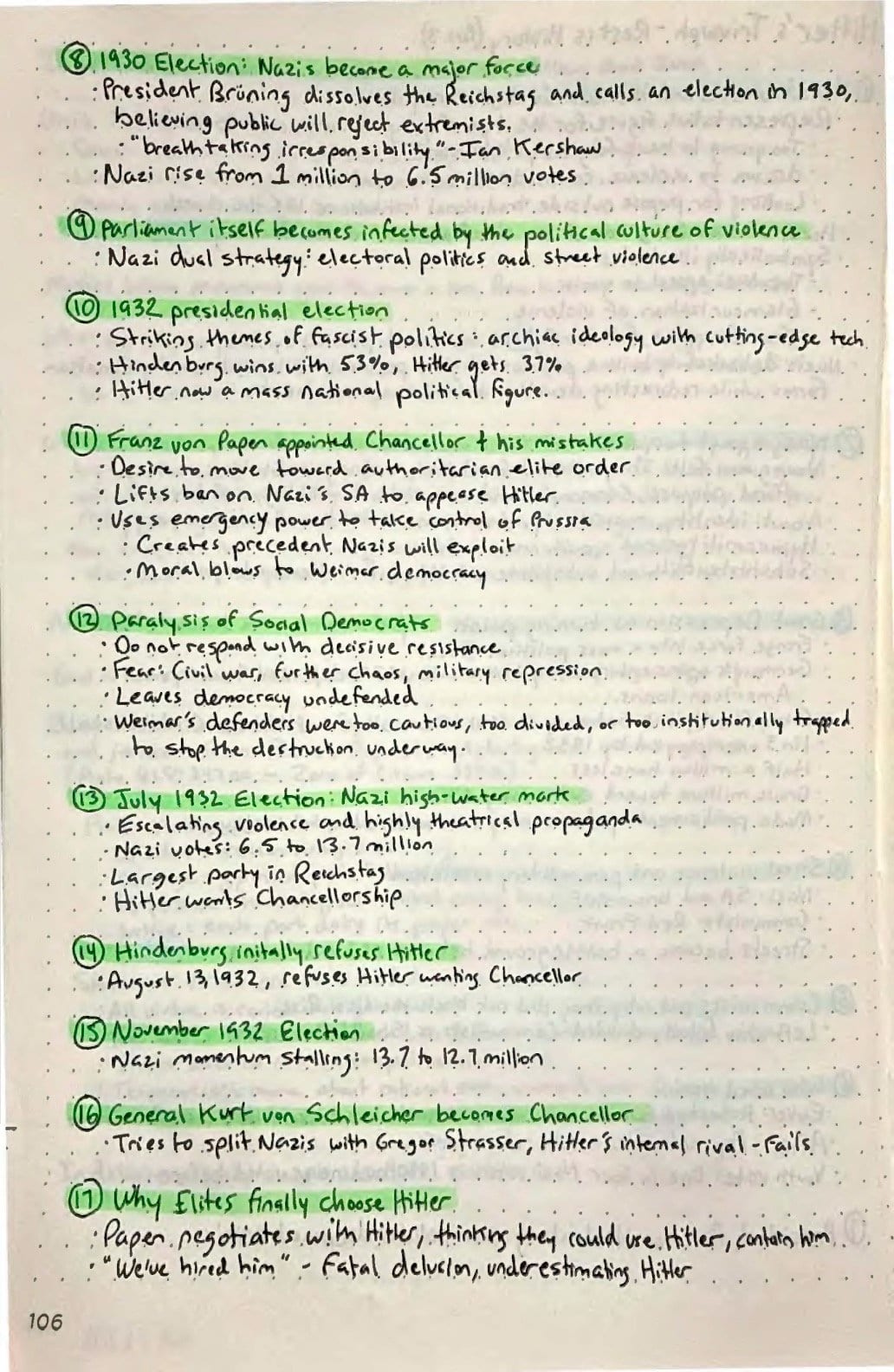
8. The 1930 election: the Nazis become a major force
Why Brüning calls the election
- Brüning dissolves the Reichstag and calls an election in 1930, believing the public will reject extremists.
Why this is called irresponsible
- The hosts cite Ian Kershaw, who calls this a decision of “breathtaking irresponsibility.”
- Brüning misreads the scale of the crisis and underestimates the appeal of the Nazis.
Nazi campaign themes
- The Nazis emphasize:
- the failure of the system
- betrayal since 1918
- the bankruptcy of parliamentary politics
- national unity over class conflict
- rebirth, pride, and order
Election results
- Nazis rise from about 1 million votes to 6.5 million
- Their Reichstag seats rise from 12 to 107
- Communists also increase, from 54 to 77
- The main losses are borne by more conventional bourgeois parties
Main significance
- This is the election that turns the Nazis into a central national force.
- Extremism floods into parliament.
9. Parliament itself becomes infected by the political culture of violence
Change in tone
- The hosts note that the Reichstag is now no longer dominated by conventional parliamentary figures.
- It is increasingly marked by:
- shouting
- theatricality
- fists
- insults
- uniformed presence
- open contempt for the system
Nazi dual strategy
- The Nazis combine:
- electoral politics
- street violence
- Their movement now brings the spirit of the street into the heart of parliamentary life.
Main idea
- Democratic procedure is increasingly hollowed out by people who despise it but know how to use it.
10. The 1932 presidential election and Hitler’s growing legitimacy
Hindenburg runs again
- Hindenburg’s presidential term expires in 1932.
- He reluctantly runs again.
- Even many who dislike him support him because the alternatives are worse.
Hitler as national candidate
- Hitler runs for president.
- This is important because it elevates him beyond being merely a party demagogue.
- He now presents himself as a national contender.
Modern campaign methods
- Hitler’s campaign uses modern mass political methods:
- planes
- multiple speeches
- rapid movement between cities
- media spectacle
- This modernity is one of the striking themes of fascist politics:
- archaic ideology paired with cutting-edge technique
Result
- In the second round:
- Hindenburg wins with 53%
- Hitler gets 37%
- roughly 13 million votes
- Hitler loses, but the result is still a major breakthrough.
Why it matters
- Hitler is now clearly a mass national political figure.
- His vote share shows the size of the constituency ready for radical change.
11. Brüning falls and Papen enters
Brüning’s fall
- Brüning is forced out in May 1932.
Franz von Papen
- Hindenburg appoints Franz von Papen as Chancellor.
- Papen is described as:
- aristocratic
- conservative
- Catholic
- rich
- well connected
- elegant but unserious
- an intriguer rather than a statesman
His cabinet
- Papen’s ministry is called the “Cabinet of Barons”
- It is packed with establishment conservatives
- It reflects a desire to move toward an authoritarian elite order rather than parliamentary government
Main idea
- Papen represents the old elite’s fantasy that they can replace messy democracy with controlled, respectable authoritarianism.
12. Papen’s fatal mistakes
Lifting the ban on the SA
- Papen lifts the ban on Nazi stormtroopers
- He does this partly to appease Hitler and potentially win Nazi cooperation
Immediate consequence
- Political violence worsens
- In Altona, fighting between Nazis, communists, and police kills 18 people
- Hundreds are injured
Papen’s misuse of the crisis
- Instead of suppressing all paramilitary forces, Papen uses the chaos to attack the Social Democratic government of Prussia
- He uses emergency power to take control of Prussia
Why this matters enormously
- Prussia was the largest and most important German state
- By destroying Prussian autonomy and removing the SPD from there, Papen:
- strikes at one of the strongest pillars of republican Germany
- centralizes power
- creates a precedent that the Nazis will later exploit
Main idea
- Papen’s coup against Prussia is described as one of the mortal blows to Weimar democracy.
13. The paralysis of the Social Democrats
Why they do not resist
- The Social Democrats do not respond with decisive resistance
- They avoid general strikes or extra-parliamentary confrontation
- They fear:
- civil war
- further chaos
- military repression
Why this is tragic
- Their caution, however understandable, leaves democracy undefended.
- One of the few major forces that actually believes in the republic fails to fight at a crucial moment.
Main idea
- Weimar’s defenders were too cautious, too divided, or too institutionally trapped to stop the destruction underway.
14. The July 1932 election: the Nazi high-water mark
Campaign atmosphere
- The election is held amid escalating violence and highly theatrical propaganda.
- Posters from all sides present politics in violent apocalyptic imagery.
- This environment favors the Nazis, who are best at dramatizing crisis.
Results
- Nazis jump from 6.5 million to roughly 13.7 million votes
- They win 230 seats
- They become by far the largest party in the Reichstag
- Communists also continue to rise, reaching 89 seats
Why this matters
- This is the Nazi electoral peak in a free election.
- Even Goebbels seems to recognize that this may be near the ceiling of their support.
Strategic consequence
- Hitler now wants power, not just growth.
- But he refuses to take a subordinate place in government.
- He wants the Chancellorship.
15. Hindenburg initially refuses Hitler
Key meeting
- On August 13, 1932, Hitler meets Hindenburg.
- Hitler wants to be made Chancellor.
- Hindenburg refuses.
Hindenburg’s reasoning
- He says he will not hand Germany to:
- one intolerant party
- a movement associated with violence
- This is one of the last major moments where the system decisively says no to Hitler.
Why it matters
- The hosts stress that this should have been the end of Hitler’s opportunity.
- Hindenburg is the one figure with enough authority to block him outright.
Hitler’s reaction
- Hitler is deeply shaken
- There is a sense that his great chance may have slipped away
16. More intrigue, more elections, more decay
Reichstag paralysis
- Papen lacks support
- A communist no-confidence motion passes overwhelmingly
- Papen is humiliated
Yet another election
- Instead of finding a stable solution, elites call yet another election
November 1932 election
- Nazi vote falls:
- from 13.7 million to 12.7 million
- They lose 44 seats
- They remain the largest party, but they are weaker
- Communists rise again to 100 seats
Why this is important
- Nazi momentum is stalling
- This is another point where Hitler could still have been blocked
- The Nazis do not come to power at the exact height of their electoral expansion
- They come to power through elite intrigue after their vote has started falling
17. Schleicher, Strasser, and the last chance to avoid Hitler
Kurt von Schleicher
- General Kurt von Schleicher becomes Chancellor after Papen
- He is portrayed as:
- clever
- manipulative
- deeply political
- interested in a military-authoritarian outcome
His attempt
- Schleicher tries to split the Nazis
- He reaches out to Gregor Strasser, Hitler’s internal rival
- Strasser is tempted, but the effort fails
Why it fails
- The Nazi movement is too centered on Hitler
- Strasser cannot credibly detach the party from him
- Strasser resigns and exits party leadership
Main idea
- This was another possible off-ramp from Hitler’s appointment, but it collapses.
18. Why elites finally choose Hitler
Papen’s role
- Papen, furious at Schleicher and still scheming, becomes central again
- He begins negotiating with Hitler
- He and others around Hindenburg persuade themselves that Hitler can be used
Their assumption
- Hitler may be vulgar, violent, and demagogic
- But they think:
- he can attract mass support
- conservatives will dominate the cabinet
- Papen will contain him
- the old elite will control the real levers of power
Famous logic
- The classic mindset is summed up in Papen’s belief:
- “We’ve hired him.”
- This is one of the key fatal delusions in the story.
Main idea
- Conservative elites enable Hitler not because they worship him, but because they underestimate him.
19. January 1933: final deal and appointment
Secret meeting
- On January 22, 1933, Hitler, Papen, and Oskar von Hindenburg meet secretly
- The deal is essentially struck:
- Hitler will become Chancellor
- Papen will be Vice Chancellor
Striking symbolic note
- On that same day, Hitler appears at a memorial event for Horst Wessel
- This juxtaposition is important:
- backroom intrigue at the top
- mythic mass politics in public
- It captures the dual nature of Nazi power:
- elite deal-making
- theatrical emotional mobilization
Appointment
- On January 30, 1933, Hitler is appointed Chancellor
- Hindenburg presides over the transfer
- The phrase quoted is:
- “And now gentlemen, forwards with God.”
Main idea
- Hitler comes to power through constitutional appointment, not open seizure.
- But the constitutional path has been corrupted by men who no longer believe in the republic.
20. Core themes and arguments of the episode
1. The Depression is decisive
- The Great Depression transformed Nazism from a radical fringe into a mass force.
2. Street violence and electoral politics worked together
- The Nazis did not choose between violence and democracy.
- They used both.
3. The left’s division was fatal
- Communists and Social Democrats would not unite against the Nazi threat.
4. Conservative elites killed Weimar
- Hindenburg, Papen, Schleicher, and others gradually dismantled democracy in the belief they were saving Germany.
5. Hitler was repeatedly underestimated
- He was seen as:
- a clown
- a demagogue
- a tool
- a frontman
- Not as the future dictator who would consume everyone around him
6. Nazi politics was theatrical and quasi-religious
- Through figures like Horst Wessel, the Nazis sacralized politics and turned the movement into a form of substitute faith.
7. Hitler took power legally, but not legitimately
- He entered office through formal constitutional means
- Yet this happened only because democratic norms, elite responsibility, and constitutional safeguards had already been hollowed out
Key historical events mentioned
Nazi martyr politics
- Rise and death of Horst Wessel
- Wessel’s funeral and posthumous cult
Economic crisis
- Wall Street Crash (1929)
- withdrawal of American loans from Germany
- collapse of Creditanstalt (1931)
Political violence
- Bloody May (1929) in Berlin
- Altona violence (1932)
Electoral turning points
- 1930 Reichstag election
- 1932 presidential election
- July 1932 Reichstag election
- November 1932 Reichstag election
Constitutional collapse
- Brüning’s emergency rule
- Papen’s coup against Prussia
- Schleicher’s failed chancellorship
- January 22, 1933 secret deal
- January 30, 1933 Hitler appointed Chancellor
Important people mentioned
Nazis
- Adolf Hitler
- Joseph Goebbels
- Horst Wessel
- Gregor Strasser
Communists / Left
- Ernst Thälmann
- Rosa Luxemburg (referenced as background to SPD-KPD hostility)
Conservative / Weimar elites
- Paul von Hindenburg
- Heinrich Brüning
- Franz von Papen
- Kurt von Schleicher
- Oskar von Hindenburg
- Hermann Müller
Historians / commentators mentioned
- Ian Kershaw
- Richard Evans
- Michael Burleigh
Cultural / comparative references
- Wagner, especially Götterdämmerung
- Antonio Salazar
- Babylon Berlin
Books, articles, and sources mentioned
Books / historians
- Ian Kershaw on Hitler and the Nazi rise
- Richard Evans on the Nazi Party and Weimar collapse
- Michael Burleigh, The Third Reich: A New History
- Tom Holland, Dominion is referenced by Tom in relation to Horst Wessel
Songs / symbolic texts
- Horst Wessel Song
- Deutschland über alles
Cultural references
- Götterdämmerung funeral march by Wagner
- Babylon Berlin as a visual analogy for the atmosphere of the era
Related topics for further exploration
Nazi rise and Weimar collapse
- The Reichstag Fire
- The Enabling Act
- How Hitler consolidated power after becoming Chancellor
- Why Hindenburg finally agreed to appoint Hitler
- Papen’s miscalculation in more detail
- Schleicher’s strategy and why it failed
Political and ideological themes
- The Nazi cult of martyrdom
- The use of Christian symbolism in fascist movements
- Why young men are drawn to paramilitary politics
- The role of humiliation and status collapse in extremism
- How modern propaganda and spectacle changed politics
Comparative topics
- Comparison between Mussolini’s rise and Hitler’s rise
- Why conservative elites think they can control extremists
- How democracies respond to anti-democratic parties
- The division of the left in interwar Europe
- Depression politics in Germany versus Britain and the United States
Social and cultural topics
- Berlin as a battleground between Communists and Nazis
- The SA and the culture of street violence
- Weimar youth culture and political radicalization
- Pseudo-religion in totalitarian politics
Bottom line
- The episode’s main argument is that Hitler’s rise to power was not simply the result of popular fanaticism or street thuggery.
- It required the combination of:
- economic catastrophe
- mass unemployment
- youth radicalization
- political violence
- left-wing division
- and, above all, the recklessness and arrogance of conservative elites
- Horst Wessel represents one side of the story:
- the emotional, mythic, violent, sacrificial politics of Nazism
- Papen, Schleicher, and Hindenburg represent the other:
- the cynical, aristocratic, backroom politics that thought it could manipulate Hitler
- Together, those two worlds met in January 1933, when Hitler was appointed Chancellor.
Total Power
Overview
- This episode covers the final phase of the Nazi rise to power:
- Hitler has become Chancellor on January 30, 1933
- but he is not yet total dictator
- the episode explains how, within weeks, he and the Nazis convert a coalition government into the foundations of a totalitarian regime
- The key themes are:
- how much power Hitler actually had at the start
- why conservative elites still believed they could control him
- how the Reichstag Fire became the decisive pretext for crushing the left
- how legality, intimidation, emergency powers, and elite complicity combined to destroy the Weimar Republic
- what broader lessons this story offers about democracy, ideology, violence, and modernity
1. The starting point: Hitler becomes Chancellor, but not yet dictator
Hitler’s formal position on January 30, 1933
- Hitler is appointed Chancellor of Germany.
- The episode stresses that this is not yet the same as full Nazi dictatorship.
- At the moment of appointment:
- Hindenburg is still President and formally the supreme authority
- Hitler heads a coalition cabinet
- there are only three Nazis in the cabinet, including Hitler
- The two other crucial Nazi figures in government are:
- Hermann Göring
- effectively controlling the Prussian Interior Ministry
- Wilhelm Frick
- controlling the Interior Ministry for the Reich
- Hermann Göring
Why these ministries mattered
- These offices gave the Nazis control over:
- the police
- internal administration
- security machinery
- This meant that even without total control of government, they already held the most dangerous instruments of coercion.
Main idea
- Hitler did not begin with total power.
- But he began with enough institutional leverage, enough momentum, and enough elite tolerance to take the rest.
2. How inevitable was dictatorship at this point?
The hosts’ answer
- Dominic’s answer is cautious but grim:
- totalitarianism was not absolutely inevitable in a metaphysical sense
- but given the alignment of forces in January 1933, the Nazis had an enormous advantage
- Why:
- they had state power in key ministries
- they had the streets
- they had momentum
- they had the passive or active support of conservative elites
- they faced opponents who were divided and weakened
The deeper point
- The decisive issue is that the conservatives around Hitler:
- never draw a hard line
- are never willing to say “this is too far”
- This is presented as the fatal democratic lesson:
- anti-democratic actors can keep pushing as long as institutions and elites keep accommodating them
Main idea
- The Nazis win not only because they are ruthless, but because those around them never stop them when there is still time.
3. Why the left could not stop Hitler
The left still had numbers
- The hosts note that the Social Democrats and Communists together still represented a massive chunk of the electorate.
- In theory, they could have made resistance much harder.
Why they do not
- They are:
- divided
- institutionally weakened
- afraid of civil war
- aware the army is on the side of the right
- A general strike is conceivable in theory, but very difficult in practice because:
- the Depression means massive unemployment
- the state can find replacements
- left-wing organizations are already under heavy pressure
Main idea
- By January 1933, the democratic and left-wing forces in Germany still existed, but their ability to act decisively had been badly eroded.
4. The torchlight rally and the symbolic transfer of legitimacy
Goebbels’ diary
- The episode opens with Joseph Goebbels’ diary entry from January 30, 1933.
- The entry captures:
- jubilation
- street mobilization
- torchlight processions
- a feeling of unstoppable national momentum
The torchlight parade
- Goebbels organizes a giant torchlight demonstration in Berlin.
- Nazi figures exaggerate attendance numbers, but it is still highly significant.
- The crucial symbolic moment:
- Hindenburg appears and takes the salute
- Hitler also salutes the parade
- This visually signals:
- the old order blessing the new one
- conservative legitimacy flowing toward Hitler
Why this matters
- The hosts emphasize that this was not just another cabinet formation.
- The entire event is staged as:
- a national awakening
- a sacred moment
- a transfer of destiny
Main idea
- The Nazis immediately turn office-holding into mass political theater.
- Legitimacy is manufactured not only through documents and decrees, but through symbolism, spectacle, and ritual.
5. The appeal to youth and idealism
Melita Maschmann example
- Richard Evans is quoted using the memoir of Melita Maschmann, a 15-year-old girl at the time.
- Her reaction captures the seduction of Nazism for youth:
- longing for belonging
- desire to escape an ordinary, narrow life
- attraction to something “great and fundamental”
Key point
- The episode insists that many young people were not merely cynical or stupid.
- They were:
- idealistic
- impressionable
- dazzled by energy, ceremony, discipline, and purpose
- The Nazis gave youth:
- a cause
- a movement
- community
- emotional intensity
Main idea
- The movement’s appeal was not just fear or hatred.
- It was also the attraction of a totalizing mission that made life feel meaningful.
6. The army is brought on side
Hitler’s meeting with the army
- Within days of taking office, Hitler addresses senior army officers on February 3, 1933.
- His message is exactly what much of the officer corps wants to hear:
- rearmament
- restoration of conscription
- destruction of Marxism
- repudiation of Versailles
- expansion and “living space” in the East
Why the army responds positively
- These officers are not necessarily Nazis.
- But many share:
- nationalism
- hostility to Marxism
- resentment over Versailles
- expansionist thinking
- So Hitler is not alien to them.
- He is offering a more radical form of goals they already sympathize with.
Main idea
- The army does not need to become fully Nazi at this moment.
- It only needs to see Hitler as useful, patriotic, and anti-left.
- That is enough.
7. Hitler wants an election, not because he trusts democracy, but because he wants to legally destroy it
Why hold another election?
- Hitler immediately seeks a new election.
- He wants:
- a stronger parliamentary position
- an Enabling Act
- the constitutional destruction of constitutional freedom
The legal strategy
- The Enabling Act would let Hitler rule by decree.
- But it requires a two-thirds majority in the Reichstag to change the constitution.
- So Hitler still needs enough formal support to legalize dictatorship.
Main idea
- Hitler’s method is not to abolish legality outright.
- It is to use legality to make lawlessness permanent.
8. Hitler’s campaign message: anti-Marxism and national resurrection
Campaign theme
- Hitler tells his inner circle that this election will be a final showdown with Marxism.
- This allows him to frame:
- Communists as the mortal threat
- Social Democrats as associated with them
- Nazis as protectors of order and nation
Support from industrialists
- Large amounts of money now flow into the Nazi campaign from industrialists and business interests.
- This supports the Marxist claim that sections of big business backed Hitler.
- But the hosts’ broader series argument remains:
- industry did not single-handedly create Nazism
- but once Hitler appears as the strongest anti-communist force, major business figures increasingly support him
Hitler’s speech at the Berlin Sports Palace
- On February 10, 1933, Hitler launches the campaign with a speech full of:
- national rebirth
- faith in the people
- quasi-religious language
- visionary self-presentation
- The hosts stress the pseudo-Christian and messianic style:
- suffering
- resurrection
- kingdom
- redemption
- glory
Main idea
- Nazi propaganda merges politics, religion, destiny, and mass spectacle into one emotional appeal.
9. Terror on the streets begins immediately
Use of state power
- While Hitler is speaking in grand moral language, the regime is already unleashing terror.
- Göring instructs the Prussian police to stop monitoring Nazi paramilitaries.
- The police become increasingly aligned with the Nazis.
Auxiliary police force
- Göring creates an auxiliary police force
- It is staffed heavily by:
- SA brownshirts
- SS men
- This effectively legalizes Nazi street violence.
Targets
- Trade unionists
- Communists
- Social Democrats
- political opponents generally
Escalation
- Nazi paramilitaries are no longer just disrupting meetings or beating opponents.
- They are now killing people under conditions of growing impunity.
Main idea
- The Nazis do not wait to consolidate power before using coercion.
- They begin terror immediately, and they do it through institutions of the state.
10. The Reichstag Fire
Marinus van der Lubbe
- The episode gives a careful account of Marinus van der Lubbe:
- Dutch
- building worker
- from Leiden
- lived in poverty
- flirted with communism
- drifter and radical
- poor arsonist before the main event
- He is portrayed as:
- unstable
- politically motivated
- acting from his own desire to provoke revolt
What he does
- After failed attempts to set other buildings on fire, on February 27, 1933, he enters the Reichstag and sets fire to the debating chamber curtains and interior.
- The Reichstag becomes a blazing inferno.
Was it a Nazi plot?
- The episode clearly rejects that claim.
- It also rejects the claim that it was a broad communist conspiracy.
- The hosts, following Richard Evans, say:
- van der Lubbe acted alone
- the Nazis did not plan the fire
- they simply exploited it with extraordinary speed and ruthlessness
Main idea
- The Reichstag Fire was not manufactured by the Nazis.
- But they turned it into the perfect opportunity for dictatorship.
11. Hitler’s immediate reaction to the fire
At the scene
- Nazi leaders rush to the burning Reichstag.
- Hitler immediately interprets it as:
- proof of a communist uprising
- justification for total emergency measures
Key language
- He shouts about:
- butchering opponents
- hanging communist deputies
- ending mercy
- This is one of the clearest moments in the episode showing Hitler’s raw violent instinct once he senses opportunity.
Main idea
- Hitler sees the fire not as a tragedy to investigate, but as a gift to weaponize.
12. The Reichstag Fire Decree
Timing
- On February 28, 1933, the morning after the fire, Hitler’s cabinet approves the Reichstag Fire Decree.
What it does
Clause 1: suspends civil liberties
- freedom of the press
- freedom of assembly
- freedom of association
- protection against arbitrary detention
Clause 2: centralizes power
- allows the central government to intervene in the German states
- transfers practical coercive power into the hands of Hitler’s cabinet
Why this matters
- This decree effectively destroys the Weimar Constitution in substance, even if not yet formally in name.
- It also shifts emergency powers away from the old presidential framework toward Hitler’s executive machinery.
Role of Hindenburg
- Hindenburg signs it.
- The hosts debate whether this was:
- senility
- ideological sympathy
- passivity
- or a mix of all three
- Either way, he gives it legal force.
Main idea
- The Reichstag Fire Decree is the decisive legal bridge from parliamentary government to coercive dictatorship.
13. Mass arrests and the first concentration camp
Immediate arrests
- Police use prepared lists to arrest thousands of communists and leftists.
- Around 4,000 people are arrested in Berlin within hours.
- Tens of thousands more follow in Prussia and Bavaria.
What this shows
- The state was ready.
- The police and administrative system had long been predisposed to repress the left.
Dachau
- In Bavaria, Heinrich Himmler announces the opening of a camp for political prisoners at Dachau on March 20, 1933.
- It is not yet an extermination camp.
- But it is already:
- a concentration camp
- a site of imprisonment, brutality, torture, and killing
Main idea
- Terror is not a later add-on to Nazi rule.
- It is present at the very birth of the regime.
14. The March 5, 1933 election
Why it matters
- Even after the terror campaign, Hitler still wants electoral confirmation for constitutional change.
Conditions of the vote
- Communist activity is effectively crushed
- meetings are broken up
- left-wing leaders are arrested
- the streets are saturated with Nazi intimidation
- swastikas, SS, SA, and police presence dominate public life
Result
- Nazis win 44% of the vote
- With their nationalist allies, they have about 52%
- This is strong, but still not enough on its own for the needed two-thirds constitutional majority
Main significance
- Even under intimidation, the Nazis still do not achieve total domination purely by votes.
- They still need further legal manipulation and exclusion of opponents.
15. The takeover of the German states
Nazi consolidation after the election
- Once the election is over, the Nazis move quickly to seize control of the states.
- Nazi flags go up on public buildings across Germany.
- State governments are:
- intimidated
- forced out
- placed under arrest
- replaced with Nazi-aligned administrators
Role of Frick
- Wilhelm Frick oversees the use of special commissioners to purge police chiefs and other state officials.
Main idea
- Federal Germany is rapidly dismantled.
- The state is being centralized and Nazified at every level.
16. The “Day of Potsdam”
Date and setting
- March 21, 1933
- ceremonial opening of the new Reichstag at the Garrison Church in Potsdam
Symbolism
- This ceremony is one of the most important symbolic events in the whole process.
- It visually unites:
- old Prussia
- military tradition
- monarchy
- conservative nationalism
- the new Nazi regime
Hindenburg’s role
- Hindenburg appears in full old-style military uniform
- He salutes the empty throne of the Kaiser
- He embodies imperial Germany
Hitler’s role
- Hitler appears in a sober suit
- He embodies the present and future
- The handshake between Hindenburg and Hitler symbolizes:
- continuity
- reassurance
- reconciliation between old elites and the Nazi movement
Why it mattered
- For conservatives and non-Nazi nationalists, this was a powerful sign that Hitler was not destroying German tradition, but inheriting and fulfilling it.
Main idea
- The Day of Potsdam gives Nazi rule historical and emotional legitimacy by staging it as the continuation of old Prussian greatness.
17. The Enabling Act
Date
- March 23, 1933
Setting
- The Reichstag meets in the Opera House rather than the burned Reichstag building.
- The building is filled with Nazi intimidation:
- stormtroopers
- menacing presence
- atmosphere of fear
Why the Nazis can get it through
- Communist deputies are absent or arrested
- intimidation shapes the environment
- conservative, liberal, and Catholic parties choose cooperation over resistance
Otto Wels and the Social Democrats
- Otto Wels, leader of the Social Democrats, delivers the one major speech of resistance.
- He defends:
- humanity
- justice
- freedom
- socialism
- He knows he is in danger.
- His speech is presented as one of the last honorable acts of Weimar democracy.
The vote
- 444 vote for
- 94 vote against
- Only the Social Democrats vote no
What the Enabling Act does
- It allows Hitler’s government to rule by decree without needing the Reichstag
- It effectively renders parliament meaningless
- It sidelines Hindenburg’s role as well
Main idea
- This is the formal legal death of Weimar democracy.
- Dictatorship is now constitutional in form, though terroristic in substance.
18. What follows immediately after the Enabling Act
Rapid Gleichschaltung-style transformation
After the Enabling Act, everything falls into place quickly:
- trade unions are taken over
- the Social Democratic Party is banned
- the Catholic Centre Party dissolves itself
- other clubs and civic bodies either Nazify themselves or disappear
- local institutions are absorbed into the state
Book burnings
- The first major book burnings happen in May 1933
- They are organized by students
- Students:
- disrupt lectures
- inform on professors
- compile book lists
- stage bonfires of banned works
Why this matters
- Youth enthusiasm again appears as a major engine of totalitarian transformation.
- The Nazis are not simply imposing rule from above.
- They are drawing on active participation from below.
Main idea
- Totalitarianism is not only state repression.
- It also requires social collaboration and self-radicalization.
19. The place of the churches
Catholic Church
- The hosts note that the Catholic Church is the one institution that retains some degree of separate existence.
- But this comes through accommodation, especially via the Concordat.
- The Catholic Centre Party dissolves itself.
Meaning
- Even where independent institutions survive, they do so by compromise rather than effective resistance.
Main idea
- The churches are not fully abolished, but they do not block Nazi consolidation.
20. The first organized anti-Jewish boycott
Date
- April 1, 1933
What happens
- SA men and Nazi activists stand outside Jewish shops and businesses
- They discourage entry
- They display signs
- They initiate the first nationwide organized anti-Jewish boycott under the regime
Why this matters
- The hosts connect this moment directly to the later story of Auschwitz
- It is not the beginning of Nazi antisemitism
- But it is a major public escalation:
- from rhetoric
- to state-backed harassment
- to systematic exclusion
Main idea
- The anti-Jewish boycott is a major early warning sign of the genocidal path ahead.
21. Bigger interpretive questions the hosts raise
Could Hitler have been stopped?
The hosts answer: yes, at several points.
- Hindenburg could have refused him
- conservatives could have drawn a line
- Schleicher might have been handled differently
- the Reichstag could have been protected
- elites could have refused the Enabling Act
But: - they did not
- again and again, they chose accommodation, intrigue, or cowardice
Was Nazism uniquely German?
The hosts lean against a simplistic “German essence” argument.
- They stress:
- broader European ideological currents
- imperial brutality
- social Darwinism
- nationalist resentment
- the trauma of World War I
- But Germany’s specific experience:
- defeat
- Versailles
- Weimar instability
- elite miscalculation
- anti-Semitic politics
helped produce Nazism in its specific form
The role of Darwinism / social Darwinism
Tom especially argues that Nazism drew enormous strength from a bastardized Darwinian vision:
- struggle
- survival
- contempt for weakness
- elimination of the unfit
- races in combat
- denial of inherent human dignity
He contrasts this with older Christian moral assumptions: - dignity of the weak
- duty of care
- moral restraint
Nazism and Communism
- The hosts note that both were murderous and totalitarian in practice.
- But they argue Nazism remains a special symbol of evil because:
- its motives were overtly racial
- extermination is tied to blood, race, and elimination
- Communism kills in the name of class utopia
- Nazism kills in the name of racial struggle and biological cleansing
The lesson for democracy
- Democracies can be undone by actors who use democratic procedures to destroy democracy
- The danger lies not only in extremists themselves, but in:
- elites who normalize them
- conservatives who think they can control them
- institutions that do not resist in time
Key historical events mentioned
- January 30, 1933: Hitler becomes Chancellor
- February 3, 1933: Hitler addresses army officers
- February 10, 1933: Berlin Sports Palace election speech
- February 27, 1933: Reichstag Fire
- February 28, 1933: Reichstag Fire Decree
- March 5, 1933: Reichstag election
- March 20, 1933: Dachau announced/opened as camp for political prisoners
- March 21, 1933: Day of Potsdam ceremony
- March 23, 1933: Enabling Act passed
- April 1, 1933: anti-Jewish boycott
- May 1933: book burnings
Main ideas distilled
1. Hitler’s dictatorship was built step by step
- Appointment as Chancellor was only the start
- coercive control and dictatorship followed through a combination of law, emergency powers, and terror
2. The Reichstag Fire was the crucial accelerator
- Not a Nazi plot
- but a gift the Nazis exploited brilliantly and brutally
3. Conservative elites made dictatorship possible
- They enabled Hitler at every stage
- They believed they could use him and contain him
- They were catastrophically wrong
4. The destruction of democracy was legal in form, terroristic in execution
- The Nazis used decrees, cabinet votes, and parliamentary acts
- but behind every legal move stood violence and intimidation
5. Youth and idealism mattered
- Many young people were seduced not despite Nazism’s intensity, but because of it
- Purpose, belonging, symbolism, and ritual were powerful attractions
6. Antisemitism was always central
- The boycott of Jewish businesses shows how quickly racial exclusion became public state policy
7. The lesson is not just about Germany
- The episode treats Nazism as a warning about democracy, human nature, modernity, and the fragility of civilized moral assumptions
Important people mentioned
Nazi leaders
- Adolf Hitler
- Joseph Goebbels
- Hermann Göring
- Wilhelm Frick
- Heinrich Himmler
- Ernst Röhm
Conservative / state figures
- Paul von Hindenburg
- Franz von Papen
- Werner von Blomberg
Opponents / victims / witnesses
- Otto Wels
- Melita Maschmann
- Marinus van der Lubbe
Historians / writers referenced
- Richard Evans
- Ian Kershaw
Literary / cultural references
- Alfred Jingle from Dickens
- Wagner, especially Götterdämmerung
- White Rose / Hans and Sophie Scholl (as a later comparison)
Books, articles, and sources mentioned
Historians / books referenced
- Richard Evans on the rise of the Third Reich and conspiracy theories around the Reichstag Fire
- Ian Kershaw on the decision points where Hitler might still have been stopped
Cultural / literary references
- Charles Dickens, The Pickwick Papers via Alfred Jingle
- Wagner, implicitly tied to Nazi ceremony and mythic staging
Historical episodes referenced from earlier discussion
- Auschwitz
- White Rose
- broader previous episodes on Hitler and Nazism
Related topics for further exploration
Nazi consolidation
- The Night of the Long Knives
- The death of Hindenburg and Hitler becoming Führer
- The merging of the presidency and chancellorship
- How the Gestapo expanded
- Gleichschaltung in culture, education, and civil society
Ideology and political theology
- Nazism as a political religion
- Nazi use of Christian symbolism
- Hitler’s relationship to Christianity
- Horst Wessel and martyr cults
- the idea of sacral politics in totalitarian regimes
Comparative topics
- Comparison between the Nazi rise and Mussolini’s consolidation
- Why some conservative elites think extremists can be controlled
- How emergency powers destroy republics
- modern parallels in democratic backsliding
Social and moral history
- Why students and youth embraced Nazism
- The behavior of judges, civil servants, and police
- Why institutions complied so quickly
- Early anti-Jewish measures before the Nuremberg Laws
Bottom line
- This episode shows how Hitler’s appointment as Chancellor became dictatorship in just weeks.
- He did not do it alone.
- He relied on:
- conservative elites
- police obedience
- army acquiescence
- emergency powers
- propaganda
- youth enthusiasm
- terror against the left
- The Reichstag Fire gave him the pretext.
- The Enabling Act gave him the formal mechanism.
- The collapse of resistance from conservatives, liberals, Catholics, and much of civil society gave him the rest.
- By spring 1933, the Weimar Republic was dead, and the regime that would lead to Dachau, the boycott of Jewish shops, and eventually Auschwitz was firmly in motion.
Content
Starting point is 00:00:00 Thank you for listening to The Rest Is History. For weekly bonus episodes, ad-free listening, early access to series, and membership of our much-loved chat community, go to therestishistory.com and join the club. That is therestishistory.com. Hello, welcome to The Rest is History. And this time last year, we were doing an anniversary episode on 1922, the year that some historians have described as the year that modernity began. And this year, Dominic, marks another anniversary, but an altogether darker anniversary, the 90th anniversary of the coming to power in January 1933 of the Nazis, when Hitler became Chancellor. And so we thought that we can’t really do justice to the rise of the Nazis in one episode.
Starting point is 00:01:06 So we’re going to, well, we’ll see how many episodes it takes, but it’s a story worth telling. I mean, it is a massive, massive story, isn’t it? It is. It’s an enormous story. So yes, you’re absolutely right, Tom. It’s 90 years ago, the 30th of January, 1933, about half past 11 at the Reich Chancellery at Wilhelmstrasse 77 in Berlin. So the Reich President’s Palace was being renovated. So Paul von Hindenburg, the iconic general of the Great War in Germany, he was the president. And he welcomes the leader of the National Socialist Party, Adolf Hitler, to become Chancellor of Germany. Hitler swears an oath to uphold the Constitution, to respect the role of the president. He says he will.
Starting point is 00:01:57 These are extraordinary times, but he’s determined to bring back normal parliamentary rule as soon as possible. And then the deal is done. And Hindenburg says famously, a now gentleman forwards with God. And that meeting, that moment has gone down as a very baleful landmark in human history. Obviously, the communists have come to power in Russia, but the coming to power of the Nazis in Germany seems to cast an even darker shadow. And one of the reasons for that, you might say, is implicit in the scene that you’ve just described, which is that the Nazis, unlike the Bolsheviks, they come to power by means of gaining mass support in free elections. And that perhaps is why it so haunts people in
Starting point is 00:02:39 democracies to this day, that something could have happened like that. Because the other aspect of the story that is so unsettling is that this is happening in perhaps the most cultured, economically advanced, industrially advanced, sophisticated country in the whole of Europe, Germany. Yeah. So those two questions, how is it that the Nazis are able to use democracy to destroy itself and how did a country like Germany come to fall under the spell of a man like Hitler both of them very very frightening questions right the way into the present they are absolutely so we’ve just done haven’t we, two podcasts about Auschwitz with Jonathan Friedland, about the story of the escape artist, the man who escaped from Auschwitz.
Starting point is 00:03:30 So we know where the story is heading. And I think you’re absolutely right that there are those two elements to the sort of mystery, as it were, a really crucial one that the Nazis didn’t seize power. I mean, they didn’t quite win power by electoral means because they never won an absolute majority in a free and fair election, but they were the biggest party. Yeah. And they’re engaging in the kind of horse trading that is standard. Absolutely standard. Liberal Democrat behavior. Yeah. I mean, absolutely. They get into power by, as it were, constitutional means. Now, obviously, there are lots of gray areas and there’s lots of violence that accompanies that. But you’re right. It’s not a coup. It’s not a revolution as it were, constitutional means. Now, obviously, there are lots of gray areas, and there’s lots of violence that accompanies that. But you’re right, it’s not a coup, it’s not a revolution as it is with the Bolsheviks in 1917. So there’s that element to it. As you
Starting point is 00:04:16 said, using democracy against itself. And then I think you’re absolutely right. It’s the fact that Germany is an immensely well-educated, sophisticated, civilized, in inverted commas, place. And ever since, I think, I know you think this too, Tom, that we have lived in the shadow of the Third Reich. Because always, for any Western democracy, that fear never goes away. That, you know, you’re only a few steps away from heading down the same dark road and how can you put i mean you’ve seen this so much of course in the last few years people worried about how could it happen again could it happen in france could it happen in the united states could it happen in britain and what does it say about human nature and about modernity
Starting point is 00:05:02 itself that such a regime was able to possibly possibly about do the causes do the roots lie deeper back so obviously the moral catastrophe of nazism which has as you said culminate i mean you know the the dark heart of it are those two episodes that we on auschwchwitz, genocide, I mean, the mass, mass killing. Yeah. Where could this have come from? Yes. And people have been asking that, and they were asking it pretty early on. And there are all kinds of, I mean, we can just sort of touch on the different explanations that people have had.
Starting point is 00:05:42 So there are some German historians who argued that it was unique to Germany, that Germany had always been on a special path, the Sonderweg thesis, this is called. So the idea that Germany didn’t modernize properly, that it didn’t have a kind of bourgeois politics like Britain and France, that it was more reactionary, that it was more militaristic, that it was special, and that Nazism was uniquely German. I don’t actually think many historians still believe that, Tom. There are people who believe that Nazism was prefigured by the Kaiser’s regime, by the First World War. So there’s a very famous German historian called Fritz Fischer. He basically argued that Germany’s war aims in 1914 were paving the way for the Third Reich, and there was a kind of
Starting point is 00:06:25 continuity in German history. Again, I’m not entirely sure about that. There was a historian called Friedrich Meinecker. Again, he said that he blamed Bismarck. He said there’s a line that runs from Bismarck and the Second Reich, so the creation of a unified germany in 1870 71 um that that leads to hitler obviously if you’re a marxist if you’re a really card carrying old-fashioned marxist you would say it’s all about um a product of the sort of the dynamics of class struggle and that’s one that’s contemporary to hitler isn’t it so a lot of communists think so brecht and famously in his place it advances the thesis that hitler is brought to power by big business. Exactly, that they’re tools of big business.
Starting point is 00:07:10 Again, I don’t think that’s one that a lot of historians would really subscribe to now. So the great British historian of the Third Reich, Richard Evans, who is very much a historian of the left, he’s pretty scathing about that thesis in the first volume of his great trilogy on the Third Reich. Probably the most famous Briton ever to write about hitler is ajp taylor i mean ajp taylor appalled people this was when he was churning out incredibly um provocative columns for the sunday express in the sort of 50s and 60s oh thank god that um historians don’t write for provocative columns for tabloids today. Tabloid is the wrong word, so I think mid-market newspaper is the correct term.
Starting point is 00:07:51 Thank you for correcting me. So A.J.P. Taylor said that Hitler was a normal German leader, that there was nothing unusual about Hitler. Nazism, said Taylor, represented the deepest wishes of the German people. Now, again, I think a lot of people now would say A.J.P. Taylor was almost being deliberately offensive with that. And that, yes, there is something peculiarly German about Nazism, but Taylor was completely ignoring the fact that Germany had all these tradition, democratic and liberal traditions, as well as more reactionary ones. But Dominic, also on the theme of centuries of, you know, this has been centuries and centuries in the making, you would not expect me to let a possible mention of Christianity slip by. I would not.
Starting point is 00:08:27 There is also the thesis that the Holocaust is bred by centuries and centuries of Christian antisemitism. Yes. And, you know, the kind of folkloric belief in Jews as the enemies of Christ, that this is the kind of fertilizing the hatred that will be watered by Hitler. Yeah, and there must be some element of truth in that, Tom, that somewhere when you’re analyzing the ingredients that lead to the death camps, the weight of history has to play a part,
Starting point is 00:08:58 hasn’t it? Although, as we will see, the quality of modern antisemitism is racial rather than religious but but but i agree i think it is you know that is a fact it must be also i’m sure we’ll know if you were picking a country in 1900 where a holocaust might happen germany probably wouldn’t have been top of the list russia france might have been even as antisemitism is probably more virulent in france in some ways with the drafus Anyway, we’re sort of jumping ahead of ourselves. So there’s always that tension. Is Nazism uniquely German? Is it uniquely European? Is it about something to do with modernity? Or if you were stepping right back, does it speak to something very dark in
Starting point is 00:09:39 human nature? Well, so isn’t there also the question of, is it bred of material circumstances? So a kind of economic collapse, the hyperinflation, the Great Depression, all that kind of a bit of both, that it’s economic crisis amplifies extremist opinions. I think, yes, I think you’re right. I think that’s a fascinating tension, isn’t it? Because I know generally in this podcast, I tend to be Mr. Material and you’re much more interested in ideas than I am. So we’ll probably, well, we’ll tease a lot of this out, I guess. So should we start by talking about, maybe we’ll tease a lot of this out, I guess. So should we start by talking about, maybe we’ll start by talking about Germany. Yes. Okay. So how far back would you trace the origins of Nazism? Would you trace it back to medieval antisemitism? Would you trace
Starting point is 00:10:38 it back to Luther? Would you trace it back to Frederick the Great? Would you trace it back to Bismarck? Well, Richard Evans, who I mentioned already in his magnificent books on the Third Reich, he begins by saying something like, does it make sense to start with Bismarck? And he thinks it does. And I think, in a sense, you’re right, because there’s only really one lifetime, not even one lifetime that separates Bismarck founding the German Empire in 1871, and the coming to power of the Nazis at the beginning of the 1930s. So it kind of, you know, since somebody could plausibly see both, it makes sense to use that as a span.
Starting point is 00:11:15 So Germany didn’t exist before 1871. I mean, there’s a concept of Germany and there are people who speak German and there’s a sense of German culture and German literature and German history, but there’s no state. Which would include Austria. We should put that out. Yes. So Austria will play a part in this because, of course, Hitler is Austrian,
Starting point is 00:11:31 but Austria is shut out of the creation of Germany or the Germans in Austria because they’re part of the Habsburg Empire. There are definitely elements in – so Bismarck is the great guiding spirit of this new German empire that’s created when they beat the French in 1871. And there are definitely elements in Bismarck’s creation, the Second Reich. We did a whole podcast about this with Katja Hoyer back in the early days of the rest of history, that prefigure Nazism. So Bismarck believes in force to get his way. Well, famously, yeah, blood and iron is the famous phrase that he uses, isn’t it?
Starting point is 00:12:07 I don’t think that makes him unusual in 19th century Europe at all. He’s very ruthless and subtle. But it is specifically that he’s talking about how the great questions of the day should not be decided by speeches and all that kind of stuff. That essentially, you know, I buy on and blood. He basically means the military, doesn’t he? He doesn’t,
Starting point is 00:12:29 but he, I mean, it works. He gets, he fights at three wars against the Danes, against the Austrians and then against the French. But that is a contrast say with Britain. I mean, it’s a very obvious question.
Starting point is 00:12:37 Britain is already, well, Britain is fighting wars abroad. Yeah. I mean, a lot of people would say, come on, you know,
Starting point is 00:12:42 the British are fighting their wars in the Sudan or Egypt or whatever. But Bismarck is enshrining a political role for the army. Agreed. And the army obviously is a tool of force. So it could be argued that the idea that force and violence are acceptable expressions of political will are kind of soldered into the German constitution. They are. I mean, I don’t know if that’s valid but i think a lot of people historians would agree with you about that tom and they would say the
Starting point is 00:13:10 the army is enshrined within brismarck’s second reich it’s kind of like a state within a state it’s self-governing it answers only to the kaiser it doesn’t answer to civilian politicians because isn’t that there’s kind of the um the joke is that politicians in the Second Reich are constantly threatened from a coup above? That if they go too far, they know that the generals and the Kaiser will dump on them. Well, this is exactly what will happen, actually, Tom. This is the shadow that hangs over the Weimar Republic later on in the years before the Nazis come to power. You have the big man, so initially the Kaiser and then President Hindenburg in the 1920s with the army, and that they’re actually often working against the democratically elected
Starting point is 00:13:52 politicians. So there’s that. There’s the idea of a kind of Germandom, that all German speakers have a destiny to be united in a single empire, a Reich. So that’s obviously there in the late 19th century. There is the experience of imperialism, the colonial experience. The Germans, if you were defending the Germans, you would say learning from other European countries’ example where they behave with great ruthlessness and bloodthirstiness, for example, in southwest Africa where they massacre the Herero population. There’s an anxiety about Bismarck’s Second Reich.
Starting point is 00:14:29 So there’s a sense that they have been, they’re latecomers, aren’t they, to the European party. They’re a new state welded together, as you said, by iron and blood. And there’s a sense that the British and the French in particular have had centuries head start. And I’ve got all these colonies and all these advantages and the Germans are catching up and feel a little bit resentful about it. That said, Bismarck is clearly not a Nazi. He is reactionary, undoubtedly, but then there are lots of reactionary, I mean, Lord Salisbury is a reactionary. There are lots of reactionary politicians in Europe. But also, there are lots of militaristic politicians. We’ve emphasised the militaristic character of the Second Reich, but it is also very democratic.
Starting point is 00:15:07 And in lots of ways, it is more democratic than Britain. Yes, it is. Absolutely. A much larger franchise. It has a much larger franchise. Exactly right. Much larger trade union movement. I suppose what you would say, again, if you’re looking with the benefits of hindsight, you
Starting point is 00:15:20 would say they have this huge party, the Social Democratic Party, kind of a left wing party. It’s the largest party in the world, right? Yeah, a million members, the largest democratic party in the world. And yet there’s always this sense in Bismarck, in the state that Bismarck has created, that they’re not really legitimate, that there’s always this suspicion of them, this idea that the conservative middle classes are terrified of them, they say that they are Marxists. Well, they are Marxists. That they are a threat to the
Starting point is 00:15:49 integrity of the Reich, that they are subversive, all this kind of thing. That said, people are saying similar things in Britain about the Labour Party, about radicals, even saying about the Liberals. Well, they are about the Labour Party. I mean, less so about the Liberals. I mean, the thing about parliamentary democracy in Britain is that you have the notion of Her Majesty’s loyal opposition. You do. Which you seem to have less so in Germany, where there is on the part of the, let’s call them the bourgeoisie, the bourgeois parties, the parties of the right, the parties of the middle classes, they are terrified of the
Starting point is 00:16:27 social democrats. And they never really regard them as legitimate. And so that is a theme that will feed through into the post-war period, right? Yeah, you’re absolutely right, Tom. And that’s a fair point. Looking back now, from post-1933, you can say they never trusted the Social Democrats. It’s the biggest party, certainly the biggest party from 1912 in Germany. But among the judiciary, the police, big business, the establishment, there was always this sense, oh, they’re not legitimate, we should crush them. That said, if the First World War had gone differently for Britain, then you would have looked back at Edwardian Britain, and you would have found people saying the liberals are betraying our country because of home rule, the liberals,
Starting point is 00:17:09 you know, you would have, Gladstone was a traitor, you know, they would have found people saying that. So I wonder whether there’s an element of hindsight here. And I suppose also, say Britain had been defeated in the First World War or France, you would also have found, not only within the constitutional World War or France, you would also have found not only within the constitutional structure of each country, but also within the current of ideas
Starting point is 00:17:32 swirling around. So that’s also a part of the mix. Absolutely, it is. Yeah, you’re absolutely right. So I think across Europe, not just in Germany, but across Europe, you have deep anxiety about modernity, all sorts of political and cultural and social tensions. So you see it in Britain, for example, in the Edwardian period about votes for women and all these sorts of things, about culture generally, distrust of sort of abstract culture and the new music and all that kind of thing. But in Germany, I think we can identify, let’s say the 1880s and 1890s. I think a lot of historians would say Nazism is in many ways a creation of the 1880s and 1890s. You can see the ingredients. The 1880s and 1890s across Europe, intellectually, are being reconfigured by one big idea,
Starting point is 00:18:25 which is Darwinism. Yeah. And what Darwinism does is to upend the fundamentally Christian idea that the rich have a duty of care for the poor and so on, that there is a, there is a value in being, you know, in weakness,
Starting point is 00:18:41 if you like, and it upends that at least the way that, that Darwinism comes to be expressed, the idea of survival of the fittest and so on. And that provides intellectual sanction for European countries across the board at their economic, their military, their cultural apex, basically to go around kicking sand in the face of anyone they want to. I think that’s probably true. I think Darwinist ideas, I agree with you. I think they permeate into all kinds of different areas. The idea of competition, the idea of struggle, the idea of inevitable confrontation. And as you said, actually, Tom, I think you’re probably right.
Starting point is 00:19:21 A disdain for weakness that perhaps wasn’t so strong before. And therefore, a kind of an anxiety that different peoples are in a race, and that if you drop behind, then you’re going to be crushed. So I was kind of looking at this in the context of all the various themes that will feed into Nazism. And it’s very kind of international so you have you have a german wilhelm marr who in 1873 is recalibrating christian anti-semitism in very overtly darwinian terms that it’s not about religious prejudice it’s about the fact that there are differences within the blood yeah and he absolutely so he’s explicit about that it’s not not religious. It’s racial. It’s racial. And he coins the word antisemitism.
Starting point is 00:20:08 And it’s something he’s tremendously proud of. And he, 1879, he founds the League of Antisemites. So that’s the German angle. But then in France, also, you have, as you said, this incredible strain of antisemitism. And it’s in France that thinkers coined the idea of the Aryans as a master race, the kind of people from the North as people who should properly be the rulers. I mean, it’s kind of an odd thing for the French. What’s his name? Gobineau. And that gets translated into German in 1898. So that’s obviously also part of it. But then there is also this British figure,
Starting point is 00:20:45 Houston Stuart Chamberlain, who writes this work, The Foundations of the 19th Century. And he further kind of refines this idea that history is forged by the competition between races. And he posits that the two great races, the two racial groups that have kind of retained their original purity amid all the miscegenation that’s been going on, are the Aryans and the Jews. And that the Aryans and the Jews are locked, therefore, in a contest for global supremacy. And you can see how this Anglo-French-German swirl of ideas is going to feed into Nazism. But it is there. You know, it’s not specific to Germany. Right. Agreed.
Starting point is 00:21:29 Houston Stuart Chamberlain, he was an old boy of Cheltenham College, Tom. And he’s drawn into this anti-Semitism because he’s a passionate liberal, would you believe? So he hates Benjamin Disraeli. He has an absolute loathing of Benjamin Disraeli, who, of course, has Jewish ancestry. Interestingly, Chamberlain marries the daughter of Richard Wagner. Richard Wagner.
Starting point is 00:21:50 Yeah. So Wagner is a hugely interesting figure. Of course, for some people, he’s tainted because of his associations with this. Other people will say, no, listen, the music is separate from the man. Sort of Wagner’s shadow, his use of pseudo sort of Nordic and Germanic nationalist mythology in his operas, his intense anti-Semitism, all of that is not unique to him. It’s part of that world that you’ve just been describing, where people are living in a world that on the one hand
Starting point is 00:22:21 is very forward-looking, it’s very scientific with all this talk of racial difference. But on the other hand it’s very forward-looking with it’s it’s very scientific with all this talk of racial difference and but on the other hand it’s backward looking steeped in history and myth and all that stuff right and that will i mean that is the great tension within fascism and nazism the way that you look back to the heroic days of you know whether it’s the germans or the romans or whatever and you look forward to cutting edge science. And the way in which Germany is the scientific brand leader, that its physicians and doctors and epidemiologists have kind of identified all kinds of diseases, have tracked down kind of bacilli, all that kind of stuff. The idea that healthy organisms can be infected by germs. I mean, this provides
Starting point is 00:23:07 a very, very potent metaphor for racists and anti-Semites. Yeah, it’s fascinating, actually. The late 19th century is this period of great interest in hygiene, in the idea of social hygiene. Everything is medicalised. People are using medical metaphors all the time. And as you said, it’s very easy to slip from talking about social hygiene if you’re talking the 1890s or something to talking about racial hygiene so clean cities clean streets but also a clean race where the best people are breeding and and outsiders are kept out because rudolph hess i mean he he defines nazism as applied biology kind of of chilling phrase.
Starting point is 00:23:46 This sort of cranky science, if you like. Confirming all your darker suspicions of science, Dominic. It is. I’ve always… Yes, you’re absolutely right, Tom. Regular listeners will know that I’m very suspicious of science generally. Yeah, so there are people talking about eugenics. There are people talking about capital punishment.
Starting point is 00:24:02 Right. And eugenics, again, eugenics is absolutely you know it’s not a right-wing thing it’s across the political spectrum the idea that healthy societies should breed out mental physical defection defects as they see them i mean there are tons of intellectuals in britain george bennett shaw all that all that george bennett shaw lots of people who would see themselves as maybe being on the left who are saying, do you know what? We should have eugenics to breed out all these impurities.
Starting point is 00:24:31 We should just execute lots more criminals, get rid of them, get them out, all of this kind of thing. There are a couple of other ideas, though, Tom, just before we move on. So one of them is this idea of pan-Germanism. So this idea that the German people must all be united in one empire, that their opponents are the Jews. So the pan-Germans, there are all sorts of pan-German movements in the 1890s, 1900s.
Starting point is 00:24:57 They’re always looking for enemies within and without. They talk in these very sort of broad brush terms. They talk about Germandom, Jewdom, you know, Slavdom. And they think that these different domes are engaged in this apocalyptic war. A lot of pan-Germans are also interested. And here’s another medical idea for you in this idea that a race needs room, needs a big living space. So this comes from an anthropologist called Ludwig Voltmann in 1900. He says the German race has evolved more than others
Starting point is 00:25:28 and we need more space and that we’ll have to acquire that space. It’s the law of nature that we will have to acquire that space from other races. So there’s all that stuff. One other element, I think, we’ve got time for just quickly, which is very very popular
Starting point is 00:25:45 in germany and again you can see similarities with things going on in britain um is this idea of people bands of brothers these are the guys going off into mountains and hiking and singing and this is the backward looking the boy scouts it’s the boy scouts in britain in germany there are all kinds of little groups of boys or young men. They’ll sometimes dress up in kind of uniform type things. They’ll go off hiking, communing with nature. They sit around a fire. They sing nationalist songs. They talk, but they exchange these very ideas when they’re out there sitting in the hills and forests of Germany, dreaming idealistically of this utopia, this nationalist utopia that one day will come.
Starting point is 00:26:27 But Dominic, to repeat, I mean, these are extremist ideas. By definition, they’re not the mainstream. There’s a lot of antisemitism on the margins. But by and large, most Germans are not obsessing about Jews. Jews are incredibly well integrated in Germany. About 1% of the population. What, 600,000, something like that? Yeah. And they’re very well integrated, very assimilated, very successful, actually, professional. But that creates resentment though, Tom, I would say. So particularly when there’s downturns, like in the 1870s.
Starting point is 00:27:00 Sure. But I think, I mean, there’s a case for saying, isn’t there, because we know what’s going to happen, historians have understandably gone back and looked for the traces of anti-Semitism in the pre-First World War world. But you can overemphasize it, I think. And so therefore, the question is, what role does the First World War play? Because all of these kind of extremist positions, I mean, they’re swirling around. But had the Nazis not come to power, had the Holocaust not happened, we’re swirling around. But had the Nazis not come to power, had the Holocaust not happened, we wouldn’t be in, you know, historians would not be really interested in them. They’re right. They’d be curious. So this is why I think the First World
Starting point is 00:27:34 War is absolutely colossal. Our producer is pestering us to take a break, but let’s just talk for a couple more minutes about the First World War. Germany’s experience of the First World War is absolutely shattering. So if you’re a German in 1914, you’re very conscious of living in the most modern, the most industrialized, the most forward-thinking society in Europe. And suddenly you’re in this war in which the Germans, by the way, they don’t think they started it. They think they are encircled and embattled by Russia and France. They blame the Russians and the French above all for the war. They think they had to get involved to support their ally, Austria. And the war is
Starting point is 00:28:11 really, really tough for the Germans on the home front in the way that it isn’t, let’s say, for the British. So they’re blockaded. The British starve them. The British are starving them. So they have famously the turnip winter in Germany, where there is just so little food, where they’re drinking coffee made of dust and all this kind of thing. At that point, some people are looking for scapegoats and they’re blaming the Jews. So there more than half of all the 13 million men who were mobilized. So by the end of the war, almost 2 million Germans had been killed. There are half a million widows. There are a million German children without fathers. So their world has kind of fallen apart. And also the value of the mark has collapsed.
Starting point is 00:29:03 Yeah, so basically their currency has been inflated to pay for the war. So incredible figure that taxation only covered 14% of German government expenditure through the war. I mean, incredibly. That is incredible. Is debt and inflation, exactly. So they’re kind of pauperizing themselves. And that obviously will be very important in the post-war years. Democracy has not exactly been suspended, but it’s been sort of pushed to the margins because by the end of the war, the country is being run by a duumvirate of two generals, General Hindenburg, Paul von Hindenburg, and General Erich Ludendorff, who we will definitely be talking about later on.
Starting point is 00:29:33 So this is to keep it together. This is to kind of keep fighting. And then, to the astonished, partly because of press censorship and so on, the German people are astonished when it all falls apart in November 1918. And almost without anybody really knowing what’s going on, the Kaiser is suddenly out. I mean, he’s out kind of overnight. And a republic has been proclaimed in Berlin by people, many of whom did not even want a republic. So most famously, Friedrich
Starting point is 00:30:05 Ebert, who’s the leader of the Social Democrats, he proclaims a republic, even though he actually wanted to keep the monarchy. So the whole thing is falling apart in chaos. Berlin is racked in the winter of 1918-19 by fighting between different left-wing factions. There’s rebellions, there’s an uprising by a group of people called the Spartacists on the left that is put down by returning soldiers from the war. So total and utter chaos. Everything has suddenly collapsed in ruins. And ordinary Germans, particularly those who fought in the war, are completely horrified and taken unawares by this. And there’s a very, very famous example, which I’ll just read to you before we go into the break.
Starting point is 00:30:46 So it’s a guy who’s a corporal. He’s been a corporal. He’s won the Iron Cross. He’s well regarded by his comrades for his bravery. He’s not yet 30. And he had been blinded in a gas attack near Ypres in the final weeks of the war. And he’s ended up in a hospital in a place called Passauvalc in Pomerania.
Starting point is 00:31:03 And in the hospital, he’s been hearing rumors of what’s all going wrong. And then on the 10th of November, so literally the day before the war ends, a Protestant pastor comes to visit the hospital to give a speech to them. And he later told the story, he said, I was in a fever of excitement as I listened to the address. The Reverend old gentleman seemed to be trembling when he informed us that the house of Hohenzollern should no longer wear the imperial crown. The fatherland had become a republic, that we should pray to the almighty not to withhold his blessing, blah, blah, blah, blah, blah. And then the pastor breaks down and he starts crying. And the soldier says, the corporal says, a feeling of profound dismay fell on the people in that assembly.
Starting point is 00:31:42 And I do not think there was a single eye that withheld its tears as for myself i broke down completely when the old gentleman tried to resume his story by informing us that we must now end this long war because the war was lost and we were at the mercy of the victor it was impossible for me to stay and listen any longer darkness surrounded me as i staggered and stumbled back to my ward and I buried my aching head between the blankets and the pillow. I had not cried since the day I stood beside my mother’s grave. And Dominic, the name of that corporal, what was it? It was, of course, Tom, Adolf Hitler. See you after the break. I’m Marina Hyde. And I’m Richard Osman. And together we host The Rest Is Entertainment.
Starting point is 00:32:25 It’s your weekly fix of entertainment news, reviews, splash of showbiz gossip and on our Q&A we pull back the curtain on entertainment and we tell you how it all works.
Starting point is 00:32:34 We have just launched our Members Club. If you want ad-free listening, bonus episodes and early access to live tickets, head to therestisentertainment.com That’s
Starting point is 00:32:41 therestisentertainment.com. Hello, welcome back to The Rest Is History. We are looking at the rise to power of the Nazis. And Dominic, just before the break, you introduced Adolf Hitler having a, well, basically losing it over germany having been defeated um yeah breaking down and sobbing like a baby beside his mother’s grave so we did an episode we did two episodes on hitler didn’t we on the life of hitler with um sir ian kershaw but just give us a brief reminder for those who didn’t listen to that and who may not know about hitler’s background where does he come from so hitler is austrian and i And I think a Syrian would undoubtedly say, the salient thing about Hitler is that up to this point, he is a nobody.
Starting point is 00:33:32 There is nothing remarkable about him at all. He’s not particularly, he doesn’t appear particularly evil. He’s a bit of a failure. He’s just a bit of a dropout. So he was born in a place in Austria called Braunau am Inn on Easter Saturday, 1889. He’s the fourth child of his Alois and Clara. So Alois’ father is just a sort of slightly rubbishy kind of bad-tempered Austrian customs official. He’s a civil servant, a sort of minor civil servant. So no Jewish ancestry.
Starting point is 00:34:02 No, nothing interesting. So A.N. dealt with that myth, and he also dealt with the myth that Hitler only had one ball. Tom, you love that. You love that detail, which is completely untrue. Those are the questions that the listeners will be asking, and we just want to put that down. Yeah, so the idea that there’s some sort of
Starting point is 00:34:18 physical or extraordinary psychological flaw is not right. It’s a cop-out. What we know about Hitler when he was a little boy is that he’s perfectly normal and a happy boy. I mean, in Kershaw, his biography describes him playing with his friends in the woods and all this stuff. In 1900, when he’s about 11, he moves to a bigger school in the city of Linz. And there, I mean, again, this is really not that exceptional. He’s at a big school now, bigger place, doesn’t really know anybody,
Starting point is 00:34:46 is very miserable, kind of is lazy, becomes a bit of a dropout, becomes a sort of sullen, surly. Oh, leave me alone. All that kind of stuff. Yeah. He tells his father famously, you know, I want to go and be an artist. And his father shouts at him and says never. Just hanging out in his room.
Starting point is 00:35:02 All that kind of stuff. His father drops dead in 1903. Adolf, who’s the apple of his mother’s eye, is able to persuade her to let him drop out of school. Then he just spends his time daydreaming and going to concerts. But also, because that’s the thing, isn’t it?
Starting point is 00:35:18 The stereotype of the teenager in his room listening to music. I mean, Hitler becomes obsessed by Wagner. Absolutely. Yeah. I mean, really obsessed. Completely obsessed by Wagner. Absolutely. Yeah. I mean, really obsessed. Completely obsessed by Wagner. And you can completely see why this sullen, rather miserable teenager
Starting point is 00:35:30 is obsessed by a composer who celebrates the hero, who conquers, you know, stands atop the bloodied bodies of his enemies. And there are so many, again and again in his operas, the figure of the hero is someone who hasn’t been recognised as a hero, who kind of emerges from nowhere so you can absolutely see that a this makes it you know you can you can see the kind of person he is but you also can i think most listeners would say this is not a particularly unusual person i mean there’s one in there at mon there are multiple versions of this person in schools the length and breadth of england and they will go on to become loss adjusters, estate agents, small business advisors, you know, perfectly normal people.
Starting point is 00:36:09 So what happens to set Hitler on the path that makes him Hitler? I suppose, so one crucial thing is him going to Vienna. So his mother dies in 1907 when he’s 18. He’s tried to get into the Fine Arts Academy in Vienna. He doesn’t get in twice. Very disappointed by that. It’s a crushing blow to him because he’s dreamed of being an artist. He ends up as a kind of dropout in a men’s hostel, the men’s home, and he’s painting pictures for tourists, so postcards famously. He gets certain things from Vienna that he perhaps wouldn’t have got somewhere else. So Vienna is, of course, it’s a largely German-speaking city, but it is the capital of
Starting point is 00:36:46 the Habsburg Empire, what we commonly call Austria. He’s spending all his time listening to Wagner. Wagner is very popular in Vienna. But he’s also reading stuff. There’s a kind of strain of antisemitism that’s particularly pronounced in Vienna. It’s particularly virulent, because Vienna is a city that is torn apart really by kind of political and racial conflict because the Habsburg Empire is multi-ethnic. Right. Because in Germany, there isn’t much mainstream political anti-Semitism. It’s on the edges. But in Vienna, that’s different. Yeah, it is. Absolutely. So Kershaw says in his biography, you know,
Starting point is 00:37:19 when Hitler goes down to the newspaper kiosk outside the men’s home or wherever, it’s full of racist periodicals. So we know that he read something called Ostara. We think he read something called Ostara by a guy called Jörg Lanz, which was all about kind of menacing, dark, swarthy figures attacking blonde women, and it’s very, very anti-Semitic. But the key figure, I know you’re very interested in, Tom, is this guy Georg Ritter von Schönerer. Yes, he wanted to get rid of the Christian calendar,
Starting point is 00:37:43 and he hated Christianity. He wanted to give all the Christian festivals German names. So, you know, Christmas wanted to be Eulafest and all that kind of stuff. But he also wanted to get rid of the Christian dating system and replace it with the date of a defeat of the Romans by the Cimbri and the Teutons.
Starting point is 00:38:02 So that’s just before Marius. The Battle of Nerea. And that this should be the equivalent of Grand Zero, the birth of Jesus, replaced the birth of Jesus. Battle of Nerea. That’s what it’s all about. Which is such a kind of eccentric, mad thing. It’s expressive of the kind of the strain of lunatic thinking that characterizes antisemitism. Yeah.
Starting point is 00:38:22 But Schoenera is important so schoenera is he’s a he’s a he’s a sort of quite a popular thinker um in in vienna at the time because he’s proposing also things like universal manhood suffrage and kind of greater state activism and so on so it’s hard to pin down politically but some of his ideas are definitely going to be very influential schoenera for example wants to push the anti-semitism further than anybody else politically. But some of his ideas are definitely going to be very influential. Schönerer, for example, wants to push the anti-Semitism further than anybody else. He wants to remove Jews completely from the life of… Yeah, so physically, politically. And he’s also the guy who comes up with the Heil, right?
Starting point is 00:38:58 Yeah. And his followers call him Führer, leader. So your Roman stuff that you were just mentioning, he starts shouting Heil when he’s in Parliament in the early 1900s. And his followers, yeah, they call him the leader. So this sort of cod Roman, you know, the Nazis
Starting point is 00:39:15 are going to pick up on all that later on. There’s also another key character in Vienna, very important, influenced upon Hitler and Nazism, is the mayor of Vienna. He’s called Karl Luger. Again, very hard to pin down politically because he’s like a sort of anti-Semitic Viennese Joseph Chamberlain, the great mayor of Birmingham in Victorian Britain,
Starting point is 00:39:39 because he carries out all these great municipal reforms. So he really modernizes Vienna and he does stuff for the working classes and the low middle classes and so on. But he wins support by being fanatically and virulently anti-Semitic. And we know- So he’s a national socialist then? He’s a nationalist socialist. Right. We know that Hitler said to people in his men’s hostel, oh, Luger is a brilliant man. He’s the best mayor of any German in history. So again, he’s picking up all of this stuff. And he’s probably picking up, he’s almost certainly picking up the antisemitism. So there’s some debate about exactly when Hitler becomes antisemitic, but he cannot not have been influenced by it. The thing is, his biographers
Starting point is 00:40:20 don’t think that it’s pathological at that stage stage because he’s just thinking about his rubbishy postcards and how miserable he is and Wagner and art and stuff. What clearly happens to him is he goes to the war because he goes to Munich in the interim. There’s the famous photo, isn’t there, in 1914? Of course, cheering. He’s delighted like lots of people are. He really feels like, although he’s born in Austria,
Starting point is 00:40:43 he’s from a German-speaking family he’s german-speaking himself he feels like his destiny lies in a in a in germandom as he would no doubt have called it so he goes off to the war and i think what obviously happens like to a lot of people in the war and this isn’t again not just in germany he’s brutalized by it he’s surrounded by death he’s a dispatch runner i mean lots of other dispatch runners are killed it’s not you know it’s better than some um posts in the army um but it’s still not it’s not a barrel of laughs um so he’s he’s inured to death and to suffering i think this is the point that where yeah because before that nobody had said oh Hitler loves violence. He’s an evil guy. But I think at this point, you know, he’s surrounded by violence.
Starting point is 00:41:30 And then there’s that sense of trauma. And that stuff in Passerbuck in the hospital has been invalided out. I mean, you read in, so that thing that I read was, of course, from Mein Kampf, My Struggle, which he writes in the mid-1920s. And there’s long passages in that, you know, it had all been in vain, in vain the sacrifices, in vain the hunger and thirst. Was it for this that the soldiers died in August and September 1914? Had all this been done to enable a gang of despicable criminals to lay hands on the fatherland? Right. I mean, this is obsessive stuff so who is he referring to as the criminals is he referring to well they’re called the november criminals aren’t they the democratic leaders who um agree to the armistice or is he referring to the jews already as the criminals both i think it’s fair to say i think um he i mean don’t forget he’s writing those words
Starting point is 00:42:23 later so he’s looking back but But at the time, there had been a rise, I mean, if Hitler was anti-Semitic already because of what he’s experienced in Vienna, it makes sense that he’s still anti-Semitic in 1918. There had been a rise in anti-Semitism in the last couple of years of the war as people look for scapegoats
Starting point is 00:42:40 because of the shortages, the rationing. So there’s a feeling that the Jews are profiteering. Yes, speculators. People are wittering about Jewish speculators, which is completely untrue and unfounded. People are also saying, oh, the Jewish Germans aren’t doing their bit for the war effort. Again, completely unfounded.
Starting point is 00:42:56 Many, many… As evidenced by the cemeteries. By the fact that one of the guys who had nominated Hitler, the guy who had nominated Hitler for the Iron Cross, was a Jewish officer. But, you know, people lash out when they’re angry and upset. And this is what’s happening, I think, across Germany. But also, presumably, I mean, Hitler has an almost religious faith in Germandom, in the blood of the German people, in the blood of the Aryan people,
Starting point is 00:43:21 and yet they have been defeated. So therefore- And it’s the nature of that. Therefore, the only way that he can explain that defeat is by treachery. Yeah, you’re right. Whether it’s democratic politicians or, more sinisterly, this idea of a basilisk within the German bloodstream. Yeah, and the nature of the defeat, Tom, explains that. Because you see, Germans losing in 1918,
Starting point is 00:43:42 they’ve gone on this tremendous offensive, attempting to win the war in one blow before the Americans can really turn the balance of the war. And they’ve actually carried all before them, or appeared to in the sort of spring and summer of 1918. And then the great Ludendorff offensive runs out of steam, they’ve been driven back. And then suddenly it collapses very, very quickly. And there’s this sort of sense that the German people have not been prepared for the defeat. Crucially, of course, there are no Allied troops at that point on German soil.
Starting point is 00:44:12 So it’s an away fixture that they’ve lost, as it were, to their surprise because they thought they were winning. And actually when the troops return to Berlin, Friedrich Ebert, who we’ll talk about next time, who’s a key figure in the creation of the Weimar Republic, social democratic leader, he famously says to them, no enemy has defeated you. And a lot of Germans believe that. They believe somehow they’ve lost the war, but they weren’t really militarily defeated,
Starting point is 00:44:37 which is completely wrong. They were defeated on French and Belgian soil, but it’s sort of been kept from them. And so they say, well, we’ve been stabbed in the back. We’ve been betrayed by traitors and so on. Anyway, Hitler comes back to Munich, where he’d been before. He comes back on the 21st of November, 1918. And at that point, Munich is already in utter, utter chaos. So when the Kaiser’s regime fell apart in the final days of the war, across Germany, people had just sort of randomly seized power in different places. In Munich, power had been seized by a man who could have been designed to provoke Hitler. He’s
Starting point is 00:45:17 a guy called Kurt Eisner. He’s a theater critic. He’s a very sort of bohemian sort of cafe habitué, wears a black cloak and steel-rimmed glasses. He’s not even from Munich, he’s from Berlin, and he’s also Jewish, and he’s very left wing. So he basically sets up his own little Bavarian Republic in Munich. It’s a complete shambles. Everybody on the right says, oh my God, this Jewish theatre critic has seized power, what the hell’s going on? He’s assassinated. An even crazier regime comes in, the Bavarian Council Republic, under another, this time it’s a poet and playwright called Ernst Toller.
Starting point is 00:45:54 They’re utterly ludicrous. Because that’s the weird thing about this is, of course, Hitler is an artist. You have all these guys who are kind of various playwrights and critics and all that kind of stuff. It’s basically people from the arts pages of newspapers, guys who are kind of various playwrights and critics and all that kind of stuff it’s it’s basically people from the arts pages of newspapers all staging coups trying to set up dictatorships you know my view tom artistic people should never be allowed anywhere in their politics um yeah so ernst toller’s regime so what they declare war on switzerland for not lending them
Starting point is 00:46:21 60 uh railway locomotives one of his ministers famously sends a telegram to Moscow asking for help because he says the previous minister has stolen the key to the ministerial toilet. So it’s absolutely shambolic. That regime is then toppled by communists, a much more hardline communist regime, which is very much in touch with what’s going on in Moscow. They do think this would appeal to you, Tom. One of their first initiatives is to turn a church in Munich into a temple of reason. Yeah, very, yeah.
Starting point is 00:46:51 Very Robespierre-ish. Very Robespierre behaviour, yes. So Munich is then retaken. And it’s retaken by a group who a lot of people say anticipate the Nazis in all kinds of ways. They’re called the Freikorps, the Free Corps. And these are basically returning soldiers who they’ve come back from the war some of them it’s still in disbelief that they’ve lost at all and these are the same guys who are putting down the communists in berlin as well exactly right killing a razor luxembourg and other left-wing people called the spartacists in berlin and they
Starting point is 00:47:19 put down the red republic in um in munich and uh they are very right wing. They are shooting people out of hand. They kill about a thousand, execute about a thousand communists when they finally fight their way into Munich. So Munich in all this period, this sort of six month period has been an absolute basket case. So what is Hitler up to at this point? I mean, what’s he doing?
Starting point is 00:47:43 Hitler is still in the army. He’s a corporal because he was in the Bavarian army. So the different states of the empire sent their own sort of contingents. So he’s in the Bavarian army. And in the summer of 1918, 1919 rather, the officers do what, you know, you would do in such a situation. They want to make sure that their men all have the right ideas because they’re worried that communist Bolshevik ideas are spread among the soldiers.
Starting point is 00:48:09 So they start to send people to sort of training camps and for instruction. They listen to lectures and speeches and so on. Hitler, we know, goes to these and he’s very good. I mean, there’s no other way of putting it. He’s very keen. He likes the ideas. And he finds that he has a talent for public speaking, right?
Starting point is 00:48:30 This is the moment where he discovers that he has this kind of malign genius for rabble-rousing, basically. Yeah. So he’s basically been sitting in the lectures and answering questions and doing whatever they do, breaking for group discussions, no doubt. And the superiors say, he’s really good. We’ll get him to give some of the lectures. He starts doing it in August, 1919. And again, they say he’s very,
Starting point is 00:48:55 very good at talking to the men because he talks to the men because he’s one of them. He talks in simple, earthy, direct language. He’s burning with bitterness about defeat. He hates the left, the communists and so on. He hates the Jews. So his anti-Semitism is very, very pronounced at this stage. There’s a famous letter from this time where he’s talking, he describes the racial tuberculosis. So again, it’s that idea of disease.
Starting point is 00:49:20 That medical language, exactly. So he’s found a voice. This nobody has found something. The one thing he’s very good at, which is basically ranting and raving to groups of soldiers who listen. Now, his superiors decide to build on that. total political chaos. There are dozens and dozens of different political parties, far left, far right, cranky, extreme, all sorts. One of them is a party called the German Workers’ Party. And this had been founded in January 1919 by a locksmith called Anton Drexler. And it’s an outgrowth of something that will interest you, Tom. I would call it the Thule Society, but you would, I imagine it’s Thule. Thule. Ultima Thule, which for the Romans was the icy land in the farthest
Starting point is 00:50:09 north, so Iceland or whatever. Yeah. So this is a kind of tiny, hard-right pan-German group, but it’s also very anti-Semitic. So they’re also really into the occult and stuff, aren’t they? They are, yes. And also they’re very into the idea of Arian stuff aren’t they they are yes yes and also they um
Starting point is 00:50:25 they’re very into the idea of of arianism and so they use the swastika which is kind of ancient indian symbol as a symbol for for the arians so that’s kind of bubbling away and they’re led by this convicted forger fraudster who is passing himself off as a baron. Oh, right. The Thule Society. Yeah. So it’s all… And it’s Thule because it’s the furthest north. So it’s this idea of a Nordic race, all that kind of stuff.
Starting point is 00:50:55 Yeah. So the German Workers’ Party is a kind of slight spin-off of this by this guy, Drexler. It’s selling all those ideas that were floating around in the 1880s 1890s kind of pan germanism nationalism anti-semitism it’s aimed at kind of lower middle class people it is actually very very small it’s nothing unusual in munich it’s one of many such parties
Starting point is 00:51:18 and hitler was sent by his um his captain a guy called Karl Mayr, who actually later completely hated Hitler and ended up being killed in the Second World War. Mayr says, go along and see what’s going on with these guys. So Hitler goes in. There’s this little meeting. In the Q&A, somebody gets up and says, I think Bavaria should break away from the rest of Germany and become its own country.
Starting point is 00:51:45 Hitler jumps to his feet and just starts shouting and says, I think Bavaria should break away from the rest of Germany and become its own country. Hitler jumps to his feet and just starts shouting and says, this is a terrible idea, you know, ranting and raving. And afterwards- It’s very like Twitter. Right. I guess so. Drexler says to him, you know, you’re very, I was impressed by you, young man, you know, why don’t you, we’d love you to join. And Hitler joins. He becomes member 555. Now,
Starting point is 00:52:12 they definitely didn’t have more than 500 members. Probably they had 55 members, but they would put the, you know, they would sort of give the impression they were bigger than they were, pad it out. He goes to more meetings. It seems probable that the army encouraged him to keep going. They said, you know, oh, great. They like you at this. Keep going. Keep an eye on them. You know, maybe we can use them. You know, we can keep tabs on them. Brilliant.
Starting point is 00:52:31 You keep turning up. So Hitler goes and he gives speeches at them and he becomes their star speaker. I mean, they’re not a highly talented outfit. So you might say that’s not very difficult. Big fish in a small pond. Yeah. But there’s no doubt he’s very good at it. And 1919 becomes 1920. The meetings get bigger and bigger and bigger. And mass meetings and kind of beer halls and things. If you read the descriptions by Ian Kershaw and Richard Evans, they make it clear that it’s easy for us to say,
Starting point is 00:53:01 these are sort of weirdos and cranks, and it’s easy to win them over. But he is very good at it. He gives these, as Evan says, he uses simple, straightforward language that ordinary people can understand, short sentences, powerful emotive slogans. He will start quietly to get people’s attention, and then he’ll get louder and louder, and he’ll work himself into a physical frenzy, kind of sweating and shouting. And it’s the sort of simplicity and the absolutism of the message. No hint of doubt, no hint of nuance. You know, he loves Germany.
Starting point is 00:53:36 It’s the Jews who are responsible for everything that has gone wrong. And the crisis facing Germany is so complex, is so terrible. It’s such a snarl of complexities that I guess very stark, simple explanations for what is going on have an obvious appeal. Of course they do, yeah. I mean, imagine that. I’ve often thought about this. To be German in the Edwardian, what we would call the Edwardian period,
Starting point is 00:54:04 was great. You know, your country had come from nowhere and was the dynamo of Europe. Amazing culture, universities, science, industry. And then you go into this war that you don’t think, I mean, lots of historians may think it’s Germany’s fault fault but the germans themselves don’t you go into this war and life just falls apart and suddenly you’re in 1919 the kaiser is gone the everything that you believed in has been turned upside down is in an absolute and utter chaos and of course you’re looking for artists and i think it’s evans richard evans talks about what he calls the revivalist fervor of Hitler’s meetings, and in such traumatic times, you can absolutely see why people who feel themselves to be suffering and to be humiliated would grasp a message offering salvation and offering scapegoats actually yeah because the jewish the anti-jewish stuff is right there from the beginning interestingly and i was quite surprised um so thinking back to my my terrible gcse history i mean the teacher by the way mr gorsy was excellent but i but i clearly had completely
Starting point is 00:55:18 misunderstood because i always thought that anti-marxism was so key to hitler but both uh in kershaw and richard evans say no he doesn’t really talk about marxism was so key to Hitler. But both Ian Kershaw and Richard Evans say no. He doesn’t really talk about Marxism at this point or Bolshevism. What he’s talking about all the time are the Jews. So the anti-Bolshevism comes later. But that makes sense, doesn’t it? Because to be anti-Marxist would be to be part of a conventional political debate of a kind that is familiar across Europe and has been for decades. Well, really, since the French Revolution, you might almost say. But to identify the Jews as the problem is to be talking in a kind of sub-Darwinian mode that perhaps people hadn’t
Starting point is 00:55:57 realized before, that the blood is all, and that therefore, if the blood gets infected then disaster happens it’s a new radical explanation that people in the mood to accept it are going to accept and actually another thing tom though is um it’s the violence of it we did the podcast about auschwitz the question that hangs over all this is at what point is the final solution on the table? I mean, Hitler is saying in April 1920, the Jews are to be exterminated. In August 1920, you shouldn’t think that you can fight a disease without killing the cause. Without annihilating the bacillus, you won’t be able to get rid of the racial tuberculosis. April 1921, the solution of the Jewish question can only be solved by brute force. So all of those ideas are there at this stage. I mean, what the thing is, though, so Hitler has cronies at this point.
Starting point is 00:56:57 By 1921, he has control of the Nazi Party. There are various internal shenanigans. He’s threatened to walk out. So when does it become the Nazi Party? When’s that name change happened? So it goes from the German Workers’ Party to the National Socialist German Workers’ Party in February 1920. And Hitler also designs the flag.
Starting point is 00:57:13 So the swastika, that comes from the Thule. Thule Society. Thule Society. The colours, black, white, red, they are are the imperial colors they’re the colors of the kaiser’s right so you can see there’s a reactionary element but there’s also the kind of slightly cranky occultist element very cranky with the with the swastika exactly um so he lives in charge really by the summer of 1921 he’s threatened to walk out and he’s been made the big man in the party. He has started to get a group of
Starting point is 00:57:48 cronies, some very recognisable names. So Hans Frank, his lawyer, you mentioned before, Rudolf Hess. So they’re both in the Thule society, aren’t they? They’re both in the Thule society. A guy called Julius Streicher, he comes in from Nuremberg. He becomes the, he’s an
Starting point is 00:58:03 absolutely obsessive anti-Semite. He edits Der Stürmer, the famous anti-Semitic newspaper. He’s a key figure because he’s going to reach out to Protestants as well as the sort of Catholic population of Bavaria. Hermann Goering. Yeah. He comes in, he’s an air ace. He’d flown with the Red Baron.
Starting point is 00:58:19 He had, well, he’d ended up becoming the commander of the Red Baron’s flying circus at the very end of the war. He’s amazingly, given his sort of corpulence later in life, he’s seen as this great dashing romantic figure in the 1920s. So a bit of a coup for the Nazis to get him. And there’s another anti-Semichot, Alfred Rosenberg, who is fanatically anti-Christian. So one for you, Tom. Rosenberg has plans to replace all crosses in Germany with swastikas and to replace all copies of the Bible with Mein Kampf.
Starting point is 00:58:49 Yeah. Well, he’s ahead of Hitler there. Yeah, he is indeed. Who for much of the 20s is proclaiming the Nazis are very Christian. Yeah. But he can see more clearly that that isn’t the case. I mean, they’re not friends I would personally choose to have. No.
Starting point is 00:59:02 But they’re hanging around with Hitler in the early 1920s. So it’s a small party, but it’s growing. Now, here’s the funny thing as we look forward to the next episode. All the ingredients are there. So you’ve got all the themes, the Lebensraum, the pan-Germanism, the search for scapegoats, the hatred of the Treaty of Versailles that has settled the end of the First World War, the hatred of the so-called November criminals, all of that stuff.
Starting point is 00:59:27 The violence, the speeches, all of that is there. But the one thing that’s not there is that at this point, Hitler does not see himself as a future leader of Germany. As Ian Kershaw puts it, Hitler sees himself as merely the drummer. He is the propagandist. He is the John the Baptist who is paving the way for the Messiah who one day will lead this German national movement to greatness. But that, of course, will change.
Starting point is 00:59:56 And I guess we’ll have to wait until next time, Tom, to discover how and why. And, of course, if you’re a member of the Restless History Club, you can listen to that right now. Don’t need to wait. Pile straight in. Don’t need to wait at all. The Weimar Republic awaits.
Starting point is 01:00:10 But if you’re not, you will have to wait until Thursday for Weimar. And I guess we will see you then. Bye-bye. Bye-bye. Bye-bye. Thanks for listening to The Rest Is History. For bonus episodes, early access, ad-free listening, and access to our chat community,
Starting point is 01:00:39 please sign up at restishistorypod.com. That’s restishistorypod.com.