Course navigation
History · Course task · Peterson Academy course · Synthesis · Timeline · Quotations
Sources and status
Lecturer: Michael Malice. This completed course note covers all eight supplied transcripts and image-based slide decks: Lesson 1, “Revolution and Disillusion” (90 pages); Lesson 2, “Stalin’s Rise to Power” (74 pages); Lesson 3, “Stalin’s Paranoia Unleashed” (46 pages); Lesson 4, “Poor Judgements, Harsh Realities” (67 pages); Lesson 5, “The Price of Division” (55 pages); Lesson 6, “Conservative Unity” (63 pages); Lesson 7, “The Cold War Thaw” (60 pages); and Lesson 8, “Shattering the Soviet State” (88 pages). The original material is preserved with each lesson below. Collapsed fact-check callouts identify selected claims checked against linked outside sources. Unchecked claims and attributed quotations remain the lecturer’s account; the course page itself requires sign-in and was not independently watched for this note. Supplemental photographs and maps are stored locally for durable display; each visual caption identifies its source, reuse status, and any important limit on interpretation. Embeds are displayed at 500 px in Obsidian while preserving the original-resolution attachment.
Course map
| Lesson | Preserved materials | Lesson synthesis |
|---|---|---|
| 1. Revolution and Disillusion | Lesson page · Transcript · Slides (file not included in this release) | Summary and fact checks below |
| 2. Stalin’s Rise to Power | Transcript · Slides (file not included in this release) | Summary and fact checks below |
| 3. Stalin’s Paranoia Unleashed | Transcript · Slides (file not included in this release) | Summary and fact checks below |
| 4. Poor Judgements, Harsh Realities | Transcript · Slides (file not included in this release) | Summary and fact checks below |
| 5. The Price of Division | Transcript · Slides (file not included in this release) | Summary and fact checks below |
| 6. Conservative Unity | Transcript · Slides (file not included in this release) | Summary and fact checks below |
| 7. The Cold War Thaw | Transcript · Slides (file not included in this release) | Summary and fact checks below |
| 8. Shattering the Soviet State | Transcript · Slides (file not included in this release) | Summary and fact checks below |
Course complete — eight of eight lessons
Every supplied transcript and slide deck is preserved and linked above. Each lesson has a structured synthesis, slide references, lecturer-story callouts, selected source checks, and important quotations. The cumulative people, abuses, quotation, and chronology indexes below now cover the complete course.
Course synthesis
The course’s governing question is how a revolution promising emancipation produced an increasingly coercive state, how that state acquired the appearance of permanence, and why its political order then unraveled so quickly. Malice’s narrative repeatedly turns on the relationship between belief, information, and coercive obedience. Revolutionary legitimacy excuses early repression; Stalin converts party machinery, forced economic transformation, fabricated evidence, and terror into personal rule; wartime victory extends Soviet power across Eastern Europe; walls, police files, and psychological pressure preserve the postwar order; and reform finally exposes the gap between official myth and lived reality. The system collapses when citizens coordinate outside the party and the officials expected to enforce fear no longer act as one reliable instrument.
| Phase | Central mechanism in the course | Lessons |
|---|---|---|
| Revolutionary promise becomes one-party coercion | Political pluralism and independent labor action are subordinated to the survival of the Bolshevik state; Goldman and Berkman become witnesses against the revolution they had welcomed. | L1 |
| Stalin consolidates rule through administration, economic compulsion, and terror | Control of appointments helps defeat rivals; collectivization and requisition turn policy into catastrophe; show trials, purges, torture, family liability, and forced labor eliminate alternative centers of authority. | L2 · L3 · L4 |
| Secrecy and outside validation protect the system’s image | Censorship, Potemkin tours, coerced confessions, selective access, and sympathetic or credulous Western reporting make repression easier to deny or rationalize. | L2 · L3 · L4 |
| Victory produces empire and division rather than political liberalization | Soviet military victory brings prestige and a European sphere of control, while special camps, postwar antisemitism, the Berlin blockade, satellite governments, and the Wall give the Cold War order institutional and physical form. | L5 |
| The bloc is maintained through restricted exit, surveillance, and managed permanence | The Wall, the Stasi, Zersetzung, child removal, and intervention in Hungary and Czechoslovakia make opposition costly; détente accepts coexistence while Reagan and Thatcher reject permanent political equilibrium. | L6 |
| Reform dissolves the monopoly on information and force | Glasnost restores forbidden memory; Polish, Hungarian, East German, Czechoslovak, Baltic, and Russian institutions organize beyond party control; borders open and security forces repeatedly decline to kill. | L7 · L8 |
Study routes through the finished note
Chronology: course-wide timetable · External validation and minimization: people and institutions · State violence and coercion: abuses index · Lecturer’s language: quotation index · Detailed study: use the lesson links in the course map.
Course-wide reference tables
Completed course indexes — Lessons 1–8
These course-wide indexes cover the complete supplied course. “All Soviet abuses” means every distinct abusive policy, coercive practice, or reported atrocity covered in the eight lessons—not every abuse in the history of the Soviet Union. The first table includes named Western outlets and collectives as well as individuals because the lectures treat institutional validation as part of the story.
Evidence labels: Documented means the policy, event, or broad practice is supported by the lesson’s linked source check; course account means it is reported in the supplied transcript but was not separately checked here; reported episode identifies an anecdote or individual story whose exact details remain uncertain; contested marks a disputed causal claim. These labels describe evidentiary status, not moral severity.
Western supporters, whitewashers, and minimizers
Early sympathizers who later became critics are included to show the change in their judgment; they should not be equated with people who continued defending Stalin after contrary evidence became available.
| Person, outlet, or collective | Western role | What the lesson says they supported, excused, or minimized | Later position or necessary qualification | Lesson |
|---|---|---|---|---|
| Emma Goldman | American anarchist writer and organizer | Welcomed the Bolshevik Revolution from abroad and arrived in Russia hoping to help build a workers’ society. | Became a fierce critic after witnessing repression; left in 1921 and argued that silence made sympathizers complicit. Included as an initial supporter who reversed, not as a lasting apologist. | L1 |
| Alexander Berkman | American anarchist writer and organizer | Called news of the October Revolution one of the happiest moments of his life and initially treated arrival in Russia as entry into a revolutionary promised land. | Broke with Bolshevik rule over censorship, imprisoned anarchists, and Kronstadt; published The Bolshevik Myth. Initial supporter who reversed. | L1 |
| Walter Duranty | British-American Moscow correspondent for The New York Times | Minimized Cheka executions, portrayed Stalin as non-autocratic, denied or minimized famine and starvation, and attacked Gareth Jones’s reporting. | Admitted in 1934 that he had been badly wrong about the famine’s scale and gravity. His 1932 Pulitzer covered 1931 articles, not the later famine dispatches. | L2 |
| H. G. Wells | British novelist and public intellectual | After meeting Stalin in 1934, described him as candid, fair, and honest and presented him as less radically left than Wells himself. | The lessons provide no comparable reversal by Wells. His interview is evidence of his judgment, not of Stalin’s moderation. | L3; L4 |
| New Masses letter signatories | American writers and cultural figures; collective named in the course | A May 1938 statement argued that Moscow-trial evidence created a presumption of guilt and urged support for Soviet efforts to eradicate alleged spies and “wreckers.” | The lesson does not treat the signatories as representative of every Western intellectual. The linked issue is a contemporary source for the statement. | L3 |
| The Nation | American magazine | Interpreted the “iron hand” visible in the trials as compatible with a dictatorship supposedly dying and a new democracy supposedly emerging. | This is an institutional editorial position quoted by the lecturer, not a claim about every writer associated with the magazine. | L4 |
| The New Republic | American magazine | Grouped by the lecturer with Western outlets that rationalized the Moscow trials and Soviet political development. | The transcript quotes The Nation directly but does not reproduce a comparably specific New Republic passage; retain the narrower attribution. | L4 |
| Upton Sinclair | American novelist, muckraker, and democratic socialist | Disputed the higher Holodomor death estimate, argued that one or five million sacrificed lives might save hundreds of millions, defended Soviet claims of free speech, rationalized punishment of alleged “wreckers,” and trusted the show-trial confessions. | The course contrasts his reform reputation with his defense of coercion. No later reversal is presented in the supplied lessons. | L4 |
| “Open Letter of the 400” signatories | American academics, writers, artists, editors, and activists | On August 14, 1939, rejected comparison of the USSR with fascist states, praised Soviet civil liberties and expanding democracy, and urged closer cooperation with Moscow. | The letter preceded the Nazi–Soviet Pact by nine days. The timing does not establish what every signer knew or how each responded afterward. | L4 |
| Jean-Paul Sartre | French philosopher and writer | Said Soviet labor camps were intolerable but also objected to their use in the “bourgeois press,” treating public criticism as politically suspect. | The lecture presents this as moral equivalence that displaced attention from prisoners. The quotation’s original context was not independently checked in this note. | L4 |
| Theodore Dreiser | American novelist | Argued that the Soviet system should be preserved and defended despite apparently cruel sacrifices, asking what freeing prisoners would accomplish if the USSR were destroyed. | Preserved as the lecturer’s quoted example; the original publication and date are not supplied in the transcript. | L4 |
| Henry A. Wallace | U.S. vice president, 1941–1945 | Praised Magadan’s development, compared Siberian expansion to the American frontier, repeated a staged picture of prosperity, minimized collectivization’s human cost, and described Soviet and American purposes as compatible. | By 1952 he admitted that he had not understood Magadan’s forced-labor system and called Soviet communism “utterly evil.” Prominent supporter who later reversed. | L4 |
| Eugene Genovese | American Marxist historian | Recalled initially finding it unbelievable that Stalin might have killed more communists than hostile regimes had. | He did the arithmetic and accepted the scale described by Roy Medvedev. Included as a retrospective example of discarded disbelief, not as evidence that he defended each Soviet policy discussed. | L4 |
| Western communist-party members who rejected criticism as propaganda | Collective described by the lecturer in the United States and other liberal democracies | For years dismissed reports about Stalinist repression as capitalist propaganda and, in some cases, initially suspected that Khrushchev’s Secret Speech was a forgery. | The transcript names no individual in this group. Malice says many surrendered their party cards after the speech circulated; include them as a collective that reversed, not as a claim about every Western communist. | L5 |
| Western détente and accommodation consensus | Political tendency spanning parts of the U.S. and Western European establishments | Malice says détente treated the Soviet bloc as a permanent, legitimate counterpart and reduced policy to coexistence and risk management rather than rollback. | This is the lecturer’s political interpretation, not proof that every advocate admired or concealed Soviet repression. Arms control and nonintervention can reflect nuclear-risk calculations without endorsing communist rule. | L6 |
| Western governments and institutions courting Nicolae Ceaușescu | U.S. administrations, the British government and monarchy, and other Western diplomatic institutions | Malice argues that Ceaușescu’s independence from Moscow made him a strategically useful guest and recipient of honors even as Romania became more coercive at home. He highlights visits and relationships involving the Nixon, Ford, and Carter administrations and a state visit hosted by Queen Elizabeth II. | Diplomatic engagement and honors document strategic courtship, not necessarily approval of every Romanian domestic policy. The lecturer’s moral criticism is strongest where anti-Soviet utility displaced scrutiny of repression. | L7 |
| Western foreign-policy and Sovietology consensus on Soviet permanence | Unnamed experts and institutions characterized collectively in the lecture’s conclusion | Malice argues that the dominant 1981 expectation treated a bipolar world and an enduring communist superpower as the realistic baseline, making advocates of possible victory or collapse appear naïve. | This is the lecturer’s retrospective characterization. The lesson supplies no survey, named forecast set, or measure of how universal the consensus actually was; assuming Soviet endurance is not equivalent to supporting Soviet repression. | L8 |
Soviet repression, coercion, and abuses covered in the course
| Period | State act, policy, or practice covered | Principal targets and consequences | Evidence status in this note | Lesson |
|---|---|---|---|---|
| From December 1917 | Creation and use of the Cheka as a political police force against alleged counterrevolutionaries. | Political opponents, rival revolutionaries, workers, and civilians could be searched, detained, imprisoned, or killed outside ordinary legal protections. | Documented broad practice; individual stories vary in reliability. | L1 |
| 1918 onward | Escalation of the Red Terror following assassination attempts and civil-war crisis. | Actual and alleged enemies were subjected to mass arrest, hostage-taking, and execution. | Documented broad campaign; the course’s exact quoted totals were not all checked. | L1 |
| 1918–1921 | War Communism, compulsory grain requisitioning, and coercive control of food. | Peasant production and supplies were seized while hunger and civil conflict intensified. | Documented policy; famine had multiple causes and should not be reduced to one act. | L1 |
| 1918–1921 | Suppression of anarchists, Socialist Revolutionaries, and other non-Bolshevik socialists, including censorship and political imprisonment. | Former revolutionary allies lost freedom of speech, organization, and personal liberty under one-party rule. | Documented broad practice; some Cheka anecdotes are reported rather than firsthand. | L1 |
| March 1921 | Armed suppression of the Kronstadt rebellion rather than negotiation over its political demands. | Sailors and civilians demanding new soviet elections, speech and assembly rights, prisoner releases, and economic concessions were defeated, imprisoned, killed, or driven into exile. | Documented event; the proposed gas attack and exact casualty figures remain unchecked here. | L1 |
| From March 1921 | Economic retreat under NEP without restoration of political pluralism. | Limited private trade returned while the party retained its monopoly and political opponents remained suppressed. | Documented institutional contrast. | L1 |
| From 1919; expanded in the 1930s | Development of the Soviet forced-labor camp system, later administered through the Gulag. | Political prisoners, religious dissenters, alleged “enemies,” and ordinary criminals were confined and compelled to labor in remote regions. | Documented system; the transcript’s “30,000 camps” figure is rejected as unsupported. | L4 |
| 1923–1930s | Solovki and other early camps used isolation, forced labor, deprivation, and punitive discipline. | Prisoners endured hunger, disease, exposure, beatings, disabling positions, and arbitrary or pointless work. | Documented conditions in broad outline; particular punishments are course accounts unless sourced. | L4 |
| From 1928 | First Five-Year Plan used extreme production demands while failures were blamed on “wreckers” and saboteurs. | Engineers, managers, railway workers, and other specialists faced denunciation, prosecution, and punishment for economic failures. | Documented coercive framework; individual cases need separate checking. | L2 |
| From 1929 | Forced collectivization and “dekulakization”: confiscation, deportation, imprisonment, and execution. | Peasant households lost land, food, tools, livestock, freedom of movement, and sometimes life; “kulak” became an elastic enemy category. | Documented policy and consequences. | L2 |
| 1932–1934 | Continued grain procurement and punitive food seizures during mass starvation. | Ukrainians and other Soviet populations were deprived of grain and household food while the state maintained coercive demands. | Documented state choices; historians dispute the precise characterization of intent. | L2 |
| August 1932 | Law protecting “socialist property” authorized execution or at least ten years’ imprisonment for theft. | Hungry people taking grain or other collective property could be treated as enemies of the people. | Documented law and enforcement context. | L2 |
| 1932–1933 | Internal passports, route closures, and movement restrictions prevented many famine victims from leaving to seek food. | Collective farmers were largely excluded from passports; routes from Ukraine were closed during the famine. | Documented; corrected from the transcript’s claim that everyone received a passport. | L2 |
| 1932–1933 | Censorship, restricted travel, and official denial obscured the famine. | Soviet citizens could not openly report the catastrophe, while foreign correspondents’ access was controlled. | Documented information control. | L2 |
| 1932 onward | Pavlik Morozov cult used a murdered child as propaganda for loyalty to the state over family. | Children were taught that exposing a parent could be heroic. | Documented propaganda cult; the official biography was repeatedly rewritten and is not secure fact. | L4 |
| 1920s–1930s | Interrogation, beating, public humiliation, and ideological conditioning of children; punishment of children for parents’ status. | Juveniles could be forced to identify others, approve parents’ arrests, or live as stigmatized orphans. | Course account and reported episodes; several stories lack traceable source details. | L4 |
| 1930s | Persecution of religious believers and pressure on clergy to renounce faith. | Clergy and worshippers faced propaganda, arrest, forced recantation, camp punishment, and—in reported cases—death by deprivation. | Documented broad persecution; the numbered-skin and island-starvation stories are reported episodes. | L4 |
| December 1934 onward | Stalin used Kirov’s assassination to widen investigation and repression. | Former Bolshevik leaders and many others were accused of terrorism and conspiracy. | Exploitation of the murder is documented; Stalin’s role in arranging it is contested. | L2 |
| 1935 | Criminal responsibility was lowered to age twelve with severe adult penalties legally available. | Children could face long imprisonment and even death; the threat also made prisoners’ families vulnerable. | Documented law; the lecture’s claim about its specific interrogation purpose is not established by the law alone. | L3 |
| 1936–1938 | Moscow show trials relied on implausible conspiracies and confessions produced under coercive conditions. | Zinoviev, Kamenev, Bukharin, Rykov, former officials, and others were publicly condemned and executed or imprisoned. | Documented trials and executions; a coerced confession is not independent evidence of guilt. | L2; L3 |
| 1936 onward | “Unpersoning,” altered photographs, censorship, and rewriting of recent history. | Purged officials disappeared from public records and collective memory as well as from office and life. | Documented propaganda practice. | L2; L3 |
| January 1936 onward | Political intimidation of artists, illustrated by the Pravda attack on Shostakovich after Stalin attended Lady Macbeth of Mtsensk. | Artists and their families faced fear, censorship, career destruction, arrest, or worse when works displeased the regime. | Documented episode; the performance was not the opera’s premiere. | L2 |
| 1930s–1940s | State promotion of Lysenkoism and suppression of Mendelian genetics. | Scientific careers and research were subordinated to politically favored doctrine, damaging Soviet biology and persecuting dissenting scientists. | Documented broad history; the course’s individual biological anecdotes remain leads for checking. | L2 |
| 1936–1938 | Purge of the secret police itself, including former interrogators, judges, Yagoda’s associates, and their families. | Thousands of NKVD personnel were arrested or executed by the terror apparatus they had helped operate. | Documented broad purge; the precise course totals were not all independently checked. | L3 |
| 1937–1938 | Purge of the Red Army and Navy. | Marshals, commanders, admirals, commissars, and other officers were removed, imprisoned, or executed, weakening the command structure before World War II. | Documented purge; denominator and category choices make simplified totals difficult. | L3 |
| 1937–1938 | National operations and ethnic deportations, especially the Polish operation, alongside campaigns against Greeks and other groups. | People were arrested for ancestry, language, names, refugee status, or alleged foreign ties; more than 100,000 were executed in the Polish operation. | Documented campaigns; the lecture’s Greek dates and totals require qualification. | L3 |
| 1930s | Persecution of foreign communists, refugees, Esperanto speakers, stamp collectors, pen pals, and people with foreign professional or personal contacts. | Conduct suggesting contact with the outside world could be recast as espionage and lead to prison or execution. | Documented climate and campaigns; several examples are lecturer vignettes. | L3 |
| 1930s | Repression of Black migrants and other foreign residents who had moved to the USSR seeking opportunity. | Robert Robinson reported that Black acquaintances who became Soviet citizens disappeared from Moscow through exile, arrest, or shooting. | First-person testimony with limits; disappearance from Moscow does not prove death in every case. | L3 |
| 1937–1938 | Purge of party and government institutions, including commissariats, republic leadership, the Central Committee, and constitution drafters. | Senior officials and large shares of party leadership were arrested or shot; institutional office offered no safety. | Documented broad purge; the transcript’s “99 of 102” and “everyone” claims are corrected in Lesson 3. | L3 |
| 1937–1938 | Mass operations governed by regional arrest and execution quotas. | Police were assigned numerical categories of people to arrest, imprison, or execute, encouraging the manufacture of enemies. | Documented through NKVD orders. | L3; L4 |
| 1930s | Night arrests, unexplained detention, overcrowding, isolation, constant light, sleep deprivation, and destruction of privacy. | Prisoners were kept in uncertainty and physically and psychologically broken before or between interrogations. | Documented broad methods; quoted descriptions are survivor testimony. | L3 |
| 1930s | Torture and threats against relatives to obtain predetermined confessions. | Beatings, mutilation, mock execution, “conveyor” interrogation, and danger to spouses or children made innocence irrelevant. | Documented coercive system; the Ivanov and Rokossovsky details are lecturer-attributed stories. | L3 |
| 1938 | Reported sexual assault of Tamara Kosior in front of her father to break his resistance. | Stanislav Kosior allegedly confessed; Tamara later died by suicide. | Reported episode found in later secondary memorial literature; no contemporary record was located for the precise sequence. | L3 |
| 1938 | Doctors were forced into a fabricated murder narrative involving Gorky, Kuibyshev, and Menzhinsky. | Pletnyov, Levin, Kazakov, and others were accused through coercive trial testimony; some were executed immediately and Pletnyov was shot later. | Documented prosecution and coercive context; Gorky’s actual cause of death remains debated. | L3 |
| 1930s–1940s | Gulag transports imposed thirst, disease, unsanitary confinement, exposure, and lethal neglect. | Prisoners—including women and children—could die before reaching Kolyma or other destinations. | Documented broad conditions; the lecture’s individual transport stories are reported testimony. | L4 |
| 1930s–1940s | Guards permitted or failed to prevent criminal prisoners’ organized violence and sexual assault against women and adolescent boys. | Political prisoners and vulnerable captives were attacked during transport and in camps, with intervention made dangerous. | Reported eyewitness account in the transcript; the lecturer does not identify the original witness or publication. | L4 |
| 1930s–1950s | Camp labor tied survival rations to quotas amid extreme cold, inadequate clothing, malnutrition, disease, and medical neglect. | Weak prisoners became less able to meet quotas and therefore received less food; forced labor served mining, logging, canals, railways, and construction. | Documented system and lethal conditions; the transcript’s 97–98% claim for “many” camps is rejected. | L4 |
| 1930s–1950s | Ideological lectures and compulsory political education continued inside the camps. | Prisoners were expected not only to submit but to affirm the state that imprisoned them. | Course account supported by survivor testimony. | L4 |
| 1930s–1950s | Removal of infants from imprisoned mothers and abuse of children in penal institutions. | Mothers could lose children after infancy; parentless and imprisoned children faced beatings, exploitation, and sexual violence. | Documented broad vulnerability; reported details. The transcript’s estimate of 500,000–1,000,000 seized infants is unsupported here. | L4 |
| From June 1940; tightened in wartime | Criminalization of absenteeism and leaving assigned employment, including war-plant work. | Workers—including young women trying to visit sick relatives or escape urban hunger—could receive years in camps. | Documented labor discipline; the relevant criminal decree dates to 1940, later than the lecture sometimes implies. | L2; L4 |
| May 1944 | Construction of a false picture of Magadan for Henry Wallace’s delegation. | Prisoners were hidden; shops and performances were staged so forced labor appeared to be voluntary frontier development. | Documented managed visit using archives and survivor testimony; some performance details remain lecturer-attributed. | L4 |
| 1938–1953 | Beria’s security apparatus used fabricated accusations, torture, and predetermined confessions while continuing political imprisonment and forced labor. | Suspects could be made to confess to impossible crimes; the rule of law was subordinated to police power. | Documented broad system; Beria’s aphorisms and pipe anecdote are lecturer-attributed rather than authenticated quotations. | L5 |
| Late 1930s–1953 | Lavrentiy Beria allegedly used state power to abduct and sexually assault women and to retaliate against people who resisted him. | Women summoned or seized by his guards faced sexual violence; the actress Tatyana Okunevskaya later described rape followed by imprisonment. | Reported survivor allegation. The broad pattern is widely reported, but the exact episode and every detail in the lecture were not independently established here. | L5 |
| 1940 | NKVD execution of Polish officers and other prisoners in the Katyn massacre, followed by decades of false Soviet attribution to Germany. | More than 21,000 Polish prisoners and members of the elite were killed across several sites; the Katyn forest contained one major burial site. | Documented massacre and cover-up; “Katyn” is often used for the wider operation, not only the bodies found in the forest. | L5 |
| 1944–1945 and after | Widespread sexual violence by Red Army personnel during the advance into Central and Eastern Europe, accompanied by reported official tolerance or apologetics. | German and other women and girls were assaulted; victims’ experiences were often subordinated to the Red Army’s wartime suffering. | Documented widespread violence; the exact Stalin remark quoted by the lecturer is an attributed memoir account, not independently authenticated here. | L5 |
| 1945 onward | Returning Soviet prisoners of war and other repatriated citizens were subjected to filtration, punishment, forced labor, or renewed confinement. | People already victimized by German captivity were treated as politically suspect because they had surrendered or lived outside Soviet control. | Documented policy and practice; outcomes varied and not every returned POW was sent to the Gulag. | L5 |
| 1945–1950 | Soviet security agencies operated special camps in occupied Germany, including Buchenwald and Sachsenhausen. | Former Nazis, political suspects, and people caught in arbitrary denunciations were held without ordinary trials; hunger and disease killed thousands. | Documented system. At Buchenwald, 28,455 were held and 7,113 died; the lecture’s specific demographic claim about Sachsenhausen’s dead was not verified. | L5 |
| 1945–1949 | Soviet military occupation and coercive political consolidation helped establish Moscow-aligned regimes in Eastern Europe. | Opposition parties, independent institutions, and electorates were constrained as communist parties captured state power. | Documented broad process; “the West ceded Eastern Europe” is too simple for the varied occupations, agreements, elections, and coups involved. | L5 |
| 1948–1953 | Postwar antisemitic campaign: suppression of Jewish public life, dismantling of the Jewish Anti-Fascist Committee, arrests, executions, and the “rootless cosmopolitan” campaign. | Jewish writers, intellectuals, scientists, physicians, and citizens who publicly welcomed Golda Meir were placed under suspicion. | Documented campaign; a settled plan to deport or exterminate all Soviet Jews remains debated and should not be stated as established fact. | L5 |
| 1952–1953 | Fabrication of the Doctors’ Plot and torture of accused physicians. | Mostly Jewish doctors were accused of murder and espionage, beaten into confessions, and used to prepare a wider purge before Stalin’s death interrupted it. | Documented fabricated case and coercion; arrested doctors were exonerated and released in April 1953. | L5 |
| June 1948–May 1949 | Berlin blockade cut road, rail, and water access to the Western sectors. | Roughly two million West Berliners faced shortages of food, fuel, and medicine until supplied by the Western airlift. | Documented blockade; the State Department records the currency dispute as the immediate precipitant. | L5 |
| August 1961 onward | East Germany closed the Berlin sector border and built the Berlin Wall under Operation Rose. | Families, workplaces, and neighborhoods were separated; freedom of movement was converted into a guarded frontier. | Documented state action; the wall was an East German project backed by the Soviet bloc, not simply a structure built by “Russia.” | L5 |
| 1961–1989 | Armed border enforcement, shootings, and other lethal conditions at the Berlin Wall. | Escapees including Günter Litfin and Peter Fechter were killed; Ida Siekmann died while trying to escape through a border building. | Documented system and named deaths. The Berlin Wall Foundation recognizes at least 140 people who died at or because of the Wall. | L5 |
| 1950s–1989 | East German Stasi surveillance and informant networks penetrated workplaces, institutions, friendships, intimate relationships, and opposition groups. | Citizens could be monitored or betrayed by colleagues, friends, or partners; records were later used to reconstruct the depth of intrusion. | Documented system. By 1989 the Stasi had about 91,000 full-time staff and roughly 189,000 unofficial collaborators; these categories should not be collapsed into “informants.” | L6 |
| 1960s–1980s | Stasi detention and interrogation used isolation, sleep deprivation, intimidation, coercive room design, and reported physical abuse. | Prisoners accused of escape or political offenses could be kept awake, psychologically destabilized, and pressured into confessions. | Documented broad methods; reported episode for the ice-water assault and exact room arrangement in Miriam’s story. | L6 |
| 1970s–1980s | Zersetzung (“decomposition”) sought to disorganize, isolate, discredit, and psychologically destabilize perceived opponents. | The Stasi manipulated careers and relationships, created distrust, interfered with daily life, and infiltrated groups to neutralize them without conspicuous trials. | Documented policy, including MfS Directive 1/76; particular examples in the lecture remain anecdotal unless independently sourced. | L6 |
| GDR period, especially 1970s–1980s | Politically coercive child removal, placement in state homes, and adoption away from parents deemed unreliable. | Children could be separated from parents imprisoned, attempting escape, or judged politically or socially unfit. | Documented cases, disputed scale. Archival research has established politically motivated forced adoptions, but the lecture’s broad claim of thousands of such adoptions is not established. | L6 |
| 1964–1989 | Operation of the Closed Youth Work Camp at Torgau as a punitive “reeducation” institution. | More than 4,000 youths aged fourteen to eighteen were confined without ordinary criminal convictions and subjected to prison-like control, drill, humiliation, violence, and isolation. | Documented institution and conditions through the official memorial; individual suicide and abuse stories require case-level sourcing. | L6 |
| October–November 1956; 1958 | Soviet armed intervention crushed the Hungarian Revolution; Imre Nagy and other leaders were later secretly tried and executed. | Reformers, protesters, fighters, and civilians were killed, imprisoned, displaced, or forced back under Moscow-aligned rule. | Documented invasion and executions. The uprising was a broad, improvised national revolt, not simply Nagy’s personal rebellion. | L6 |
| August 1968 onward | Soviet-led Warsaw Pact invasion ended the Prague Spring and imposed “normalization.” | Czechoslovak political liberalization was reversed; censorship and controls were restored and reformist leaders removed. | Documented invasion and suppression. The United States condemned but did not intervene, in part because it had already treated the Eastern bloc as outside its military sphere. | L6 |
| October 1966–December 1989 | Romania’s Decree 770 sharply restricted abortion while contraception was also made difficult to obtain; the regime later used workplace surveillance, compulsory examinations, taxes, and other pressures to enforce pronatalism. | Women lost reproductive autonomy; unsafe abortion, unwanted births, family hardship, and child abandonment increased. | Documented policy and broad consequences. The official decree is dated October 1, 1966, though the lecture calls it a 1967 policy because the first large birth cohort arrived then. | L7 |
| 1971–1989 | Ceaușescu built an extreme personality cult and subordinated education, media, scholarship, and public honors to the ruling family. | Nicolae and Elena Ceaușescu were presented as uniquely brilliant national parents; Elena’s scientific status was inflated through ghostwriting and political control. | Documented broad system; particular ghostwriters and foreign honors in the transcript are course accounts unless separately linked. | L7 |
| August 1980–1989 | The Polish communist state restricted and then outlawed Solidarity, imposed martial law on December 13, 1981, cut communications, arrested activists, and used force against strikes. | Independent labor organization and opposition politics were driven underground; nine miners were killed during the December 16 pacification of the Wujek mine. | Documented repression. The Polish Institute of National Remembrance records nine deaths, correcting the lecture’s “eight.” | L7 |
| 1980s | Ceaușescu’s debt-repayment drive combined export priorities with severe domestic austerity, rationing, heating and electricity restrictions, and continued prestige construction. | Ordinary Romanians endured shortages and cold while the dictatorship protected its monumental projects and political claims. | Documented broad policy and consequences; exact household experiences vary. | L7 |
| 1980s–1989 | Romania confined very large numbers of children—many with disabilities or abandoned after coercive pronatalist policy—in overcrowded, gravely under-resourced institutions. | Children suffered malnutrition, developmental deprivation, neglect, abuse, and medical danger, including HIV transmission through unsafe transfusion practices. | Documented broad system. UNICEF estimates that more than 100,000 children lived in large residential institutions in 1989 under extremely poor conditions; the silent-cot scene is a lecturer-reported journalist’s observation. | L7 |
| September–October 1989 | East German police and Stasi forces arrested and beat demonstrators while the SED leadership publicly praised China’s violent suppression at Tiananmen and prepared forces for possible lethal action. | Protesters in Leipzig, Berlin, and other cities faced detention, assault, and a credible threat that the state would use troops against peaceful crowds. | Documented repression and preparations. The October 9 Leipzig march remained peaceful because local and national authorities ultimately withheld force; responsibility for the restraint is historically debated. | L8 |
| November 17, 1989 | Czechoslovak riot police trapped and beat peaceful demonstrators on Prague’s Národní Street. | Students and other protesters were injured and detained; the false report that a student named Martin Šmíd had been killed accelerated mass mobilization. | Documented violent intervention and false-death rumor. No student was killed; contemporary official injury figures were understated, while the lecture’s “over 500” requires qualification rather than being treated as a settled exact count. | L8 |
| April–June 1990 | The Soviet government imposed an economic blockade after Lithuania restored its independence. | Supplies of energy and raw materials were restricted in an attempt to compel the Lithuanian government to reverse or suspend its declaration. | Documented coercive policy. The blockade occurred within a larger constitutional dispute over secession, but the economic pressure was real. | L8 |
| January 11–13, 1991 | Soviet forces assaulted Lithuanian media and communications sites, including the Vilnius television tower. | Thirteen civilians were killed during the January 13 assault, more than 500 were injured, and a fourteenth civilian later died from wounds; a Soviet serviceman was also killed. | Documented use of military force. The Lithuanian parliament’s chronology corrects the lecture’s less precise “over a dozen.” Gorbachev later denied authorizing the assault, leaving responsibility disputed between command and political levels. | L8 |
| August 18–21, 1991 | Senior Soviet officials detained Gorbachev at Foros, declared an emergency authority, censored media, moved troops into Moscow, and prepared to storm the Russian White House. | The coup attempt threatened elected institutions, civil liberties, and mass civilian resistance; three civilians died near a tunnel during the crisis, although the planned assault was abandoned. | Documented coup attempt. The lecture emphasizes that military and KGB units refused orders or declined to attack, a crucial limit on the plotters’ ability to restore coercive rule. | L8 |
Course-wide timetable
This is the complete chronological spine of the eight-lesson course, including the American and European background used to frame the Soviet story. It includes every major dated event or institutional transition to which the lectures give causal or interpretive weight; incidental birth dates, later deaths, and repeated references are omitted unless they change the course’s argument. Dates corrected by the lesson fact-checks are used here rather than repeating known transcript errors.
| Date or period | Event in the course narrative | Why it matters to the course | Lesson |
|---|---|---|---|
| 1870s–1880s | Industrial conflict, labor radicalism, armed-worker debates, and anarchist advocacy develop in the United States. | Establishes the Western radical milieu from which Goldman and Berkman emerged. | L1 |
| May 1886 | Haymarket rally, bomb, police gunfire, and subsequent prosecution of eight anarchists. | The disputed trial and executions radicalized the young Emma Goldman. | L1 |
| November 1887 | Four Haymarket defendants are executed; Louis Lingg dies in jail. | Creates the martyr narrative central to Goldman’s political formation. | L1 |
| July 1892 | Homestead confrontation; Berkman attacks Henry Clay Frick on July 23. | Shows revolutionary violence failing to ignite the worker response Berkman and Goldman expected. | L1 |
| September 1901 | Leon Czolgosz assassinates President William McKinley. | Intensifies American repression and exclusion directed at anarchists. | L1 |
| June 1907 | Tiflis bank robbery involving Bolshevik underground networks. | Introduces Stalin as an organizer associated with violent revolutionary finance. | L2 |
| April 1917 | United States enters World War I; wartime speech and draft opposition are prosecuted. | Leads to the imprisonment and eventual deportation of Goldman and Berkman. | L1 |
| November 1917 | Bolsheviks seize power in the October Revolution by the Russian calendar. | Begins the political experiment Goldman and Berkman initially welcomed. | L1 |
| December 1917 | Cheka is established. | Creates the political-police institution used against alleged counterrevolution. | L1 |
| March 3, 1918 | Treaty of Brest-Litovsk is signed. | Ends Russia’s participation in World War I so the Bolsheviks can preserve their regime. | L1 |
| August–September 1918 | Attempt on Lenin’s life is followed by escalation of the Red Terror. | Marks intensification of state violence against actual and alleged opponents. | L1 |
| 1919 | Soviet forced-labor camps begin under the Cheka; the United States conducts Palmer-era raids and deportations. | Establishes parallel contexts of coercive state response while the Soviet camp system takes institutional form. | L1; L4 |
| December 1919 | Goldman and Berkman are deported aboard the Buford and sent to Russia. | Converts their distant revolutionary hope into firsthand experience. | L1 |
| 1920–1921 | Goldman and Berkman encounter censorship, imprisoned anarchists, Cheka repression, and one-party rule. | Their political allegiance turns into disillusionment. | L1 |
| March 1–18, 1921 | Kronstadt sailors issue demands; Bolshevik forces crush the rebellion. | Becomes the decisive breach between the anarchists and Bolshevik rule. | L1 |
| March 1921 | Lenin proposes the New Economic Policy while Kronstadt is still in revolt. | Economic retreat does not bring political pluralism. | L1 |
| 1921–1923 | Famine devastates Soviet Russia; the American Relief Administration provides large-scale aid into summer 1923. | Demonstrates both the human crisis and the possibility of aid across ideological hostility. | L1 |
| April 1922 | Stalin becomes general secretary of the Communist Party. | A post that appears administrative gives him growing control over appointments, personnel records, and the coalition-building machinery used against his rivals. | L2 |
| December 30, 1922 | Founding declaration and treaty of the USSR are adopted. | Separates early Bolshevik/Soviet Russia from the formally constituted union. | L1; L2 |
| 1923 | Solovki is established as an OGPU special-purpose camp; Goldman’s first disillusionment volume appears. | Early camp development and early Western testimony emerge at roughly the same moment. | L1; L4 |
| January 21, 1924 | Lenin dies. | Opens the decisive succession struggle within the party. | L2 |
| 1924–1926 | Party leaders suppress Lenin’s warning about Stalin; the full testament becomes available in Western newspapers in 1926. | The succession struggle is also a struggle over control of Lenin’s authority and the documentary record. | L2 |
| 1924–1925 | Goldman speaks against Bolshevik rule; Berkman publishes The Bolshevik Myth. | Shows that radical critics made warnings available well before the Great Terror. | L1 |
| 1927 | Trotsky loses Communist Party membership. | Stalin’s shifting alliances isolate a major rival. | L2 |
| 1928 | First Five-Year Plan begins; Trotsky is sent to Alma-Ata. | Central planning and political exclusion advance together. | L2 |
| 1929 | Trotsky is deported from the USSR; forced collectivization accelerates. | Consolidates Stalin’s power while opening the assault on independent peasant agriculture. | L2 |
| 1930–1931 | Collectivization and dekulakization expand; camp labor and mass deportation grow. | Links agricultural transformation to coercion, dispossession, and forced labor. | L2; L4 |
| August 1932 | Severe law against theft of socialist property is adopted. | Hunger-driven taking of food can be punished by death or long imprisonment. | L2 |
| 1932–1934 | Soviet famine and Holodomor; grain seizures and movement restrictions continue. | State choices intensify a catastrophic famine across Ukraine and other Soviet regions. | L2 |
| September 1932 onward | Pavlik Morozov’s murder is transformed into a national child-hero cult. | State propaganda elevates loyalty to the regime over family loyalty. | L4 |
| March 1933 | Gareth Jones reports famine after traveling through Soviet villages; Malcolm Muggeridge also sends critical reports. | Provides Western evidence contradicting official denial and Duranty’s minimization. | L2 |
| 1934 | Wells interviews and praises Stalin; Sinclair runs the EPIC campaign; Kirov is murdered on December 1. | Western admiration coexists with the event Stalin uses to expand repression. | L2; L3; L4 |
| 1935 | Criminal responsibility is lowered to age twelve. | Makes children directly vulnerable to severe punishment and family-based coercion. | L3 |
| January–August 1936 | Stalin attends Lady Macbeth; Pravda attacks it; first Moscow trial ends with executions of Zinoviev, Kamenev, and others. | Cultural intimidation and show-trial justice become visible parts of the same political order. | L2 |
| Late 1936 | Yagoda is replaced by Yezhov; purge turns against the secret police. | The terror begins consuming its own administrators. | L3 |
| December 1936 | The Stalin Constitution is adopted; many of the officials involved in drafting or administering the proclaimed order are subsequently purged. | The contrast between expansive constitutional language and terror in practice becomes part of the regime’s control over appearances. | L3 |
| January 1937 | Census produces a politically unacceptable population count and is suppressed. | Demographic evidence that contradicted official expectations becomes dangerous. | L2 |
| 1937–1938 | Great Terror peaks: mass-operation quotas, national operations, military purge, government purge, and widespread torture. | Repression expands from elite trials to institutions, ethnic categories, families, and ordinary social contact. | L3 |
| Early 1938 | Former NKVD chief Genrikh Yagoda is executed after the apparatus he helped direct is turned against him and his family. | The purge of the purgers demonstrates that intimate knowledge of Stalinist repression offers no security and can itself become a liability. | L3 |
| May 3, 1938 | New Masses republishes a letter defending the Moscow trials. | Illustrates continued Western validation while the terror is underway. | L3 |
| May 1938 | Stanislav Kosior is arrested; the reported assault of his daughter is used to break him. | Exemplifies the terror’s use of family vulnerability; exact details remain a reported account. | L3 |
| August 14–23, 1939 | “Open Letter of the 400” urges cooperation with the USSR; nine days later the Nazi–Soviet Pact is signed. | Places a confident public defense immediately before a dramatic reversal in Soviet foreign alignment. | L4 |
| September 1939 | Germany invades Poland from the west; the USSR enters from the east on September 17. | Turns the pact’s secret territorial arrangements into military action. | L4 |
| March–April 1940 | Stalin’s leadership authorizes the execution of Polish prisoners; NKVD killings associated with Katyn follow. | Combines mass murder with a false official narrative that later blamed Germany. | L5 |
| June 26, 1940 | Decree criminalizes absenteeism and unauthorized departure from employment. | Labor discipline can now send workers to prison or camps for leaving assigned work. | L2; L4 |
| June 22, 1941 | Nazi Germany invades the Soviet Union. | Begins the catastrophic eastern war that shapes Soviet victory, occupation, and postwar legitimacy. | L5 |
| 1942–1948 | Jewish Anti-Fascist Committee mobilizes support during the war, then is dissolved as Stalin’s antisemitic campaign expands. | A wartime instrument of state diplomacy becomes a target once independent Jewish identity appears politically threatening. | L5 |
| May 24–26, 1944 | Vice President Henry Wallace visits Magadan during a carefully managed Soviet tour. | Officials hide prisoners and stage prosperity, producing false eyewitness reassurance. | L4 |
| July 1944 | Democratic convention replaces Wallace with Harry Truman on Roosevelt’s ticket. | Determines who will inherit the presidency when Roosevelt dies. | L4 |
| April 12, 1945 | Roosevelt dies 82 days into his fourth term; Truman becomes president. | Shows how close Wallace came to assuming presidential power after his Soviet judgments. | L4 |
| May 1945 | Nazi Germany is defeated; Soviet forces take Berlin and occupy much of Eastern Europe. | Military victory gives the USSR immense prestige while creating the geopolitical line that structures the Cold War. | L5 |
| 1945–1950 | Soviet special camps operate in occupied Germany, including at Buchenwald and Sachsenhausen. | Demonstrates that the defeat of Nazism did not end internment without ordinary legal protections in the Soviet zone. | L5 |
| March 5, 1946 | Winston Churchill delivers the “Iron Curtain” speech at Fulton, Missouri. | Publicly names the growing political division between Soviet-controlled Eastern Europe and the West. | L5 |
| October 20, 1946 | Berlin holds its first postwar citywide election: SPD 48.7%, CDU 22.2%, SED 19.8%, LDP 9.3%. | Corrects the lecture’s “98%” claim and shows the Soviet-backed SED finishing third despite high turnout. | L5 |
| February 1948 | Communist takeover in Czechoslovakia consolidates Soviet-bloc control. | Corrects the transcript’s “by 1940” date and illustrates how postwar coalition politics became one-party rule. | L5 |
| June 24, 1948–May 12, 1949 | Soviet Union blockades West Berlin; the United States and Britain sustain it by air. | The confrontation tests whether the Western sectors can survive without abandoning the city. | L5 |
| 1948 | Wallace runs for president as the Progressive Party candidate and finishes fourth. | His Soviet views remain part of American public debate as camp testimony spreads. | L4 |
| September 1948 | Tens of thousands welcome Israeli representative Golda Meir near Moscow’s main synagogue. | The public display of Jewish solidarity becomes a trigger for surveillance and repression in the lecture’s account. | L5 |
| 1949 | NATO is founded; the Federal Republic of Germany and German Democratic Republic are established; the USSR tests its first atomic bomb. | Formalizes the military, territorial, and nuclear division described by the lesson. | L5 |
| February 1950 | East Germany creates the Ministry for State Security, later known universally as the Stasi. | Gives the GDR the institution that will combine formal policing, mass surveillance, informant recruitment, interrogation, and covert psychological disruption. | L6 |
| 1950–1953 | Korean War turns Cold War division into open warfare. | The divided peninsula becomes a proxy battlefield whose political separation persists. | L5 |
| 1951 | Elinor Lipper publishes Eleven Years in Soviet Prison Camps. | A former prisoner publicly describes the concealment surrounding Wallace’s visit. | L4 |
| 1952 | Wallace acknowledges that Magadan administered forced labor and condemns Soviet communism as evil. | Completes the lesson’s arc from managed observation to belated recognition. | L4 |
| January–April 1953 | Doctors’ Plot is publicly announced; Stalin dies March 5; accused doctors are exonerated and released in April. | A fabricated antisemitic case collapses once the dictator who demanded the confessions is gone. | L5 |
| March 27, 1953 onward | Large amnesty releases more than a million prisoners, chiefly people convicted of ordinary crimes or short sentences; political releases expand later. | Corrects a simple “Gulag dismantled immediately” story while marking the beginning of substantial change. | L5 |
| June–December 1953 | Beria is arrested, tried, and executed. | Stalin’s most feared security chief is removed by his former colleagues during the succession struggle. | L5 |
| February 25, 1956 | Khrushchev delivers the Secret Speech to a closed session of the Twentieth Party Congress. | Officially denounces Stalin’s cult, fabricated cases, torture, and mass repression while preserving the party’s legitimacy. | L5 |
| October 23–November 4, 1956 | Hungarian Revolution challenges Soviet domination; Soviet forces launch the decisive intervention on November 4. | Demonstrates that de-Stalinization did not permit a Warsaw Pact state to leave Moscow’s strategic control. | L6 |
| June 16, 1958 | Imre Nagy and Pál Maléter are executed after secret proceedings. | Punishes symbolic leaders of the Hungarian uprising and warns future reformers. | L6 |
| 1961 | Stalingrad is renamed Volgograd during de-Stalinization. | Corrects the impression that the renaming immediately followed the 1956 speech. | L5 |
| August 13, 1961 | Operation Rose closes the sector border and begins construction of the Berlin Wall. | Converts migration out of East Germany into a physically enforced barrier. | L5 |
| August 15, 1961 | East German border guard Conrad Schumann leaps over barbed wire into West Berlin. | Produces one of the most recognizable images of choosing escape over enforcing the new border. | L5 |
| August 22–24, 1961 | Ida Siekmann dies after jumping from a border building; Günter Litfin is shot while trying to escape two days later. | They become the first recognized Wall victim and the first person shot and killed at the border, respectively. | L5 |
| August 17, 1962 | Peter Fechter is shot and dies in public beside the Wall. | His prolonged death becomes an international symbol of the border regime’s human cost. | L5 |
| May 5, 1963 | Heinz Meixner drives an Austin-Healey Sprite beneath the Checkpoint Charlie barrier with his fiancée and her mother concealed inside. | Illustrates ingenious resistance to a border designed to make departure impossible. | L6 |
| 1964–1989 | The Closed Youth Work Camp at Torgau confines more than 4,000 East German youths. | Shows coercive “reeducation” reaching children outside the ordinary criminal-court process. | L6 |
| October 1, 1966 | Romania adopts Decree 770 restricting abortion; coercive pronatalist enforcement expands under Ceaușescu. | Begins a policy whose demographic and institutional consequences become central to Lesson 7’s Romanian case study. | L7 |
| January–August 1968 | Alexander Dubček’s Prague Spring reforms are ended by a Soviet-led Warsaw Pact invasion on August 20–21. | Establishes the coercive principle later called the Brezhnev Doctrine: bloc sovereignty remained subordinate to communist rule. | L6 |
| 1971 | Erich Honecker replaces Walter Ulbricht as East Germany’s leader. | The GDR increasingly supplements visible terror with surveillance, controlled social policy, and the covert psychological methods later codified as Zersetzung. | L6 |
| February 1975 | Margaret Thatcher defeats Edward Heath and becomes Conservative Party leader. | Marks the rise of a politician who rejects the postwar consensus and later becomes a central anti-Soviet partner. | L6 |
| January 1976 | MfS Directive 1/76 codifies the Stasi’s use of Zersetzung against perceived opponents. | Makes covert psychological disruption and social isolation an explicit instrument of state security. | L6 |
| October 16, 1978 | Cardinal Karol Wojtyła is elected Pope John Paul II. | Gives communist Poland a globally visible religious leader whose moral authority the regime cannot easily contain. | L7 |
| March–May 1979 | Callaghan’s government loses a no-confidence vote 311–310; Thatcher wins the election and becomes prime minister. | Converts Conservative opposition to consensus politics into governing power. | L6 |
| June 2–10, 1979 | John Paul II makes his first papal visit to Poland. | Mass public worship gives Poles an experience of solidarity outside party control and helps prepare the social ground for an independent labor movement. | L7 |
| August–September 1980 | Strikes centered on the Gdańsk Shipyard produce the August Agreements and the independent trade union Solidarity. | Creates a mass civic organization that joins labor, intellectual, religious, and national opposition to communist rule. | L7 |
| November 4, 1980 | Ronald Reagan defeats Jimmy Carter in the U.S. presidential election. | Brings the lecture’s American challenger to détente into office. | L6 |
| March 30, 1981 | Reagan is shot and seriously wounded by John Hinckley Jr. | His survival and public humor become part of the political persona emphasized by the lecturer. | L6 |
| December 13–16, 1981 | Poland imposes martial law; forces crush the Wujek mine strike, eventually killing nine miners. | Demonstrates the state’s readiness to use emergency rule and lethal force against Solidarity. | L7 |
| April 2, 1982 | Argentina invades the Falkland Islands. | Ends the lesson on the crisis that will test Thatcher’s leadership and military resolve. | L6 |
| April 2–June 14, 1982 | Britain retakes the Falkland Islands after a ten-week war; General Belgrano is sunk May 2. | Establishes Thatcher’s wartime authority while raising enduring questions about escalation and the attack outside the exclusion zone. | L7 |
| November 1982–March 1985 | Brezhnev, Andropov, and Chernenko die in rapid succession before Gorbachev becomes general secretary. | The aging leadership and repeated funerals dramatize institutional stagnation and Reagan’s inability to sustain negotiations with a Soviet counterpart. | L7 |
| March 1983 | Reagan publicly calls the USSR an “evil empire” and announces the Strategic Defense Initiative. | Moral confrontation and a proposed technological challenge to nuclear deterrence sharpen Soviet fears while creating the dispute that later dominates Reykjavík. | L7 |
| June 9, 1983 | Thatcher wins a second term in a Conservative landslide. | Converts Falklands victory and divided opposition into a stronger domestic mandate. | L7 |
| October 25, 1983 | U.S.-led forces invade Grenada after Reagan withholds the final decision from Thatcher. | Shows that the “special relationship” could contain sharp asymmetry and allied deception. | L7 |
| December 17, 1983 | An IRA car bomb explodes outside Harrods, killing six people. | Introduces the domestic political violence that frames the lecturer’s story of Thatcher’s survival and resolve. | L7 |
| October 12, 1984 | The IRA bombs the Grand Hotel in Brighton during the Conservative Party conference; five people are killed. | Thatcher survives and continues the conference, while the IRA’s communiqué reduces the conflict to endurance: “You’ll have to be lucky always.” | L7 |
| November 6, 1984 | Reagan defeats Walter Mondale 525–13 in the Electoral College. | Gives Reagan an overwhelming second-term mandate while preserving the lecture’s memorable age-debate joke. | L7 |
| December 16, 1984 | Thatcher meets Mikhail Gorbachev at Chequers and concludes that the West can “do business” with him. | Makes Thatcher an early Western advocate for testing the younger Soviet leader through direct negotiation. | L7 |
| March 11, 1985 | Gorbachev becomes general secretary of the Communist Party of the Soviet Union at age fifty-four. | Opens the reform phase in which a leader formed by the Soviet system tries to rescue it through controlled change. | L7 |
| November 19–20, 1985 | Reagan and Gorbachev meet at Geneva. | Begins sustained summit diplomacy despite continued conflict over nuclear weapons and the Strategic Defense Initiative. | L7 |
| October 11–12, 1986 | Reagan and Gorbachev nearly reach a sweeping nuclear-arms bargain at Reykjavík, but Reagan refuses to confine SDI research to the laboratory. | A failed agreement nevertheless exposes the scale of both leaders’ disarmament ambitions and prepares later arms reductions. | L7 |
| 1986–1988 | Perestroika and glasnost widen economic experimentation and public discussion of Soviet history, censorship, and state crimes. | Reform weakens the information monopoly that had protected the party’s legitimacy, even while Gorbachev intends to renew rather than abolish socialism. | L7 |
| March 1987 | Thatcher visits Moscow and participates in an unusually direct live Soviet television interview. | Displays the thaw as a change in both elite diplomacy and the range of political argument Soviet audiences could encounter. | L7 |
| June 12, 1987 | Reagan calls on Gorbachev to “tear down this wall” at the Brandenburg Gate. | Supplies the lecture’s most famous public demand that political opening reach the physical division of Europe. | L7 |
| December 8, 1987 | Reagan and Gorbachev sign the INF Treaty in Washington. | Turns the diplomatic opening into the first agreement eliminating an entire class of U.S. and Soviet nuclear missiles. | L7 |
| May 29–June 2, 1988 | Reagan visits Moscow and says his “evil empire” language belonged to “another time.” | Signals that the relationship has shifted from rhetorical confrontation toward negotiated transformation. | L7 |
| November 1988 | Thatcher visits Poland and meets Lech Wałęsa. | Gives visible Western recognition to an opposition leader while communist authorities are moving toward negotiation. | L7 |
| December 7, 1988 | Gorbachev announces major unilateral force reductions at the United Nations. | Reinforces the credibility of nonintervention and reduces the military threat hanging over Eastern European reform. | L7 |
| February 6–April 5, 1989 | Polish Round Table negotiations legalize Solidarity and set rules for partly free parliamentary elections. | Converts underground opposition into a negotiated route toward political power. | L7 |
| Spring–summer 1989 | Hungary begins dismantling the Austrian border fence; Gorbachev declines to intervene. | Creates a physical breach in the Iron Curtain and demonstrates that the Brezhnev Doctrine is no longer being enforced. | L7 |
| June 4 and 18, 1989 | Solidarity wins all 161 freely contested Sejm seats and 99 of 100 Senate seats across two rounds. | The electorate turns a controlled opening into an overwhelming rejection of communist rule. | L7 |
| June 4, 1989 | Chinese forces crush the Tiananmen Square protest movement as Polish voters deliver Solidarity’s victory. | The paired date highlights that communist systems facing mass dissent could still choose radically different paths. | L7 |
| June 16, 1989 | Hungary publicly reburies Imre Nagy and four associates at Heroes’ Square, with a sixth coffin representing other victims of 1956. | Reclassifies the “counterrevolution” as a national uprising and restores public memory that the communist state had tried to suppress. | L8 |
| August 19, 1989 | The Pan-European Picnic temporarily opens a gate near Sopron; roughly 600–700 East Germans cross into Austria. | Turns Hungary’s partial border liberalization into a mass-escape precedent and corrects the lecture’s figure of about 2,000. | L8 |
| August 24, 1989 | Tadeusz Mazowiecki becomes Poland’s first noncommunist prime minister since the immediate postwar era. | Shows that Solidarity’s electoral victory has begun converting into executive authority. | L8 |
| September 4, 1989 onward | Weekly demonstrations centered on Leipzig’s St. Nicholas Church grow into the Monday demonstrations. | Church-based peace prayers become a recurring public challenge to SED rule. | L8 |
| Night of September 10–11, 1989 | Hungary permits East German refugees to cross freely into Austria; more than 18,000 leave within days. | The GDR can no longer seal its population inside the bloc once a neighboring communist state refuses to return refugees. | L8 |
| September 30–October 5, 1989 | East Germans sheltering in West Germany’s Prague embassy are allowed to travel west in sealed trains routed through the GDR. | A bureaucratic attempt to preserve East German sovereignty becomes a spectacle of state-authorized “deportation” into freedom. | L8 |
| October 7, 1989 | The GDR marks its fortieth anniversary during Gorbachev’s visit while 15,000 people demonstrate successfully in Plauen. | The official celebration and the first major protest that security forces cannot disperse reveal the regime’s rapidly shrinking authority. | L8 |
| October 9, 1989 | About 70,000 people march peacefully around Leipzig while police, Stasi, and military forces stand down. | The feared “Chinese solution” does not occur; nonviolence and official restraint turn Leipzig into the decisive proof that the regime can be defied. | L8 |
| October 16, 1989 | Leipzig’s next Monday demonstration draws roughly 120,000–150,000 people. | Once the state has declined to fire, participation expands and demands move from reform toward removal of the Wall and leadership. | L8 |
| October 18, 1989 | The SED Politburo removes Erich Honecker and installs Egon Krenz. | Sacrificing one leader fails to restore legitimacy because Krenz is identified with the same system and with praise for the Tiananmen crackdown. | L8 |
| November 4, 1989 | Approximately 500,000 people demonstrate at Alexanderplatz in East Berlin. | The largest system-critical demonstration in GDR history shows that protest has become national and public rather than local or underground. | L8 |
| November 9–10, 1989 | Schabowski prematurely announces new travel rules as effective “immediately”; crowds compel border guards to open Berlin crossings. | An administrative and communications failure becomes the practical fall of the Berlin Wall because local commanders choose not to shoot. | L8 |
| November 17, 1989 | Czechoslovak police violently disperse a student march on Prague’s Národní Street. | The intervention and the false rumor of a student’s death ignite the Velvet Revolution. | L8 |
| November 19–27, 1989 | Civic Forum forms; daily demonstrations, theater and student strikes, and a two-hour national general strike isolate the communist leadership. | Independent civic coordination demonstrates that organized social authority has shifted outside the party. | L8 |
| November 29, 1989 | Czechoslovakia’s parliament removes the constitutional guarantee of Communist Party leadership. | Formally ends the party’s monopoly only twelve days after the student demonstration. | L8 |
| December 4, 1989 onward | Citizens begin occupying regional Stasi offices to stop destruction of records; the Berlin headquarters is occupied in January 1990. | The feared secret police loses operational control, and preserving its files becomes part of democratic accountability. | L8 |
| December 21–25, 1989 | Ceaușescu’s Bucharest rally collapses into revolt; Nicolae and Elena flee, are captured, summarily tried, and immediately executed. | Romania’s regime falls through violence rather than negotiated transition, while the irregular trial complicates any simple story of legal restoration. | L8 |
| December 29, 1989 | Václav Havel is elected president of Czechoslovakia. | A banned playwright and former political prisoner moves from dissident leadership to constitutional office within weeks. | L8 |
| January 1990 | The Polish United Workers’ Party dissolves itself. | Confirms that the organization which monopolized Polish power has lost both office and institutional continuity. | L8 |
| March 11, 1990 | Lithuania restores the independence it lost during Soviet annexation; Moscow rejects the declaration and later imposes an economic blockade. | Transfers the crisis from Soviet control of satellite states to the constitutional survival of the USSR itself. | L8 |
| March 18, 1990 | East Germany holds its first free parliamentary election; the Alliance for Germany wins on a platform favoring rapid reunification. | Converts the Wall’s opening into an electoral mandate to end the GDR rather than merely reform it. | L8 |
| May 29, 1990 | Boris Yeltsin is elected chairman of the Russian parliament. | Gives the Russian republic its own competing center of authority inside the Soviet Union. | L8 |
| October 3, 1990 | The German Democratic Republic accedes to the Federal Republic, completing German reunification. | Converts the Wall’s opening and the SED’s electoral defeat into the disappearance of the East German state. | L8 |
| January 11–13, 1991 | Soviet forces seize Lithuanian communications facilities and assault the Vilnius television tower. | Lethal force fails to reverse independence and further damages Gorbachev’s authority and international standing. | L8 |
| March 31, 1991 | Georgia votes overwhelmingly for restoration of independence. | Demonstrates that the Baltic challenge is becoming a broader republic-level exit movement. | L8 |
| June 12, 1991 | Yeltsin wins the new Russian presidency with about 57% of the vote. | A directly elected Russian president now rivals the Soviet president for democratic authority. | L8 |
| August 18–21, 1991 | Senior officials isolate Gorbachev, announce an emergency committee, and move troops into Moscow; resistance gathers at the Russian White House and key forces refuse to attack. | The failed coup destroys the remaining authority of the Communist Party and shifts decisive power to Yeltsin and the republics. | L8 |
| August–September 1991 | Estonia, Latvia, Ukraine, Belarus, Azerbaijan, Armenia, and other republics declare or confirm independence; Moscow recognizes the Baltic states on September 6. | What had been a reform crisis becomes rapid territorial disintegration of the union. | L8 |
| December 1, 1991 | Ukraine confirms independence by referendum with 90.32% voting yes. | Ukraine’s exit makes a viable continuation of the Soviet Union politically and economically implausible. | L8 |
| December 8–21, 1991 | Russia, Ukraine, and Belarus declare the USSR no longer exists and establish the CIS; eleven republics endorse the new arrangement at Alma-Ata. | Republic leaders displace the remaining union government and negotiate succession outside Gorbachev’s authority. | L8 |
| December 25–26, 1991 | Gorbachev resigns, the Soviet flag is lowered over the Kremlin, and the Soviet of Republics declares that the USSR has ceased to exist. | Ends the state founded in 1922, though the Russian Federation continues its United Nations membership and many Soviet legal obligations. | L8 |
| December 31, 1992–January 1, 1993 | Czechoslovakia peacefully dissolves into the Czech Republic and Slovakia in the “Velvet Divorce.” | Provides the lecture’s postscript: the end of communist rule did not require every inherited multinational state to remain intact, and political separation could occur without a return to Soviet-style force. | L8 |
Important lecturer-selected quotations by lesson
How to read these quotations
These are short, exact excerpts from quotations as presented by the lecturer in the supplied transcripts. They preserve the lecture’s attribution, but inclusion here does not independently authenticate the wording against an original edition, archive, recording, or translation. Ellipses mark omitted words. The eight lesson tables below form the completed course quotation index.
Lesson 1 — Revolution and Disillusion
| Speaker or source | Short quotation used in the lecture | Why it matters | Transcript |
|---|---|---|---|
| Alexander Berkman | “The happiest day of my existence was passed in a prison cell…” | Captures the intense revolutionary hope with which Berkman greeted the Bolshevik seizure of power. | L1 transcript |
| Vladimir Lenin, as quoted by Berkman | “Liberty is a luxury not to be permitted at the present stage of development.” | States the regime’s argument that freedom must be postponed until the revolution is secure. | L1 transcript |
| Vladimir Lenin, as reported by Emma Goldman | “Free speech is a bourgeois notion.” | Condenses Goldman’s account of the ideological rejection of dissent during the revolutionary period. | L1 transcript |
| Emma Goldman and Alexander Berkman | “We want no bloodshed.” | Marks their attempt to mediate before Bolshevik forces crushed the Kronstadt rebellion. | L1 transcript |
| Emma Goldman | “To call the present Soviet government a workers’ experiment is the most preposterous lie ever told.” | Expresses the end point of her disillusionment without abandoning her advocacy for workers. | L1 transcript |
Lesson 2 — Stalin’s Rise to Power
| Speaker or source | Short quotation used in the lecture | Why it matters | Transcript |
|---|---|---|---|
| 1932 Soviet edict, as characterized in the lecture | “The highest measure of social defense.” | Shows the euphemism used for execution under the law protecting socialist property. | L2 transcript |
| Soviet novel quoted by the lecturer | “Not one of them was guilty of anything, but they all belonged to a class that was guilty of everything.” | Distills the substitution of class identity for individual culpability during dekulakization. | L2 transcript |
| Walter Duranty | “There is no famine or actual starvation, nor is there likely to be.” | Provides the lecture’s clearest example of public denial while mass starvation was underway. | L2 transcript |
| Ukrainian peasants, reported by Gareth Jones | “We haven’t had bread for over two months. We are doomed.” | Places reported village testimony directly against official and journalistic minimization. | L2 transcript |
| Malcolm Muggeridge | “Me? What happened to me? Oh, yeah, I couldn’t get work.” | Summarizes the professional penalty he said followed his famine reporting. | L2 transcript |
| Vladimir Lenin’s final letter | “Stalin is too coarse, and this defect becomes intolerable in a secretary general.” | Records Lenin’s warning about Stalin’s fitness for the office from which he consolidated power. | L2 transcript |
Lesson 3 — Stalin’s Paranoia Unleashed
| Speaker or source | Short quotation used in the lecture | Why it matters | Transcript |
|---|---|---|---|
| Nikolai Yezhov | “Better that 10 innocent people should suffer than one spy get away. When you chop wood, chips fly.” | Makes explicit the terror’s acceptance of innocent victims in the pursuit of supposed enemies. | L3 transcript |
| Unnamed Soviet guard, as recalled by a prisoner | “Even if you weren’t guilty, we can’t release you because then people would say we’re picking up innocent people.” | Shows a self-sealing system in which acknowledging innocence would indict the police. | L3 transcript |
| Dewey Commission | “It is hardly credible that… they would have gone about it through such amateurish ways.” | States the commission’s objection to the implausible mechanics of the Moscow-trial conspiracy claims. | L3 transcript |
| Granville Hicks | “If these men were innocent, the administration of the Soviet Union was a vicious, ruthless tyranny.” | Frames the dilemma posed by the show trials for Western communists and fellow travelers. | L3 transcript |
| George Orwell | “What was frightening… was… the eagerness of Western intellectuals to justify them.” | Shifts attention from the existence of show trials to their rationalization abroad. | L3 transcript |
| H. G. Wells | “I have never met a man more candid, fair, and honest.” | Illustrates the extraordinary personal confidence a prominent Western writer placed in Stalin. | L3 transcript |
Lesson 4 — Poor Judgements, Harsh Realities
| Speaker or source | Short quotation used in the lecture | Why it matters | Transcript |
|---|---|---|---|
| George Orwell | “If… you express a mild distaste for slave labor camps or one-candidate elections, you are either insane or actuated by the worst motives.” | Describes the intellectual pressure surrounding criticism of Soviet repression. | L4 transcript |
| Upton Sinclair | “My belief is that the million or 5 million lives which were sacrificed will mean the savings of hundreds of millions…” | Provides the lesson’s starkest utilitarian defense of mass death in pursuit of a promised future. | L4 transcript |
| Hannah Arendt | “The fellow traveler organizations surround the totalitarian movements with a mist of normality and respectability…” | Names the social function of sympathizers who make a totalitarian movement appear ordinary and legitimate. | L4 transcript |
| Jean-Paul Sartre | “I find these camps intolerable, but I find it equally intolerable the use made of them… in the bourgeois press.” | Shows condemnation of the camps being counterbalanced by hostility to their political use in Western media. | L4 transcript |
| Theodore Dreiser | “If that means serious and in some cases seemingly cruel sacrifices, it is… just too bad.” | Exemplifies the subordination of individual victims to preservation of the Soviet project. | L4 transcript |
| Henry Wallace | “I don’t think I’ve ever seen anything better put on by the talent of a single city.” | Captures how a staged prisoner performance helped produce a false impression of Magadan. | L4 transcript |
| Gulag survivor quoted by the lecturer | “They didn’t just want to oppress us. They wanted us to thank them for it.” | Summarizes the camp system’s demand for ideological affirmation as well as submission. | L4 transcript |
| Henry Wallace, reassessing the USSR in 1952 | “More and more, I’m convinced that Russian communism… is something utterly evil.” | Completes Wallace’s movement from credulous visitor to explicit repudiation. | L4 transcript |
Lesson 5 — The Price of Division
| Speaker or source | Short quotation used in the lecture | Why it matters | Transcript |
|---|---|---|---|
| Winston Churchill | “An iron curtain has descended across the continent.” | Names the geopolitical division that organizes the lesson’s first and final movements. | L5 transcript |
| Lavrentiy Beria, attributed | “Show me the man, and I’ll show you the crime.” | Condenses the logic of a police system that starts with a target and manufactures an offense. The exact provenance is not established here. | L5 transcript |
| Lavrentiy Beria, attributed | “Let me have one night with him and I’ll have him confessing he’s the king of England.” | States the boast that coercion can produce any confession, however absurd. | L5 transcript |
| Joseph Stalin, directive reported in the lecture | “Throw the doctors in chains, beat them to a pulp, and grind them into powder.” | Makes the Doctors’ Plot confessions inseparable from an order to use torture. | L5 transcript |
| Lina Stern | “At my age, I would be the one paying.” | Her retort interrupts an antisemitic and misogynistic interrogation with defiance. | L5 transcript |
| Svetlana Alliluyeva, memoir account | “His death throes were agonizing.” | Opens the daughter’s vivid, retrospective description of Stalin’s final hours. | L5 transcript |
| Nikita Khrushchev | “How is it possible that a man confesses to crimes which he had not committed?” | Uses official acknowledgment of torture to overturn the evidentiary logic of Stalin’s trials. | L5 transcript |
| Mikhail Bakunin | “When the people are being beaten with a stick, they are not much happier if it is called ‘the people’s stick.’” | Rejects the idea that violence becomes emancipatory merely because the state acts in the people’s name. | L5 transcript |
Lesson 6 — Conservative Unity
| Speaker or source | Short quotation used in the lecture | Why it matters | Transcript |
|---|---|---|---|
| Stasi interrogator, as recalled in Miriam’s story | “I have plenty of time. I have nothing but time.” | Condenses an interrogation strategy built on silence, distance, uncertainty, and exhaustion rather than open argument. | L6 transcript |
| Simon Wiesenthal, attributed | “The Stasi was much, much worse than the Gestapo… if you consider only the oppression of its own people.” | Supplies the lecture’s stark comparison for the density of East German domestic surveillance. The original source and context remain unverified here. | L6 transcript |
| Former Stasi recruiter quoted in the lecture | “Informers got the feeling that they were somebody.” | Highlights status, recognition, and petty authority alongside ideology or fear as motives for collaboration. | L6 transcript |
| Margaret Thatcher | “Consensus seems to be the process of abandoning all beliefs, principles, values, and policies…” | States her case that agreement can become directionless compromise rather than prudent coalition-building. | L6 transcript |
| Ronald Reagan | “My idea of American foreign policy toward the Soviet Union is simple… We win and they lose.” | Captures the strategic break with managing a permanent equilibrium that Malice calls “conservative unity.” | L6 transcript |
| Cuban refugee in a Reagan speech | “How lucky you are? I had some place to escape to.” | Reverses the student’s claim that refugees were merely lucky by contrasting free societies with states that closed exits. | L6 transcript |
| Margaret Thatcher | “I can’t bear Britain in decline.” | Connects her anti-consensus politics to a moral and national rejection of managed deterioration. | L6 transcript |
| Ronald Reagan | “Are you better off than you were four years ago?” | Distills the 1980 election into an experiential test of incumbent performance. | L6 transcript |
Lesson 7 — The Cold War Thaw
| Speaker or source | Short quotation used in the lecture | Why it matters | Transcript |
|---|---|---|---|
| Margaret Thatcher | “Britain simply will not reward aggression. That is the lesson of 1938.” | Explains why Thatcher rejected a Falklands compromise she associated with appeasement. | L7 transcript |
| Provisional IRA communiqué | “We only have to be lucky once. You’ll have to be lucky always.” | Reduces political violence to an asymmetry of patience between attacker and defender after the Brighton bombing. | L7 transcript |
| Ronald Reagan | “I am not going to exploit, for political purposes, my opponent’s youth and inexperience.” | Turns concern about Reagan’s age into a joke at Walter Mondale’s expense and becomes the lecture’s emblem of campaign performance. | L7 transcript |
| Ronald Reagan | “They kept dying on me.” | Compresses the rapid succession from Brezhnev to Andropov to Chernenko and Reagan’s difficulty establishing sustained dialogue. | L7 transcript |
| Mikhail Gorbachev | “I am not under instructions from the politburo to persuade you to join the Communist Party.” | Uses humor to answer Thatcher’s ideological lecture and marks the personal opening between them. | L7 transcript |
| Margaret Thatcher | “I like Mr. Gorbachev. We can do business together.” | Publicly identifies Gorbachev as a Soviet leader with whom the West might negotiate without abandoning political disagreement. | L7 transcript |
| Mikhail Gorbachev, as recalled in the lecture | “I will not press the button even for training purposes.” | Presents his fear of nuclear war as personal conviction rather than merely diplomatic posture. | L7 transcript |
| Margaret Thatcher | “They would cheat. I would cheat.” | States her realist objection to abolishing nuclear weapons without a reliable way to prevent secret rearmament. | L7 transcript |
| Pope John Paul II | “Let your spirit descend and renew the face of the earth, the face of this land.” | Gives the Polish section its religious language of national and moral renewal outside party control. | L7 transcript |
| Ronald Reagan | “Mr. Gorbachev, tear down this wall.” | Makes political opening measurable against the continued physical division of Berlin and Europe. | L7 transcript |
Lesson 8 — Shattering the Soviet State
| Speaker or source | Short quotation used in the lecture | Why it matters | Transcript |
|---|---|---|---|
| Senior Solidarity figure, unnamed | “We knew that we had won the election, but we also knew that they had all the guns.” | Captures the uncertainty between electoral victory and the communist state’s retained coercive power. | L8 transcript |
| Timothy Garton Ash, as quoted by the lecturer | “The communists lost an election. Solidarity won. The communists acknowledged that Solidarity won.” | Identifies peaceful acceptance of defeat—not voting alone—as the revolutionary novelty in Poland. | L8 transcript |
| Mikhail Gorbachev | “Those who are afraid had better hold on because perestroika has only just begun.” | Rejects Honecker and Ceaușescu’s demand that Moscow halt political change in Poland and Hungary. | L8 transcript |
| Leipzig demonstrators | “We are the people. No violence.” | Joins popular sovereignty to disciplined nonviolence at the decisive October 9 demonstration. | L8 transcript |
| Günter Schabowski | “That comes into effect, according to my information, immediately without delay.” | The mistaken timing of the travel announcement becomes the immediate trigger for crowds at the Berlin crossings. | L8 transcript |
| Mikhail Gorbachev | “How can you shoot Germans who walk across the border to meet other Germans?” | Supplies Gorbachev’s retrospective acceptance after East German guards have already opened the Wall. | L8 transcript |
| Prague demonstrators | “We have no weapons.” | Emphasizes the nonviolent posture of students trapped and beaten on Národní Street. | L8 transcript |
| Nicolae Ceaușescu | “I do not recognize this court.” | His objection was self-serving but also points to the summary tribunal’s serious procedural illegitimacy. | L8 transcript |
| Raisa Gorbacheva | “We all knew our history.” | Explains why the isolated family treated the coup’s false health announcement as a possible death threat. | L8 transcript |
| Alpha Group officer, as reported | “We will not go to the White House to kill people.” | Marks the refusal of an elite coercive unit to turn a planned assault into mass killing. | L8 transcript |
| Michael Dobbs | “At the time of its demise, it had 15 million members. Not a single one of them put up any resistance.” | Condenses the Communist Party’s sudden loss of both mystique and committed defenders after the coup. | L8 transcript |
| Michael Malice | “Utopias don’t exist, but progress does, and so do victories by good over evil.” | States the lecturer’s concluding moral: the absence of perfection does not erase genuine liberation or political progress. | L8 transcript |
Lesson 1 - Revolution and Disillusion
Central thread
Malice tells the early revolutionary story through Emma Goldman and Alexander Berkman, two anarchists who expected a workers’ revolution to bring freedom and equality. Their experience of Bolshevik Russia, especially the suppression of fellow revolutionaries and the Kronstadt uprising, becomes his test of whether revolutionary means served the promised ends. The lecture also traces violence and state repression in the United States before turning to Russia. Goldman and Berkman opposed capitalism and remained sympathetic to workers, but their anarchism should not be treated as the same politics as Bolshevik one-party rule.
Visual aid — Goldman and Berkman before their break with Bolshevik rule
Emma Goldman and Alexander Berkman, c. 1917–1919. Their shared revolutionary hopes make their later criticism of Bolshevik repression central to this lesson. Photographer unidentified. Wikimedia Commons source. Public domain.
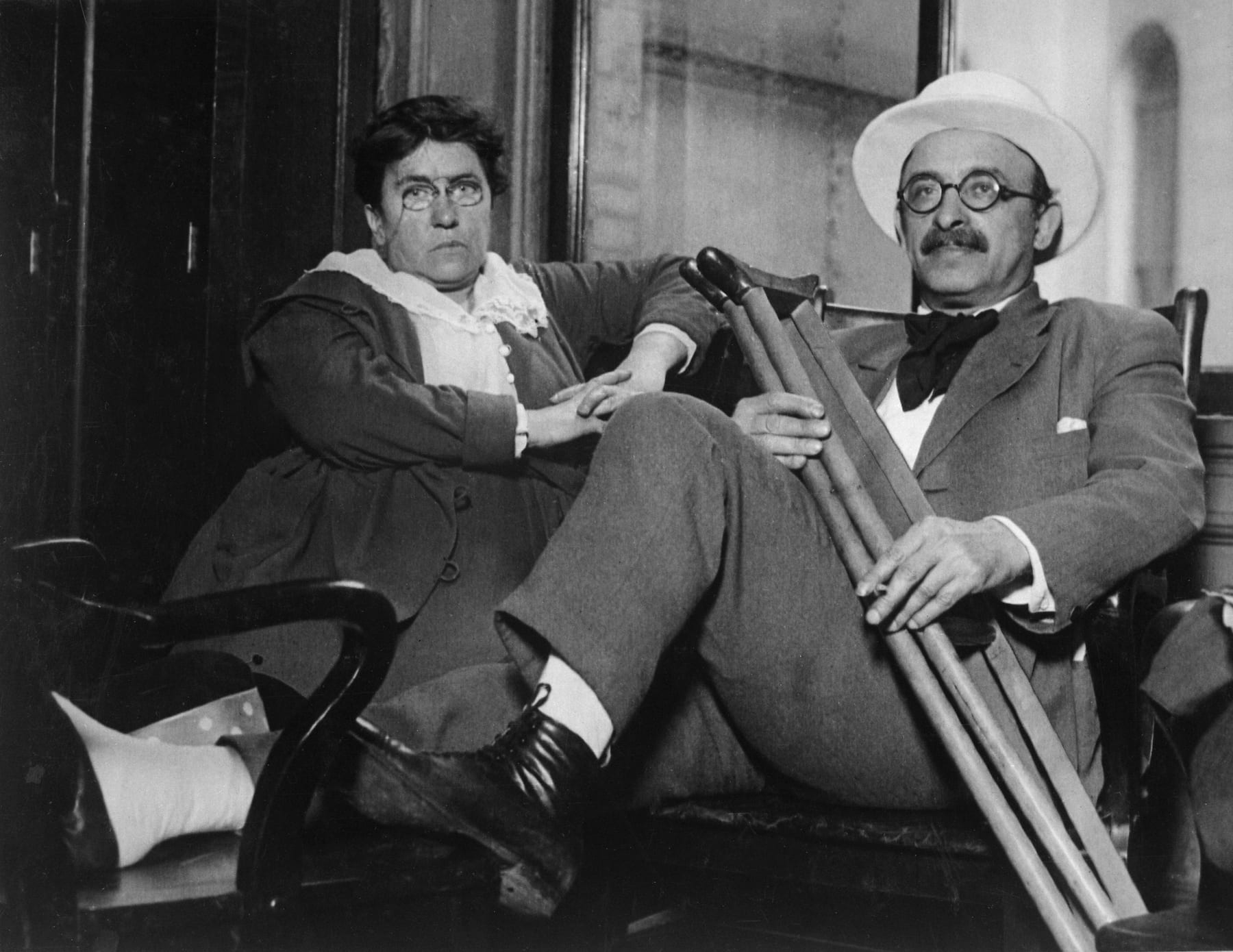
Fact check and context — when the USSR began
The events from 1917 through most of 1922 concern Bolshevik/Soviet Russia, not yet a formally constituted USSR. The Union of Soviet Socialist Republics was proclaimed in December 1922. This distinction helps date the institutions discussed in the lecture. Library of Congress country study; Library of Congress account of the founding documents.
1. Labor radicalism, dynamite, and Haymarket (1870s–1887)
Malice begins in industrial America, where some radicals imagined labor’s overthrow of capitalism as the next stage after independence and emancipation. He describes armed organizing in Chicago, Illinois restrictions on private militias, and the 1886 Presser v. Illinois decision. He then turns to dynamite: a mining technology that anarchist agitators also saw as a weapon against concentrated state and corporate power. Johann Most’s advocacy of revolutionary violence supplies the immediate ideological context. Slides 2–8 (file not included in this release)
Fact check — who discovered nitroglycerin?
The transcript credits Christian Schönbein. The Nobel Prize’s history of Alfred Nobel instead credits Ascanio Sobrero with synthesizing nitroglycerin. Nobel later made its use more practical through a detonator and dynamite. This is a factual correction to the lecture, not just a difference in emphasis.
The May 1886 eight-hour-day movement culminated in a Chicago rally at Haymarket Square. The lecturer emphasizes that the rally itself was peaceful before an unidentified person threw a bomb as police moved to disperse it. Police and civilians died in the explosion and subsequent gunfire. Eight anarchists were convicted; four were executed, while Louis Lingg died in jail. Malice argues that the trial punished political advocacy more than proof of who threw the bomb. The case radicalized the young Goldman, who read about the defendants’ trial and interpreted them as martyrs. Slides 9–18 (file not included in this release)
Visual aid — Haymarket as illustrated for a national audience
Thure de Thulstrup, “The Anarchist Riot in Chicago,” Harper’s Weekly, May 15, 1886. This is a contemporary press engraving, not a photograph or neutral reconstruction; it shows how the violence was visualized for readers soon after the event. Wikimedia Commons source. Public domain.
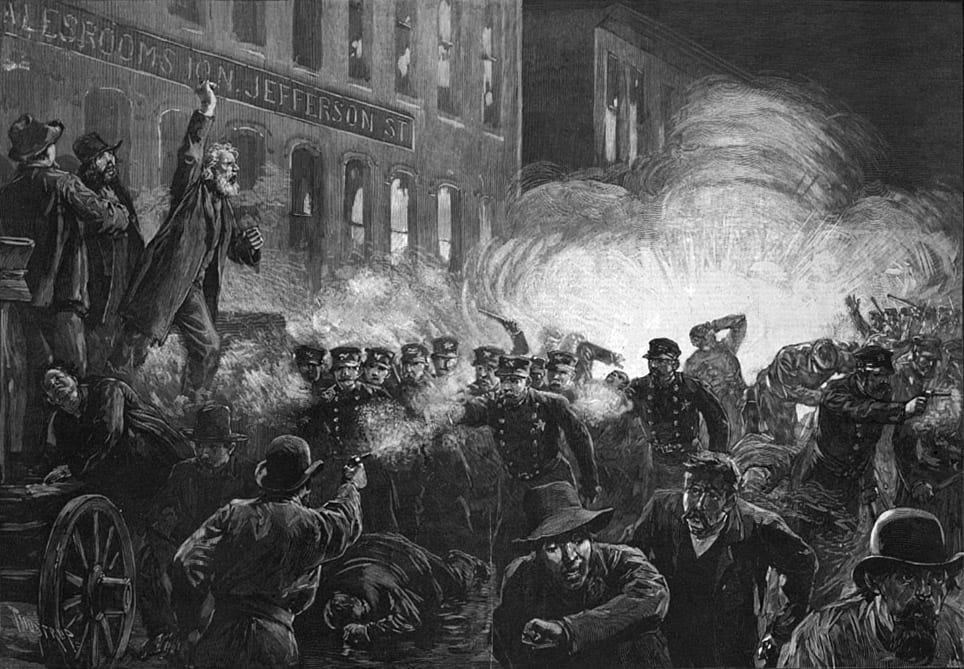
Fact check — the Haymarket pardons
The bomber remains unidentified, and the trial’s fairness was widely contested. But the transcript says the executed men were “posthumously pardoned.” Governor John Peter Altgeld pardoned the three surviving defendants in 1893; four had been hanged and Lingg had died in prison. The National Park Service’s account of the Haymarket monument records the defendants’ fates and Altgeld’s pardons.
2. Homestead and the politics of assassination (1892–1901)
At Carnegie Steel’s Homestead works, Henry Clay Frick’s effort to weaken the union, a lockout, replacement workers, and the arrival of Pinkerton agents produced a deadly confrontation. Berkman and Goldman thought assassinating Frick would ignite a wider labor revolt. Berkman shot and stabbed Frick in July 1892, but Frick survived and Berkman went to prison. The lecturer presents the attack as a political failure: it alienated workers and diverted attention from the strike. Slides 20–27 (file not included in this release)
Fact check — Homestead chronology and demands
The transcript dates the militia’s arrival to July 18 and says the workers were “not even” seeking a raise. The Library of Congress timeline dates the militia’s arrival to July 12, and its strike overview describes competing wage demands, including the union’s request for raises and the company’s desired cuts. Berkman’s attack on Frick was on July 23. These corrections leave the central point about a violent labor conflict intact.
Goldman continued organizing and speaking. Leon Czolgosz, who had heard her, assassinated President William McKinley in 1901. Malice draws a line from Goldman’s rhetoric to Czolgosz’s stated inspiration, while also describing the government’s unsuccessful effort to establish a wider conspiracy involving her. The attack helped drive federal exclusion and deportation policies directed at anarchists. The lecture’s causal suggestion about Goldman’s influence is based on the assassin’s reported words; hearing a speech does not by itself establish her responsibility for his act. Slides 28–35 (file not included in this release)
Fact check — McKinley’s murder weapon
The transcript says Czolgosz drew a rifle at point-blank range. A Library of Congress description of the assassination identifies a concealed revolver. The National Park Service says the gun was hidden in a handkerchief as McKinley greeted him.
3. World War I, speech restrictions, and deportation (1917–1919)
Wilson’s reelection campaign had emphasized that the United States remained out of the European war; in 1917 the United States entered it. The Espionage Act was then used against opponents of the draft, including Goldman and Berkman. Malice uses Schenck v. United States to argue that wartime protection for antiwar political speech was weak, and he stresses that the Court upheld convictions for distributing anti-draft leaflets. After the 1919 anarchist bombing campaign, federal raids and deportations intensified. Goldman and Berkman were sent to Russia aboard the Buford, the so-called “Soviet Ark,” in December 1919. Slides 37–42 (file not included in this release) · Slides 61–66 (file not included in this release)
Fact check — declaration of war and Schenck
Wilson asked Congress for war on April 2, 1917; Congress approved the declaration on April 6, rather than granting it on April 2 as the transcript says. U.S. Senate record. In Schenck, the Court upheld convictions under the Espionage Act for a charged conspiracy to obstruct recruitment and for mailing the leaflets. The lecturer’s description of the leaflets as mere opposition to war is an interpretation; the Court’s opinion and the case summary should be read before using it as a simple rule about all antiwar speech.
4. The Bolshevik promise and the early state (1917–1918)
The lecture then moves back to Russia. The Bolsheviks seized power in the October Revolution; the lecture frames their ambition as a centrally planned, radically remade society. It briefly contrasts Bolsheviks, Mensheviks, Socialist Revolutionaries, and anarchists. Goldman and Berkman initially welcomed the revolution from afar, even though their anarchist ideal of local autonomy differed from Lenin’s party-led state. The Cheka, the new political police, became a means of suppressing perceived counterrevolution. Slides 43–53 (file not included in this release)
At Brest-Litovsk, Trotsky stalled peace negotiations in hopes that revolution in Germany would improve Russia’s position. His “neither war nor peace” stance was followed by a German advance. Lenin secured acceptance of a harsh treaty in March 1918 to preserve Bolshevik rule. After an attempt on Lenin’s life in August, the regime escalated terror against actual and alleged opponents. Malice reads these developments as an early indication that state survival and ideological control would outrank the revolution’s emancipatory claims. Slides 54–60 (file not included in this release)
Fact check and context — Brest-Litovsk
The U.S. State Department history confirms that the Treaty of Brest-Litovsk was signed on March 3, 1918 and ended Russia’s participation in World War I. The account of Trotsky’s strategy and the lecture’s precise territorial/industrial percentages would need separate source checking before quotation.
5. Goldman and Berkman encounter Bolshevik rule (1920–1921)
On arriving in Russia, Berkman felt he had reached the revolution he had dreamed of. The two anarchists gradually became alarmed by restrictions on speech, imprisoned anarchists, and Cheka violence. Malice recounts Berkman’s refusal to help circulate an anti-anarchist Lenin essay without a chance to answer it. Their critique mattered because it came from people committed to radical social change, not from defenders of the old Russian order. The lecture draws on their later memoirs but sometimes presents reported stories as direct observation. Slides 66–70 (file not included in this release)
Fact check — Goldman’s Cheka account
The lecture says Goldman herself saw Cheka prisoners transported in bloody wagons and adds that mounted officers fired DShK machine guns. In Goldman’s My Further Disillusionment in Russia, the scene is a story told by a guest of a doctor, not an incident she claims to have witnessed. Her text says mounted Chekists fired into the air but does not name DShKs. The weapon detail is also anachronistic: the U.S. Army’s reference identifies the DShK as the M1938 model. The underlying allegation of executions should be attributed to Goldman’s source unless independently corroborated.
6. Kronstadt as a turning point (March 1921)
Sailors at Kronstadt, previously associated with revolutionary defense, demanded new soviet elections, freedoms of speech and assembly, release of political prisoners, equal rations, and permission for small-scale independent production. Goldman and Berkman offered to mediate. Bolshevik forces instead assaulted the naval base and crushed the uprising. For Malice, Kronstadt is the lecture’s decisive contrast between “power to the soviets” as a promise and party monopoly as practice. Goldman and Berkman left Soviet Russia and published sustained criticisms in My Disillusionment in Russia, My Further Disillusionment in Russia, and The Bolshevik Myth. Slides 71–82 (file not included in this release)
Visual aid — Kronstadt sailors in 1921
Sailors at Kronstadt, 1921. The image helps place faces beside the uprising, but the Commons record does not securely identify every person or the precise moment shown; no additional inference should be drawn from the photograph alone. Wikimedia Commons source. Public domain.
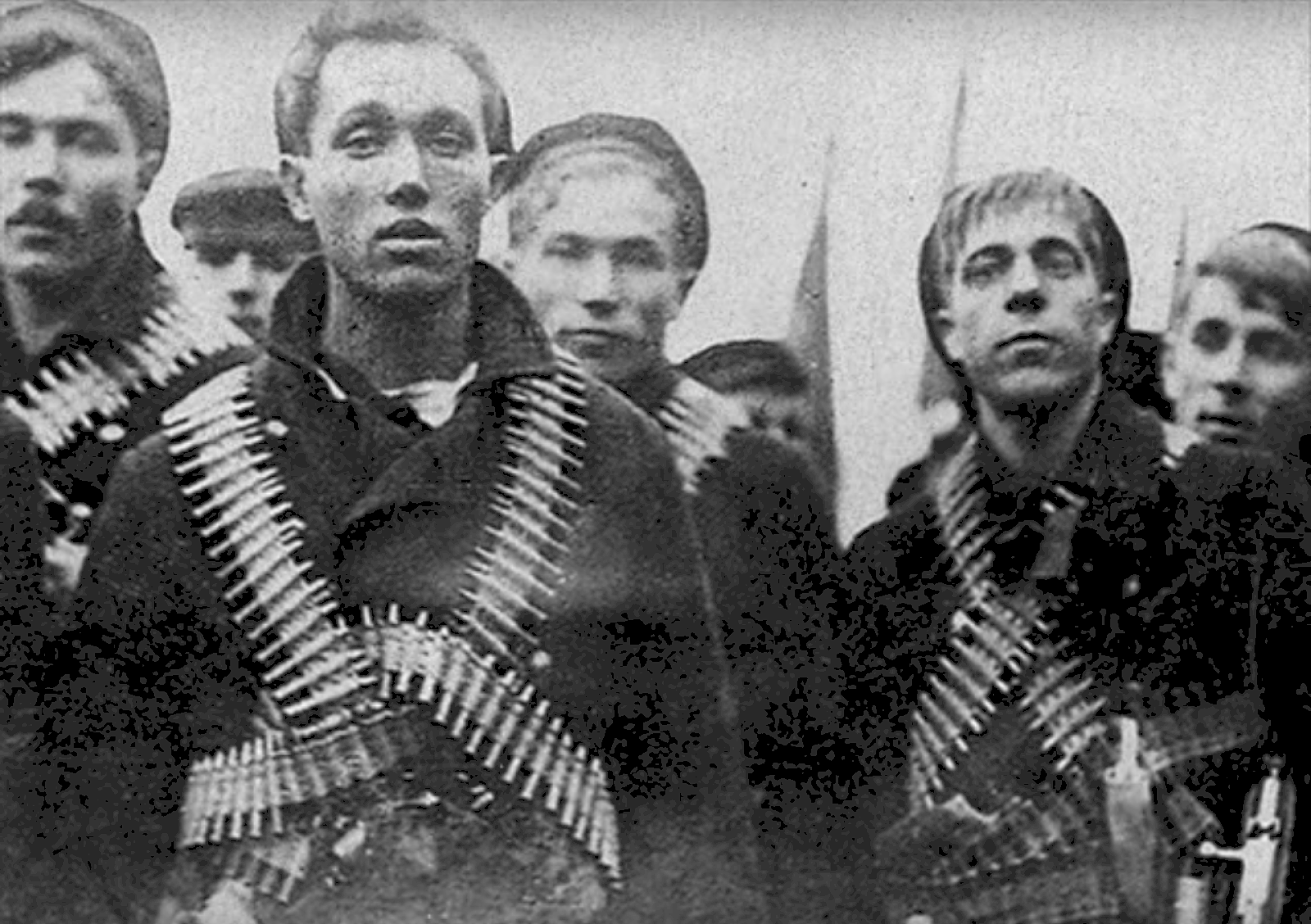
Fact check and context — chronology and evidence
A Library of Congress map description dates the Kronstadt resolution to March 1 and the garrison’s defeat to March 18, 1921. Goldman’s own account is valuable primary testimony about her response, while her broader judgments are arguments to assess alongside other records. The transcript’s more specific claims about a proposed gas attack, individual quotations from Lenin, and exact numbers killed or imprisoned are not established by these checks and should be verified before reuse.
7. NEP, famine, and the approach of Lenin’s succession (1921–1922)
The New Economic Policy replaced grain requisitioning with a tax and reopened room for small private trade while the state retained control of major sectors. Malice reads this as Lenin’s pragmatic retreat from War Communism, but notes that political pluralism did not accompany economic relaxation. The famine of 1921–22 brings in Herbert Hoover’s American Relief Administration, which delivered large-scale aid despite hostility between the U.S. and Bolshevik governments. The lesson ends with Lenin’s 1922 stroke and introduces Stalin as the next figure in the story. Slides 83–89 (file not included in this release)
Fact check — NEP did not begin after Kronstadt fell
The lecture narrates NEP as if Lenin introduced it after the rebellion was suppressed. The Library of Congress country study places Lenin’s proposal before the Tenth Party Congress while Kronstadt was in revolt in March 1921. The policy can be understood in the same crisis context, but “after Kronstadt” is inaccurate as a sequence.
Fact check — why American relief ended
The lecture says Hoover’s relief workers withdrew because the Bolsheviks exported grain while people starved. The Hoover Institution’s archive-based account says the American Relief Administration’s Russian mission lasted into summer 1923, after the worst of the 1921–22 famine had passed. This check does not establish the claimed withdrawal motive or resolve questions about Soviet grain exports; treat that causal claim as unverified, not as the reason the ARA left.
What to retain from Lesson 1
- The narrative device: Goldman and Berkman first welcome the revolution, then judge it against their own commitments to workers’ freedom and local self-rule.
- The core institutional question: What happens when a party claiming to act for workers controls the press, police, and definition of “counterrevolutionary”?
- The civil-war context: External war, internal rebellion, assassination, famine, and coercive state building all matter to explanation. The lecture’s moral conclusion should still be evaluated against chronology and primary records.
- The NEP tension: Economic concessions could ease scarcity without reopening political competition.
Primary-source leads for further study
- Emma Goldman, My Disillusionment in Russia (1923) and My Further Disillusionment in Russia (1924). The second volume contains chapters omitted from the first U.S. publication; read both before treating either as her complete account.
- U.S. State Department documents on the Treaty of Brest-Litovsk for contemporary diplomatic records.
- Hoover Institution’s ARA Russia collection overview for photographs and archival leads about famine relief.
Questions to carry into the next lesson
- Did wartime emergency produce the Bolshevik restrictions, or did party doctrine and organization make them likely even without war?
- Which Kronstadt demands were answered economically by NEP, and which political demands remained rejected?
- How did Lenin’s illness change the balance among the leaders who controlled the new state?
Lesson 2 - Stalin’s Rise to Power
Central thread
Malice follows Stalin from Bolshevik organizer to party leader, then asks what happened when the state tried to remake agriculture, control information, and explain its failures by finding enemies. The lecture’s strongest through line is institutional: control over appointments, food, police, the press, and public truth made opposition increasingly dangerous. Its vivid stories also require care. Several dates are wrong, some causal claims are contested, and a few anecdotes are presented more confidently than the available checks warrant.
Sequence to keep in view: Lenin’s last illness and the USSR’s formation (1922) → Lenin’s death (1924) → Trotsky’s defeat, internal exile, and deportation abroad (1927–29) → the first Five-Year Plan and forced collectivization (from 1928–29) → the Soviet famine and Holodomor (1932–34) → Kirov’s murder (1934) → Moscow show trials and the Great Terror (especially 1936–38). Slides 2–8 (file not included in this release) · Slides 12–29 (file not included in this release) · Slides 47–63 (file not included in this release)
1. An organizer wins a succession struggle (1907–1929)
Born Ioseb Jughashvili in Georgia, Stalin had participated in the Bolsheviks’ underground work, including the 1907 Tiflis bank robbery. Malice contrasts Trotsky’s public reputation as a revolutionary intellectual with Stalin’s command of party machinery. As Lenin became incapacitated, the general secretary’s access to personnel and information mattered: Stalin could build alliances inside the organization that would choose its own leaders. Lenin died on January 21, 1924. Slides 2–5 (file not included in this release)
The lecturer presents “socialism in one country” as a clean Lenin-versus-Stalin dispute. It became an important post-Lenin succession argument, especially against Trotsky’s emphasis on international revolution. Lenin’s own final letters concentrated on party stability, nationality policy, and Stalin’s growing power; the leaders’ disagreement cannot be reduced to this single slogan. A further lesson from the period is that winning control of a party organization can matter as much as winning a public debate. Slides 6–8 (file not included in this release)
Fact check — USSR founding date and succession alliances
The transcript says the USSR was proclaimed on December 28, 1922; slide 6 says December 30, the date the founding declaration and treaty were adopted at the First All-Union Congress. Library of Congress; declaration and treaty in a teaching archive. The transcript also says Kamenev and Zinoviev initially sided with Trotsky against Stalin. They first allied with Stalin against Trotsky, then later joined Trotsky in the United Opposition against Stalin. The alliances changed over time; this matters to how Stalin isolated opponents. Library of Congress country study.
Fact check — Trotsky’s expulsion
Trotsky lost his party membership in 1927 and was sent to Alma-Ata within the USSR in 1928. He was deported out of the country in 1929, rather than in early 1928 as the transcript says. Library of Congress country study; Trotsky’s contemporary account of his deportation is a partisan primary account of the latter step.
2. Rapid industrialization and the attack on independent farming (1928–1932)
Malice moves from crowded city apartments and shared facilities to the shortage of food. The first Five-Year Plan intensified state direction of industry and departed from Lenin’s New Economic Policy. Forced collectivization then brought peasant households into collective farms. “Kulak,” originally a category for wealthier peasants, became a political label used in a broad campaign of confiscation, deportation, and repression. Many peasants resisted; the upheaval reduced livestock and damaged agricultural production. The lecture describes urban housing and informers to show how coercion could reach ordinary domestic life, though its anecdotes and claims about architectural intent are illustrative rather than a measured account of all Soviet housing. Slides 9–20 (file not included in this release)
Visual aid — property after “dekulakization”
A storeroom or barn confiscated from a “dekulakized” peasant household in the Donetsk region, 1930. The photograph documents material seizure, while its original Soviet classification should not be treated as independent proof that the owner met any stable economic definition of “kulak.” Photograph attributed to Mikhail Zelezniak. Wikimedia Commons source. Public domain.
Context — plan and collectivization were related but distinct
The Five-Year Plan began in 1928; the most sweeping drive to collectivize agriculture accelerated in 1929–30. The original plan anticipated collectivizing a smaller share of households than Stalin’s subsequent campaign reached. This distinction makes the shift in policy clearer than treating all collectivization as one measure imposed in 1928. Library of Congress archival exhibition.
Grain procurement targets, dispossession, exports, falling yields, and coercive enforcement feature in Malice’s explanation of the ensuing famine. The regime did not simply fail to predict a poor harvest: it continued demanding grain and other food while people were starving. The lecture contrasts this with Goldman’s earlier call for hungry workers to take bread. That contrast is rhetorically strong, but the precise harvest and export figures quoted in the transcript have not been checked here. Slides 21–29 (file not included in this release)
3. The Holodomor and movement controls (1932–1934)
In Soviet Ukraine, searches for concealed grain, punitive seizures, the August 1932 law protecting collective property, and restrictions on travel made escape and survival harder. Malice draws on Anne Applebaum and recollections of villagers to convey the experience of repeated searches; these accounts are reported testimony, not firsthand observation by the lecturer. The famine also reached other Soviet regions, with Kazakhstan suffering especially severe losses relative to its population. “Holodomor” names the Ukrainian catastrophe; the wider 1932–34 Soviet famine is a related but broader subject. Slides 21–29 (file not included in this release)
Map — estimated population decline in Ukraine, 1929–1933
Estimated population change across Ukraine between 1929 and 1933. Darker areas indicate greater decline. This is a later demographic visualization—not a direct map of deaths, policy intent, or a single cause—and its non-English legend should be read with the underlying methodology before quantitative reuse. Map by Sergento (2014). Wikimedia Commons source. CC BY-SA 4.0.
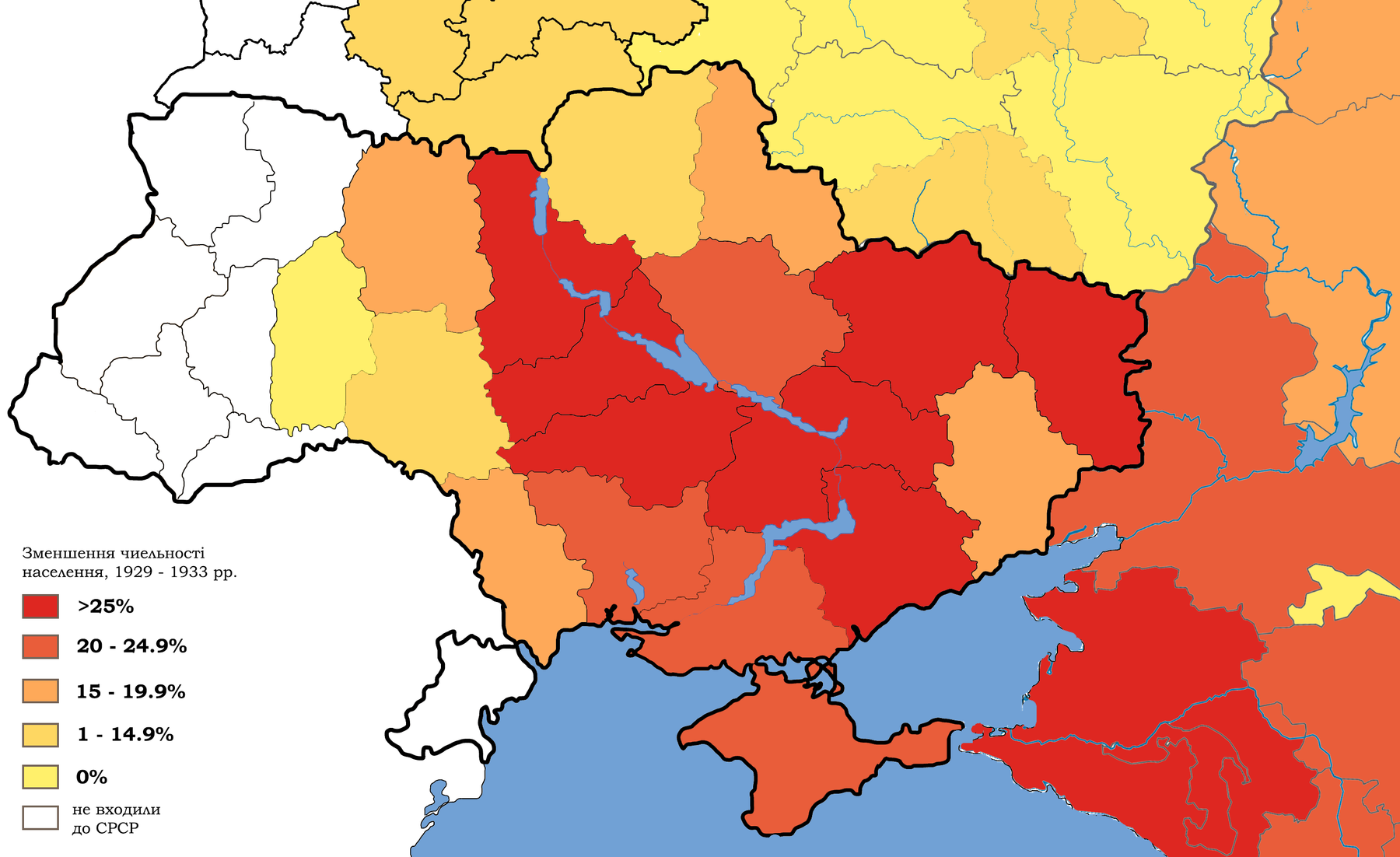
Fact check — the passports went to whom?
The transcript says “everyone was issued a passport” in 1932. The internal-passport system excluded most collective farmers; coupled with restrictions on travel and the January 1933 closure of routes from Ukraine, that exclusion helped prevent people from leaving famine areas to seek food. The policy had the opposite practical effect from the transcript’s wording. Holodomor Research and Education Consortium (HREC) account.
Context — causes and intention
Weather and harvest fluctuations were part of the agricultural setting, but coercive collectivization, requisitions, punitive seizures, and movement restrictions were state choices that intensified the catastrophe. The evidence for these policies is strong. Historians and governments disagree over the precise legal and historical characterization of intent, including the question of genocide; a claim about a particular official’s intent needs its own documentary support. HREC historical overview; Harvard Ukrainian Research Institute demographic research.
4. What outsiders could see: Duranty, Jones, and the census (1932–1939)
The lecturer then turns from the famine itself to how it was reported. Foreign correspondents in Moscow faced censorship and restricted travel. New York Times correspondent Walter Duranty minimized or denied starvation while Gareth Jones traveled through villages and publicized what he saw in March 1933. Malcolm Muggeridge also reported on the famine. Malice uses their disagreement to ask how official access, ideological sympathy, and the demand for firsthand reporting shaped what readers abroad learned. Slides 30–42 (file not included in this release)
Visual aid — Gareth Jones
Welsh journalist Gareth Jones, whose March 1933 dispatches reported starvation after unauthorized travel through Soviet Ukraine. This later published portrait is included to connect the reporting dispute to the individual who challenged official denial. Wikimedia Commons source. Ukrainian Institute of National Memory; CC BY-SA 3.0.
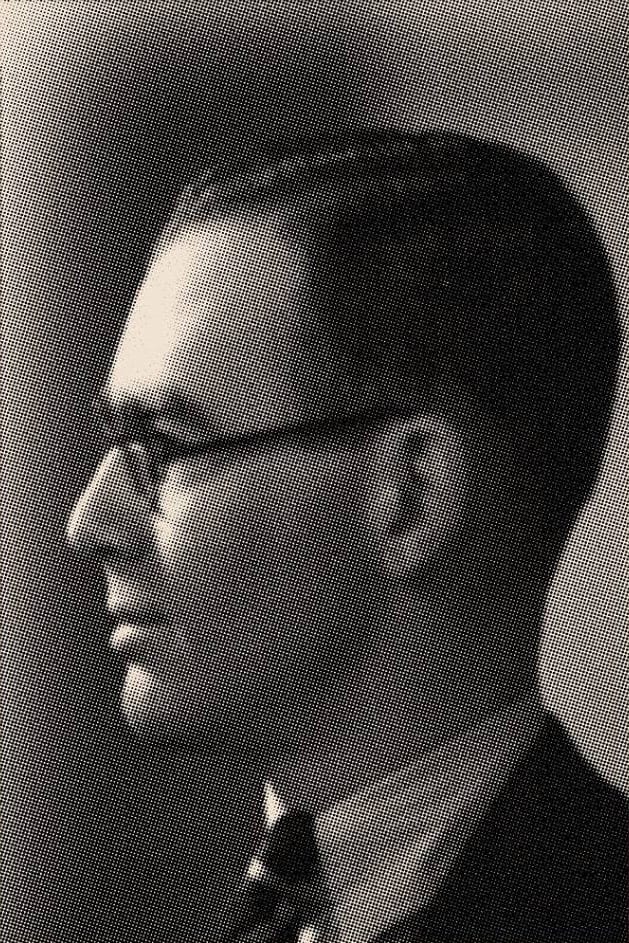
Fact check — Duranty’s Pulitzer and the famine dispatches
Duranty received the 1932 Pulitzer Prize for thirteen articles published in 1931, not for his 1932 famine reporting as the transcript says. In 2003 the Pulitzer Board called his later 1932–33 famine dispatches gravely defective, but it declined to revoke the prize because it did not find clear and convincing evidence of deliberate deception in the 1931 prize-winning articles. That decision did not vindicate his famine coverage. Pulitzer Board’s statement and article list. Compare Duranty’s March 31, 1933 response with Jones’s March 29 press release and reporting archive.
Malice gives a figure of nearly four million Ukrainian deaths and relates the suppression of the unexpectedly low 1937 Soviet census. These are different kinds of evidence. An estimate of excess deaths compares observed deaths with a demographic baseline; a census shortfall against a forecast also reflects births, migration, counting, and the assumptions behind the forecast. The second figure cannot simply be read as a count of famine deaths. Slides 43–46 (file not included in this release)
Fact check — deaths, birth deficit, and the 1937 census
One major demographic reconstruction estimates 3.9 million excess deaths in Ukraine in 1932–34, plus a 600,000 birth deficit. Its researchers estimate 8.7 million excess deaths across the entire USSR, including 3.3 million in Russia; the lecture’s “over one million” elsewhere materially understates that reconstruction. Estimates differ by method and geography, so “historical consensus” should not imply a single uncontested tally. Harvard Ukrainian Research Institute and collaborating demographers. The 1937 census found roughly 162 million, below expected figures of roughly 170–172 million, and was suppressed. A new 1939 census reported about 170.5 million. It was a new census two years later, not simply a correction of the 1937 count, and the gap between a projection and a census is not a death count. Demographic study of the 1937 and 1939 censuses; 1939 U.S. diplomatic report of the published result.
5. Kirov’s murder and the machinery of the Great Terror (1934–1938)
Sergei Kirov, the influential Leningrad party chief, was killed by Leonid Nikolaev on December 1, 1934. Stalin used the assassination to broaden investigation and repression. The 1936–38 Moscow trials put former Bolshevik leaders in the dock on charges of terrorism, conspiracy with Trotsky, and foreign collaboration. Zinoviev and Kamenev, once Stalin’s political partners, were among the defendants who confessed and were executed. Malice highlights the peculiarity of defendants making elaborate self-incriminating statements and the vulnerability of people whose safety depended on the party’s changing definition of loyalty. Slides 47–57 (file not included in this release)
Fact check — was Kirov an agreed successor, and did Stalin order his murder?
Kirov was prominent and some party members discussed him as an alternative to Stalin. The lecture’s description of an agreed, nearly official successor goes further than the evidence presented here. Stalin’s exploitation of Kirov’s murder to launch repression is well documented; Stalin’s direct responsibility for arranging the killing remains disputed among historians. The Library of Congress archival exhibition argues that Stalin and the police planned it, while historian J. Arch Getty’s study questions the evidence for Stalin’s complicity. The certain consequence should not be mistaken for proof of the disputed cause.
The lecture uses two alleged meetings with Trotsky as tests of the prosecution’s story. One defendant named a Copenhagen “Hotel Bristol” that had closed; another, Georgy Pyatakov, claimed to have flown to Norway despite contemporary challenges to the flight’s feasibility and airport records. The contradictions are important, but the venues and testimony need to be examined together rather than turning a single detail into proof of every defendant’s innocence. An independent commission chaired by John Dewey later scrutinized the charges against Trotsky and found them unsupported. Its report is a contemporaneous adversarial inquiry, valuable as evidence about the allegations and their contradictions, not a substitute for the full trial record. Slides 54–61 (file not included in this release)
Fact check — the Bristol, Smirnov, and Lenin’s final letter
The Hotel Bristol had closed, but a nearby Bristol café and Grand Hotel figure in competing explanations of the trial testimony; the phrase “the hotel didn’t exist” is accurate only if those distinctions are kept in view. The Dewey Commission’s documentary review details them and also notes that the prosecution did not produce the code it alleged Ivan Smirnov used from prison. The transcript dates Smirnov’s execution to May 1937; he was a defendant in the August 1936 first Moscow trial and was executed then. Lenin’s December 1922–January 1923 “Letter to the Congress” did recommend considering Stalin’s removal as general secretary, but the claim of immediate total suppression is too strong: it was read to delegations at the 1924 party congress, though not broadly published in the USSR at that time. Lenin’s text with publication history; 1936 trial record.
6. Expertise, art, and control of the record
Malice describes a system in which production failures could be explained as “wrecking” and technical specialists could be denounced as enemies. His examples range from engineers and railway workers to scientists. Trofim Lysenko’s political rise and opposition to Mendelian genetics show how state power could elevate a favored scientific program and damage research. The lecture’s individual arrest stories and unusual biological claims are leads for further checking; the broader history should not be reduced to the proposition that all Soviet scientists rejected genetics. Slides 64–69 (file not included in this release)
Fact check — criminal penalties for being late came later
The lecture folds the punishment of someone arriving twenty minutes late into its 1930s story. Soviet rules defined more than twenty minutes of lateness as absenteeism in 1938; criminal penalties for absenteeism under the cited labor decree came on June 26, 1940. These rules belong to a later tightening of labor discipline, not to the first phase of the Great Terror. Historical labor-policy chronology; text of the 1940 decree.
The final example moves from science to art. After Stalin attended Shostakovich’s Lady Macbeth of Mtsensk, Pravda denounced the opera, a frightening signal to the composer and his circle. The slides end with altered photographs, an image of how the regime could make disgraced people disappear from its public record as well as from public life. Slides 70–73 (file not included in this release)
Fact check — Stalin did not attend the opera’s premiere
Lady Macbeth of Mtsensk premiered in 1934. Stalin attended a performance on January 26, 1936; the Pravda editorial usually translated as “Muddle Instead of Music” appeared January 28. The transcript calls the 1936 performance the premiere. Boston Symphony Orchestra’s performance history; Shostakovich’s life chronology.
What to retain from Lesson 2
- Succession: Stalin’s advantage lay in organizing power and shifting alliances, not an inevitable victory in a two-person contest with Trotsky.
- Collectivization: Rapid industrialization and forced agricultural transformation were linked state projects, with especially devastating consequences for the countryside.
- Information: Censorship, restricted travel, failed public accounting, show trials, and manipulated images all affected what people could know or safely say.
- Evidence: Separate policy records, witness testimony, a journalist’s claims, a demographic estimate, and an unresolved allegation about an assassination. They do different kinds of work.
Questions to carry into the next lesson
- How did terror move from trials of party leaders to the wider population, and who made the decisions at each level?
- Which forms of resistance to collectivization were documented, and how did officials turn the evidence into accusations of “sabotage”?
- How did Stalin’s purges affect Soviet capacity to govern and to respond to the coming war?
Lesson 3 - Stalin’s Paranoia Unleashed
Central thread
Malice follows the Great Terror as it spreads from Stalin’s political opponents to the police, army, ethnic minorities, foreign communists, officials, and their families. The altered photographs at the opening make his theme visible: the state tried to control both who could live in the present and who could be remembered in the past. The lecture then asks how forced confessions could appear convincing abroad when fear and fabricated charges were shaping them at home. Its account is strongest as a description of the terror’s reach; several striking numbers, quotations, and personal episodes need the qualifications below. Slides 2–4 (file not included in this release)
Sequence: Yagoda replaced by Yezhov (1936) → purge of the Red Army leadership and NKVD mass operations (1937–38) → attacks on national groups, officials, and families → 1938 Moscow trial and foreign responses. The case studies overlap; the terror did not advance through these groups one at a time.
1. Erasing people and purging the enforcers (1936–1938)
The lecture opens with photographs retouched after an official fell from favor. Removing a person from a published image could make the official record conform to the current political line. Malice then turns from the image to the institution that carried out arrests. Stalin replaced NKVD chief Genrikh Yagoda with Nikolai Yezhov in 1936. Under Yezhov, the police arrested and executed people who had themselves helped carry out earlier purges. Yagoda was a defendant in the 1938 trial and was executed. This shows how service to the regime offered no durable protection when an official could become a liability or be accused of belonging to an invented conspiracy. Slides 5–8 (file not included in this release)
Before and after — Nikolai Yezhov removed from the record
Top: Stalin, Molotov, and NKVD chief Nikolai Yezhov beside the Moscow–Volga Canal, April 1937. Bottom: a retouched version after Yezhov’s fall, with Yezhov removed. The pair is direct visual evidence of alteration; it does not by itself reveal who ordered this particular edit or where every version circulated. Original · retouched version. Public domain.
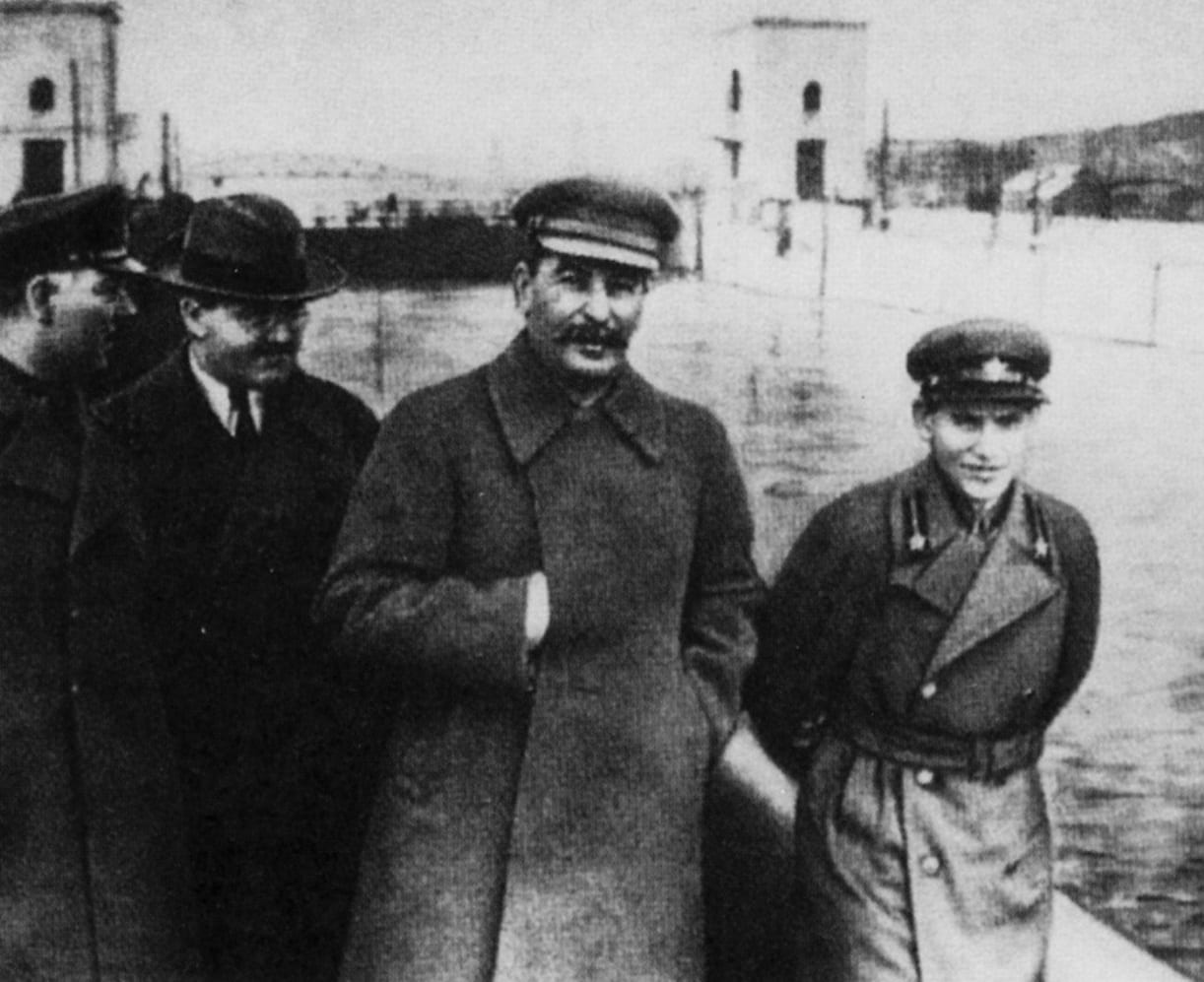
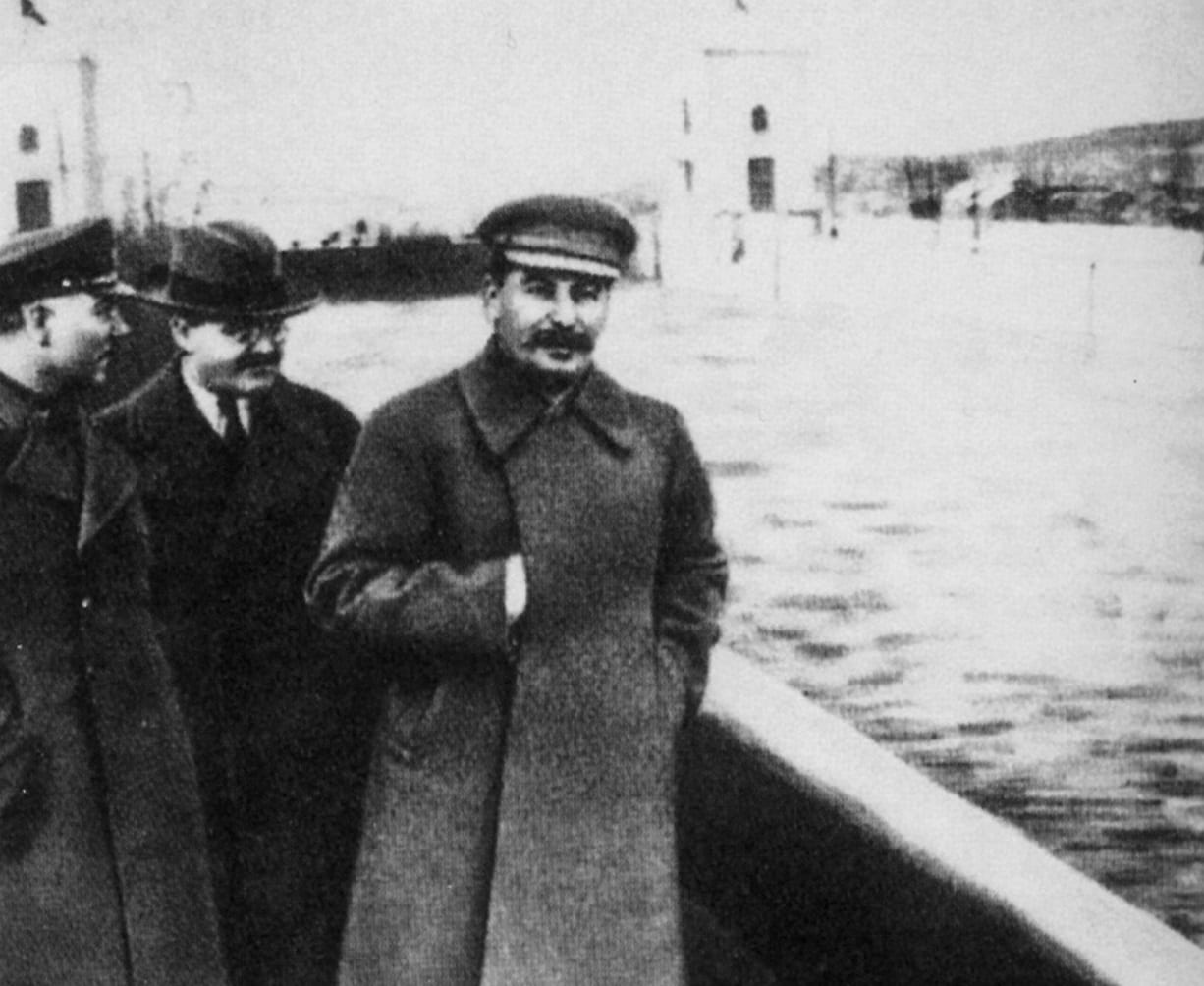
Lecturer’s story — Yagoda and the purge of the purgers
Malice recounts that Stalin replaced NKVD chief Genrikh Yagoda with Nikolai Yezhov, who arrived with 300 new officials and scattered senior police personnel to supposed regional assignments before arresting them and their assistants. Some interrogators allegedly killed themselves rather than undergo the torture they had inflicted on others; the lecture gives a figure of 3,000 police executions in 1937. Yezhov also arrested Yagoda’s relatives—exiling his wife, parents, sisters, nieces, and nephews—and Yagoda was executed in 1938. The story’s point is that knowing how the terror had been manufactured made its own administrators disposable.
This is the lecturer’s narrative; the precise personnel counts are qualified immediately below. Transcript · Slides 5–8 (file not included in this release)
Source check — police turnover and photographs
The replacement of Yagoda and purge of NKVD personnel are well documented, but the transcript’s exact counts of 300 incoming officials and 3,000 NKVD executions in 1937 were not independently established in this check. Use them as the lecturer’s figures, not settled totals. The documented mass operations also make clear that terror was directed through orders, regional quotas, and police institutions, not simply through Yezhov’s personal initiative. Hoover Institution, Stalin’s Loyal Executioner, chapter 4; the Met’s example of an altered Soviet photograph.
2. The army and the fear of an alternative center of power (1937–1938)
Marshal Mikhail Tukhachevsky and other senior officers were accused of treason and executed in 1937. Arrests and dismissals spread through the officer corps. Malice argues that destroying experienced leadership weakened the army when Germany invaded in 1941. The loss of officers plausibly mattered, but the precise effect on wartime performance is a historical question rather than something proved by the lecture’s rank list alone. Slides 9–11 (file not included in this release)
Visual aid — Marshal Mikhail Tukhachevsky
Marshal Mikhail Tukhachevsky, c. 1935, shortly before his 1937 arrest, secret trial, and execution. The portrait helps recover the individual behind the purge statistics; it is not evidence for the accusations against him. Photographer unidentified; Bettmann Archive provenance noted by the source. Wikimedia Commons source. Public domain.
Lecturer’s story — Tukhachevsky and a compliment treated as treason
After Marshal Mikhail Tukhachevsky was condemned as an enemy of the people, the lecture says an unnamed woman remarked that he was handsome. She received a ten-year sentence for praising a man who, only days earlier, had been celebrated as one of the Soviet Union’s leading commanders. Malice uses the episode to show how abruptly an approved public figure could become dangerous even to mention favorably.
The woman’s case is presented by the lecturer as an anecdote; the transcript does not identify her or supply a source. Transcript · Slides 9–11 (file not included in this release)
Fact check — the army’s losses
The transcript says Stalin killed officers in every rank count it recites. Those commonly repeated counts often combine execution with arrest or dismissal, and some dismissed officers were later reinstated. Recent research finds that, among 1,844 general-grade officers, more than half were repressed and at least 780 executed, including three of the five top-ranking marshals. This is a severe loss without treating every removal as a killing. The claim that the purge caused specific defeats in 1941 needs a separate causal assessment. Becker Friedman Institute summary of archival research; University Press of Kansas, Peter Whitewood’s study of the Red Army purges.
3. National operations, refugees, and suspicion of foreigners (1937–1938)
The NKVD also conducted operations against people cast as potential agents of foreign states. The lecture focuses on Soviet Poles, Greeks, Jewish refugees, and communists who had moved to the USSR to escape fascism or build socialism. Its central point is the danger of guilt assigned by origin or foreign contact: a name, correspondence, language, or journey abroad could become evidence of espionage. Yet these populations were targeted under different policies at different times, and the lecture sometimes folds later deportations into the Great Terror. Slides 12–17 (file not included in this release)
Lecturer’s story — Isaac Babel and the danger of a foreign friendship
Malice presents Ukrainian-born writer Isaac Babel as a celebrated author whose international reputation offered no protection. Because Babel was friendly with French writer André Malraux, the relationship could be recast as foreign espionage; the lecture says Babel was tortured and executed as a spy. The accompanying before-and-after images are used to turn the abstract category of “foreign contact” into an individual human case.
This callout preserves the lecturer’s causal framing; friendship with Malraux should not by itself be treated as a complete historical account of Babel’s arrest. Transcript · Slides 15–16 (file not included in this release)
Fact check — Polish operation and Greek deportations
The Polish operation of 1937–38 is documented: Poland’s Institute of National Remembrance reports at least 139,835 people sentenced, most of them Poles, and at least 111,091 murdered. That supports the lecture’s broad claim that more than 100,000 were killed. Soviet Greeks were also repressed in 1937–38, but I could not substantiate the lecture’s figure of 200,000 Greeks deported then. The Library of Congress describes the large-scale deportations of Greeks from the Black Sea region as occurring during and after World War II; those should not be merged with the 1937–38 Greek operation. Institute of National Remembrance; Ukrainian Institute of National Memory on the Greek operation; Library of Congress archival exhibition.
Fact check — the claim that over half a million Jews were executed
The transcript’s figure of more than 500,000 Jews executed in this campaign is unsupported and should not be repeated as fact. A Soviet Interior Ministry accounting, cited in a scholarly history, gives 681,692 death sentences for all groups combined in 1937–38; its authors caution that the figures are incomplete. Jewish people were among the victims, and YIVO notes that their share was disproportionately high, but it does not describe the Great Terror as a specifically anti-Jewish operation. Later Soviet anti-Jewish campaigns belong to another period. Hoover Institution, Stalin’s Loyal Executioner, pp. 103–05; YIVO Encyclopedia, “Union of Soviet Socialist Republics”.
Malice uses Jamaican-born engineer Robert Robinson’s account to show how Black migrants who had sought an alternative to American racism could also face Soviet repression. Robinson’s memoir is valuable first-person testimony, though his statement about acquaintances vanishing cannot by itself establish each person’s fate. Slides 16–17 (file not included in this release)
Lecturer’s story — Robert Robinson and Black migrants to the USSR
Jamaican-born engineer Robert Robinson moved to the Soviet Union in 1930 after Soviet outreach offered Black Americans an escape from American racism and a role in building a new society. Malice quotes him as later saying that “every single black I knew in the 1930s who became a Soviet citizen disappeared within seven years,” and treats their disappearance as evidence that foreigners became dangerous because they retained knowledge of life outside the USSR.
The source check below restores limiting language from Robinson’s memoir and distinguishes disappearance from Moscow from a proven death in every case. Transcript · Slides 16–17 (file not included in this release)
Source check — what Robinson actually wrote
The transcript drops two limiting details from Robinson’s line: he wrote of the Black people he knew in the early 1930s who became Soviet citizens and said they disappeared from Moscow within seven years. He went on to assert that some were exiled and others shot. His memoir therefore supports his alarm and reports different outcomes; it does not establish that everyone who left Moscow was killed. Robert Robinson, Black on Red, text of memoir.
4. When suspicion reached the party and everyday life
The lecture lists high officials swept up in the terror and describes a society in which a foreign acquaintance or an innocuous remark could be read as conspiracy. The night arrest, unexplained detention, overcrowded cell, and repeated interrogation are presented through survivor accounts. These passages convey the prisoner’s loss of control, though the transcript does not identify the source of every quotation and anecdote. The broader machinery is independently visible in NKVD orders that set categories and quotas for arrest, imprisonment, and execution. Slides 18–27 (file not included in this release)
Visual aid — former allies before they became purge victims
Stalin, Alexei Rykov, Lev Kamenev, and Grigory Zinoviev at the Fourteenth Party Congress, 1925. Rykov, Kamenev, and Zinoviev were later executed in Stalin’s purge trials. The group portrait makes the instability of elite status visible without implying that their later fates were already fixed in 1925. Photograph by Nikolai Petrov. Wikimedia Commons source. Public domain.
Visual aid — the interrogation room as a psychological instrument
Museum diorama depicting an NKVD interrogation, Military Museum, Chișinău, Moldova. It helps visualize the lecturer’s account of a prisoner isolated on a small stool, far from an interrogator whose desk and position controlled the room, while the interrogator could intensify uncertainty by waiting and staring. This is a modern museum reconstruction, not a photograph of the precise “corner-to-corner” second-floor room described in the transcript, so the window placement and exact geometry should not be treated as corroboration. Photograph by Adam Jones (2017). Wikimedia Commons source. CC BY-SA 2.0.
Government officials and bodies targeted in the lecturer’s list (1937–1938)
Malice gives the following office-by-office list. The transcript identifies positions or groups rather than naming most of the individuals, and it says the first fifteen entries were arrested—not necessarily executed. The final two outcomes are reproduced separately as the lecturer states them. Source: Lesson 3 transcript.
| Office or group named by the lecturer | Number or scope stated | Fate stated in the transcript |
|---|---|---|
| Commissar for heavy industry | One officeholder | Arrested |
| Commissar for finance | One officeholder | Arrested |
| Commissar for agriculture | One officeholder | Arrested |
| Commissar for interior trade | One officeholder | Arrested |
| Commissar for education | One officeholder | Arrested |
| Commissar for military industry | One officeholder | Arrested |
| Commissar for justice | One officeholder | Arrested |
| Commissar for state farms | One officeholder | Arrested |
| Commissar for communications | One officeholder | Arrested |
| Commissar for sea and river transport | One officeholder | Arrested |
| Chairman of the State Bank | One officeholder | Arrested |
| Secretary of the Central Executive Committee | One officeholder | Arrested |
| Ukrainian prime minister | One officeholder | Arrested |
| Deputies to the Ukrainian prime minister | All of his deputies | Arrested |
| Party Central Committee members | 99 of 102, according to the lecturer | Arrested |
| People who worked on the 1936 constitution | “Everyone who worked on it,” according to the lecturer | Later executed as traitors |
| President of the Belorussian Republic | One officeholder, not named in the transcript | Died by suicide |
Fact check — Central Committee and constitution figures
The lecture says 99 of 102 Central Committee members were arrested and that everyone who worked on the 1936 constitution was executed. In his 1956 report on the purge, Nikita Khrushchev gave a different, specific figure: 98 of 139 members and candidate members elected at the 1934 Party Congress were arrested and shot. This was still a devastating purge. The constitution claim is untenable as phrased: the drafting commission was chaired by Stalin, who lived until 1953. Many involved in the political leadership were later repressed, but not all constitution workers were executed. Khrushchev’s “Secret Speech,” translated text; University of Illinois, Stalin Constitution source guide.
Lecturer’s vignettes — when ordinary details became evidence
- On the day Zinoviev and Kamenev were executed, a listener heard Chopin’s funeral march on the radio and asked whether it was a coded signal from Trotsky.
- Illiterate peasants accused of being “Trotskyites” reportedly reached prison without knowing what the word meant.
- An unnamed Czech prisoner was made to confess that he became a German spy during the First World War, although neither Czechoslovakia nor the Soviet Union yet existed when the alleged recruitment occurred.
- A guard explained the system’s circular logic to a captive: releasing an innocent person would reveal that innocent people had been arrested, so release itself became impossible.
These are transcript vignettes; the lecturer does not identify the radio listener, peasants, Czech prisoner, or guard by name or provide their original records. Transcript · Slides 18–27 (file not included in this release)
5. Confessions, children, and the 1938 trial
Malice argues that interrogators needed signed confessions more than true accounts. He describes sleep deprivation, threats, and violence, then uses Marshal Konstantin Rokossovsky’s detention and the reported ordeal of Ukrainian party leader Stanislav Kosior’s family to show how prisoners and relatives could be made vulnerable. These are disturbing cases; the institutional fact of repression should be kept distinct from the exact details of an individual story. Slides 31–38 (file not included in this release)
Lecturer’s story — Konstantin Rokossovsky survives the interrogators
Malice describes Konstantin Rokossovsky as a forty-year-old military officer whose interrogators broke his ribs, smashed his toes with a hammer, pulled out his nails and nine teeth, and subjected him to mock executions. According to the lecture, he refused to confess, was eventually released, and later helped command Soviet forces against Nazi Germany with replacement steel teeth. Malice calls him one of the lucky ones because survival and return to command were exceptional outcomes.
The callout records the lecturer’s account and does not independently authenticate each torture detail. Transcript · Slides 31–33 (file not included in this release)
Lecturer’s story — “Comrade Ivanov” and a child used as leverage
The transcript calls him “Comrade Ivanov” because his actual name is said to be lost. An old Bolshevik who had endured tsarist prison and hard labor, he resisted four months of interrogation after being imprisoned with his wife. Yezhov then telephoned Ivanov’s mother-in-law in front of him and asked about his sleeping son. Ivanov understood the implied threat, asked her to take good care of the boy, broke down after the call, and signed the confession placed before him.
The name is explicitly a placeholder in the lecture, and no underlying source is identified in the transcript. Transcript · Slides 33–35 (file not included in this release)
Lecturer’s story — Stanislav Kosior and his daughter Tamara
Stanislav Kosior, first secretary of the Communist Party of Ukraine from 1928 to 1938, had publicly defended Stalin’s policy during the famine and was elevated to deputy prime minister before his arrest. Malice says ordinary torture failed to produce a confession, after which interrogators brought in Kosior’s teenage daughter Tamara and sexually assaulted her in front of him. The lecture says Kosior then confessed and Tamara later died by suicide beneath a train.
This is a reported and highly sensitive account, not a contemporaneously verified fact in this note; the source check below states the evidentiary limitation. Transcript · Slides 35–38 (file not included in this release)
Fact check — children and family punishment
A 1935 Soviet law lowered criminal responsibility to age 12 and permitted severe adult penalties, including death, for children. That is a grave fact, but the law itself does not establish the lecture’s claim that its purpose was to pressure political prisoners to confess or that every interrogator displayed it. A separate 1937 NKVD order (No. 00486) targeted the wives and children of alleged “traitors to the motherland.” Keep the law, the family-punishment policy, and the reported tactics of particular interrogators distinct. Law Library of Congress, Children’s Rights, Russia section; historical study of children of “enemies of the people”.
Source check — the account of Kosior’s daughter
Kosior’s arrest and execution are documented. A later memorial biography also recounts the sexual assault of his daughter Tamara and her subsequent suicide, citing a 2021 secondary work. I did not locate a contemporary record independently establishing the assault, the precise interrogation sequence, or its effect on Kosior’s confession. The episode should be identified as a reported account, not introduced with the lecture’s “what we do know” certainty.
The 1938 Moscow trial supplied another set of supposed conspiratorial murders. State prosecutors alleged that doctors had caused the deaths of writer Maxim Gorky, economic official Valerian Kuibyshev, and former secret-police chief Vyacheslav Menzhinsky. Malice treats the accusations as invented additions to a widening plot. The more careful reading is that coerced trial testimony cannot prove the charges, while the historical question of Gorky’s actual cause of death remains debated. Slides 28–30 (file not included in this release)
Lecturer’s story — inventing additional victims and forcing doctors to confess
To answer the objection that the supposed nationwide conspiracy had killed only Kirov, Malice says prosecutors retroactively presented Maxim Gorky, Valerian Kuibyshev, and former secret-police chief Vyacheslav Menzhinsky as additional murder victims. Cardiologist Dmitry Pletnyov was publicly branded a sadist after an operative accused him of biting her; Dr. Levin and Dr. Kazhekov were also told that they had deliberately killed the men through medical mistreatment. The lecture says Pletnyov initially escaped execution while Levin and Kazhekov were executed, allowing the state to enlarge its imaginary conspiracy through coerced confessions.
The adjacent fact-check corrects the lecture’s errors about Gorky’s date of death, John Dewey, and Pletnyov’s eventual fate, and notes that Gorky’s cause of death remains debated. Transcript · Slides 28–30 (file not included in this release)
Fact check — Dewey, Gorky, and the doctors
The lecturer confuses two men: John Dewey chaired the commission assessing accusations against Trotsky and Leon Sedov in the Moscow trials; Melvil Dewey devised the Dewey Decimal Classification. Maxim Gorky died on June 18, 1936, not in 1968. The doctors were charged in the 1938 trial with causing the deaths of Gorky and others, but a historical review emphasizes that Gorky’s death remains contested. Dr. Dmitry Pletnyov received a prison sentence in 1938 and was shot in 1941; “spared death” describes only the trial’s initial sentence. Dewey Commission report; OCLC on Melvil Dewey; German Historical Museum on Gorky’s dates; historical review of Gorky’s death; historical medicine study of Pletnyov.
6. Why foreign audiences could still believe the trials
The last part contrasts John Dewey’s challenge to the Moscow accusations with public defenses of the trials by some left-wing writers and journalists. Malice quotes Granville Hicks, George Orwell, and Eugene Lyons to argue that political commitment could make an implausible prosecution seem credible. A New Masses statement in 1938 did defend the trials; the important distinction is between its signatories and Western intellectuals as a whole. The lecture closes with H. G. Wells’s admiring impression of Stalin following their 1934 meeting. Slides 39–45 (file not included in this release)
Lecturer’s story — John Dewey’s counter-inquiry
Malice introduces John Dewey as a leading American progressive who chaired an independent commission examining the accusations against Trotsky and other Moscow-trial defendants. He emphasizes the commission’s conclusion that a vast terrorist conspiracy would not plausibly have operated in the amateurish manner alleged by Soviet prosecutors. In telling the story, however, the lecturer incorrectly associates John Dewey with the Dewey Decimal Classification, which was devised by Melvil Dewey.
The distinction between the two Deweys and the commission’s proper scope is documented in the fact-check above. Transcript · Slides 39–40 (file not included in this release)
Lecturer’s portraits — Hicks, Orwell, Lyons, and Wells
- Former communist Granville Hicks framed a dilemma: if the defendants were innocent, Soviet government was a ruthless tyranny; if guilty, communist leadership had been corrupt from the beginning.
- George Orwell found Western intellectuals’ eagerness to justify the trials more frightening than the predictable existence of show trials under totalitarianism.
- Journalist Eugene Lyons argued that fellow travelers extended every benefit of the doubt to the Soviet state and its firing squads rather than to their victims.
- After interviewing Stalin in 1934, H. G. Wells described him as candid, fair, and honest and even suggested that Wells himself stood further to the political left.
These are the lecturer’s selected portraits of Western reaction, not a representative survey of Western intellectual opinion; the context callout below preserves that limitation. Transcript · Slides 39–45 (file not included in this release)
Context — the Western sources in the slides
The May 3, 1938 New Masses issue is a contemporary source for a defense of the trials, while the Dewey Commission report shows that critics also spoke publicly. In the published Wells–Stalin interview, Wells’s claim that he was further “to the Left” concerned how quickly capitalism might be transformed; it is not evidence that Stalin was a political moderate. The slide showing Kristen Ghodsee’s 2017 essay introduces a separate argument about women’s economic and sexual lives under later Eastern European socialism; it is not a defense of the 1938 trials or of violence against Kosior’s family. Ghodsee’s explanation of her sources and argument.
What to retain from Lesson 3
- The Great Terror was organized through institutions, orders, and categories of suspicion, even as officials within those institutions could themselves become victims.
- The national operations and the Red Army purge were related parts of the terror, but their targets, timelines, and counts should be kept distinct.
- Confessions produced under coercion are evidence of what the state wanted defendants to say, not independent proof that the alleged plots existed.
- Foreign reactions differed. The question is why some people trusted official Soviet prosecutions despite available challenges to their credibility.
Questions to carry into the next lesson
- How did the removal of experienced officers affect Soviet military decisions in 1941, alongside Germany’s own advantages and mistakes?
- What did Soviet citizens know about arrests and executions at the time, and how did that differ by region or social position?
- What evidence led foreign observers to accept or reject the Moscow trials?
Lesson 4 - Poor Judgements, Harsh Realities
Central thread
Malice contrasts two kinds of evidence: the judgments made at a safe distance by writers, academics, and an American vice president, and the conditions experienced inside Soviet families, transports, and forced-labor camps. The first half asks why prominent outsiders rationalized arrests, famine, and coerced confessions. The second follows Henry Wallace’s carefully staged 1944 visit to Magadan into a wider account of the Gulag. The lecture’s strongest through-line is the moral danger of treating human beings as raw material for a supposedly historic experiment. Its many vivid anecdotes are useful testimony, but some are unidentified or compressed; the callouts below therefore preserve Malice’s stories while distinguishing them from the selected claims independently checked here.
1. Family loyalty becomes political liability
The lesson begins where the Great Terror reached private life. Marriage or kinship to an alleged “enemy of the people” could expose relatives to arrest, exile, or professional ruin. Malice points to the imprisonment of Mikhail Kalinin’s wife and, later, Vyacheslav Molotov’s wife to argue that status near the top did not protect a household. He then turns to children: some were pressured to approve their parents’ arrests, some inherited the social stigma of an “enemy” family, and others were themselves interrogated. Religious renunciations are presented as another form of compelled betrayal, replacing loyalties outside the party with loyalty to Stalin. Slides 5–13 (file not included in this release)
Visual aid — Pavlik Morozov as a Soviet child icon
Pavlik Morozov, 1932. The surviving image became attached to a propaganda biography repeatedly rewritten after his death. It identifies the boy at the center of the cult; it does not validate the official denunciation-and-murder narrative. Creator unidentified. Wikimedia Commons source. Public domain.
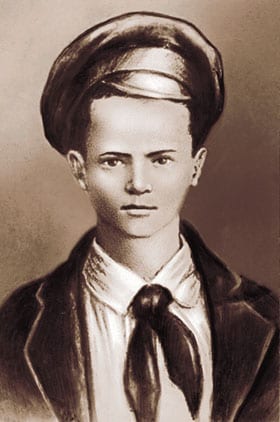
Lecturer’s story — Pavlik Morozov, the child made into a model informer
Malice recounts the official Soviet story of Pavlik Morozov, a boy said to have reported his “kulak” father for hiding grain and then to have been killed by him. Statues and lessons turned Pavlik into a moral example: children were to put the party above their parents, even at the cost of their lives. The story matters here less as a secure biography than as a lesson Soviet institutions taught children about family loyalty.
The source check below explains why the official narrative should not be repeated as settled fact. Transcript · Slides 7–8 (file not included in this release)
Source check — the Pavlik legend was repeatedly rewritten
Oxford historian Catriona Kelly’s research describes Pavlik and his younger brother as murder victims whose deaths were rapidly transformed into a political legend. The boy was celebrated as a symbol of loyalty to the state, but accounts of his denunciation, motives, family circumstances, and killers changed over time. The transcript’s version—father, hoarded grain, denunciation, patricidal revenge—is the propaganda narrative, not an uncontested reconstruction of the case. Oxford, “Pavlik Morozov: Soviet Boy Hero”; Oxford description of Kelly’s archival study.
Lecturer’s stories — children made to betray, accuse, or disappear
- Malice quotes Sergei Maslov on Moscow pickpockets aged eleven to fifteen who were reportedly beaten until they identified other children, including innocent boys, as accomplices.
- A group calling itself Revenge for Our Parents allegedly circulated a leaflet protesting mass arrests. The children, their siblings, and their remaining parents were then arrested.
- A father considered sheltering his daughter’s thirteen-year-old friend after both of her parents were taken. An NKVD secretary warned him to “get rid of her”; he put the girl into the street, and the transcript leaves her fate unknown.
- Malice cites historian Sheila Fitzpatrick’s example of a communist who informed on his mother-in-law and was then arrested because he was related to her.
These vignettes illustrate the lecture’s argument about collective liability. The transcript identifies Fitzpatrick but does not give page references or an underlying source for the Maslov, youth-group, or orphan stories. Transcript · Slides 8–13 (file not included in this release)
2. Upton Sinclair and the arithmetic of a promised future
Malice next uses Upton Sinclair as a case study in how humanitarian commitments could coexist with apologetics for state violence. He sketches Sinclair’s influence through The Jungle, his socialist electoral campaigns, and his 1934 EPIC run for governor of California. The focus then narrows to Sinclair’s published exchange with former Soviet correspondent Eugene Lyons, Terror in Russia? Sinclair questioned the higher estimates for famine deaths, defended coercion as a Russian historical necessity, and argued that present sacrifices might prevent greater future bloodshed. Malice treats this reasoning as a refusal to grant actual victims the same moral weight as an imagined future population. Slides 14–24 (file not included in this release)
Lecturer’s story — Sinclair counts “broken eggs” before asking about the omelet
The lecture juxtaposes Sinclair’s earlier reforming reputation with his willingness to reason in millions. In the exchange with Lyons, Sinclair disputed whether five million people had died in the Ukrainian famine, suggested one million was nearer the truth, and argued that one or five million sacrificed lives might save hundreds of millions later. Malice answers the familiar omelet metaphor by asking where the promised omelet was after so many “eggs” had been broken.
A scan of Sinclair’s March 1938 letter preserves the primary document. The callout summarizes the argument rather than treating Malice’s commentary as Sinclair’s own words. Transcript · Slides 18–22 (file not included in this release) · Sinclair’s 1938 letter.
The lecture also quotes Sinclair asking whether seasoned revolutionaries could possibly be tortured into confessing inventions. Malice’s reply is epistemic as well as moral: an observer’s inability to imagine a mechanism is not evidence that the mechanism did not operate. Eugene Genovese’s later reassessment supplies a retrospective parallel—his own rough calculation forced him to accept that Stalin had killed extraordinary numbers of communists. Slides 21–24 (file not included in this release)
3. Respectability, the “Open Letter of the 400,” and the Nazi–Soviet Pact
An August 14, 1939 open letter signed by hundreds of prominent Americans defended closer cooperation with the USSR and rejected comparisons between Soviet and fascist dictatorship. It praised Soviet cultural opportunity, women’s emancipation, childcare, universal suffrage, civil liberties, and an allegedly expanding democracy. Malice reads the signatories’ institutional credentials as crucial: universities, magazines, and cultural organizations could place a “mist of normality,” in Hannah Arendt’s phrase, around claims that might otherwise look implausible. Nine days after the letter’s date, Germany and the Soviet Union signed their non-aggression pact; Germany invaded Poland from the west on September 1 and the USSR entered from the east on September 17. Slides 25–30 (file not included in this release)
Lecturer’s story — a public defense overtaken by events
The “Open Letter of the 400” offered ten contrasts between the USSR and fascist states and urged cooperation with Moscow against aggression. Malice emphasizes the timing: the letter appeared just before the Molotov–Ribbentrop Pact made Soviet cooperation with Hitler impossible to dismiss as a mere hostile comparison. He says some organizations that had urged intervention against fascism then pivoted toward peace campaigns once Soviet policy changed.
The letter and the pact chronology are documented. The transcript does not name the organizations said to have changed their positions “literally overnight,” so that broader claim remains the lecturer’s account. Transcript · Slides 25–30 (file not included in this release)
Primary-source check — letter and pact chronology
The surviving “Open Letter of the 400” is dated August 14, 1939 and contains the claims quoted in the lecture, including “steadily expanding democracy” and the list of social rights. The German–Soviet Non-Aggression Pact was signed on August 23. The close sequence makes Malice’s juxtaposition legitimate; it does not by itself show what each signatory knew about secret negotiations or how each responded afterward. Text and signatories of the open letter; U.S. State Department documentary record of the pact negotiations.
4. Henry Wallace, succession, and the stakes of political judgment
The narrative turns to Henry A. Wallace, Franklin Roosevelt’s vice president during the third term. Malice recounts Wallace’s unconventional spiritual interests, his left-wing reputation, the 1944 struggle over whether he would remain on the ticket, and the elevation of Harry Truman instead. Roosevelt died soon after beginning his fourth term, so the convention decision determined who became president during the closing months of World War II. That near succession raises the stakes of Wallace’s judgments about the USSR: they were not merely the opinions of a visiting writer. Slides 31–35 (file not included in this release)
Lecturer’s story — Eleanor Roosevelt tells Truman who is in trouble
After Roosevelt’s death, Truman was summoned to the White House from a drink with the Speaker of the House. He asked Eleanor Roosevelt whether there was anything he could do for her. Malice recounts her reply: “Is there anything we can do for you? You’re the one in trouble now.” The vignette makes the succession immediate: the man substituted for Wallace at the 1944 convention suddenly inherited the presidency and the war.
The quotation is reproduced from the transcript; it was not independently authenticated for this note. Transcript · Slides 34–35 (file not included in this release)
Fact check — Wallace’s office and Roosevelt’s timing
The transcript calls Wallace Roosevelt’s secretary of state before the vice presidency. He was secretary of agriculture from 1933 to 1940, vice president from January 1941 to January 1945, and later secretary of commerce. Cordell Hull—not Wallace—was secretary of state. Roosevelt died on April 12, 1945, 82 days after his January 20 inauguration, not five weeks afterward. The central succession point remains sound: Democratic leaders replaced Wallace with Truman in 1944, and Truman became president when Roosevelt died. FDR Presidential Library, cabinet and vice-presidential chronology; U.S. Senate biography of Wallace; U.S. Senate biography of Truman.
5. A Potemkin visit to Magadan (May 1944)
As vice president, Wallace traveled through Soviet Asia and visited Magadan, the administrative center of the Kolyma forced-labor region. He interpreted settlement and industrial expansion through an American frontier analogy, praising hardy pioneers and rapid urban growth. Malice argues that officials showed him a curated city while hiding the penal labor that made the region function. Wallace’s Soviet Asia Mission then carried those impressions to an American audience. Slides 35–44 (file not included in this release)
Lecturer’s story — prisoners perform a city for Wallace
The delegation attended a concert that Wallace praised as the achievement of a single city’s talent. According to Malice, the conductor, lead ballerina, singers, and choir were prisoners; they had rehearsed through the night and pledged to behave as Soviet patriots. Two singers who knew English were removed, and the performers were returned to the camp after the visitors left. The performance literalizes the lecture’s theme: captives were made to stage evidence that concealed their captivity.
Archival and survivor materials support the broader staging of Wallace’s visit and the prisoner performance. The precise handling of the two English-speaking singers is retained as the lecturer’s account. Transcript · Slides 40–44 (file not included in this release)
Source check — what is documented about the Wallace visit
Wallace was in Magadan from May 24 to 26, 1944. A Wilson Center study built from Russian archival records, Wallace’s published account, and former-prisoner testimony documents preparations to conceal camp reality, a theater performance during the visit, and Wallace’s admiring account of regional development. This supports the lecture’s central claim that the visit was managed and deceptive. It does not make every anecdotal detail equally certain; survivor recollections and administrative records should be identified separately. Wilson Center, “Three Days in ‘Auschwitz without Gas Chambers’: Henry A. Wallace’s Visit to Magadan in 1944”.
6. From a camp system to a forced-labor economy
The lecture broadens from Wallace’s visit to the Gulag’s institutional development. Soviet forced-labor camps began under Lenin, expanded rapidly under Stalin, and became deeply involved in mining, logging, canals, railways, and construction. Malice treats Solovki as an early model: isolation, political prisoners, disciplinary labor, starvation, disease, and punishments that damaged bodies before work even began. Transport to Kolyma could take weeks by rail and then ship, separating prisoners from home while exposing them to thirst, lice, disease, violence, and death. Criminal prisoners were often placed above “counterrevolutionaries” in the camp hierarchy, reinforcing the state’s distinction between ordinary lawbreaking and political enmity. Slides 45–52 (file not included in this release)
Map — selected Gulag locations across the Soviet Union
Selected major Gulag sites and regions. The map conveys the system’s geographic reach, but it is not an exhaustive inventory of every camp administration, colony, subcamp, prison, or special settlement. Map by Antonu (2011). Wikimedia Commons source. CC BY-SA 3.0.
Visual aid — construction on the Kolyma “Road of Bones”
A truck on the Kolyma highway, 1938. Built through Dalstroy’s forced-labor economy, the route later became known as the “Road of Bones.” The photograph documents the road and period infrastructure; it does not show the transport episode or individual abuses described in the testimony below. Photographer unidentified. Wikimedia Commons source. Public domain.
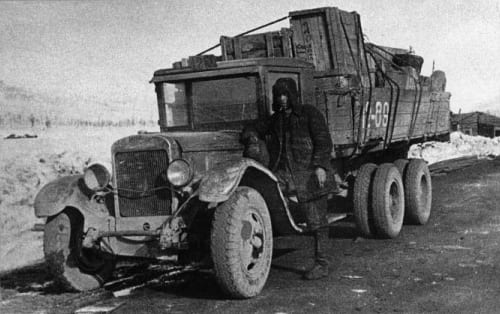
Lecturer’s story — the journey to Kolyma
Malice describes crowded rail cars in which water, sanitation, and even the right to relieve oneself became instruments of control. People who held cups through the bars to catch rain risked being shot; the dead were removed during stops, and some children did not survive the journey. The remaining sea passage was dominated by criminal prisoners whom guards feared or indulged.
He then quotes an unidentified eyewitness describing organized sexual assaults against women and adolescent boys in a ship’s hold. Other prisoners could not intervene without risking death, and guards reportedly cleared the aftermath with water.
This is a graphic transcript account. Because the lecturer does not identify the eyewitness or publication, it is preserved as attributed testimony rather than independently verified detail. Transcript · Slides 49–52 (file not included in this release)
Fact check and scale — origins, population, camps, and mortality
The Library of Congress dates the Soviet forced-labor camp system to 1919 and says it became numerically significant in the early 1930s; it also confirms the Gulag’s major economic role. The transcript’s claim that Stalin’s system reached 30,000 camps is not supported by the sources checked here and likely conflates camp administrations, colonies, subcamps, and other detention sites. Its statement that “many” camps had 97–98% death rates is likewise incompatible with surviving system-wide annual figures: a Hoover archival study reports rates from 2.5% to 15% for 1931–1940, including 7.8% in 1938. Those official figures still record lethal conditions and may understate harm because moribund prisoners could be released before death. The correction is about scale, not exoneration. Library of Congress, “The Gulag”; Hoover archival study, mortality table; Hoover discussion of mortality undercounting.
7. Work quotas, degradation, religion, and children inside the camps
Camp slogans promised redemption through work, while rations were tied to output and weakness could be interpreted as sabotage. During the Great Terror, regional arrest quotas fed more people into the system. Malice emphasizes cold-weather labor, inadequate clothing and food, disease, ideological lectures, and punishments for religious observance. He also describes a prisoner code in which stealing another inmate’s bread could be punished more severely than stealing possessions because food separated survival from death. The lecture’s most disturbing claims concern women and children: coercive relationships, infants removed from mothers, imprisoned children beaten or sexually abused, and young wartime workers sentenced for leaving factories. Slides 52–63 (file not included in this release)
Lecturer’s stories — faith and bodily survival
- Women who refused numbered clothing on religious grounds allegedly had the numbers stamped directly onto their skin.
- A religious community that regarded passports and Soviet money as signs of the Antichrist was reportedly deported to an island and offered food only if members signed for it; when they refused, they were left to starve.
- Potato peeling, a punishment in other settings, became coveted because it offered a chance to reach scraps of food.
- The dark Kolyma song called it a “wonderful land” with twelve months of winter and the rest summer.
The transcript supplies no names, camp records, or publications for the first two episodes. They are therefore retained as lecturer-attributed stories, while the general persecution of religious prisoners and lethal deprivation is well established. Transcript · Slides 54–58 (file not included in this release)
Lecturer’s story — children claimed by the security organs
Malice says some women formed prohibited relationships with prisoners or guards as a means of surviving the cold. Infants born in the camps were taken from their mothers after a year, with officials saying the children belonged to the security organs. Parentless and imprisoned children then faced beatings, humiliation, and sexual abuse from older children or administrators. The lecture presents this as the final extension of the attack on family loyalty described at its beginning.
The transcript’s estimate that 500,000 to one million infants were seized is not tied to a named source and was not independently established in this review; it should not be reused as a confirmed statistic. Transcript · Slides 59–61 (file not included in this release)
8. Wallace’s belated recognition
The final movement returns to the gap between presentation and reality. Wallace ran for president as the Progressive Party candidate in 1948. By then, former prisoners were publishing accounts of what had been hidden during his visit. Malice closes with Wallace’s 1952 admission that he had not understood Magadan’s role in administering forced labor and his judgment that Soviet communism’s disregard for truth, intolerance, and hostility to religion made it “utterly evil.” The reversal does not erase his earlier praise; it demonstrates that political judgment can change when testimony formerly excluded from view is finally allowed to count. Slides 64–66 (file not included in this release)
Lecturer’s story — Elinor Lipper’s three “holidays”
Former prisoner Elinor Lipper, who was in Kolyma during Wallace’s visit, later wrote that prisoners owed him gratitude for the only three consecutive “holidays” they received: to ensure he saw no captives, they were confined and shown films from morning to night. A schoolboy similarly remembered shop windows suddenly filled with food for the delegation, only for the produce to disappear after Wallace left.
Lipper’s memoir is first-person testimony; the Wilson Center study uses it alongside archival sources. The schoolboy is not named in the transcript. Transcript · Slides 64–66 (file not included in this release) · Wilson Center study of the visit.
What to retain from Lesson 4
- Soviet repression reached through formal institutions into marriage, kinship, childhood, religion, and the possibility of helping an orphaned neighbor.
- Malice’s Western intellectuals did not all make the same argument, but the recurring error was to discount present victims in favor of a promised future or to treat criticism as aid to an enemy.
- Wallace’s Magadan visit shows how a state can manufacture apparently direct observation by controlling whom a visitor meets, what appears in shops, and who performs on a stage.
- The Gulag was both a system of political repression and a labor institution with major economic functions. Its brutality is well documented, but individual anecdotes and extreme numerical claims still require source discipline.
- The lesson’s moral contrast depends on keeping three layers separate: what officials staged, what witnesses later reported, and what archival records can independently establish.
Questions to carry into the next lesson
- How did the Nazi–Soviet Pact change communist parties’ public positions outside the USSR, and how quickly did those positions change after Germany invaded the Soviet Union?
- Which parts of the Gulag economy were economically productive, and which survived because political goals overrode efficiency?
- How should historians weigh survivor memoirs, secret-police records, official statistics, and curated foreign visits when those sources conflict?
Lesson 5 - The Price of Division
Central thread
Malice moves from the Soviet victory over Nazi Germany to the political and human divisions that followed it. The lesson has two connected arcs. The first concerns what Stalinism looked like at the moment of victory and immediately after Stalin’s death: returning POWs punished as suspects, Beria’s police power and alleged sexual predation, Katyn, postwar antisemitism, the Doctors’ Plot, Stalin’s death, Beria’s fall, and Khrushchev’s partial repudiation of the terror. The second concerns division made physical: Soviet consolidation in Eastern Europe, the Berlin blockade and airlift, the creation of rival German states, mass migration out of East Germany, and the Berlin Wall. The title’s “price” is paid by named people—Tatyana Okunevskaya, Lina Stern, Conrad Schumann, Ida Siekmann, Günter Litfin, and Peter Fechter—not only by states on a map.
1. Victory, expansion, and the Cold War order (1945–1950)
The Red Army’s capture of Berlin symbolizes a victory purchased at staggering Soviet cost. Malice immediately complicates the triumphal image: some Soviet POWs returned from German captivity only to face filtration, confinement, or punishment at home. Soviet forces and political influence dominated much of Eastern Europe, Germany and Berlin were divided into occupation zones, and Korea was split into Soviet and American spheres. Churchill’s March 1946 “Iron Curtain” speech gives the new division its enduring name. The American nuclear monopoly soon ended, and the Korean War converted geopolitical division into mass violence. Slides 2–5 (file not included in this release)
Map — the Iron Curtain in the later Cold War
Europe divided by the Iron Curtain, with later NATO and Warsaw Pact alignments. This retrospective map is useful for orientation, but it should not be read as a precise map of Europe on the day of Churchill’s March 1946 speech: the two formal alliances and several borders shown developed later. Map by Sémhur (2008). Wikimedia Commons source. CC BY-SA 4.0.
Fact check — casualties, Eastern Europe, Czechoslovakia, and the atomic bomb
The lecture’s “8–12 million soldiers plus a similar number of civilians” is not a clean consensus breakdown; classifications vary, and a frequently cited total is about 26 million Soviet citizens killed during the war. Its account also compresses different processes into “the West ceded Eastern Europe”: military occupation, Allied settlements, coalition politics, coercion, fraudulent elections, and coups differed by country. The Baltic states had already been annexed by the USSR in 1940, not newly incorporated only after 1945. The communist takeover in Czechoslovakia occurred in February 1948, not 1940. Finally, Soviet atomic espionage is extensively documented, but saying American “Stalinists and fellow travelers delivered the bomb” overstates a multi-causal history that also included Soviet scientific work. USHMM symposium, Soviet wartime losses; U.S. State Department record of the 1948 Czechoslovak coup; National Archives, Venona and atomic-espionage records; National Archives, Soviet atomic test in 1949.
2. Beria: manufactured guilt and personal predation
Lavrentiy Beria, head of the security police from late 1938 and a central figure in the postwar leadership, embodies the lesson’s link between official and personal lawlessness. The sayings attributed to him—“Show me the man, and I’ll show you the crime” and the boast that he could make an innocent man confess to being the king of England—capture the inversion of justice under coerced confession. Malice also describes Beria as a serial sexual predator who used guards, official cars, and the threat of imprisonment to obtain and silence women. Slides 6–10 (file not included in this release)
Lecturer’s story — Beria’s pipe
In Malice’s dark political joke, Stalin breaks a favorite pipe and orders Beria to investigate. Beria returns after ten suspects have confessed and five have died; Stalin then finds the pipe under a sofa and asks what should be done. Beria replies that the dead should be rehabilitated and the living released.
The story is a lecturer-attributed joke, not documentary evidence of a particular investigation. Its function is to expose a system in which confession measures police power rather than guilt. Transcript · Slides 8–9 (file not included in this release)
Reported survivor story — Tatyana Okunevskaya
Actress Tatyana Okunevskaya later said that Beria invited her to perform, took her to a private house, tried to intoxicate and seduce her, and raped her after she resisted. The lecture says her refusal to remain compliant was followed by arrest and years in prison and exile. Malice uses the episode to show sexual violence backed by the machinery of the state: refusal could itself be punished.
This callout preserves a survivor allegation reported in later memoir and biography. It should not be presented as though every detail were established by a contemporaneous police record. The lecturer’s broad description of Beria as a sexual predator is widely repeated, but his quoted aphorisms, body counts, and the assertion about children’s remains require separate sourcing. Transcript · Slides 9–10 (file not included in this release)
Correction — Trotsky was killed with an ice axe
The transcript says Beria’s agent killed Trotsky with an ice pick. Ramón Mercader attacked Trotsky in Mexico in August 1940 with a shortened mountaineering ice axe, a common but meaningful correction. The lecture also presents the operation as Beria’s personal “coup de grâce”; the assassination was an NKVD operation under Stalin, while assigning individual authorship requires more precise documentation than the transcript supplies.
3. War, sexual violence, Katyn, and punishment after captivity
Malice refuses to let Soviet victimhood erase Soviet crimes. He places the enormous losses caused by the German invasion alongside widespread Red Army sexual violence during the advance westward and Stalin’s reported attempt to excuse soldiers who had crossed “thousands of kilometers through blood and fire.” He then turns to the Katyn massacre: Polish officers and members of the elite captured after the 1939 invasion were executed in 1940, their graves were discovered under German occupation in 1943, and the Soviet state spent decades blaming Germany. The same suspicion of contact with the outside world shaped the treatment of returning Soviet POWs. Slides 11–12 (file not included in this release)
Fact check — what “Katyn” includes
The Soviet leadership approved executions of more than 21,000 Polish prisoners and members of the elite at several sites. Roughly four thousand of the victims were buried in the Katyn forest near Smolensk, but “Katyn massacre” is commonly used for the wider killing operation. German discovery of the graves did not make the German regime a trustworthy investigator; later archival evidence established NKVD responsibility independently of Nazi propaganda. U.S. National Archives, “The Katyn Massacre”.
Source status — Stalin’s remark about Red Army assaults
The wording quoted by Malice is attributed to Stalin through Milovan Djilas’s memoir account of a conversation. Widespread sexual violence by Soviet troops is well documented; the precise sentence remains an attributed retrospective quotation rather than a transcript or contemporaneous order. The distinction matters because documentation of the crime does not automatically authenticate every reported remark about it.
4. Postwar antisemitism, Golda Meir, and the Doctors’ Plot
The lesson traces a sharp turn from wartime mobilization of Jewish support to postwar persecution. Soviet reporting subsumed murdered Jews under the general category of “Soviet citizens,” while independent Jewish organization attracted suspicion. The Jewish Anti-Fascist Committee was dismantled; its chairman Solomon Mikhoels was murdered by Stalin’s agents; writers, intellectuals, and scientists were arrested. The mass welcome for Golda Meir in Moscow in September 1948 became evidence, in Stalin’s eyes, of a loyalty beyond Soviet control. In the final years of his life, the regime’s campaign against “rootless cosmopolitans” converged with the fabricated Doctors’ Plot, in which mostly Jewish physicians were accused, tortured, and made to confess. Slides 13–20 (file not included in this release)
Lecturer’s story — the crowd that welcomed Golda Meir
When Israel’s first representative to the USSR, Golda Meir, went to Moscow’s main synagogue, tens of thousands of Soviet Jews gathered to greet her. Malice says officials photographed the crowd and arrested people they could identify. The story marks the regime’s fear that a spontaneous public community might claim a loyalty not fully controlled by the party.
The size of the welcome and the subsequent antisemitic campaign are well documented. Treat the claim that every identifiable person was ordered arrested as the lecturer’s account unless a specific arrest list or directive is produced. Transcript · Slide 16 (file not included in this release)
Lecturer’s story — Lina Stern answers her interrogators
Lina Stern, a celebrated physiologist in her seventies, was accused of selling her body during foreign conferences. She answered, “At my age, I would be the one paying.” Most of her co-defendants in the Jewish Anti-Fascist Committee case were executed; Stern received imprisonment and exile instead. The lecturer uses the retort as a moment of personal defiance inside an antisemitic and misogynistic interrogation.
The quotation is preserved from the supplied transcript and was not authenticated against a trial record or original memoir for this note. Transcript · Slides 15–16 (file not included in this release)
Source check — documented campaign, uncertain extermination plan
Library of Congress archival material confirms that the Jewish Anti-Fascist Committee was created for wartime mobilization, then disbanded in November 1948 as most members were arrested and the official antisemitic campaign intensified. The Doctors’ Plot and threats of mass deportation were real sources of terror. The transcript’s claim that a B’nai B’rith president believed Stalin was preparing an extermination campaign records a contemporary fear, not proof that a finalized plan for exterminating Soviet Jews existed. Library of Congress, Russian Archives exhibition; Library of Congress, translated Jewish Anti-Fascist Committee document; USHMM symposium paper on Soviet Jews.
5. Stalin’s death, limited amnesty, and Beria’s fall (1953)
Stalin suffered a cerebral hemorrhage on March 1, 1953 and died on March 5 after delayed medical attention. The irony was acute: the state had imprisoned leading physicians as conspirators, yet officials reportedly sought advice from some of those same doctors. After Stalin’s death, the Doctors’ Plot was declared fabricated and the accused were released. A large amnesty followed, while the longer dismantling of the Gulag and release of political prisoners unfolded over years. Beria briefly appeared to lead reform, but his colleagues arrested him in June; he was executed in December. Slides 21–26 (file not included in this release)
Lecturer’s story — imprisoned doctors consulted as Stalin lay dying
Malice recounts officials asking jailed specialists to advise Stalin’s attendants without telling them the patient’s identity. The physicians reportedly recommended exactly the treatment already being given. Whether or not every detail survives scrutiny, the scene captures the regime’s self-inflicted predicament: its purge had made medical expertise politically dangerous at the moment the dictator needed it.
The story is retained as the lecturer’s account. Stalin’s collapse, delayed discovery, and the broader absence of trusted physicians are well documented; this exact consultation sequence was not independently verified here. Transcript · Slide 22 (file not included in this release)
Memoir scene — Svetlana Alliluyeva watches her father die
Stalin’s daughter remembered his breathing, darkening face, and a final moment when he opened his eyes and raised a hand as though pointing upward or cursing those around him. Malice lets the family witness close the dictator’s life in the same intimate register used throughout the course for victims and relatives.
This is retrospective memoir evidence: valuable for what Svetlana remembered and how she interpreted it, but not a neutral medical chart. A published medical-historical review reproduces a shorter version of the scene. Transcript · Slide 23 (file not included in this release) · Medical-historical review of Stalin’s death.
Fact check — the March 1953 amnesty was broad but mainly nonpolitical
The March 27 amnesty released more than a million prisoners, especially people with sentences of five years or less, pregnant women, mothers, juveniles, the elderly, and the seriously ill. But it principally benefited people convicted of ordinary crimes; most political prisoners remained confined until later reviews and releases under Khrushchev. It is therefore misleading to collapse the amnesty, the political-prisoner releases, and the dismantling of the Gulag into one immediate event. R. W. Davies, archival review of forced labor after Stalin; Library of Congress, post-Stalin transition.
6. Khrushchev’s Secret Speech and the limits of de-Stalinization
On February 25, 1956, Nikita Khrushchev addressed a closed session of the Twentieth Party Congress. He denounced Stalin’s cult of personality, deportations, fabricated conspiracies, coerced confessions, and mass punishment of loyal communists. The speech mattered because the party itself now acknowledged mechanisms critics had described for years. Malice emphasizes the shock among communists abroad: people who had dismissed reports as capitalist propaganda could no longer do so as easily, and many left their parties. De-Stalinization then removed names, statues, and honors, including the 1961 renaming of Stalingrad as Volgograd. Slides 27–34 (file not included in this release)
Context — confession, party self-defense, and independent evidence
Khrushchev’s speech is a major primary source for the regime’s admission of torture and fabricated cases, but it was also a political act that concentrated blame on Stalin while protecting Lenin, the party, and much of the system. Its claims should be compared with archives and survivor testimony rather than treated as self-validating merely because they came from Stalin’s successor. The transcript’s assertion that the criticism was “true, all of it” is rhetorical and too broad: many central accusations were vindicated, but each historical claim still requires its own evidence. U.S. State Department diplomatic record of the speech; translated excerpt of Khrushchev’s speech.
7. Postwar Berlin: elections, camps, blockade, and division
Berlin lay inside the Soviet occupation zone but was itself divided among four powers. Malice contrasts a postwar election that frustrated communist hopes with the NKVD’s reuse of former Nazi camp sites as Soviet special camps. Economic conflict then sharpened political division. When the Western powers introduced the Deutsche Mark in their zones, the Soviet Union blocked surface access to West Berlin on June 24, 1948. The United States and Britain answered with an airlift that supplied the city until the blockade ended on May 12, 1949. The crisis helped solidify two German states and the rival alliance systems of the Cold War. Slides 35–39 (file not included in this release)
Map — Berlin’s four occupation sectors inside the Soviet zone
The American, British, French, and Soviet sectors of Berlin, 1945–1990. The map makes the blockade’s geography legible: the Western sectors formed an enclave surrounded by the Soviet occupation zone and later East Germany. Map by Paasikivi (2016). Wikimedia Commons source. CC BY-SA 4.0.
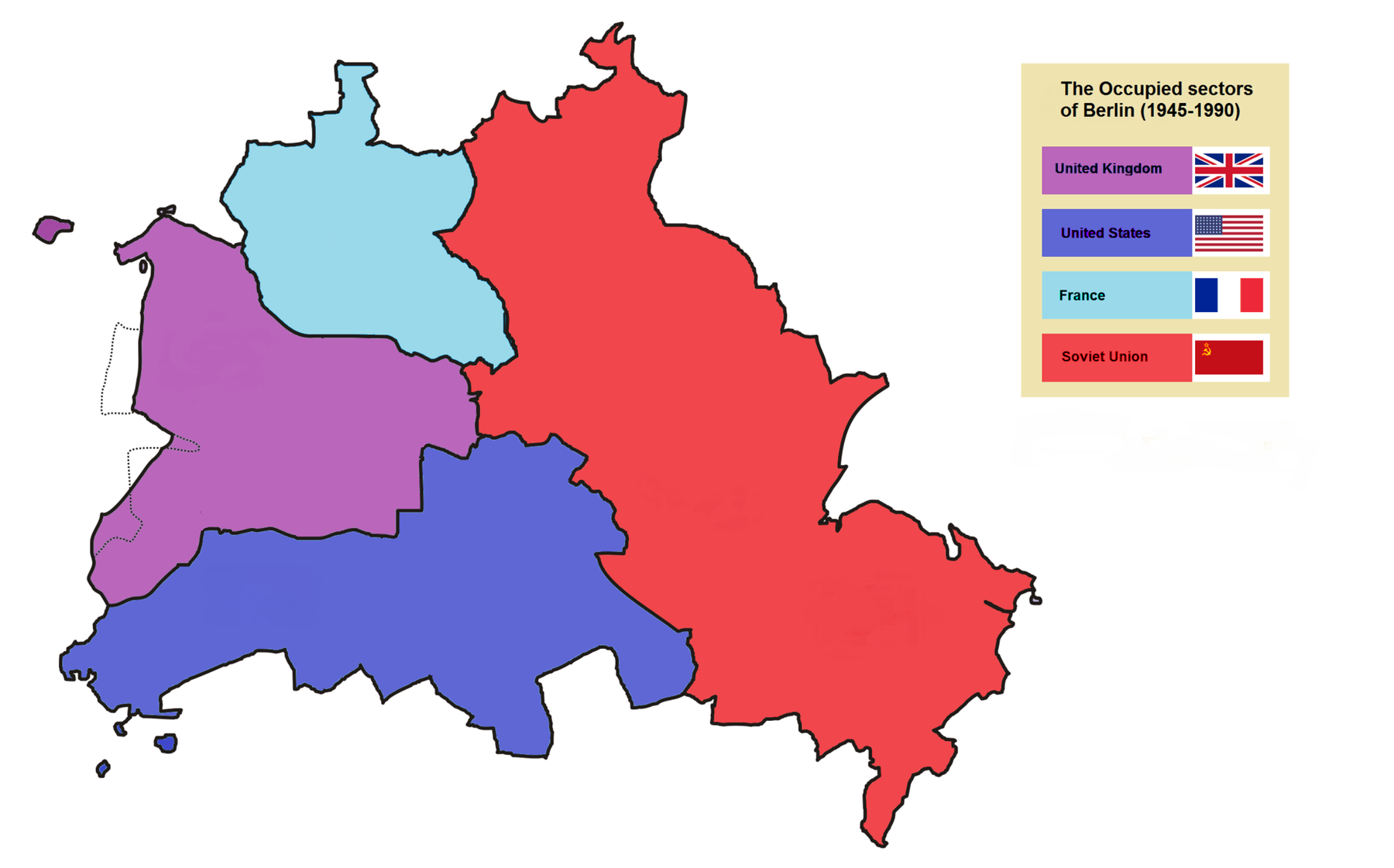
Correction — Berlin’s 1946 election was 48.7%, not 98%
In the October 20, 1946 citywide election, the Social Democrats won 48.7%, the Christian Democrats 22.2%, the Soviet-backed Socialist Unity Party 19.8%, and the Liberal Democrats 9.3%. Turnout was 92.3%. The transcript’s “98% of the vote in a three-way race” likely confuses the SPD share with high turnout and omits the fourth party. Its central point survives the correction: the SED finished third. Berlin government history of the postwar city.
Source check — Soviet special camps in Germany
Soviet Special Camp No. 2 operated at Buchenwald from August 1945 to 1950. The memorial records 28,455 prisoners and 7,113 deaths, chiefly from hunger and disease. Detainees included Nazi functionaries, but also people imprisoned through denunciation, mistaken identity, or broad political suspicion. This supports the lecture’s account of internment without ordinary trials while complicating a single description of every prisoner. The transcript’s claim that most of more than 10,000 bodies found at Sachsenhausen were children and the elderly was not substantiated by the sources checked. Buchenwald Memorial, Special Camp No. 2; Buchenwald Memorial, burial grounds.
Lecturer’s image — an air bridge over the Iron Curtain
The blockade closed canals, railways, and roads while West Berlin’s food, fuel, and medicine dwindled. Malice answers Churchill’s metaphor with another: an iron curtain could reach only so high. Aircraft formed a conveyor belt over it, turning supply into a daily demonstration that the Western sectors would not be abandoned.
The State Department dates the blockade from June 24, 1948 to May 12, 1949 and says that, at peak efficiency, one aircraft landed about every 45 seconds—even more frequently than the transcript’s “every minute.” Transcript · Slide 38 (file not included in this release) · U.S. State Department, Berlin Airlift.
Visual aid — an aircraft of the Berlin Airlift
Handley Page Halifax G-ALEF at Wunstorf during the Berlin Airlift, 1948–1949. The aircraft gives physical scale to the “air bridge” described by the lecturer; it is one participating aircraft, not an image of the entire operation. Imperial War Museums photograph; photographer unidentified. Wikimedia Commons source. Public domain as identified by Commons.
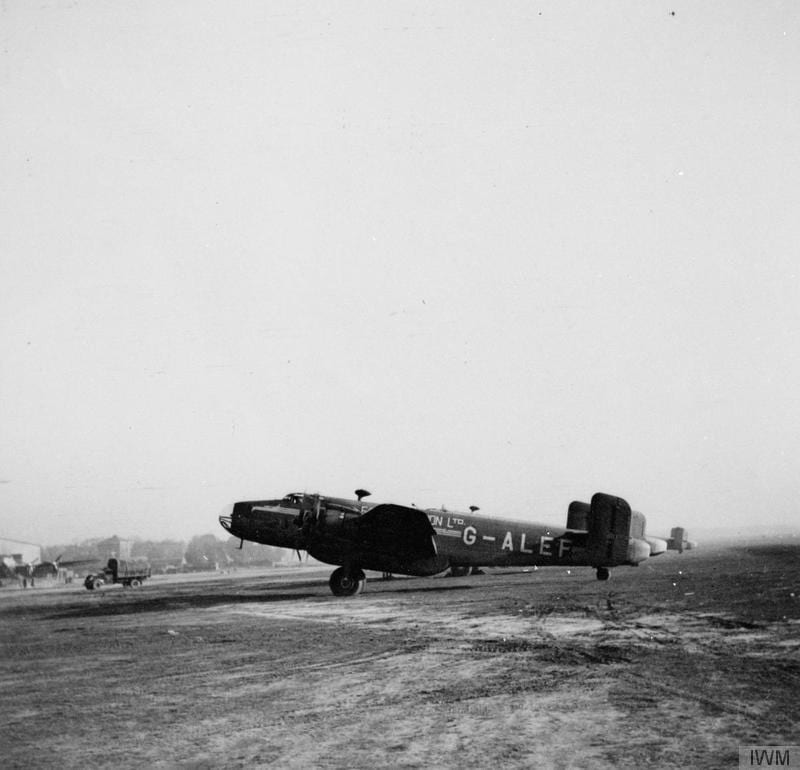
8. Exodus, Operation Rose, and the Berlin Wall
Living standards and political freedom drew millions from East Germany, and Berlin’s still-open sector boundary became the principal route. Malice calls this migration “voting with their feet”: each departure challenged the regime’s claims about which system workers preferred. In the early hours of August 13, 1961, East German forces began Operation Rose, closing streets and transit links with barbed wire before replacing the provisional barrier with masonry and concrete. The official label “Anti-Fascist Protective Rampart” recast citizens trying to leave as fascist threats rather than people escaping the state. Slides 40–44 (file not included in this release)
Fact check — whose wall and when
The border closure began on August 13, 1961, under an East German operation backed by the Soviet bloc. Calling it simply a Russian construction obscures the GDR’s direct role. The transcript’s claim that cranes blocked the Brandenburg Gate on Friday, August 18 belongs to the early consolidation of the barrier, not its beginning. Bundesarchiv educational dossier on Operation Rose; Berlin Wall Foundation, history of the Wall.
Lecturer’s story — Conrad Schumann chooses the other side
Nineteen-year-old East German border guard Conrad Schumann stood opposite West Berliners beside a low coil of barbed wire. Photographer Peter Leibing recognized that the pacing guard might run and prepared for a single shot. Schumann dropped his cigarette, leapt the wire, shed his weapon, and escaped in a waiting police vehicle. The photograph became an enduring image of a man refusing to enforce the new boundary.
The transcript calls the photographer “Peter Leibing” and the guard Conrad Schumann; the slide’s OCR-like “Schud” is an error. The detailed thoughts assigned to Schumann and Leibing are narrative reconstruction unless traced to their later testimony. Transcript · Slides 45–46 (file not included in this release)
Photograph — Conrad Schumann’s “Leap into Freedom”
Peter Leibing, East German border guard Conrad Schumann leaping over barbed wire into West Berlin, August 15, 1961. This is the photograph described in the lesson. The Library of Congress catalog supplies the creator, date, and reproduction number LC-USZ62-138900, but warns that publication may be restricted; the local copy is retained here for private study and is not labeled public domain. Library of Congress catalog record.
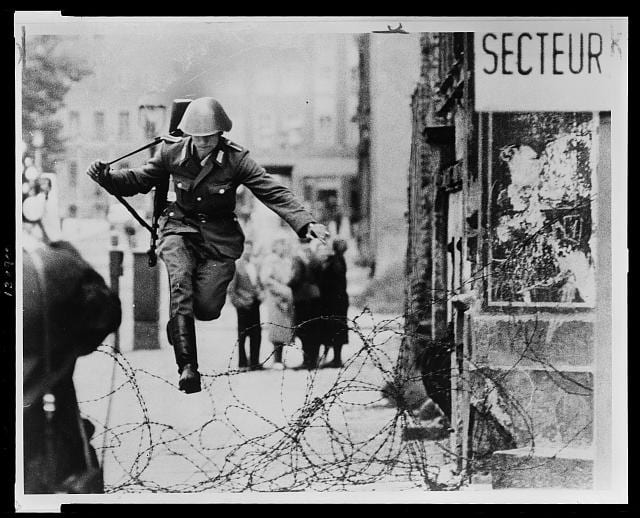
9. The Wall’s first victims: Ida Siekmann and Günter Litfin
The first fatalities show how quickly an administrative boundary became lethal. Ida Siekmann, whose apartment building stood directly on the border, jumped from a third-floor window on August 22, 1961, one day before her fifty-ninth birthday. Two days later, Günter Litfin, twenty-four, was shot while attempting to swim across the border. East German reporting obscured the killing, while his brother was interrogated as though escape required a family conspiracy. Slides 47–49 (file not included in this release)
Lecturer’s story — Ida Siekmann’s final route out
After the street entrance to Siekmann’s building was sealed, residents could still try to escape through windows opening toward West Berlin. Furniture and belongings were thrown down first; people then jumped or descended with improvised ropes, sometimes toward firefighters’ nets. Siekmann jumped before rescuers could position one and died on the way to hospital. Malice asks the listener to see not an abstract border casualty but a woman whose home had abruptly become part of a prison wall.
The Berlin Wall Foundation identifies Siekmann as the Wall’s first victim and dates her death to August 22, 1961. The transcript says she died nine days after construction began, which is correct. Transcript · Slides 47–49 (file not included in this release) · Berlin Wall Foundation biography of Ida Siekmann.
10. Peter Fechter and the visible price of division (1962)
On August 17, 1962, eighteen-year-old bricklayer Peter Fechter and Helmut Kulbeik attempted to cross the Wall. Kulbeik succeeded; Fechter was shot in the pelvis and collapsed in the “death strip.” He cried for help for nearly an hour while East German guards hesitated and people on the western side could not safely reach him. His public death, photographed and filmed, turned the Wall’s coercion into an image the world could not easily ignore. Slides 50–54 (file not included in this release)
Lecturer’s story — Peter Fechter’s last hour
Malice slows the narrative to imagine the ordinary thoughts that might occupy an eighteen-year-old dying in public: his mother, a school crush, poems, regret, fear for his family. A crowd shouted “murder” and threw bandages, but the young man bled to death before East German guards carried his body away. The imaginative passage is not evidence about Fechter’s actual thoughts; it is the lecturer’s attempt to restore personhood to someone propaganda reduced to a “fascist” escapee.
The Berlin Wall Foundation confirms Fechter’s age, occupation, date of death, gunshot wound, and the international impact of the images. Its account also explains the dangerous border situation and disputes over responsibility for rescue; the transcript’s morally forceful presentation should not erase those operational complexities. Transcript · Slides 50–54 (file not included in this release) · Berlin Wall Foundation biography of Peter Fechter.
Scale and definition — deaths at the Berlin Wall
The Berlin Wall Foundation recognizes at least 140 people who were killed or died in direct connection with the border regime between 1961 and 1989. Its categories distinguish people shot while escaping, accidental deaths, suicides linked to the Wall, border guards killed in service, and people from East and West who died without intending to cross. That taxonomy is more precise than treating every death as the same kind of event. Berlin Wall Foundation, victims of the Wall.
What to retain from Lesson 5
- Soviet victory over Nazism did not erase Stalinist repression; it enlarged Soviet prestige and territorial power while returning POWs, occupied populations, and internal minorities remained vulnerable to coercion.
- Beria illustrates how arbitrary justice and private predation could reinforce one another, but the exact stories and quotations about him have different evidentiary weight.
- Stalin’s postwar antisemitic campaign, the Jewish Anti-Fascist Committee cases, and the Doctors’ Plot were real and lethal. A claimed finalized plan for wholesale extermination or deportation requires more caution than the lecture gives it.
- Stalin’s death opened change, but not an instantaneous liberation: the first amnesty chiefly released nonpolitical and short-term prisoners, while political review and Gulag dismantling developed over several years.
- Khrushchev’s Secret Speech broke the official silence about torture and fabricated cases while strategically narrowing responsibility to Stalin and the personality cult.
- The Berlin blockade and Wall transformed ideological division into problems of food, travel, family separation, escape, and death. Schumann, Siekmann, Litfin, and Fechter make that cost concrete.
- Several transcript errors are important enough to remember: Czechoslovakia’s coup was in 1948, Berlin’s SPD won 48.7% rather than 98%, Trotsky was attacked with an ice axe, and Stalingrad became Volgograd in 1961.
Questions to carry into the next lesson
- How far did de-Stalinization change Soviet institutions, and where did it merely change names, symbols, and permitted narratives?
- What explains the difference between Khrushchev’s willingness to expose Stalin’s crimes and the Soviet state’s continued coercion in East Germany and elsewhere?
- How did images of the Berlin Wall and its victims alter Western public understanding in ways that statistics or diplomatic language could not?
Lesson 6 - Conservative Unity
Central thread
Malice begins with people trying to escape the German Democratic Republic and then moves inward, from the Berlin Wall to the Stasi’s interrogation rooms, informant networks, covert psychological warfare, and control over children. He widens the frame through the Soviet suppressions of Hungary in 1956 and Czechoslovakia in 1968, arguing that Western policy gradually settled into managing a permanent division. The second half introduces Margaret Thatcher and Ronald Reagan as politicians who rejected that consensus. “Conservative unity” is therefore the lecturer’s name for a convergence of moral language, anti-communism, national confidence, and electoral success—not a claim that the two leaders agreed on every policy or had yet defeated the Soviet system by 1982.
1. Heinz Meixner drives beneath the Wall (1963)
The lesson resumes at Checkpoint Charlie. Austrian lathe worker Heinz Meixner, twenty, could cross into East Berlin but his fiancée Margarete Thurau could not legally leave. He measured the checkpoint barrier and rented a tiny Austin-Healey Sprite. With its windscreen removed and its tires partly deflated, the car sat low enough to pass beneath the barrier. On May 5, 1963, Margarete lay behind the seats, her mother hid in the luggage compartment behind bricks intended as protection from gunfire, and Meixner accelerated through the checkpoint, ducking below the barrier as the car crossed into West Berlin. A second escape by Norbert Konrad exploited the same vulnerability before guards added lower steel bars. Slides 2–3 (file not included in this release)
Lecturer’s story — two inches of freedom
Malice presents Meixner’s escape as applied intelligence rather than brute force: lawful access gave him reconnaissance, a low sports car defeated the gate’s design assumption, and surprise reduced the guards’ reaction time to seconds. The mother-in-law in the luggage compartment makes the story comic until the bricks reveal the expected danger—everyone in the car had planned around the possibility of being shot.
The transcript correctly names Heinz Meixner and dates the escape to May 5, 1963; the slide calls him “Hans,” apparently in error. The independently checked secondary account confirms the route, car, passengers, and date, while noting minor disagreement among later sources about exactly when the barrier was modified. Transcript · Documented reconstruction of the Meixner escape.
Reference photograph — the escape car’s model
A 1959 Austin-Healey Sprite, the same low-slung model family used in Meixner’s escape. This is a modern photograph of a reference vehicle, not the actual escape car; the windscreen is still attached. Photograph by Bob P. B. (2018). Wikimedia Commons source. CC BY 2.0.

Scale — the Wall was about 96 miles, not 104
The Berlin Wall Foundation gives the total border around West Berlin as 155 km, approximately 96 miles. The transcript’s 104-mile figure is close enough to convey scale but is not the Foundation’s measurement. Only part of the system was a concrete wall through the urban center; the full border also incorporated fences, patrol roads, watchtowers, and other barriers. Berlin Wall Foundation, “The Berlin Wall”.
2. “Miriam”: escape, sleep deprivation, and the interrogation room
The lecture next follows “Miriam,” a woman interviewed by Anna Funder in Stasiland. At sixteen in 1968, she tried to climb the Wall after the state separated her from a friend. A guard dog found her; she was arrested and placed under continuous interrogation. Guards reportedly prevented sleep by waking her whenever she drifted off, while interrogators used distance, silence, and a deliberately asymmetrical room to make her feel exposed. The interrogator sat near a window with the outside world behind him; Miriam was put on a small stool across the room and told, “I have plenty of time. I have nothing but time.” Slides 4–9 (file not included in this release)
Lecturer’s story — breaking Miriam
Malice recounts Miriam being taken into a bathroom, held by the legs, plunged headfirst into ice water, pulled out, and questioned before being submerged again. He says her interrogator immediately resumed a calm, almost bureaucratic demeanor and that she ultimately confessed before receiving an eighteen-month sentence. The cruelty lies partly in the alternation: terror was administered as a procedure, then hidden behind ordinary furniture, measured silence, and the promise that the state could wait indefinitely.
This preserves Funder’s reported survivor narrative as presented by the lecturer. The general use of isolation, sleep deprivation, intimidation, and psychological pressure in Stasi detention is well documented; this note has not independently authenticated every detail of Miriam’s bath interrogation or the precise geometry of her room. Transcript
Photograph — preserved Stasi interrogation room
A preserved interrogation room in the former Stasi detention prison at Berlin-Hohenschönhausen. The window, desk, chairs, and separation help visualize the institutional setting described in Miriam’s story, but this museum-site photograph does not establish that it is her room or that every Stasi room used the exact “corner-to-corner” arrangement. Photograph by Anagoria (2012). Wikimedia Commons source. CC BY 3.0.
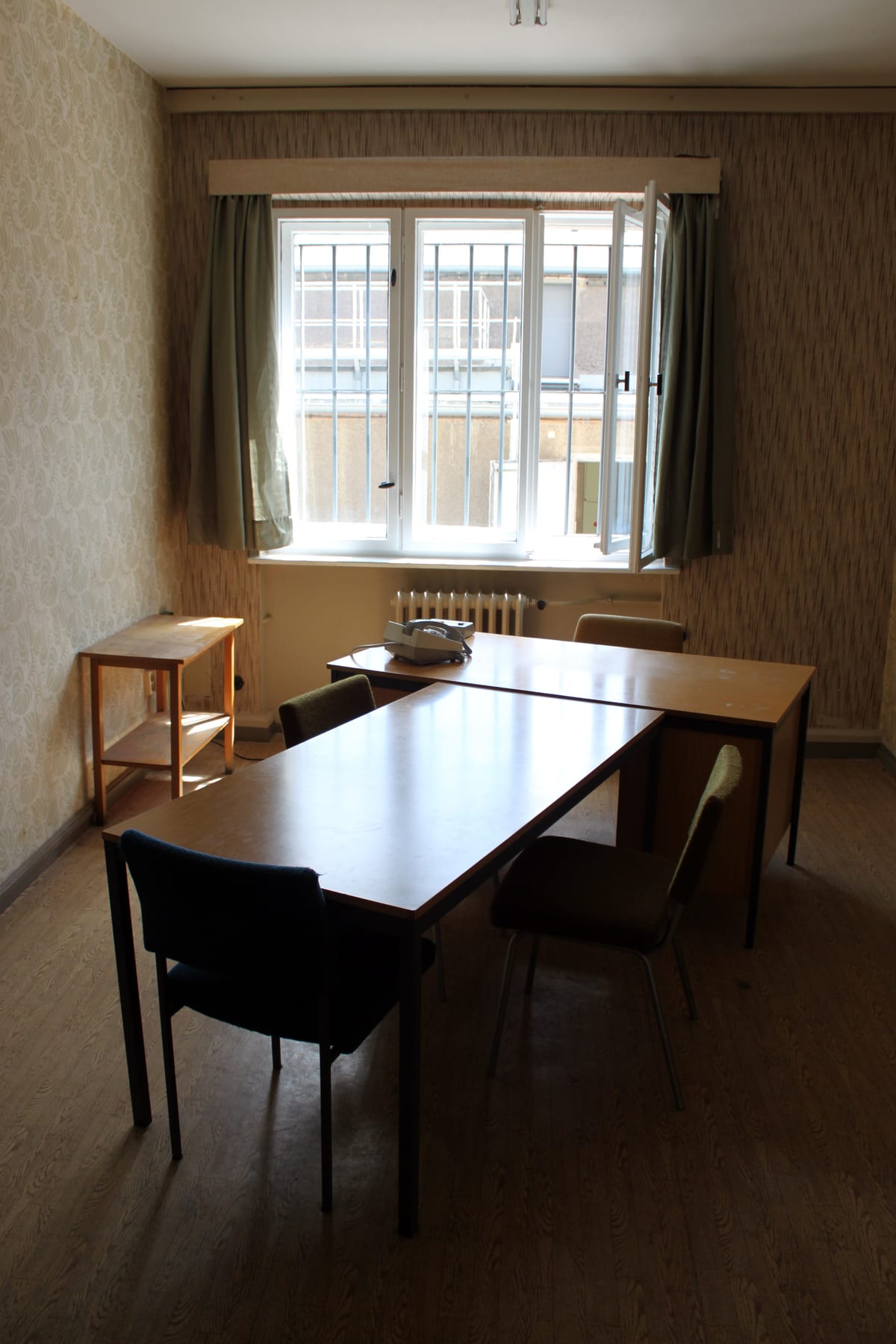
3. The Stasi: official staff, unofficial collaborators, and intimate betrayal
The Ministry for State Security—the Stasi—combined a large professional bureaucracy with a far wider network of unofficial collaborators. Informants reported from workplaces, universities, churches, artistic circles, schools, families, and opposition groups. Malice emphasizes that motives were mixed: ideological loyalty and fear mattered, but so did professional advantage, material benefit, recognition, and the intoxicating feeling of being important. That last motive explains the recruiter’s line that informants gained “the feeling that they were somebody.” Slides 10–12 (file not included in this release)
Correction — 91,015 full-time employees and about 189,000 unofficial collaborators
The transcript gives 102,000 employees and says roughly 2% of the population were informants. The Stasi Records Archive instead records 91,015 full-time employees on October 31, 1989 and about 189,000 unofficial collaborators, approximately one for every ninety GDR citizens. Full-time staff and unofficial collaborators were distinct categories; combining them yields a measure of the apparatus’s reach but should not convert every employee into an “informant.” Bundesarchiv on full-time Stasi employees · Bundesarchiv on unofficial collaborators.
Lecturer’s story — discovering the informer at home
Malice describes East Germans opening their Stasi files after reunification and learning that a spouse, partner, friend, or colleague had supplied intimate reports. One woman recognized the handwriting of the man with whom she shared her life. Another, Frau Trumpelmann, could read the bureaucratic record of how agents had entered her home and rearranged or removed objects. The archive did not merely prove that surveillance occurred; it forced victims to reinterpret years of private memory.
The file-reading phenomenon and intimate reach of the IM network are documented. The named episodes are retained as the lecturer’s account because the transcript does not identify an archival file or page for either woman. Transcript
4. Zersetzung: covert psychological destruction
Under Erich Honecker the GDR increasingly supplemented conspicuous arrests with Zersetzung, literally “decomposition” or “corrosion.” MfS Directive 1/76 made the purpose explicit: split, paralyze, disorganize, and isolate hostile groups or individuals. The methods could include engineering professional failure, spreading compromising information, sowing suspicion among friends, manipulating relationships, interfering with mail or telephones, moving household objects, damaging property, and repeatedly stopping or following a target. Because each incident could be dismissed as accident, incompetence, or paranoia, the victim might lose both social credibility and confidence in his or her own perception. Slides 13–14 (file not included in this release)
The Stasi also infiltrated opposition groups. An agent could encourage recklessness, push illegal action, produce internal accusations, or make a movement appear more extreme than it was. Malice’s larger point is that a dictatorship need not imprison every dissident if it can make organized trust impossible.
Source check — Zersetzung was policy, not merely anecdote
Directive 1/76 instructed the MfS to use measures that discredited people, created professional and social failure, produced mutual suspicion, and dissolved groups. That archival record supports the lecture’s general account. It does not automatically authenticate every socks, telephone, or tire-slashing vignette, which still requires its own source. Stasi Records Archive, Directive 1/76.
5. Children, forced adoption, and Torgau
The lesson identifies Margot Honecker, East Germany’s minister of education and Erich Honecker’s wife, with a school and child-welfare system designed to form “socialist personalities.” Parents labeled politically unreliable—or punished for attempted escape—could lose custody. Children could be placed in state homes or proposed for adoption, sometimes without parents knowing where they had been sent. Malice presents this as an attack on the family analogous to earlier Soviet efforts to make the state the child’s final moral authority. Slides 15–18 (file not included in this release)
Qualification — coercive removals are documented; the scale of “forced adoption” remains disputed
East German authorities did remove children for political and ideological reasons, and archival work has established cases in which adoption severed families targeted by the state. But recent historical summaries caution that the total number of politically motivated forced adoptions is unresolved and that not every abusive state placement became an adoption. The transcript’s broad claim that “thousands” were taken and given to loyal communists should therefore be retained as the lecturer’s allegation, not a settled count. Bundesstiftung Aufarbeitung, exhibition materials on GDR forced adoption · overview of the GDR residential-care system.
The most punitive youth institution was the Closed Youth Work Camp at Torgau. The official memorial records more than 4,000 admissions between 1964 and 1989, generally of youths fourteen to eighteen. Young people were confined under prison-like conditions for “reeducation,” including strict routines, drill, isolation, humiliation, violence, and forced compliance; ordinary criminal conviction was not required. Slides 19–21 (file not included in this release)
Lecturer’s story — punishment made self-reinforcing
Malice describes children at Torgau being forced through exhausting routines and then punished for failing to perform them correctly. Some reportedly injured themselves or attempted suicide to escape the institution. The story’s point is not that every resident experienced an identical sequence, but that discipline was structured to make normal resistance look like further proof that the child required coercive “reeducation.”
The memorial documents prison-like confinement, paramilitary drill, violence, humiliating punishments, and more than 4,000 admissions. The precise incidents of self-harm in the lecture were not traced to individual case files here. Transcript · Torgau Memorial, historical site.
Photograph — the Torgau memorial site
The former Closed Youth Work Camp at Torgau, now a memorial and documentation site. This 2012 exterior is not a period photograph, but it anchors the institution in a real surviving place. Photograph by Stefan Kühn. Wikimedia Commons source. CC0.
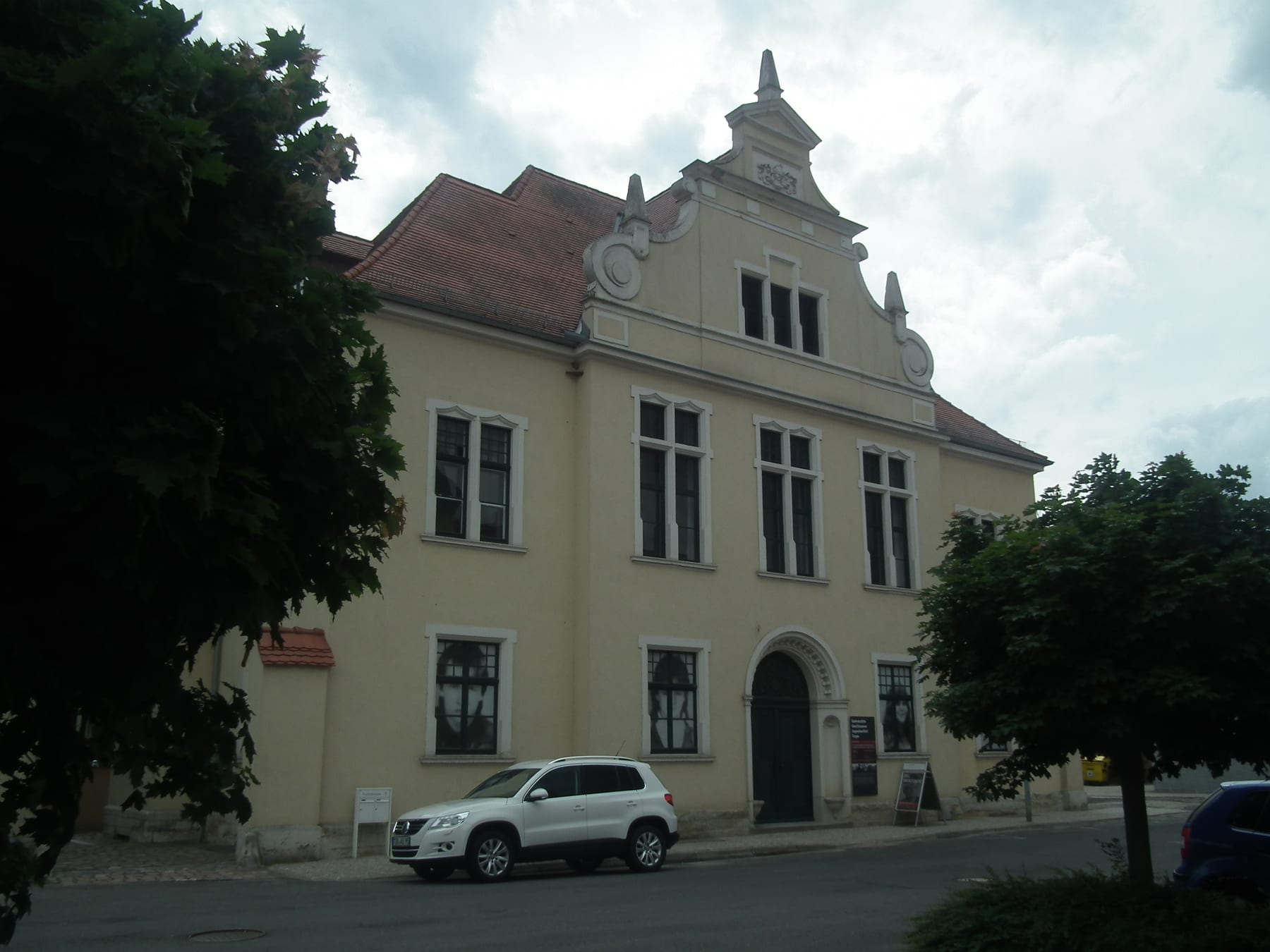
6. Hungary, Prague, and the limits of reform inside the bloc
The Hungarian Revolution began on October 23, 1956 as a spontaneous and rapidly changing national uprising. Imre Nagy became its symbolic political leader and announced neutrality and withdrawal from the Warsaw Pact. Soviet forces launched the decisive invasion on November 4. Nagy took refuge in the Yugoslav embassy, was later seized, secretly tried, and executed with Pál Maléter and others in June 1958. The sequence demonstrated that Khrushchev’s repudiation of Stalin did not include accepting an allied state’s departure from Soviet strategic control. Slide 22 (file not included in this release)
Period photograph — Soviet armor in Budapest
A Soviet tank attempts to clear a road barricade in Budapest, October 1956. The photograph shows the uprising as an urban confrontation rather than merely a diplomatic crisis. CIA photograph. Wikimedia Commons source. U.S. public domain.
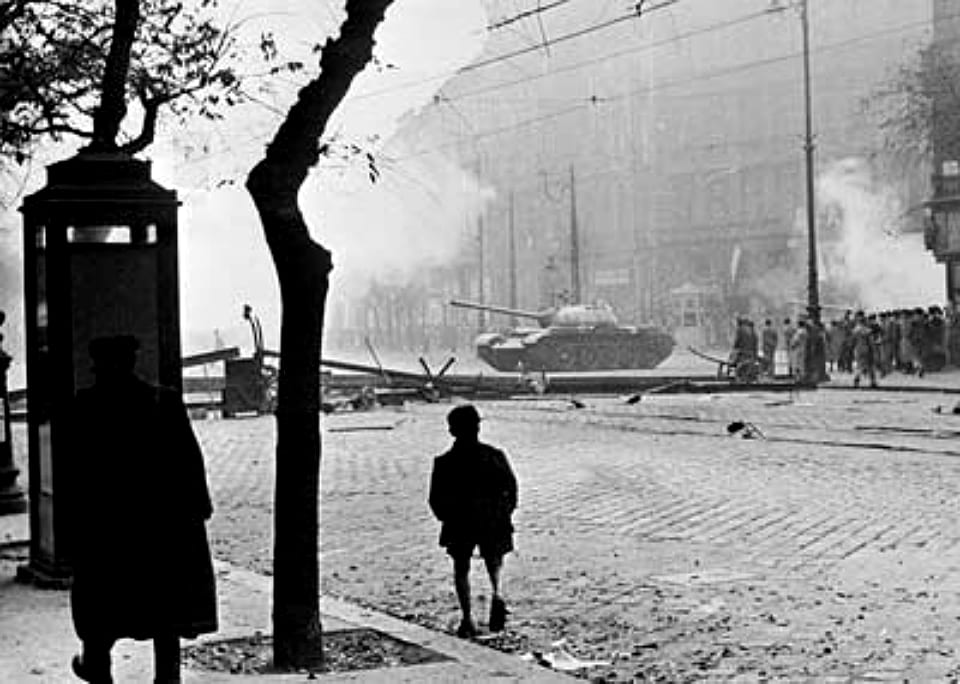
In 1968 Alexander Dubček attempted “socialism with a human face” in Czechoslovakia: freer speech, reduced censorship, and reforms within—not abolition of—the communist system. Soviet and allied leaders treated liberalization as contagious. On August 20–21, Soviet-led Warsaw Pact forces invaded, removed the reform movement’s freedom of action, and eventually replaced Dubček. The lesson links this to the Brezhnev Doctrine, under which the sovereignty of a socialist state was limited whenever communist rule appeared threatened. The Johnson administration condemned the invasion but did not intervene militarily, a choice shaped by Vietnam, nuclear risk, and the established division of Europe. Slides 23–26 (file not included in this release)
Period photograph — Prague surrounded by Warsaw Pact armor
Crowds surround Soviet tanks during the first days of the 1968 invasion of Czechoslovakia. The image captures both overwhelming military force and immediate civilian resistance. Photographer not identified on the source page. Wikimedia Commons source. CC BY-SA 3.0.
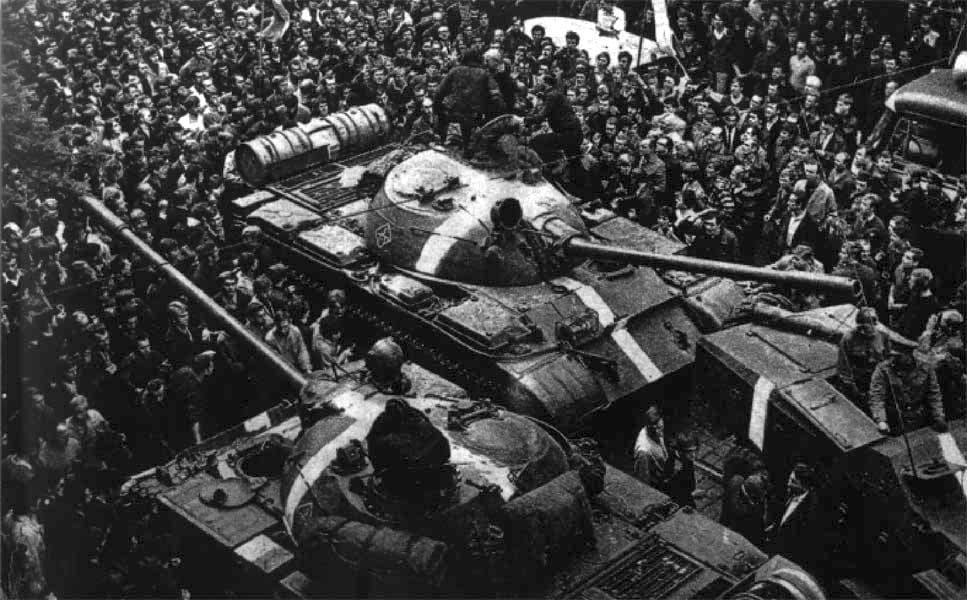
Map — the divided Europe in which Hungary and Czechoslovakia were contained
Cold War Europe showing NATO and Warsaw Pact alignment. Reused from Lesson 5 to locate Hungary and Czechoslovakia within the Soviet alliance system. It is a later overview, not a map of troop movements in either invasion. Wikimedia Commons source. CC BY-SA 3.0.
Source check — two suppressions, two important qualifications
A United Nations investigation described Hungary as a broad, improvised national uprising rooted in longstanding grievances; it was not simply a coup organized by Nagy. The U.S. State Department’s historical account dates the Czechoslovak invasion to August 20–21, 1968 and explains that U.S. nonintervention was anticipated because Washington had already signaled that the Eastern bloc lay outside its military commitment. These sources support the lecture’s central contrast while cautioning against making either episode the product of one leader alone. Office of the Historian on Hungary · Office of the Historian on the 1968 invasion.
7. Détente and the argument for “conservative unity”
Malice characterizes the late-1960s and 1970s Western consensus as détente: arms control, recognition of spheres of influence, and acceptance that nuclear stability required coexistence with a Soviet bloc that might endure indefinitely. The doctrine of mutual assured destruction could restrain direct war, but in his presentation it also made the political division of Europe seem permanent. The lesson does not give a balanced diplomatic history of détente; it uses détente as the foil against which Reagan and Thatcher define themselves. Slides 27–30 (file not included in this release)
Thatcher’s attack on “consensus” and Reagan’s 1977 formula—“We win and they lose”—share a refusal to treat managed decline or permanent ideological equilibrium as the only responsible position. Their unity was temperamental and strategic: clarity over ambiguity, moral opposition to communist dictatorship, market-oriented reform at home, and a willingness to absorb near-term political pain for a different long-term direction.
Interpretive boundary — accommodation is not the same as whitewashing
The course-wide “Western supporters, whitewashers, and minimizers” table includes the détente consensus because Malice presents it as a form of legitimizing permanence. That categorization is his argument, not a finding that arms-control advocates concealed Soviet crimes or favored communist government. Policymakers could know the regime was repressive and still believe negotiation, nonintervention, and deterrence reduced the risk of nuclear war.
8. Margaret Thatcher: from Grantham to Downing Street
Born in 1925 to a shopkeeping Methodist family in Grantham, Thatcher studied chemistry at Oxford, trained as a barrister, and entered Parliament for Finchley in 1959. She advanced through opposition and government, becoming education secretary under Edward Heath. After Conservative defeats and prolonged British economic turmoil—high inflation, labor conflict, the three-day week, and the Winter of Discontent—she challenged Heath and became party leader in 1975. Slides 31–32, 39–45 (file not included in this release)
The Callaghan government lost a confidence vote on March 28, 1979 by 311–310. In the ensuing election the Conservatives won and Thatcher became Britain’s first woman prime minister. Malice emphasizes that she did not merely offer a more efficient administration of the postwar consensus; she argued that the consensus itself produced drift and decline. Her early government divided colleagues into “wets” and “dries,” pursued monetarist policy through recession and unemployment, and reshuffled resistant ministers. The lesson ends just as Argentina invades the Falkland Islands on April 2, 1982, turning foreign policy into the next test of her leadership. Slides 41–51, 59–63 (file not included in this release)
Corrections — Thatcher’s early appointments and the 1979 vote
The transcript’s “in 1927, Thatcher was recommended to Ted Heath for a place in the shadow cabinet” is an obvious transcription or speaking error: she was two years old. Thatcher entered Heath’s Shadow Cabinet in October 1967 with responsibility for Fuel and Power, moved to Transport in 1968, and became shadow education spokesperson in 1969. The lecture’s 311–310 no-confidence result is correct. Margaret Thatcher Foundation chronology · UK Parliament record of the confidence motion · UK government biography.
9. Ronald Reagan: political conversion, election, and survival
Reagan’s path ran through radio, Hollywood, the Screen Actors Guild, and General Electric speaking tours. Malice presents anti-communism as the bridge from a Democratic New Deal inheritance to Republican politics: Reagan campaigned for Barry Goldwater in 1964, won the California governorship in 1966, challenged Gerald Ford in 1976, and entered the 1980 primaries as the movement conservative whom party leaders had once underestimated. The “I am paying for this microphone, Mr. Green” confrontation and “there you go again” debate line helped turn command of performance into a political asset. Slides 33–38, 46–58 (file not included in this release)
Reagan defeated Jimmy Carter with 489 electoral votes to 49. Carter carried six states plus the District of Columbia, a detail the lecture compresses into “six states.” Reagan’s closing question—“Are you better off than you were four years ago?”—made economic and national decline a matter of the voter’s own experience rather than policy abstraction.
Lecturer’s story — humor after the assassination attempt
On March 30, 1981 John Hinckley Jr. fired six shots as Reagan left the Washington Hilton. A ricochet struck Reagan under the left arm and entered his chest. Malice retells Reagan’s remarks to Nancy—“Honey, I forgot to duck”—and to the medical team—“I hope you’re all Republicans”—as evidence that practiced humor could become courage under pressure. The episode reinforced the public persona on which his political communication depended.
The Reagan Library places the shooting after 69 days in office, not “a couple weeks” after the inauguration. It confirms the date, attacker, six shots, ricochet, and serious wound; the jokes are preserved as attributed recollections rather than clinical evidence. Transcript · Reagan Library, assassination attempt.
Source check — the 1980 electoral count
The National Archives records 489 electoral votes for Reagan and 49 for Carter. The landslide gave Reagan a mandate, but the popular vote was less lopsided than the electoral map and independent candidate John Anderson received more than 5.7 million votes. National Archives, 1980 Electoral College results.
Later photograph — the Reagan–Thatcher alliance
Prime Minister Margaret Thatcher and President Ronald Reagan walking at Camp David, November 6, 1986. This photograph postdates the lesson’s 1982 endpoint; it illustrates the mature political partnership whose separate origins Lesson 6 traces. White House Photographic Office, photographer unidentified. Wikimedia Commons source. U.S. public domain.
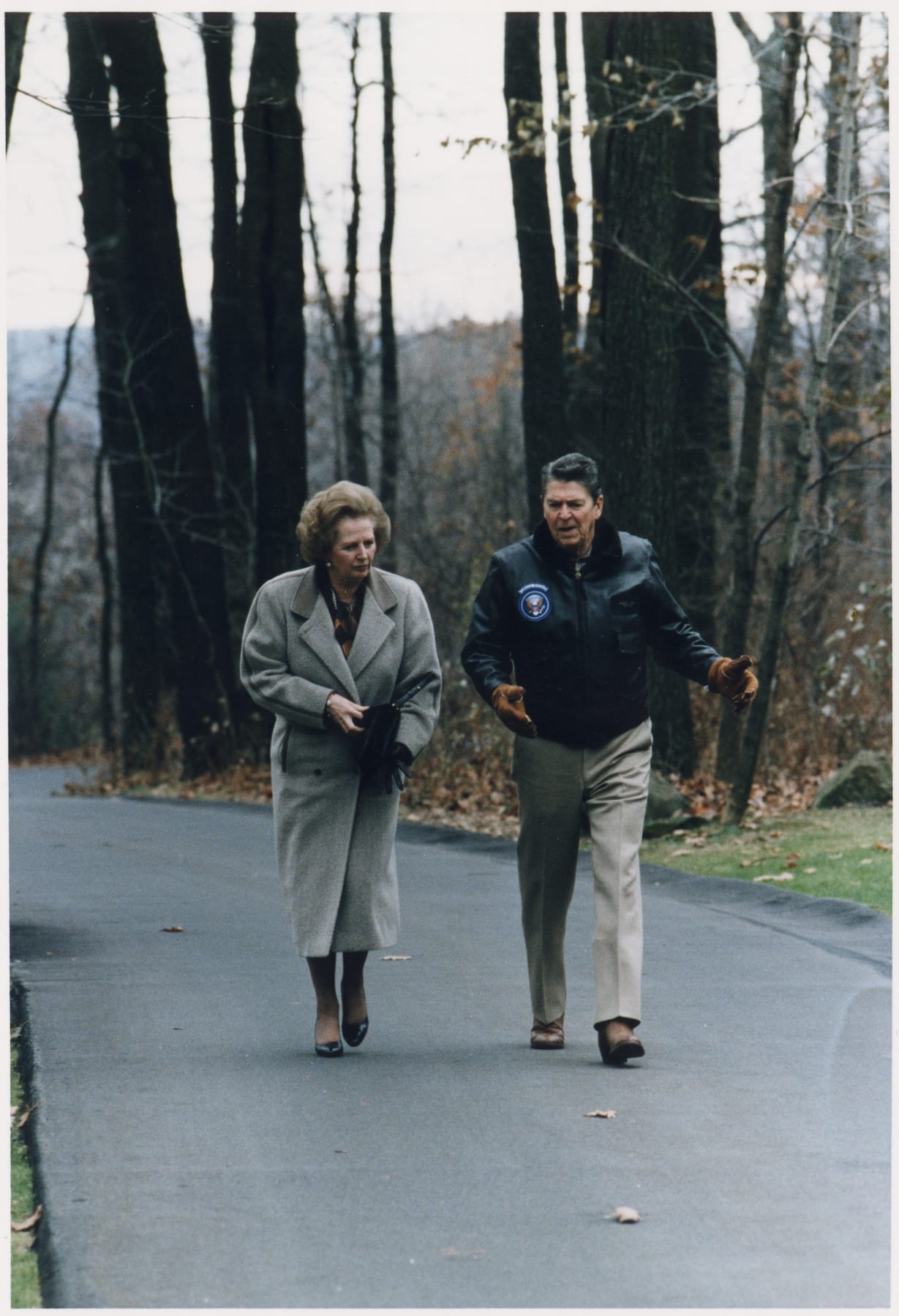
What to retain from Lesson 6
- East German coercion operated at several scales: a lethal border prevented exit; interrogation broke individual prisoners; informant networks dissolved private trust; Zersetzung damaged lives while obscuring the state’s hand; and the education and welfare systems could discipline children and families.
- Miriam’s interrogation, the discovery of intimate informers, and Torgau are essential stories, but their evidence differs: a reported survivor narrative is not the same kind of source as an archival staffing count or a formal Stasi directive.
- The Stasi’s reach was enormous, but its categories matter: about 91,000 full-time staff and 189,000 unofficial collaborators in 1989 do not support calling 2% of all East Germans “informants.”
- Politically coercive child removal is documented; the exact number of forced adoptions and whether every removal was centrally ordered remain disputed.
- Hungary in 1956 and Czechoslovakia in 1968 show the limits of reform inside the Soviet alliance even after Stalin’s death.
- The lecture’s account of détente is argumentative. It accurately identifies accommodation and nuclear restraint as features of the era but treats their moral and strategic costs more fully than their rationale.
- Thatcher and Reagan rose through different systems but shared a rejection of managed decline and permanent Soviet parity. By the lesson’s end, however, this is a political alignment and governing project—not yet an explanation of the Soviet Union’s eventual collapse.
- Important corrections: the Wall was about 155 km/96 miles; Heinz, not Hans, Meixner escaped in 1963; Thatcher entered the Shadow Cabinet in 1967, not 1927; and Reagan was shot 69 days after taking office.
Questions to carry into the next lesson
- Which mattered more to late Cold War change: ideological clarity, military and economic pressure, internal Soviet weakness, or reform from within the communist bloc?
- How should historians compare visible repression—walls, shootings, prisons—with covert repression designed to make victims look unreliable or isolated?
- When does diplomatic accommodation become complicity, and when is it a prudent response to nuclear danger?
Lesson 7 - The Cold War Thaw
Central thread
Malice presents the Cold War thaw as a chain of contingent openings rather than a smooth or inevitable Soviet retreat. Thatcher’s Falklands victory and Reagan’s reelection first strengthen leaders willing to speak in moral and confrontational terms. Yet the same leaders then recognize in Mikhail Gorbachev a negotiating partner whose fear of nuclear war and need for reform create possibilities that rhetoric alone could not produce. The story moves from alliance friction and failed summitry to glasnost, Poland’s independent civil society, Hungary’s breached frontier, and Romania’s refusal to change. The governing paradox is that pressure and dialogue operate together: the Western alliance is neither perfectly united nor consistently farsighted, and Gorbachev’s reforms begin as an effort to save socialism but loosen the controls that sustained it.
1. The Falklands: resolve, war, and political authority (1982–1983)
Argentina’s April 2, 1982 invasion placed a remote territorial dispute at the center of Thatcher’s premiership. U.S. Secretary of State Alexander Haig proposed an interim arrangement while the British task force sailed south. Thatcher answered with the analogy that organizes the lecture’s opening: Neville Chamberlain had discussed a superficially similar compromise at the same table in 1938, and “Britain simply will not reward aggression.” Malice treats the comparison as evidence that she understood the crisis through the moral memory of appeasement, not merely through calculations about the islands themselves. Slides 2–5 (file not included in this release)
Map — the Falkland Islands
The Falkland Islands in the South Atlantic. The map clarifies the distance from Britain and the archipelago’s division into East and West Falkland, both central to the logistical problem Malice emphasizes. Map by Eric Gaba (Sting), drawing on NASA, CIA, and other geographic sources. Wikimedia Commons source. CC BY-SA 2.5.
The most controversial naval action was the sinking of the Argentine cruiser ARA General Belgrano by HMS Conqueror on May 2. The ship was outside the British-declared Total Exclusion Zone, but the British government argued that the exclusion zone did not exhaust the normal wartime right to attack a threatening enemy warship and that Argentine naval units were attempting a pincer movement. The episode therefore belongs in two frames at once: it was a decisive act intended to protect the task force, and it remained a bitter political controversy about rules of engagement, direction of travel, and prospects for diplomacy. Argentine forces surrendered on June 14. In the June 1983 election, the Conservatives gained fifty-eight seats and Thatcher’s authority was transformed. Slides 4–5 (file not included in this release)
Period photograph — ARA General Belgrano before the war
ARA General Belgrano at Ushuaia, January 31, 1982. The photograph was taken by Samuel Scorpio, one of the naval cadets aboard that summer, roughly three months before the cruiser was sunk. Wikimedia Commons source. CC BY-SA 4.0.
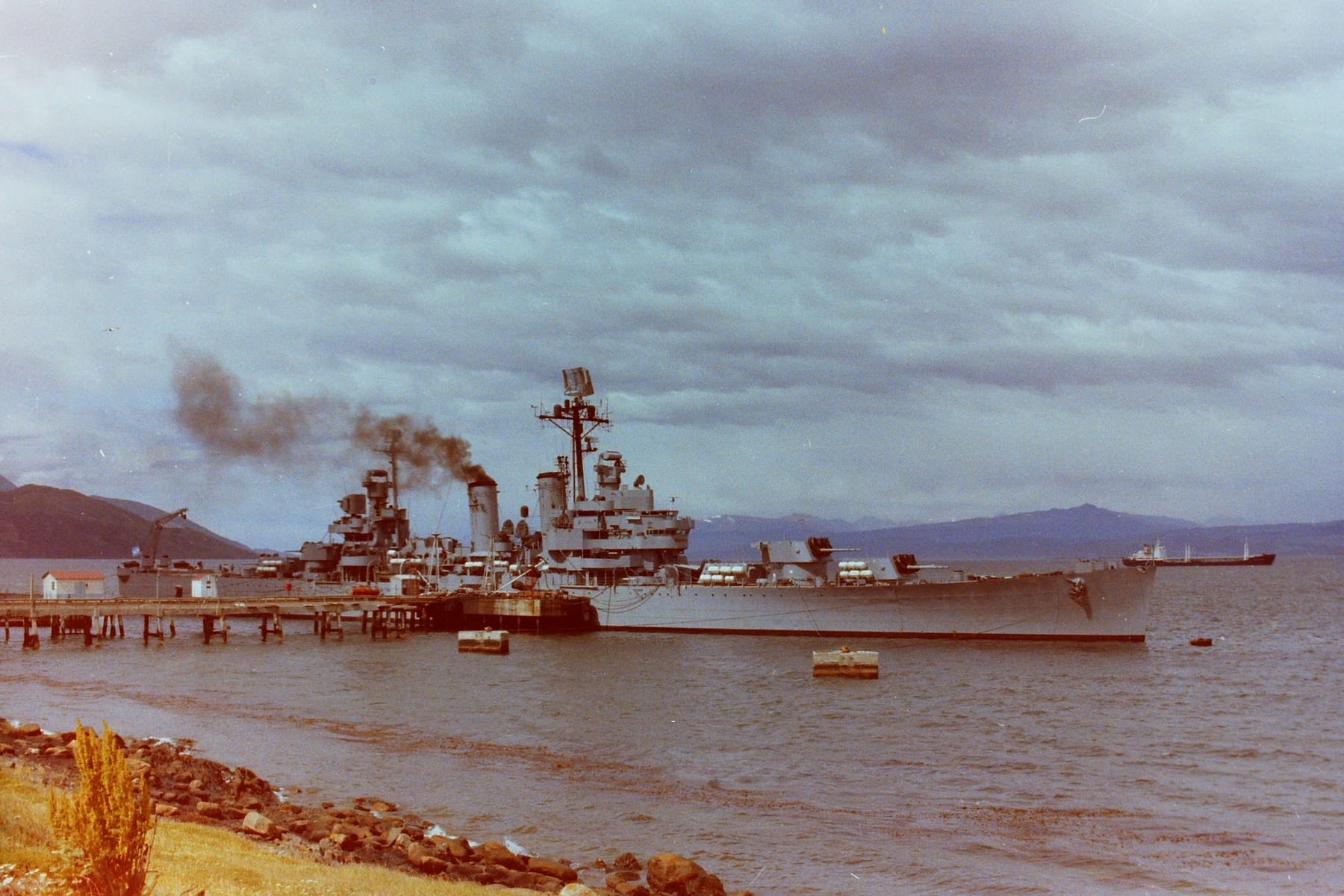
Source check — the Belgrano death toll and exclusion zone
323 people died, not the transcript’s rounded “300.” The ship was just outside the 200-nautical-mile exclusion zone. British ministers maintained that it formed part of a threatening Argentine naval operation and that the rules of engagement had been changed to permit the attack; critics disputed the necessity and timing. The corrected death toll should not be used to collapse the continuing controversy into a single uncontested interpretation. Argentine government memorial account · U.S. Office of the Historian situation report · UK Parliament debate and official rationale.
2. Alliance fracture and political violence: Grenada, Harrods, and Brighton (1983–1984)
The “special relationship” did not prevent deception. Reagan approved the October 1983 invasion of Grenada but withheld the decision from Thatcher because, as he later explained in the lecture, “I didn’t want her to say no.” Foreign Secretary Geoffrey Howe assured Parliament that intervention was not imminent while the decision had effectively already been made. Malice uses the humiliation to show that Reagan and Thatcher’s ideological affinity did not erase unequal power or conflicting judgments about sovereignty and Commonwealth responsibility. Slides 6–8 (file not included in this release)
Lecturer’s story — Denis Thatcher at Harrods
The lecture lightens a grim sequence with Denis Thatcher’s dry humor. After the December 1983 IRA bombing outside Harrods, Margaret reportedly asked what he had bought her. His answer—essentially, “They blew it up before I could”—turns the family’s familiarity with danger into a joke. The attack itself was not comic: six people were killed, including civilians and police officers.
The wording is preserved as the lecturer’s anecdote; it has not been independently traced here to a recording or Denis Thatcher’s published correspondence. Transcript
On October 12, 1984 the IRA bombed Brighton’s Grand Hotel during the Conservative Party conference. Five people were killed and others badly injured. Thatcher survived, delivered the scheduled conference speech, and refused to let the attack dissolve the government’s public routine. The IRA’s later statement—“We only have to be lucky once. You’ll have to be lucky always”—captured the defender’s permanent burden. In Malice’s structure, this is not a digression from the Cold War. It establishes the domestic violence and personal risk surrounding the leaders who would soon negotiate nuclear danger abroad. Slides 9–10 (file not included in this release)
3. Reagan’s second mandate and a dying Soviet gerontocracy (1984–1985)
Reagan neutralized concern about his age in the second 1984 debate with Walter Mondale by promising not to exploit his opponent’s “youth and inexperience.” The joke worked because Mondale laughed too, converting a vulnerability into command of the room. Reagan then won forty-nine states and 525 electoral votes to Mondale’s 13; Mondale carried Minnesota and the District of Columbia. The lecture’s “every state but Minnesota” describes the state map but leaves out D.C. Slides 11–12 (file not included in this release)
Across the superpower divide, leadership continuity was almost impossible. Leonid Brezhnev died in November 1982, Yuri Andropov in February 1984, and Konstantin Chernenko in March 1985. Reagan’s “They kept dying on me” is comic shorthand for a serious diplomatic problem: summit relationships could not mature before the Soviet counterpart disappeared. His “evil empire” rhetoric, meanwhile, defined the USSR as a moral adversary at the very moment when he also wanted movement on nuclear arms. Malice keeps both impulses together rather than treating negotiation as a repudiation of confrontation.
Lecturer’s story — the Soviet potato queue
In the lecture’s political joke, a man waiting hours for potatoes threatens to kill the Soviet leader, then returns because the line for the assassination is even longer. The joke’s logic matters more than its provenance: citizens cope with scarcity and political helplessness by treating both as bureaucratic queues.
This is political folklore, not evidence for a particular shortage, speaker, or date. Transcript
4. Thatcher recognizes Gorbachev—and the system that formed him
When Thatcher met Gorbachev at Chequers on December 16, 1984, he was not yet general secretary. She arrived ready to lecture him on Soviet conduct; he answered that the Politburo had not instructed him to recruit her into the Communist Party. Humor did not dissolve disagreement, but it made sustained argument possible. Thatcher’s public conclusion—“I like Mr. Gorbachev. We can do business together”—identified him to Reagan and Western audiences as a different kind of Soviet interlocutor. Gorbachev, in turn, wanted her help restraining the Strategic Defense Initiative. Slides 13–15 (file not included in this release)
Period photograph — Reagan and Thatcher after the Chequers meeting
Ronald Reagan and Margaret Thatcher at Camp David, December 22, 1984, six days after Thatcher met Gorbachev at Chequers. The image anchors the channel through which she conveyed her judgment of the future Soviet leader. White House Photographic Office. Wikimedia Commons source. U.S. public domain.
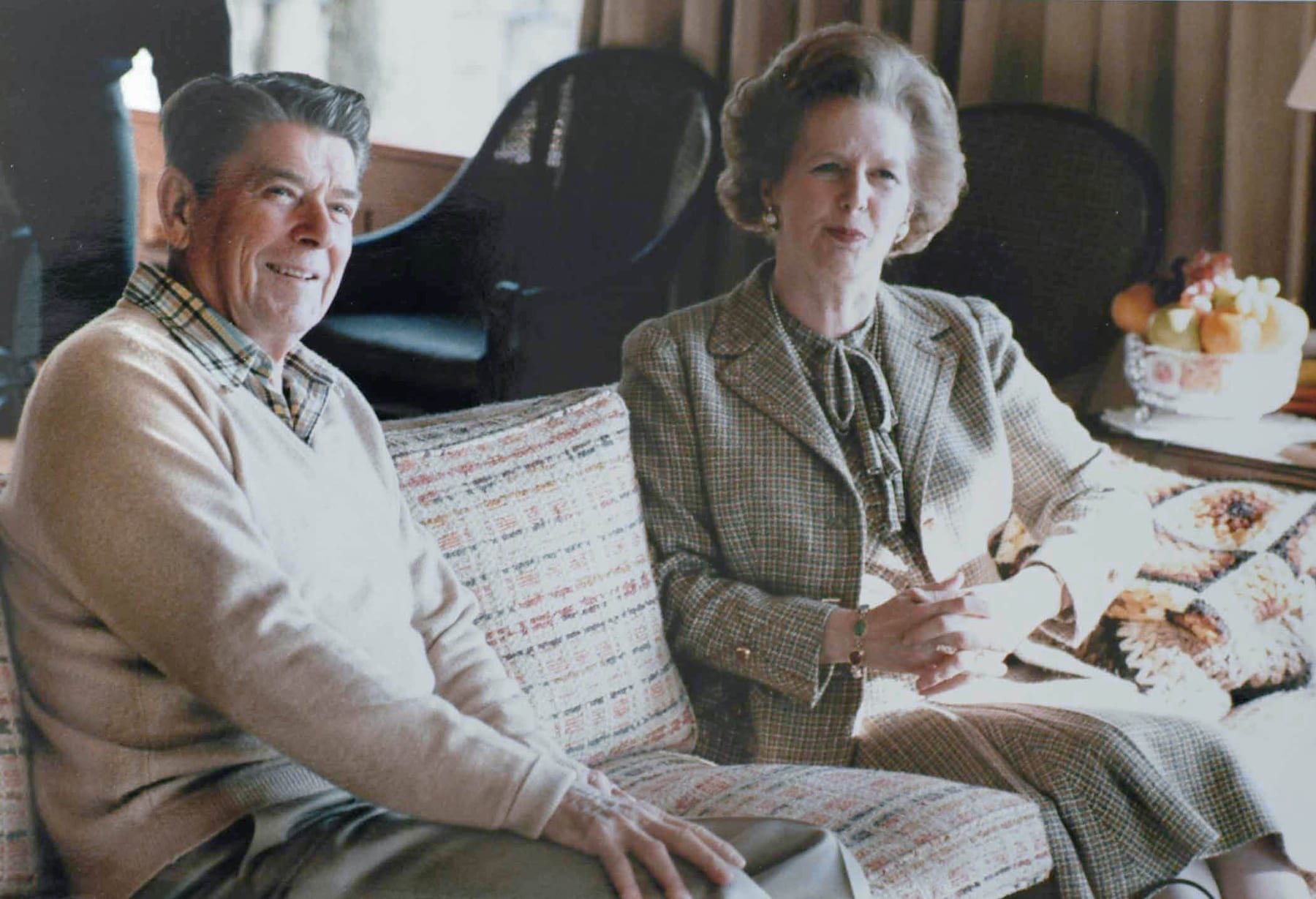
Gorbachev’s biography complicates any story of an outsider arriving to destroy communism. Born in 1931 in the North Caucasus, he grew up amid famine, collectivization, war, and repression. Both grandfathers were arrested. Yet he remained a believer, rose through the party, and interpreted reform as restoration of a system whose ideals he still accepted. His 1969 visit to Czechoslovakia also exposed the resentment left by the Warsaw Pact invasion. When he became general secretary on March 11, 1985, at fifty-four, his relative youth mattered because it ended the rapid succession of sick elderly leaders and gave reform time to acquire institutional momentum. Slides 16–18 (file not included in this release)
Lecturer’s story — Gorbachev’s grandfather under interrogation
Malice recounts the arrest of one of Gorbachev’s grandfathers during the Great Terror on a fabricated Trotskyist charge. Interrogators allegedly kept a bright lamp on him, beat him, crushed his arms in a door, and forced him into a wet sheepskin coat before placing him on a hot stove so that it tightened as it dried. He survived and returned home, but the story shows how terror could enter a loyal communist family without producing an immediate ideological break in the next generation.
The episode is retained as the lecturer’s biographical account. This note independently confirms the broad fact that both grandfathers suffered Soviet repression, but it has not authenticated every torture detail against the relevant memoir edition or archival file. Transcript
5. Nuclear fear, SDI, Geneva, and the Reykjavík near-breakthrough (1985–1987)
Malice argues that Reagan and Gorbachev shared an unusually personal revulsion toward nuclear war. Each could imagine strategic deterrence failing through fear, error, or momentum. The lecture attributes to Gorbachev a refusal even to press a simulated launch button and to Reagan a private conviction that he would not retaliate after a first strike. Whether every private claim is literal or retrospective, their diplomacy repeatedly moved beyond managing arsenals toward imagining abolition. Slides 19–23 (file not included in this release)
The obstacle was Reagan’s Strategic Defense Initiative (SDI). He imagined defenses capable of intercepting ballistic missiles and making nuclear weapons “impotent and obsolete.” Gorbachev feared that a workable shield would permit the United States to strike without remaining vulnerable to retaliation. Thatcher also doubted both the technology and the stability of abandoning deterrence. The Geneva summit in November 1985 began sustained personal negotiation, while Reagan’s extraterrestrial-invasion thought experiment—would the two countries cooperate if Earth faced an alien threat?—sought a shared identity above the superpower rivalry. Slides 21–26 (file not included in this release)
Lecturer’s story — “little green men”
Reagan repeatedly asked Gorbachev whether an attack from space would make Americans and Soviets recognize their common humanity. Malice adds Colin Powell’s reported reaction that the president seemed preoccupied with “little green men.” The story is useful because it joins Reagan’s theatrical imagination to a real strategic intuition: enemies may cooperate when a larger danger changes the frame.
The precise Powell wording is retained as an attributed recollection, not independently authenticated here. Transcript
At Reykjavík on October 11–12, 1986, the leaders approached extraordinarily deep reductions—far beyond what most officials had expected. The negotiations collapsed when Gorbachev demanded that SDI research be confined to laboratories and Reagan refused. The final walkout looked like failure, and Thatcher feared that Reagan’s abolitionist impulses might remove the nuclear protection on which European security depended. Her line “They would cheat. I would cheat” states the verification problem in its bluntest form. Yet the summit redefined the negotiating frontier and helped prepare the Intermediate-Range Nuclear Forces Treaty, signed in December 1987. Slides 27–29 (file not included in this release)
Period photograph — Reykjavík negotiations
Reagan and Gorbachev meeting at Höfði House, October 11, 1986. The men nearly reached a far-reaching arms agreement before dividing over SDI testing. White House Photographic Office, preserved by the U.S. National Archives. Wikimedia Commons source. U.S. public domain.
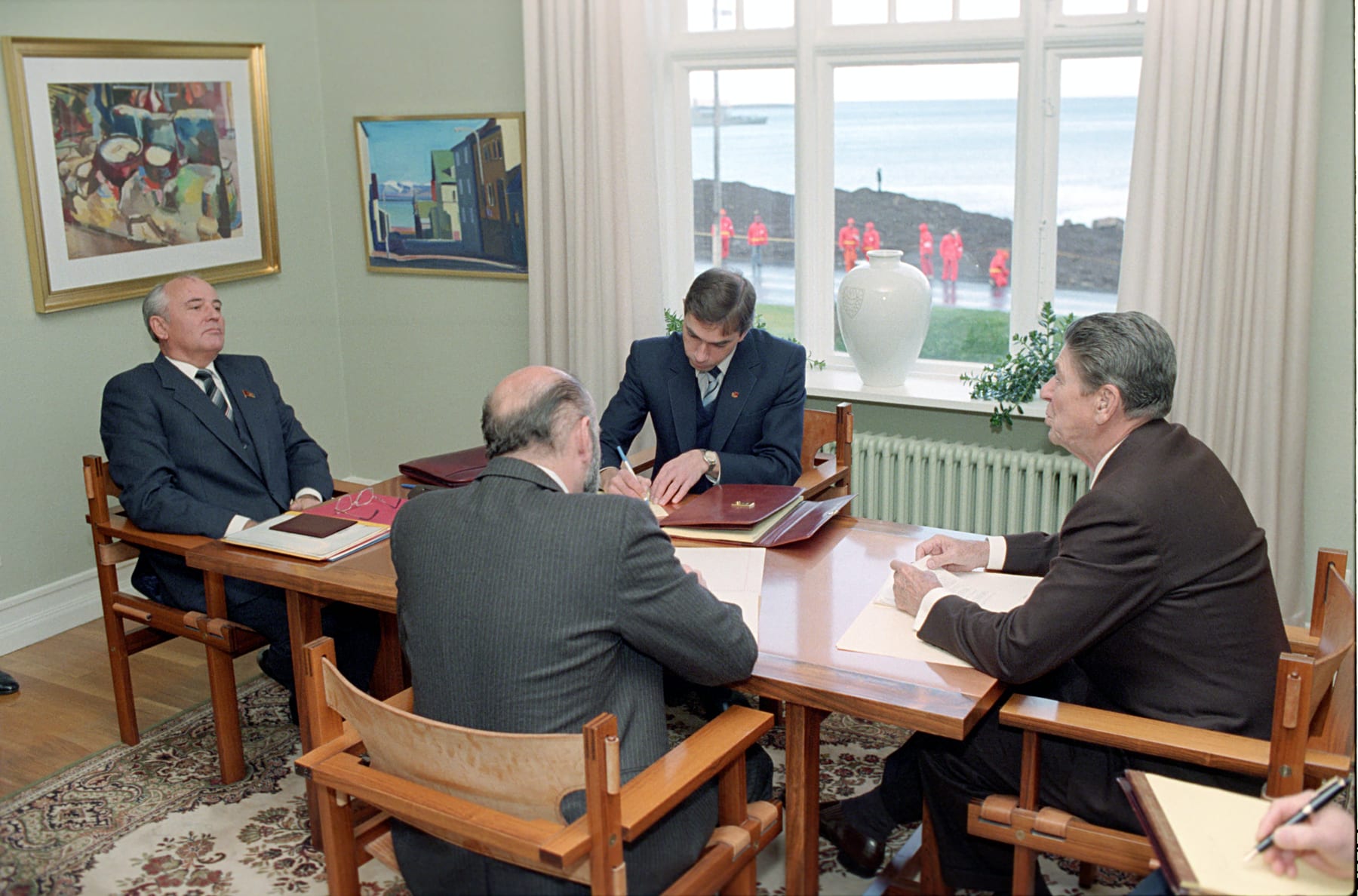
Source check — Reykjavík and Soviet defense spending
The Reagan Library memorandum confirms that Gorbachev made laboratory-only limits on space-defense research the decisive condition and that both leaders left when Reagan would not accept it. The lecture’s separate claim that the USSR spent 30–40% of GDP on the military is not supported by contemporary CIA estimates: the agency estimated roughly 11–12% of GNP, or around 15% in a later revised series. Figures above 30% referred in some estimates to the military share of particular industrial or machine-building output, not the whole economy. The broader point—that defense imposed a heavy and rising burden—survives the correction. Reagan Library memorandum of conversation · CIA estimate: about 15% of GNP through 1984 · CIA estimate and methodological range.
6. Perestroika, glasnost, and the loss of monopoly over memory
Perestroika—restructuring—attempted to make the Soviet economy more productive through limited decentralization, enterprise reform, and experimentation. Glasnost—openness—expanded the space for journalists, artists, scholars, and ordinary citizens to discuss corruption, historical falsification, camp repression, and the Nazi–Soviet Pact. Malice emphasizes the destabilizing feedback between them: economic reform required truthful information, but truthful information exposed the political crimes and lies on which party authority rested. Slides 30–32 (file not included in this release)
Previously suppressed literature returned, including Solzhenitsyn’s The Gulag Archipelago; works rejected as decadent or politically dangerous, including Nabokov’s Lolita, entered public circulation. School history examinations were reportedly suspended because approved textbooks no longer matched the newly discussable record. These changes did not create free institutions overnight, but they made the old demand—believe the party over your memory—far harder to enforce.
Thatcher’s March 1987 Moscow visit dramatized the change. Her use of the Prayer of St. Francis placed reconciliation inside a still-adversarial trip, while her live Soviet television interview exposed a mass audience to combative political exchange that previously would have been carefully filtered. Reagan’s June 1987 Brandenburg Gate challenge—“Mr. Gorbachev, tear down this wall”—kept the physical division visible. By his 1988 Moscow visit, Reagan said the “evil empire” belonged to another time, indicating how quickly the relationship had changed without claiming that Soviet authoritarianism had already disappeared. Slides 33–35 (file not included in this release)
7. Poland: church, labor, repression, and negotiation (1978–1989)
The Polish story begins before Gorbachev. The 1978 election of Karol Wojtyła as Pope John Paul II gave a predominantly Catholic nation under communist rule a leader whose authority did not depend on the party. During his June 1979 visit, millions encountered one another as a public outside official control. His prayer—“Let your spirit descend and renew the face of the earth, the face of this land”—joined religion, national identity, and civic confidence. Malice’s causal claim is not that the Pope created every later organization, but that the visit helped Poles see themselves as a social body larger than the state. Slides 36–37 (file not included in this release)
Period photograph — John Paul II in Poland, 1979
Crowds greeting Pope John Paul II during his first papal visit to Poland in 1979. The image helps explain the lecture’s emphasis on scale: participation made visible a community the party could neither create nor safely suppress all at once. Photographer unidentified. Wikimedia Commons source. Public domain in Poland under the licensing rationale recorded by Commons.
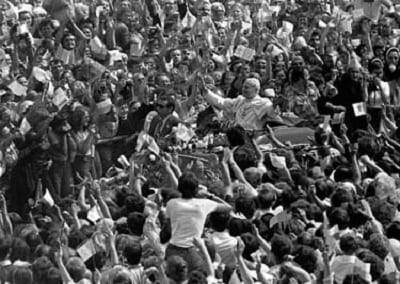
Price increases and workplace grievances helped ignite strikes in summer 1980, but the movement became more than a wage dispute. At the Gdańsk Shipyard, Lech Wałęsa and the Interfactory Strike Committee negotiated the August Agreements, including recognition of an independent trade union. Solidarity combined workers, intellectuals, clergy, and local organizers into a mass civic movement. That scale made it a rival source of legitimacy even before it sought governmental power. Slides 38–39 (file not included in this release)
Period photograph — Wałęsa and Solidarity, August 1980
Lech Wałęsa during the August 1980 Solidarity movement. The cross above him reflects the alliance of labor organization, Catholic symbolism, and national opposition described in the lecture. Photographer unidentified; originally published in Znak. Wikimedia Commons source. Public domain in Poland under the licensing rationale recorded by Commons.
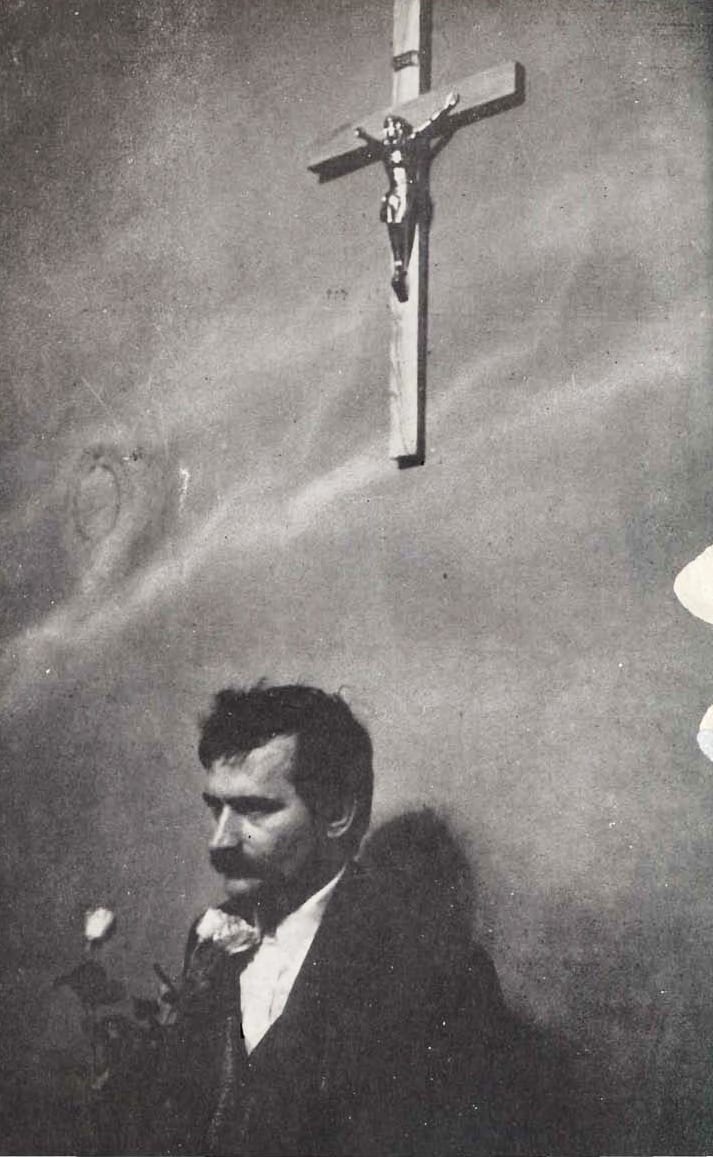
General Wojciech Jaruzelski imposed martial law on December 13, 1981. Communications were cut, curfews imposed, leaders interned, and independent organization driven underground. On December 16, security forces opened fire during the pacification of the Wujek coal mine. The repression stopped Solidarity from operating openly, but it did not erase the networks, memories, or international support that made later negotiation possible. Slides 40–43 (file not included in this release)
Source check — Wujek and the 1989 election
The lecture says eight miners were killed at Wujek; the Polish Institute of National Remembrance records nine deaths—six at the mine and three later in hospitals. The transcript also turns the 1989 arrangement into “35 seats” and says Solidarity won thirty-three. The actual rule reserved 65% of the 460-seat Sejm for the governing coalition and opened 161 seats (35%) to competition. Solidarity won 160 of those 161 in the first round and the last one in the second, plus 99 of 100 Senate seats. Institute of National Remembrance on Wujek · Senate of Poland on the June 1989 results.
By 1988 the communist government could neither restore economic confidence nor permanently remove Solidarity. Thatcher visited Poland and met Wałęsa, who joked that the ceiling itself might be listening. Gorbachev’s December 1988 United Nations speech announcing unilateral military reductions strengthened the belief that Moscow would not repeat Hungary or Prague. Ninety-two Round Table sessions from February to April 1989 produced legalization and partly free elections—an agreement designed to contain opposition that instead revealed how little support the ruling system retained. Slides 42–43, 58 (file not included in this release)
Lecturer’s story — Wałęsa points to the ceiling
During Thatcher’s 1988 meeting with Wałęsa, the Solidarity leader reportedly gestured upward when sensitive subjects arose, implying that the room was bugged. The joke communicates a whole political environment in one gesture: surveillance was expected, but fear no longer controlled the conversation.
The episode is preserved as the lecturer’s account; the transcript does not identify a recording or diary entry that would independently fix the wording. Transcript
Period photograph — the Polish Round Table, 1989
Government and opposition representatives at the Polish Round Table, February or April 1989. Lech Wałęsa, Tadeusz Mazowiecki, and other opposition figures sit opposite representatives of the communist state. Institute of National Remembrance photograph, photographer unidentified. Wikimedia Commons source. Public domain in Poland under the licensing rationale recorded by Commons.
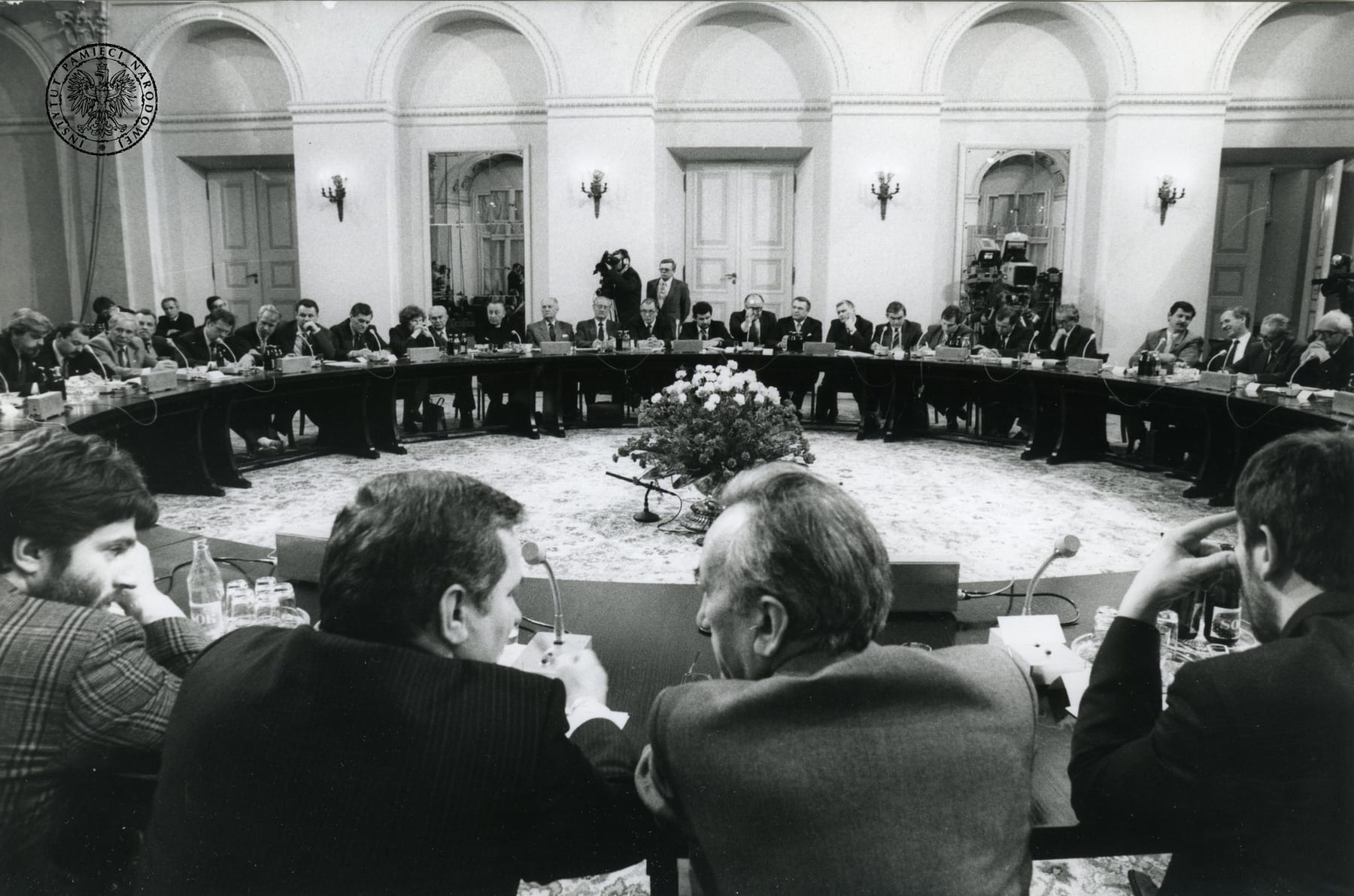
8. Hungary opens a border and tests Gorbachev’s restraint (1989)
Hungarian prime minister Miklós Németh treated the deteriorating border fence with Austria as both an economic burden and a political test. When he raised removal with Gorbachev, the crucial answer was not enthusiastic sponsorship but nonintervention. Hungary began dismantling the system in spring 1989; the ceremonial cutting by foreign ministers in June and the Pan-European Picnic in August made the breach visible. East Germans could increasingly use Hungary as a route west. The decisive change from 1956 and 1968 was therefore not merely that reformers acted, but that Moscow did not send tanks when they did. Slides 44–48 (file not included in this release)
Period photograph — dismantling the Hungarian–Austrian barrier
A worker dismantling the “Iron Curtain” on the Hungarian–Austrian border in 1989. Unlike a later memorial, this is a period photograph of the physical work that turned a diplomatic change into an opening people could cross. Photograph by Tamás Urbán/Fortepan. Wikimedia Commons source. CC BY-SA 3.0.
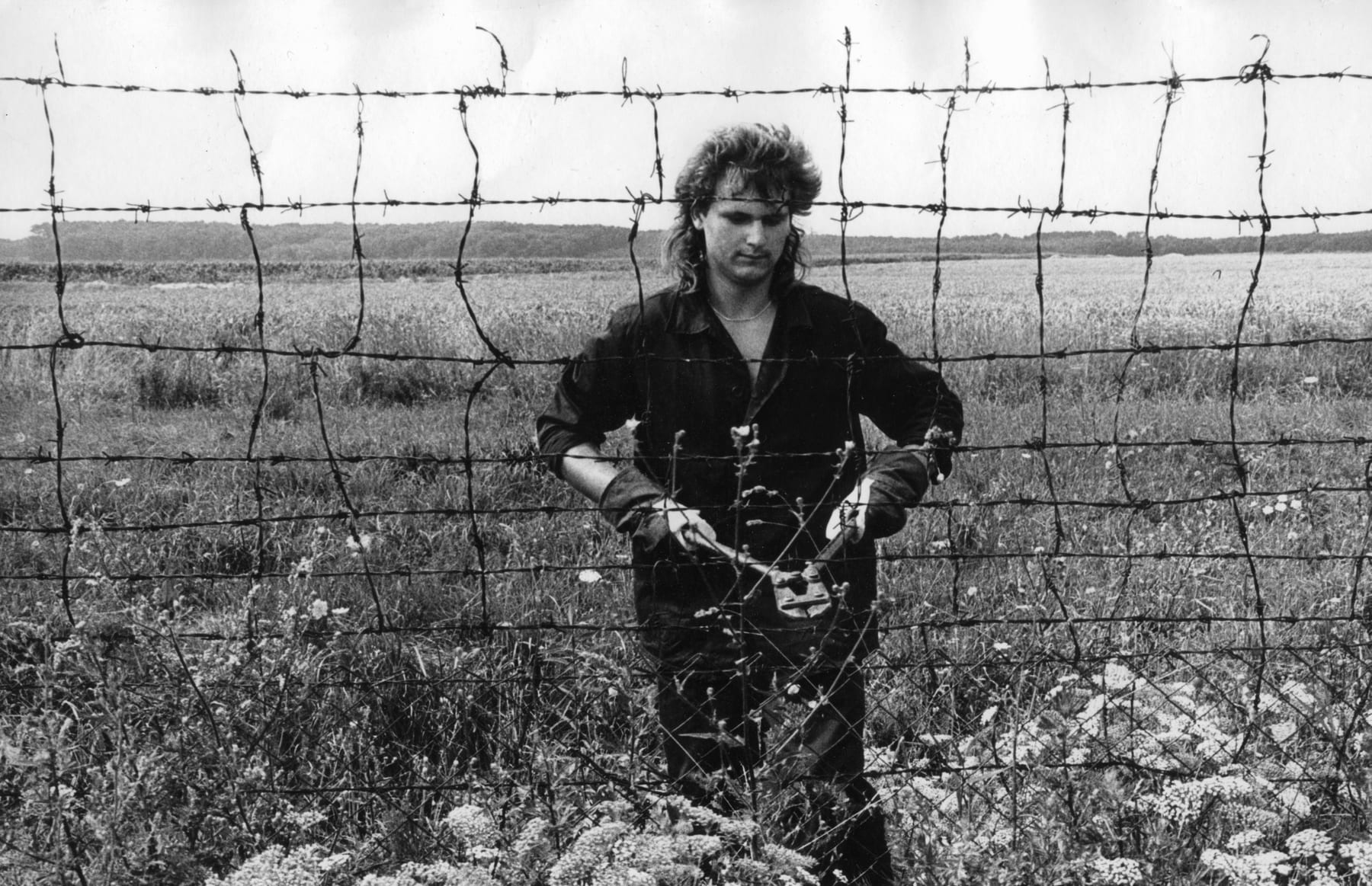
9. Romania: coercion without thaw
Romania is the counterexample that prevents “1989” from becoming a simple story of reform spreading automatically. Nicolae Ceaușescu, party leader from 1965, gained Western attention by denouncing the 1968 invasion of Czechoslovakia and sometimes pursuing policies independent of Moscow. Malice argues that this strategic usefulness helped Western governments overlook or compartmentalize an increasingly personal dictatorship. Ceaușescu visited Washington and received state honors; Britain hosted him at a state visit. These gestures did not make Western leaders authors of Romanian repression, but they made the regime appear more legitimate and respectable than its internal conduct warranted. Slides 49–53 (file not included in this release)
Period photograph — Ceaușescu received at the White House
Nicolae Ceaușescu and President Jimmy Carter during the Romanian state visit, April 12, 1978. The image directly documents the Western courtship discussed in the lecture: strategic independence from Moscow could produce public honor even as domestic repression deepened. Photograph by Jack E. Kightlinger, White House Photo Office. Wikimedia Commons source. U.S. public domain.
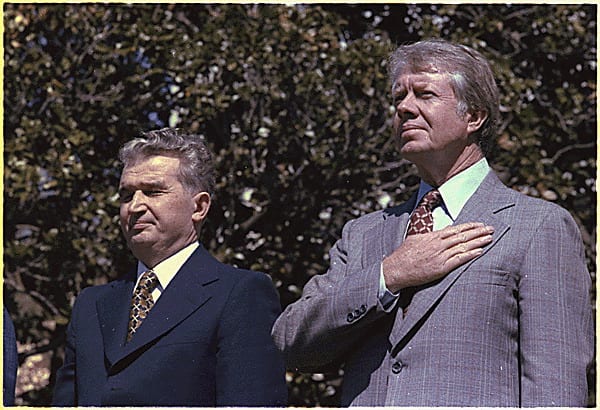
The regime’s Decree 770, adopted October 1, 1966, severely restricted abortion in pursuit of rapid population growth; access to contraception was also constrained. Enforcement expanded into workplaces, medical examinations, taxes on childlessness, and invasive scrutiny of women’s private lives. The policy produced an early birth surge but also unsafe abortion, unwanted births, family hardship, and abandonment. Its effects cannot be reduced to a single causal line, yet it formed part of the background to the immense child-institution system later exposed to the world. Slides 50–51 (file not included in this release)
After visits to China and North Korea in 1971, Ceaușescu intensified a personality cult. Nicolae became the indispensable national genius; Elena Ceaușescu acquired an inflated scientific identity, titles, and publications produced through political power rather than normal scholarship. In the 1980s the state exported heavily to repay foreign debt while rationing food, heat, and electricity at home. At the same time, the enormous House of the Republic—today’s Palace of Parliament—consumed labor and material as a monumental expression of the regime. Ceaușescu announced that the foreign debt had been paid in April 1989, but the austerity imposed on the population did not end. Slides 51–54, 57 (file not included in this release)
Lecturer’s story — the silence of the Romanian orphanage
A British journalist entered a Romanian institution expecting the noise of crying children. Instead, the cots were silent. The children had reportedly learned that crying brought no comfort, so the ordinary signal by which an infant summons care had disappeared. Malice uses that absence of sound as the lesson’s most concentrated image of developmental neglect.
This is a journalist’s observation as retold by the lecturer, not a representative survey of every institution. Independent evidence does support the larger system: UNICEF estimates that more than 100,000 children lived in large Romanian residential institutions in 1989 under extremely poor conditions that damaged health and development. Transcript · UNICEF, Children in Public Care 2014.
Source check — Decree 770’s date and institutional consequences
The official legal text dates Decree 770 to October 1, 1966, not 1967. The “1967” label commonly appears because the first large cohort born under the policy arrived the following year. The decree itself regulated abortion; later administrative measures and the scarcity of contraception made the wider pronatalist regime more invasive than this one text alone. A Council of Europe report links the abortion ban and lack of contraception to unwanted births and placement of many children in state institutions, while UNICEF documents the scale and conditions visible by 1989. Official Romanian legal text · Council of Europe historical summary · UNICEF institutional-care report.
Gorbachev’s 1987 visit to Bucharest exposed incompatible definitions of reform. Gorbachev urged openness and restructuring; Ceaușescu defended centralized control and treated the Soviet changes as dangerous. Romania thus remained a hard dictatorship while Poland negotiated and Hungary opened its border. The divergence matters: Soviet nonintervention created opportunity, but local regimes and societies still determined how—or whether—that opportunity was used.
10. June 4, 1989: two futures on one date
The first round of Poland’s partly free election took place on June 4, 1989. Solidarity won 160 of the 161 competitive Sejm seats immediately and ninety-two Senate seats; after the second round it held all 161 available Sejm seats and ninety-nine of one hundred Senate seats. The authorities had designed a controlled competition in which 65% of the lower house remained reserved. Voters used the remaining space to deliver an unmistakable verdict against communist rule. Slides 58–59 (file not included in this release)
The same date saw the violent suppression of the Tiananmen Square protest movement in Beijing. Malice closes on the contrast: one communist government accepted an electoral result that destabilized its monopoly, while another used force to restore control. The comparison guards against retrospective inevitability. A thaw is an opening in which actors make choices; it is not a law that guarantees liberalization.
What to retain from Lesson 7
- The thaw did not begin with harmony. It emerged from leaders whose authority had been strengthened by conflict, electoral success, and a willingness to use hard rhetoric.
- Reagan and Thatcher were close allies but not interchangeable: Grenada exposed asymmetry, Thatcher distrusted Reagan’s nuclear abolitionism, and both could differ sharply over SDI and European deterrence.
- Gorbachev was a product and believer of the Soviet system, not an outside democrat. His reforms sought renewal, but glasnost weakened the party’s control over historical memory and public explanation.
- Reykjavík failed as an immediate treaty summit but succeeded in moving the arms-control imagination from limits on expansion toward deep reductions; the INF Treaty made part of that shift concrete.
- Poland’s change depended on institutions outside the party—church, trade union, underground press, and civic networks—combined with the new fact that Moscow would not intervene militarily.
- Hungary demonstrated the practical end of the Brezhnev Doctrine by dismantling a border and permitting movement west without Soviet invasion.
- Romania shows that Soviet restraint alone did not produce liberalization. Ceaușescu combined reproductive coercion, personality cult, austerity, prestige construction, and catastrophic child institutionalization while retaining Western diplomatic attention because of his independence from Moscow.
- Important corrections: the Belgrano death toll was 323; Reagan won 525–13 in the Electoral College while Mondale also carried D.C.; contemporary CIA estimates put Soviet defense near 11–15% of GNP, not 30–40%; nine miners died after Wujek; Solidarity ultimately won all 161 competitive Sejm seats and 99 of 100 Senate seats; and Decree 770 dates to October 1, 1966.
Questions to carry into the next lesson
- Did Gorbachev’s reforms fail because they were too limited, because openness outran economic restructuring, or because a reformed union could no longer satisfy its republics and satellite states?
- How much causal weight should be assigned to Reagan and Thatcher compared with Polish civil society, Eastern European reformers, Soviet economic weakness, and Gorbachev’s refusal to use force?
- Why did negotiated transition become possible in Poland and Hungary while Romania remained coercive—and what does that difference predict about the final phase of communist rule?
Lesson 8 - Shattering the Soviet State
Central thread
Malice presents the Soviet collapse as a sequence in which fear changes sides. The regimes still possess armies, police, party offices, and weapons, but citizens discover that Moscow may no longer rescue local rulers and that local soldiers may no longer obey an order to kill. Exit through Hungary encourages protest inside East Germany; Leipzig proves that a mass march can survive; the Wall falls when officials cannot coordinate and guards refuse bloodshed; Czechoslovakia’s police violence produces a broader civic coalition; and Romania demonstrates the more violent path available when a ruler will not yield. The final movement transfers the same problem into the USSR itself: republics assert sovereignty, Boris Yeltsin acquires an electoral mandate independent of the union, and the failed August coup strips the Communist Party of its remaining mystique. The lecture’s moral conclusion is emphatic, but the historical mechanism is more exact: ideals mattered because institutions of coercion ceased functioning as a unified instrument.
1. June 4, 1989: massacre in Beijing, accepted defeat in Poland
The lesson opens by returning to the date that closed Lesson 7. Chinese forces violently cleared the Tiananmen protest movement while Polish voters used a partly free election to reject communist rule. The parallel is not that Poland was already free; communist authorities still controlled most guaranteed Sejm seats, the security apparatus, and the weapons. The novelty was that the Polish leadership accepted the opposition’s victory rather than nullifying it through mass force. Malice quotes a senior Solidarity figure’s uncertainty—“we also knew that they had all the guns”—and Timothy Garton Ash’s three-part formulation: the communists lost, Solidarity won, and the communists acknowledged the result. Slides 2–5 (file not included in this release)
East German television praised China’s response as firm action against Western-instigated disorder. The message was intended to intimidate, but it also clarified the stakes for East Germans deciding whether to remain, flee, or protest. Gorbachev’s refusal to impose a European “Tiananmen” was therefore not passive background. It removed the external guarantee that had sustained communist governments in Hungary in 1956 and Czechoslovakia in 1968.
2. Hungary rehabilitates 1956 and opens an escape route
Hungary’s public reburial of Imre Nagy on June 16, 1989 reversed the official memory of 1956. Nagy and four associates were honored at Heroes’ Square, while a sixth coffin represented other victims of the uprising. The state had once hidden Nagy’s grave to prevent commemoration; now approximately 200,000 people gathered while his recorded voice was broadcast. Reclassifying 1956 from “counterrevolution” to popular uprising did more than honor the dead: it made the ruling party concede that its own legitimacy rested on a falsified past. Slides 6–9 (file not included in this release)
Period photograph — the reburial of Imre Nagy and the heroes of 1956
Heroes’ Square, Budapest, June 16, 1989. The photograph records the mass public reburial ceremony through which suppressed memory became authorized national commemoration. It shows participation and scale, but cannot by itself establish the political views of every attendee. FOTO:FORTEPAN / tm, image 77279. Wikimedia Commons source. CC BY-SA 3.0.
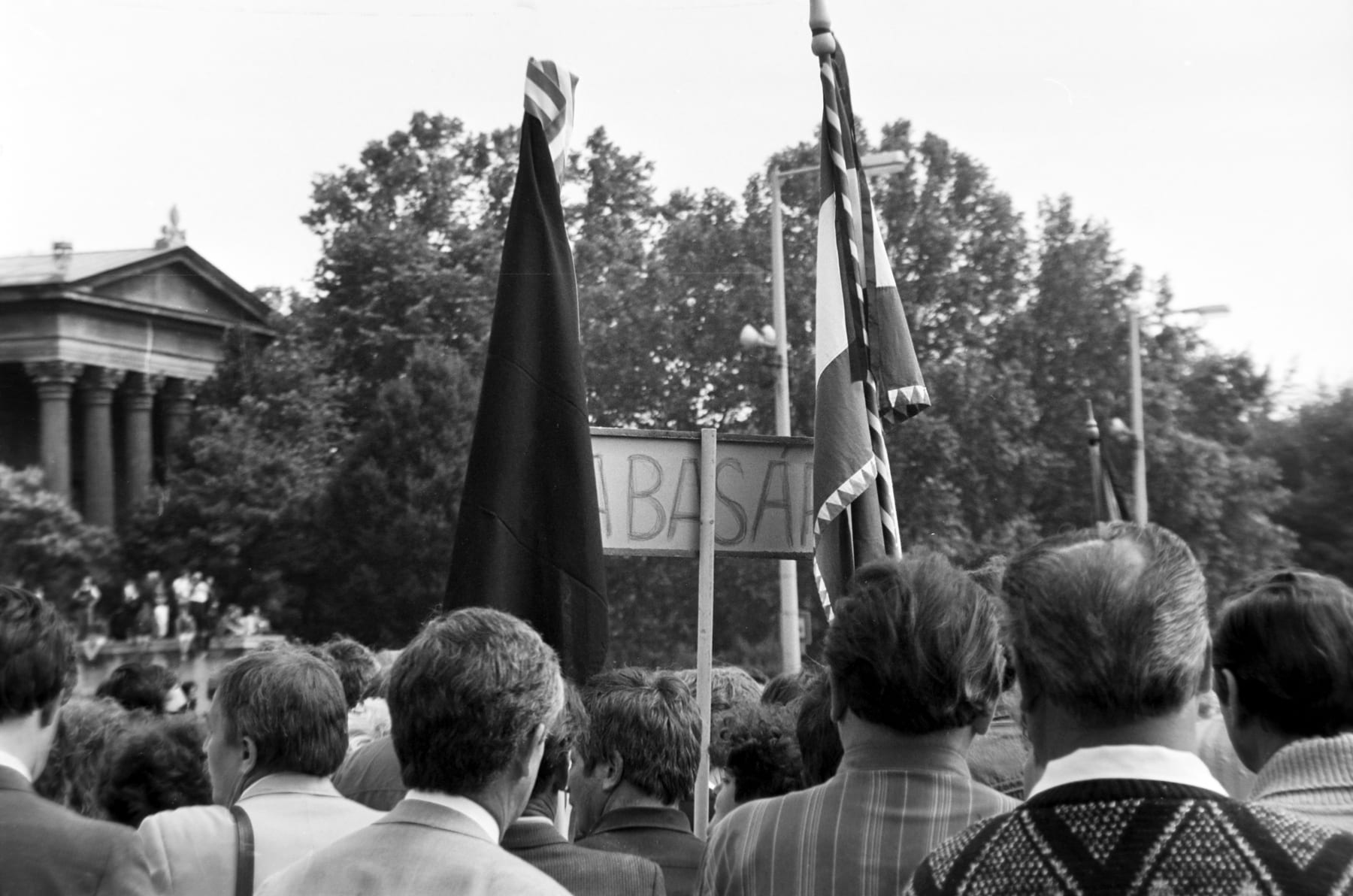
The more immediate pressure came from East Germans vacationing or sheltering in Hungary. At the Pan-European Picnic near Sopron on August 19, Hungarian guards did not stop hundreds who crossed a temporarily opened gate into Austria. On the night of September 10–11, Hungary formally allowed East German refugees to leave for the West. The GDR demanded their return; Hungary refused, Soviet foreign minister Eduard Shevardnadze urged the GDR to permit emigration, and Gorbachev declined to intervene. A neighboring communist state had turned exit from East Germany into a practical possibility. Slides 10–16 (file not included in this release)
Source check — the Pan-European Picnic and the size of the crossing
German federal sources put the number of East Germans who escaped during the August 19 picnic at roughly 600–700, not the lecture’s approximately 2,000. The larger argument survives the correction: it was the largest single East German flight across the international border since the Wall’s construction and became a visible test of whether Hungarian guards would use force. Hungary’s full opening to East German refugees followed in September. German Federal Government overview; Stasi Records Archive account.
Lecturer’s story — “deported” westward into freedom
East Germans crowded into the West German embassy in Prague were eventually permitted to leave on sealed trains routed through GDR territory. The regime required them to surrender East German citizenship, intending to present their departure as an expulsion of traitors. Malice emphasizes the historical inversion: trains packed with Germans crossed East German territory under state authority, but this time their destination was freedom in the West. The attempt to preserve bureaucratic dignity instead advertised how badly the state had lost control of allegiance. Transcript
3. Leipzig: when armed institutions choose not to fire
Beginning in September, Monday peace prayers at Leipzig’s St. Nicholas Church became marches. The state still arrested and beat protesters, and Erich Mielke urged an East German answer modeled on Beijing. By October 9, police, Stasi, military units, hospitals, and local officials were prepared for mass casualties. Yet approximately 70,000 people filled the city ring chanting “We are the people” and “No violence.” Local officials restricted the security forces to self-protection; soldiers and police did not attack; Soviet troops remained in their barracks. The march completed its route peacefully and clandestine footage reached Western television. Slides 17–26 (file not included in this release)
Lecturer’s story — soldiers recognizing their own families
Malice asks the listener to imagine conscripts issued pistols and ammunition while knowing that their wives, parents, siblings, and children might be among the marchers. Some reportedly cried because an order to fire would turn military obedience into the murder of neighbors and family. The story identifies a decisive structural fact: repression depends not merely on weapons but on people willing to use them against recognizable civilians. It is retained as the lecturer’s human-scale account; the exact individual soldiers are not identified in the transcript. Transcript
Period photograph — Leipzig’s Monday demonstration
Demonstrators on Leipzig’s Karl-Marx-Platz, October 16, 1989. This is the Monday after the decisive October 9 march; it visualizes the movement’s rapid expansion rather than the exact crowd whose survival first broke the fear barrier. Bundesarchiv, Bild 183-1990-0922-002 / Friedrich Gahlbeck. Wikimedia Commons source. CC BY-SA 3.0 DE.
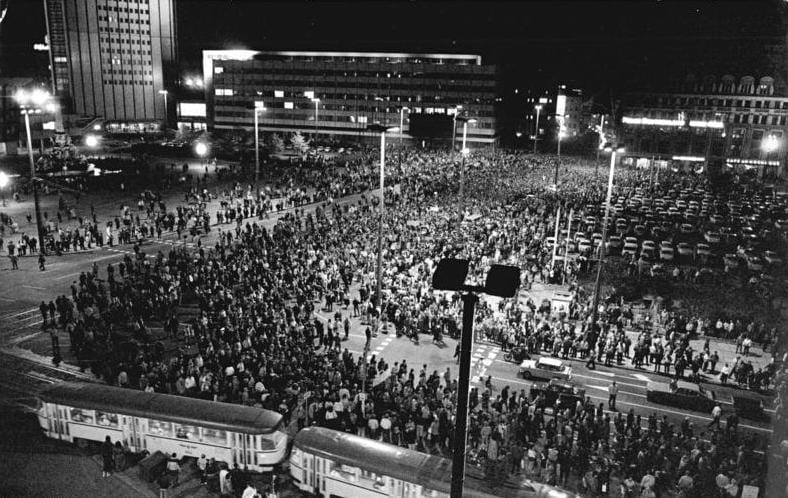
Source check — Leipzig’s crowd sizes and the decision against force
German federal histories support approximately 70,000 marchers on October 9. The next Monday’s total is given as about 120,000 in one government photo history and 150,000 in another account, so the note retains a range rather than a false precision. The broader evidence is secure: thousands of armed personnel had been prepared, no attack occurred, and the successful march encouraged much larger participation. German Federal Government, October 9 chronology; federal photographic history.
Honecker could not recover from that demonstration. The following week, a still larger crowd demanded change and removal of the Wall. On October 18, the Politburo replaced him with Egon Krenz, but Krenz had publicly associated himself with the Chinese leadership after Tiananmen and could not plausibly embody a break with the regime. The GDR’s debt, industrial deterioration, and dependence on foreign credit also deprived the new leadership of an economic rescue plan. Gorbachev refused a Soviet bailout and renewed instructions that Soviet forces not intervene.
Lecturer’s story — Honecker votes to remove himself
At the leadership meeting, Honecker’s supposed allies denounced him one after another. The vote to remove him was unanimous; according to the lecture, Honecker—formed by a political culture of collective unanimity—also voted for the motion that ended his own rule. Malice uses the scene to show how quickly ritual loyalty evaporated once the office no longer guaranteed power. Transcript
4. Schabowski’s error and the opening of the Berlin Wall
On November 4, an estimated 500,000 people filled Alexanderplatz. Five days later, Günter Schabowski read new travel rules at a televised press conference. The measure had been intended to begin after officials could prepare the border system, but Schabowski had not been properly briefed. Asked when it took effect, he answered, “immediately, without delay,” and then confirmed that the provision applied to West Berlin. Broadcast news converted an unclear administrative proposal into a public promise that citizens could test that same evening. Slides 32–37 (file not included in this release)
Period photograph — Schabowski’s November 9 press conference
Günter Schabowski addresses journalists in East Berlin, November 9, 1989. A still image cannot convey the hesitant reading or the consequential question-and-answer exchange, but it locates the accidental announcement inside an ordinary official press conference. Bundesarchiv, Bild 183-1989-1109-030 / Thomas Lehmann. Wikimedia Commons source. CC BY-SA 3.0 DE.
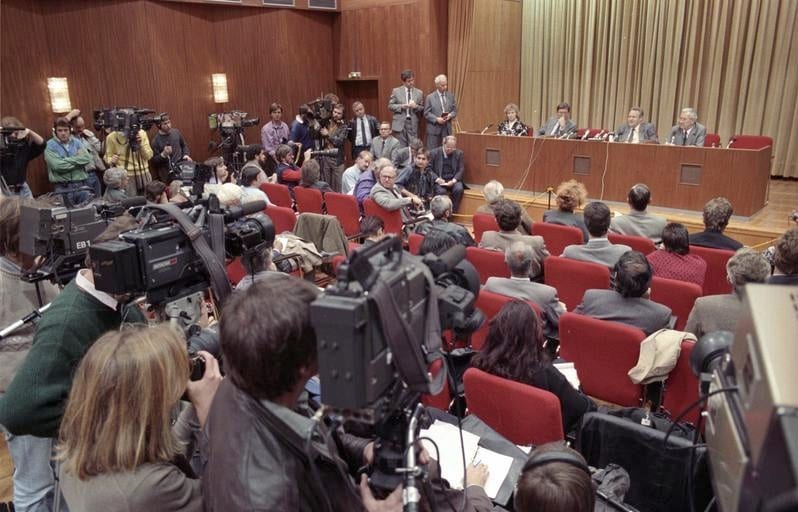
Lecturer’s story — the border commander who opens the gate
Crowds converged on the checkpoints before guards had usable instructions. At Bornholmer Straße, the commander faced tens of thousands pressing toward armed men who had never been prepared for a peaceful mass demand. He concluded that keeping the barrier closed risked panic, crushing, or a nervous shot that could trigger catastrophe. He opened the gate on his own authority. Other checkpoints followed, and by midnight the system was open. The Wall fell not because the concrete disappeared but because people stopped enforcing it. Transcript
Source check — what Schabowski actually changed
The German Federal Archives confirms that the governing bodies had approved a travel measure but that the press material omitted or obscured the intended November 10 publication schedule. Schabowski’s “sofort, unverzüglich” answer reached guards and citizens before operational instructions did. The crowd then compelled local officials to improvise. This was an accidental trigger within a much larger crisis, not a single sentence that independently caused the revolution. German Federal Archives account.
Period photograph — people atop the Berlin Wall
People on the Wall near the Brandenburg Gate during its opening. The altered warning sign asks “How?” one is supposed to be leaving West Berlin, capturing the sudden obsolescence of the border’s language. The Commons page notes that its stated November 9 date is probably imprecise because the mass opening unfolded overnight into November 10. Photograph by Sue Ream. Wikimedia Commons source. CC BY 3.0.
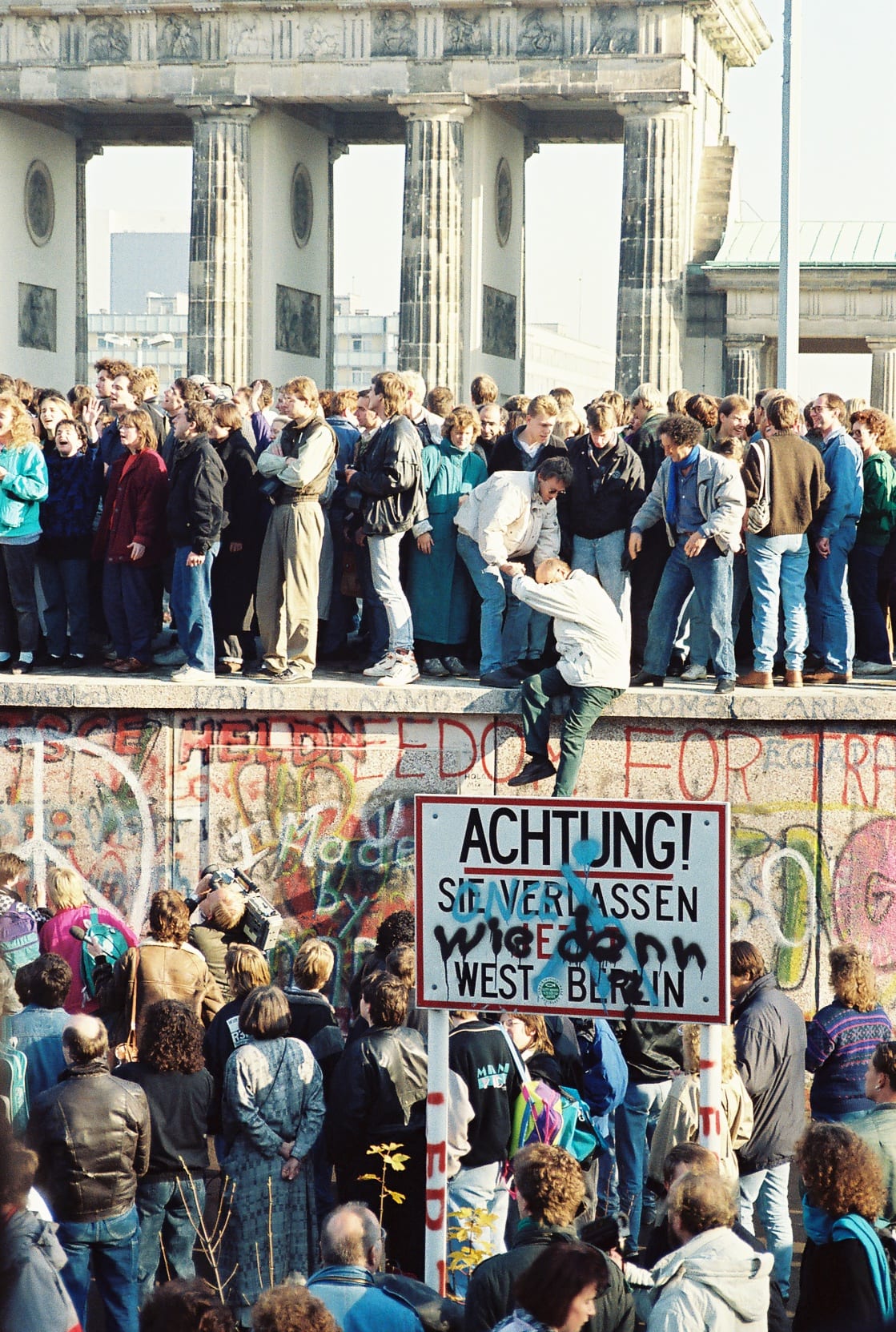
5. Prague: police violence, a false death report, and the Velvet Revolution
Czechoslovak leaders hoped economic stability and continued policing would contain change. On November 17, a sanctioned student commemoration of Jan Opletal developed into an anti-communist march. At Národní Street, riot police trapped peaceful demonstrators, ignored their flowers, candles, songs, and request to leave, and then beat them. No student was killed, but a report spread that a Charles University student named Martin Šmíd had died. There were two students of that name; both were alive. After decades of official lying, producing the men did not immediately restore the government’s credibility. Slides 38–41 (file not included in this release)
Václav Havel and other dissidents formed Civic Forum at the Magic Lantern theater. Actors, students, athletes, workers, and citizens with divergent ideologies united around an end to political monopoly, accountability for the police intervention, release of political prisoners, and public dialogue. Demonstrators jingled keys to tell the rulers that it was time to go home. When the People’s Militia and army declined to attack, the leadership’s remaining leverage collapsed. The party leadership resigned, a two-hour general strike demonstrated overwhelming social support, and parliament removed the constitutional guarantee of communist rule. By December 29, Havel was president. Slides 42–47 (file not included in this release)
Lecturer’s story — a revolution accelerated by a rumor
Malice’s point is not that the Velvet Revolution was fictitious because Martin Šmíd was alive. The police attack was real, public trust had already been destroyed, and the rumor became credible precisely because citizens knew what the security state could do. The strange reversal—authorities finally told the truth and were not believed—shows how repeated lying consumes a government’s ability to communicate even accurate information. Transcript
Period photograph — Wenceslas Square during the Velvet Revolution
A nighttime protest in Wenceslas Square, probably November 24–28, 1989. The image shows the mass civic phase after the November 17 police attack; its dating is approximate and it should not be read as a photograph of the initial student march. Photograph by Robbie Morrison. Wikimedia Commons source. CC BY 4.0.
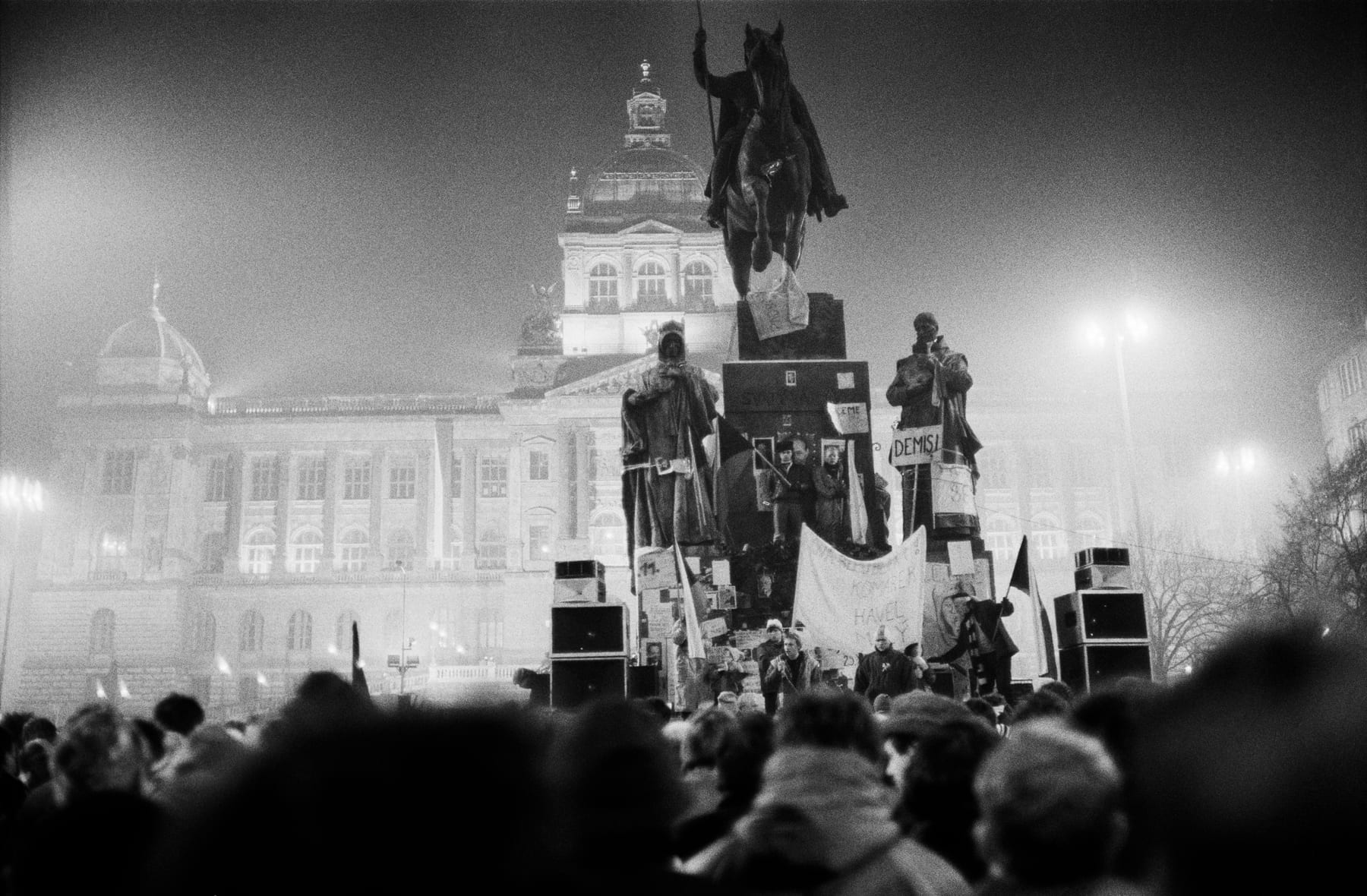
Source check — the Šmíd rumor and injury figures
The Czech Institute for the Study of Totalitarian Regimes confirms that two Martin Šmíds studied at the university and neither was killed. It also documents the security forces’ violent intervention and warns that official contemporary accounts understated injuries. The lecture’s “over 500 injured” should therefore be treated as an estimate, not a securely established exact count. Institute study of the November 17 intervention; Institute teaching file on the rumor.
6. The Stasi loses its mystique and East Germany disappears
After the Wall opened, the East German security state declined with extraordinary speed. Citizens occupied Stasi offices to prevent records from being shredded. The lecture dwells on the reversal: protesters still nervously showed identification when guards asked, then proceeded to take control of the institution that had catalogued their lives. Erich Mielke, once feared as the head of a vast surveillance apparatus, was reduced to insisting before a hostile parliament, “I love all human beings.” The SED renamed itself, expelled former leaders, and tried to assign responsibility to predecessors. Slides 48–49 (file not included in this release)
Malice’s biographical endings are intentionally caustic: Krenz and Schabowski served prison terms; Mielke died after release on health grounds; Honecker’s prosecution ended because of illness; Margot Honecker lived in Chile without recanting. The essential institutional point is that surveillance files, uniforms, and offices did not preserve authority once the public and lower-level officials ceased treating the organization as invulnerable. East Germany held free elections in March 1990 and ceased to exist through reunification on October 3.
7. Romania: revolution, flight, and summary execution
Romania provides the lesson’s violent counterexample. On December 21, 1989, Ceaușescu addressed a carefully organized Bucharest rally intended to prove that he remained in control. Boos and confusion interrupted the ritual; his bewildered pause was broadcast before television transmission failed. As unrest spread and the army’s loyalty fractured, Nicolae and Elena fled the Central Committee building by helicopter, moved through Snagov, landed in a field, commandeered cars, and were captured. Slides 50–54 (file not included in this release)
Period photograph — the Central Committee balcony overtaken by the revolution
The balcony from which Ceaușescu delivered his final speech, occupied by the crowd during the Romanian Revolution. The image captures the physical transfer of a symbolic stage from ruler to public, but not the full sequence of armed conflict elsewhere in Bucharest and Romania. National Museum of Romanian History, Communism in Romania collection; photographer uncredited. Wikimedia Commons source. Reuse permitted with museum attribution.
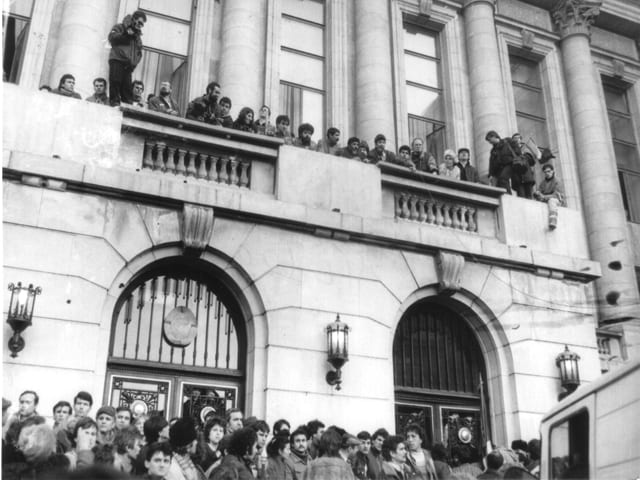
The couple were tried in a classroom by an extraordinary military tribunal on Christmas Day. Defense preparation lasted minutes, the proceedings took less than an hour, charges included an unsupported claim of genocide involving more than 60,000 victims, and the death sentence was executed immediately. Ceaușescu’s refusal to recognize the court did not erase his dictatorship’s crimes, but neither did those crimes make the proceeding a fair trial. The episode belongs both to the overthrow of a violent regime and to the danger of replacing legality with vengeance. Slides 55–57 (file not included in this release)
Lecturer’s story — the dictator discovers that the rally is no longer scripted
The lecture lingers on the instant when Ceaușescu hears boos and cannot interpret them. For decades, applause, slogans, scholarly honors, and public adoration had been organized for him. His face shows not merely fear but incomprehension: a political world designed to return only obedience suddenly produces unscripted feedback. The helicopter flight and complaints in custody extend the same theme—he continues acting as commander-in-chief after the chain of command has ceased to recognize him. Transcript
Source check — the Christmas Day tribunal
Romania’s official December 26 communiqué records the charges, death sentence, confiscation order, and the assertion that the sentence was final and had already been executed. It is a primary record of what the new authority claimed, not proof that the charges or procedure were sound. The “more than 60,000 victims” allegation was grossly inflated, and the immediate execution denied meaningful review. Romania abolished the death penalty less than two weeks later. Official trial communiqué; January 7, 1990 abolition decree.
8. Yeltsin: rivalry, disorder, and a supermarket as political education
Gorbachev’s opening allowed political rivals to speak and organize. Boris Yeltsin, appointed Moscow party chief in 1985, attacked the pace and privileges of perestroika, clashed with Gorbachev, and resigned from the Politburo. The party humiliated and removed him, but the punishment transformed a disgraced official into a public symbol of resistance to the same apparatus Gorbachev hoped to reform. The transcript also includes stories about Yeltsin’s alcohol use, his unexplained 1987 wound, and—years later—Bill Clinton’s account of finding him intoxicated outside Blair House seeking pizza. These anecdotes illuminate temperament and disorder, but they should not substitute for analysis of his institutional power. Slides 58–61 (file not included in this release)
Lecturer’s story — the Houston supermarket
During a September 1989 visit to the United States, Yeltsin made an unscheduled stop at a Randall’s supermarket near Houston. The abundance and ordinary accessibility of food reportedly shocked him more than the Johnson Space Center. Malice treats the visit as an epistemic break: shelves available to ordinary Americans contradicted decades of explanations for Soviet scarcity. Whether every later recollection is perfectly literal, the story captures a real comparative problem—the system had to restrict travel and information because direct observation made its claims harder to sustain. Slides 62–63 (file not included in this release)
9. Lithuania and the contest between union and republic sovereignty
Lithuania restored its independence on March 11, 1990. Gorbachev rejected the act and imposed an economic blockade, arguing that secession had to proceed through a union process. Meanwhile Yeltsin became chairman of the Russian parliament, giving the largest Soviet republic—home to roughly half the union’s population and most of its territory and oil production—an institutional leader independent of Gorbachev. The political question was no longer simply whether Moscow would let satellite governments reform; it was whether the union government could command its own constituent republics. Slides 64–67 (file not included in this release)
Map — the fifteen Soviet republics
The fifteen union republics numbered alphabetically by their later state names. The map clarifies why Russian and Soviet authority were no longer synonymous: Russia was the largest republic but only one constitutional component of the union. Boundaries are schematic and do not resolve later territorial disputes. Map by Master Uegly, derived from work by Aris Katsaris and Saul ip. Wikimedia Commons source. Public domain.
In January 1991, Soviet forces attacked Lithuanian broadcasting and communications sites. Tanks and troops killed civilians at the Vilnius television tower, but thousands continued to protect the parliament and the independence government survived. Gorbachev later denied authorizing the action. As the note records, that leaves two damaging possibilities: either the Soviet president shared responsibility or the coercive apparatus acted beyond his control.
Period photograph — an unarmed Lithuanian confronts a Soviet tank
Vilnius, January 13, 1991. An unarmed civilian stands directly before a Soviet tank during the assault. The photograph powerfully records individual exposure to military force but does not identify the man’s intentions beyond the visible act. Photograph by Andrius Petrulevičius, Lithuanian Central State Archives. Wikimedia Commons source. CC BY 4.0.
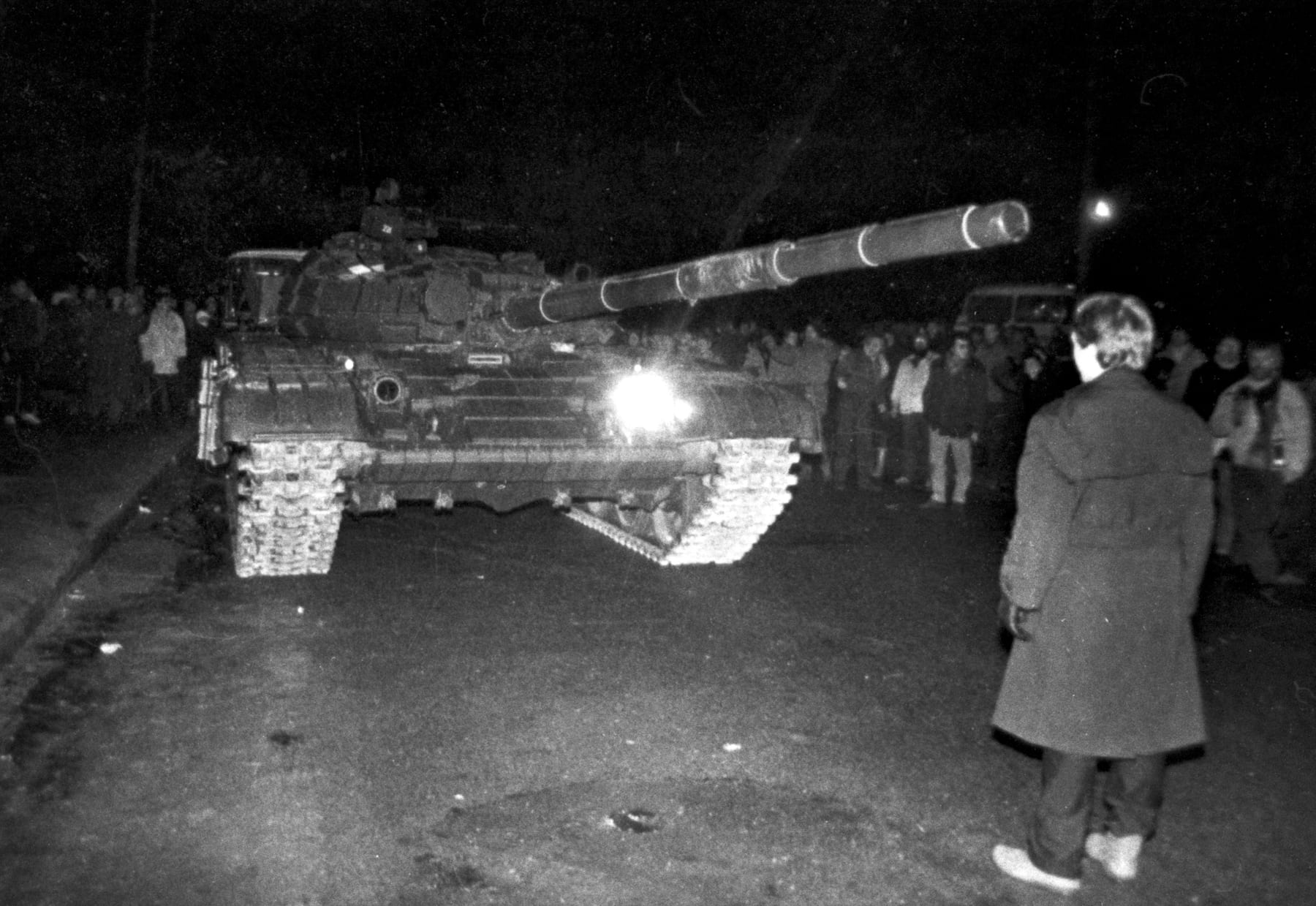
Source check — the January Events death toll
The Lithuanian parliament’s official chronology records thirteen civilians killed during the January 13 assault and more than 500 wounded; Vytautas Koncevičius died of gunshot wounds on February 18, bringing the later civilian commemorative total to fourteen. A Soviet serviceman was also killed. This is more precise than the lecture’s “over a dozen.” Seimas chronology of January 13, 1991.
10. The August coup: dead phones, tanks, and refusals to obey
By summer 1991, Yeltsin had been elected president of Russia while Gorbachev remained president of the USSR. Officials who feared a new union treaty and further loss of party control isolated Gorbachev at his Crimean residence on August 18. Every telephone—including the protected line intended for nuclear emergencies—was dead. A delegation demanded that he declare an emergency or transfer power to Vice President Gennady Yanayev. Gorbachev refused, and the plotters announced that illness had made him unable to govern. Slides 68–71 (file not included in this release)
Lecturer’s story — Raisa Gorbacheva: “We all knew our history”
Hearing that her husband had been removed for reasons of health, Raisa understood the announcement as a possible threat rather than a neutral lie. She hid food, refused anything not sealed in a package, and prepared for poisoning or detention. Gorbachev recorded four copies of a statement proving that he was alive and well, distributing them among trusted people so at least one might survive. The family’s behavior shows how Soviet political memory remained operative even for the people at the top. Transcript
Yeltsin rejected the emergency committee, reached the Russian White House, and made it the center of resistance. Tanks entered Moscow, but their crews did not act as a single obedient force. Citizens built barricades, information circulated by fax and foreign broadcasting, and military officers warned the Russian leadership of the planned assault. The iconic “tank stand” mattered because it visibly transferred initiative from the coup committee to an elected republic leader. Slides 72–77 (file not included in this release)
Period photograph — armored vehicles at the Russian White House
Armored vehicles on Krasnopresnenskaya Embankment near the Russian White House, August 20, 1991. The photograph documents the coup’s military presence; it does not by itself identify which crews supported the plotters, defected, or remained undecided. Photograph by Ole Husby. Wikimedia Commons source. CC BY-SA 2.0.
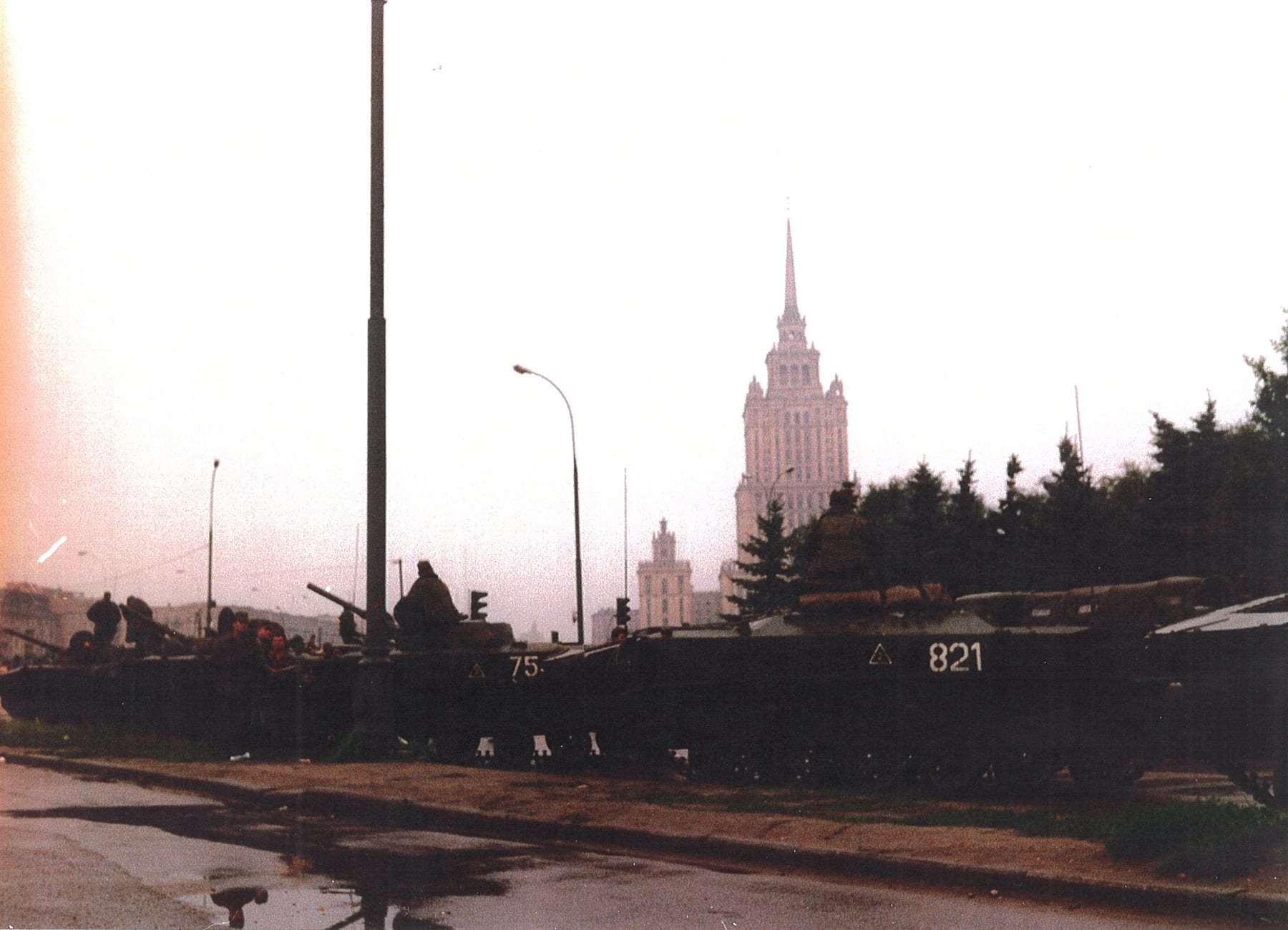


Lecturer’s story — the Alpha Group refuses Operation Thunder
The planned assault on the White House was set for the early hours of August 21. The KGB’s Alpha Group had participated in earlier Soviet assaults, including in Lithuania, but its officers concluded that they would not enter the building to kill civilians. Senior military commanders also withheld cooperation. The immediate consequence was practical, not rhetorical: without reliable armed units, the plotters could proclaim authority but could not seize its main opponents. Transcript
The coup collapsed within three days. Gorbachev insisted that communications be restored before meeting its representatives. Vladimir Kryuchkov and other organizers were arrested; Raisa suffered a temporary stroke during the crisis. The failed seizure had not restored the union. It had demonstrated that the party, KGB, and armed forces could no longer coordinate decisive coercion. Slides 78–80 (file not included in this release)
Source check — why the coup was attempted
The Library of Congress archival overview identifies the immediate objective as preventing the planned new union treaty and restoring party authority. It also emphasizes Yeltsin’s elected Russian presidency and the White House as the rallying point for resistance. This supports the lecture’s institutional account while leaving individual conversations and motives dependent on memoir evidence. Library of Congress, “Internal Workings of the Soviet Union”.
11. Demystification, republic independence, and dissolution
After the coup, Gorbachev suspended Communist Party activity while officials tried to destroy records. The most important collapse was psychological as well as legal. Michael Dobbs’s line that a party of fifteen million members met its demise without resistance expresses the disappearance of mystique: once archives, privileges, private behavior, and frightened leaders became visible, the “bureaucratic supermen” looked ordinary and self-protective. The coercive center had lost both obedience below and belief outside itself. Slides 81–83 (file not included in this release)
Republic declarations now accelerated. Estonia and Latvia restored independence during the coup; Ukraine, Belarus, Azerbaijan, Armenia, and others followed or confirmed earlier declarations. The decisive popular vote came in Ukraine on December 1: 90.32% supported independence, including majorities in every administrative region. On December 8, the leaders of Russia, Ukraine, and Belarus declared that the USSR had ceased to exist and formed the Commonwealth of Independent States; the Alma-Ata arrangements broadened the settlement later that month. Gorbachev resigned on December 25. The Soviet flag came down over the Kremlin, and on December 26 the union’s remaining legislative body formally recognized the end. Slides 84–85 (file not included in this release)
Source check — Ukraine’s vote and the USSR’s international succession
Ukraine’s official historical institute records 28,804,071 yes votes, or 90.32%, correcting the lecture’s rounded 92%. The United Nations records a separate legal consequence: on December 24, Yeltsin notified the secretary-general that the Russian Federation would continue the USSR’s membership, including its Security Council seat, with support from the CIS states. The Soviet state ended, but not every international right or obligation simply vanished. Ukrainian Institute of National Memory; United Nations membership history.
12. The lecture’s conclusion: contingency, progress, and moral memory
Malice closes by attacking the assumption that the Soviet Union’s persistence made it permanent. The prediction that U.S.–Soviet bipolarity would continue indefinitely could appear realistic in 1981; ten years later the union no longer existed. Yet the course should not be reduced to a triumphalist claim that all post-Soviet problems disappeared. The lecturer explicitly denies a happy ending or attainable utopia. His argument is narrower: imperfect aftermath does not nullify genuine victories over political systems that imprisoned movement, speech, organization, and memory. Slides 86–87 (file not included in this release)
The final warning concerns political imagination. Authoritarian systems cultivate an appearance of omniscience and inevitability. Lessons 7 and 8 show why that appearance can fail: rulers receive fabricated information; officials avoid responsibility; citizens coordinate around churches, unions, theaters, elections, and republic institutions; and armed subordinates discover that refusal is possible. “Freedom defeated tyranny” is the lecture’s normative summary. Historically, the more precise conclusion is that the Soviet order became vulnerable when its stories, incentives, command relationships, and willingness to use mass violence ceased reinforcing one another.
What to retain from Lesson 8
- The collapse was not a single event. Hungary’s opening, Leipzig’s nonviolent breakthrough, the Wall’s opening, the Velvet Revolution, Romania’s violent overthrow, republic sovereignty, and the August coup each removed a different support of the Soviet order.
- Gorbachev’s nonintervention was causally essential but not sufficient. Polish unions, churches, Hungarian reformers, East German demonstrators, Czechoslovak civic networks, Baltic independence movements, and Russian institutions supplied the organized action.
- Security forces repeatedly made the decisive choice. Border guards opened gates, East German forces stood down, Czechoslovak militia and army units refused repression, and Soviet military and KGB elements declined to storm the Russian White House.
- Information failures mattered in both directions: Schabowski’s mistake opened a border; the false Šmíd report mobilized a public conditioned to distrust official truth; fax machines and foreign media defeated coup censorship; and exposed records demystified the party and police.
- Romania warns against assuming that liberation automatically produces legality. Ceaușescu’s dictatorship fell, but the summary tribunal and immediate execution did not constitute a fair judicial reckoning.
- The fall of East European communist governments and the dissolution of the USSR were related but distinct. After Moscow abandoned military enforcement abroad, the union itself faced competing republican governments and independence mandates.
- Important corrections: approximately 600–700, not 2,000, crossed at the Pan-European Picnic; October 9 drew about 70,000 in Leipzig; the November 4 Alexanderplatz demonstration is commonly estimated around 500,000, not 700,000; thirteen civilians died on January 13 in Lithuania and a fourteenth later died of wounds; Yeltsin won the Russian presidency with about 57%, not 59%; and Ukraine’s independence vote was 90.32%, not 92%.
Questions for course-level synthesis
- Which mattered most to the Soviet system’s fall: economic failure, loss of ideological credibility, organized civil society, nationalist sovereignty, Western pressure, or the refusal of coercive institutions to keep killing?
- Did Gorbachev destroy the system by reforming it, save Eastern Europe by refusing intervention, or lose control of processes that no leader could have safely contained?
- How should the peaceful transitions in Poland, Hungary, East Germany, and Czechoslovakia be compared with Romania’s violence and the Soviet use of force in Lithuania?
- What evidence would be needed to test Malice’s claim that Western experts broadly assumed Soviet permanence, rather than accepting it as a memorable retrospective judgment?