Filed with 60.23 History · Related: 60.13 Wars · 60.14 Colonialism
Thanks for the clarification. I’ll begin a thorough investigation into the transition from empires to modern states during the 19th century in Europe, the Middle East, and Asia—focusing on intra-continental empire collapses and colonial transformations that led to new national borders.
This will include:
- A list and medium-detail overview of new countries formed
- Maps showing territorial changes before and after
- Associated wars and conflicts
- Data on population displacement, forced migrations, and resettlements
I’ll let you know once everything is ready for review.
The 19th century was a period of dramatic political transformation across Europe, the Middle East, and Asia. Several long-standing empires declined, contracted, or underwent internal restructuring, giving rise to new nation-states and redrawn boundaries. This era saw the collapse or reform of intra-continental empires – such as the Ottoman, Austro-Hungarian (Habsburg), Qing, and Russian Empires – as well as the breakup of some colonial empires (notably the Spanish Empire) resulting in independent countries. Nationalist movements, international rivalries, and colonial ambitions all played a role in reshaping the map. Below is a comprehensive overview by region, highlighting major imperial transitions, newly formed countries or territorial reorganizations, key wars driving these changes, and the human impact in terms of displacement and resettlement.
Europe: Decline of Multi-National Empires and Rise of Nation-States
By 1800, Europe was dominated by large empires or imperial confederations: the Napoleonic French Empire (briefly), the Austrian Habsburg Empire, the Russian Empire, the Ottoman Empire (holding territory in the Balkans), and loose remnants of the Holy Roman Empire. The Congress of Vienna (1814–1815) reorganized Europe after the Napoleonic Wars, restoring or strengthening conservative monarchies (Europe and nations, 1815-1914 - The map as history). However, the century that followed saw relentless pressures of nationalism and liberal revolution that the old multi-ethnic empires struggled to contain. One by one, regions broke away or unified into modern nation-states:
-
The Napoleonic Upheaval and Vienna Settlement: The French Revolutionary and Napoleonic Wars (1792–1815) had already dismantled the Holy Roman Empire (dissolved in 1806) and spread nationalist ideas. After Napoleon’s defeat, the Congress of Vienna attempted to restore the pre-Revolutionary order, but could not erase the growing desire of peoples for self-determination. France’s occupation of Europe had kindled nationalist sentiments in Germany, Italy, Poland, and Spain, setting the stage for later independence movements.
-
Austrian (Habsburg) Empire’s Reforms and Contractions: The Austrian Empire (after 1867 known as the Austro-Hungarian Empire) was a vast multi-ethnic realm in Central Europe. It underwent internal reform but also lost territory during the 19th century. The Habsburgs ceded their German Confederation leadership to Prussia after the Austro-Prussian War (1866) and surrendered Lombardy (1859) and Venetia (1866) to a unifying Italy. In 1867, the empire was restructured by the Compromise of 1867 into a dual monarchy (Austria-Hungary) to appease Hungarian nationalism. This preserved the empire until World War I, but within it various nations (Czechs, Slovaks, Poles, South Slavs, Ukrainians, Italians, etc.) were agitating for autonomy. Notably, Hungary gained equal status (though not full independence) in the dual monarchy.
-
Russian Empire’s Expansion and Relative Stability: The Romanov Russian Empire did not collapse in the 19th century – in fact it expanded, reaching the Pacific and Central Asia – but it too faced pressures. Russia played the role of both suppressor and victim of nationalist movements: it crushed Polish uprisings (1830–31, 1863) and governed Congress Poland directly; it also clamped down on Ukrainian and Baltic separatism. Yet, by century’s end Russia was dubbed the “prison of nations” with many minorities restive under Tsarist rule. Militarily, Russia’s ambitions were checked in the Crimean War (1853–1856), where an alliance of Britain, France, and the Ottomans defeated Russia – forcing Russia to cede territory in Bessarabia and accept the Black Sea’s neutralization. Internally, Russia in 1861 emancipated the serfs, a major social transformation toward a modern state. But the seeds of future collapse (realized in 1917) were being sown by economic lag and political discontent.
-
Ottoman Empire’s Retreat in Europe: Often called the “Sick Man of Europe” by the mid-19th century, the Ottoman Empire saw its European territories fragment into new states. National revolts, frequently supported by the Great Powers, led to Ottoman contraction in the Balkans. (The Ottoman changes in the Middle East are covered in the next section.) In Southeast Europe, the Ottoman decline was so pronounced that by 1912 only a small strip of territory in eastern Thrace remained under Istanbul’s control (one) (one). The Eastern Question – what would happen as Ottoman control receded – dominated 19th-century diplomacy.
New Countries and Territorial Reorganizations in 19th-Century Europe
Several new nations emerged or took their modern form in Europe during the 19th century, often as a result of the weakening of the above empires or the consolidation of smaller states. Key examples include:
-
Greece: The Greek War of Independence (1821–1829) liberated Greece from Ottoman rule with European support. The new Kingdom of Greece was recognized in 1830 – the first new nation-state to break from the Ottoman Empire (Ottoman Empire - Wikipedia). The war was brutal; essentially all Muslims (Turks and allied Albanians) in the territory of independent Greece either fled or were killed by its conclusion (one). As one historian notes, “After the Greek Rebellion of 1822 to 1830 all of the Turks of the new Greek Kingdom were gone; all had either migrated or died.” (one) Greece started as a small kingdom in the Peloponnese and Athens region. Over the century it expanded northward – annexing Thessaly in 1881 and Epirus, Macedonia, Crete, and the Aegean Islands in the early 20th century – reaching roughly its modern borders. When Thessaly was added in 1881, about 70,000 more Turkish Muslims left those territories for the shrinking Ottoman domains (one).
-
Serbia: The Serbian Revolution (1804–1815) against Ottoman authority established Serbia as an autonomous principality by 1817 (Ottoman Empire - Wikipedia). Initially a vassal state (under the Ottoman Sultan’s suzerainty), Serbia gradually expanded its territory and gained full de jure independence after the Russo-Turkish War of 1877–78. The Congress of Berlin (1878) recognized Serbia as a fully independent kingdom (it was proclaimed a kingdom in 1882). However, Serbia’s expansion was limited; some Serb-inhabited regions (Bosnia, Kosovo, etc.) remained outside its control. By 1878, Serbia’s Muslim population had largely fled or been expelled: in areas taken by the Serbian state, over 90% of Muslims were gone (around 119,000 people forced out) (one). These refugees (along with those from other Balkan states) swelled the Muslim populations in Ottoman-held lands.
-
Romania: The regions of Wallachia and Moldavia, historically vassals of the Ottoman Empire on the lower Danube, took advantage of Russian protection and Ottoman weakness. They united in 1859 under Prince Alexandru Ioan Cuza, forming the basis of modern Romania (the United Principalities). Full independence was achieved in the Russo-Turkish War of 1877–78: Romania became independent (and was recognized as a kingdom in 1881) (Ottoman Empire - Wikipedia). Romania had to cede Bessarabia’s southern part to Russia, but received Dobruja from the Ottomans. Like Serbia, Romania’s independence led to the flight of most Muslims (mainly Turks and Tatars in the Danube delta): roughly 83% of Muslims (152,000 people) left Romanian territory around 1877–78 (one).
-
Bulgaria: The Bulgarian national revival culminated in the April Uprising (1876) against Ottoman rule, which was brutally suppressed (with up to 100,000 Bulgarian civilians killed in reprisals) (Ottoman Empire - Wikipedia). This atrocity prompted Russian intervention in 1877. The ensuing peace (Treaty of San Stefano, revised by the 1878 Congress of Berlin) carved out a large autonomous Principality of Bulgaria (in practice independent, though nominally still under the Sultan) and a separate autonomous province of Eastern Rumelia. Bulgaria gained de jure independence in 1908, uniting with Eastern Rumelia. The creation of an autonomous Bulgaria in 1878 caused massive population shifts – in the areas that became Bulgaria, an estimated 515,000 Muslims fled and 288,000 were killed during the 1877–78 war and its aftermath (one). Only about 46% of the pre-war Muslim population remained in what became Bulgaria (one), while some Bulgarian Christians from Ottoman Thrace resettled into the new country. Bulgaria’s independence thus fundamentally changed the ethnic map of the region.
-
Montenegro: Always a peculiar case, the tiny mountainous Montenegro had been de facto autonomous for centuries, resisting Ottoman conquest. It was formally recognized as an independent principality in 1878 at the Congress of Berlin. Montenegro roughly doubled its territory after 1878 but was still very small. Virtually all Muslims in areas annexed by Montenegro were expelled or killed (later analysis shows 100% of Muslims were gone from the regions it took) (one), given the long history of conflict between Montenegrins and the Ottoman-aligned Muslim population.
-
Italy: The Italian peninsula was unified for the first time since the Roman Empire. Italy’s unification (the Risorgimento) occurred in stages between 1859 and 1870, driven by the Kingdom of Sardinia-Piedmont and leaders like Cavour and Garibaldi. This was not a case of an imperial collapse per se, but the decline of Austrian influence and the ousting of other rulers (the Bourbons in the south, the Pope in Rome) were necessary for nationhood. Austria’s defeat in 1859 (Franco-Austrian War) led it to relinquish Lombardy, and its defeat in 1866 (Seven Weeks’ War with Prussia) forced it to cede Venetia to the new Italian state. By 1870, Italy had incorporated most of the peninsula (taking Rome from French-backed papal control). The emergence of Italy as a unified nation-state in 1861 (proclaimed Kingdom of Italy) thus partly came at the expense of the Austrian (Habsburg) Empire’s holdings. About a quarter million people died in the wars of Italian unification, but the process did not create the kind of refugee crises seen in the Balkans (since these were wars between standing armies rather than ethnic expulsions).
-
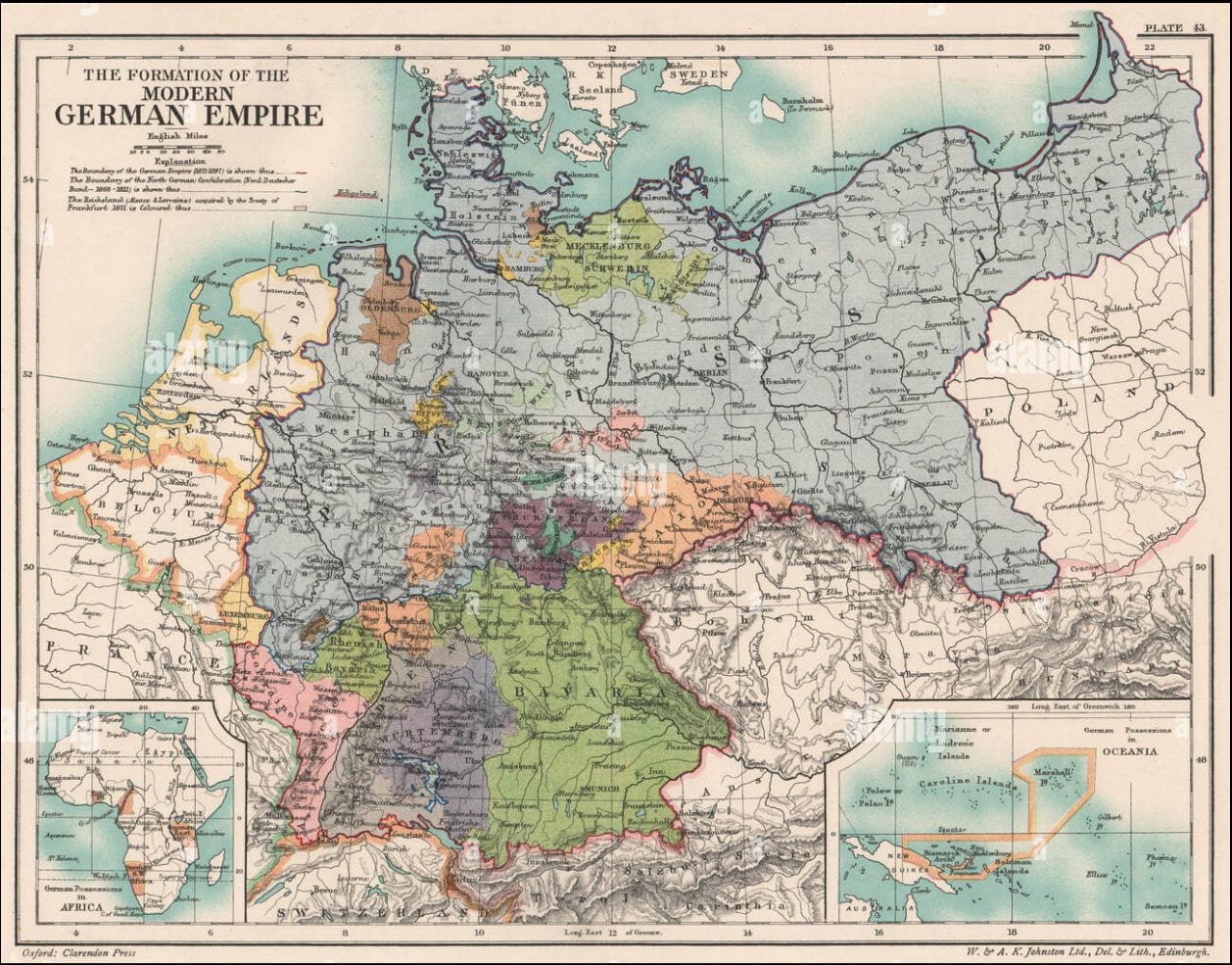
Germany: Similarly, the formation of a unified German Empire in 1871 under Prussian leadership transformed Central Europe. The old German Confederation (loose successor to the Holy Roman Empire) had been presided over by Austria, but Prussia’s victory in 1866 effectively excluded Austria and consolidated the northern German states. After a war with France (1870–71), the southern German states joined the German Empire proclaimed in 1871. The creation of Germany didn’t stem from an imperial “collapse” so much as the reorganization of many small monarchies into a nation-state, but it did mark the final end of Austrian influence in Germany. The unification was formalized by diplomatic means and force of arms (notably the wars of 1866 and 1870). The German Empire’s formation did not itself cause major population displacements (as it was more unification than fragmentation), but it did accelerate the decline of French influence (France ceded Alsace-Lorraine in 1871) and the old order in Central Europe.
-
Belgium: In Western Europe, Belgium emerged as a new country in 1830. What is now Belgium had been merged with the Netherlands in 1815 as the United Kingdom of the Netherlands. Differences in religion and language led to the Belgian Revolution (1830), resulting in an independent Kingdom of Belgium recognized in 1831. This was a relatively quick secession and did not involve the collapse of a multi-ethnic empire, but rather the breakup of a post-Napoleonic merger. Casualties were limited (in the low thousands) and there was minimal population displacement – aside from some population exchange of Dutch officials and withdrawal of Dutch troops, the inhabitants generally stayed in place since the conflict was brief.
-
Others: A few other notable changes: Norway and Sweden were joined in a personal union after 1814; Norway had been ceded by Denmark to Sweden. Norway maintained internal autonomy and peaceful nationalism led to the dissolution of the union in 1905, making Norway fully independent (just after the 19th century). Poland, which had been partitioned out of existence in the late 18th century by Russia, Prussia, and Austria, did not regain independence in the 19th century (despite the uprisings mentioned). However, the idea of Polish nationhood stayed alive, and de facto Poland did exist as the Duchy of Warsaw under Napoleon (1807–1815) and then as a Russian-controlled “Congress Poland” (1815–1860s) before being absorbed. The failure of the 1863 uprising led to intensified Russification. Ireland remained under British rule throughout the 19th century, although the Great Famine (1845–49) and push for Home Rule set the stage for eventual independence in the 20th. Spain’s own European territory stayed intact (aside from losing control of its American colonies), but Spain went through civil strife (the Carlist Wars) and a brief loss of its monarchy (1873–74 First Republic) before stabilization.
Map – Europe’s Changing Borders: The map below illustrates the contraction of Ottoman territory in the Balkans by circa 1900, as well as the new nation-states (Greece, Serbia, Romania, Montenegro, Bulgaria) that emerged in Southeastern Europe. Ottoman European provinces like Bosnia-Herzegovina were occupied by Austria-Hungary (eventually annexed in 1908). This visual highlights old imperial boundaries versus the new national borders at the end of the 19th century. (Balkan Wars | Facts, Causes, Map, & Significance | Britannica) (“Turkey in Europe” and the Balkan states after 1878.)
Wars and Conflicts Driving Change in Europe
Numerous wars and revolts in the 19th century accelerated the transition from empires to nation-states in Europe. Some key conflicts and their outcomes include:
-
Napoleonic Wars (1803–1815): A series of continent-wide wars led by Napoleonic France against various coalitions. Napoleon’s conquests spread revolutionary ideals and redrew borders; after his defeat, the Congress of Vienna sought to restore the old order but also left a legacy of compact, strengthened states (like the Netherlands, the German Confederation, and a enlarged Prussia) that would later facilitate unification movements.
-
Greek War of Independence (1821–1829): A nationalist uprising of Greeks against Ottoman rule. The war drew in Great Power intervention (Britain, France, Russia) on the Greek side and resulted in Greek independence. It was marked by extreme violence, including the massacre of civilian populations (e.g. the Chios massacre in 1822) and large-scale population exchanges (the departure or killing of virtually all Turks in the territory of the new Greek state) (one).
-
Revolutions of 1848: A wave of liberal and nationalist revolts across Europe. In the Austrian Empire, the 1848 revolutions led to a Hungarian War of Independence (1848–1849), in which Hungarian rebels declared separation from Habsburg rule. The revolution was crushed with Russian help, but it demonstrated the deep national tensions in the empire. Elsewhere, 1848 saw failed attempts to unify Germany and Italy by liberal means, foreshadowing the later, more conservative-led unifications.
-
Crimean War (1853–1856): Fought mainly in Crimea and the Black Sea, this war pitted the Russian Empire against an alliance of the Ottoman Empire, Britain, France, and Sardinia. Russia’s defeat checked its southward expansion for two decades and preserved Ottoman rule in the Balkans a bit longer. The war had significant human costs: beyond military casualties (~500,000+ deaths from battle and disease combined among all sides), it caused mass displacement of Crimean Tatars. Following Russia’s loss, between 200,000 and 300,000 Crimean Tatars fled Russian-annexed Crimea for Ottoman territory, fearing Russian reprisals and oppression (one). (These were in addition to an earlier Tatar exodus of ~100,000 after Russia annexed Crimea in 1783 (one).) The Crimean War thus not only altered great-power politics but also led to lasting demographic change in Crimea (which was largely depopulated of its indigenous Tatars).
-
Second Italian War of Independence (1859): Fought by France and Sardinia-Piedmont against Austria. Victory led to Austrian withdrawal from Lombardy; this war was crucial for Italian unification. Third Italian War of Independence (1866): Italy (allied with Prussia in the Austro-Prussian War) seized Venetia as Austria was defeated. Franco-Prussian War (1870–1871): Prussia’s decisive victory unified Germany and also ended French hegemony in Europe, resulting in France ceding Alsace-Lorraine to the new German Empire.
-
Russo-Turkish War (1877–1878): A pivotal conflict that liberated much of the Balkans from Ottoman control. Russia (supporting Orthodox Slavs and Bulgarians) invaded Ottoman Europe and Anatolia. The Ottomans were defeated, leading to the Treaty of San Stefano and Congress of Berlin. Outcomes: independence for Romania, Serbia, Montenegro, and autonomy for Bulgaria (as noted above) (Ottoman Empire - Wikipedia). The war was extremely costly for civilians, especially Muslims in the Balkans. Contemporary records indicate that in Ottoman Europe, some 515,000 Muslims fled and 288,000 died due to the war (one). In some regions taken by new states, entire Muslim communities vanished (e.g. in Montenegro’s gains, 100% of Muslims were gone; Serbia’s gains, 91% gone) (one). Conversely, about 187,000 Bulgarian Christians resettled from remaining Ottoman lands into the new Bulgaria (one). The war thus caused one of the 19th century’s great refugee crises, as discussed in the next subsection.
-
Wars of German Unification: The Austro-Prussian War (1866) and Franco-Prussian War (1870–71) were instrumental in consolidating Germany. While these did not directly create new countries (rather, they merged existing ones), they destroyed the old framework (the German Confederation) and removed Austria and France as obstacles to nationhood. These wars had significant military casualties (e.g. ~45,000 dead in 1866, ~180,000 dead in 1870–71) but little in the way of population expulsions, since they were traditional inter-state wars.
-
Other Conflicts: The Polish November Uprising (1830–31) and January Uprising (1863) against Russian rule, though unsuccessful, resulted in mass deportations of Polish patriots to Siberia and the abolition of what autonomy Poland had. Russian Poland (Congress Kingdom) was fully integrated and russified after 1863, which some historians view as the “death” of the Congress Kingdom. The suppression of Hungary’s 1848 revolt similarly led to executions and exile of Hungarian leaders (e.g. Lajos Kossuth fled to the Ottoman Empire). These uprisings didn’t create new states at the time, but they kept the idea of those nations alive until the 20th century.
Human Impact: Displacement and Migration in Europe
The 19th-century transition from empires to nation-states in Europe often came with large-scale population upheavals. As old multiethnic empires broke apart, people moved (or were forced to move) to align with new borders or escape persecution. Major instances include:
-
Flight of Muslims from the Balkans: The independence of Balkan Christian nations led to the exodus of millions of Muslim residents (Turks, Albanians, Circassians, Bosniaks, and others) who had lived under Ottoman rule. Historians estimate that from the late 18th century through the early 20th (roughly 1790–1923), over 5 million Muslims were driven from or voluntarily left Europe (the Balkans, Crimea, Caucasus) to refuge in remaining Ottoman lands (Ottoman Empire - Wikipedia) (Ottoman Empire - Wikipedia). Many also perished during these tumultuous events. For example, the Greek War of Independence saw tens of thousands of Turkish Muslims and Jews massacred or expelled from the Peloponnese and other areas, while Greeks in some Ottoman reprisals (like the Constantinople massacre of 1821 or during the war) also suffered. The Russo-Turkish War of 1877–78 and subsequent nation-building caused a massive outflow: in Bulgaria alone, more than half a million Turkish-Muslims became refugees and nearly 300,000 died during the conflict (one). Likewise, Serbia, Montenegro, and Greece, upon expanding, saw most of their Muslim populations leave. Contemporary research by McCarthy et al. finds that in regions annexed by Balkan Christian states, between 1876 and 1913, the Muslim population declined by 60–100% due to death or exile (one) (Ottoman Empire - Wikipedia).
-
Refugees into Ottoman Domains: The Ottoman Empire, for its part, accepted vast numbers of Muslim refugees (known as muhacirs) from lost territories. In the late 19th century, Ottoman Anatolia and Thrace were inundated with these settlers. One estimate indicates that 7–9 million Muslims from the Balkans, Caucasus, and Crimea relocated into Ottoman Anatolia/Thrace during the empire’s slow collapse (Ottoman Empire - Wikipedia) (Ottoman Empire - Wikipedia). This dramatically changed the demographic makeup of Anatolia, increasing the Turkish/Muslim share of the population. Whole new villages were founded by Circassian and Balkan refugees in western Anatolia and Syria. The Ottomans also at times intentionally resettled these immigrants to reinforce loyalty in volatile areas (an early example of demographic engineering).
-
Circassian and Caucasian Expulsions: Relatedly, on the empire’s Asian fringe, the Russian conquest of the Caucasus (1817–1864) led to the expulsion of the Muslim Circassian and Abkhaz peoples. Around 1.2 million Circassians and Abkhazians were expelled by Tsarist Russia in the 1860s, nearly all of whom took refuge in Ottoman lands (one). The journey and resettlement were deadly – roughly one-third of them died from starvation or disease along the way (one). This event (sometimes termed the Circassian genocide) emptied the northwest Caucasus; today, Turkey and the Middle East have large diaspora communities of these peoples. Similarly, after Russia annexed Muslim-majority regions like Kazan (Volga) and Crimea, many Tatars and others fled: we saw earlier that up to 300,000 Crimean Tatars left after the Crimean War (one) (adding to earlier migrations). The Caucasus campaigns also involved population exchanges: as Russia took over what is now Armenia, many local Muslims (Azeri Turks) fled south while many Christian Armenians migrated in (one) – for instance, about 20,000 Muslim Turks fled Erivan (Yerevan) province in 1827–1829, their lands then populated by Armenian settlers (one).
-
Jewish Migrations: Although not directly tied to “new nation-state formation” in the 19th century, it’s worth noting the mass emigration of Jews from the Russian Empire in the late 1800s. Facing pogroms (especially after 1881) and restrictive laws, approximately 2 million Jews left the Russian Empire between 1880 and 1914, mostly to the United States. This can be seen partly as a result of the Russian Empire’s failure to accommodate national and religious minorities in an era of nationalism. (Meanwhile, some Jews in Western Europe began adopting Zionism, aiming to eventually create a nation-state of their own in Palestine – though that materializes only in the 20th century.)
-
Economic Migration and Settler Movements: The 19th century also saw large movements of people for economic reasons which intersected with imperial transitions. The Irish Great Famine (1845–49), under British rule, led to the migration of over 1 million Irish abroad (mostly to North America). Within Italy, after unification, poverty drove many Italians to emigrate (launching a diaspora of some 10+ million Italians by 1914). These were voluntary migrations but on a mass scale. The formation of nation-states did not immediately alleviate economic hardships, so many citizens sought better opportunities overseas, creating modern immigrant nations like the United States and Argentina.
In summary, Europe’s 19th-century evolution from empires to nation-states was turbulent. By 1900, the map of Europe had been redrawn: where once large empires and composite kingdoms stood, now nations like Italy, Germany, Greece, Serbia, Romania, and others had taken their place. The old empires that still existed (Austria-Hungary, Ottoman Turkey, and Russia) were visibly weakened and filled with internal strains. Crucially, these political changes exacted a huge human toll: in addition to those killed in wars, millions were uprooted – especially Muslims fleeing the Balkans, but also ethnic minorities in conflict zones throughout the continent. The stage was set for the final denouement of the continental empires in the early 20th century (World War I), but the 19th century had already irreversibly transformed the European order.
Middle East: Ottoman Collapse and Colonial Carve-Up
In the Middle East, the 19th century is defined largely by the decline of the Ottoman Empire and the growing influence of European colonial powers (Britain, France, and Russia). At the start of the century, the Ottoman Empire still controlled most of the Middle East: Anatolia (modern Turkey), the Levant, Mesopotamia (Iraq), the Arabian Peninsula’s coasts, Egypt (as a semi-autonomous province), and the Maghreb (North Africa) as far as Algeria. Persia (Iran) under the Qajar dynasty was another major entity, and to the east, Afghanistan had just emerged as an independent realm. By 1900, much had changed: the Ottomans had lost control of North Africa and Egypt, Western powers had established footholds or protectorates, and local powers like Egypt and Arabia were on paths diverging from Istanbul. While most new nation-states in the Middle East proper would only emerge in the 20th century, the 19th century set the stage by fragmenting the old empires and drawing new boundaries. This section examines the shrinking of Ottoman power, territorial reorganization under colonial pressure, and the human impact in the region.
-
Ottoman Empire’s “Sick Man” Era: In the Middle East, unlike in the Balkans, the Ottomans did not face ethnically motivated independence movements (Arabs and others did not yet seek independent nations in the 1800s), but the empire was challenged by ambitious governors and foreign encroachment. The Egyptian Revolt under Mehmet Ali was a key episode: Muhammad Ali Pasha, the Ottoman governor of Egypt, modernized his army and defied the Sultan. He seized Syria and parts of Arabia in 1831, and defeated the Ottoman forces, coming close to overthrowing the Sultan. Only intervention by Britain, Russia, and Austria forced Muhammad Ali to back down in 1840 (Ottoman Empire - Wikipedia) (Ottoman Empire - Wikipedia). In return, he secured hereditary rule in Egypt – effectively making Egypt a self-governing khedivate (still nominally Ottoman) from 1841 onward. This was the first major territorial loss of Ottoman central authority in the Middle East. The Ottoman attempt to reassert control in 1839 had failed until the Great Powers stepped in (Ottoman Empire - Wikipedia), highlighting Ottoman dependency on Europe.
-
Loss of North Africa: The Ottoman hold on its African provinces slipped away. Algeria, which had been an autonomous Ottoman regency, was invaded and conquered by France beginning in 1830. The conquest was brutal – tens of thousands of Algerians were killed in the initial French campaign (Ottoman Empire - Wikipedia), and by the end of the 19th century French rule was consolidated (with perhaps hundreds of thousands of Algerian deaths over decades of resistance). Algeria became a French colony (eventually organized as an integral territory of France). Tunisia followed – in 1881 France imposed a protectorate over Tunisia (Treaty of Bardo), effectively taking control from the Ottomans (who had only nominal suzerainty there). Libya (Tripolitania and Cyrenaica) remained Ottoman until much later (Italy would invade in 1911), but by 1900 the Ottomans had lost all of North Africa except that. The Turkic and Arab populations in North Africa generally remained in place under new colonial rulers, though some loyalist families emigrated to Ottoman lands. Notably, many Algerians, disillusioned by French rule, migrated to other parts of the Ottoman Empire (like Syria) in the late 19th century, and some Muslim tribes in Tunisia did as well – a pattern of Muslim flight from European colonization similar to what happened in the Balkans.
-
Anglo-Ottoman Struggles in Egypt and Arabia: After Muhammad Ali’s quasi-independence, Egypt drifted into the British sphere. The Suez Canal (opened 1869) made Egypt strategically vital. In 1882, amid an Egyptian nationalist revolt (the Urabi Revolt), Britain intervened militarily and occupied Egypt (Ottoman Empire - Wikipedia). Thereafter, Egypt, while still officially an Ottoman province under Khedive Tewfik, was under effective British control (a veiled protectorate). This marks a transition: Egypt was no longer truly part of the Ottoman imperial system, and it would eventually become a British protectorate in 1914. In the Arabian Peninsula, the Ottomans reasserted themselves in the western coast (the Hijaz, containing the holy cities Mecca and Medina) and the province of Yemen in the 1870s, but much of the interior was beyond their control. The First Saudi State (1744–1818) had been crushed by an Egyptian-Ottoman expedition, but the Second Saudi State (Emirate of Nejd, 1824–1891) rose in central Arabia. It too fell apart by 1891 due to internal disputes and Ottoman pressure. By 1900, a new Saudi leader (Abdulaziz Ibn Saud) was beginning to reconquer territories – leading to the Third Saudi State in the 20th century. In essence, the Ottoman Empire lost Arabia piece by piece: while the Hijaz railway and Ottoman garrisons held key towns, the tribes of Arabia were increasingly independent. The Trucial States (what is now the UAE) and Oman entered into British protectorate agreements in the 19th century (1820s onward), reducing Ottoman influence in the Gulf. Kuwait likewise came under British protection in 1899, detaching itself from Ottoman Basra. These arrangements redrew political lines: by 1900, the Persian Gulf sheikhdoms (Kuwait, Bahrain, Qatar, and the Trucial Coast) were effectively outside Ottoman control and under British oversight, precursors to the Gulf states of today.
-
Persia (Qajar Iran) and Russian/British Encroachment: The Qajar Dynasty ruled Persia through the 19th century and, while not colonized, it suffered significant territorial losses to Russia. The Russo-Persian Wars (1804–1813 and 1826–1828) ended with Iran ceding the Caucasus territories: modern-day Georgia, Armenia, and Azerbaijan were taken by the Russian Empire (Treaties of Gulistan 1813 and Turkmenchay 1828). This was a permanent loss of Persian imperial land in the Caucasus. Large numbers of Muslims fled these regions when Russia took over – e.g., during the 1820s, about 20,000 Azeri Turks fled Erivan (Armenia) into remaining Persian territory, while tens of thousands of Christian Armenians moved the opposite direction into the new Russian Caucasus (one). Later in the century, Britain and Russia contended for influence in what became known as the Great Game. While Persia remained sovereign, it was forced to yield concessions: e.g., Russia and Britain divided Persia into informal spheres of influence in 1907 (with the north under Russian influence, the southeast under British, and a neutral center). Earlier, Britain had already wrested away Herat (western Afghanistan) from Persian influence, to safeguard India. The Anglo-Persian War (1856–1857) was fought when Persia tried to reassert control over Herat; Britain defeated them and the Treaty of Paris (1857) obliged Persia to abandon claims on Afghanistan. Thus, by the late 19th century Persia had lost the Caucasus and ceased attempts to control Afghanistan, but it did begin its own reform process with the Persian Constitutional Revolution (1905–1911), nudging toward a modern constitutional state (albeit one soon undermined by foreign interference).
-
Afghanistan: The Emirate of Afghanistan emerged in 1747 under Ahmad Shah Durrani, but in the 19th century it became a buffer between the Russian and British empires. The British fought two major wars in Afghanistan: the First Anglo-Afghan War (1839–1842) (a failed British attempt to install a puppet ruler) and the Second Anglo-Afghan War (1878–1880). The second war ended with Afghanistan effectively a British protectorate in foreign affairs (Treaty of Gandamak 1879), though not annexed. Importantly, the Durand Line (1893) was agreed as the border between British India and Afghanistan. This Durand Line (which cuts through Pashtun tribes) later became the modern Pakistan-Afghanistan border. During these conflicts, Afghanistan did not fracture into new states, but its boundaries were refined by imperial interests, drawing new lines on the map of the Middle East’s eastern edge. The wars were devastating locally – the First Anglo-Afghan War famously saw an entire British-Indian garrison of about 16,000 (including families/camp followers) wiped out during a retreat. Many Afghan towns were ruined in the fighting. Although Afghanistan remained intact, its inability to protect its own foreign policy foreshadowed the era of high imperialism.
-
Ottoman Modernization and the Armenian Question: Internally, the Ottomans attempted reforms (Tanzimat, 1839–1876; First Constitutional Era 1876–78) to modernize the state and grant equal rights to all subjects, hoping to forestall nationalist separatism. These had limited success. By the 1890s, the empire faced new internal strife – notably, discontent among the Armenian Christian minority in Anatolia, who agitated for reform or autonomy. Sultan Abdul Hamid II reacted harshly, leading to the Hamidian Massacres (1894–1896) in which 100,000–300,000 Armenians were killed in Ottoman Anatolia (Ottoman Empire - Wikipedia). Many Armenian villages were destroyed, and thousands of survivors fled, some to Russian Armenia, others to the Levant or abroad. This was a grim prelude to the even larger Armenian tragedy during World War I, but it underscores that by the end of the 19th century the Ottoman Empire was experiencing violent convulsions even in its core Middle Eastern lands. Those events did not create a new country but did deepen communal divisions that would shape the 20th-century emergence of new states (Turkey, Armenia, etc.).
Territorial Changes and New Boundaries in the Middle East (19th Century):
-
Egypt: Functionally independent from 1805 under Muhammad Ali, and under British occupation from 1882. While not a sovereign country yet, it was no longer truly under Ottoman control. This foreshadows Egypt’s later independence (it became a British protectorate in 1914 and gained nominal independence in 1922). Egypt’s autonomy also allowed it to build its own empire for a time – Muhammad Ali conquered the Sudan (1820s) and waged war into Arabia and the Levant. His dynasty continued to rule Egypt (and Sudan) under British oversight. Historical context: The British defended Ottoman suzerainty in name to prevent a total collapse that rivals (like France or Russia) could exploit, but effectively Britain treated Egypt as part of its route to India (Suez Canal) (Ottoman Empire - Wikipedia). New boundaries: The 1880s saw British-delineated borders in the Sinai (between Egypt and Ottoman Palestine) and in Sudan (the concept of an Anglo-Egyptian Sudan). Egypt’s semi-detachment meant the Ottoman Empire lost one of its most populous and rich regions. Population impact: Egypt’s population in 1800 was about 4 million; by 1900, it grew to ~10 million under relative stability. However, the British suppression of the Urabi Revolt (1882) caused some thousands of casualties, and a portion of the Egyptian army was disbanded. Leaders of the nationalist revolt (Colonel Urabi and others) were exiled (Urabi to Ceylon). The British occupation also eventually led to some rural dislocation as economy shifted to export agriculture (cotton), though mass displacement was limited.
-
Sudan: Muhammad Ali’s forces conquered Sudan (the Nilotic Sudan) in the 1820s, establishing nominal Egyptian-Ottoman rule. In 1881, a religious leader, the Mahdi, revolted against Anglo-Egyptian rule, leading to the Mahdist War (1881–1899). The Mahdists actually defeated the British at Khartoum in 1885 (General Gordon was killed) and set up the Mahdist State for over a decade. The British finally crushed this state in 1898 at the Battle of Omdurman. In 1899, Sudan was re-organized as the Anglo-Egyptian Sudan, a condominium effectively run by Britain. So by the end of the 19th century, Sudan had passed from Ottoman/Egyptian control to British control (with Egyptian consent). The Mahdist rebellion caused immense loss of life – perhaps a million Sudanese perished due to war, famine and disease in that tumultuous period – and it produced refugee movements as well (Egyptian Sudanese loyalists fleeing north in 1885, etc.). After reconquest, some Sudanese Mahdist supporters were in turn displaced or sold into slavery. Sudan’s formal independence would come much later (1956), but the British conquest fixed its borders roughly (with some frontier adjustments with French West Africa and Italian Eritrea).
-
The Levant: The Ottoman provinces of Syria and Iraq remained under Ottoman control in the 19th century, but not without interference. In the Levant, France took an interest as a protector of Maronite Christians. A civil war in Mount Lebanon (1860) between Druze and Maronite communities led to French intervention and the establishment of the Mount Lebanon Mutasarrifate – an autonomous district under a Christian governor – within the Ottoman Empire. This was an example of a territory being reorganized due to international pressure. It wasn’t an independent country, but a special administrative unit that foreshadowed later division of the Levant. Meanwhile, Britain and France’s contests in the region would intensify around World War I (with the Sykes-Picot Agreement), beyond our period. Population shifts: In 1860’s Lebanon conflict, thousands of Christians were massacred in Damascus and Mount Lebanon, and many survivors fled (some to Egypt). The Ottomans with European oversight then resettled some refugees back and ensured a power-sharing system. This was a smaller scale demographic effect compared to the Balkan or Caucasian exoduses, but significant locally.
-
Iraq and Arabia: 19th-century Iraq (Mesopotamia) stayed Ottoman, but with difficulty. Tribal uprisings were frequent. The Muntafik and Shammar tribes, for example, sometimes required military campaigns to subdue. In the late 19th century, the Ottomans tightened administration (the Tanzimat reforms) to better integrate Iraq, which meant sedentarizing some nomads and settling Circassian refugees in places like Amman (in today’s Jordan) (Population transfer in the Ottoman Empire - Wikipedia) (Population transfer in the Ottoman Empire - Wikipedia). Arabia, as noted, saw the rise and fall of the Saudi emirates. After the collapse of the Second Saudi State in 1891, the Rashidi dynasty (allies of the Ottomans) controlled central Arabia from Ha’il. The Ottomans reoccupied the Hijaz (the Sharif of Mecca remained an Ottoman vassal) and nominally Yemen. Yemen was troublesome; the highland Zaydi imams rebelled periodically, presaging a permanent break by 1910. Boundaries: Few formal borders existed in Arabia then – boundaries were fluid deserts. One exception: the Treaty of Erzurum (1847) between Persia and the Ottoman Empire delineated their frontier in Iraq and eastern Turkey, which largely survives as today’s Iran-Iraq and Iran-Turkey borders. This followed conflicts over territory like Kurdistan and proxy fights in what is now Iraq. The treaty, mediated by the British and Russians, settled a long-disputed boundary and represents a rare case of a clearly drawn international border in the region during the 19th century.
Key Wars in the Middle East (19th Century): Several conflicts marked the imperial transitions:
-
Greek War (covered above) and Russo-Turkish Wars (1828–29 and 1877–78) – these had Middle Eastern fronts (e.g., the Russians captured Erzurum and Kars in eastern Anatolia in 1877–78). By the Treaty of Berlin (1878), the Ottomans lost Kars and Batum to Russia in the Caucasus. As a result, many Muslims in those areas (e.g., 78,000 Turks from the Kars/Ardahan area) fled south into the Ottoman heartland (one), while the Russians encouraged Armenians to move into those regions. These wars thus affected the eastern Ottoman provinces, transferring territory that is now in Armenia/Georgia to Russian control.
-
Egyptian–Ottoman Wars (1831–33, 1839–41): Muhammad Ali’s campaigns against the Sultan. The first war resulted in the Egyptian occupation of Syria; the second ended with European intervention. These conflicts effectively made Egypt a power on its own and temporarily gave it Syria and the Hijaz. The human cost included heavy casualties in battle and the devastation of Syrian districts (the 1830s conflict saw cities like Acre besieged). When the Ottomans returned to Syria, some pro-Egyptian locals were persecuted, and Egyptian occupation troops withdrew. The outcome was Egypt’s autonomy and the return of Syria to direct Ottoman rule – but significantly weakened Ottoman authority and prestige.
-
Anglo-Persian War (1856–57): A short war where Britain seized Persian-held Herat to keep it out of the hands of a Qajar Shah (who might threaten India). Persia’s defeat cemented the separation of Herat (West Afghanistan) from Iran. It was a minor conflict but symptomatic of imperial power projection. Persian losses were small (a few thousand), but the strategic loss was large – Iran’s dream of regaining influence in Central Asia was dashed.
-
Anglo-Afghan Wars: These did not break up an empire but aimed to control Afghanistan’s orientation. The First War’s disaster showed the limits of imperial might, while the Second War secured British interests. Afghan civilian populations suffered from reprisals by both sides; for instance, during Britain’s re-invasion in 1879, villages were burned in punitive raids. Some Afghans fled to neighboring regions (a number of Afghan chiefs went into exile in British India or Persia after losing to the British-supported emir Abdur Rahman). The net result was Afghanistan’s isolation – it did not fracture, but its borders (Durand Line) split ethnic groups like Pashtuns and Baluchis between Afghanistan and British India.
-
Mahdist Revolt in Sudan (1881–98): This can be seen as a colonial-era “breakaway state.” The self-proclaimed Mahdi, Muhammad Ahmad, expelled Turco-Egyptian administrators and in 1885 established an Islamic state centered in Omdurman. It took until 1898 for the British-Egyptian forces under Kitchener to reconquer Sudan. The fall of Khartoum (1885) shocked Victorian Britain (General Gordon’s death). When the Mahdist state fell, Sudan became effectively a new territorial unit under Anglo-Egyptian rule. The violent decade of Mahdist rule and the war to end it depopulated regions of Sudan – estimates suggest perhaps 50% of Sudan’s population perished due to war, famine, disease in those years. Many Sudanese (especially in the north) were displaced – either fleeing to Egypt or into the southern Sudan forests to escape the Mahdists or Anglo-Egyptian retribution. After 1898, some Sudanese rebels were deported or migrated (e.g., some Mahdist adherents went to the Hijaz). This was one of the deadliest conflicts in the Middle East in the late 19th century, illustrating how colonial interventions could spark massive upheavals.
-
Yemeni Ottomans Wars: In the 1870s and 1890s, the Ottomans fought protracted campaigns against the Zaydi Imams in Yemen (southwest Arabia) to retain control. These conflicts were less well-known internationally but were brutal locally – sieges of highland forts, destruction of crops, etc. Many Yemeni highlanders retreated to inaccessible areas to resist. Eventually (1911) the Ottomans granted a form of autonomy to the Imam. Yemen wasn’t independent in the 19th century, but these struggles presaged its break in WWI. Some Yemenis, especially Ismaili communities, migrated to Ottoman Syria during this period due to the instability.
Population Displacement and Resettlement in the Middle East
Much like in the Balkans, imperial contractions in the Middle East led to significant population movements, though often of a slightly different character (more inter-imperial migration and less formation of homogeneous nation-states until the 20th century). Key instances include:
-
Caucasian Migrations: The Circassian exile (1860s) discussed earlier primarily affected the Ottoman Middle East. The Ottoman government resettled large numbers of these North Caucasian Muslim refugees in Anatolia, but also in the Levant and Balkans. For example, Circassian communities were settled in what is now Jordan, Syria, and Israel. These settlers sometimes displaced local populations or altered local demographics. In Jordan, Circassians were settled in Amman (which had been mostly abandoned) in 1880, laying the foundation for the modern capital of a new country (Transjordan) that would form post-WWI (Population transfer in the Ottoman Empire - Wikipedia) (Population transfer in the Ottoman Empire - Wikipedia). Their loyalty to the Sultan provided a counterweight to potentially rebellious local tribes. Overall, the 1.2 million Circassian/Abkhaz expellees caused a humanitarian crisis; the Ottoman Empire had to find housing and food for them. Many died en route (an estimated 500,000 deaths (one)), and those who survived often arrived destitute. Nonetheless, they and their descendants became part of the social fabric of the Middle East.
-
Muslim Flight from the Caucasus and Crimea: Similarly, Crimean Tatar refugees and Azeri/Turkish refugees from the Caucasus (fleeing Russian conquest) were resettled in Ottoman domains. Some Crimean Tatars settled in Anatolia and Dobruja (Romania) under Ottoman rule. Nogai Tatars from the steppes north of the Black Sea also moved en masse into Anatolia after Russia expanded. For instance, after the Crimean War, around 300,000 Crimean Tatars and Nogais fled to the Ottoman Empire (one). Their vacant lands in Crimea were taken by Russian settlers. Many of these Tatar refugees were settled in Ottoman Bulgaria and Dobruja — until those areas themselves were lost, triggering a second exodus when Bulgaria became independent. By 1878, Dobruja (now Romanian) had an influx of Muslim refugees while its native Bulgarians had left for Bulgaria (one).
-
Lebanon and Syria: The conflicts of 1860 in Mount Lebanon (Maronite-Druze war) caused about 10,000 Christians to be killed and many villages burned. France sent ships that evacuated thousands of Christian survivors. These refugees went to Beirut, Damascus (some were later killed in Damascus riots), or abroad. After order was restored, an estimated 100,000 people were displaced in the short term. Many Maronites eventually returned under the new autonomous administration, but some chose to emigrate (the beginnings of the Lebanese diaspora to the Americas can trace roots to the 1860s unrest). Additionally, as the 19th century progressed, economic migration from the Levant grew – by the 1890s, thousands of Levantine Christians (and some Muslims) went to Egypt (under British prosperity) or to the Americas seeking better fortunes, partly because local economies were disrupted by integration into world trade and periodic sectarian tensions.
-
Jewish Resettlement in Palestine: In the late 19th century, the Zionist movement began the organized migration of European Jews to Ottoman Palestine (the First Aliyah in 1882–1903). By 1900, about 50,000 Jews had settled in Palestine (many escaping Russian pogroms). While small in number relative to the population, this marks a new phenomenon of population movement that would lead to major 20th-century changes (the establishment of Israel). Ottoman authorities were wary but often allowed Jewish land purchases. Thus, the tail end of the 19th century saw the initial redrawing of demographic lines in Palestine, setting the stage for a new nation-state conflict in the future.
-
Mecca Pilgrims and Slaves: A different kind of migration relevant to the Middle East is the annual Hajj pilgrimage – not a displacement, but it did result in some permanent resettlements. In the 19th century, tens of thousands of Muslims from India, Central Asia, and Africa traveled to Mecca/Medina. Some stayed (especially Indians and Central Asians who opened businesses or joined Sufi orders in the Hijaz). Others died during epidemics or returned home. There was also the Indian Muslim soldiers who came with the British to garrison Egypt and Sudan; a number of them settled or married locally, adding a South Asian element to Red Sea coastal populations. The slave trade (though increasingly suppressed) also relocated populations: e.g., Ethiopian and East African slaves were brought to Egypt and Arabia; some later became part of free communities (the ancestors of some groups in Mecca and Jeddah today). These are side notes to political transitions, but they highlight the population intermixing under the imperial systems.
-
Persia and Central Asia: The Russian takeover of Turkestan (Central Asia) in the 1860s-1870s led to some local Khans and their followers fleeing to Persia or Afghanistan. After the fall of Tashkent and Samarkand, a number of Uzbek nobles escaped south. Conversely, Russian rule opened an outflow of Persians to Russian lands for work (the Caucasus oilfields attracted Persian labor migrants by the 1890s). The net result was new diaspora communities (Persian speakers in Baku, Bukharan Jews in Afghanistan, etc.), but not on the massive scale of the Ottoman refugee flows.
In sum, the Middle East in the 19th century underwent a gradual breakup of Ottoman hegemony. Unlike the Balkans, where new nation-states were formed immediately, in the Middle East the immediate result was often colonial control or autonomous regions rather than fully independent countries. By 1900, the Ottoman Empire had lost North Africa and Egypt, retained a restive grip on the Arab heartlands, and was financially at the mercy of European powers (having declared bankruptcy in 1875). Persia retained its dynasty but was under heavy foreign influence. The human consequences were significant: traditional populations were displaced by war (Armenians in Anatolia, Turkmen and Kurds in Russian/Persian conflicts, etc.), and large influxes of refugees (Circassians, Tatars, Algerians) arrived in the region, adding new layers to the demographic mosaic. These shifts laid the groundwork for the new countries of the 20th century Middle East – such as Turkey, Iran’s modernized state, the Arab states carved from Ottoman lands, and the partition of the Arabian Peninsula – but those developments accelerated after World War I. The 19th century was essentially a time of imperial contraction and informal colonization in the Middle East, rather than outright independence movements (with the significant exception of Egypt’s trajectory).
Asia: The Fall of Eastern Empires and the Colonial Redrawing of Borders
In Asia, the 19th century was marked by the decline of once-mighty Asian empires (the Qing dynasty in China, the Mughal Empire in India, and regional powers like the Maratha and Burmese kingdoms) and the aggressive expansion of Western colonial empires (primarily Britain, France, and Russia). By 1900, much of Asia was either directly ruled or strongly dominated by European powers, except for a few reforming states like Japan and Siam. The transitions from indigenous empires to modern states in Asia often involved colonial rule as an intermediate stage – unlike in Europe, where new sovereign nations appeared, in Asia new political entities often took the form of colonies or protectorates, with genuine independence delayed to the 20th century. Still, the 19th century saw profound changes: dynastic collapses, territorial losses, social upheavals, and the beginnings of modernization that would shape Asia’s modern nations. Here we outline the major imperial transformations in East, South, and Southeast Asia, along with key wars and population impacts.
-
Qing China’s Decline and Territorial Contraction: The Qing Dynasty (1644–1912) was at its height at the start of the 19th century, ruling over not just China proper but also Tibet, Xinjiang, Mongolia, and Manchuria – a vast multi-ethnic empire. The 19th century proved disastrous for Qing China, which faced internal rebellions and external wars that it largely lost. While the Qing state did not collapse until 1911, by 1900 it had “gradually lost control of its peripheral territories” (Qing dynasty - Wikipedia) and suffered partial colonization by foreign powers. Major events and transitions:
-
Opium Wars and Foreign Encroachment: Defeats by Western powers forced China to open up ports and cede territory. In the First Opium War (1839–1842), Britain’s victory led to the Treaty of Nanking: China had to cede Hong Kong Island to Britain (Qing dynasty - Wikipedia) and open five treaty ports to trade. This marked the beginning of the “treaty century.” The Second Opium War (1856–1860) (with Britain and France) led to further humiliation: more ports opened, foreign legations in Beijing, legalization of the opium trade, and cession of the Kowloon Peninsula (adjacent to Hong Kong) to Britain and parts of Manchuria to Russia. In 1860, via the Treaty of Beijing, the Qing ceded to Russia the Maritime Provinces north of Korea (including Vladivostok) – “large chunks of territory in the Northeast” (Qing dynasty - Wikipedia). By this, China lost access to the Sea of Japan and a region now called Outer Manchuria. Simultaneously, France and Britain secured long-term leases in other ports. These wars signaled that China, once the dominant power in East Asia, had become semi-colonized. No new Chinese nation-state emerged; instead, foreign “spheres of influence” divided the Qing realm (Britain in the Yangtze Valley, France in the southwest, Russia in Manchuria, etc.). The Chinese populace suffered as ports like Shanghai effectively fell under foreign administration, and the economy came under foreign domination. Population impact: The Opium Wars themselves caused limited population displacement – casualties were a few thousand Chinese soldiers and civilians – but the ensuing foreign presence led to migrations such as Chinese coolies leaving from the treaty ports and some coastal Chinese moving inland to avoid colonial influence.
-
Taiping Rebellion (1850–1864): Perhaps the deadliest civil war in history, this massive rebellion against Qing rule was a pseudo-nationalist, quasi-Christian movement led by Hong Xiuquan. The Taiping Heavenly Kingdom controlled much of southern China at its height, seeking to overthrow the Qing. The rebellion was eventually crushed by Qing forces (with foreign aid), but at an appalling cost: an estimated 20–30 million people died (Taiping Rebellion | Causes, Effects, & Facts - Britannica) (Millions Dead: The Three Most Horrific Civil War Ever) from warfare, famine, and disease as a result of the Taiping Rebellion. Large swathes of the fertile Yangtze Delta were devastated. Population displacement was enormous – millions of Chinese fled the war zones. Some became long-term refugees: for example, many people from war-torn provinces like Guangdong and Fujian emigrated overseas (to Southeast Asia, the Americas, etc.) during and after the Taiping era, both to escape chaos and in search of livelihoods (this was the beginning of the great Chinese diaspora). The rebellion’s end in 1864 did not restore the old order fully – Qing authority was weakened and regional armies (under generals like Zeng Guofan and Li Hongzhang) gained power, a devolution that persisted. The Taiping Rebellion “irrevocably altered the Qing dynasty”, as Britannica notes (Taiping Rebellion | Causes, Effects, & Facts - Britannica), leaving it much enfeebled.
-
Other Internal Rebellions: Concurrent with Taiping, the Qing faced the Nian Rebellion (1851–1868) in north China and two Muslim rebellions: the Panthay Rebellion in Yunnan (1856–1873) and the Dungan Revolt in Northwest China (1862–1877). All were violently suppressed. In the Dungan Revolt (by the Hui Muslim people in Shaanxi, Gansu, Xinjiang), casualties reached the millions (perhaps 8–10 million dead, including civilians). When the Qing reconquered Xinjiang in 1877 (after also expelling Yaqub Beg’s short-lived Kashgaria), many defeated Muslim rebels fled to Russian Central Asia. There are accounts of at least 10,000 Dungan (Hui) people fleeing into Russian Turkestan after 1877 (Dungan revolt (1862–1877) | Military Wiki - Fandom), where the Russian Empire gave them refuge in areas like modern Kyrgyzstan and Kazakhstan. This created a Hui diaspora outside China. Meanwhile, Qing victory in Xinjiang led to the formal creation of Xinjiang Province in 1884, incorporating that region as part of China (even as some Uighur and Kazakh communities resisted). These upheavals did not produce new states at the time (except the short-lived regimes of the rebels), but did cause major demographic shifts and the weakening of Qing control. Whole regions like northwest China were depopulated – for instance, the Hui population of Shaanxi was almost wiped out (those who survived fled to Russia or were relocated).
-
Foreign Invasions and Loss of Tributaries: Qing China also lost influence over several neighboring lands that had traditionally acknowledged Chinese suzerainty:
- Vietnam: China’s centuries-old tributary, Vietnam, was invaded by France. In the Sino-French War (1884–1885), the French defeated China’s southern fleet and forces. The war ended with the Treaty of Tientsin (Tianjin) in 1885, in which China recognized the French protectorate over Vietnam (Annam and Tonkin) (Qing dynasty - Wikipedia). In essence, China gave up its claims and influence in Vietnam (Qing dynasty - Wikipedia), and France went on to form French Indochina (which by 1893 included Cambodia and Laos as well). This was a key moment: the Qing dynasty, traditionally the hegemon of East Asia, had to accept a Western power replacing it in Vietnam. Population impact: The Vietnamese population came under French rule; some pro-Chinese Vietnamese officials fled to China after the conquest, and Vietnam’s economy was redirected to serve France. In China’s Guangxi and Yunnan provinces, the war caused disruption and many Chinese soldiers died, but civilian displacement was minor and localized (some border area tribes migrated to escape battles).
- Korea: Long a tributary of China, Korea (Joseon dynasty) was fought over by China and an emerging Japan. The First Sino-Japanese War (1894–1895) was a decisive Japanese victory. The Treaty of Shimonoseki (1895) forced China to recognize the complete independence of Korea (ending its tributary status) and to cede Taiwan and the Pescadores Islands to Japan (Qing dynasty - Wikipedia). Japan also initially got the Liaodong Peninsula, but the Triple Intervention by Russia, France, and Germany compelled Japan to give Liaodong back to China (though Russia then leased it from China in 1898, taking Port Arthur). The net effect: China lost Taiwan – which became Japan’s first colony in Asia – and lost suzerainty over Korea, which became a Japanese protectorate by 1905 and was annexed in 1910. Population impact: The war itself caused tens of thousands of deaths (mostly Chinese and Korean soldiers). Taiwanese resistance to Japanese takeover in 1895 led to several months of guerrilla war, during which thousands of Taiwanese were killed; some elite Taiwanese fled to China rather than submit to Japanese rule. Korea’s “independence” initially meant the end of the old tributary trade and the beginning of Japanese economic penetration, which caused social upheaval; anti-Japanese Koreans (and soldiers of the Qing’s erstwhile garrison in Seoul) left Korea after 1895 (some Korean reformers even went into exile in China or Russia during the tumult).
- Southeast and Central Asia: Burma (Myanmar) was historically under partial Chinese influence (as well as Indian). The Konbaung Dynasty of Burma fell to Britain in stages (Anglo-Burmese Wars of 1824, 1852, 1885) – by 1886 Burma was annexed to British India. China had considered Burma a tributary in the 18th century, but had no real say in its fate by the 19th. The fall of Burma eliminated a buffer kingdom, extending British India’s border to Yunnan. Similarly, Siam (Thailand) navigated pressures by ceding territory: in 1893 Siam ceded Laos to France, in 1907 western Cambodia to France, and in 1909 Malay territories to Britain – preserving its core independence at the cost of peripheral lands. These adjustments were negotiated without war with China, but they illustrate how Asian political geography was redrawn: traditional mandala spheres were replaced by European map partitions. China’s role as a regional overlord was supplanted by Western powers partitioning Southeast Asia.
- Russian Expansion in Northeast and Central Asia: Russia not only took the Amur basin from Qing China in 1858–60, but also expanded into Central Asia, conquering the Khanates of Kokand, Bukhara, and Khiva by 1873. While this didn’t directly take land from Qing China (except the Ili region in northwest Xinjiang, which Russia occupied 1871–81 before returning it under pressure), it encroached on what China considered its sphere (nominal Qing influence extended to some Kazakh and Kyrgyz tribes). The result was that by 1880 the map of Central Asia was basically the Russian Empire up to the borders of Afghanistan and Iran. Population impact: One notable movement was after Russia took the Ili Valley: a large number of Muslims (Taranchi Uyghurs and Dungan Hui) fled Chinese Ili when the Qing briefly reasserted control in 1881 – about 45,000 Muslim refugees (mostly Dungans) moved to Russian turf rather than stay under Qing rule. This was the tail-end of the Dungan Revolt aftermath. Central Asian nomads like the Kazakhs also had to choose allegiance; many Kazakh clans opted to be under Russian protection in the 1840s–1860s, effectively migrating or at least shifting loyalty (some even moved into Russian territory). This ended the Kazakh Khanate and incorporated those peoples into the Russian realm.
-
Modernization Attempts: Despite all these blows, the Qing did attempt a “Self-Strengthening” reform movement after the mid-century, building arsenals, a navy, and initiating industrialization. However, conservative resistance and fiscal strain meant China lagged behind the powers. Defeats like the Sino-Japanese War were stark evidence. In 1898, the young Guangxu Emperor tried the Hundred Days’ Reforms, a more radical modernization push, but it was suppressed by the Empress Dowager Cixi. This turmoil set the stage for the Qing’s eventual fall (and indeed sparked the anti-foreign Boxer Rebellion in 1900, where peasant xenophobia led to an international intervention in Beijing).
By 1900, although the Qing dynasty still ruled on paper, China had been carved into spheres of influence and had lost peripheral territories (some historians describe it as a “semi-colony”). The idea of China as a nation-state (as opposed to a dynasty) was growing among reformers, leading to the 1911 revolution shortly after. In effect, the 19th century transitions “from empire to modern state” in China would culminate in the early 20th century with the birth of the Chinese Republic, but the groundwork was laid by the imperial disintegration and foreign incursions of the 1800s.
-
-
Collapse of the Mughal Empire and the Rise of British India: In South Asia, the once dominant Mughal Empire had already fragmented in the 18th century, but it survived in weakened form until 1857. At the start of the 19th century, large parts of the Indian subcontinent were under the control of the British East India Company, but several Indian states remained: the Maratha Confederacy, the Sikh Empire in Punjab, Mysore, Hyderabad, etc., alongside Mughal Delhi (a figurehead emperor). The 19th century saw Britain systematically conquer or annex these polities, forging the British Raj which became the precursor to several modern countries (India, Pakistan, Bangladesh, Myanmar). Major milestones:
-
Anglo-Maratha Wars (1803–1818): A series of conflicts that ended in the defeat of the Maratha Confederacy, the last major power resisting British domination in India. By 1818, the Maratha territories were annexed or put under British subsidiarity. This effectively left the British East India Company as the paramount power across India, with only a few princely states remaining autonomous under British suzerainty.
-
Conquest of Sindh and Punjab: The Sindh region (now in Pakistan) was conquered by the British in 1843. The Sikh Empire in Punjab, founded by Ranjit Singh, was a formidable state in the early 19th century. After Ranjit’s death, the British fought two Anglo-Sikh Wars (1845–46 and 1848–49). The Sikhs were defeated, and in 1849 Britain annexed the Punjab. The annexation of Punjab also included territories in the northwest like Peshawar. With this, by 1850 Britain controlled the entire Indian subcontinent from Afghanistan’s border to Burma, except for some semi-autonomous princely states. The absorption of Punjab marked the final collapse of indigenous imperial power in India – the Mughal emperor in Delhi was by then a ceremonial figure under Company protection.
-
Indian Rebellion of 1857 (First War of Independence): Sparked by discontented sepoys (Indian soldiers in Company service) and various princes and peasants, the great revolt of 1857–1858 was a last, albeit fractured, attempt to uproot British rule. Rebels in northern India proclaimed the restoration of Mughal authority under Emperor Bahadur Shah II. The British brutally suppressed the rebellion by 1858. In its aftermath, the British Crown took direct control (the British Raj), abolishing the East India Company. The Mughal Empire was formally ended – the last Mughal emperor was deposed and exiled to Burma. Many smaller princely dynasties were also extinguished or punished (e.g., the Nawab of Awadh). The rebellion saw huge loss of life – some estimates say 800,000 to 1,000,000 Indians (combatants and civilians) died in the violence and famine that accompanied it. Entire cities like Delhi and Lucknow were ravaged. There were also targeted reprisals: British forces executed or displaced communities along the Ganges where resistance was strong. Population movements: After 1857, some Muslim aristocrats from the fallen courts (Delhi, Lucknow) emigrated to the princely state of Hyderabad or to Mecca, unable to reconcile with British rule. British revenge included mass hangings and village burnings, causing survivors to flee regions like Rohilkhand temporarily. In the long term, the Raj period brought more stability (no immediate new states until 1947), but the trauma of 1857 lingered in memory.
-
Integration of Princely States: Post-1858, the subcontinent was a patchwork of directly ruled provinces and indirectly ruled princely states. The latter (around 565 in number) were autocratic states under British paramountcy. No new independent countries were formed in the 19th century from this structure, but this dual system laid the basis for future divisions. Regions like Hyderabad, Mysore, Kashmir, Travancore etc. had internal sovereignty but not external – they represent the lingering of pre-modern states into the modern era, ended only by integration after Indian and Pakistani independence.
-
Burma (Myanmar): Burma was one of the last holdouts. The Burmese kingdom engaged in wars with the British, which it lost. British annexation came in phases: Lower Burma in 1826 (after the First Anglo-Burmese War) and all of Burma in 1886 (after the Third Anglo-Burmese War). Burma was then administered as part of British India until 1937. The fall of the Konbaung dynasty meant the end of Burmese sovereignty. The last king, Thibaw, was exiled to India. Population impact: The annexation opened the floodgates for Indian immigration to Burma – by the early 20th century, Indian communities (traders, laborers) made up a significant portion of Rangoon’s population under the British Empire. Conversely, some Burmese resistance fighters fled to Siam or stayed in remote hills; many were killed in pacification campaigns (which continued into the 1890s). Traditional society was upended, and the incorporation into the British Empire put Burma on a separate trajectory (leading to a separate nation-state in the 20th century, partitioned from India).
-
Central Asia Buffer States: The Great Game led to defining borders in the heart of Asia. One significant new entity was “The Great Game” delineation of Afghanistan’s and Persia’s borders, mentioned earlier (Durand Line 1893, and the defining of the Russo-Afghan border through protocols in 1880s). While not a new country creation, it was the creation of buffer states’ borders. Similarly, Tibet became effectively autonomous after the 1850s as Qing influence waned (and an 1904 British expedition asserted influence), and Mongolia remained under Qing until 1911 but with Russian interest growing. So by 1900, China’s losses and Russian/British moves meant that the political map of Inner Asia was partitioned: Russian Turkestan, Afghan Amirate, British India, Chinese Turkestan (Xinjiang), and Tibet (still nominally Qing).
-
Japan and Siam – Modernized Survivors: Amid the colonization of Asia, Japan stands out as an Asian empire that transitioned into a modern nation-state (and indeed an imperial power itself) rather than being colonized. The Meiji Restoration of 1868 overthrew the Tokugawa shogunate (feudal military government) and “restored” power to the Emperor, leading to a centralized modern state – the Empire of Japan. Japan rapidly Westernized its industry and military. By the 1890s, Japan was powerful enough to defeat China (1894–95) and later Russia (1904–05). Thus Japan transformed from a semi-feudal Tokugawa domain system to a unified modern nation-state with a constitution (1889) in just a few decades. It also began acquiring its own colonies (Taiwan 1895, Korea 1910). Population impact: Japan’s transformations caused some dislocation – many samurai lost status, some rebellions (e.g. Satsuma Rebellion 1877) were crushed (about 12,000 casualties). But Japan did not suffer foreign invasion or partition; instead, many Japanese emigrated (to Hawaii, California, etc.) due to economic pressures in Meiji period – over 200,000 by 1900 – which is a different dynamic (voluntary emigration rather than refugee flight). Siam (Thailand) similarly modernized under King Chulalongkorn (Rama V) to avoid colonization. It conceded territory and reformed its administration into a nation-state with defined borders, maintaining nominal independence (albeit under heavy French and British economic influence). Siam’s survival meant that unlike its neighbors, it did not experience a wholesale change in sovereignty, though it did rationalize from a traditional mandala kingdom into a more Westphalian state by delineating frontiers and centralizing power.
-
Key Wars in Asia and their Role in Redrawing Boundaries
As touched on above, the crucial conflicts in Asia that sealed the fate of empires and shaped new boundaries include:
-
First Opium War (1839–1842): Britain vs. Qing China – resulted in the first unequal treaty, ceding Hong Kong (Qing dynasty - Wikipedia) and opening ports. Significance: started the era of foreign colonies (Hong Kong) and concessions on Chinese soil.
-
Taiping Rebellion (1850–1864): Civil war in China – not a war between states but massively disruptive. It weakened the Qing and indirectly made it easier for foreigners to gain influence, although it did not directly cause border changes. Casualties of ~20 million make it one of the deadliest conflicts ever (Taiping Rebellion | Causes, Effects, & Facts - Britannica).
-
Second Opium War (1856–1860): Britain and France vs. China – led to more treaty ports, cession of Kowloon, and legalization of opium. Russia took Amur territories simultaneously (via diplomacy backed by the threat of force) (Qing dynasty - Wikipedia).
-
Indian Rebellion (1857–1858): Indian sepoys and princes vs. British East India Company – led to the British Crown assuming control and the final dissolution of the Mughal dynasty. It was a watershed that ushered in the British Raj (a more centralized colony encompassing modern India, Pakistan, Bangladesh, and Burma). Casualties numbered in the hundreds of thousands (exact figures unknown, but large civilian toll from reprisals and famine).
-
Anglo-Chinese War / French-Chinese War (1884–85): Essentially the Sino-French War – resulted in France taking Vietnam (Qing dynasty - Wikipedia). Also, Franco-Siamese War (1893) forced Siam to cede Laos. These conflicts established French Indochina.
-
Sino-Japanese War (1894–1895): Japan vs. China – resulted in Japan annexing Taiwan and the Pescadores, and making Korea independent of China (only for Japan to then dominate Korea) (Qing dynasty - Wikipedia). This war shocked China and the world, signaling the arrival of Japan as a modern power and the further crumbling of Qing influence.
-
Russo-Japanese War (1904–1905): Although just outside the 19th century, it was a direct result of 19th-century buildup. Japan defeated Russia and took over Port Arthur and the Liaodong lease, and solidified control of Korea. It was the first time an Asian power beat a European power in modern times, profoundly affecting Asian nationalism. Its seeds lay in Russia’s and Japan’s 19th-century expansions.
-
Anglo-Afghan Wars (1839–42, 1878–80): Britain vs. Afghanistan – ended with British determining foreign policy of Afghanistan and setting the Durand Line (1893) as mentioned. They highlight the lengths Britain went to secure India’s frontiers.
-
Anglo-Burmese Wars (1824–26, 1852, 1885): Britain vs. Konbaung Dynasty – resulted in the annexation of Burma into British India by 1886. This eliminated a centuries-old kingdom and extended colonial borders to Siam and China. Burmese resistance continued guerilla-style for years after 1885.
-
Various Central Asian conquests (1840s–1870s): Russia vs. Kokand/Bukhara/Khiva – these were not one war but a series of campaigns. By 1885, Russia’s empire met British influence at the Hindu Kush. The Panjdeh Incident of 1885 (a skirmish between Russia and Afghanistan) nearly caused a Russo-British war, but diplomacy prevailed, and they finalized boundaries in the Pamirs by 1895. These conquests ended the ancient Silk Road khanates and created the modern boundaries of Kazakhstan, Turkmenistan, Uzbekistan, etc. (as internal Soviet divisions later solidified them). Some local peoples (like the Turkmen of Merv) were massacred in the process (e.g., the Battle of Geok Tepe 1881 where Russian forces killed perhaps 15,000 Turkmen).
Population Movements and Social Changes in Asia
The 19th century Asian transitions triggered significant population movements, some voluntary and others forced:
-
Labor Migrations (Indentured/Contract Labor): With the abolition of the slave trade, European colonies turned to indentured servants, especially from India and China. From the 1830s onward, millions of Indians were sent as indentured laborers to plantations in the Caribbean, Mauritius, Fiji, East Africa, and Southeast Asia. This was not directly a result of an empire “breaking up,” but it was facilitated by the British imperial structure after consolidating India. Similarly, large numbers of Chinese “coolies” migrated to work in California, Peru, Southeast Asian tin mines, and Malayan rubber plantations. Many of these Chinese migrants left from treaty ports like Xiamen and Guangzhou, their departure often hastened by the poverty and disorder of mid-century China (Taiping rebellion, etc.). For instance, during 1851–1875, an estimated over 1.5 million Chinese emigrated overseas, a flow linked to the upheavals of that era. These migrations created new diaspora communities (e.g., Chinese in Singapore, Indians in Guyana) and changed the demographic profiles of many regions. They were semi-coerced (indenture contracts were often exploitative), making them part of the human cost of the imperial economic order, if not a direct “refugee” situation from war.
-
Refugees of War and Rebellion: We already discussed the Hui Muslim flight to Russia after the Dungan Revolt (~10,000 people) (Dungan revolt (1862–1877) | Military Wiki - Fandom). Additionally, after the Taiping Rebellion, many Chinese in the worst-hit areas (like those in parts of Guangxi and Hunan) migrated to other provinces or abroad. In the aftermath of the Boxer Rebellion (1900), which saw anti-foreigner violence in North China, the defeated Qing had to accept foreign troops on soil and pay indemnities. Thousands of Chinese Christian converts (and some missionaries) had been killed by the Boxers; in retaliation, some Boxer partisans fled or were executed, and some Chinese in strongly Boxer-supporting villages left to avoid collective punishment by the foreign expeditionary forces.
-
Exile of Monarchs and Elites: The collapse of states often led to rulers and their retinues being exiled. We have examples: the last Mughal Emperor sent to Rangoon (where he died in 1862), the last King of Burma exiled to India, many deposed Indian princes (like Nawab Wajid Ali Shah of Awadh exiled to Calcutta in 1856) – their courts-in-exile became new diaspora centers of culture (e.g., Lucknow’s Nawabi culture continued in Metiabruz, Calcutta). Similarly in Vietnam, failed anti-French royals and scholars (Can Vuong movement) escaped to China or Thailand in the 1880s. These exiles, though numerically small, symbolized the end of eras and sometimes became rallying points for later nationalist movements.
-
Japan’s Industrialization and Migration: Japan’s rapid modernization uprooted many people from rural areas to cities (the population of Tokyo, Osaka, etc. boomed). Some surplus population also emigrated: by 1890s, Japan allowed emigration, and Japanese communities formed in Hawaii, the U.S. West Coast, and Latin America. While not refugees, they were part of global migratory trends enabled by the new world economy that imperialism created. Korea after 1876 (when it opened ports under Japanese pressure) also saw migrations – Koreans to Manchuria and Russia in modest numbers, and some to Hawaii (as laborers in the 1900s). Again, this is partly outside 19th century or at its tail end, but rooted in the changes of sovereignty (Korea’s loss of Chinese protection and later colonization by Japan led many Koreans to seek livelihoods abroad or to escape Japanese rule).
-
Famines and Social Upheaval: Colonial economic policies sometimes contributed to devastating famines (e.g., the Great Indian Famine of 1876–78 and the Indian famine of 1899–1900 together killed 6–10 million in British India). These were not “forced migrations” but mass death events; however, survivors often migrated in search of food. During the 1876–78 famine in India (especially affecting Deccan and South India), many villagers left their homes trekking toward relief camps or cities; some migrated after to better-watered areas. In China, the Northern Chinese Famine of 1876–79 (triggered by drought and exacerbated by governmental weakness post-rebellions) killed ~9–13 million in Shaanxi, Shanxi, etc. Many people sold their land and drifted to other regions after this famine. Such tragedies underscore the population vulnerability during imperial decline and transition – weak states and exploitative colonial systems both had deadly consequences for common people, causing de facto demographic shifts (villages emptied out, or ethnic compositions changed when one group suffered heavier losses).
In Asia, by 1900, the map looked very different from 1800:
- The Qing Empire was still there in name but mutilated by foreign powers; within a decade it would be gone, replaced by a republic claiming roughly the same boundaries (minus the ceded territories).
- The Indian subcontinent was entirely under British rule – either as provinces or princely states – forming the entity of India (which would later split into several nations).
- Southeast Asia was almost entirely colonized: French Indochina, British Malaya and Burma, the Dutch East Indies, Spanish (soon American) Philippines. Only Siam remained independent, having modernized sufficiently to negotiate with the West.
- Japan stood as a rising nation-state and empire, while Korea and Taiwan had just fallen under Japan’s rule.
- Central Asia was absorbed by Russia, and Persia and Afghanistan, though officially independent, were under heavy Russian/British influence with fixed borders drawn by those powers.
- Many of the new borders drawn in Asia during the 19th century remain today: the frontiers of India with Burma and Afghanistan, of Russia with China (the Amur/Ussuri line), of China with Vietnam, of Iran with the Caucasus, etc., all date to this era.
The human cost in Asia’s 19th-century transitions was staggering: beyond the tens of millions dead in rebellions and famines (Taiping, Indian famines, etc.), there were large displacements – Chinese diaspora migrations, Indian indentured diaspora, movements of Muslims in and out of Russian/Central Asian lands, and the cultural dislocation of peoples under new rulers. Unlike Europe, where population exchanges often meant removal of one ethnic group and replacement by another, in Asia the pattern was often influx of foreign colonists/administrators (e.g., British to India, French to Indochina, Russians to Siberia and Tashkent) and outflux of local labor or refugee populations (Indians, Chinese, etc., moving abroad or to less crowded frontiers).
Finally, we can’t ignore that the 19th century transitions in Asia also sparked the first Asian nationalist and reformist movements. By 1900, Indian intellectuals had founded the Indian National Congress (1885) to seek self-rule, Chinese reformers were plotting the end of the dynasty, Filipino rebels (like José Rizal and the Katipunan) were fighting the Spanish (and in 1898 declared the First Philippine Republic, though it was soon crushed by the U.S.), and other Asians were dreaming of future independence. These movements would bear fruit in the 20th century – but their roots lay in the imperial displacements and humiliations of the 19th century. The collapse of intra-Asian empires and the dominance of colonial powers set the stage for the creation of new modern states in the century to come.
Maps – Asian Empires and Colonial Dominance: Below is a map depicting the world in 1885, highlighting colonial possessions. Asia at this point is largely partitioned: British India (red) spans South Asia, French (blue) control in Indochina, the Dutch (orange) in Indonesia, the Qing Empire (grey, labeled “China”) internally sovereign but with loss of outer territories to the Russian Empire (purple) in the north, and independent Japan (green) just beginning to expand. This visualization contrasts the situation with that of 1800, when most of Asia (aside from British India and a few enclaves) was under indigenous empires. It demonstrates how the 19th century saw Asia’s political landscape reshaped under European imperialism. (World colonial empires in 1885 – Asia is mostly under European influence, except Qing China, Japan, Siam, Persia, etc.)
Conclusion: The 19th century was an age of empire breaking and state making across continents. Europe transitioned into a system of nation-states as multi-ethnic empires crumbled or reformed – giving rise to countries like Greece, Italy, Germany, Serbia, Romania, and Bulgaria, while sowing seeds for the later independence of others. The Middle East saw the Ottoman Empire shrink drastically, losing territory to new nations in Europe and to European colonies in Africa and Arabia; by 1900 the Ottoman state was on life support and the modern map of the Middle East was beginning to take shape under colonial designs. Asia experienced the fall of long-established powers (Mughals, Qing, etc.) and a wholesale redrawing of boundaries under the pressure of Western imperialism – leading not immediately to independence, but first to colonial subjugation, and setting the stage for 20th-century liberation movements.
The human cost of these transitions was enormous. Across these regions, conservative estimates suggest tens of millions died violently in wars and rebellions (e.g., 20–30 million in Taiping China (Taiping Rebellion | Causes, Effects, & Facts - Britannica), ~1 million in 1857 India, hundreds of thousands in the Balkan independence wars (one), etc.), and many millions more perished indirectly through famine and disease exacerbated by the conflicts and dislocations (China’s 19th-century famines, India’s famines under colonial rule, etc.). Furthermore, the mass displacement of populations was a defining feature: from the 7+ million Muslims expelled from or fleeing the collapsing Ottoman domains (Ottoman Empire - Wikipedia) (Ottoman Empire - Wikipedia), to the millions of Indians and Chinese who migrated abroad, to the countless smaller streams of refugees (Circassians, Crimean Tatars, Armenians, Vietnamese mandarins, deposed royals, and so on). Entire communities were uprooted and transplanted, leaving legacies in new lands (for example, the presence of Circassian towns in Jordan or Chinese communities in Malaysia today directly stems from these 19th-century events).
In conclusion, the 19th century remade the political geography of Europe, the Middle East, and Asia. Empires that had lasted centuries either vanished or were fundamentally transformed, and in their place new entities emerged – some proudly independent nations, others colonies that would later become nations. The maps and demographics of these continents in 1900 were radically different from those of 1800. This century of transformation laid the groundwork (and the fault lines) for many 20th-century developments, from the formation of modern Turkey and the Balkans to the independence of India and the rise of China and Japan as nation-states. The echoes of those imperial transitions – in borders, in ethnic distributions, and in inter-state tensions – are still very much with us in the 21st century.
Sources:
- McCarthy, Justin. Death and Exile: The Ethnic Cleansing of Ottoman Muslims, 1821-1922. Darwin Press, 1995. (Statistics on population movements in the Balkans and Anatolia) (one) (one) (one) (one).
- Wikipedia: “Ottoman Empire – Decline and Modernisation” (on Balkan states’ independence and population exchange) (Ottoman Empire - Wikipedia) (Ottoman Empire - Wikipedia); “Population transfer in the Ottoman Empire” (Population transfer in the Ottoman Empire - Wikipedia) (Population transfer in the Ottoman Empire - Wikipedia); “Qing dynasty” (on losses of territory and wars) (Qing dynasty - Wikipedia) (Qing dynasty - Wikipedia); “Taiping Rebellion” (casualties) (Taiping Rebellion | Causes, Effects, & Facts - Britannica); “Indian Rebellion of 1857” (background and outcome) (Ottoman Empire - Wikipedia).
- Britannica: “Greek War of Independence” (context and foreign intervention) (Ottoman Empire - Wikipedia); “Taiping Rebellion” (summary of devastation) (Taiping Rebellion | Causes, Effects, & Facts - Britannica).
- UNHCR / Ottoman Archives: On forced migrations of Muslims and Christians in the collapse of the Ottoman Empire (one) (one).
- Kumar, Dharma. The Cambridge Economic History of India, vol.2 (on Indian economic conditions under the Raj, including famines and migrations).
- Thompson, Roger. The Pacific in the Age of Early Industrialization (on Chinese and Indian indentured migrations).
- Maps: World colonial empire maps (Wikimedia Commons); Britannica “Balkan Peninsula, Turkey in Europe c.1900” (illustrating new Balkan nations); historical atlases for Qing China territorial changes and British India.